Dear Friends,

A warm welcome to the International       •	   General information on what to
Consultation 2012, generously host-            expect when arriving;
ed by Childline South Africa in Dur-      •	   Travel information and tips;
ban, South Africa from 17-19 Octo-
                                          •	   Frequently Asked Questions
ber, 2012.
                                               about the IC;
                                          •	   Practical tips and information
With Child Helpline International’s            about Durban and South Africa;
(CHI’s) 10th anniversary just around
                                          •	   A detailed agenda and session
the corner in 2013, this sixth gather-
                                               abstracts;
ing of the extended CHI family prom-
ises to be particularly exhilarating.     •	   General Assembly updates and
We invite you to join us for three days        information.
of networking, sharing and learning,
as we explore together the triumphs       For specific questions regarding the
and ongoing challenges of child pro-      programme or any other logistical
tection worldwide.                        questions, please do not hesitate to
                                          contact us pre-event at IC2012@
                                          childhelplineinternational.org,  and
This Information Pack is intended to
                                          by speaking to any member of the
help you prepare for, and to guide
                                          Childline South Africa or CHI team in
you during the Sixth International
                                          Durban.
Consultation. In these pages you will
find:
                                          With regards and best wishes for a
                                          fulfilling Sixth International Consulta-
                                          tion,

                                          CHI and Childline South Africa


2
Table of Contents

Welcome Address - Childline South Africa                   4
Welcome Address - Child Helpline International             5
Arrival and General IC Information                         6
•	 Arrival at King Shaka International Airport, Durban     7
•	 Safety when travelling                                  8
•	 General Information - IC                                9-14
•	 Practical Information - Durban & South Africa           15-23
Childline South Africa                                     24
•	 Introducing Childline South Africa                      25-27
•	 Meet the Childline South Africa Team                    28-31
Child Helpline International (CHI)                         32
•	 Introducing CHI                                         33
•	 Supervisory Board                                       34
•	 Governance Structure                                    35
•	 Meet the CHI Team                                       36-41
Agenda Information                                         42
•	 General Information                                     43
•	 Full Programme                                          44-53
•	 Keynote Speakers                                        54-59
•	 Parallel Sessions                                       60-62
•	 Marketplace                                             63-65
•	 Regional Spaces                                         66
•	 Open Space                                              67
•	 Site Visits                                             68
General Assembly                                           69
•	 General Assembly Information & Agenda                   70-72
•	 Nomination Process and Role Descriptions                73-78
Annexes                                                    79
•	 Childline South Africa Youth Consultation               80
•	 About Techno Brain                                      81-82
•	 Child Impact Assessment Advisory Council Concept Note   83-86
•	 Thank you!                                              87
•	 Notation pages for your use                             88-89
Quick Reference Block Agenda                               back
                                                                   3
Welcome Address - Childline South Africa


Dear IC Participants,


Siyanamukela eDurban, KwaZulu Natal, South Africa.


Childline South Africa is thrilled to be the IC host and looks forward to welcoming you
to Durban, KwaZulu Natal, South Africa.

We are honoured to be hosting the Sixth International Consultation with Child Helpline
International. The identified theme of “Strengthening Child Protection Systems” has
come at an opportune time for us in South Africa – and perhaps also for other develop-
ing countries. We are at a stage when we have excellent law and policy, but are now
faced with the challenge of implementation in order to see if these laws and policies
are workable in action.

We need, as child helplines, to see how we are contributing to protecting children in
our countries. This is not something we can do alone – we need to do this together
with other institutions and systems. However child helplines have an important role as
catalysts, bringing to the attention of others the challenges that children face.

Parallel to the IC, Childline South Africa will be hosting a Youth Consultation process.
We will host 30 children from different socio-economic circumstances and different
communities and cultures in our province, thus reflecting the diversity of our context.
These young people will also be deliberating on the same theme of child protection
systems, but most importantly they will be able to reflect on how they, as young people,
are experiencing child and youth safety issues in their communities.

We look forward to having the international community of child helplines visit our beau-
tiful city and hope that you will enjoy the province of KwaZulu-Natal with all its diversi-
ties in scenery, language, and culture.


Dumisile Nala
National Executive Officer
Childline South Africa

4
Welcome Address - Child Helpline International


Dear CHI Members, Partners and Guests,


On behalf of Child Helpline International (CHI), welcome to the Sixth International Con-
sultation of Child Helplines!

We are very honoured and excited to host this wonderful child helpline gathering in the
Africa region, here in Durban, South Africa. This meeting will also be the launch of CHI’s
10th Anniversary which we will be celebrating throughout 2013. I am personally very
excited that so many of you are once again showing your commitment to our unique
network and to the children we all serve by attending this International Consultation. I
know that many important decisions, opportunities and exchanges will take place here
in the coming days. With nearly 200 participants from around the globe, we certainly do
weave a very rich tapestry of experiences, knowledge and expertise to share.

As CHI’s Executive Director, it is always a pleasure to meet each one of you again. I
look forward to hearing your updates and learning more about your trials and triumphs
since we last met. More than anything, I look forward to soaking up the warmth and the
passion that has come to characterise the CHI family and which gives us the energy to
carry on with our cause throughout the year.

On behalf of CHI I would also like to thank Childline South Africa and the city of Durban
for their hospitality and dedication to help make this inspiring gathering a reality.

And of course, please do not hesitate to approach any member of our team throughout
the duration of the International Consultation with any questions you may have. We will
be happy to assist you in any way we can.

I wish us all a productive and invigorating International Consultation and look forward
to seeing you in Durban!


With warm regards,


Nenita La Rose
Executive Director, CHI

                                                                                         5
Arrival and General Information


•	 Arrival at King Shaka International Airport
•	 Safety when travelling
•	 General Information - IC
•	 Practical Information - Durban + South Africa
Arrival at King Shaka International Airport, Durban
Here are some pointers and information for delegates arriving at King Shaka Interna-
tional Airport, also referred to as La Mercy Airport. King Shaka / La Mercy is the major
airport in the city of Durban, South Africa and is located at La Mercy, approximately
thirty five kilometres north of the city centre. All arrival passengers come out into the
Arrivals Hall which is situated on the ground floor with a common meeting area.


 INTERNATIONAL ARRIVALS:                         DOMESTIC ARRIVALS:
 Should you be arriving on an Emirates           When you arrive on your connect-
 flight from Dubai or an Air Mauritius           ing, domestic flight, proceed to bag-
 flight from Mauritius, you will arrive in       gage collection. Once you have your
 the International section of the arrivals       bags, continue out into the public area
 terminal. Upon arrival you will need            where you will see a Bundu Bashers
 to clear immigrations (so have your             representative, wearing bottle green
 passports ready) and then collect your          shirts and South Africa coloured sash-
 baggage before proceeding through               es, and holding up a CHI board, wel-
 Customs and Excise. You will then               coming you. Make yourself known to a
 come out into the public area, where            Bundu Bashers or CHI representative
 you will see a Bundu Bashers repre-             for us to direct you to your coach for
 sentative (wearing bottle green shirts          transfer to the hotel.
 and South Africa coloured sashes,
 and holding up a CHI board). Make
 yourself known to any of the Bundu
 Bashers or CHI representatives in or-
 der for us to direct you to your coach
 for transfer to the hotel.


Currency exchange facilities available at the airport:
Foreign exchange, banking services and automated teller machines (ATMs) situated
on the ground floor of the passenger terminal building are:
• Bidvest Bank (Rennies foreign exchange) • Standard Bank • A Nedbank ATM
• An ABSA ATM • A Standard Bank ATM • Landside Retail
* Please make yourself known to a Bundu Bashers or CHI representative before you use any of
  these facilities so that we know that you have arrived and can wait for you!


Useful contact numbers upon arrival:
Shireane Goodenough (Bundu Bashers Travel):	 	              +27 31 72 500 5437
Helen Mason, Head of Operations, CHI:		      	              +31 61 136 1103
Airports Company of SA Information: 	 	      	              +27 31 32-436-6584
Airport Clinic:	 	    	       	       	      	              +27 31 32-436-6509
                                                                                           7
Safety when travelling
    We hope that all of our participants will experience a safe and uneventful journey
    but would like to make you aware of a few safety issues:


    Luggage and travel insurance                Safety tips – South Africa
    Unfortunately the international airports    Crime in South Africa, like many other
    in Dubai and Johannesburg are known         places in today’s world, can be an is-
    for experiencing problems with lost         sue. We advise all participants to avoid
    luggage. Please note that participants      unnecessary problems by following a
    will need to arrange their own travel in-   few simple precautionary tips:
    surance to cover any such incidents.
    CHI does not provide any insurance          •	   Avoid deserted areas at night.
    coverage for participants. We also          •	   Try to go out in groups.
    recommend that you carry a change           •	   Avoid wearing visible jewellery or
    of clothes in your hand luggage as a             carrying cameras and bags loose-
    precaution.                                      ly over your shoulder.
                                                •	   Keep mobile phones, wallets and
                                                     personal documents tucked away
                                                     where no one can see or get to
         Useful contact Numbers:                     them.
                                                •	   Don’t leave your bag(s) unattend-
                   IC Contact:                       ed or open.
     Helen Mason: +31 61 136 1103 (CHI)         •	   When using automatic teller ma-
      BB Travel: +27 31 (0)72 500 5437               chines (ATMs) in South Africa,
                                                     practice the generally accepted
        Airports Company of SA Information:          safety precautions you would em-
            +27 31 (0)32-436-6584                    ploy when at home.
                         •                      •	   Never accept an offer from a stran-
                                                     ger to help you with your transac-
                   Police / Fire:
                                                     tion at an ATM.
                     10111
                                                •	   Do not accept rides from strangers
                    Ambulance:                       or unauthorised taxi cabs.
                     10177
             From mobile phones only,
               for any emergency:
                      112


8
Hotel Location
General Information - IC
 1. Hotel Information
 The venue for the Sixth International Consul-   additional nights in the hotel outside of
 tation is:                                      the special rate periods you will need
 The Gateway Hotel                               to arrange and pay for yourself directly
 Corner of Boulevard & Twilight Drive            with the hotel of your choice.
 Durban, South Africa
                                                 Check In/Out
 Tel:	 +27 (0) 31 536 9200
 Fax:	 +27 (0) 31 536 9201                       Normal hotel check-in is any time after
 Web:	 www.thegatewayhotel.co.za/                14:00. The hotel will do its best to ac-
                                                 commodate earlier check-in, but cannot
                                                 guarantee it. Check out is 10:00 on the
 Extended hotel stay fee                         day of departure. If your flight leaves
 The hotels are offering a special rate of       later in the evening, the hotel can store
 €102 per night (including breakfast) for        your luggage for you during the day, but
 any participants who would like to stay         you are responsible for collecting it and
 extra nights at the hotel immediately           taking it with you to the airport.
 before or after the IC. This special rate
 is applicable for the nights of 14 and 15
                                                 When: Check-in after 14:00
 October before the IC, and the nights           When: Check-out before 10:00
 of 19, 20 and 21 October after the IC.
 Hotel bookings for these nights are not           ** Please note that any personal expenses
 included in your conference fee and you           incurred during your stay, including room ser-
 will be invoiced for these extra nights. If       vice, mini-bar use, laundry and dry cleaning,
 you are interested in staying at the hotel        telephone calls made from your hotel room
 during the special rate periods, please           and all other extra hotel services, are the sole
 contact us at IC2012@childhelplinein-             responsibility of the delegate and must be set-
 ternational.org before the event. Any             tled upon checkout from the hotel.


10
General Information - IC


Accommodations sponsored participants
Some sponsored delegates will be        •	Delegates staying at the Royal Palm will
accommodated at the Royal Palm            take their breakfast at the Royal Palm
hotel, which is less than 5 minutes       and their lunch and dinner with the full
walk from the conference venue. The       delegation at the Gateway hotel.
accommodation at the Royal Palm al-
lows those delegates who are sharing    •	The extended hotel rate, dates and ar-
rooms extra comfort and space.            rangements noted on the previous page
                                          apply for the Royal Palm hotel as well.
The Royal Palm Hotel
08 Palm Boulevard                         ** Please note that any personal expenses
New Town Centre                           incurred during your stay, including room ser-
Umhlanga Ridge, 4320                      vice, mini-bar use, laundry and dry cleaning,
Durban, South Africa                      telephone calls made from your hotel room
Tel:	 +27 (0) 31 581 8000                 and all other extra hotel services, are the sole
Fax:	 +27 (0) 31 581 8002                 responsibility of the delegate and must be set-
Web:	 www.royal-palm.co.za/               tled upon checkout from the hotel.


                                                                                             11
General Information - IC
 2. Conference Fee                                    3. Wi-Fi Services
 Your conference fee covers three nights              There is free wireless internet (wi-fi) in
 at the hotel (16-18 October) and all                 the lobby of the Gateway hotel and in
 meals during the IC (dinner on Tuesday               the rooms. Please be advised, howev-
 16 October through lunch on Friday 19                er, that there is only one (1) communal
 October), as well as transfers and con-              computer available in the lobby for use.
 ference materials.

 Kindly note that all other expenses in-              4. Language and Translations
 curred by conference participants are
 not covered and are the responsibility of            The official language of the IC is Eng-
 the individual delegate.                             lish. We are doing our utmost to have
                                                      simultaneous translations for Spanish,
                                                      French and Arabic at the plenary ses-
                                                      sions and appropriate translation avail-
                                                      able during the Regional Spaces and
                                                      workshops. Some technical limitations
                                                      will be unavoidable however.


 5. IC Sign-In and Materials
 Sign-In, ID tag and conference bag                   Connecting to Children and the 2011
 We kindly invite you to please sign in               Violence Against Children reports.
 and pick up your IC 2012 bag, ID tag and
 important information, at the IC Desk in             Your posters & materials at the IC
 the lobby of the hotel, on Tuesday 16                We are please to remind you that there
 October, between 15:00 and 19:00.                    will be a designated exhibit area where
                                                      you can share your posters and other
 When: Tuesday 16 October, 15:00-19:00
                                                      materials with your fellow participants.
 * There will also be someone at the registration     The exhibit area will be open to visitors
 desk at all times, for late arrivals and questions   at all times during the IC. You are invited
 regarding logistical and travel matters              to hand in your materials for the exhibit
                                                      area upon registration. We will make
 Distribution of CHI materials                        sure your materials are placed, in alpha-
 The IC presents a wonderful opportunity              betical order by country. Please bear in
 for the CHI Secretariat to distribute new            mind that space is limited and plan ac-
 publications and tools to our members.               cordingly. If you have any questions,
 Please make sure to leave room in your               please do not hesitate to contact us at
 luggage to take them back home with                  IC2012@childhelplineinternational.org
 you! Materials which will be distributed             or speak to a member of the CHI or
 at the IC in hard copy include the 2011              Childline South Africa staff at the event.

12
General Information - IC
6. Meals
As noted above, your conference fee covers meals from dinner on Tuesday 16 Octo-
ber through lunch on Friday 19 October. Breakfast will be served at your hotel (Gate-
way hotel or Royal Palm) and coffee/tea breaks, lunches and dinners will be served
at the Gateway hotel, unless otherwise specified in the Full Programme. There will be
several vegetarian options available at all meals.


Civic Reception and Welcome Dinner            Traditional Dress at Welcome Dinner
As is the tradition at the International      CHI’s members and partners constitute
Consultation, there will be a welcome         a rich and varied tapestry of cultures.
dinner on Wednesday 17 October,               The IC is a wonderful opportunity to
generously sponsored by the Mayor of          share a bit of ourselves with one an-
Durban. Busses will transport all partici-    other. To this end, please bring your
pants from the hotels to the dinner site.     country’s traditional dress to wear to
More information will be provided upon        the official welcome dinner on Monday
registration.                                 evening.

Departure from hotel: You will be given       Alcohol
more information on the exact departure       There will be no alcohol served at meals
time and bus arrangements to the welcome      during the conference. Participants may
dinner upon registration.                     purchase alcohol during dinner at their
                                              own expense.
Dress code: Traditional dress of your coun-
try, or smart-casual dinner attire.           Special Dietary Requests
                                              If you have any special dietary needs,
                                              please notify staff upon registration and
                                              sign-in at the hotel. We will do our best
                                              to accommodate your needs.


7. Emergency IC Contacts:
If you need any additional assistance during the IC and are unable to locate CHI,
Childline South Africa or Bundu Bashers Travel staff on the ground, please call:

•	 Helen Mason, Head of Operations, CHI:	      +31 61 136 1103
•	 Shireane Goodenough, Bundu Bashers Travel:	 +27 31 (0)72 500 5437


                                                                                      13
General Information - IC
 8. Sponsored participants
 Sponsored participants - reimbursements at      Sponsored participants – shared rooms
 the IC                                          As per CHI’s Sponsorship Protocol, all
 Except for emergencies, all reimburse-          sponsored participants are requested to
 ments for sponsored participants will be        share a room with another sponsored
 done via bank transfer only. Only a small       participant. For the IC in Durban we are
 cash reserve will be available for such         fortunate enough to have capacity in
 emergencies at the IC. Please consult           the hotel to offer sponsored participants
 the Programme Manager for your re-              the opportunity to pay for a single room
 gion before approaching CHI’s financial         if they would prefer not to share. You
 officer, Jonathan Mateyo, about IC reim-        should have received information about
 bursements. Any unresolved queries re-          this via email. If you did not, please
 lated to IC reimbursements can then be          contact Jane Hannon at jane@childhel-
 directed to Jonathan Mateyo, via email          plineinternational.org for more informa-
 at jonathan@childhelplineinternational.         tion. For participants who are sharing
 org or at the CHI Operations Room at            a room, we will be contacting you soon
 the hotel during the IC at the following        to let you know who you will be sharing
 specific times:                                 with. We will only match delegates with
                                                 the same gender and we will also try
 •	 Thu. 18 October 17.00-18.00		                to match delegates speaking the same
    for countries beginning with the letters A   language.
    to L
 •	 Thu. 18 October 18.00-19.00		
                                                 Sponsored participants – further information
    for countries beginning with M to Z
                                                 For any further questions both prior to
                                                 and during the IC, please contact Jane
 Please allow sufficient time for the bank       Hannon: jane@childhelplineinternation-
 transactions to be processed.                   al.org or in person during the IC.


 Sponsored participants – boarding passes
 Sponsored participants are kindly re-
 quested to hold onto their boarding
 passes and to hand them to Indra Bis-
 eswar, CHI’s Office Manager, upon their
 arrival at the hotel in Durban.


14
Practical Information: Durban & South Africa

South Africa,    officially the Re-
public of South Africa, is a coun-
try located at the southern tip of
Africa.


Geography                                  Population
South Africa is divided into nine prov-    South Africa is a nation of diversity, with
inces, with 2,798 kilometres (1,739 mi)    many different cultures, languages and
of coastline on the Atlantic and Indian    religious beliefs.
oceans. To the north of the country lie
the neighbouring territories of Namibia,   Most South Africans are the product of
Botswana and Zimbabwe; to the east         some form of immigration: Indigenous
are Mozambique and Swaziland; and          Africans are descendants of migrants
Lesotho is an enclave surrounded by        from further north in Africa who first en-
South African territory.                   tered what are now the confines of the
                                           country roughly one thousand years
                                           ago. White South Africans trace back to
                                           later European settlers, mainly from the
                                           Netherlands and Britain. Coloureds are
                                           the combined heritages of all of these
                                           groups, as well as from slaves from the
                                           then East Indies. Other South Africans
                                           are descendants of Indian and Chinese
                                           labourers who arrived in the nineteenth
                                           and early twentieth centuries.

                                           According to the mid-2011 estimates
                                           from Statistics South Africa, the coun-
                                           try’s population stands at 50.5 million.
                                           Africans are in the majority, making up
                                           79.5% of the population, while white
                                           people and coloured people each make
                                           up 9.0% and the Indian/Asian popula-
                                           tion 2.5%. The Durban Metropolitan
                                           Area has a population of approximately
                                           2.5 million people.


                                                                                     15
History
 South Africa’s history is as diverse and rich as its people, languages and cultures. To
 give a full overview requires far more space than these pages allow, and we thus make
 do with a brief summary here:

 •	     The discovery of a nearly two million            •	   The discovery of mineral riches in
        year-old new species of hominid,                      South Africa coincided with a hard-
        Australopithecus sediba in the Cra-                   ening of racial attitudes in the late
        dle of Humankind World Heritage                       19th century. As a result, the need
        Site just 40 kilometres from Johan-                   for cheap labour in the mines saw
        nesburg in 2010, as well as fossils                   a rise in oppressive policies toward
        found in caves across South Africa                    blacks, including ‘pass laws’, meant
        over the last century, attest to the                  to ensure indigenous populations
        nation’s rich prehistoric heritage.                   could not easily own land. This
                                                              helped channel them into labour
 •	     More recently, South African history
                                                              markets, and specifically the mines.
        has frequently been dominated by
        discord and strife between various               •	   The late 1800s and early 1900s
        diverse ethnic groups. For the first                  were marked by the Anglo-Boer
        150 years of its contemporary his-                    wars, fought between the British
        tory, from 1652, the country was a                    Empire and the Afrikaans-speaking
        Dutch colony, and then a British col-                 Dutch settlers (mainly farmers, or
        ony for another 150 years starting in                 ‘boers’ in Dutch). The ‘scorched
        1795. As with other colonial-era set-                 earth policy’ employed by the Brit-
        tlements, conflict and repression of                  ish, and the internment of many
        the indigenous Khosian and Bantu                      Boer and Africans in concentration
        people soon ensued.                                   camps left a bitter after-taste.


      Apartheid:
     Racial segregation in South Africa began in colonial times under Dutch and British rule. How-
     ever, apartheid as an official policy was introduced following the general election of 1948.
     New legislation classified inhabitants into four racial groups (‘native’, ‘white’, ‘coloured’, and
     ‘Asian’), and residential areas were segregated, sometimes by means of forced removals.
     Non-white political representation was completely abolished in 1970, and starting in that year
     black people were deprived of their citizenship, legally becoming citizens of one of ten tribally
     based self-governing homelands called bantustans, four of which became nominally inde-
     pendent states. The government segregated education, medical care, beaches, and other
     public services, and provided black people with services inferior to those of white people.

     Reforms to apartheid in the 1980s failed to quell the mounting opposition, and in 1990 Presi-
     dent Frederik Willem de Klerk began negotiations to end apartheid, culminating in multi-racial
     democratic elections in 1994, which were won by the African National Congress under Nelson
     Mandela. Although the official abolishment of Apartheid occurred in 1990 with repeal of the
     last of the remaining Apartheid laws, the end of Apartheid is widely regarded as arising from
     the 1994 democratic general elections.

16
Fun Facts
                                               •	   South Africa has three capital
•	   The British won the Anglo-Boer                 cities: Pretoria, often treated
     wars, but the ensuing poverty                  as the single capital, is home
     amongst both the Boers and the                 to the executive branch of
     blacks, and the fanning of Afrikan-            government; Cape Town is
     er1 nationalism, eventually led to             home to the Assembly; and the
     the rise to power of the Afrikaner             Supreme Court is located in
     National Party (NP) in the general             Bloemfontein.
     election of 1948.
                                               •	   Although Johannesburg is the
•	   Today, the country is best known for           commercial centre of the coun-
     its emergence from the oppressive              try, it is not actually one of the
     system of Apartheid, a system of               capital cities.
     racial segregation institutionalised
     by political leaders in south Africa      •	   The national flag of the Repub-
     after the Second World War. Nelson             lic of South Africa was adopt-
     Mandela is one of the central fig-
                                                    ed on Freedom Day, 27 April
     ures from this era of South African
                                                    1994, and first flown 10 May
     history, although by no means the
                                                    1994 - the day Nelson Mandela
     only one.
                                                    was inaugurated as President.
     Read the full history overview here:
                                               •	   The flag incorporates the green
     http://www.info.gov.za/aboutsa/history.
                                                    and yellow of Nelson Mande-
     htm.
                                                    la’s party, and the red, white
                                                    and blue of the former Boer re-
                                                    publics flags.

                                               •	   The ‘V’ shape starting at the
                                                    flag pole side represents the
                                                    convergence of South Africa’s
                                                    diverse society and the desire
                                                    for unity.

                                               •	   It is the only six-coloured na-
                                                    tional flag in the world!


1
 South Africans of Germanic, mainly Dutch,
descent, and among them the Boers.


                                                                                         17
Cuisine                                       potatoes. It has a Cape Malay heritage;
 The cuisine of South Africa is sometimes      Boerewors: Literally, farmer’s sausage.
 called ‘rainbow cuisine’, as it has had       It’s made with seasoned beef or pork;
 a variety of cultural and regional influ-     Bredie: A heavily spiced stew incorporat-
 ences. These include the dishes of the        ing meat (typically lamb) and vegeta-
 indigenous people of South Africa (such       bles. Tomato Bredie is the best-known
 as the Khosian and Xhosa, Zulu and            version of this speciality, introduced by
 Sotho-speaking people); colonial foods        the Cape Malays; Bunny chow: A fast
 brought by the Dutch and British, as well     food dish consisting of a hollowed out
 as their slaves; the unique flavours and      loaf of bread filled with curry, that origi-
 spices of the Indian and Chinese mi-          nated in the Durban Indian commu-
 grant workers; the cuisine of the Cape        nity; Melktert: Translates “milk tart”. It’s
 Malay people, which has many charac-          a milk-egg-and-sugar dessert custard
 teristics of Malaysia and Java; and reci-     prepared in a round pastry shell; Potjie-
 pes from neighbouring colonial cultures       kos: A traditional meat-and-vegetable
 such as Portuguese Mozambique.                stew of the Boers. It’s slowly cooked in
                                               a three-legged cast-iron pot over coals;
 Some typical South African dishes in-         Sosaties: Marinated, cubed meat (usu-
 clude: Biltong: This is jerky-type air-       ally lamb) is skewered and barbecued
 dried meat (usually beef); Bobotie: It’s      shish-kebab style; Vetkoek: a traditional
 like the British shepherd’s pie, but the      Afrikaner pastry. It is dough deep-fried
 minced meat is curried - and the top-         in cooking oil and either filled with
 ping is frothy custard instead of mashed      cooked mince (ground beef) or spread
                                               with syrup, honey, or jam.

 The City of Durban
 Durban (Zulu: eThekwini, from itheku meaning ‘bay / lagoon’) is the largest city in the
 South African province of KwaZulu-Natal and the third largest city in South Africa. It
 forms part of the eThekwini metropolitan municipality. Durban is famous for being the
 busiest port in South Africa. It is also seen as one of the major centres of tourism be-
 cause of the city’s warm subtropical climate and extensive beaches. The municipality,
 which includes neighbouring towns, has a population of almost 3.5 million, making the
 combined municipality the biggest city on the east coast of the African continent. The
 metropolitan land area of 2,292 square kilometres (885 square miles) is comparatively
 larger than other South African cities, resulting in a somewhat lower population density
 of 1,513 square kilometres (3,920 square miles).

 Today, Durban is the busiest container port in Africa and a popular tourist destination.
 The Golden Mile, developed as a welcoming tourist destination in the 1970s, as well as
 Durban at large, provide ample tourist attractions. The Golden Mile was redeveloped
 late 2009 in time for the 2010 FIFA world cup. It was resurfaced and widened between
 Ushaka Marine World and Moses Mabhida Stadium. Durban’s most popular beaches
 are also located along the Golden Mile. The city is also a gateway to the national parks
 and historic sites of Zululand and the Drakensberg.

18
Travel Information for Durban, South Africa
Visa Requirements for South Africa
Whether or not you need a visa to travel             before arriving at a South African
to South Africa depends on your na-                  port of entry if you intend to stay
tionality (the country of your passport).            in the country for 90 days or less:
Some nationalities are ‘visa exempt’ –               African Union Laissez Passer, Andorra, Argen-
meaning they do not need to apply for                tina, Australia, Austria, Belgium, Botswana, Bra-
a visa before they travel. Some nation-              zil, Canada, Childe, Czech Republic, Denmark,
alities are visa exempt if the applicant             Ecuador, Finland, France, Germany, Greece,
is travelling to South Africa for 30 days            Iceland, Ireland, Israel, Italy, Jamaica, Japan,
or less, and some nationalities are visa             Liechtenstein, Luxemburg, Malta, Monaco,
exempt if the applicant is travelling to             Netherlands, New Zealand, Norway, Northern
South Africa for a period of 90 days or              Ireland, Paraguay, Portugal, San Marino, Sin-
less. Everyone else needs to apply for a             gapore, Spain, St Vincent & the Grenadines,
visa before leaving for South Africa.                Sweden, Switzerland, Tanzania (90 days per
                                                     year from 1 November 2010), United Kingdom
1. If you hold a national passport (dip-             of Great Britain, Uruguay, Venezuela, United
                                                     States of America, Zimbabwe. And: British Is-
   lomatic, official or ordinary) or a
                                                     lands of Bailiwick, Guernsey, Jersey, Isle of
   travel document for any one of the
                                                     Man and Virgin Islands. And: British Overseas
   following listed countries / territo-             Territories namely: Anguilla, Bermuda, British
   ries / international organizations,               Antarctic Territory, British Indian Ocean Territory,
   you will not need to apply for a                  British Virgin Islands, Cayman Islands, Falkland
   visa before arriving at a South Af-               Islands, Gibraltar, Montserrat, St Helena and
   rican port of entry if you intend to              Dependencies (Ascension Island, Gough Is-
   stay for a period of 30 days or less,             land and Tristan da Cuna), Pitcairn, Henderson,
   or are in transit:                                Ducie and Oeno Islands, the Sovereign Base Ar-
                                                     eas of Cyprus, South Georgia and South Sand-
  Antigua and Barbuda, Barbados, Belize, Be-
                                                     wich Islands and the Turks and Caicos Island.
  nin, Bolivia, Cape Verde, Costa Rica, Cyprus,
  Gabon, Guyana, Hong Kong (only with regard
  to holders of Hong Kong British National Over-   3. Travellers travelling on passports
  seas passports and Hong Kong Special Admin-         from any country not listed above
  istrative Region passports), Hungary, Jordan,       are required to apply for a visa pri-
  Lesotho, Macau (only with regard to holders of      or to departing for South Africa.
  Macau Special Administrative Region passports
  (MSAR)), Malaysia, Malawi, Maldives, Mauri-      The information listed here comes from
  tius, Mozambique, Namibia, Peru, Poland, Sey-    the website of the Department of Home
  chelles, Slovak Republic, South Korea (Repub-    Affairs of the Republic of South Africa:
  lic), Swaziland, Thailand, Turkey, Zambia.       www.home-affairs.gov.za/Counties%20
                                                   Exempy%20from%20SA%20Visaa.
2. If you hold a national passport (dip-           html. As the information is subject to
   lomatic, official or ordinary) or a             change, please do also check with the
   travel document for any one of the              South African Embassy or Consulate in
   following listed countries / territo-           your country of origin to be absolutely
   ries / international organisations,             sure about your visa requirements be-
   you will not need to apply for a visa           fore you depart for South Africa.

                                                                                                        19
Documents Needed for Travel to South Africa        The following health requirements are
 Foreigners who wish to visit South Af-             recommended (not required) for South
 rica must have:                                    Africa:
 •	 Passport / travel document valid for            •	 Tetanus recommended if coming from
    thirty (30) more days after the intend-            an infected area;
    ed return date from South Africa;               •	 Hepatitis A & B recommended;
 •	 The passport must contain at least              •	 Typhoid recommended;
    two (2) unused (blank) pages labelled           •	 Malaria prophylaxis recommended if
    Visa;                                              visiting high risk Malaria areas such
 •	 A return ticket;                                   as the Kruger National Park;
 •	 Proof of financial means in the form            •	 Bilharzia & Rabies present.
    of bank statements, salary advices,
    or on-person monetary means (cash,
    travellers checks or credit card).              Drinking water
                                                    Tap water in South Africa’s major cities
 Given that the conditions may vary, it             is safe to drink and cook with. Not all tap
 is advisable that you contact the South            water in rural areas is safe for consump-
 African Embassy or Consulate in your               tion, so take precautions if necessary.
 country of origin to verify these require-         The responsibility to provide clean wa-
 ments before you start your trip.                  ter rests with locally-based water ser-
                                                    vices authorities, which regularly moni-
                                                    tor the quality of drinking water in South
 Travel Insurance                                   Africa. These authorities are also rated
 Please kindly note that participants               according to the Blue Drop Certification
 need to arrange their own travel insur-            System. Tap water undergoes treatment
 ance, as CHI does not provide any in-              which ensures it is free of harmful micro-
 surance coverage for participants. Trav-           organisms and contaminants. In some
 el insurance is recommended for travel             areas South African drinking water is
 to South Africa.                                   rich in minerals and may involve a bit
                                                    of getting used to. Avoid drinking water
                                                    from streams and rivers.
 Vaccinations
 The following health requirements are
 required for South Africa:                         Weather and Climate
 •	 Yellow Fever if coming from an infect-          Durban’s weather is fairly mild year-
    ed country.                                     round, with some rainfall throughout,
                                                    but mostly in summer. The seasons are
 Please make sure you have a valid Yellow Fe-       as follows: Summer- November-March,
 ver vaccination prior to your departure to South   Autumn- April-May, Winter- June-August,
 Africa. If you are uncertain whether you are al-   Spring- September-October. The rainy
 ready vaccinated or not, please contact your lo-   season is late November through De-
 cal health provider or health clinic.              cember extending into January, with
                                                    tropical thunderstorms an almost daily
                                                    interlude to the warm, sunny days. The

20
windy season starts about August and          in South Africa. Please do check with
can last right through to January.            your mobile company about using your
                                              phone in South Africa before you leave
October is spring time in Durban, with        your home. You may be given an al-
temperatures usually ranging from highs       ternate phone to take with you on your
of around 23°C (73°F) to lows of about        travels. Alternatively, local South African
18°C (64°F), although it can be windy         mobile phones can be hired at all inter-
and also rain on and off.                     national airports and prepaid airtime can
                                              be purchased at most retail outlets. To
                                              make calls, the following codes apply:
Attire
What you should wear in South Africa          For outgoing international calls:
will depend on the season, the occa-          Dial 00 plus the country and area codes
sion and the place. Durban in mid-Oc-         of the destination concerned. Refer to
tober can be warm and sunny, but also         telephone directories for international
windy and there can be occasional rain        dialing codes, or obtain 24-hour assis-
showers. It is advisable to bring a light     tance by calling 10903.
jacket or wrap, as well as sunglasses
and a hat. If you are doing business in       For incoming international calls:
the country, business attire (suit and tie)   The code for people to dial to call you in
is generally called for in the corporate      South Africa is +27 followed by the city
sector, but media for example generally       code (31 for Durban), or the cellphone
dress more casually. For game viewing,        code, dropping the first 0.
a couple of neutral-toned items will be
useful, but there’s no need to go over-       Special dialling codes within South Africa:
board. A good pair of walking shoes is        08 numbers are free to the caller with-
also advisable. For the evening, if you       in South Africa; 0860 numbers are
are dining at an upmarket restaurant          charged at local rates; 0861 numbers
or seeing a show, smart-casual attire is      are charged at a flat rate.
recommended.
                                              Time Zone
Telecommunications                            South African Standard Time, or SAST,
There is a well-established mobile (cel-      is the name of the time zone used by
lular) phone network in South Africa.         all of South Africa, as well as Swaziland
Four mobile service providers - Voda-         and Lesotho. The zone is two hours
com, MTN, CellC and Virgin - ensure           ahead of UTC (UTC+2) and is the same
countrywide coverage and reception is         as Central Africa Time, with Daylight
generally good in urban areas. Please         saving time not being observed in either
note that mobile coverage in South Afri-      time zone. There are other countries,
ca uses GSM technology, meaning that          such as Greece, that are in the same
it is incompatible with older, single band    time zone but do not use the term ‘South
phones from the USA, Japan and some           African Standard Time’.
other countries. Most newer phones
are tri-band or four-band and will work
                                                                                        21
Languages                                               Electricity
 South Africa has eleven official lan-                   •	 The South African electricity supply is
 guages: two West-Germanic languages                        220/230 volts AC 50 HZ.
 (English and Afrikaans) and nine Ban-                   •	 Most plugs are 15 amp 3-prong or 5
 tu languages. Four of these are Nguni                      amp 2-prong, with round pins. If an
 languages (Zulu, Xhosa, Swati and                          adaptor is called for, consider bringing
 Ndebele) and three are Sotho–Tswana                        one with you, although they can be
 languages (Northern Sotho, Southern                        purchased locally.
 Sotho and Tswana). Tsonga is a Tswa–
                                                         •	 US-made appliances may need a
 Ronga language. Fewer than one per
                                                            transformer.
 cent of South Africans speak a first lan-
 guage other than an official one. Most                  •	 Most hotel rooms have 110 volt outlets
 South Africans can speak more than                         for electric shavers and appliances.
 one language. Dutch and English were
 the first official languages of South Af-
 rica from 1910 to 1925. Afrikaans was
 added as a part of Dutch in 1925. Dutch                 Currency and Payments
 was replaced by Afrikaans when South                    The rand (sign: R; code: ZAR) is the cur-
 Africa became a republic in 1961, and                   rency of South Africa. It takes its name
 Dutch was dropped in 1983. Between                      from the Witwatersrand (White-waters-
 1983 and 1994, South Africa had only                    ridge in English), the ridge upon which
 two official languages: English and Af-                 Johannesburg is built and where most
 rikaans.                                                of South Africa’s gold deposits were
                                                         found. The rand is subdivided into 100
 Systems of Measurement                                  cents. Coins come in denominations of
 The units of measurement used in                        5c, 10c, 20c, 50c, R1, R2 and R5. Notes
 South Africa are metric. Road distances                 come in denominations of R10, R20,
 are measured in kilometres, petrol in li-               R50, R100 and R200.
 tres and solid food in grams. These are
 the basic conversions from metric to the                All major credit cards are accepted in
 imperial system, and vice versa:                        the country, particularly MasterCard,
                                                         Visa, American Express and Diners
 -----------------------------------------------------
                                                         Club. Travellers’ cheques can be ex-
 1 cm		                    0.39 inch
 1 metre		                 3.3 ft or 1.1 yards           changed in banks, bureaux de changes
 1 km		                    0.62 miles                    and some hotels. Money can also be
 1 kg		                    2.2 lb                        withdrawn at automated teller machines
 1 litre		                 0.62 US gallons
                                                         (ATM) of which there are many coun-
 1 litre		                 0.22 imperial gallons
 1 gram		                  0.04 oz                       trywide. South Africa’s main banks are
 -----------------------------------------------------   Absa Bank, First National Bank, Ned-
 1 ft		                    0.3 metre                     bank, Standard Bank and Capitec.
 1 inch		                  2.45 cm
 1 mile		                  1.6 km
 1 lb		                    0.45 kg                       Tipping is common practice in South Af-
 1 oz		                    28 gram                       rica, and the exact amount depends on
 1 imperial gallon	 4.55 litres                          the situation:
 1 US gallon	              3.8 litres

22
•	 In a restaurant or bar it is polite to tip   Banking, Shopping & Office hours
   10-15%. Some restaurants will add            All hours listed here are indicative only.
   the tip to your bill automatically, so       Precise hours at any given location may
   check your bill before tipping.              vary and are subject to change.
•	 Tour guides and coach drivers are
   tipped at the end of the day. Recom-         Banking hours
   mended tip is usually R10.00 per per-        08h30/09h00 - 15h30/16h00 Mon-Fri
   son on a day tour.                           08h00/09h00 - 11h00/11h30/12h00 Sat
•	 At hotels and airports it is customary
   to tip the porter R3.00-R5.00 per bag.       Shopping hours
                                                09h00- 17h00/18h00 Mon-Fri
•	 In South Africa, petrol (gas) stations
                                                08h30/09h00 - 13h00 Sat (smaller centres)
   are manned by attendants who will
                                                09h00 - 17h00/18h00 Sat (urban areas)
   refuel your vehicle, clean your wind-
                                                10h00 - 15h00/16h00 Sun (urban areas)
   screen and offer to check your oil, wa-
   ter and tyre pressure. A tip here will
                                                Office hours
   depend on how much they do for you.
                                                08h30/09h00 - 17h00 Mon-Fri
   It is customary to pay in silver (R1, R2
   and R5 coins) at your discretion.
                                                Government department
•	 Consider a 10% – 15% tip for mas-            08h30 - 16h40 Mon-Fri
   sages, body wraps, facials and hair-
   cuts.                                        Post Offices hours
•	 The 10% tipping rule also applies            08h30 - 16h30 Mon-Fri
   when taking a taxi. Please note also         09h00 - 12h00 Sat
   that most cabs work with cash only
   and it is better to ask how much you’ll
   be expected to pay for your journey          Meal times
   before getting in.                           Generally, breakfast is between 7-9 AM,
                                                lunch anytime between 12-2PM and
                                                dinner between 6-8PM.


                                                                                            23
Childline south Africa


     •	 Introducing Childline South Africa
     •	 Meet the Childline South Africa Team


24
Introducing
   Childline South Africa

Childline South Africa is an effective
non-profit, non-government organization
that works collectively to protect children
from all forms of violence and to create
a culture of children’s rights in South Af-
rica. Childline services began in KwaZu-               Childline South Africa is an affiliation of
lu-Natal in 1986 in response to the very               provincial Childlines. Each Province in
high levels of child sexual abuse which                South Africa , has a provincial Childline
characterised South Africa. Other pro-                 office to which the toll free line for chil-
vincial offices developed from this date               dren is directed. The National Childline
with the National Office opening on 1st                Office has a coordinating and develop-
August 2003.                                           ment function and provides the online
                                                       counselling.
Childline South Africa (National Office) is
committed through the support and ca-                  Programmes
pacity building of its affiliates to inter alia:       Programmes delivered through the pro-
•	 Developing appropriate child protection ser-        vincial offices include:
   vices including a 24-hour toll-free helpline and
   supportive therapeutic services for children        1. Crisis Line
   who have been victims of trauma & abuse, and        The toll-free counselling line deals with
   their families;                                     thousands of queries from children and
                                                       adults. The line, which provides an in-
•	 Education and awareness raising programmes          valuable preventive, educational and
   facilitating the prevention of violence against     remedial service, receives calls relating
   children;                                           to a wide variety of issues and problems
•	 Court preparation & support programmes for          including abuse (physical, emotional,
   children who have to give evidence in court;        sexual); child pornography; abuse at
•	 Networking to establish strategic alliances with    school by educators; abandonment;
   the aim of advocating for policy changes that       HIV/AIDS; relationship problems (peers,
   will facilitate good management practices for       parents, teachers); sexual problems and
   abused children;                                    pregnancy; depression and attempted
•	 Research into violence against children within      suicide; neglect; financial problems;
   the South African context; and                      learning and educational problems; bul-
                                                       lying; harassment; homeless children;
•	 On-going training and development of staff
                                                       begging; divorce, custody and access;
   members and volunteers;
                                                       sibling issues; loneliness; and test calls.
•	 Online counselling service;                         The Childline Toll free number receives
•	 Training and capacity building within its own af-   approximately 2 million calls on an an-
   filiates, and including networking partners.        nual basis across South Africa.
                                                                                                  25
2. Prevention & Education                      and numerous policy documents related
 Prevention and education programmes            to the care and protection of children.
 in schools, communities and other con-
 texts provide information on children’s        7. Online Counselling Service
 rights, child abuse, HIV/AIDS, leadership      In the light of the ever growing use and
 development and responsible relation-          popularity of the internet, and an in-
 ship and sexual behaviours.                    crease in popularity of online commu-
                                                nication, particularly by adolescents,
 3. Training of Volunteers                      Childline South Africa is keeping up with
 The training of volunteers assists Child-      the times, and meeting young South Af-
 line to provide their services with the as-    ricans where they are – online. Online
 sistance of professional staff who moni-       Counselling and assistance is offered
 tor and mentor. Volunteers provide the         nationally Monday – Saturday, from
 majority of the on-line counselling ser-       2pm – 6pm. The Online counselling ser-
 vices. Staff and volunteers receive train-     vice is available to South African youth
 ing around HIV/AIDS and counselling. If        under the age of 21 years, who are
 you are interested in receiving informa-       registered on MXit, as well as to adults
 tion regarding this training, please con-      with concerns about children. Based in
 tact your nearest Childline office for their   the national office in Durban   this ser-
 schedule.                                      vice networks closely with all Childline
                                                provincial offices, to which children and
 4. Treatment services to abused chil-          youth requiring face to face services are
 dren and their families                        referred. The aim of the online counsel-
 This service focuses on the healing of         ling service is to provide advice and in-
 both the child and family from the trauma      formation services to 	 contribute      to
 of abuse and includes dealing with fami-       the overall well-being of children, youth
 lies of children who are HIV/AIDS infect-      and caregivers of children and to ensure
 ed as a result of abuse. Therapy reduces       the inclusion of children and youth with
 the cycle of violence in families and com-     disabilities, particularly the hearing im-
 munities through this healing process.         paired.

 5. Networking & Coordination                   8. Some of the Childline offices also
 Networking and coordination of services        offer:
 to children is an important activity to en-    •	 Court preparation services. This is offered to
 sure that children do not experience sec-         abused children who have to testify in criminal
 ondary trauma.                                    court.
                                                •	 Safe emergency care. This is offered to chil-
 6. Advocacy                                       dren in need of immediate removal.
 Advocacy on children’s rights which in-
                                                •	 Training of other professionals who in the
 volves monitoring legislation and policy
                                                   course of their work may come into contact with
 and its implementation. Developed and
                                                   children who have suffered abuse and neglect.
 synthesized comment by Childline on
 proposed legislation and a number of           •	 Offender rehabilitation. This programme ad-
 policy documents such as The Children’s           dresses the offending behaviour of children and
 Act, The Child Justice Act; The Criminal          adults who have committed offences against
 Law (Sexual Offences) Amendment Act;              children.

26
Offices and Contact Information
For immediate assistance, Childline South Africa has a toll-free number: 08000 555 55. Children and adults on
behalf of children who call this number are directed to the appropriate regional office.

Childline National Office                                Chatsworth: Chatsworth Crisis Care Centre
Tel: (+27)-(0)31-207 9108                                Port Shepstone: 1 Voortrekker Place
Fax: (+27)-(0)86 511 0032 / (+27)-(0)31 207 9082         Outer West: Mobile Unit in Other West / Pinetown
Postal Address: PO Box 51418, Musgrave, 4062             areas
Physical Address: Suite 310, 3rd Floor Cowey Park,       Ndwedwe: Ndwedwe Justice Centre, Ndwedwe
91 Problem Mkhize Rd, Morningside, Durban, 4000          Inanda: Mobile Unit in Inanda
Email: admin@childlinesa.org.za
Web: www.childlinesa.org.za                              Childline Limpopo
                                                         Tel: (+27)-(0)15-2956449
Childline Free State                                     Postal Address: PO BOX 3521, Polokwane 0700,
Tel: (+27)-(0)51-4303311                                 Limpopo Province
Postal Address: PO Box 1011, Bloemfontein, 9300          Physical Address 17 Hans van Rensburg St, Polok-
Physical Address: 54 Aliwal Street, Bloemfontein         wane
Email: SanmarieD@childwelfarebfn.org.za                  Email: childliner.cl@telkomsa.net

Childline Gauteng                                        Childline Mpumalanga
Tel: (+27)-(0)11-6452000                                 Tel: (+27)-(0)13-7522770
Postal Address: PO Box 32453, Braamfontein, 2017         Postal Address: PO Box 40017, The Village, 1218
Physical Address: 13 TMI Building, 305 Memorial          Physical Address: Medeen building, 303 Hensall
Institute for child Health and Development, Joubert      Street, Nelspruit, 1200
Street Extension, Johannesburg                           Email: Phumzile@childlinempu.org.za
Email: admingauteng@childline.org.za                     Web: www.childlinemp.org.za
Web: www.childline.org.za
                                                         Childline Northern Cape
Sub offices                                              Tel: (+27) 053 8325962
Katorus: Katlehong Resource Centre, 824                  Postal Address: PO Box 258, Kimberly, 8301
Ramokunopi, West Katlehong                               Physical Address: 6 York Street, Kimberly 8301
Soweto/Pfunanani: Chris Hani / Baragwanath, Old          Email: administration@childlinenc.org.za
Potchefstroom Road, Soweto
Thembisa: Thembisa Multipurpose Centre, Andre            Childline North West
Maphetu Street, Thembisa                                 Tel: (+27)-(0)18-2974411
Sebokeng: No 19 Moshoeshoe Street, Sebokeng              Postal Address: 31 Retrief Street, Potchef-
                                                         stroom,2531
Childline KwaZulu-Natal                                  Physical Address: Same as above
Tel: (+27)-(0)31-3120904                                 Email: j.joeydekoker@gmail.com
Postal Address: PO Box 37875, Overport, 4067             Web: no site available as yet
Physical Address: 123 Percy Osborn Road, Morn-
ingside Durban                                           Childline Western Cape
Email: administration@childlinekzn.org.za                Tel: (+27)-(0)21-461 1113
Web: www.childlinekzn.org.za                             Physical Address: 56 Roeland Street, Cape Town,
                                                         8001 and 38 Flemming Road, Wynburg, Capetown
Sub offices                                              7800
Pietermaritzburg: 383 Bulwer Street                      Postal Address: Same as Above
Umlazi: Prince Mshiyeni Hospital, Comfort Zone           Email: info@lifelinewc.org.za
Kwa Mashu: Kwa Mashu Police Station                      Web: www.lifelinewc.org.
                                                                                                            27
The Childline South Africa Team

          Dumisile Nala graduated from the University of KwaZulu
          Natal in Social Work, after which she worked for Childline
          KwaZulu Natal for a period of 4 years. She started as a
          Social Worker and when she left the organisation, she was
          the Assistant Director. She then relocated to the United
          Kingdom where she worked and lived for a period of 8
          years. During this period, she gained extensive knowledge
          on child protection, child mental health, foster care, and
          adoption. In 2008 she moved back to South Africa and
          worked for Childline National Office as the Assistant
          National Director. In May 2009 she became the Chief
          Executive Officer of Childline South Africa.


          Joan van Niekerk began her work as volunteer in 1986,
          designing and developing therapeutic programmes and
          integrating them with the services on Crisis Line. National
          Coordinator for 6 years (2003-2009), she headed up the
          national office and was involved in using information from
          CHI network to motivate changes in law, policy and
          implementation. Passionate about Childline, she believes
          that they continue making a significant difference in many
          children’s lives.


          Bhavna Lutchman has been the Online Counselling
          Project Manager since 2011. As a psychology graduate,
          she has always been counselling and assisting people. She
          loves children and is happy to work for such an
          organisation with such a wonderful vision.


          Beauty Makhanya has been the Office Administrator for
          the last 2 years, providing administrative support within the
          National Office and Childline Network. She ensures that
          meetings, training sessions and international engagements
          are efficiently well arranged.

28
The Childline South Africa Team

     Dieu-Donne Clemitson has been the Data Capturer since
     the beginning of 2012. She is involved with the back-office
     support which helps orphans and vulnerable children in
     South Africa. She believes that they all need the guidance
     and nurturing possible to turn them into self-efficient adults.


     Farah Adam was a volunteer counsellor for 2 years. Since
     2010, she has been the Assistant for the Childline SA
     Resource Centre and The Sixth International Consultation
     of Child Helplines 2012 on behalf of Childline South Africa.
     As a psychology graduate, she enjoys counselling, helping
     and assisting others. She believes that helping children is a
     privilege.


     Natashya Pillay joined Childline SA at the beginning of
     2012 as PEPFAR Fellow assisting with Monitoring and
     Evaluation (M&E). She is qualified with a Bachelor of Social
     Science degree (Psychology and Industrial Psychology)
     and a Master’s degree in Population Studies (School of
     Development Studies). Her experience and skills in in
     research, development and M&E, is hoped to assist
     Childline in its aims to strengthen its M&E division.


     Nolusindiso Buyana -Training Officer, she joined Childline
     SA in 2011. Her professional background in Social Work
     conducting training. Her aim is to capacitate the Childline
     Network and its partners so that they provide high quality
     child protection services to children and families throughout
     South Africa. She us very proud to be part of this
     organisation.


                                                                       29
The Childline South Africa Team
                          Reshma Singh - Training Officer since 2011. Her work
                         entails training of caregivers and other professionals on
                         Child Protection and legislation pertaining to Children in the
                         South African Context. She feels fortunate and loves
                         working and caring for children.


                         Sibusisiwe Khumalo - OVC Programme Manager. Her
                         passion is dealing with disadvantaged communities. Her
                         work helps her to make contribution to the orphaned and
                         vulnerable children and their families and ensuring they
                         have access to desperately needed services offered by
                         Childline.


     Childline South Africa Regional Directors

                         Alice Carnell:	Childline	North	West	
                         I am Alice Carnell and was appointed as director of
                         Childline North West in February 2002. Since then the
                         organisation has grown so much that it is difficult to recall
                         where we have stated. I have 28 years experience as a
                         social worker and 4 years as an educator. I am passionate
                         about children and my job. For me this is actually not a job,
                         but a calling and my whole life!! I am proud to say that
                         Childline North West IS making a difference in the lives of
                         children.


                         Dr	Benita	S	Nel: Childline Mpumalanga
                         Is a founding member of CLMPU and launched the
                         Crisisline for children in Mpumalanga in 2003. She has
                         been the director of CLMPU for the past eight years. she
                         entered the NPO sector in 2001 when she was appointed
                         the director of LifeLine Nelspruit. In 2007 Dr Nel registered
                         for a PHD in Social Work with the research focussing of the
                         transition from social worker to NPO manager. She
                         completed this process in February 2012.

30
The Childline South Africa Team
     Loinel Scott-Muller:	Childline	Western	Cape	
     Widely experienced in Social Work, Management in NPO
     and Executive/Board level work and has been working as
     Director of the Spades Youth Development Agency for the
     past 13 years. He wrote his Master’s Thesis in Social Work
     at Stellenbosch University in 2010 and Joined Childline
     Western	Cape	in	August	2011.	“I	see	Childline	as	a	beacon
     of hope for vulnerable children throughout the world.
     Through Childline we can address and protect the rights of
     children and give voice to their plight."


     Marietha	Johnson: Childline Free State
     I was part of the affiliation with Childline Free State in 2005
     and furthered from a social worker to newly appointed
     director of the organisation. Working at Childline Free State
     allows me to be innovative and creative in applying new
     systems or projects to enhance current work environments.
     I am passionate about Childline Free State and see this
     organisation growing to a leader within the child protection
     field. "I believe in giving someone the best you have, the
     best will come back to you."


     Motlatso	Priscilla	Molaudzi: Childline Limpopo
     Priscilla Motlatso Molaudzi was at Ga Phooko Village in
     Sekgosese, in the Limpopo province. She matriculated in
     1988 at Mahudu High School, Limpopo. From 1990-1998.
     she worked as a domestic while studying at UNISA for a
     social worker profession. She worked for 4 years at
     Mpumalanga Mental Health as a social worker. She has
     been	director	of	Childline	Limpopo	since	2005.	“Bringing
     hope to the hopeless motivates me to keep doing what is
     necessary	and	possible.”	


     Naomi	Dube: Childline Northern Cape
     The director of Childline Northern Cape, a very young
     organisation that has been in existence May 2009. I joined
     the organisation in December 2011. My motivation for this
     job is the children who should be awarded a platform to
     advocate for issues relating to them. As a result CLNC
     seeks to establish a very strong arm of advocacy and child
     mobilisation in the Northern Cape in the next three years.

                                                                       31
Child helpline international
                      (Chi)


     •	 Introducing Child Helpline International (CHI)
     •	 CHI Supervisory Board
     •	 CHI Governance Structure
     •	 Meet the CHI Team


32
Giving a voice to children and young people worldwide.

Child Helpline International (CHI ) is the global network
of child helplines in 136 countries (as of August 2012),
which together receive over 14 million contacts a year
from children and young people in need of care and
protection. CHI supports the creation and strengthening of
national toll-free child helplines worldwide, and uses child
helpline data and knowledge to highlight gaps in child
protection systems and advocate for the rights of children.

Vision
A world where technology allows children to be heard one by one and through
their voices shape the world and realise their rights.
Mission
To respond to children in need of care and protection and voice their concerns to
policy and decision-makers.


                             CHI’s Soul Statement
   hildren are full citizens of the world. They need, deserve, and have an
    inalienable right to respect, nurturance, and support aimed at keeping
   them safe and helping them to participate fully in their lives according to
  their individual capabilities. Adults have a special obligation to ensure that
      children are safe and receive this respect, nurturance and support.
  hild helplines provide children with unique opportunities to express their
  thoughts, feelings, and needs and to seek help in their own terms, without
  fear or inhibition. Trusted by children, child helplines help to keep children
  safe and to receive respect, nurturance and support. They do this through
   their own direct responses and by using the knowledge given to them by
                       children to advocate on their behalf.
   HI exists because child helplines around the world gain strength from
     working together to express these shared ideals, values and beliefs.

            ~ CHI’s Articles of Association, Article 2.1, March 2009

                                                                                    33
CHI Supervisory Board
 Each of CHI’s Supervisory Board members is a leader in the corporate or child protection sectors. Of
 the eight board members, five are regional child helpline representatives. Selected by child helplines from
 their region to represent them in all matters, Regional Representatives provide a solid system of «checks
 and balances» and are a critical aspect of CHI›s governance structure. They enable the Secretariat to
 better develop appropriate programmes, services and products for member child helplines. Three of the
 Board members are recognised experts in their field, with the Chair being social entrepreneur Jeroo Bil-
 limoria. Four members from the Management Team of the CHI Secretariat form the Management Board.
 They provide an essential link between the strategy of the network and the work of the Secretariat.

 Patron - Baroness Valerie Howarth (unpaid)

 Supervisory Board (unpaid)
 Chair:		         Jeroo Billimoria
 Secretary:	      Kees Peijster
 Treasurer:	      Anita Nijboer


 Regional Representatives (unpaid)
 Regional Representative Africa – Irene Nyamu (Kenya)
 Regional Representative Americas and Caribbean – Barbara Prado (Peru)
 Regional Representative Asia Pacific – Madhav Pradhan (Nepal)
 Regional Representative Europe – Sheila Donovan (Spain)
 Regional Representative MENA – Khalifa Al Jaber (Qatar)


 Management Board (paid)
 CHI Executive Director - Nenita La Rose
 Head of Policy and Research – Ravi Prasad
 Head of Programmes - Leen Decadt
 Head of Operations - Helen Mason
34
35
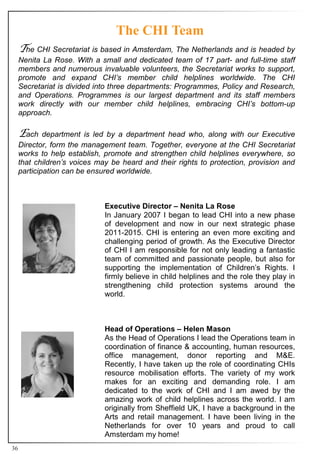
The CHI Team
     he CHI Secretariat is based in Amsterdam, The Netherlands and is headed by
     Nenita La Rose. With a small and dedicated team of 17 part- and full-time staff
     members and numerous invaluable volunteers, the Secretariat works to support,
     promote and expand CHI’s member child helplines worldwide. The CHI
     Secretariat is divided into three departments: Programmes, Policy and Research,
     and Operations. Programmes is our largest department and its staff members
     work directly with our member child helplines, embracing CHI’s bottom-up
     approach.

     ach    department is led by a department head who, along with our Executive
     Director, form the management team. Together, everyone at the CHI Secretariat
     works to help establish, promote and strengthen child helplines everywhere, so
     that children’s voices may be heard and their rights to protection, provision and
     participation can be ensured worldwide.


                              Executive Director – Nenita La Rose
                              In January 2007 I began to lead CHI into a new phase
                              of development and now in our next strategic phase
                              2011-2015. CHI is entering an even more exciting and
                              challenging period of growth. As the Executive Director
                              of CHI I am responsible for not only leading a fantastic
                              team of committed and passionate people, but also for
                              supporting the implementation of Children’s Rights. I
                              firmly believe in child helplines and the role they play in
                              strengthening child protection systems around the
                              world.


                              Head of Operations – Helen Mason
                              As the Head of Operations I lead the Operations team in
                              coordination of finance & accounting, human resources,
                              office management, donor reporting and M&E.
                              Recently, I have taken up the role of coordinating CHIs
                              resource mobilisation efforts. The variety of my work
                              makes for an exciting and demanding role. I am
                              dedicated to the work of CHI and I am awed by the
                              amazing work of child helplines across the world. I am
                              originally from Sheffield UK, I have a background in the
                              Arts and retail management. I have been living in the
                              Netherlands for over 10 years and proud to call
                              Amsterdam my home!
36
Head of Programmes – Leen Decadt
As Head of Programmes, I am responsible for
coordinating CHI’s programmes department which
consists of five regions (Africa (francophone and
anglo/lusaphone Africa), Americas and Caribbean, Asia
Pacific, Europe and MENA). I am involved in managing,
evaluating and reporting on CHI’s Programmes to
various key stakeholders, developing and sustaining
external relationships and advocating at all levels. I
returned to Europe 6 years ago, after having lived for 14
years in different parts of Africa, working for U.N. and
NGOs in child protection and community development.


Head of Policy and Research – Ravi Prasad
I am the head of the Policy and Research team and
work with my colleagues to raise policy and child rights
issues that need to be addressed by policy makers and
civil society itself. I spent over two decades working as
a journalist, much of it in conflict zones around the
world. Influenced by what I saw, experienced, reported
and narrated about the human suffering, I switched over
to working for international organisations and was
involved with policy, advocacy, campaigns and
communications.


Programme        Manager       for    Anglophone      and
Lusophone Africa – Alice Mapenzi Kubo
I am originally from Kenya and have lived in the
Netherlands since 2000. My work as Programme
Manager for Africa involves cooperation with member
child helplines, establishing and strengthening helplines,
establishing and maintaining relationships with like-
minded organisations, regional advocacy on behalf of
partner organisations and the African children.


Programme Manager for Francophone Africa –
Vincent Arah
As Programme Manager for Francophone Africa my
main tasks are assisting francophone African countries


                                                             37
The CHI Team
     in establishing new Child Helplines or scaling up of
     existing ones, lobbying for toll free numbers, creating
     partnerships and facilitating networking and learning
     among Francophone African countries.


     Programme Manager for the Americas and
     Caribbean – Magdalena Aguilar
     As the Programme Manager for the Americas and
     Caribbean at CHI, I work to facilitate the exchange of
     knowledge among member child helplines. I’m also
     expanding our network by helping set up child helplines
     in those countries where there are none, and by
     searching for child helplines that might be interested in
     joining our network. Further, I work as a liaison between
     the members and the Secretariat, exposing the
     members’ needs and challenges, which are translated
     into the development of manuals and theme based
     trainings.


     Programme Manager for Asia Pacific – Vivian
     Velema-Andyka & Laurence Caron
     As the Programme Manager for Asia & Pacific, we are
     responsible in assisting in the establishment, the scale-
     up, and the networking of helplines throughout the
     region. It is our goal to create a positive relationship
     amongst these helplines, which will allow for a free
     exchange of knowledge and learning experiences.


     Programme Manager for Europe – Thomas Mőller
     As the Programme Manager for Europe, I closely work
     together with CHI’s European membership. I have a
     strong focus on membership development within this
     very diverse region that includes organisations from
     Iceland all the way to the far eastern parts of Russia. In
     2011, I have joined the CHI Management Team and
     since coordinate the Secretariat’s efforts in engaging
     with the telecoms and ICT sector. Living in The
     Netherlands since 2007, I am a happy and proud father
     of two boys, which I am currently trying to turn into
     football enthusiasts.

38
The CHI Team
Programme Manager for Middle East & North Africa
– Nafila Maani
As the Programme Manager for the Middle East and
North Africa, I am responsible for networking with the
existing child helplines in the region and facilitating new
child helplines in countries where there are none. A
major part of my work involves supporting child
helplines at all stages of development and keeping an
overview of all country level activities. Additionally I
support CHI’s members in the region through
advocating with regional bodies.


Policy and Partnerships Coordinator – Johan
Martens
In January 2008 I joined the Child Helpline International
Secretariat. In September 2011, the Advocacy
department refocused its efforts as the Policy and
Research department. In my role as Policy and
Partnerships Coordinator I am responsible for policy
influencing with United Nations agencies and
international child protection organisations. Towards this
end, I work with my colleagues to collect information
from the child helplines around the world on the
contacts they receive from children in need and use this
information     to    implement       research,   develop
partnerships, write policy documents and advocate on
the regional and international level.


Policy and Research Coordinator- Marieke Noz
As Policy and Research Coordinator I work on the
coordination of awareness raising efforts, for CHI as a
network and on relevant topics. One of CHI’s most
insightful publications, Connecting to Children, is
produced annually with help of all (member) child
helplines. This data outlines the reasons why children
call, their profiles and information on the helplines
themselves. With the continual support of our members,
coordinating the collection of this data and compiling
Connecting to Children is my main task at CHI. I have a
university degree in Human Geography and
Communications (M.A and M.MSc).

                                                              39
The CHI Team

     Communications Manager – Ammanjah de Vries
     As Communications Manager I have the privilege of
     being involved in many facets of the Secretariat’s work,
     from the production of communication products and
     tools for our extensive network of members, to external
     communication with key stakeholders and policy and
     decision makers. I am also responsible for guiding
     internal branding and marketing processes. Together
     with the rest of the CHI team I hope to do my part to
     ensure children everywhere are afforded their full rights,
     and that their voices can be heard and counted.


     Financial Officer – Jonathan Mateyo
     As CHI’s Finance Officer I am responsible for
     processing all financial transactions. In my position, I
     am also responsible for the quarterly financial reports
     and donor financial reports. The preparation of our
     financial annual report and facilitating the required
     annual audit process are also part of my tasks.


     Services Coordinator – Jane Hannon
     As the Services Coordinator at CHI I work closely with
     the Deputy Head of Programmes to ensure that all CHI
     hosted training events run efficiently and effectively,
     with the overall goal of strengthening child helplines
     across the world.


40
The CHI Team

Evaluating & Monitoring Officer – Ann Murray
Klaasman-Brown
I am Jamaican and I am the Monitoring and Evaluation
Officer at CHI. In terms of monitoring, I track the
implementation of programmes in our member
countries. On the evaluation side, I assess our
                             delivering service to
effectiveness and impact in delive
children world-wide.


Maternity cover - Evaluating & Monitoring Officer –
Manon Becher
I have recently joined the CHI team as the new
Monitoring and Evaluation Officer, temporarily replacing
Ann-Murray Brown during her maternity leave. With
     Murray                                        Within
this exciting role I work across the teams, supporting
them in measuring the quantitative and qualitative
progress made within their programmes and projects. I
am responsible for the development and maintenance
of reporting and evaluation processes for project
performance management, and ensuring programmes
meet or exceed donor expectations and CHI’s str strategic
goals.


Office Manager – Indra Biseswar
As the office manager my role involve multitasking and
                                  involves
flexibility. I am responsible for the day day-to-day office
operations and logistics and help coordinate and
connect between all of CHI’s different operational
                                    s
facets. Additionally, I support the team as a whole in the
myriad of activities they undertake, including contacts
with members and partners throughout the network, and
also coordinate the CRM.


                                                              41
Agenda information


     •	 General Information
     •	 Full Programme
     •	 Keynote Speakers
     •	 Parallel Sessions
     •	 Marketplace
     •	 Regional Spaces
     •	 Open Space
     •	 Site Visits


     (For information about the General Assembly, see pages 69-78)


42
General Information - Agenda
Below you will find some general information regarding the agenda for the International
Consultation 2012. The detailed programme, further information on conference rooms,
keynote speakers, parallel sessions and regional spaces can be found further on in this
chapter.


Locations of sessions and meetings                   Translations during IC sessions
All plenary sessions, regional spaces                Please note that the official language
and workshops will take place at the                 of the IC is English. We are doing our
Gateway hotel. Meeting rooms are lo-                 utmost to have simultaneous transla-
cated on the   ground floor. The exact               tions for Spanish, French and Arabic at
rooms for the different sessions are list-           the plenary sessions and appropriate
ed in the full programme on pages 44-                translation available during the Regional
53. Any room changes will be announced and           Spaces and workshops. Some technical
posted at the IC.                                    limitations will be unavoidable,however.
                                                     More information will be available upon
                                                     registration.
Agenda Overview and Detailed Programme
An easy block overview of the IC agen-
da can be found on the back cover of                 Your posters and materials at the IC
this booklet and will be handed out to               In true IC-spirit, and with an eye to shar-
you upon registration. The full IC pro-              ing and networking, we are please to re-
gramme can be found on page 44-53 of                 mind you that there will be a designated
this booklet.                                        exhibit area where you can share your
                                                     posters and other materials with your
                                                     fellow participants. The exhibit area will
Parallel Sessions – how to register for              be open to visitors at all times during the
In order to facilitate translations during           IC, and you are invited to hand in your
the parallel sessions, you will be asked             material upon registration. CHI staff will
upon registration at the hotel to indicate           ensure that your material is included in
which sessions you will be attending.                the exhibit area, alphabetically by coun-
Please have a look on pages 60-62 of                 try. Please do bear in mind that space is
this booklet and choose the sessions                 somewhat limited and plan accordingly.
you wish to attend. Registration from the            If you have any questions, please do not
parallel sessions will be on a first come            hesitate to contact us at IC2012@child-
first serve basis.                                   helplineinternational.org or speak to a
                                                     member of the CHI staff at the event.
More information on the parallel sessions, includ-
ing abstracts and information on speakers, can       Also, for those members whose annual reports
be found on page 60-62.                              are not available on-line, please bring a hard
                                                     copy to give to your CHI programme manager.


                                                                                                  43
Full IC Programme


     The information presented here is subject to change. Please be
     sure to check the latest agenda information, including times and
     room numbers, throughout the International Consultation.


     Please see pages 60-68 for more detailed information about the
     Parallel Sessions, the Marketplace Session, the Regional Spaces,
     Open Space and site visits.


     Please note that you will be asked to pre-register for the Parallel
     Sessions when you sign-in at the IC Information Desk in the lobby
     of the Gateway hotel. See pages 60-62 for more details.


     You will be given more information on departure times and bus ar-
     rangements for travel to and from the Civic Reception and Dinner,
     and the site visits, during sign-in at the IC Information Desk in the
     lobby of the Gateway hotel.


     Please find more detailed information about the General Assembly
     on pages 69-78.


44
Tuesday 16 October 2012


Arrival and Registration

15.00 – 19.00     Arrival and Registration                          IC info desk, hotel lobby
IC participants are invited to register at the IC info desk, to sign up for the parallel
sessions and to drop of any materials for the poster exhibit. Your ID badge and
conference bag will be handed out upon registration.

* There will also be someone at the registration desk at all times, for late arrivals and
questions regarding logistical and travel matters.


19.00 onwards Arrival dinner                                               hotel restaurant
Delegates are invited to join an informal dinner which will be served in the hotel
restaurant. We hope that this buffet dinner will allow all delegates to rekindle friendships
and get into the IC mood.


 * Note: The information presented in this programme is subject to change. Please be sure to check the
 latest agenda information, including times and room numbers, during the International Consultation itself.


                                                                                                              45
Wednesday 17 October 2012 – Morning Sessions


8.15 – 9.00             Press Conference (closed session)                                   follow room signs


                                                                 th
9.00 – 10.30       Official Opening & Launch of 10 Anniversary CHI              Umboni room
All IC participants are invited to join the official opening session of the Sixth CHI
                                                                                th
International Consultation, which also marks the official launch of CHI’s 10 anniversary
(2013).

Speakers:
• Nenita La Rose, Executive Director Child Helpline International
• Words of welcome His Worship the Mayor of Durban, Cllr James Nxumalo
• Words of welcome Premier of Kwa Zulu Natal, Zweli Mkhize (tbc)
• Minister Lulama Xingwana, Ministry of Women, Children and People with
   Disabilities, South Africa (tbc)
• Minister Bathabile Olive Dlamini, Ministry of Social Development (tbc)
• Youth participant speaker
• Rev. CD Jaftha, Deputy Chair of Childline South Africa


10.30 – 11.00           Press Interviews (closed session)                                 follow room signs


10.30 – 11.00     Group Photo - followed by Tea/coffee break           hotel restaurant
This moment will also be used to take a group photo of all delegates present. Please
await instructions from members of staff.


     * Note: The information presented in this programme is subject to change. Please be sure to check the
     latest agenda information, including times and room numbers, during the International Consultation itself.


46
11.00 – 13.00     Thematic Plenary Session                          Umboni room

“10 Years of Strengthening Child Protection Systems”

Keynote speakers:
• Jeroo Billimoria, Chair Supervisory Board CHI
• Agnès Kaboré Ouattara, Chairperson African Committee of Experts on the Rights
   and Welfare of the Child (ACERWC)
• Anzaira Bondoc Roxas, Youth Peer Education Network (Y-PEER)
• Jolanda van Schaik, Head Corporate Social Responsibility KPMG Netherlands
• Video message from International Telecommunications Union (ITU) Secretary
   General Dr. Hamadoun I. Touré

Followed by a panel discussion with:
• Susan Bissell (Chief of Child Protection, Programme Division, UNICEF)
• Agnes Akosua Aidoo (Vice-Chairperson and Rapporteur for the UN CRC)
• Dumisile Nala (Executive Director Childline South Africa).


13.00 – 14.00     Lunch at hotel restaurant                       hotel restaurant
Lunch will be served at the hotel restaurant for all delegates.


                                                                                  47
Wednesday 17 October 2012 – Afternoon Sessions


14.00 – 15.30        Parallel sessions
“10 Years of Strengthening Child Protection Systems”
IC participants are invited to a series of exciting sessions during which child helpline
representatives and partners will share their knowledge and experiences on various
aspects of strengthening child protection systems and the role of child helplines therein.

• Parallel Session 1:      Strengthening weak child protection systems check room signs
 In this session participants will review current efforts and experiences to build stronger
 child protection systems in countries where those systems are relatively weak.
 Chair: Susan Bissell, Chief of Child Protection, Programme Division, UNICEF
 Presenters:	Zia	Ahmed	Awan,	President	Madadgaar	Helpline	(Pakistan); Tobias
 Chinake, Deputy Director of the Ministry of Labour and Social Services and Justine
 Passaportis, Director Childline Zimbabwe (Zimbabwe); Sara Oviedo Fierro, former
 Director of the Consejo Nacional de la Niñez y Adolescencia and Candidatefor
 Ecuador to the UN Committee on the Rights of the Child (Ecuador).

• Parallel Session 2: Strengthening well-developed child protection check room signs
                           systems
 In this session participants will review current efforts and experiences to build stronger
 child protection systems in countries where those systems are already well developed.
 Chair: Sheila Donovan, Head of International Relations ANAR Spain (Spain)
 Presenters:	Peter	Liver,	NSPCC	(UK);	Glenda	Schnell,	Youthline (New Zealand);
 Alisa Simon Kids Help Phone (Canada).

• Parallel Session 3: Improving referral mechanisms and case                          check room signs
                           management
 In this session participants will review the role of child helplines as access point to
 child protection systems with a special focus on improving referral mechanisms and
 case management.


* Note: The information presented in this programme is subject to change. Please be sure to check the
latest agenda information, including times and room numbers, during the International Consultation itself.


48
Chair: Joan van Niekerk, Manager Training and Advocacy, Childline South Africa
  (South Africa)
  Presenters:	Catalina	Florea,	Executive	Director	Asociatia	Telefonul Copilului
  (Romania); Ganga Iddamalgoda, Project Manager National Child Protection Authority
  (Sri Lanka); Mary Moonan, Programme Coordinator ChildLine (Trinidad and Tobago).

• Parallel Session 4: Networking with partners to strengthen child       check room signs
                            protection systems
  In this session participants will explore opportunities to network with partners at
  regional and international level to strengthen child protection systems.
  Chair: Agnes Akosua Aidoo, Vice-Chairperson and Rapporteur for the UN CRC
  Presenters:	Eamonn	Hanson,	Global	Advocacy	Coordinator,	War	Child Holland
  (Holland); Divya Naidu, Save the Children South Africa regional office (South Africa);
  Agnès Kaboré Ouattara, Chairperson African Committee of Experts on the Rights and
  Welfare of the Child (ACERWC).

15.30 – 16.00         Report back in plenary “Strengthening Child            Umboni room
                      Protection Systems”

16.15 – 17.45      CHI Marketplace (including refreshments)                 hotel restaurant
The marketplace session offers an interactive opportunity learn more about recent
achievements and progress on a variety of CHI topics. There will be eight thematic
‘market	stalls’	which	will	be	visited	in	pre-arranged groups in a rotating fashion, allowing
everyone equal time and full comprehension of each stall.	The	stalls	are:	
1. PSP (Principles, Standards and Practices) taskforce;
2. RAP (Research Advocacy Policy) Council;
3. New Technologies Advisory Council;
4. CHI Secretariat;
5. CHI Supervisory Board;
6.Child Impact Assessment taskforce;
7. CHI’s new website;
8. Open space for innovative ideas to benefit the network.

19.30              Civic Reception and Dinner, Durban City Hall
More information about the exact departure time from the hotel and busses to City Hall
will be available upon registration.


                                                                                          49
Thursday 18 October 2012

 8.30-9.15       Plenary for all participants – General Assembly          Umboni room
 Regional update and highlights from CHI’s five Regional Representatives.


 9.30 – 11.00      Regional space for child helplines and partners (5 regions) –
                   including Tea/Coffee break
 Full and associate CHI members and partners are invited to the Regional Spaces to
 hear about and discuss developments in their regions since the last IC in Madrid, Spain
                                                                    th
 two years ago, to discuss various current CHI matters and CHI’s 10 anniversary, and
 to nominate their regional representatives and taskforce members. (more information
 on page 66).

 The Regional Spaces will take place in the following rooms:
 Africa                                                  check room signs
 Americas and Caribbean                                  check room signs
 Asia Pacific                                            check room signs
 Europe                                                  check room signs
 MENA                                                    check room signs


 9.30 – 11.00            Parallel session for stakeholders & CHI Board - “Envisioning CHI’s
                         future” (closed session).


 11.30 – 13.00      General Assembly CHI                                       Umboni room
 All participants are invited to join the General Assembly of child helplines. Only full CHI
 members are requested to contribute to items concerning CHI governance. Chaired by
 Jeroo Billimoria, Chair of the CHI Supervisory Board. (more information- pages 69-78).


     * Note: The information presented in this programme is subject to change. Please be sure to check the
     latest agenda information, including times and room numbers, during the International Consultation itself.


50
13.30 – 17.00    Site visits to Childline South Africa and referral partners
                 (including packed lunches)
Childline South Africa has organised exciting site visits to the child helpline and referral
partners in Durban. (more information on page 68).

This trip will also provide opportunities to see more of the city of Durban. Travel to and
from the site visits will be arranged upon registration.


18.00 – 18.45     Side meeting for outgoing and incoming regional representatives,
                  deputies and PSP taskforce representatives (closed session).


19.00             Networking Dinner – Sponsored by Techno Brain hotel restaurant
This networking dinner is generously hosted by Techno Brain and will take place in the
hotel restaurant. More information about Techno Brain can be found in the appendixes.


                                                                                               51
Friday 19 October 2012

 8.00 – 9.00     Optional Demo – Case Management System                check room signs
 Optional demo session open to all participants who are interested in an effective Case
 Management System (Techno Brain, Childline Kenya and Childline Zambia).


 9.15 – 12.30       Open Space –including Tea/Coffee break             check room signs
 Participants set the stage by creating the agenda themselves with topics related to child
 helplines not covered in other IC sessions. This space provides for opportunities to
 network and share good practices with members and partners.


 13.00 – 14.00           Lunch                                                               hotel restaurant


 14.00 – 15.30           Parallel Sessions - including Tea/Coffee break

 • Parallel Session 1:          The role of child helplines in preventing child            check room signs
                                sexual abuse

     There has been an increase in the prevalence of child sexual abuse over the last
     couple of decades, often in settings considered to be safe for children such as
     schools, institutions, neighbourhoods and even in their homes. This session explores
     the roles child helplines play in the prevention of the sexual abuse of children.
     Chairs: Jenny Coleman, Stop It Now! (USA) and Sumnima Tuladhar, CWIN (Nepal)
     Presenters:	Juliana	Cunha,	Coordinator	Safernet	(Brazil);	Lucyna Kicinska,
     Coordinator 116111 Helpline for Children and Youth (Poland); Irene Nyamu, Director
     Childline Kenya (Kenya).


 • Parallel Session 2:          Brand management                                           check room signs
     Child helplines aim to position themselves publicly to reach out to more children and
     sensitise the public about their services. This session will provide different examples


     * Note: The information presented in this programme is subject to change. Please be sure to check the
     latest agenda information, including times and room numbers, during the International Consultation itself.


52
and best practices of how CHI members are implementing their marketing activities
 and the impact of such activities on the operations of the child helpline.
 Chair: Jolanda van Schaik, Head of Corporate Social Responsibility, KPMG (the
 Netherlands)
 Presenters:	Martin	Houghton	Brown,	Director	Missing	People	UK (UK); Tahani al
 Majhad- Manager- Child Helpline Saudi Arabia (Saudi Arabia).


• Parallel Session 3:   Reaching out to marginalized children and       check room signs
                        young people

 Research supports the claim that marginalised children are more vulnerable to abuse
 and are more likely to see their rights violated in breach of the spirit of the UN CRC.
 Direct links have also been drawn between marginalisation and prevalence of abuse
 and trafficking. This session explores ways in which child helplines can improve their
 strategies and services for the most marginalized children.
 Chair: Barbara Prado, President Fundación ANAR (Perú)
 Presenters:	Wong	Poai	Hong,	Board	Member	Childline	Malaysia	(Malaysia); Nevin
 Öktem, Project Advisor Association for Solidarity with Freedom-Deprived Juvenile
 (Turkey); Anzaira Bondoc Roxas, Youth Peer Education Network (Philippines).

15.45 – 16.15     Reporting back in plenary                                  Umboni room


16.15 – 16.45     Evaluation                                                 Umboni room


16.45 – 17.30     Official Closing ceremony                                 Umboni room
All delegates are invited to attend the closing ceremony of the Sixth CHI International
Consultation	of	child	helplines	which	will	include:
•	   Presentation	of	CHI	“Durban	Resolutions”	
•    Presentation by Youth Consultation participants on the results of their parallel
     conference and recommendations to child helplines.


Farewells and Departure of Delegates

                                                                                           53
Keynote Speakers
               Keynote Speakers for the Opening Ceremony:
 Nenita La Rose, Executive Director Child Helpline International
 Nenita La Rose has been the Executive Director of Child Helpline International since
 January 2007. She has over 20 years experience successively as a legal advisor at
 an NGO in the Netherlands for refugees and asylum seekers and as an Amsterdam
 government official serving as personal advisor to the mayor of Amsterdam. She has
 broad experience in managing projects in an international context as Director of the In-
 ternational Desk of the City of Amsterdam and acting as Ambassador for the city in the
 European Network for European Union Capitals. From 2001-2007, Nenita La Rose was
 Director of General Affairs and Public Services at the Amsterdam city district Southeast.
 Nenita La Rose was, among other positions, also a Board member of the National Bu-
 reau against Racism and of the Centre for Voluntary Work in Amsterdam, chair of the
 Music Centre in the Amsterdam district Southeast and Secretary of the Dutch Theatre
 Foundation Frascati.

 His Worship the Mayor of Durban, Cllr James Nxumalo
 EThekwini Mayor, Cllr James Nxumalo was born on a farm in New Hanover where
 both his parents worked as farm labourers. He started his education at Ingqaza Lower
 Primary School, walking some 10kms to get to school each day. Whilst at high school
 he got involved in politics and worked in the structures of the United Democratic Front
 (UDF) in the 1980s. In 1990, he joined the ANC Youth League, the ANC and the South
 African Communist Party. During that year he was employed as a labourer at a chicken
 factory & because the working conditions there were deplorable, he organised work-
 ers to join trade unions as well as the ANC and SACP. He is presently the provincial
 Chairman of the SACP in KwaZulu-Natal. He holds several educational certificates,
 including Local Government Development and Management, Project Management,
 Conflict Resolution, Advanced Certificate in Public and Development Management as
 well as Executive Leadership Development. Mayor Nxumalo has vast experience in
 local government. He was elected Councillor and member of the Executive Committee
 of the then Outer West Local Council in 1996, reelected Councillor for the eThekwini
 Municipality in 2000 and became Speaker of the Municipality in 2005. Cllr Nxumalo
 was elected Mayor of eThekwini on 06 June 2011. He was recently elected Deputy
 Chairperson of SALGA KZN. He is SALGA’s Climate Change Champion and sits on the
 Inter-Ministerial Committee organising the COP 17 conference.

 Premier Zweli Mkhize, Premier of Kwa Zulu Natal (to be confirmed)
 Premier Zweli Mkhize has been the Premier of KwaZulu-Natal Provincial since 6 May
 2009. He is also a Leader of Government Business in KwaZulu-Natal; Chairperson of
 the African National Congress (ANC) in KwaZulu-Natal; Member of the ANC’s National
 Executive Committee (NEC); Chairperson of the ANC’s National Education and Health
 sub-committee; and was Chairperson: 2010 World Cup Political Oversight Committee.

54
Keynote Speakers


Dr. Mkhize was the longest serving Provincial Health Member of the Executive Com-
mittee (MEC) in the country. He served as MEC for Health in KwaZulu-Natal (1994 -
2004) and MEC for Finance and Economic Development (2005 - 2009). After doing his
internship at Mc Cords Hospital in Durban in 1983 and working at Edendale Hospital
in Pietermaritsburg in 1984, he went into exile in 1986 and continued with his medical
practice in Swaziland and Zimbabwe. He returned to South Africa in 1991 and worked
at Themba Hospital and started his private practice in Pietermaritsburg. He served as
a member of the ANC’s National Health Secretariat (1991 and 1994). He co-founded
the Regional Health Forum and became a member of the National Health Forum. Dr.
Mkhize played a practical role in the process leading towards the establishment of a
democratic government in this country. He also played an active role in the promotion
of peace and stability in the KwaZulu-Natal.

Minister Lulama Xingwana, Ministry of Women, Children and People with Disabilities, South Africa
(to be confirmed)
Minister Lulu Xingwana has vast experience working in civil society structures, parlia-
ment and government. From 1981, she was a member of the Federation of South Afri-
can Women. She worked for a literacy organization, Learn and Teach, and later joined
South African Council of Churches (SACC) as Director of Women Development Pro-
gramme. From 1991-1994, she headed the Development Section of the ANC Women’s
League and was also the Chairperson of Malibongwe Rural Development Project for
women (1998-2000) She was a Member of the first democratic Parliament and served
as the Chairperson of the Parliamentary Women Caucus from 1999-2004. She also
chaired the Joint Monitoring Committee on Improvement of Quality of Life and Status
of Women. From 2004-2006 she was Deputy Minister of Minerals and Energy where
she encouraged women participation in these sectors through Women in Energy in
South Africa (Woesa) and Women in Mining (SAWIMA). From 2006-2009 she was the
Minister of Agriculture and Land Affairs and spearheaded the establishment of Women
in Agriculture and Rural Development (WARD). From 2009-2010 she was Minister of
Arts and Culture where she highlighted the role of women in various forms of art and
encouraged development and empowerment of women in this sector. In November
2010 she was appointed the Minister for Women, Children and People with Disabilities.

Minister Bathabile Olive Dlamini, Ministry of Social Development (to be confirmed)
Minister Bathabile Olive Dlamini has been Minister of Social Development of the Re-
public of South Africa since 01 November 2010 and is also a Member of the National
Executive Committee of the African National Congress (ANC). She became an active
member of the Idlangamabala Youth at Imbali’s St Marks Anglican Church as well as
South African Student Congress. She also worked with various structures after the re-
lease of Nelson Mandela including the Congress of South Africa Trade Unions, Youth
                                                                                               55
Keynote Speakers


 and various underground structures of the ANC. She became part of the interim lead-
 ership that was formed to build the ANC Women’s League structures in the Kwa-Zulu
 Natal regions (1991). She was elected to the first Regional Executive Committee of the
 ANCWL and worked for the Pietermaritzburg Cripples Care Association non-govern-
 mental organisation (NGO), that worked with the physically disabled in Pietermaritz-
 burg and brought about the change of name of the NGO (1991 - 1993). She also served
 as a member of the Imbali Rehabilitation Programme (1991 - 1993) and was deputy
 Secretary General of the ANCWL (1993). She served as a Member of Parliament and
 in Correctional Services and Social Development Portfolio Committees (1994 - 2004).
 She has been serving the ANC on a full time basis from 2005. She was one of the long-
 est serving Secretary-Generals of the ANCWL, serving from 1998-2008. She was also
 NEC of the ANC as well as the National Working Committee (2007) and was involved in
 the formation of the progressive Women’s Movement of South Africa (2007). She was
 the Deputy Minister of Social Development of the Republic of South Africa from 2009
 to October of 2010.


 Rev. Cupido David (Kiepie) Jaftha, Deputy Chair of Childline South Africa
 Rev. Cupido David (Kiepie) Jaftha trained as a pastor in the Reformed Churches of
 South Africa and still serves as pastor in the Heidedal congregation in Bloemfontein,
 capital city of the Free State Province. After leaving full time ministry, Kiepie acted as
 Free State Regional Manager in the National Department of Public Works and the Small
 Business Development Corporation, which later became Business Partners, as the
 Marketing Manager for the Free State and Northern Cape and later for Gauteng, North
 West and Limpopo Provinces. In 1999 Kiepie was appointed the Chief Director: Re-
 source Management at the University of the Free State (UFS). In 2001 he spearheaded
 the establishment of the Chief Directorate Community Service at the same university.
 He was also involved in the founding of NatCemf which later became SAHECEF (South
 African Higher Education Community Engagement Forum). In November 2011 he was
 awarded the SAHECEF 2011 Excellence Award In Community Engagement. Amongst
 others Kiepie serves as Vice-Chairperson, and currently as acting Chairperson on the
 National Board of Childline South Africa (CLSA), Chairperson of the Africa Board of Di-
 rectors of the International Institute for Development and Ethics (IIDE - A), Chairperson
 of the Board of Trustees of the Towers of Hope Leadership Foundation, Chairperson of
 the Board of Governors of Child Welfare Bloemfontein and Childline Free State, Direc-
 tor and Vice-Chairperson of the OFM, a regional radio station and publicity company
 in the Free State Province. Currently he is an Affiliated Researcher at the Centre for
 Development Support of the UFS.


56
Keynote Speakers
           Keynote Speakers for the Thematic Plenary Session:
Jeroo Billimoria, Chair Supervisory Board CHI
Jeroo Billimoria is the Founder and Managing Director of Child and Youth Finance
International. Jeroo is considered among the world’s leading social entrepreneurs and
is now working on her ninth entrepreneurial venture. She is a Skoll awardee, and an
Ashoka and Schwab Fellow. Among her organizations are Childline India and Child
Helpline International which have facilitated a global movement for protection of chil-
dren and youth and is active in more than 181 countries – having responded to over
160 million calls. Her previous organization, Aflatoun, has been recognized among the
world’s top 50 NGOs. In a space of three short years, Aflatoun succeeded in working
with global partners to provide social and financial education to over 1 million children
in 84 countries. Jeroo is now heading CYFI for building a ChildFinance movement
to ensure financial inclusion and ChildFinance Education for 100 million children and
youth in 100 countries by 2015.

Agnès Kaboré Ouattara, Chairperson African Committee of Experts on the Rights and Welfare of
the Child (ACERWC)
Mme Agnès Kaboré is the current Chairperson of the African Committee of Experts on
the Rights and Welfare of the Child (ACERWC). Mme Kaboré is a socio-economist who
has held a number of senior positions relating to children’s issues within the Burkina
Faso civil service. She is presently the Director General for Child and Youth Protection
in the Ministry for Social Action and National Solidarity. Furthermore, she has exten-
sive civil society experience, having been, for example, Deputy Secretary General of
the Burkina Faso Association for Family Wellbeing and a member of the Board of the
Red Cross in Burkina Faso since 2005. She has also worked with GTZ as an advisor
on cross-cutting themes such as mainstreaming HIV/AIDS and combating child labour
in the agricultural sector. She has worked as an international consultant on situation
analysis and developing strategies and policies for the protection of children.

Anzaira Bondoc Roxas, Youth Peer Education Network (Y-PEER)
Anzaira Bondoc Roxas, 26 years old, is a Registered Nurse-Midwife in the Philippines
and represents Youth Peer Education Network (Y-PEER). Y-PEER is a ground break-
ing and comprehensive youth-to-youth initiative pioneered by UNFPA. Y-PEER is a
network of more than 500 non-profit organizations and governmental institutions; its
membership includes thousands of young people who work in the many areas sur-
rounding adolescent sexual and reproductive health and rights. Anzaira Bondoc Roxas
joined Y-PEER in 2009 as a representative of Family Planning Organization of the Phil-
ippines (FPOP), a member association of International Planned Parenthood Federa-
tion (IPPF). She was involved in FPOP as one of the Adolescent Reproductive Health
advocate since 2002. She became the Focal Point In-Charge of Y-PEER Philippines
in 2010 and provides capacity building on SRHR and HIV and AIDS to young people.
                                                                                           57
Keynote Speakers

 She was also a Project Staff of Youth Friendly Services for Young People’ Sexuality in
 the Philippines (YES4YES). She spent two months in Northern Mindanao region where
 30,000 people had been displaced. As the Y-PEER Network’s focal point in the Philip-
 pines, she worked relentlessly to mobilize youth who assisted in medical missions and
 helped distribute dignity kits for the humanitarian response. As a member of Y-PEER
 her passion is to strengthen the Peer Education approach as a vehicle to raise aware-
 ness and to empower by reaching behaviour change among those 10-24 years of age.

 Jolanda van Schaik, Head Corporate Social Responsibility KPMG Netherlands
 A Dutch national, Jolanda van Schaik is the Head of KPMG Corporate Social Respon-
 sibility and Chair of the KPMG Make it Happen Fund Foundation. She previously held
 various managerial positions in the Dutch health care system and was the Marketing
 Manager Public Sector Netherlands & EMA - Programme Manager Board of Manage-
 ment at KPMG Netherlands. She also serves on the Supervisory Client Board of the
 Amstelveen Hospital.

 Video message ITU Secretary General Dr. Hamadoun Touré
 Dr Hamadoun I. Touré, Secretary-General of the International Telecommunication Un-
 ion (ITU) since January 2007, was re-elected for a second four-year term in October
 2010. As Secretary-General, Dr Touré is committed to ITU’s mission of connecting the
 world, and to helping achieve the Millennium Development Goals through harnessing
 the unique potential of Information and Communication Technologies (ICTs). A long-
 standing champion of ICTs as a driver of social and economic development, Dr Touré
 previously served as Director of ITU’s Telecommunication Development Bureau (BDT)
 from 1998-2006. Dr Touré started his professional career in his native Mali in 1979.
 He built a solid career in the satellite industry, serving as managing engineer in Mali’s
 first International Earth Station. He joined Intelsat’s Assistance and Development Pro-
 gramme in 1985. He was appointed Intelsat’s Group Director for Africa and the Middle
 East in 1994, earning a reputation as an energetic leader through his commitment to
 various regional connectivity projects such as RASCOM. In 1996 he joined ICO Global
 Communications as African Regional General Manager, spearheading the companies’
 activities across the African region. A national of Mali, Dr Touré holds a Masters Degree
 in Electrical Engineering from the Technical Institute of Electronics and Telecommunica-
 tions of Leningrad, and a PhD from the University of Electronics, Telecommunications
 and Informatics of Moscow. He is married with four children and two grandchildren, and
 is proficient in four official ITU languages: English, French, Russian and Spanish.

 Susan Bissell (Head of Child Protection Unit UNICEF)
 In 2009, Susan Lynn Bissell was appointed to her current position in New York, heading
 all of UNICEF’s Child Protection work. She oversees a team of professionals guiding
 efforts for children affected by armed conflict, child protection systems strengthening

58
Keynote Speakers

to prevent and respond to all forms of violence against children, and a range of other
matters. UNICEF is active in child protection in 170 countries, and the New York team
offers leadership, strategic vision, and technical support. Susan Bissell first served
UNICEF in 1987, in New York, in what was then called the Division of Information and
Public Affairs. She was honoured to accept on behalf of her UNICEF Child Protection
colleagues around the world.

Agnes Akosua Aidoo, Vice- Chairperson and Rapporteur for the UN Committee on the Rights of
the Child
Agnes Akosua Aidoo is a national of Ghana and has been a member of the UN Com-
mittee on the Rights of the Child since March 2007. She has served as a Vice-Chairper-
son (2007-2011) and Rapporteur of the Committee from March 2012 to date. A strong
advocate on children’s rights and women’s rights, Dr. Aidoo’s work experience covers
over 30 years and has spanned numerous countries in Africa, Middle East, North and
South America, China and South Asia. For 21 years (1978-1999) she worked as a gen-
der and social policy adviser in the UN Economic Commission for Africa (ECA) and as
a global adviser on gender at the UNICEF Headquarters and UNICEF Representative
to Tanzania. She has undertaken policy research and analysis, publications, advocacy,
strategy formulation, programme development and management as well as advisory
services to numerous governments on issues of women’s and children’s rights from
early childhood, child poverty, child protection, social policy, women’s empowerment,
vulnerability and exclusion with special focus on the girl child. Prior to UN service, Dr.
Aidoo had a career as a university lecturer and assistant professor for 10 years at the
University of Cape Coast in Ghana and University of California at Los Angeles (UCLA)
in the USA. She is a Member of the International Board of Trustees and Chair of the Ad-
ministrative Council of the African Child Policy Forum, Member of the Advisory Board
of the Institute of African Studies, University of Ghana, and Member of the Board of
Trustees of the National Partnership for Children’s Trust, Ghana.


Dumisile Nala, Executive Director Childline South Africa
Dumisile Nala graduated from the University of KwaZulu Natal in Social Work, after
which she worked for Childline KwaZulu Natal for a period of 4 years. She started as
a Social Worker and when she left the organisation, she was the Assistant Director.
She then relocated to the United Kingdom where she worked and lived for a period of
8 years. During this period, she gained extensive knowledge on child protection, child
mental health, foster care, and adoption. In 2008 she moved back to South Africa and
worked for Childline National Office as the Assistant National Director. In May 2009 she
became the Chief Executive Officer of Childline South Africa.


                                                                                         59
Parallel Sessions - Overview
 In order to facilitate translations during the parallel sessions, you will be asked upon
 registration at the hotel to indicate which two (2) sessions you will be attending – one
 (1) parallel session on Wednesday 17 October, and one (1) on Friday 19 October.
 Please have a look bellow at the sessions for each day and choose which session you
 wish to attend for each block. Please note the languages available for each session
 when making your choices. Registration for the parallel sessions will be done on a first
 come first served basis. If your session(s) of choice is full, you will be kindly requested
 to choose an alternative session(s) to attend.


     Wednesday 17 October 2012 – Parallel Sessions
     14.00 – 15.30       Parallel sessions
     “10 Years of Strengthening Child Protection Systems”
     IC participants are invited to a series of exciting sessions during which child helpline
     representatives and partners will share their knowledge and experiences on various aspects of
     strengthening child protection systems and the role of child helplines therein.


     • Parallel Session 1:    Strengthening weak child protection systems

      Languages:	English,	Spanish;	Translation to: Arabic, English, Spanish
      room: check signs

      In this session participants will review current efforts and experiences to build stronger child
      protection systems in countries where those systems are relatively weak.
      Chair: Susan Bissell, Chief of Child Protection, Programme Division, UNICEF
      Presenters:	Zia	Ahmed	Awan,	President	Madadgaar	Helpline	(Pakistan); Tobias Chinake,
      Deputy Director of the Ministry of Labour and Social Services and Justine Passaportis, Director
      Childline Zimbabwe (Zimbabwe); Sara Oviedo Fierro, former Director of the Consejo Nacional
      de la Niñez y Adolescencia and Candidate for Ecuador to the UN Committee on the Rights of
      the Child (Ecuador).


     • Parallel Session 2:    Strengthening well-developed child protection systems

      Languages:	English;	Translation to: Arabic, French
      room: check signs

      In this session participants will review current efforts and experiences to build stronger child
      protection systems in countries where those systems are already well developed.
      Chair: Sheila Donovan, Head of International Relations ANAR Spain (Spain)
      Presenters:	Peter	Liver,	NSPCC	(UK);	Glenda	Schnell,	Youthline (New Zealand); Alisa Simon
      Kids Help Phone (Canada).


60
• Parallel Session 3:    Improving referral mechanisms and case management

 Languages:	English;	Translation to: French, Spanish
 room: check signs

 In this session participants will review the role of child helplines as access point to child
 protection systems with a special focus on improving referral mechanisms and case
 management.
 Chair: Joan van Niekerk, Manager Training and Advocacy, Childline South Africa (South Africa)
 Presenters:	Catalina	Florea,	Executive	Director	Asociatia	Telefonul Copilului (Romania); Ganga
 Iddamalgoda, Project Manager National Child Protection Authority (Sri Lanka); Mary Moonan,
 Programme Coordinator ChildLine (Trinidad and Tobago).


• Parallel Session 4:    Networking with partners to strengthen child protection systems

 Languages:	English;	Translation to: French, Spanish
 room: check signs

 In this session participants will explore opportunities to network with partners at regional and
 international level to strengthen child protection systems.
 Chair: Agnes Akosua Aidoo, Vice-Chairperson and Rapporteur for the UN CRC
 Presenters:	Eamonn	Hanson,	Global	Advocacy	Coordinator,	War	Child Holland (Holland);
 Divya Naidu, Save the Children South Africa regional office (South Africa); Agnès Kaboré
 Ouattara, Chairperson African Committee of Experts on the Rights and Welfare of the Child
 (ACERWC).


                                                                                                    61
Friday 19 October 2012 – Parallel Sessions

      14.00 – 15.30      Parallel Sessions - including Tea/Coffee break

      • Parallel Session 1:    The role of child helplines in preventing child sexual abuse

       Languages:	English;	Translation to: French, Spanish
       room: check signs
      There has been an increase in the prevalence of child sexual abuse over the last
      couple of decades, often in settings considered to be safe for children such as
      schools, institutions, neighbourhoods and even in their homes. This session explores
      the roles child helplines play in the prevention of the sexual abuse of children.
      Chairs: Jenny Coleman, Stop It Now! (USA) and Sumnima Tuladhar, CWIN (Nepal)
      Presenters:	Juliana	Cunha,	Coordinator	Safernet	(Brazil);	Lucyna Kicinska,
      Coordinator 116111 Helpline for Children and Youth (Poland); Irene Nyamu, Director
      Childline Kenya (Kenya).

     • Parallel Session 2:    Brand management

      Languages:	English;	Translation to: Arabic, Spanish
      room: check signs

      Child helplines aim to position themselves publicly to reach out to more children and
      sensitise the public about their services. This session will provide different examples
      and best practices of how CHI members are implementing their marketing activities
      and the impact of such activities on the operations of the child helpline.
      Chair: Jolanda van Schaik, Head of Corporate Social Responsibility, KPMG (the
      Netherlands)
      Presenters:	Martin	Houghton	Brown,	Director	Missing	People	UK (UK); Tahani al
      Majhad, Manager, Child Helpline Saudi Arabia (Saudi Arabia).

     • Parallel Session 3:    Reaching out to marginalized children and young people

      Languages:	English;	Translation to: Arabic, French
      room: check signs

      Research supports the claim that marginalised children are more vulnerable to abuse
      and are more likely to see their rights violated in breach of the spirit of the UN CRC.
      Direct links have also been drawn between marginalisation and prevalence of abuse
      and trafficking. This session explores ways in which child helplines can improve their
      strategies and services for the most marginalized children.
      Chair: Barbara Prado, President Fundación ANAR (Peru)
      Presenters:	Wong	Poai	Hong,	Board	Member	Childline	Malaysia	(Malaysia); Nevin
      Öktem, Project Advisor Association for Solidarity with Freedom-Deprived Juvenile
      (Turkey); Anzaira Bondoc Roxas, Youth Peer Education Network (Philippines).

62
The Marketplace
The marketplace session offers an interactive opportunity to learn more about recent
achievements and progress on a variety of CHI topics. There will be eight (8) thematic
‘market stalls’ set up in the hotel restaurant area. Delegates will visit each stall in a
rotating fashion in pre-arranged groups, allowing everyone equal time and full compre-
hension of each stall.


Objective:
The  marketplace aims to:
•	 Facilitate knowledge sharing in an interactive and innovative way;
•	 Provide an opportunity to members and partners to openly and critically look at ideas,
   projects or issues that are important for the global network of child helplines;
•	 Foster constructive dialogue on any relevant discussion to be taken forward to other
   formal and informal settings during the rest of the International Consultation.


The market stalls:

1. PSP (Principles, Standards and Practices) taskforce
 At this Market Stall, the Principles, Standards and Practices (PSP) Taskforce will in-
 troduce its Taskforce Members and the Principles and Standards Assessment (PSA)
 tool to new members and partner organisations. They will provide an overview of the
 work undertaken by the PSP Taskforce during the 2010 – 2012 period, including key
 findings from the 2012 PSA Report. A discussion will be facilitated regarding the PSA
 tool, its current use by CHI and member organisations and brainstorm on ways to
 strengthen its value. This space will offer opportunities to participants to share their
 vision on the Taskforce’s future.


2. Open Space for Innovative Ideas
 This “market stall” will allow the participants to present ideas, comments, or thoughts
 about any topic they see relevant to benefit CHI’s network. It is a space for members
 and partners to bring up issues that are important for CHI but are not mentioned
 throughout the programme of the IC. The suggested ideas and topics will be com-
 piled and analysed at the Secretariat level after the IC.


                                                                                        63
The Marketplace

 3. RAP (Research, Advocacy and Policy) Advisory Council
  In 2011 Child Helpline International set up the Research, Advocacy and Policy Advi-
  sory (RAP) Council to support the mining and use of data for evidence-based advo-
  cacy. Comprising academics, researchers, child helplines and partner organisations,
  the RAP Council has eight members. The council made several recommendations
  on the use of data for advocacy, academic research and also the simplification of
  Data Questionnaire sent out annually for collecting data from members. Based on the
  recommendations of the RAP Council CHI has already modified the Data Question-
  naire. Briefing papers were published on thematic issues in 2011 and 2012 and CHI
  increased its engagement with international and regional bodies to influence policy
  based on the data. Currently CHI is moving ahead with the implementation of the
  recommendations.


 4. New Technologies Advisory Council
  At the fifth International Consultation for child helplines in October 2010 in Spain, the
  General Assembly requested the CHI secretariat to establish an Advisory Council on
  New Communication Technologies, providing strategic advice on how the network
  should best position itself in order to stay relevant for child helplines in the years
  to come. The New Technologies Advisory Council, established in 2011, consists of
  5 child helplines, representation from the International Telecommunications Union
  (ITU), Techno Brain Ltd. (one of Africa’s leading custom software application provid-
  ers) and an independent Telecoms and New Media Consultant. The group, meet-
  ing for the second time in South Africa, will introduce their three main projects: a
  stock-take of existing new technologies in the network; advocacy strategy with the
  telecommunication sector (Group of Friends of CHI; regional harmonisation; online
  protection; apps for child helplines...) and medium and long term Trend Watching,
  relevant to child helplines.


 5. CHI secretariat
  Participants will receive an update from the CHI Secretariat on key achievements and
  challenges faced in 2012; information will be shared on how the Secretariat supports
  the creation and strengthening of national free-of-costs child helplines worldwide,
  and how it is using annual child helpline data to highlight gaps in child protection
  systems and advocate with strategic partners for the rights of children. Also, CHI is
  constantly working with the telecommunications sector to ensure free-of-costs ac-
  cess to child helplines for children everywhere. Lastly, participants will be updated on
  human resources, fundraising and the 2013 budget.


64
The Marketplace

6. CHI Supervisory Board
 CHI is a bottom-up organization, founded in 2003 by a group of independent child
 helplines. As a network, CHI liaises with policy makers, the private sector and child
 development agencies on the one hand and the member helplines on the other. CHI’s
 bottom-up approach gives the opportunity to its member child helplines to nominate
 regional representatives to serve in two years term in CHI’ Supervisory Board. As
 Secretary of the Supervisory Council, Kees Peijster will clarify any pressing issue on
 statutory matters of CHI as a Dutch foundation, such as the nomination process of
 new regional representatives, deputies and task force members.


7. Launch of CHI’s new website
 In this session, CHI unveils its new, upgraded website. CHI has grown over the last
 several years, moving from consolidation to being a well-established and substantial
 network of child helplines around the world. CHI needs a website worthy of the tasks
 now at hand – a website with improved functionality for advocacy, better interactivity
 and sharing options for members and partners, integration of online social media and
 a clearer overview and reflection of the accomplishments of the network. A brief intro-
 duction to the new site will be given, with particular emphasis on the new interactive
 Members’ Area and upgraded features for sharing projects and accomplishments.
 The new website will be fully launched in early November 2012.


8. Child Impact Assessment Advisory Council
 Child Helpline International’s mission and a child helpline’s core business is to re-
 spond to children in need of care and protection, and voice their concerns to policy
 and decision-makers. However, measuring the impact we actually have on the chil-
 dren and young people we serve, is a challenging task. At the Child Impact Assess-
 ment (CIA) Market Stall we will present CHI’s newly released CIA Manual, providing
 a starting point for child helplines to develop a strategy and accompanying tools to
 assess the impact of their service. In addition we will discuss the start of the CIA
 Advisory Council, which is envisioned to form a guiding platform consisting of mem-
 ber child helplines with expertise in Monitoring & Evaluation, where child helplines
 around the world can seek support, learn from each other and share experiences and
 best practices. More information can be found in the appendixes.

Delegates will visit each stall in a rotating fashion in pre-arranged groups, allowing
everyone equal time and full comprehension of each stall. More information about your
pre-assigned group will be available when you sign-in upon your arrival.

                                                                                       65
The Regional Spaces

Time: 	 	          Thursday 18 October 2012, 9:30-11:00
Location:	 Room allocations for the Regional Spaces will be announced in ple-	
		         nary in the morning. Please also check the room signs for more info-	
		rmation.


Full and associate CHI members and partners are invited to the Regional Spaces to
hear about and discuss developments in their regions since the last IC in Madrid, Spain
two years ago. They will discuss various current CHI matters and CHI’s 10th anniver-
sary. Full members will be invited to nominate regional representatives, deputy regional
representatives and PSP taskforce representatives.


Regional updates and highlights will be presented in the general plenary by CHI’s five
Regional Representatives prior to breaking up into Regional Spaces.


General agenda items to be discussed in the Regional Spaces:
 •	 CHI’s 10th anniversary: data publications and policy dialogues; 2013 Regional Con-
    sultations (venue, possible donors,…)
 •	 Update on parallel envisioning exercise with stakeholders: “CHI 2015+”
 •	 Reformulation of Objective 2 of the 2011-2015 Strategy
 •	 Membership fee from 100 to 125 euro
 •	 Child Impact Assessment advisory council (interested helplines can volunteer to join
    – more information in the appendixes)
 •	 Nomination of regional representatives, deputy regional representatives and PSP
    taskforce representatives
    (full members only are requested to give their input into the nomination process. Associate members
    and partners are welcome to observe)
 •	 Discussion of region-specific issues


66
The Open Space Session

Time: 	 	        Friday 19 October 2012, 9:00-12:30
Topic: 	 	       Any topic related to the IC theme “Strengthening Child Protection Sy-	
	        	       stems”, not already covered in the agenda.  


The “Open Space” represents a self-organising process where participants construct
the agenda during the meeting itself. Open Space sessions serve two main purposes:

1.	 To give an opportunity to incorporate issues that are not already covered by the IC
    agenda.
2.	 Ideal for international meetings to help participants become familiar with one an-
    other.

Open Space meetings have a single facilitator who initiates and concludes the meeting
and leads the agenda finding exercise.


Process:
1.	 At the beginning of the Open Space, participants will be invited to suggest topics
    (related to the IC theme and not already covered in other sessions) which they
    would like to discuss throughout the session.
2.	 The facilitator gathers the suggestions on a flip chart which will eventually become
    the agenda of the Open Space session.
3.	 All participants will be asked to indicate their interest to attend one session or an-
    other through a show of hands.
4.	 The groups gather to discuss the topic; a rapporteur shares the session’s highlights
    back into the plenum.

Please have a look at the Full Programme sent to you via email and in this information
packet (on pages 44-53) to see which topics are already covered and which, if any,
topics related to ‘Strengthening Child Protection Systems’ you would like to put up for
inclusion in the Open Space session.


                                                                                         67
Site Visits
 Childline South Africa has organised a great afternoon programme to visit the KwaZulu-
 Natal (KZN) child helpline centre and two of their referral partners in Durban. This trip
 will also provide opportunities to see more of the city of Durban. Travel to and from the
 site visits will be arranged upon registration. The sites are:

  • Childline KwaZulu-Natal (KZN)
 Childline KwaZulu-Natal was the first Childline call centre to be established in South
 Africa. The helpline was established by the South African Society for the Prevention
 of Child Abuse and Neglect and the Paediatric Department of Addington Children’s
 Hospital (subsequently closed), after staff realised that many children who presented
 with abuse injuries had no recourse to assistance as the abuse was occurring in their
 own homes. The service was opened on the 6th June 1986. The service has grown
 and developed over the past 26 years – and received 390,000 calls in 2011, runs
 therapy clinics in 10 locations for abused and traumatised children and their families,
 offers court support to child witnesses, and runs life skills, child protection and educa-
 tion programmes in schools and communities, offers parenting programmes, training
 programmes for professionals working in child protection and networking services. The
 site visit is to the main centre of Childline KZN, from which the call centre operates, as
 well as one of the therapy units and which is also the main operations hub.

  • The Kwa Muhle Museum
 The museum is situated in a historic building near the centre of Durban City. The build-
 ing was originally the offices of the “Native Administration Department”, a central cog in
 the machinery of apartheid and the centre of Durban’s harsh system of labour control.
 It is a fitting irony that the museum now displays reconstructions of the oppressive envi-
 ronments experienced by the black population of South Africa under apartheid, offering
 a window into the harsh realities of the period.


  • The Durban Magistrates Court
 This building was originally built to accommodate the Durban Magistrates Courts dur-
 ing the apartheid era and designed in such a way that a complete separation of race
 groups was possible as people came to court. There were separate entrances, sepa-
 rate lifts, separate passages, and the courtrooms were even divided down the middle
 so that black and white people did not sit together. Today this structure enables us to
 offer protection to children arriving at court as witnesses from contact with and intimi-
 dation from those who may have abused them. The site visit will include the special
 sexual offences court which enables children to testify in a separate room to the court-
 room itself, with the assistance of the intermediary. The site visit will include a tour of
 the court and information from the Senior Public Prosecutor on the functioning of the
 Court and inter-sector management of child abuse.
68
General assembly


•	 General Assembly Information & Agenda
•	 Nomination Process and Role Descriptions


                                              69
General Assembly Information & Agenda

 Time: Thursday 18 October 2012 11.30-13.00,              ing is necessary or if this is considered
 Durban                                                   desirable by the Management Board or
                                                          by one or more member child helplines.
 Chair: Jeroo Billimoria, Chairperson Supervi-
 sory Board CHI                                           Each affiliated organisation (full mem-
                                                          ber) has the right to cast one vote in the
 The CHI Foundation has affiliated organ-                 Assembly of Child Helplines.
 isations (full members), which together
 form an Assembly of Child Helplines.                     The Assembly of Child Helplines nomi-
                                                          nates the Regional Representative as
 The General Assembly of Child Hel-                       member of the Supervisory Board and
 plines comes together every two years,                   also the Deputy Regional Representa-
 or whenever a resolution of such a meet-                 tive.


 General Assembly Agenda:

 1. Mid-term review of CHI’s strategic plan 2011-2015.
   Time:			5 min.
   Preparation:		        Discussed at Regional spaces

     Decision/Action Requested:
     The General Assembly to approve the Management Board proposal to reformulate
     Goal 2 of CHI’s Strategic Plan 2011-2015 Into:
     “Work with the communications sector  to ensure that children can access child helplines, through their
     preferred means of communication,  whether using traditional or contemporary technologies”

     Background information:
     Over the last 20 years, the communications sector has evolved from predominantly
     a provider of telephone services into a diverse, competitive, and interconnected in-
     dustry. This development has had a significant impact on many children in regards
     to their communication habits and their expectations towards attractive support ser-
     vices for them. The picture is complex and changing, with different technologies, dif-
     ferent age groups, different young people, in different parts of the world, with differ-
     ent technological infrastructure and accessibility. Therefore CHI needs to be able to
     provide relevant services to its membership in settings where newer communication
     technologies become more and more pertinent, as well as in the more conventional
     settings where fixed and mobile phones are the only way to connect.
     In order to address both, the traditional demands and the new and ever changing
     challenges child helplines face nowadays, the CHI Management Board proposes to
     change the formulation of it current strategic objective 2 as follows:
70
“Work with the communications sector to ensure that children can access child helplines, through their
 preferred means of communication, whether using traditional or contemporary technologies.”

2. Increasing the CHI Annual Membership Fee €100-€125 per year.
 Time:			5 min.
 Preparation:		 Discussed at Regional spaces

 Decision/Action Requested:
 1.	The General Assembly to approve the Management Board proposal to have an
    increase in the annual membership fee from €100 to €125, effective as of 2013.
 2.	The General Assembly to approve a systemised approach where full members
    have the option to contribute more than the annual fee and/or offer to pay for the
    membership fee of another child helpline member, effective as of 2013.

 Background information:
 Since 2004 CHI has charged an annual membership fee of €100.00 for all full mem-
 bers (one of three annual membership requirements along with submission of child
 helpline data and PSA).
 At the International Consultation in 2010, a proposed increase from €100.00 to
 €125.00 was made at the General Assembly of Child Helplines. The proposal was
 withdrawn by the Management Board because the membership did not have enough
 time to discuss and prepare this.
 Why does CHI charge a membership fee?
 As with many networks and membership organisations charging a membership fee
 is an important transaction in setting a value for services received by members.
 However, in CHI’s case the fee charged is symbolic. Payment of the fee by child
 helpline members is a sign (one of many) of commitment to CHI.
 Why is the membership fee important to CHI?
 CHI raises funds from a variety of donors to cover the costs of serving its member
 child helplines. CHI also aims to accumulate modest reserve funds in order to sus-
 tain its operation in times of a funding crisis. CHI has a responsibility to maintain its
 services to its members.
 Additional options
 •	 Some full member child helplines may wish to contribute more than the €125 per
    annum on a voluntary basis.
 •	 Peer-peer support for child helpline members who struggle to pay their fee.

3. Highlights from brainstorm meeting “Envisioning CHI’s future”
 Time:			25 min.
 Preparation:		 The Envisioning exercise was organised between CHI’s sup-	
 			            ervisory committee and CHI’s stakeholders

                                                                                                      71
Decision/Action Requested:
     •	 The General Assembly to take note of the feedback and the suggested direction
        for CHI to follow, which will be used as input for the discussions at the Regional
        Consultations in 2013
     •	 The General Assembly to approve a new element in CHI’s fundraising strategy
        for sustainability: the invitation of non child helpline members (corporate partners,
        academics) as Friends of CHI

 4. CHI’s 10th Anniversary: Action Plan
     Time:			15 min.
     Preparation:		 Discussed at Regional spaces

     Decision/Action Requested:
     The General Assembly to take note of CHI’s 10th Anniversary Action Plan

     Background information:
     CHI will celebrate its 10th anniversary in 2013 starting with the launch at the IC in
     Durban in 2012. This 10th anniversary presents an excellent opportunity for CHI
     to position itself as the only global network of independent organisations engaged
     in providing necessary care, support and protection to children and young people;
     Organisations that also serve as a repository of knowledge on the needs of children
     and young people.

     The Management Board of CHI presents a plan of action for suggested activities in
     2013.

 5. Nomination Regional Representatives, Deputies and PSP Taskforce Members
     Time:			25 min.
     Preparation:		 Discussed at Regional spaces

     Decision/Action Requested:
     The General Assembly to approve the nominees presented.

     Background information:
     •	 Nomination Regional Representatives to the Supervisory Board
     •	 Nomination Deputy Regional Representatives to the Supervisory Board
     •	 Nomination PSP task force members

 6. AOB with the permission of the chair
     Time:			10 min.


72
Nomination Process and Role Descriptions


June 2012

Child Helpline International – Governance and Nomination of Regional and
Taskforce Representatives


Dear Child Helpline Members,

Child Helpline International (CHI) has been a participatory network since its founding in
2003. Full members of CHI play an active role in determining much of the long-term
strategic direction of CHI through the work done by and advice received from the Regional
Representatives serving in the Supervisory Board and the various working groups and
taskforces convened by CHI.

At the upcoming Sixth International Consultation in Durban, once again, all full members of
CHI will have the opportunity to contribute to the representation of child helpline members
in CHI’s governance and the decision making process at the Supervisory Board and
General Assembly of Child Helplines.

To promote transparent and efficient nomination procedures during the International
Consultation, the current Supervisory Board has approved a new nomination process for
Regional Representatives and Taskforce Representatives ahead of the International
Consultation meeting. The new nomination process is contained in this document and
provides a step by step process of nomination.

CHI’s legal constitution.

In CHI’s legal constitution there are three bodies:

      General Assembly of National Child Helplines.
      Supervisory Board with five Regional Representatives (nominated by the regions)
       and three Supervisory Committee members.
      Management Board with an Executive Director and three Heads of Departments
       (with day to day management responsibilities).

In this legal framework the Supervisory Board and the Management Board may also jointly
convene Advisory Councils. The Advisory Councils shall assist the Management Board
and/or the Supervisory Board by providing advice based on their specific expertise.

At	the	moment	CHI	has	two	Advisory	Councils:	

   1. The Research Advocacy and Policy (RAP) Advisory Council (academics within and
      beyond the network have been recruited).
   2. The New Communication Technologies (NCT) Advisory Council (IT experts from
      within and beyond the network have been recruited).

Please note: The members of the Advisory Councils are recruited by The Management
Board and not via nomination.


                                                                                              73
Nomination process for CHI’s representatives - Important Notes

     The nomination process will result in delegating the Regional Representatives to the
     Supervisory Board and /or to taskforces or working groups.

     You can nominate yourself or, if they agree, you can nominate someone from a fellow child
     helpline in your region. The current Regional Representatives and Principles and Standards
     and Practices (PSP) Taskforce can opt for a second term if they are eligible. Only full
     member child helplines can be nominated.

     Below we would like to share the process of making a decision on the nomination. Please
     remember that all work is conducted in English, therefore persons nominated for any
     position must be fluent in both written and spoken English. For the Americas and Caribbean
     and the MENA region it is preferable that the nominees also bilingual (Spanish/English and
     Arabic/English respectively). Additionally, it is strongly preferred that the Deputy for The
     Africa region is bilingual; French/English.

     If you are considering being nominated for Supervisory Board or PSP taskforce
     representation, please contact the current Supervisory Board and/or PSP Taskforce
     members of your region to find out about the expected workload and commitment.


     Nomination to Supervisory Board of CHI

     You can either nominate yourself or be nominated	as:

         Regional Representative to the Supervisory Board
        or
         Deputy Regional Representative to the Supervisory Board.

     Role of the Regional Representative:
     The role of Regional Representatives to the Supervisory Board is described in CHI’s
     statutes article 12.1: “The supervision of the policy of the Management Board and the
     general course of affairs in the Foundation shall be conducted by the Supervisory Board. It
     shall assist the Management Board by providing advice. In carrying out their duties the
     members of the Supervisory Board shall be guided by the interest of the Foundation and its
     organisation...”

     Role of the Deputy:
     The Deputy Regional Representative role was introduced in 2008 as a trial and has proven
     to be a strengthening factor in the governance of the network.

           The Deputy Regional Representative has a supporting role to Regional
            Representative and the regional Programme Manager by facilitating regional
            advocacy activities.
           The Deputy Regional Representative acts in place of and in case the Regional
            Representative to the Supervisory Board is not able to attend the meeting or leaves
            his/her own organisation.


74
Requirements
Regional Representative nominees and Deputy Regional Representative nominees must
be:

      A representative of a full member of CHI; with proven participation within the CHI
       network (attendance at consultations; completion of online data and PSA checklist
       and payment of annual membership fee).
      Fluent in written and spoken English. For the Americas and Caribbean and the
       MENA region it is preferable that the nominees also bilingual (Spanish/English and
       Arabic/English respectively). Additionally, it is strongly preferred that the Deputy for
       The Africa region is bilingual; French/English.
      Management or Board level position at the child helpline and knowledgeable about
       child helpline issues.
      Well respected in their region.
      Ready, willing and able to perform the work of serving as Regional Representative
       and Deputy (must have the time to travel).
      Experience in governance is a plus.
      While the individual is nominated, it is the child helplines in the regions that are
       being represented. Therefore, all nominees presenting themselves in the final round
       at the IC need to have submitted to the CHI secretariat a written support declaration
       of their own child helpline Management and/or Board.

If you considering being a nominee, please discuss the workload and consequences with
your child helpline Management and Board before your nomination takes place.

Rules of nomination

      Nominees for Regional Representative will serve for a period of two years with no
       more than four years in one capacity.

      The starting point of this rule was April 2009, the start of CHI’s current governance
       structure. The rule will be applied retro-actively.

The	main	rule:	
Maximum 6 years for         1 child helpline organisation from the same country to
represent one of the 5      regions (nominations are organisation-related, not person-
related). The adoption of   a maximum of six years for any combination will ensure that the
principles of the network   are retained. After a ‘break’ of 2 years, members can become
eligible again.

Schedule	to	be	followed:

                            2 years SB + 4 years TF = 6 years
                                            or
                            4 years SB + 2 years TF = 6 years
                                            or
                      4 years one TF + 2 years another TF = 6 years


                                                                                                  75
Steps to follow

     If you are eligible and you want to nominate yourself or nominate someone else, these are
     the steps to follow:

     1 June – 1 August 2012
     Open call for nomination – send an email to the Executive Director of CHI
     (Nenita@childhelplineinternational.org) with your name or the name of the person you want
     to nominate, the reason why and for which position.

     1 August – 1 Sept. 2012
     For the purpose of transparency, the Child Helpline members will be informed about the list
     of nominees of both the Regional Representative and the Deputy Regional Representative
     (and the taskforce see below).
     CHI’s Management Board reviews the nominations and makes a shortlist of eligible child
     helpline members per position per region according the criteria mentioned earlier. This will
     be done after having consulted the supervisory committee
     The pre-selected eligible nominees for both positions (Regional Representative and Deputy
     Regional Representative) are informed of their nomination after which the region will be
     informed.

     September 2012
     The nominees present themselves via email to the respective region and those nominees
     opting for a second term should state their past activities for the region.

     18 October 2012
     At the IC Regional Space the pre-selected nominees present themselves in person after
     which the members nominate one per position by consensus. The General Assembly
     approves the nominations.


     Nomination to the PSP Taskforce

     The Principles, Standards and Practices Taskforce (PSP Taskforce) reflects one of the core
     focuses of the CHI secretariat in outlining the membership process and the ongoing
     development of optimal standards for child helplines.

     The PSP Taskforce will continue for the next two years (2012-2014).

     Role of the PSP taskforce members

           In the PSP Taskforce regional child helpline representation is required.
           The PSP Taskforce responds to the needs of the members.
           The PSP Taskforce members support the ongoing evolution of optimal standards in
            all areas.


     Requirements


76
Regional	nominees	to	the	PSP	Taskforce	must	be:

      A representative of a full member of CHI; with proven participation within the CHI
       network (attendance at consultations; completion of online data and PSA checklist
       and payment of annual membership fee).
      Fluent in written and spoken English. For the Americas and Caribbean and the
       MENA region it is preferable that the nominees also bilingual (Spanish/English and
       Arabic/English respectively). Additionally, it is strongly preferred that the Deputy for
       The Africa region is bilingual; French/English.
      Highly knowledgeable of the given topic and child helpline operation.
      Ready, willing and able to perform the work of serving as PSP Taskforce member
       (must have time to travel to meetings, to participate in relevant work as needed and
       agreed upon and communicate to the child helplines of their region).
      While the individual is nominated, it is the child helplines in the regions that are
       being represented. Therefore, persons who are nominated should have the full
       support in writing of their own child helpline Management and/or Board.

If you do consider being nominated, please discuss the workload and consequences with
your child helpline Management and Board before your nomination.

Rules
Regional Representative nominees will serve for a period of two years with no more than
four years in one capacity.

The starting point of this resignation rule is April 2009, the start of CHI’s new governance
structure. The rule will be applied retro-actively.

The	main	rule:	

Maximum 6 years for         1 child helpline organisation from the same country to
represent one of the 5      regions (nominations are organisation-related, not person-
related). The adoption of   a maximum of six years for any combination will ensure that the
principles of the network   are retained. After a ‘break’ of 2 years, members can become
eligible again.

Schedule	to	be	followed:

                            2 years SB + 4 years TF = 6 years
                                            or
                            4 years SB + 2 years TF = 6 years
                                            or
                      4 years one TF + 2 years another TF = 6 years


Steps to follow
If you are eligible and you want to nominate yourself or nominate someone else, these are
the steps to follow:

1 June – 1 August 2012


                                                                                                  77
Open call for nomination – send an email to the Executive Director of CHI
     (Nenita@childhelplineinternational.org) with your name or the name of the person you
     want to nominate, the reason why and for which position.

     1 August – 1 Sept. 2012
     For the purpose of transparency, the Child Helpline members will be informed about the list
     of nominees for the PSP Taskforce. CHI’s Management Board reviews the nominations
     and makes a shortlist of eligible child helpline members per position per region according
     the criteria mentioned earlier. This will be done after having consulted the Supervisory
     Committee
     The pre-selected eligible nominees for the PSP Taskforce are informed of their nomination
     after which the region will be informed.

     September 2012 The nominees present themselves via email to the respective region
     and those nominees opting for a second term should state their past activities serving on
     the PSP Taskforce.

     18 October 2012 At the IC Regional Space the pre-selected nominees present
     themselves in person after which the members nominate one person by consensus. The
     General Assembly approves the nominations.

     If you have any queries, do not hesitate to contact me, Nenita@childhelplineinternational.org.


     Yours sincerely,


     NENITA LA ROSE
     Executive Director
     CHILD HELPLINE INTERNATIONAL


78
Annexes


•	 Childline South Africa Youth Consultation
•	 About Techno Brain
•	 Child Impact Assessment - Concept Note
•	 Thank you!
•	 Notation pages for your use...
•	 Quick Reference Block Agenda


                                               79
Childline South Africa Youth Consultation
 As part of the International Consultation of      These included:
 Child Helplines, Childline South Africa will      •	 The South African constitution
 host a simultaneous Youth Consultation            •	 The United Nations Convention of the
 where 30 young people from around Kwa-               Rights of the Child
 Zulu Natal representing the children of South     •	 The African Charter on the rights and wel-
 Africa will meet to discuss the same theme           fare of the African child
 of “Strengthening Child Protection Systems”.      •	 The Children’s Act (38 of 2005)
 This will ensure that children and young peo-
 ple’s voices are heard during this very impor-    To enhance their knowledge and in prepara-
 tant Consultation.                                tion for the consultation, young people will
                                                   engage with their peers and neighbourhoods
 To reflect the cultural diversity of our coun-    to ascertain their views on child protection
 try, we have select children from different       systems in South Africa and access to ser-
 cultural groups. Furthermore, these young         vices.
 people represent different socioeconomic
 backgrounds including urban, rural and town-      During the Consultation itself, young people
 ship communities. This we believe will enrich     will then share resources and information
 the discussions that will take place amongst      and discuss different aspects of the main
 young people and give realistic experiences       theme with the view of coming up with rec-
 from different communities.                       ommendations that will be presented to the
                                                   main Consultation.
 Young people will discuss and exploring the
 existing child protection systems, how it is      Post conference
 keeping and making them feel /not feel safe       Childline South Africa has been thinking of
 in their communities. They will have the op-      establishing Junior Management Structures
 portunity to hear about child protection sys-     both at National and Provincial level (a Junior
 tems from other countries through interac-        Management Committee already exists in our
 tions with the international delegates. They      Limpopo Office). It is our hope that the young
 will be in a position to generate recommenda-     people who are part of the Youth Consulta-
 tions on how South Africa and Childhelpline       tion will develop a keen interest and a better
 in particular can improve on the existing Child   knowledge of the child helpline and that they
 Protections systems.                              would want to be part of the Junior Manage-
                                                   ment Structure that will be established before
 The Youth Consultation will take place at         the end of 2012.
 Gateway KZN Science Centre, which is in the
 same vicinity and walking distance from the       Furthermore, these young people are expect-
 Gateway Hotel where the ‘adult’ International     ed to share with the rest of their school the
 Consultation will take place.                     experiences they will have during the confer-
                                                   ence so that their peers are also enriched.
 In preparing young people for the confer-
 ence, Childline met with the schools, parents     We look forward to delegates from CHI’s In-
 and young people themselves to inform them        ternational Consultation in Durban having the
 about the conference and what we intended         opportunity to interact with the youth of Kwa-
 to achieve.                                       Zulu Natal, and vice versa. We hope that the
                                                   youth have lots of fun with us, and that they
 The young people will be exposed to a num-        will also grow and become active citizens in
 ber of documents to help them prepare for         their communities who are able to stand up
 the conference.                                   for their rights.

80
BPO / ITES Case Studies
                                                     For Healthcare Industry & NGOs


Techno Brain BPO / ITES, an ISO 9001:2008 Certified business process outsourcing & IT
enabled services division of Techno Brain, has various specifically tailored solutions for
NGOs utilizing latest technologies and state‐of‐the‐art infrastructure.
Helpline Solution for NGOs to save Children & Women
Techno Brain BPO / ITES has developed an unique Helpline solution which can be used by
NGOs across the globe to promote child & women rights & protection and help them to
live in a safe & non‐threatening environment. Utilizing the customized Build, Operate and
Transfer (BOT) model, Techno Brain BPO / ITES designs and implements this Helpline
solution in various NGOs.
Techno Brain BPO / ITES has successfully implemented this Helpline solution at Childline
Kenya, a National NGO in Kenya and also at Childline Zambia. This ICT upgrade has enabled
Childline Kenya & Zambia to resolve approximately 80% of the cases and call drop rate was
decreased to less than 1%.
This helpline solution can also be implemented across various public sector agencies like
police, agriculture, education, immigration, tourism, public services, etc.

Benefits:
   24 x 7 Support Facility        Increased Productivity        Improved Service Delivery
   Efficient Case Assigning       100 % Call Recordings         Effective Data Analysis
   Robust Report Tracking


                              www.technobrainbpo.com
                                                                                          81
Interactive Voice Response (IVR) Solution for Maternal Healthcare
On average, in Africa, there are 18 maternal deaths per 100 women during delivery. In
Africa, antenatal ladies in both urban and especially neglected rural areas have low access
to medical attention and informative services including emergency services. To address
this grim issue, Techno Brain BPO / ITES has developed a completely automated
Interactive Voice Response (IVR) based solution using mobile telephony technology to
generate automated voice responses. This technology enables user to interact with a
database via a touch‐tone telephone to acquire information from or enter data into the
database.
Techno Brain BPO / ITES has successfully implemented IVR solution in an African
healthcare institution to automatically call their patients (mostly pregnant women)
regularly on their mobile & provide them accurate & up to date health related information
through a recorded message. This IVR solution will enable maternal healthcare
institutions to record information of around 90% pregnant women in a region, track their
health progress periodically and help about 75% of maternal women to have a safe
delivery.
Benefits:
      Automated Operations to make monthly calls and feed information to maternal women
      Seamless interfacing with third‐party databases
      Manage voice recording with ease
      Ability to obtain real time and updated information to provide reliable service
      Improve productivity with comprehensive reports

ICT Enabled Health Care Solution
      APPLICATIONS                     WHAT?                               WHY?
         Maternal Health Care                                                 Transfer Information
                                             Reminds      Connects
         Post Maternal Care                                                   Creates Awareness
                                             Reports      Responds
         Help Line for Citizens                                               Saves Lives


Nairobi, Kenya                                                         Kampala, Uganda
Tel: +254 20 2364167 / 8, +1 347 227 6913 (USA)                        Tel: +256 414 341 767

                 info@technobrainbpo.com, www.technobrainbpo.com
                                         GLOBAL PRESENCE
Ethiopia | Ghana | India | Kenya | Malawi | Mozambique | Rwanda | South Africa
           South Sudan | Tanzania | UAE | Uganda | UK | USA | Zambia
 82
Child Impact Assessment Advisory Council - Concept Note

Background


Child Helpline International‟s mission and a child helpline‟s core business are
responding to children and young people in need of care and protection, and
voice their concerns to policy and decision-makers. However, measuring the
impact a child helpline actually has on the children and young people it serves, is
a challenging task.


With a Child Impact Assessment (CIA) exercise, we refer to “the analysis of
lasting changes - positive or negative, intended or not - in people‟s lives brought
about by a given activity of an ”. In this case, an analysis of how the activities of a
child helpline result in medium to longer term changes in the lives of the children
and young people they serve.


Throughout the years CHI‟s member child helplines expressed increasing interest
in the development of strategies and procedures to conduct a Child Impact
Assessment for their service, and requested guidance for starting this process. In
response CHI engaged the consultancy service of the Dutch Research Institute
TNO. In collaboration with 12 child helplines across the world, TNO identified a
„child impact assessment model‟ most suited for the work of child helplines.


This resulted in the development of the Child Impact Assessment Manual. The
Manual explains how the Outcomes Model works, describes essential Monitoring
and Evaluation (M&E) terms, and suggests steps for child helplines to undertake
their child impact assessment from start to finish. The Manual will be available on
the CHI website.


                                                                                      1
                                                                                          83
The development of the Child Impact Assessment (CIA) Advisory Council


 While the CIA Manual provides a valuable starting point, the need for a more
 continuous structure was identified to guide child helplines in achieving a common
 level of quality in conducting impact assessments and supporting the adaptation
 of best practice models.


 The aim of the CIA Advisory Council is to build on the existing expertise within
 CHI‟s global network, and provide a platform where child helplines around the
 world gain strength from working together and sharing their experiences,
 practices and knowledge. The Child Impact Assessment Advisory Council will be
 a guiding body, convened by CHI, supporting child helplines with the development
 of a CIA strategy with accompanying procedures and tools.


 One of the first tasks of the Child Impact Assessment Advisory Council will be the
 development of the Terms of Reference detailing its roles and responsibility.
 However, below we have listed some examples of activities the Advisory Council
 is intended to undertake;


         The CIA Manual is a starting point and working document. The CIA
         Advisory Council will (continuously) review the Manual to ensure it
         reflects current and relevant best practices. This review can be based on
         the member‟s own experiences as well as practices brought to the
         Advisory Council by other child helplines.

         The CIA Advisory Council will communicate „best practices‟ and „lessons
         learnt‟ to the CHI membership.

         The Advisory Council provides technical support to child helplines
         conducting an impact assessment.

                                                                                 2


84
Ultimately, the CIA Advisory Council will work towards institutionalising
        child impact assessments across CHI membership.


With the latter we refer to the adoption of a global approach building a concrete
and empirical evidence base demonstrating the impact child helplines have on
children and young people, and the role they play in national child protection
systems.


The Advisory Council Composition and Selection of its Members

The Advisory Council will comprise of 4 to 8 people with expertise and interest in
the process of a Child Impact Assessment, serving for a period of two years.


The CIA Advisory Council members are required to meet following criteria:

        Have proven expertise in Child Impact Assessments and/or Monitoring &
        Evaluation strategies, procedures and tools.
        Be able to play a guiding role for other child helplines and share best
        practices across the CHI network.
        Work for a CHI member child helpline. It will be possible to invite
        additional experts to the CIA advisory council in the future if CHI and the
        CIA Advisory Council deem it necessary.
        Possess a University degree in social sciences/ social work/ international
        studies or another relevant area.
        Speak English fluently
        Be ready, willing and able to perform the work of serving as a CIA
        Advisory Council member.
        Have your organisation‟s Management and/or Board‟s full support for
        joining the Advisory Council and allocating time.


                                                                                 3


                                                                                      85
Member Responsibilities & benefits:


         Be able to meet at least twice a year, at CHI Secretariat or via
         teleconference meetings. The first meeting will take place early 2013.
         Be available for ad hoc information requests made by the CHI Secretariat
         as well as member child helplines.


 This is a volunteer assignment and not a CHI staff position. Selected members
 will hence not receive payment of any kind for their services, only travel costs will
 be	reimbursed.	However,	benefits	include:


         Volunteering for an internationally recognised child protection
         International recognition of your work
         Building your professional portfolio
         Opportunity to meet with experts from around the world


 Selection process:


 CHI will approach candidates whom we know to have the expertise we are
 looking for. Parties interested in joining the CIA Advisory Council meeting above
 requirements can also express interest by submitting a brief cover letter (one A4
 page maximum) outlining your experience and knowledge of Monitoring &
 Evaluation and Impact Assessments, together with your CV.


 Expressions of Interest need to be submitted by Friday 16 November 2012, via
 email    to   Manon     Becher,     CHI     Monitoring    &    Evaluation    Officer;
 manon@childhelplineinternational.org


                                                                                    4


86
Thank You!
Childline South Africa and CHI would like to thank all those who made this important
event possible, from our invaluable members and partners, to the staff and volunteers
who worked tirelessly to attend to every detail, to our dedicated donors and sponsors.
We would particularly like to give special mention to:


•	 Thank you also to valued partners - such as Plan RESA, Plan and UNICEF National Offices
   and others - who have supported many child helpline members to participate in this IC.
•	 Mr. Eric Apelgren, Head of International & Governance Relations, EThekwini Municipality, for
   volunteering his time as Master of Ceremonies for this IC.
•	 A special, heartfelt “thank you!” to Childline South Africa staff and volunteers, who gave so
   generously of their time and talents, to help make this International Consultation a reality for
   all of us.

                                                                                                  87
Notes....

     ------------------------------------------------------------------

     ------------------------------------------------------------------

     ------------------------------------------------------------------

     ------------------------------------------------------------------

     ------------------------------------------------------------------

     ------------------------------------------------------------------

     ------------------------------------------------------------------

     ------------------------------------------------------------------

     ------------------------------------------------------------------

     ------------------------------------------------------------------

     ------------------------------------------------------------------

     ------------------------------------------------------------------
88
Notes....

------------------------------------------------------------------

------------------------------------------------------------------

------------------------------------------------------------------

------------------------------------------------------------------

------------------------------------------------------------------

------------------------------------------------------------------

------------------------------------------------------------------

------------------------------------------------------------------

------------------------------------------------------------------

------------------------------------------------------------------

------------------------------------------------------------------

------------------------------------------------------------------
                                                                     89
CHI 2012 International Consultation - Info Pack

CHI 2012 International Consultation - Info Pack

  • 2.
    Dear Friends, A warmwelcome to the International • General information on what to Consultation 2012, generously host- expect when arriving; ed by Childline South Africa in Dur- • Travel information and tips; ban, South Africa from 17-19 Octo- • Frequently Asked Questions ber, 2012. about the IC; • Practical tips and information With Child Helpline International’s about Durban and South Africa; (CHI’s) 10th anniversary just around • A detailed agenda and session the corner in 2013, this sixth gather- abstracts; ing of the extended CHI family prom- ises to be particularly exhilarating. • General Assembly updates and We invite you to join us for three days information. of networking, sharing and learning, as we explore together the triumphs For specific questions regarding the and ongoing challenges of child pro- programme or any other logistical tection worldwide. questions, please do not hesitate to contact us pre-event at IC2012@ childhelplineinternational.org, and This Information Pack is intended to by speaking to any member of the help you prepare for, and to guide Childline South Africa or CHI team in you during the Sixth International Durban. Consultation. In these pages you will find: With regards and best wishes for a fulfilling Sixth International Consulta- tion, CHI and Childline South Africa 2
  • 3.
    Table of Contents WelcomeAddress - Childline South Africa 4 Welcome Address - Child Helpline International 5 Arrival and General IC Information 6 • Arrival at King Shaka International Airport, Durban 7 • Safety when travelling 8 • General Information - IC 9-14 • Practical Information - Durban & South Africa 15-23 Childline South Africa 24 • Introducing Childline South Africa 25-27 • Meet the Childline South Africa Team 28-31 Child Helpline International (CHI) 32 • Introducing CHI 33 • Supervisory Board 34 • Governance Structure 35 • Meet the CHI Team 36-41 Agenda Information 42 • General Information 43 • Full Programme 44-53 • Keynote Speakers 54-59 • Parallel Sessions 60-62 • Marketplace 63-65 • Regional Spaces 66 • Open Space 67 • Site Visits 68 General Assembly 69 • General Assembly Information & Agenda 70-72 • Nomination Process and Role Descriptions 73-78 Annexes 79 • Childline South Africa Youth Consultation 80 • About Techno Brain 81-82 • Child Impact Assessment Advisory Council Concept Note 83-86 • Thank you! 87 • Notation pages for your use 88-89 Quick Reference Block Agenda back 3
  • 4.
    Welcome Address -Childline South Africa Dear IC Participants, Siyanamukela eDurban, KwaZulu Natal, South Africa. Childline South Africa is thrilled to be the IC host and looks forward to welcoming you to Durban, KwaZulu Natal, South Africa. We are honoured to be hosting the Sixth International Consultation with Child Helpline International. The identified theme of “Strengthening Child Protection Systems” has come at an opportune time for us in South Africa – and perhaps also for other develop- ing countries. We are at a stage when we have excellent law and policy, but are now faced with the challenge of implementation in order to see if these laws and policies are workable in action. We need, as child helplines, to see how we are contributing to protecting children in our countries. This is not something we can do alone – we need to do this together with other institutions and systems. However child helplines have an important role as catalysts, bringing to the attention of others the challenges that children face. Parallel to the IC, Childline South Africa will be hosting a Youth Consultation process. We will host 30 children from different socio-economic circumstances and different communities and cultures in our province, thus reflecting the diversity of our context. These young people will also be deliberating on the same theme of child protection systems, but most importantly they will be able to reflect on how they, as young people, are experiencing child and youth safety issues in their communities. We look forward to having the international community of child helplines visit our beau- tiful city and hope that you will enjoy the province of KwaZulu-Natal with all its diversi- ties in scenery, language, and culture. Dumisile Nala National Executive Officer Childline South Africa 4
  • 5.
    Welcome Address -Child Helpline International Dear CHI Members, Partners and Guests, On behalf of Child Helpline International (CHI), welcome to the Sixth International Con- sultation of Child Helplines! We are very honoured and excited to host this wonderful child helpline gathering in the Africa region, here in Durban, South Africa. This meeting will also be the launch of CHI’s 10th Anniversary which we will be celebrating throughout 2013. I am personally very excited that so many of you are once again showing your commitment to our unique network and to the children we all serve by attending this International Consultation. I know that many important decisions, opportunities and exchanges will take place here in the coming days. With nearly 200 participants from around the globe, we certainly do weave a very rich tapestry of experiences, knowledge and expertise to share. As CHI’s Executive Director, it is always a pleasure to meet each one of you again. I look forward to hearing your updates and learning more about your trials and triumphs since we last met. More than anything, I look forward to soaking up the warmth and the passion that has come to characterise the CHI family and which gives us the energy to carry on with our cause throughout the year. On behalf of CHI I would also like to thank Childline South Africa and the city of Durban for their hospitality and dedication to help make this inspiring gathering a reality. And of course, please do not hesitate to approach any member of our team throughout the duration of the International Consultation with any questions you may have. We will be happy to assist you in any way we can. I wish us all a productive and invigorating International Consultation and look forward to seeing you in Durban! With warm regards, Nenita La Rose Executive Director, CHI 5
  • 6.
    Arrival and GeneralInformation • Arrival at King Shaka International Airport • Safety when travelling • General Information - IC • Practical Information - Durban + South Africa
  • 7.
    Arrival at KingShaka International Airport, Durban Here are some pointers and information for delegates arriving at King Shaka Interna- tional Airport, also referred to as La Mercy Airport. King Shaka / La Mercy is the major airport in the city of Durban, South Africa and is located at La Mercy, approximately thirty five kilometres north of the city centre. All arrival passengers come out into the Arrivals Hall which is situated on the ground floor with a common meeting area. INTERNATIONAL ARRIVALS: DOMESTIC ARRIVALS: Should you be arriving on an Emirates When you arrive on your connect- flight from Dubai or an Air Mauritius ing, domestic flight, proceed to bag- flight from Mauritius, you will arrive in gage collection. Once you have your the International section of the arrivals bags, continue out into the public area terminal. Upon arrival you will need where you will see a Bundu Bashers to clear immigrations (so have your representative, wearing bottle green passports ready) and then collect your shirts and South Africa coloured sash- baggage before proceeding through es, and holding up a CHI board, wel- Customs and Excise. You will then coming you. Make yourself known to a come out into the public area, where Bundu Bashers or CHI representative you will see a Bundu Bashers repre- for us to direct you to your coach for sentative (wearing bottle green shirts transfer to the hotel. and South Africa coloured sashes, and holding up a CHI board). Make yourself known to any of the Bundu Bashers or CHI representatives in or- der for us to direct you to your coach for transfer to the hotel. Currency exchange facilities available at the airport: Foreign exchange, banking services and automated teller machines (ATMs) situated on the ground floor of the passenger terminal building are: • Bidvest Bank (Rennies foreign exchange) • Standard Bank • A Nedbank ATM • An ABSA ATM • A Standard Bank ATM • Landside Retail * Please make yourself known to a Bundu Bashers or CHI representative before you use any of these facilities so that we know that you have arrived and can wait for you! Useful contact numbers upon arrival: Shireane Goodenough (Bundu Bashers Travel): +27 31 72 500 5437 Helen Mason, Head of Operations, CHI: +31 61 136 1103 Airports Company of SA Information: +27 31 32-436-6584 Airport Clinic: +27 31 32-436-6509 7
  • 8.
    Safety when travelling We hope that all of our participants will experience a safe and uneventful journey but would like to make you aware of a few safety issues: Luggage and travel insurance Safety tips – South Africa Unfortunately the international airports Crime in South Africa, like many other in Dubai and Johannesburg are known places in today’s world, can be an is- for experiencing problems with lost sue. We advise all participants to avoid luggage. Please note that participants unnecessary problems by following a will need to arrange their own travel in- few simple precautionary tips: surance to cover any such incidents. CHI does not provide any insurance • Avoid deserted areas at night. coverage for participants. We also • Try to go out in groups. recommend that you carry a change • Avoid wearing visible jewellery or of clothes in your hand luggage as a carrying cameras and bags loose- precaution. ly over your shoulder. • Keep mobile phones, wallets and personal documents tucked away where no one can see or get to Useful contact Numbers: them. • Don’t leave your bag(s) unattend- IC Contact: ed or open. Helen Mason: +31 61 136 1103 (CHI) • When using automatic teller ma- BB Travel: +27 31 (0)72 500 5437 chines (ATMs) in South Africa, practice the generally accepted Airports Company of SA Information: safety precautions you would em- +27 31 (0)32-436-6584 ploy when at home. • • Never accept an offer from a stran- ger to help you with your transac- Police / Fire: tion at an ATM. 10111 • Do not accept rides from strangers Ambulance: or unauthorised taxi cabs. 10177 From mobile phones only, for any emergency: 112 8
  • 9.
  • 10.
    General Information -IC 1. Hotel Information The venue for the Sixth International Consul- additional nights in the hotel outside of tation is: the special rate periods you will need The Gateway Hotel to arrange and pay for yourself directly Corner of Boulevard & Twilight Drive with the hotel of your choice. Durban, South Africa Check In/Out Tel: +27 (0) 31 536 9200 Fax: +27 (0) 31 536 9201 Normal hotel check-in is any time after Web: www.thegatewayhotel.co.za/ 14:00. The hotel will do its best to ac- commodate earlier check-in, but cannot guarantee it. Check out is 10:00 on the Extended hotel stay fee day of departure. If your flight leaves The hotels are offering a special rate of later in the evening, the hotel can store €102 per night (including breakfast) for your luggage for you during the day, but any participants who would like to stay you are responsible for collecting it and extra nights at the hotel immediately taking it with you to the airport. before or after the IC. This special rate is applicable for the nights of 14 and 15 When: Check-in after 14:00 October before the IC, and the nights When: Check-out before 10:00 of 19, 20 and 21 October after the IC. Hotel bookings for these nights are not ** Please note that any personal expenses included in your conference fee and you incurred during your stay, including room ser- will be invoiced for these extra nights. If vice, mini-bar use, laundry and dry cleaning, you are interested in staying at the hotel telephone calls made from your hotel room during the special rate periods, please and all other extra hotel services, are the sole contact us at IC2012@childhelplinein- responsibility of the delegate and must be set- ternational.org before the event. Any tled upon checkout from the hotel. 10
  • 11.
    General Information -IC Accommodations sponsored participants Some sponsored delegates will be • Delegates staying at the Royal Palm will accommodated at the Royal Palm take their breakfast at the Royal Palm hotel, which is less than 5 minutes and their lunch and dinner with the full walk from the conference venue. The delegation at the Gateway hotel. accommodation at the Royal Palm al- lows those delegates who are sharing • The extended hotel rate, dates and ar- rooms extra comfort and space. rangements noted on the previous page apply for the Royal Palm hotel as well. The Royal Palm Hotel 08 Palm Boulevard ** Please note that any personal expenses New Town Centre incurred during your stay, including room ser- Umhlanga Ridge, 4320 vice, mini-bar use, laundry and dry cleaning, Durban, South Africa telephone calls made from your hotel room Tel: +27 (0) 31 581 8000 and all other extra hotel services, are the sole Fax: +27 (0) 31 581 8002 responsibility of the delegate and must be set- Web: www.royal-palm.co.za/ tled upon checkout from the hotel. 11
  • 12.
    General Information -IC 2. Conference Fee 3. Wi-Fi Services Your conference fee covers three nights There is free wireless internet (wi-fi) in at the hotel (16-18 October) and all the lobby of the Gateway hotel and in meals during the IC (dinner on Tuesday the rooms. Please be advised, howev- 16 October through lunch on Friday 19 er, that there is only one (1) communal October), as well as transfers and con- computer available in the lobby for use. ference materials. Kindly note that all other expenses in- 4. Language and Translations curred by conference participants are not covered and are the responsibility of The official language of the IC is Eng- the individual delegate. lish. We are doing our utmost to have simultaneous translations for Spanish, French and Arabic at the plenary ses- sions and appropriate translation avail- able during the Regional Spaces and workshops. Some technical limitations will be unavoidable however. 5. IC Sign-In and Materials Sign-In, ID tag and conference bag Connecting to Children and the 2011 We kindly invite you to please sign in Violence Against Children reports. and pick up your IC 2012 bag, ID tag and important information, at the IC Desk in Your posters & materials at the IC the lobby of the hotel, on Tuesday 16 We are please to remind you that there October, between 15:00 and 19:00. will be a designated exhibit area where you can share your posters and other When: Tuesday 16 October, 15:00-19:00 materials with your fellow participants. * There will also be someone at the registration The exhibit area will be open to visitors desk at all times, for late arrivals and questions at all times during the IC. You are invited regarding logistical and travel matters to hand in your materials for the exhibit area upon registration. We will make Distribution of CHI materials sure your materials are placed, in alpha- The IC presents a wonderful opportunity betical order by country. Please bear in for the CHI Secretariat to distribute new mind that space is limited and plan ac- publications and tools to our members. cordingly. If you have any questions, Please make sure to leave room in your please do not hesitate to contact us at luggage to take them back home with IC2012@childhelplineinternational.org you! Materials which will be distributed or speak to a member of the CHI or at the IC in hard copy include the 2011 Childline South Africa staff at the event. 12
  • 13.
    General Information -IC 6. Meals As noted above, your conference fee covers meals from dinner on Tuesday 16 Octo- ber through lunch on Friday 19 October. Breakfast will be served at your hotel (Gate- way hotel or Royal Palm) and coffee/tea breaks, lunches and dinners will be served at the Gateway hotel, unless otherwise specified in the Full Programme. There will be several vegetarian options available at all meals. Civic Reception and Welcome Dinner Traditional Dress at Welcome Dinner As is the tradition at the International CHI’s members and partners constitute Consultation, there will be a welcome a rich and varied tapestry of cultures. dinner on Wednesday 17 October, The IC is a wonderful opportunity to generously sponsored by the Mayor of share a bit of ourselves with one an- Durban. Busses will transport all partici- other. To this end, please bring your pants from the hotels to the dinner site. country’s traditional dress to wear to More information will be provided upon the official welcome dinner on Monday registration. evening. Departure from hotel: You will be given Alcohol more information on the exact departure There will be no alcohol served at meals time and bus arrangements to the welcome during the conference. Participants may dinner upon registration. purchase alcohol during dinner at their own expense. Dress code: Traditional dress of your coun- try, or smart-casual dinner attire. Special Dietary Requests If you have any special dietary needs, please notify staff upon registration and sign-in at the hotel. We will do our best to accommodate your needs. 7. Emergency IC Contacts: If you need any additional assistance during the IC and are unable to locate CHI, Childline South Africa or Bundu Bashers Travel staff on the ground, please call: • Helen Mason, Head of Operations, CHI: +31 61 136 1103 • Shireane Goodenough, Bundu Bashers Travel: +27 31 (0)72 500 5437 13
  • 14.
    General Information -IC 8. Sponsored participants Sponsored participants - reimbursements at Sponsored participants – shared rooms the IC As per CHI’s Sponsorship Protocol, all Except for emergencies, all reimburse- sponsored participants are requested to ments for sponsored participants will be share a room with another sponsored done via bank transfer only. Only a small participant. For the IC in Durban we are cash reserve will be available for such fortunate enough to have capacity in emergencies at the IC. Please consult the hotel to offer sponsored participants the Programme Manager for your re- the opportunity to pay for a single room gion before approaching CHI’s financial if they would prefer not to share. You officer, Jonathan Mateyo, about IC reim- should have received information about bursements. Any unresolved queries re- this via email. If you did not, please lated to IC reimbursements can then be contact Jane Hannon at jane@childhel- directed to Jonathan Mateyo, via email plineinternational.org for more informa- at jonathan@childhelplineinternational. tion. For participants who are sharing org or at the CHI Operations Room at a room, we will be contacting you soon the hotel during the IC at the following to let you know who you will be sharing specific times: with. We will only match delegates with the same gender and we will also try • Thu. 18 October 17.00-18.00 to match delegates speaking the same for countries beginning with the letters A language. to L • Thu. 18 October 18.00-19.00 Sponsored participants – further information for countries beginning with M to Z For any further questions both prior to and during the IC, please contact Jane Please allow sufficient time for the bank Hannon: jane@childhelplineinternation- transactions to be processed. al.org or in person during the IC. Sponsored participants – boarding passes Sponsored participants are kindly re- quested to hold onto their boarding passes and to hand them to Indra Bis- eswar, CHI’s Office Manager, upon their arrival at the hotel in Durban. 14
  • 15.
    Practical Information: Durban& South Africa South Africa, officially the Re- public of South Africa, is a coun- try located at the southern tip of Africa. Geography Population South Africa is divided into nine prov- South Africa is a nation of diversity, with inces, with 2,798 kilometres (1,739 mi) many different cultures, languages and of coastline on the Atlantic and Indian religious beliefs. oceans. To the north of the country lie the neighbouring territories of Namibia, Most South Africans are the product of Botswana and Zimbabwe; to the east some form of immigration: Indigenous are Mozambique and Swaziland; and Africans are descendants of migrants Lesotho is an enclave surrounded by from further north in Africa who first en- South African territory. tered what are now the confines of the country roughly one thousand years ago. White South Africans trace back to later European settlers, mainly from the Netherlands and Britain. Coloureds are the combined heritages of all of these groups, as well as from slaves from the then East Indies. Other South Africans are descendants of Indian and Chinese labourers who arrived in the nineteenth and early twentieth centuries. According to the mid-2011 estimates from Statistics South Africa, the coun- try’s population stands at 50.5 million. Africans are in the majority, making up 79.5% of the population, while white people and coloured people each make up 9.0% and the Indian/Asian popula- tion 2.5%. The Durban Metropolitan Area has a population of approximately 2.5 million people. 15
  • 16.
    History South Africa’shistory is as diverse and rich as its people, languages and cultures. To give a full overview requires far more space than these pages allow, and we thus make do with a brief summary here: • The discovery of a nearly two million • The discovery of mineral riches in year-old new species of hominid, South Africa coincided with a hard- Australopithecus sediba in the Cra- ening of racial attitudes in the late dle of Humankind World Heritage 19th century. As a result, the need Site just 40 kilometres from Johan- for cheap labour in the mines saw nesburg in 2010, as well as fossils a rise in oppressive policies toward found in caves across South Africa blacks, including ‘pass laws’, meant over the last century, attest to the to ensure indigenous populations nation’s rich prehistoric heritage. could not easily own land. This helped channel them into labour • More recently, South African history markets, and specifically the mines. has frequently been dominated by discord and strife between various • The late 1800s and early 1900s diverse ethnic groups. For the first were marked by the Anglo-Boer 150 years of its contemporary his- wars, fought between the British tory, from 1652, the country was a Empire and the Afrikaans-speaking Dutch colony, and then a British col- Dutch settlers (mainly farmers, or ony for another 150 years starting in ‘boers’ in Dutch). The ‘scorched 1795. As with other colonial-era set- earth policy’ employed by the Brit- tlements, conflict and repression of ish, and the internment of many the indigenous Khosian and Bantu Boer and Africans in concentration people soon ensued. camps left a bitter after-taste. Apartheid: Racial segregation in South Africa began in colonial times under Dutch and British rule. How- ever, apartheid as an official policy was introduced following the general election of 1948. New legislation classified inhabitants into four racial groups (‘native’, ‘white’, ‘coloured’, and ‘Asian’), and residential areas were segregated, sometimes by means of forced removals. Non-white political representation was completely abolished in 1970, and starting in that year black people were deprived of their citizenship, legally becoming citizens of one of ten tribally based self-governing homelands called bantustans, four of which became nominally inde- pendent states. The government segregated education, medical care, beaches, and other public services, and provided black people with services inferior to those of white people. Reforms to apartheid in the 1980s failed to quell the mounting opposition, and in 1990 Presi- dent Frederik Willem de Klerk began negotiations to end apartheid, culminating in multi-racial democratic elections in 1994, which were won by the African National Congress under Nelson Mandela. Although the official abolishment of Apartheid occurred in 1990 with repeal of the last of the remaining Apartheid laws, the end of Apartheid is widely regarded as arising from the 1994 democratic general elections. 16
  • 17.
    Fun Facts • South Africa has three capital • The British won the Anglo-Boer cities: Pretoria, often treated wars, but the ensuing poverty as the single capital, is home amongst both the Boers and the to the executive branch of blacks, and the fanning of Afrikan- government; Cape Town is er1 nationalism, eventually led to home to the Assembly; and the the rise to power of the Afrikaner Supreme Court is located in National Party (NP) in the general Bloemfontein. election of 1948. • Although Johannesburg is the • Today, the country is best known for commercial centre of the coun- its emergence from the oppressive try, it is not actually one of the system of Apartheid, a system of capital cities. racial segregation institutionalised by political leaders in south Africa • The national flag of the Repub- after the Second World War. Nelson lic of South Africa was adopt- Mandela is one of the central fig- ed on Freedom Day, 27 April ures from this era of South African 1994, and first flown 10 May history, although by no means the 1994 - the day Nelson Mandela only one. was inaugurated as President. Read the full history overview here: • The flag incorporates the green http://www.info.gov.za/aboutsa/history. and yellow of Nelson Mande- htm. la’s party, and the red, white and blue of the former Boer re- publics flags. • The ‘V’ shape starting at the flag pole side represents the convergence of South Africa’s diverse society and the desire for unity. • It is the only six-coloured na- tional flag in the world! 1 South Africans of Germanic, mainly Dutch, descent, and among them the Boers. 17
  • 18.
    Cuisine potatoes. It has a Cape Malay heritage; The cuisine of South Africa is sometimes Boerewors: Literally, farmer’s sausage. called ‘rainbow cuisine’, as it has had It’s made with seasoned beef or pork; a variety of cultural and regional influ- Bredie: A heavily spiced stew incorporat- ences. These include the dishes of the ing meat (typically lamb) and vegeta- indigenous people of South Africa (such bles. Tomato Bredie is the best-known as the Khosian and Xhosa, Zulu and version of this speciality, introduced by Sotho-speaking people); colonial foods the Cape Malays; Bunny chow: A fast brought by the Dutch and British, as well food dish consisting of a hollowed out as their slaves; the unique flavours and loaf of bread filled with curry, that origi- spices of the Indian and Chinese mi- nated in the Durban Indian commu- grant workers; the cuisine of the Cape nity; Melktert: Translates “milk tart”. It’s Malay people, which has many charac- a milk-egg-and-sugar dessert custard teristics of Malaysia and Java; and reci- prepared in a round pastry shell; Potjie- pes from neighbouring colonial cultures kos: A traditional meat-and-vegetable such as Portuguese Mozambique. stew of the Boers. It’s slowly cooked in a three-legged cast-iron pot over coals; Some typical South African dishes in- Sosaties: Marinated, cubed meat (usu- clude: Biltong: This is jerky-type air- ally lamb) is skewered and barbecued dried meat (usually beef); Bobotie: It’s shish-kebab style; Vetkoek: a traditional like the British shepherd’s pie, but the Afrikaner pastry. It is dough deep-fried minced meat is curried - and the top- in cooking oil and either filled with ping is frothy custard instead of mashed cooked mince (ground beef) or spread with syrup, honey, or jam. The City of Durban Durban (Zulu: eThekwini, from itheku meaning ‘bay / lagoon’) is the largest city in the South African province of KwaZulu-Natal and the third largest city in South Africa. It forms part of the eThekwini metropolitan municipality. Durban is famous for being the busiest port in South Africa. It is also seen as one of the major centres of tourism be- cause of the city’s warm subtropical climate and extensive beaches. The municipality, which includes neighbouring towns, has a population of almost 3.5 million, making the combined municipality the biggest city on the east coast of the African continent. The metropolitan land area of 2,292 square kilometres (885 square miles) is comparatively larger than other South African cities, resulting in a somewhat lower population density of 1,513 square kilometres (3,920 square miles). Today, Durban is the busiest container port in Africa and a popular tourist destination. The Golden Mile, developed as a welcoming tourist destination in the 1970s, as well as Durban at large, provide ample tourist attractions. The Golden Mile was redeveloped late 2009 in time for the 2010 FIFA world cup. It was resurfaced and widened between Ushaka Marine World and Moses Mabhida Stadium. Durban’s most popular beaches are also located along the Golden Mile. The city is also a gateway to the national parks and historic sites of Zululand and the Drakensberg. 18
  • 19.
    Travel Information forDurban, South Africa Visa Requirements for South Africa Whether or not you need a visa to travel before arriving at a South African to South Africa depends on your na- port of entry if you intend to stay tionality (the country of your passport). in the country for 90 days or less: Some nationalities are ‘visa exempt’ – African Union Laissez Passer, Andorra, Argen- meaning they do not need to apply for tina, Australia, Austria, Belgium, Botswana, Bra- a visa before they travel. Some nation- zil, Canada, Childe, Czech Republic, Denmark, alities are visa exempt if the applicant Ecuador, Finland, France, Germany, Greece, is travelling to South Africa for 30 days Iceland, Ireland, Israel, Italy, Jamaica, Japan, or less, and some nationalities are visa Liechtenstein, Luxemburg, Malta, Monaco, exempt if the applicant is travelling to Netherlands, New Zealand, Norway, Northern South Africa for a period of 90 days or Ireland, Paraguay, Portugal, San Marino, Sin- less. Everyone else needs to apply for a gapore, Spain, St Vincent & the Grenadines, visa before leaving for South Africa. Sweden, Switzerland, Tanzania (90 days per year from 1 November 2010), United Kingdom 1. If you hold a national passport (dip- of Great Britain, Uruguay, Venezuela, United States of America, Zimbabwe. And: British Is- lomatic, official or ordinary) or a lands of Bailiwick, Guernsey, Jersey, Isle of travel document for any one of the Man and Virgin Islands. And: British Overseas following listed countries / territo- Territories namely: Anguilla, Bermuda, British ries / international organizations, Antarctic Territory, British Indian Ocean Territory, you will not need to apply for a British Virgin Islands, Cayman Islands, Falkland visa before arriving at a South Af- Islands, Gibraltar, Montserrat, St Helena and rican port of entry if you intend to Dependencies (Ascension Island, Gough Is- stay for a period of 30 days or less, land and Tristan da Cuna), Pitcairn, Henderson, or are in transit: Ducie and Oeno Islands, the Sovereign Base Ar- eas of Cyprus, South Georgia and South Sand- Antigua and Barbuda, Barbados, Belize, Be- wich Islands and the Turks and Caicos Island. nin, Bolivia, Cape Verde, Costa Rica, Cyprus, Gabon, Guyana, Hong Kong (only with regard to holders of Hong Kong British National Over- 3. Travellers travelling on passports seas passports and Hong Kong Special Admin- from any country not listed above istrative Region passports), Hungary, Jordan, are required to apply for a visa pri- Lesotho, Macau (only with regard to holders of or to departing for South Africa. Macau Special Administrative Region passports (MSAR)), Malaysia, Malawi, Maldives, Mauri- The information listed here comes from tius, Mozambique, Namibia, Peru, Poland, Sey- the website of the Department of Home chelles, Slovak Republic, South Korea (Repub- Affairs of the Republic of South Africa: lic), Swaziland, Thailand, Turkey, Zambia. www.home-affairs.gov.za/Counties%20 Exempy%20from%20SA%20Visaa. 2. If you hold a national passport (dip- html. As the information is subject to lomatic, official or ordinary) or a change, please do also check with the travel document for any one of the South African Embassy or Consulate in following listed countries / territo- your country of origin to be absolutely ries / international organisations, sure about your visa requirements be- you will not need to apply for a visa fore you depart for South Africa. 19
  • 20.
    Documents Needed forTravel to South Africa The following health requirements are Foreigners who wish to visit South Af- recommended (not required) for South rica must have: Africa: • Passport / travel document valid for • Tetanus recommended if coming from thirty (30) more days after the intend- an infected area; ed return date from South Africa; • Hepatitis A & B recommended; • The passport must contain at least • Typhoid recommended; two (2) unused (blank) pages labelled • Malaria prophylaxis recommended if Visa; visiting high risk Malaria areas such • A return ticket; as the Kruger National Park; • Proof of financial means in the form • Bilharzia & Rabies present. of bank statements, salary advices, or on-person monetary means (cash, travellers checks or credit card). Drinking water Tap water in South Africa’s major cities Given that the conditions may vary, it is safe to drink and cook with. Not all tap is advisable that you contact the South water in rural areas is safe for consump- African Embassy or Consulate in your tion, so take precautions if necessary. country of origin to verify these require- The responsibility to provide clean wa- ments before you start your trip. ter rests with locally-based water ser- vices authorities, which regularly moni- tor the quality of drinking water in South Travel Insurance Africa. These authorities are also rated Please kindly note that participants according to the Blue Drop Certification need to arrange their own travel insur- System. Tap water undergoes treatment ance, as CHI does not provide any in- which ensures it is free of harmful micro- surance coverage for participants. Trav- organisms and contaminants. In some el insurance is recommended for travel areas South African drinking water is to South Africa. rich in minerals and may involve a bit of getting used to. Avoid drinking water from streams and rivers. Vaccinations The following health requirements are required for South Africa: Weather and Climate • Yellow Fever if coming from an infect- Durban’s weather is fairly mild year- ed country. round, with some rainfall throughout, but mostly in summer. The seasons are Please make sure you have a valid Yellow Fe- as follows: Summer- November-March, ver vaccination prior to your departure to South Autumn- April-May, Winter- June-August, Africa. If you are uncertain whether you are al- Spring- September-October. The rainy ready vaccinated or not, please contact your lo- season is late November through De- cal health provider or health clinic. cember extending into January, with tropical thunderstorms an almost daily interlude to the warm, sunny days. The 20
  • 21.
    windy season startsabout August and in South Africa. Please do check with can last right through to January. your mobile company about using your phone in South Africa before you leave October is spring time in Durban, with your home. You may be given an al- temperatures usually ranging from highs ternate phone to take with you on your of around 23°C (73°F) to lows of about travels. Alternatively, local South African 18°C (64°F), although it can be windy mobile phones can be hired at all inter- and also rain on and off. national airports and prepaid airtime can be purchased at most retail outlets. To make calls, the following codes apply: Attire What you should wear in South Africa For outgoing international calls: will depend on the season, the occa- Dial 00 plus the country and area codes sion and the place. Durban in mid-Oc- of the destination concerned. Refer to tober can be warm and sunny, but also telephone directories for international windy and there can be occasional rain dialing codes, or obtain 24-hour assis- showers. It is advisable to bring a light tance by calling 10903. jacket or wrap, as well as sunglasses and a hat. If you are doing business in For incoming international calls: the country, business attire (suit and tie) The code for people to dial to call you in is generally called for in the corporate South Africa is +27 followed by the city sector, but media for example generally code (31 for Durban), or the cellphone dress more casually. For game viewing, code, dropping the first 0. a couple of neutral-toned items will be useful, but there’s no need to go over- Special dialling codes within South Africa: board. A good pair of walking shoes is 08 numbers are free to the caller with- also advisable. For the evening, if you in South Africa; 0860 numbers are are dining at an upmarket restaurant charged at local rates; 0861 numbers or seeing a show, smart-casual attire is are charged at a flat rate. recommended. Time Zone Telecommunications South African Standard Time, or SAST, There is a well-established mobile (cel- is the name of the time zone used by lular) phone network in South Africa. all of South Africa, as well as Swaziland Four mobile service providers - Voda- and Lesotho. The zone is two hours com, MTN, CellC and Virgin - ensure ahead of UTC (UTC+2) and is the same countrywide coverage and reception is as Central Africa Time, with Daylight generally good in urban areas. Please saving time not being observed in either note that mobile coverage in South Afri- time zone. There are other countries, ca uses GSM technology, meaning that such as Greece, that are in the same it is incompatible with older, single band time zone but do not use the term ‘South phones from the USA, Japan and some African Standard Time’. other countries. Most newer phones are tri-band or four-band and will work 21
  • 22.
    Languages Electricity South Africa has eleven official lan- • The South African electricity supply is guages: two West-Germanic languages 220/230 volts AC 50 HZ. (English and Afrikaans) and nine Ban- • Most plugs are 15 amp 3-prong or 5 tu languages. Four of these are Nguni amp 2-prong, with round pins. If an languages (Zulu, Xhosa, Swati and adaptor is called for, consider bringing Ndebele) and three are Sotho–Tswana one with you, although they can be languages (Northern Sotho, Southern purchased locally. Sotho and Tswana). Tsonga is a Tswa– • US-made appliances may need a Ronga language. Fewer than one per transformer. cent of South Africans speak a first lan- guage other than an official one. Most • Most hotel rooms have 110 volt outlets South Africans can speak more than for electric shavers and appliances. one language. Dutch and English were the first official languages of South Af- rica from 1910 to 1925. Afrikaans was added as a part of Dutch in 1925. Dutch Currency and Payments was replaced by Afrikaans when South The rand (sign: R; code: ZAR) is the cur- Africa became a republic in 1961, and rency of South Africa. It takes its name Dutch was dropped in 1983. Between from the Witwatersrand (White-waters- 1983 and 1994, South Africa had only ridge in English), the ridge upon which two official languages: English and Af- Johannesburg is built and where most rikaans. of South Africa’s gold deposits were found. The rand is subdivided into 100 Systems of Measurement cents. Coins come in denominations of The units of measurement used in 5c, 10c, 20c, 50c, R1, R2 and R5. Notes South Africa are metric. Road distances come in denominations of R10, R20, are measured in kilometres, petrol in li- R50, R100 and R200. tres and solid food in grams. These are the basic conversions from metric to the All major credit cards are accepted in imperial system, and vice versa: the country, particularly MasterCard, Visa, American Express and Diners ----------------------------------------------------- Club. Travellers’ cheques can be ex- 1 cm 0.39 inch 1 metre 3.3 ft or 1.1 yards changed in banks, bureaux de changes 1 km 0.62 miles and some hotels. Money can also be 1 kg 2.2 lb withdrawn at automated teller machines 1 litre 0.62 US gallons (ATM) of which there are many coun- 1 litre 0.22 imperial gallons 1 gram 0.04 oz trywide. South Africa’s main banks are ----------------------------------------------------- Absa Bank, First National Bank, Ned- 1 ft 0.3 metre bank, Standard Bank and Capitec. 1 inch 2.45 cm 1 mile 1.6 km 1 lb 0.45 kg Tipping is common practice in South Af- 1 oz 28 gram rica, and the exact amount depends on 1 imperial gallon 4.55 litres the situation: 1 US gallon 3.8 litres 22
  • 23.
    • In arestaurant or bar it is polite to tip Banking, Shopping & Office hours 10-15%. Some restaurants will add All hours listed here are indicative only. the tip to your bill automatically, so Precise hours at any given location may check your bill before tipping. vary and are subject to change. • Tour guides and coach drivers are tipped at the end of the day. Recom- Banking hours mended tip is usually R10.00 per per- 08h30/09h00 - 15h30/16h00 Mon-Fri son on a day tour. 08h00/09h00 - 11h00/11h30/12h00 Sat • At hotels and airports it is customary to tip the porter R3.00-R5.00 per bag. Shopping hours 09h00- 17h00/18h00 Mon-Fri • In South Africa, petrol (gas) stations 08h30/09h00 - 13h00 Sat (smaller centres) are manned by attendants who will 09h00 - 17h00/18h00 Sat (urban areas) refuel your vehicle, clean your wind- 10h00 - 15h00/16h00 Sun (urban areas) screen and offer to check your oil, wa- ter and tyre pressure. A tip here will Office hours depend on how much they do for you. 08h30/09h00 - 17h00 Mon-Fri It is customary to pay in silver (R1, R2 and R5 coins) at your discretion. Government department • Consider a 10% – 15% tip for mas- 08h30 - 16h40 Mon-Fri sages, body wraps, facials and hair- cuts. Post Offices hours • The 10% tipping rule also applies 08h30 - 16h30 Mon-Fri when taking a taxi. Please note also 09h00 - 12h00 Sat that most cabs work with cash only and it is better to ask how much you’ll be expected to pay for your journey Meal times before getting in. Generally, breakfast is between 7-9 AM, lunch anytime between 12-2PM and dinner between 6-8PM. 23
  • 24.
    Childline south Africa • Introducing Childline South Africa • Meet the Childline South Africa Team 24
  • 25.
    Introducing Childline South Africa Childline South Africa is an effective non-profit, non-government organization that works collectively to protect children from all forms of violence and to create a culture of children’s rights in South Af- rica. Childline services began in KwaZu- Childline South Africa is an affiliation of lu-Natal in 1986 in response to the very provincial Childlines. Each Province in high levels of child sexual abuse which South Africa , has a provincial Childline characterised South Africa. Other pro- office to which the toll free line for chil- vincial offices developed from this date dren is directed. The National Childline with the National Office opening on 1st Office has a coordinating and develop- August 2003. ment function and provides the online counselling. Childline South Africa (National Office) is committed through the support and ca- Programmes pacity building of its affiliates to inter alia: Programmes delivered through the pro- • Developing appropriate child protection ser- vincial offices include: vices including a 24-hour toll-free helpline and supportive therapeutic services for children 1. Crisis Line who have been victims of trauma & abuse, and The toll-free counselling line deals with their families; thousands of queries from children and adults. The line, which provides an in- • Education and awareness raising programmes valuable preventive, educational and facilitating the prevention of violence against remedial service, receives calls relating children; to a wide variety of issues and problems • Court preparation & support programmes for including abuse (physical, emotional, children who have to give evidence in court; sexual); child pornography; abuse at • Networking to establish strategic alliances with school by educators; abandonment; the aim of advocating for policy changes that HIV/AIDS; relationship problems (peers, will facilitate good management practices for parents, teachers); sexual problems and abused children; pregnancy; depression and attempted • Research into violence against children within suicide; neglect; financial problems; the South African context; and learning and educational problems; bul- lying; harassment; homeless children; • On-going training and development of staff begging; divorce, custody and access; members and volunteers; sibling issues; loneliness; and test calls. • Online counselling service; The Childline Toll free number receives • Training and capacity building within its own af- approximately 2 million calls on an an- filiates, and including networking partners. nual basis across South Africa. 25
  • 26.
    2. Prevention &Education and numerous policy documents related Prevention and education programmes to the care and protection of children. in schools, communities and other con- texts provide information on children’s 7. Online Counselling Service rights, child abuse, HIV/AIDS, leadership In the light of the ever growing use and development and responsible relation- popularity of the internet, and an in- ship and sexual behaviours. crease in popularity of online commu- nication, particularly by adolescents, 3. Training of Volunteers Childline South Africa is keeping up with The training of volunteers assists Child- the times, and meeting young South Af- line to provide their services with the as- ricans where they are – online. Online sistance of professional staff who moni- Counselling and assistance is offered tor and mentor. Volunteers provide the nationally Monday – Saturday, from majority of the on-line counselling ser- 2pm – 6pm. The Online counselling ser- vices. Staff and volunteers receive train- vice is available to South African youth ing around HIV/AIDS and counselling. If under the age of 21 years, who are you are interested in receiving informa- registered on MXit, as well as to adults tion regarding this training, please con- with concerns about children. Based in tact your nearest Childline office for their the national office in Durban this ser- schedule. vice networks closely with all Childline provincial offices, to which children and 4. Treatment services to abused chil- youth requiring face to face services are dren and their families referred. The aim of the online counsel- This service focuses on the healing of ling service is to provide advice and in- both the child and family from the trauma formation services to contribute to of abuse and includes dealing with fami- the overall well-being of children, youth lies of children who are HIV/AIDS infect- and caregivers of children and to ensure ed as a result of abuse. Therapy reduces the inclusion of children and youth with the cycle of violence in families and com- disabilities, particularly the hearing im- munities through this healing process. paired. 5. Networking & Coordination 8. Some of the Childline offices also Networking and coordination of services offer: to children is an important activity to en- • Court preparation services. This is offered to sure that children do not experience sec- abused children who have to testify in criminal ondary trauma. court. • Safe emergency care. This is offered to chil- 6. Advocacy dren in need of immediate removal. Advocacy on children’s rights which in- • Training of other professionals who in the volves monitoring legislation and policy course of their work may come into contact with and its implementation. Developed and children who have suffered abuse and neglect. synthesized comment by Childline on proposed legislation and a number of • Offender rehabilitation. This programme ad- policy documents such as The Children’s dresses the offending behaviour of children and Act, The Child Justice Act; The Criminal adults who have committed offences against Law (Sexual Offences) Amendment Act; children. 26
  • 27.
    Offices and ContactInformation For immediate assistance, Childline South Africa has a toll-free number: 08000 555 55. Children and adults on behalf of children who call this number are directed to the appropriate regional office. Childline National Office Chatsworth: Chatsworth Crisis Care Centre Tel: (+27)-(0)31-207 9108 Port Shepstone: 1 Voortrekker Place Fax: (+27)-(0)86 511 0032 / (+27)-(0)31 207 9082 Outer West: Mobile Unit in Other West / Pinetown Postal Address: PO Box 51418, Musgrave, 4062 areas Physical Address: Suite 310, 3rd Floor Cowey Park, Ndwedwe: Ndwedwe Justice Centre, Ndwedwe 91 Problem Mkhize Rd, Morningside, Durban, 4000 Inanda: Mobile Unit in Inanda Email: admin@childlinesa.org.za Web: www.childlinesa.org.za Childline Limpopo Tel: (+27)-(0)15-2956449 Childline Free State Postal Address: PO BOX 3521, Polokwane 0700, Tel: (+27)-(0)51-4303311 Limpopo Province Postal Address: PO Box 1011, Bloemfontein, 9300 Physical Address 17 Hans van Rensburg St, Polok- Physical Address: 54 Aliwal Street, Bloemfontein wane Email: SanmarieD@childwelfarebfn.org.za Email: childliner.cl@telkomsa.net Childline Gauteng Childline Mpumalanga Tel: (+27)-(0)11-6452000 Tel: (+27)-(0)13-7522770 Postal Address: PO Box 32453, Braamfontein, 2017 Postal Address: PO Box 40017, The Village, 1218 Physical Address: 13 TMI Building, 305 Memorial Physical Address: Medeen building, 303 Hensall Institute for child Health and Development, Joubert Street, Nelspruit, 1200 Street Extension, Johannesburg Email: Phumzile@childlinempu.org.za Email: admingauteng@childline.org.za Web: www.childlinemp.org.za Web: www.childline.org.za Childline Northern Cape Sub offices Tel: (+27) 053 8325962 Katorus: Katlehong Resource Centre, 824 Postal Address: PO Box 258, Kimberly, 8301 Ramokunopi, West Katlehong Physical Address: 6 York Street, Kimberly 8301 Soweto/Pfunanani: Chris Hani / Baragwanath, Old Email: administration@childlinenc.org.za Potchefstroom Road, Soweto Thembisa: Thembisa Multipurpose Centre, Andre Childline North West Maphetu Street, Thembisa Tel: (+27)-(0)18-2974411 Sebokeng: No 19 Moshoeshoe Street, Sebokeng Postal Address: 31 Retrief Street, Potchef- stroom,2531 Childline KwaZulu-Natal Physical Address: Same as above Tel: (+27)-(0)31-3120904 Email: j.joeydekoker@gmail.com Postal Address: PO Box 37875, Overport, 4067 Web: no site available as yet Physical Address: 123 Percy Osborn Road, Morn- ingside Durban Childline Western Cape Email: administration@childlinekzn.org.za Tel: (+27)-(0)21-461 1113 Web: www.childlinekzn.org.za Physical Address: 56 Roeland Street, Cape Town, 8001 and 38 Flemming Road, Wynburg, Capetown Sub offices 7800 Pietermaritzburg: 383 Bulwer Street Postal Address: Same as Above Umlazi: Prince Mshiyeni Hospital, Comfort Zone Email: info@lifelinewc.org.za Kwa Mashu: Kwa Mashu Police Station Web: www.lifelinewc.org. 27
  • 28.
    The Childline SouthAfrica Team Dumisile Nala graduated from the University of KwaZulu Natal in Social Work, after which she worked for Childline KwaZulu Natal for a period of 4 years. She started as a Social Worker and when she left the organisation, she was the Assistant Director. She then relocated to the United Kingdom where she worked and lived for a period of 8 years. During this period, she gained extensive knowledge on child protection, child mental health, foster care, and adoption. In 2008 she moved back to South Africa and worked for Childline National Office as the Assistant National Director. In May 2009 she became the Chief Executive Officer of Childline South Africa. Joan van Niekerk began her work as volunteer in 1986, designing and developing therapeutic programmes and integrating them with the services on Crisis Line. National Coordinator for 6 years (2003-2009), she headed up the national office and was involved in using information from CHI network to motivate changes in law, policy and implementation. Passionate about Childline, she believes that they continue making a significant difference in many children’s lives. Bhavna Lutchman has been the Online Counselling Project Manager since 2011. As a psychology graduate, she has always been counselling and assisting people. She loves children and is happy to work for such an organisation with such a wonderful vision. Beauty Makhanya has been the Office Administrator for the last 2 years, providing administrative support within the National Office and Childline Network. She ensures that meetings, training sessions and international engagements are efficiently well arranged. 28
  • 29.
    The Childline SouthAfrica Team Dieu-Donne Clemitson has been the Data Capturer since the beginning of 2012. She is involved with the back-office support which helps orphans and vulnerable children in South Africa. She believes that they all need the guidance and nurturing possible to turn them into self-efficient adults. Farah Adam was a volunteer counsellor for 2 years. Since 2010, she has been the Assistant for the Childline SA Resource Centre and The Sixth International Consultation of Child Helplines 2012 on behalf of Childline South Africa. As a psychology graduate, she enjoys counselling, helping and assisting others. She believes that helping children is a privilege. Natashya Pillay joined Childline SA at the beginning of 2012 as PEPFAR Fellow assisting with Monitoring and Evaluation (M&E). She is qualified with a Bachelor of Social Science degree (Psychology and Industrial Psychology) and a Master’s degree in Population Studies (School of Development Studies). Her experience and skills in in research, development and M&E, is hoped to assist Childline in its aims to strengthen its M&E division. Nolusindiso Buyana -Training Officer, she joined Childline SA in 2011. Her professional background in Social Work conducting training. Her aim is to capacitate the Childline Network and its partners so that they provide high quality child protection services to children and families throughout South Africa. She us very proud to be part of this organisation. 29
  • 30.
    The Childline SouthAfrica Team Reshma Singh - Training Officer since 2011. Her work entails training of caregivers and other professionals on Child Protection and legislation pertaining to Children in the South African Context. She feels fortunate and loves working and caring for children. Sibusisiwe Khumalo - OVC Programme Manager. Her passion is dealing with disadvantaged communities. Her work helps her to make contribution to the orphaned and vulnerable children and their families and ensuring they have access to desperately needed services offered by Childline. Childline South Africa Regional Directors Alice Carnell: Childline North West I am Alice Carnell and was appointed as director of Childline North West in February 2002. Since then the organisation has grown so much that it is difficult to recall where we have stated. I have 28 years experience as a social worker and 4 years as an educator. I am passionate about children and my job. For me this is actually not a job, but a calling and my whole life!! I am proud to say that Childline North West IS making a difference in the lives of children. Dr Benita S Nel: Childline Mpumalanga Is a founding member of CLMPU and launched the Crisisline for children in Mpumalanga in 2003. She has been the director of CLMPU for the past eight years. she entered the NPO sector in 2001 when she was appointed the director of LifeLine Nelspruit. In 2007 Dr Nel registered for a PHD in Social Work with the research focussing of the transition from social worker to NPO manager. She completed this process in February 2012. 30
  • 31.
    The Childline SouthAfrica Team Loinel Scott-Muller: Childline Western Cape Widely experienced in Social Work, Management in NPO and Executive/Board level work and has been working as Director of the Spades Youth Development Agency for the past 13 years. He wrote his Master’s Thesis in Social Work at Stellenbosch University in 2010 and Joined Childline Western Cape in August 2011. “I see Childline as a beacon of hope for vulnerable children throughout the world. Through Childline we can address and protect the rights of children and give voice to their plight." Marietha Johnson: Childline Free State I was part of the affiliation with Childline Free State in 2005 and furthered from a social worker to newly appointed director of the organisation. Working at Childline Free State allows me to be innovative and creative in applying new systems or projects to enhance current work environments. I am passionate about Childline Free State and see this organisation growing to a leader within the child protection field. "I believe in giving someone the best you have, the best will come back to you." Motlatso Priscilla Molaudzi: Childline Limpopo Priscilla Motlatso Molaudzi was at Ga Phooko Village in Sekgosese, in the Limpopo province. She matriculated in 1988 at Mahudu High School, Limpopo. From 1990-1998. she worked as a domestic while studying at UNISA for a social worker profession. She worked for 4 years at Mpumalanga Mental Health as a social worker. She has been director of Childline Limpopo since 2005. “Bringing hope to the hopeless motivates me to keep doing what is necessary and possible.” Naomi Dube: Childline Northern Cape The director of Childline Northern Cape, a very young organisation that has been in existence May 2009. I joined the organisation in December 2011. My motivation for this job is the children who should be awarded a platform to advocate for issues relating to them. As a result CLNC seeks to establish a very strong arm of advocacy and child mobilisation in the Northern Cape in the next three years. 31
  • 32.
    Child helpline international (Chi) • Introducing Child Helpline International (CHI) • CHI Supervisory Board • CHI Governance Structure • Meet the CHI Team 32
  • 33.
    Giving a voiceto children and young people worldwide. Child Helpline International (CHI ) is the global network of child helplines in 136 countries (as of August 2012), which together receive over 14 million contacts a year from children and young people in need of care and protection. CHI supports the creation and strengthening of national toll-free child helplines worldwide, and uses child helpline data and knowledge to highlight gaps in child protection systems and advocate for the rights of children. Vision A world where technology allows children to be heard one by one and through their voices shape the world and realise their rights. Mission To respond to children in need of care and protection and voice their concerns to policy and decision-makers. CHI’s Soul Statement hildren are full citizens of the world. They need, deserve, and have an inalienable right to respect, nurturance, and support aimed at keeping them safe and helping them to participate fully in their lives according to their individual capabilities. Adults have a special obligation to ensure that children are safe and receive this respect, nurturance and support. hild helplines provide children with unique opportunities to express their thoughts, feelings, and needs and to seek help in their own terms, without fear or inhibition. Trusted by children, child helplines help to keep children safe and to receive respect, nurturance and support. They do this through their own direct responses and by using the knowledge given to them by children to advocate on their behalf. HI exists because child helplines around the world gain strength from working together to express these shared ideals, values and beliefs. ~ CHI’s Articles of Association, Article 2.1, March 2009 33
  • 34.
    CHI Supervisory Board Each of CHI’s Supervisory Board members is a leader in the corporate or child protection sectors. Of the eight board members, five are regional child helpline representatives. Selected by child helplines from their region to represent them in all matters, Regional Representatives provide a solid system of «checks and balances» and are a critical aspect of CHI›s governance structure. They enable the Secretariat to better develop appropriate programmes, services and products for member child helplines. Three of the Board members are recognised experts in their field, with the Chair being social entrepreneur Jeroo Bil- limoria. Four members from the Management Team of the CHI Secretariat form the Management Board. They provide an essential link between the strategy of the network and the work of the Secretariat. Patron - Baroness Valerie Howarth (unpaid) Supervisory Board (unpaid) Chair: Jeroo Billimoria Secretary: Kees Peijster Treasurer: Anita Nijboer Regional Representatives (unpaid) Regional Representative Africa – Irene Nyamu (Kenya) Regional Representative Americas and Caribbean – Barbara Prado (Peru) Regional Representative Asia Pacific – Madhav Pradhan (Nepal) Regional Representative Europe – Sheila Donovan (Spain) Regional Representative MENA – Khalifa Al Jaber (Qatar) Management Board (paid) CHI Executive Director - Nenita La Rose Head of Policy and Research – Ravi Prasad Head of Programmes - Leen Decadt Head of Operations - Helen Mason 34
  • 35.
  • 36.
    The CHI Team he CHI Secretariat is based in Amsterdam, The Netherlands and is headed by Nenita La Rose. With a small and dedicated team of 17 part- and full-time staff members and numerous invaluable volunteers, the Secretariat works to support, promote and expand CHI’s member child helplines worldwide. The CHI Secretariat is divided into three departments: Programmes, Policy and Research, and Operations. Programmes is our largest department and its staff members work directly with our member child helplines, embracing CHI’s bottom-up approach. ach department is led by a department head who, along with our Executive Director, form the management team. Together, everyone at the CHI Secretariat works to help establish, promote and strengthen child helplines everywhere, so that children’s voices may be heard and their rights to protection, provision and participation can be ensured worldwide. Executive Director – Nenita La Rose In January 2007 I began to lead CHI into a new phase of development and now in our next strategic phase 2011-2015. CHI is entering an even more exciting and challenging period of growth. As the Executive Director of CHI I am responsible for not only leading a fantastic team of committed and passionate people, but also for supporting the implementation of Children’s Rights. I firmly believe in child helplines and the role they play in strengthening child protection systems around the world. Head of Operations – Helen Mason As the Head of Operations I lead the Operations team in coordination of finance & accounting, human resources, office management, donor reporting and M&E. Recently, I have taken up the role of coordinating CHIs resource mobilisation efforts. The variety of my work makes for an exciting and demanding role. I am dedicated to the work of CHI and I am awed by the amazing work of child helplines across the world. I am originally from Sheffield UK, I have a background in the Arts and retail management. I have been living in the Netherlands for over 10 years and proud to call Amsterdam my home! 36
  • 37.
    Head of Programmes– Leen Decadt As Head of Programmes, I am responsible for coordinating CHI’s programmes department which consists of five regions (Africa (francophone and anglo/lusaphone Africa), Americas and Caribbean, Asia Pacific, Europe and MENA). I am involved in managing, evaluating and reporting on CHI’s Programmes to various key stakeholders, developing and sustaining external relationships and advocating at all levels. I returned to Europe 6 years ago, after having lived for 14 years in different parts of Africa, working for U.N. and NGOs in child protection and community development. Head of Policy and Research – Ravi Prasad I am the head of the Policy and Research team and work with my colleagues to raise policy and child rights issues that need to be addressed by policy makers and civil society itself. I spent over two decades working as a journalist, much of it in conflict zones around the world. Influenced by what I saw, experienced, reported and narrated about the human suffering, I switched over to working for international organisations and was involved with policy, advocacy, campaigns and communications. Programme Manager for Anglophone and Lusophone Africa – Alice Mapenzi Kubo I am originally from Kenya and have lived in the Netherlands since 2000. My work as Programme Manager for Africa involves cooperation with member child helplines, establishing and strengthening helplines, establishing and maintaining relationships with like- minded organisations, regional advocacy on behalf of partner organisations and the African children. Programme Manager for Francophone Africa – Vincent Arah As Programme Manager for Francophone Africa my main tasks are assisting francophone African countries 37
  • 38.
    The CHI Team in establishing new Child Helplines or scaling up of existing ones, lobbying for toll free numbers, creating partnerships and facilitating networking and learning among Francophone African countries. Programme Manager for the Americas and Caribbean – Magdalena Aguilar As the Programme Manager for the Americas and Caribbean at CHI, I work to facilitate the exchange of knowledge among member child helplines. I’m also expanding our network by helping set up child helplines in those countries where there are none, and by searching for child helplines that might be interested in joining our network. Further, I work as a liaison between the members and the Secretariat, exposing the members’ needs and challenges, which are translated into the development of manuals and theme based trainings. Programme Manager for Asia Pacific – Vivian Velema-Andyka & Laurence Caron As the Programme Manager for Asia & Pacific, we are responsible in assisting in the establishment, the scale- up, and the networking of helplines throughout the region. It is our goal to create a positive relationship amongst these helplines, which will allow for a free exchange of knowledge and learning experiences. Programme Manager for Europe – Thomas Mőller As the Programme Manager for Europe, I closely work together with CHI’s European membership. I have a strong focus on membership development within this very diverse region that includes organisations from Iceland all the way to the far eastern parts of Russia. In 2011, I have joined the CHI Management Team and since coordinate the Secretariat’s efforts in engaging with the telecoms and ICT sector. Living in The Netherlands since 2007, I am a happy and proud father of two boys, which I am currently trying to turn into football enthusiasts. 38
  • 39.
    The CHI Team ProgrammeManager for Middle East & North Africa – Nafila Maani As the Programme Manager for the Middle East and North Africa, I am responsible for networking with the existing child helplines in the region and facilitating new child helplines in countries where there are none. A major part of my work involves supporting child helplines at all stages of development and keeping an overview of all country level activities. Additionally I support CHI’s members in the region through advocating with regional bodies. Policy and Partnerships Coordinator – Johan Martens In January 2008 I joined the Child Helpline International Secretariat. In September 2011, the Advocacy department refocused its efforts as the Policy and Research department. In my role as Policy and Partnerships Coordinator I am responsible for policy influencing with United Nations agencies and international child protection organisations. Towards this end, I work with my colleagues to collect information from the child helplines around the world on the contacts they receive from children in need and use this information to implement research, develop partnerships, write policy documents and advocate on the regional and international level. Policy and Research Coordinator- Marieke Noz As Policy and Research Coordinator I work on the coordination of awareness raising efforts, for CHI as a network and on relevant topics. One of CHI’s most insightful publications, Connecting to Children, is produced annually with help of all (member) child helplines. This data outlines the reasons why children call, their profiles and information on the helplines themselves. With the continual support of our members, coordinating the collection of this data and compiling Connecting to Children is my main task at CHI. I have a university degree in Human Geography and Communications (M.A and M.MSc). 39
  • 40.
    The CHI Team Communications Manager – Ammanjah de Vries As Communications Manager I have the privilege of being involved in many facets of the Secretariat’s work, from the production of communication products and tools for our extensive network of members, to external communication with key stakeholders and policy and decision makers. I am also responsible for guiding internal branding and marketing processes. Together with the rest of the CHI team I hope to do my part to ensure children everywhere are afforded their full rights, and that their voices can be heard and counted. Financial Officer – Jonathan Mateyo As CHI’s Finance Officer I am responsible for processing all financial transactions. In my position, I am also responsible for the quarterly financial reports and donor financial reports. The preparation of our financial annual report and facilitating the required annual audit process are also part of my tasks. Services Coordinator – Jane Hannon As the Services Coordinator at CHI I work closely with the Deputy Head of Programmes to ensure that all CHI hosted training events run efficiently and effectively, with the overall goal of strengthening child helplines across the world. 40
  • 41.
    The CHI Team Evaluating& Monitoring Officer – Ann Murray Klaasman-Brown I am Jamaican and I am the Monitoring and Evaluation Officer at CHI. In terms of monitoring, I track the implementation of programmes in our member countries. On the evaluation side, I assess our delivering service to effectiveness and impact in delive children world-wide. Maternity cover - Evaluating & Monitoring Officer – Manon Becher I have recently joined the CHI team as the new Monitoring and Evaluation Officer, temporarily replacing Ann-Murray Brown during her maternity leave. With Murray Within this exciting role I work across the teams, supporting them in measuring the quantitative and qualitative progress made within their programmes and projects. I am responsible for the development and maintenance of reporting and evaluation processes for project performance management, and ensuring programmes meet or exceed donor expectations and CHI’s str strategic goals. Office Manager – Indra Biseswar As the office manager my role involve multitasking and involves flexibility. I am responsible for the day day-to-day office operations and logistics and help coordinate and connect between all of CHI’s different operational s facets. Additionally, I support the team as a whole in the myriad of activities they undertake, including contacts with members and partners throughout the network, and also coordinate the CRM. 41
  • 42.
    Agenda information • General Information • Full Programme • Keynote Speakers • Parallel Sessions • Marketplace • Regional Spaces • Open Space • Site Visits (For information about the General Assembly, see pages 69-78) 42
  • 43.
    General Information -Agenda Below you will find some general information regarding the agenda for the International Consultation 2012. The detailed programme, further information on conference rooms, keynote speakers, parallel sessions and regional spaces can be found further on in this chapter. Locations of sessions and meetings Translations during IC sessions All plenary sessions, regional spaces Please note that the official language and workshops will take place at the of the IC is English. We are doing our Gateway hotel. Meeting rooms are lo- utmost to have simultaneous transla- cated on the ground floor. The exact tions for Spanish, French and Arabic at rooms for the different sessions are list- the plenary sessions and appropriate ed in the full programme on pages 44- translation available during the Regional 53. Any room changes will be announced and Spaces and workshops. Some technical posted at the IC. limitations will be unavoidable,however. More information will be available upon registration. Agenda Overview and Detailed Programme An easy block overview of the IC agen- da can be found on the back cover of Your posters and materials at the IC this booklet and will be handed out to In true IC-spirit, and with an eye to shar- you upon registration. The full IC pro- ing and networking, we are please to re- gramme can be found on page 44-53 of mind you that there will be a designated this booklet. exhibit area where you can share your posters and other materials with your fellow participants. The exhibit area will Parallel Sessions – how to register for be open to visitors at all times during the In order to facilitate translations during IC, and you are invited to hand in your the parallel sessions, you will be asked material upon registration. CHI staff will upon registration at the hotel to indicate ensure that your material is included in which sessions you will be attending. the exhibit area, alphabetically by coun- Please have a look on pages 60-62 of try. Please do bear in mind that space is this booklet and choose the sessions somewhat limited and plan accordingly. you wish to attend. Registration from the If you have any questions, please do not parallel sessions will be on a first come hesitate to contact us at IC2012@child- first serve basis. helplineinternational.org or speak to a member of the CHI staff at the event. More information on the parallel sessions, includ- ing abstracts and information on speakers, can Also, for those members whose annual reports be found on page 60-62. are not available on-line, please bring a hard copy to give to your CHI programme manager. 43
  • 44.
    Full IC Programme The information presented here is subject to change. Please be sure to check the latest agenda information, including times and room numbers, throughout the International Consultation. Please see pages 60-68 for more detailed information about the Parallel Sessions, the Marketplace Session, the Regional Spaces, Open Space and site visits. Please note that you will be asked to pre-register for the Parallel Sessions when you sign-in at the IC Information Desk in the lobby of the Gateway hotel. See pages 60-62 for more details. You will be given more information on departure times and bus ar- rangements for travel to and from the Civic Reception and Dinner, and the site visits, during sign-in at the IC Information Desk in the lobby of the Gateway hotel. Please find more detailed information about the General Assembly on pages 69-78. 44
  • 45.
    Tuesday 16 October2012 Arrival and Registration 15.00 – 19.00 Arrival and Registration IC info desk, hotel lobby IC participants are invited to register at the IC info desk, to sign up for the parallel sessions and to drop of any materials for the poster exhibit. Your ID badge and conference bag will be handed out upon registration. * There will also be someone at the registration desk at all times, for late arrivals and questions regarding logistical and travel matters. 19.00 onwards Arrival dinner hotel restaurant Delegates are invited to join an informal dinner which will be served in the hotel restaurant. We hope that this buffet dinner will allow all delegates to rekindle friendships and get into the IC mood. * Note: The information presented in this programme is subject to change. Please be sure to check the latest agenda information, including times and room numbers, during the International Consultation itself. 45
  • 46.
    Wednesday 17 October2012 – Morning Sessions 8.15 – 9.00 Press Conference (closed session) follow room signs th 9.00 – 10.30 Official Opening & Launch of 10 Anniversary CHI Umboni room All IC participants are invited to join the official opening session of the Sixth CHI th International Consultation, which also marks the official launch of CHI’s 10 anniversary (2013). Speakers: • Nenita La Rose, Executive Director Child Helpline International • Words of welcome His Worship the Mayor of Durban, Cllr James Nxumalo • Words of welcome Premier of Kwa Zulu Natal, Zweli Mkhize (tbc) • Minister Lulama Xingwana, Ministry of Women, Children and People with Disabilities, South Africa (tbc) • Minister Bathabile Olive Dlamini, Ministry of Social Development (tbc) • Youth participant speaker • Rev. CD Jaftha, Deputy Chair of Childline South Africa 10.30 – 11.00 Press Interviews (closed session) follow room signs 10.30 – 11.00 Group Photo - followed by Tea/coffee break hotel restaurant This moment will also be used to take a group photo of all delegates present. Please await instructions from members of staff. * Note: The information presented in this programme is subject to change. Please be sure to check the latest agenda information, including times and room numbers, during the International Consultation itself. 46
  • 47.
    11.00 – 13.00 Thematic Plenary Session Umboni room “10 Years of Strengthening Child Protection Systems” Keynote speakers: • Jeroo Billimoria, Chair Supervisory Board CHI • Agnès Kaboré Ouattara, Chairperson African Committee of Experts on the Rights and Welfare of the Child (ACERWC) • Anzaira Bondoc Roxas, Youth Peer Education Network (Y-PEER) • Jolanda van Schaik, Head Corporate Social Responsibility KPMG Netherlands • Video message from International Telecommunications Union (ITU) Secretary General Dr. Hamadoun I. Touré Followed by a panel discussion with: • Susan Bissell (Chief of Child Protection, Programme Division, UNICEF) • Agnes Akosua Aidoo (Vice-Chairperson and Rapporteur for the UN CRC) • Dumisile Nala (Executive Director Childline South Africa). 13.00 – 14.00 Lunch at hotel restaurant hotel restaurant Lunch will be served at the hotel restaurant for all delegates. 47
  • 48.
    Wednesday 17 October2012 – Afternoon Sessions 14.00 – 15.30 Parallel sessions “10 Years of Strengthening Child Protection Systems” IC participants are invited to a series of exciting sessions during which child helpline representatives and partners will share their knowledge and experiences on various aspects of strengthening child protection systems and the role of child helplines therein. • Parallel Session 1: Strengthening weak child protection systems check room signs In this session participants will review current efforts and experiences to build stronger child protection systems in countries where those systems are relatively weak. Chair: Susan Bissell, Chief of Child Protection, Programme Division, UNICEF Presenters: Zia Ahmed Awan, President Madadgaar Helpline (Pakistan); Tobias Chinake, Deputy Director of the Ministry of Labour and Social Services and Justine Passaportis, Director Childline Zimbabwe (Zimbabwe); Sara Oviedo Fierro, former Director of the Consejo Nacional de la Niñez y Adolescencia and Candidatefor Ecuador to the UN Committee on the Rights of the Child (Ecuador). • Parallel Session 2: Strengthening well-developed child protection check room signs systems In this session participants will review current efforts and experiences to build stronger child protection systems in countries where those systems are already well developed. Chair: Sheila Donovan, Head of International Relations ANAR Spain (Spain) Presenters: Peter Liver, NSPCC (UK); Glenda Schnell, Youthline (New Zealand); Alisa Simon Kids Help Phone (Canada). • Parallel Session 3: Improving referral mechanisms and case check room signs management In this session participants will review the role of child helplines as access point to child protection systems with a special focus on improving referral mechanisms and case management. * Note: The information presented in this programme is subject to change. Please be sure to check the latest agenda information, including times and room numbers, during the International Consultation itself. 48
  • 49.
    Chair: Joan vanNiekerk, Manager Training and Advocacy, Childline South Africa (South Africa) Presenters: Catalina Florea, Executive Director Asociatia Telefonul Copilului (Romania); Ganga Iddamalgoda, Project Manager National Child Protection Authority (Sri Lanka); Mary Moonan, Programme Coordinator ChildLine (Trinidad and Tobago). • Parallel Session 4: Networking with partners to strengthen child check room signs protection systems In this session participants will explore opportunities to network with partners at regional and international level to strengthen child protection systems. Chair: Agnes Akosua Aidoo, Vice-Chairperson and Rapporteur for the UN CRC Presenters: Eamonn Hanson, Global Advocacy Coordinator, War Child Holland (Holland); Divya Naidu, Save the Children South Africa regional office (South Africa); Agnès Kaboré Ouattara, Chairperson African Committee of Experts on the Rights and Welfare of the Child (ACERWC). 15.30 – 16.00 Report back in plenary “Strengthening Child Umboni room Protection Systems” 16.15 – 17.45 CHI Marketplace (including refreshments) hotel restaurant The marketplace session offers an interactive opportunity learn more about recent achievements and progress on a variety of CHI topics. There will be eight thematic ‘market stalls’ which will be visited in pre-arranged groups in a rotating fashion, allowing everyone equal time and full comprehension of each stall. The stalls are: 1. PSP (Principles, Standards and Practices) taskforce; 2. RAP (Research Advocacy Policy) Council; 3. New Technologies Advisory Council; 4. CHI Secretariat; 5. CHI Supervisory Board; 6.Child Impact Assessment taskforce; 7. CHI’s new website; 8. Open space for innovative ideas to benefit the network. 19.30 Civic Reception and Dinner, Durban City Hall More information about the exact departure time from the hotel and busses to City Hall will be available upon registration. 49
  • 50.
    Thursday 18 October2012 8.30-9.15 Plenary for all participants – General Assembly Umboni room Regional update and highlights from CHI’s five Regional Representatives. 9.30 – 11.00 Regional space for child helplines and partners (5 regions) – including Tea/Coffee break Full and associate CHI members and partners are invited to the Regional Spaces to hear about and discuss developments in their regions since the last IC in Madrid, Spain th two years ago, to discuss various current CHI matters and CHI’s 10 anniversary, and to nominate their regional representatives and taskforce members. (more information on page 66). The Regional Spaces will take place in the following rooms: Africa check room signs Americas and Caribbean check room signs Asia Pacific check room signs Europe check room signs MENA check room signs 9.30 – 11.00 Parallel session for stakeholders & CHI Board - “Envisioning CHI’s future” (closed session). 11.30 – 13.00 General Assembly CHI Umboni room All participants are invited to join the General Assembly of child helplines. Only full CHI members are requested to contribute to items concerning CHI governance. Chaired by Jeroo Billimoria, Chair of the CHI Supervisory Board. (more information- pages 69-78). * Note: The information presented in this programme is subject to change. Please be sure to check the latest agenda information, including times and room numbers, during the International Consultation itself. 50
  • 51.
    13.30 – 17.00 Site visits to Childline South Africa and referral partners (including packed lunches) Childline South Africa has organised exciting site visits to the child helpline and referral partners in Durban. (more information on page 68). This trip will also provide opportunities to see more of the city of Durban. Travel to and from the site visits will be arranged upon registration. 18.00 – 18.45 Side meeting for outgoing and incoming regional representatives, deputies and PSP taskforce representatives (closed session). 19.00 Networking Dinner – Sponsored by Techno Brain hotel restaurant This networking dinner is generously hosted by Techno Brain and will take place in the hotel restaurant. More information about Techno Brain can be found in the appendixes. 51
  • 52.
    Friday 19 October2012 8.00 – 9.00 Optional Demo – Case Management System check room signs Optional demo session open to all participants who are interested in an effective Case Management System (Techno Brain, Childline Kenya and Childline Zambia). 9.15 – 12.30 Open Space –including Tea/Coffee break check room signs Participants set the stage by creating the agenda themselves with topics related to child helplines not covered in other IC sessions. This space provides for opportunities to network and share good practices with members and partners. 13.00 – 14.00 Lunch hotel restaurant 14.00 – 15.30 Parallel Sessions - including Tea/Coffee break • Parallel Session 1: The role of child helplines in preventing child check room signs sexual abuse There has been an increase in the prevalence of child sexual abuse over the last couple of decades, often in settings considered to be safe for children such as schools, institutions, neighbourhoods and even in their homes. This session explores the roles child helplines play in the prevention of the sexual abuse of children. Chairs: Jenny Coleman, Stop It Now! (USA) and Sumnima Tuladhar, CWIN (Nepal) Presenters: Juliana Cunha, Coordinator Safernet (Brazil); Lucyna Kicinska, Coordinator 116111 Helpline for Children and Youth (Poland); Irene Nyamu, Director Childline Kenya (Kenya). • Parallel Session 2: Brand management check room signs Child helplines aim to position themselves publicly to reach out to more children and sensitise the public about their services. This session will provide different examples * Note: The information presented in this programme is subject to change. Please be sure to check the latest agenda information, including times and room numbers, during the International Consultation itself. 52
  • 53.
    and best practicesof how CHI members are implementing their marketing activities and the impact of such activities on the operations of the child helpline. Chair: Jolanda van Schaik, Head of Corporate Social Responsibility, KPMG (the Netherlands) Presenters: Martin Houghton Brown, Director Missing People UK (UK); Tahani al Majhad- Manager- Child Helpline Saudi Arabia (Saudi Arabia). • Parallel Session 3: Reaching out to marginalized children and check room signs young people Research supports the claim that marginalised children are more vulnerable to abuse and are more likely to see their rights violated in breach of the spirit of the UN CRC. Direct links have also been drawn between marginalisation and prevalence of abuse and trafficking. This session explores ways in which child helplines can improve their strategies and services for the most marginalized children. Chair: Barbara Prado, President Fundación ANAR (Perú) Presenters: Wong Poai Hong, Board Member Childline Malaysia (Malaysia); Nevin Öktem, Project Advisor Association for Solidarity with Freedom-Deprived Juvenile (Turkey); Anzaira Bondoc Roxas, Youth Peer Education Network (Philippines). 15.45 – 16.15 Reporting back in plenary Umboni room 16.15 – 16.45 Evaluation Umboni room 16.45 – 17.30 Official Closing ceremony Umboni room All delegates are invited to attend the closing ceremony of the Sixth CHI International Consultation of child helplines which will include: • Presentation of CHI “Durban Resolutions” • Presentation by Youth Consultation participants on the results of their parallel conference and recommendations to child helplines. Farewells and Departure of Delegates 53
  • 54.
    Keynote Speakers Keynote Speakers for the Opening Ceremony: Nenita La Rose, Executive Director Child Helpline International Nenita La Rose has been the Executive Director of Child Helpline International since January 2007. She has over 20 years experience successively as a legal advisor at an NGO in the Netherlands for refugees and asylum seekers and as an Amsterdam government official serving as personal advisor to the mayor of Amsterdam. She has broad experience in managing projects in an international context as Director of the In- ternational Desk of the City of Amsterdam and acting as Ambassador for the city in the European Network for European Union Capitals. From 2001-2007, Nenita La Rose was Director of General Affairs and Public Services at the Amsterdam city district Southeast. Nenita La Rose was, among other positions, also a Board member of the National Bu- reau against Racism and of the Centre for Voluntary Work in Amsterdam, chair of the Music Centre in the Amsterdam district Southeast and Secretary of the Dutch Theatre Foundation Frascati. His Worship the Mayor of Durban, Cllr James Nxumalo EThekwini Mayor, Cllr James Nxumalo was born on a farm in New Hanover where both his parents worked as farm labourers. He started his education at Ingqaza Lower Primary School, walking some 10kms to get to school each day. Whilst at high school he got involved in politics and worked in the structures of the United Democratic Front (UDF) in the 1980s. In 1990, he joined the ANC Youth League, the ANC and the South African Communist Party. During that year he was employed as a labourer at a chicken factory & because the working conditions there were deplorable, he organised work- ers to join trade unions as well as the ANC and SACP. He is presently the provincial Chairman of the SACP in KwaZulu-Natal. He holds several educational certificates, including Local Government Development and Management, Project Management, Conflict Resolution, Advanced Certificate in Public and Development Management as well as Executive Leadership Development. Mayor Nxumalo has vast experience in local government. He was elected Councillor and member of the Executive Committee of the then Outer West Local Council in 1996, reelected Councillor for the eThekwini Municipality in 2000 and became Speaker of the Municipality in 2005. Cllr Nxumalo was elected Mayor of eThekwini on 06 June 2011. He was recently elected Deputy Chairperson of SALGA KZN. He is SALGA’s Climate Change Champion and sits on the Inter-Ministerial Committee organising the COP 17 conference. Premier Zweli Mkhize, Premier of Kwa Zulu Natal (to be confirmed) Premier Zweli Mkhize has been the Premier of KwaZulu-Natal Provincial since 6 May 2009. He is also a Leader of Government Business in KwaZulu-Natal; Chairperson of the African National Congress (ANC) in KwaZulu-Natal; Member of the ANC’s National Executive Committee (NEC); Chairperson of the ANC’s National Education and Health sub-committee; and was Chairperson: 2010 World Cup Political Oversight Committee. 54
  • 55.
    Keynote Speakers Dr. Mkhizewas the longest serving Provincial Health Member of the Executive Com- mittee (MEC) in the country. He served as MEC for Health in KwaZulu-Natal (1994 - 2004) and MEC for Finance and Economic Development (2005 - 2009). After doing his internship at Mc Cords Hospital in Durban in 1983 and working at Edendale Hospital in Pietermaritsburg in 1984, he went into exile in 1986 and continued with his medical practice in Swaziland and Zimbabwe. He returned to South Africa in 1991 and worked at Themba Hospital and started his private practice in Pietermaritsburg. He served as a member of the ANC’s National Health Secretariat (1991 and 1994). He co-founded the Regional Health Forum and became a member of the National Health Forum. Dr. Mkhize played a practical role in the process leading towards the establishment of a democratic government in this country. He also played an active role in the promotion of peace and stability in the KwaZulu-Natal. Minister Lulama Xingwana, Ministry of Women, Children and People with Disabilities, South Africa (to be confirmed) Minister Lulu Xingwana has vast experience working in civil society structures, parlia- ment and government. From 1981, she was a member of the Federation of South Afri- can Women. She worked for a literacy organization, Learn and Teach, and later joined South African Council of Churches (SACC) as Director of Women Development Pro- gramme. From 1991-1994, she headed the Development Section of the ANC Women’s League and was also the Chairperson of Malibongwe Rural Development Project for women (1998-2000) She was a Member of the first democratic Parliament and served as the Chairperson of the Parliamentary Women Caucus from 1999-2004. She also chaired the Joint Monitoring Committee on Improvement of Quality of Life and Status of Women. From 2004-2006 she was Deputy Minister of Minerals and Energy where she encouraged women participation in these sectors through Women in Energy in South Africa (Woesa) and Women in Mining (SAWIMA). From 2006-2009 she was the Minister of Agriculture and Land Affairs and spearheaded the establishment of Women in Agriculture and Rural Development (WARD). From 2009-2010 she was Minister of Arts and Culture where she highlighted the role of women in various forms of art and encouraged development and empowerment of women in this sector. In November 2010 she was appointed the Minister for Women, Children and People with Disabilities. Minister Bathabile Olive Dlamini, Ministry of Social Development (to be confirmed) Minister Bathabile Olive Dlamini has been Minister of Social Development of the Re- public of South Africa since 01 November 2010 and is also a Member of the National Executive Committee of the African National Congress (ANC). She became an active member of the Idlangamabala Youth at Imbali’s St Marks Anglican Church as well as South African Student Congress. She also worked with various structures after the re- lease of Nelson Mandela including the Congress of South Africa Trade Unions, Youth 55
  • 56.
    Keynote Speakers andvarious underground structures of the ANC. She became part of the interim lead- ership that was formed to build the ANC Women’s League structures in the Kwa-Zulu Natal regions (1991). She was elected to the first Regional Executive Committee of the ANCWL and worked for the Pietermaritzburg Cripples Care Association non-govern- mental organisation (NGO), that worked with the physically disabled in Pietermaritz- burg and brought about the change of name of the NGO (1991 - 1993). She also served as a member of the Imbali Rehabilitation Programme (1991 - 1993) and was deputy Secretary General of the ANCWL (1993). She served as a Member of Parliament and in Correctional Services and Social Development Portfolio Committees (1994 - 2004). She has been serving the ANC on a full time basis from 2005. She was one of the long- est serving Secretary-Generals of the ANCWL, serving from 1998-2008. She was also NEC of the ANC as well as the National Working Committee (2007) and was involved in the formation of the progressive Women’s Movement of South Africa (2007). She was the Deputy Minister of Social Development of the Republic of South Africa from 2009 to October of 2010. Rev. Cupido David (Kiepie) Jaftha, Deputy Chair of Childline South Africa Rev. Cupido David (Kiepie) Jaftha trained as a pastor in the Reformed Churches of South Africa and still serves as pastor in the Heidedal congregation in Bloemfontein, capital city of the Free State Province. After leaving full time ministry, Kiepie acted as Free State Regional Manager in the National Department of Public Works and the Small Business Development Corporation, which later became Business Partners, as the Marketing Manager for the Free State and Northern Cape and later for Gauteng, North West and Limpopo Provinces. In 1999 Kiepie was appointed the Chief Director: Re- source Management at the University of the Free State (UFS). In 2001 he spearheaded the establishment of the Chief Directorate Community Service at the same university. He was also involved in the founding of NatCemf which later became SAHECEF (South African Higher Education Community Engagement Forum). In November 2011 he was awarded the SAHECEF 2011 Excellence Award In Community Engagement. Amongst others Kiepie serves as Vice-Chairperson, and currently as acting Chairperson on the National Board of Childline South Africa (CLSA), Chairperson of the Africa Board of Di- rectors of the International Institute for Development and Ethics (IIDE - A), Chairperson of the Board of Trustees of the Towers of Hope Leadership Foundation, Chairperson of the Board of Governors of Child Welfare Bloemfontein and Childline Free State, Direc- tor and Vice-Chairperson of the OFM, a regional radio station and publicity company in the Free State Province. Currently he is an Affiliated Researcher at the Centre for Development Support of the UFS. 56
  • 57.
    Keynote Speakers Keynote Speakers for the Thematic Plenary Session: Jeroo Billimoria, Chair Supervisory Board CHI Jeroo Billimoria is the Founder and Managing Director of Child and Youth Finance International. Jeroo is considered among the world’s leading social entrepreneurs and is now working on her ninth entrepreneurial venture. She is a Skoll awardee, and an Ashoka and Schwab Fellow. Among her organizations are Childline India and Child Helpline International which have facilitated a global movement for protection of chil- dren and youth and is active in more than 181 countries – having responded to over 160 million calls. Her previous organization, Aflatoun, has been recognized among the world’s top 50 NGOs. In a space of three short years, Aflatoun succeeded in working with global partners to provide social and financial education to over 1 million children in 84 countries. Jeroo is now heading CYFI for building a ChildFinance movement to ensure financial inclusion and ChildFinance Education for 100 million children and youth in 100 countries by 2015. Agnès Kaboré Ouattara, Chairperson African Committee of Experts on the Rights and Welfare of the Child (ACERWC) Mme Agnès Kaboré is the current Chairperson of the African Committee of Experts on the Rights and Welfare of the Child (ACERWC). Mme Kaboré is a socio-economist who has held a number of senior positions relating to children’s issues within the Burkina Faso civil service. She is presently the Director General for Child and Youth Protection in the Ministry for Social Action and National Solidarity. Furthermore, she has exten- sive civil society experience, having been, for example, Deputy Secretary General of the Burkina Faso Association for Family Wellbeing and a member of the Board of the Red Cross in Burkina Faso since 2005. She has also worked with GTZ as an advisor on cross-cutting themes such as mainstreaming HIV/AIDS and combating child labour in the agricultural sector. She has worked as an international consultant on situation analysis and developing strategies and policies for the protection of children. Anzaira Bondoc Roxas, Youth Peer Education Network (Y-PEER) Anzaira Bondoc Roxas, 26 years old, is a Registered Nurse-Midwife in the Philippines and represents Youth Peer Education Network (Y-PEER). Y-PEER is a ground break- ing and comprehensive youth-to-youth initiative pioneered by UNFPA. Y-PEER is a network of more than 500 non-profit organizations and governmental institutions; its membership includes thousands of young people who work in the many areas sur- rounding adolescent sexual and reproductive health and rights. Anzaira Bondoc Roxas joined Y-PEER in 2009 as a representative of Family Planning Organization of the Phil- ippines (FPOP), a member association of International Planned Parenthood Federa- tion (IPPF). She was involved in FPOP as one of the Adolescent Reproductive Health advocate since 2002. She became the Focal Point In-Charge of Y-PEER Philippines in 2010 and provides capacity building on SRHR and HIV and AIDS to young people. 57
  • 58.
    Keynote Speakers Shewas also a Project Staff of Youth Friendly Services for Young People’ Sexuality in the Philippines (YES4YES). She spent two months in Northern Mindanao region where 30,000 people had been displaced. As the Y-PEER Network’s focal point in the Philip- pines, she worked relentlessly to mobilize youth who assisted in medical missions and helped distribute dignity kits for the humanitarian response. As a member of Y-PEER her passion is to strengthen the Peer Education approach as a vehicle to raise aware- ness and to empower by reaching behaviour change among those 10-24 years of age. Jolanda van Schaik, Head Corporate Social Responsibility KPMG Netherlands A Dutch national, Jolanda van Schaik is the Head of KPMG Corporate Social Respon- sibility and Chair of the KPMG Make it Happen Fund Foundation. She previously held various managerial positions in the Dutch health care system and was the Marketing Manager Public Sector Netherlands & EMA - Programme Manager Board of Manage- ment at KPMG Netherlands. She also serves on the Supervisory Client Board of the Amstelveen Hospital. Video message ITU Secretary General Dr. Hamadoun Touré Dr Hamadoun I. Touré, Secretary-General of the International Telecommunication Un- ion (ITU) since January 2007, was re-elected for a second four-year term in October 2010. As Secretary-General, Dr Touré is committed to ITU’s mission of connecting the world, and to helping achieve the Millennium Development Goals through harnessing the unique potential of Information and Communication Technologies (ICTs). A long- standing champion of ICTs as a driver of social and economic development, Dr Touré previously served as Director of ITU’s Telecommunication Development Bureau (BDT) from 1998-2006. Dr Touré started his professional career in his native Mali in 1979. He built a solid career in the satellite industry, serving as managing engineer in Mali’s first International Earth Station. He joined Intelsat’s Assistance and Development Pro- gramme in 1985. He was appointed Intelsat’s Group Director for Africa and the Middle East in 1994, earning a reputation as an energetic leader through his commitment to various regional connectivity projects such as RASCOM. In 1996 he joined ICO Global Communications as African Regional General Manager, spearheading the companies’ activities across the African region. A national of Mali, Dr Touré holds a Masters Degree in Electrical Engineering from the Technical Institute of Electronics and Telecommunica- tions of Leningrad, and a PhD from the University of Electronics, Telecommunications and Informatics of Moscow. He is married with four children and two grandchildren, and is proficient in four official ITU languages: English, French, Russian and Spanish. Susan Bissell (Head of Child Protection Unit UNICEF) In 2009, Susan Lynn Bissell was appointed to her current position in New York, heading all of UNICEF’s Child Protection work. She oversees a team of professionals guiding efforts for children affected by armed conflict, child protection systems strengthening 58
  • 59.
    Keynote Speakers to preventand respond to all forms of violence against children, and a range of other matters. UNICEF is active in child protection in 170 countries, and the New York team offers leadership, strategic vision, and technical support. Susan Bissell first served UNICEF in 1987, in New York, in what was then called the Division of Information and Public Affairs. She was honoured to accept on behalf of her UNICEF Child Protection colleagues around the world. Agnes Akosua Aidoo, Vice- Chairperson and Rapporteur for the UN Committee on the Rights of the Child Agnes Akosua Aidoo is a national of Ghana and has been a member of the UN Com- mittee on the Rights of the Child since March 2007. She has served as a Vice-Chairper- son (2007-2011) and Rapporteur of the Committee from March 2012 to date. A strong advocate on children’s rights and women’s rights, Dr. Aidoo’s work experience covers over 30 years and has spanned numerous countries in Africa, Middle East, North and South America, China and South Asia. For 21 years (1978-1999) she worked as a gen- der and social policy adviser in the UN Economic Commission for Africa (ECA) and as a global adviser on gender at the UNICEF Headquarters and UNICEF Representative to Tanzania. She has undertaken policy research and analysis, publications, advocacy, strategy formulation, programme development and management as well as advisory services to numerous governments on issues of women’s and children’s rights from early childhood, child poverty, child protection, social policy, women’s empowerment, vulnerability and exclusion with special focus on the girl child. Prior to UN service, Dr. Aidoo had a career as a university lecturer and assistant professor for 10 years at the University of Cape Coast in Ghana and University of California at Los Angeles (UCLA) in the USA. She is a Member of the International Board of Trustees and Chair of the Ad- ministrative Council of the African Child Policy Forum, Member of the Advisory Board of the Institute of African Studies, University of Ghana, and Member of the Board of Trustees of the National Partnership for Children’s Trust, Ghana. Dumisile Nala, Executive Director Childline South Africa Dumisile Nala graduated from the University of KwaZulu Natal in Social Work, after which she worked for Childline KwaZulu Natal for a period of 4 years. She started as a Social Worker and when she left the organisation, she was the Assistant Director. She then relocated to the United Kingdom where she worked and lived for a period of 8 years. During this period, she gained extensive knowledge on child protection, child mental health, foster care, and adoption. In 2008 she moved back to South Africa and worked for Childline National Office as the Assistant National Director. In May 2009 she became the Chief Executive Officer of Childline South Africa. 59
  • 60.
    Parallel Sessions -Overview In order to facilitate translations during the parallel sessions, you will be asked upon registration at the hotel to indicate which two (2) sessions you will be attending – one (1) parallel session on Wednesday 17 October, and one (1) on Friday 19 October. Please have a look bellow at the sessions for each day and choose which session you wish to attend for each block. Please note the languages available for each session when making your choices. Registration for the parallel sessions will be done on a first come first served basis. If your session(s) of choice is full, you will be kindly requested to choose an alternative session(s) to attend. Wednesday 17 October 2012 – Parallel Sessions 14.00 – 15.30 Parallel sessions “10 Years of Strengthening Child Protection Systems” IC participants are invited to a series of exciting sessions during which child helpline representatives and partners will share their knowledge and experiences on various aspects of strengthening child protection systems and the role of child helplines therein. • Parallel Session 1: Strengthening weak child protection systems Languages: English, Spanish; Translation to: Arabic, English, Spanish room: check signs In this session participants will review current efforts and experiences to build stronger child protection systems in countries where those systems are relatively weak. Chair: Susan Bissell, Chief of Child Protection, Programme Division, UNICEF Presenters: Zia Ahmed Awan, President Madadgaar Helpline (Pakistan); Tobias Chinake, Deputy Director of the Ministry of Labour and Social Services and Justine Passaportis, Director Childline Zimbabwe (Zimbabwe); Sara Oviedo Fierro, former Director of the Consejo Nacional de la Niñez y Adolescencia and Candidate for Ecuador to the UN Committee on the Rights of the Child (Ecuador). • Parallel Session 2: Strengthening well-developed child protection systems Languages: English; Translation to: Arabic, French room: check signs In this session participants will review current efforts and experiences to build stronger child protection systems in countries where those systems are already well developed. Chair: Sheila Donovan, Head of International Relations ANAR Spain (Spain) Presenters: Peter Liver, NSPCC (UK); Glenda Schnell, Youthline (New Zealand); Alisa Simon Kids Help Phone (Canada). 60
  • 61.
    • Parallel Session3: Improving referral mechanisms and case management Languages: English; Translation to: French, Spanish room: check signs In this session participants will review the role of child helplines as access point to child protection systems with a special focus on improving referral mechanisms and case management. Chair: Joan van Niekerk, Manager Training and Advocacy, Childline South Africa (South Africa) Presenters: Catalina Florea, Executive Director Asociatia Telefonul Copilului (Romania); Ganga Iddamalgoda, Project Manager National Child Protection Authority (Sri Lanka); Mary Moonan, Programme Coordinator ChildLine (Trinidad and Tobago). • Parallel Session 4: Networking with partners to strengthen child protection systems Languages: English; Translation to: French, Spanish room: check signs In this session participants will explore opportunities to network with partners at regional and international level to strengthen child protection systems. Chair: Agnes Akosua Aidoo, Vice-Chairperson and Rapporteur for the UN CRC Presenters: Eamonn Hanson, Global Advocacy Coordinator, War Child Holland (Holland); Divya Naidu, Save the Children South Africa regional office (South Africa); Agnès Kaboré Ouattara, Chairperson African Committee of Experts on the Rights and Welfare of the Child (ACERWC). 61
  • 62.
    Friday 19 October2012 – Parallel Sessions 14.00 – 15.30 Parallel Sessions - including Tea/Coffee break • Parallel Session 1: The role of child helplines in preventing child sexual abuse Languages: English; Translation to: French, Spanish room: check signs There has been an increase in the prevalence of child sexual abuse over the last couple of decades, often in settings considered to be safe for children such as schools, institutions, neighbourhoods and even in their homes. This session explores the roles child helplines play in the prevention of the sexual abuse of children. Chairs: Jenny Coleman, Stop It Now! (USA) and Sumnima Tuladhar, CWIN (Nepal) Presenters: Juliana Cunha, Coordinator Safernet (Brazil); Lucyna Kicinska, Coordinator 116111 Helpline for Children and Youth (Poland); Irene Nyamu, Director Childline Kenya (Kenya). • Parallel Session 2: Brand management Languages: English; Translation to: Arabic, Spanish room: check signs Child helplines aim to position themselves publicly to reach out to more children and sensitise the public about their services. This session will provide different examples and best practices of how CHI members are implementing their marketing activities and the impact of such activities on the operations of the child helpline. Chair: Jolanda van Schaik, Head of Corporate Social Responsibility, KPMG (the Netherlands) Presenters: Martin Houghton Brown, Director Missing People UK (UK); Tahani al Majhad, Manager, Child Helpline Saudi Arabia (Saudi Arabia). • Parallel Session 3: Reaching out to marginalized children and young people Languages: English; Translation to: Arabic, French room: check signs Research supports the claim that marginalised children are more vulnerable to abuse and are more likely to see their rights violated in breach of the spirit of the UN CRC. Direct links have also been drawn between marginalisation and prevalence of abuse and trafficking. This session explores ways in which child helplines can improve their strategies and services for the most marginalized children. Chair: Barbara Prado, President Fundación ANAR (Peru) Presenters: Wong Poai Hong, Board Member Childline Malaysia (Malaysia); Nevin Öktem, Project Advisor Association for Solidarity with Freedom-Deprived Juvenile (Turkey); Anzaira Bondoc Roxas, Youth Peer Education Network (Philippines). 62
  • 63.
    The Marketplace The marketplacesession offers an interactive opportunity to learn more about recent achievements and progress on a variety of CHI topics. There will be eight (8) thematic ‘market stalls’ set up in the hotel restaurant area. Delegates will visit each stall in a rotating fashion in pre-arranged groups, allowing everyone equal time and full compre- hension of each stall. Objective: The marketplace aims to: • Facilitate knowledge sharing in an interactive and innovative way; • Provide an opportunity to members and partners to openly and critically look at ideas, projects or issues that are important for the global network of child helplines; • Foster constructive dialogue on any relevant discussion to be taken forward to other formal and informal settings during the rest of the International Consultation. The market stalls: 1. PSP (Principles, Standards and Practices) taskforce At this Market Stall, the Principles, Standards and Practices (PSP) Taskforce will in- troduce its Taskforce Members and the Principles and Standards Assessment (PSA) tool to new members and partner organisations. They will provide an overview of the work undertaken by the PSP Taskforce during the 2010 – 2012 period, including key findings from the 2012 PSA Report. A discussion will be facilitated regarding the PSA tool, its current use by CHI and member organisations and brainstorm on ways to strengthen its value. This space will offer opportunities to participants to share their vision on the Taskforce’s future. 2. Open Space for Innovative Ideas This “market stall” will allow the participants to present ideas, comments, or thoughts about any topic they see relevant to benefit CHI’s network. It is a space for members and partners to bring up issues that are important for CHI but are not mentioned throughout the programme of the IC. The suggested ideas and topics will be com- piled and analysed at the Secretariat level after the IC. 63
  • 64.
    The Marketplace 3.RAP (Research, Advocacy and Policy) Advisory Council In 2011 Child Helpline International set up the Research, Advocacy and Policy Advi- sory (RAP) Council to support the mining and use of data for evidence-based advo- cacy. Comprising academics, researchers, child helplines and partner organisations, the RAP Council has eight members. The council made several recommendations on the use of data for advocacy, academic research and also the simplification of Data Questionnaire sent out annually for collecting data from members. Based on the recommendations of the RAP Council CHI has already modified the Data Question- naire. Briefing papers were published on thematic issues in 2011 and 2012 and CHI increased its engagement with international and regional bodies to influence policy based on the data. Currently CHI is moving ahead with the implementation of the recommendations. 4. New Technologies Advisory Council At the fifth International Consultation for child helplines in October 2010 in Spain, the General Assembly requested the CHI secretariat to establish an Advisory Council on New Communication Technologies, providing strategic advice on how the network should best position itself in order to stay relevant for child helplines in the years to come. The New Technologies Advisory Council, established in 2011, consists of 5 child helplines, representation from the International Telecommunications Union (ITU), Techno Brain Ltd. (one of Africa’s leading custom software application provid- ers) and an independent Telecoms and New Media Consultant. The group, meet- ing for the second time in South Africa, will introduce their three main projects: a stock-take of existing new technologies in the network; advocacy strategy with the telecommunication sector (Group of Friends of CHI; regional harmonisation; online protection; apps for child helplines...) and medium and long term Trend Watching, relevant to child helplines. 5. CHI secretariat Participants will receive an update from the CHI Secretariat on key achievements and challenges faced in 2012; information will be shared on how the Secretariat supports the creation and strengthening of national free-of-costs child helplines worldwide, and how it is using annual child helpline data to highlight gaps in child protection systems and advocate with strategic partners for the rights of children. Also, CHI is constantly working with the telecommunications sector to ensure free-of-costs ac- cess to child helplines for children everywhere. Lastly, participants will be updated on human resources, fundraising and the 2013 budget. 64
  • 65.
    The Marketplace 6. CHISupervisory Board CHI is a bottom-up organization, founded in 2003 by a group of independent child helplines. As a network, CHI liaises with policy makers, the private sector and child development agencies on the one hand and the member helplines on the other. CHI’s bottom-up approach gives the opportunity to its member child helplines to nominate regional representatives to serve in two years term in CHI’ Supervisory Board. As Secretary of the Supervisory Council, Kees Peijster will clarify any pressing issue on statutory matters of CHI as a Dutch foundation, such as the nomination process of new regional representatives, deputies and task force members. 7. Launch of CHI’s new website In this session, CHI unveils its new, upgraded website. CHI has grown over the last several years, moving from consolidation to being a well-established and substantial network of child helplines around the world. CHI needs a website worthy of the tasks now at hand – a website with improved functionality for advocacy, better interactivity and sharing options for members and partners, integration of online social media and a clearer overview and reflection of the accomplishments of the network. A brief intro- duction to the new site will be given, with particular emphasis on the new interactive Members’ Area and upgraded features for sharing projects and accomplishments. The new website will be fully launched in early November 2012. 8. Child Impact Assessment Advisory Council Child Helpline International’s mission and a child helpline’s core business is to re- spond to children in need of care and protection, and voice their concerns to policy and decision-makers. However, measuring the impact we actually have on the chil- dren and young people we serve, is a challenging task. At the Child Impact Assess- ment (CIA) Market Stall we will present CHI’s newly released CIA Manual, providing a starting point for child helplines to develop a strategy and accompanying tools to assess the impact of their service. In addition we will discuss the start of the CIA Advisory Council, which is envisioned to form a guiding platform consisting of mem- ber child helplines with expertise in Monitoring & Evaluation, where child helplines around the world can seek support, learn from each other and share experiences and best practices. More information can be found in the appendixes. Delegates will visit each stall in a rotating fashion in pre-arranged groups, allowing everyone equal time and full comprehension of each stall. More information about your pre-assigned group will be available when you sign-in upon your arrival. 65
  • 66.
    The Regional Spaces Time: Thursday 18 October 2012, 9:30-11:00 Location: Room allocations for the Regional Spaces will be announced in ple- nary in the morning. Please also check the room signs for more info- rmation. Full and associate CHI members and partners are invited to the Regional Spaces to hear about and discuss developments in their regions since the last IC in Madrid, Spain two years ago. They will discuss various current CHI matters and CHI’s 10th anniver- sary. Full members will be invited to nominate regional representatives, deputy regional representatives and PSP taskforce representatives. Regional updates and highlights will be presented in the general plenary by CHI’s five Regional Representatives prior to breaking up into Regional Spaces. General agenda items to be discussed in the Regional Spaces: • CHI’s 10th anniversary: data publications and policy dialogues; 2013 Regional Con- sultations (venue, possible donors,…) • Update on parallel envisioning exercise with stakeholders: “CHI 2015+” • Reformulation of Objective 2 of the 2011-2015 Strategy • Membership fee from 100 to 125 euro • Child Impact Assessment advisory council (interested helplines can volunteer to join – more information in the appendixes) • Nomination of regional representatives, deputy regional representatives and PSP taskforce representatives (full members only are requested to give their input into the nomination process. Associate members and partners are welcome to observe) • Discussion of region-specific issues 66
  • 67.
    The Open SpaceSession Time: Friday 19 October 2012, 9:00-12:30 Topic: Any topic related to the IC theme “Strengthening Child Protection Sy- stems”, not already covered in the agenda. The “Open Space” represents a self-organising process where participants construct the agenda during the meeting itself. Open Space sessions serve two main purposes: 1. To give an opportunity to incorporate issues that are not already covered by the IC agenda. 2. Ideal for international meetings to help participants become familiar with one an- other. Open Space meetings have a single facilitator who initiates and concludes the meeting and leads the agenda finding exercise. Process: 1. At the beginning of the Open Space, participants will be invited to suggest topics (related to the IC theme and not already covered in other sessions) which they would like to discuss throughout the session. 2. The facilitator gathers the suggestions on a flip chart which will eventually become the agenda of the Open Space session. 3. All participants will be asked to indicate their interest to attend one session or an- other through a show of hands. 4. The groups gather to discuss the topic; a rapporteur shares the session’s highlights back into the plenum. Please have a look at the Full Programme sent to you via email and in this information packet (on pages 44-53) to see which topics are already covered and which, if any, topics related to ‘Strengthening Child Protection Systems’ you would like to put up for inclusion in the Open Space session. 67
  • 68.
    Site Visits ChildlineSouth Africa has organised a great afternoon programme to visit the KwaZulu- Natal (KZN) child helpline centre and two of their referral partners in Durban. This trip will also provide opportunities to see more of the city of Durban. Travel to and from the site visits will be arranged upon registration. The sites are: • Childline KwaZulu-Natal (KZN) Childline KwaZulu-Natal was the first Childline call centre to be established in South Africa. The helpline was established by the South African Society for the Prevention of Child Abuse and Neglect and the Paediatric Department of Addington Children’s Hospital (subsequently closed), after staff realised that many children who presented with abuse injuries had no recourse to assistance as the abuse was occurring in their own homes. The service was opened on the 6th June 1986. The service has grown and developed over the past 26 years – and received 390,000 calls in 2011, runs therapy clinics in 10 locations for abused and traumatised children and their families, offers court support to child witnesses, and runs life skills, child protection and educa- tion programmes in schools and communities, offers parenting programmes, training programmes for professionals working in child protection and networking services. The site visit is to the main centre of Childline KZN, from which the call centre operates, as well as one of the therapy units and which is also the main operations hub. • The Kwa Muhle Museum The museum is situated in a historic building near the centre of Durban City. The build- ing was originally the offices of the “Native Administration Department”, a central cog in the machinery of apartheid and the centre of Durban’s harsh system of labour control. It is a fitting irony that the museum now displays reconstructions of the oppressive envi- ronments experienced by the black population of South Africa under apartheid, offering a window into the harsh realities of the period. • The Durban Magistrates Court This building was originally built to accommodate the Durban Magistrates Courts dur- ing the apartheid era and designed in such a way that a complete separation of race groups was possible as people came to court. There were separate entrances, sepa- rate lifts, separate passages, and the courtrooms were even divided down the middle so that black and white people did not sit together. Today this structure enables us to offer protection to children arriving at court as witnesses from contact with and intimi- dation from those who may have abused them. The site visit will include the special sexual offences court which enables children to testify in a separate room to the court- room itself, with the assistance of the intermediary. The site visit will include a tour of the court and information from the Senior Public Prosecutor on the functioning of the Court and inter-sector management of child abuse. 68
  • 69.
    General assembly • GeneralAssembly Information & Agenda • Nomination Process and Role Descriptions 69
  • 70.
    General Assembly Information& Agenda Time: Thursday 18 October 2012 11.30-13.00, ing is necessary or if this is considered Durban desirable by the Management Board or by one or more member child helplines. Chair: Jeroo Billimoria, Chairperson Supervi- sory Board CHI Each affiliated organisation (full mem- ber) has the right to cast one vote in the The CHI Foundation has affiliated organ- Assembly of Child Helplines. isations (full members), which together form an Assembly of Child Helplines. The Assembly of Child Helplines nomi- nates the Regional Representative as The General Assembly of Child Hel- member of the Supervisory Board and plines comes together every two years, also the Deputy Regional Representa- or whenever a resolution of such a meet- tive. General Assembly Agenda: 1. Mid-term review of CHI’s strategic plan 2011-2015. Time: 5 min. Preparation: Discussed at Regional spaces Decision/Action Requested: The General Assembly to approve the Management Board proposal to reformulate Goal 2 of CHI’s Strategic Plan 2011-2015 Into: “Work with the communications sector to ensure that children can access child helplines, through their preferred means of communication, whether using traditional or contemporary technologies” Background information: Over the last 20 years, the communications sector has evolved from predominantly a provider of telephone services into a diverse, competitive, and interconnected in- dustry. This development has had a significant impact on many children in regards to their communication habits and their expectations towards attractive support ser- vices for them. The picture is complex and changing, with different technologies, dif- ferent age groups, different young people, in different parts of the world, with differ- ent technological infrastructure and accessibility. Therefore CHI needs to be able to provide relevant services to its membership in settings where newer communication technologies become more and more pertinent, as well as in the more conventional settings where fixed and mobile phones are the only way to connect. In order to address both, the traditional demands and the new and ever changing challenges child helplines face nowadays, the CHI Management Board proposes to change the formulation of it current strategic objective 2 as follows: 70
  • 71.
    “Work with thecommunications sector to ensure that children can access child helplines, through their preferred means of communication, whether using traditional or contemporary technologies.” 2. Increasing the CHI Annual Membership Fee €100-€125 per year. Time: 5 min. Preparation: Discussed at Regional spaces Decision/Action Requested: 1. The General Assembly to approve the Management Board proposal to have an increase in the annual membership fee from €100 to €125, effective as of 2013. 2. The General Assembly to approve a systemised approach where full members have the option to contribute more than the annual fee and/or offer to pay for the membership fee of another child helpline member, effective as of 2013. Background information: Since 2004 CHI has charged an annual membership fee of €100.00 for all full mem- bers (one of three annual membership requirements along with submission of child helpline data and PSA). At the International Consultation in 2010, a proposed increase from €100.00 to €125.00 was made at the General Assembly of Child Helplines. The proposal was withdrawn by the Management Board because the membership did not have enough time to discuss and prepare this. Why does CHI charge a membership fee? As with many networks and membership organisations charging a membership fee is an important transaction in setting a value for services received by members. However, in CHI’s case the fee charged is symbolic. Payment of the fee by child helpline members is a sign (one of many) of commitment to CHI. Why is the membership fee important to CHI? CHI raises funds from a variety of donors to cover the costs of serving its member child helplines. CHI also aims to accumulate modest reserve funds in order to sus- tain its operation in times of a funding crisis. CHI has a responsibility to maintain its services to its members. Additional options • Some full member child helplines may wish to contribute more than the €125 per annum on a voluntary basis. • Peer-peer support for child helpline members who struggle to pay their fee. 3. Highlights from brainstorm meeting “Envisioning CHI’s future” Time: 25 min. Preparation: The Envisioning exercise was organised between CHI’s sup- ervisory committee and CHI’s stakeholders 71
  • 72.
    Decision/Action Requested: • The General Assembly to take note of the feedback and the suggested direction for CHI to follow, which will be used as input for the discussions at the Regional Consultations in 2013 • The General Assembly to approve a new element in CHI’s fundraising strategy for sustainability: the invitation of non child helpline members (corporate partners, academics) as Friends of CHI 4. CHI’s 10th Anniversary: Action Plan Time: 15 min. Preparation: Discussed at Regional spaces Decision/Action Requested: The General Assembly to take note of CHI’s 10th Anniversary Action Plan Background information: CHI will celebrate its 10th anniversary in 2013 starting with the launch at the IC in Durban in 2012. This 10th anniversary presents an excellent opportunity for CHI to position itself as the only global network of independent organisations engaged in providing necessary care, support and protection to children and young people; Organisations that also serve as a repository of knowledge on the needs of children and young people. The Management Board of CHI presents a plan of action for suggested activities in 2013. 5. Nomination Regional Representatives, Deputies and PSP Taskforce Members Time: 25 min. Preparation: Discussed at Regional spaces Decision/Action Requested: The General Assembly to approve the nominees presented. Background information: • Nomination Regional Representatives to the Supervisory Board • Nomination Deputy Regional Representatives to the Supervisory Board • Nomination PSP task force members 6. AOB with the permission of the chair Time: 10 min. 72
  • 73.
    Nomination Process andRole Descriptions June 2012 Child Helpline International – Governance and Nomination of Regional and Taskforce Representatives Dear Child Helpline Members, Child Helpline International (CHI) has been a participatory network since its founding in 2003. Full members of CHI play an active role in determining much of the long-term strategic direction of CHI through the work done by and advice received from the Regional Representatives serving in the Supervisory Board and the various working groups and taskforces convened by CHI. At the upcoming Sixth International Consultation in Durban, once again, all full members of CHI will have the opportunity to contribute to the representation of child helpline members in CHI’s governance and the decision making process at the Supervisory Board and General Assembly of Child Helplines. To promote transparent and efficient nomination procedures during the International Consultation, the current Supervisory Board has approved a new nomination process for Regional Representatives and Taskforce Representatives ahead of the International Consultation meeting. The new nomination process is contained in this document and provides a step by step process of nomination. CHI’s legal constitution. In CHI’s legal constitution there are three bodies:  General Assembly of National Child Helplines.  Supervisory Board with five Regional Representatives (nominated by the regions) and three Supervisory Committee members.  Management Board with an Executive Director and three Heads of Departments (with day to day management responsibilities). In this legal framework the Supervisory Board and the Management Board may also jointly convene Advisory Councils. The Advisory Councils shall assist the Management Board and/or the Supervisory Board by providing advice based on their specific expertise. At the moment CHI has two Advisory Councils: 1. The Research Advocacy and Policy (RAP) Advisory Council (academics within and beyond the network have been recruited). 2. The New Communication Technologies (NCT) Advisory Council (IT experts from within and beyond the network have been recruited). Please note: The members of the Advisory Councils are recruited by The Management Board and not via nomination. 73
  • 74.
    Nomination process forCHI’s representatives - Important Notes The nomination process will result in delegating the Regional Representatives to the Supervisory Board and /or to taskforces or working groups. You can nominate yourself or, if they agree, you can nominate someone from a fellow child helpline in your region. The current Regional Representatives and Principles and Standards and Practices (PSP) Taskforce can opt for a second term if they are eligible. Only full member child helplines can be nominated. Below we would like to share the process of making a decision on the nomination. Please remember that all work is conducted in English, therefore persons nominated for any position must be fluent in both written and spoken English. For the Americas and Caribbean and the MENA region it is preferable that the nominees also bilingual (Spanish/English and Arabic/English respectively). Additionally, it is strongly preferred that the Deputy for The Africa region is bilingual; French/English. If you are considering being nominated for Supervisory Board or PSP taskforce representation, please contact the current Supervisory Board and/or PSP Taskforce members of your region to find out about the expected workload and commitment. Nomination to Supervisory Board of CHI You can either nominate yourself or be nominated as:  Regional Representative to the Supervisory Board or  Deputy Regional Representative to the Supervisory Board. Role of the Regional Representative: The role of Regional Representatives to the Supervisory Board is described in CHI’s statutes article 12.1: “The supervision of the policy of the Management Board and the general course of affairs in the Foundation shall be conducted by the Supervisory Board. It shall assist the Management Board by providing advice. In carrying out their duties the members of the Supervisory Board shall be guided by the interest of the Foundation and its organisation...” Role of the Deputy: The Deputy Regional Representative role was introduced in 2008 as a trial and has proven to be a strengthening factor in the governance of the network.  The Deputy Regional Representative has a supporting role to Regional Representative and the regional Programme Manager by facilitating regional advocacy activities.  The Deputy Regional Representative acts in place of and in case the Regional Representative to the Supervisory Board is not able to attend the meeting or leaves his/her own organisation. 74
  • 75.
    Requirements Regional Representative nomineesand Deputy Regional Representative nominees must be:  A representative of a full member of CHI; with proven participation within the CHI network (attendance at consultations; completion of online data and PSA checklist and payment of annual membership fee).  Fluent in written and spoken English. For the Americas and Caribbean and the MENA region it is preferable that the nominees also bilingual (Spanish/English and Arabic/English respectively). Additionally, it is strongly preferred that the Deputy for The Africa region is bilingual; French/English.  Management or Board level position at the child helpline and knowledgeable about child helpline issues.  Well respected in their region.  Ready, willing and able to perform the work of serving as Regional Representative and Deputy (must have the time to travel).  Experience in governance is a plus.  While the individual is nominated, it is the child helplines in the regions that are being represented. Therefore, all nominees presenting themselves in the final round at the IC need to have submitted to the CHI secretariat a written support declaration of their own child helpline Management and/or Board. If you considering being a nominee, please discuss the workload and consequences with your child helpline Management and Board before your nomination takes place. Rules of nomination  Nominees for Regional Representative will serve for a period of two years with no more than four years in one capacity.  The starting point of this rule was April 2009, the start of CHI’s current governance structure. The rule will be applied retro-actively. The main rule: Maximum 6 years for 1 child helpline organisation from the same country to represent one of the 5 regions (nominations are organisation-related, not person- related). The adoption of a maximum of six years for any combination will ensure that the principles of the network are retained. After a ‘break’ of 2 years, members can become eligible again. Schedule to be followed: 2 years SB + 4 years TF = 6 years or 4 years SB + 2 years TF = 6 years or 4 years one TF + 2 years another TF = 6 years 75
  • 76.
    Steps to follow If you are eligible and you want to nominate yourself or nominate someone else, these are the steps to follow: 1 June – 1 August 2012 Open call for nomination – send an email to the Executive Director of CHI (Nenita@childhelplineinternational.org) with your name or the name of the person you want to nominate, the reason why and for which position. 1 August – 1 Sept. 2012 For the purpose of transparency, the Child Helpline members will be informed about the list of nominees of both the Regional Representative and the Deputy Regional Representative (and the taskforce see below). CHI’s Management Board reviews the nominations and makes a shortlist of eligible child helpline members per position per region according the criteria mentioned earlier. This will be done after having consulted the supervisory committee The pre-selected eligible nominees for both positions (Regional Representative and Deputy Regional Representative) are informed of their nomination after which the region will be informed. September 2012 The nominees present themselves via email to the respective region and those nominees opting for a second term should state their past activities for the region. 18 October 2012 At the IC Regional Space the pre-selected nominees present themselves in person after which the members nominate one per position by consensus. The General Assembly approves the nominations. Nomination to the PSP Taskforce The Principles, Standards and Practices Taskforce (PSP Taskforce) reflects one of the core focuses of the CHI secretariat in outlining the membership process and the ongoing development of optimal standards for child helplines. The PSP Taskforce will continue for the next two years (2012-2014). Role of the PSP taskforce members  In the PSP Taskforce regional child helpline representation is required.  The PSP Taskforce responds to the needs of the members.  The PSP Taskforce members support the ongoing evolution of optimal standards in all areas. Requirements 76
  • 77.
    Regional nominees to the PSP Taskforce must be:  A representative of a full member of CHI; with proven participation within the CHI network (attendance at consultations; completion of online data and PSA checklist and payment of annual membership fee).  Fluent in written and spoken English. For the Americas and Caribbean and the MENA region it is preferable that the nominees also bilingual (Spanish/English and Arabic/English respectively). Additionally, it is strongly preferred that the Deputy for The Africa region is bilingual; French/English.  Highly knowledgeable of the given topic and child helpline operation.  Ready, willing and able to perform the work of serving as PSP Taskforce member (must have time to travel to meetings, to participate in relevant work as needed and agreed upon and communicate to the child helplines of their region).  While the individual is nominated, it is the child helplines in the regions that are being represented. Therefore, persons who are nominated should have the full support in writing of their own child helpline Management and/or Board. If you do consider being nominated, please discuss the workload and consequences with your child helpline Management and Board before your nomination. Rules Regional Representative nominees will serve for a period of two years with no more than four years in one capacity. The starting point of this resignation rule is April 2009, the start of CHI’s new governance structure. The rule will be applied retro-actively. The main rule: Maximum 6 years for 1 child helpline organisation from the same country to represent one of the 5 regions (nominations are organisation-related, not person- related). The adoption of a maximum of six years for any combination will ensure that the principles of the network are retained. After a ‘break’ of 2 years, members can become eligible again. Schedule to be followed: 2 years SB + 4 years TF = 6 years or 4 years SB + 2 years TF = 6 years or 4 years one TF + 2 years another TF = 6 years Steps to follow If you are eligible and you want to nominate yourself or nominate someone else, these are the steps to follow: 1 June – 1 August 2012 77
  • 78.
    Open call fornomination – send an email to the Executive Director of CHI (Nenita@childhelplineinternational.org) with your name or the name of the person you want to nominate, the reason why and for which position. 1 August – 1 Sept. 2012 For the purpose of transparency, the Child Helpline members will be informed about the list of nominees for the PSP Taskforce. CHI’s Management Board reviews the nominations and makes a shortlist of eligible child helpline members per position per region according the criteria mentioned earlier. This will be done after having consulted the Supervisory Committee The pre-selected eligible nominees for the PSP Taskforce are informed of their nomination after which the region will be informed. September 2012 The nominees present themselves via email to the respective region and those nominees opting for a second term should state their past activities serving on the PSP Taskforce. 18 October 2012 At the IC Regional Space the pre-selected nominees present themselves in person after which the members nominate one person by consensus. The General Assembly approves the nominations. If you have any queries, do not hesitate to contact me, Nenita@childhelplineinternational.org. Yours sincerely, NENITA LA ROSE Executive Director CHILD HELPLINE INTERNATIONAL 78
  • 79.
    Annexes • Childline SouthAfrica Youth Consultation • About Techno Brain • Child Impact Assessment - Concept Note • Thank you! • Notation pages for your use... • Quick Reference Block Agenda 79
  • 80.
    Childline South AfricaYouth Consultation As part of the International Consultation of These included: Child Helplines, Childline South Africa will • The South African constitution host a simultaneous Youth Consultation • The United Nations Convention of the where 30 young people from around Kwa- Rights of the Child Zulu Natal representing the children of South • The African Charter on the rights and wel- Africa will meet to discuss the same theme fare of the African child of “Strengthening Child Protection Systems”. • The Children’s Act (38 of 2005) This will ensure that children and young peo- ple’s voices are heard during this very impor- To enhance their knowledge and in prepara- tant Consultation. tion for the consultation, young people will engage with their peers and neighbourhoods To reflect the cultural diversity of our coun- to ascertain their views on child protection try, we have select children from different systems in South Africa and access to ser- cultural groups. Furthermore, these young vices. people represent different socioeconomic backgrounds including urban, rural and town- During the Consultation itself, young people ship communities. This we believe will enrich will then share resources and information the discussions that will take place amongst and discuss different aspects of the main young people and give realistic experiences theme with the view of coming up with rec- from different communities. ommendations that will be presented to the main Consultation. Young people will discuss and exploring the existing child protection systems, how it is Post conference keeping and making them feel /not feel safe Childline South Africa has been thinking of in their communities. They will have the op- establishing Junior Management Structures portunity to hear about child protection sys- both at National and Provincial level (a Junior tems from other countries through interac- Management Committee already exists in our tions with the international delegates. They Limpopo Office). It is our hope that the young will be in a position to generate recommenda- people who are part of the Youth Consulta- tions on how South Africa and Childhelpline tion will develop a keen interest and a better in particular can improve on the existing Child knowledge of the child helpline and that they Protections systems. would want to be part of the Junior Manage- ment Structure that will be established before The Youth Consultation will take place at the end of 2012. Gateway KZN Science Centre, which is in the same vicinity and walking distance from the Furthermore, these young people are expect- Gateway Hotel where the ‘adult’ International ed to share with the rest of their school the Consultation will take place. experiences they will have during the confer- ence so that their peers are also enriched. In preparing young people for the confer- ence, Childline met with the schools, parents We look forward to delegates from CHI’s In- and young people themselves to inform them ternational Consultation in Durban having the about the conference and what we intended opportunity to interact with the youth of Kwa- to achieve. Zulu Natal, and vice versa. We hope that the youth have lots of fun with us, and that they The young people will be exposed to a num- will also grow and become active citizens in ber of documents to help them prepare for their communities who are able to stand up the conference. for their rights. 80
  • 81.
    BPO / ITESCase Studies For Healthcare Industry & NGOs Techno Brain BPO / ITES, an ISO 9001:2008 Certified business process outsourcing & IT enabled services division of Techno Brain, has various specifically tailored solutions for NGOs utilizing latest technologies and state‐of‐the‐art infrastructure. Helpline Solution for NGOs to save Children & Women Techno Brain BPO / ITES has developed an unique Helpline solution which can be used by NGOs across the globe to promote child & women rights & protection and help them to live in a safe & non‐threatening environment. Utilizing the customized Build, Operate and Transfer (BOT) model, Techno Brain BPO / ITES designs and implements this Helpline solution in various NGOs. Techno Brain BPO / ITES has successfully implemented this Helpline solution at Childline Kenya, a National NGO in Kenya and also at Childline Zambia. This ICT upgrade has enabled Childline Kenya & Zambia to resolve approximately 80% of the cases and call drop rate was decreased to less than 1%. This helpline solution can also be implemented across various public sector agencies like police, agriculture, education, immigration, tourism, public services, etc. Benefits: 24 x 7 Support Facility Increased Productivity Improved Service Delivery Efficient Case Assigning 100 % Call Recordings Effective Data Analysis Robust Report Tracking www.technobrainbpo.com 81
  • 82.
    Interactive Voice Response(IVR) Solution for Maternal Healthcare On average, in Africa, there are 18 maternal deaths per 100 women during delivery. In Africa, antenatal ladies in both urban and especially neglected rural areas have low access to medical attention and informative services including emergency services. To address this grim issue, Techno Brain BPO / ITES has developed a completely automated Interactive Voice Response (IVR) based solution using mobile telephony technology to generate automated voice responses. This technology enables user to interact with a database via a touch‐tone telephone to acquire information from or enter data into the database. Techno Brain BPO / ITES has successfully implemented IVR solution in an African healthcare institution to automatically call their patients (mostly pregnant women) regularly on their mobile & provide them accurate & up to date health related information through a recorded message. This IVR solution will enable maternal healthcare institutions to record information of around 90% pregnant women in a region, track their health progress periodically and help about 75% of maternal women to have a safe delivery. Benefits: Automated Operations to make monthly calls and feed information to maternal women Seamless interfacing with third‐party databases Manage voice recording with ease Ability to obtain real time and updated information to provide reliable service Improve productivity with comprehensive reports ICT Enabled Health Care Solution APPLICATIONS WHAT? WHY? Maternal Health Care Transfer Information Reminds Connects Post Maternal Care Creates Awareness Reports Responds Help Line for Citizens Saves Lives Nairobi, Kenya Kampala, Uganda Tel: +254 20 2364167 / 8, +1 347 227 6913 (USA) Tel: +256 414 341 767 info@technobrainbpo.com, www.technobrainbpo.com GLOBAL PRESENCE Ethiopia | Ghana | India | Kenya | Malawi | Mozambique | Rwanda | South Africa South Sudan | Tanzania | UAE | Uganda | UK | USA | Zambia 82
  • 83.
    Child Impact AssessmentAdvisory Council - Concept Note Background Child Helpline International‟s mission and a child helpline‟s core business are responding to children and young people in need of care and protection, and voice their concerns to policy and decision-makers. However, measuring the impact a child helpline actually has on the children and young people it serves, is a challenging task. With a Child Impact Assessment (CIA) exercise, we refer to “the analysis of lasting changes - positive or negative, intended or not - in people‟s lives brought about by a given activity of an ”. In this case, an analysis of how the activities of a child helpline result in medium to longer term changes in the lives of the children and young people they serve. Throughout the years CHI‟s member child helplines expressed increasing interest in the development of strategies and procedures to conduct a Child Impact Assessment for their service, and requested guidance for starting this process. In response CHI engaged the consultancy service of the Dutch Research Institute TNO. In collaboration with 12 child helplines across the world, TNO identified a „child impact assessment model‟ most suited for the work of child helplines. This resulted in the development of the Child Impact Assessment Manual. The Manual explains how the Outcomes Model works, describes essential Monitoring and Evaluation (M&E) terms, and suggests steps for child helplines to undertake their child impact assessment from start to finish. The Manual will be available on the CHI website. 1 83
  • 84.
    The development ofthe Child Impact Assessment (CIA) Advisory Council While the CIA Manual provides a valuable starting point, the need for a more continuous structure was identified to guide child helplines in achieving a common level of quality in conducting impact assessments and supporting the adaptation of best practice models. The aim of the CIA Advisory Council is to build on the existing expertise within CHI‟s global network, and provide a platform where child helplines around the world gain strength from working together and sharing their experiences, practices and knowledge. The Child Impact Assessment Advisory Council will be a guiding body, convened by CHI, supporting child helplines with the development of a CIA strategy with accompanying procedures and tools. One of the first tasks of the Child Impact Assessment Advisory Council will be the development of the Terms of Reference detailing its roles and responsibility. However, below we have listed some examples of activities the Advisory Council is intended to undertake; The CIA Manual is a starting point and working document. The CIA Advisory Council will (continuously) review the Manual to ensure it reflects current and relevant best practices. This review can be based on the member‟s own experiences as well as practices brought to the Advisory Council by other child helplines. The CIA Advisory Council will communicate „best practices‟ and „lessons learnt‟ to the CHI membership. The Advisory Council provides technical support to child helplines conducting an impact assessment. 2 84
  • 85.
    Ultimately, the CIAAdvisory Council will work towards institutionalising child impact assessments across CHI membership. With the latter we refer to the adoption of a global approach building a concrete and empirical evidence base demonstrating the impact child helplines have on children and young people, and the role they play in national child protection systems. The Advisory Council Composition and Selection of its Members The Advisory Council will comprise of 4 to 8 people with expertise and interest in the process of a Child Impact Assessment, serving for a period of two years. The CIA Advisory Council members are required to meet following criteria: Have proven expertise in Child Impact Assessments and/or Monitoring & Evaluation strategies, procedures and tools. Be able to play a guiding role for other child helplines and share best practices across the CHI network. Work for a CHI member child helpline. It will be possible to invite additional experts to the CIA advisory council in the future if CHI and the CIA Advisory Council deem it necessary. Possess a University degree in social sciences/ social work/ international studies or another relevant area. Speak English fluently Be ready, willing and able to perform the work of serving as a CIA Advisory Council member. Have your organisation‟s Management and/or Board‟s full support for joining the Advisory Council and allocating time. 3 85
  • 86.
    Member Responsibilities &benefits: Be able to meet at least twice a year, at CHI Secretariat or via teleconference meetings. The first meeting will take place early 2013. Be available for ad hoc information requests made by the CHI Secretariat as well as member child helplines. This is a volunteer assignment and not a CHI staff position. Selected members will hence not receive payment of any kind for their services, only travel costs will be reimbursed. However, benefits include: Volunteering for an internationally recognised child protection International recognition of your work Building your professional portfolio Opportunity to meet with experts from around the world Selection process: CHI will approach candidates whom we know to have the expertise we are looking for. Parties interested in joining the CIA Advisory Council meeting above requirements can also express interest by submitting a brief cover letter (one A4 page maximum) outlining your experience and knowledge of Monitoring & Evaluation and Impact Assessments, together with your CV. Expressions of Interest need to be submitted by Friday 16 November 2012, via email to Manon Becher, CHI Monitoring & Evaluation Officer; manon@childhelplineinternational.org 4 86
  • 87.
    Thank You! Childline SouthAfrica and CHI would like to thank all those who made this important event possible, from our invaluable members and partners, to the staff and volunteers who worked tirelessly to attend to every detail, to our dedicated donors and sponsors. We would particularly like to give special mention to: • Thank you also to valued partners - such as Plan RESA, Plan and UNICEF National Offices and others - who have supported many child helpline members to participate in this IC. • Mr. Eric Apelgren, Head of International & Governance Relations, EThekwini Municipality, for volunteering his time as Master of Ceremonies for this IC. • A special, heartfelt “thank you!” to Childline South Africa staff and volunteers, who gave so generously of their time and talents, to help make this International Consultation a reality for all of us. 87
  • 88.
    Notes.... ------------------------------------------------------------------ ------------------------------------------------------------------ ------------------------------------------------------------------ ------------------------------------------------------------------ ------------------------------------------------------------------ ------------------------------------------------------------------ ------------------------------------------------------------------ ------------------------------------------------------------------ ------------------------------------------------------------------ ------------------------------------------------------------------ ------------------------------------------------------------------ ------------------------------------------------------------------ 88
  • 89.
    Notes.... ------------------------------------------------------------------ ------------------------------------------------------------------ ------------------------------------------------------------------ ------------------------------------------------------------------ ------------------------------------------------------------------ ------------------------------------------------------------------ ------------------------------------------------------------------ ------------------------------------------------------------------ ------------------------------------------------------------------ ------------------------------------------------------------------ ------------------------------------------------------------------ ------------------------------------------------------------------ 89