Lymphadenopathy

• Enlargement of the lymph nodes due to
  specific or nonspecific causes.
• LYMPHADENITIS:
• Genaralised or local Lymphadenopathy.
• Can be considered normal: 1) soft, flat,
  submandibular nodes (<1cm) in healthy
  children and young adults; 2) palpabale
  inguinal lymph nodes of up to 2cm in
  diameter in healthy adults.
• May be a primary or secondary manifestation
  of numerous disorders, both benign and
  malignant.
• 2/3 of causes are non specific, & less than 1% are
  malignant.
Clinical Assessment

 Medical History
 Physical Examination
 Laboratory Tests
 Excisional LN Biopsy
Medical History

 Reveals the setting in which
  lymphadenopathy is occuring.
 General information, accompanying
  symptoms, personal and social history.
GENERAL INFORMATION

I.   Age: Young age: TB, Syphilis, primary
     malignant lymphoma. Old age; secondary
     metastatic carcinoma.
II. Occupation: Brucellosis
III. Socio economic status;
accompanying symptoms

I.   Fever
II. Soar throat
III. Cough
IV. Fatigue
V. Wt loss
VI. Increased night sweating
VII. Pressure effects
History of presenting
complaints
I.   Duration
II. Which group was 1st affected?
III. Pain
IV. Fever
V. Primary focus
VI. Loss of appetite & wait
VII. Pressure effects
Past history

I.     h/o TB,Syphilis, any URTI,
II.    h/o recent blood transfusion.
III.   immuno suppression.
IV.    Any viral infection
V.     HISTORY OF MEDICATION: phenytoin,
       cyclosporin,allopurinol ,carbamazepine,
       hydralazine
Personal         history

 h/o exposure to pets
 h/o tobacco use, alcohol, smoking, i/v drug
  abbuse
 h/o travel to any endemic area
Family history

 h/o any TB in family, any malignancy
  (lymphoma)
HISTORY WITH SPECIAL
FINDINGS
 FEVER:lymphoma,TB,SLE,IMN, AIDS
 Petechial H’agein palate in a young boy with
  cervical lymphadenopathy:IMN
 Hard lump in breast +ipsilateral axillary
  lymphadenopathy :CA BREAST
 NON PITTING oedema with inguinal
  adenopathy :FILARIASIS
 Fever,WT loss loss appetite night sweat
  lymphadenopathy:TB ,AIDS,MALINGNANCY
 PROLONGED MEDICATION
 LYMPHADENOPATHY with SKIN lesion
 :SLE ,SARCOIDOSIS,
General examination

I.     Malnutrition
II.    Anaemia
III.   Icterus
IV.    Lymphadenopathy
V.     Edema
Physical Examination

 Introduce yourself


 Consent


 Position: cervical, axillary and inguinal
 Palpate normal side first


 Clean, dry warm hands (gloves).
General principles of exam

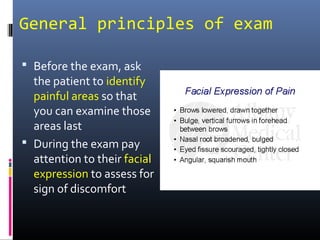
 Before the exam, ask
  the patient to identify
  painful areas so that
  you can examine those
  areas last
 During the exam pay
  attention to their facial
  expression to assess for
  sign of discomfort
Remember:

 Normal lymph nodes are not palpable
 Examine the draining lymph nodes area of
  any lesion
 Examine the area drained by affected lymph
  nodes
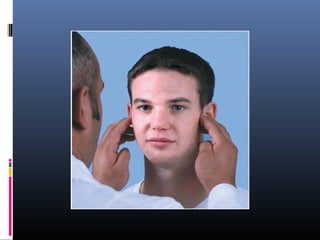
Examination of the lymph
nodes follow the same steps
used in every examination:

Inspection
Palpation
Percussion
Auscultation
Inspection
An examination of the lymph nodes forms part of the
  routine for most body systems.

As there is no need to percuss or auscultate,
  examination involves inspection followed by palpation
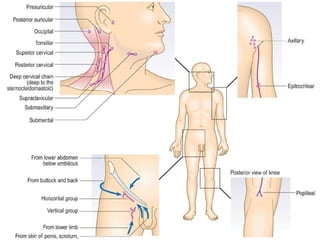
The following groups of lymph nodes are to be
   examined:
1- Cervical groups
2- Axillary groups
3- Inguinal groups
4- Epitrochlear lymph nodes.
5-popleteal lymph nodes
5- Remember that the liver and spleen are parts of
   the lymphoid tissue
Exposure:

 Cervical: all head and neck to clavicles


 Axillary: stripped to the waist


 Inguinal: umblicus to knee
Don't forget to examine the draining areas
The following points are to
be fulfilled during
inspection:
 SSSSS (5S):
1- Site.
2- Shape.
3- Size.
4- Surface: Smooth, nodular, irregular.
5- Skin overlying the swelling (scars, colour…).
6- Other draining lymph nodes.
7- Number
8- pressure effect
Palpation
 Technique: use the pads of the index and middle
 finger to move the skin in circular motions over
 the underlying tissues in each area
Technique
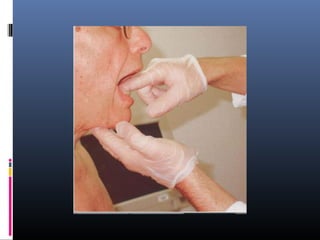
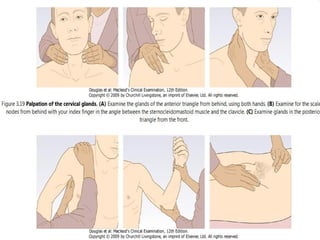
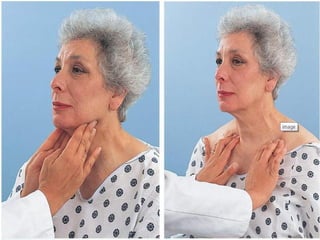
Cervical Lymph nodes
1- seat the patient in a chair
2- palpate from behind (?): right hand for right
   side and vice versa
3- slightly bend the neck towards the side to be
   examined
3- use one hand at a time
4- Bimanual examination may be employed
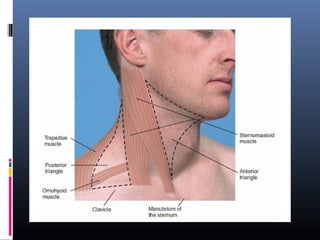
 Elevated shoulders facilitate palpation of
  supraclavicular LN
 Deep nodes are deep to sternomastoid
 Virchow nodes
The following points are to be
fulfilled during palpation:
   Confirm your inspection
   Temprature
   Tenderness
   Consistency
   Mobility
   Special signs
   Draining area
   Matted or not
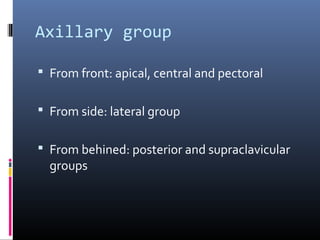
Axillary group

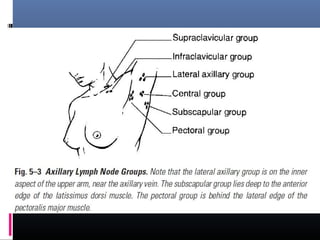
 From front: apical, central and pectoral


 From side: lateral group


 From behined: posterior and supraclavicular
  groups
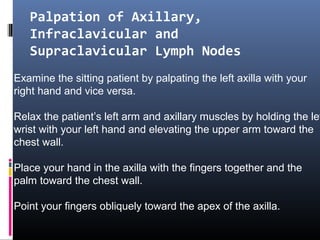
Palpation of Axillary,
   Infraclavicular and
   Supraclavicular Lymph Nodes
Examine the sitting patient by palpating the left axilla with your
right hand and vice versa.

Relax the patient’s left arm and axillary muscles by holding the lef
wrist with your left hand and elevating the upper arm toward the
chest wall.

Place your hand in the axilla with the fingers together and the
palm toward the chest wall.

Point your fingers obliquely toward the apex of the axilla.
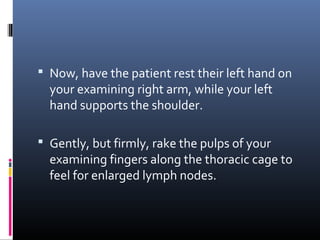
 Now, have the patient rest their left hand on
  your examining right arm, while your left
  hand supports the shoulder.

 Gently, but firmly, rake the pulps of your
  examining fingers along the thoracic cage to
  feel for enlarged lymph nodes.
Palpation of Axillary,
    Infraclavicular and
    Supraclavicular Lymph Nodes
The central group of nodes occurs near the middle of the thoracic
wall of the axilla.
The lateral axillary group is located near the upper part of the
humerus and is best demonstrated by having the patient’s arm
elevated so that you can feel along the axillary vein.

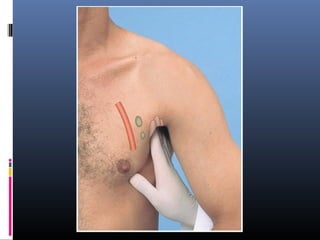
With the patient’s arm still elevated, feel along beneath the lateral
edge of the pectoralis major muscle for the pectoral group.
 Palpate the subscapular nodes from behind
  the patient with the arm raised, palpating
  with the left hand under the anterior edge of
  the latissimus dorsi muscle.
 Palpate under the clavicle for the
  infraclavicular group.

 Enlargement in the supraclavicular group is
  sought by feeling the soft tissues above and
  behind the clavicle
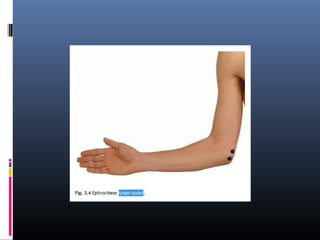
 Epitrochlear nodes: Approximately 3 cm
  proximal to the medial humeral epicondyle,
  in the groove between the biceps and triceps
  brachii.
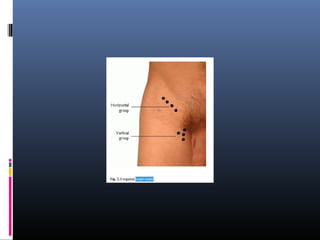
 Palpation of the Inguinal Nodes:
A horizontal group lies along the inguinal
   ligament (both above and over) and,
A vertical group is beside the great saphenous
   vein in the proximal thigh.
Iliac nodes: aboveand deep to inguinal ligament
Palpation of a lymph node:

      TT SSSS CE SSS (2T, 4S, CE, 3S).


- Temperature of skin over swelling: normal, warm,
cold (compare with contra-lateral side).
- Tenderness (look to the patient’s face).
- Site.
- Shape.
- Size.
- Surface: Smooth, nodular, irregular.
- Consistency: Soft, firm, hard, cystic.
- Edge: Well-defined, ill-defined.
- Surrounding structures and mobility of the swelling:
   Relation to muscles etc.
- Special signs: e.g. are pulsations transmitted
or expansile?.
- (Other) Swellings.
Relation of a swelling to adjacent muscle by
  inspection: The patient is asked to contract the
  muscles against resistance:

 If the swelling becomes MORE apparent it is
SUPERFICIAL to the muscles.
 If the swelling becomes LESS apparent it is DEEP
to the muscles.
 If the swelling is NOT AFFECTED it is IN the muscle.
OTHER SYSTEMS

 RESP ...SYSTEM
 CVS
 CNS
 GIT
At the end:

 Cover the patient


 Thank the patient
DDs

 IMN
 SLE
 FILARIASIS
 LYMPHOMA
 AIDS
Follow-up and Treatment

• Follow-up at 2-4 weeks interval for benign
  causes.
• Antibiotics are given only if there is strong
  evidence of bacterial infection.
• DO NOT USE GLUCOCORTICOIDS-might
  obscure diagnosis or delay healing in cases of
  infection (EXCEPTION: life-threatening
  pharyngeal obstruction by enlarged lymph
  tissue in Waldeyer’s ring caused by IM.)
 CONCLUSSION
Thank you

Approach+to+a+patient+with+lymphadenopathy

  • 2.
    Lymphadenopathy • Enlargement ofthe lymph nodes due to specific or nonspecific causes. • LYMPHADENITIS: • Genaralised or local Lymphadenopathy.
  • 3.
    • Can beconsidered normal: 1) soft, flat, submandibular nodes (<1cm) in healthy children and young adults; 2) palpabale inguinal lymph nodes of up to 2cm in diameter in healthy adults. • May be a primary or secondary manifestation of numerous disorders, both benign and malignant.
  • 4.
    • 2/3 ofcauses are non specific, & less than 1% are malignant.
  • 5.
    Clinical Assessment  MedicalHistory  Physical Examination  Laboratory Tests  Excisional LN Biopsy
  • 6.
    Medical History  Revealsthe setting in which lymphadenopathy is occuring.  General information, accompanying symptoms, personal and social history.
  • 7.
    GENERAL INFORMATION I. Age: Young age: TB, Syphilis, primary malignant lymphoma. Old age; secondary metastatic carcinoma. II. Occupation: Brucellosis III. Socio economic status;
  • 8.
    accompanying symptoms I. Fever II. Soar throat III. Cough IV. Fatigue V. Wt loss VI. Increased night sweating VII. Pressure effects
  • 9.
    History of presenting complaints I. Duration II. Which group was 1st affected? III. Pain IV. Fever V. Primary focus VI. Loss of appetite & wait VII. Pressure effects
  • 10.
    Past history I. h/o TB,Syphilis, any URTI, II. h/o recent blood transfusion. III. immuno suppression. IV. Any viral infection V. HISTORY OF MEDICATION: phenytoin, cyclosporin,allopurinol ,carbamazepine, hydralazine
  • 11.
    Personal history  h/o exposure to pets  h/o tobacco use, alcohol, smoking, i/v drug abbuse  h/o travel to any endemic area
  • 12.
    Family history  h/oany TB in family, any malignancy (lymphoma)
  • 13.
    HISTORY WITH SPECIAL FINDINGS FEVER:lymphoma,TB,SLE,IMN, AIDS  Petechial H’agein palate in a young boy with cervical lymphadenopathy:IMN  Hard lump in breast +ipsilateral axillary lymphadenopathy :CA BREAST  NON PITTING oedema with inguinal adenopathy :FILARIASIS  Fever,WT loss loss appetite night sweat lymphadenopathy:TB ,AIDS,MALINGNANCY
  • 14.
     PROLONGED MEDICATION LYMPHADENOPATHY with SKIN lesion :SLE ,SARCOIDOSIS,
  • 15.
    General examination I. Malnutrition II. Anaemia III. Icterus IV. Lymphadenopathy V. Edema
  • 16.
    Physical Examination  Introduceyourself  Consent  Position: cervical, axillary and inguinal
  • 17.
     Palpate normalside first  Clean, dry warm hands (gloves).
  • 18.
    General principles ofexam  Before the exam, ask the patient to identify painful areas so that you can examine those areas last  During the exam pay attention to their facial expression to assess for sign of discomfort
  • 19.
    Remember:  Normal lymphnodes are not palpable  Examine the draining lymph nodes area of any lesion  Examine the area drained by affected lymph nodes
  • 20.
    Examination of thelymph nodes follow the same steps used in every examination: Inspection Palpation Percussion Auscultation
  • 22.
  • 23.
    An examination ofthe lymph nodes forms part of the routine for most body systems. As there is no need to percuss or auscultate, examination involves inspection followed by palpation
  • 24.
    The following groupsof lymph nodes are to be examined: 1- Cervical groups 2- Axillary groups 3- Inguinal groups 4- Epitrochlear lymph nodes. 5-popleteal lymph nodes 5- Remember that the liver and spleen are parts of the lymphoid tissue
  • 25.
    Exposure:  Cervical: allhead and neck to clavicles  Axillary: stripped to the waist  Inguinal: umblicus to knee
  • 26.
    Don't forget toexamine the draining areas
  • 27.
    The following pointsare to be fulfilled during inspection:
  • 28.
     SSSSS (5S): 1-Site. 2- Shape. 3- Size. 4- Surface: Smooth, nodular, irregular. 5- Skin overlying the swelling (scars, colour…). 6- Other draining lymph nodes. 7- Number 8- pressure effect
  • 29.
    Palpation Technique: usethe pads of the index and middle finger to move the skin in circular motions over the underlying tissues in each area
  • 30.
  • 31.
    Cervical Lymph nodes 1-seat the patient in a chair 2- palpate from behind (?): right hand for right side and vice versa 3- slightly bend the neck towards the side to be examined 3- use one hand at a time 4- Bimanual examination may be employed
  • 34.
     Elevated shouldersfacilitate palpation of supraclavicular LN  Deep nodes are deep to sternomastoid  Virchow nodes
  • 35.
    The following pointsare to be fulfilled during palpation:  Confirm your inspection  Temprature  Tenderness  Consistency  Mobility  Special signs  Draining area  Matted or not
  • 39.
    Axillary group  Fromfront: apical, central and pectoral  From side: lateral group  From behined: posterior and supraclavicular groups
  • 40.
    Palpation of Axillary, Infraclavicular and Supraclavicular Lymph Nodes Examine the sitting patient by palpating the left axilla with your right hand and vice versa. Relax the patient’s left arm and axillary muscles by holding the lef wrist with your left hand and elevating the upper arm toward the chest wall. Place your hand in the axilla with the fingers together and the palm toward the chest wall. Point your fingers obliquely toward the apex of the axilla.
  • 41.
     Now, havethe patient rest their left hand on your examining right arm, while your left hand supports the shoulder.  Gently, but firmly, rake the pulps of your examining fingers along the thoracic cage to feel for enlarged lymph nodes.
  • 42.
    Palpation of Axillary, Infraclavicular and Supraclavicular Lymph Nodes The central group of nodes occurs near the middle of the thoracic wall of the axilla. The lateral axillary group is located near the upper part of the humerus and is best demonstrated by having the patient’s arm elevated so that you can feel along the axillary vein. With the patient’s arm still elevated, feel along beneath the lateral edge of the pectoralis major muscle for the pectoral group.
  • 43.
     Palpate thesubscapular nodes from behind the patient with the arm raised, palpating with the left hand under the anterior edge of the latissimus dorsi muscle.  Palpate under the clavicle for the infraclavicular group.  Enlargement in the supraclavicular group is sought by feeling the soft tissues above and behind the clavicle
  • 46.
     Epitrochlear nodes:Approximately 3 cm proximal to the medial humeral epicondyle, in the groove between the biceps and triceps brachii.
  • 48.
     Palpation ofthe Inguinal Nodes: A horizontal group lies along the inguinal ligament (both above and over) and, A vertical group is beside the great saphenous vein in the proximal thigh. Iliac nodes: aboveand deep to inguinal ligament
  • 50.
    Palpation of alymph node: TT SSSS CE SSS (2T, 4S, CE, 3S). - Temperature of skin over swelling: normal, warm, cold (compare with contra-lateral side). - Tenderness (look to the patient’s face). - Site. - Shape. - Size.
  • 51.
    - Surface: Smooth,nodular, irregular. - Consistency: Soft, firm, hard, cystic. - Edge: Well-defined, ill-defined. - Surrounding structures and mobility of the swelling: Relation to muscles etc. - Special signs: e.g. are pulsations transmitted or expansile?. - (Other) Swellings.
  • 52.
    Relation of aswelling to adjacent muscle by inspection: The patient is asked to contract the muscles against resistance:  If the swelling becomes MORE apparent it is SUPERFICIAL to the muscles.  If the swelling becomes LESS apparent it is DEEP to the muscles.  If the swelling is NOT AFFECTED it is IN the muscle.
  • 53.
    OTHER SYSTEMS  RESP...SYSTEM  CVS  CNS  GIT
  • 54.
    At the end: Cover the patient  Thank the patient
  • 55.
    DDs  IMN  SLE FILARIASIS  LYMPHOMA  AIDS
  • 56.
    Follow-up and Treatment •Follow-up at 2-4 weeks interval for benign causes. • Antibiotics are given only if there is strong evidence of bacterial infection. • DO NOT USE GLUCOCORTICOIDS-might obscure diagnosis or delay healing in cases of infection (EXCEPTION: life-threatening pharyngeal obstruction by enlarged lymph tissue in Waldeyer’s ring caused by IM.)
  • 57.
  • 58.