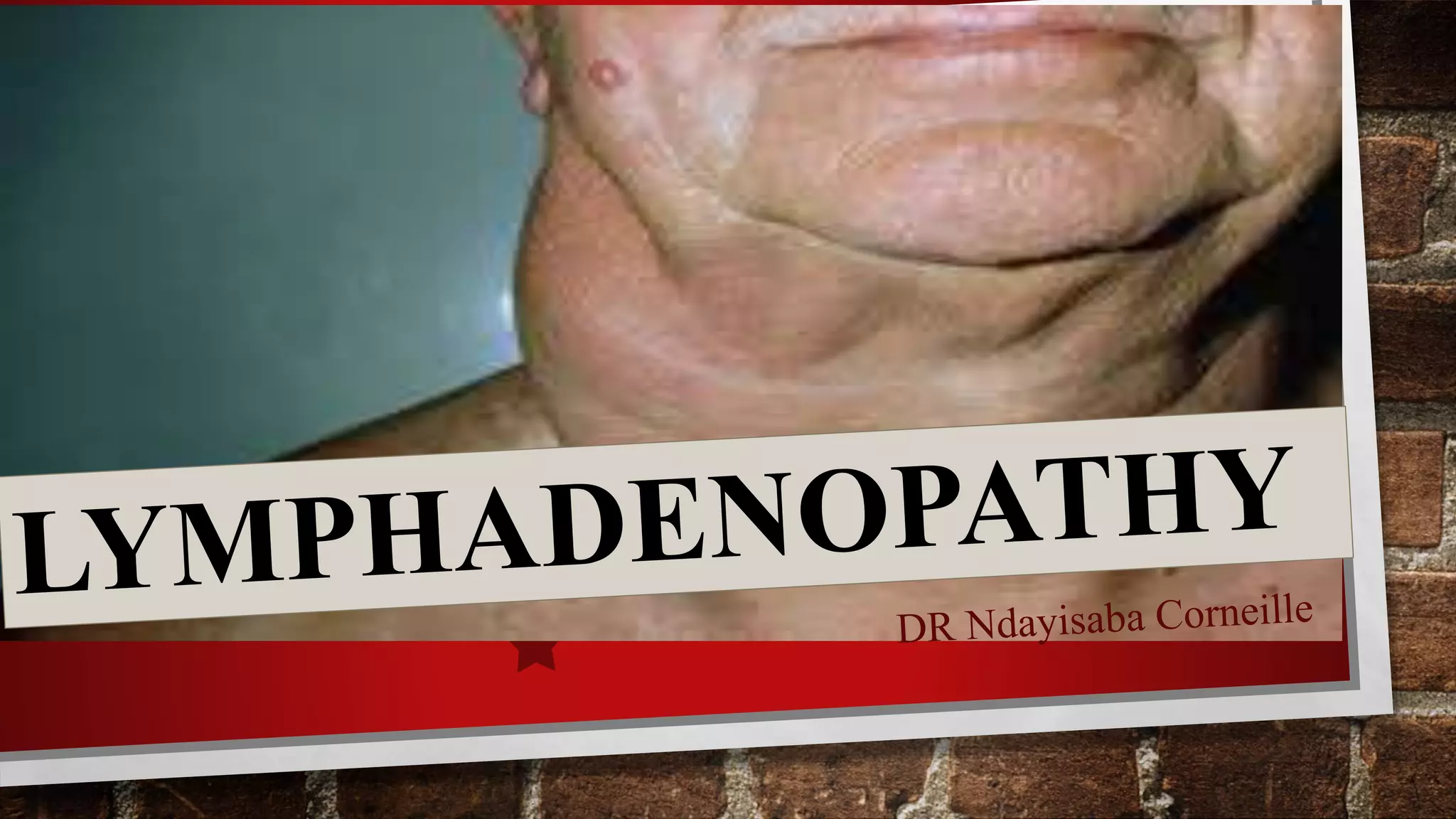
LYMPADENOPATHY
• lymphadenopathy or adenopathy is disease of
the lymph nodes, in which they are abnormality
in size, character and consistency .
• Lymphadenopathy of an inflammatory type
(the most common type) is lymphadenitis,
producing swollen or enlarged lymph nodes
• According to Davidsons “lymphadenopathy can
be caused by benign or malignant disease”
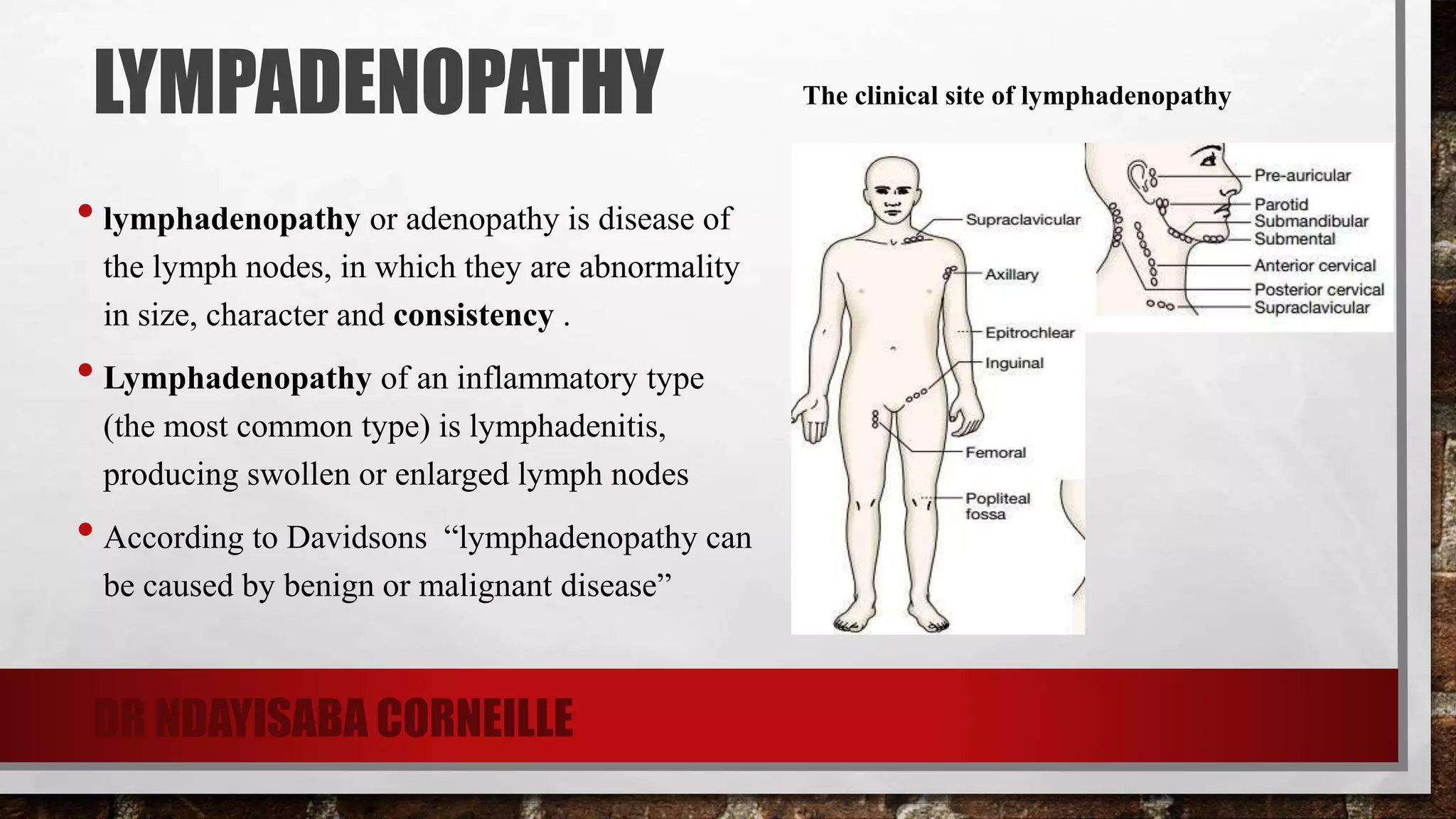
The clinical site of lymphadenopathy
DR NDAYISABA CORNEILLE
CLASSIFICATION
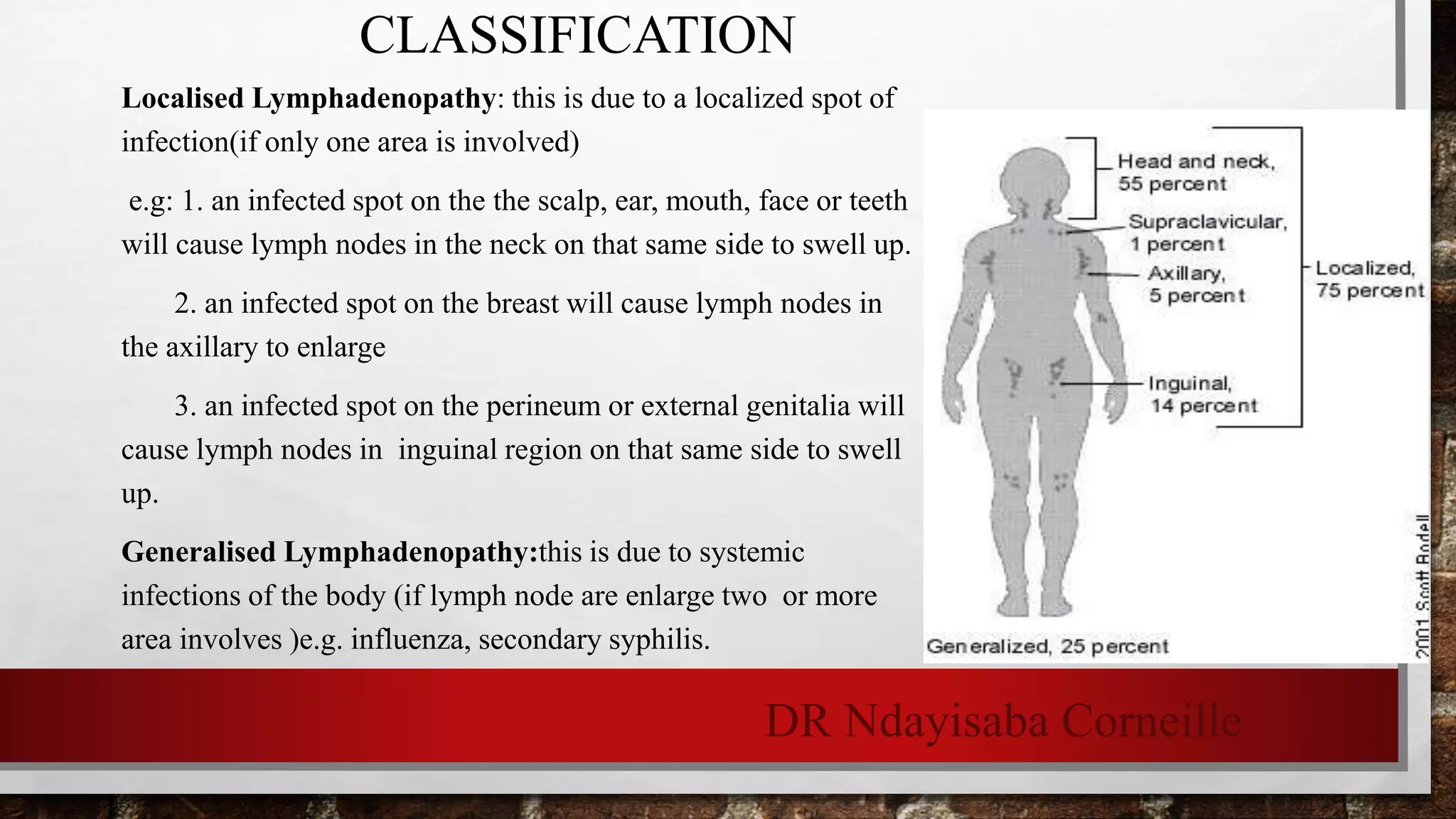
Localised Lymphadenopathy: this is due to a localized spot of
infection(if only one area is involved)
e.g: 1. an infected spot on the the scalp, ear, mouth, face or teeth
will cause lymph nodes in the neck on that same side to swell up.
2. an infected spot on the breast will cause lymph nodes in
the axillary to enlarge
3. an infected spot on the perineum or external genitalia will
cause lymph nodes in inguinal region on that same side to swell
up.
Generalised Lymphadenopathy:this is due to systemic
infections of the body (if lymph node are enlarge two or more
area involves )e.g. influenza, secondary syphilis.
DR Ndayisaba Corneille
CAUSE OF LYMPHADENOPATHY
•Infective
• bacterial eg : streptococcal, tuberculosis, brucellosis
• viral eg: cmv, viral hepatitis, mumps virus, adenovirus, measles, rubella,
influenza virus, human immunodeficiency virus (hiv)
• protozoal eg : toxoplasmosis
• fungal eg : coccidiodomycosis ,histoplasmosis, coccidioidomycosis
• parasitic e.g. toxoplasmosis, filariasis, pediculosis etc.
•Neoplastic
• primary: lymphomas, leukaemias, neuroblastoma
• secondary: lung, breast, thyroid, stomach
DR Ndayisaba Corneille
.Autoimmune; e.g juvenile rheumatoid arthritis, systemic
lupus erythematosus, langerhans cell histiocytosis,
dermatomyositis.
.Miscellaneous/ unusual; e.g. kawasaki disease
(mucocutaneous lymph node syndrome), sarcoidosis.etc
.Latrogenic e.g. serum sickness, medications like;
captopril, carbamazepine, phenytoin, etc.
DR Ndayisaba Corneille
THE SIGNS AND SYMPTOMS OF LYMPHADENOPATHY
•Painful, warm, or red lump under your skin.
•More tired than usual.
•Skin rash.
•Unexplained weight loss.
•Enlarged spleen (organ that filters blood)
•Fever or night sweats.
DR Ndayisaba Corneille
DIAGNOSIS OF LYMPHADENOPATHY
• Careful history and physical examination are the core of the evaluation. in most
cases, a careful history and physical examination will identify a readily
diagnosable cause of the lymphadenopathy, such as upper respiratory tract
infection, pharyngitis, periodontal disease, conjunctivitis, lymphadenitis, tinea,
insect bites, recent immunization, cat-scratch disease or dermatitis, and no
further assessment is necessary.
DR Ndayisaba Corneille
PHYSICAL EXAMINATION
when lymphadenopathy is localized, the clinician should examine the region drained by the
nodes for evidence of infection, skin lesions or tumors
other nodal sites should also be carefully examined to exclude the possibility of generalized
rather than localized lymphadenopathy.
careful palpation of the submandibular, anterior and posterior cervical, supraclavicular,
axillary and inguinal nodes can be accomplished in a short time and will identify patients with
generalized lymphadenopathy
DR Ndayisaba Corneille
• if lymph nodes are detected, the following five characteristics should be noted and
described:
1.size 4.matting 7.tissue invasion
2.pain/tenderness ; 5.location
3.consistency ; 6.mobility;
Matting: a group of nodes that feels connected and seems to move as a unit is said to be
“matted.” nodes that are matted can be either benign (e.g., tuberculosis, sarcoidosis or
lymphogranuloma venereum) or malignant (e.g., metastatic carcinoma or lymphomas)
DR Ndayisaba Corneille
• Mobility :fixed or matted nodes suggest metastatic carcinoma, whereas freely
movable nodes may occur in infections, collagen vascular disease and lymphoma.
• Tissue Invasion:lymphovascular invasion ( LVI or lymphovascular space invasion )
is spread of a cancer to the blood vessels and/or lymphatics. It has got prognostic
significance in some cancers
• Consistency : stony-hard nodes are typically a sign of cancer, usually metastatic.
very firm, rubbery nodes suggest lymphoma. softer nodes are the result of infections
or inflammatory conditions
• Pain/Tenderness : when a lymph node rapidly increases in size, its capsule stretches
and causes pain
DR Ndayisaba Corneille
Head and Neck lymphadenopathy
Cervical lymphadenopathy: this includes posterior
cervical nodes, which drain the scalp, neck and upper
thoracic skin. the anterior cervical nodes drain the
larynx, tongue, oropharynx and anterior neck.
Sub-maxillary and submental lymphadenopathy:
these affected nodes drain the teeth, tongue, gums and
buccal mucosa. enlargement is usually due to
pharyngitis, herpetic gingivostomatitis and dental
abscess.
Preauricular lymphadenopathy:
affected nodes drain the eyelids, skin of cheeks and
temporal region of the scalp.
SITE AND DIFFERENTIAL DIAGNOSIS OF LYMPHADENOPATHY
DR Ndayisaba Corneille
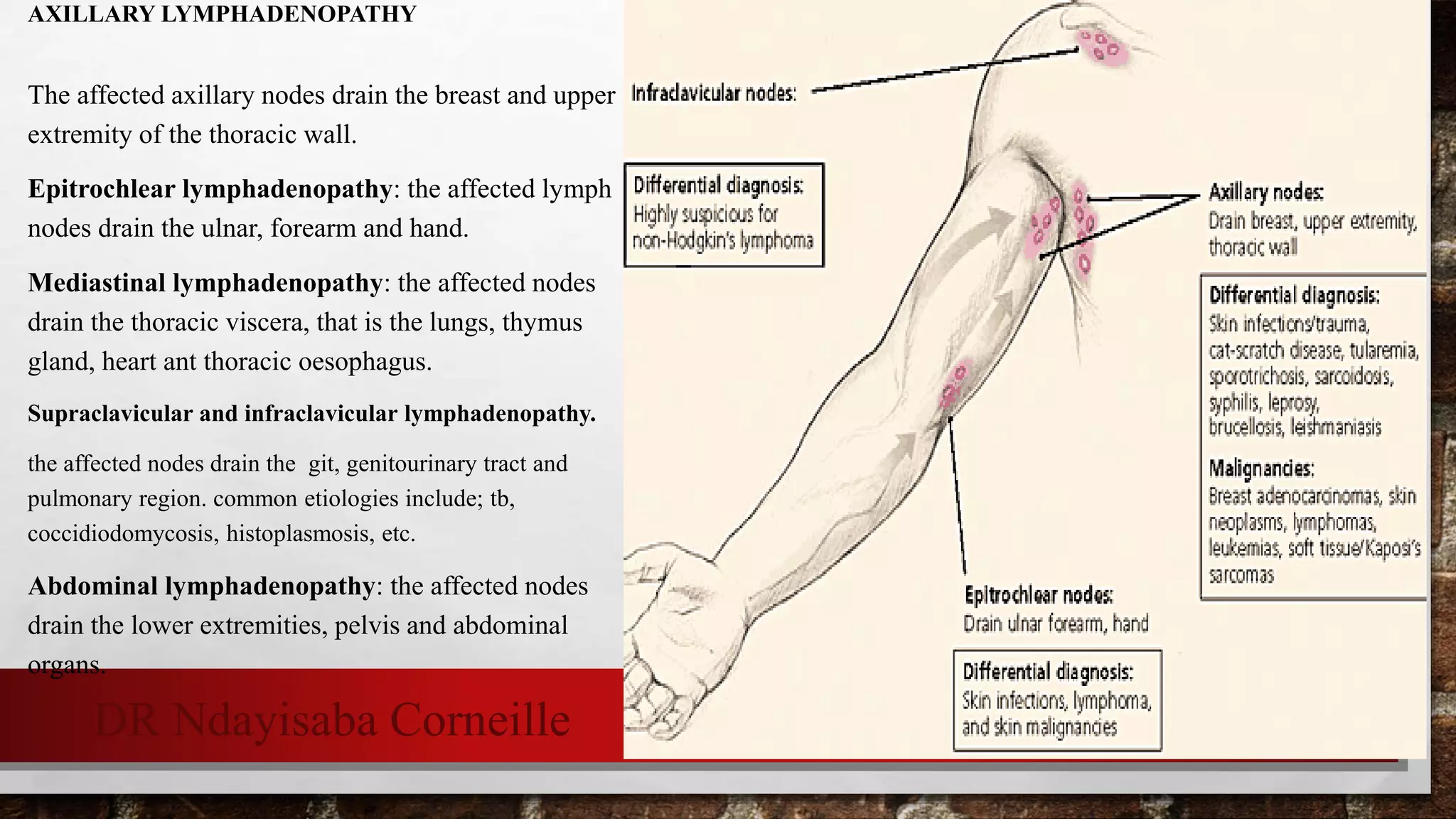
AXILLARY LYMPHADENOPATHY
The affected axillary nodes drain the breast and upper
extremity of the thoracic wall.
Epitrochlear lymphadenopathy: the affected lymph
nodes drain the ulnar, forearm and hand.
Mediastinal lymphadenopathy: the affected nodes
drain the thoracic viscera, that is the lungs, thymus
gland, heart ant thoracic oesophagus.
Supraclavicular and infraclavicular lymphadenopathy.
the affected nodes drain the git, genitourinary tract and
pulmonary region. common etiologies include; tb,
coccidiodomycosis, histoplasmosis, etc.
Abdominal lymphadenopathy: the affected nodes
drain the lower extremities, pelvis and abdominal
organs.
DR Ndayisaba Corneille
Iliac and inguinal lymphadenopathy:
the affected nodes include the
horizontal node group and vertical
node group. these groups drain
the lower abdomen, external
genitalia skin, anal canal, lower
third of the vagina and lower
extremity.
DR Ndayisaba Corneille
REFERENCES
• HARRISON'S PRINCIPLES OF INTERNAL MEDICINE, 18TH EDITION
• DAVIDSON'S PRINCIPLES AND PRACTICE OF MEDICINE,18TH EDITION
DR Ndayisaba Corneille
THANKS FOR
YOUR
ATTENTION
DR Ndayisaba Corneille

Lymphadenopathy

  • 2.
    LYMPADENOPATHY • lymphadenopathy oradenopathy is disease of the lymph nodes, in which they are abnormality in size, character and consistency . • Lymphadenopathy of an inflammatory type (the most common type) is lymphadenitis, producing swollen or enlarged lymph nodes • According to Davidsons “lymphadenopathy can be caused by benign or malignant disease” The clinical site of lymphadenopathy DR NDAYISABA CORNEILLE
  • 3.
    CLASSIFICATION Localised Lymphadenopathy: thisis due to a localized spot of infection(if only one area is involved) e.g: 1. an infected spot on the the scalp, ear, mouth, face or teeth will cause lymph nodes in the neck on that same side to swell up. 2. an infected spot on the breast will cause lymph nodes in the axillary to enlarge 3. an infected spot on the perineum or external genitalia will cause lymph nodes in inguinal region on that same side to swell up. Generalised Lymphadenopathy:this is due to systemic infections of the body (if lymph node are enlarge two or more area involves )e.g. influenza, secondary syphilis. DR Ndayisaba Corneille
  • 4.
    CAUSE OF LYMPHADENOPATHY •Infective •bacterial eg : streptococcal, tuberculosis, brucellosis • viral eg: cmv, viral hepatitis, mumps virus, adenovirus, measles, rubella, influenza virus, human immunodeficiency virus (hiv) • protozoal eg : toxoplasmosis • fungal eg : coccidiodomycosis ,histoplasmosis, coccidioidomycosis • parasitic e.g. toxoplasmosis, filariasis, pediculosis etc. •Neoplastic • primary: lymphomas, leukaemias, neuroblastoma • secondary: lung, breast, thyroid, stomach DR Ndayisaba Corneille
  • 5.
    .Autoimmune; e.g juvenilerheumatoid arthritis, systemic lupus erythematosus, langerhans cell histiocytosis, dermatomyositis. .Miscellaneous/ unusual; e.g. kawasaki disease (mucocutaneous lymph node syndrome), sarcoidosis.etc .Latrogenic e.g. serum sickness, medications like; captopril, carbamazepine, phenytoin, etc. DR Ndayisaba Corneille
  • 6.
    THE SIGNS ANDSYMPTOMS OF LYMPHADENOPATHY •Painful, warm, or red lump under your skin. •More tired than usual. •Skin rash. •Unexplained weight loss. •Enlarged spleen (organ that filters blood) •Fever or night sweats. DR Ndayisaba Corneille
  • 7.
    DIAGNOSIS OF LYMPHADENOPATHY •Careful history and physical examination are the core of the evaluation. in most cases, a careful history and physical examination will identify a readily diagnosable cause of the lymphadenopathy, such as upper respiratory tract infection, pharyngitis, periodontal disease, conjunctivitis, lymphadenitis, tinea, insect bites, recent immunization, cat-scratch disease or dermatitis, and no further assessment is necessary. DR Ndayisaba Corneille
  • 8.
    PHYSICAL EXAMINATION when lymphadenopathyis localized, the clinician should examine the region drained by the nodes for evidence of infection, skin lesions or tumors other nodal sites should also be carefully examined to exclude the possibility of generalized rather than localized lymphadenopathy. careful palpation of the submandibular, anterior and posterior cervical, supraclavicular, axillary and inguinal nodes can be accomplished in a short time and will identify patients with generalized lymphadenopathy DR Ndayisaba Corneille
  • 9.
    • if lymphnodes are detected, the following five characteristics should be noted and described: 1.size 4.matting 7.tissue invasion 2.pain/tenderness ; 5.location 3.consistency ; 6.mobility; Matting: a group of nodes that feels connected and seems to move as a unit is said to be “matted.” nodes that are matted can be either benign (e.g., tuberculosis, sarcoidosis or lymphogranuloma venereum) or malignant (e.g., metastatic carcinoma or lymphomas) DR Ndayisaba Corneille
  • 10.
    • Mobility :fixedor matted nodes suggest metastatic carcinoma, whereas freely movable nodes may occur in infections, collagen vascular disease and lymphoma. • Tissue Invasion:lymphovascular invasion ( LVI or lymphovascular space invasion ) is spread of a cancer to the blood vessels and/or lymphatics. It has got prognostic significance in some cancers • Consistency : stony-hard nodes are typically a sign of cancer, usually metastatic. very firm, rubbery nodes suggest lymphoma. softer nodes are the result of infections or inflammatory conditions • Pain/Tenderness : when a lymph node rapidly increases in size, its capsule stretches and causes pain DR Ndayisaba Corneille
  • 11.
    Head and Necklymphadenopathy Cervical lymphadenopathy: this includes posterior cervical nodes, which drain the scalp, neck and upper thoracic skin. the anterior cervical nodes drain the larynx, tongue, oropharynx and anterior neck. Sub-maxillary and submental lymphadenopathy: these affected nodes drain the teeth, tongue, gums and buccal mucosa. enlargement is usually due to pharyngitis, herpetic gingivostomatitis and dental abscess. Preauricular lymphadenopathy: affected nodes drain the eyelids, skin of cheeks and temporal region of the scalp. SITE AND DIFFERENTIAL DIAGNOSIS OF LYMPHADENOPATHY DR Ndayisaba Corneille
  • 12.
    AXILLARY LYMPHADENOPATHY The affectedaxillary nodes drain the breast and upper extremity of the thoracic wall. Epitrochlear lymphadenopathy: the affected lymph nodes drain the ulnar, forearm and hand. Mediastinal lymphadenopathy: the affected nodes drain the thoracic viscera, that is the lungs, thymus gland, heart ant thoracic oesophagus. Supraclavicular and infraclavicular lymphadenopathy. the affected nodes drain the git, genitourinary tract and pulmonary region. common etiologies include; tb, coccidiodomycosis, histoplasmosis, etc. Abdominal lymphadenopathy: the affected nodes drain the lower extremities, pelvis and abdominal organs. DR Ndayisaba Corneille
  • 13.
    Iliac and inguinallymphadenopathy: the affected nodes include the horizontal node group and vertical node group. these groups drain the lower abdomen, external genitalia skin, anal canal, lower third of the vagina and lower extremity. DR Ndayisaba Corneille
  • 14.
    REFERENCES • HARRISON'S PRINCIPLESOF INTERNAL MEDICINE, 18TH EDITION • DAVIDSON'S PRINCIPLES AND PRACTICE OF MEDICINE,18TH EDITION DR Ndayisaba Corneille
  • 15.