Lymphatic
System
Gwyneth Sophia L. Provido NCM101-9203
LYMPHATIC SYSTEM OVERVIEW
• The Lymphatic system
is a group of organs,
vessels and tissues that
protect you
infection and
from
keep a
healthy balance of
fluids throughout your
body.
PARTS OF THE LYMPHATIC
SYSTEM
• This system includes the bone
marrow, spleen, thymus, lymph
nodes, and lymphatic vessels
PURPOSE OF THE LYMPHATIC
SYSTEM
1. Return fluid to the heart
2. Helps large molecules enter the
blood e.g. hormones and lipids
3. Immune surveillance
MATERIALS
• Tape measure
• Tongue depressor
• Penlight
• Washable markers
BEFORE THE ASSESSMENT:
• Ensure your client is in a comfortable position
• Your hands are warm.
• The temperature in the room is comfortable.
• Provide privacy by closing the door and curtains, properly
draping your client, and only exposing areas of their body as
needed to perform your examination.
• Explain the procedure to your client and be sure to answer any
questions they have before obtaining verbal consent.
METHOD OF ASSESSMENT
Inspection Palpation
METHOD OF ASSESSMENT
Inspection
• Typically, you are not able to visualize lymph nodes or the lymph
system.
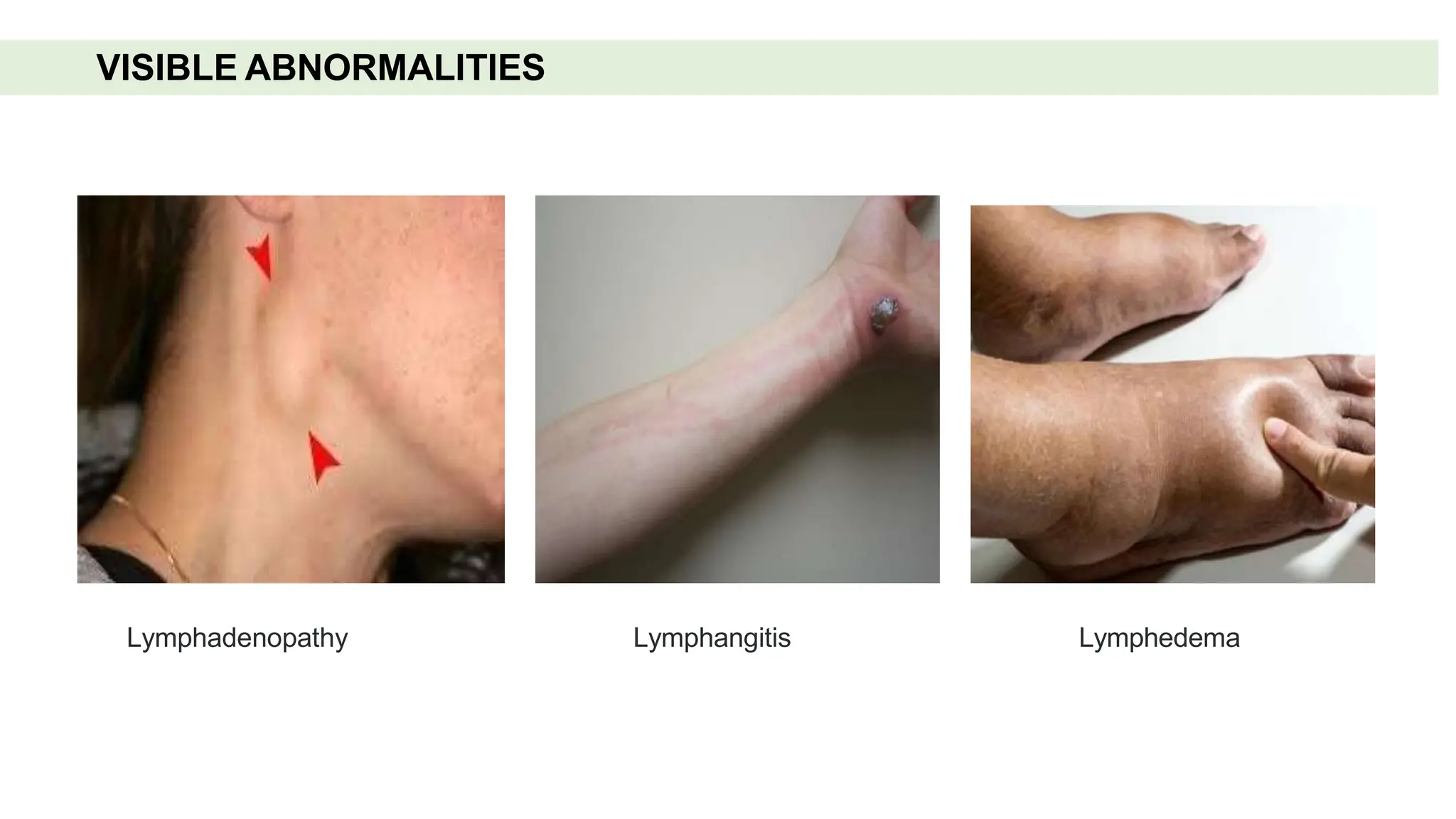
• Visible abnormalities of the lymphatic system usually fall into one of
three categories: lymphadenopathy, lymphangitis, lymphedema.
• Start with the head and neck and move downward, inspecting each
area of the body for visible lymph nodes, swelling, and redness.
• Using a tongue depressor and pen light, inspect the tonsils and
adenoids inside the oropharynx, noting their size, color, and shape.
Both structures should be pink and symmetrical with an irregular
surface.
VISIBLE ABNORMALITIES
Lymphadenopathy Lymphangitis Lymphedema
METHOD OF ASSESSMENT
Inspection Palpation
METHOD OF ASSESSMENT
Palpation
• Start with the head and neck
and move downward,
sequentially, from the head, to
the neck, and then to the
upper and lower extremities.
• Palpate with light pressure
using the pads of the fingers to
find superficial nodes and then
gradually increase pressure to
detect deeper nodes.
METHOD OF ASSESSMENT
Palpation
• During palpation, feel for
temperature, enlargement,
firmness, tenderness, and
mobility of the lymph
nodes.
• Remember that in healthy
adult clients, lymph nodes can
range from 0.5 to 1 cm, and
it's normal not to feel any
superficial lymph nodes.
METHOD OF ASSESSMENT
Palpation
• If you do feel a lymph node, it should feel soft, mobile, non-tender, and equal
bilaterally.
• If you find enlarged lymph nodes, check for other abnormalities such as a
node that’s firm, fixed or non-movable, tender, or asymmetric. Continue to
explore the surrounding tissue for signs of infection or inflammation like redness,
warmth, or a nearby wound which could be the source of an enlarged lymph
node.
PALPATE THE SPLEEN FOR
ENLARGEMENT
• To do this, you’ll stand on your client’s right
side and put your left hand under them,
touching the costovertebral angle, and then
press upwards. Next, put the palm of your
right hand on your client’s abdomen below
the left costal margin. Press your fingers
inward towards the spleen and ask them to
take a deep breath.
• Normally, the spleen is not palpable, so if
you feel it, it’s probably enlarged,
OTHER LYMPHATIC SYSTEM DISORDER
Hodgkin's lymphoma Lymphangioleiomyomatosis (LAM) Splenomegaly
CONCLUSION
• As the nurse, it’s your responsibility to correctly assess,
interpret, report, and document your findings. If your
assessment reveals something that’s potentially abnormal or
emergent, such as a painless, enlarged, non-movable lymph
node, you should report this immediately to the health care
provider, while monitoring client progress and changes from
baseline.
THANK YOU!

Lymphatic-System for nursing students(1).pptx

  • 1.
  • 2.
    LYMPHATIC SYSTEM OVERVIEW •The Lymphatic system is a group of organs, vessels and tissues that protect you infection and from keep a healthy balance of fluids throughout your body.
  • 3.
    PARTS OF THELYMPHATIC SYSTEM • This system includes the bone marrow, spleen, thymus, lymph nodes, and lymphatic vessels PURPOSE OF THE LYMPHATIC SYSTEM 1. Return fluid to the heart 2. Helps large molecules enter the blood e.g. hormones and lipids 3. Immune surveillance
  • 4.
    MATERIALS • Tape measure •Tongue depressor • Penlight • Washable markers
  • 5.
    BEFORE THE ASSESSMENT: •Ensure your client is in a comfortable position • Your hands are warm. • The temperature in the room is comfortable. • Provide privacy by closing the door and curtains, properly draping your client, and only exposing areas of their body as needed to perform your examination. • Explain the procedure to your client and be sure to answer any questions they have before obtaining verbal consent.
  • 6.
  • 7.
    METHOD OF ASSESSMENT Inspection •Typically, you are not able to visualize lymph nodes or the lymph system. • Visible abnormalities of the lymphatic system usually fall into one of three categories: lymphadenopathy, lymphangitis, lymphedema. • Start with the head and neck and move downward, inspecting each area of the body for visible lymph nodes, swelling, and redness. • Using a tongue depressor and pen light, inspect the tonsils and adenoids inside the oropharynx, noting their size, color, and shape. Both structures should be pink and symmetrical with an irregular surface.
  • 8.
  • 12.
  • 13.
    METHOD OF ASSESSMENT Palpation •Start with the head and neck and move downward, sequentially, from the head, to the neck, and then to the upper and lower extremities. • Palpate with light pressure using the pads of the fingers to find superficial nodes and then gradually increase pressure to detect deeper nodes.
  • 14.
    METHOD OF ASSESSMENT Palpation •During palpation, feel for temperature, enlargement, firmness, tenderness, and mobility of the lymph nodes. • Remember that in healthy adult clients, lymph nodes can range from 0.5 to 1 cm, and it's normal not to feel any superficial lymph nodes.
  • 15.
    METHOD OF ASSESSMENT Palpation •If you do feel a lymph node, it should feel soft, mobile, non-tender, and equal bilaterally. • If you find enlarged lymph nodes, check for other abnormalities such as a node that’s firm, fixed or non-movable, tender, or asymmetric. Continue to explore the surrounding tissue for signs of infection or inflammation like redness, warmth, or a nearby wound which could be the source of an enlarged lymph node.
  • 16.
    PALPATE THE SPLEENFOR ENLARGEMENT • To do this, you’ll stand on your client’s right side and put your left hand under them, touching the costovertebral angle, and then press upwards. Next, put the palm of your right hand on your client’s abdomen below the left costal margin. Press your fingers inward towards the spleen and ask them to take a deep breath. • Normally, the spleen is not palpable, so if you feel it, it’s probably enlarged,
  • 17.
    OTHER LYMPHATIC SYSTEMDISORDER Hodgkin's lymphoma Lymphangioleiomyomatosis (LAM) Splenomegaly
  • 18.
    CONCLUSION • As thenurse, it’s your responsibility to correctly assess, interpret, report, and document your findings. If your assessment reveals something that’s potentially abnormal or emergent, such as a painless, enlarged, non-movable lymph node, you should report this immediately to the health care provider, while monitoring client progress and changes from baseline.
  • 19.