By: Joseline Manuel-Santos, Ph.D.
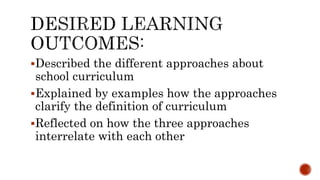
Described the different approaches about
school curriculum
Explained by examples how the approaches
clarify the definition of curriculum
Reflected on how the three approaches
interrelate with each other
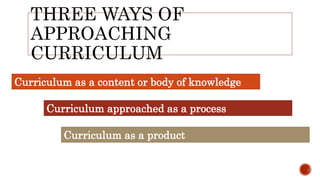
THREE WAYS OF
APPROACHING
CURRICULUM
Curriculum as a content or body of knowledge
Curriculum approached as a process
Curriculum as a product
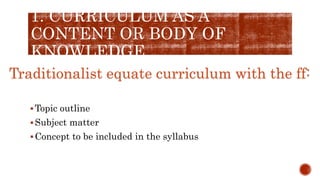
1. CURRICULUM AS A
CONTENT OR BODY OF
KNOWLEDGE
Topic outline
Subject matter
Concept to be included in the syllabus
Traditionalist equate curriculum with the ff:
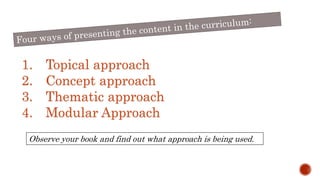
1. Topical approach
2. Concept approach
3. Thematic approach
4. Modular Approach
Observe your book and find out what approach is being used.
1. Significance
- Content becomes the means of developing
cognitive, affective or psychomotor skills
- Address cultural context of the learners
Browse your book and look for a proof that it is significant
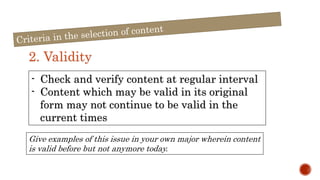
2. Validity
- Check and verify content at regular interval
- Content which may be valid in its original
form may not continue to be valid in the
current times
Give examples of this issue in your own major wherein content
is valid before but not anymore today.
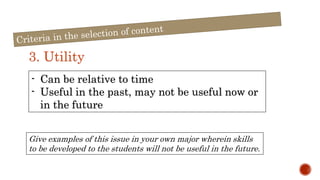
3. Utility
- Can be relative to time
- Useful in the past, may not be useful now or
in the future
Give examples of this issue in your own major wherein skills
to be developed to the students will not be useful in the future.
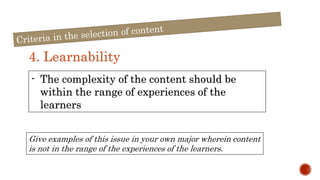
4. Learnability
- The complexity of the content should be
within the range of experiences of the
learners
Give examples of this issue in your own major wherein content
is not in the range of the experiences of the learners.
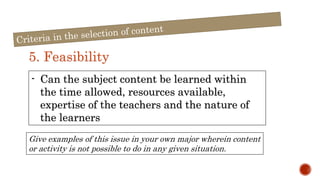
5. Feasibility
- Can the subject content be learned within
the time allowed, resources available,
expertise of the teachers and the nature of
the learners
Give examples of this issue in your own major wherein content
or activity is not possible to do in any given situation.
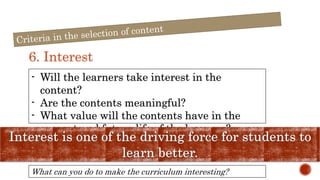
6. Interest
- Will the learners take interest in the
content?
- Are the contents meaningful?
- What value will the contents have in the
present and future life of the learners?
What can you do to make the curriculum interesting?
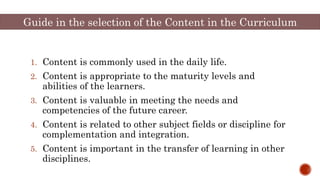
Guide in the selection of the Content in the Curriculum
1. Content is commonly used in the daily life.
2. Content is appropriate to the maturity levels and
abilities of the learners.
3. Content is valuable in meeting the needs and
competencies of the future career.
4. Content is related to other subject fields or discipline for
complementation and integration.
5. Content is important in the transfer of learning in other
disciplines.
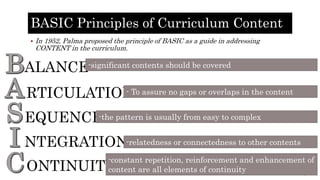
BASIC Principles of Curriculum Content
 In 1952, Palma proposed the principle of BASIC as a guide in addressing
CONTENT in the curriculum.
ALANCE
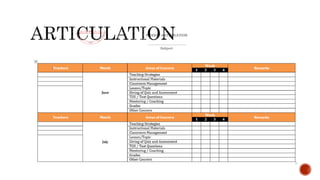
RTICULATION
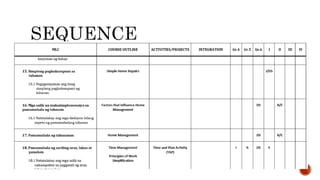
EQUENCE
NTEGRATION
ONTINUITY
-significant contents should be covered
- To assure no gaps or overlaps in the content
-the pattern is usually from easy to complex
-relatedness or connectedness to other contents
-constant repetition, reinforcement and enhancement of
content are all elements of continuity
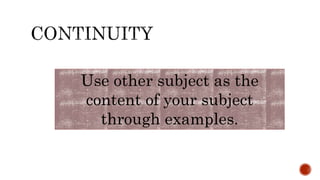
Use other subject as the
content of your subject
through examples.
2. CURRICULUM
APPROACHED AS PROCESS
2. CURRICULUM
APPROACHED AS PROCESS
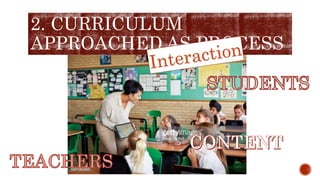
Curriculum happens in the classroom
Practice of teaching
Curriculum happens in the classroom
Concern of teachers to emphasize
• Critical thinking
• Meaning-making
• Heads-on
• Hands-on
• and many others
2. CURRICULUM
APPROACHED AS PROCESS
The process provides the
curriculum on how to
teach the content.
Pedagogical Content Knowledge
If you have this content, how will
you teach it?
2. CURRICULUM
APPROACHED AS PROCESS
What curriculum are you
using?
 Problem-based
 Hands-on, Minds-on
 Cooperative learning
 Blended Curriculum
 On-line
 Case-based
 and many more
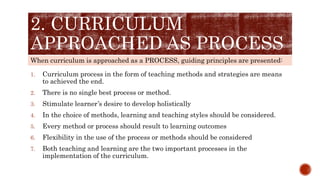
When curriculum is approached as a PROCESS, guiding principles are presented:
2. CURRICULUM
APPROACHED AS PROCESS
1. Curriculum process in the form of teaching methods and strategies are means
to achieved the end.
2. There is no single best process or method.
3. Stimulate learner’s desire to develop holistically
4. In the choice of methods, learning and teaching styles should be considered.
5. Every method or process should result to learning outcomes
6. Flexibility in the use of the process or methods should be considered
7. Both teaching and learning are the two important processes in the
implementation of the curriculum.
3. CURRICULUM AS A
PRODUCT
is what students desire to
achieve as a learning outcomes
3. CURRICULUM AS A
PRODUCT
The real purpose of education is to bring about
significant changes in students’ pattern of behavior.
Curriculum product is expressed in form of outcomes which are
referred to as the achieved learning outcomes.
There maybe several desired learning outcomes, but if the process
is not successful, then no learning outcomes will be achieved.
These learned or achieved outcomes are demonstrated by the
person who has meaningful experiences in the curriculum.
All of these are result of planning, content and processes in the
curriculum.

Approaches About School Curriculum

  • 1.
  • 2.
    Described the differentapproaches about school curriculum Explained by examples how the approaches clarify the definition of curriculum Reflected on how the three approaches interrelate with each other
  • 4.
    THREE WAYS OF APPROACHING CURRICULUM Curriculumas a content or body of knowledge Curriculum approached as a process Curriculum as a product
  • 5.
    1. CURRICULUM ASA CONTENT OR BODY OF KNOWLEDGE Topic outline Subject matter Concept to be included in the syllabus Traditionalist equate curriculum with the ff:
  • 6.
    1. Topical approach 2.Concept approach 3. Thematic approach 4. Modular Approach Observe your book and find out what approach is being used.
  • 7.
    1. Significance - Contentbecomes the means of developing cognitive, affective or psychomotor skills - Address cultural context of the learners Browse your book and look for a proof that it is significant
  • 8.
    2. Validity - Checkand verify content at regular interval - Content which may be valid in its original form may not continue to be valid in the current times Give examples of this issue in your own major wherein content is valid before but not anymore today.
  • 9.
    3. Utility - Canbe relative to time - Useful in the past, may not be useful now or in the future Give examples of this issue in your own major wherein skills to be developed to the students will not be useful in the future.
  • 10.
    4. Learnability - Thecomplexity of the content should be within the range of experiences of the learners Give examples of this issue in your own major wherein content is not in the range of the experiences of the learners.
  • 11.
    5. Feasibility - Canthe subject content be learned within the time allowed, resources available, expertise of the teachers and the nature of the learners Give examples of this issue in your own major wherein content or activity is not possible to do in any given situation.
  • 12.
    6. Interest - Willthe learners take interest in the content? - Are the contents meaningful? - What value will the contents have in the present and future life of the learners? What can you do to make the curriculum interesting?
  • 13.
    Guide in theselection of the Content in the Curriculum 1. Content is commonly used in the daily life. 2. Content is appropriate to the maturity levels and abilities of the learners. 3. Content is valuable in meeting the needs and competencies of the future career. 4. Content is related to other subject fields or discipline for complementation and integration. 5. Content is important in the transfer of learning in other disciplines.
  • 14.
    BASIC Principles ofCurriculum Content  In 1952, Palma proposed the principle of BASIC as a guide in addressing CONTENT in the curriculum. ALANCE RTICULATION EQUENCE NTEGRATION ONTINUITY -significant contents should be covered - To assure no gaps or overlaps in the content -the pattern is usually from easy to complex -relatedness or connectedness to other contents -constant repetition, reinforcement and enhancement of content are all elements of continuity
  • 19.
    Use other subjectas the content of your subject through examples.
  • 20.
  • 21.
    2. CURRICULUM APPROACHED ASPROCESS Curriculum happens in the classroom Practice of teaching Curriculum happens in the classroom Concern of teachers to emphasize • Critical thinking • Meaning-making • Heads-on • Hands-on • and many others
  • 22.
    2. CURRICULUM APPROACHED ASPROCESS The process provides the curriculum on how to teach the content. Pedagogical Content Knowledge If you have this content, how will you teach it?
  • 23.
    2. CURRICULUM APPROACHED ASPROCESS What curriculum are you using?  Problem-based  Hands-on, Minds-on  Cooperative learning  Blended Curriculum  On-line  Case-based  and many more
  • 24.
    When curriculum isapproached as a PROCESS, guiding principles are presented: 2. CURRICULUM APPROACHED AS PROCESS 1. Curriculum process in the form of teaching methods and strategies are means to achieved the end. 2. There is no single best process or method. 3. Stimulate learner’s desire to develop holistically 4. In the choice of methods, learning and teaching styles should be considered. 5. Every method or process should result to learning outcomes 6. Flexibility in the use of the process or methods should be considered 7. Both teaching and learning are the two important processes in the implementation of the curriculum.
  • 25.
    3. CURRICULUM ASA PRODUCT is what students desire to achieve as a learning outcomes
  • 26.
    3. CURRICULUM ASA PRODUCT The real purpose of education is to bring about significant changes in students’ pattern of behavior. Curriculum product is expressed in form of outcomes which are referred to as the achieved learning outcomes. There maybe several desired learning outcomes, but if the process is not successful, then no learning outcomes will be achieved. These learned or achieved outcomes are demonstrated by the person who has meaningful experiences in the curriculum. All of these are result of planning, content and processes in the curriculum.