A New Feature To The
K To 12 Curriculum
THE
SPIRAL
CURRICULUM
The spiral approach is a technique often
used in teaching where first the basic
facts of a subject are learned, without
worrying about details. Then as learning
progresses, more and more details are
introduced, while at the same time they
are related to the basics which are
reemphasized many times to help enter
them into long-term memory.
What is a spiral
approach?
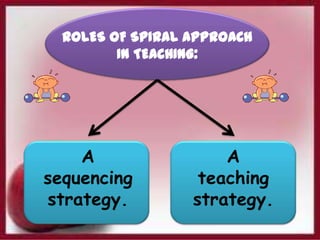
ROLES OF SPIRAL APPROACH
IN TEACHING:
A
sequencing
strategy.
A
teaching
strategy.
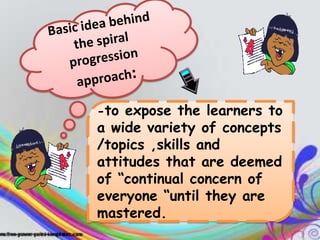
-to expose the learners to
a wide variety of concepts
/topics ,skills and
attitudes that are deemed
of “continual concern of
everyone “until they are
mastered.
A spiral curriculum
design is one in which
“key concepts are
presented repeatedly
throughout the curriculum,
but with deepening layers
of complexity.”
After a mastery of the initial
topic, the student “spirals
upwards” as the new knowledge is
introduced in next lessons,
enabling him/her to reinforce
what is already learned. In the
end, a rich breadth and depth of
knowledge is achieved.
With this procedure, two
purposes are served :
1. The previously learned
concept is reviewed hence
improving its retention
2. The topic may be
progressively elaborated
when it is reintroduced
leading to a broadened
understanding and transfer
of learning.
In structuring a course, certain
prequisite knowledge and skills must be first
mastered which in turn provides linkages
between each lesson as the students “spirals
upwards” in a course of study.
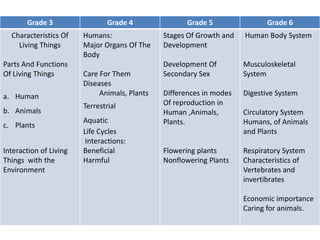
Grade 3 Grade 4 Grade 5 Grade 6
Characteristics Of
Living Things
Parts And Functions
Of Living Things
a. Human
b. Animals
c. Plants
Interaction of Living
Things with the
Environment
Humans:
Major Organs Of The
Body
Care For Them
Diseases
Animals, Plants
Terrestrial
Aquatic
Life Cycles
Interactions:
Beneficial
Harmful
Stages Of Growth and
Development
Development Of
Secondary Sex
Differences in modes
Of reproduction in
Human ,Animals,
Plants.
Flowering plants
Nonflowering Plants
Human Body System
Musculoskeletal
System
Digestive System
Circulatory System
Humans, of Animals
and Plants
Respiratory System
Characteristics of
Vertebrates and
invertibrates
Economic importance
Caring for animals.
The Learning Spiral
Is a curriculum design
framework which will help
science teachers construct
lessons, activities or projects
that target the development of
thinking skills and dispositions
which do not stop at
identification , instead facilitate
implementation of the desired
performance.
• Is a curriculum design tool which
will help develop concrete and
practical thinking-centered lessons
that make students performances
of understanding explicit .it may
be used to structure an entire
project which can readily fit into
the regular curriculum and can
help design thinking centered
lessons..
Learn with focus on the learners,
and
learning in a real situation as the
teachers facilitate their students
to learn from experience,
activities and work, leading to
the development of learners in all
aspects , physical, mental,
emotional, social and intellectual.
The learner-
centered approach is characterized
by:
 In adopting the spiral
approach, the teachers will be
enriched with varied experiences
in preparing every science lesson
and curriculum a proper blending
of concepts, skills and values
from the natural and physical
sciences and appropriately
sequenced from a start upward
according to the level of difficulty.
One should always
remember that one keeps
moving upward, but keeps
returning to the
fundamentals through
reviews but adding more.
His idea was that transfer of thinking
processes from one context to another
required students to learned the
fundamental principles of subjects and
to explore ideas on a deeper level
rather than just mastering facts and
rote learning procedures.
BRUNER emphasized the gains that
can be acquired by developing students
powers of analysis ,judgment and
memory in order to increase capacity
to transfer learning into new students.
In the spiral
progression
approach, the
first basic
facts of a
subject are
learned
without
worrying
about details.
In spiral
teaching ,
teacher
moves
upward but
keeps
returning to
the
fundamentals
Mylene Mendez
Joy Desire Moldez
Charo Montenegro
Ivy Mariel Najarro
R

Spiral progression in Science

  • 1.
    A New FeatureTo The K To 12 Curriculum
  • 2.
  • 3.
    The spiral approachis a technique often used in teaching where first the basic facts of a subject are learned, without worrying about details. Then as learning progresses, more and more details are introduced, while at the same time they are related to the basics which are reemphasized many times to help enter them into long-term memory. What is a spiral approach?
  • 4.
    ROLES OF SPIRALAPPROACH IN TEACHING: A sequencing strategy. A teaching strategy.
  • 5.
    -to expose thelearners to a wide variety of concepts /topics ,skills and attitudes that are deemed of “continual concern of everyone “until they are mastered.
  • 6.
    A spiral curriculum designis one in which “key concepts are presented repeatedly throughout the curriculum, but with deepening layers of complexity.”
  • 7.
    After a masteryof the initial topic, the student “spirals upwards” as the new knowledge is introduced in next lessons, enabling him/her to reinforce what is already learned. In the end, a rich breadth and depth of knowledge is achieved.
  • 8.
    With this procedure,two purposes are served : 1. The previously learned concept is reviewed hence improving its retention 2. The topic may be progressively elaborated when it is reintroduced leading to a broadened understanding and transfer of learning.
  • 9.
    In structuring acourse, certain prequisite knowledge and skills must be first mastered which in turn provides linkages between each lesson as the students “spirals upwards” in a course of study.
  • 10.
    Grade 3 Grade4 Grade 5 Grade 6 Characteristics Of Living Things Parts And Functions Of Living Things a. Human b. Animals c. Plants Interaction of Living Things with the Environment Humans: Major Organs Of The Body Care For Them Diseases Animals, Plants Terrestrial Aquatic Life Cycles Interactions: Beneficial Harmful Stages Of Growth and Development Development Of Secondary Sex Differences in modes Of reproduction in Human ,Animals, Plants. Flowering plants Nonflowering Plants Human Body System Musculoskeletal System Digestive System Circulatory System Humans, of Animals and Plants Respiratory System Characteristics of Vertebrates and invertibrates Economic importance Caring for animals.
  • 11.
    The Learning Spiral Isa curriculum design framework which will help science teachers construct lessons, activities or projects that target the development of thinking skills and dispositions which do not stop at identification , instead facilitate implementation of the desired performance.
  • 12.
    • Is acurriculum design tool which will help develop concrete and practical thinking-centered lessons that make students performances of understanding explicit .it may be used to structure an entire project which can readily fit into the regular curriculum and can help design thinking centered lessons..
  • 13.
    Learn with focuson the learners, and learning in a real situation as the teachers facilitate their students to learn from experience, activities and work, leading to the development of learners in all aspects , physical, mental, emotional, social and intellectual. The learner- centered approach is characterized by:
  • 14.
     In adoptingthe spiral approach, the teachers will be enriched with varied experiences in preparing every science lesson and curriculum a proper blending of concepts, skills and values from the natural and physical sciences and appropriately sequenced from a start upward according to the level of difficulty.
  • 15.
    One should always rememberthat one keeps moving upward, but keeps returning to the fundamentals through reviews but adding more.
  • 16.
    His idea wasthat transfer of thinking processes from one context to another required students to learned the fundamental principles of subjects and to explore ideas on a deeper level rather than just mastering facts and rote learning procedures. BRUNER emphasized the gains that can be acquired by developing students powers of analysis ,judgment and memory in order to increase capacity to transfer learning into new students.
  • 17.
    In the spiral progression approach,the first basic facts of a subject are learned without worrying about details. In spiral teaching , teacher moves upward but keeps returning to the fundamentals
  • 18.
    Mylene Mendez Joy DesireMoldez Charo Montenegro Ivy Mariel Najarro R