Bacterial Exanthems Part II:
Scarlet Fever:
Definition and nomenclature:
• A disease manifested by pharyngitis, fever and a
distinctive scarlatiniform rash caused by
toxin‐producing group A β‐haemolytic streptococci,
Synonyms and inclusions:
• Scarlatina
Epidemiology:
Incidence and prevalence
• The disease occurs worldwide.
Age
• Scarlet fever is mainly a disease of young children
who do not have protective antibodies against
streptococcal exotoxins.
• Most cases between the ages of 5 and 15 years
although infections are reported in infancy and
adults.
Epidemiology Contd:
Sex
• Equal ratio of males and females.
Ethnicity
• More common in conditions of overcrowding, least
affluent populations and areas of poor sanitation.
Associated diseases
• Rheumatic fever,
• Poststreptococcal glomerulonephritis,
• Osteomyelitis.
Pathophysiology:
Predisposing factors:
• An acute infection caused by strains of
Streptococcus pyogenes producing pyrogenic
exotoxin (erythrogenic toxin, erythrotoxin), of
which there are three types, A, B and C
• All three are capable of producing scarlet fever.
• Type A is believed to have been responsible for the
severe disease seen several decades ago.
Pathology:
• The Erythrogenic toxin is responsible for:
– cutaneous vasodilatation, which is associated with
oedema and a perivascular cellular infiltrate.
– A degenerative myocarditis.
• The Bacterial component of the syndrome causes:
– septic lesions in many organs, with abscess formation.
• The Immunologic component causes:
– Glomerulonephritis
– Rheumatiic Fever
• An attack with a rash confers permanent, specific
antitoxic immunity. The toxin produced by other
strains is not neutralized, hence second attacks,
although rare, can occur.
Causative organisms:
Streptococcus pyogenes.
Sources of infection:
– Droplet infection is the commonest
– Surgical and other wounds may be the source
– Spread by fomites or
– By milk.
A 1930s American poster attempting to
curb the spread of such diseases as
scarlet fever by regulating milk supply
Clinical Features:
Clinical features:
• Incubation period: 2–5 days
• Abrupt onset with: Fever, anorexia and vomiting.
• Cutaneous Findings:
– Rash:
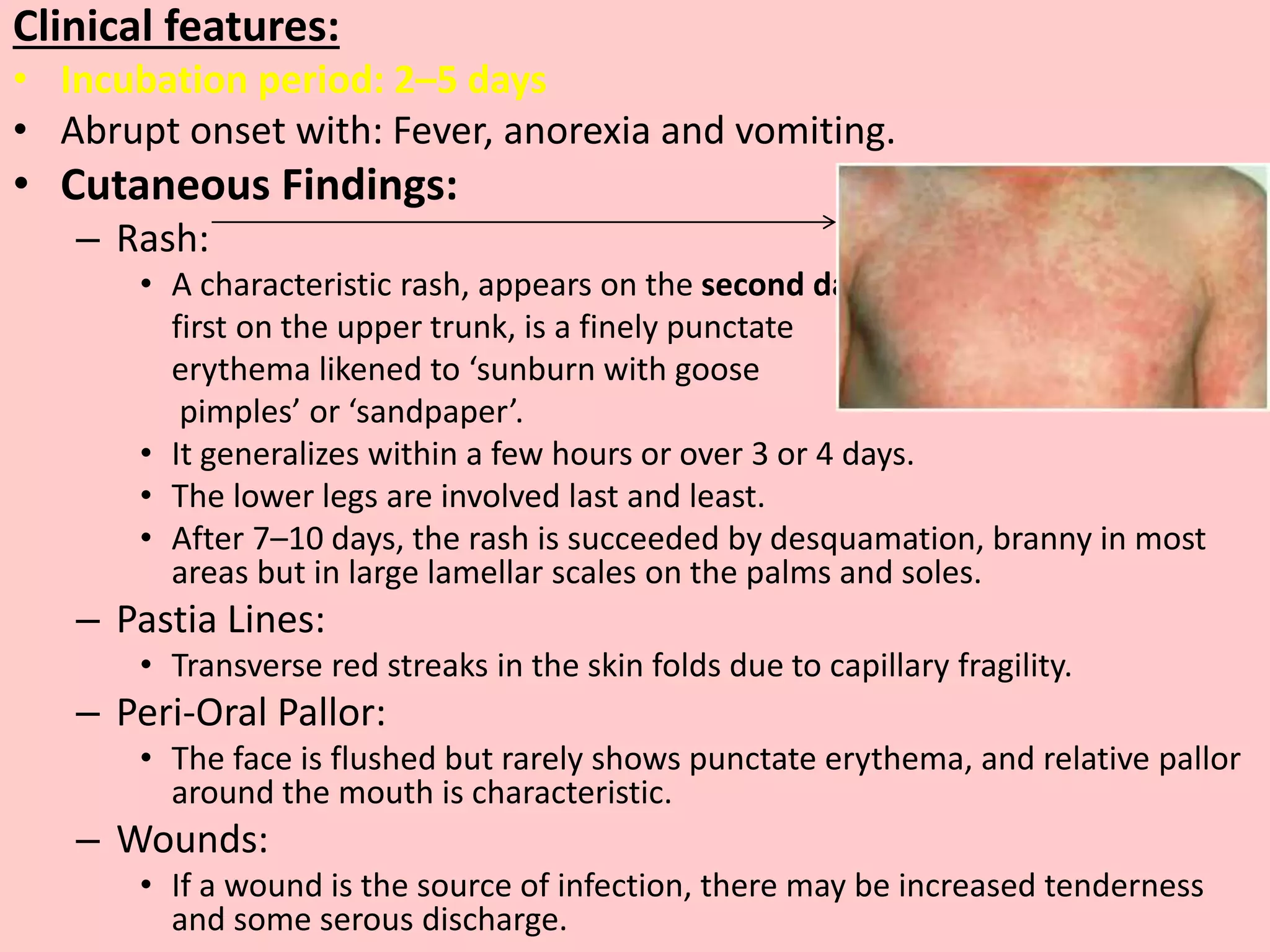
• A characteristic rash, appears on the second day,
first on the upper trunk, is a finely punctate
erythema likened to ‘sunburn with goose
pimples’ or ‘sandpaper’.
• It generalizes within a few hours or over 3 or 4 days.
• The lower legs are involved last and least.
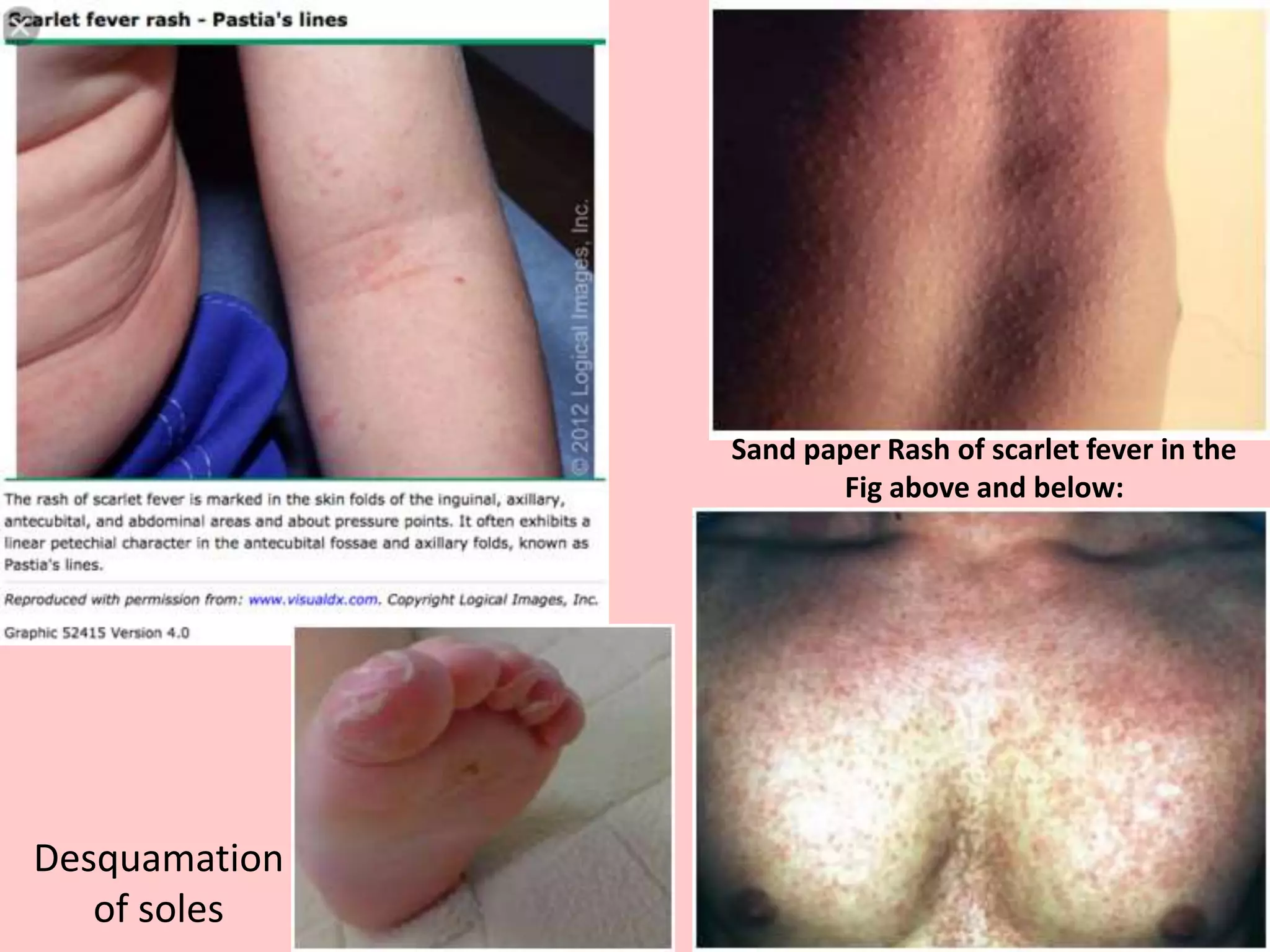
• After 7–10 days, the rash is succeeded by desquamation, branny in most
areas but in large lamellar scales on the palms and soles.
– Pastia Lines:
• Transverse red streaks in the skin folds due to capillary fragility.
– Peri-Oral Pallor:
• The face is flushed but rarely shows punctate erythema, and relative pallor
around the mouth is characteristic.
– Wounds:
• If a wound is the source of infection, there may be increased tenderness
and some serous discharge.
Sand paper Rash of scarlet fever in the
Fig above and below:
Desquamation
of soles
Time Line for Cutaneous Manifestations:
Clinical Features Contd:
• Mucous Membranes:
– Tonsils:
• If the throat is the portal of entry, there is an acute follicular or
membranous tonsillitis, with painful lymphadenopathy
– Oral mucous membranes:
• Are bright red and there may be deeper red puncta on the palate.
– Tongue:
• White Strawberry tongue: initially heavily coated tongue, but by the
second or third day scattered swollen red papillae give the ‘white
strawberry tongue’ appearance.
• Red Strawberry Tongue: As the epithelium is shed in 2-3 days, the
tongue becomes smooth and dark red before returning to normal.
• Fever usually settles in 7–10 days.
• Patient is infectious up to 7 days before the symptoms start until
24 hours after starting the first antibiotic tablet.
White Strawberry Tongue
Red Strawberry Tongue
Clinical Features Contd:
• In the severe toxic form:
– Eruption is very intense and may be purpuric.
– Fever is high
– Patient is delirious or comatose.
– Myocarditis is often present.
• In the septic forms:
– Local pharyngeal lesions are severe and
– Extensive oedema.
– Otitis media
– Peritonsillar abscesses
Differential diagnosis:
• Rubella,
• Early stage of smallpox,
• Drug reactions
• Erythema Infectiosum
• Epstein-Barr Virus (EBV) Infectious Mononucleosis
• Kawasaki Disease
• Measles
• Toxic Shock Syndrome
• Recurrent scarlatiniform erythema caused by
Yersinia pseudotuberculosis.
• Some staphylococcal infections are accompanied by
scarlatiniform erythema
Complications and co‐morbidities:
• Complications due to the toxin:
– myocarditis
• Complications due to Bacterial invasion of the tissues
by local extension or by haematogenous dissemination:
– Hepatitis,
– Arthritis,
– Meningitis and
– Osteomyelitis.
– Otitis Media
– Peritonsillar abscess
• Complications due to Allergic Reaction:
– Rheumatic fever and
– Glomerulonephritis
Disease course and prognosis:
• Good prognosis
• Mortality is under 1%.
• Second attacks are more frequent in patients in
whom early antibiotic control of the initial attack
has impaired an adequate immune response
Investigations:
• Throat swab culture of group A β‐haemolytic
Streptococcus,
• Rapid Antigen Detection Tests:
– Done in the doctor's office.
– Performed by swabbing the back of the throat.
– The bacterial swab is then subjected to either
enzymes or acid to extract parts of the
Strep pyogenes bacteria. Results are available in 10 to 20 minutes.
• Rising antistreptolysin‐O titre
• The Schultz–Charlton test:
– Blanching of the rash around the point of injection of antitoxin.
• Complete Blood Count:
– polymorphonuclear leukocytosis.
Management:
• Goals of the treatment of scarlet fever are:
– To prevent acute rheumatic fever,
– To reduce the spread of infection,
– To prevent poststreptococcal glomerulonephritis and
suppurative sequelae (eg, adenitis, mastoiditis,
abscesses, cellulitis), and
– To shorten the course of illness.
Symptomatic Treatment:
• Paracetamol or Ibuprofen for fever
• Rest and hydration
• Stay away from nursery, school or work for 24 hours
after starting the antibiotic.
• Avoid sharing utensils and fomites
• Avoid contact with at risk patients for e.g.
immunocompromised patients
Specific Treatment:
• Penicillin remains the mainstay of antibiotic treatment of scarlet fever
and should be given in full dosage for 10 days as soon as the
diagnosis is suspected
Future Topic to be discussed:
• Staphylococcal Scalded Skin Syndrome.
Previously Discussed Topics:
• Viral warts and Anogenital warts
• Epidermodysplasia verruciformis
• Mealses
• Rubella
• Erythema Infectiosum
• Roseola Infantum
• Infectious Mononucleosis
• Cytomegalovirus Infection
• Molluscum contagiosum
• Toxic Shock Syndrome.
Scarlet Fever Made Very Simple and Easy

Scarlet Fever Made Very Simple and Easy

  • 1.
    Bacterial Exanthems PartII: Scarlet Fever:
  • 2.
    Definition and nomenclature: •A disease manifested by pharyngitis, fever and a distinctive scarlatiniform rash caused by toxin‐producing group A β‐haemolytic streptococci, Synonyms and inclusions: • Scarlatina
  • 3.
    Epidemiology: Incidence and prevalence •The disease occurs worldwide. Age • Scarlet fever is mainly a disease of young children who do not have protective antibodies against streptococcal exotoxins. • Most cases between the ages of 5 and 15 years although infections are reported in infancy and adults.
  • 4.
    Epidemiology Contd: Sex • Equalratio of males and females. Ethnicity • More common in conditions of overcrowding, least affluent populations and areas of poor sanitation. Associated diseases • Rheumatic fever, • Poststreptococcal glomerulonephritis, • Osteomyelitis.
  • 5.
    Pathophysiology: Predisposing factors: • Anacute infection caused by strains of Streptococcus pyogenes producing pyrogenic exotoxin (erythrogenic toxin, erythrotoxin), of which there are three types, A, B and C • All three are capable of producing scarlet fever. • Type A is believed to have been responsible for the severe disease seen several decades ago.
  • 6.
    Pathology: • The Erythrogenictoxin is responsible for: – cutaneous vasodilatation, which is associated with oedema and a perivascular cellular infiltrate. – A degenerative myocarditis. • The Bacterial component of the syndrome causes: – septic lesions in many organs, with abscess formation. • The Immunologic component causes: – Glomerulonephritis – Rheumatiic Fever • An attack with a rash confers permanent, specific antitoxic immunity. The toxin produced by other strains is not neutralized, hence second attacks, although rare, can occur.
  • 7.
    Causative organisms: Streptococcus pyogenes. Sourcesof infection: – Droplet infection is the commonest – Surgical and other wounds may be the source – Spread by fomites or – By milk. A 1930s American poster attempting to curb the spread of such diseases as scarlet fever by regulating milk supply
  • 9.
  • 10.
    Clinical features: • Incubationperiod: 2–5 days • Abrupt onset with: Fever, anorexia and vomiting. • Cutaneous Findings: – Rash: • A characteristic rash, appears on the second day, first on the upper trunk, is a finely punctate erythema likened to ‘sunburn with goose pimples’ or ‘sandpaper’. • It generalizes within a few hours or over 3 or 4 days. • The lower legs are involved last and least. • After 7–10 days, the rash is succeeded by desquamation, branny in most areas but in large lamellar scales on the palms and soles. – Pastia Lines: • Transverse red streaks in the skin folds due to capillary fragility. – Peri-Oral Pallor: • The face is flushed but rarely shows punctate erythema, and relative pallor around the mouth is characteristic. – Wounds: • If a wound is the source of infection, there may be increased tenderness and some serous discharge.
  • 11.
    Sand paper Rashof scarlet fever in the Fig above and below: Desquamation of soles
  • 12.
    Time Line forCutaneous Manifestations:
  • 13.
    Clinical Features Contd: •Mucous Membranes: – Tonsils: • If the throat is the portal of entry, there is an acute follicular or membranous tonsillitis, with painful lymphadenopathy – Oral mucous membranes: • Are bright red and there may be deeper red puncta on the palate. – Tongue: • White Strawberry tongue: initially heavily coated tongue, but by the second or third day scattered swollen red papillae give the ‘white strawberry tongue’ appearance. • Red Strawberry Tongue: As the epithelium is shed in 2-3 days, the tongue becomes smooth and dark red before returning to normal. • Fever usually settles in 7–10 days. • Patient is infectious up to 7 days before the symptoms start until 24 hours after starting the first antibiotic tablet.
  • 14.
    White Strawberry Tongue RedStrawberry Tongue
  • 16.
    Clinical Features Contd: •In the severe toxic form: – Eruption is very intense and may be purpuric. – Fever is high – Patient is delirious or comatose. – Myocarditis is often present. • In the septic forms: – Local pharyngeal lesions are severe and – Extensive oedema. – Otitis media – Peritonsillar abscesses
  • 17.
    Differential diagnosis: • Rubella, •Early stage of smallpox, • Drug reactions • Erythema Infectiosum • Epstein-Barr Virus (EBV) Infectious Mononucleosis • Kawasaki Disease • Measles • Toxic Shock Syndrome • Recurrent scarlatiniform erythema caused by Yersinia pseudotuberculosis. • Some staphylococcal infections are accompanied by scarlatiniform erythema
  • 18.
    Complications and co‐morbidities: •Complications due to the toxin: – myocarditis • Complications due to Bacterial invasion of the tissues by local extension or by haematogenous dissemination: – Hepatitis, – Arthritis, – Meningitis and – Osteomyelitis. – Otitis Media – Peritonsillar abscess • Complications due to Allergic Reaction: – Rheumatic fever and – Glomerulonephritis
  • 19.
    Disease course andprognosis: • Good prognosis • Mortality is under 1%. • Second attacks are more frequent in patients in whom early antibiotic control of the initial attack has impaired an adequate immune response
  • 20.
    Investigations: • Throat swabculture of group A β‐haemolytic Streptococcus, • Rapid Antigen Detection Tests: – Done in the doctor's office. – Performed by swabbing the back of the throat. – The bacterial swab is then subjected to either enzymes or acid to extract parts of the Strep pyogenes bacteria. Results are available in 10 to 20 minutes. • Rising antistreptolysin‐O titre • The Schultz–Charlton test: – Blanching of the rash around the point of injection of antitoxin. • Complete Blood Count: – polymorphonuclear leukocytosis.
  • 21.
    Management: • Goals ofthe treatment of scarlet fever are: – To prevent acute rheumatic fever, – To reduce the spread of infection, – To prevent poststreptococcal glomerulonephritis and suppurative sequelae (eg, adenitis, mastoiditis, abscesses, cellulitis), and – To shorten the course of illness.
  • 22.
    Symptomatic Treatment: • Paracetamolor Ibuprofen for fever • Rest and hydration • Stay away from nursery, school or work for 24 hours after starting the antibiotic. • Avoid sharing utensils and fomites • Avoid contact with at risk patients for e.g. immunocompromised patients
  • 23.
    Specific Treatment: • Penicillinremains the mainstay of antibiotic treatment of scarlet fever and should be given in full dosage for 10 days as soon as the diagnosis is suspected
  • 24.
    Future Topic tobe discussed: • Staphylococcal Scalded Skin Syndrome. Previously Discussed Topics: • Viral warts and Anogenital warts • Epidermodysplasia verruciformis • Mealses • Rubella • Erythema Infectiosum • Roseola Infantum • Infectious Mononucleosis • Cytomegalovirus Infection • Molluscum contagiosum • Toxic Shock Syndrome.