DERMAL
TOXICOLOGY
www.mcqsinpharmacology.com
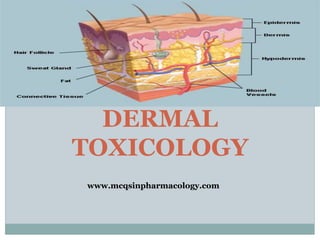
SKIN STRUCTURE
 Skin is a water resistant covering of multiple cell layers.
 It has three major divisions
 Epidermis
 Dermis
 Hypodermis
www.mcqsinpharmacology.com
 Epidermis has five layers(from superficial to deep)
 Stratum corneum
 Stratum lucidum
 Stratum granuolosum
 Stratum spinosum
 Stratum basale (include melanocytes)
or stratum germinativum
 Dermis
 Supported by network of loose
connective tissue containing
collagen and elastin.
www.mcqsinpharmacology.com
 Supplied by extensive blood vessels that are under active
neurogenic control.
 Hypodermis(fat storage)
 OTHER COMPONENETS OF SKIN:
 Hair follicles
 Sebaceous glands
 Sweat glands
www.mcqsinpharmacology.com
BIOTRANSFORMATION OF
XENOBIOTICS
 The deep layers of the epidermis have significant capability
to metabolize foreign compounds. The dermis has no
significant xenobiotic metabolizing ability.
 Compounds that are biotransformed in other organs are
delivered to the skin, where they exert toxic or
photodynamic activity that damages the skin.
www.mcqsinpharmacology.com
EXPOSURE TO TOXICANTS
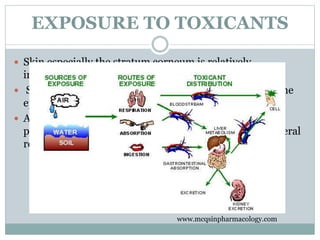
 Skin especially the stratum corneum is relatively
impermeable to water soluble substances.
 Small non polar lipophilic toxicants readily penetrate the
epidermis and are absorbed by dermal vasculature.
 Axillary, inguinal, mammary and scrotal skin is highly
permeable compared with the skin in the dorsal and lateral
regions of most of the mammals.
www.mcqsinpharmacology.com
DERMAL HYPERMIA
 Increases in environmental temperature may enhances
absorption e.g in hot climates, dermal hyperemia may
increase the toxicity of organophosphate insecticide to
mammals.
 Highly lipophilic substances that contain surfactants or
detergents.
www.mcqsinpharmacology.com
RESPONSE TO TOXICANTS
Irritation, degeneration and necrosis
Direct irritation of the skin by corrosive, caustic and
necrotizing chemicals elicits an inflammatory response.
Generally materials with less than pH 2 and Ph 12 are
strong irritants. e.g acids, alkalis and metal salts.
a) Agents that damage cell membrane results in irritation
followed by the cardinal signs of inflammation(i.e.
erythema, swelling , heat and pain) leucocytosis and
increased vascular permeability.
 Eschar formation, ulceration and necrosis may
permanently damage the skin.
www.mcqsinpharmacology.com
Chemicals associated with dermal
irritation, degeneration and necrosis
Acids
Alcohols
Alkalis
Hydrocarbon solvents(minerals,
turpentine, kerosene)
iodine
Arsenic
Detergents
Formaldehyde
Mercuric salts
Phenols
Thallium
www.mcqsinpharmacology.com
Allergic Contact
Dermatitis
 Some chemicals act as antigens by combining with a carrier
proteins, eliciting a response from cellular components of
the immune system.
 Langerhans’ cells in the epidermis process the antigen and
interact with appropriate T lymphocytes to form sensitized
T lymphocytes.
 Sensitized T lymphocytes react to later exposure to the
antigen by producing a variety of cytokines. The cytokines
initiate a series of changes that characterize the allergic
response(i.e. erythema, itching , edema)
Plants associated with allergic contact
dermatitis
www.mcqsinpharmacology.com
Photosensitization
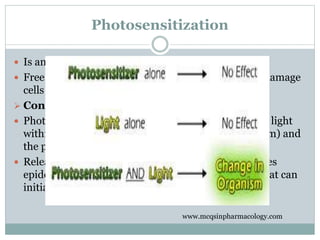
 Is an increase in susceptibility to ultraviolet light
 Free radicals produced by photodynamic reactions damage
cells and lysosomal membranes.
 Conditions lead to photosensitization
 Photosensitization depends on the absorption of UV light
within the specific range of wavelengths (280-790 nm) and
the presence of photodynamic agent in the skin.
 Released energy of the photodynamic agents damages
epidermal cell membrane and forms free radicals that can
initiate a chain reaction of membrane damage.
www.mcqsinpharmacology.com
 photosensitization is most prominent on areas of the body
where protection from sunlight is least effective.
 dorsal and lateral areas of the body
 thin and unpigmented skin of the body
 photosensitization is most likely to occur in sunny climates
and during the spring and summer when sunlight is more
intense or of longer duration each day.
www.mcqsinpharmacology.com
Clinical effects of photosensitization
 early signs of erythema and edema
 pruritis, photophobia and hyperesthesia follow
 serious signs that occur later in the course of the disease
include exudation of serum, formation of vesicles ,
ulceration, exfoliation of damaged epidermis, and,
possibly, blindness.
www.mcqsinpharmacology.com
Types of photosensitization
 primary photosensitization occurs when a
photodynamic agent is directly ingested, absorbed through
the skin, or injected, or when a chemical is biotransformed
to a photodynamic metabolite.
 the major effects of primary photosensitizers occur in the
skin; other organs are usually spared.
 prompt removal of the photosensitizer and supportive
treatment often results in recovery with new sequelae.
 secondary photosensitization occur as a result of
compromised liver function, which reduces the excretion of
plant pigment metabolites from the body.
www.mcqsinpharmacology.com
 several toxic plants are known to cause hepatogenous
photosensitization.
 normally chlorophyll is metabolized to phylloerythrin by
intestinal and colonic bacteria. Phylloerythrin reabsorbed
from the gut is conjugated by the liver and excreted in the
bile.
 failure of the liver to conjugate or excrete phylloerythrin
allows it to accumulate in the dermal vasculature, where it
is activated to a photodynamic state by ultraviolet light.
 Liver damage and involvement of other organ system may
accompany the expected skin related signs of
photosensitization.
www.mcqsinpharmacology.com
Cutaneous Porphyrias(Vampires disease)
 porphyria, which can cause photosensitization, is the
presence of abnormal levels of porphyrins in the blood as a
result of abnormal heme synthesis.
www.mcqsinpharmacology.com
Hyperkeratosis
 is the abnormal proliferation or keratinization of the
superficial epidermis .Toxicants include highly chlorinated
naphthalenes.
Alopecia
 associated with thallium, arsenic, and selenium toxicosis .
chemotherapy with cytostatic drugs.
Skin cancer
 Skin cancers are named after the type of skin cell from
which they arise.
 Basal cell carcinoma originates from the lowest layer of the
epidermis, and is the most common but least dangerous
skin cancer.
 Squamous cell carcinoma originates from the middle layer,
and is less common but more likely to spread and, if
untreated, become fatal.
 Melanoma, which originates in the pigment-producing cells
(melanocytes), is the least common, but most aggressive,
most likely to spread and, if untreated, become fatal.
www.mcqsinpharmacology.com
 Basal cell carcinoma
 Note the pearly translucency to
fleshy color, tiny blood vessels
on the surface, and sometime
ulceration which can be
characteristics. The key term is
translucency.
 Squamous cell carcinoma
 Commonly presents as a red,
crusted, or scaly patch or bump.
Often a very rapid growing
tumor.
 Malignant melanoma
 The common appearance is an
asymmetrical area, with an
irregular border, color
variation, and often greater
than 6 mm diameter. www.mcqsinpharmacology.com
Causes
 Ultraviolet radiation from sun exposure is the primary
cause of skin cancer.
 HPV infections increase the risk of squamous cell
carcinoma.
 Some genetic syndromes
 Chronic non-healing wounds.
 Ionizing radiation, environmental carcinogens, artificial UV
radiation (e.g. tanning beds), aging, and light skin color
 The use of many immunosuppressive medication increase
the risk of skin cancer. Cyclosporin A, increases the risk
approximately 200 times, and azathioprine about 60 times
www.mcqsinpharmacology.com
Management
 Sunscreen is effective in prevention
 Surgical excision
 Radiation therapy
 Skin grafting
www.mcqsinpharmacology.com
References
 Toxicology by Osweiler
 www.google.com.pk
 www.medmerits.com
 www.google.com.pk
 www.webmd.com
 www.crystalspring.co.uk
 apps.ashland.edu
 www.ncbi.nlm.nih.gov
www.mcqsinpharmacology.com

Dermal toxicology

  • 1.
  • 2.
    SKIN STRUCTURE  Skinis a water resistant covering of multiple cell layers.  It has three major divisions  Epidermis  Dermis  Hypodermis www.mcqsinpharmacology.com
  • 3.
     Epidermis hasfive layers(from superficial to deep)  Stratum corneum  Stratum lucidum  Stratum granuolosum  Stratum spinosum  Stratum basale (include melanocytes) or stratum germinativum  Dermis  Supported by network of loose connective tissue containing collagen and elastin. www.mcqsinpharmacology.com
  • 4.
     Supplied byextensive blood vessels that are under active neurogenic control.  Hypodermis(fat storage)  OTHER COMPONENETS OF SKIN:  Hair follicles  Sebaceous glands  Sweat glands www.mcqsinpharmacology.com
  • 5.
    BIOTRANSFORMATION OF XENOBIOTICS  Thedeep layers of the epidermis have significant capability to metabolize foreign compounds. The dermis has no significant xenobiotic metabolizing ability.  Compounds that are biotransformed in other organs are delivered to the skin, where they exert toxic or photodynamic activity that damages the skin. www.mcqsinpharmacology.com
  • 6.
    EXPOSURE TO TOXICANTS Skin especially the stratum corneum is relatively impermeable to water soluble substances.  Small non polar lipophilic toxicants readily penetrate the epidermis and are absorbed by dermal vasculature.  Axillary, inguinal, mammary and scrotal skin is highly permeable compared with the skin in the dorsal and lateral regions of most of the mammals. www.mcqsinpharmacology.com
  • 7.
    DERMAL HYPERMIA  Increasesin environmental temperature may enhances absorption e.g in hot climates, dermal hyperemia may increase the toxicity of organophosphate insecticide to mammals.  Highly lipophilic substances that contain surfactants or detergents. www.mcqsinpharmacology.com
  • 8.
    RESPONSE TO TOXICANTS Irritation,degeneration and necrosis Direct irritation of the skin by corrosive, caustic and necrotizing chemicals elicits an inflammatory response. Generally materials with less than pH 2 and Ph 12 are strong irritants. e.g acids, alkalis and metal salts. a) Agents that damage cell membrane results in irritation followed by the cardinal signs of inflammation(i.e. erythema, swelling , heat and pain) leucocytosis and increased vascular permeability.  Eschar formation, ulceration and necrosis may permanently damage the skin. www.mcqsinpharmacology.com
  • 9.
    Chemicals associated withdermal irritation, degeneration and necrosis Acids Alcohols Alkalis Hydrocarbon solvents(minerals, turpentine, kerosene) iodine Arsenic Detergents Formaldehyde Mercuric salts Phenols Thallium www.mcqsinpharmacology.com
  • 10.
    Allergic Contact Dermatitis  Somechemicals act as antigens by combining with a carrier proteins, eliciting a response from cellular components of the immune system.  Langerhans’ cells in the epidermis process the antigen and interact with appropriate T lymphocytes to form sensitized T lymphocytes.  Sensitized T lymphocytes react to later exposure to the antigen by producing a variety of cytokines. The cytokines initiate a series of changes that characterize the allergic response(i.e. erythema, itching , edema)
  • 11.
    Plants associated withallergic contact dermatitis www.mcqsinpharmacology.com
  • 12.
    Photosensitization  Is anincrease in susceptibility to ultraviolet light  Free radicals produced by photodynamic reactions damage cells and lysosomal membranes.  Conditions lead to photosensitization  Photosensitization depends on the absorption of UV light within the specific range of wavelengths (280-790 nm) and the presence of photodynamic agent in the skin.  Released energy of the photodynamic agents damages epidermal cell membrane and forms free radicals that can initiate a chain reaction of membrane damage. www.mcqsinpharmacology.com
  • 13.
     photosensitization ismost prominent on areas of the body where protection from sunlight is least effective.  dorsal and lateral areas of the body  thin and unpigmented skin of the body  photosensitization is most likely to occur in sunny climates and during the spring and summer when sunlight is more intense or of longer duration each day. www.mcqsinpharmacology.com
  • 14.
    Clinical effects ofphotosensitization  early signs of erythema and edema  pruritis, photophobia and hyperesthesia follow  serious signs that occur later in the course of the disease include exudation of serum, formation of vesicles , ulceration, exfoliation of damaged epidermis, and, possibly, blindness. www.mcqsinpharmacology.com
  • 15.
    Types of photosensitization primary photosensitization occurs when a photodynamic agent is directly ingested, absorbed through the skin, or injected, or when a chemical is biotransformed to a photodynamic metabolite.  the major effects of primary photosensitizers occur in the skin; other organs are usually spared.  prompt removal of the photosensitizer and supportive treatment often results in recovery with new sequelae.  secondary photosensitization occur as a result of compromised liver function, which reduces the excretion of plant pigment metabolites from the body. www.mcqsinpharmacology.com
  • 16.
     several toxicplants are known to cause hepatogenous photosensitization.  normally chlorophyll is metabolized to phylloerythrin by intestinal and colonic bacteria. Phylloerythrin reabsorbed from the gut is conjugated by the liver and excreted in the bile.  failure of the liver to conjugate or excrete phylloerythrin allows it to accumulate in the dermal vasculature, where it is activated to a photodynamic state by ultraviolet light.  Liver damage and involvement of other organ system may accompany the expected skin related signs of photosensitization. www.mcqsinpharmacology.com
  • 17.
    Cutaneous Porphyrias(Vampires disease) porphyria, which can cause photosensitization, is the presence of abnormal levels of porphyrins in the blood as a result of abnormal heme synthesis. www.mcqsinpharmacology.com
  • 19.
    Hyperkeratosis  is theabnormal proliferation or keratinization of the superficial epidermis .Toxicants include highly chlorinated naphthalenes.
  • 20.
    Alopecia  associated withthallium, arsenic, and selenium toxicosis . chemotherapy with cytostatic drugs.
  • 21.
    Skin cancer  Skincancers are named after the type of skin cell from which they arise.  Basal cell carcinoma originates from the lowest layer of the epidermis, and is the most common but least dangerous skin cancer.  Squamous cell carcinoma originates from the middle layer, and is less common but more likely to spread and, if untreated, become fatal.  Melanoma, which originates in the pigment-producing cells (melanocytes), is the least common, but most aggressive, most likely to spread and, if untreated, become fatal. www.mcqsinpharmacology.com
  • 22.
     Basal cellcarcinoma  Note the pearly translucency to fleshy color, tiny blood vessels on the surface, and sometime ulceration which can be characteristics. The key term is translucency.  Squamous cell carcinoma  Commonly presents as a red, crusted, or scaly patch or bump. Often a very rapid growing tumor.  Malignant melanoma  The common appearance is an asymmetrical area, with an irregular border, color variation, and often greater than 6 mm diameter. www.mcqsinpharmacology.com
  • 23.
    Causes  Ultraviolet radiationfrom sun exposure is the primary cause of skin cancer.  HPV infections increase the risk of squamous cell carcinoma.  Some genetic syndromes  Chronic non-healing wounds.  Ionizing radiation, environmental carcinogens, artificial UV radiation (e.g. tanning beds), aging, and light skin color  The use of many immunosuppressive medication increase the risk of skin cancer. Cyclosporin A, increases the risk approximately 200 times, and azathioprine about 60 times www.mcqsinpharmacology.com
  • 24.
    Management  Sunscreen iseffective in prevention  Surgical excision  Radiation therapy  Skin grafting www.mcqsinpharmacology.com
  • 25.
    References  Toxicology byOsweiler  www.google.com.pk  www.medmerits.com  www.google.com.pk  www.webmd.com  www.crystalspring.co.uk  apps.ashland.edu  www.ncbi.nlm.nih.gov www.mcqsinpharmacology.com