DIFFERENTIAL DIAGNOSIS OF
PAPULAR LESIONS ON FACE
DR.MIKHIN GEORGE THOMAS
CLASSIFICATION
INFECTIONS
INFLAMMATORY DISORDERS
TUMOURS
OTHERS
INFECTIONS
• Molluscum contagiosum
• Tinea faciei
• Lupus vulgaris
• Demodicidosis
INFLAMMATORY DISORDERS
• Acne
• Rosacea
• Perioral dermatitis
• Lupus miliaris disseminatus faciei
• FACE
• Sarcoidosis
• Follicular mucinosis
• Pseudofolliculitis barbae
TUMOURS
BENIGN EPIDERMAL TUMORS
AND CYSTS:
DPN
Seborrhoeic keratosis
Keratoacanthoma
Milia
Tumors cont…
PREMALIGNANT
EPITHELIAL LESIONS
 Actinic keratosis
 Cutaneous horn
MALIGNANT
 Basal cell carcinoma
Tumors of skin appendages
• Eccrine gland tumors : syringoma, eccrine hidrocystoma
• Apocrine gland tumors : syringocystadenoma papilliferum
• Sebaceous gland tumors : sebaceoma, sebaceous adenoma,
sebaceous hyperplasia
• Tumor of hair follicle mesenchyme : trichodiscoma
• Hair follicle tumors : dilated pore, trichoadenoma
• External root sheath tumors : trichilemmoma
• Hamartomas : trichoepithelioma, trichofolliculoma
Soft tissue tumors
• Fibrous tumor : fibrous papule of face
• Fibrohistiocytic tumors : atypical fibroxanthoma
OTHERS
• Colloid milia
• Angiofibroma
INFECTIONS
MOLLUSCUM
CONTAGIOSUM
• Pox virus family
• MCV 1-4; majority : type 1
• Contact with infected persons or contaminated
objects, sexual abuse
• Peak incidence : 2-5 yrs
• IP: 14 days to 6 mths
• C/F : shiny, pearly white, hemispherical, umbilicated
papule, 5-10 mm
• Agminate form or giant molluscum
• Distribution depends on the mode of infection
• Widespread and refractory
mollusca on the face- HIV
infection and iatrogenic
immunosuppression.
• Viral entry into the basal layer
where an early increase in cell
division extends into the
supra basal layer.
• Molluscum bodies
Course & treatment :
Spontaneous clearance
• Curettage
• Cryotherapy
• Electrosurgery
• Phenol
• cantharidin
• tricholoroacetic acid
• pot.hydroxide solution
• topical salicylic acid preparations
tretinoin
• imiquimod cream
• cidofovir
LUPUS VULGARIS
• Chronic progressive post primary,
paucibacillary form of cutaneous tuberculosis
• Moderate or high degree of immunity
• Underlying focus- bone, joint or lymph node
• Haematogenous or lymphatic spread
• C/F: 80%- head and neck
India- buttocks and trunk
Initial lesion : small reddish brown plaque,
soft, with peripheral extension.
5 types: plaque, ulcerative, vegetating,
tumour like, papular and nodular forms.
• Diascopy : apple jelly nodules
• Diagnosis
• Treatment : standard ATT
• Differential diagnosis :
 Rosacea
 leprosy nodules: firmer
 Nodules of sarcoidosis :
resemble grains of sand
DEMODICIDOSIS
• Demodex folliculorum - follicle mite
• Areas of high sebum production
• Head down position in the follicle, 2-6 mites, motile
• Can produce papular and papulopustular lesions in
immunosuppressed individuals
• Pathogenic role: pityriasis folliculorum, rosacea, perioral
dermatitis, blepharitis
• Treatment : topical acaricides
TINEA FACIEI
• Ringworm of glabrous skin of face
• Trichophyton mentagrophytes, T.rubrum
• Direct inoculation or secondary spread from
other sites
• Itching, burning & exacerbation with sun
exposure
• Erythema +, Scaling less prominent
• Simple papular lesions or flat patches of
erythema
• D/D : PMLE and DLE
• Treatment : antifungals
TINEA BARBAE
• A disease of adult male
• Ringworm of beard and moustache areas of
face
• Invasion of coarse hairs
• Commonly farm workers
• Trichophyton verrucosum,
T.mentagrophytes
• C/F: highly inflammatory pustular
folliculitis
Hairs surrounded by red inflammatory
papules or pustules
Loose hairs in affected areas
• Treatment : antifungals
ACNE
• A chronic inflammatory disease of pilosebaceous units
• Usually starts in adolescence
• Seborrhoea , open & closed comedones, erythematous
papules & pustules, nodules, pseudocysts, scarring
• Pathogenesis : 4 factors
• 99% - lesions on face
• Early lesions – comedones
• Grading of acne
• Acne variants – infantile, occupational, mechanical,
tropical, acne excoriee, acne conglobata, acne fulminans
fulminans.
Treatment :
 Topicals – retinoids, benzoyl
peroxide, topical antibiotics,
nicotinamide, azelaic acid
 Physical modalities
 Systemic therapy : antibiotics,
oral retinoids, hormonal
therapy, zinc
 Acne surgery
Differential diagnosis :
rosacea, perioral dermatitis,
gram negative folliculitis
ROSACEA
• A vascular disorder affecting central face
• Presence of one or more of the following:
flushing, non transient erythema, papules and
pustules, telangiectasia
• Not a disorder of sebaceous glands, absence of
comedones
• Pathogenesis :
o Damage to dermal connective tissue
o Abnormal vascular reactivity
o Sensitivity to noxious stimuli
o High levels of cathelicidin
o H.pylori, Demodex folliculorum
Cont…
• Early : episodic flushing, mild telangiectasia, transient
edema
• Progressive : papules, pustules, sustained edema, extensive
telangiectasia
• Late : induration, rhinophyma
• Lymphoedema, eye involvement, salivary gland involvement
• Histopathology :
– Dilated capillaries & lymphatic channels in mid dermis
– Perivascular lymphohistiocytic infiltrates
– Solar elastosis
– Sometimes granulomas
– Pustules – neutrophilic infiltration
• Treatment
• Topical : metronidazole, tretinoin,
clindamycin, tacrolimus, azelaic acid
• Systemic : tetracyclines, metronodazole, isotretinoin
• Rhinophyma : surgical excision, intense pulsed light lasers,
dermabrasion
PERIORAL DERMATITIS
• Persistent erythematous eruption
of tiny papules and papulopustules
– perioral
• Periocular dermatitis
• Pathogenesis :
 Demodex, candida , fusiform
bacteria
 Irritant and allergic contact factors
 Atopy
 Topical steroids, cosmetic products
 Hormonal factors, sensititvity to
sunlight
Cont..• Begins in nasolabial areas  perioral areas; sparing lip
margins
• Monomorphic papules & pustules
• Histopathology – eczematous changes, mononuclear
infiltrate; rarely granulomatous inflammation
• Treatment
– Discontinue topical steroids
– Avoid potential contact allergens
– Oral tetracyclines for 4 weeks
– Topical tetracycline, metronidazole, erythromycin
– Pimecrolimus 1% cream
ACNE AGMINATA
• Lupus miliaris disseminatus faciei – historical
• Acnitis or FIGURE
• A self limiting variant of granulomatous form of rosacea
• C/F : Multiple, monomorphic, symmetrical, reddish-brown
papules on the chin, forehead, cheeks and eyelids
• Clustering around mouth or eyelids or eyebrows - ‘agminata’
• Diascopy – apple jelly nodules
• Granulomatous histology with large area of caseation
• D/D : micropapular sarcoidosis
• Treatment : tetracyclines, dapsone, low dose prednisolone
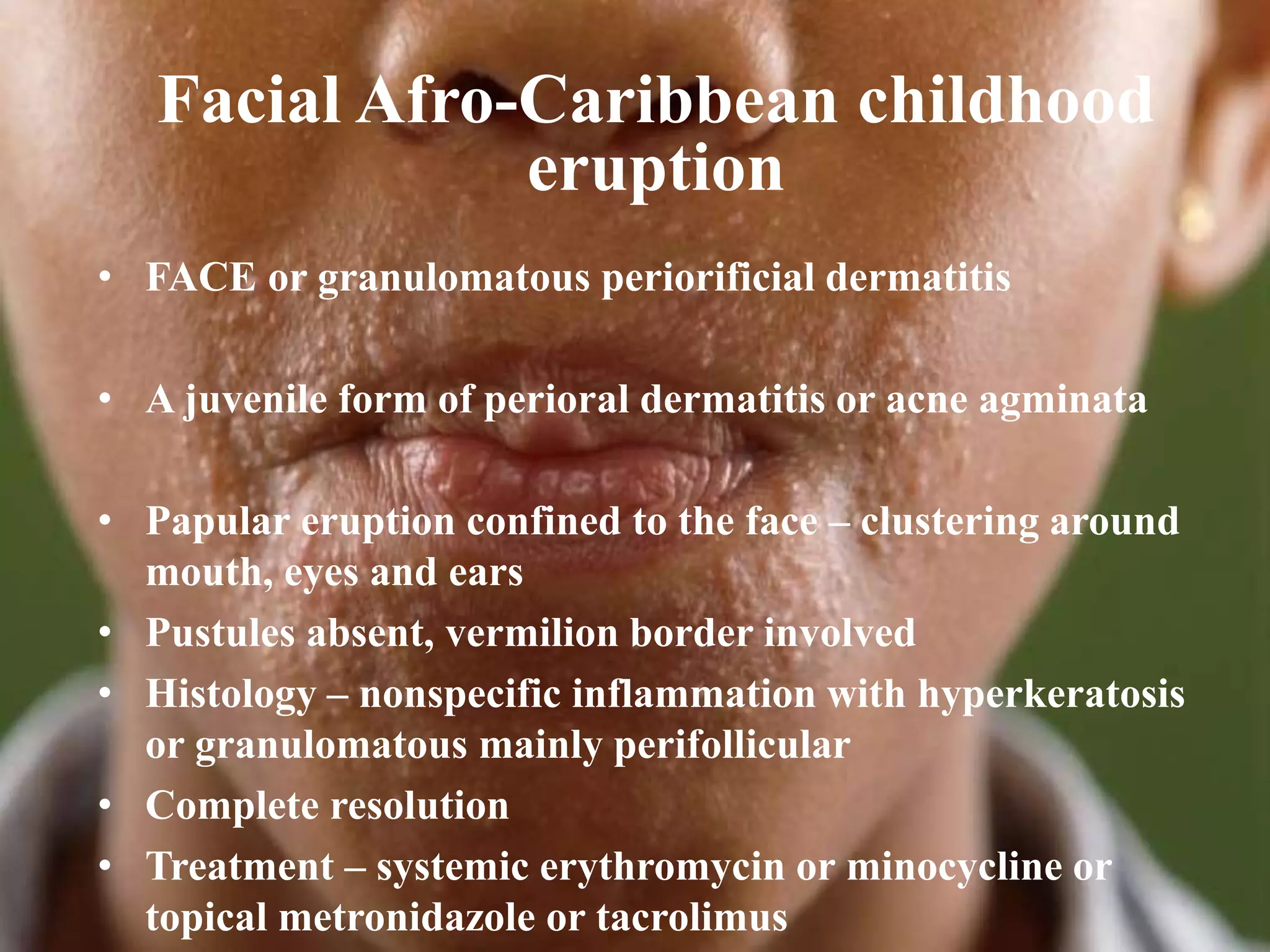
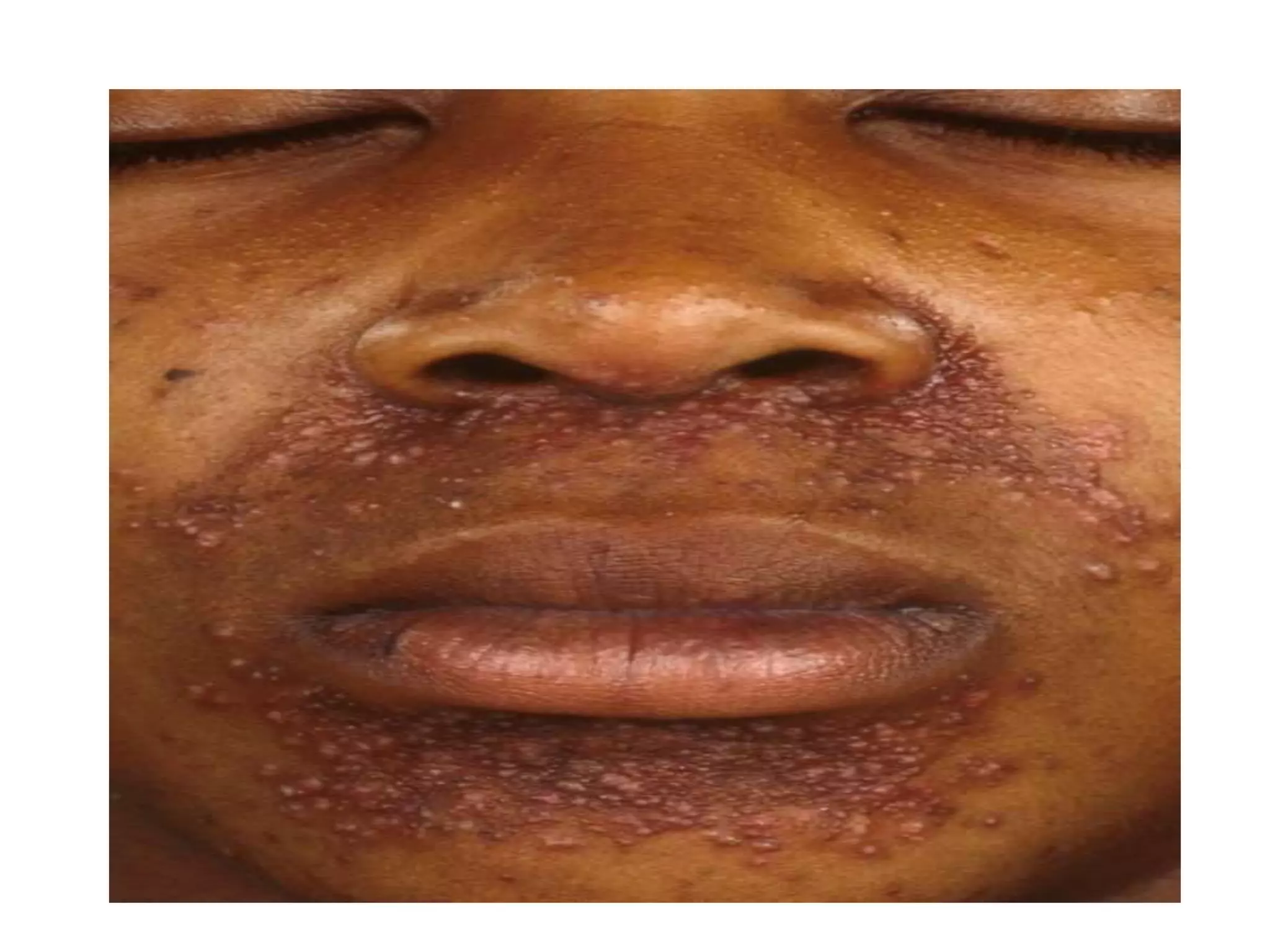
Facial Afro-Caribbean childhood
eruption
• FACE or granulomatous periorificial dermatitis
• A juvenile form of perioral dermatitis or acne agminata
• Papular eruption confined to the face – clustering around
mouth, eyes and ears
• Pustules absent, vermilion border involved
• Histology – nonspecific inflammation with hyperkeratosis
or granulomatous mainly perifollicular
• Complete resolution
• Treatment – systemic erythromycin or minocycline or
topical metronidazole or tacrolimus
SARCOIDOSIS
• A disease characterised by formation in all or
several affected organs or tissues of epithelioid cell
tubercles, without caseation, proceeding either to
resolution or to conversion into hyaline fibrous
tissue.
• Etiology : genetic factors, infectious agents,
immunological response
• Acute and subacute : erythematopapular lesions, scar
sarcoidosis , papular and lichenoid variety
• Sub acute and chronic : erythrodermic, nodular, annular,
angiolupoid, subcutaneous
• Chronic : plaque ( lupus pernio)
• Others : ulcerative, psoriasiform, palmoplantar, ungual,
mucosal
• Systemic features : cardiac, respiratory, muscle, CNS,
ocular, renal, liver, spleen, lymphnodes
• Raised ACE levels , hypercalcemia
Cont…Histopathology
– Well defined aggregates of epithelioid cells
– Few Langhan’s type giant cells
– Naked tubercle – paucity of lymphocytes
– MNG cells with asteroid bodies and Schaumann bodies
Treatment :
– Corticosteroids
– Immunosuppressants
– Biologics
– Other drugs – allopurinol,
doxycycline, chloroquine,
minocycline, levamisole,
isotretinoin, fumaric acid
esters, thalidomide
– Topical therapy – high potent
topical steroids, ILS,
tacrolimus
– PUVA, cryotherapy,
radiotherapy
FOLLICULAR MUCINOSIS
• Alopecia mucinosa
• 2 distinct forms: associated with MF and benign inflammatory form
• C/F are identical : follicular papules and boggy cutaneous plaques
• Severe pruritus and prediliction for face and scalp
• Prominent giant comedones and alopecia
• Pathology : degeneration of involved hair follicles with a prominent
pilotropic atypical T cell infiltrate, inter follicular epidermotropism
• CD3+ve, CD4+ve and CD8 –ve
• Treatment : dapsone for inflammatory forms
Associated with MF: bexarotene, radiotherapy, total skin electron
beam therapy
PSEUDOFOLLICULITIS BARBAE
•Inflammation due to penetration into the skin of sharp tips
of shaved hairs
•If shaven too long – the hair may curve backwards after
emerging from the follicle to penetrate the adjacent skin
•If cut very short – it retracts into the follicle; may directly
penetrate the follicle wall
•Curly hair – more prone
•Male beard – commonest area
•Complications – keloid, hyperpigmentation
Treatment
• Stop shaving for 4-6 weeks
• Lifting out of reentrant hairs
• Hair maintained at 1 mm length
• Steroid-antibiotic combination
creams and emollients
• Hair removal with chemical
depilatories or topical
eflornithine hydrochloride cream
• Laser
TUMOURS
Benign epidermal tumors and
cysts
• DPN
• Seborrhoeic keratosis
• Milia
• Dermatosis papulosa nigra
• Pigmented papular eruption of face and neck
• Nevoid developmental defects of pilosebaceous
follicles
• Histology resembling seborrhoeic keratoses
• C/F: black or dark brown, flattened or
cupuliform papules 1-5 mm
• Malar regions and forehead
• Also on neck, chest and back
• Treatment : electrosurgery
SEBORRHOEIC
KERATOSIS
• Benign tumor of epidermal keratinocytes
• Increasing age ; 5th decade ; M=F
• Most frequent on face and upper trunk
• Classical, DPN, stucco keratosis
• Hyperpigmented papules or plaques
• Sign of Leser-Trelat
• Histopathological types : clonal, hyperkeratotic,
acanthotic, irritated, reticulate, melanoacanthoma
• Treatment : curettage, electrosurgery, cryotherapy
KERATOACANTHOMA
• Molluscum sebaceum
• Rapidly evolving tumor of the skin composed of
keratinizing squamous cells originating in pilosebaceous
follicles
• M>F; middle aged ; white races
• Etiology : sunexposure, tar and mineral oil, sorafenib
• C/F: firm, rounded, flesh colored or reddish papule
rapid growth phase- 10- 20mm
Telangiectasias, central horny plug or crust concealing a
keratin filled crater
• Central part of face – nose,
cheeks, eyelids and lips
• Usually solitary
• Histopathology : epidermis
normal or acanthotic, composed
of mass of rapidly multiplying
squamous cells,
hyperchromaticity, atypical
mitotic figures, dyskeratosis and
loss of polarity
• D/D : SCC
• Treatment : curettage and
coagulation of base, excision
and suture, radiotherapy, 5-FU.
MILIA
• Small subepidermal keratin cyst
• All ages ; from infancy onwards
• Due to pilosebaceous or eccrine sweat duct plugging
• Primary or secondary
• Subepidermal blistering diseases(BP , EB, PCT), burns,
dermabrasion, radiotherapy
• Firm white or yellowish 1-2mm dome
shaped papules, on cheeks and eyelids
of adults
• Eruptive milia- rare
• Milia en plaque
• Histopathology : small
cysts lined by stratified
epithelium few cell layers
thick and contain
concentric lamellae of
keratin
• D/D : milia are whiter and
more translucent than
syringomas
• Spontaneous clearance
• Treatment : incision and
squeezing of contents,
chemical cautery,
electrosurgery.
Tumors cont…
PREMALIGNANT
EPITHELIAL LESIONS
 Actinic keratosis
 Cutaneous horn
MALIGNANT
 Basal cell carcinoma
ACTINIC KERATOSIS
• Or solar keratosis
• Premalignant epithelial lesion
• Hyperkeratotic lesions on chronically light exposed
skin
• Low risk of progression to invasive SCC
• Middle aged or elderly; fair skinned
• Relapsing or remitting lesions
• Face, scalp and dorsa of hands
• C/F : multiple macules or papules with a rough scaly
surface, 1mm to 2 cms, aymptomatic
• Hyperemic base with punctate bleeding points
• Histopathology :
• Treatment : curettage and cautery, cryotherapy, topical
5-FU, imiquimod, photodynamic therapy, dermabrasion
and chemical peels
CUTANEOUS HORN
• Horny plugs or outgrowths due to various epidermal
changes
• Infection : molluscum, viral wart
• Benign: keratoacanthoma, seborrhoeic keratosis,
trichilemmal and epidermoid cyst
• Malignant : BCC, SCC
• C/F : hard yellowish brown horn, curved,
circumferential ridges, surrounded by normal
epidermis or acanthotic collarette
• Upper face and ears
• Inflammation and induration beneath : malignant
transformation
• Histology : absent granular layer, no atypicality
• Treatment : excision
BASAL CELL
CARCINOMA
• Basalioma or rodent ulcer
• Most common malignant tumour of skin ; rarely metastasizes
• Composed of cells similar to basal cells an appendages
• M>F
• Etiology: UV exposure, arsenic, ionizing radiations and burns,
mutations in PTCH1 gene, immunosuppression
• C/F : small, translucent or pearly papule, raised and rounded
areas covered by thin epidermis, dilated superficial vessels,
nodule or plaque
• Erosions & crusting common, sometimes ulcerate
• Types
Pathology
-Tumor cells resemble
basal cells of epidermis
-Peripheral palisading of
nuclei
-Stroma
-Clefting artefact
-Atypia
Treatment
– Surgical excision
– Non-surgical approaches:
curettage and cautery,
cryotherapy,
laser, topical imiquimod,
topical 5FU, PDT,
systemic retinoids
Tumors of skin appendages
 Eccrine gland tumors : syringoma, eccrine hidrocystoma
 Apocrine gland tumors : syringocystadenoma papilliferum
 Sebaceous gland tumors : sebaceoma, sebaceous adenoma,
sebaceous hyperplasia
 Tumor of hair follicle mesenchyme: trichodiscoma
 Hair follicle tumors : dilated pore, trichoadenoma
 External root sheath tumors : trichilemmoma
 Hamartomas : trichoepithelioma, trichofolliculoma
SYRINGOMA
• Benign tumor with differentiation
towards eccrine acrosyringium
• F>M
• C/F : numerous small, firm, smooth
skin colored or yellowish papules,
<3 mm
• Outline – angular or crenated
• Face esp lower eyelids
• Other sites: neck, chest, trunk,
axillae, vulva,ventral trunk.
• Eruptive syringomas : familial in
adolescent girls
• Histopathology :
 collections of convoluted and cystic
duct spaces in upper dermis
 Lined by double layer of cells
 Tail like strand of cells into the stroma-
‘tadpole or comma appearance’
• Treatment :
electrosurgery, cryotherapy, dermabrasion,
laser resurfacing
ECCRINE HIDROCYSTOMA
• Tumour by mature deformed eccrine sweat units; secretions dilate
the ducts
• Rare; middle aged women; exposure to heat
• Confined to cheeks and eyelids
• Cystic, blue, increase in size on exposure to heat and flattens with
exposure to cold
• Multiple, pigmented lesions on face
• Pathology : uni or multilocular dermal cystic lesion lined by 2 layers
of cells
• Inner layer- columnar , outer layer- myoepithelial cells
• Treatment : electrodessication, CO2 laser, pulse dye laser, excision
SYRINGOCYSTADENOMA
PAPILLIFERUM
• Exuberant proliferating lesion with apocrine differentiation
• Birth or childhood
• C/F : Multiple warty papules, translucent and pigmented
• Majority on face and scalp
• Pathology
– Papillomatosis with invaginations
– Cystic structures –
apocrine pattern
– Dermis – plasma cells
– Sometimes sebaceous, eccrine,
follicular differentiation
• Treatment – surgical excision
SEBACEOUS TUMOURS
• Sebaceous adenomas and
sebaceomas
• Benign tumors composed of
incompletely differentiated
sebaceous cells
• Rare; elderly
• C/F : rounded, raised, sessile or
pedunculated, <10 mm,waxy or
yellowish, plaques or ulceration
• Face and scalp
• Multiple - Muir Torre syndrome
• Pathology
– Sebaceoma – irregular cell masses of mostly undifferentiated
basaloid cells
– Sebaceous adenoma – sharply demarcated lesion with peripheral
basaloid cells and central mature sebaceous cells
• Treatment – surgical excision
SEBACEOUS HYPERPLASIA
• Benign proliferation in middle aged
and elderly
• Yellowish-pink papules 1-3 mm
• Forehead and temples
• Renal transplant patients on CsA
• Treatment – cautery, cryotherapy,
TCA, laser
TRICHODISCOMA
• Hamartomatous proliferation of
mesodermal component of the
Haarscheibe
• Haarscheibe – a slowly reacting
mechanoceptor associated with
hair follicle
• C/F : multiple, discrete, flat
topped papules 2-3 mm
• Central face
• Birt – Hogg- Dube syndrome
• Pathology : non encapsulated area
of myxoid, poorly cellular stroma
wirh focal collagen deposition in
dermis, proliferation of vessels
DILATED PORE
• Wiener’s pore or infundibuloma
• Area of expanded follicular infundibulum
• Dilated poral opening into subcutaneous
tissue
• C/F : comedo like lesion on head and neck
in elderly
• Pathology : wide crater like cavity, from
which acanthotic areas of follicular
epithelium radiate; follicle lined by outer
root sheath epithelium
TRICHOADENOMA
• Rare benign tumor, with multiple cystic
structures closely resembling
infundibular portion of hair follicle
• Differentiates towards follicular
infundibulum
• C/F : Papule or nodule on the face
• Pathology : lesions in upper dermis,
cluster of cysts
TRICHILEMMOMA
• Proliferation of external root sheath of hair
follicle
• Infundibular keratinisation
• C/F : small non specific papules on facial
skin in young adults
• Multiple : Cowden’s syndrome
• Pathology
– Lobular tumors extending from epidermis
– Clear cytoplasm – glycogen
– Peripheral palisading
– Sometimes prominent epidermal changes
– Variant – desmoplastic trichilemmoma
TRICHOEPITHELIOMA
• Hamartoma of the hair germ
composed of immature islands
of basaloid cells
• Focal primitive follicular
differentiation and induction of
a cellular stroma
• 3 forms : solitary, multiple and
desmoplastic
• Solitary- skin colored papules,
5-8 mm, on face esp around
nose, upper lips, cheeks
• Brooke spiegler syndrome –
trichoepitheliomas,
cylindromas and spiradenomas
• Pathology
– Well circumscribed lesion in
superficial dermis
– Horn cysts and basaloid cells
– Tumor islands show
peripheral palisading
• Treatment – surgical excision,
curettage, electrosurgery,
cryotherapy ,dermabrasion
TRICHOFOLLICULOMA
• Hamartoma of pilosebaceous follicle
• Several hairs form within the follicular
opening , protruding onto the epidermal
surface
• Young adults
• Prediliction for face
• C/F : small raised nodules, 2-3 hairs
protruding in a small tuft
• Pathology
– Cystic cavity lined by squamous
epithelium
– Keratinised material & fragments of hair
shafts
– Several pilosebaceous structures opening
into the canal
Treatment : excision
Soft tissue tumors
• Fibrous tumor : fibrous papule of face
• Fibrohistiocytic tumors : atypical fibroxanthoma
FIBROUS PAPULE OF FACE
• Benign tumor
• Small facial papule with distinctive
fibrovascular component
• C/F: slowly developing dome shaped skin
colored or red or pigmented papule, sessile,
• Nose, forehead, cheeks, chin or neck
• Pathology: normal epidermis, clear cells
overlying the lesion, increased collagen in
the dermis, dilated vascular channels,
increased cellularity
• Treatment : excision or surgical paring
ATYPICAL FIBROXANTHOMA
• Fibrohistiocytic tumor
• Sun damaged skin of elderly ; M>F
• UV induced p53 mutations
• C/F : papules or nodules with ulceration
, red fleshy appearance
• On ears, cheeks, bald scalp of elderly
males
• Local recurrence, metastasis to
lymphnodes and internal organs
• Pathology: large spindle shaped and
histiocytic cells, multinucleated in
dermis, mitotic figures, atypical forms
• Resembles a highly malignant soft
tissue sarcoma histologically
• Treatment : mohs micrographic surgery
COLLOID MILIA
• Degenerative change on light exposed skin
• Nonfamilial occurring in later life
• UV, trauma, hydroquinone
• C/F : small dermal papules, 1-2 mm, yellowish
brown , irregular groups
• Face esp around orbits, sides of neck, ears, dorsa of
hands and back.
• Rare juvenile and nodular form
• Histopathology : colloid globules at tips of dermal
papillae
• Treatment : electrosurgery, dermabrasion, Er:YAG
laser, topical retinoids
• Small flesh colored to brownish
red papules – usually on central
face
• Multiple lesions – Tuberous
Sclerosis Complex
• Composed of hyperplastic blood
vessels, sebaceous glands,
immature hair follicles
• Treatment – electrosurgery, laser
ANGIOFIBROMA
HOW TO
APPROACH??
Onset
Duration
Evolution
Mucosal lesions
Systemic Complaints
Treatment history
? Symptomatic
Triggering factors
Photosensitivity
Past history
HISTORY
Morphology of predominant lesion
Number of lesions, symmetry
Size, colour and surface
? Flat topped ? Translucent
Umbilication? Erythema ? Telangiectasia
Annular lesions
Diascopy
Other types of lesions
? Scarring ? Ulceration
Distribution over face
Nasolabial fold, perioral & periocular regions
Involvement of other areas
Other systems
Investigations
EXAMINATION…
GOECKERMAN REGIMEN
2-5% CRUDE
COAL TAR
• Applied over the lesions for period of 24hrs
• Excess wiped off with mineral oil
UV- B
• Sub erythmogenic dose for 2-5 mins
COAL TAR
BATH
• 90mL of coal tar in 120L water
INGRAM REGIMEN
COAL TAR BATH
• 15-30 mins
UV-B
• Exposed to suberythmogenic
dose(1/3 to ½ of MED)
ANTHRALIN(0.1%)
• Apply with spatula over lesions
• Paste is powdered with talc
BATH PUVA
SPECIFICATIONS
• A special room with non skid bath tiles with bath
tub containing markings for 50,65,80,100L.
• Geyser for warm water
Principle
• Final concentration- 3.75mg/L
• 3.75mL of 1% psoralen in 100L of water
Procedure
• 10mins in supine and prone, maximum coverage
• Avoid splashing of face and eyes
BATH PUVA
Procedure
• Gently pat dry, and exposed to UV-
A with special precautions
• 3 times a week
Follow up
• 12-15 sessions for improvement
• Maintenance for 3-4 months

differentials of papules on face

  • 1.
    DIFFERENTIAL DIAGNOSIS OF PAPULARLESIONS ON FACE DR.MIKHIN GEORGE THOMAS
  • 2.
  • 3.
    INFECTIONS • Molluscum contagiosum •Tinea faciei • Lupus vulgaris • Demodicidosis
  • 4.
    INFLAMMATORY DISORDERS • Acne •Rosacea • Perioral dermatitis • Lupus miliaris disseminatus faciei • FACE • Sarcoidosis • Follicular mucinosis • Pseudofolliculitis barbae
  • 5.
    TUMOURS BENIGN EPIDERMAL TUMORS ANDCYSTS: DPN Seborrhoeic keratosis Keratoacanthoma Milia
  • 6.
    Tumors cont… PREMALIGNANT EPITHELIAL LESIONS Actinic keratosis  Cutaneous horn MALIGNANT  Basal cell carcinoma
  • 7.
    Tumors of skinappendages • Eccrine gland tumors : syringoma, eccrine hidrocystoma • Apocrine gland tumors : syringocystadenoma papilliferum • Sebaceous gland tumors : sebaceoma, sebaceous adenoma, sebaceous hyperplasia • Tumor of hair follicle mesenchyme : trichodiscoma • Hair follicle tumors : dilated pore, trichoadenoma • External root sheath tumors : trichilemmoma • Hamartomas : trichoepithelioma, trichofolliculoma
  • 8.
    Soft tissue tumors •Fibrous tumor : fibrous papule of face • Fibrohistiocytic tumors : atypical fibroxanthoma
  • 9.
  • 10.
  • 11.
    MOLLUSCUM CONTAGIOSUM • Pox virusfamily • MCV 1-4; majority : type 1 • Contact with infected persons or contaminated objects, sexual abuse • Peak incidence : 2-5 yrs • IP: 14 days to 6 mths • C/F : shiny, pearly white, hemispherical, umbilicated papule, 5-10 mm • Agminate form or giant molluscum • Distribution depends on the mode of infection
  • 12.
    • Widespread andrefractory mollusca on the face- HIV infection and iatrogenic immunosuppression. • Viral entry into the basal layer where an early increase in cell division extends into the supra basal layer. • Molluscum bodies
  • 13.
    Course & treatment: Spontaneous clearance • Curettage • Cryotherapy • Electrosurgery • Phenol • cantharidin • tricholoroacetic acid • pot.hydroxide solution • topical salicylic acid preparations tretinoin • imiquimod cream • cidofovir
  • 14.
    LUPUS VULGARIS • Chronicprogressive post primary, paucibacillary form of cutaneous tuberculosis • Moderate or high degree of immunity • Underlying focus- bone, joint or lymph node • Haematogenous or lymphatic spread • C/F: 80%- head and neck India- buttocks and trunk Initial lesion : small reddish brown plaque, soft, with peripheral extension. 5 types: plaque, ulcerative, vegetating, tumour like, papular and nodular forms. • Diascopy : apple jelly nodules
  • 15.
    • Diagnosis • Treatment: standard ATT • Differential diagnosis :  Rosacea  leprosy nodules: firmer  Nodules of sarcoidosis : resemble grains of sand
  • 16.
    DEMODICIDOSIS • Demodex folliculorum- follicle mite • Areas of high sebum production • Head down position in the follicle, 2-6 mites, motile • Can produce papular and papulopustular lesions in immunosuppressed individuals • Pathogenic role: pityriasis folliculorum, rosacea, perioral dermatitis, blepharitis • Treatment : topical acaricides
  • 17.
    TINEA FACIEI • Ringwormof glabrous skin of face • Trichophyton mentagrophytes, T.rubrum • Direct inoculation or secondary spread from other sites • Itching, burning & exacerbation with sun exposure • Erythema +, Scaling less prominent • Simple papular lesions or flat patches of erythema • D/D : PMLE and DLE • Treatment : antifungals
  • 18.
    TINEA BARBAE • Adisease of adult male • Ringworm of beard and moustache areas of face • Invasion of coarse hairs • Commonly farm workers • Trichophyton verrucosum, T.mentagrophytes • C/F: highly inflammatory pustular folliculitis Hairs surrounded by red inflammatory papules or pustules Loose hairs in affected areas • Treatment : antifungals
  • 19.
    ACNE • A chronicinflammatory disease of pilosebaceous units • Usually starts in adolescence • Seborrhoea , open & closed comedones, erythematous papules & pustules, nodules, pseudocysts, scarring • Pathogenesis : 4 factors • 99% - lesions on face • Early lesions – comedones • Grading of acne • Acne variants – infantile, occupational, mechanical, tropical, acne excoriee, acne conglobata, acne fulminans fulminans.
  • 21.
    Treatment :  Topicals– retinoids, benzoyl peroxide, topical antibiotics, nicotinamide, azelaic acid  Physical modalities  Systemic therapy : antibiotics, oral retinoids, hormonal therapy, zinc  Acne surgery Differential diagnosis : rosacea, perioral dermatitis, gram negative folliculitis
  • 22.
    ROSACEA • A vasculardisorder affecting central face • Presence of one or more of the following: flushing, non transient erythema, papules and pustules, telangiectasia • Not a disorder of sebaceous glands, absence of comedones • Pathogenesis : o Damage to dermal connective tissue o Abnormal vascular reactivity o Sensitivity to noxious stimuli o High levels of cathelicidin o H.pylori, Demodex folliculorum
  • 23.
    Cont… • Early :episodic flushing, mild telangiectasia, transient edema • Progressive : papules, pustules, sustained edema, extensive telangiectasia • Late : induration, rhinophyma • Lymphoedema, eye involvement, salivary gland involvement • Histopathology : – Dilated capillaries & lymphatic channels in mid dermis – Perivascular lymphohistiocytic infiltrates – Solar elastosis – Sometimes granulomas – Pustules – neutrophilic infiltration
  • 24.
    • Treatment • Topical: metronidazole, tretinoin, clindamycin, tacrolimus, azelaic acid • Systemic : tetracyclines, metronodazole, isotretinoin • Rhinophyma : surgical excision, intense pulsed light lasers, dermabrasion
  • 25.
    PERIORAL DERMATITIS • Persistenterythematous eruption of tiny papules and papulopustules – perioral • Periocular dermatitis • Pathogenesis :  Demodex, candida , fusiform bacteria  Irritant and allergic contact factors  Atopy  Topical steroids, cosmetic products  Hormonal factors, sensititvity to sunlight
  • 26.
    Cont..• Begins innasolabial areas  perioral areas; sparing lip margins • Monomorphic papules & pustules • Histopathology – eczematous changes, mononuclear infiltrate; rarely granulomatous inflammation • Treatment – Discontinue topical steroids – Avoid potential contact allergens – Oral tetracyclines for 4 weeks – Topical tetracycline, metronidazole, erythromycin – Pimecrolimus 1% cream
  • 27.
    ACNE AGMINATA • Lupusmiliaris disseminatus faciei – historical • Acnitis or FIGURE • A self limiting variant of granulomatous form of rosacea • C/F : Multiple, monomorphic, symmetrical, reddish-brown papules on the chin, forehead, cheeks and eyelids • Clustering around mouth or eyelids or eyebrows - ‘agminata’ • Diascopy – apple jelly nodules • Granulomatous histology with large area of caseation • D/D : micropapular sarcoidosis • Treatment : tetracyclines, dapsone, low dose prednisolone
  • 29.
    Facial Afro-Caribbean childhood eruption •FACE or granulomatous periorificial dermatitis • A juvenile form of perioral dermatitis or acne agminata • Papular eruption confined to the face – clustering around mouth, eyes and ears • Pustules absent, vermilion border involved • Histology – nonspecific inflammation with hyperkeratosis or granulomatous mainly perifollicular • Complete resolution • Treatment – systemic erythromycin or minocycline or topical metronidazole or tacrolimus
  • 31.
    SARCOIDOSIS • A diseasecharacterised by formation in all or several affected organs or tissues of epithelioid cell tubercles, without caseation, proceeding either to resolution or to conversion into hyaline fibrous tissue. • Etiology : genetic factors, infectious agents, immunological response
  • 32.
    • Acute andsubacute : erythematopapular lesions, scar sarcoidosis , papular and lichenoid variety • Sub acute and chronic : erythrodermic, nodular, annular, angiolupoid, subcutaneous • Chronic : plaque ( lupus pernio) • Others : ulcerative, psoriasiform, palmoplantar, ungual, mucosal • Systemic features : cardiac, respiratory, muscle, CNS, ocular, renal, liver, spleen, lymphnodes • Raised ACE levels , hypercalcemia
  • 34.
    Cont…Histopathology – Well definedaggregates of epithelioid cells – Few Langhan’s type giant cells – Naked tubercle – paucity of lymphocytes – MNG cells with asteroid bodies and Schaumann bodies
  • 35.
    Treatment : – Corticosteroids –Immunosuppressants – Biologics – Other drugs – allopurinol, doxycycline, chloroquine, minocycline, levamisole, isotretinoin, fumaric acid esters, thalidomide – Topical therapy – high potent topical steroids, ILS, tacrolimus – PUVA, cryotherapy, radiotherapy
  • 36.
    FOLLICULAR MUCINOSIS • Alopeciamucinosa • 2 distinct forms: associated with MF and benign inflammatory form • C/F are identical : follicular papules and boggy cutaneous plaques • Severe pruritus and prediliction for face and scalp • Prominent giant comedones and alopecia • Pathology : degeneration of involved hair follicles with a prominent pilotropic atypical T cell infiltrate, inter follicular epidermotropism • CD3+ve, CD4+ve and CD8 –ve • Treatment : dapsone for inflammatory forms Associated with MF: bexarotene, radiotherapy, total skin electron beam therapy
  • 38.
    PSEUDOFOLLICULITIS BARBAE •Inflammation dueto penetration into the skin of sharp tips of shaved hairs •If shaven too long – the hair may curve backwards after emerging from the follicle to penetrate the adjacent skin •If cut very short – it retracts into the follicle; may directly penetrate the follicle wall •Curly hair – more prone •Male beard – commonest area •Complications – keloid, hyperpigmentation
  • 39.
    Treatment • Stop shavingfor 4-6 weeks • Lifting out of reentrant hairs • Hair maintained at 1 mm length • Steroid-antibiotic combination creams and emollients • Hair removal with chemical depilatories or topical eflornithine hydrochloride cream • Laser
  • 40.
  • 41.
    Benign epidermal tumorsand cysts • DPN • Seborrhoeic keratosis • Milia
  • 42.
    • Dermatosis papulosanigra • Pigmented papular eruption of face and neck • Nevoid developmental defects of pilosebaceous follicles • Histology resembling seborrhoeic keratoses • C/F: black or dark brown, flattened or cupuliform papules 1-5 mm • Malar regions and forehead • Also on neck, chest and back • Treatment : electrosurgery
  • 43.
    SEBORRHOEIC KERATOSIS • Benign tumorof epidermal keratinocytes • Increasing age ; 5th decade ; M=F • Most frequent on face and upper trunk • Classical, DPN, stucco keratosis • Hyperpigmented papules or plaques • Sign of Leser-Trelat • Histopathological types : clonal, hyperkeratotic, acanthotic, irritated, reticulate, melanoacanthoma • Treatment : curettage, electrosurgery, cryotherapy
  • 45.
    KERATOACANTHOMA • Molluscum sebaceum •Rapidly evolving tumor of the skin composed of keratinizing squamous cells originating in pilosebaceous follicles • M>F; middle aged ; white races • Etiology : sunexposure, tar and mineral oil, sorafenib • C/F: firm, rounded, flesh colored or reddish papule rapid growth phase- 10- 20mm Telangiectasias, central horny plug or crust concealing a keratin filled crater
  • 46.
    • Central partof face – nose, cheeks, eyelids and lips • Usually solitary • Histopathology : epidermis normal or acanthotic, composed of mass of rapidly multiplying squamous cells, hyperchromaticity, atypical mitotic figures, dyskeratosis and loss of polarity • D/D : SCC • Treatment : curettage and coagulation of base, excision and suture, radiotherapy, 5-FU.
  • 47.
    MILIA • Small subepidermalkeratin cyst • All ages ; from infancy onwards • Due to pilosebaceous or eccrine sweat duct plugging • Primary or secondary • Subepidermal blistering diseases(BP , EB, PCT), burns, dermabrasion, radiotherapy • Firm white or yellowish 1-2mm dome shaped papules, on cheeks and eyelids of adults • Eruptive milia- rare • Milia en plaque
  • 48.
    • Histopathology :small cysts lined by stratified epithelium few cell layers thick and contain concentric lamellae of keratin • D/D : milia are whiter and more translucent than syringomas • Spontaneous clearance • Treatment : incision and squeezing of contents, chemical cautery, electrosurgery.
  • 49.
    Tumors cont… PREMALIGNANT EPITHELIAL LESIONS Actinic keratosis  Cutaneous horn MALIGNANT  Basal cell carcinoma
  • 50.
    ACTINIC KERATOSIS • Orsolar keratosis • Premalignant epithelial lesion • Hyperkeratotic lesions on chronically light exposed skin • Low risk of progression to invasive SCC • Middle aged or elderly; fair skinned • Relapsing or remitting lesions • Face, scalp and dorsa of hands • C/F : multiple macules or papules with a rough scaly surface, 1mm to 2 cms, aymptomatic • Hyperemic base with punctate bleeding points
  • 51.
    • Histopathology : •Treatment : curettage and cautery, cryotherapy, topical 5-FU, imiquimod, photodynamic therapy, dermabrasion and chemical peels
  • 52.
    CUTANEOUS HORN • Hornyplugs or outgrowths due to various epidermal changes • Infection : molluscum, viral wart • Benign: keratoacanthoma, seborrhoeic keratosis, trichilemmal and epidermoid cyst • Malignant : BCC, SCC • C/F : hard yellowish brown horn, curved, circumferential ridges, surrounded by normal epidermis or acanthotic collarette • Upper face and ears • Inflammation and induration beneath : malignant transformation • Histology : absent granular layer, no atypicality • Treatment : excision
  • 53.
    BASAL CELL CARCINOMA • Basaliomaor rodent ulcer • Most common malignant tumour of skin ; rarely metastasizes • Composed of cells similar to basal cells an appendages • M>F • Etiology: UV exposure, arsenic, ionizing radiations and burns, mutations in PTCH1 gene, immunosuppression • C/F : small, translucent or pearly papule, raised and rounded areas covered by thin epidermis, dilated superficial vessels, nodule or plaque • Erosions & crusting common, sometimes ulcerate • Types
  • 54.
    Pathology -Tumor cells resemble basalcells of epidermis -Peripheral palisading of nuclei -Stroma -Clefting artefact -Atypia
  • 55.
    Treatment – Surgical excision –Non-surgical approaches: curettage and cautery, cryotherapy, laser, topical imiquimod, topical 5FU, PDT, systemic retinoids
  • 56.
    Tumors of skinappendages  Eccrine gland tumors : syringoma, eccrine hidrocystoma  Apocrine gland tumors : syringocystadenoma papilliferum  Sebaceous gland tumors : sebaceoma, sebaceous adenoma, sebaceous hyperplasia  Tumor of hair follicle mesenchyme: trichodiscoma  Hair follicle tumors : dilated pore, trichoadenoma  External root sheath tumors : trichilemmoma  Hamartomas : trichoepithelioma, trichofolliculoma
  • 57.
    SYRINGOMA • Benign tumorwith differentiation towards eccrine acrosyringium • F>M • C/F : numerous small, firm, smooth skin colored or yellowish papules, <3 mm • Outline – angular or crenated • Face esp lower eyelids • Other sites: neck, chest, trunk, axillae, vulva,ventral trunk. • Eruptive syringomas : familial in adolescent girls
  • 58.
    • Histopathology : collections of convoluted and cystic duct spaces in upper dermis  Lined by double layer of cells  Tail like strand of cells into the stroma- ‘tadpole or comma appearance’ • Treatment : electrosurgery, cryotherapy, dermabrasion, laser resurfacing
  • 59.
    ECCRINE HIDROCYSTOMA • Tumourby mature deformed eccrine sweat units; secretions dilate the ducts • Rare; middle aged women; exposure to heat • Confined to cheeks and eyelids • Cystic, blue, increase in size on exposure to heat and flattens with exposure to cold • Multiple, pigmented lesions on face • Pathology : uni or multilocular dermal cystic lesion lined by 2 layers of cells • Inner layer- columnar , outer layer- myoepithelial cells • Treatment : electrodessication, CO2 laser, pulse dye laser, excision
  • 61.
    SYRINGOCYSTADENOMA PAPILLIFERUM • Exuberant proliferatinglesion with apocrine differentiation • Birth or childhood • C/F : Multiple warty papules, translucent and pigmented • Majority on face and scalp • Pathology – Papillomatosis with invaginations – Cystic structures – apocrine pattern – Dermis – plasma cells – Sometimes sebaceous, eccrine, follicular differentiation • Treatment – surgical excision
  • 62.
    SEBACEOUS TUMOURS • Sebaceousadenomas and sebaceomas • Benign tumors composed of incompletely differentiated sebaceous cells • Rare; elderly • C/F : rounded, raised, sessile or pedunculated, <10 mm,waxy or yellowish, plaques or ulceration • Face and scalp • Multiple - Muir Torre syndrome
  • 63.
    • Pathology – Sebaceoma– irregular cell masses of mostly undifferentiated basaloid cells – Sebaceous adenoma – sharply demarcated lesion with peripheral basaloid cells and central mature sebaceous cells • Treatment – surgical excision
  • 64.
    SEBACEOUS HYPERPLASIA • Benignproliferation in middle aged and elderly • Yellowish-pink papules 1-3 mm • Forehead and temples • Renal transplant patients on CsA • Treatment – cautery, cryotherapy, TCA, laser
  • 65.
    TRICHODISCOMA • Hamartomatous proliferationof mesodermal component of the Haarscheibe • Haarscheibe – a slowly reacting mechanoceptor associated with hair follicle • C/F : multiple, discrete, flat topped papules 2-3 mm • Central face • Birt – Hogg- Dube syndrome • Pathology : non encapsulated area of myxoid, poorly cellular stroma wirh focal collagen deposition in dermis, proliferation of vessels
  • 66.
    DILATED PORE • Wiener’spore or infundibuloma • Area of expanded follicular infundibulum • Dilated poral opening into subcutaneous tissue • C/F : comedo like lesion on head and neck in elderly • Pathology : wide crater like cavity, from which acanthotic areas of follicular epithelium radiate; follicle lined by outer root sheath epithelium
  • 67.
    TRICHOADENOMA • Rare benigntumor, with multiple cystic structures closely resembling infundibular portion of hair follicle • Differentiates towards follicular infundibulum • C/F : Papule or nodule on the face • Pathology : lesions in upper dermis, cluster of cysts
  • 68.
    TRICHILEMMOMA • Proliferation ofexternal root sheath of hair follicle • Infundibular keratinisation • C/F : small non specific papules on facial skin in young adults • Multiple : Cowden’s syndrome • Pathology – Lobular tumors extending from epidermis – Clear cytoplasm – glycogen – Peripheral palisading – Sometimes prominent epidermal changes – Variant – desmoplastic trichilemmoma
  • 69.
    TRICHOEPITHELIOMA • Hamartoma ofthe hair germ composed of immature islands of basaloid cells • Focal primitive follicular differentiation and induction of a cellular stroma • 3 forms : solitary, multiple and desmoplastic • Solitary- skin colored papules, 5-8 mm, on face esp around nose, upper lips, cheeks • Brooke spiegler syndrome – trichoepitheliomas, cylindromas and spiradenomas
  • 70.
    • Pathology – Wellcircumscribed lesion in superficial dermis – Horn cysts and basaloid cells – Tumor islands show peripheral palisading • Treatment – surgical excision, curettage, electrosurgery, cryotherapy ,dermabrasion
  • 71.
    TRICHOFOLLICULOMA • Hamartoma ofpilosebaceous follicle • Several hairs form within the follicular opening , protruding onto the epidermal surface • Young adults • Prediliction for face • C/F : small raised nodules, 2-3 hairs protruding in a small tuft • Pathology – Cystic cavity lined by squamous epithelium – Keratinised material & fragments of hair shafts – Several pilosebaceous structures opening into the canal Treatment : excision
  • 72.
    Soft tissue tumors •Fibrous tumor : fibrous papule of face • Fibrohistiocytic tumors : atypical fibroxanthoma
  • 73.
    FIBROUS PAPULE OFFACE • Benign tumor • Small facial papule with distinctive fibrovascular component • C/F: slowly developing dome shaped skin colored or red or pigmented papule, sessile, • Nose, forehead, cheeks, chin or neck • Pathology: normal epidermis, clear cells overlying the lesion, increased collagen in the dermis, dilated vascular channels, increased cellularity • Treatment : excision or surgical paring
  • 74.
    ATYPICAL FIBROXANTHOMA • Fibrohistiocytictumor • Sun damaged skin of elderly ; M>F • UV induced p53 mutations • C/F : papules or nodules with ulceration , red fleshy appearance • On ears, cheeks, bald scalp of elderly males • Local recurrence, metastasis to lymphnodes and internal organs • Pathology: large spindle shaped and histiocytic cells, multinucleated in dermis, mitotic figures, atypical forms • Resembles a highly malignant soft tissue sarcoma histologically • Treatment : mohs micrographic surgery
  • 75.
    COLLOID MILIA • Degenerativechange on light exposed skin • Nonfamilial occurring in later life • UV, trauma, hydroquinone • C/F : small dermal papules, 1-2 mm, yellowish brown , irregular groups • Face esp around orbits, sides of neck, ears, dorsa of hands and back. • Rare juvenile and nodular form • Histopathology : colloid globules at tips of dermal papillae • Treatment : electrosurgery, dermabrasion, Er:YAG laser, topical retinoids
  • 77.
    • Small fleshcolored to brownish red papules – usually on central face • Multiple lesions – Tuberous Sclerosis Complex • Composed of hyperplastic blood vessels, sebaceous glands, immature hair follicles • Treatment – electrosurgery, laser ANGIOFIBROMA
  • 78.
  • 79.
    Onset Duration Evolution Mucosal lesions Systemic Complaints Treatmenthistory ? Symptomatic Triggering factors Photosensitivity Past history HISTORY
  • 80.
    Morphology of predominantlesion Number of lesions, symmetry Size, colour and surface ? Flat topped ? Translucent Umbilication? Erythema ? Telangiectasia Annular lesions Diascopy Other types of lesions ? Scarring ? Ulceration Distribution over face Nasolabial fold, perioral & periocular regions Involvement of other areas Other systems Investigations EXAMINATION…
  • 82.
    GOECKERMAN REGIMEN 2-5% CRUDE COALTAR • Applied over the lesions for period of 24hrs • Excess wiped off with mineral oil UV- B • Sub erythmogenic dose for 2-5 mins COAL TAR BATH • 90mL of coal tar in 120L water
  • 83.
    INGRAM REGIMEN COAL TARBATH • 15-30 mins UV-B • Exposed to suberythmogenic dose(1/3 to ½ of MED) ANTHRALIN(0.1%) • Apply with spatula over lesions • Paste is powdered with talc
  • 84.
    BATH PUVA SPECIFICATIONS • Aspecial room with non skid bath tiles with bath tub containing markings for 50,65,80,100L. • Geyser for warm water Principle • Final concentration- 3.75mg/L • 3.75mL of 1% psoralen in 100L of water Procedure • 10mins in supine and prone, maximum coverage • Avoid splashing of face and eyes
  • 85.
    BATH PUVA Procedure • Gentlypat dry, and exposed to UV- A with special precautions • 3 times a week Follow up • 12-15 sessions for improvement • Maintenance for 3-4 months