HIV ASSOCIATED NEPHROPATHYDr. M. A. SoodMombasa Dialysis Centre
INTRODUCTIONAssociation btw HIV and renal disease was first reported in 1984 in New York City and Miami.Reported series of HIV-sero+ve patient who developed a renal syndrome characterized by progressive renal failure and proteinuria.Most common biopsy finding was Focal segmental Glomerulosclerosis(FSGS).
HIV –associated nephropathy (HIVAN), formerly known as AIDs-associated nephropathy , is characterised by the following findings1.  Nephrotic range proteinuria2. Azotemia3. Normal to large kidney on ultrasonographic images4. Normal pressure5. Focal segmental glomerulosclerosis(FSGS) on biopsy findings
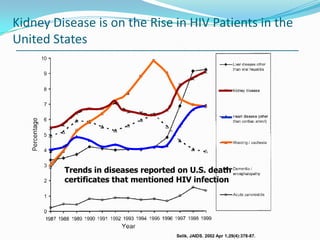
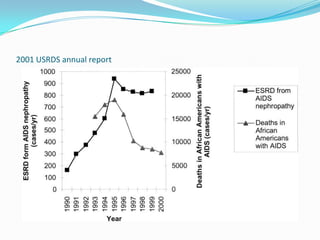
EpidemiologyIncidence of end-stage renal disease(ESRD) due to HIVAN has increased more rapidly than any other etiology of renal disease.In 1999, HIVAN became the 3rd leading cause of ESRD in Africa Americans aged 20-64Since introduction of HAART, the incidence of  ESRD due to HIVAN has decreased.
Kidney Disease is on the Rise in HIV Patients in the United StatesTrends in diseases reported on U.S. death certificates that mentioned HIV infectionSelik, JAIDS. 2002 Apr 1;29(4):378-87.
2001 USRDS annual report
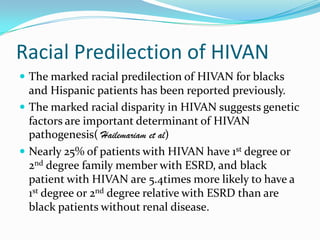
Racial Predilection of HIVANThe marked racial predilection of HIVAN for blacks and Hispanic patients has been reported previously.The marked racial disparity in HIVAN suggests genetic factors are important determinant of HIVAN pathogenesis( Hailemariam et al)Nearly 25% of patients with HIVAN have 1st degree or 2nd degree family member with ESRD, and black patient with HIVAN are 5.4times more likely to have a 1st degree or 2nd degree relative with ESRD than are black patients without renal disease.
The Duffy antigen/receptor for chemokines(DARC) has been proposed as a candidate gene involved in HIVAN pathogenesis. The DARC promoter has a high prevalence of polymorphisms in black patientsLiu et al have demonstrated increased DARC expression in renal specimens from children with HIVAN and haemolytic uremic syndrome.
Pathogenesis OF HIVANRole of HIV infection of Renal Epithelial CellsUntil recently, it was unknown whether HIV infection of renal parenchymal cell caused HIVAN directly or Whether HIVAN was an indirect renal response to HIV-induced immune dysregulation. Studies using an HIV transgenic mouse model of HIVAN have provided important insight into HIVAN pathogenesis.
HIV-transgene is expressed in renal glomerular and tubular epithelial cells that transgene expression in renal epithelial cells was required for development of the HIVAN phenotype.Further support for a role of direct infection of renal parenchymal cells in HIVAN was provided by a macque model of HIV-induced renal disease( stephen et al)
In situ hybridization for HIV-mRNA in HIVAN.
The mechanism by which HIV gain entry into renal epithelial cells is UNKNOWN. CD4, receptor for HIV and CCR5 and CXCR4, the major co-receptors for HIV are not expressed in most renal epithelial cells.
The kidney as a Reservior for HIVInfection of renal epithelial cells by HIV has important implication for HIV seropositive patient not only because it contributes to renal disease but also the kidney may be an important reservoir for HIV.Bruggeman et al detected HIV detected HIV by both RNA in situ hybridization and DNA in situ PCR in three patients who had undetectable viral load in peripheral blood samples.
Winston et al reported despite an undetectable viral load in the peripheral blood while on HAART, the patients continued to express HIV in renal epithelial cells as determined by RNA in situ hybridization.Thus , even in the face of an optimal virologic response to antiretroviral therapy and clinical remission of HIVAN.HIV infection persisted in the renal epithelium and the virus remained transciptionally active at a low level
HISTOPATHOLOGICAL ASPECTS
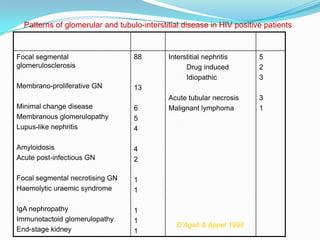
Patterns of glomerular and tubulo-interstitial disease in HIV positive patientsD’Agati & Appel 1998
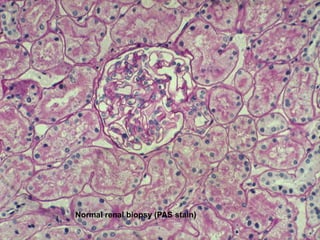
Normal renal biopsy (PAS stain)
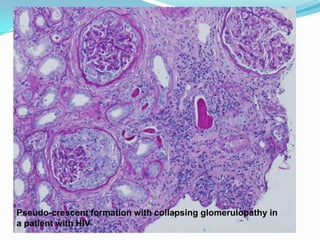
Pseudo-crescent formation with collapsing glomerulopathy in a patient with HIV
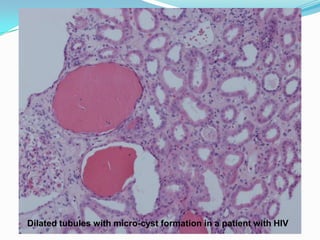
Dilated tubules with micro-cyst formation in a patient with HIV
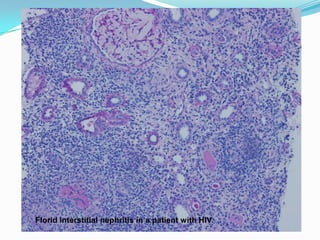
Florid interstitial nephritis in a patient with HIV
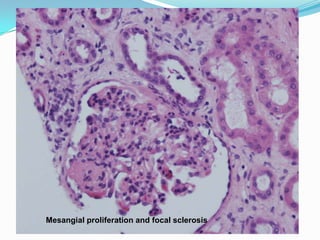
Mesangial proliferation and focal sclerosis
One of the pathologic hallmark of HIVAN is focal Glomerulosclerosis, often of the collapsing type.The collapsing lesions are associated with vigorous podocyte proliferation and loss of podocyte differentiationmarkers, including synaptopodin, podocalyxin.
HIVAN: 	InvestigationsNormal sized, but extremely echogenic kidney in pt with HIVANNormal kidney, less echogenic than liverNephrotic range proteinuria is usually presentSerum complement levels normalCD4 counts variable, from normal to lowPresence of HIV antibodiesRenal ultrasound - usually shows echogenic kidneys with preserved or enlarged size of more than 12 cm in spite of severe renal insufficiencyTreatmentThe following discussion will focus on the best available evidence concerning the efficacy of:-1. HAART2.ACE-inhibitors3. Steroids in treatment of HIVAN
HIVAN: 	Possible mechanisms of benefit of HAARTSuppression of viral replication felt to be a key factor?viral proteins/cytokines released during active viral replication directly cytopathic to kidneysRecent evidence (Foster, 2004) suggests ‘non-viral’ actions of HAART may be equally important
Protease inhibitors shown to inhibit reactive O2 species (ROS) generation and ROS-linked apoptosis of murinemesangial cells independent of HIV gene expression
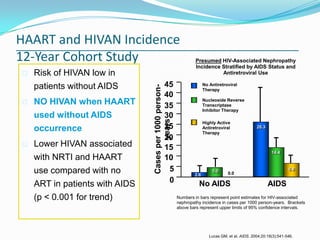
This anti-apoptotic non-virologic effect of protease inhibitors may be important in humansHAART and HIVAN Incidence 12-Year Cohort StudyPresumed HIV-Associated Nephropathy Incidence Stratified by AIDS Status and Antiretroviral UseRisk of HIVAN low in patients without AIDS
NO HIVAN when HAART used without AIDS occurrence
Lower HIVAN associated with NRTI and HAART use compared with no ART in patients with AIDS (p < 0.001 for trend)45No Antiretroviral Therapy40Nucleoside Reverse Transcriptase Inhibitor Therapy3530Highly Active Antiretroviral Therapy2526.3Cases per 1000 person-years201514.41056.85.00.02.60No AIDSAIDSNumbers in bars represent point estimates for HIV-associated nephropathy incidence in cases per 1000 person-years.  Brackets above bars represent upper limits of 95% confidence intervals.Lucas GM, et al. AIDS. 2004;20:18(3):541-546.
ACE-inhibitorsThe effect of ACE inhibitors on HIVAN progression has also been studied.Kimmel et al reported an increase in renal survival associated with captopril usage in a retrospective case-control study of 18 patients with biopsy proven HIVANBurns et al offered 10mg/d fosiniopril after 12-24wk, renal function remained stable.
SteriodsPrednisone has been found in several studies to be associated with reduced risk of progressive renal failure with HIVAN The only study in the HAART era evaluating the efficacy of prednisone in patients with HIVAN was recently published by Szczech et al.After multivariate analysis of several clinical variable , the association between prednisone and reduced rate of decline in Creatinine clearance remained highly significant
Differential Diagnosis of ARF in HIVHIV RelatedHIVAN Thrombotic MicroangiopathyMembranoproliferative GNImmune Complex GN (MPGN or Lupus Like)MedicationIndinavir, Tenofovir, Sulfadiazine, Pentamidine, Sulfamethoxazole and trimethoprimOtherUsual causes in general population – pre-renal, etcAIN – multiple medication exposuresHepatitis B and C related diseaseRhabdomyolysis – statins and PI’s
PrognosisThe data regarding prognosis for renal and patient survival after diagnosis of HIVAN are biased by the fact the majority of patients are referred to nephrologist late in the course of their renal disease and HIV infection.Patients with HIVAN who are not treated with HAART, ACE-inhibitors, or prednisone, generally have a poor prognosis with a mean time to progression to ESRD of 1 to 3 months.
Clinical variables associated with progression of renal failure including:1. Elevated serum Creatinine2. Low CD4 count3. High HIV viral load4. Higher Level of proteinuria5. Previous antiretroviral therapy
ConclusionHIVAN was 1st described 26years ago, its important cause of renal failure among black patients.Since introduction of HAART, the incidence ESRD has decreased.Although data are lacking, the prevalence of HIVAN is probably highest in Africa, where it will likely emerge as a major cause of morbidity and mortality as the prognosis of AIDS survival improves.HIV infection of renal epithelial cells components of HIVAN pathogenesis.

Hiv associated nephropathy(Dr. sood)

  • 1.
    HIV ASSOCIATED NEPHROPATHYDr.M. A. SoodMombasa Dialysis Centre
  • 2.
    INTRODUCTIONAssociation btw HIVand renal disease was first reported in 1984 in New York City and Miami.Reported series of HIV-sero+ve patient who developed a renal syndrome characterized by progressive renal failure and proteinuria.Most common biopsy finding was Focal segmental Glomerulosclerosis(FSGS).
  • 3.
    HIV –associated nephropathy(HIVAN), formerly known as AIDs-associated nephropathy , is characterised by the following findings1. Nephrotic range proteinuria2. Azotemia3. Normal to large kidney on ultrasonographic images4. Normal pressure5. Focal segmental glomerulosclerosis(FSGS) on biopsy findings
  • 4.
    EpidemiologyIncidence of end-stagerenal disease(ESRD) due to HIVAN has increased more rapidly than any other etiology of renal disease.In 1999, HIVAN became the 3rd leading cause of ESRD in Africa Americans aged 20-64Since introduction of HAART, the incidence of ESRD due to HIVAN has decreased.
  • 5.
    Kidney Disease ison the Rise in HIV Patients in the United StatesTrends in diseases reported on U.S. death certificates that mentioned HIV infectionSelik, JAIDS. 2002 Apr 1;29(4):378-87.
  • 6.
  • 7.
    Racial Predilection ofHIVANThe marked racial predilection of HIVAN for blacks and Hispanic patients has been reported previously.The marked racial disparity in HIVAN suggests genetic factors are important determinant of HIVAN pathogenesis( Hailemariam et al)Nearly 25% of patients with HIVAN have 1st degree or 2nd degree family member with ESRD, and black patient with HIVAN are 5.4times more likely to have a 1st degree or 2nd degree relative with ESRD than are black patients without renal disease.
  • 8.
    The Duffy antigen/receptorfor chemokines(DARC) has been proposed as a candidate gene involved in HIVAN pathogenesis. The DARC promoter has a high prevalence of polymorphisms in black patientsLiu et al have demonstrated increased DARC expression in renal specimens from children with HIVAN and haemolytic uremic syndrome.
  • 9.
    Pathogenesis OF HIVANRoleof HIV infection of Renal Epithelial CellsUntil recently, it was unknown whether HIV infection of renal parenchymal cell caused HIVAN directly or Whether HIVAN was an indirect renal response to HIV-induced immune dysregulation. Studies using an HIV transgenic mouse model of HIVAN have provided important insight into HIVAN pathogenesis.
  • 10.
    HIV-transgene is expressedin renal glomerular and tubular epithelial cells that transgene expression in renal epithelial cells was required for development of the HIVAN phenotype.Further support for a role of direct infection of renal parenchymal cells in HIVAN was provided by a macque model of HIV-induced renal disease( stephen et al)
  • 11.
    In situ hybridizationfor HIV-mRNA in HIVAN.
  • 12.
    The mechanism bywhich HIV gain entry into renal epithelial cells is UNKNOWN. CD4, receptor for HIV and CCR5 and CXCR4, the major co-receptors for HIV are not expressed in most renal epithelial cells.
  • 13.
    The kidney asa Reservior for HIVInfection of renal epithelial cells by HIV has important implication for HIV seropositive patient not only because it contributes to renal disease but also the kidney may be an important reservoir for HIV.Bruggeman et al detected HIV detected HIV by both RNA in situ hybridization and DNA in situ PCR in three patients who had undetectable viral load in peripheral blood samples.
  • 14.
    Winston et alreported despite an undetectable viral load in the peripheral blood while on HAART, the patients continued to express HIV in renal epithelial cells as determined by RNA in situ hybridization.Thus , even in the face of an optimal virologic response to antiretroviral therapy and clinical remission of HIVAN.HIV infection persisted in the renal epithelium and the virus remained transciptionally active at a low level
  • 15.
  • 16.
    Patterns of glomerularand tubulo-interstitial disease in HIV positive patientsD’Agati & Appel 1998
  • 17.
  • 18.
    Pseudo-crescent formation withcollapsing glomerulopathy in a patient with HIV
  • 19.
    Dilated tubules withmicro-cyst formation in a patient with HIV
  • 20.
    Florid interstitial nephritisin a patient with HIV
  • 21.
  • 22.
    One of thepathologic hallmark of HIVAN is focal Glomerulosclerosis, often of the collapsing type.The collapsing lesions are associated with vigorous podocyte proliferation and loss of podocyte differentiationmarkers, including synaptopodin, podocalyxin.
  • 23.
    HIVAN: InvestigationsNormal sized,but extremely echogenic kidney in pt with HIVANNormal kidney, less echogenic than liverNephrotic range proteinuria is usually presentSerum complement levels normalCD4 counts variable, from normal to lowPresence of HIV antibodiesRenal ultrasound - usually shows echogenic kidneys with preserved or enlarged size of more than 12 cm in spite of severe renal insufficiencyTreatmentThe following discussion will focus on the best available evidence concerning the efficacy of:-1. HAART2.ACE-inhibitors3. Steroids in treatment of HIVAN
  • 24.
    HIVAN: Possible mechanismsof benefit of HAARTSuppression of viral replication felt to be a key factor?viral proteins/cytokines released during active viral replication directly cytopathic to kidneysRecent evidence (Foster, 2004) suggests ‘non-viral’ actions of HAART may be equally important
  • 25.
    Protease inhibitors shownto inhibit reactive O2 species (ROS) generation and ROS-linked apoptosis of murinemesangial cells independent of HIV gene expression
  • 26.
    This anti-apoptotic non-virologiceffect of protease inhibitors may be important in humansHAART and HIVAN Incidence 12-Year Cohort StudyPresumed HIV-Associated Nephropathy Incidence Stratified by AIDS Status and Antiretroviral UseRisk of HIVAN low in patients without AIDS
  • 27.
    NO HIVAN whenHAART used without AIDS occurrence
  • 28.
    Lower HIVAN associatedwith NRTI and HAART use compared with no ART in patients with AIDS (p < 0.001 for trend)45No Antiretroviral Therapy40Nucleoside Reverse Transcriptase Inhibitor Therapy3530Highly Active Antiretroviral Therapy2526.3Cases per 1000 person-years201514.41056.85.00.02.60No AIDSAIDSNumbers in bars represent point estimates for HIV-associated nephropathy incidence in cases per 1000 person-years. Brackets above bars represent upper limits of 95% confidence intervals.Lucas GM, et al. AIDS. 2004;20:18(3):541-546.
  • 29.
    ACE-inhibitorsThe effect ofACE inhibitors on HIVAN progression has also been studied.Kimmel et al reported an increase in renal survival associated with captopril usage in a retrospective case-control study of 18 patients with biopsy proven HIVANBurns et al offered 10mg/d fosiniopril after 12-24wk, renal function remained stable.
  • 30.
    SteriodsPrednisone has beenfound in several studies to be associated with reduced risk of progressive renal failure with HIVAN The only study in the HAART era evaluating the efficacy of prednisone in patients with HIVAN was recently published by Szczech et al.After multivariate analysis of several clinical variable , the association between prednisone and reduced rate of decline in Creatinine clearance remained highly significant
  • 31.
    Differential Diagnosis ofARF in HIVHIV RelatedHIVAN Thrombotic MicroangiopathyMembranoproliferative GNImmune Complex GN (MPGN or Lupus Like)MedicationIndinavir, Tenofovir, Sulfadiazine, Pentamidine, Sulfamethoxazole and trimethoprimOtherUsual causes in general population – pre-renal, etcAIN – multiple medication exposuresHepatitis B and C related diseaseRhabdomyolysis – statins and PI’s
  • 32.
    PrognosisThe data regardingprognosis for renal and patient survival after diagnosis of HIVAN are biased by the fact the majority of patients are referred to nephrologist late in the course of their renal disease and HIV infection.Patients with HIVAN who are not treated with HAART, ACE-inhibitors, or prednisone, generally have a poor prognosis with a mean time to progression to ESRD of 1 to 3 months.
  • 33.
    Clinical variables associatedwith progression of renal failure including:1. Elevated serum Creatinine2. Low CD4 count3. High HIV viral load4. Higher Level of proteinuria5. Previous antiretroviral therapy
  • 34.
    ConclusionHIVAN was 1stdescribed 26years ago, its important cause of renal failure among black patients.Since introduction of HAART, the incidence ESRD has decreased.Although data are lacking, the prevalence of HIVAN is probably highest in Africa, where it will likely emerge as a major cause of morbidity and mortality as the prognosis of AIDS survival improves.HIV infection of renal epithelial cells components of HIVAN pathogenesis.