APPLYING VIRTUAL ENVIRONMENTS
IN DISTANCE LEARNING OF PRODUCT
DEVELOPMENT
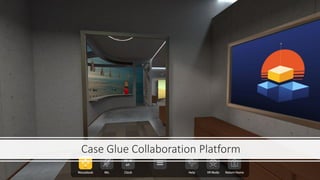
Case Glue Collaboration Platform
Jari Jussila, Markku Mikkonen & Jali Närhi
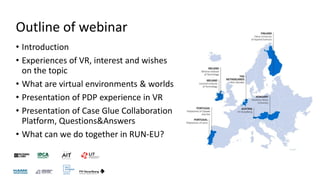
Outline of webinar
• Introduction
• Experiences of VR, interest and wishes
on the topic
• What are virtual environments & worlds
• Presentation of PDP experience in VR
• Presentation of Case Glue Collaboration
Platform, Questions&Answers
• What can we do together in RUN-EU?
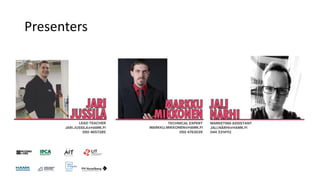
Presenters
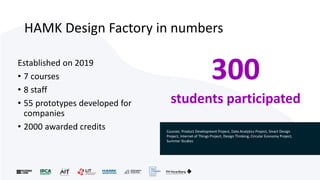
HAMK Design Factory in numbers
300
students participated
Established on 2019
• 7 courses
• 8 staff
• 55 prototypes developed for
companies
• 2000 awarded credits Courses: Product Development Project, Data Analytics Project, Smart Design
Project, Internet of Things Project, Design Thinking, Circular Economy Project,
Summer Studies
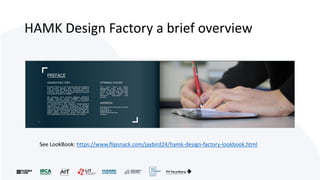
HAMK Design Factory a brief overview
See LookBook: https://www.flipsnack.com/jaybird24/hamk-design-factory-lookbook.html
Your institution experiences in VR
• Interests & wishes:
• Experiences:
Virtual environments & worlds
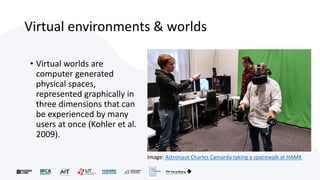
• Virtual worlds are
computer generated
physical spaces,
represented graphically in
three dimensions that can
be experienced by many
users at once (Kohler et al.
2009).
Image: Astronaut Charles Camarda taking a spacewalk at HAMK
Opportunities of VR technologies in Higher
Education
• It creates interest in learning and increases students’ engagement.
• Provides more interactive experiences - users can feel the experiences with their senses.
• Makes possible remote teaching (e.g. immersive 180-degree videos)
• Supports learning by doing (skill-based learning, e.g. medicine, engineering).
• VR has the potential to immerse people in a virtual but realistic environment in which they are
confronted with a certain situation and a number of unexpected events. This creates a test
environment in which a teacher can evaluate the reactions of the student and give him/her
feedback afterwards.
• Expensive physical training can become cheaper with VR. VR makes unsafe training conditions
safe (e.g. spacewalk)
Source: modified fromVRinSight Erasmus+ project. VRinSight Curriculum 2019
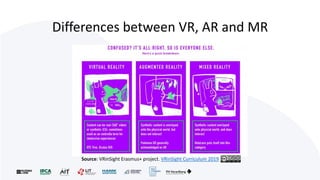
Differences between VR, AR and MR
Source: VRinSight Erasmus+ project. VRinSight Curriculum 2019
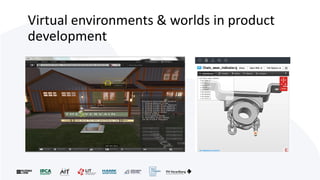
Virtual environments & worlds in product
development
Virtual worlds in product development
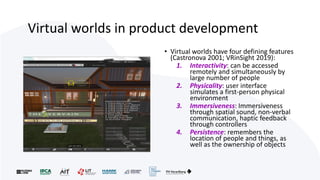
• Virtual worlds have four defining features
(Castronova 2001; VRinSight 2019):
1. Interactivity: can be accessed
remotely and simultaneously by
large number of people
2. Physicality: user interface
simulates a first-person physical
environment
3. Immersiveness: Immersiveness
through spatial sound, non-verbal
communication, haptic feedback
through controllers
4. Persistence: remembers the
location of people and things, as
well as the ownership of objects
Virtual environments in product
development
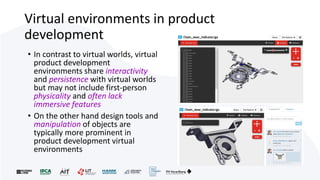
• In contrast to virtual worlds, virtual
product development
environments share interactivity
and persistence with virtual worlds
but may not include first-person
physicality and often lack
immersive features
• On the other hand design tools and
manipulation of objects are
typically more prominent in
product development virtual
environments
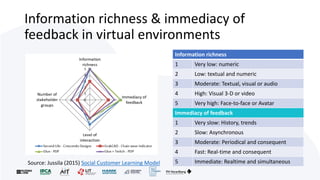
Information richness & immediacy of
feedback in virtual environments
Information richness
1 Very low: numeric
2 Low: textual and numeric
3 Moderate: Textual, visual or audio
4 High: Visual 3-D or video
5 Very high: Face-to-face or Avatar
Immediacy of feedback
1 Very slow: History, trends
2 Slow: Asynchronous
3 Moderate: Periodical and consequent
4 Fast: Real-time and consequent
5 Immediate: Realtime and simultaneous
Source: Jussila (2015) Social Customer Learning Model
Readings
• Castronova, E. (2001). Virtual Worlds: A First-Hand Account of
Market and Society on the Cyberian Frontier. CESifo Working Paper
Series No. 618. https://ssrn.com/abstract=294828
• Kohler, T., Matzler, K., & Füller, J. (2009). Avatar-based innovation:
Using virtual worlds for real-world innovation. Technovation, 29(6-7),
395-407
• Jussila, J. J., Kärkkäinen, H., & Leino, M. (2012). Learning from and
with customers with social media: A model for social customer
learning. International Journal of Management, Knowledge and
Learning, 1(1), 5-25. http://issbs.si/press/ISSN/2232-5697/1-
1.pdf#page=7
• Jussila, J. (2015). Social Media in Business-to-Business Companies'
Innovation. Doctoral dissertation. http://urn.fi/URN:ISBN:978-952-
15-3621-2
• VRinSights (2019). VRinSight Curriculum. Boosting Virtual Reality
Learning with Higher Business Mangement Education.
https://www.vrinsight.org/app/download/10685027371/VRinSight_I
O2_Curriculum%20Module.pdf?t=1589378625
• Jussila, J., Raitanen, J., Partanen, A., Tuomela, V., Siipola, V., &
Kunnari, I. (2020). Rapid Product Development in University-Industry
Collaboration: Case Study of a Smart Design Project. Technology
Innovation Management Review, 10(3).
https://timreview.ca/article/1336
Comments, Questions and Answers
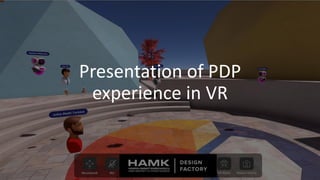
Presentation of PDP
experience in VR
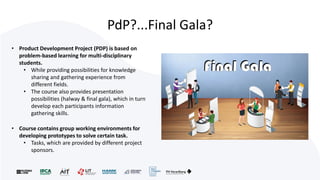
PdP?...Final Gala?
• Product Development Project (PDP) is based on
problem-based learning for multi-disciplinary
students.
• While providing possibilities for knowledge
sharing and gathering experience from
different fields.
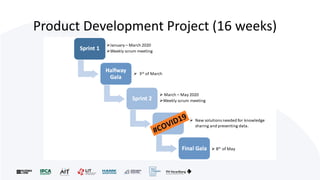
• The course also provides presentation
possibilities (halway & final gala), which in turn
develop each participants information
gathering skills.
• Course contains group working environments for
developing prototypes to solve certain task.
• Tasks, which are provided by different project
sponsors.
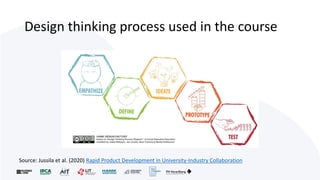
Design thinking process used in the course
Source: Jussila et al. (2020) Rapid Product Development in University-Industry Collaboration
Product Development Project (16 weeks)
Case Glue Collaboration Platform
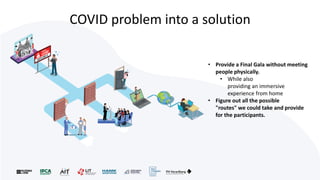
COVID problem into a solution
• Provide a Final Gala without meeting
people physically.
• While also
providing an immersive
experience from home
• Figure out all the possible
"routes" we could take and provide
for the participants.
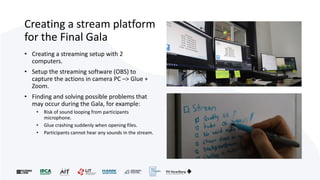
Creating a stream platform
for the Final Gala
• Creating a streaming setup with 2
computers.
• Setup the streaming software (OBS) to
capture the actions in camera PC –> Glue +
Zoom.
• Finding and solving possible problems that
may occur during the Gala, for example:
• Risk of sound looping from participants
microphone.
• Glue crashing suddenly when opening files.
• Participants cannot hear any sounds in the stream.
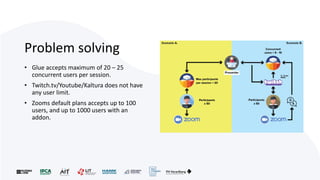
Problem solving
• Glue accepts maximum of 20 – 25
concurrent users per session.
• Twitch.tv/Youtube/Kaltura does not have
any user limit.
• Zooms default plans accepts up to 100
users, and up to 1000 users with an
addon.
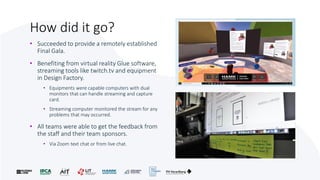
How did it go?
• Succeeded to provide a remotely established
Final Gala.
• Benefiting from virtual reality Glue software,
streaming tools like twitch.tv and equipment
in Design Factory.
• Equipments were capable computers with dual
monitors that can handle streaming and capture
card.
• Streaming computer monitored the stream for any
problems that may occurred.
• All teams were able to get the feedback from
the staff and their team sponsors.
• Via Zoom text chat or from live chat.
For the future
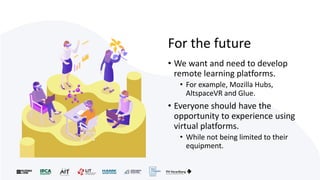
• We want and need to develop
remote learning platforms.
• For example, Mozilla Hubs,
AltspaceVR and Glue.
• Everyone should have the
opportunity to experience using
virtual platforms.
• While not being limited to their
equipment.
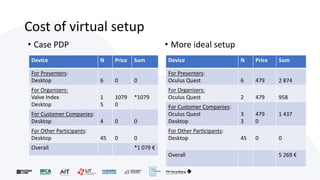
Cost of virtual setup
• Case PDP • More ideal setup
Device N Price Sum
For Presenters:
Oculus Quest 6 479 2 874
For Organizers:
Oculus Quest 2 479 958
For Customer Companies:
Oculus Quest
Desktop
3
3
479
0
1 437
For Other Participants:
Desktop 45 0 0
Overall 5 269 €
Device N Price Sum
For Presenters:
Desktop 6 0 0
For Organizers:
Valve Index
Desktop
1
5
1079
0
*1079
For Customer Companies:
Desktop 4 0 0
For Other Participants:
Desktop 45 0 0
Overall *1 079 €
Questions & Answers
For a good overview of VR platforms, see VRinSight Showcase:
https://www.vrinsight.org/app/download/10685637371/IO2+VRinSight+Showcase.pdf?t=1586859190
Links to EU VR research & projects
• Virtual, Augment, Mixed Realities: https://vam-realities.eu/
• VRinsight – Boosting Virtual Reality Learning within Higher Business
Management Education: https://www.vrinsight.org/
Contact details
https://www.linkedin.com/company/hamk-
design-factory
blog.hamk.fi/designfactory
facebook.com/hamkuas
twitter.com/hamkdf
instagram.com/hamkdf
https://www.youtube.com/channel/UCXfqw-
9CXTEUkYULsdJpIIA
hamk uas
pinterest.com/hamkuas

Applying virtual environments in distance learning of product development

  • 1.
    APPLYING VIRTUAL ENVIRONMENTS INDISTANCE LEARNING OF PRODUCT DEVELOPMENT Case Glue Collaboration Platform Jari Jussila, Markku Mikkonen & Jali Närhi
  • 2.
    Outline of webinar •Introduction • Experiences of VR, interest and wishes on the topic • What are virtual environments & worlds • Presentation of PDP experience in VR • Presentation of Case Glue Collaboration Platform, Questions&Answers • What can we do together in RUN-EU?
  • 3.
  • 4.
    HAMK Design Factoryin numbers 300 students participated Established on 2019 • 7 courses • 8 staff • 55 prototypes developed for companies • 2000 awarded credits Courses: Product Development Project, Data Analytics Project, Smart Design Project, Internet of Things Project, Design Thinking, Circular Economy Project, Summer Studies
  • 5.
    HAMK Design Factorya brief overview See LookBook: https://www.flipsnack.com/jaybird24/hamk-design-factory-lookbook.html
  • 6.
    Your institution experiencesin VR • Interests & wishes: • Experiences:
  • 7.
    Virtual environments &worlds • Virtual worlds are computer generated physical spaces, represented graphically in three dimensions that can be experienced by many users at once (Kohler et al. 2009). Image: Astronaut Charles Camarda taking a spacewalk at HAMK
  • 8.
    Opportunities of VRtechnologies in Higher Education • It creates interest in learning and increases students’ engagement. • Provides more interactive experiences - users can feel the experiences with their senses. • Makes possible remote teaching (e.g. immersive 180-degree videos) • Supports learning by doing (skill-based learning, e.g. medicine, engineering). • VR has the potential to immerse people in a virtual but realistic environment in which they are confronted with a certain situation and a number of unexpected events. This creates a test environment in which a teacher can evaluate the reactions of the student and give him/her feedback afterwards. • Expensive physical training can become cheaper with VR. VR makes unsafe training conditions safe (e.g. spacewalk) Source: modified fromVRinSight Erasmus+ project. VRinSight Curriculum 2019
  • 9.
    Differences between VR,AR and MR Source: VRinSight Erasmus+ project. VRinSight Curriculum 2019
  • 10.
    Virtual environments &worlds in product development
  • 11.
    Virtual worlds inproduct development • Virtual worlds have four defining features (Castronova 2001; VRinSight 2019): 1. Interactivity: can be accessed remotely and simultaneously by large number of people 2. Physicality: user interface simulates a first-person physical environment 3. Immersiveness: Immersiveness through spatial sound, non-verbal communication, haptic feedback through controllers 4. Persistence: remembers the location of people and things, as well as the ownership of objects
  • 12.
    Virtual environments inproduct development • In contrast to virtual worlds, virtual product development environments share interactivity and persistence with virtual worlds but may not include first-person physicality and often lack immersive features • On the other hand design tools and manipulation of objects are typically more prominent in product development virtual environments
  • 13.
    Information richness &immediacy of feedback in virtual environments Information richness 1 Very low: numeric 2 Low: textual and numeric 3 Moderate: Textual, visual or audio 4 High: Visual 3-D or video 5 Very high: Face-to-face or Avatar Immediacy of feedback 1 Very slow: History, trends 2 Slow: Asynchronous 3 Moderate: Periodical and consequent 4 Fast: Real-time and consequent 5 Immediate: Realtime and simultaneous Source: Jussila (2015) Social Customer Learning Model
  • 14.
    Readings • Castronova, E.(2001). Virtual Worlds: A First-Hand Account of Market and Society on the Cyberian Frontier. CESifo Working Paper Series No. 618. https://ssrn.com/abstract=294828 • Kohler, T., Matzler, K., & Füller, J. (2009). Avatar-based innovation: Using virtual worlds for real-world innovation. Technovation, 29(6-7), 395-407 • Jussila, J. J., Kärkkäinen, H., & Leino, M. (2012). Learning from and with customers with social media: A model for social customer learning. International Journal of Management, Knowledge and Learning, 1(1), 5-25. http://issbs.si/press/ISSN/2232-5697/1- 1.pdf#page=7 • Jussila, J. (2015). Social Media in Business-to-Business Companies' Innovation. Doctoral dissertation. http://urn.fi/URN:ISBN:978-952- 15-3621-2 • VRinSights (2019). VRinSight Curriculum. Boosting Virtual Reality Learning with Higher Business Mangement Education. https://www.vrinsight.org/app/download/10685027371/VRinSight_I O2_Curriculum%20Module.pdf?t=1589378625 • Jussila, J., Raitanen, J., Partanen, A., Tuomela, V., Siipola, V., & Kunnari, I. (2020). Rapid Product Development in University-Industry Collaboration: Case Study of a Smart Design Project. Technology Innovation Management Review, 10(3). https://timreview.ca/article/1336
  • 15.
  • 16.
  • 17.
    PdP?...Final Gala? • ProductDevelopment Project (PDP) is based on problem-based learning for multi-disciplinary students. • While providing possibilities for knowledge sharing and gathering experience from different fields. • The course also provides presentation possibilities (halway & final gala), which in turn develop each participants information gathering skills. • Course contains group working environments for developing prototypes to solve certain task. • Tasks, which are provided by different project sponsors.
  • 18.
    Design thinking processused in the course Source: Jussila et al. (2020) Rapid Product Development in University-Industry Collaboration
  • 19.
  • 20.
  • 21.
    COVID problem intoa solution • Provide a Final Gala without meeting people physically. • While also providing an immersive experience from home • Figure out all the possible "routes" we could take and provide for the participants.
  • 22.
    Creating a streamplatform for the Final Gala • Creating a streaming setup with 2 computers. • Setup the streaming software (OBS) to capture the actions in camera PC –> Glue + Zoom. • Finding and solving possible problems that may occur during the Gala, for example: • Risk of sound looping from participants microphone. • Glue crashing suddenly when opening files. • Participants cannot hear any sounds in the stream.
  • 23.
    Problem solving • Glueaccepts maximum of 20 – 25 concurrent users per session. • Twitch.tv/Youtube/Kaltura does not have any user limit. • Zooms default plans accepts up to 100 users, and up to 1000 users with an addon.
  • 24.
    How did itgo? • Succeeded to provide a remotely established Final Gala. • Benefiting from virtual reality Glue software, streaming tools like twitch.tv and equipment in Design Factory. • Equipments were capable computers with dual monitors that can handle streaming and capture card. • Streaming computer monitored the stream for any problems that may occurred. • All teams were able to get the feedback from the staff and their team sponsors. • Via Zoom text chat or from live chat.
  • 25.
    For the future •We want and need to develop remote learning platforms. • For example, Mozilla Hubs, AltspaceVR and Glue. • Everyone should have the opportunity to experience using virtual platforms. • While not being limited to their equipment.
  • 26.
    Cost of virtualsetup • Case PDP • More ideal setup Device N Price Sum For Presenters: Oculus Quest 6 479 2 874 For Organizers: Oculus Quest 2 479 958 For Customer Companies: Oculus Quest Desktop 3 3 479 0 1 437 For Other Participants: Desktop 45 0 0 Overall 5 269 € Device N Price Sum For Presenters: Desktop 6 0 0 For Organizers: Valve Index Desktop 1 5 1079 0 *1079 For Customer Companies: Desktop 4 0 0 For Other Participants: Desktop 45 0 0 Overall *1 079 €
  • 27.
    Questions & Answers Fora good overview of VR platforms, see VRinSight Showcase: https://www.vrinsight.org/app/download/10685637371/IO2+VRinSight+Showcase.pdf?t=1586859190
  • 28.
    Links to EUVR research & projects • Virtual, Augment, Mixed Realities: https://vam-realities.eu/ • VRinsight – Boosting Virtual Reality Learning within Higher Business Management Education: https://www.vrinsight.org/
  • 29.