


Immersive Worlds for Learning
eXperience+: Engaging users in
the zone of proximal flow in
Second Life
Niki Lambropoulos, Rolf Reinhardt, Stylianos
Mystakidis, Dimitris Tolis, Sophi Danis & Alain Gourdin
-Immersive Worlds Team * LANETO Group
-University of West Paris
EADTU Conference, Paphos, Cyprus, 27 - 28 September, 2012
                                                            www.immersive-worlds.com
Agenda

• Web 1.0 Web 2.0 Web 3.0
• Virtual Collaboration in Immersive Worlds
• 3D VIRTUAL IMMERSIVE ENVIRONMENTS
  – Second Life
• User/Learner eXperience+ (U/LX+)
• Zone of Proximal Flow (ZPF)
• The Innovation Management eCourse
  – Virtual Collaboration for Creativity & Open Innovation
• Immersive Worlds of the Present Future
• Conclusions & Future Trends

                                           www.immersive-worlds.com
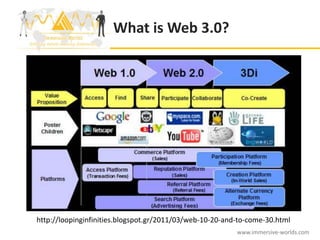
What is Web 3.0?


http://loopinginfinities.blogspot.gr/2011/03/web-10-20-and-to-come-30.html
                                                          www.immersive-worlds.com
Virtual Collaboration in
                Immersive Worlds

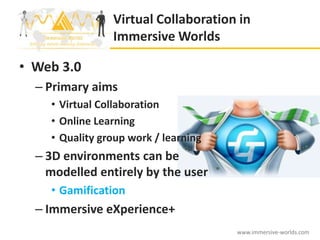
• Web 3.0
  – Primary aims
    • Virtual Collaboration
    • Online Learning
    • Quality group work / learning
  – 3D environments can be
    modelled entirely by the user
    • Gamification
  – Immersive eXperience+
                                      www.immersive-worlds.com
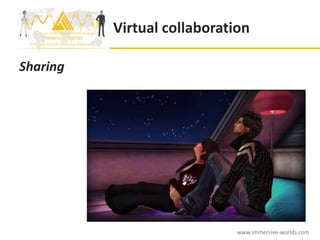
Virtual collaboration

Sharing


                             www.immersive-worlds.com
Immersive Worlds


     Upgrading reality
     Pushing boundaries of
      • Space
      • Imagination
     Quality services
      • Planning via preparing
      • Running sessions
      • Following-up activities


                    www.immersive-worlds.com
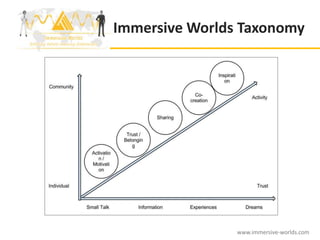
Immersive Worlds Taxonomy


                www.immersive-worlds.com
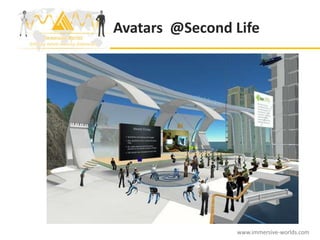
Avatars @Second Life


                www.immersive-worlds.com
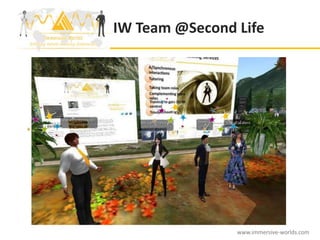
IW Team @Second Life


                www.immersive-worlds.com
www.immersive-worlds.com
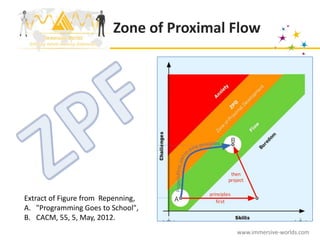
Zone of Proximal Flow


Extract of Figure from Repenning,
A. "Programming Goes to School",
B. CACM, 55, 5, May, 2012.
                                          www.immersive-worlds.com
ZPF 10 Immersive Factors

1.  Clear goals as challenge level and skill high level
2.  Concentration and focused attention
3.  Loss of feeling
4.  Distorted sense of time
5.  Direct and immediate feedback
6.  Balance between ability level and challenge
7.  Sense of personal control over the situation or activity
8.  The activity is intrinsically rewarding, so there is an
    effortlessness of action
9. Lack of awareness of bodily needs
10. Absorption into the activity

                                              www.immersive-worlds.com
Engagement Factors

1. Perception via the senses
2. Action via the body/kinaesthetic – physical body
   functions
3. Emotion via the heart – emotional & instinctual
   nature functions
4. Cognition via the mind – rational consciousness
   functions
5. Co-creativity via imagination & intuition –
   higher consciousness thinking functions
6. Combinations of the above

                                      www.immersive-worlds.com
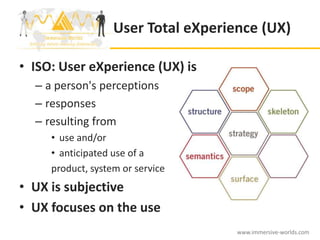
User Total eXperience (UX)

• ISO: User eXperience (UX) is
  – a person's perceptions
  – responses
  – resulting from
     • use and/or
     • anticipated use of a
     product, system or service
• UX is subjective
• UX focuses on the use
                                     www.immersive-worlds.com
User/Learner Experience (U/LX+)

Immersive Experience+
• Make learning interesting & fun
• Engage the learner
   –   Have a clear & focused purpose
   –   Be present
   –   Be in a state of constant flow
   –   Connect with each other
• Design: Understanding Users as Learners
   –   Usability
   –   Pedagogical usability
   –   Mental & conceptual models
   –   Joy, enthusiasm, humour
   –   Other psychological factors
                                            www.immersive-worlds.com
http://www.itin.fr/


                 www.immersive-worlds.com
Innovation Management eCourse

• Promote entrepreneurship and innovation
  knowledge and skills in action
• Reduce transactive cost for virtual collaboration
• Create sense of belonging in a working group
• Orchestrate collaborative learning convergence
• Promote synergy for direct fit between
   – Social needs, working demands &
   – Virtual collaboration and educational tasks, methods
     and tools
• Use 3D Immersive Worlds to enhance two ways
  communication for virtual collaboration
                                             www.immersive-worlds.com
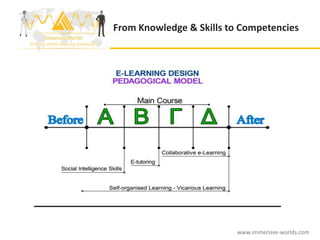
From Knowledge & Skills to Competencies


                          www.immersive-worlds.com
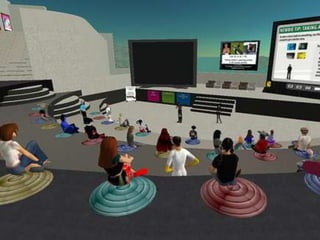
In the class… and


                    www.immersive-worlds.com
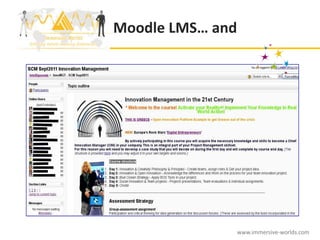
Moodle LMS… and


                  www.immersive-worlds.com
www.immersive-worlds.com
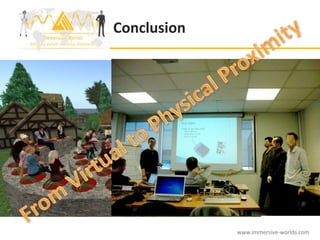
Conclusion


             www.immersive-worlds.com
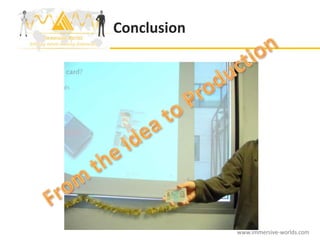
Conclusion


             www.immersive-worlds.com
Immersive Worlds
                of the Present Future
Integration of Virtual & Augmented Reality
Technologies: Provide the user with
• Immersive multisensory stimuli (e.g.
  touching, movement capture, haptic sensor)
• Emotional channels (e.g. affective computing)
• System adaptation & interoperability (e.g.
  personalisation & multiple user interfaces)
• Novel & Unique Immersive eXperience+

    Create a Strong Vibration to Remember
                                       www.immersive-worlds.com
Niki Lambropoulos
   On behalf of the
Immersive Worlds Team

Immersive worlds Pafos Sept-2012

  • 1.
    Immersive Worlds forLearning eXperience+: Engaging users in the zone of proximal flow in Second Life Niki Lambropoulos, Rolf Reinhardt, Stylianos Mystakidis, Dimitris Tolis, Sophi Danis & Alain Gourdin -Immersive Worlds Team * LANETO Group -University of West Paris EADTU Conference, Paphos, Cyprus, 27 - 28 September, 2012 www.immersive-worlds.com
  • 2.
    Agenda • Web 1.0Web 2.0 Web 3.0 • Virtual Collaboration in Immersive Worlds • 3D VIRTUAL IMMERSIVE ENVIRONMENTS – Second Life • User/Learner eXperience+ (U/LX+) • Zone of Proximal Flow (ZPF) • The Innovation Management eCourse – Virtual Collaboration for Creativity & Open Innovation • Immersive Worlds of the Present Future • Conclusions & Future Trends www.immersive-worlds.com
  • 3.
    What is Web3.0? http://loopinginfinities.blogspot.gr/2011/03/web-10-20-and-to-come-30.html www.immersive-worlds.com
  • 4.
    Virtual Collaboration in Immersive Worlds • Web 3.0 – Primary aims • Virtual Collaboration • Online Learning • Quality group work / learning – 3D environments can be modelled entirely by the user • Gamification – Immersive eXperience+ www.immersive-worlds.com
  • 5.
    Virtual collaboration Sharing www.immersive-worlds.com
  • 6.
    Immersive Worlds  Upgrading reality  Pushing boundaries of • Space • Imagination  Quality services • Planning via preparing • Running sessions • Following-up activities www.immersive-worlds.com
  • 7.
    Immersive Worlds Taxonomy www.immersive-worlds.com
  • 8.
    Avatars @Second Life www.immersive-worlds.com
  • 9.
    IW Team @SecondLife www.immersive-worlds.com
  • 10.
  • 11.
    Zone of ProximalFlow Extract of Figure from Repenning, A. "Programming Goes to School", B. CACM, 55, 5, May, 2012. www.immersive-worlds.com
  • 12.
    ZPF 10 ImmersiveFactors 1. Clear goals as challenge level and skill high level 2. Concentration and focused attention 3. Loss of feeling 4. Distorted sense of time 5. Direct and immediate feedback 6. Balance between ability level and challenge 7. Sense of personal control over the situation or activity 8. The activity is intrinsically rewarding, so there is an effortlessness of action 9. Lack of awareness of bodily needs 10. Absorption into the activity www.immersive-worlds.com
  • 13.
    Engagement Factors 1. Perceptionvia the senses 2. Action via the body/kinaesthetic – physical body functions 3. Emotion via the heart – emotional & instinctual nature functions 4. Cognition via the mind – rational consciousness functions 5. Co-creativity via imagination & intuition – higher consciousness thinking functions 6. Combinations of the above www.immersive-worlds.com
  • 14.
    User Total eXperience(UX) • ISO: User eXperience (UX) is – a person's perceptions – responses – resulting from • use and/or • anticipated use of a product, system or service • UX is subjective • UX focuses on the use www.immersive-worlds.com
  • 15.
    User/Learner Experience (U/LX+) ImmersiveExperience+ • Make learning interesting & fun • Engage the learner – Have a clear & focused purpose – Be present – Be in a state of constant flow – Connect with each other • Design: Understanding Users as Learners – Usability – Pedagogical usability – Mental & conceptual models – Joy, enthusiasm, humour – Other psychological factors www.immersive-worlds.com
  • 16.
    http://www.itin.fr/ www.immersive-worlds.com
  • 17.
    Innovation Management eCourse •Promote entrepreneurship and innovation knowledge and skills in action • Reduce transactive cost for virtual collaboration • Create sense of belonging in a working group • Orchestrate collaborative learning convergence • Promote synergy for direct fit between – Social needs, working demands & – Virtual collaboration and educational tasks, methods and tools • Use 3D Immersive Worlds to enhance two ways communication for virtual collaboration www.immersive-worlds.com
  • 18.
    From Knowledge &Skills to Competencies www.immersive-worlds.com
  • 19.
    In the class…and www.immersive-worlds.com
  • 20.
    Moodle LMS… and www.immersive-worlds.com
  • 21.
  • 22.
    Conclusion www.immersive-worlds.com
  • 23.
    Conclusion www.immersive-worlds.com
  • 24.
    Immersive Worlds of the Present Future Integration of Virtual & Augmented Reality Technologies: Provide the user with • Immersive multisensory stimuli (e.g. touching, movement capture, haptic sensor) • Emotional channels (e.g. affective computing) • System adaptation & interoperability (e.g. personalisation & multiple user interfaces) • Novel & Unique Immersive eXperience+ Create a Strong Vibration to Remember www.immersive-worlds.com
  • 25.
    Niki Lambropoulos On behalf of the Immersive Worlds Team