19 July 2017
PolyU
Prof. Eric Tsui
Ms. Nicole Sy
KM Specialist
Ms. Nikolina
Dragicevic
Fee (19 July)*: HKD 1,400 (Regular Fee)
HKD 1,120 (KMIRC members)
Fee (20 July)**: HKD 300
* Fee covers lunch, handout and refreshments
* We can provide overseas students with low cost accommodation in the PolyU Hall
(cost details upon request)
** Enrolment for company visit is only offered for participants joining summer school
on a first-come-first-served basis.
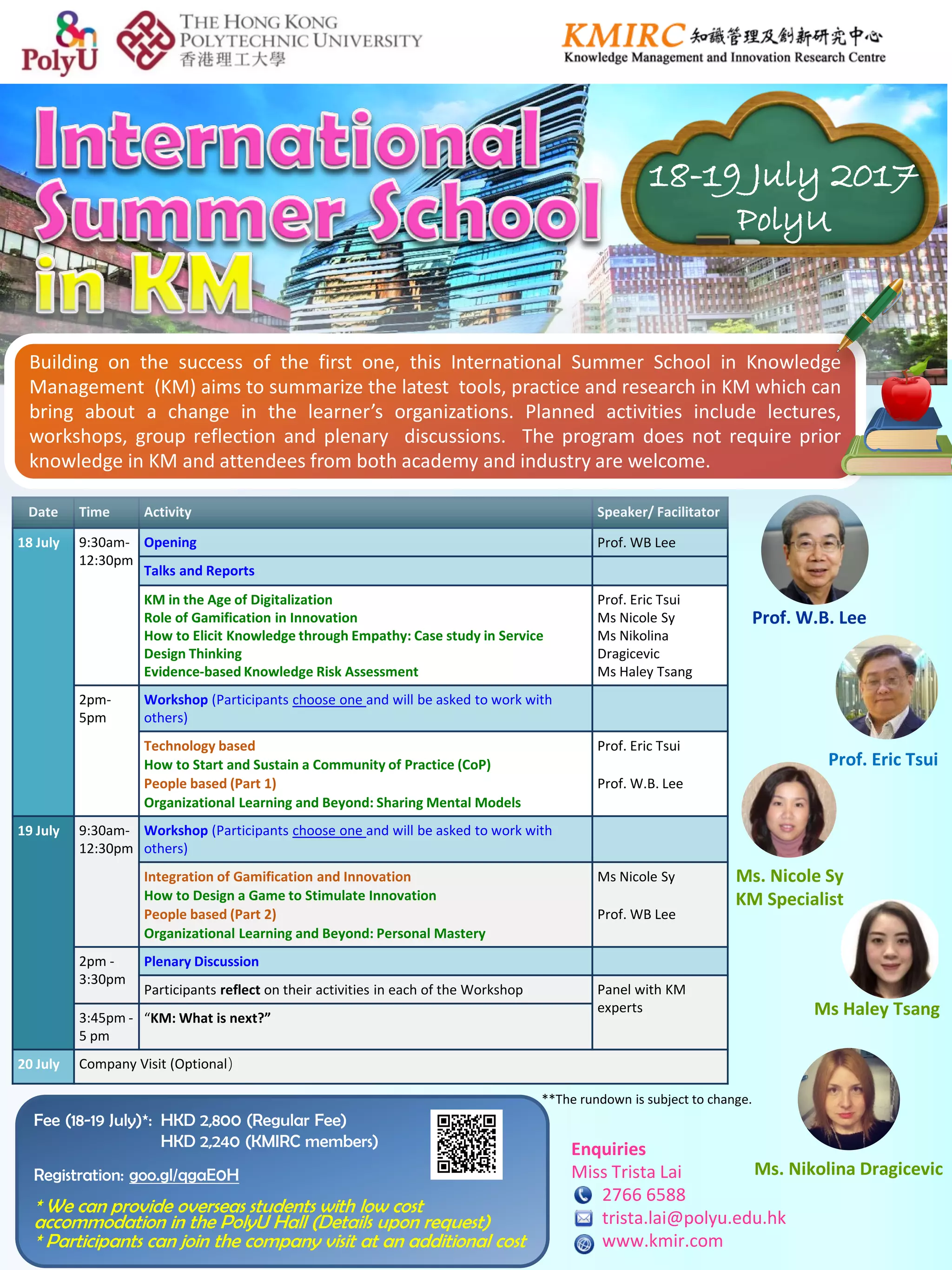
Building on the success of the first school, this International Summer School in Knowledge
Management (KM) aims to summarize the latest tools, practice and research in KM which
can bring about a change in the learner’s organizations. Planned activities include
lectures, workshops, and group reflection. The program does not require prior
knowledge in KM and attendees from both academia and industry are welcome.
*** The programme is subject to change.
REGISTRATION
goo.gl/qgaE0H
Date Time Activity Speaker/
Facilitator
19
July
9:15am-
12:30pm
• KM in the Age of Digitalization
• Role of Gamification in Innovation
• Service Design Thinking
Prof. Eric Tsui
Ms Nicole Sy
Ms Nikolina
Dragicevic
2pm-5pm Workshop (Participants choose one to attend and
work in groups)
• How to Start and Sustain a Community of Practice
(CoP)
• How to Design a Game to Stimulate Innovation
Prof. Eric Tsui
Ms Nicole Sy
20
July
Company Visit to Asia Miles
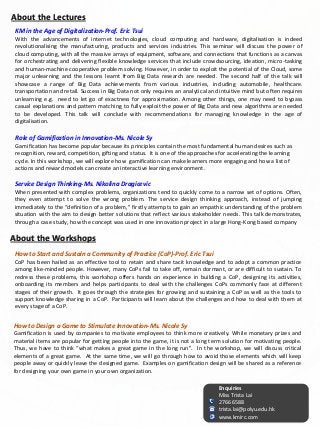
How to Start and Sustain a Community of Practice (CoP)-Prof. Eric Tsui
CoP has been hailed as an effective tool to retain and share tacit knowledge and to adopt a common practice
among like-minded people. However, many CoPs fail to take off, remain dormant, or are difficult to sustain. To
redress these problems, this workshop offers hands on experience in building a CoP, designing its activities,
onboarding its members and helps participants to deal with the challenges CoPs commonly face at different
stages of their growth. It goes through the strategies for growing and sustaining a CoP as well as the tools to
support knowledge sharing in a CoP. Participants will learn about the challenges and how to deal with them at
every stage of a CoP.
Role of Gamification in Innovation-Ms. Nicole Sy
Gamification has become popular because its principles contain the most fundamental human desires such as
recognition, reward, competition, gifting and status. It is one of the approaches for accelerating the learning
cycle. In this workshop, we will explore how gamification can make learners more engaging and how a list of
actions and reward models can create an interactive learning environment.
KM in the Age of Digitalization-Prof. Eric Tsui
With the advancements of internet technologies, cloud computing and hardware, digitalisation is indeed
revolutionalising the manufacturing, products and services industries. This seminar will discuss the power of
cloud computing, with all the massive arrays of equipment, software, and connections that functions as a canvas
for orchestrating and delivering flexible knowledge services that include crowdsourcing, ideation, micro-tasking
and human-machine cooperative problem solving. However, in order to exploit the potential of the Cloud, some
major unlearning and the lessons learnt from Big Data research are needed. The second half of the talk will
showcase a range of Big Data achievements from various industries, including automobile, healthcare.
transportation and retail. Success in Big Data not only requires an analytical and intuitive mind but often requires
unlearning e.g. need to let go of exactness for approximation. Among other things, one may need to bypass
casual explanations and pattern matching to fully exploit the power of Big Data and new algorithms are needed
to be developed. This talk will conclude with recommendations for managing knowledge in the age of
digitalisation.
Service Design Thinking-Ms. Nikolina Dragicevic
When presented with complex problems, organizations tend to quickly come to a narrow set of options. Often,
they even attempt to solve the wrong problem. The service design thinking approach, instead of jumping
immediately to the “definition of a problem,” firstly attempts to gain an empathic understanding of the problem
situation with the aim to design better solutions that reflect various stakeholder needs. This talk demonstrates,
through a case study, how the concept was used in one innovation project in a large Hong-Kong based company
Enquiries
Miss Trista Lai
2766 6588
trista.lai@polyu.edu.hk
www.kmirc.com
About the Workshops
How to Design a Game to Stimulate Innovation-Ms. Nicole Sy
Gamification is used by companies to motivate employees to think more creatively. While monetary prizes and
material items are popular for getting people into the game, it is not a long term solution for motivating people.
Thus, we have to think “what makes a great game in the long run”. In the workshop, we will discuss critical
elements of a great game. At the same time, we will go through how to avoid those elements which will keep
people away or quickly leave the designed game. Examples on gamification design will be shared as a reference
for designing your own game in your own organization.
About the Lectures

International Summer School

  • 1.
    19 July 2017 PolyU Prof.Eric Tsui Ms. Nicole Sy KM Specialist Ms. Nikolina Dragicevic Fee (19 July)*: HKD 1,400 (Regular Fee) HKD 1,120 (KMIRC members) Fee (20 July)**: HKD 300 * Fee covers lunch, handout and refreshments * We can provide overseas students with low cost accommodation in the PolyU Hall (cost details upon request) ** Enrolment for company visit is only offered for participants joining summer school on a first-come-first-served basis. Building on the success of the first school, this International Summer School in Knowledge Management (KM) aims to summarize the latest tools, practice and research in KM which can bring about a change in the learner’s organizations. Planned activities include lectures, workshops, and group reflection. The program does not require prior knowledge in KM and attendees from both academia and industry are welcome. *** The programme is subject to change. REGISTRATION goo.gl/qgaE0H Date Time Activity Speaker/ Facilitator 19 July 9:15am- 12:30pm • KM in the Age of Digitalization • Role of Gamification in Innovation • Service Design Thinking Prof. Eric Tsui Ms Nicole Sy Ms Nikolina Dragicevic 2pm-5pm Workshop (Participants choose one to attend and work in groups) • How to Start and Sustain a Community of Practice (CoP) • How to Design a Game to Stimulate Innovation Prof. Eric Tsui Ms Nicole Sy 20 July Company Visit to Asia Miles
  • 2.
    How to Startand Sustain a Community of Practice (CoP)-Prof. Eric Tsui CoP has been hailed as an effective tool to retain and share tacit knowledge and to adopt a common practice among like-minded people. However, many CoPs fail to take off, remain dormant, or are difficult to sustain. To redress these problems, this workshop offers hands on experience in building a CoP, designing its activities, onboarding its members and helps participants to deal with the challenges CoPs commonly face at different stages of their growth. It goes through the strategies for growing and sustaining a CoP as well as the tools to support knowledge sharing in a CoP. Participants will learn about the challenges and how to deal with them at every stage of a CoP. Role of Gamification in Innovation-Ms. Nicole Sy Gamification has become popular because its principles contain the most fundamental human desires such as recognition, reward, competition, gifting and status. It is one of the approaches for accelerating the learning cycle. In this workshop, we will explore how gamification can make learners more engaging and how a list of actions and reward models can create an interactive learning environment. KM in the Age of Digitalization-Prof. Eric Tsui With the advancements of internet technologies, cloud computing and hardware, digitalisation is indeed revolutionalising the manufacturing, products and services industries. This seminar will discuss the power of cloud computing, with all the massive arrays of equipment, software, and connections that functions as a canvas for orchestrating and delivering flexible knowledge services that include crowdsourcing, ideation, micro-tasking and human-machine cooperative problem solving. However, in order to exploit the potential of the Cloud, some major unlearning and the lessons learnt from Big Data research are needed. The second half of the talk will showcase a range of Big Data achievements from various industries, including automobile, healthcare. transportation and retail. Success in Big Data not only requires an analytical and intuitive mind but often requires unlearning e.g. need to let go of exactness for approximation. Among other things, one may need to bypass casual explanations and pattern matching to fully exploit the power of Big Data and new algorithms are needed to be developed. This talk will conclude with recommendations for managing knowledge in the age of digitalisation. Service Design Thinking-Ms. Nikolina Dragicevic When presented with complex problems, organizations tend to quickly come to a narrow set of options. Often, they even attempt to solve the wrong problem. The service design thinking approach, instead of jumping immediately to the “definition of a problem,” firstly attempts to gain an empathic understanding of the problem situation with the aim to design better solutions that reflect various stakeholder needs. This talk demonstrates, through a case study, how the concept was used in one innovation project in a large Hong-Kong based company Enquiries Miss Trista Lai 2766 6588 trista.lai@polyu.edu.hk www.kmirc.com About the Workshops How to Design a Game to Stimulate Innovation-Ms. Nicole Sy Gamification is used by companies to motivate employees to think more creatively. While monetary prizes and material items are popular for getting people into the game, it is not a long term solution for motivating people. Thus, we have to think “what makes a great game in the long run”. In the workshop, we will discuss critical elements of a great game. At the same time, we will go through how to avoid those elements which will keep people away or quickly leave the designed game. Examples on gamification design will be shared as a reference for designing your own game in your own organization. About the Lectures