Design Factory Project
- Empathizing
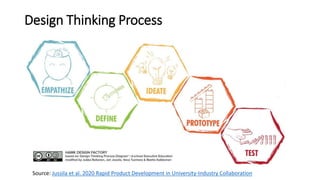
Design Thinking Process
Source: Jussila et al. 2020 Rapid Product Development in University-Industry Collaboration
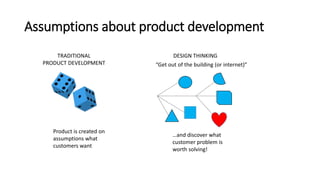
Assumptions about product development
TRADITIONAL
PRODUCT DEVELOPMENT
DESIGN THINKING
Product is created on
assumptions what
customers want
“Get out of the building (or internet)”
…and discover what
customer problem is
worth solving!
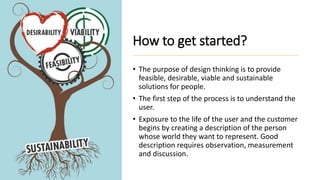
How to get started?
• The purpose of design thinking is to provide
feasible, desirable, viable and sustainable
solutions for people.
• The first step of the process is to understand the
user.
• Exposure to the life of the user and the customer
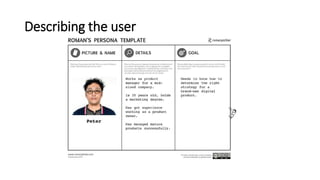
begins by creating a description of the person
whose world they want to represent. Good
description requires observation, measurement
and discussion.
Describing the user
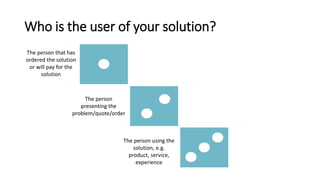
Who is the user of your solution?
The person
presenting the
problem/quote/order
The person that has
ordered the solution
or will pay for the
solution
The person using the
solution, e.g.
product, service,
experience
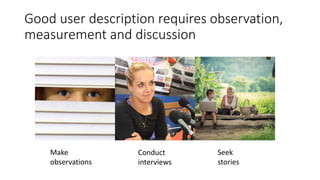
Good user description requires observation,
measurement and discussion
Make
observations
Conduct
interviews
Seek
stories
Tools for empathizing
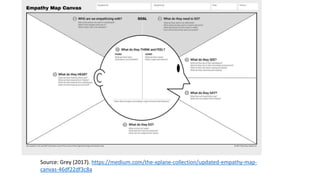
• Empathy Map Canvas: https://medium.com/the-xplane-
collection/updated-empathy-map-canvas-46df22df3c8a
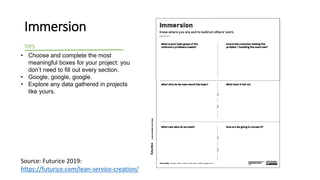
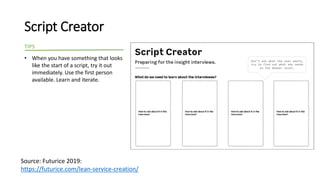
• Lean Service Creation Canvases, e.g. Immersion, Script Creator:
https://futurice.com/lean-service-creation/
• The Value Proposition Canvas:
https://www.strategyzer.com/canvas/value-proposition-canvas
Immersion
• Choose and complete the most
meaningful boxes for your project: you
don’t need to fill out every section.
• Google, google, google.
• Explore any data gathered in projects
like yours.
TIPS
Source: Futurice 2019:
https://futurice.com/lean-service-creation/
Source: Grey (2017). https://medium.com/the-xplane-collection/updated-empathy-map-
canvas-46df22df3c8a
Script Creator
• When you have something that looks
like the start of a script, try it out
immediately. Use the first person
available. Learn and iterate.
TIPS
Source: Futurice 2019:
https://futurice.com/lean-service-creation/

DFP20 Empathizing

  • 1.
  • 2.
    Design Thinking Process Source:Jussila et al. 2020 Rapid Product Development in University-Industry Collaboration
  • 3.
    Assumptions about productdevelopment TRADITIONAL PRODUCT DEVELOPMENT DESIGN THINKING Product is created on assumptions what customers want “Get out of the building (or internet)” …and discover what customer problem is worth solving!
  • 4.
    How to getstarted? • The purpose of design thinking is to provide feasible, desirable, viable and sustainable solutions for people. • The first step of the process is to understand the user. • Exposure to the life of the user and the customer begins by creating a description of the person whose world they want to represent. Good description requires observation, measurement and discussion.
  • 5.
  • 6.
    Who is theuser of your solution? The person presenting the problem/quote/order The person that has ordered the solution or will pay for the solution The person using the solution, e.g. product, service, experience
  • 7.
    Good user descriptionrequires observation, measurement and discussion Make observations Conduct interviews Seek stories
  • 8.
    Tools for empathizing •Empathy Map Canvas: https://medium.com/the-xplane- collection/updated-empathy-map-canvas-46df22df3c8a • Lean Service Creation Canvases, e.g. Immersion, Script Creator: https://futurice.com/lean-service-creation/ • The Value Proposition Canvas: https://www.strategyzer.com/canvas/value-proposition-canvas
  • 9.
    Immersion • Choose andcomplete the most meaningful boxes for your project: you don’t need to fill out every section. • Google, google, google. • Explore any data gathered in projects like yours. TIPS Source: Futurice 2019: https://futurice.com/lean-service-creation/
  • 10.
    Source: Grey (2017).https://medium.com/the-xplane-collection/updated-empathy-map- canvas-46df22df3c8a
  • 11.
    Script Creator • Whenyou have something that looks like the start of a script, try it out immediately. Use the first person available. Learn and iterate. TIPS Source: Futurice 2019: https://futurice.com/lean-service-creation/