February 26, 2021
Advances in Teaching and Learning
Technologies
Olga Scrivner
Indiana University
Harrisburg University of Science & Technology
Rose-Hulman Institute of Technology
Hawaii International Conference on Systems Sciences
Mini-Track: Advances in Teaching and Learning Technologies
Jan 4-7, 2022, Maui
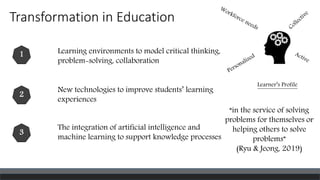
Transformation in Education
1 Learning environments to model critical thinking,
problem-solving, collaboration
2
New technologies to improve students’ learning
experiences
3
The integration of artificial intelligence and
machine learning to support knowledge processes
“in the service of solving
problems for themselves or
helping others to solve
problems”
(Ryu & Jeong, 2019)
Learner’s Profile
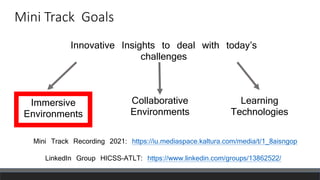
Mini Track Goals
Innovative Insights to deal with today’s
challenges
Immersive
Environments
Collaborative
Environments
Learning
Technologies
Mini Track Recording 2021: https://iu.mediaspace.kaltura.com/media/t/1_8aisngop
LinkedIn Group HICSS-ATLT: https://www.linkedin.com/groups/13862522/
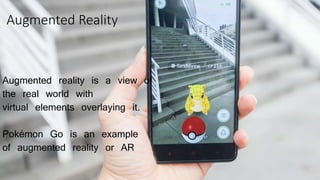
Augmented Reality
Augmented reality is a view of
the real world with
virtual elements overlaying it.
Pokémon Go is an example
of augmented reality or AR
Augmented Reality: Definition
“a real time direct or indirect view of a physical real world
environment that has been enhanced/augmented by adding
virtual computer generated information to it”
(Carmigniani et al. 2011)
Scrivner et al. 2017. Immersive Mobile Technologies: Virtual/Augmented Reality Technologies in the Classroom. Teaching Symposium
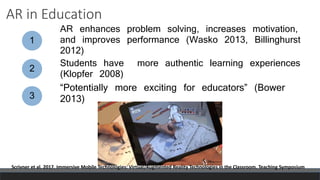
AR in Education
AR enhances problem solving, increases motivation,
and improves performance (Wasko 2013, Billinghurst
2012)
1
Students have more authentic learning experiences
(Klopfer 2008)
2
“Potentially more exciting for educators” (Bower
2013)
3
Scrivner et al. 2017. Immersive Mobile Technologies: Virtual/Augmented Reality Technologies in the Classroom. Teaching Symposium
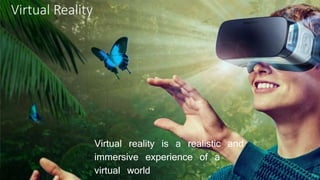
Virtual Reality
Virtual reality is a realistic and
immersive experience of a
virtual world
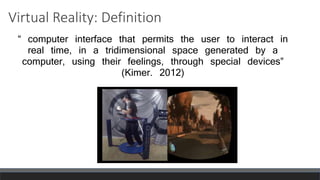
Virtual Reality: Definition
“ computer interface that permits the user to interact in
real time, in a tridimensional space generated by a
computer, using their feelings, through special devices”
(Kimer. 2012)
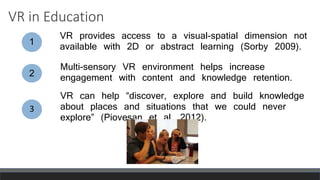
VR in Education
VR provides access to a visual-spatial dimension not
available with 2D or abstract learning (Sorby 2009).
1
Multi-sensory VR environment helps increase
engagement with content and knowledge retention.
2
VR can help “discover, explore and build knowledge
about places and situations that we could never
explore” (Piovesan et al. 2012).
3
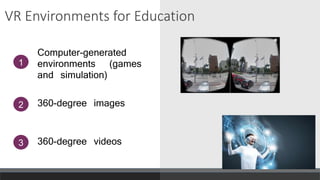
VR Environments for Education
Computer-generated
environments (games
and simulation)
1
2 360-degree images
3 360-degree videos
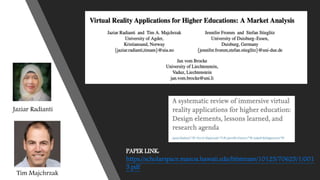
PAPER LINK:
https://scholarspace.manoa.hawaii.edu/bitstream/10125/70625/1/001
3.pdf
Tim Majchrzak
Jaziar Radianti
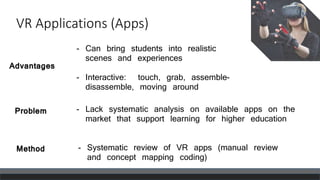
VR Applications (Apps)
- Can bring students into realistic
scenes and experiences
- Interactive: touch, grab, assemble-
disassemble, moving around
Advantages
- Lack systematic analysis on available apps on the
market that support learning for higher education
Problem
Method - Systematic review of VR apps (manual review
and concept mapping coding)
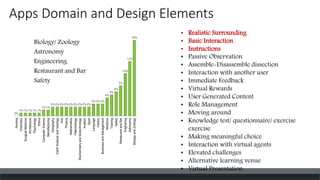
Apps Domain and Design Elements
0%
1%1%1%1%1%
1%1%
2%2%2%2%2%2%2%2%2%
3%3%3%
4%
5%
6%
7%
10%
13%
18%
Nursing
Chemistry
Surgical
Medicine
Architecture
Psychology
Ethics
Computer
Science
Manufacturing
Geography
Earth
Science
and
Geology
Arts
Physics
Mathematics
Paleontology
Biochemistry
and
biotechnology
Aviation
Sport
Language
History
Business
and
Management
Medicine
Training
Safety
Restaurant
and
Bar
Enginering
Astronomy
Biology
and
Zoology
• Realistic Surrounding
• Basic Interaction
• Instructions
• Passive Observation
• Assemble-Disassemble dissection
• Interaction with another user
• Immediate Feedback
• Virtual Rewards
• User Generated Content
• Role Management
• Moving around
• Knowledge test/ questionnaire/ exercise
exercise
• Making meaningful choice
• Interaction with virtual agents
• Elevated challenges
• Alternative learning venue
• Virtual Presentation
Biology/ Zoology
Astronomy
Engineering
Restaurant and Bar
Safety
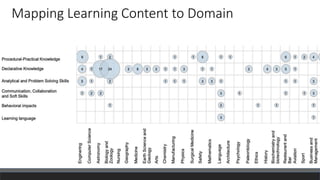
Mapping Learning Content to Domain
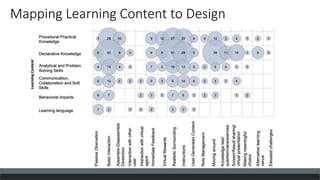
Mapping Learning Content to Design
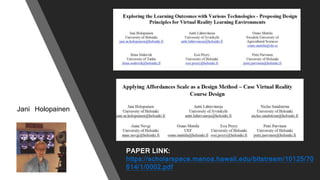
Jani Holopainen
PAPER LINK:
https://scholarspace.manoa.hawaii.edu/bitstream/10125/70
614/1/0002.pdf
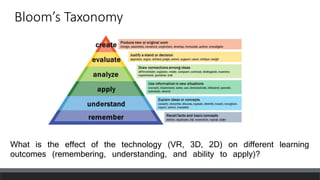
Bloom’s Taxonomy
What is the effect of the technology (VR, 3D, 2D) on different learning
outcomes (remembering, understanding, and ability to apply)?
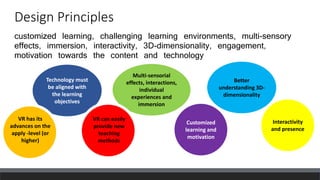
Design Principles
customized learning, challenging learning environments, multi-sensory
effects, immersion, interactivity, 3D-dimensionality, engagement,
motivation towards the content and technology
Technology must
be aligned with
the learning
objectives
Multi-sensorial
effects, interactions,
individual
experiences and
immersion
Better
understanding 3D-
dimensionality
VR can easily
provide new
teaching
methods
Customized
learning and
motivation
Interactivity
and presence
VR has its
advances on the
apply -level (or
higher)
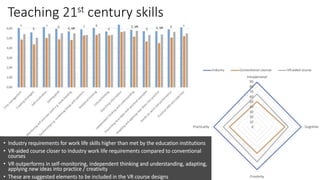
Teaching 21st century skills
Yongqian Lin
PAPER LINK:
https://scholarspace.manoa.hawaii.edu/bitstream/10125/70
622/1/0010.pdf
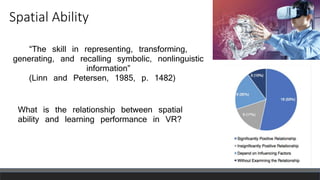
Spatial Ability
“The skill in representing, transforming,
generating, and recalling symbolic, nonlinguistic
information”
(Linn and Petersen, 1985, p. 1482)
What is the relationship between spatial
ability and learning performance in VR?
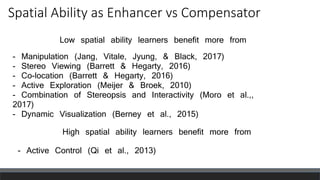
Spatial Ability as Enhancer vs Compensator
Low spatial ability learners benefit more from
- Manipulation (Jang, Vitale, Jyung, & Black, 2017)
- Stereo Viewing (Barrett & Hegarty, 2016)
- Co-location (Barrett & Hegarty, 2016)
- Active Exploration (Meijer & Broek, 2010)
- Combination of Stereopsis and Interactivity (Moro et al.,,
2017)
- Dynamic Visualization (Berney et al., 2015)
High spatial ability learners benefit more from
- Active Control (Qi et al., 2013)
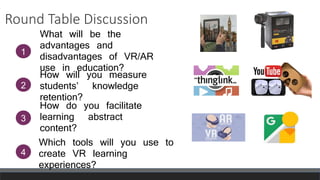
Round Table Discussion
What will be the
advantages and
disadvantages of VR/AR
use in education?
1
3
How do you facilitate
learning abstract
content?
4
Which tools will you use to
create VR learning
experiences?
How will you measure
students’ knowledge
retention?
2
Appendix: Hands-On Practice
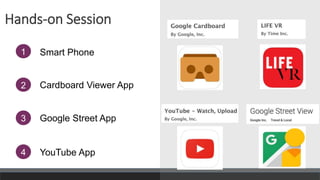
Hands-on Session
Smart Phone
1
3 Google Street App
4 YouTube App
Cardboard Viewer App
2
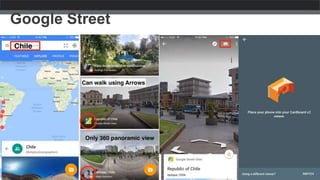
Google Street
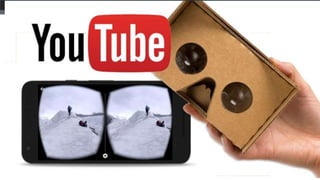
Download YouTube phone App
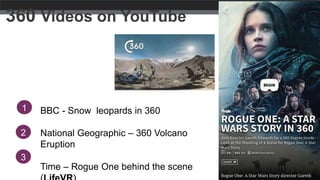
360 Videos on YouTube
BBC - Snow leopards in 360
National Geographic – 360 Volcano
Eruption
Time – Rogue One behind the scene
3
2
1
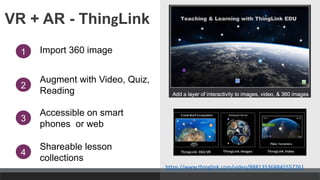
VR + AR - ThingLink
Import 360 image
1
3
Accessible on smart
phones or web
4
Shareable lesson
collections
Augment with Video, Quiz,
Reading
2
https://www.thinglink.com/video/888135368845557761
References
Lin, Y., & Suh, A. (2021). The Role of Spatial Ability in Learning with Virtual
Reality: A Literature Review. Proceedings of the 54th Hawaii International
Conference on System Sciences, 94–103. https://doi.org/10.24251/hicss.2021.011
Holopainen, J., Lähtevänoja, A., Sandström, N., Nevgi, A., Mattila, O., Pöyry, E.,
& Parvinen, P. (2021). Applying Affordances Scale as a Design Method –
Case Virtual Reality Course Design. Proceedings of the 54th Hawaii
International Conference on System Sciences, 14–23.
https://doi.org/10.24251/hicss.2021.003
Holopainen, J., Lähtevänoja, A., Mattila, O., Södervik, I., Pöyry, E., & Parvinen,
P. (2020). Exploring the Learning Outcomes with Various Technologies -
Proposing Design Principles for Virtual Reality Learning Environments.
Proceedings of the 53rd Hawaii International Conference on System Sciences.
https://doi.org/10.24251/hicss.2020.004
Radianti, J., Majchrzak, T. A., Fromm, J., Stieglitz, S., & Vom Brocke, J.
(2021). Virtual Reality Applications for Higher Educations: A Market Analysis.
Proceedings of the 54th Hawaii International Conference on System Sciences.
https://doi.org/10.24251/hicss.2021.014
Scrivner, O., Perez, N., Madewell, J., & Buckley, (2017). Immersive Mobile
Technologies: Virtual/Augmented Reality Technologies in the Classroom. ATLT
Teaching Symposium, Sep 2017, IUPUI.

HICSS ATLT: Advances in Teaching and Learning Technologies

  • 1.
    February 26, 2021 Advancesin Teaching and Learning Technologies Olga Scrivner Indiana University Harrisburg University of Science & Technology Rose-Hulman Institute of Technology
  • 2.
    Hawaii International Conferenceon Systems Sciences Mini-Track: Advances in Teaching and Learning Technologies Jan 4-7, 2022, Maui
  • 3.
    Transformation in Education 1Learning environments to model critical thinking, problem-solving, collaboration 2 New technologies to improve students’ learning experiences 3 The integration of artificial intelligence and machine learning to support knowledge processes “in the service of solving problems for themselves or helping others to solve problems” (Ryu & Jeong, 2019) Learner’s Profile
  • 4.
    Mini Track Goals InnovativeInsights to deal with today’s challenges Immersive Environments Collaborative Environments Learning Technologies Mini Track Recording 2021: https://iu.mediaspace.kaltura.com/media/t/1_8aisngop LinkedIn Group HICSS-ATLT: https://www.linkedin.com/groups/13862522/
  • 5.
    Augmented Reality Augmented realityis a view of the real world with virtual elements overlaying it. Pokémon Go is an example of augmented reality or AR
  • 6.
    Augmented Reality: Definition “areal time direct or indirect view of a physical real world environment that has been enhanced/augmented by adding virtual computer generated information to it” (Carmigniani et al. 2011) Scrivner et al. 2017. Immersive Mobile Technologies: Virtual/Augmented Reality Technologies in the Classroom. Teaching Symposium
  • 7.
    AR in Education ARenhances problem solving, increases motivation, and improves performance (Wasko 2013, Billinghurst 2012) 1 Students have more authentic learning experiences (Klopfer 2008) 2 “Potentially more exciting for educators” (Bower 2013) 3 Scrivner et al. 2017. Immersive Mobile Technologies: Virtual/Augmented Reality Technologies in the Classroom. Teaching Symposium
  • 8.
    Virtual Reality Virtual realityis a realistic and immersive experience of a virtual world
  • 9.
    Virtual Reality: Definition “computer interface that permits the user to interact in real time, in a tridimensional space generated by a computer, using their feelings, through special devices” (Kimer. 2012)
  • 10.
    VR in Education VRprovides access to a visual-spatial dimension not available with 2D or abstract learning (Sorby 2009). 1 Multi-sensory VR environment helps increase engagement with content and knowledge retention. 2 VR can help “discover, explore and build knowledge about places and situations that we could never explore” (Piovesan et al. 2012). 3
  • 11.
    VR Environments forEducation Computer-generated environments (games and simulation) 1 2 360-degree images 3 360-degree videos
  • 12.
  • 13.
    VR Applications (Apps) -Can bring students into realistic scenes and experiences - Interactive: touch, grab, assemble- disassemble, moving around Advantages - Lack systematic analysis on available apps on the market that support learning for higher education Problem Method - Systematic review of VR apps (manual review and concept mapping coding)
  • 14.
    Apps Domain andDesign Elements 0% 1%1%1%1%1% 1%1% 2%2%2%2%2%2%2%2%2% 3%3%3% 4% 5% 6% 7% 10% 13% 18% Nursing Chemistry Surgical Medicine Architecture Psychology Ethics Computer Science Manufacturing Geography Earth Science and Geology Arts Physics Mathematics Paleontology Biochemistry and biotechnology Aviation Sport Language History Business and Management Medicine Training Safety Restaurant and Bar Enginering Astronomy Biology and Zoology • Realistic Surrounding • Basic Interaction • Instructions • Passive Observation • Assemble-Disassemble dissection • Interaction with another user • Immediate Feedback • Virtual Rewards • User Generated Content • Role Management • Moving around • Knowledge test/ questionnaire/ exercise exercise • Making meaningful choice • Interaction with virtual agents • Elevated challenges • Alternative learning venue • Virtual Presentation Biology/ Zoology Astronomy Engineering Restaurant and Bar Safety
  • 15.
  • 16.
  • 17.
  • 18.
    Bloom’s Taxonomy What isthe effect of the technology (VR, 3D, 2D) on different learning outcomes (remembering, understanding, and ability to apply)?
  • 19.
    Design Principles customized learning,challenging learning environments, multi-sensory effects, immersion, interactivity, 3D-dimensionality, engagement, motivation towards the content and technology Technology must be aligned with the learning objectives Multi-sensorial effects, interactions, individual experiences and immersion Better understanding 3D- dimensionality VR can easily provide new teaching methods Customized learning and motivation Interactivity and presence VR has its advances on the apply -level (or higher)
  • 20.
  • 21.
  • 22.
    Spatial Ability “The skillin representing, transforming, generating, and recalling symbolic, nonlinguistic information” (Linn and Petersen, 1985, p. 1482) What is the relationship between spatial ability and learning performance in VR?
  • 23.
    Spatial Ability asEnhancer vs Compensator Low spatial ability learners benefit more from - Manipulation (Jang, Vitale, Jyung, & Black, 2017) - Stereo Viewing (Barrett & Hegarty, 2016) - Co-location (Barrett & Hegarty, 2016) - Active Exploration (Meijer & Broek, 2010) - Combination of Stereopsis and Interactivity (Moro et al.,, 2017) - Dynamic Visualization (Berney et al., 2015) High spatial ability learners benefit more from - Active Control (Qi et al., 2013)
  • 24.
    Round Table Discussion Whatwill be the advantages and disadvantages of VR/AR use in education? 1 3 How do you facilitate learning abstract content? 4 Which tools will you use to create VR learning experiences? How will you measure students’ knowledge retention? 2
  • 25.
  • 26.
    Hands-on Session Smart Phone 1 3Google Street App 4 YouTube App Cardboard Viewer App 2
  • 27.
  • 28.
  • 29.
    360 Videos onYouTube BBC - Snow leopards in 360 National Geographic – 360 Volcano Eruption Time – Rogue One behind the scene 3 2 1
  • 30.
    VR + AR- ThingLink Import 360 image 1 3 Accessible on smart phones or web 4 Shareable lesson collections Augment with Video, Quiz, Reading 2 https://www.thinglink.com/video/888135368845557761
  • 31.
    References Lin, Y., &Suh, A. (2021). The Role of Spatial Ability in Learning with Virtual Reality: A Literature Review. Proceedings of the 54th Hawaii International Conference on System Sciences, 94–103. https://doi.org/10.24251/hicss.2021.011 Holopainen, J., Lähtevänoja, A., Sandström, N., Nevgi, A., Mattila, O., Pöyry, E., & Parvinen, P. (2021). Applying Affordances Scale as a Design Method – Case Virtual Reality Course Design. Proceedings of the 54th Hawaii International Conference on System Sciences, 14–23. https://doi.org/10.24251/hicss.2021.003 Holopainen, J., Lähtevänoja, A., Mattila, O., Södervik, I., Pöyry, E., & Parvinen, P. (2020). Exploring the Learning Outcomes with Various Technologies - Proposing Design Principles for Virtual Reality Learning Environments. Proceedings of the 53rd Hawaii International Conference on System Sciences. https://doi.org/10.24251/hicss.2020.004 Radianti, J., Majchrzak, T. A., Fromm, J., Stieglitz, S., & Vom Brocke, J. (2021). Virtual Reality Applications for Higher Educations: A Market Analysis. Proceedings of the 54th Hawaii International Conference on System Sciences. https://doi.org/10.24251/hicss.2021.014 Scrivner, O., Perez, N., Madewell, J., & Buckley, (2017). Immersive Mobile Technologies: Virtual/Augmented Reality Technologies in the Classroom. ATLT Teaching Symposium, Sep 2017, IUPUI.