Spectroscopy
- by R.Varshini
Ⅱ- BIOTECH
 Spectroscopy
 Discovery of Spectroscopy
 Principle of Spectroscopy
 Types of Spectroscopy
 Application of Spectroscopy
Spectroscopy
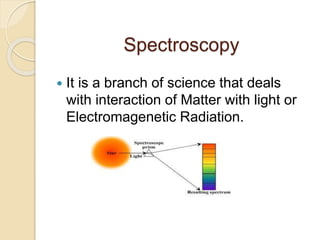
 It is a branch of science that deals
with interaction of Matter with light or
Electromagenetic Radiation.
Discovery of Spectroscopy
 The systematic attribution of spectra to
chemical elements began in the 1860s
with the work of German physicist
Gustav Kirchhoff and chemist Robert
Bunsen. They demonstrated that
spectroscopy could be used for trace
chemical analysis and several of the
chemical elements they discovered were
previously unknown.
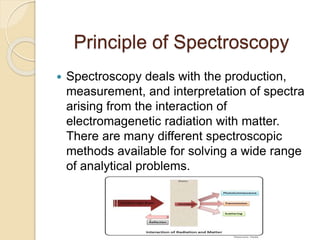
Principle of Spectroscopy
 Spectroscopy deals with the production,
measurement, and interpretation of spectra
arising from the interaction of
electromagenetic radiation with matter.
There are many different spectroscopic
methods available for solving a wide range
of analytical problems.
Types of Spectroscopy
 There are Many different types of
spectroscopy, but the Most common types
used for chemical analysis includes atomic
spectroscopy, ultraviolet and visible
spectroscopy, infrared spectroscopy,
Raman spectroscopy and nuclear magnetic
resonance.
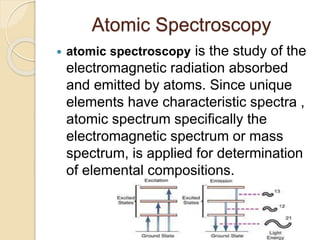
Atomic Spectroscopy
 atomic spectroscopy is the study of the
electromagnetic radiation absorbed
and emitted by atoms. Since unique
elements have characteristic spectra ,
atomic spectrum specifically the
electromagnetic spectrum or mass
spectrum, is applied for determination
of elemental compositions.
Ultraviolet & Visible
Spectroscopy
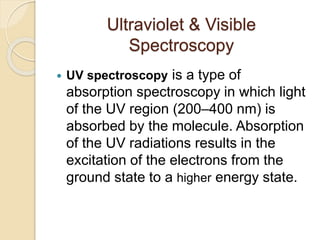
 UV spectroscopy is a type of
absorption spectroscopy in which light
of the UV region (200–400 nm) is
absorbed by the molecule. Absorption
of the UV radiations results in the
excitation of the electrons from the
ground state to a higher energy state.
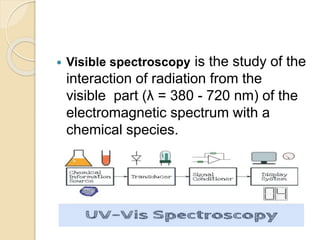
 Visible spectroscopy is the study of the
interaction of radiation from the
visible part (λ = 380 - 720 nm) of the
electromagnetic spectrum with a
chemical species.
Infrared Spectroscopy
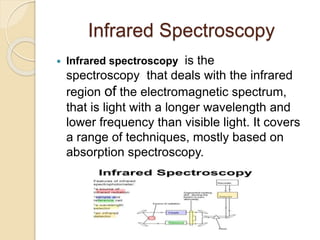
 Infrared spectroscopy is the
spectroscopy that deals with the infrared
region of the electromagnetic spectrum,
that is light with a longer wavelength and
lower frequency than visible light. It covers
a range of techniques, mostly based on
absorption spectroscopy.
Raman Spectroscopy
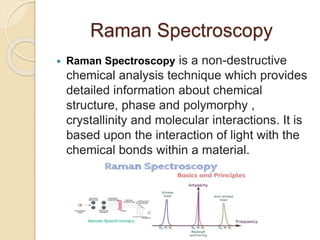
 Raman Spectroscopy is a non-destructive
chemical analysis technique which provides
detailed information about chemical
structure, phase and polymorphy ,
crystallinity and molecular interactions. It is
based upon the interaction of light with the
chemical bonds within a material.
Nuclear Magnetic Resonance
Spectroscopy
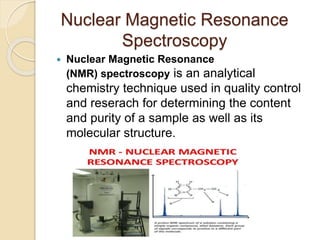
 Nuclear Magnetic Resonance
(NMR) spectroscopy is an analytical
chemistry technique used in quality control
and reserach for determining the content
and purity of a sample as well as its
molecular structure.
Application of Spectroscopy
 Cure monitoring of composites using optical
fibers.
 Estimate weathered wood exposure times
using near infrared spectroscopy.
 Measurement of toxic compounds in blood
samples
 Non-destructive elemental analysis by X-
ray fluorescence.
 Electronic structure research with various
spectroscopes.
conclusion

Applied Biochemistry

  • 1.
  • 2.
     Spectroscopy  Discoveryof Spectroscopy  Principle of Spectroscopy  Types of Spectroscopy  Application of Spectroscopy
  • 3.
    Spectroscopy  It isa branch of science that deals with interaction of Matter with light or Electromagenetic Radiation.
  • 4.
    Discovery of Spectroscopy The systematic attribution of spectra to chemical elements began in the 1860s with the work of German physicist Gustav Kirchhoff and chemist Robert Bunsen. They demonstrated that spectroscopy could be used for trace chemical analysis and several of the chemical elements they discovered were previously unknown.
  • 5.
    Principle of Spectroscopy Spectroscopy deals with the production, measurement, and interpretation of spectra arising from the interaction of electromagenetic radiation with matter. There are many different spectroscopic methods available for solving a wide range of analytical problems.
  • 6.
    Types of Spectroscopy There are Many different types of spectroscopy, but the Most common types used for chemical analysis includes atomic spectroscopy, ultraviolet and visible spectroscopy, infrared spectroscopy, Raman spectroscopy and nuclear magnetic resonance.
  • 7.
    Atomic Spectroscopy  atomicspectroscopy is the study of the electromagnetic radiation absorbed and emitted by atoms. Since unique elements have characteristic spectra , atomic spectrum specifically the electromagnetic spectrum or mass spectrum, is applied for determination of elemental compositions.
  • 8.
    Ultraviolet & Visible Spectroscopy UV spectroscopy is a type of absorption spectroscopy in which light of the UV region (200–400 nm) is absorbed by the molecule. Absorption of the UV radiations results in the excitation of the electrons from the ground state to a higher energy state.
  • 9.
     Visible spectroscopyis the study of the interaction of radiation from the visible part (λ = 380 - 720 nm) of the electromagnetic spectrum with a chemical species.
  • 10.
    Infrared Spectroscopy  Infraredspectroscopy is the spectroscopy that deals with the infrared region of the electromagnetic spectrum, that is light with a longer wavelength and lower frequency than visible light. It covers a range of techniques, mostly based on absorption spectroscopy.
  • 11.
    Raman Spectroscopy  RamanSpectroscopy is a non-destructive chemical analysis technique which provides detailed information about chemical structure, phase and polymorphy , crystallinity and molecular interactions. It is based upon the interaction of light with the chemical bonds within a material.
  • 12.
    Nuclear Magnetic Resonance Spectroscopy Nuclear Magnetic Resonance (NMR) spectroscopy is an analytical chemistry technique used in quality control and reserach for determining the content and purity of a sample as well as its molecular structure.
  • 13.
    Application of Spectroscopy Cure monitoring of composites using optical fibers.  Estimate weathered wood exposure times using near infrared spectroscopy.  Measurement of toxic compounds in blood samples  Non-destructive elemental analysis by X- ray fluorescence.  Electronic structure research with various spectroscopes.
  • 14.