UNIT-5
SPECTROSCOPIC TECHNIQUES AND
APPLICATIONS
1
CONTENTS
• What is Spectroscopy?
• Types of spectroscopy
• Uses and Applications
• Conclusion
• Reference
2
WHAT IS SPECTROSCOPY?
• Spectroscopy deals with the interaction of
electromagnetic radiation with matter
• Used to extract very useful information like
structural and other physico-chemical
properties of molecules.
• Spectroscopy is the most imperative and
promising tool for the structural investigation
of chemically relevant systems.
3
THE INTERACTION OF RADIATION WITH MATTER
4
5
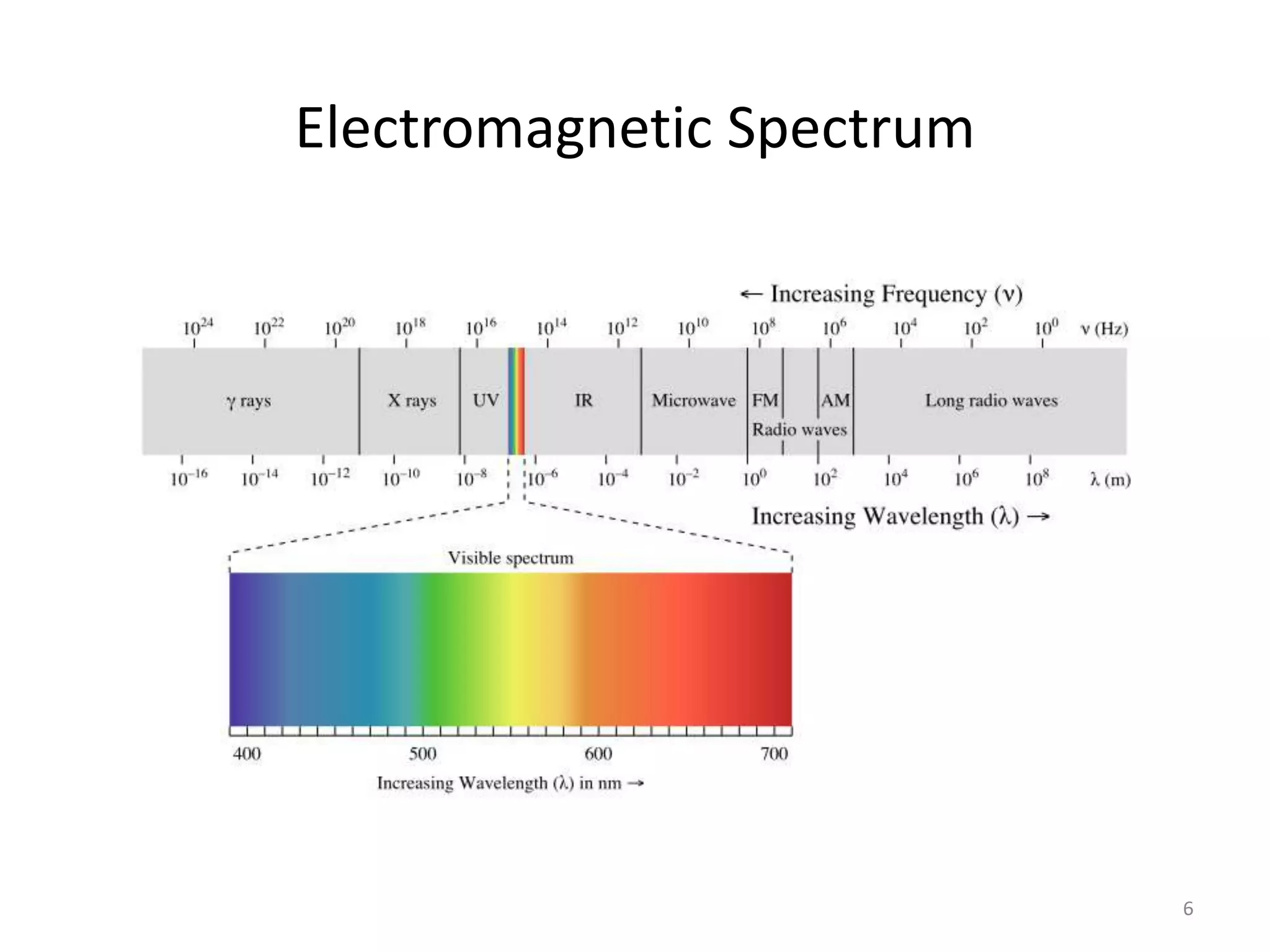
Electromagnetic Spectrum
6
• Electromagnetic radiations are produced by the
oscillations of electric and magnetic dipoles
residing in the atom.
• The most important consequence of
electromagnetic interaction is that energy is
absorbed or emitted by the matter in discrete
amounts called quanta.
• Spectroscopic methods are generally used to
measurer the energy difference between various
molecular energy levels and to determine the
atomic and molecular structures.
7
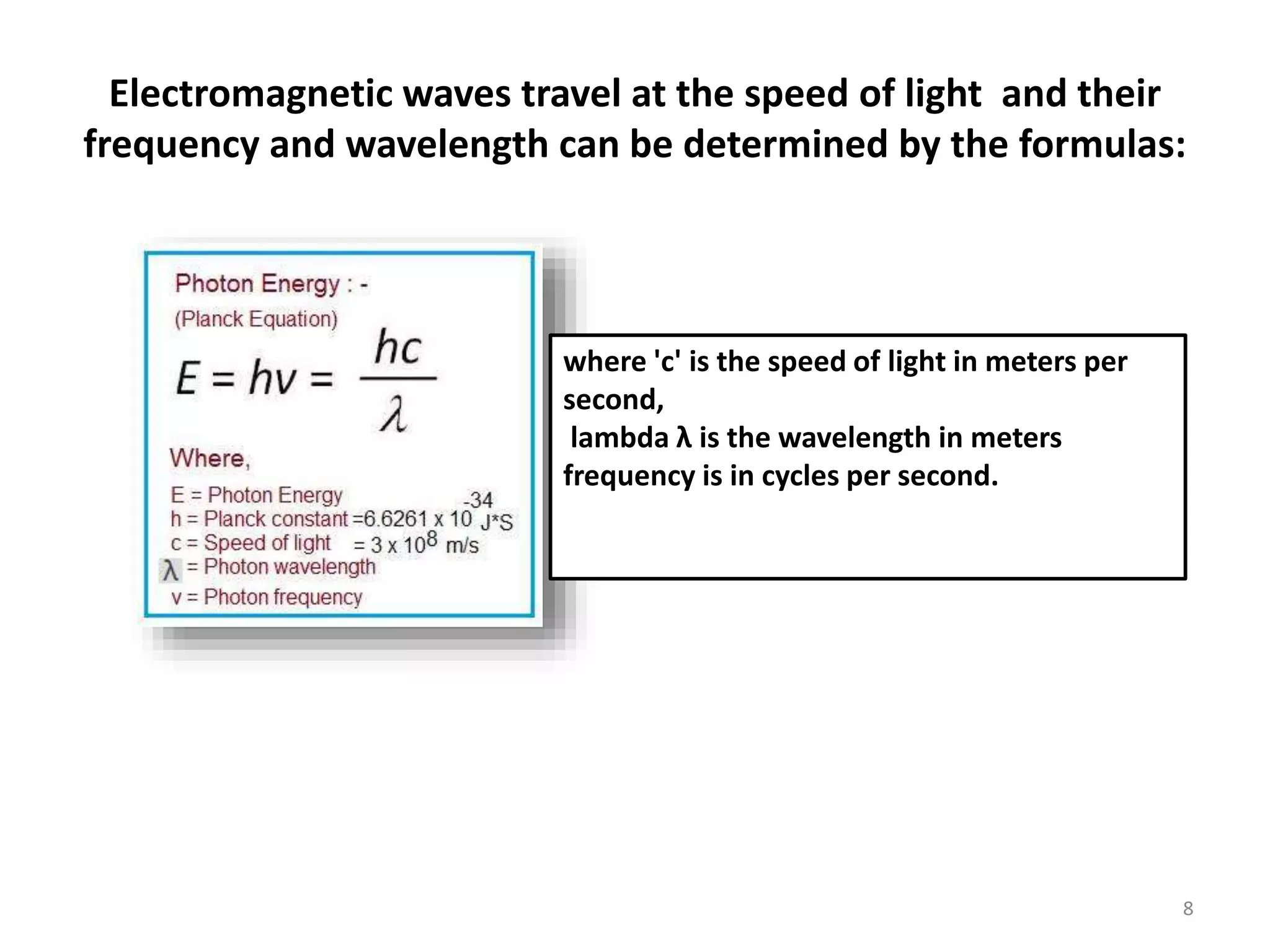
Electromagnetic waves travel at the speed of light and their
frequency and wavelength can be determined by the formulas:
where 'c' is the speed of light in meters per
second,
lambda λ is the wavelength in meters
frequency is in cycles per second.
8
Molecule contains :
• Translational energy
• Rotational energy
• • Vibratioal energy
• Electronic energy
• All except the Translational energy are quantized
• Energy(molecule )= E(rot )+ E(vib )+ E(elec )
9
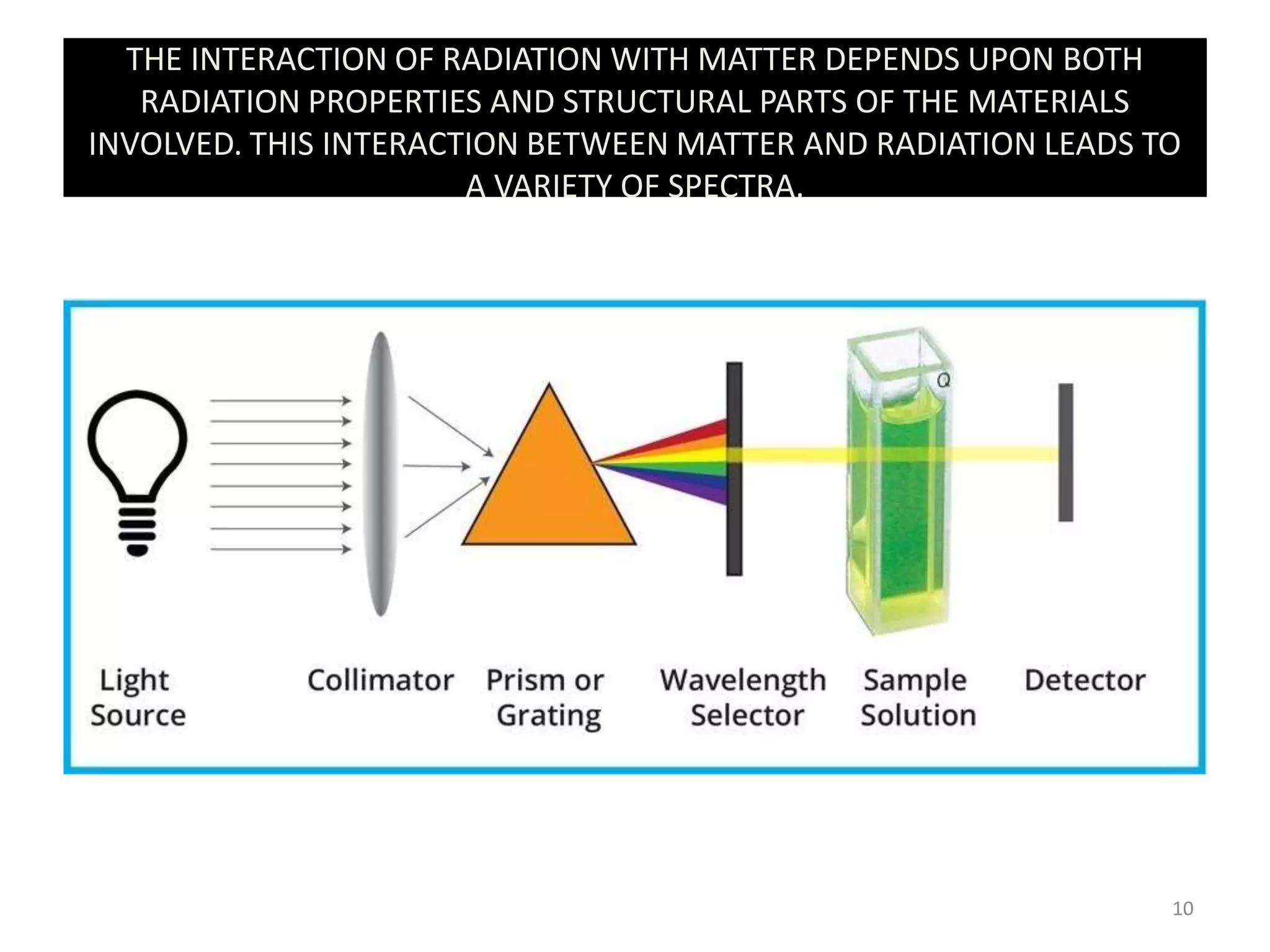
THE INTERACTION OF RADIATION WITH MATTER DEPENDS UPON BOTH
RADIATION PROPERTIES AND STRUCTURAL PARTS OF THE MATERIALS
INVOLVED. THIS INTERACTION BETWEEN MATTER AND RADIATION LEADS TO
A VARIETY OF SPECTRA.
10
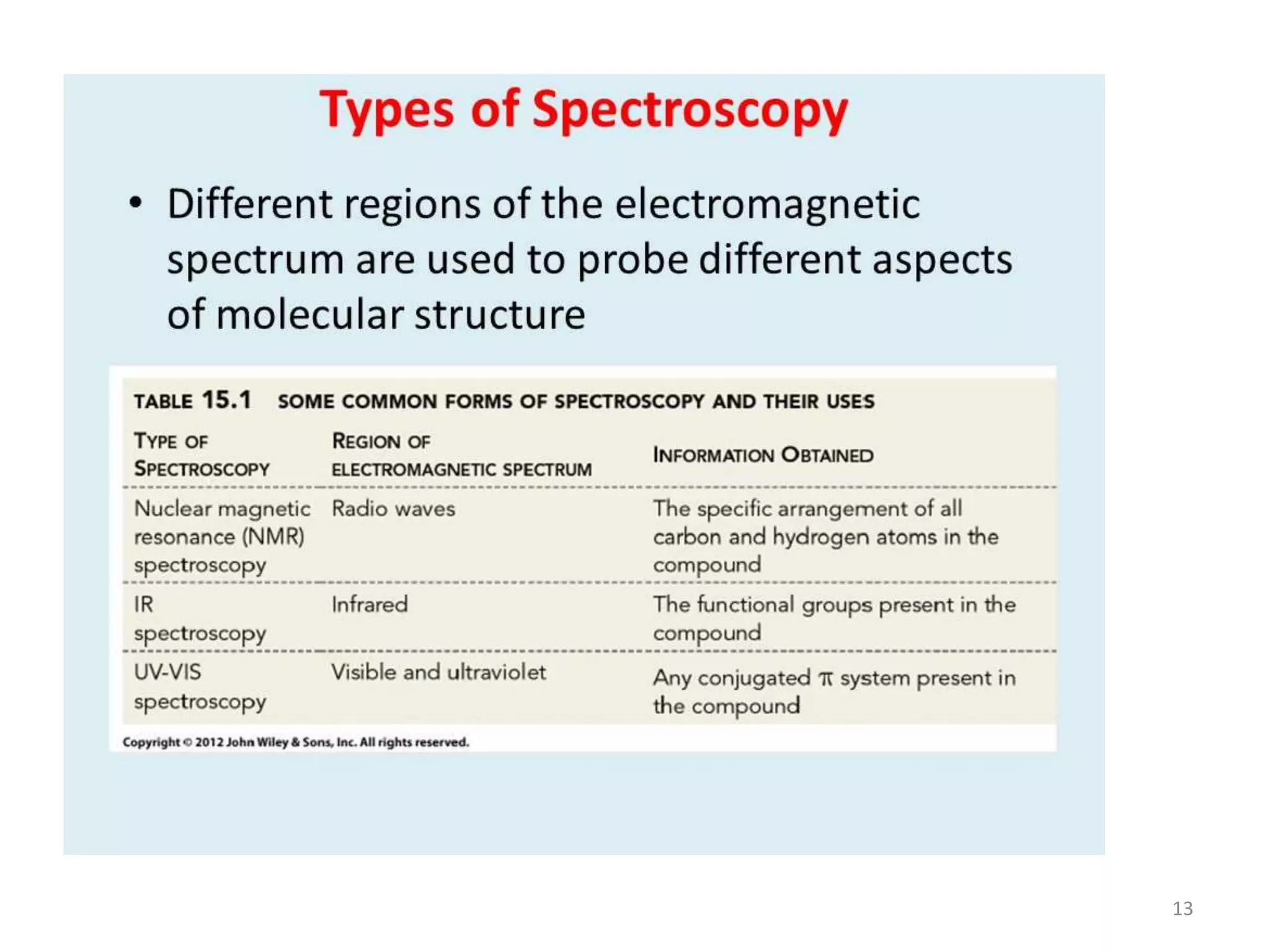
THREE TYPES OF THE ABSORPTION SPECTRUM:
Nuclear spin states
Electronic energy levels
Infrared
Radio frequency
Ultraviolet-
visible
Absorptionof
Electromagnetic
Radiation Results
inTransition Between
Region ofthe
Electromagnetic
Spectrum
Nuclear magnetic
resonance
Infrared
Ultraviolet-
visible
Type of
Spectroscopy
Frequency
(hetz)
2.5 x10¹⁴-1.5x10¹⁵
3 x10⁷-9x10⁸
1 x10¹³
-1x10¹⁴ Vibrational energy levels
11
12
13
INFRARED SPECTROSCOPY
Far-Infrared (400-33 cm-1): vibrations
of molecules containing heavy
atoms, molecular skeleton
vibrations and crystal lattice
vibrations
Mid-Infrared (4000-400 cm-1): useful
for organic analysis
Near Infrared (12820-4000 cm-
1): overtones; very useful for
quantitative analysis
14
REQUIREMENTS FOR VISIBILITY IN THE IR REGION
(selection rules)
• A change in dipole moment, whether it is induced
or permanent.
Heteronuclear Diatomicmlecules E.g HCl, HBr etc
N2, F2, etc. are inactive in the IR.
• Resonant frequencies that are in the infrared
frequency range of 100−4000 cm−1.
• After the absorption of radiation only transition for
which v=(+)(-) i.e, transition from=0 to V=1(change
in vibration quatum number between two vibrational
energy levels)
15
Molecular Vibrations
16
CHANGE IN DIPOLE MOMENT IN
TRIATOMIC MOLECULES
17
Hooke’s Law
18
19
IR SPECTRUM
20
21
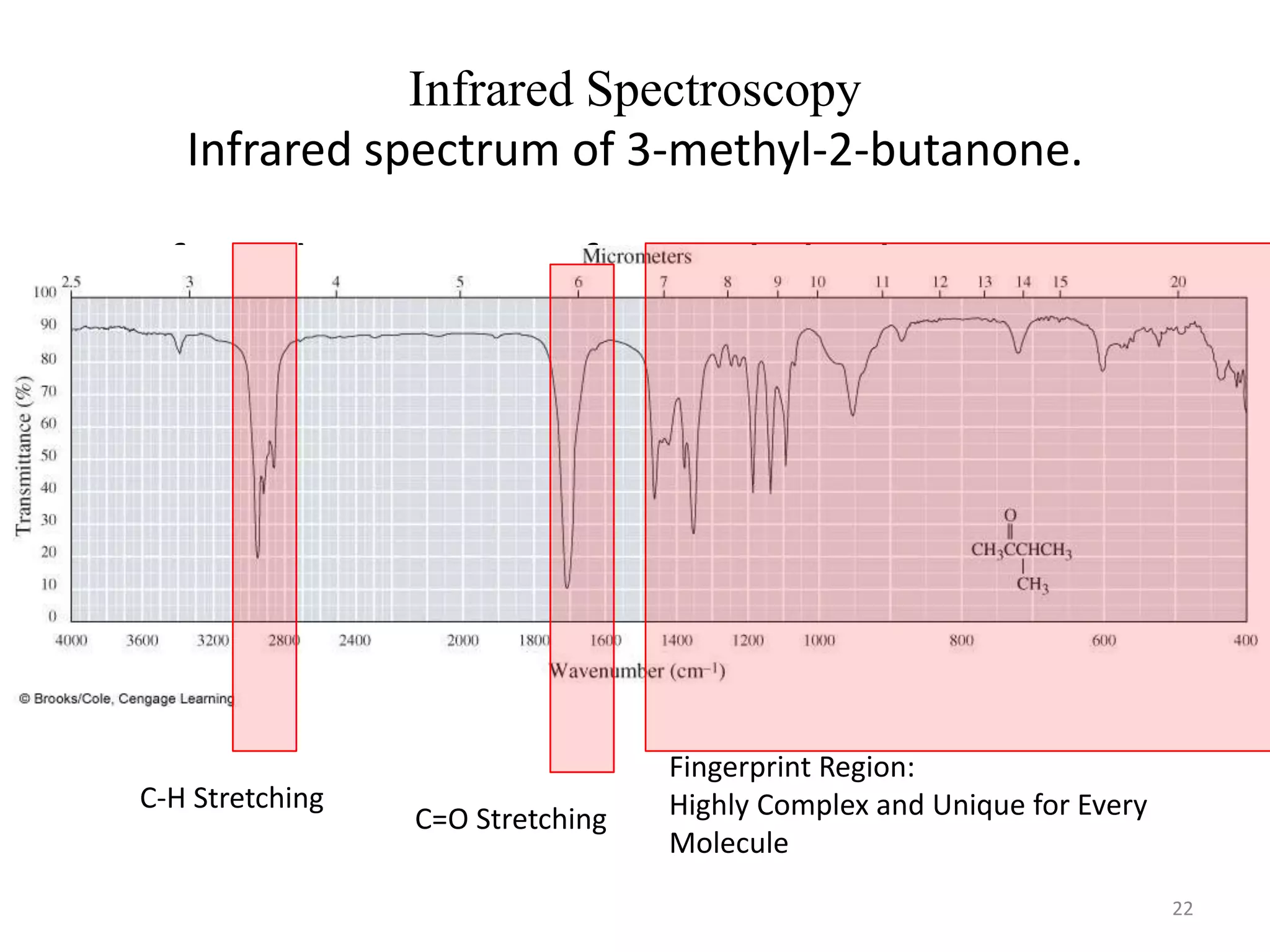
Infrared Spectroscopy
Infrared spectrum of 3-methyl-2-butanone.
• Infrared spectrum of 3-methyl-2-butanone.
Fingerprint Region:
Highly Complex and Unique for Every
Molecule
C-H Stretching
C=O Stretching
22
23
24
25
26
27
28
29
UV spectrum of acetone
30
31
32
33
34
35
36
37
38
39
40
41
42
43
44
45
46
47
48
49
50
51
52
53
54
55
56
57
58
59
60
61
62

spectroscopy ppt.pptx

  • 1.
  • 2.
    CONTENTS • What isSpectroscopy? • Types of spectroscopy • Uses and Applications • Conclusion • Reference 2
  • 3.
    WHAT IS SPECTROSCOPY? •Spectroscopy deals with the interaction of electromagnetic radiation with matter • Used to extract very useful information like structural and other physico-chemical properties of molecules. • Spectroscopy is the most imperative and promising tool for the structural investigation of chemically relevant systems. 3
  • 4.
    THE INTERACTION OFRADIATION WITH MATTER 4
  • 5.
  • 6.
  • 7.
    • Electromagnetic radiationsare produced by the oscillations of electric and magnetic dipoles residing in the atom. • The most important consequence of electromagnetic interaction is that energy is absorbed or emitted by the matter in discrete amounts called quanta. • Spectroscopic methods are generally used to measurer the energy difference between various molecular energy levels and to determine the atomic and molecular structures. 7
  • 8.
    Electromagnetic waves travelat the speed of light and their frequency and wavelength can be determined by the formulas: where 'c' is the speed of light in meters per second, lambda λ is the wavelength in meters frequency is in cycles per second. 8
  • 9.
    Molecule contains : •Translational energy • Rotational energy • • Vibratioal energy • Electronic energy • All except the Translational energy are quantized • Energy(molecule )= E(rot )+ E(vib )+ E(elec ) 9
  • 10.
    THE INTERACTION OFRADIATION WITH MATTER DEPENDS UPON BOTH RADIATION PROPERTIES AND STRUCTURAL PARTS OF THE MATERIALS INVOLVED. THIS INTERACTION BETWEEN MATTER AND RADIATION LEADS TO A VARIETY OF SPECTRA. 10
  • 11.
    THREE TYPES OFTHE ABSORPTION SPECTRUM: Nuclear spin states Electronic energy levels Infrared Radio frequency Ultraviolet- visible Absorptionof Electromagnetic Radiation Results inTransition Between Region ofthe Electromagnetic Spectrum Nuclear magnetic resonance Infrared Ultraviolet- visible Type of Spectroscopy Frequency (hetz) 2.5 x10¹⁴-1.5x10¹⁵ 3 x10⁷-9x10⁸ 1 x10¹³ -1x10¹⁴ Vibrational energy levels 11
  • 12.
  • 13.
  • 14.
    INFRARED SPECTROSCOPY Far-Infrared (400-33cm-1): vibrations of molecules containing heavy atoms, molecular skeleton vibrations and crystal lattice vibrations Mid-Infrared (4000-400 cm-1): useful for organic analysis Near Infrared (12820-4000 cm- 1): overtones; very useful for quantitative analysis 14
  • 15.
    REQUIREMENTS FOR VISIBILITYIN THE IR REGION (selection rules) • A change in dipole moment, whether it is induced or permanent. Heteronuclear Diatomicmlecules E.g HCl, HBr etc N2, F2, etc. are inactive in the IR. • Resonant frequencies that are in the infrared frequency range of 100−4000 cm−1. • After the absorption of radiation only transition for which v=(+)(-) i.e, transition from=0 to V=1(change in vibration quatum number between two vibrational energy levels) 15
  • 16.
  • 17.
    CHANGE IN DIPOLEMOMENT IN TRIATOMIC MOLECULES 17
  • 18.
  • 19.
  • 20.
  • 21.
  • 22.
    Infrared Spectroscopy Infrared spectrumof 3-methyl-2-butanone. • Infrared spectrum of 3-methyl-2-butanone. Fingerprint Region: Highly Complex and Unique for Every Molecule C-H Stretching C=O Stretching 22
  • 23.
  • 24.
  • 25.
  • 26.
  • 27.
  • 28.
  • 29.
  • 30.
    UV spectrum ofacetone 30
  • 31.
  • 32.
  • 33.
  • 34.
  • 35.
  • 36.
  • 37.
  • 38.
  • 39.
  • 40.
  • 41.
  • 42.
  • 43.
  • 44.
  • 45.
  • 46.
  • 47.
  • 48.
  • 49.
  • 50.
  • 51.
  • 52.
  • 53.
  • 54.
  • 55.
  • 56.
  • 57.
  • 58.
  • 59.
  • 60.
  • 61.
  • 62.