Application of Stack
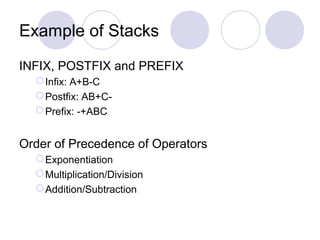
Example of Stacks
INFIX, POSTFIX and PREFIX
Infix: A+B-C
Postfix: AB+C-
Prefix: -+ABC
Order of Precedence of Operators
Exponentiation
Multiplication/Division
Addition/Subtraction
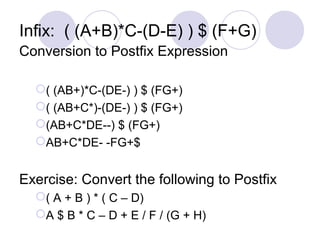
Infix: ( (A+B)*C-(D-E) ) $ (F+G)
Conversion to Postfix Expression
( (AB+)*C-(DE-) ) $ (FG+)
( (AB+C*)-(DE-) ) $ (FG+)
(AB+C*DE--) $ (FG+)
AB+C*DE- -FG+$
Exercise: Convert the following to Postfix
( A + B ) * ( C – D)
A $ B * C – D + E / F / (G + H)
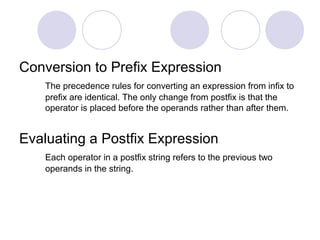
Conversion to Prefix Expression
The precedence rules for converting an expression from infix to
prefix are identical. The only change from postfix is that the
operator is placed before the operands rather than after them.
Evaluating a Postfix Expression
Each operator in a postfix string refers to the previous two
operands in the string.
Algorithm to Evaluate a Postfix Expression
opndstk = the empty stack
/* scan the input string reading one
element */
/* at a time into symb */
while (not end of input) {
symb = next input character;
if (symb is an operand)
push(opndstk, symb)
else {
/* symb is an operator */
opnd2 = pop(opndstk);
opnd1 = pop(opndstk);
value = result of applying
symb to opnd1 and opnd2;
push(opndstk, value);
} /* end else */
} /* end while */
return (pop(opndstk));
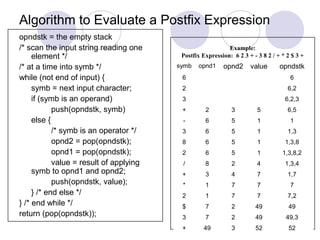
Example:
Postfix Expression: 6 2 3 + - 3 8 2 / + * 2 $ 3 +
symb opnd1 opnd2 value opndstk
6 6
2 6,2
3 6,2,3
+ 2 3 5 6,5
- 6 5 1 1
3 6 5 1 1,3
8 6 5 1 1,3,8
2 6 5 1 1,3,8,2
/ 8 2 4 1,3,4
+ 3 4 7 1,7
* 1 7 7 7
2 1 7 7 7,2
$ 7 2 49 49
3 7 2 49 49,3
+ 49 3 52 52
Conversion of Infix Expression to postfix
A+B*C = ABC*+
(A+B)*C = AB+C*
There must be a precedence function.
prcd(op1, op2), where op1 and op2 are characters representing
operators.
This function returns TRUE if op1 has precendence over op2 when op1
appears to the left of op2 in an infix expression without parenthesis.
prcd(op1,op2) returns FALSE otherwise.
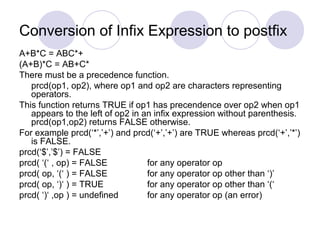
For example prcd(‘*’,’+’) and prcd(‘+’,’+’) are TRUE whereas prcd(‘+’,’*’)
is FALSE.
prcd(‘$’,’$’) = FALSE
prcd( ‘(‘ , op) = FALSE for any operator op
prcd( op, ‘(‘ ) = FALSE for any operator op other than ‘)’
prcd( op, ‘)‘ ) = TRUE for any operator op other than ‘(‘
prcd( ‘)‘ ,op ) = undefined for any operator op (an error)
Algorithm to Convert Infix to Postfix
opstk = the empty stack;
while (not end of input) {
symb = next input character;
if (symb is an operand)
add symb to the postfix string
else {
while (!empty(opstk) &&
prcd(stacktop(opstk),symb) ) {
topsymb = pop(opstk);
add topsymb to the postfix
string;
} /* end while */
push(opstk, symb);
} /* end else */
} /* end while */
/* output any remaining operators */
while (!empty(opstk) ) {
topsymb = pop(opstk);
add topsymb to the postfix string;
} /* end while */
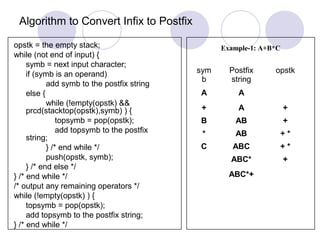
Example-1: A+B*C
sym
b
Postfix
string
opstk
A A
+ A +
B AB +
* AB + *
C ABC + *
ABC* +
ABC*+
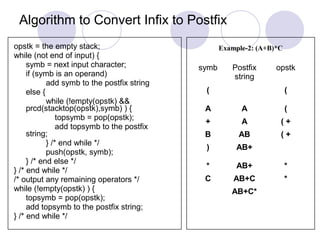
Algorithm to Convert Infix to Postfix
Example-2: (A+B)*C
symb Postfix
string
opstk
( (
A A (
+ A ( +
B AB ( +
) AB+
* AB+ *
C AB+C *
AB+C*
opstk = the empty stack;
while (not end of input) {
symb = next input character;
if (symb is an operand)
add symb to the postfix string
else {
while (!empty(opstk) &&
prcd(stacktop(opstk),symb) ) {
topsymb = pop(opstk);
add topsymb to the postfix
string;
} /* end while */
push(opstk, symb);
} /* end else */
} /* end while */
/* output any remaining operators */
while (!empty(opstk) ) {
topsymb = pop(opstk);
add topsymb to the postfix string;
} /* end while */
Algorithm to Convert Infix to Postfix
opstk = the empty stack;
while (not end of input) {
symb = next input character;
if (symb is an operand)
add symb to the postfix string
else {
while (!empty(opstk) &&
prcd(stacktop(opstk),symb) ) {
topsymb = pop(opstk);
add topsymb to the postfix
string;
} /* end while */
push(opstk, symb);
} /* end else */
} /* end while */
/* output any remaining operators */
while (!empty(opstk) ) {
topsymb = pop(opstk);
add topsymb to the postfix string;
} /* end while */
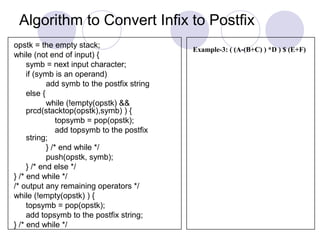
Example-3: ( (A-(B+C) ) *D ) $ (E+F)
Algorithm to Convert Infix to Postfix
opstk = the empty stack;
while (not end of input) {
symb = next input character;
if (symb is an operand)
add symb to the postfix string
else {
while (!empty(opstk) &&
prcd(stacktop(opstk),symb) ) {
topsymb = pop(opstk);
add topsymb to the postfix
string;
} /* end while */
push(opstk, symb);
} /* end else */
} /* end while */
/* output any remaining operators */
while (!empty(opstk) ) {
topsymb = pop(opstk);
add topsymb to the postfix string;
} /* end while */
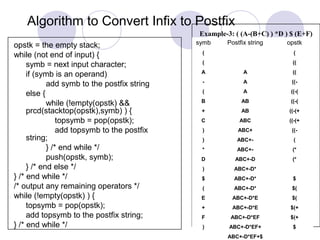
Example-3: ( (A-(B+C) ) *D ) $ (E+F)
symb Postfix string opstk
( (
( ((
A A ((
- A ((-
( A ((-(
B AB ((-(
+ AB ((-(+
C ABC ((-(+
) ABC+ ((-
) ABC+- (
* ABC+- (*
D ABC+-D (*
) ABC+-D*
$ ABC+-D* $
( ABC+-D* $(
E ABC+-D*E $(
+ ABC+-D*E $(+
F ABC+-D*EF $(+
) ABC+-D*EF+ $
ABC+-D*EF+$

Application of Stacks

  • 1.
  • 2.
    Example of Stacks INFIX,POSTFIX and PREFIX Infix: A+B-C Postfix: AB+C- Prefix: -+ABC Order of Precedence of Operators Exponentiation Multiplication/Division Addition/Subtraction
  • 3.
    Infix: ( (A+B)*C-(D-E)) $ (F+G) Conversion to Postfix Expression ( (AB+)*C-(DE-) ) $ (FG+) ( (AB+C*)-(DE-) ) $ (FG+) (AB+C*DE--) $ (FG+) AB+C*DE- -FG+$ Exercise: Convert the following to Postfix ( A + B ) * ( C – D) A $ B * C – D + E / F / (G + H)
  • 4.
    Conversion to PrefixExpression The precedence rules for converting an expression from infix to prefix are identical. The only change from postfix is that the operator is placed before the operands rather than after them. Evaluating a Postfix Expression Each operator in a postfix string refers to the previous two operands in the string.
  • 5.
    Algorithm to Evaluatea Postfix Expression opndstk = the empty stack /* scan the input string reading one element */ /* at a time into symb */ while (not end of input) { symb = next input character; if (symb is an operand) push(opndstk, symb) else { /* symb is an operator */ opnd2 = pop(opndstk); opnd1 = pop(opndstk); value = result of applying symb to opnd1 and opnd2; push(opndstk, value); } /* end else */ } /* end while */ return (pop(opndstk)); Example: Postfix Expression: 6 2 3 + - 3 8 2 / + * 2 $ 3 + symb opnd1 opnd2 value opndstk 6 6 2 6,2 3 6,2,3 + 2 3 5 6,5 - 6 5 1 1 3 6 5 1 1,3 8 6 5 1 1,3,8 2 6 5 1 1,3,8,2 / 8 2 4 1,3,4 + 3 4 7 1,7 * 1 7 7 7 2 1 7 7 7,2 $ 7 2 49 49 3 7 2 49 49,3 + 49 3 52 52
  • 6.
    Conversion of InfixExpression to postfix A+B*C = ABC*+ (A+B)*C = AB+C* There must be a precedence function. prcd(op1, op2), where op1 and op2 are characters representing operators. This function returns TRUE if op1 has precendence over op2 when op1 appears to the left of op2 in an infix expression without parenthesis. prcd(op1,op2) returns FALSE otherwise. For example prcd(‘*’,’+’) and prcd(‘+’,’+’) are TRUE whereas prcd(‘+’,’*’) is FALSE. prcd(‘$’,’$’) = FALSE prcd( ‘(‘ , op) = FALSE for any operator op prcd( op, ‘(‘ ) = FALSE for any operator op other than ‘)’ prcd( op, ‘)‘ ) = TRUE for any operator op other than ‘(‘ prcd( ‘)‘ ,op ) = undefined for any operator op (an error)
  • 7.
    Algorithm to ConvertInfix to Postfix opstk = the empty stack; while (not end of input) { symb = next input character; if (symb is an operand) add symb to the postfix string else { while (!empty(opstk) && prcd(stacktop(opstk),symb) ) { topsymb = pop(opstk); add topsymb to the postfix string; } /* end while */ push(opstk, symb); } /* end else */ } /* end while */ /* output any remaining operators */ while (!empty(opstk) ) { topsymb = pop(opstk); add topsymb to the postfix string; } /* end while */ Example-1: A+B*C sym b Postfix string opstk A A + A + B AB + * AB + * C ABC + * ABC* + ABC*+
  • 8.
    Algorithm to ConvertInfix to Postfix Example-2: (A+B)*C symb Postfix string opstk ( ( A A ( + A ( + B AB ( + ) AB+ * AB+ * C AB+C * AB+C* opstk = the empty stack; while (not end of input) { symb = next input character; if (symb is an operand) add symb to the postfix string else { while (!empty(opstk) && prcd(stacktop(opstk),symb) ) { topsymb = pop(opstk); add topsymb to the postfix string; } /* end while */ push(opstk, symb); } /* end else */ } /* end while */ /* output any remaining operators */ while (!empty(opstk) ) { topsymb = pop(opstk); add topsymb to the postfix string; } /* end while */
  • 9.
    Algorithm to ConvertInfix to Postfix opstk = the empty stack; while (not end of input) { symb = next input character; if (symb is an operand) add symb to the postfix string else { while (!empty(opstk) && prcd(stacktop(opstk),symb) ) { topsymb = pop(opstk); add topsymb to the postfix string; } /* end while */ push(opstk, symb); } /* end else */ } /* end while */ /* output any remaining operators */ while (!empty(opstk) ) { topsymb = pop(opstk); add topsymb to the postfix string; } /* end while */ Example-3: ( (A-(B+C) ) *D ) $ (E+F)
  • 10.
    Algorithm to ConvertInfix to Postfix opstk = the empty stack; while (not end of input) { symb = next input character; if (symb is an operand) add symb to the postfix string else { while (!empty(opstk) && prcd(stacktop(opstk),symb) ) { topsymb = pop(opstk); add topsymb to the postfix string; } /* end while */ push(opstk, symb); } /* end else */ } /* end while */ /* output any remaining operators */ while (!empty(opstk) ) { topsymb = pop(opstk); add topsymb to the postfix string; } /* end while */ Example-3: ( (A-(B+C) ) *D ) $ (E+F) symb Postfix string opstk ( ( ( (( A A (( - A ((- ( A ((-( B AB ((-( + AB ((-(+ C ABC ((-(+ ) ABC+ ((- ) ABC+- ( * ABC+- (* D ABC+-D (* ) ABC+-D* $ ABC+-D* $ ( ABC+-D* $( E ABC+-D*E $( + ABC+-D*E $(+ F ABC+-D*EF $(+ ) ABC+-D*EF+ $ ABC+-D*EF+$