Notations
Prepared by: Muhammed Saffarini
Objectives Overview
• Notations
• Prefix, Infix and Postfix Notations
• Conversion of one type expression to another
• Evaluation of Prefix and Postfix Notations
Notation
The way to write arithmetic expression is known as a notation.
An arithmetic expression can be written in three different but
equivalent notations, i.e., without changing the essence or
output of an expression. These notations are:
• Infix Notation
• Prefix Notation
• Postfix Notation
These notations are named as how they use operator in
expression. The terms infix, prefix, and postfix tell us whether
the operators go between, before, or after the operands.
Infix Notation
• We write expression in infix notation, e.g. a - b + c,
where operators are used in-between operands. It is
easy for us humans to read, write, and speak in infix
notation but the same does not go well with
computing devices. An algorithm to process infix
notation could be difficult and costly in terms of time
and space consumption.
Parentheses
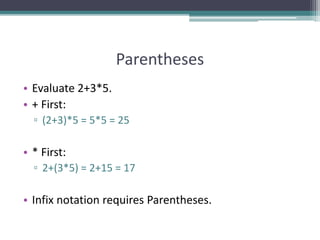
• Evaluate 2+3*5.
• + First:
▫ (2+3)*5 = 5*5 = 25
• * First:
▫ 2+(3*5) = 2+15 = 17
• Infix notation requires Parentheses.
Prefix Notation
• In this notation, operator is prefixed to operands, i.e.
operator is written ahead of operands. For example,
+ab. This is equivalent to its infix notation a + b.
Prefix notation is also known as Polish Notation.
Parentheses
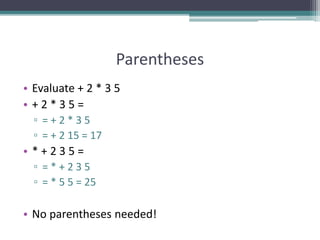
• Evaluate + 2 * 3 5
• + 2 * 3 5 =
▫ = + 2 * 3 5
▫ = + 2 15 = 17
• * + 2 3 5 =
▫ = * + 2 3 5
▫ = * 5 5 = 25
• No parentheses needed!
Postfix Notation
• This notation style is known as Reversed Polish
Notation. In this notation style, the operator is
postfixed to the operands i.e., the operator is
written after the operands. For example, ab+. This is
equivalent to its infix notation a + b.
Parentheses
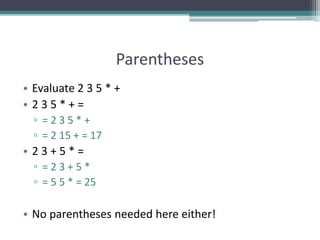
• Evaluate 2 3 5 * +
• 2 3 5 * + =
▫ = 2 3 5 * +
▫ = 2 15 + = 17
• 2 3 + 5 * =
▫ = 2 3 + 5 *
▫ = 5 5 * = 25
• No parentheses needed here either!
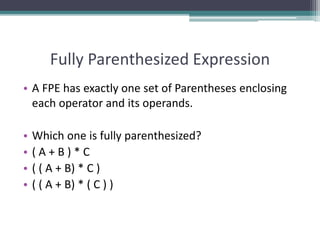
Fully Parenthesized Expression
• A FPE has exactly one set of Parentheses enclosing
each operator and its operands.
• Which one is fully parenthesized?
• ( A + B ) * C
• ( ( A + B) * C )
• ( ( A + B) * ( C ) )
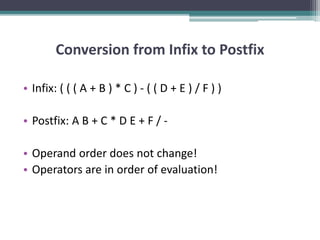
Conversion from Infix to Postfix
• Infix: ( ( ( A + B ) * C ) - ( ( D + E ) / F ) )
• Postfix: A B + C * D E + F / -
• Operand order does not change!
• Operators are in order of evaluation!
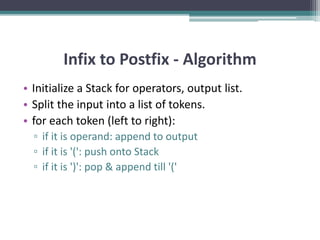
Infix to Postfix - Algorithm
• Initialize a Stack for operators, output list.
• Split the input into a list of tokens.
• for each token (left to right):
▫ if it is operand: append to output
▫ if it is '(': push onto Stack
▫ if it is ')': pop & append till '('
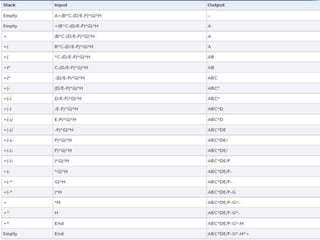
FPE Infix to Postfix
( ( ( A + B ) * ( C - E ) ) / ( F + G ) )
● stack: <empty>
● output: []
FPE Infix to Postfix
( ( A + B ) * ( C - E ) ) / ( F + G ) )
● stack: (
● output: []
FPE Infix to Postfix
( A + B ) * ( C - E ) ) / ( F + G ) )
● stack: ( (
● output: []
FPE Infix to Postfix
A + B ) * ( C - E ) ) / ( F + G ) )
● stack: ( ( (
● output: []
FPE Infix to Postfix
+ B ) * ( C - E ) ) / ( F + G ) )
● stack: ( ( (
● output: [A]
FPE Infix to Postfix
B ) * ( C - E ) ) / ( F + G ) )
● stack: ( ( ( +
● output: [A]
FPE Infix to Postfix
) * ( C - E ) ) / ( F + G ) )
● stack: ( ( ( +
● output: [A B]
FPE Infix to Postfix
* ( C - E ) ) / ( F + G ) )
● stack: ( (
● output: [A B + ]
FPE Infix to Postfix
( C - E ) ) / ( F + G ) )
● stack: ( ( *
● output: [A B + ]
FPE Infix to Postfix
C - E ) ) / ( F + G ) )
● stack: ( ( * (
● output: [A B + ]
FPE Infix to Postfix
- E ) ) / ( F + G ) )
● stack: ( ( * (
● output: [A B + C ]
FPE Infix to Postfix
E ) ) / ( F + G ) )
● stack: ( ( * ( -
● output: [A B + C ]
FPE Infix to Postfix
) ) / ( F + G ) )
● stack: ( ( * ( -
● output: [A B + C E ]
FPE Infix to Postfix
) / ( F + G ) )
● stack: ( ( *
● output: [A B + C E - ]
FPE Infix to Postfix
/ ( F + G ) )
● stack: (
● output: [A B + C E - * ]
FPE Infix to Postfix
( F + G ) )
● stack: ( /
● output: [A B + C E - * ]
FPE Infix to Postfix
F + G ) )
● stack: ( / (
● output: [A B + C E - * ]
FPE Infix to Postfix
+ G ) )
● stack: ( / (
● output: [A B + C E - * F ]
FPE Infix to Postfix
G ) )
● stack: ( / ( +
● output: [A B + C E - * F ]
FPE Infix to Postfix
) )
● stack: ( / ( +
● output: [A B + C E - * F G ]
FPE Infix to Postfix
)
● stack: ( /
● output: [A B + C E - * F G + ]
FPE Infix to Postfix
● stack: <empty>
● output: [A B + C E - * F G + / ]
Infix to Prefix Conversion
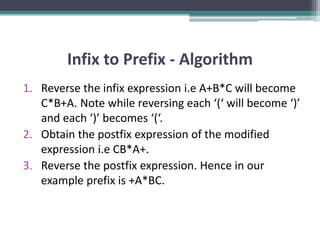
Infix to Prefix - Algorithm
1. Reverse the infix expression i.e A+B*C will become
C*B+A. Note while reversing each ‘(‘ will become ‘)’
and each ‘)’ becomes ‘(‘.
2. Obtain the postfix expression of the modified
expression i.e CB*A+.
3. Reverse the postfix expression. Hence in our
example prefix is +A*BC.
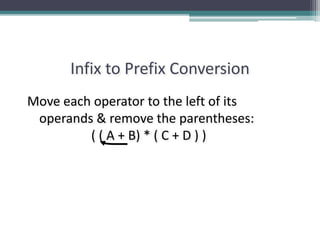
Infix to Prefix Conversion
Move each operator to the left of its
operands & remove the parentheses:
( ( A + B) * ( C + D ) )
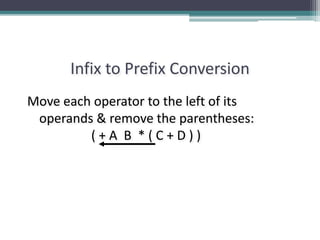
Infix to Prefix Conversion
Move each operator to the left of its
operands & remove the parentheses:
( + A B * ( C + D ) )
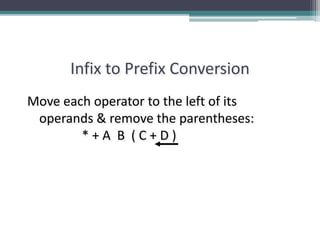
Infix to Prefix Conversion
Move each operator to the left of its
operands & remove the parentheses:
* + A B ( C + D )
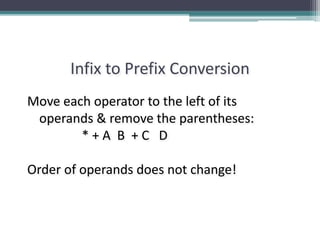
Infix to Prefix Conversion
Move each operator to the left of its
operands & remove the parentheses:
* + A B + C D
Order of operands does not change!
Postfix to Infix Conversion
Algorithm
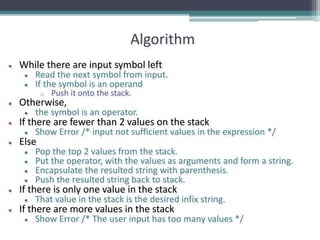
● While there are input symbol left
● Read the next symbol from input.
● If the symbol is an operand
o Push it onto the stack.
● Otherwise,
● the symbol is an operator.
● If there are fewer than 2 values on the stack
● Show Error /* input not sufficient values in the expression */
● Else
● Pop the top 2 values from the stack.
● Put the operator, with the values as arguments and form a string.
● Encapsulate the resulted string with parenthesis.
● Push the resulted string back to stack.
● If there is only one value in the stack
● That value in the stack is the desired infix string.
● If there are more values in the stack
● Show Error /* The user input has too many values */
Prefix to Infix Conversion
Algorithm
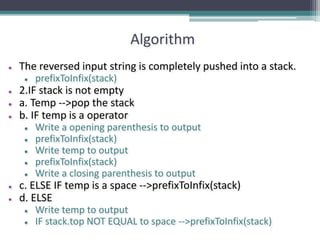
● The reversed input string is completely pushed into a stack.
● prefixToInfix(stack)
● 2.IF stack is not empty
● a. Temp -->pop the stack
● b. IF temp is a operator
● Write a opening parenthesis to output
● prefixToInfix(stack)
● Write temp to output
● prefixToInfix(stack)
● Write a closing parenthesis to output
● c. ELSE IF temp is a space -->prefixToInfix(stack)
● d. ELSE
● Write temp to output
● IF stack.top NOT EQUAL to space -->prefixToInfix(stack)
Prefix to Postfix Conversion
Algorithm
● Read the Prefix expression in reverse order (from right to
left)
● If the symbol is an operand, then push it onto the Stack
● If the symbol is an operator, then pop two operands from
the Stack
Create a string by concatenating the two operands and
the operator after them.
string = operand1 + operand2 + operator
And push the resultant string back to Stack
● Repeat the above steps until end of Prefix expression.
Postfix to Prefix Conversion
Algorithm
● Read the Postfix expression from left to right
● If the symbol is an operand, then push it onto the Stack
● If the symbol is an operator, then pop two operands from
the Stack
Create a string by concatenating the two operands and
the operator before them.
string = operator + operand2 + operand1
And push the resultant string back to Stack
● Repeat the above steps until end of Prefix expression.
Postfix Evaluation
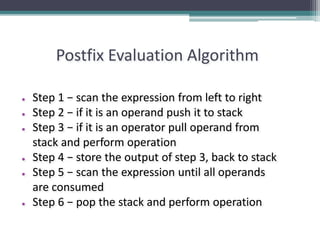
Postfix Evaluation Algorithm
● Step 1 − scan the expression from left to right
● Step 2 − if it is an operand push it to stack
● Step 3 − if it is an operator pull operand from
stack and perform operation
● Step 4 − store the output of step 3, back to stack
● Step 5 − scan the expression until all operands
are consumed
● Step 6 − pop the stack and perform operation
Prefix Evaluation
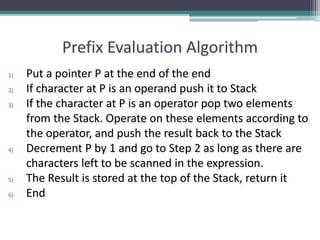
Prefix Evaluation Algorithm
1) Put a pointer P at the end of the end
2) If character at P is an operand push it to Stack
3) If the character at P is an operator pop two elements
from the Stack. Operate on these elements according to
the operator, and push the result back to the Stack
4) Decrement P by 1 and go to Step 2 as long as there are
characters left to be scanned in the expression.
5) The Result is stored at the top of the Stack, return it
6) End
Summary
• Notations
• Prefix, Infix and Postfix Notations
• Conversion of one type expression to another
• Evaluation of Prefix and Postfix Notations
References
● http://scanftree.com/Data_Structure/
● https://www.geeksforgeeks.org/convert-infix-
prefix-notation/
● https://www.tutorialspoint.com/data_structures
_algorithms/expression_parsing.htm

week9-prefixinfixandpostfixnotations-191013065821.pptx

  • 1.
  • 2.
    Objectives Overview • Notations •Prefix, Infix and Postfix Notations • Conversion of one type expression to another • Evaluation of Prefix and Postfix Notations
  • 3.
    Notation The way towrite arithmetic expression is known as a notation. An arithmetic expression can be written in three different but equivalent notations, i.e., without changing the essence or output of an expression. These notations are: • Infix Notation • Prefix Notation • Postfix Notation These notations are named as how they use operator in expression. The terms infix, prefix, and postfix tell us whether the operators go between, before, or after the operands.
  • 4.
    Infix Notation • Wewrite expression in infix notation, e.g. a - b + c, where operators are used in-between operands. It is easy for us humans to read, write, and speak in infix notation but the same does not go well with computing devices. An algorithm to process infix notation could be difficult and costly in terms of time and space consumption.
  • 5.
    Parentheses • Evaluate 2+3*5. •+ First: ▫ (2+3)*5 = 5*5 = 25 • * First: ▫ 2+(3*5) = 2+15 = 17 • Infix notation requires Parentheses.
  • 6.
    Prefix Notation • Inthis notation, operator is prefixed to operands, i.e. operator is written ahead of operands. For example, +ab. This is equivalent to its infix notation a + b. Prefix notation is also known as Polish Notation.
  • 7.
    Parentheses • Evaluate +2 * 3 5 • + 2 * 3 5 = ▫ = + 2 * 3 5 ▫ = + 2 15 = 17 • * + 2 3 5 = ▫ = * + 2 3 5 ▫ = * 5 5 = 25 • No parentheses needed!
  • 8.
    Postfix Notation • Thisnotation style is known as Reversed Polish Notation. In this notation style, the operator is postfixed to the operands i.e., the operator is written after the operands. For example, ab+. This is equivalent to its infix notation a + b.
  • 9.
    Parentheses • Evaluate 23 5 * + • 2 3 5 * + = ▫ = 2 3 5 * + ▫ = 2 15 + = 17 • 2 3 + 5 * = ▫ = 2 3 + 5 * ▫ = 5 5 * = 25 • No parentheses needed here either!
  • 10.
    Fully Parenthesized Expression •A FPE has exactly one set of Parentheses enclosing each operator and its operands. • Which one is fully parenthesized? • ( A + B ) * C • ( ( A + B) * C ) • ( ( A + B) * ( C ) )
  • 11.
  • 12.
    Conversion from Infixto Postfix • Infix: ( ( ( A + B ) * C ) - ( ( D + E ) / F ) ) • Postfix: A B + C * D E + F / - • Operand order does not change! • Operators are in order of evaluation!
  • 13.
    Infix to Postfix- Algorithm • Initialize a Stack for operators, output list. • Split the input into a list of tokens. • for each token (left to right): ▫ if it is operand: append to output ▫ if it is '(': push onto Stack ▫ if it is ')': pop & append till '('
  • 14.
    FPE Infix toPostfix ( ( ( A + B ) * ( C - E ) ) / ( F + G ) ) ● stack: <empty> ● output: []
  • 15.
    FPE Infix toPostfix ( ( A + B ) * ( C - E ) ) / ( F + G ) ) ● stack: ( ● output: []
  • 16.
    FPE Infix toPostfix ( A + B ) * ( C - E ) ) / ( F + G ) ) ● stack: ( ( ● output: []
  • 17.
    FPE Infix toPostfix A + B ) * ( C - E ) ) / ( F + G ) ) ● stack: ( ( ( ● output: []
  • 18.
    FPE Infix toPostfix + B ) * ( C - E ) ) / ( F + G ) ) ● stack: ( ( ( ● output: [A]
  • 19.
    FPE Infix toPostfix B ) * ( C - E ) ) / ( F + G ) ) ● stack: ( ( ( + ● output: [A]
  • 20.
    FPE Infix toPostfix ) * ( C - E ) ) / ( F + G ) ) ● stack: ( ( ( + ● output: [A B]
  • 21.
    FPE Infix toPostfix * ( C - E ) ) / ( F + G ) ) ● stack: ( ( ● output: [A B + ]
  • 22.
    FPE Infix toPostfix ( C - E ) ) / ( F + G ) ) ● stack: ( ( * ● output: [A B + ]
  • 23.
    FPE Infix toPostfix C - E ) ) / ( F + G ) ) ● stack: ( ( * ( ● output: [A B + ]
  • 24.
    FPE Infix toPostfix - E ) ) / ( F + G ) ) ● stack: ( ( * ( ● output: [A B + C ]
  • 25.
    FPE Infix toPostfix E ) ) / ( F + G ) ) ● stack: ( ( * ( - ● output: [A B + C ]
  • 26.
    FPE Infix toPostfix ) ) / ( F + G ) ) ● stack: ( ( * ( - ● output: [A B + C E ]
  • 27.
    FPE Infix toPostfix ) / ( F + G ) ) ● stack: ( ( * ● output: [A B + C E - ]
  • 28.
    FPE Infix toPostfix / ( F + G ) ) ● stack: ( ● output: [A B + C E - * ]
  • 29.
    FPE Infix toPostfix ( F + G ) ) ● stack: ( / ● output: [A B + C E - * ]
  • 30.
    FPE Infix toPostfix F + G ) ) ● stack: ( / ( ● output: [A B + C E - * ]
  • 31.
    FPE Infix toPostfix + G ) ) ● stack: ( / ( ● output: [A B + C E - * F ]
  • 32.
    FPE Infix toPostfix G ) ) ● stack: ( / ( + ● output: [A B + C E - * F ]
  • 33.
    FPE Infix toPostfix ) ) ● stack: ( / ( + ● output: [A B + C E - * F G ]
  • 34.
    FPE Infix toPostfix ) ● stack: ( / ● output: [A B + C E - * F G + ]
  • 35.
    FPE Infix toPostfix ● stack: <empty> ● output: [A B + C E - * F G + / ]
  • 37.
    Infix to PrefixConversion
  • 38.
    Infix to Prefix- Algorithm 1. Reverse the infix expression i.e A+B*C will become C*B+A. Note while reversing each ‘(‘ will become ‘)’ and each ‘)’ becomes ‘(‘. 2. Obtain the postfix expression of the modified expression i.e CB*A+. 3. Reverse the postfix expression. Hence in our example prefix is +A*BC.
  • 39.
    Infix to PrefixConversion Move each operator to the left of its operands & remove the parentheses: ( ( A + B) * ( C + D ) )
  • 40.
    Infix to PrefixConversion Move each operator to the left of its operands & remove the parentheses: ( + A B * ( C + D ) )
  • 41.
    Infix to PrefixConversion Move each operator to the left of its operands & remove the parentheses: * + A B ( C + D )
  • 42.
    Infix to PrefixConversion Move each operator to the left of its operands & remove the parentheses: * + A B + C D Order of operands does not change!
  • 43.
    Postfix to InfixConversion
  • 44.
    Algorithm ● While thereare input symbol left ● Read the next symbol from input. ● If the symbol is an operand o Push it onto the stack. ● Otherwise, ● the symbol is an operator. ● If there are fewer than 2 values on the stack ● Show Error /* input not sufficient values in the expression */ ● Else ● Pop the top 2 values from the stack. ● Put the operator, with the values as arguments and form a string. ● Encapsulate the resulted string with parenthesis. ● Push the resulted string back to stack. ● If there is only one value in the stack ● That value in the stack is the desired infix string. ● If there are more values in the stack ● Show Error /* The user input has too many values */
  • 45.
    Prefix to InfixConversion
  • 46.
    Algorithm ● The reversedinput string is completely pushed into a stack. ● prefixToInfix(stack) ● 2.IF stack is not empty ● a. Temp -->pop the stack ● b. IF temp is a operator ● Write a opening parenthesis to output ● prefixToInfix(stack) ● Write temp to output ● prefixToInfix(stack) ● Write a closing parenthesis to output ● c. ELSE IF temp is a space -->prefixToInfix(stack) ● d. ELSE ● Write temp to output ● IF stack.top NOT EQUAL to space -->prefixToInfix(stack)
  • 47.
  • 48.
    Algorithm ● Read thePrefix expression in reverse order (from right to left) ● If the symbol is an operand, then push it onto the Stack ● If the symbol is an operator, then pop two operands from the Stack Create a string by concatenating the two operands and the operator after them. string = operand1 + operand2 + operator And push the resultant string back to Stack ● Repeat the above steps until end of Prefix expression.
  • 49.
  • 50.
    Algorithm ● Read thePostfix expression from left to right ● If the symbol is an operand, then push it onto the Stack ● If the symbol is an operator, then pop two operands from the Stack Create a string by concatenating the two operands and the operator before them. string = operator + operand2 + operand1 And push the resultant string back to Stack ● Repeat the above steps until end of Prefix expression.
  • 51.
  • 52.
    Postfix Evaluation Algorithm ●Step 1 − scan the expression from left to right ● Step 2 − if it is an operand push it to stack ● Step 3 − if it is an operator pull operand from stack and perform operation ● Step 4 − store the output of step 3, back to stack ● Step 5 − scan the expression until all operands are consumed ● Step 6 − pop the stack and perform operation
  • 53.
  • 54.
    Prefix Evaluation Algorithm 1)Put a pointer P at the end of the end 2) If character at P is an operand push it to Stack 3) If the character at P is an operator pop two elements from the Stack. Operate on these elements according to the operator, and push the result back to the Stack 4) Decrement P by 1 and go to Step 2 as long as there are characters left to be scanned in the expression. 5) The Result is stored at the top of the Stack, return it 6) End
  • 55.
    Summary • Notations • Prefix,Infix and Postfix Notations • Conversion of one type expression to another • Evaluation of Prefix and Postfix Notations
  • 56.
    References ● http://scanftree.com/Data_Structure/ ● https://www.geeksforgeeks.org/convert-infix- prefix-notation/ ●https://www.tutorialspoint.com/data_structures _algorithms/expression_parsing.htm

Editor's Notes

  • #42 Start with Fully parenthesized expression. Move each operator to the left of its operands and remove the set of parentheses.
  • #43 Start with Fully parenthesized expression. Move each operator to the left of its operands and remove the set of parentheses.
  • #44 Start with Fully parenthesized expression. Move each operator to the left of its operands and remove the set of parentheses.