STACK 
SUBMITTED BY: 
Archie Jamwal 
SUBMITTED TO: 
Mrs. Ruchi Gupta
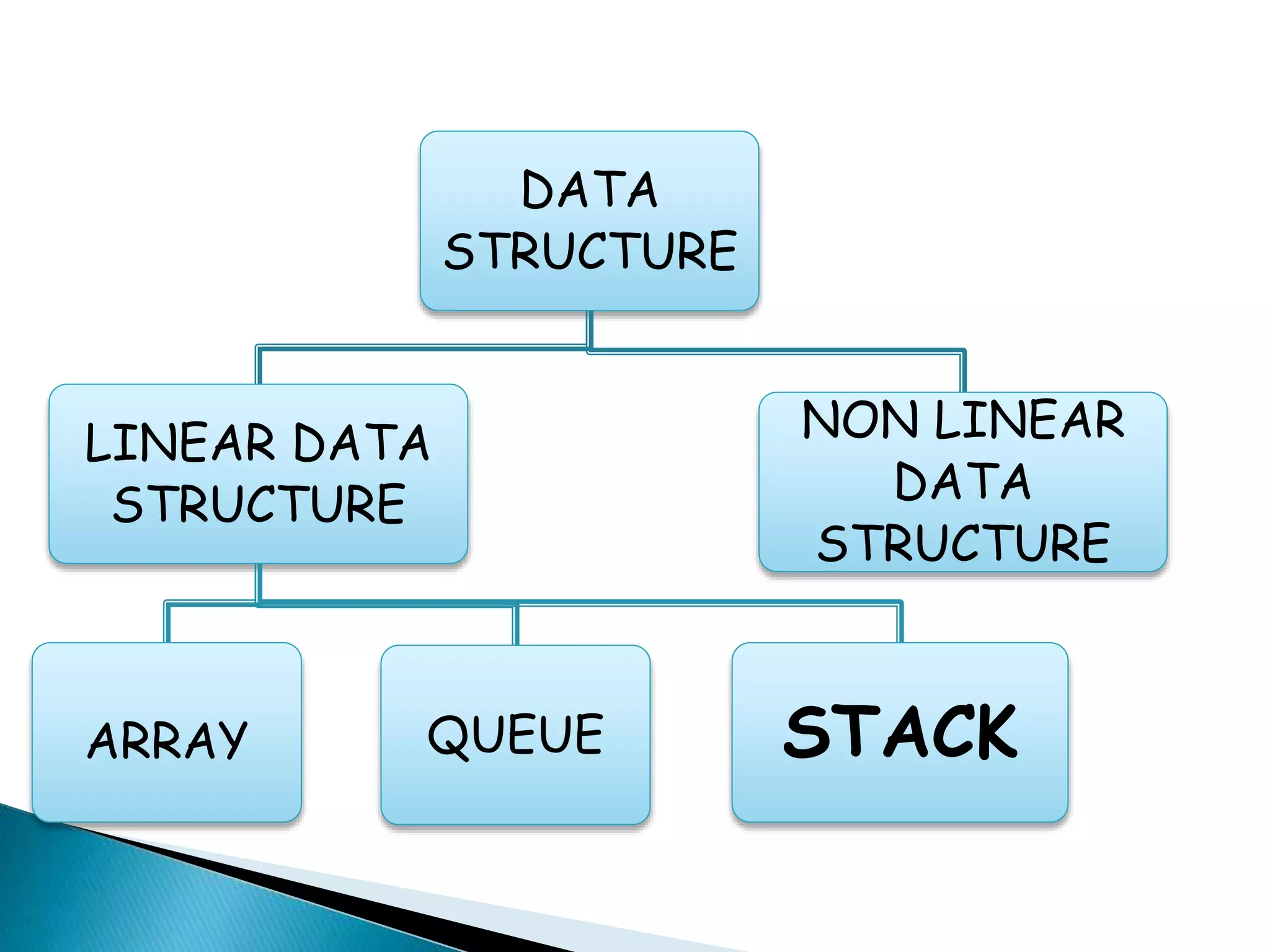
DATA 
STRUCTURE 
LINEAR DATA 
STRUCTURE 
NON LINEAR 
DATA 
STRUCTURE 
ARRAY QUEUE STACK
What is Linear Data Structure 
In linear data structure, data is arranged 
in linear sequence. 
 Data items can be traversed in a single 
run. 
 In linear data structure elements are 
accessed or placed in contiguous(together 
in sequence) memory location.
WHAT Is 
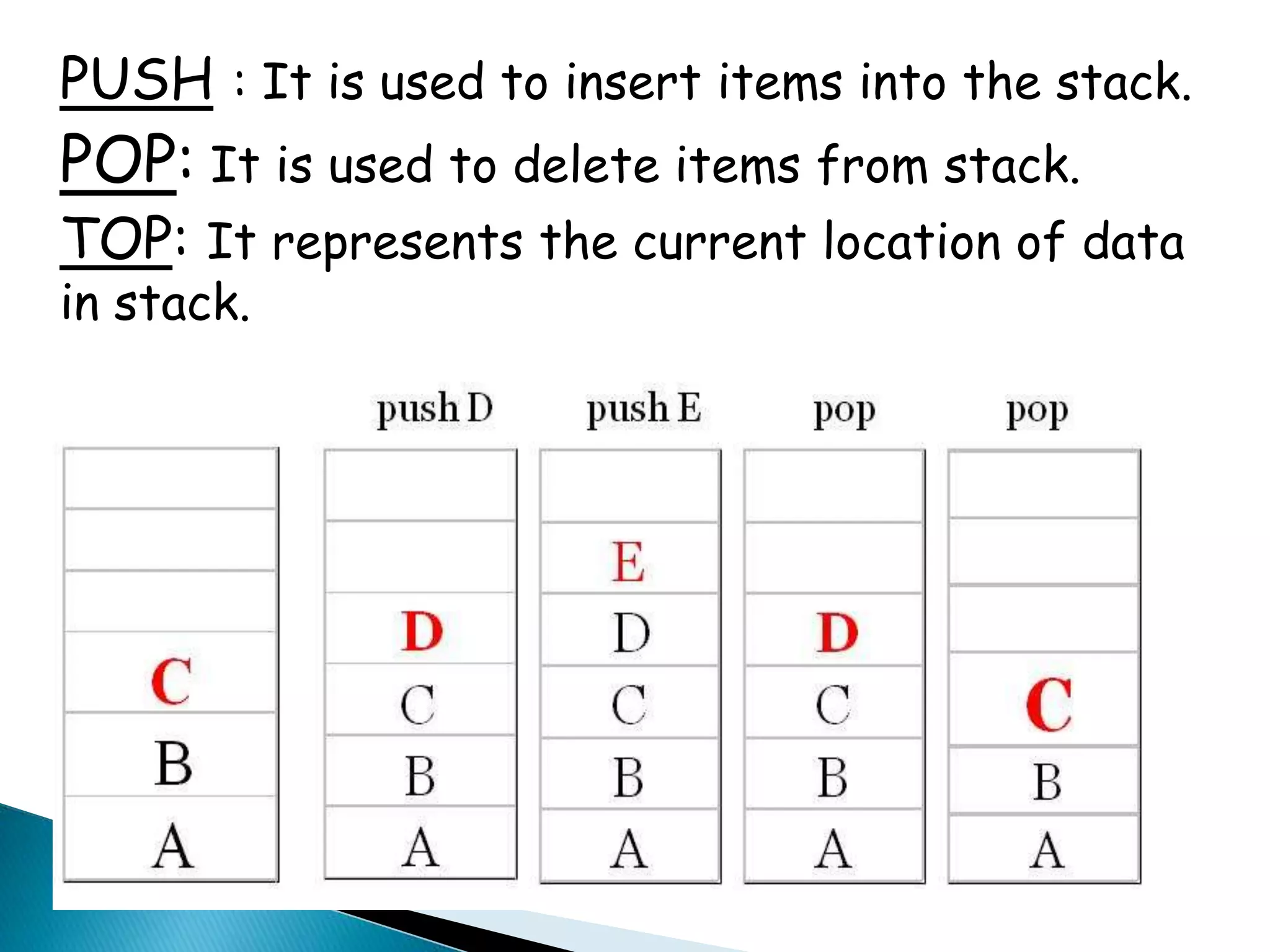
 A stack is called a last-in-first-out (LIFO) 
collection. This means that the last thing 
we added (pushed) is the first thing that 
gets pulled (popped) off. 
 A stack is a sequence of items that are 
accessible at only one end of the sequence.
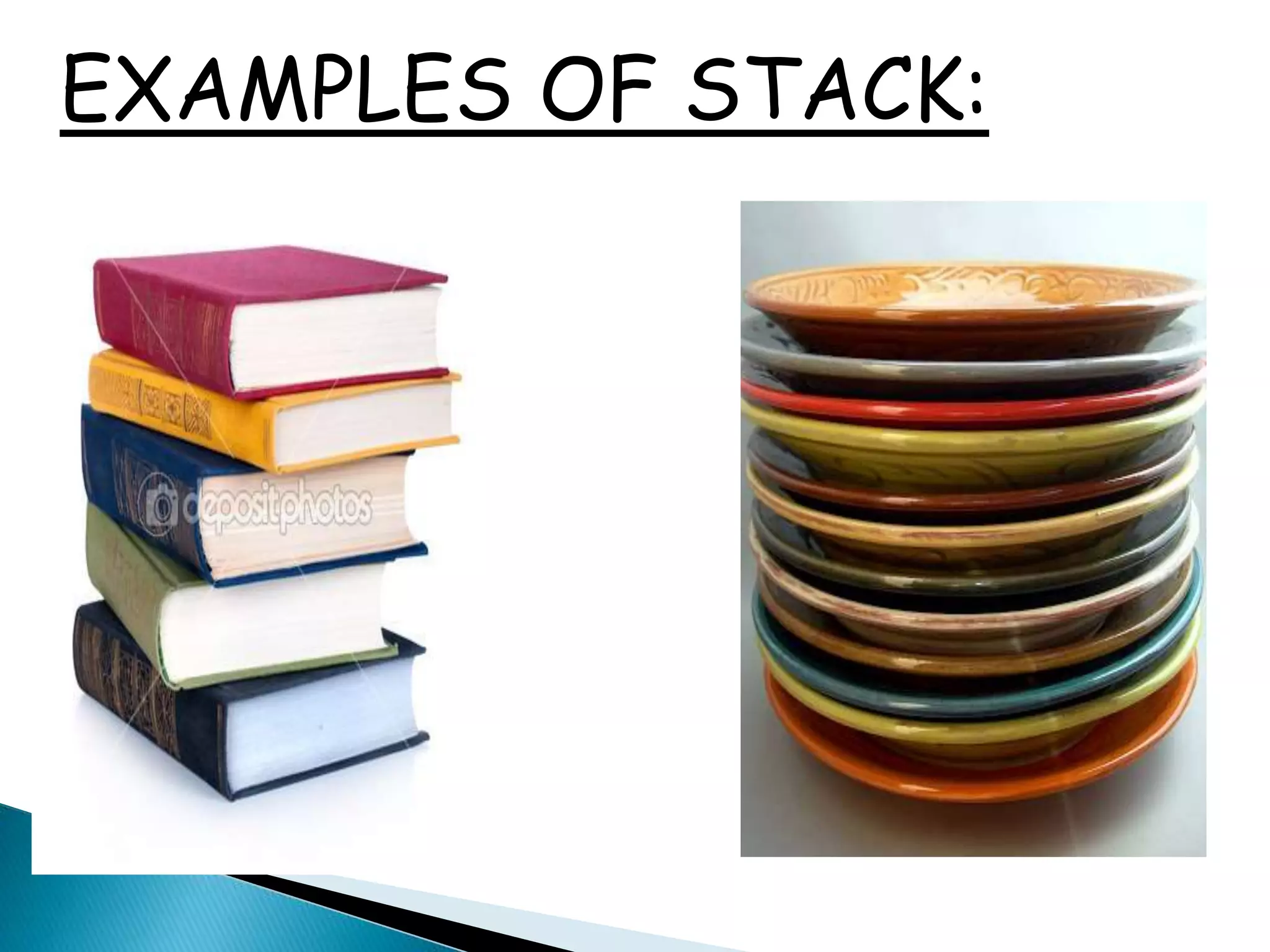
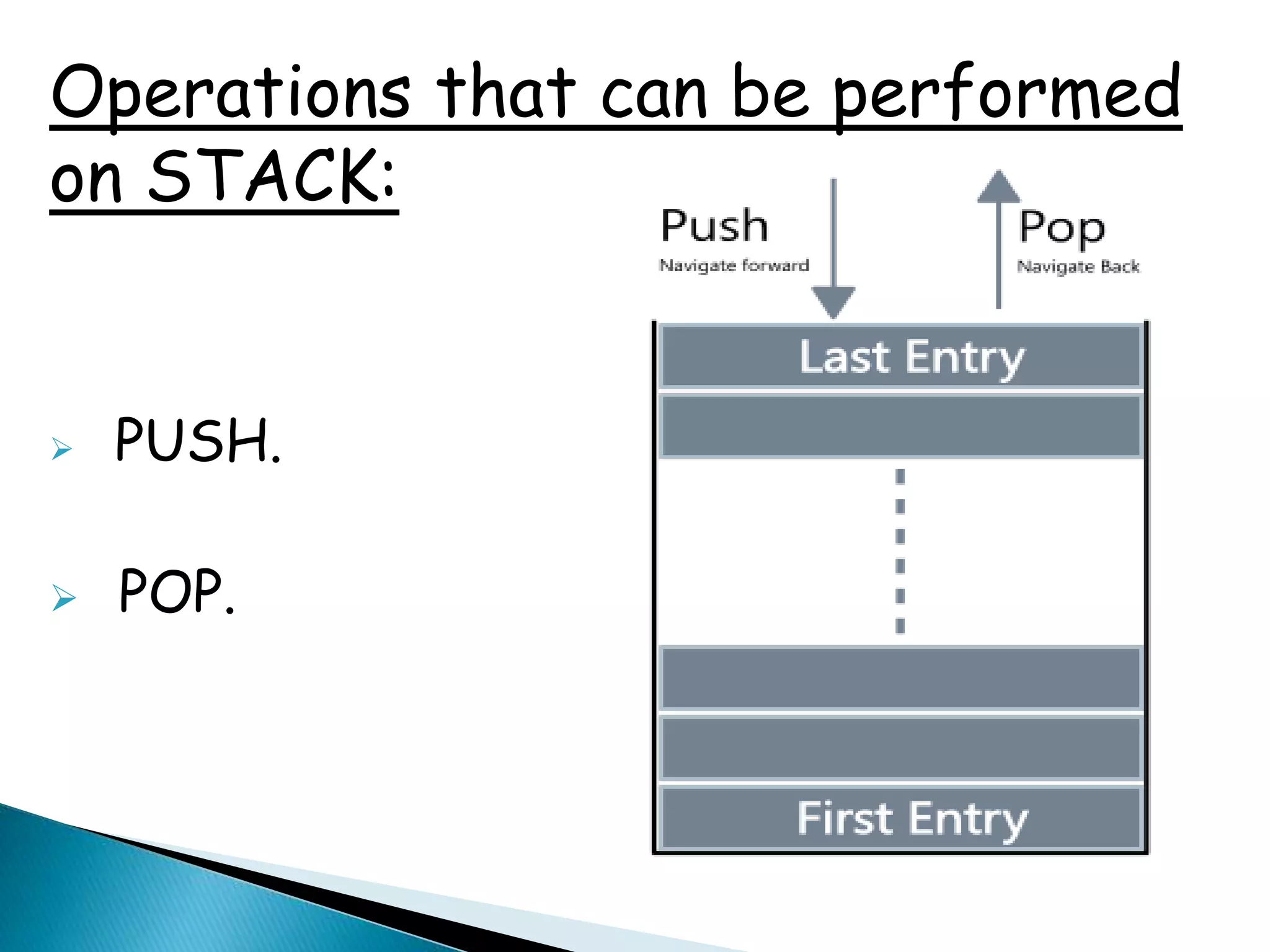
EXAMPLES OF STACK:
Operations that can be performed 
on STACK: 
 PUSH. 
 POP.
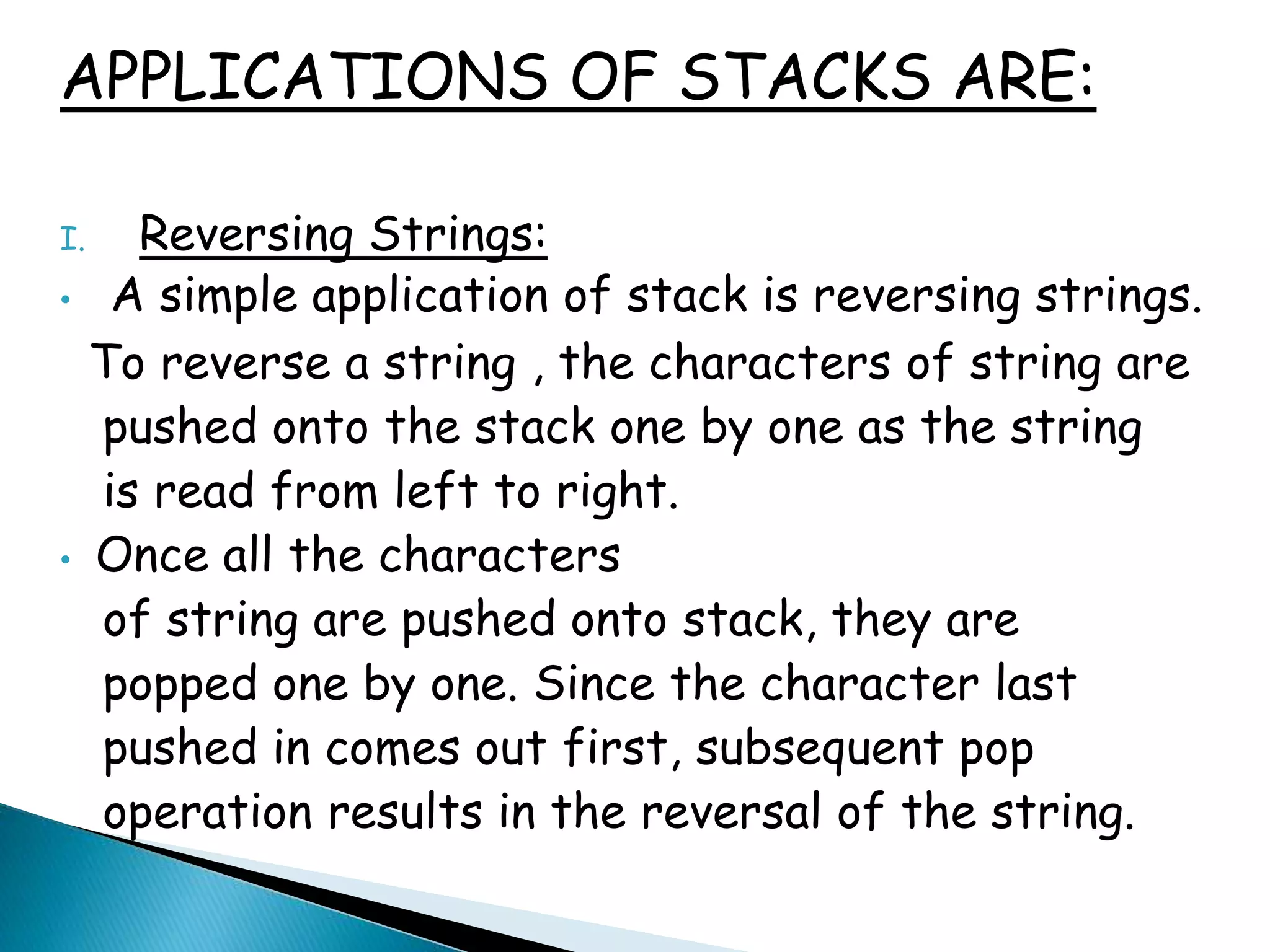
PUSH : It is used to insert items into the stack. 
POP: It is used to delete items from stack. 
TOP: It represents the current location of data 
in stack.
ALGORITHM OF INSERTION IN 
STACK: (PUSH) 
1. Insertion(a,top,item,max) 
2. If top=max then 
print ‘STACK OVERFLOW’ 
exit 
else 
3. top=top+1 
end if 
4. a[top]=item 
5. Exit
ALGORITHM OF DELETION IN 
STACK: (POP) 
1. Deletion(a,top,item) 
2. If top=0 then 
print ‘STACK UNDERFLOW’ 
exit 
else 
3. item=a[top] 
end if 
4. top=top-1 
5. Exit
ALGORITHM OF DISPLAY IN 
STACK: 
1.Display(top,i,a[i]) 
2.If top=0 then 
Print ‘STACK EMPTY’ 
Exit 
Else 
3.For i=top to 0 
Print a[i] 
End for 
4.exit
APPLICATIONS OF STACKS ARE: 
I. Reversing Strings: 
• A simple application of stack is reversing strings. 
To reverse a string , the characters of string are 
pushed onto the stack one by one as the string 
is read from left to right. 
• Once all the characters 
of string are pushed onto stack, they are 
popped one by one. Since the character last 
pushed in comes out first, subsequent pop 
operation results in the reversal of the string.
For example: 
To reverse the string ‘REVERSE’ the string is 
read from left to right and its characters are 
pushed . LIKE: 
onto a stack.
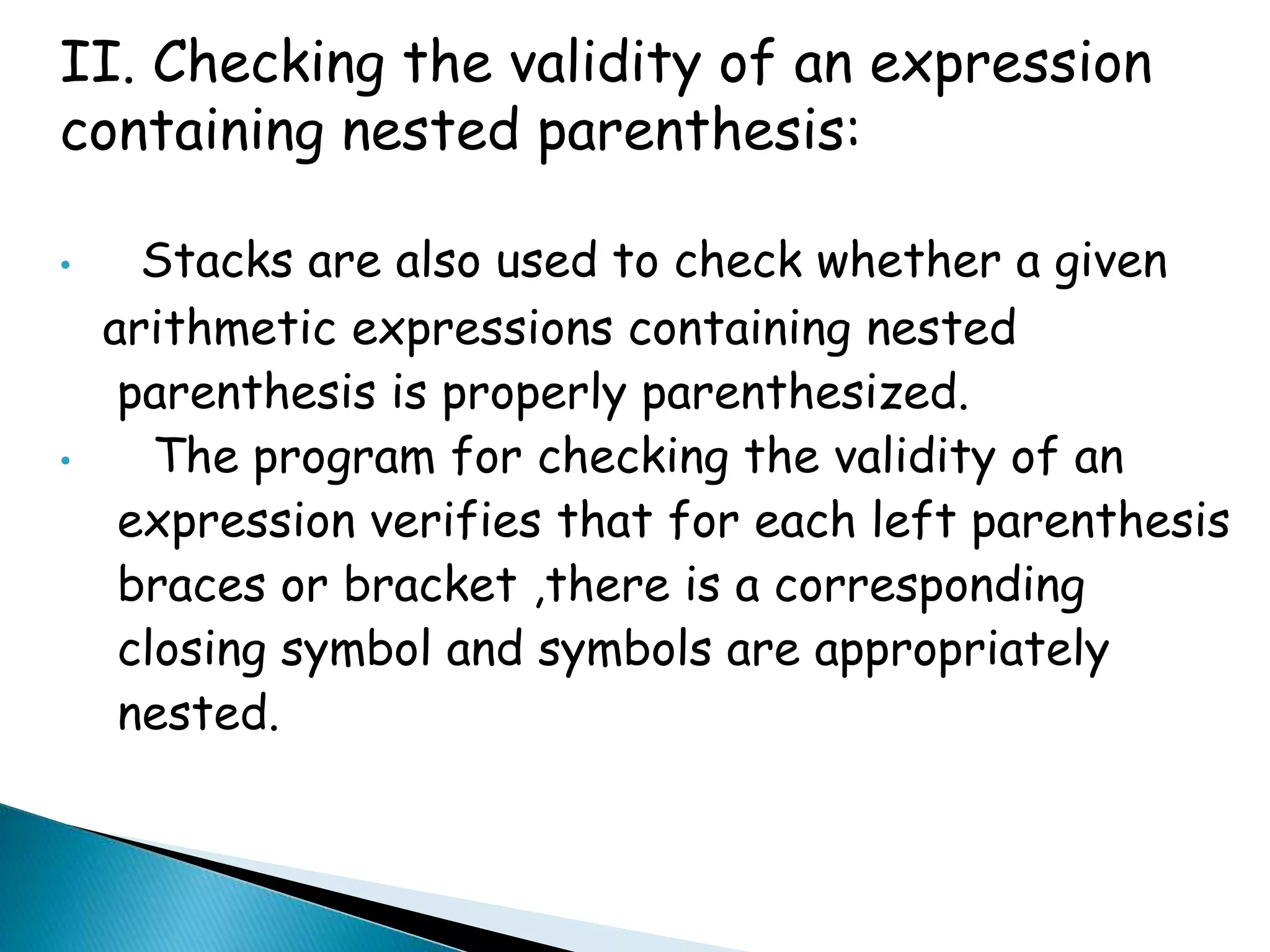
II. Checking the validity of an expression 
containing nested parenthesis: 
• Stacks are also used to check whether a given 
arithmetic expressions containing nested 
parenthesis is properly parenthesized. 
• The program for checking the validity of an 
expression verifies that for each left parenthesis 
braces or bracket ,there is a corresponding 
closing symbol and symbols are appropriately 
nested.
For example: 
VALID INPUTS INVALID INPUTS 
{ } 
{ ( } 
( { [ ] } ) 
( [ ( ( ) ] ) 
{ [ ] ( ) } 
{ } [ ] ) 
[ { ( { } [ ] ( { 
[ { ) } ( ] } ] 
})}]
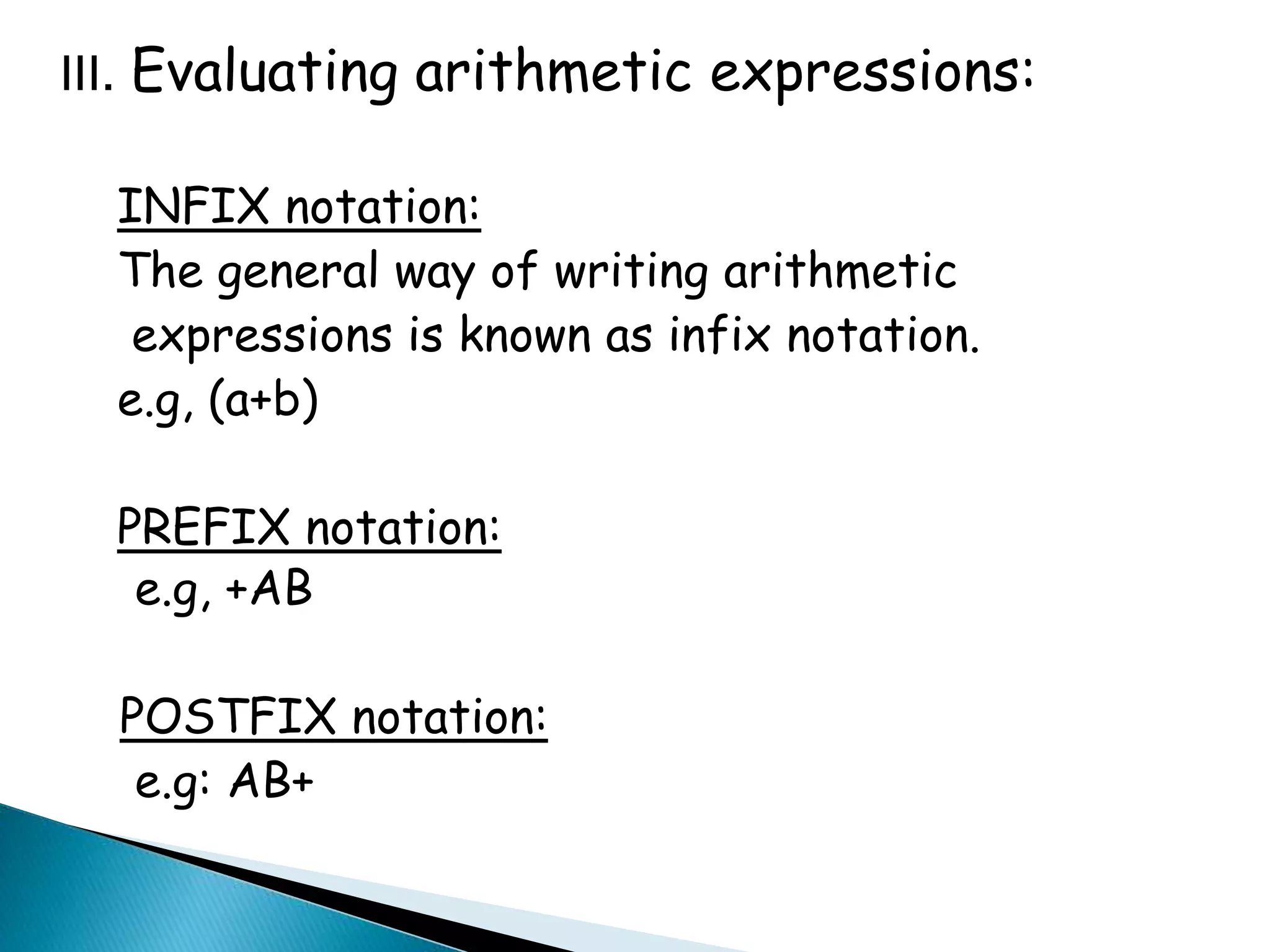
III. Evaluating arithmetic expressions: 
INFIX notation: 
The general way of writing arithmetic 
expressions is known as infix notation. 
e.g, (a+b) 
PREFIX notation: 
e.g, +AB 
POSTFIX notation: 
e.g: AB+
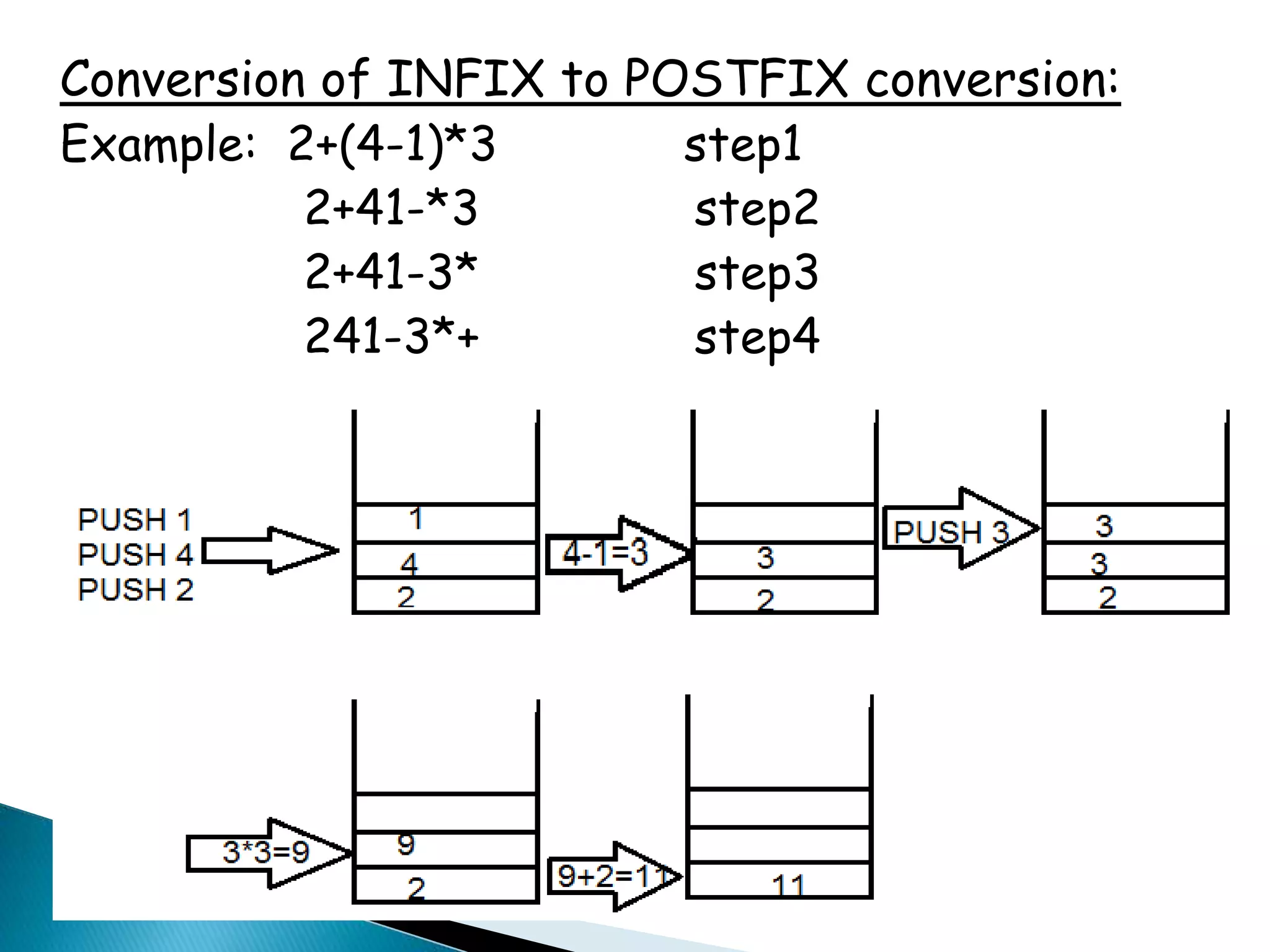
Conversion of INFIX to POSTFIX conversion: 
Example: 2+(4-1)*3 step1 
2+41-*3 step2 
2+41-3* step3 
241-3*+ step4
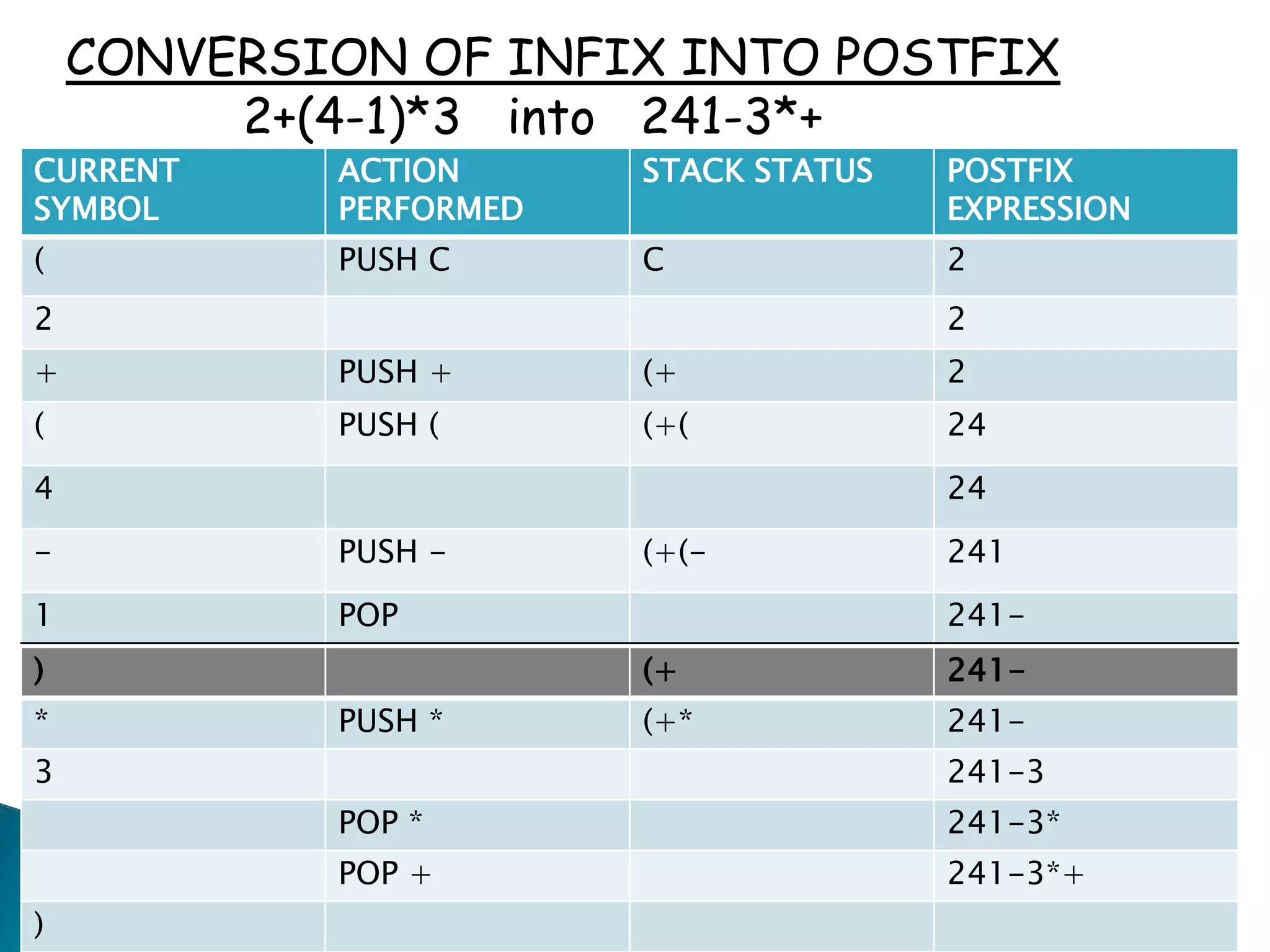
CURRENT 
SYMBOL 
ACTION 
PERFORMED 
STACK STATUS POSTFIX 
EXPRESSION 
( PUSH C C 2 
2 2 
+ PUSH + (+ 2 
( PUSH ( (+( 24 
4 24 
- PUSH - (+(- 241 
1 POP 241- 
) (+ 241- 
* PUSH * (+* 241- 
3 241-3 
POP * 241-3* 
POP + 241-3*+ 
) 
CONVERSION OF INFIX INTO POSTFIX 
2+(4-1)*3 into 241-3*+
THANK YOU 

STACKS IN DATASTRUCTURE

  • 1.
    STACK SUBMITTED BY: Archie Jamwal SUBMITTED TO: Mrs. Ruchi Gupta
  • 2.
    DATA STRUCTURE LINEARDATA STRUCTURE NON LINEAR DATA STRUCTURE ARRAY QUEUE STACK
  • 3.
    What is LinearData Structure In linear data structure, data is arranged in linear sequence.  Data items can be traversed in a single run.  In linear data structure elements are accessed or placed in contiguous(together in sequence) memory location.
  • 4.
    WHAT Is A stack is called a last-in-first-out (LIFO) collection. This means that the last thing we added (pushed) is the first thing that gets pulled (popped) off.  A stack is a sequence of items that are accessible at only one end of the sequence.
  • 5.
  • 6.
    Operations that canbe performed on STACK:  PUSH.  POP.
  • 7.
    PUSH : Itis used to insert items into the stack. POP: It is used to delete items from stack. TOP: It represents the current location of data in stack.
  • 8.
    ALGORITHM OF INSERTIONIN STACK: (PUSH) 1. Insertion(a,top,item,max) 2. If top=max then print ‘STACK OVERFLOW’ exit else 3. top=top+1 end if 4. a[top]=item 5. Exit
  • 9.
    ALGORITHM OF DELETIONIN STACK: (POP) 1. Deletion(a,top,item) 2. If top=0 then print ‘STACK UNDERFLOW’ exit else 3. item=a[top] end if 4. top=top-1 5. Exit
  • 10.
    ALGORITHM OF DISPLAYIN STACK: 1.Display(top,i,a[i]) 2.If top=0 then Print ‘STACK EMPTY’ Exit Else 3.For i=top to 0 Print a[i] End for 4.exit
  • 11.
    APPLICATIONS OF STACKSARE: I. Reversing Strings: • A simple application of stack is reversing strings. To reverse a string , the characters of string are pushed onto the stack one by one as the string is read from left to right. • Once all the characters of string are pushed onto stack, they are popped one by one. Since the character last pushed in comes out first, subsequent pop operation results in the reversal of the string.
  • 12.
    For example: Toreverse the string ‘REVERSE’ the string is read from left to right and its characters are pushed . LIKE: onto a stack.
  • 13.
    II. Checking thevalidity of an expression containing nested parenthesis: • Stacks are also used to check whether a given arithmetic expressions containing nested parenthesis is properly parenthesized. • The program for checking the validity of an expression verifies that for each left parenthesis braces or bracket ,there is a corresponding closing symbol and symbols are appropriately nested.
  • 14.
    For example: VALIDINPUTS INVALID INPUTS { } { ( } ( { [ ] } ) ( [ ( ( ) ] ) { [ ] ( ) } { } [ ] ) [ { ( { } [ ] ( { [ { ) } ( ] } ] })}]
  • 15.
    III. Evaluating arithmeticexpressions: INFIX notation: The general way of writing arithmetic expressions is known as infix notation. e.g, (a+b) PREFIX notation: e.g, +AB POSTFIX notation: e.g: AB+
  • 16.
    Conversion of INFIXto POSTFIX conversion: Example: 2+(4-1)*3 step1 2+41-*3 step2 2+41-3* step3 241-3*+ step4
  • 17.
    CURRENT SYMBOL ACTION PERFORMED STACK STATUS POSTFIX EXPRESSION ( PUSH C C 2 2 2 + PUSH + (+ 2 ( PUSH ( (+( 24 4 24 - PUSH - (+(- 241 1 POP 241- ) (+ 241- * PUSH * (+* 241- 3 241-3 POP * 241-3* POP + 241-3*+ ) CONVERSION OF INFIX INTO POSTFIX 2+(4-1)*3 into 241-3*+
  • 18.