Stack
Stack
A stack is a data structure
in which items can be
inserted only from one end
and get items back from the
same end. There , the last
item inserted into stack, is
the the first item to be taken
out from the stack. In short
its also called Last in First
out [LIFO].
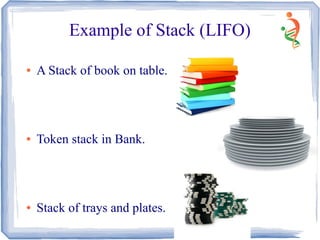
Example of Stack (LIFO)
● A Stack of book on table.
● Token stack in Bank.
● Stack of trays and plates.
Stack Operations
● Top: Open end of the stack is called Top, From this end item can
be inserted.
● Push: To insert an item from Top of stack is called push operation.
The push operation change the position of Top in stack.
● POP: To put-off, get or remove some item from top of the stack is
the pop operation, We can POP only only from top of the stack.
● IsEmpty: Stack considered empty when there is no item on Top.
IsEmpty operation return true when no item in stack else false.
● IsFull: Stack considered full if no other element can be inserted on
top of the stack. This condition normally occur when stack
implement ed through array.
Stack Abstract Data Type
ADT/Class Stack {
Data/Attributes/Values:
int size; Top
Type items;
Functions/Operations:
CreateStack (int size); --create stack of size
Void Push(int n); - - if stack is not full
Type Pop(); - - if stack is not empty return top item
Int isEmpty(); - - return true if empty otherwise false
Int isFull(); - - return true if full otherwise false }
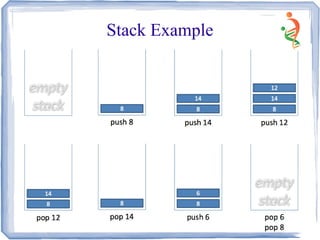
Stack Example
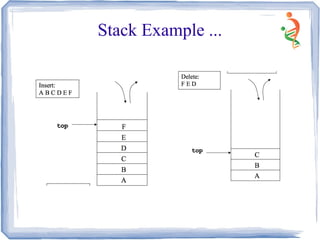
Stack Example ...
# include <iostream.h>
#include <conio.h>
template <class Type>
Class intstack { private:
int size, top;
Type* Items;
// Functions & Operations
public:
Intstack ( ) { //default constructor
top=0; size=3;
Items = new Type[size]; }
Stack Implementation using Array
~intstack( ) {
delete[] Items; }
Void Push (Type a) {
if(!IsFul( ))
Items[top++ ] = a;
else
Cout <<”n stack is full.... push failed”; }
Type POP(void) {
if(!isEmpty( ))
return Items [ --top ];
else
Count <<n stack is empty .. POP failed”; }
Stack Implementation using Array
int IsEmpty ( ) { return (top == 0); }
int IsFull( ) { return (top == size); }
Void Display ( ) {
If( isEmpty( ))
Cout<<”Empty”;
Else for (int i=0; i<top; i++)
cout<<Item[i] <<” “;
}
} ; // end stack class
Stack Implementation using Array
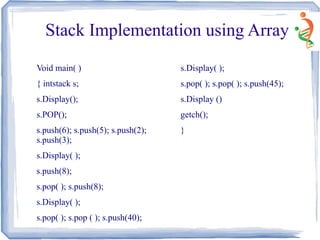
Void main( )
{ intstack s;
s.Display();
s.POP();
s.push(6); s.push(5); s.push(2);
s.push(3);
s.Display( );
s.push(8);
s.pop( ); s.push(8);
s.Display( );
s.pop( ); s.pop ( ); s.push(40);
s.Display( );
s.pop( ); s.pop( ); s.push(45);
s.Display ()
getch();
}
Stack Implementation using Array
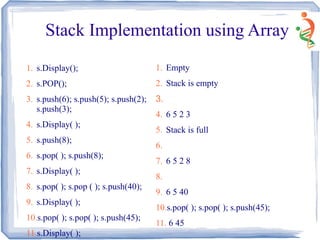
1. s.Display();
2. s.POP();
3. s.push(6); s.push(5); s.push(2);
s.push(3);
4. s.Display( );
5. s.push(8);
6. s.pop( ); s.push(8);
7. s.Display( );
8. s.pop( ); s.pop ( ); s.push(40);
9. s.Display( );
10.s.pop( ); s.pop( ); s.push(45);
11.s.Display( );
1. Empty
2. Stack is empty
3.
4. 6 5 2 3
5. Stack is full
6.
7. 6 5 2 8
8.
9. 6 5 40
10.s.pop( ); s.pop( ); s.push(45);
11. 6 45
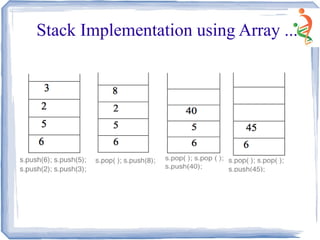
Stack Implementation using Array ...
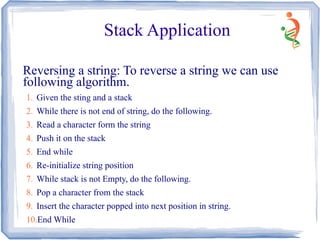
Stack Application
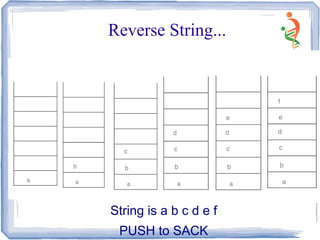
Reversing a string: To reverse a string we can use
following algorithm.
1. Given the sting and a stack
2. While there is not end of string, do the following.
3. Read a character form the string
4. Push it on the stack
5. End while
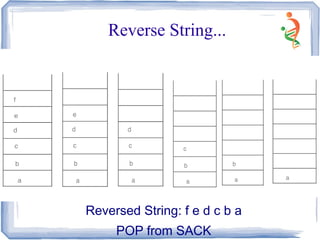
6. Re-initialize string position
7. While stack is not Empty, do the following.
8. Pop a character from the stack
9. Insert the character popped into next position in string.
10.End While
Reverse String
Void reverse (char* str) {
Inst i, len;
len = strlen(str);
//Create stack of characters of size =
len
Stack<char> s(len);
for(i=o; i< len; i++ )
s.Push(str[i]);
s.Display;
For (j=0; j<len;j++)
str[j] = s.POP[j];
}
void main( )
{
char str[ ] =”abcdef”;
cout<<” Original String is “<<str;
reverse(str);
cout<<” Reversed String is “<<str;
getch();
}
Reverse String...
String is a b c d e f
PUSH to SACK
Reverse String...
Reversed String: f e d c b a
POP from SACK
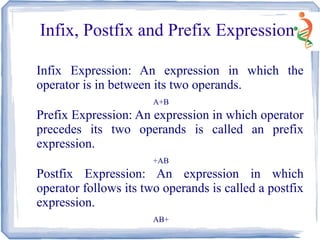
Infix Expression: An expression in which the
operator is in between its two operands.
A+B
Prefix Expression: An expression in which operator
precedes its two operands is called an prefix
expression.
+AB
Postfix Expression: An expression in which
operator follows its two operands is called a postfix
expression.
AB+
Infix, Postfix and Prefix Expression
Infix to Postfix Conversion
Infix expression can be directly evaluated but
the standard practice in CS is that the infix
expression converted to postfix form and then
the expression is evaluated. During both
processes stack is proved to be a useful data
structure.
1. Given a expression in the infix form.
2. Find the highest precedence operator
3. If there are more then one operators with the same
precedence check associativity, i.e. pick the left most first.
4. Convert the operator and its operands from infix to postfix
A + B --> A B+
5. Repeat steps 2 to 4, until all the operators in the given
expression are in the postfix form.
Infix to Postfix By-Hand Algorithm
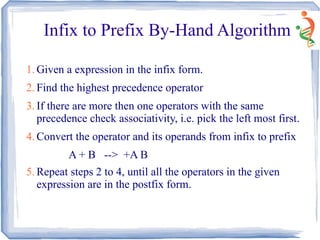
Infix to Prefix By-Hand Algorithm
1. Given a expression in the infix form.
2. Find the highest precedence operator
3. If there are more then one operators with the same
precedence check associativity, i.e. pick the left most first.
4. Convert the operator and its operands from infix to prefix
A + B --> +A B
5. Repeat steps 2 to 4, until all the operators in the given
expression are in the postfix form.
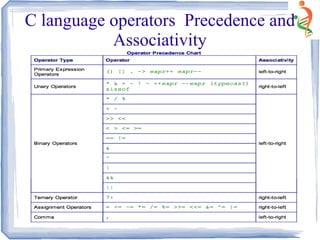
C language operators Precedence and
Associativity
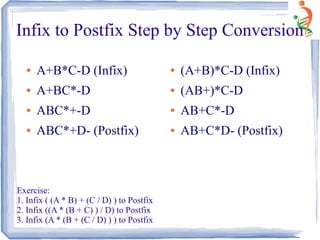
● A+B*C-D (Infix)
● A+BC*-D
● ABC*+-D
● ABC*+D- (Postfix)
● (A+B)*C-D (Infix)
● (AB+)*C-D
● AB+C*-D
● AB+C*D- (Postfix)
Exercise:
1. Infix ( (A * B) + (C / D) ) to Postfix
2. Infix ((A * (B + C) ) / D) to Postfix
3. Infix (A * (B + (C / D) ) ) to Postfix
Infix to Postfix Step by Step Conversion
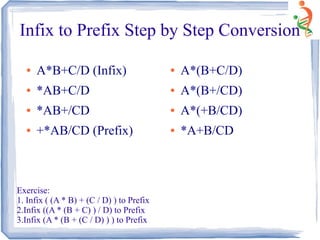
● A*B+C/D (Infix)
● *AB+C/D
● *AB+/CD
● +*AB/CD (Prefix)
● A*(B+C/D)
● A*(B+/CD)
● A*(+B/CD)
● *A+B/CD
Exercise:
1. Infix ( (A * B) + (C / D) ) to Prefix
2.Infix ((A * (B + C) ) / D) to Prefix
3.Infix (A * (B + (C / D) ) ) to Prefix
Infix to Prefix Step by Step Conversion
Infix to Postfix using stack
● Given an expression in the Infix form.
● Create and initialize a stack to hold operators.
● While expression has more token (operator and operands) Do.
● If the next token is an operand, add it to postfix string.
● Else if the next token is end parenthesis ')', then
– Do until the start parenthesis '(' is opened
● Pop operator from the stack
● Add to postfix string
– END Do
– Discard the Popped start parenthesis '('.
● End If
Infix to Postfix using stack ...
● If the next token is start parenthesis '(', push it on the stack.
● Else If the next token is an operator, Then
– While (Stack is not empty) AND (precedence of operator on top
of the stack is more then the current operator) Do
● Pop operator from the stack
● Add to postfix string
– End While
– Push operator to stack
● End if
● End While
Infix to Postfix using stack ...
● While stack is not empty
– Pop operator from the stack
– Add to postfix string
● End While
● Postfix is Created
Infix to Postfix using stack
● Example A*B+C become AB*C+
Infix to Postfix using stack ...
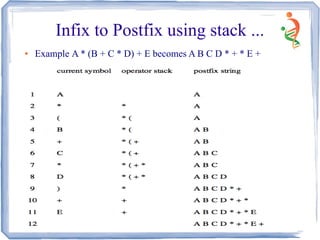
● Example A * (B + C * D) + E becomes A B C D * + * E +
Infix to Postfix using Stack..
1. Print operands as they arrive.
2. If the stack is empty or contains a left parenthesis on top, push the
incoming operator onto the stack.
3. If the incoming symbol is a left parenthesis, push it on the stack.
4. If the incoming symbol is a right parenthesis, pop the stack and print
the operators until you see a left parenthesis. Discard the pair of
parentheses.
5. If the incoming symbol has higher precedence than the top of the
stack, push it on the stack.
6. If the incoming symbol has equal precedence with the top of the
stack, use association. If the association is left to right, pop and print the
top of the stack and then push the incoming operator. If the association
is right to left, push the incoming operator.
Infix to Postfix using Stack..
7. If the incoming symbol has lower precedence than the symbol on the top of
the stack, pop the stack and print the top operator. Then test the incoming
operator against the new top of stack.
8. At the end of the expression, pop and print all operators on the stack. (No
parentheses should remain.)
Evaluating Arithmetic Postfix
Expression
● Expression is available in the postfix form
● Initialize the stack of operands.
● While expression has more token (operators and operands), do
– If the next token is an operand
● Push it on the stack
– Else the token is an operator
● Pop two operands from the stack
● Apply the operator to the operands
● Push the result back on to the stack
– End If
● End While
● Result of expression is on the operand stack, pop and display.
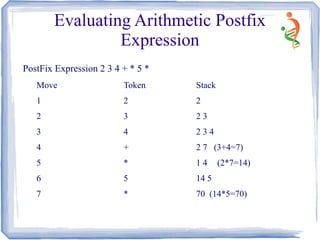
Evaluating Arithmetic Postfix
Expression
PostFix Expression 2 3 4 + * 5 *
Move Token Stack
1 2 2
2 3 2 3
3 4 2 3 4
4 + 2 7 (3+4=7)
5 * 1 4 (2*7=14)
6 5 14 5
7 * 70 (14*5=70)

Stack

  • 1.
  • 2.
    Stack A stack isa data structure in which items can be inserted only from one end and get items back from the same end. There , the last item inserted into stack, is the the first item to be taken out from the stack. In short its also called Last in First out [LIFO].
  • 3.
    Example of Stack(LIFO) ● A Stack of book on table. ● Token stack in Bank. ● Stack of trays and plates.
  • 4.
    Stack Operations ● Top:Open end of the stack is called Top, From this end item can be inserted. ● Push: To insert an item from Top of stack is called push operation. The push operation change the position of Top in stack. ● POP: To put-off, get or remove some item from top of the stack is the pop operation, We can POP only only from top of the stack. ● IsEmpty: Stack considered empty when there is no item on Top. IsEmpty operation return true when no item in stack else false. ● IsFull: Stack considered full if no other element can be inserted on top of the stack. This condition normally occur when stack implement ed through array.
  • 5.
    Stack Abstract DataType ADT/Class Stack { Data/Attributes/Values: int size; Top Type items; Functions/Operations: CreateStack (int size); --create stack of size Void Push(int n); - - if stack is not full Type Pop(); - - if stack is not empty return top item Int isEmpty(); - - return true if empty otherwise false Int isFull(); - - return true if full otherwise false }
  • 6.
  • 7.
  • 8.
    # include <iostream.h> #include<conio.h> template <class Type> Class intstack { private: int size, top; Type* Items; // Functions & Operations public: Intstack ( ) { //default constructor top=0; size=3; Items = new Type[size]; } Stack Implementation using Array
  • 9.
    ~intstack( ) { delete[]Items; } Void Push (Type a) { if(!IsFul( )) Items[top++ ] = a; else Cout <<”n stack is full.... push failed”; } Type POP(void) { if(!isEmpty( )) return Items [ --top ]; else Count <<n stack is empty .. POP failed”; } Stack Implementation using Array
  • 10.
    int IsEmpty () { return (top == 0); } int IsFull( ) { return (top == size); } Void Display ( ) { If( isEmpty( )) Cout<<”Empty”; Else for (int i=0; i<top; i++) cout<<Item[i] <<” “; } } ; // end stack class Stack Implementation using Array
  • 11.
    Stack Implementation usingArray Void main( ) { intstack s; s.Display(); s.POP(); s.push(6); s.push(5); s.push(2); s.push(3); s.Display( ); s.push(8); s.pop( ); s.push(8); s.Display( ); s.pop( ); s.pop ( ); s.push(40); s.Display( ); s.pop( ); s.pop( ); s.push(45); s.Display () getch(); }
  • 12.
    Stack Implementation usingArray 1. s.Display(); 2. s.POP(); 3. s.push(6); s.push(5); s.push(2); s.push(3); 4. s.Display( ); 5. s.push(8); 6. s.pop( ); s.push(8); 7. s.Display( ); 8. s.pop( ); s.pop ( ); s.push(40); 9. s.Display( ); 10.s.pop( ); s.pop( ); s.push(45); 11.s.Display( ); 1. Empty 2. Stack is empty 3. 4. 6 5 2 3 5. Stack is full 6. 7. 6 5 2 8 8. 9. 6 5 40 10.s.pop( ); s.pop( ); s.push(45); 11. 6 45
  • 13.
  • 14.
    Stack Application Reversing astring: To reverse a string we can use following algorithm. 1. Given the sting and a stack 2. While there is not end of string, do the following. 3. Read a character form the string 4. Push it on the stack 5. End while 6. Re-initialize string position 7. While stack is not Empty, do the following. 8. Pop a character from the stack 9. Insert the character popped into next position in string. 10.End While
  • 15.
    Reverse String Void reverse(char* str) { Inst i, len; len = strlen(str); //Create stack of characters of size = len Stack<char> s(len); for(i=o; i< len; i++ ) s.Push(str[i]); s.Display; For (j=0; j<len;j++) str[j] = s.POP[j]; } void main( ) { char str[ ] =”abcdef”; cout<<” Original String is “<<str; reverse(str); cout<<” Reversed String is “<<str; getch(); }
  • 16.
    Reverse String... String isa b c d e f PUSH to SACK
  • 17.
    Reverse String... Reversed String:f e d c b a POP from SACK
  • 18.
    Infix Expression: Anexpression in which the operator is in between its two operands. A+B Prefix Expression: An expression in which operator precedes its two operands is called an prefix expression. +AB Postfix Expression: An expression in which operator follows its two operands is called a postfix expression. AB+ Infix, Postfix and Prefix Expression
  • 19.
    Infix to PostfixConversion Infix expression can be directly evaluated but the standard practice in CS is that the infix expression converted to postfix form and then the expression is evaluated. During both processes stack is proved to be a useful data structure.
  • 20.
    1. Given aexpression in the infix form. 2. Find the highest precedence operator 3. If there are more then one operators with the same precedence check associativity, i.e. pick the left most first. 4. Convert the operator and its operands from infix to postfix A + B --> A B+ 5. Repeat steps 2 to 4, until all the operators in the given expression are in the postfix form. Infix to Postfix By-Hand Algorithm
  • 21.
    Infix to PrefixBy-Hand Algorithm 1. Given a expression in the infix form. 2. Find the highest precedence operator 3. If there are more then one operators with the same precedence check associativity, i.e. pick the left most first. 4. Convert the operator and its operands from infix to prefix A + B --> +A B 5. Repeat steps 2 to 4, until all the operators in the given expression are in the postfix form.
  • 22.
    C language operatorsPrecedence and Associativity
  • 23.
    ● A+B*C-D (Infix) ●A+BC*-D ● ABC*+-D ● ABC*+D- (Postfix) ● (A+B)*C-D (Infix) ● (AB+)*C-D ● AB+C*-D ● AB+C*D- (Postfix) Exercise: 1. Infix ( (A * B) + (C / D) ) to Postfix 2. Infix ((A * (B + C) ) / D) to Postfix 3. Infix (A * (B + (C / D) ) ) to Postfix Infix to Postfix Step by Step Conversion
  • 24.
    ● A*B+C/D (Infix) ●*AB+C/D ● *AB+/CD ● +*AB/CD (Prefix) ● A*(B+C/D) ● A*(B+/CD) ● A*(+B/CD) ● *A+B/CD Exercise: 1. Infix ( (A * B) + (C / D) ) to Prefix 2.Infix ((A * (B + C) ) / D) to Prefix 3.Infix (A * (B + (C / D) ) ) to Prefix Infix to Prefix Step by Step Conversion
  • 25.
    Infix to Postfixusing stack ● Given an expression in the Infix form. ● Create and initialize a stack to hold operators. ● While expression has more token (operator and operands) Do. ● If the next token is an operand, add it to postfix string. ● Else if the next token is end parenthesis ')', then – Do until the start parenthesis '(' is opened ● Pop operator from the stack ● Add to postfix string – END Do – Discard the Popped start parenthesis '('. ● End If
  • 26.
    Infix to Postfixusing stack ... ● If the next token is start parenthesis '(', push it on the stack. ● Else If the next token is an operator, Then – While (Stack is not empty) AND (precedence of operator on top of the stack is more then the current operator) Do ● Pop operator from the stack ● Add to postfix string – End While – Push operator to stack ● End if ● End While
  • 27.
    Infix to Postfixusing stack ... ● While stack is not empty – Pop operator from the stack – Add to postfix string ● End While ● Postfix is Created
  • 28.
    Infix to Postfixusing stack ● Example A*B+C become AB*C+
  • 29.
    Infix to Postfixusing stack ... ● Example A * (B + C * D) + E becomes A B C D * + * E +
  • 30.
    Infix to Postfixusing Stack.. 1. Print operands as they arrive. 2. If the stack is empty or contains a left parenthesis on top, push the incoming operator onto the stack. 3. If the incoming symbol is a left parenthesis, push it on the stack. 4. If the incoming symbol is a right parenthesis, pop the stack and print the operators until you see a left parenthesis. Discard the pair of parentheses. 5. If the incoming symbol has higher precedence than the top of the stack, push it on the stack. 6. If the incoming symbol has equal precedence with the top of the stack, use association. If the association is left to right, pop and print the top of the stack and then push the incoming operator. If the association is right to left, push the incoming operator.
  • 31.
    Infix to Postfixusing Stack.. 7. If the incoming symbol has lower precedence than the symbol on the top of the stack, pop the stack and print the top operator. Then test the incoming operator against the new top of stack. 8. At the end of the expression, pop and print all operators on the stack. (No parentheses should remain.)
  • 32.
    Evaluating Arithmetic Postfix Expression ●Expression is available in the postfix form ● Initialize the stack of operands. ● While expression has more token (operators and operands), do – If the next token is an operand ● Push it on the stack – Else the token is an operator ● Pop two operands from the stack ● Apply the operator to the operands ● Push the result back on to the stack – End If ● End While ● Result of expression is on the operand stack, pop and display.
  • 33.
    Evaluating Arithmetic Postfix Expression PostFixExpression 2 3 4 + * 5 * Move Token Stack 1 2 2 2 3 2 3 3 4 2 3 4 4 + 2 7 (3+4=7) 5 * 1 4 (2*7=14) 6 5 14 5 7 * 70 (14*5=70)