1
Queues
2
Queues
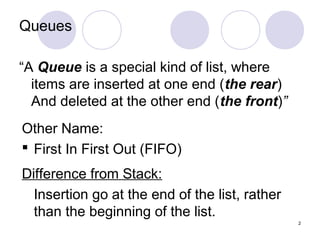
“A Queue is a special kind of list, where
items are inserted at one end (the rear)
And deleted at the other end (the front)”
Other Name:
 First In First Out (FIFO)
Difference from Stack:
Insertion go at the end of the list, rather
than the beginning of the list.
3
Common Operations on Queues
(Queue ADT)
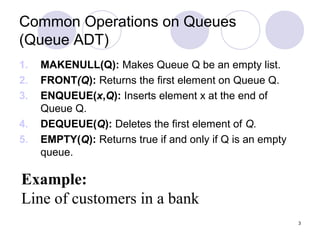
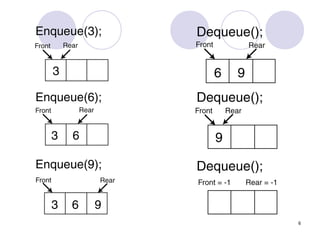
1. MAKENULL(Q): Makes Queue Q be an empty list.
2. FRONT(Q): Returns the first element on Queue Q.
3. ENQUEUE(x,Q): Inserts element x at the end of
Queue Q.
4. DEQUEUE(Q): Deletes the first element of Q.
5. EMPTY(Q): Returns true if and only if Q is an empty
queue.
Example:
Line of customers in a bank
4
Applications of Queues
Operating system
multi-user/multitasking environments, where
several users or task may be requesting the
same resource simultaneously.
Communication Software
queues to hold information received over
networks and dial up connections. (Information
can be transmitted faster than it can be
processed, so is placed in a queue waiting to
be processed)
Some other?
5
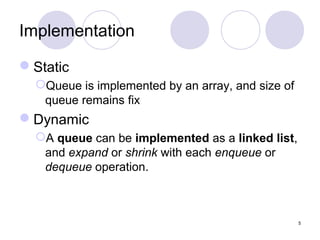
Implementation
Static
Queue is implemented by an array, and size of
queue remains fix
Dynamic
A queue can be implemented as a linked list,
and expand or shrink with each enqueue or
dequeue operation.
6
7
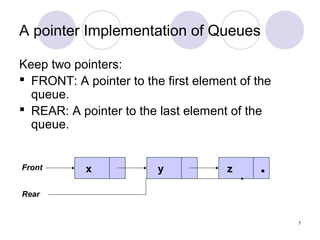
A pointer Implementation of Queues
Keep two pointers:
 FRONT: A pointer to the first element of the
queue.
 REAR: A pointer to the last element of the
queue.
x y .zFront
Rear
8
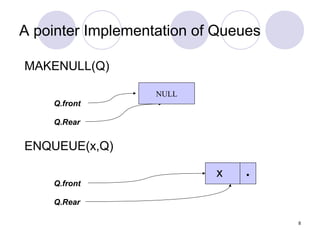
A pointer Implementation of Queues
Q.front
Q.Rear
MAKENULL(Q)
Q.front
Q.Rear
ENQUEUE(x,Q)
.x
NULL
9
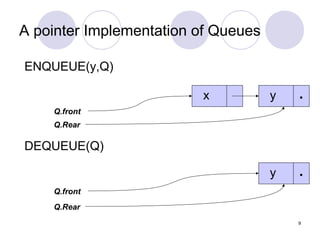
Q.front
Q.Rear
ENQUEUE(y,Q)
x .y
Q.front
Q.Rear
DEQUEUE(Q)
.y
A pointer Implementation of Queues
10
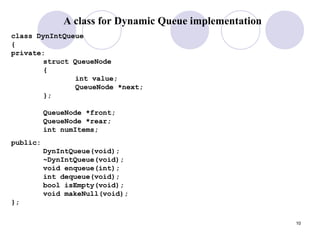
A class for Dynamic Queue implementation
class DynIntQueue
{
private:
struct QueueNode
{
int value;
QueueNode *next;
};
QueueNode *front;
QueueNode *rear;
int numItems;
public:
DynIntQueue(void);
~DynIntQueue(void);
void enqueue(int);
int dequeue(void);
bool isEmpty(void);
void makeNull(void);
};
11
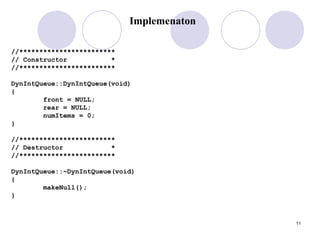
Implemenaton
//************************
// Constructor *
//************************
DynIntQueue::DynIntQueue(void)
{
front = NULL;
rear = NULL;
numItems = 0;
}
//************************
// Destructor *
//************************
DynIntQueue::~DynIntQueue(void)
{
makeNull();
}
12
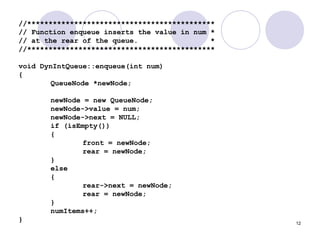
//********************************************
// Function enqueue inserts the value in num *
// at the rear of the queue. *
//********************************************
void DynIntQueue::enqueue(int num)
{
QueueNode *newNode;
newNode = new QueueNode;
newNode->value = num;
newNode->next = NULL;
if (isEmpty())
{
front = newNode;
rear = newNode;
}
else
{
rear->next = newNode;
rear = newNode;
}
numItems++;
}
13
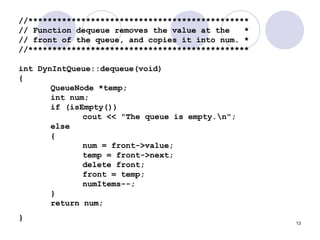
//**********************************************
// Function dequeue removes the value at the *
// front of the queue, and copies it into num. *
//**********************************************
int DynIntQueue::dequeue(void)
{
QueueNode *temp;
int num;
if (isEmpty())
cout << "The queue is empty.n";
else
{
num = front->value;
temp = front->next;
delete front;
front = temp;
numItems--;
}
return num;
}
14
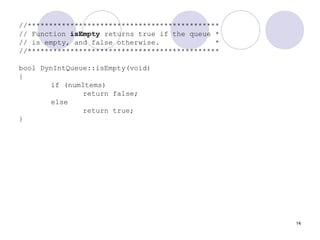
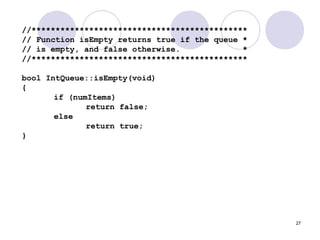
//*********************************************
// Function isEmpty returns true if the queue *
// is empty, and false otherwise. *
//*********************************************
bool DynIntQueue::isEmpty(void)
{
if (numItems)
return false;
else
return true;
}
15
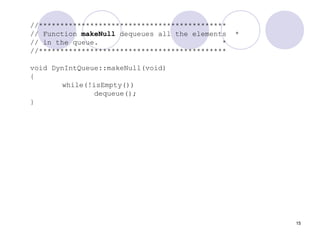
//********************************************
// Function makeNull dequeues all the elements *
// in the queue. *
//********************************************
void DynIntQueue::makeNull(void)
{
while(!isEmpty())
dequeue();
}
16
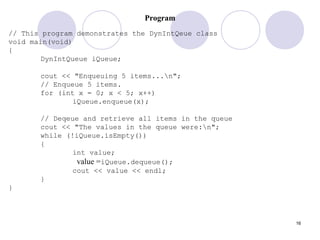
Program
// This program demonstrates the DynIntQeue class
void main(void)
{
DynIntQueue iQueue;
cout << "Enqueuing 5 items...n";
// Enqueue 5 items.
for (int x = 0; x < 5; x++)
iQueue.enqueue(x);
// Deqeue and retrieve all items in the queue
cout << "The values in the queue were:n";
while (!iQueue.isEmpty())
{
int value;
value =iQueue.dequeue();
cout << value << endl;
}
}
17
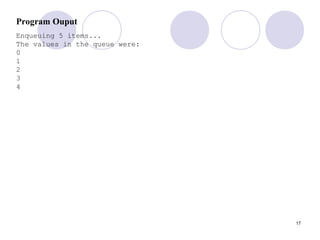
Program Ouput
Enqueuing 5 items...
The values in the queue were:
0
1
2
3
4
18
Array Implementation
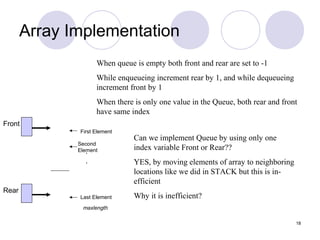
First Element
Last Element
maxlength
Front
Second
Element.
.
Rear
When queue is empty both front and rear are set to -1
While enqueueing increment rear by 1, and while dequeueing
increment front by 1
When there is only one value in the Queue, both rear and front
have same index
Can we implement Queue by using only one
index variable Front or Rear??
YES, by moving elements of array to neighboring
locations like we did in STACK but this is in-
efficient
Why it is inefficient?
19
Array Implementation
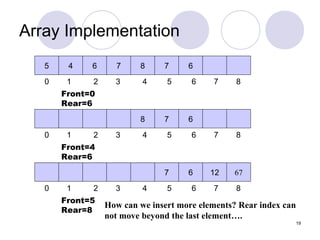
5 4 6 7 8 7 6
0 1 2 3 4 5 6 7 8
Front=0
Rear=6
8 7 6
0 1 2 3 4 5 6 7 8
Front=4
Rear=6
7 6 12 67
0 1 2 3 4 5 6 7 8
Front=5
Rear=8
How can we insert more elements? Rear index can
not move beyond the last element….
20
Solution: Using circular queue
Allow rear to wrap around the array.
if(rear == queueSize-1)
rear = 0;
else
rear++;
Or use module arithmetic
rear = (rear + 1) % queueSize;
21
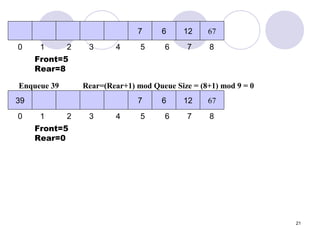
7 6 12 67
0 1 2 3 4 5 6 7 8
Front=5
Rear=8
Enqueue 39 Rear=(Rear+1) mod Queue Size = (8+1) mod 9 = 0
39 7 6 12 67
0 1 2 3 4 5 6 7 8
Front=5
Rear=0
22
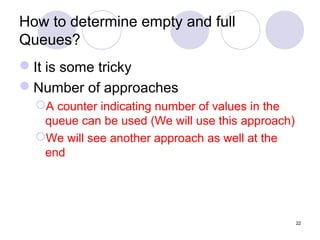
How to determine empty and full
Queues?
It is some tricky
Number of approaches
A counter indicating number of values in the
queue can be used (We will use this approach)
We will see another approach as well at the
end
23
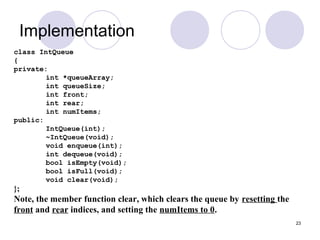
Implementation
class IntQueue
{
private:
int *queueArray;
int queueSize;
int front;
int rear;
int numItems;
public:
IntQueue(int);
~IntQueue(void);
void enqueue(int);
int dequeue(void);
bool isEmpty(void);
bool isFull(void);
void clear(void);
};
Note, the member function clear, which clears the queue by resetting the
front and rear indices, and setting the numItems to 0.
24
IntQueue::IntQueue(int s) //constructor
{
queueArray = new int[s];
queueSize = s;
front = -1;
rear = -1;
numItems = 0;
}
IntQueue::~IntQueue(void) //destructor
{
delete [] queueArray;
}
25
//********************************************
// Function enqueue inserts the value in num *
// at the rear of the queue. *
//********************************************
void IntQueue::enqueue(int num)
{
if (isFull())
cout << "The queue is full.n";
else
{
// Calculate the new rear position
rear = (rear + 1) % queueSize;
// Insert new item
queueArray[rear] = num;
// Update item count
numItems++;
}
}
26
//*********************************************
// Function dequeue removes the value at the *
// front of the queue, and copies t into num. *
//*********************************************
int IntQueue::dequeue(void)
{
if (isEmpty())
cout << "The queue is empty.n";
else
{
// Move front
front = (front + 1) % queueSize;
// Retrieve the front item
int num = queueArray[front];
// Update item count
numItems--;
}
return num;
}
27
//*********************************************
// Function isEmpty returns true if the queue *
// is empty, and false otherwise. *
//*********************************************
bool IntQueue::isEmpty(void)
{
if (numItems)
return false;
else
return true;
}
28
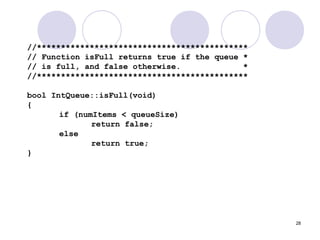
//********************************************
// Function isFull returns true if the queue *
// is full, and false otherwise. *
//********************************************
bool IntQueue::isFull(void)
{
if (numItems < queueSize)
return false;
else
return true;
}
29
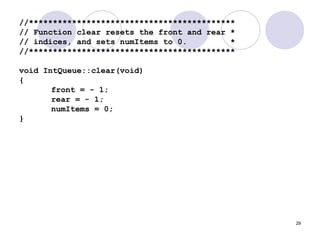
//*******************************************
// Function clear resets the front and rear *
// indices, and sets numItems to 0. *
//*******************************************
void IntQueue::clear(void)
{
front = - 1;
rear = - 1;
numItems = 0;
}
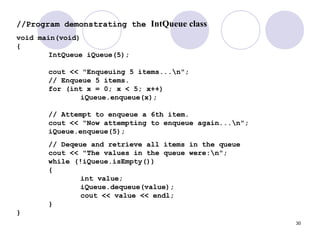
30
//Program demonstrating the IntQueue class
void main(void)
{
IntQueue iQueue(5);
cout << "Enqueuing 5 items...n";
// Enqueue 5 items.
for (int x = 0; x < 5; x++)
iQueue.enqueue(x);
// Attempt to enqueue a 6th item.
cout << "Now attempting to enqueue again...n";
iQueue.enqueue(5);
// Deqeue and retrieve all items in the queue
cout << "The values in the queue were:n";
while (!iQueue.isEmpty())
{
int value;
iQueue.dequeue(value);
cout << value << endl;
}
}
31
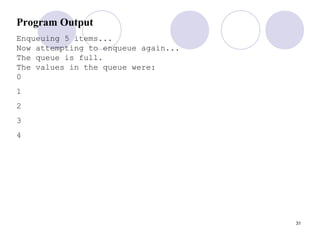
Program Output
Enqueuing 5 items...
Now attempting to enqueue again...
The queue is full.
The values in the queue were:
0
1
2
3
4
32
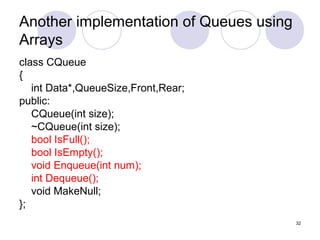
Another implementation of Queues using
Arrays
class CQueue
{
int Data*,QueueSize,Front,Rear;
public:
CQueue(int size);
~CQueue(int size);
bool IsFull();
bool IsEmpty();
void Enqueue(int num);
int Dequeue();
void MakeNull;
};
33
CQueue::CQueue(int size)
{
Front=Rear=-1;
Data=new int[size];
}
void CQueue ::Enqueue(int num);
{
if (IsFull()) { cout<<“Overflow” return; }
if (IsEmpty() Rear=Front=0;
else Rear=(Rear+1) % QueueSize;
Data[Rear]=num;
}
34
int CQueue ::Dequeue(int num);
{
if (IsEmpty()) { cout<<“Underflow”; return; }
int ReturnValue=Data[Front];
if (Front==Rear) //only one element in the queue
Front=Rear=-1;
else
Front=(Front+1) % QueueSize;
return ReturnValue;
}
35
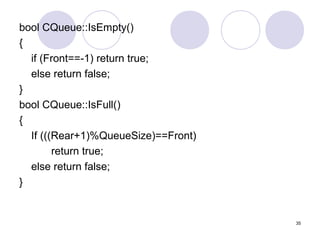
bool CQueue::IsEmpty()
{
if (Front==-1) return true;
else return false;
}
bool CQueue::IsFull()
{
If (((Rear+1)%QueueSize)==Front)
return true;
else return false;
}

Algo>Queues

  • 1.
  • 2.
    2 Queues “A Queue isa special kind of list, where items are inserted at one end (the rear) And deleted at the other end (the front)” Other Name:  First In First Out (FIFO) Difference from Stack: Insertion go at the end of the list, rather than the beginning of the list.
  • 3.
    3 Common Operations onQueues (Queue ADT) 1. MAKENULL(Q): Makes Queue Q be an empty list. 2. FRONT(Q): Returns the first element on Queue Q. 3. ENQUEUE(x,Q): Inserts element x at the end of Queue Q. 4. DEQUEUE(Q): Deletes the first element of Q. 5. EMPTY(Q): Returns true if and only if Q is an empty queue. Example: Line of customers in a bank
  • 4.
    4 Applications of Queues Operatingsystem multi-user/multitasking environments, where several users or task may be requesting the same resource simultaneously. Communication Software queues to hold information received over networks and dial up connections. (Information can be transmitted faster than it can be processed, so is placed in a queue waiting to be processed) Some other?
  • 5.
    5 Implementation Static Queue is implementedby an array, and size of queue remains fix Dynamic A queue can be implemented as a linked list, and expand or shrink with each enqueue or dequeue operation.
  • 6.
  • 7.
    7 A pointer Implementationof Queues Keep two pointers:  FRONT: A pointer to the first element of the queue.  REAR: A pointer to the last element of the queue. x y .zFront Rear
  • 8.
    8 A pointer Implementationof Queues Q.front Q.Rear MAKENULL(Q) Q.front Q.Rear ENQUEUE(x,Q) .x NULL
  • 9.
  • 10.
    10 A class forDynamic Queue implementation class DynIntQueue { private: struct QueueNode { int value; QueueNode *next; }; QueueNode *front; QueueNode *rear; int numItems; public: DynIntQueue(void); ~DynIntQueue(void); void enqueue(int); int dequeue(void); bool isEmpty(void); void makeNull(void); };
  • 11.
    11 Implemenaton //************************ // Constructor * //************************ DynIntQueue::DynIntQueue(void) { front= NULL; rear = NULL; numItems = 0; } //************************ // Destructor * //************************ DynIntQueue::~DynIntQueue(void) { makeNull(); }
  • 12.
    12 //******************************************** // Function enqueueinserts the value in num * // at the rear of the queue. * //******************************************** void DynIntQueue::enqueue(int num) { QueueNode *newNode; newNode = new QueueNode; newNode->value = num; newNode->next = NULL; if (isEmpty()) { front = newNode; rear = newNode; } else { rear->next = newNode; rear = newNode; } numItems++; }
  • 13.
    13 //********************************************** // Function dequeueremoves the value at the * // front of the queue, and copies it into num. * //********************************************** int DynIntQueue::dequeue(void) { QueueNode *temp; int num; if (isEmpty()) cout << "The queue is empty.n"; else { num = front->value; temp = front->next; delete front; front = temp; numItems--; } return num; }
  • 14.
    14 //********************************************* // Function isEmptyreturns true if the queue * // is empty, and false otherwise. * //********************************************* bool DynIntQueue::isEmpty(void) { if (numItems) return false; else return true; }
  • 15.
    15 //******************************************** // Function makeNulldequeues all the elements * // in the queue. * //******************************************** void DynIntQueue::makeNull(void) { while(!isEmpty()) dequeue(); }
  • 16.
    16 Program // This programdemonstrates the DynIntQeue class void main(void) { DynIntQueue iQueue; cout << "Enqueuing 5 items...n"; // Enqueue 5 items. for (int x = 0; x < 5; x++) iQueue.enqueue(x); // Deqeue and retrieve all items in the queue cout << "The values in the queue were:n"; while (!iQueue.isEmpty()) { int value; value =iQueue.dequeue(); cout << value << endl; } }
  • 17.
    17 Program Ouput Enqueuing 5items... The values in the queue were: 0 1 2 3 4
  • 18.
    18 Array Implementation First Element LastElement maxlength Front Second Element. . Rear When queue is empty both front and rear are set to -1 While enqueueing increment rear by 1, and while dequeueing increment front by 1 When there is only one value in the Queue, both rear and front have same index Can we implement Queue by using only one index variable Front or Rear?? YES, by moving elements of array to neighboring locations like we did in STACK but this is in- efficient Why it is inefficient?
  • 19.
    19 Array Implementation 5 46 7 8 7 6 0 1 2 3 4 5 6 7 8 Front=0 Rear=6 8 7 6 0 1 2 3 4 5 6 7 8 Front=4 Rear=6 7 6 12 67 0 1 2 3 4 5 6 7 8 Front=5 Rear=8 How can we insert more elements? Rear index can not move beyond the last element….
  • 20.
    20 Solution: Using circularqueue Allow rear to wrap around the array. if(rear == queueSize-1) rear = 0; else rear++; Or use module arithmetic rear = (rear + 1) % queueSize;
  • 21.
    21 7 6 1267 0 1 2 3 4 5 6 7 8 Front=5 Rear=8 Enqueue 39 Rear=(Rear+1) mod Queue Size = (8+1) mod 9 = 0 39 7 6 12 67 0 1 2 3 4 5 6 7 8 Front=5 Rear=0
  • 22.
    22 How to determineempty and full Queues? It is some tricky Number of approaches A counter indicating number of values in the queue can be used (We will use this approach) We will see another approach as well at the end
  • 23.
    23 Implementation class IntQueue { private: int *queueArray; intqueueSize; int front; int rear; int numItems; public: IntQueue(int); ~IntQueue(void); void enqueue(int); int dequeue(void); bool isEmpty(void); bool isFull(void); void clear(void); }; Note, the member function clear, which clears the queue by resetting the front and rear indices, and setting the numItems to 0.
  • 24.
    24 IntQueue::IntQueue(int s) //constructor { queueArray= new int[s]; queueSize = s; front = -1; rear = -1; numItems = 0; } IntQueue::~IntQueue(void) //destructor { delete [] queueArray; }
  • 25.
    25 //******************************************** // Function enqueueinserts the value in num * // at the rear of the queue. * //******************************************** void IntQueue::enqueue(int num) { if (isFull()) cout << "The queue is full.n"; else { // Calculate the new rear position rear = (rear + 1) % queueSize; // Insert new item queueArray[rear] = num; // Update item count numItems++; } }
  • 26.
    26 //********************************************* // Function dequeueremoves the value at the * // front of the queue, and copies t into num. * //********************************************* int IntQueue::dequeue(void) { if (isEmpty()) cout << "The queue is empty.n"; else { // Move front front = (front + 1) % queueSize; // Retrieve the front item int num = queueArray[front]; // Update item count numItems--; } return num; }
  • 27.
    27 //********************************************* // Function isEmptyreturns true if the queue * // is empty, and false otherwise. * //********************************************* bool IntQueue::isEmpty(void) { if (numItems) return false; else return true; }
  • 28.
    28 //******************************************** // Function isFullreturns true if the queue * // is full, and false otherwise. * //******************************************** bool IntQueue::isFull(void) { if (numItems < queueSize) return false; else return true; }
  • 29.
    29 //******************************************* // Function clearresets the front and rear * // indices, and sets numItems to 0. * //******************************************* void IntQueue::clear(void) { front = - 1; rear = - 1; numItems = 0; }
  • 30.
    30 //Program demonstrating theIntQueue class void main(void) { IntQueue iQueue(5); cout << "Enqueuing 5 items...n"; // Enqueue 5 items. for (int x = 0; x < 5; x++) iQueue.enqueue(x); // Attempt to enqueue a 6th item. cout << "Now attempting to enqueue again...n"; iQueue.enqueue(5); // Deqeue and retrieve all items in the queue cout << "The values in the queue were:n"; while (!iQueue.isEmpty()) { int value; iQueue.dequeue(value); cout << value << endl; } }
  • 31.
    31 Program Output Enqueuing 5items... Now attempting to enqueue again... The queue is full. The values in the queue were: 0 1 2 3 4
  • 32.
    32 Another implementation ofQueues using Arrays class CQueue { int Data*,QueueSize,Front,Rear; public: CQueue(int size); ~CQueue(int size); bool IsFull(); bool IsEmpty(); void Enqueue(int num); int Dequeue(); void MakeNull; };
  • 33.
    33 CQueue::CQueue(int size) { Front=Rear=-1; Data=new int[size]; } voidCQueue ::Enqueue(int num); { if (IsFull()) { cout<<“Overflow” return; } if (IsEmpty() Rear=Front=0; else Rear=(Rear+1) % QueueSize; Data[Rear]=num; }
  • 34.
    34 int CQueue ::Dequeue(intnum); { if (IsEmpty()) { cout<<“Underflow”; return; } int ReturnValue=Data[Front]; if (Front==Rear) //only one element in the queue Front=Rear=-1; else Front=(Front+1) % QueueSize; return ReturnValue; }
  • 35.
    35 bool CQueue::IsEmpty() { if (Front==-1)return true; else return false; } bool CQueue::IsFull() { If (((Rear+1)%QueueSize)==Front) return true; else return false; }