
www.vasantkothari.com
A
Series of Articles
On
Application of Contemporary
Fibers in Apparel
By
Vasant Kothari
www.vasantkothari.com
Index
1 Ingeo
2 Bamboo
3 Lyocell
4 Soybean
5 Modal
6 Chloro
7 Cocona
8 Coffee
9 Carilare
10 Melamine
11 Dyeable Polypropylene
12 Cupro
13 Milk
14 Nettle
15 Pearl
16 Chitosan
17 Banana
18 Pina
19 Lotus
20 Seaweed
21 PTT
22 Spider Silk
23 Feather
24 Rice
25 Abaca
26 Hibiscus
27 Camel
28 Silver
29 Aloe Vera
30 Sugar Cane
31 FIR
32 Horse Hair
33 Angora
34 Chiengora
35 Llamas
36 Amicor
37 Qivit
38 Vicuna
APPAREL VIEWS / JANUARY 2011 57
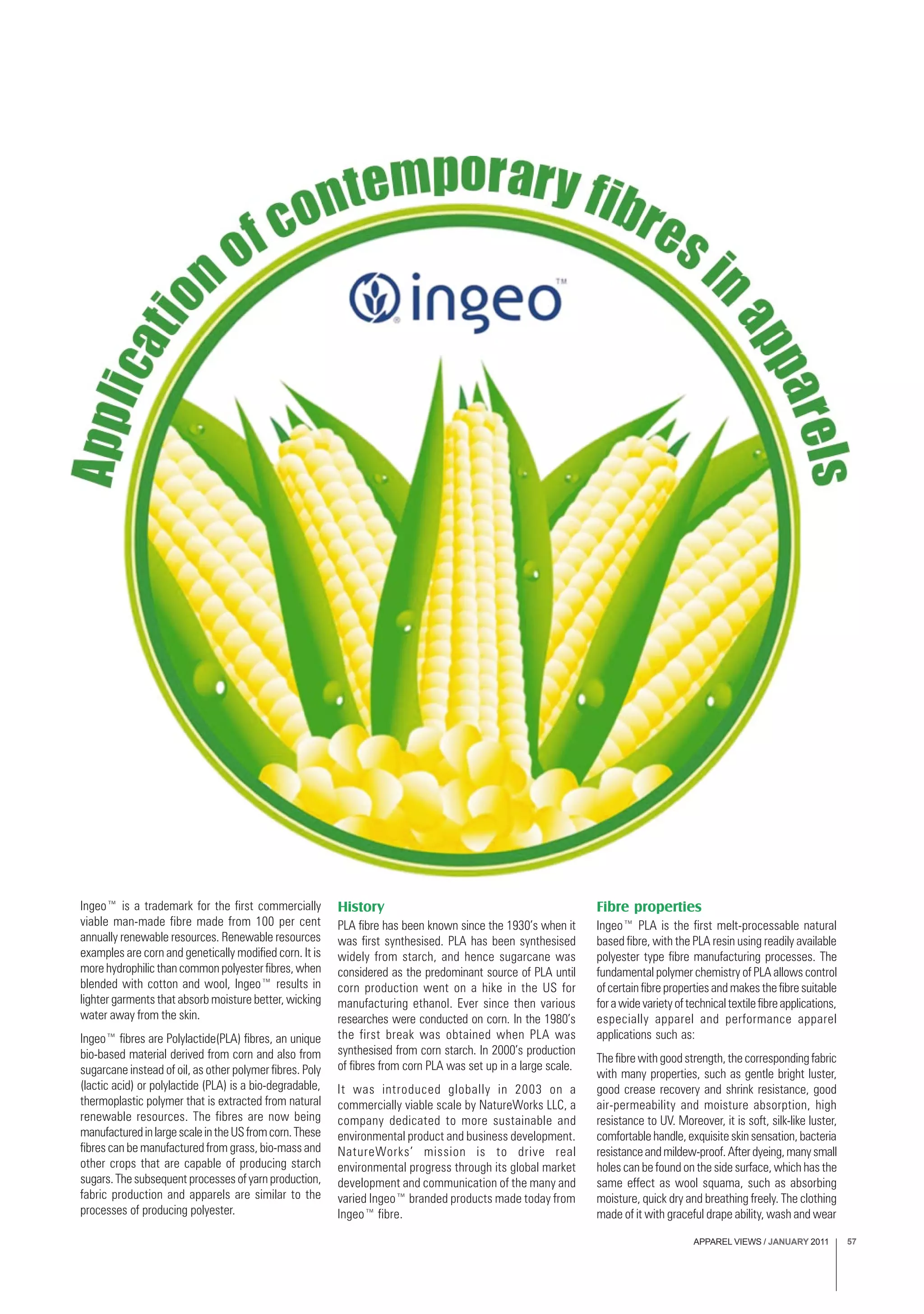
Ingeo™ is a trademark for the first commercially
viable man-made fibre made from 100 per cent
annually renewable resources. Renewable resources
examples are corn and genetically modified corn. It is
more hydrophilic than common polyester fibres, when
blended with cotton and wool, Ingeo™ results in
lighter garments that absorb moisture better, wicking
water away from the skin.
Ingeo™ fibres are Polylactide(PLA) fibres, an unique
bio-based material derived from corn and also from
sugarcane instead of oil, as other polymer fibres. Poly
(lactic acid) or polylactide (PLA) is a bio-degradable,
thermoplastic polymer that is extracted from natural
renewable resources. The fibres are now being
manufacturedinlargescaleintheUSfromcorn.These
fibres can be manufactured from grass, bio-mass and
other crops that are capable of producing starch
sugars. The subsequent processes of yarn production,
fabric production and apparels are similar to the
processes of producing polyester.
History
PLA fibre has been known since the 1930’s when it
was first synthesised. PLA has been synthesised
widely from starch, and hence sugarcane was
considered as the predominant source of PLA until
corn production went on a hike in the US for
manufacturing ethanol. Ever since then various
researches were conducted on corn. In the 1980’s
the first break was obtained when PLA was
synthesised from corn starch. In 2000’s production
of fibres from corn PLA was set up in a large scale.
It was introduced globally in 2003 on a
commercially viable scale by NatureWorks LLC, a
company dedicated to more sustainable and
environmental product and business development.
NatureWorks’ mission is to drive real
environmental progress through its global market
development and communication of the many and
varied Ingeo™ branded products made today from
Ingeo™ fibre.
Fibre properties
Ingeo™ PLA is the first melt-processable natural
based fibre, with the PLA resin using readily available
polyester type fibre manufacturing processes. The
fundamental polymer chemistry of PLA allows control
of certain fibre properties and makes the fibre suitable
forawidevarietyoftechnicaltextilefibreapplications,
especially apparel and performance apparel
applications such as:
The fibre with good strength, the corresponding fabric
with many properties, such as gentle bright luster,
good crease recovery and shrink resistance, good
air-permeability and moisture absorption, high
resistance to UV. Moreover, it is soft, silk-like luster,
comfortable handle, exquisite skin sensation, bacteria
resistanceandmildew-proof.Afterdyeing,manysmall
holes can be found on the side surface, which has the
same effect as wool squama, such as absorbing
moisture, quick dry and breathing freely. The clothing
made of it with graceful drape ability, wash and wear
APPAREL VIEWS / JANUARY 201158
treatment, rebound resilience, size stability to the
many solvents including dry cleaning agent, dirt
resistance, endurance to the sunlight and the climate,
it is a new generation of green fibre.
This fibre can replace various textile materials, it is
most fit for clothing, can be made into yarn, fabric,
knitting, nonwoven, staple fibre, multifilament and
single filament. It can be spun into pure yarn, at the
same time can be spun with cotton, wool, viscose
and other chemical fibres. It has been widely used in
underwear, outer coat, sports wears, shirt, T-shirt,
jacket, trousers and dress. It is regarded as an
environmental-friendly new textile material. It blends
the humanity, nature and technology into a unity
concordantly.
Main features in clothing industry:
• Soft handle, which assures you of an irreplaceable
good feeling
• Low moisture absorption and high wicking, offering
benefits for sports and performance apparel and
products
• Low flammability and smoke generation
• With good wrinkle and shrink resistance, graceful
drape ability, easy care
• Antimicrobial, mildew-proof, keep skin clean and
safe
• High resistance to ultra violet (UV) light, a benefit
forperformanceapparelaswellasoutdoorfurniture
and furnishings applications
• A low index of refraction, which provides excellent
colour characteristics. The refractive index of 1.35–
1.45 is lower than PET(1.54)
• Bio-degradable completely and environment-
friendly
• Lower specific gravity, 1.25 g/cm3, making PLA
lighter in weight than other fibres
• In addition to coming from an annually renewable
resource base PLA fibres are readily melt-spun,
offering manufacturing advantages that result in
greater consumer choice
• High resilience
• Low odour retention
• Biological resistance: Not inherently ‘antimicrobial’
without suitable after-finish treatment
• Care must be taken in dyeing and finishing, as PLA
is a linear aliphatic fibre, its resistance to hydrolysis
PLA is even less environmentally costly than other
bio-degradable thermoplastics, since the entire mass
of PLA can eventually be re-converted into new PLA,
whereas many other bio-degradable thermoplastics
incorporate at least some material derived from fossil
fuels.
Comparison with other fibres
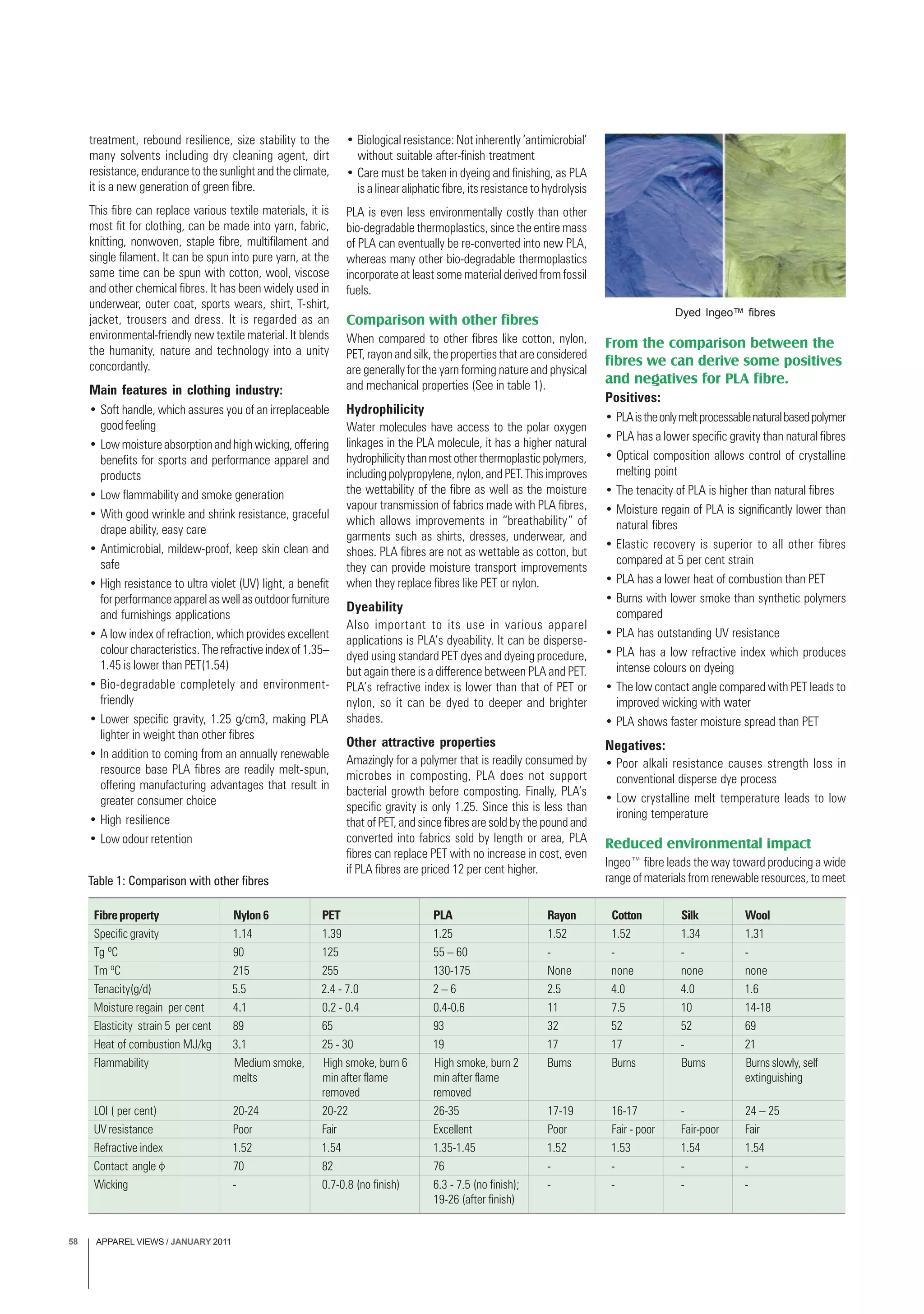
When compared to other fibres like cotton, nylon,
PET, rayon and silk, the properties that are considered
are generally for the yarn forming nature and physical
and mechanical properties (See in table 1).
Hydrophilicity
Water molecules have access to the polar oxygen
linkages in the PLA molecule, it has a higher natural
hydrophilicitythanmostotherthermoplasticpolymers,
including polypropylene, nylon, and PET. This improves
the wettability of the fibre as well as the moisture
vapour transmission of fabrics made with PLA fibres,
which allows improvements in “breathability” of
garments such as shirts, dresses, underwear, and
shoes. PLA fibres are not as wettable as cotton, but
they can provide moisture transport improvements
when they replace fibres like PET or nylon.
Dyeability
Also important to its use in various apparel
applications is PLA’s dyeability. It can be disperse-
dyed using standard PET dyes and dyeing procedure,
but again there is a difference between PLA and PET.
PLA’s refractive index is lower than that of PET or
nylon, so it can be dyed to deeper and brighter
shades.
Other attractive properties
Amazingly for a polymer that is readily consumed by
microbes in composting, PLA does not support
bacterial growth before composting. Finally, PLA’s
specific gravity is only 1.25. Since this is less than
that of PET, and since fibres are sold by the pound and
converted into fabrics sold by length or area, PLA
fibres can replace PET with no increase in cost, even
if PLA fibres are priced 12 per cent higher.
From the comparison between the
fibres we can derive some positives
and negatives for PLA fibre.
Positives:
• PLAistheonlymeltprocessablenaturalbasedpolymer
• PLA has a lower specific gravity than natural fibres
• Optical composition allows control of crystalline
melting point
• The tenacity of PLA is higher than natural fibres
• Moisture regain of PLA is significantly lower than
natural fibres
• Elastic recovery is superior to all other fibres
compared at 5 per cent strain
• PLA has a lower heat of combustion than PET
• Burns with lower smoke than synthetic polymers
compared
• PLA has outstanding UV resistance
• PLA has a low refractive index which produces
intense colours on dyeing
• The low contact angle compared with PET leads to
improved wicking with water
• PLA shows faster moisture spread than PET
Negatives:
• Poor alkali resistance causes strength loss in
conventional disperse dye process
• Low crystalline melt temperature leads to low
ironing temperature
Reduced environmental impact
Ingeo™ fibre leads the way toward producing a wide
range of materials from renewable resources, to meet
Fibreproperty Nylon6 PET PLA Rayon Cotton Silk Wool
Specific gravity 1.14 1.39 1.25 1.52 1.52 1.34 1.31
Tg ºC 90 125 55 – 60 - - - -
Tm ºC 215 255 130-175 None none none none
Tenacity(g/d) 5.5 2.4 - 7.0 2 – 6 2.5 4.0 4.0 1.6
Moisture regain per cent 4.1 0.2 - 0.4 0.4-0.6 11 7.5 10 14-18
Elasticity strain 5 per cent 89 65 93 32 52 52 69
Heat of combustion MJ/kg 3.1 25 - 30 19 17 17 - 21
Flammability Medium smoke, High smoke, burn 6 High smoke, burn 2 Burns Burns Burns Burnsslowly, self
melts min after flame min after flame extinguishing
removed removed
LOI ( per cent) 20-24 20-22 26-35 17-19 16-17 - 24 – 25
UV resistance Poor Fair Excellent Poor Fair - poor Fair-poor Fair
Refractive index 1.52 1.54 1.35-1.45 1.52 1.53 1.54 1.54
Contact angle 70 82 76 - - - -
Wicking - 0.7-0.8 (no finish) 6.3 - 7.5 (no finish); - - - -
19-26 (after finish)
Table 1: Comparison with other fibres
Dyed Ingeo™ fibres
APPAREL VIEWS / JANUARY 2011 59
the world's needs today without compromising the
earth's ability to meet the needs of tomorrow. The
fibre is an environmentally preferable option to
petroleum-based synthetic materials:
1. It uses an annually renewable resource, field corn,
instead of petroleum, to make synthetic materials
2. NatureWorks PLA is the world's first greenhouse-
gas-neutral polymer*
3. Products made with Ingeo™ fibre are compostable
where that attribute is desired
4. From cradle to resin, production of this fibre uses
68 per cent less fossil fuel resources than resins
for traditional synthetic fibres
Drawbacks
Of course, no material has only useful and valuable
properties. But those properties of PLA, which could
be called drawbacks, are relatively few, and some are
even useful for certain applications.
The one property for which we have not found a
promising application is PLA’s relatively poor abrasion
resistance. This may limit or even preclude the use of
PLA fibres in some high-performance apparel
applications, in ropes, or in other uses where abrasion
resistance is required. But in tests to date, it has not
proven severe enough to limit the usefulness of PLA
fibres in carpet.
A second “drawback” is PLA’s relatively low melt
temperature. Even the most crystalline form melts at
about 175°C. This will limit PLA’s applicability in high-
temperature environments, but it is at least high
enough not to preclude ironing and drying in apparel
applications.
Uses and applications
Ingeo™ fibre – an innovative performance fibre ideally
suited for apparel, furnishings and nonwovens
applications is ideal for packaging manufacturing.
Applications using Ingeo™ bio-polymer can be clear,
opaque, flexible or rigid. It provides gloss and clarity
similar to polystyrene, and exhibits tensile strength
and modulus comparable to hydrocarbon-based
thermoplastics.
The fibre can have the look and feel of natural fibres
with a comparable performance to traditional
synthetics. Its natural versatility offers the opportunity
to design new yarns, fabrics and garments for a
contemporary wardrobe in both pure qualities and
innovative blends. A new style of fine woven
lightweights plays with reflections, textures and
transparency. Knitwear begins with refined and
functional weights for home wear, separates and
underwear.
• Versatility Ingeo™ fibre is versatile, available in
both filament and staple spun forms. It can make a
wide variety of textile styles from dress to
sportswear, furnishings to drapes and soft
nonwoven baby wipes to tough landscape textiles
• Performance this fibre can outperform traditional
synthetics for UV light resistance, hypoallergenic
properties, outstanding moisture management,
stain resistance, low odour retention, easy care/
quick dry, breathability, comfort and insulation
properties
Thisfibreisusedinmanydifferentapparelapplications:
Contemporary sports and casual wear – T-shirts,
fleece and jeans. Functional fashion separates-
shirting, trousers, duvet jackets, jersey dressing and
essential next-to-skin items such as underwear and
hosiery. Ingeo™ fibre can also be used in new fibrefill
blends for thermal wadding that offers unique natural
insulation properties.
T-shirt
Contemporary-iconic-everyday-unique-performing
- easywear - comfort - quick dry - low odour
Key performances
Moisture wicking: Ingeo™ fibre wicks, (transports
moisture) better than a wide range of other synthetic
fibres.
Comfort: This has proved to be quicker dry than all
the other competitive fibres.
Confidence: This fibre does not allow bacteria
proliferationandthereforeoffersexceptionallowodour
retention.
Shirting
Classics reborn - easy wear - comfort - quick dry -
new touch - iron free
Key performances
Easy care: It's possible either to wash or dry clean
garments made from Ingeo™ fibre.
It is ideal for today's life: It has natural resilience and
holds its shape well over time lighter
Touch: Ingeo™ fibre has an unusual light, dry hand
feel.
Jersey dressing
Fashion driven - special aesthetics - deluxe touch -
unique character - sensual drape - filament sheen
Key performances
Versatility: The fibre is available in both staple and
filament forms in a wide variety of counts from a
micro denier for the finest lightest fabrics to higher
counts for more robust applications
Practicality:CanmachinewashIngeo™fibreproducts.
They show good soil release, are quick drying, and
have excellent after wash appearance. There is no
need to iron.
Duvet jacket
Functional - summer shell/winter duvet - unique
aesthetics - performing - lightweight - comfort - warm
- cool
Key performances
Uniquelusterandtouch:Ingeo™filamentfabricshave
a subtle luster and fluid drape with a natural hand
offeringabeautifulnewmaterialtostimulatecreativity.
Warmth and loft: The fibre has a soft, fluffy feel and
after it's compressed, it easily returns to its bulky
appearance. It provides the outstanding insulating
performance properties.
Performance underwear
Insulating- dry fit - easy care - low odour - lightweight
- moisture - management
Key performances
Confidence: Low odour
FabricMfg Description
Avelana Plain woven fabrics in 100 per cent Ingeo™ fibre for fashion separates
Bel Maille Weft knit fabrics in 100 per cent fibre piece dye for the high fashion market
Chia Her A small range of woven fabrics combining Ingeo™ fibre with wool and cotton in twists
and slub yarns
Cotonificio Veneto Fleece and garment dyed jersey double face fabrics in Ingeo™ fibre mixed with cotton
Everwin A range of fabrics in Ingeo™ fibre blended with cotton
Figli di Michelangelo A range of different fabric structures: corded fabrics, interlock, fleece in 100 per cent
Calamai Ingeo™ fibre and vanisé with Ingeo™ fibre blended with cotton
Fountain Set A new range of nearly 40 jersey fabrics in 100 per cent Ingeo™ fibre solid piece dye,
and in Ingeo™ fibre blended with cotton including a small range of heather mixtures
Gipitex New range of woven filament outerwear - a specialist filament mill working in
partnership with Ingeo™ fibre to uncover the full potential of new yarns, structures
and finishes
Louis Vidon A range of very light weft knit fabrics in 100 per cent Ingeo™ fibre for intimate
wear garments
Mario Cucchetti Jersey qualities in 100 per cent Ingeo™ fibre and blends with cotton
Pontetorto Fleece and interlock in 100 per cent Ingeo™ fibre; double face jersey combined with
Ingeo™ fibre cotton and wool
Radici Tessuti A range of woven fabrics in 100 per cent Ingeo™ fibre and blended with cotton and
linen with waterproof membrane laminate finishes
Tessitura Romanò A range of 100 per cent Ingeo™ fibre woven fabrics
Tintex A range of super smooth jersey fabrics (Interlock, rib, single jersey and fleece) in
100 per cent Ingeo™ fibre
Fabrics from Ingeo™ fibres
APPAREL VIEWS / JANUARY 201160
Comfort: Dry fit, moisture management, natural touch
Easy care: Quick dry, no iron
Future
As it can be seen, only few applications for the unique
property set offered by PLA fibres. Many more
applications are likely to arise just from the properties
discussed above. But there is also still quite a bit of
investigation to be done regarding the properties of
the polymer and fibres made from it. With future
discoveries in polymer and fibre properties and future
developments in appropriate applications for the
fibres, we expect the use of PLA fibres to expand
rapidly in the next several years. It seems likely that,
as it matures, PLA will eventually find acceptance in
an array of applications as broad as PET, nylon, and
polypropylene. PLA is also being used in the packing
and plastic industries. If the fibre production from
corn is commercialised, there is a great scope for the
fibres to replace fossil fuel fibres like PET, nylon; thus
reducing the carbon emissions in the atmosphere
and also providing excellent properties.
Brands using Ingeo™ fibre products are:
• Armani, men’s and women’s fashion brand (Italy)
• FrancoFrancesca,Italianfashionbrandanddesigner
(Italy)
• Kei Kagami, avant-garde fashion designer (UK)
• Linda Loudermilk, eco luxury designer (USA)
presenting a range of garments made of Ingeo™
(USA)
• Nadia Fassi, Italian fitness brand using Ingeo™ in
their key woman line (Italy)
• REI,hikingsocksfromoutdoorsportsretailers(USA)
• Versace, luxury fashion brand (Italy)
• Diesel, jeans wear fashion brand (Italy)
Conclusion
This fibre is a novel product that combines the best of
both worlds: The performance of a synthetic fibre and
the advantages of a natural material. Ingeo™ fibre
provides one of the best options for society to become
more environmentally-friendly and responsible. This
successful blend of environmental soundness,
aesthetic appeal and proven performance are
combining to propel Ingeo™ fibre products to affirmed
international success. Today, there are many leading
manufacturers around the world actively developing
products made from Ingeo™. Products are already on
the market and available for purchase in places like
the US, Japan, and Europe.
It is helping humanity decrease its dependency on
petroleum and given the textile world an opportunity
to manufacture products without the need for
petroleum. In addition, this fibre production emits 60
per cent to 80 per cent less greenhouse gases into
the atmosphere. It is made from 100 per cent natural
resources that can be grown as quickly as one year.
Thebestalternativedowncomfortercanonlybemade
of a natural resource fibre such as Ingeo™ and still
provide the same quality and comfort as other man
made products. This fibre has completely
revolutionised the textile world and allowed the
companies to be environmentally responsible
Thinking bio-renewable? Think corn! Think…
By Vasant R Kothari, Assistant Professor,
NIFT, Bangalore & S.Vaithilingam,
MFTech, NIFT Bangalore (Author can be
contacted @ www.vasantkothari.com)
APPAREL VIEWS / FEBRUARY 201148
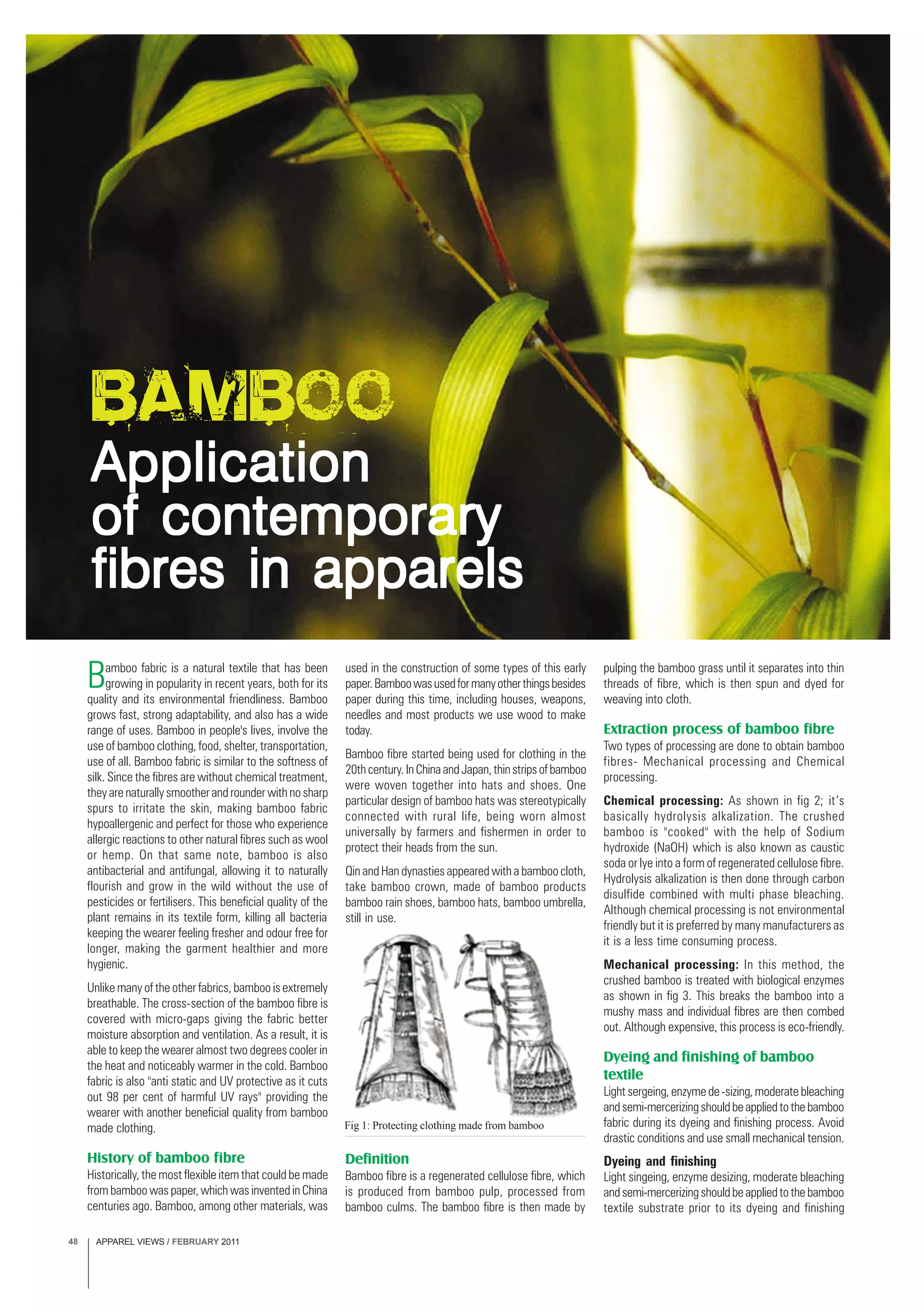
Bamboo fabric is a natural textile that has been
growing in popularity in recent years, both for its
quality and its environmental friendliness. Bamboo
grows fast, strong adaptability, and also has a wide
range of uses. Bamboo in people's lives, involve the
use of bamboo clothing, food, shelter, transportation,
use of all. Bamboo fabric is similar to the softness of
silk. Since the fibres are without chemical treatment,
they are naturally smoother and rounder with no sharp
spurs to irritate the skin, making bamboo fabric
hypoallergenic and perfect for those who experience
allergic reactions to other natural fibres such as wool
or hemp. On that same note, bamboo is also
antibacterial and antifungal, allowing it to naturally
flourish and grow in the wild without the use of
pesticides or fertilisers. This beneficial quality of the
plant remains in its textile form, killing all bacteria
keeping the wearer feeling fresher and odour free for
longer, making the garment healthier and more
hygienic.
Unlike many of the other fabrics, bamboo is extremely
breathable. The cross-section of the bamboo fibre is
covered with micro-gaps giving the fabric better
moisture absorption and ventilation. As a result, it is
able to keep the wearer almost two degrees cooler in
the heat and noticeably warmer in the cold. Bamboo
fabric is also "anti static and UV protective as it cuts
out 98 per cent of harmful UV rays" providing the
wearer with another beneficial quality from bamboo
made clothing.
History of bamboo fibre
Historically, the most flexible item that could be made
from bamboo was paper, which was invented in China
centuries ago. Bamboo, among other materials, was
used in the construction of some types of this early
paper.Bamboowasusedformanyotherthingsbesides
paper during this time, including houses, weapons,
needles and most products we use wood to make
today.
Bamboo fibre started being used for clothing in the
20thcentury.InChinaandJapan,thinstripsofbamboo
were woven together into hats and shoes. One
particular design of bamboo hats was stereotypically
connected with rural life, being worn almost
universally by farmers and fishermen in order to
protect their heads from the sun.
Qin and Han dynasties appeared with a bamboo cloth,
take bamboo crown, made of bamboo products
bamboo rain shoes, bamboo hats, bamboo umbrella,
still in use.
pulping the bamboo grass until it separates into thin
threads of fibre, which is then spun and dyed for
weaving into cloth.
Extraction process of bamboo fibre
Two types of processing are done to obtain bamboo
fibres- Mechanical processing and Chemical
processing.
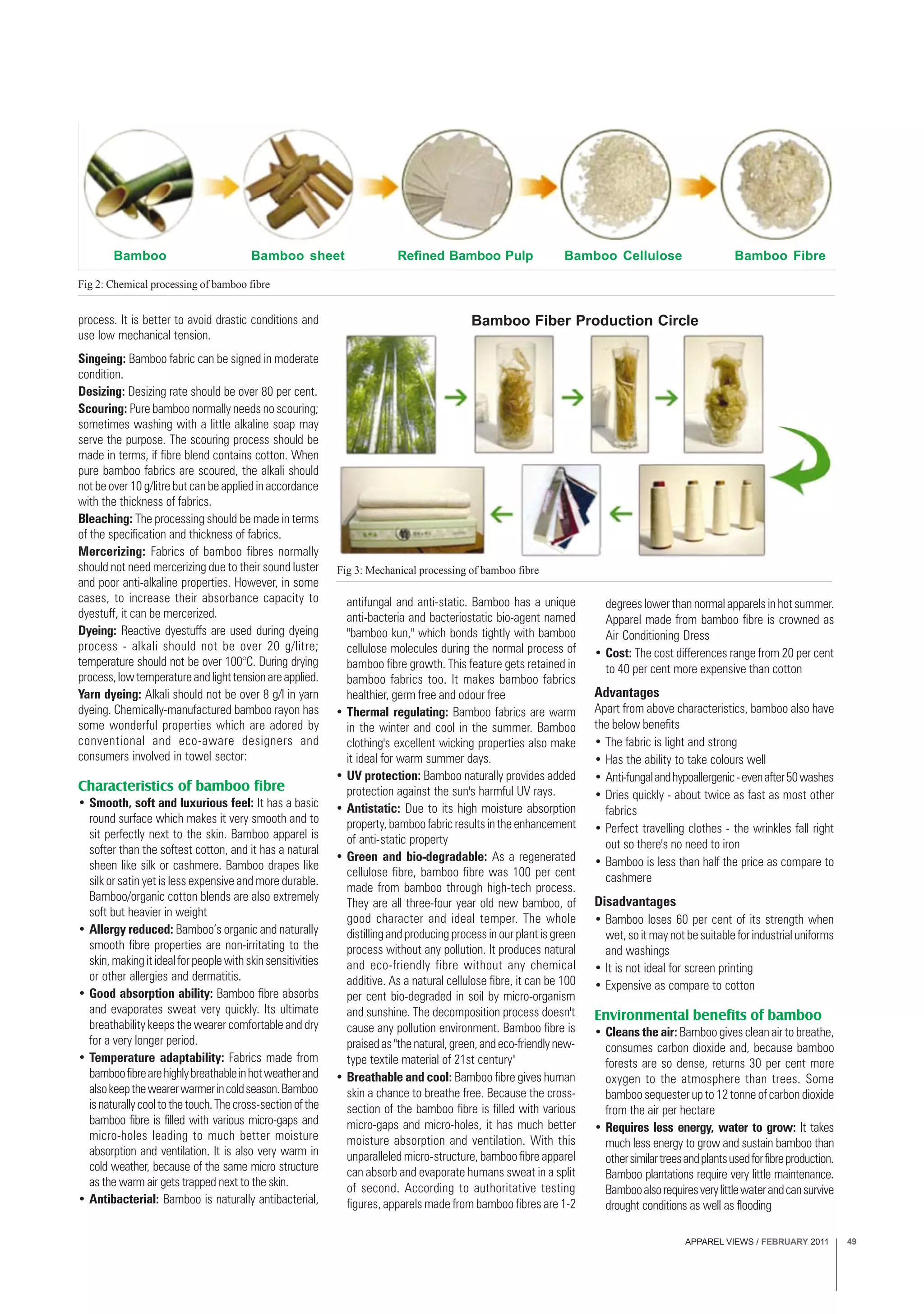
Chemical processing: As shown in fig 2; it’s
basically hydrolysis alkalization. The crushed
bamboo is "cooked" with the help of Sodium
hydroxide (NaOH) which is also known as caustic
soda or lye into a form of regenerated cellulose fibre.
Hydrolysis alkalization is then done through carbon
disulfide combined with multi phase bleaching.
Although chemical processing is not environmental
friendly but it is preferred by many manufacturers as
it is a less time consuming process.
Mechanical processing: In this method, the
crushed bamboo is treated with biological enzymes
as shown in fig 3. This breaks the bamboo into a
mushy mass and individual fibres are then combed
out. Although expensive, this process is eco-friendly.
Dyeing and finishing of bamboo
textile
Light sergeing, enzyme de -sizing, moderate bleaching
andsemi-mercerizingshouldbeappliedtothebamboo
fabric during its dyeing and finishing process. Avoid
drastic conditions and use small mechanical tension.
Dyeing and finishing
Light singeing, enzyme desizing, moderate bleaching
andsemi-mercerizingshouldbeappliedtothebamboo
textile substrate prior to its dyeing and finishing
Definition
Bamboo fibre is a regenerated cellulose fibre, which
is produced from bamboo pulp, processed from
bamboo culms. The bamboo fibre is then made by
Fig 1: Protecting clothing made from bamboo
Bamboo
ApplicationApplicationApplicationApplicationApplication
of contemporaryof contemporaryof contemporaryof contemporaryof contemporary
fibres in apparelsfibres in apparelsfibres in apparelsfibres in apparelsfibres in apparels
APPAREL VIEWS / FEBRUARY 2011 49
Fig 3: Mechanical processing of bamboo fibre
process. It is better to avoid drastic conditions and
use low mechanical tension.
Singeing: Bamboo fabric can be signed in moderate
condition.
Desizing: Desizing rate should be over 80 per cent.
Scouring: Pure bamboo normally needs no scouring;
sometimes washing with a little alkaline soap may
serve the purpose. The scouring process should be
made in terms, if fibre blend contains cotton. When
pure bamboo fabrics are scoured, the alkali should
not be over 10 g/litre but can be applied in accordance
with the thickness of fabrics.
Bleaching: The processing should be made in terms
of the specification and thickness of fabrics.
Mercerizing: Fabrics of bamboo fibres normally
should not need mercerizing due to their sound luster
and poor anti-alkaline properties. However, in some
cases, to increase their absorbance capacity to
dyestuff, it can be mercerized.
Dyeing: Reactive dyestuffs are used during dyeing
process - alkali should not be over 20 g/litre;
temperature should not be over 100°C. During drying
process,lowtemperatureandlighttensionareapplied.
Yarn dyeing: Alkali should not be over 8 g/l in yarn
dyeing. Chemically-manufactured bamboo rayon has
some wonderful properties which are adored by
conventional and eco-aware designers and
consumers involved in towel sector:
Characteristics of bamboo fibre
• Smooth, soft and luxurious feel: It has a basic
round surface which makes it very smooth and to
sit perfectly next to the skin. Bamboo apparel is
softer than the softest cotton, and it has a natural
sheen like silk or cashmere. Bamboo drapes like
silk or satin yet is less expensive and more durable.
Bamboo/organic cotton blends are also extremely
soft but heavier in weight
• Allergy reduced: Bamboo’s organic and naturally
smooth fibre properties are non-irritating to the
skin,makingitidealforpeoplewithskinsensitivities
or other allergies and dermatitis.
• Good absorption ability: Bamboo fibre absorbs
and evaporates sweat very quickly. Its ultimate
breathability keeps the wearer comfortable and dry
for a very longer period.
• Temperature adaptability: Fabrics made from
bamboofibrearehighlybreathableinhotweatherand
alsokeepthewearerwarmerincoldseason.Bamboo
isnaturallycooltothetouch.Thecross-sectionofthe
bamboo fibre is filled with various micro-gaps and
micro-holes leading to much better moisture
absorption and ventilation. It is also very warm in
cold weather, because of the same micro structure
as the warm air gets trapped next to the skin.
• Antibacterial: Bamboo is naturally antibacterial,
Fig 2: Chemical processing of bamboo fibre
antifungal and anti-static. Bamboo has a unique
anti-bacteria and bacteriostatic bio-agent named
"bamboo kun," which bonds tightly with bamboo
cellulose molecules during the normal process of
bamboo fibre growth. This feature gets retained in
bamboo fabrics too. It makes bamboo fabrics
healthier, germ free and odour free
• Thermal regulating: Bamboo fabrics are warm
in the winter and cool in the summer. Bamboo
clothing's excellent wicking properties also make
it ideal for warm summer days.
• UV protection: Bamboo naturally provides added
protection against the sun's harmful UV rays.
• Antistatic: Due to its high moisture absorption
property,bamboofabricresultsintheenhancement
of anti-static property
• Green and bio-degradable: As a regenerated
cellulose fibre, bamboo fibre was 100 per cent
made from bamboo through high-tech process.
They are all three-four year old new bamboo, of
good character and ideal temper. The whole
distilling and producing process in our plant is green
process without any pollution. It produces natural
and eco-friendly fibre without any chemical
additive. As a natural cellulose fibre, it can be 100
per cent bio-degraded in soil by micro-organism
and sunshine. The decomposition process doesn't
cause any pollution environment. Bamboo fibre is
praisedas"thenatural,green,andeco-friendlynew-
type textile material of 21st century"
• Breathable and cool: Bamboo fibre gives human
skin a chance to breathe free. Because the cross-
section of the bamboo fibre is filled with various
micro-gaps and micro-holes, it has much better
moisture absorption and ventilation. With this
unparalleled micro-structure, bamboo fibre apparel
can absorb and evaporate humans sweat in a split
of second. According to authoritative testing
figures, apparels made from bamboo fibres are 1-2
degrees lower than normal apparels in hot summer.
Apparel made from bamboo fibre is crowned as
Air Conditioning Dress
• Cost: The cost differences range from 20 per cent
to 40 per cent more expensive than cotton
Advantages
Apart from above characteristics, bamboo also have
the below benefits
• The fabric is light and strong
• Has the ability to take colours well
• Anti-fungalandhypoallergenic-evenafter50washes
• Dries quickly - about twice as fast as most other
fabrics
• Perfect travelling clothes - the wrinkles fall right
out so there's no need to iron
• Bamboo is less than half the price as compare to
cashmere
Disadvantages
• Bamboo loses 60 per cent of its strength when
wet,soitmaynotbesuitableforindustrialuniforms
and washings
• It is not ideal for screen printing
• Expensive as compare to cotton
Environmental benefits of bamboo
• Cleans the air: Bamboo gives clean air to breathe,
consumes carbon dioxide and, because bamboo
forests are so dense, returns 30 per cent more
oxygen to the atmosphere than trees. Some
bamboo sequester up to 12 tonne of carbon dioxide
from the air per hectare
• Requires less energy, water to grow: It takes
much less energy to grow and sustain bamboo than
othersimilartreesandplantsusedforfibreproduction.
Bamboo plantations require very little maintenance.
Bambooalsorequiresverylittlewaterandcansurvive
drought conditions as well as flooding
Bamboo Fiber Production Circle
Bamboo Bamboo sheet Refined Bamboo Pulp Bamboo Cellulose Bamboo Fibre
APPAREL VIEWS / FEBRUARY 201150
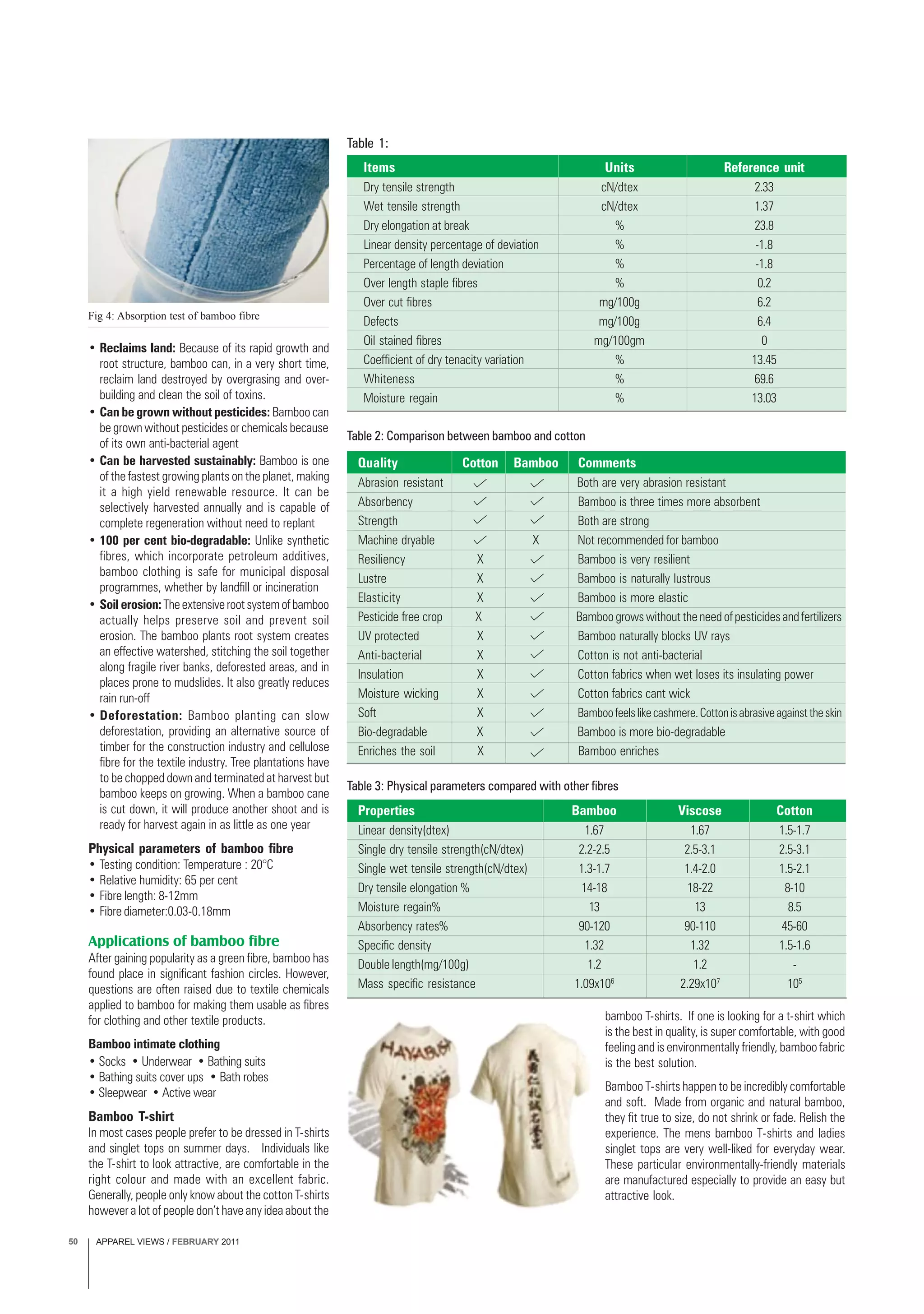
Fig 4: Absorption test of bamboo fibre
• Reclaims land: Because of its rapid growth and
root structure, bamboo can, in a very short time,
reclaim land destroyed by overgrasing and over-
building and clean the soil of toxins.
• Can be grown without pesticides: Bamboo can
be grown without pesticides or chemicals because
of its own anti-bacterial agent
• Can be harvested sustainably: Bamboo is one
of the fastest growing plants on the planet, making
it a high yield renewable resource. It can be
selectively harvested annually and is capable of
complete regeneration without need to replant
• 100 per cent bio-degradable: Unlike synthetic
fibres, which incorporate petroleum additives,
bamboo clothing is safe for municipal disposal
programmes, whether by landfill or incineration
• Soil erosion:Theextensiverootsystemofbamboo
actually helps preserve soil and prevent soil
erosion. The bamboo plants root system creates
an effective watershed, stitching the soil together
along fragile river banks, deforested areas, and in
places prone to mudslides. It also greatly reduces
rain run-off
• Deforestation: Bamboo planting can slow
deforestation, providing an alternative source of
timber for the construction industry and cellulose
fibre for the textile industry. Tree plantations have
to be chopped down and terminated at harvest but
bamboo keeps on growing. When a bamboo cane
is cut down, it will produce another shoot and is
ready for harvest again in as little as one year
Physical parameters of bamboo fibre
• Testing condition: Temperature : 20°C
• Relative humidity: 65 per cent
• Fibre length: 8-12mm
• Fibre diameter:0.03-0.18mm
Applications of bamboo fibre
After gaining popularity as a green fibre, bamboo has
found place in significant fashion circles. However,
questions are often raised due to textile chemicals
applied to bamboo for making them usable as fibres
for clothing and other textile products.
Bamboo intimate clothing
• Socks • Underwear • Bathing suits
• Bathing suits cover ups • Bath robes
• Sleepwear • Active wear
Bamboo T-shirt
In most cases people prefer to be dressed in T-shirts
and singlet tops on summer days. Individuals like
the T-shirt to look attractive, are comfortable in the
right colour and made with an excellent fabric.
Generally, people only know about the cotton T-shirts
however a lot of people don’t have any idea about the
Table 1:
Table 2: Comparison between bamboo and cotton
bamboo T-shirts. If one is looking for a t-shirt which
is the best in quality, is super comfortable, with good
feeling and is environmentally friendly, bamboo fabric
is the best solution.
Bamboo T-shirts happen to be incredibly comfortable
and soft. Made from organic and natural bamboo,
they fit true to size, do not shrink or fade. Relish the
experience. The mens bamboo T-shirts and ladies
singlet tops are very well-liked for everyday wear.
These particular environmentally-friendly materials
are manufactured especially to provide an easy but
attractive look.
Items Units Reference unit
Dry tensile strength cN/dtex 2.33
Wet tensile strength cN/dtex 1.37
Dry elongation at break % 23.8
Linear density percentage of deviation % -1.8
Percentage of length deviation % -1.8
Over length staple fibres % 0.2
Over cut fibres mg/100g 6.2
Defects mg/100g 6.4
Oil stained fibres mg/100gm 0
Coefficient of dry tenacity variation % 13.45
Whiteness % 69.6
Moisture regain % 13.03
Quality Cotton Bamboo Comments
Abrasion resistant Both are very abrasion resistant
Absorbency Bamboo is three times more absorbent
Strength Both are strong
Machine dryable X Not recommended for bamboo
Resiliency X Bamboo is very resilient
Lustre X Bamboo is naturally lustrous
Elasticity X Bamboo is more elastic
Pesticide free crop X Bamboogrowswithouttheneedofpesticidesandfertilizers
UV protected X Bamboo naturally blocks UV rays
Anti-bacterial X Cotton is not anti-bacterial
Insulation X Cotton fabrics when wet loses its insulating power
Moisture wicking X Cotton fabrics cant wick
Soft X Bamboofeelslikecashmere.Cottonisabrasiveagainsttheskin
Bio-degradable X Bamboo is more bio-degradable
Enriches the soil X Bamboo enriches
Properties Bamboo Viscose Cotton
Linear density(dtex) 1.67 1.67 1.5-1.7
Single dry tensile strength(cN/dtex) 2.2-2.5 2.5-3.1 2.5-3.1
Single wet tensile strength(cN/dtex) 1.3-1.7 1.4-2.0 1.5-2.1
Dry tensile elongation % 14-18 18-22 8-10
Moisture regain% 13 13 8.5
Absorbency rates% 90-120 90-110 45-60
Specific density 1.32 1.32 1.5-1.6
Double length(mg/100g) 1.2 1.2 -
Mass specific resistance 1.09x10⁶
2.29x10⁷
105
Table 3: Physical parameters compared with other fibres
APPAREL VIEWS / FEBRUARY 2011 51
Bamboo for kids wear
Bamboo wear is also excellent for children. Children's
and babies bamboo wear is luxuriously soft, but
practical, bamboo fibres render this breathable and
are naturally antibacterial. Even children will notice
thedifferencewhentheyfirstwearit. Allofthebamboo
fabric chosen without the harmful chemicals is used
in the manufacture of this fabric, making it an ideal
selection for kid’s sensitive skin. Bamboo is incredibly
silky and comfortable much more than the softest
cotton. Bamboo wear is actually pre-washed so no
worry about shrinking.
Home furnishings fabrics
• Sheets • Comforters • Duvet covers
• Pillow shams • Pillows • Bed skirts
• Table cloth • Drapes • Blinds • Sofa slipcovers
• Zhejiang Kingtex Co. Ltd. - China
• Zhejiang Texwell Textile Co. Ltd. - China
• Jeen Wei Enterprise Co. Ltd. - China
• Abalioglu Textile Industries Inc. - Turkey
• Eren Tekstil Sanayi ve Ticaret A.S - Turkey
• Bilkont Dis Ticaret Tekstil Sanayi A.S - Turkey
• Table Bay Spinners - South Africa
• Richfield Tang Knits Ltd. - Mauritius
• Tenbro - China
Fashion trends
Due to the global focus that environmental issues
has received, Bamboo-fibre products have caught the
fancy of consumers, who are considering its many
eco-friendly advantages. It is no wonder experts have
predicted that bamboo-fibre products will set new
fashiontrendsforautumn-winterclothinglikescarves,
ties and outdoors sportswear. There are many local
clothing, textiles and fabric enterprises that produce
bamboo-fibre products. The companies are reaping
rich harvests from the sale of bamboo-fibre products.
One such success story is that of Jigao Chemical
Fibre Co. Ltd., whose products made of bamboo-fibre
have become popular both in the domestic as well as
the overseas markets. Currently, Hebei Jigao's
products occupy over 90 per cent of China's bamboo-
fibre market. Such is its rage that despite high prices,
bamboo-fibre products sell very well in the market. A
piece of leisure suit and jacket made from bamboo-
fibrecosts40,000&45,000yuanrespectivelyinJapan.
Conclusion
Bamboo fabric is a natural textile that has been
growinginpopularityinrecentyears,bothforitsquality
and its environmental friendliness. Bamboo and
people's lives, involve the use of bamboo clothing,
food, shelter, transportation, use of all. In the apparel
side, bamboo clothing plays an important role in the
origin and development. Bamboo fabric is used for a
range of clothing, such as shirts, dresses, socks and
slacks and because of its antimicrobial properties, is
ideal for active wear. Other applications include
bathrobes and towels, foot mats, mats, bed clothes,
underwear, close-fitting T-shirts, and stockings.
Bamboo fabric products include sweaters, bath-suits,
mats, blankets, towels, nappies (diapers), underwear
and other lingerie, all types of clothing, and linen.
Bamboo is often blended with 30 per cent cotton
to add structure to garments. Bamboo is also used
for sheets and pillowcases, because its smooth
fibre lends a satin feel; bamboo sheets also feel
warmer in winter and cooler in summer. The fastest
growing grass species in the world, in fact, making
them one of the most easily renewable natural
resources we have. Aside from being more
sustainable, bamboo fabric is also light and strong,
with excellent wicking properties
Bathroom Textiles
• Hand towels • Wash cloths • Body towels
• Tub mats • Bath rugs • Decorative lid covers
• Shower curtains
Non woven fabrics
• Sanitary napkins • Face masks (industrial and
medical) • Food grade packaging • Mattresses
Medical and hygienic clothing & products
• Sanitary towels • Gauze • Bandages
• Absorbent pads • Surgical wear
• Doctors coat • Medical masks
Nanotechnology in bamboo clothing
industry
New nano-technologies are also being introduced into
the bamboo clothing industry. It is based on a bamboo
clothing line made from nano-particles of bamboo
charcoal. In this process, bamboo is dried and burned
in 800°C ovens until it is reduced to charcoal. The
bamboo is processed and converted into fine nano
particles which are then embedded into cotton,
polyester or nylon fibres. This conventional fibre yarn
that contains trapped bamboo charcoal nano particles
is then woven into fabrics mostly socks and blankets
now. It is reported that the active bamboo charcoal
ingredients will only remain active in the clothing for
about six months of active use.
Caring for bamboo clothes
Like average garment, bamboo fabric can be washed
with everything. For the best maintenance of bamboo
clothing, it should be washed using the gentle cycle,
cold (up to 60°C) or luke warm water, where line dried
is preferred. Because bamboo fabric loses some of
its strength when it is very wet, putting bamboo
clothing into a lingerie bag will protect it during the
wash cycle. Colour bamboo clothes can also be
washed with whites or lighter shade even in the first
wash. Due to the absorbency of bamboo the dye is
absorbed into the yarn and does not bleed.
It is best to refrain from machine drying even on low
heat as it may cause the garment to lose its shape
sooner than if line dried is done only. Air-dry a bamboo
fabric item for best results. Drying it flat on a drying
rack is the preferred method. If it is hang on a
clothesline, it is recommended to double the garment
to avoid stretching or distortion.
Garments may be ironed with low heat and keep your
iron setting no higher than 'synthetic'. Bamboo cannot
handle the same degree of heat as a cotton garment.
Do not use any steam on bamboo fabric; this can
cause noticeable rings to appear on the fabric. If this
happens, wash the clothes again. Never bleach
bamboo fabric, Chlorine bleaches often cause
yellowing.
Bamboo fabric manufacturers
• Zhejiang Texwell Textile Co.,Ltd - Mainland China
• Lee Yaw Textile Co. Ltd. - Mainland China
Washing and maintenance of bamboo fibre products
By Vasant R Kothari, Assistant Professor,
NIFT, Bangalore & Pallavi Jain, MFTech
(Student), NIFT Bangalore (Author can be
contacted @ www.vasantkothari.com)
APPAREL VIEWS / MARCH 201146
Basically, there are two broad categories of fibres: Natural fibres like cotton, wool, hemp, ramie and silk; and
artificial fibres synthesized out of petrochemicals like nylon and polyester. Lyocell falls somewhere in-
between. The raw material for lyocell is cellulose from wood pulp, a mix of hardwood trees like oak and birch,
although Lyocell branded lyocell is made from eucalyptus trees, which are broken down chemically in a soupy
sludge that is squirted out a showerhead spinneret and reformed as fibres. Lyocell is more accurately described
as a recovered or regenerated fibre, although manufacturers’ makes a distinction between regenerated fibres
and lyocell which they describe as a "solvent spun fibre" that keeps the cellulose structure closer to that found
in nature. This makes it a natural fabric, and it is noted for its durability and strength, in addition to its eco-
friendly manufacturing techniques.
History
The first fabrics made with wood pulp were made as far back as the mid 19th century. They were not universally
accepted or very profitable. At the end of the 19th century, a method for creating rayon out of wood cellulose
became popular, and rayon became one of the first manmade fibres, as a silk substitute, and an inspiration to
later produce lyocell. Success of rayon particularly in the latter 20th century fuelled interest in making other
products from wood pulp.
Application of contemporary
fibres in apparels
Lyocellisafabricmostknow
better by its brand name
Lyocell owned by Lenzing
Fibres of Austria. Lyocell
heralds the beginning of a
new age in fibre technology.
Completely natural, Lyocell
offers a unique combination
of the most desirable
properties of manmade and
natural fibres: Soft as silk,
strong as polyester, cool as
linen, warm as wool and as
absorbent as cotton.
Lyocell
APPAREL VIEWS / MARCH 201146
APPAREL VIEWS / MARCH 2011 47
The solvent-spun cellulosic fibre lyocell was first produced commercially in the
United States in 1992 by Courtaulds Fibres (now Acordis Cellulosic Fibres), an
international supplier of rayon. The company used the brand name Lyocell. Lenzing
AG had acquired patents and research on lyocell from American Enka when it
bought that company's rayon operation in 1992. In 1996, lyocell became the first
new generic fier group in 30 years to be approved by the Federal Trade Commission
as the properties and production processes were unique to designate it as a
separate fibre group. Since then, lyocell has realised increasing visibility and
acceptanceintheapparelmarket,especiallyindesignerandbetterpricedgarments.
Its versatility and desirable properties provide many advantages, both functional
and aesthetic.
Federal Trade Commission Definition for Lyocell Fibre: A cellulose fibre obtained by
an organic solvent spinning process where:
1) “Organic solvent” means a mixture of organic chemicals and water, and
2)“Solvent spinning” means dissolving and spinning without the formation of a
derivative
Although it is given a separate generic name, the FTC classifies Lyocell as a sub-
category under “Rayon.”
Fibre properties
A manufactured fibre composed of regenerated cellulose. Lyocell has excellent
properties of cellulose fibres. Lyocell fabric feels very cool, moisture permeability;
texture can be changed to cotton wool, silk and all kinds of feelings. It is having
similar hand and drape as rayon, but is stronger, more durable, and in many cases
machine washable. It has a subtle luster and is rich in colour. Lyocell possesses
low shrinkage characteristics, as well as good absorbency and wrinkle resistant
qualities.
Lyocell fibre characteristics
• Texture
• Soft, simulates silk, suede, or leather touch
• Great for sensitive skin
• Loycell smooth fibre surface feels soft and supple against the skin and its
incredible wicking abilities keep the skin dry
• Strength
• High tensile strength
• Excellent wet strength (2X rayon dry/3X rayon wet)
• Lyocell fibres dry strength close to the polyester fibre, wet strength decreased
only 15 per cent
• Moisture absorbent
• Highly absorbent
• It has natural breathability and 50 per cent greater moisture absorption than
cotton
• Swells radially when wet
• Due to its moisture management, it is also anti-bacterial
• Dyeing
• Lyocell was created with colour in mind, because of the fibres' high absorbency
• The fabrics can be dyed to high quality standards
• Very versatile fabric dyeable to vibrant colours, with a variety of effects and
textures
• Easily dyeable to strong colour-fast shades
• Drape
• Good drapability
• Temperature
• Does not melt
• Outperforms cotton and rayon at high temperatures
• Fibrillation
• This eco-fabric has controllable fibrillation (the very fine hairs found on the
outer fibres), which can be manipulated into everything from suede-like softness
to a silky smooth finish
• Dimensional stability
• Low shrinkage
• Good wash ability
• Can be hand washable
• Bio-degradable
• The fibre is economical in its use of energy and natural resources, and is fully
bio-degradable
• Durability
• Wrinkle resistant
Since Loycell is a manufactured fibre, the diametre and length of fibres can be
varied. Lyocell can be made into micro fibres (very fine fibres), offering depth and
body to fabrics combined with luxurious drape. Short staple length fibres give a
cotton-like look to fabrics. Long filament fibres are successful in silk-like end uses.
Lyocell blends well with other fibres including wool, silk, rayon, cotton, linen,
nylon, and polyester. It successfully takes many finishes, both functional and
those designed to achieve different surface effects and dyes easily. Overall, lyocell
is a versatile fibre with many desirable properties.
Important features of Lyocell fibres
Moisture
Unlike synthetic fibres Lyocell offers unique moisture transport, as a result of nano
technology. The nano technology of the fibre supports this natural fibre property,
guaranteeing optimum conditions for the skin. Synthetic fibres are unable to absorb
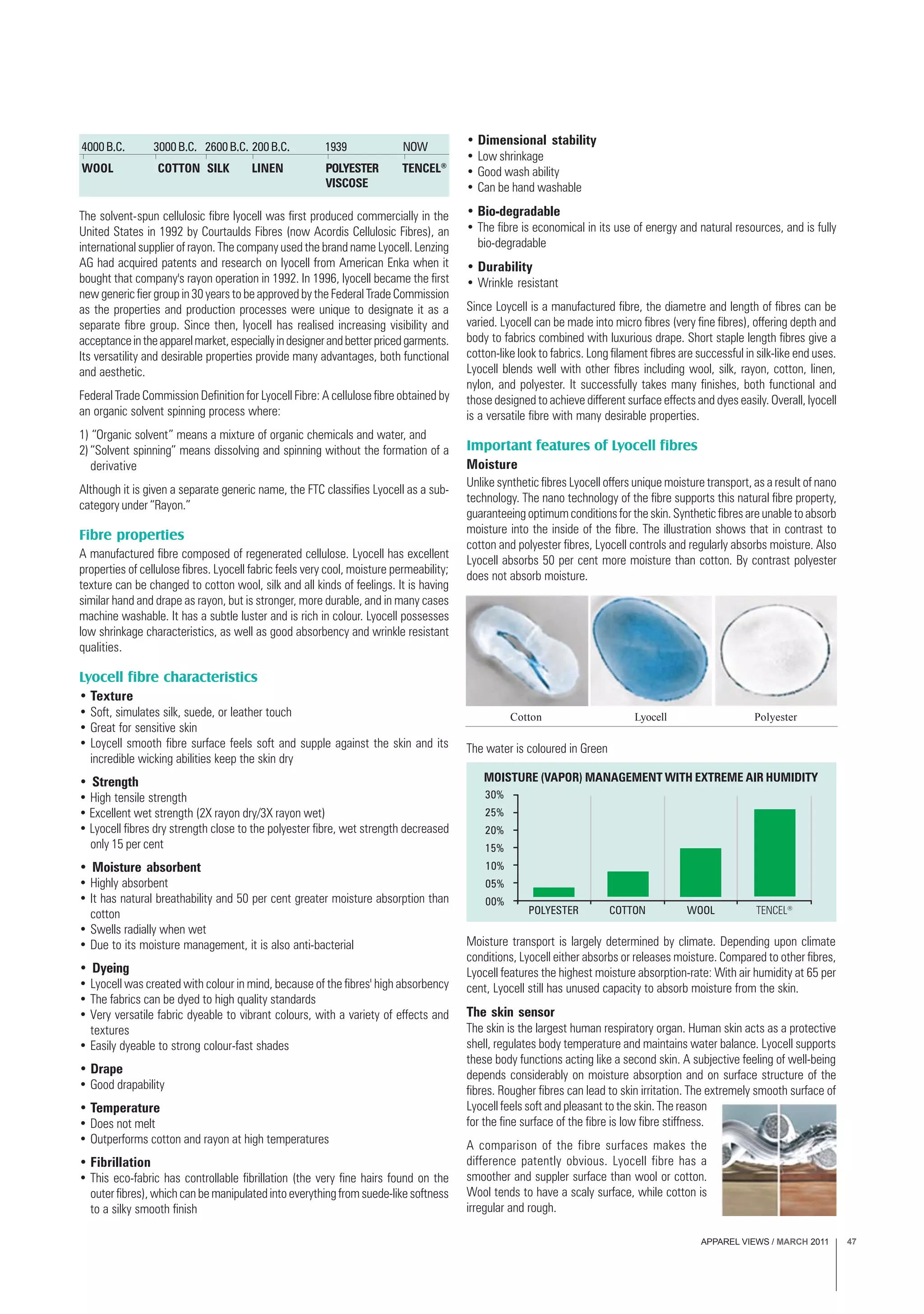
moisture into the inside of the fibre. The illustration shows that in contrast to
cotton and polyester fibres, Lyocell controls and regularly absorbs moisture. Also
Lyocell absorbs 50 per cent more moisture than cotton. By contrast polyester
does not absorb moisture.
4000B.C. 3000B.C. 2600B.C. 200B.C. 1939 NOW
WOOL SILKCOTTON LINEN POLYESTER
VISCOSE
TENCEL®
Moisture transport is largely determined by climate. Depending upon climate
conditions, Lyocell either absorbs or releases moisture. Compared to other fibres,
Lyocell features the highest moisture absorption-rate: With air humidity at 65 per
cent, Lyocell still has unused capacity to absorb moisture from the skin.
The skin sensor
The skin is the largest human respiratory organ. Human skin acts as a protective
shell, regulates body temperature and maintains water balance. Lyocell supports
these body functions acting like a second skin. A subjective feeling of well-being
depends considerably on moisture absorption and on surface structure of the
fibres. Rougher fibres can lead to skin irritation. The extremely smooth surface of
Lyocell feels soft and pleasant to the skin. The reason
for the fine surface of the fibre is low fibre stiffness.
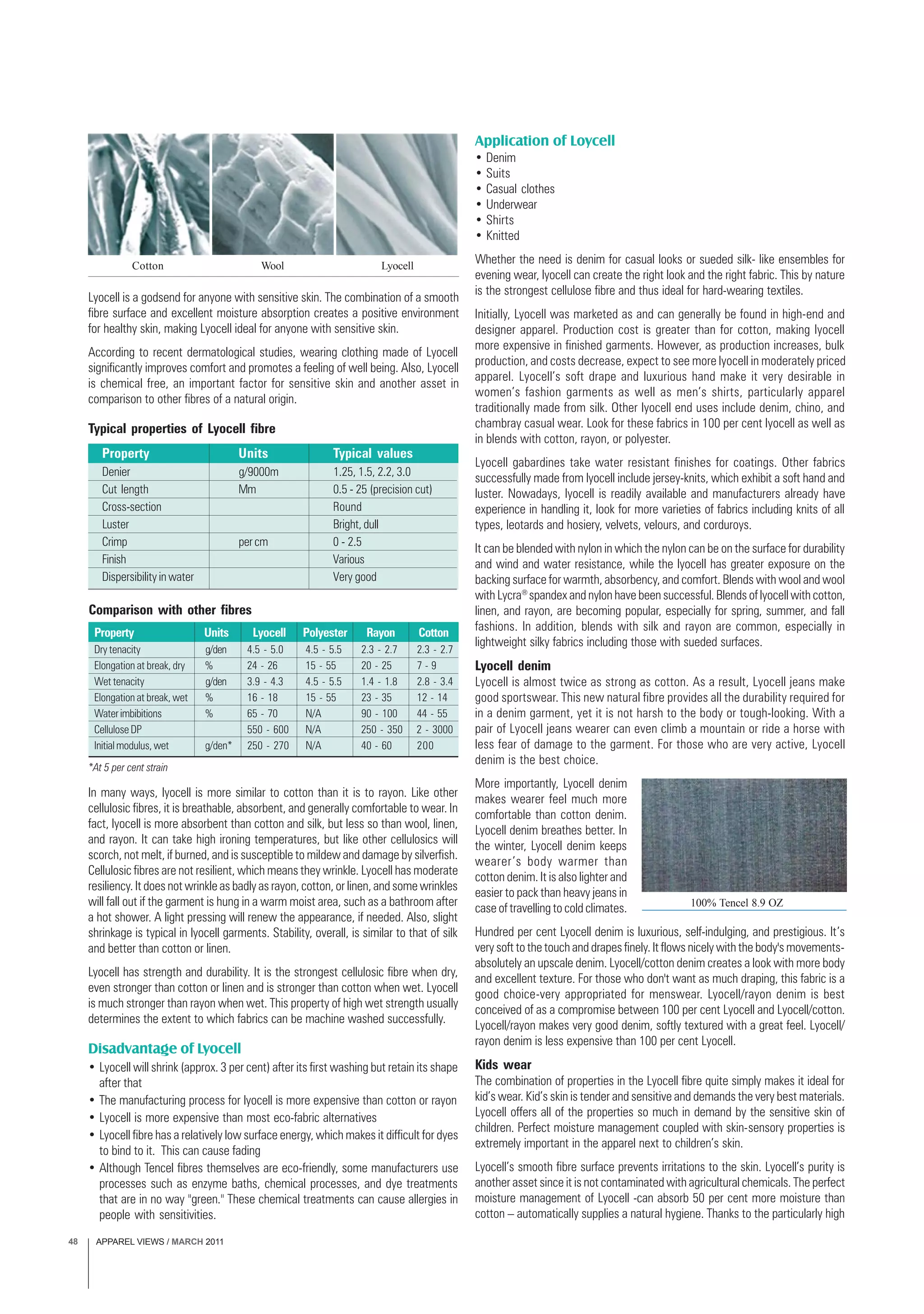
A comparison of the fibre surfaces makes the
difference patently obvious. Lyocell fibre has a
smoother and suppler surface than wool or cotton.
Wool tends to have a scaly surface, while cotton is
irregular and rough.
PolyesterCotton Lyocell
MOISTURE (VAPOR) MANAGEMENT WITH EXTREME AIR HUMIDITY
30%
25%
20%
15%
10%
05%
00%
POLYESTER COTTON WOOL TENCEL®
The water is coloured in Green
APPAREL VIEWS / MARCH 201148
Lyocell is a godsend for anyone with sensitive skin. The combination of a smooth
fibre surface and excellent moisture absorption creates a positive environment
for healthy skin, making Lyocell ideal for anyone with sensitive skin.
According to recent dermatological studies, wearing clothing made of Lyocell
significantly improves comfort and promotes a feeling of well being. Also, Lyocell
is chemical free, an important factor for sensitive skin and another asset in
comparison to other fibres of a natural origin.
In many ways, lyocell is more similar to cotton than it is to rayon. Like other
cellulosic fibres, it is breathable, absorbent, and generally comfortable to wear. In
fact, lyocell is more absorbent than cotton and silk, but less so than wool, linen,
and rayon. It can take high ironing temperatures, but like other cellulosics will
scorch, not melt, if burned, and is susceptible to mildew and damage by silverfish.
Cellulosic fibres are not resilient, which means they wrinkle. Lyocell has moderate
resiliency. It does not wrinkle as badly as rayon, cotton, or linen, and some wrinkles
will fall out if the garment is hung in a warm moist area, such as a bathroom after
a hot shower. A light pressing will renew the appearance, if needed. Also, slight
shrinkage is typical in lyocell garments. Stability, overall, is similar to that of silk
and better than cotton or linen.
Lyocell has strength and durability. It is the strongest cellulosic fibre when dry,
even stronger than cotton or linen and is stronger than cotton when wet. Lyocell
is much stronger than rayon when wet. This property of high wet strength usually
determines the extent to which fabrics can be machine washed successfully.
Disadvantage of Lyocell
• Lyocell will shrink (approx. 3 per cent) after its first washing but retain its shape
after that
• The manufacturing process for lyocell is more expensive than cotton or rayon
• Lyocell is more expensive than most eco-fabric alternatives
• Lyocell fibre has a relatively low surface energy, which makes it difficult for dyes
to bind to it. This can cause fading
• Although Tencel fibres themselves are eco-friendly, some manufacturers use
processes such as enzyme baths, chemical processes, and dye treatments
that are in no way "green." These chemical treatments can cause allergies in
people with sensitivities.
Application of Loycell
• Denim
• Suits
• Casual clothes
• Underwear
• Shirts
• Knitted
Whether the need is denim for casual looks or sueded silk- like ensembles for
evening wear, lyocell can create the right look and the right fabric. This by nature
is the strongest cellulose fibre and thus ideal for hard-wearing textiles.
Initially, Lyocell was marketed as and can generally be found in high-end and
designer apparel. Production cost is greater than for cotton, making lyocell
more expensive in finished garments. However, as production increases, bulk
production, and costs decrease, expect to see more lyocell in moderately priced
apparel. Lyocell’s soft drape and luxurious hand make it very desirable in
women’s fashion garments as well as men’s shirts, particularly apparel
traditionally made from silk. Other lyocell end uses include denim, chino, and
chambray casual wear. Look for these fabrics in 100 per cent lyocell as well as
in blends with cotton, rayon, or polyester.
Lyocell gabardines take water resistant finishes for coatings. Other fabrics
successfully made from lyocell include jersey-knits, which exhibit a soft hand and
luster. Nowadays, lyocell is readily available and manufacturers already have
experience in handling it, look for more varieties of fabrics including knits of all
types, leotards and hosiery, velvets, velours, and corduroys.
It can be blended with nylon in which the nylon can be on the surface for durability
and wind and water resistance, while the lyocell has greater exposure on the
backing surface for warmth, absorbency, and comfort. Blends with wool and wool
with Lycra®
spandex and nylon have been successful. Blends of lyocell with cotton,
linen, and rayon, are becoming popular, especially for spring, summer, and fall
fashions. In addition, blends with silk and rayon are common, especially in
lightweight silky fabrics including those with sueded surfaces.
Lyocell denim
Lyocell is almost twice as strong as cotton. As a result, Lyocell jeans make
good sportswear. This new natural fibre provides all the durability required for
in a denim garment, yet it is not harsh to the body or tough-looking. With a
pair of Lyocell jeans wearer can even climb a mountain or ride a horse with
less fear of damage to the garment. For those who are very active, Lyocell
denim is the best choice.
More importantly, Lyocell denim
makes wearer feel much more
comfortable than cotton denim.
Lyocell denim breathes better. In
the winter, Lyocell denim keeps
wearer’s body warmer than
cotton denim. It is also lighter and
easier to pack than heavy jeans in
case of travelling to cold climates.
Hundred per cent Lyocell denim is luxurious, self-indulging, and prestigious. It’s
very soft to the touch and drapes finely. It flows nicely with the body's movements-
absolutely an upscale denim. Lyocell/cotton denim creates a look with more body
and excellent texture. For those who don't want as much draping, this fabric is a
good choice-very appropriated for menswear. Lyocell/rayon denim is best
conceived of as a compromise between 100 per cent Lyocell and Lyocell/cotton.
Lyocell/rayon makes very good denim, softly textured with a great feel. Lyocell/
rayon denim is less expensive than 100 per cent Lyocell.
Kids wear
The combination of properties in the Lyocell fibre quite simply makes it ideal for
kid’s wear. Kid’s skin is tender and sensitive and demands the very best materials.
Lyocell offers all of the properties so much in demand by the sensitive skin of
children. Perfect moisture management coupled with skin-sensory properties is
extremely important in the apparel next to children’s skin.
Lyocell’s smooth fibre surface prevents irritations to the skin. Lyocell’s purity is
another asset since it is not contaminated with agricultural chemicals. The perfect
moisture management of Lyocell -can absorb 50 per cent more moisture than
cotton – automatically supplies a natural hygiene. Thanks to the particularly high
LyocellCotton Wool
Typical properties of Lyocell fibre
Property Units Typical values
Denier g/9000m 1.25, 1.5, 2.2, 3.0
Cut length Mm 0.5 - 25 (precision cut)
Cross-section Round
Luster Bright, dull
Crimp percm 0 - 2.5
Finish Various
Dispersibility in water Very good
Comparison with other fibres
Property Units Lyocell Polyester Rayon Cotton
Dry tenacity g/den 4.5 - 5.0 4.5 - 5.5 2.3 - 2.7 2.3 - 2.7
Elongation at break, dry % 24 - 26 15 - 55 20 - 25 7 - 9
Wet tenacity g/den 3.9 - 4.3 4.5 - 5.5 1.4 - 1.8 2.8 - 3.4
Elongation at break, wet % 16 - 18 15 - 55 23 - 35 12 - 14
Waterimbibitions % 65 - 70 N/A 90 - 100 44 - 55
Cellulose DP 550 - 600 N/A 250 - 350 2 - 3000
Initial modulus, wet g/den* 250 - 270 N/A 40 - 60 200
*At 5 per cent strain
100% Tencel 8.9 OZ
APPAREL VIEWS / MARCH 2011 49
moisture absorption of Lyocell, the growth of bacteria can be nipped in the bud.
The moisture is transported from the skin directly into the inside of the fibre. Thus
no film of moisture, which can be the basis for bacterial growth, forms on the fibre.
Home textile
To some extent, lyocell is available in home products including bath towels,
sheets, pillowcases, and window treatments. Industrial uses for lyocell include
conveyor belts (because of the fibre's strength), ultra-low tar cigarette filters,
printer’s blankets, abrasive backings, carbon shields, specialty papers, and medical
dressings.
Caring of Lyocell
Washing: Because of its high wet strength and cellulosic or plant base, lyocell
can generally be either hand washed or machine washed and tumbled dried
successfully; however, some lyocell fabrics perform best when dry-cleaned.
Lyocell will shrink about 3 per cent with the first washing, and will resist shrinking
from then on.
Hand washable/line dry lyocell fabrics are frequently knits (often blended with
rayon or cotton) or wovens, such as chambray or sand washed "silk-like" fabrics.
When wet, fabrics made from lyocell become stiff and almost boardy. Although
this improves as drying occurs, undesirable stiffness may be removed by tossing
the garment into the dryer with a towel on low temperature to enhance the fabric's
softness and drape.
Machine wash and tumble dry lyocell fabrics are either treated with a special
finish or modified as they are manufactured. These fabrics can be machine washed
and tumble dried much like cotton or cotton/polyester blends are handled in the
homelaundry.Mediumtemperaturesettingsforwateranddryingarerecommended
as well as permanent press settings. If line dried, be sure to toss in the dryer with
a damp towel to soften the fabric after it is dry or nearly dry.
Dry cleaning: Lyocell fabrics that require dry cleaning may have either a smooth
or sanded surface. If machine washed or hand washed, it could develop a "hairy"
surface. In addition, water spotting may be noticeable in some fabrics that are
"spot" cleaned to remove stains. Wrinkling may occur after wetting the fabric.
Fabrics made from lyocell that is not specially treated to prevent fibrillation are
usually labelled as "dry clean only.” Reduced moisture and agitation during dry-
cleaning prevent fibrillation.
Ironing: Lyocell is a cellulosic fibre and, as a result, will wrinkle. It may need a
slight touch up with a warm iron. Because lyocell is similar to cotton, it can take
medium to high temperature settings. The exception is fabric made from fine
yarns or micro-fibres. Heat will penetrate these fabrics more quickly with the
potential for scorching. In many instances, however, wrinkles are likely to hang
out overnight, particularly in a warm, moist environment.
Bleaching: Generally, use of oxygen or chlorine bleaches should not damage the
lyocell fibre itself, but may affect either dyes or resin finishes applied to the
fabrics. Also, because the surface of some fabrics can be damaged when wet if
subjected to abrasion, avoid excessive rubbing during stain removal.
Storing: Moths and mildew can damage garments made by lyocell. It is necessary
that lyocell should be clean and dry when stored in a cool, well-ventilated location.
Don't store lyocell in plastic bags.
Conclusion
Today the world demands for “Organic, eco-friendly and bio-degradable” products.
Lyocell is the environmentally friendly fibre, and, the first truly revolutionary
fibre introduced to the market since Spandex 40 years ago, is made from wood
pulp. Virtually all of the chemicals used in the production process are reclaimed.
The resulting fibre, lyocell, is both bio-degradable and recyclable. It’s an
improved fibre, in terms of performance and properties. Its outstanding, essential
and desirable properties make it suitable for development of a variety of high
value-added woven and knitted products, an extremely broad market prospect
for various end uses. It is easy to conclude that the future scope for Lyocell fibre
is definitely vast
By Vasant R Kothari
Assistant Professor, NIFT, Bangalore
(Author can be contacted @ www.vasantkothari.com)
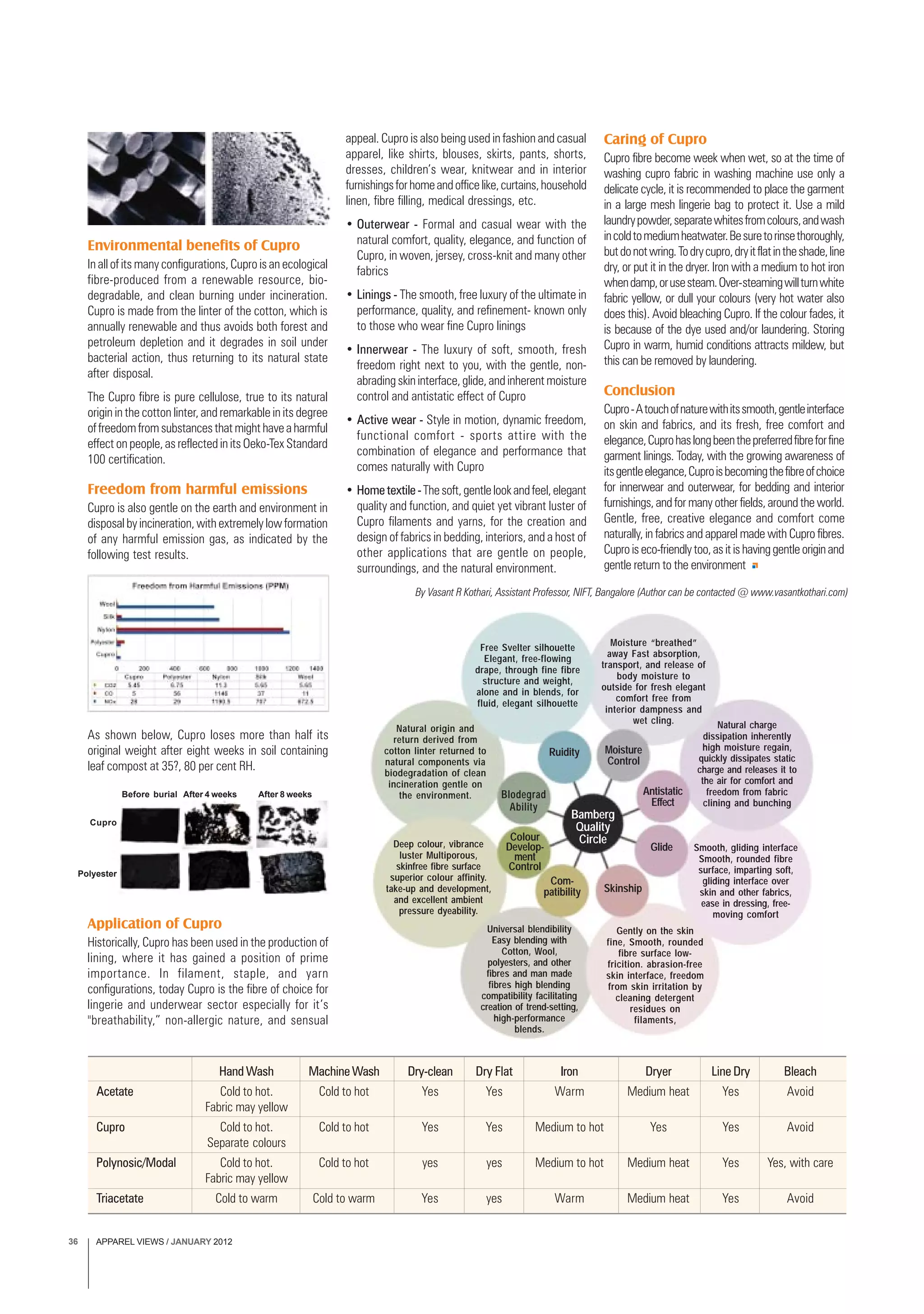
APPAREL VIEWS / MAY 201142
SPF is a kind of regenerative plant fibre. SPF is the
only botanic protein fibre in the world, a newly
born guard to mankind's skin. This fibre appears from
soybean a plant which has enormous source and
affluent in nutrition. As it contains 18 amino acids
beneficial to the human body, and added anti-bacterial
elements, SPF offers a protective function to the skin.
SPF has been praised locally and internationally by
industry expert as the healthy and comfortable fibre
of 21st Century. The main component of soybean fibre
is it possesses the superiorities of many natural fibres
and synthesised ones and it is quite similar to those
of cashmere and silk, featuring fine denier, low density
and good tenacity and elongation. The resulting fabric
can give cashmere-like hand touch, silk-like luster,
cotton-like moisture conduction and wool-like warm
retentiveness. The invention of SPF is the contribution
of mankind to the protection of natural rare minerals,
the protection of resources, the care of the
environment and the consideration of the global
balance. It is an active fibre, a new green textile fibre.
SPF is an advanced textile fibre. It is also known as
"vegetable cashmere" or "soy silk." It is made from
the soybean cake after oiling by new bioengineering
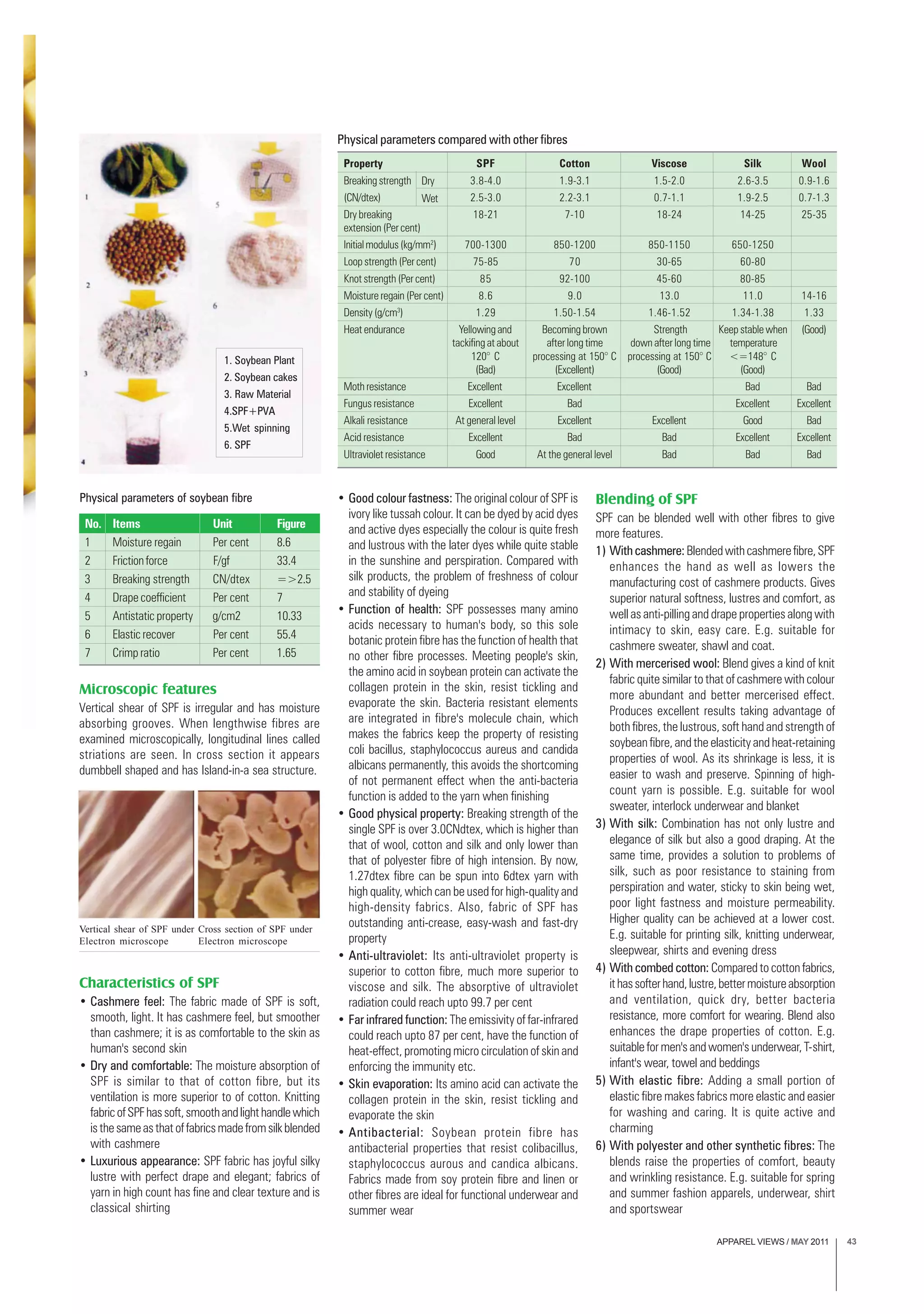
technology. Firstly, the spherical protein is distilled
from the soybean cake and refined. Secondly, under
the functioning of auxiliary agent and biological
enzyme, the space structure of spherical protein
changes, and then protein spinning liquid is confected
by adding high polymers, and then thirdly, after the
liquid is cooked, the 0.9~3.0dtex fibre is produced by
wet spinning, and stabilised by acetalising, and finally
cut into short staples after curling and thermoforming.
SPF is praised as the health, comfortable and green
fibre of the new century. Its major material is soybean
protein from the farmers, massive in quantity and
inexpensive in price, and using it will not cause the
predatory development on the resources but is helpful
to resources' recovery and redevelopment. The
production of SPF will not bring pollution to the
environment, as the accessory and auxiliary agent
used are not poisonous, while the residue after the
protein extracted can be still used as feed. SPF has
not only the superiorities of the natural fibres but also
the physical properties of synthetic ones. SPF meets
the people's demand of comfortable and beautiful
wearing and also conforms to the trend of easy care.
It is the potential material for middle and high class
clothing in textile industry.
History of SPF
In 1932-33 the Ford Motor Company spent millions of
dollars on soybean research. Henry Ford promoted
the soybean, helping to develop uses for it both in
food and in industrial products. By 1935 every Ford
car had soy involved in its manufacture. For example,
soybean oil was used to paint the automobiles as
well as fluid for shock absorbers.
In 1935, Ford hired chemists Robert Boyer and Frank
Calvert to produce artificial silk. They succeeded in
making a textile fibre of spun soy protein fibres,
hardened or tanned in a formaldehyde bath, which
was given the name Azlon by the Federal Trade
Commission.Theproductionstartedin1939andfibres
were used to make upholstery for motorcars. It was
also usable in the making of suits, felt hats, necktie
and overcoats.
ThoughpilotproductionofAzlonreached5,000pounds
per day in 1940, it never reached the commercial
market. Then the production was taken over by the
Drackett Products Co. and a new plant was set up in
1949. After 10 years of hard work of Li Guanqi's as
well as the contribution and assistance of many other
departments and organisation, soybean fibre has
come into birth and its industrialisation started.
China began the commercial production of soybean
fibre in 2001 in line with the call from China National
Textile & Apparel Council (CNTAC). According rough
statistics, over 500 textile mills have been concerned
withthedevelopmentandapplicationofsoybeanfibre.
APPAREL VIEWS / MAY 2011 43
Microscopic features
Vertical shear of SPF is irregular and has moisture
absorbing grooves. When lengthwise fibres are
examined microscopically, longitudinal lines called
striations are seen. In cross section it appears
dumbbell shaped and has Island-in-a sea structure.
Physical parameters of soybean fibre
No. Items Unit Figure
1 Moisture regain Per cent 8.6
2 Frictionforce F/gf 33.4
3 Breaking strength CN/dtex =>2.5
4 Drape coefficient Per cent 7
5 Antistatic property g/cm2 10.33
6 Elastic recover Per cent 55.4
7 Crimp ratio Per cent 1.65
Characteristics of SPF
• Cashmere feel: The fabric made of SPF is soft,
smooth, light. It has cashmere feel, but smoother
than cashmere; it is as comfortable to the skin as
human's second skin
• Dry and comfortable: The moisture absorption of
SPF is similar to that of cotton fibre, but its
ventilation is more superior to of cotton. Knitting
fabricofSPFhassoft,smoothandlighthandlewhich
isthesameasthatoffabricsmadefromsilkblended
with cashmere
• Luxurious appearance: SPF fabric has joyful silky
lustre with perfect drape and elegant; fabrics of
yarn in high count has fine and clear texture and is
classical shirting
Vertical shear of SPF under
Electron microscope
Cross section of SPF under
Electron microscope
Property SPF Cotton Viscose Silk Wool
Breaking strength 3.8-4.0 1.9-3.1 1.5-2.0 2.6-3.5 0.9-1.6
(CN/dtex) 2.5-3.0 2.2-3.1 0.7-1.1 1.9-2.5 0.7-1.3
Dry breaking 18-21 7-10 18-24 14-25 25-35
extension (Per cent)
Initialmodulus(kg/mm2
) 700-1300 850-1200 850-1150 650-1250
Loop strength (Per cent) 75-85 70 30-65 60-80
Knot strength (Per cent) 85 92-100 45-60 80-85
Moisture regain (Per cent) 8.6 9.0 13.0 11.0 14-16
Density(g/cm3
) 1.29 1.50-1.54 1.46-1.52 1.34-1.38 1.33
Heat endurance Yellowing and Becoming brown Strength Keep stable when (Good)
tackifing at about after long time down after long time temperature
120° C processing at 150° C processing at 150° C <=148° C
(Bad) (Excellent) (Good) (Good)
Moth resistance Excellent Excellent Bad Bad
Fungus resistance Excellent Bad Excellent Excellent
Alkali resistance At general level Excellent Excellent Good Bad
Acid resistance Excellent Bad Bad Excellent Excellent
Ultraviolet resistance Good At the general level Bad Bad Bad
Wet
Dry
Physical parameters compared with other fibres
• Good colour fastness: The original colour of SPF is
ivory like tussah colour. It can be dyed by acid dyes
and active dyes especially the colour is quite fresh
and lustrous with the later dyes while quite stable
in the sunshine and perspiration. Compared with
silk products, the problem of freshness of colour
and stability of dyeing
• Function of health: SPF possesses many amino
acids necessary to human's body, so this sole
botanic protein fibre has the function of health that
no other fibre processes. Meeting people's skin,
the amino acid in soybean protein can activate the
collagen protein in the skin, resist tickling and
evaporate the skin. Bacteria resistant elements
are integrated in fibre's molecule chain, which
makes the fabrics keep the property of resisting
coli bacillus, staphylococcus aureus and candida
albicans permanently, this avoids the shortcoming
of not permanent effect when the anti-bacteria
function is added to the yarn when finishing
• Good physical property: Breaking strength of the
single SPF is over 3.0CNdtex, which is higher than
that of wool, cotton and silk and only lower than
that of polyester fibre of high intension. By now,
1.27dtex fibre can be spun into 6dtex yarn with
high quality, which can be used for high-quality and
high-density fabrics. Also, fabric of SPF has
outstanding anti-crease, easy-wash and fast-dry
property
• Anti-ultraviolet: Its anti-ultraviolet property is
superior to cotton fibre, much more superior to
viscose and silk. The absorptive of ultraviolet
radiation could reach upto 99.7 per cent
• Far infrared function: The emissivity of far-infrared
could reach upto 87 per cent, have the function of
heat-effect, promoting micro circulation of skin and
enforcing the immunity etc.
• Skin evaporation: Its amino acid can activate the
collagen protein in the skin, resist tickling and
evaporate the skin
• Antibacterial: Soybean protein fibre has
antibacterial properties that resist colibacillus,
staphylococcus aurous and candica albicans.
Fabrics made from soy protein fibre and linen or
other fibres are ideal for functional underwear and
summer wear
Blending of SPF
SPF can be blended well with other fibres to give
more features.
1) With cashmere:Blendedwithcashmerefibre,SPF
enhances the hand as well as lowers the
manufacturing cost of cashmere products. Gives
superior natural softness, lustres and comfort, as
well as anti-pilling and drape properties along with
intimacy to skin, easy care. E.g. suitable for
cashmere sweater, shawl and coat.
2) With mercerised wool: Blend gives a kind of knit
fabric quite similar to that of cashmere with colour
more abundant and better mercerised effect.
Produces excellent results taking advantage of
both fibres, the lustrous, soft hand and strength of
soybean fibre, and the elasticity and heat-retaining
properties of wool. As its shrinkage is less, it is
easier to wash and preserve. Spinning of high-
count yarn is possible. E.g. suitable for wool
sweater, interlock underwear and blanket
3) With silk: Combination has not only lustre and
elegance of silk but also a good draping. At the
same time, provides a solution to problems of
silk, such as poor resistance to staining from
perspiration and water, sticky to skin being wet,
poor light fastness and moisture permeability.
Higher quality can be achieved at a lower cost.
E.g. suitable for printing silk, knitting underwear,
sleepwear, shirts and evening dress
4) With combed cotton: Compared to cotton fabrics,
ithassofterhand,lustre,bettermoistureabsorption
and ventilation, quick dry, better bacteria
resistance, more comfort for wearing. Blend also
enhances the drape properties of cotton. E.g.
suitable for men's and women's underwear, T-shirt,
infant's wear, towel and beddings
5) With elastic fibre: Adding a small portion of
elastic fibre makes fabrics more elastic and easier
for washing and caring. It is quite active and
charming
6) With polyester and other synthetic fibres: The
blends raise the properties of comfort, beauty
and wrinkling resistance. E.g. suitable for spring
and summer fashion apparels, underwear, shirt
and sportswear
1. Soybean Plant
2. Soybean cakes
3. Raw Material
4.SPF+PVA
5.Wet spinning
6. SPF
APPAREL VIEWS / MAY 201144
Applications of soybean fibre
Yarn: Spinning methods have already been
established for 100 per cent soybean fibre, its blends
with natural (cotton, linen, wool, cashmere and silk)
and chemical (modified polyester, viscose, tencel,
polynosic etc.) fibres, and used in plants dealing with
cotton, silk and wool. Production of 100 per cent
soybean fibre yarns in the range of 21S-80S and
blendedyarns(28/72,30/70,45/55,60/40,70/30,85/
15 etc.) is possible.
Knit fabric: Soybean protein contained in the fibre
makes a superior, soft hand endowed with both
moisture absorbency and permeability, which makes
best application in knits and innerwear. Finished with
an anti-bacterial agent, health-care functionalities are
also given. It has great potential in its use in high-
grade knits and innerwear.
Woven fabric: Weaves made of soybean fibre blends
with other natural or chemical fibres have so far been
used in shirting and home textiles. A series of such
products, too, has already been developed. Their
special feature is the lustre and soft hand found in
silk. Their economic effects are extremely high.
SPF are soft and smooth as well as absorbent it is
ideal for products that are worn close to the skin such
as underwear, sleepwear, sportswear and children's
and infant's clothes, bed sheets, towels and blankets.
Undergarments: The undergarment made by SPF and
spandex, has incomparable and unimaginable
softness and comfortableness. Wearer’s skin enjoys
the pleasing breath after wearing SPF fabric, easy
stretch and fine caring especially “skin on skin”
feeling.
Baby wear: Eco-friendly soybean baby clothing offers
many benefits to baby. The breathability, warmth and
comfort are outstanding.
Skirt: SPF has lustre of silk which is joyful and an
excellent drape which makes the fabric elegant;
fabrics of yarn with high count has fine and clear
appearance and is ideal for top-level shirt.
Advantages
• Luxurious appearance
• Fabric is soft, smooth and light
• Naturallyhasthelight,smooth,softfeelofcashmere
• Light-reflecting properties gives the lustre of silk
• Elegant draping abilities
• Anti-wrinkle
• Provides better ventilation than cotton
• Higher breaking strength than wool, cotton or silk
• Good absorbency - moisture absorption equal to
cotton
• Warmth retention like wool
• No shrinkage
• Antibacterial qualities
• Colour-fast and has good dyeing properties
• Sunlight resistant
• Perspiration fastness
• Dries quickly and easily
• Very lightweight - perfect for undergarments or
summer wear and excellent for kids clothes
• Natural golden colour
Disadvantages
• Due to the low frictional coefficient, low crimp
number and low crimp stability of soybean fibre,
the soybean fabric is easy to fuzz
Caring for soybean clothes
• Soy clothing is easy wash and dries quickly
• Hand wash or gently cycle in cold water
• Get shrink in boiling water
• No dry cleaning is necessary
• Avoid chlorine bleaches
• Either air dry, or tumble dry with no heat
• Fast drying fibre
• Can be ironed on a low setting without steam
• High heat may damages the fabric
• Like many other fabrics, dark coloured soy materials
can bleed when laundered. Wash these separately,
or use a dye catcher sheet
• Hang or lay flat to dry
Environmental benefits of soybean
SPF fabrics are considered green. These consist of
by-products left over from processing tofu, soybean
oil, and other soy foods. The raw materials’ being a
natural product available in abundance and recyclable
there is no waste of resources. All auxiliary materials
and agents used in the production of SPF are harmless
to nature, and most auxiliaries used and even
unfinished products are recyclable. The bean dregs,
too, after having their protein extracted can be used
as fodder. SPF is a kind of environmentally protecting
product which does not harm to the environment,
atmosphere,waterandhumanbodyduringitsprocess
of production.
Conclusion
The invention of SPF is the contribution of mankind to
the protection of natural rare minerals, the protection
of resources, the care of the environment and the
consideration of the global balance. SPF produces a
positive effect on human skin improving its overall
energetic balance. Some of the healthy organic
components prevent early skin aging. SPF offers a
number of great properties for both the wearer and
the environment. It is a renewable natural resource
that is bio-degradable and eco-friendly.
SPF can fill up the vacancy in textile material
development of our country as a big textile-producing
country. It will inevitably stimulate the new product
development in the field of cotton, wool and spun silk
spinning, and bring the textile corporations new
development opportunity
Tee-shirt in ‘Luxury soy’ 55 per cent soy, 40 per cent
cotton, 5 per cent Lycra
By Vasant R Kothari, Assistant Professor,
NIFT, Bangalore & Pallavi Jain, MFTech
(Student), NIFT Bangalore (Author can be
contacted @ www.vasantkothari.com)
2(x)ist's recently released soy collection features several
styles of briefs and a T-shirt made with 95 per cent soy-
based fabric (the rest is nylon).
APPAREL VIEWS / JUNE 201132
Modal is a wood pulp based cellulosic fibre, made out of pure wooden chips
from the beech tree, technically as the European Schneider Zelkova tree.
While viscose rayon can be obtained from the wood pulp from a number of different
trees, Modal uses only beech wood, thus it is essentially a variety of viscose
rayon; a generic name for modified viscose rayon fibre that has high tenacity and
high wet modulus.
ModalwasfirstdevelopedbyAustriabasedLenzingAGCompanywhotrademarked
the fabrics’ name, but now many manufacturers make their own versions. It was
initially imported from Czech Republic, Slovakia, Hungary and Germany; but now
for the Indian market, it is catered by Lenzing, Austria, which has tied up with
Rajasthan Textile Mills.
History of Modal
Modal fibres’ staple versions were initially developed in 1930s for industrial textiles
(in tires, conveyor belts and hose pipes), and for blending with rapidly growing
synthetics. Changes in viscose rayon processing such as spin conditions; chemical
solutions and stretching sequences produced viscose rayon fibres with increased
crystalline and thus greater strength. Additional developments in Japan in 1951
by S. Tachikawa led to the production of Modal fibre with high wet modulus called
polynosic fibre.
Definition
Modal fibres are defined in International Standard ISO 206: 999 (E) as high wet
modulus, high breaking strength regenerated cellulose fibres produced by using
particular viscose rayon, and regeneration bath compositions which allows greater
molecular orientation during stretch and coagulation of the fibres.
Again,ModalasdefinedbytheInternationalBureauforStandardisationofManmade
Fibres (BISFA) is a distinct viscose rayon fibre genre, which has a higher wet
modulus and satisfies a minimum value of tenacity in the wet stage at five per
cent elongation.
Characteristics of Modal
In many ways Modal acts like cotton, but it also have some significant advantages
over cotton.
Modal: Functional utility
1. Modal displays high dimensional stability, both for low shrinkage and low
unrecoverable extension. These benefits can be attributed to the morphological
structureofModal,whichimpartsexcellentelasticproperties.Itblendsbeautifully
with almost all textile fibres, viz. cotton, wool, silk synthetics and elastane
2. It is more hygroscopic in nature i.e. absorbs 50 per cent more water than cotton,
hence, keeps wearer cool during summers and warm during the winters
3. Modal is as strong as polyester with excellent wear resistance
Modal: Aesthetically appealing
1. Garments made from Modal fabrics can benefit by acquiring a desirable clean,
soft touch finish on the surface of finish. Its smoothness makes hard water
deposits less likely to adhere to the surface (say lime from hard water), so the
fabric stays soft through repeated washings. Thus the fabrics have a truly
pleasant touch and are comfort to wear
2. Unlike cotton, Modal fabrics show more resistance to shrinkage, has good
moisture regain and air permissibility, thus considered best for exercising
clothing and health suit
3. Reduced growth of bacteria when compared to cotton, if both stored for the
same long period of time; and doesn’t age like cotton
4. Modal has an advantage that it is less likely to fade or to form pills as a result
of friction
5. Modal imparts colour brilliance to fabrics and garments which remain bright
and true, also retains its appearance after several washes as shown in figure
below. This is because Modal takes up colour uniformly, deeply, and fast which
brings out the natural brilliance. Modal also maintain anti crease properties (in
blends) and have relatively easy care.
Physical parameters of Modal fibre
The “all skin” high tenacity yarns consist of finer and more uniform texture. When
coagulation and stretch occur together, before regeneration and crystallisation of
cellulose, structure has a fibrillar texture. The cross section is either circular or
bean shaped.
Modal: After 25 washes Cotton: After 25 washes
APPAREL VIEWS / JUNE 2011 33
The cross section analysis of both Modal and viscose rayon fibres are analysed
and are shown in figure below:
• Promodal: Produced by modal and Lyocell’s fibres blend of 65/35 per cent ratio.
Keep cool, 100 per cent natural and harmony is very well with skin. Expel steam
to outside, dimension stability is well. Presents to lower pilling value, better
using values and easy clean
• Modal/Nylon: Modal/nylon blend ratio is 80/20 per cent. Blend has a well-
known characteristics of modal which softness, do not disturbance to skin and
also higher wet and dry tensile strength fastness values, easy iron
Applications of Modal
Modal is preferred, where comfort and aesthetics, brightness and naturalness
are demanded. Today Modal is widely used in clothing as a replacement for
cotton, with an annual production of more than 4,000 tonne with the Indian textile
industries. Modal may be used on its own or in a blend with cotton, wool and other
synthetic fibres viz. spandex etc.
1. It is very soft and thus is popular for both clothing and house hold textiles
2. Used for tablecloths and bed linen (beddings), bathrobes, upholstery and in
home furnishings. Also used as outerwear, sportswear and leisurewear.
Microscopic view of Modal fibres
Physical parameters compared with other fibres
A typical comparison of properties of high wet modulus viscose rayon with
commonly used convectional fibres is as follows:
Blending of Modal
The fibre cross-section of Modal is similar to that of cotton ensuring that Modal
is an optimum blending partner. Modal cannot only be blended with cotton to get
optimum results. Like no other cellulose fibre, Modal® harmonises with other
fibres in a simple and uncomplicated manner, to give the desired properties.
• Modal/cotton: Both fibres’ based cellulosic and being natural presents 100 per
cent naturalness. Blend makes cotton soft and supple. It also improves the
fabric uniformity. Modal and cotton fibre’s colour fastness resembles to provide
uniform appearance which impart sheen and colour brilliance in the final product
• Modal/wool: Modal/wool blend fabric presents climatic, high comfortable,
softer, bright and woollen characteristics thanks to combination of wool fibres’
warm, softer, stuffed handle, taking shape with steam and modal fibre’s superior
characteristics
• Modal/Linen: Brightness,softerhandleandcomfortablecharacteristicsofmodal
and cooler and special effect of linen shows on blend. Presents to comfort and
elegant characteristics for long time by superior tenacity
• Modal/Polyester: Modal/polyesterblendyarnpresentsbrightness,softerhandle
and comfort with easy clean and higher tenacity characteristics. Fabric has
well-fitting structure
• Modal/Acrylic: Hasasofterhandleandsilkysurface.Presentstohighercomfort.
Pilling is lower
• Modal/Tencel: Modal/tencel blend presents better dimension stability; good
handle and comfort characteristics due to perfect combination of blend
Regular viscose rayon Modal fibre
Properties High-wet modulus Commonly used
Modal Viscose rayon Cotton Polyester Wool
Density (g/cm3) 1.53 1.51 1.55 1.39 1.31
Moisture regain (per cent) 11.8 per cent 12.5 per cent 8.5 per cent 0.4 per cent 13.5 per cent
Tenacity (GPD) 2.2-4.0 dry 1.2-3.0 3.0-5.0 3.0-5.8 0.8-2.0
3.8-5.0 wet 0.5-0.8 4.0 2.4-3.0 1.0
Bkng elongation ( per cent) 7.0 per cent dry 15-30 per cent 3-10 per cent 19-55 per cent 20-40 per cent
8.5 per cent wet 30 per cent 10 per cent 47 per cent 31 per cent
Work of rupture (mN/tex) 11.5 25 20-23 - -
Initial modulus (mN/tex) 13300 8850 5450 8830-10150 4300
As for 1.3 dtex Modal fibre, given by Ford and Courtaulds
3. Also find applications in undergarments and toweling purposes
4. Lenzing Modal is used exclusively for soft flowing tops and lingerie; exclusively
in knitwear markets having high-end apparel/non apparel products.
5. For socks and stockings, as well as in technical applications, such as tire cord,
abrasive ground fabric, rubber cloths and other coating supports
Advantages
• Absorbs 50 per cent more water than cotton
• Takes dye as well as cotton
• Lightweight fabric
• Has the appearance of silk: Lustre/sheen/gloss
• Holds colour when machine washed in warm water
• Fabric isn’t stiff, doesn’t become rigid when machine washed
• Can be repeatably washed and holds soft and smooth characteristics
Used as Leisure wear Comfortable sportswear
APPAREL VIEWS / JUNE 201134
• Soft and smooth against the skin
• Doesn’t pile as much as cotton
• Resistant to fading
• Resistant to shrinkage
• Resistant to mineral build up when washed again and again e.g. lime from
hard water
• Blends are more crease resistant
• Doesn’t age like cotton
Disadvantages
• 100 per cent Modal requires ironing
• 100 per cent Modal has tendency to pile due to long fibres
• Modal is more expensive than viscose rayon and cotton
• Processing the beech wood into a cellulose fibre is a man made process, which
uses more energy than processing natural fibres
Caring for Modal
Modal fabric needs to be cleaned gently to avoid damage and help the fabric stay
flexible and colourfast. When well cared for, this fabric is highly durable. Some
modal fabric items are delicate and should be hand washed in cool water with a
mild detergent, wrapped in a towel to squeeze out the water, and then dried flat in
the shade. Modal should not be washed or dried in high heat or subjected to
bleach and other harsh cleaners.
Stainsonmodalfabriccanberemovedwithhandscrubbingandagentledetergent.
The fabric should not be soaked or vigorously rubbed to remove stains. The earlier
a stain is treated, the better; when a stain is brand new, blotting with cool water
can sometimes flush out the stain, especially if a gentle detergent is added to
encourage the stain to lift.
If the fabric becomes wrinkled, it can be ironed at a low temperature. Fabric
that is dulled may benefit from ironing to restore the sheen by smoothing the
individual fibres. To avoid wrinkling while traveling, modal garments can be
rolled up as opposed to folded. Modal garments should not be left on hangers
as the prolonged hanging can cause the garments to distort and may also
break some of the fibres, weakening the garment and causing it to lose some
of its elasticity. Such garments should be stored flat or rolled to protect the
fabric while also avoiding wrinkles.
Environmental benefits of Modal
University of Utrecht in Netherlands carried out a life cycle analysis of Modal
fibres i.e. evaluated all of the environmental impacts caused by making fibres. The
topics examined were over fertilisation, the excess acidity of air, water and soil
consumption, global warming and the effects on human health. Another important
point was the consumption of non-renewable resources, as in the case, is raw
material wood. Utrecht came to conclusion that with Modal, the toxic load on
fresh water and soil is 100 times less as compared to cotton.
The yield of Modal is upto six times higher; and for their cultivation, needs 10-20
times less water in contrast to cotton. Since Modal uses beech wood i.e.
sustainably grown forest plantations, thus the land could not have been used for
any other purpose. Cotton on other hand requires agricultural land. Modal is 100
per cent bio-degradable fabric and can be recycled into lesser worth products e.g.
filling materials.
Conclusion
Modal, the second-generation viscose fibre, currently called the new "wonder"
fabric, fulfils man's eternal quest for a textile fibre that combines the best of both
aesthetics and utility performance. Today, Modal fibre is replacing the cotton from
its current dominant market very fast. Its eco-friendly, 100 per cent bio-degradable
characteristics has made it accepted globally within a short period of time
By Vasant R Kothari, Assistant Professor, NIFT, Bangalore and
Prashant Verma, MF Tech (Student), NIFT Bangalore
(Author can be contacted @ www.vasantkothari.com)
APPAREL VIEWS / AUGUST 201136
Characteristics of Chlorofibre
Like polyester, Chlorofibre is a synthetic polymer that
is spun and turns into yarns and weaved to become
fabric. Chlorofibre is a soft, dry and comfortable fabric.
Chlorofibre fabrics are non-absorbent which is why it
is easy to keep dry. Its construction gives the fabric a
wicking effect, channelling perspiration from the skin
and expelled through the fabric. This helps to keep
the skin dry and increase level of comfort. The fabric
is soft and has an excellent isothermic property,
keeping away cold air and acting as an insulator.
It also has the highest thermal efficiency of any fibre
(natural or manmade) and, being totally non-
absorbent, is easy to launder and does not retain
odour. To make garments even more comfortable, it
is recommended to brush the inner surface of the
fabric to give a warm furry finish and use flat-locked
seams to ensure comfort when carrying a rucksack,
golf clubs or fishing bag.
Chlorofibre is likely to be PVC of low degree of
polymerisation, which accounts for its softness
without the need for plasticiser. Like most synthetic
Application ofApplication ofApplication ofApplication ofApplication of
contemcontemcontemcontemcontemporporporporporarararararyyyyy
fffffibribribribribres in appares in appares in appares in appares in apparelselselselsels
CHLCHLCHLCHLCHLOROROROROROFIBREOFIBREOFIBREOFIBREOFIBRE
The Chlorofibres are textile fibres synthetic made
from Polyvinyl Chloride (PVC) with a base derived
from natural products (salt, coal and oil). The term
refers to all the textile fibres from PVC. They are sold
in cut fibres and like polyester, it can be spun and
turn into yarns and weaved to become fabric.
Chlorofibres are flammable and emit no droplets
during combustion but emit toxic gases. They dry
quickly, waterproof, crease-resistant and have a high
co-efficient of thermal, electric and acoustic.
Chlorofibre came to be noticed because of its
special properties. With high performance products
and fibre of innovative characteristics, it became
an established material. Rhovyl is the leading
manufacturer of synthetic PVC based fibres
polymers, it is likely to be protected against oxidative
degradation with antioxidant. Another redeeming
quality for Chlorofibre is that the fabric is surprisingly
soft and comfortable. As a good insulator, it has the
property of keeping out the cold, which has
traditionally relied on air (and perspiration) trapped in
the air pockets of wool and other thick fabrics.
Negative ion clothing
Chlorofibre generates static electricity with just a
mild friction with our skin. Chlorofibre is the only
fibre for clothing that produces negative ions. Static
electricity is generated easily when brushed against
the skin. The electrical charge in turn generated a
massive amount of negative ions. These ions are
trapped between the body and the fabric which acts
like a giant negative ion patch which allows the
beneficial negative ions to penetrate the skin.
This unique fibre can produce anions for a long time
and can adjust the balance and stability of the energy
insideandoutsidethehumanbody.Thefibrehasgreat
ability to keep warm in cool temperature and keep
cool in hot temperature, produce anions, remain
permeable and flame retardant thus improving the
health. Once the body is restored to the normal state,
the immune system can fight pathogens and thus
keep wearer healthy.
Blending of Chlorofibre
Like other fibres Chlorofibre can be blended from 25
to 30 per cent with other fibres either spinning or
during the weaving or knitting to give the desired
properties.
• Cotton: ThepropertiesofChlorofibrecombinedwith
those of cotton guarantee warmth, natural skin
breathability and extreme softness. Besides all
clothes made with cotton blend are machine
washable, dry quickly in the open air and need no
iron. Products can be worn as underwear or
outerwear to give the comfort and softness to body
• Wool: The performances of Chlorofibre combined
with those of wool guarantee a perfect insulation
against cold. Blend gives the combination of
warmth with softness and provides a dry skin in
every circumstance. Besides, products made of
APPAREL VIEWS / AUGUST 2011 37
this fibre that does not felt, are machine washable,
dry quickly and need no iron and can be used in
clothing (sweaters, underwear, lingerie and socks)
• Silk: Chlorofibre can be easily blended with silk
fibre. The breathable fibre ensures optimum
evacuation of moisture and offers a dry comfort
even during the effort. It provides an optimum heat
regulation whatever the atmospheric conditions.
The final product of this blend was developed to
meet the requirements of sportsmen. It is used in
clothing (sports clothes, technical underwear,
hosiery and polar knit)
• Aramid: Combination of Chlorofibre and aramid
fibre protects its user from heat and flames, while
remaining comfortable, supple and economical.
These garments may be dry cleaned, washed in
standard industrial washing machines. They dry
rapidly, do not need ironing and are fully bleach-
resistant.
Applications of Chlorofibre
Hosiery
Technique and comfort are the key words for
Chlorofibre used in hosiery. These characteristics
blend happily with other fibres to respond most
accurately to the requirements of the end-users.
Casual outerwear
Chlorofibre casual outerwear line gives the ability to
really take pleasure in looking casual while also giving
human body the added health benefits, like, the rapid
moisture permeability and added warmth that these
garments have to offer and feel protected all day long.
Kids wear
Chlorofibre provides the excellent range of kids’
garments to assist their bodies to breathe easier and
fight those seasonal allergy attacks by surrounding
them with a healthy an ionic atmosphere.
Undergarments
Warmth, softness and comfort are among the qualities
that make Chlorofibre such an essential part of the
world of underclothes. Chlorofibre undergarments
deliverpremiumhealthbenefitsprotectingagainstharsh
environments every day. They are light weight and
breathable to keep person dry and comfortable in the
areas where they need it the most.
Sporstwear
Comfort and performance are among the qualities that
make Chlorofibre so essential to the sports world. It
offers a range of products that meet the requirements
of sportsmen for technical clothes that are
comfortable, warm and breathable.
Socks
Socks made out of this fibre are the perfect socks for
activewear,businesswear,orevenstay-at-home-wear.
Thenegativeiontechnologyrepelsmoisture,protecting
against infection, foot odour, and forming bacteria.
Advantages
• Thermal insulation
• Wicking of moisture
• Flame retardancy
• Resistance to mildew and fungi
• Resistance to acids, bases, reducing and oxidising
agents
Health benefits
• Purify the blood, regulate its PH balance, and
stimulate circulation
• Rejuvenate cells, stimulate cell metabolism
• Strengthen the immune system
• Regulate autonomic nerves
Caring
Belowareafewtipsandthingstoavoidwhencleaning
and caring for Chlorofibre products.
Washing instructions
• Do not wash Chlorofibre garments with regular
clothing
• Temperature cannot exceed 70°F
• Use laundry bag (s) for the wash cycle
• Wash in cold water with a low setting (Piling of the
fibres may occur after washing, but this will not
affect the quality of the product)
• Use a delicate rinse cycle, limit the time to one-
two minutes
• Lay it flat on a towel and stretch it to the correct
size and shape before setting to dry
• Air dry naturally by laying over a clothes line, flat
surface, or drying rack with netting
Precautions
• Avoid industrial, commercial, or dry cleaning
machines and all Laundromat dryers
• Do not dry Chlorofibre products with a home dryer,
laundromat dryers, or any added heat devises such
as an iron or steam cleaner
• Do not use fabric softeners (they can interfere with
static dispersion)
• Do not use bleach
• Do not iron
Conclusion
Polyvinyl Chloride or PVC is as ubiquitous a synthetic
polymer as one can imagine. Its use as a textile fibre
is however very little known. This is not surprising
since Chlorofibre is but one amidst a wide variety of
synthetic fabric material amongst polyester,
polyamide (nylon), rayon (which is semi-synthetic),
polyvinyl alcohol, polypropylene etc. which in turn are
combined with other fibres including natural fibres to
produce a wide variety of textile
Vasant R Kothari, Assistant Professor, NIFT, Bangalore
(Author can be contacted @ www.vasantkothari.com)
APPAREL VIEWS / JULY 201134
Application of
contemporary
fibres in apparels
History of coconut shell fibre
Cocona®, TrapTek LLC's patented innovative technology that incorporates
activated carbon derived from recycled coconut shells into fibres and yarns, has
received accolades as a natural, sustainable technology. The technology was
developed in 2002 by Gregory W Haggquist, Ph. D. the Longmont, Colo. based
company's founder and made its consumer market debut in 2006 in knitted cycling
apparel developed by United Knitting, Cleveland, Tenn., and Bethel, Conn.-based
Cannondale Bicycle Corp.
Technology of coconut shell fibre
Cocona’s outstanding features are due to the fact that the surface of the activated
carbon has a pore structure. The pores absorb odour molecules at the same
time as enabling the moisture to escape from the skin’s surface and absorb into
the sock more quickly than normal due to the large surface area. Yarn made with
Cocona®
has a surface area that is upto 10 times larger than conventional
polyester yarn.
The Cocona®
technology imbeds activated carbon from coconut shells into
polyester or nylon polymers. The coconut shells, recycled waste from the food
industry, are burned at 300°C followed by a 1,000°C steam-activation process.
The activated carbon is used for water and air filtration, wastewater treatment,
and other such industries. The microscopic, ultra-fine particles that are too
small for those applications are just what TrapTek needs to incorporate into its
fibre and yarn.
The coconut tree is known as “The tree of life.” Coconut meat, milk and oil have been widely used in products like
suntan lotion, cooking, oil, medicine, water and air filters. In textile also, coir is very popular which is extracted from
the husk of coconut and used in products such as floor mats, doormats, brushes, mattresses etc. Now, the finest
quality of activated carbon comes from coconut shells to provide superior dry times, odour adsorption and UV protection
on a wide range of product applications. The Cocona®
material is a natural fabric enhancer that is produced from
activated carbon from coconut shells, which is infused into the textile fibre by Cocona Inc. patent method. The activated
carbon is derived from coconut husks; it is a “waste” product of the water filter industry and is known since immemorial
times to absorb poisons and odours. Activated carbon has a huge absorbing area — one gram of it has a surface area
the size of two tennis court. This activated carbon is infused into natural fibres like cotton, wool and synthetic fibres
like polyester, nylon, etc, which is then blended with other fibres to create performance fabrics
COCCOCCOCCOCCOCONUTONUTONUTONUTONUT SHELLSHELLSHELLSHELLSHELL
FIBREFIBREFIBREFIBREFIBRE -C-C-C-C-COCOCOCOCOCONAONAONAONAONA®®®®®
COCCOCCOCCOCCOCONUTONUTONUTONUTONUT SHELLSHELLSHELLSHELLSHELL
FIBREFIBREFIBREFIBREFIBRE -C-C-C-C-COCOCOCOCOCONAONAONAONAONA®®®®®
APPAREL VIEWS / JULY 2011 35
Characteristics of coconut shell fibre
Cocona®
fabrics offer superior comfort and enhanced performance in a variety of
clothing applications. Cocona®
fabric provides protection from harmful UV rays;
successfully manage odours, static, and moisture. Independent laboratory tests
measuring the amount of time a wet fabric takes to dry at room temperature,
fabrics made with Cocona®
dried significantly faster than other leading moisture-
wicking fabrics including polyester (50 per cent faster), cotton (92 per cent faster),
and bamboo (96 per cent faster). Fabrics made with Cocona®
yarns and fibres are
inherently lightweight, comfortable, and easy-care.
Activated carbon has been used for centuries to purify drinking water and to
absorb toxins. When incorporated into yarns and fibres, it creates a fabric that
provides highly effective evaporative cooling, odour control, and superior UV
protection, upto 50+UPF (the highest possible rating). Because Cocona®
technology is inside the fibre; it cannot wash off or wear out like ordinary surface
treatments to fabrics.
The distinctive benefits of Cocona®
fabric include:
• Evaporative cooling - Cocona®
fabrics dry faster providing increased comfort
while reducing the amount of time and energy required drying garments after
washing. Activated carbon embedded within the yarn of woven and knitted
fabrics wicks moisture away from the skin and transports it to the fabric surface
for rapid evaporation. Cocona®
fabric’s powerful moisture management
properties provide a 50 per cent increase in moisture transfer compared to
standard polyester
• Odour adsorption - Activated carbon embedded within the yarns and fibres
absorbs a wide range of odour molecules. Odours emanating from the wearer,
inherent in the fabric, and present in the surrounding environment are attracted
to and trapped within the pores of the carbon, to keep the clothing fresher
longer, and reducing the need for daily washing. Odour molecules are released
and the carbon renewed when the fabric is washed and dried
• Durable - Cocona®
performance is permanently embedded in the yarn and will
not wash out. Cocona®
clothing lasts longer than items made from other organic
fabrics such as pure cotton or bamboo
• Comfort - Clothes made using Cocona®
yarn are available in all weights for items
that feel softer, stay fresher, and wear more comfortably than other fabrics
Environmental benefits of coconut shell fibre
Cocona®
technology utilises recycled coconut shells that would have gone to
landfills. Suppliers convert the coconut shells into activated carbon, primarily for
the air and water filtration industries. Cocona®
uses the particles that are too
small to use in water and air filters, apply their processes and then combine it
with other fabrics. While this is not a completely “green” process it is much
better than using chemicals to treat the materials.
Applications of coconut shell fibre
Apparel made from the fibre helps spread and evaporate surface moisture rapidly,
making it perfect for sportswear, undergarments, golf apparel and other active
applications. Cocona®
fibres are used in garments ranging from shirts, pants,
shorts, outerwear, underwear, footwear, travel wear and tank tops.
Moisture
Management
Odour
Resistant
UV
Protection
Wash
Durable
Wide comfort
Range
Active Natural
Particles
Cocona - activated carbon
• Activated carbon is usually derived from charcoal.
• Cocona is derived from coconut husk.
• There are 20 billion coconuts produced annually.
• Activated carbon has a huge surface area, and is highly porous.
• One gram has a surface area of around 500 m2
/g or the size of two tennis courts.
• It grabs stole odours through adsorption to its porous surface.
• It uses evaporative cooling to move moisture (sweat) away from the skin.
• Activated carbon also blocks out harmful UV radiation.
• Carbon is activated either chemically or steam. It can be reactivated in
tumble drying.
• The activated carbon finish is locked into the fibre polymer prior to spinning.
Garments made with CoconaTM
fabric provide up to
50UPF, 2.5x more protection than ordinary polyester!
UV Test
UV protection
Fig: Cocona®
enhances the performance of above products largely
Antimicrobial/antibacterial fabrics Cocona®
fabrics
Treatments wash out over time and Carbon is renewed during regular
lose their effectiveness machine wash and dry cycle
Not effective against existing odours Odour molecules are adsorbed onto
(smoke odours, body odours, etc.) the surface of the activated carbon
Strict government regulations Activated carbon is free of all
(FIFRA, EPA) government regulations
Chemicals kill all bacteria; good All natural - activated carbon is
and bad made from coconut shells
Products vary in effectiveness All fabrics are tested and certified
Comparison with antimicrobial/antibacterial fabrics
APPAREL VIEWS / JULY 201136
Conclusion
Nowadays everyone is becoming more environmentally aware, trying to be
carbon neutral, buying organic, and minimising their impact on the
environment. Using the active carbon is a new concept of using a natural
technology in order to give sport fabrics several new features without adding
chemicals. By working innovatively and provide the market with new and
exciting concept creates more business opportunities for retailers, while
allowing users to better clothes
Caring for coconut shell fibre
Cocona’s good features can never wash out from garment as these are natural
features from the activated carbon. In fact, with every wash, the features of
garment will be reactivated. It’s important not to use scented products as
well as softener as these clogs the pores. To achieve the highest performance,
wash these garments over 40 degrees and use tumble drying. The drying time
in a tumble drier decrease with 35 per cent with a Cocona®
garment compared
to a similar material in polyester, this will save 22 per cent in energy. As
compare to cotton or a bamboo product, a Cocona®
product use 52 per cent
less energy to dry the garment.
Brands using coconut shell fibre for their products
Over 50 brands are utilising Cocona®
fibres in sports and active wear including
Eddie Bauer, Cutter & Buck, Izod, New Balance, Marmot, GoLite, Oakley, Patagonia
and Cannondale.
By Vasant R Kothari Assistant Professor, NIFT, Bangalore (Author
can be contacted @ www.vasantkothari.com)
Products
made from
Cocona®
fibre
APPAREL VIEWS / SEPTEMBER 201142
Acompany from Taiwan named Singtex Industries
discovered a way to turn used coffee grounds
into wearable yarn!
Singtex Industrial Co., a world-renowned Taiwanese
company known for producing functional fabrics, is
out with its ground breaking idea and has
successfully developed a new eco-friendly product
that uses fibres made from waste coffee grounds.
The fabric, called “S. Cafe” is a result of three years
dedication and efforts of the company to transform
waste coffee grounds into eco-friendly fabric with
the investment of about $1.7 mn.
S.Café is a technical composite fibre, which
incorporates used coffee grinds, gathered from coffee
shops. These grinds are refined and are imbedded
into the yarns of the material. While it does not
have the coffee aroma once manufactured into fabric,
the material does naturally trap odour in the fibres,
thus eliminating unwanted scents in the air. Two
per cent of the fabric is coffee extracts, while the
rest is polyester or nylon.
With the slogan “Drink it, wear it”, the new material
called S. Cafe fabric has not only attracted coffee
zealots, but has also drawn the attention of
international companies such as Timberland and
North Face.
Processing of coffee fibre
The process of making fabric out of coffee grounds is
verysimilartothatusedtoturnbamboointoaviscose-
like material. The resultant fabric is soft, light, flexible
and breathable and can also be used to produce an
outer shell that is water resistant. Singtex has
patented a process to transform coffee grounds into
S.Cafe yarn through a temperature of 160°C for
carbonisation, which is energy efficient in comparison
to 600°C for normal yarn.
Coffee fibre is the brainchild of a few research
scientists who also double as coffee connoisseurs.
Singtex Industries General Manager Jason Yen and
three fellow scientists basically created a process to
use coffee ground, which was generally treated as
waste, through extracting, nano-grinding, micropolis,
and wicking material improvement, all these patented
technologies that recycles coffee grounds into tiny-
sized particles. This is then processed to create a
technicalcompositefibre.Later,thisembeddedcoffee
fibre converted into yarn and are then woven together
to create the S. Café fabric, which can be used for
bothknittedandwovenclothing.Asinglecupofcoffee
can make two T-shirts. The fabric isn't made just
fromcoffeegrounds,butapparentlyamixtureofcoffee
grounds in a low percentage along with polyester or
other more traditional material such as nylon. The
benefits of this product are numerous.
S.Café®
has excellent functions which utilises coffee
properties to its ultimate. Therefore, it is remarkable
in odour control and offers some protection against
harmful UV as well. Another benefit is that the coffee
element also makes the fabric dry quickly. Of course
this is attractive to many, including sports
manufacturers. Most importantly, brewed coffee
grounds which were treated as waste becomes a
brand new material in fibre.
Mechanism of coffee fibre
When looked at under a microscope, coffee beans
are found to have many pores. These pores increase
greatly in number after the beans have been roasted,
a characteristic that when blended into the fabric
helps “accelerate the moisture transportation process
and provide better elimination properties” than other
PET materials.
Most of us need that caffeine jolt to kick-start us into the day. In 2010 The National Coffee Association reported that
almost 50 per cent of American adults drink at least one cup of coffee per day, and at least 25 per cent of the adult
population drinks coffee occasionally. Globally, we consume around 20 bn cups of coffee per day. That's a whole lot of
people drinking tonne of ground coffee beans. With so many people united in this cultural coffee craving, could you
imagine what would happen if people could not only drink their coffee, but also wear it? Well, imagine no more.
APPAREL VIEWS / SEPTEMBER 2011 43
Fast drying odour control
UV protection Eco-Friendly
While roasting processing, it would make the green
bean expands, and this means the space inside the
coffee bean become bigger. These spaces are the
crucial for the functions. After brewing, some
material had been washed off from these spaces by
hot water, and through the patented process to
maximise its’ capacity.
The functions which S.Café®
provides were because
of coffee grounds structure. In order to maximise its
capacity, coffee grounds must be empty, so extract
all the phenol, ester and oil, those chemicals which
make coffee fascinating.
Major properties of coffee fibre
• Fast drying: As moisture is generated by the body,
S.Cafe diffuses it and rapidly wicks it away from
the body into the atmosphere. Coffee fibre never
stops working, as it continually passes moisture
away from the skin to the outer surface for fast
drying. It is not a finish that washes or wears out, it
works forever
• Odour control: Nano sized coffee granules are
permanently embedded in the fibre. These coffee
particles absorb the odour, which are then released
when the clothing is next washed
• UV protection: Natural UV protection is
provided by the particles that refract and diffuse
the sun rays
• Eco-friendly: S.Cafe technology utilises recycled
coffee grounds that otherwise would have gone to
the landfill, expanding the lifecycle of coffee and
giving the waste a value
Disadvantage of coffee fibre
The super fine grounds added to S.Cafe yarn are only
one to two microns in diameter and are added to be
about 2 per cent of the yarn. Any higher concentration
and the yarn begin to lose strength.
Environmental benefits of
coffee fibre
As coffee is one of the world’s most popular drinks,
tonne of used coffee grounds are discarded. Most
coffee grounds end-up in landfill, but Singtex is now
collecting waste grounds from the drinks giant to
turn into sportswear. However, this new discovery
totally expands the life circle of coffee industry and
makes waste more valuable.
The fabric made with coffee fibre does not use any
chemicals and is free of harmful materials commonly
generated during the production or transportation of
other types of yarn. The manufacture of the new
product does not require high temperature
carbonisation, so its manufacture is also energy
efficient. And more importantly process doesn’t use
any hazardous chemicals as well.
Moreover, S.Café fibres meet Swiss bluesign®
standards for environmentally friendly textiles.
bluesign®
is an independent industry textile standard.
The independent international quality standard serves
people, the environment and a responsibly acting
textile industry. Instead of focusing on end-product
test, the bluesign®
standard analyses all the input
in producing procedure, from raw material, to
chemical component, to water and energy
resources. The bluesign®
standard is dedicated on
protecting consumer and reducing the
environmental impact by minimising waste and
emissions and by reducing resource usage. It is
designed to provide solutions concerning
environment, health and safety on all levels.
Applications of coffee fibre
Fabric made with coffee fibre is perfect for mid and
base layers for adrenalin-powered sports like rock
climbing, as well as walking, running and yoga.
Coffee fibres can be used in active wear T-shirts
and even sports bras. Currently, it is used primarily
for clothing, but this material can be used as part of
the structures used in interior design for coffee
shops and home furnishing.
Caring for coffee fibre clothes
The eco-friendly fabric can be washed by using clean
water without need for detergent.
Brands using coffee fibre
Although French brand name sporting goods
company Eider Action Wear was the first to
introduce a line of S. Cafe fitness wear, more than
20 major international sports apparel brands are
picking up on the idea to utilise this eco-friendly
fabric into their active wear as well. Timberland and
New Balance each have the fabric incorporated in
their clothes, for example. Nike, North Face, Mizuno,
Mountain Khakis and Puma, among 70 other global
brands wanting a piece of the java cloth.
Conclusion
When did coffee become a daily drink? No one can tell
the exact time, but there’s one thing we can make
sure is that people have already taken coffee as an
elementoflifeforalongwhile.Itisculturethatcouldn’t
be erased from our life. And now, coffee is not only for
drinking, you can also wear it! Coffee fibre is a sub-
productofcoffeeindustry,aslongaspeoplestilldrinks
coffee, we will have endless coffee ground to use. So
start your day with a good cup of coffee, and then
wear it on your sleeve as well. Science fiction just
got science smart
By Vasant R Kothari, Assistant Professor, NIFT, Bangalore
(Author can be contacted @ www.vasantkothari.com)
APPAREL VIEWS / OCTOBER 201142
Bast fibre has a long history of textile uses. Because of its inherent rot and abrasion resistance and high tensile strength,
the bast fibre long was used in products such as sails and ropes. Its cultivation requires no pesticides, nor irrigation
except in drought conditions, and it will grow in a range of geographical areas and climates. In recent years, as interest
heightened in organically grown fibres and eco-friendly production processes, hemp found a niche market in organic
apparel.ThankstoNaturallyAdvancedTechnologiesInc.(NAT),Vancouver,Canada,whorecentlydevelopedtheCRAiLAR®
enzymatic technology for processing bast fibres in collaboration with National Research Council of Canada (NRC)
It is a patented process that treats bast fibre stock such as flax and hemp to
produce textile-grade fibres so comfortable and fine that they can be turned
into yarn suitable for hosiery, denim, knitwear, non-woven fabricsalone, or
blended with other natural fibres used to manufacture apparel products and
home furnishings.
Production of CRAiLAR fibre
CRAiLAR fibres begin as the long, strong filaments found in the outermost part of
the hemp or flax plant. CRAiLAR fibres are made from a portion of the plant stalk
that, because of its stiff hand and rough texture, has been historically underused
in the garment industry.
In the all-natural CRAiLAR technology process, long bast fibre is cut into 1.5- to 2-
inch staple lengths and processed in a closed-loop enzymatic bath using
specialised equipment to produce a soft, white fibre similar to organic cotton.
This softness of the fibre stock is achieved by removing all the lignin, the binding
agent which contributes to stiffness texture of bast fibre. The result is a fine, soft
and completely separated textile fibre that merges the strength and durability of
flax with the most desirable attributes of cotton and can be carded and spun on
traditional cotton spinning systems alone or blended with other fibres.
CRAiLAR advanced materials technology comprises a pulping process that does
not use harsh chemicals and is more economical than traditional pulping
equipment used in the craft industry. Further, the process maintains the integrity
of hemp's cellulosic structure and increases yield. Every step of this process can
be certified organic, making it eco-friendly from beginning to end.
What are the differences between hemp and flax?
Hemp and flax are both bast fibres. Hemp grows larger and its fibres are
coarser. Flax has very similar properties to hemp but produces finer fibres.
Hemp cultivation does not require the use of pesticides or herbicides; and it
flourishes in cool climates, is drought-tolerant, benefits the soil and supports
elimination of greenhouse gases. Flax is known to be easy to grow with minimal
use of herbicides, pesticides and engineered irrigation and is abundant in the
US and Canada, which significantly reduces costs from a supply-chain
perspective as compared to other natural fibres. The environmental
sustainability of flax is virtually identical to hemp with the exception that
hemp produces more biomass per acre than flax. However, the flax plant
generates a higher percentage of bast fibre per plant than hemp.
Initially, Naturally Advanced Technologies (NAT) developed hemp yarns
and fabrics with cotton like properties, and now they are using flax fibres
in the next phase of its CRAiLAR technology. The productivity of processing
using flax is said to be twice as efficient as it is with hemp, yielding
nearly twice as much usable fibre after going through the process. But
performance benefits of CRAiLAR flax fibre are the same or similar to
CRAiLAR hemp fibre.
APPAREL VIEWS / OCTOBER 2011 43
Fibre properties
CRAiLARtechnologymakesuseofbastnaturalproperties,includingtensilestrength,
thermoregulation, and antimicrobial and abrasion resistance. Its organic fibres are
stronger than glass and cotton fibres and softer as compare to linen fibre. The
organic fibres carry antimicrobial properties as well.
• Dye uptake – The ability of a fibre to absorb dye is critical, from both a cost and
an environmental standpoint. These organic fibres can achieve a better depth
of colour using 20 per cent less dye than cotton
• Shrink resistance – Fabrics made from these organic fibres shrink 50 per cent
lessthancottonwhenlaundered.Blendedwithothernaturalfibres,theseorganic
fibres act as stabilizers, helping garments retain their shape longer
• Staple length – CRAiLAR organic fibres start out as hemp fibres of upto a
metre long, which are cut to 75mm – comparable to the finest cotton in the
market. The longer the staple length, the softer the yarn and the finer the
gauge during knitting
• Tensile strength – Tensile strength refers to the amount of pulling a material
can stand before it stretches and breaks, and speaks to the longevity of a fabric.
These fibres take on the soft texture of organic cotton, but with a 40 per cent
highest tensile strength
• Thermoregulation – Garments made from the fibres retain bast’s thermo
regulation qualities. So, it keep the wearer comfortable in any kind of weather
• Wicking properties – The ability for a textile to disperse moisture along its
surface affects its absorbency and comfort. In laboratory tests, CRAiLAR organic
fibres was shown to have a wicking capability of 2.5 inches in three minutes, as
compared to the average of three inches in three minutes for other textiles
materials
Fabric produced using CRAiLAR technology resulted in a 50 per cent reduction in
shrinkage, 45-per cent increase in tensile strength, and 20 per cent reduction in
dye uptake. The fabric also exhibited wicking capabilities.
Comparison of properties with other fibres
CRAiLAR®
flax is soft like cotton, has a similar colour, possesses similar
performance traits and is cool and comfortable to wear year-round, with the
strength, moisture-wicking properties and shrink-resistance of sturdy bast fibres.
This flax and cotton look the same, fit the same and wash the same. Still,
CRAiLAR®
flax fibres shrink less than cotton fibres do, wick moisture better,
and have increased dye uptake meaning they take less chemicals to reach the
same colour levels.
Flax/Hemp fibre Organic fibre
Requires only regular rainfall Needs regular irrigation
Faster growing, high-yielding crop
Faster growing, high-yielding crop Top producing countries (India, Turkey, Syria,
Tanzania) located in warm climate
Flax is widely cultivated around the world. Widely cultivated around the world
Hemp has restrictions
Hardy. Shades out weeds and has fewer Requires more attentive cultivation. No or
natural insect enemies. No or little chemical little chemical fertilizer or pesticide input
fertilizer or pesticide input
Test fabrics (20 per cent CRAiLAR and 80 %
cotton yarns) used conventional cotton-
spinning equipment and existing infrastructure
with the following results:
• Reduced shrinkage 50 per cent
• Increase burst strength 45 per cent
• Reduced dye uptake 20 per cent
• Demonstrated wicking capabilities
Natural Non- Rene- Carbon No No No Organic Non Energy Soft Abso- Durable Breat- Shrink Colour- Recyc- Biode-
raw petroleum wable rich irrigation chemical chemical processing polluting efficient rbent hable resistant fast lable gradable
materials based fertilisers pesticides processing processing
CARiLAR
fibre
Organic
cotton
Conven-
tional
cotton
Conven-
tional
hemp
Rayon
Linen
Wool
Silk
Acetate
Polyester
Nylon
APPAREL VIEWS / OCTOBER 201144
Soft, white CRAiLAR®
organic fibres can be
blended with cotton for
numerous apparel
applications
Reduced environmental impact
Bast fibres has always been one of the most sustainable, renewable,
environmentally sounds crops in existence- requiring no irrigation, chemicals or
pesticides to thrive. While CRAiLAR®
fibres are strong and durable like petroleum-
based synthetics they’re made from earth-friendly flax or hemp. The organic fibres
story is also green from beginning to end. The process is no polluting and consumes
a less energy and water than it makes to make other natural fibres or petroleum
based synthetic ones.
The processing chemicals used within the process have been approved for use
as textile auxiliary agents according to the Global Organic Textile Standards
(GOTS). GOTS approved inputs are screened for prohibited toxic chemicals
such as aromatic solvents, heavy metals or fluorocarbons as well as Genetically
Modified Organisms (GMO).
According to NAT, the CRAiLAR process can also be used with the stalk portion
of the oilseed flax plant, traditionally cultivated for food and industrial
applications, which would normally be discarded during processing. The company
adds that making use of this by-product, in addition to processing fibre-variety
flax, further enhances the sustainability factor. All of this makes CRAiLAR organic
fibres truly eco-desirable.
Uses and applications
Thanks to its ability to enhance the performance characteristics of natural bast
fibres, CRAiLAR is anticipated to gain adoption and use in textile, home furnishings,
industrial energy, medical and composite material applications.
It can be used in both mainstream and alternative apparel and fashion fabrics.
Potential applications for CRAiLARflax fibre include denim, work wear, sportswear,
knitwear, bed and bath, disposable drapes, and gowns.
Brands using CRAiLAR fibre products
• Levi Strauss & Co., San Francisco, is developing cotton/CRAiLAR flax denim and
non-denim fabrics and is testing blends containing upto 50 per cent CRAiLAR flax
CRAiLAR®
flax fibre is
cut to staple lengths that
can be blended with
cotton and spun on
traditional cotton
spinning systems.
• Hanesbrands Inc. signed a 10-year supply agreement of the fibre
• Westex Inc., the premier manufacturer of flame resistant and arc rated protective
clothing fabrics, is also doing product development with the flax fibre. Westex
products used in electrical maintenance, electric and gas utilities, oil, gas,
petrochemical, chemical, military, and ferrous metals industries
• Cintas, leading uniform brand in the US, is also using the fibre for their product
categories as CRAiLAR flax fibre can increase durability and longevity of the
uniform due to the tensile strength of CRAiLAR. In addition, the fibre’s ability to
wick moisture provides users of Cintas uniforms a more comfortable uniform to
wear in hot summer months.
Conclusion
The recent run up in cotton prices has opened up opportunities to promote other
natural fibres for various textile and apparel uses. Flax is a cost-effective raw
material for fibre production. And new CRAiLAR/cotton-blend alternative has arrived
to help textile makers manage the unpredictability of weather-sensitive raw cotton
supply and oil price-dependent synthetic fibre costs.
These fibres are the foundation of the first truly sustainable yarn in the apparel
industry, and are poised to become the revolutionary next step in sustainable
fibres, providing an economically sustainable complement to cotton
By Vasant R Kothari, Assistant Professor, NIFT, Bangalore
(Author can be contacted @ www.vasantkothari.com)
APPAREL VIEWS / NOVEMBER 201130
As per federal trade commission Melamine fibre is defined as, a manufactured
fibre in which the fibre-forming substance is a synthetic polymer composed
of at least 50 per cent by weight of a cross-linked Melamine polymer and it is mainly
producedbyBasofilfibresLLC,Enka,NCandmarketedunderthetradename,Basofil
fibre. Basofil is an advanced technology Melamine fibre designed to enhance
commodity fibres and synergistic high-temperature fibres to deliver cost-effective,
engineered heat insulating and flame-resistant solutions and that the fibre, which is
white and dyeable, can be processed on standard textile manufacturing equipment
for the production of woven, knitted, and nonwoven fabrics.
Production of Melamine fibre
The production process Melamine fibre is proprietary. It is based on a unique
Melamine chemistry that results in a cross-linked, non-thermoplastic polymer of
Melamine units joined by methylene and dimethylene ether linkages. In the
polymerization reaction, methylol derivatives of Melamine react with each other
to form a three-dimensional structure. This network structure of Melamine fibre
produces unique fibres with excellent inherent characteristics for fire protection,
heat stability and low flammability – that is also durable and resistant to chemicals
and ultraviolet light. Further, Melamine’s most outstanding physical properties
are its high Limiting Oxygen Index (LOI), low thermal conductivity and the fact that
it does not shrink, melt or drip when exposed to a flame.
Fibre properties
Melamine fibre is a cost effective heat resistant fibre with a 400°F (200°C)
continuous operating temperature. Melamine fibres are flame resistant, have
outstanding heat/dimensional stability, and are self-extinguishing.
Below are some important characteristics of Melamine fibre:
• Inherent, non-toxic protection - Fabrics made with Melamine are proven to be
non-toxic and non-irritating through vigorous and extensive evaluation of VOC
off-gassing, smoke density and skin irritation
• Highly insulating - Melamine is the most thermally insulating fibre available,
boasting the industry’s highest Thermal Protective Performance (TPP) ratings
• Attractive finish - Melamine is white in colour and dyeable to support many
different fabric finishes
• Durable and protective - With a superior dimensional stability, Melamine will
not shrink, melt or drip, making it an excellent choice for protection in electric
arc, flash fire, molten metals and hot gas environments
• Cool and breathable - Elliptically-shaped Melamine fibres allow fabrics to
breathe better and keep wearers cooler
• Melamine retains its protective qualities and durability through repeated
launderings • Chars without shrinking • Low thermal conductivity
• High heat dimensional stability • Processable on standard textile equipment
• Unparalleled ultraviolet (UV) resistance • Melamine is insoluble
• Improve durability through fibre blending
• Optimised design includes:
• Minimising apparel weight and thickness
• Maximising durability and minimising lifecycle costs through fibre blending
Blending with other fibre
Melamine fibres can be blended with both synergistic high temperature fibres and
commodity fibres for peak performance.
• Melamine/cellulose • Melamine/polyester
• Melamine/aramid • Melamine/meta-aramid
Because of its variable denier and staple length, low tensile strength, and
difficulty in processing, Melamine is generally blended with stronger fibres
such as aramids. It is more often used in needled products or yarns made from
wrapped spinning techniques, though recent advances have led to satisfactory
ring spun yarns, blended with other fibres, such as para-aramids, suitable for
weaving into firemen’s turnout gear. This development may lead the way to its
adoption in other areas.
Faster, stronger, lighter, safer... these demands are constantly being pushed upon by today's researchers and manufacturers,
including protective clothing - routine or specialised. High performance and high temperature resistant fibres aid enormously
in allowing products to meet these challenges. The markets and products, which are facilitated by the use of these fibres, go
far beyond the scope and awareness of most people. Melamine fibre has recently entered the high temperature fibre
market, one of the newest fibres, and has made a rapid impact. Melamine fibre is an advanced synthetic fibre having
superior heat and flame resistance with decomposition temperature above 350°C
Self-extinguishing behaviour of model paper with 35 per cent WF series Melamine fibre.
APPAREL VIEWS / NOVEMBER 2011 31
Uses and applications
Apparel made with Melamine provides superior comfort, softness and
breathability while protecting people who work in hazardous environments.
Melamine is suitable for competitive and compliant protective apparel solutions
those are well-suited to industrial, military and fire service professions. In the
event of a fire, protective apparel must resist flame exposure and protect the
wearer. Fabrics made with Melamine retain flexibility and dimensional stability
when exposed to direct flame, ensuring that protective garments will not break
open or shrink away during fire exposure.
Fabrics made with Melamine add insulation and protection in technical apparel.
Following are the major application of Melamine fibre in apparel:
• Fire fighter turnout gear, including gloves and hoods
• Military and law-enforcement protective gear
• Industrial garments and protective workwear
• Racing apparel
Apart from apparel, Melamine is also used for below application in industry:
• Mattresses, home furnishings/nonwovens
• Speciality flame resistant papers
• Electrical papers
• Transmission/friction papers
Measurement Units Typical values
Colour Ivory white
Average diametre µm 15
Average denier g/9000m 2.2 - 2.4
Specific gravity g/cm3 1.4
Tensile strength ksi 36
Tenacity g/den 2.0
Modulus Msi
g/den 1.0 55
Elongation at break Per cent 11
Moisture regain Per cent 5
(23°C, 65 per cent RH)
Shrinkage at 200°C Per cent <1
(1 hr exposure)
Limiting oxygen index Per cent 32
Maximum continuous °C 200
operating temperature
Maximum use temperature °C 260-370°C (500-698°F)
Melting temperature °C Does not melt or drip
Hot air shrinkage, 1 hr. @ 200°C Per cent <1
Resistance to mildew, aging, sunlight Excellent
Resistance to solvents, alkalis Excellent
UV resistance No strength loss
after 200 hrs. xenon
Important properties of Melamine fibre
Melamine – Fibre cross section, longitudinal view, fabric and yarn
Protective converalls made with a Basofil/aramid firber blend hold up to flash-fire conditions
Beginning of test Mid-test End of test
Heat Dimensional Stability
(A) Basofil (B) Para-aramid (C) Meta-aramid (D) Rayon (E) Polyester (F) Modacrylic
By Vasant R Kothari, Assistant Professor, NIFT, Bangalore
(Author can be contacted @ www.vasantkothari.com)
• Filtration media
• Engineered materials/Short-fibre composites
• Adhesives/Fillers
• Tire sealants
• Truck/Rail brakes
• Fire blocking fabrics: Aircraft seating, fire blockers
for upholstered furniture in high-risk occupancies
• Filter media: High capacity, high efficiency, high
temperature bag house air filters.
Conclusion
High performance fibres and high temperature resistant fibres offer numerous
advantages over traditional fibres. Higher strength, lighter weight, higher operating
temperatures and flame-retardant ability are some of the most prominent features
of these fibres. These outstanding properties create opportunities to manufacture
products that historically could not be made due to technical constraints. The
protective clothing area is one of those markets.
High performance fibres allow companies to enter niche markets, which typically
provide higher profits as well as strong barriers to entry for the competition. Even
in the high performance area, many markets have become "commodity"
applications, particularly them Melamine in protective clothing, specifically fire
resistance. The protective clothing market will continue to bring new opportunities
for high performance fibres as the fibre manufacturers expand their current product
lines as well as create new and exciting specialised materials.
Having only recently been introduced, Melamine has a limited range, but rapidly
growing, of on-going applications. Potential looks promising for this high
performance,lowcostfibretofinditswayintoanumberofexistingareas,especially
as processing difficulties are overcome
APPAREL VIEWS / DECEMBER 201164
Dyeable polypropylene fibre is a revolutionary new
fibre for the apparel market created by
FibreVisions, one of the world’s largest producers of
polyolefin staple fibres. CoolVisions™ is the industry’s
premier disperse-dyeable polypropylene fibre, created
to address the needs of the manufacturer and the
desires of the consumer.
Dyeablepolypropylenefibresofferavastarrayofinherent
benefits and properties of traditional polypropylene
fibres: Lightweight and comfortable, with moisture
management, durability, thermal insulation and stain
resistance. Unlike traditional polypropylene fibre, this
new fibre is dyeable with disperse dyes, and its unique
design results in a soft hand.
Conventional polypropylene fibre
In contrast to other fibres, conventional polypropylene
fibres cannot be dyed. Instead, the colour has to be
imparted at the fibre extrusion step through mass
colouration or solution dyeing. The process involves
adding a relatively thermally stable pigment colour
during the melt spinning of the fibre. The pigments
used are not usually miscible with polypropylene.
Thus, the pigments are present as discrete particles
in the fibre, and the colour imparted becomes
permanent in the fibre.
While this has the benefit of very good colourfastness,
there are two significant disadvantages. The first is
that introducing new colours involves a relatively
complex colour-matching step. The second is the
absence of greige goods to be dyed. This means
that relatively large lots of fibre are made for every
new colour, and the time required going from a
Application of contemporary fibres in apparels
new colour concept to the final fabric or garment
can be long.
Ideally, it should have a dyeing profile similar to or
compatible with large-volume fibres such as
polyester, nylon or cotton, so that it is compatible
with the dyeing and related processes that are already
well-established. Furthermore, it should not change
the essential benefits of polypropylene fibres
presented in Table 1 especially its low density and its
low surface energy. There have been several attempts
to make dyeable polypropylene fibres, but they have
not been successful because the resulting product
did not meet these criteria.
Technology of dyeable
polypropylene fibre
FiberVisions has developed a revolutionary new
polypropylenefibre,dyeablepolypropylenefibre,which
meets the needs of facile dyeing and polypropylene
fibrecharacteristicsbyincorporatinganadditivewithin
the polypropylene fibre. The fibre can be dyed using
conventional disperse dyes in a manner similar to
that used for polyester fibres.
As discussed, dyeable polypropylene fibres contain
an additive that acts as a dye receptor. The additive
is present in the fibres as small domains into which
the disperse dyes dissolve during the dyeing process.
At dyeing temperatures greater than the boiling point
of water, the disperse dyes diffuse readily through the
polypropylene fibre into the encapsulated domains of
the additive. Under actual garment use conditions -
whichincludemuchlowertemperatures-thediffusion
of the disperse dyes back out of the fibre is greatly
diminished, resulting in good colourfastness. As with
polyester fibres, high-energy disperse dyes should be
used to obtain optimum colourfastness.
The approach of encapsulating the additive within
thepolypropylenefibrehasmanybenefits.Thesurface
of the fibre is essentially unchanged, resulting in
excellent aqueous stain resistance and low water
absorption. The polypropylene fibre also serves to
protect the dyes from chemicals such as chlorine,
resulting in excellent bleach fastness.
Sincetheabilitytodyethepolypropylenefibreisimparted
bytheincorporationofanadditive,theleveloftheadditive
affectsthedepthofshade.Thishasacoupleofbenefits;
the additive level can be controlled quite well, resulting
in reduced shade sensitivity to processing conditions. In
addition,thelevelcanbeintentionallychangedtoproduce
fibres that dye to different depths, thereby offering an
additional styling tool.
Dyeable polypropylene fibre
characteristics
Currently, dyeable polypropylene fibres are available
in form of staple fibre for ring spinning. The yarn
spinning, knitting and weaving procedures for
dyeable polypropylene can be done in a similar
manner to current pigmented polypropylene
products. The dyeing procedure mirrors the same
steps used for disperse dyeing polyester. Lower
temperatures can be used for dyeing and are required
for the finishing process. Dyeable polypropylene
fibres can easily be blended with wool, cotton,
cellulosic or man-made fibres.
Dyeable polypropylene fibre
Polypropylene fibres possess a number of attractive properties when compared to other fibres used in apparel.
Despite of desirable properties, polypropylene fibres traditionally have suffered from a major drawback that has
limited its usage in textile apparel applications and the main reason behind this was dyeing. Polypropylene can now
easily be dyed with disperse dyes in aqueous media in a standard industry process
APPAREL VIEWS / DECEMBER 2011 65
Comparison of polypropylene fibre
with other fibres
Lightweight and comfortable
Polypropylene fibres are among the lightest in weight
of all available commercial fibres. The increased
number of polypropylene fibres per kilogram of fabric
offers added value as compared to many other fibres,
resulting in improved coverage for the same weight
range or equal coverage in lighter-weight fabrics for
comfortable garments. In addition, dyeable
polypropylene fibres are inherently softer than
traditional polypropylene fibres, resulting in greater
comfort. This combination of attributes makes
garments made from these new fibres inherently easy
care, easy wear.
Thermal insulation
Dyeable polypropylene fibres provide better insulation
than most other fibres. Insulation power is the ability
to insulate against heat conduction through the fibre,
relative to the insulation power of air. In cold weather,
the greater the insulation power, the greater warmth
wearer will feel in the fabrics.
2
1.6
1.2
0.8
0.4
0
Density (g/cm3
)
Polypropylene
Polyester
Polyamide
Acrylic
Cotton
W
ool
Silk
Moisture management
Dyeable polypropylene fibres out perform all other
dyeable fibres in low-moisture-absorption tests. In
addition, garments made from polypropylene tend to
have a high moisture-vapour-transmission providing
the industry’s fastest drying garments. This is
important in comfort, especially when one wants the
skin to stay cool and dry. The mechanical properties
ofpolypropylenefibresarenotaffectedwhenthefabric
is wet an inherent advantage compared to fibres like
rayon, which can lose strength substantially.
As with traditional polypropylene, dyeable
polypropylene offers excellent chemical resistance
and aqueous stain resistance. Bleach and other
household cleaning chemicals do not affect the fibres,
which also are not attacked by microbial organisms
such as mold, mildew and bacteria.
Polypropylene Polyester Polyamide Acrylic Cotton Wool Silk
Stain resistance
Advantages of dyeable
polypropylene fibre
The fibres feature a wide array of inherent benefits
and properties including:
• Light weight and comfort
• Cottony softness
• Easy care, easy wears
• Moisture management
• Durability
• Breathability
• Thermal insulation
• Stain resistance
Brands using dyeable polypropylene
fibre for their products
Today global brands such as Terramar and The North
Face are using dyeable polypropylene fibres in their
products. The North Face flannel Tekware shirts for
men and women were introduced at outdoor retailer
wintermarketlastyearitself.TheNorthFacegarments
are blends of dyeable polypropylene fibres and cotton.
15
Polypropylene
10
5
0
Polyester Polyamide Acrylic Cotton Wool Silk
Moisture Regain percentage
Polypropylene Polyester Polyamide Acrylic Cotton Wool Silk
FairFair
Good
Excellent
Good GoodGood
Chlorine bleach
resistance
Polypropylene Polyester Polyamide Acrylic Cotton Wool Silk
0.2
0.15
0.1
0.05
0
Insulation power
(Air = 1)
Polypropylene Polyester Polyamide Acrylic Cotton Wool Silk
FairFairFairFair
Good
Excellent Excellent Durability
Chlorine bleach resistance
Bleach and other household cleaning chemicals do
not affect dyeable polypropylene fibres.
Caring for dyeable polypropylene
fibre
Dyeable polypropylene fibre dries very quickly. The
garment made with dyeable polypropylene can be
machine wash in cold water. These fabrics need to
lay flat to dry or tumble dry on low permanent press
cycle. Cool iron can be used, if needed. Dry cleaning is
not required for the garment made by dyeable
polypropylene fibre.
Environmental benefits of dyeable
polypropylene fibre
Polypropyleneisenjoyingarevivalintheapparelmarket
with today’s increased interest in “green” products
andtheadventofdyeability.Polypropylenehasastrong
sustainabilityplatform.Tobegin,polypropylenehasthe
best carbon footprint in the category of synthetics. As
compared to all other the major synthetic fibres,
polyolefins are the only ones which begin as a co-
product,meaninglowergreenhousegasemissionsand
lower energy use than other fibre resins. The fibre
manufacturing process of polypropylene has a low
impact on the environment as there is no toxic waste,
low emissions, and no fluorocarbons, or halogens. The
environmental impact is also seen at the consumer
level, with reduced energy use for drying of garments
and high potential for recycling.
Conclusion
Fashiondesignersandtextilemanufacturersarefacing
increasingdemandsforstyle,sophisticationandabove
all, performance. They are trying delivering everything
from the simplest everyday garments to the most
glamorous fashions, and they also have an ambition to
create more value-added products through innovation
and stronger branding. The challenge now is to go
beyondthebasicsandrespondquicklytomarketneeds.
Invention of dyeable polypropylene fibre provides
brilliant colour shades to meet fast-moving market
trends by providing new styling options for apparel.
Dyeable polypropylene fibre is well-suited for any
lifestyle as it is easy care, easy wear. Further, dyeable
polypropylene fibres also offers immense production
possibilities where manufacturers benefit from
increasing their operational effectiveness, reducing
the inventory of coloured yarns, streamlining the
production process and obvious better margins.
Retailersarealsogettingbenefitedbecauseofproduct
differentiation, speed to market and most importantly
consumer satisfaction
Durable
Dyeable polypropylene fibres have excellent
toughness and abrasion resistance resulting in
durable products that wear longer than most
other fibres.
Stain resistance
Stain resistance is one of the superior advantages of
dyeable polypropylene fibres. Polypropylene fibre is
inherently resistant to water-based stains.
By Vasant R Kothari, Assistant Professor, NIFT, Bangalore
(Author can be contacted @ www.vasantkothari.com)
Perspiration escapes
as water vapor
through microscopic
pores. These pores
are too small for water
droplets to penetrate.
APPAREL VIEWS / JANUARY 201234
It is also gentle on the environment, through its 100
per cent pure cellulose composition that inherently
returns to its natural origins by bio-degradation or
clean-burning incineration.
Origin of Cupro
The Cupro story begins with its original conception
and creation during the mid to late 19th century, and
its first commercial production in Germany by the JP
Bemberg Company in 1897. The production process
technology developed by JP Bemberg was introduced
into Japan in 1928 and brought to commercial
production at the Asahi Kasei plant in Nobeoka City,
Miyazaki Prefecture in 1931, thus marking the origins
and early growth of Asahi Kasei itself and the ensuing
growth and development of Asahi Kasei throughout
the following decades.
Manufacturing of Cupro
Cupro is a regenerated cellulose fibre derived from
cotton linter and its name comes from
cuprammonium, which refers to the process of
dissolving pure cellulose in an ammonium solution of
copper oxide at low temperature in a nitrogen
atmosphere,followedbyextrudingthroughspinnerets
into a sulphuric acid solution necessary to decompose
cuprammonium complex to cellulose.
Characteristics of Cupro
As discussed above, Cupro is produced from linter -
the short, downy fibre that enfolds and protects the
cotton seed. It is reborn as 100 per cent pure
regenerated cellulose fibres which, unlike natural
fibres,arealmostperfectlyroundandfreefromsurface
and structural irregularity.
Cupro is similar to rayon, but breathes and regulates
body temperature like cotton. It is often used as a silk
substitute, cupro is noted for its ability to create
beautifully draped clothing, except it can be machine-
washed and -dried. Cupro is a hypoallergenic,
antistatic fabric that is resistant to stretching out of
shape at higher temperatures.
With a multiporous surface that is inherently free
from the skin layer found in cotton, viscose, and many
other fibres, the Cupro fibre is naturally silken in
smoothness, luster, and colour development, and in
its moisture absorption and release.
The result is smooth, fresh, free comfort, creativity,
and elegance in a fibre that, like the cotton linter from
which it originates, is bio-degradable, and gentle on
the environment.
Advantages of Cupro
1. Transpiring and not harmful to the skin because of
natural origin
Application of
contemporary
fibres in apparels
CUPRO FIBRE
Cupro is the gentle fibre - a pure cellulosic fibre, reborn from the
linter of the cotton plant. Cupro fibre is also known as Bemberg,
which is the name of the firm that firstly invented and put it on
the market. Cottonseeds have a fine nap, which is transformed
into cellulose, and Cupro derives exactly from this particular kind
of cellulose. Cupro is a filament similar to viscose in its
characteristics, but, unlike viscose, it is lot finer and softer and it is
more resistant to wetness and it does not buy any electric charge.
Cupro fibres are also breathable, hygroscopic and it is proof against
hyperhidrosis and salt water. Contrary to silk, Cupro is easily
flammable. Cupro fibre is gentle on the earth, through its origin in
a natural renewable resource. It is Gentle on people, through its
smooth, free, elegant comfort, all year round.
2. Due to its hygroscopic properties offers thermal
comfort (cool with high temperatures and hot with
cool temperatures)
3. Free of electrostatic charges
4. Softness
5. Silk appearance and feel
6. Brightness of colours
7. Durability can be ironed and washed
8. Usable 100 per cent pure or mixed with all other
fibres
9. Cupro also offers elegance and prestige
Disadvantages of Cupro
1. It is more expensive to manufacture as compared
to viscose rayon
2. Like other forms of rayon, cupro is weak when wet
Comparison of Cupro with
other fibres
Cupro is having many advantages above other fibres
as shown in given table:
Cotton lint
-Cotton yarns
-Cotton fabrics
Cotton linter
-Regenerated
cellulosic fibers
-Gun power
-Paints material
Seed
The Cupro Life Cycle
Biodegradation
in rain and soil
Applications
Cellulose regeneration,
fiber production
Plant growth
Cotton Bolls
Cotton Linter
Sun
APPAREL VIEWS / JANUARY 2012 35
Cool refreshing comfort
Cupro fibre, with its high hydroxyl-group content and
highporosity,inherentlyabsorbsandretainsanoptimal
level of moisture inside the fabric. The human body
releases about 23 gm of water vapour per hour, via
the skin. Cupro is a fibre that "breathes"-absorbing
internal moisture and carrying it outside, thus
preventing the hot, humid, sticky feeling encountered.
Cellulosic Cupro, with its moisture regain of 11 per
cent, inherently absorbs moisture within as well as
between the fibres from regions of high humidity, and
releases it to regions of lower humidity. The Cupro
fabricfunctionsasamoistureandheat"pump,”rapidly
absorbing water vapour and heat from the humid
interior and releasing them to the cooler external air.
Characteristics Antistatic Moisture Slide Gentleness to skin Abrasion Resistance
Cupro
Viscose Rayon
Acetate
Polyester
Silk
Freedom from clinging effect
Because of its resistance to static-charge build-
up, fabrics made with Cupro maintain their natural
drape and silhouette, free from the charge-induced
clinging effect.
(Fabric cling resistance, after rubbing 12 times to
induce static charge; by JIS test method)
Minimal static charge
Because of its inherent level of moisture regain,
Cupro provide minimal generation and rapid
dissipation of electrostatic charge that tends to
occur even in synthetic fibres treated for prevention
of static charge build up.
Natural drape, graceful silhouette
With its optimal weight and soft, natural body, Cupro
gives fabrics a luxurious drape and lines, and a
graceful, flowing silhouette.
The efficient, full dyeing fibre
The highly amorphous structure of Cupro fibre enables
efficient dyeing at atmospheric pressure and
outstanding colour development in selected hues,
values, and saturations, with either direct or reaction
dyes. Because of its more porous, more amorphous
structure,Cuproexhibitsfasterdyetake-upandgreater
saturation than cotton, ramie, and rayon.
Fibre Natural Regenerated Semi Synthetic Synthetic
Dye Cotton Wool Silk Cupro Rayon Acetate Nylon Polyester Acrylic Dyeing Temp
Dispersing Acetate 80°C & Polyester 130°C
Acidic 90 - 100°C
Reactive 60 - 80°C
Cationic 100°C
Direct 85 - 95°C
Cupro Polyester
Silhouette Cupro (Above) and nylon (Below)
Cupro filament is nearly circular in cross-section, and
largely free from the shape and diametre irregularities
found in most natural fibres. This gives Cupro its
brilliant,uniformhues,anditssilkyluster.Unlikecotton
andrayon,moreover,theCuprofilamenthasnosurface
skin and is highly porous. The end-result is superior
dye ability, moisture and water absorption, and
compatibility with finishing resins.
APPAREL VIEWS / JANUARY 201236
Environmental benefits of Cupro
In all of its many configurations, Cupro is an ecological
fibre-produced from a renewable resource, bio-
degradable, and clean burning under incineration.
Cupro is made from the linter of the cotton, which is
annually renewable and thus avoids both forest and
petroleum depletion and it degrades in soil under
bacterial action, thus returning to its natural state
after disposal.
The Cupro fibre is pure cellulose, true to its natural
origin in the cotton linter, and remarkable in its degree
offreedomfromsubstancesthatmighthaveaharmful
effect on people, as reflected in its Oeko-Tex Standard
100 certification.
Freedom from harmful emissions
Cupro is also gentle on the earth and environment in
disposal by incineration, with extremely low formation
of any harmful emission gas, as indicated by the
following test results.
appeal. Cupro is also being used in fashion and casual
apparel, like shirts, blouses, skirts, pants, shorts,
dresses, children’s wear, knitwear and in interior
furnishingsforhomeandofficelike,curtains,household
linen, fibre filling, medical dressings, etc.
• Outerwear - Formal and casual wear with the
natural comfort, quality, elegance, and function of
Cupro, in woven, jersey, cross-knit and many other
fabrics
• Linings - The smooth, free luxury of the ultimate in
performance, quality, and refinement- known only
to those who wear fine Cupro linings
• Innerwear - The luxury of soft, smooth, fresh
freedom right next to you, with the gentle, non-
abrading skin interface, glide, and inherent moisture
control and antistatic effect of Cupro
• Active wear - Style in motion, dynamic freedom,
functional comfort - sports attire with the
combination of elegance and performance that
comes naturally with Cupro
• Hometextile-Thesoft,gentlelookandfeel,elegant
quality and function, and quiet yet vibrant luster of
Cupro filaments and yarns, for the creation and
design of fabrics in bedding, interiors, and a host of
other applications that are gentle on people,
surroundings, and the natural environment.
As shown below, Cupro loses more than half its
original weight after eight weeks in soil containing
leaf compost at 35?, 80 per cent RH.
Before burial After 4 weeks After 8 weeks
Cupro
Polyester
Application of Cupro
Historically, Cupro has been used in the production of
lining, where it has gained a position of prime
importance. In filament, staple, and yarn
configurations, today Cupro is the fibre of choice for
lingerie and underwear sector especially for it’s
"breathability,” non-allergic nature, and sensual
Hand Wash MachineWash Dry-clean Dry Flat Iron Dryer Line Dry Bleach
Acetate Cold to hot. Cold to hot Yes Yes Warm Medium heat Yes Avoid
Fabric may yellow
Cupro Cold to hot. Cold to hot Yes Yes Medium to hot Yes Yes Avoid
Separate colours
Polynosic/Modal Cold to hot. Cold to hot yes yes Medium to hot Medium heat Yes Yes, with care
Fabric may yellow
Triacetate Cold to warm Cold to warm Yes yes Warm Medium heat Yes Avoid
Caring of Cupro
Cupro fibre become week when wet, so at the time of
washing cupro fabric in washing machine use only a
delicate cycle, it is recommended to place the garment
in a large mesh lingerie bag to protect it. Use a mild
laundrypowder,separatewhitesfromcolours,andwash
incoldtomediumheatwater.Besuretorinsethoroughly,
butdonotwring.Todrycupro,dryitflatintheshade,line
dry, or put it in the dryer. Iron with a medium to hot iron
whendamp,orusesteam.Over-steamingwillturnwhite
fabric yellow, or dull your colours (very hot water also
does this). Avoid bleaching Cupro. If the colour fades, it
is because of the dye used and/or laundering. Storing
Cupro in warm, humid conditions attracts mildew, but
this can be removed by laundering.
Conclusion
Cupro-Atouchofnaturewithitssmooth,gentleinterface
on skin and fabrics, and its fresh, free comfort and
elegance,Cuprohaslongbeenthepreferredfibreforfine
garment linings. Today, with the growing awareness of
itsgentleelegance,Cuproisbecomingthefibreofchoice
for innerwear and outerwear, for bedding and interior
furnishings, and for many other fields, around the world.
Gentle, free, creative elegance and comfort come
naturally, in fabrics and apparel made with Cupro fibres.
Cuproiseco-friendlytoo,asitishavinggentleoriginand
gentle return to the environment
Free Svelter silhouette
Elegant, free-flowing
drape, through fine fibre
structure and weight,
alone and in blends, for
fluid, elegant silhouette
Moisture “breathed”
away Fast absorption,
transport, and release of
body moisture to
outside for fresh elegant
comfort free from
interior dampness and
wet cling. Natural charge
dissipation inherently
high moisture regain,
quickly dissipates static
charge and releases it to
the air for comfort and
freedom from fabric
clining and bunching
Smooth, gliding interface
Smooth, rounded fibre
surface, imparting soft,
gliding interface over
skin and other fabrics,
ease in dressing, free-
moving comfort
Natural origin and
return derived from
cotton linter returned to
natural components via
biodegradation of clean
incineration gentle on
the environment.
Deep colour, vibrance
luster Multiporous,
skinfree fibre surface
superior colour affinity.
take-up and development,
and excellent ambient
pressure dyeability.
Universal blendibility
Easy blending with
Cotton, Wool,
polyesters, and other
fibres and man made
fibres high blending
compatibility facilitating
creation of trend-setting,
high-performance
blends.
Gently on the skin
fine, Smooth, rounded
fibre surface low-
fricition. abrasion-free
skin interface, freedom
from skin irritation by
cleaning detergent
residues on
filaments,
Ruidity Moisture
Control
Antistatic
Effect
Glide
Skinship
Com-
patibility
Colour
Develop-
ment
Control
Blodegrad
Ability
Bamberg
Quality
Circle
By Vasant R Kothari, Assistant Professor, NIFT, Bangalore (Author can be contacted @ www.vasantkothari.com)
APPAREL VIEWS / FEBRUARY 201232
From childhood, we had been hearing that milk is good for health and our daily food menu should include it. Despite its
being healthy, there are many people who do not like to drink milk. Now these people can well relieve themselves by not
drinking milk and even then getting all of its benefits. Now they can wear the benefits of milk. Milk fibre is an innovative
organic and healthy fibre derived from milk. The milk fibre is made from casein, an odourless protein found in mammalian
milk. Milk protein fibre is a kind of fresh fibre that has very healthy functions. It contains seventeen amino-acids that are
beneficial to human health. The fibre obtained from the processing of milk lipids is 100 per cent natural and hypoallergenic
and antibacterial, and is also very soft to the touch and something very important is that it’s like cotton and silk
Application of
contemporary
fibres in apparels
MILK FIBREMILK FIBRE
Milk dewatered
and skimmed
Polymerise Spinning
DraftingRinsingDrying
Crimping Cutting Milk protein
fibre
Milk fibre, sometimes marketed as Milkofil, Aralac, Merinova, or Lanatil, was
invented in Italy and the US in the 1930s, in part, to stretch the wartime
supply of wool and cotton. During World War II, wool was in short supply, in part
because it was required to make military uniforms. Scientists were searching for
substitutes and one result was the milk protein fibre. Earlier it was used for a wide
variety of garments as well as hats and blankets.
Processing of milk fibre
Milk fibre is made from milk protein having practically the same chemical
composition as wool. To make it, milk is first dewatered, i.e. all the water content
is taken out from it and then it is skimmed and mixed with acid. This extracts the
casein, which looks like pot cheese. New bio-engineering technique is then applied
to make a protein spinning fluid. This fluid is suitable for wet spinning process
through which the final high-grade textile fibre is made. While spinning, a solvent
is used by most of the manufacturers and micro-zinc ion is embedded in the fibre
which gives it the characteristics of being bacteriostatic and durable. It combines
the advantages of both, natural as well as synthetic fibres. Milk fibre can be dyed
either with reactive, acid or cationic dyes.
Sr. No. Item name Index
1 Fibre tenacity (dtex) 0.8-3
2 Breaking tenacity (cN/dtex) 2.5-3.5
3 Breaking elongation rate (per cent) 25-35
4 Modulus (cN/dtex) 60-80
5 Standard moisture regain (per cent) 5.5
6 Specific resistance 1.5×10⁴
7 Static friction co-efficient 0.187
Dynamic friction co-efficient 0.214
8 Colour fastness to washing 4-5 grade
Fastness to crocking 4-5 grade
Fastness to perspiration 4-5 grade
Colour fastness to light 4 grade
9 Pilling resistance 3-4 grade
10 Content of formaldehyde 0
Major properties of milk fibre
APPAREL VIEWS / FEBRUARY 2012 33
Characteristics of milk fibre
• pH of milk fibre is 6.8, exactly the same as that of skin and for this reason it is
particularly suited for textile that will be in contact with the skin, like clothing,
underwear and bedding
• The fabrics made of these fibres nourish and take care of skin in a very efficient
manner by keeping away allergies and even wrinkles
• The natural protein humectants factor is present in the milk fibre, which makes
skin more delicate and smooth. As such fabrics made of milk yarns are suitable
for household textiles
• The amino acids present in the fibre make it antibacterial and antifungal
• It is glossy and luxurious in appearance, feel and comfort ability, just like silk
• Fabric made with milk fibre is very soft and skin-friendly equivalent or superior
to that of cashmere
• It has many beneficial chemical properties such as moderated fibre breaking
tenacity and modulus etc.
• Milkfabricsarecoolandbreathableasitishygroscopicinnature;assuchitabsorbs
moisture very well. On the other hand, its warmth retention property is good
• It is very easy to dye and can be dyed under normal temperature
• It has the property of colour fastness
• Milk fibre is mothproof
• Fibre that is made from casein, which is the main protein in milk, has long-term
emissions of negative ions. It is thus beneficial for air quality, it stimulates
blood circulation, is a natural antibacterial agent, and is sterile
Disadvantage of milk fibre
• It takes about 100 pounds of skim milk to make 3 pounds of milk fibre, a likely
reason why it isn’t more widespread
• Sometime garments made from milk fibre smelled like sour milk when wet
• Milk fabric gets wrinkles easily after washing and should be ironed
• Milk fabrics isn’t very durable
• It also won’t survive the washing machine too many times
Blending with other fibres
The milk protein fibre can be spun purely or spun with cashmere, silk, spun silk,
cotton, wool, ramie and other fibres to weave fabrics with the features of milk
protein fibre. When milk fibre is combined with these fibres, the resultant fabric
gets different qualities adopted from different fibres but one common quality that
is retained in all the blends is that of its being a healthy and eco-friendly fibre.
Milk fibre blended with silk, bamboo fibre- the cool fibre: This blended fibre is
moisture retentive, sweat conductive, comfortable and ventilative which gives it
the property of coolness. It is soft and smooth with an attractive gloss, reflecting
elegance in the personality of the wearer- and it is healthy.
Milk fibre blended with mercerised wool, cashmere- the thermal protective fibre:
Milk protein fibre has a kind of three-dimensional and multigap structure. With its
propertiesoflightweightandhighmoistureabsorption,themilkfibrewhenblended
with wool and warm cashmere, becomes highly cold proof material- and it is
comfortable and healthy too.
Comparison of properties with other fibres
Property Milk protein Cotton Silk Wool
fibre
Length (mm) 38 25-39 ----- 58-100
Fineness (dtex) 1.52 1.2-2.0 1.0-2.8 6-9
Dry tensile strength(CN/dtex) 2.8 1.9-3.1 3.8-4.0 2.6-3.5
Dry breaking elongation rate (%) 25-35 7-10 11-16 14-25
Wet tensile strength (CN/dtex) 2.4 3.2 2.1-2.8 0.8
Wet breaking elongation rate (%) 28.8 13 27-33 50
Friction co-efficient (static) 0.187 0.52 0.24
Friction co-efficient (dynamic) 0.214 0.26 0.384
Logarithm of mass specific 9.1 6.8 9.8 8.4
resistance (Wg/cm2
)
Initial modulus (CN/dtex) 60-80 60-82 60-80 44-88
Moisture regain (%) 5-8 7-8 8-9 15-17
Specific weight (g/cm3
) 1.22 1.50-1.54 1.46-1.52 1.34-1.38
Table: Main properties of milk fibre
Milk fibre blended with cotton, cashmere- for top-grade under clothings: The milk
protein contains plenty of amino acid and natural wet protecting genes. It is
capable of restricting fungus too. The natural fibres, cotton and cashmere too
have more or less similar qualities and when blended with milk fibre, the properties
are enhanced to make comfortable, healthy and well fitted underwears.
Milk fibre blended with cotton, silk- for home textile: Milk fibre regulates air
quality and when mixed with cotton or silk it also adopts the qualities of
comfortability, durability and elegance making it perfect for home furnishings.
Applications of milk fibre
The fabrics made from milk yarn are primarily used to create top-grade underwear,
shirts, T-shirts, loungewear, kids wear, etc. to satisfy people's pursuit of
comfortable, healthy, superior and fashionable garments. The milk protein fibre
moistens skin and it is healthy and bacteriostatic - it is the perfect material to
produce underwear. The important ingredients of milk protein fibre are milk casein
proteins, which can nourish and lubricate the skin. The milk protein contains the
natural humectant factor, which can capture moisture and this will maintain the
skins moisture - it makes the skin tender and smooth and reduce wrinkles –
people dream of taking milk baths can be realised.
Milk protein fibre can reduce the cost of cashmere products. At present, the
whole industrial process from fibre spinning, weaving, printing and dyeing to
ready-made garments has been combined, milk yarn with different specifications
has been developed, and milk underwear, milk cashmere sweaters, T-shirts and
so on have already appeared in the market.
Caring for milk fibre clothes
The eco-friendly fabric can be washed by using clean water without need for
detergent. The drawback is that it wrinkles easily after washing and should be
ironed. Machine washing is not recommended.
Environmental benefits of milk fibre
Although its association with milk itself certifies that milk fibre is a naturally healthy
fibre yet for authentication beyond doubt, it has been granted the International
Ecological Textile Oeko-Tex Standard 100 Authentication in April, 2004. Milk fibre is
sustainable because it requires low- CO2
in the atmosphere before being produced
and environmentally friendly dyes that are used because they are all only made
naturally and consume only 300 times less water of traditional dyes. Milk fibre
adopts continues graft copolymerisation techniques. Formaldehyde in the milk fibre
products is also zero. So milk fibre can be considered as ‘green product’.
Brands using milk fibre
Charles G Bailey, a menswear collection of tailored sportswear that debuted for
SS '08, use milk fibre for a few items in his collection. It is the first luxury men’s
wear brand to use the fabric in tops, which is a reflection of the change in what is
definitive as masculine men’s wear. The collection speaks for itself with its
brilliant use of colour and interesting design touches.
Premier Vision, Italian jersey knitter, Olimpiasare producing a beautiful range of
soft and lightweight fabrics using milk fibre. Although this is a niche product and
isnotcheap,Olimpiashavealreadysoldsomeoftheirmilkfibrefabricstobabywear
manufacturers in Italy, and also the fabrics have been used for maternity wear for
a Spanish company.
Conclusion
The milk fibre is a piece of brand-new products; it is a top-grade fibre which is
green, healthy and comfortable, and many other properties that are enough to
make it one of the most popular goods in the market as new favourite of the textile
trade and fabric of the future
By Vasant R Kothari, Assistant Professor, NIFT, Bangalore
(Author can be contacted @ www.vasantkothari.com)
APPAREL VIEWS / MARCH 201244
Nettle can be considered as one of the latest to be added in the list of possible commercial fibre,
and the biggest advantage it holds is that it can be 100 per cent sustainable. Nettles are an innovative
new bast fibre grown without pesticides and herbicides. The bark stem of the nettle plant contains
pliable fibres that can be woven, spun or twisted to make cloth or cordage. Nettle is a bast fibre
obtained from the stem of the wild growing stinging nettle plant, found in the temperate regions
of the world. Countries like UK and Germany, have been involved in the development of this fibre
since 1999, and have made considerable growth in this direction. A number of researches have
been conducted not only in developing commercial textiles using nettle, but also in the cultivation
and propagation of the crop in the most sustainable manner
Application of contemporary fibres in apparels
APPAREL VIEWS / MARCH 2012 45
Harvested
nettle stalks
Weaving Dyeing
Retting Spinning Finishing
Breaking &
scutching
Hackling Nettle fabric
The nettle plant contains high quality fibre, with
properties similar to flax and hemp, consisting up
to 17 per cent by weight of the plant. The fibre has
remarkable high tensile strength, fineness, low
specific weight and average length of 4 mtr, this
allows production of fine fabrics and technical
applications. Fibre from the nettle plants has a
cellulose content of 86.5 per cent. The plant is very
fibrous, so makes strong ropes, paper and fabrics.
Recent research shows that the nettle could, in
theory, replace cotton as it’s a far more
environmentally-friendly way of making fabric.
History of Nettle fibre
Fabric made from stinging Nettle plants is not new; in
fact,nettlefabrichasbeenaroundforover2,000years.
In the 16th century, cotton became more popular
becauseitwaseasiertoharvestandspinthannettles.
However, advances in spinning technology and the
need to find alternatives to the over burdened cotton
industry are leading to the revival of nettle fabric.
Soldiers during the Crimean War relied on uniforms
madefromnettlestokeepwarmatatimewhenfabric
makers had to be versatile. In the past, nettles have
been used in Scotland as a replacement for linen.
Evidence from Neolithic settlements in Switzerland
shows that nettle was used to make cloth before
linen or wool. Until 1900 or so, it was widely used
instead of cotton, due to a cotton shortage. Nettle
yarn was used to make rucksacks for soldiers in the
First World War. And Nettle fabrics were also used in
military clothing during the Second World War.
However, as synthetic materials became more
popular, nettle fabric lost its market share, and
eventually the technology for producing fibre from the
plant was forgotten. The German firm Stoffkontor
Kranz AGhas invested significant efforts to develop
new methods for producing nettle fabrics. Another
industrial-scale developer of nettle textiles is Camira,
creator of Sting Plus fabric.
Processing of Nettle fibre
The fibrous stem of the nettle that holds the potential
to revolutionise the clothes. The most difficult part
with bast fibres in general is the extraction of the
fibres with the least damage possible. Stinging nettles
need a different approach than hemp and flax, since it
is a more delicate fibre. Like hemp and linen, nettle
plantsfeaturelongstringyfibresthatcanbeseparated
out through a process called retting. Retting is
traditionally a time-consuming process, as the
unwanted parts of the stem essentially have to be
rotted away. But newly developed processes using
enzymes speed up the process and could make nettle
fibre a contender with cotton.
Nettle fibres are extracted by soaking the cut nettles
in water for a few days, allowing the soft parts to rot
away and leaving the fibrous parts intact. Then
remove, wash, and start the spinning process.
Major properties of Nettle fibre
• Nettle fibres can be long: Anything above 1 3/8
inch is equal to the best Egyptian cotton. The taller
the nettles, the stronger the fibre
• Nettles are ideal for fabric because of their flame
retardant qualities – they are durable and
sustainable
• The fabric produced from nettles is finer than hemp
fabric and comparable or even softer than cotton
• Nettle fibre is stronger than cotton. Not only are
they particularly strong and elastic making them
ideal as a textile fibre
• Nettle can be dyed and bleached in the same way
as cotton, and when mercerized (given a lustre by
submerging in a strong alkali solution) is only
slightly inferior to silk. It has been considered much
superior to cotton for velvet and plush. Nettle, like
other natural cellulosic fibres, can be dyed with
reactive dyes or in some cases direct dyes
• Good dimensional stability, fibres tend to have
higher strength when wet than dry
• Nettle fibres are extremely durable and resistant
to abrasion and pilling
• Moisture regains of nettle fibres is in range of 5-8
per cent
• The fibres of the stinging nettle have a special
characteristic in the fact that they are hollow, which
means they can accumulate air inside thus creating
a natural insulation. To create a cool fibre for
summer the yarn lengths are twisted closing the
hollow core and reducing insulation. In winter with
a low twist the hollow fibre remains open
maintaining a constant temperature
• Nettlefibrecanbemadeintoawiderangeofwoven,
as well as knitted fabrics
Disadvantages of Nettle fibre
• Nettle fibres are currently only available in
extremely limited volumes and unlikely to be in a
position where sufficient fibre will be available for
use in garments
• Incorporation into clothing will take time to develop
• In case of large production, the process of
vegetative propagation is very labour intensive
Blending with other fibres
Wool and nettle fibre are blended together, spun into
fibre, woven into upholstery fabric and then piece-
dyed. Technical evaluation found a 75 per cent wool
25 per cent nettle composition to be the optimum
fibre blend, producing a fabric suitable for heavy duty
APPAREL VIEWS / APRIL 201244
This innovative fabric not only inherits pearl’s skin-
care attribute, but is also moisture absorptive and
breathable, so it is especially fitting for making
underwear. Reportedly, pearl fibre clothing protects
and nourishes the skin and reduces the possibility of
depigmentation, infection, inflammation and blocks
direct UV rays while maintaining the moisture. Pearl
fibre can be used in knits and woven, as either a
filament or spun yarn. Pearl fibre offers all the benefits
of natural pearl, only in a new format a textile fibre.
Processing of pearl fibre
"Seashell” pearl fibre is a kind of functional fibre that
is produced via a highly refined and sophisticated
production process using a viscose yarn blended with
pearl powder during the spinning process. The pearl
powder is from natural pearls, raised in rivers or lakes.
With nano-grade pearl powder added into cellulose
fibre spinning, thus makes pearl powder evenly cover
in and the surface of the fibre. As nano-grade pearl
As the world changes, all resources are rapidly
being stretched to their maximum limits, new and
innovative ways are bringing fresh sources to the
forefront of the textile industry. Milk is a fibre, soya
makes fibre, bamboo, the fastest growing woody
plants in the world, makes fibre and last but not
the least pearl can also make fibre which is now
being utilised in the clothing industry. A new variety
of fabric -- pearl fibre fabric, has been developed
by Quanzhou Textile and Apparel Professional
College by using natural pearl as main raw material.
powder is uniformly distributed both inside and over
the surface of the fibre, fabric made of this kind of
fibre provides smooth and luxurious velvet touch. On
the other hand, when pearl fibre meets lactic acid in
the body sweat, the nutrients inside the pearl will be
dissolved by the acid. Clothes made with pearl fibre
virtually witness a perfect combination of comfort
and durability.
Major properties of pearl fibre
Pearl is living under the fresh water, cold natured,
which can relieve internal heat from human body.
APPAREL VIEWS / APRIL 2012 45
Therefore, constant wearing of pearl fibre clothes will
help to reduce freckles, dispel ache and keep skin
smooth, fine-tuned, elastic and naturally beautiful.
The main ingredient of pearl is calcium carbonate,
which has anti-ultraviolet efficacy. With nano-grade
powder pearl inside, the fibre acquires excellent anti-
ultraviolet performance. According to latest research,
pearl powder also provides a good reflection of far
infrared rays, which improves micro-circulation and
promotes human health. Nano-grade pearl fibre’s
viscose base allows for excellent breathability and
moisture management.
Pearl fibre, pearl fibre yarn, pearl fibre fabric, and all
the products have no harmful chemical substances,
theyallhaveanaturalaffinitywiththeskin,withbeauty
skin care, moisture permeability, feel comfort,
whitening skin, and far-infrared emission and many
other functions.
As pearl viscose fibres as a carrier, so the basic
physical properties of viscose fibres are similar to
the same:
• 13 per cent moisture regain
• Density 1.52 g/cm3
• About single fibre strength is greater than
1.95 cn/dtex
• Wet strong at 1.05 cn/dtex
• Dry elongation 15 per cent
Good pearl fibre dyeing, colour dyeing bright and
conventionalacidandalkalipost-treatmentdonotaffect
theperformanceofpearlfibreandnutrients.Pearlitself
has a natural glossy and elegant luster shine. The pearl
fibre has raised the luxury standard to a new height. It
has given the naturally shinny and alluring
attractivenessfromtheclosetsoffairytaleprincesses.
It will let any designer to create the very best styles.
Anti-agingandwhiting:Whenwearingpearlfibrefabric,
humanbodyiscloselytouchedbythepearlpowderinside
the fibre all the time. The lactic acid, which human body
perspires, may dissolve the nutrients of pearls. The skin
will then absorb the nutrition promote activities such as
naturalantioxidantenzymesuperoxidedismutase(SOD),
and help prevent the development of melanin, which
causesfrecklesanddarkpatchesontheskin.Therefore,
constant wearing of pearl fibre clothes will help reduce
freckles, dispel ache and keep skin smooth, fine-tuned,
elastic and naturally beautiful.
Far-infrared radiating: Because of the tiny pearl
particles of which the main composition is calcium
carbonate, pearl fibre has an excellent performance
of far-infrared radiating. Far-infrared radiating is a
health care function, which can help stimulating blood
circulation, relieving fatigue.
Blending with other fibres
Pearl fibres can be spun, and can be blended with a
variety of textile materials, development of new types
of textiles. These fibres can be blended with cotton,
tencel; modal, cashmere, silk, lycra and other fibres
blended knitted and woven products, and gained
market recognition.
The fibre is a great choice blending with wool.
“Softness combined with warmness!” Winter will
never be cold and hard again! The heat retention and
humidity controlling functions from both fibres will
provide a most comfortable soft and warm
environment for the body.
With the blending of pearl fibre with cotton to make
denim ensures that the denim’s roughness and
abrasion to the skin will be greatly reduced. In the
sametime,wearercanenjoydenim’sfreespiritfeeling.
This allows the casual wearer to be elegant and
functional at the same time.
It enhances even the most soft and “feather-light”
fibres in the world such as modal, tencel, and cotton
fibres. At the same time, it also enhances the glossy
and shine outlook when blending with the best of the
best fibres of the world. It is the “Soft of the softs,
light of the lights!” It is just like wearing a whole pearl
on skin. Being soft, light, and supple is not all! It also
has an excellent combination of appearance retention
and functions such as moisture absorption to make
all designer dreams come true!
Applications of pearl fibre
Pearl fibre is characterised by its skin nourish and
anti-ultraviolet functions. It possesses excellent
moisture management and incomparable softness
and comfortableness. Because of the distinct value
of pearl, this fibre can be used to create the most
luxury clothing products such as bra, briefs, vest,
night-suit, negligee, underwear, swimsuit, T-shirts,
shirts, sportswear, bedclothes, jeans, socks and
towels.
Women’s elegant lingerie: Elegantly soft and smooth
to touch. This will give every woman her very own
personal comfort and feeling of being special and
unique. Skin nourishment and skin care will only
enhance a woman’s being of beauty and health.
Women’s fashion: Comfortable and feathery supple
pearl fibre is a women’s best partner. Soft, gentle,
brilliantly bright and smartly functional just like a
woman.
Comfortable and healthy summer wear: Pearl fibre
is the perfect climate control during the hot sweaty
summer.
Caring for pearl fibre clothes
Pearl powder is permanently bound into the fibre of
the fabric. Since the nutrients and trace elements are
naturally engrained in the fibre, it would not be wash
off or wear off even after many repeated washes.
Again, pearl fibre is alkali endurable but not acid, so
By Vasant R Kothari, Assistant Professor, NIFT, Bangalore
(Author can be contacted @ www.vasantkothari.com)
Fabrics: 65.1 per cent pearl fibre; 29.8 per cent
polyamide; 5.1 per cent spandex
washing in alkaline water will not damage the fibre in
any way. This will give the wearer a long lasting
healthy silky skin sensation. Pearl fibre clothes are
machine washable too!
Environmental benefits of
pearl fibre
Pearlfibreisproducedwithoutanychemicaladditives.
It is a completely all natural environmental-friendly
and bio-degradable fibre product. All of the trace
elements are thoroughly tested to ensure the best
healthy skin care for the consumer of the product. A
healthy body is its own healthy environment.
Brands using pearl fibre
The only known brand that uses pearl is Izumi.
Conclusion
Initially, pearl fibre is being mostly produced for
Japanese and European markets. Pearl fibre meets
the trend of “green consumption” and “healthy
consumption,” popular among customers. It is
estimated that pearl fibre series of clothing will
possibly come out in some top-grade market places
in coming year.
APPAREL VIEWS / MAY 201244
Today, Chitosan fibre is extracted from shells in deep sea and is widely applied
in textile. Chitin, a natural polymer from marine resources, is found particularly
in the shells of crustacean’s suchas crab and shrimp, the cuticles of insects, and
the cell walls of fungi and is one of the most abundant biopolymers next to
cellulose. Chitosan is a natural product derived from chitin. Chitin is the natural
polysaccharide biologically produced by living creatures on the earth in huge
quantities. Its production is next to the cellulose, which is biologically produced
by plant. It is estimated that total production of Chitin on the earth annually is
about 100 bn tonne. Technically speaking, Chitosan is a naturally occurring
substance that is chemically similar to cellulose which is a plant fibre. Like plant
fibres, Chitosan possesses many of the same properties as fibre.
Processing of Chitosan fibre
The idea behind the development of Chitosan fibre is the fact that chemical
structure of Chitin/Chitosan is quite similar to that of cellulose. Composite fibre of
Chitin/Chitosan and cellulose is manufactured by uniformly blending and using
high tech method, the Protein enriched cellulose Chitin/Chitosan is mixed with
natural cellulose viscose, cotton husk pulp mixture and extruding the blended
viscose into spin-bath to produce the usable fibre. Being organic in nature, it is
completely bio-degradable and thus it is called a “Green eco-friendly fibre!”
Mechanism of Chitosan fibre
Chitosan can be used in textile in different ways:
1.After treatment type: In this case, Chitosan can be applied at the finishing
stage of the fabric by fixing it on the fabric with the binders. It is apparent that
Chitosan decreases as fabric is washed, leading to lesser function
2.Mixed type: In this case Chitosan powder is simply mixed with cellulose
viscose on the surface of the fibre. The more the physical properties of fibre
weaken during wearing/washing the higher percentage of powder becomes,
there is a limit of quantities of powder to be mixed
3.Complete blending: Blending of Chitosan cellulose with the viscose at the fibre
production stage only. As chitosan becomes in built part of fibre, its antibacterial
function stays unchanged against washing or abrasion for a long time
Application of
contemporary
fibres in
apparels
CHITOSAN
FIBRE
Crabs are as ugly as to terror, but for some people it is so
good to eat, and now the crab is able to prove that they
are also useful in the textile and clothing. It is strange
but true, because the Japanese have done research for
some years who extracted fibres from crab shells: They
recycle the scraps of food, and mixing with viscose turn
it into a textile fibre. After contact with skin, this fibre
produces an antibacterial effect and at the same time
prevents the fabric to absorb odours. And it is good for
underwear, hosiery, socks, sportswear and all that is in
contact with the skin, as well as tissue health
Mixed type:
Red points are chitosan
Chitosan fibre
Chitin/Chitosan and cellulose
form so uniformly as to be dyed
green evenly
Application of
contemporary
fibres in
apparels
CHITOSAN
FIBRE
APPAREL VIEWS / MAY 2012 45
Characteristics of Chitosan fibre
• Comfortable: Chitosan fibre is most comfortable
and heat preservation surpasses other textiles
fabrics. Fibre’s molecular structure is made-up of
a large hydroxyl hydrophilic group composition.
Chitosan moisture absorption is seven times
stronger than cotton
• Durable: Yarn made by filature liquor of Chitosan
fibre blended with cotton fibre is strong enough to
knit fabric and effectiveness is longer and durable
from washing than any other products which are
made of coating
• Beautifying and anti-aging: Nurse the skin, get
rid of tickle, activate cells and repair broken skin
surface cutis, which enables skin slippery
and tender
• Anti-bacteria and deodorized: Underwear made
in chitosan fibre can prevent from bacteria
spreading and eliminate foreign odour because
Chitin is the unique material with positive charge,
while usually bacteria and virus has negative
charge,thentheycanneutralisesoastokillbacteria
by deforming its internal structure
• Anti-static: Chitosan fibres are not producing the
static electricity and could be applied to the baby
wear or anti-electricity clothing
• Decomposing: Chitin fibre can be decomposed by
biology naturally, which is beneficial to earth
• Excellent co-ordination: Chitosan fibre is
consistent with body and it can efficiently prevent
skin from such natural hurt as radiation, heavy
mental ion if long wearing
• Chitosan fibre also gives elegant softness hand
feel and excellent appearance retention properties
Comparison of properties with
other fibres
• Excellent for weak or sensitive skin
• Water absorption property is good
• Eco-friendly and bio-degradable
Blending with other fibres
As Chitosan is a close to cellulose and initially mixed
with viscose so it can be blended with all the fibres
which are used along with viscose. Blended spinning
can be done with other fibres such as wool, cotton,
silk etc. Chitosan and polyester filament also gives
good blend, which is strong as well as healthy. Ratio
of Chitosan in the blend can be varied in wide range of
1 to 99 per cent depending on requirement of fibre.
Applications of Chitosan fibre
Today,Chitosanfibresarebeingusedallovertheworld
in making comfortable and healthy textile products
such as undergarments, socks, pajamas, bathrobes,
and infant wears. It is the perfect fibre for developing
into Sports Jersey wear. With odour and sweat
resistance and control, an athlete can compete
throughout an entire hot day.
Hospitals have long used Chitosan fibre products for
its strong anti-bacterial, anti-inflammation, bleeding
stopping, and natural pain healing functions. It is
widely used as bandages, medical dressings, and the
miraculous absorbing naturally dissolving sutures.
From sanitary sterile gauzes to nurse’s uniforms,
Chitosan fibre is the ultimate healthy green fibre for
all medical professions. In addition many non-harmful
products such as bedding, children plush toys, and
non-woven can also be made by Chitosan fibre.
Water absorption property
Moisture absorption property (at 20°C, 65 R.H.)
Softness
Composite fibre of Chitin/
Chitosan and cellulose is
manufactured by uniformly
blending and using high tech
method, the protein enriched
cellulose Chitin/Chitosan is
mixed with natural cellulose
viscose, cotton husk pulp
mixture and extruding the
blended viscose into spin-bath
to produce the usable fibre.
Being organic in nature, it is
completely bio-degradable and
thus it is called a
“Green eco-friendly fibre!”
Fabrics:88% regenerated fibre 5%
chitosan fibre 7% spandex
Advantages of Chitosan fibre
• It is perfect to maintain a healthy, odourless, and
clean human skin
• It is a completely non-harmful non-toxic fibre
• It has unique active elements, which make it soft
as well as healthy
• Physical properties of Chitosan fibre are almost
the same as those of regular rayon fibre
• Dyes Chitosan fibre shows excellent touch and hue
• Effective antibacterial function for a long time
Enhanced
elastic band
Ventilative
design
Chitosan
Enhanced band
of thenar
Silver
CRAB
SHELL
CHITIN
PULP POWDERED
CHITIN
EXTRUDING
INTO
SPIN-BATH
CHITIN/
CHITOSAN
VISCOSE
+
CELLULOSE
VISCOSE
Chitosan
Product Flow
Chitosan Fibre
APPAREL VIEWS / JUNE 201246
Banana fibre is a kind of new-type natural fibre.
Bananafibreisextractedfrombarkofbananatree,
anditbelongstobastfibre.Thus,itis100percenteco-
friendlyfibre.Theoutermostlayerofthestalkproduces
coarser fibre used for carpets and ropes. The inner
layeryieldssoftfabricforclothing.Bananafibreisstrong,
lightweight and glossy. This bio-degradable fibre
absorbsmoisturewell.Theappearanceofbananafibre
is similar with natural original bamboo fibre and ramie
fibre, but fineness and spin ability of banana fibre is
better than natural original bamboo fibre and ramie
fibre.Thechemicalcompositionofbananafibreismainly
cellulose, hemi cellulose, and lignin.
History of banana fibre
Historically, banana stems had been used as a source
of fibre with the earliest evidence around the 13th
century. But its popularity was faded after other
convenient fibres such as cotton and silk were made
available. As fibre industry has been developing to
increase production efficiency, new fibres were then
developedtoeffectivelyrespondtheconsumers’need,
including the production of man-made fibres using
petroleum to optimise the fibre properties.
Processing of banana fibre
Bananafibrescanbeextractedbyemployingchemical,
mechanical or biological methods. Chemical method
causes environmental pollution, while mechanical
method fails to remove the gummy material from the
fibre bundle surface. Biological procedures yield more
fibre bundles than the other two procedures without
any harm to the environment. The extraction of
banana fibres using biological natural retting has
already been reported. After extracting the fibres,
degumming is essential prior to the utilisation of
fibres. The removal of heavily coated, non-cellulosic
gummy material from the cellulosic part of plant fibres
is called degumming.
Major properties of banana fibre
There are characteristics with high strength, small
elongation, good luster, light weight, strong moisture
absorption, fast moisture absorption and release,
Bananas and plantains are important crops within the global fruit industry. It is the fourth most important global food crop. It
is cultivated in over 129 countries, over an area of 10 mn hectares, with an annual production of 88 mn metric tonne. Around
1 bn tonne of stems and leaves are thrown away annually, and these banana stems can be used as a source for fibre
easy degradation as well as environmental protection
etc. Banana fibre can be made into garment, curtain,
towel, bed sheet, etc. due to its characteristics with
light, good luster and moisture absorption. Banana
fibre has a good luster and banana clothes have a
good drape. This fibre clothes are very noble,
fashionable, environment-friendly and healthy.
Banana fibre average fineness is 2386Nm (4.1dtex)
with this it is thinner than all other bast fibres, average
fibre length is 60 mm. Currently, the highest count of
100 per cent banana yarn can be produced to Nm60
(Ne35), the feeling of banana fibre is better than ramie
fibre, there is no feeling of urtication. With the average
Silk 65 per cent Cotton 25 per cent Banana 10 per centBanana fibre
APPAREL VIEWS / JUNE 2012 47
strength of 3.93 cN/dtex one can spin 100 per cent
banana fibre yarns in Nm 60/1 finest.
A natural sorbent: Banana fibres in their natural state
produce a highly sorbent material. The key factor is
the high porosity and natural capillary action of the
fibre, allowing it to absorb oil. Banana fibre is a super
sorbent, in that less fibre product is needed to
remediate any spillage. Banana fibres can be used in
sorbent socks, pillows and booms, or as loose fibre
to clean up land-based spills.
Banana fibres expand when wet, naturally creating
cavities. Accordingly, the more moisture or water
is absorbed, so its diffusiveness improves. In other
words, they efficiently absorb perspiration and
water, and then dry quickly. Because of higher water
absorption, banana fibre clothing is very cool. Shirts
with banana fibres blended into the fabric are highly
regarded for their comfort when worn - especially
in summer.
• It can be spun through almost all the methods of
spinning including ring spinning, open-end spinning,
bast fibre spinning, and semi-worsted spinning
among others
• Similar in appearance to linen
• Usually, blended with other fibres like silk or
polyester
• Washable/easy care
• With its many qualities gaining popularity in the
fashion industry, many clothing lines and interior
designers are fast adopting this fibre
Disadvantages of banana fibre
Theinherentdrawbackofbananafibreisitspoorquality
and higher irregularity, owing to the multi-cellular
nature of the fibres. Another problem with banana
fibre is that it has less elongation.
Blending with other fibres
Banana fibre is a natural fibre with high strength,
which can be blended easily with cotton fibre or
other synthetic fibres to produce blended fabric and
textiles. Banana fibre can be made 100 per cent
weaving fabric, but composition of banana fibre
should be less than 50 per cent, 30 per cent is the
best choice if it is used for knitting fabric. One can
spin 100 per cent banana yarn and blended banana
yarn with cotton, viscose, bamboo, polyester, modal,
Tencel, etc. according to requirements.
Applications of banana fibre
A variety of products have been made from banana
fibres. The banana fibres were reported to be elegant
and highly versatile. As they do not crumple easily,
these fibres have been used in the manufacture of
dress materials. The fineness of texture depends on
quality of the fibre used. The material has a beautiful
sheen and is used for making wedding gowns and
barongs. Hand-extracted fibres have been used to
produce handbags, wall hangings, table mats and
other fancy articles. Banana fibre is classified as
medium quality fibre and performs very well in
combination with other fibres for making fine articles.
In the recent past, banana fibre had a very limited
application and was primarily used for making items
likeropes,mats,andsomeothercompositematerials.
With the increasing environmental awareness and
growing importance of eco-friendly fabrics, banana
fibre has also been recognised for all its good qualities
and now its application is increasing in other fields
too such as apparel garments and home furnishings.
However, in Japan, it is being used for making
traditional dresses like kimono, and kamishimo since
the Edo period (1600-1868). Due to its being
lightweightandcomfortabletowear,itisstillpreferred
by people there as summer wear. Banana fibre is also
usedtomakefinecushioncovers,Necties,bags,table
WITH THE INCREASING
ENVIRONMENTAL AWARENESS
AND GROWING IMPORTANCE
OF ECO-FRIENDLY FABRICS,
BANANA FIBRE HAS ALSO
BEEN RECOGNISED FOR ALL ITS
GOOD QUALITIES AND NOW ITS
APPLICATION IS INCREASING
IN OTHER FIELDS TOO SUCH AS
APPAREL GARMENTS AND
HOME FURNISHINGS.
Advantages of banana fibre
• Fibre production employs thousands of people in
poor communities in tropical countries
• Banana fibres are strong and durable, and are still
usedformakingropesandmatsinsomedeveloping
nations
• Appearance of banana fibre is similar to that of
bamboo fibre and ramie fibre, but its fineness and
spin ability is better than two
• The chemical composition of banana fibre is
cellulose, hemi cellulose, and lignin
• It has somewhat shiny appearance depending upon
the extraction and spinning process
• It is light weight
• It has strong moisture absorption quality. It absorbs
as well as releases moisture very fast
• It is bio- degradable and has no negative effect on
environment and thus can be categorised as eco-
friendly fibre
• Its average fineness is 2400 Nm
Woven dress, made of banana fibre paper
APPAREL VIEWS / JULY 201252
Piña is a Spanish word that means pineapple. Pineapple fibre is made from the waste of pineapple fruit that is
rich in lignin and cellulose. It is one of the best ways to use organic waste in a productive way. Organic matter
is much above to be called as waste because so much can be done even from the leftover portion
The credit for making textile fibres from pineapple
leaves go to the Philippines. Pineapple fibre or piña
cloth is more valuable than gold or silver in Philippines.
Piña cloth is simple and elegant. Products created are
considered a work of love and patience. Therefore, a
piña garment is considered as an heirloom.
Manila city in Asia use the piña fabric in wedding
ceremonies. Piña or pineapple fabric is weaved by
few weavers making it precious and expensive. It is
extensively used to make Barong Tagalong wedding
dresses and traditional formal clothes in Philippines.
History of piña fibre
Piña fabric weaving is an age-old tradition dating
back to Hispanic times. Piña clothes were said to
have reached Greece and African countries many
centuries ago. During 19th century, piña fabric was
much in demand, not only in Philippines but
worldwide. However, production ceased and all but
disappeared when cheaper cotton fabrics took over.
Till the mid-eighties of 20th century, piña fibre was
nearly impossible to find, with only a handful of
aging, part-time weavers working for its survival.
In fact, piña has been revived in the recent past
two decades only. Fortunately, traditional piña
weaving has survived being dangerously close to
disappearing and production has since begun to
flourish. Now once again, piña fibre has great
prospects for the future.
Processing of piña fibre
One of the commonly used fruits is pineapple. From
each pineapple fruit, only 52 per cent is used for jam
and juice production. Remaining 48 per cent consists
of fruit peel and leaves forming the waste. These
waste, also known as organic waste, are rich in lignin
and cellulose and thus from a very good raw material
for allied fibres.
Most of the piña fibres are made from the leaves of
pineapple and most commonly used in Philippines.
The specific pineapple plant grows spiny leaves upto
2 mtr in length, which are first cut from the plant. Piña
fibre is extracted from the pineapple leaves by hand
scraping, decortications or retting.
In hand scraping, the leaves are stripped by pulling or
scraping the fibre away with tools made from coconut
shells or pottery shards. Extraction from the long,
stiff leaves is time consuming and labour intensive.
It generally takes five-seven days to complete the
process of pineapple fibre production. A kilo of leaves
may provide upto 15-18 pieces of white, creamy and
lustrous as silk fibre about 60 cm long and it easily
retains dyes.
Decortication uses a motorised machine with blades
to scrape off the pulp in order to separate the fibre.
Fibres are quiet sticky so it is difficult to separate
these during decortications. In retting, the leaves are
immersed in water for softening the plant gums. They
are then dried in the open air, the fibres are waxed to
remove any entanglements and then they are knotted
and bind into yarns for weaving into fabric. Because
the fibre is fine and breaks easily, working with it is
slow and tedious. Workers are constantly knotting
broken threads.
APPAREL VIEWS / JULY 2012 53
THE FIBRES ARE HAND SPUN
INTO IVORY-WHITE COLOURED
AND NATURALLY GLOSSY
FABRIC. PINEAPPLE FABRIC IS
LIGHTWEIGHT, SOFT,
SHINNING, TRANSPARENT AND
A LITTLE STIFF FABRIC USED
FOR MAKING CLOTHES HAVING
ELEGANT LOOKS.
The fibres are hand spun into ivory-white coloured
and naturally glossy fabric. Pineapple fabric is
lightweight, soft, shinning, transparent and a little
stiff fabric used for making clothes having elegant
looks.
Major characteristics of piña fibre
As the piña fabric is lightweight but stiff, this sheer
fabric can be used in any creative design. These
fabrics, apart from environmental-friendly, have many
other qualities.
• It is very soft
• It has the luster and mostly white or ivory in colour
• It is light in weight
• Easy to maintain and care
• Blends with other fabrics very well
• No need of dry cleaning
• Beautifully elegant appearance
Comparison of properties with
other fibres
• Piñafibreisconsideredtobemoredelicateintexture
than any other vegetal fibre
• Piña fibres are softer than hemp
• It has better texture than silk
• It is similar in appearance to linen
Disadvantage of piña fibre
The manufacturing process of piña fabric is tedious,
time consuming and labour intensive, which make it
quiet expensive. Training weavers for piña fabric is
also difficult, however, since it requires meticulous
patience and dedicated practice. Weaver working for
eight hours/day on a plain weave on piña fabric can
finish 1 mtr of cloth in a day, while a weaver working
eight hours per day on a cloth with a design can finish
only half to three quarters of a metre, depending on
the intricacy of the design. Because of productivity,
adequate supply of piña fibre is also a big challenge.
Blending with other fibres
Piña fibre can be blended with cotton, abaca, and silk
inordertocreatewonderfullight,breezyfabrics.When
woven with silk, it’s called piñaseda or piña silk.
Piñajusi is blended with jusi (abaca or silk) for strength
and sheerness and is less expensive than 100 per
centpiña.Piñafibrecanalsobeblendedwithpolyester.
Applications of piña fibre
Themajorend-useofpiñafibreistheBarongTagalong,
wedding dresses and other traditional Philippines
formal dress like shirt. It can also be used for table
linens, mats, bags and other clothing items.
Caring for piña fibre clothes
To wash, piña fabric takes small amount of detergent
in warm water. Soak the fabric in this detergent water
to remove stains and dirt. If yellowing of fabric has
occurred the soak the piña fabric overnight in the
water containing small amount of vinegar. Scrub it
gently with the help of soft tooth brush to remove the
stubborn dirt. Rinse it in clean water in an up/down
dipping motion but do not twists or wring the fabric.
Hang it to dry or lay flat. It will not affect the shape.
Iron it on low to medium setting while damp. Iron the
back side if embroidery is there on the fabric. Can go
for professional dry cleaning with low power solvent,
if required.
Environmental benefits of piña fibre
Piña fibres are eco-friendly fibres as these are
manufactured from the pineapple waste. This waste
is rich in lignin and cellulose and these content make
decomposition quiet hard. This results in pollution
The pineapple threads are ready to be used in the
warp and weft of the pineapple fibre cloth
and affect environment badly, which is being taking
care by converting this waste into the textile fibre.
Conclusion
Till date most of the pineapple fibres are used for
making traditional dresses. Recently, piña fibres have
been promoted to top fashion houses and piña
pineapple fabric was officially re-introduced to the
world. Global fashion designers are always searching
for innovative materials and new ideas to give them
an edge in the industry. Piña fibres have the potential
to greatly influence fashion. As piña fibre production
gains momentum, thousands of jobs for weavers will
be created. This will lead to huge potential and
economic rewards for indigenous weavers, their
families, and their communities. It will raise the
standard of living and benefit the country. Today
consumers can play a pivotal role in the re-
introduction of piña fabric with demand and support
for natural fibres for clothing
By Vasant R Kothari, Assistant Professor, NIFT, Bangalore
(Author can be contacted @ www.vasantkothari.com)
APPAREL VIEWS / AUGUST 201240
The Italian luxury brand Loro Piana made what it
called a discovery: Lotus flower fibre, a natural
raw material produced on the lakes of Myanmar,
extractedfromtheplant,spunbyhandandnecessarily
woven within 24 hours, producing a fabric akin to raw
silk. The fabric has been made locally for centuries
but is largely unknown outside of the region. Now
Loro Piana has initiated a programme to back a fully
sustainable production, and launched a jacket made
with the first batch of cloth.
History of lotus fibre
Thedevelopmentofthelotus-rootfabricisonlywoven
in one spot, Kyaing Kan village, at the Southern tip of
Inle Lake in Myanmar, formerly known as Burma.
Textile historian Sylvia Fraser-Lu wrote that the
development of lotus-root fabric began around 1,910
when a woman, Daw Sa Oo, wanted to create a set of
robes for a nearby monastary's abbot from the lotus
plant. She succeeded, and she and her friends began
to weave one or two sets of robes per year, given as
gifts to local monks.
In the 1980s, local craft co-operatives, managed by
women, began to spring up in the area, with many
devout local women weaving the fibres gathered by
younger women in the community, during the
harvesting season, from June to November, when
the level of the lake is the highest. The production of
the fabric remained small.
A decade later, in the 1990s, Japanese couture
designers wanted to acquire more fabric for their
designs, but the local community was divided about
whether the fabric, which was previously an
exclusively religious fabric, should be
commercialised. Some entrepreneurs set-up
workshops to create fabric for the foreign market, but
The lotus flower, or Nelumbonucifera, has long been a revered plant in Asia, where it serves as a
divine symbol for both Buddhists and Hindus. Revered for its unsullied beauty rising out of the mud,
lotus flowers are also popular for water gardens and can be grown from seed. The plant's fibres can,
amazingly, also be used to create clothe very rare and labour-intensive cloth
as demand from Japan was low, lotus-fibre cloth
remained a rare, handmade textile.
But in 2009, the Head of luxury Italian brand Loro
Piana, one Pier Luigi Loro Piana, discovered the fabric
after receiving a length of it from a Japanese friend.
Impressed by the fabric's breathable and wrinkle-free
qualities, Pina traveled to Myanmar to learn more
about the fabric and offered to buy the entire line of
production - about 55 yards per month - for his
company. Loro Piana has made the fabric into jackets,
which cost about $5,600 per jacket.
Processing of lotus fibre
All the process of lotus fabric, from raw material
collection to yarn spinning and weaving, is completely
handmade and therefore time-consuming. Of course,
that limits the quantity: This explains the rareness
and preciousness of this extraordinary material.
The lotus leaf stems are gathered and the nubbly
prickets are removed with a coconut husk. A shallow
knife cut is made around a bunch of five-six stems
which are quickly snapped off and twisted to reveal
some 20 - to 30 fine white filaments that are drawn
APPAREL VIEWS / AUGUST 2012 41
The Loro Piana Lotus Flower®
is said to be one of the finest
aquatic fibres ever, creating
the perfect summer fabric
thanks to its exceptional
breathability, soft and
irregular weft, and resistance
to creasing. The fabric has the
appearance of antique linen or
raw silk and the colour of
lotus fibre is milky yellow.
By Vasant R Kothari, Assistant Professor, NIFT, Bangalore
(Author can be contacted @ www.vasantkothari.com)
and rolled into a single thread. It takes approximately
25 women making thread to keep one weaver busy.
The yarns are prepared for weaving by placing the
skeins on a bamboo spinning frame and transferring
the thread onto winders in readiness for the warping
process. Taking care to avoid tangling, the 40 mtr
long threads are then lifted from warping posts and
coiled into huge plastic bags, while yarn for the weft
is wound onto small bamboo bobbins.
Lotus-fibre fabric is woven on a traditional Cambodian
frame loom. Weaving components include a cloth
beam,alargewarpspacer-beater,andapairofheddles
supported by a transverse bar resting above the
frame. The heddles are connected by rope to a pair of
wooden, disc-shaped foot treadles.
There is no warp beam on a Cambodian loom. The
excess warp is stored behind the weaver and released
as weaving progresses. This limits the width of cloth
woven to around 24 inches (60 - 75 cm). The use of a
temple keeps the selvages straight while water is on
hand to moisten the threads during the course of
weaving.Giventheaquaticoriginofthefabric,weavers
feel that lotus fibres need to “remain cool.” The fabric
is woven in 100 yard (90-metre) batches, which take
about a month and a half to complete. It is estimated
thatfibresfromaround120,000lotusstemsareneeded
to weave the fabric for a costume. The fabric is then
dyed either with chemical or natural dyes.
Major properties
The Loro Piana Lotus Flower®
is said to be one of the
finest aquatic fibres ever, creating the perfect summer
fabric thanks to its exceptional breathability, soft and
irregular weft, and resistance to creasing. The fabric
has the appearance of antique linen or raw silk and
the colour of lotus fibre is milky yellow. It is exclusive
organic fabric. The lotus fabric looks like a blend of
linen and silk and is wrinkle-free.
The lotus fibre, showing ribbon spiral revolving
structure vertically, has clearly imperceptible cross
striation, and is bundle fibre composed of many
monofils. The transverse section of lotus monofil is
circular or similar circular. When drew and stretched
by outside force, the transverse section of lotus
monofil will become smaller and the shape complex.
The crystalline structure of the lotus fibre chiefly
consists of cellulose, and is representative cellulose
structure, with the crystallinity of 48 per cent and the
orientation degree of 60 per cent.
Lotus fibre is multi-filament, each of which is
composed with some parallel monofilament. The
finenessofmonofilamentis4µm.Thecross-sectional
shape of lotus fibre is similar to round or oval. The
main component of lotus fibre is cellulose.
The average fibre length of lotus fibre for preparation is
40-300 mm. The fineness is 0.8-22 dtex. This fibre and
its products have many good properties such as very
cool,stiffandneat,breathableandcomfortable,moisture
absorptionandfast-drying,bodycontactandanti-wrinkle,
health and environmental protection and so on.
It was found that the single lotus fibre associated by
a few micro-fibres, and the diametre of these micro-
fibres is about 4 µm, and the space between is from
3 µm to 5 µm. The endwise of lotus fibre presents
ribbon spiral revolving. The cross section of lotus has
lumen and pore space.
As far as thermal properties are concerned, as the
temperature increases, the lotus fibre's TG curves
appeartwoweightlossbands.Itbeginstodecompose
at about (160° C), and the main weight loss
temperature is about (260° C). The lotus fibre's DSC
curve appears double melting peaks. The higher
melting peak appears at (324.7 °C), and the lower one
appears at (377.7 °C). The heat shrinkages of lotus
fibres in boiling water and hot air are 0.36 per cent
and 0.3 per cent respectively. The combustion
characteristics of the lotus fibre are similar with that
of cotton and flax fibre, and the limit oxygen index of
the lotus fibre is 17 -19 per cent.
Comparison of properties with
other fibres
The initial modulus of lotus fibre is 146.81 cN/dtex,
and is superior to cotton, wool and silk, and is close
to ramie. The breaking tenacity of lotus fibre is 3.44
cN/dtex, is superior to wool, and is close to cotton
and silk, and is next to ramie.
The elongation at break is 2.75 per cent, which is
close to ramie, is smaller than cotton, wool and silk.
Under small stress, lotus fibre has good elasticity;
the static and dynamic friction factors of lotus fibre
are 0.554 and 0.320 respectively, which shows that
lotus fibre is unsmooth fibre.
Advantages
As per the weavers of lotus fabric, lotus is a healing
and powerful plant and wearing the lotus fabric is
said to bring many healing benefits. Lotus flower is a
powerful plant that is why it has been used for the
Buddhist Monk’s robes. The lotus flower will only
grow in pristine water conditions and also radiates
this pure essence through the thread.
Many of the staff and villagers in Burma explained
that if one wears the lotus fabric it makes wearer feel
calm, peaceful and meditative. It is also claimed that
it helped relieve headaches, asthma, heart conditions
and lung and throat issues.
Disadvantages
Raw material collection to yarn spinning and weaving,
is completely handmade and therefore time -
consuming and expensive. Further, due to the delicacy
of each fibre, the lotus fabric must be weaved within
24 hours or the fibres will start deteriorating.
Blending with other fibres
In order to make the lotus fibre affordable, the lotus
scarves offered by Kyar Chi are mixed with 100 per
centsilktoofferdifferentdesigns.Handwovennatural
fibre textiles composed of 15 per cent lotus fibres
and85percentcottonusedforupholsteryanddrapery
for commercial and residential use.
Environmental benefits
Lotus flower fabric is an exclusive organic and natural
fibre fabric.
Brands using lotus fibre
At present Kyar Chi and Italian fashion company Lora
Piana are using the lotus fibre to make the scarf and
jackets for their brands respectively.
Conclusion
The shift toward lighter, softer fabrics is changing
today’s textile market. In addition to improved milling
techniques and an increased appetite for novelty,
changing lifestyles have brought a dramatic
transformation in the fabrics that high-end consumers
are looking for. Lotus fabric is extremely rare, luxurious
and soft. Lotus fibres are the rarest and most sacred
fibre in the world. It cannot only provide green
ecological raw materials for the textile industries,
butalsoopenupanewwayforthedeepprocessingof
agriculture. It is also having fairly good social benefits
and economic value
APPAREL VIEWS / SEPTEMBER 201260
The sea is the origin of life, full of interesting secrets. A large number of substances used in medicine today,
also for the benefit of human health, come from the sea. The seaweed, for example, with their precious
ingredients contributes in the human well-being. This is where the idea of using natural substances to develop
a fibre with a beneficial effect came from. Most people know that seaweed can be used to produce medicines,
but never clothes. After several years of research, researchers in China have successfully extracted seaweed
fibre, which could be spun into thread and woven or knit into fabrics.
Major material of textile products, like cotton,
linen and chemical fibre, are more and more
restricted by resource and environmental limits.
Ocean was thus hopefully to be a third source we
could attain textile fibre. The idea behind seaweed
fibre is actually quite simple: The natural raw
materials cellulose and seaweed represent the
basis for the manufacture of the seaweed fibre,
employing the “Lyocell Process.” The cellulose
fibres act as functional substrate for the seaweed.
Cellulose combined with seaweed is how the
seaweed has been permanently incorporated into
the fibre, locking the effects of the marine
substances into the fibre for good.
Fibre with seaweed is soft, bright, and it looks just
like a piece of fine quality cotton, however, when put
a lighter near it, it doesn't burn. And it is flame-
retardant. These fibres have considerable strength
and the cloth made out of seaweed fibre is said to be
sturdier than cotton.
Application of contemporary fibre in apparels
Seaweed fibre
Processing of seaweed fibre
The seaweed fibre stands for the “healthy
combination” of perceptible comfort, a wide array of
different processing possibilities and the versatility
of being combined with other fibres in knitted fabrics,
weaves and non-wovens. Seaweed fibre was made
by processing alginate that abstracting from seaweed
and water with specific equipment. Researchers has
been succeed in abstracting fibre from various
seaweed, including brown seaweed, carrageenan
seaweed, and even enteromorpha that had caused
serious pollution in the Yellow Sea and the Bohai Sea.
According to leading researchers, abstraction of
seaweed fibre has gone through the initial and middle
stage. Big-scaled production is under preparation.
The seaweed fibre was ground from natural seaweed
become less than micron granule, and then adds its
powder into wood-cellulose NMMO solution benefit
environmental protection. By way of Lyocell
manufacturing process, turn into what seaweed
element and cellulose form the sea cell fibre.
Cutting-edge technology can be applied to further
optimise and refine this excellent basis, to incorporate
as many positive properties as possible. Normally,
APPAREL VIEWS / SEPTEMBER 2012 61
cellulose is extracted by means of the Lyocell process,
which is known to be considerably more
environmentally-friendly and economical than
conventional methods. The very latest techniques can
also be used to protect the raw material’s valuable
ingredients and the environment.
Mechanism of seaweed fibre
Seaweeds are the “fuel of the seas.” Seaweed is
added as the active substance in a fibre for a good
reason.Thefactthat,ascomparedtoanyothernatural
product, this marine plant is rich in various minerals,
trace elements, carbohydrates, amino acids, iodine,
fats and vitamins, has been well-known since the
times of Chinese medicine.
9. It is inherently flame-retardant. Thus, apart from
being made into daily fashion pieces, it can also
be used to produce fire protective clothing and
medical clothing
Carbohydrates Amino acids Vitamins Minerals
Alginic acid Arginine Ascorbic acid Aluminium
Laminarin Asparagine Carotinoids Calcium
Mannitol Valine Tocopherols Magnesium
Sodium
Potassium
Justonekilogramofdriedseaweedcontainstheactive
agents of more than 100,000 litre of sea water – one
good reason to employ them in fibre. A tonne of dry
seaweed could provide 200-250 kg alginate and thus
200kgfibre.Every100gseaweedfibrecouldbewoven
into 1m2
cloth. Blended yarn blending seaweed fibre
with cotton could be woven into cheaper fabric.
The seaweed fibre offers the manifold properties of
seaweed and its health-promoting substances. With
their abundance of nutrients, seaweed stimulates the
organismandhasahealingeffect.Moreover,seaweed
has been proved to protect the skin and exhibit anti-
inflammatory properties. The structure of fibre
facilitates an active exchange of substances between
fibre and skin. The natural body moisture releases the
constituents when the fabric is worn.The effect of
seaweed remains unchanged even after numerous
washing cycles.
Major properties of seaweed fibre
1. Cellulosecharacteristicmakefeelmuchsoftnature
2. Seaweed fibre possess higher strength and size
stability,evenifwashingoperationnumberabove10
times can maintain in here touch sense and efficacy
3. Wear comfortably; suck sweat 50 per cent faster
than cotton
4. Mineralandvitaminintheseaweedfibrecanslowly
release at wet environment, make skin possess
health care effect
5. Active compound can arouse cell activation in
seaweed fibre
6. Seaweed fibre can protect skin and avoid external
environmental hurt
7. The process is environmental protection
completely
8. Adapted to be used for underwear, sportswear,
bed sheet, decoration, and other fabric that
contact skin
Density dtex 7.7 6.7
Length of cut mm 38 60
Strength cN/tex >35 >28
Strength wet cN/tex >30 >21
Extension % 13 14
Extension wet % 17 17
Wet module cN/tex >180 >120
SeaCell®
- Technical data
Advantage of seaweed fibre
In co-operation with the Fresenius Institute in Berlin,
it was demonstrated that, in the humid environment
oftheskinsurface,theseaweedfibreisabletorelease
its active ingredients as required. The porous, open
structure of the seaweed textile fibres promotes
humidityintakeandrelease,andahealthfulinteraction
between the fibre and the skin. The garment absorbs
what skin expels, while skin absorbs the healthful
elements carried in the fibres.
The seaweed fibre is non-cytotoxic (cytotoxic refers
to the property of substances or certain cells to
destroy other cells) and hence well-tolerated by the
skin. Patch tests (skin test to examine allergic
reactions to substances), carried out by Friedrich
Schiller University Jena, and demonstrated that the
seaweed fibre does not cause any allergic reactions
and irritations on sensitive skin.
The seaweed fibres contain valuable active
substances from seaweed, which promotes health,
nurtures the skin and protects against free radicals.
Even after numerous washings, the health-promoting,
beneficial effects of the fibre remain unaffected.
Seaweed has many advantages including
carbohydrate, amino acid, fat, cellulose, abundant
mineral substance such as calcium, magnesium,
sodium, and vitamin A, E, C constituents etc. They
make agood effect on improve skin's looks naturally.
Fabric manufactured from seaweed fibre offers
following advantages:
• Breathable
• Soft
• Supports skin blood flow
• Stimulates skin cell regeneration
• Pleasant touch, comfortable feel
• Flame retardant
Blending with other fibres
Seaweed fibre can be perfectly mixed with all natural
and synthetic fibres. It can be applicable as a knit,
woven or non-woven fabric. The resulting material is
one of the most breathable and soft fabrics. Seaweed
can be blended with cotton in any ratio. A luxurious
Fibre with seaweed is
soft, bright, and it looks
just like a piece of fine
quality cotton, however,
when put a lighter near
it, it doesn't burn. And it
is flame-retardant. These
fibres have considerable
strength and the cloth
made out of seaweed
fibre is said to be
sturdier than cotton.
Apparels made with seaweed fibres
70 per cent merino wool, 30 per cent
natural seaweed fibre
APPAREL VIEWS / SEPTEMBER 201262
Brands using seaweed fibre
silk combined with seaweed has dramatic sheen,
beautiful drape, with just enough 'grab' to ease
knitting. Seaweed fibres can also be blended with
wool fibre.
Applications of seaweed fibre
• Home textiles: Ideal field of application, among
others because of the combination of skin care and
special softness
• Sports- and leisure wear, socks, work wear: Ideal
field of application, among others because of the
increased skin care and regeneration during
physical effort
• Night- and underwear: Ideal field of application,
among others because of the health-promoting
care-protection- and wellness qualities
Few more application:
1. Infant dress 2. Cure fabric
3. Medical clothing 4. Work wear
5. Socks 6. Attire for yoga
7. Fire protective clothing
Brand Country Product
Kauf Ag Switzerland Men’s shirt
Seaweed By Christine Zillich Germany Ladies wear
Baby elephant USA Kid’s wear
Liegelind Germany Kid’s wear
Rywan France Socks
Puntoblanco Spain Socks
Cocoon Austria Sleepwear
SpecialProtectors Taiwan Medical
Orca New Zealand T-shirts
ADEA Italy/USA T-shirts
Illori Taiwan Jackets
extraordinary softness with gentle care and provide
protection against negative environmental
influences.
Apropos: SeaCell®
does not have a cytotoxic effect
and causes no incompatibility on sensitive skin. The
fibre provides skin physiological harmlessness and
body pleasant properties.
Conclusion
The clothes we wear today are made out of either
synthetic from petroleum or natural fibres from land
resources such as cotton, linen and wool -- and
producing natural fibres takes a lot of resources
(cotton, for example, needs a lot of water). As the
two resources, land and oil, have been over-exploited,
it's time to look for an alternative – Seaweed fibres
may be one of the best option as it is natural,
environmentally-friendly, contemporary and
economical at the same time.
Seaweed fibres are going to open new chapter in
textile history with the development of fabrics
containing active health-promoting substances that
survive the manufacturing process and remain in the
fibre even after repeated washing. Today, China is the
world's largest producer of seaweed in the world,
turning out more than 60 per cent of the natural
seaweed product. The next step is to mass produce
seaweed fabrics and the fashion industry is looking
forward to introduce the "fashion from the sea."
Environmental benefits of seaweed
fibre
Seaweed brings the positive achievements of nature
back to men. Seaweed fibre comes directly from the
sea, which makes use of an otherwise untapped
resource. Seaweed is bio-degradable -- all its waste
can be dissolved in water. Most important, no
chemical ingredient is added during the
manufacturing process. So, it is all natural. The
production of seaweed fibre material does not take
oil and land resources. The fabric manufactured by
seaweed fibre has been certified by the European
“Eco-Label.” Further, the European Union also
awarded with the European Environmental Award
2000 in the category “Technology for sustainable
developments.’’ Seaweed can be used ideally for
the production of home textiles that combine
Sea silk (Seaweed and silk blend yarn)
By Vasant R Kothari, Assistant Professor, NIFT, Bangalore
(Author can be contacted @ www.vasantkothari.com)
APPAREL VIEWS / OCTOBER 201240
The modification of polyester is an important item in the research of fibres that have new characteristics and
new performances. This fibre is the most spread among the chemical fibres and it has reached the high
maturity. PTT belongs to a class of polymers called aromatic polyesters. However, PTT polymer is a unique
product in that it behaves very differently than other polyesters.
Application of contemporary fibres in apparel
PTTPTTPTTPTTPTT (T(T(T(T(TRIEXTRIEXTRIEXTRIEXTRIEXTA)A)A)A)A) FIBREFIBREFIBREFIBREFIBRE
The fibre is got through polycondensation of PTA
(purified terephthalic acid) and PDO (1,3
propanediol), which is chemically obtained by the shell
groupandthatisbiochemicallyobtainedbyDuPont.The
uniquepropertiesofPTThavebeenknownformanyyears
but the polymer has not been commercially available
because of the high cost of production of the PDO raw
material. Extensive research effort by shell chemicals
has resulted in a cost-effective process to manufacture
PDO. With this breakthrough in processing technology
for PDO, PTT are now commercially available for use in
carpetfibre,textilefibre,monofilament,film,non-woven
fabric, and engineering thermoplastic applications.
PTT is a futuristic synthetic fibre with its unique spring-
like molecular structure possessing the favourable
properties of both polyester and nylon, while having
its own stretchiness. It is also readily compatible
with natural and synthetic fibres thanks to its unique
soft texture.
History of PTT fibre
Poly (trimethylene terephthalate) (PTT) was first
synthesized and patented in 1941, but it was not
produced commercially. PTT was commercialised as
a molding material in the late 1990s. Asahi Kasei
Fibers began development of PTT fibre in 1996, with
production and sale beginning in 1999. Teijin Fibers
began developing PTT fibre in 2000.
The vast majority of polyester textile fibres are
PET. Its sister polymer, poly (butylene terephthalate)
(PBT), has a very limited application to textiles.
PTT, made by shell chemicals and marketed under
the trade name Corterra®, has many
characteristics that lend themselves to a variety
of products - durable, stain resistance, superior
elastic recovery, good colourfastness, uniform dye
uptake, luxurious feel, antistatic properties, stain
resistance, and easy care.
Description of PTT fibre
PTT is produced by the poly-condensation reaction
of PTA (purified terephthalic acid) and PDO (1, 3
propanediol) and has unique properties as
compared to the other aromatic polyesters, PET
(polyethylene terephthalate) and PBT (polybutylene
terephthalate).
PTT fibre characteristics
PTT is an advanced polymer that can be spun into
fibres. The fibres and yarns have a unique combination
of properties including stretch and recovery, softness,
bulk, and easy dye. Fabrics produced from PTT fibres
and yarns clean easily and have superior durability.
As regards to other synthetic fibres, PTT ones are
softer, are easier to be dyed, keep vivid colours longer,
lose their shape easier and as easier go back to their
original shape. They also are better dirty-resistant,
are easier to be cleaned and dry quickly.
PTT is resistant to strong oxidising bleaches, such as
sodium hypochlorite, even in concentrated form (6
per cent). In fact, it is said to resist bleaching even
better than polyester PET. Colourfastness of PTT is
superior to polyester and type 6 nylon and comparable
to type 6, 6 nylon when subjected to a wide range of
tests including high concentrations of ozone, nitrogen
dioxide, and light and sun fading.
PTT is oleophilic, and performs similarly to polyester
PET and olefin, and it easily removes oily spots and
soils (petroleum, animal, vegetable) using dry solvent
APPAREL VIEWS / OCTOBER 2012 41
than other synthetic fibres, thereby reducing energy
needs and costs, PTT offering a 30 per cent savings
over nylon 6 and a 40 per cent savings over nylon 6,
6. Fibre and fabric production costs are lower since
PTT can dye at the boiling point of water with no
additional heat, pressure, or chemical carriers.
Blending with other fibres
PTTfibrescanbeblendedbeautifullywithcotton,wool
and linen. It’s an ideal choice for ready-to-wear
applications. PTT provides exceptional softness as
well as flattering drape and durability when blended
with wool. PTT helps cotton and linen resist wrinkles
to keep wearers looking sharp all day long.
Applications of PTT fibre
Fabrics made from PTT fibres not only offer easy-care
and stretch, but a combination of features that include
inherent stain resistance, lasting durability for longer
wear, remarkable softness, beautiful fluid drape and
rich brilliant colours. There also are benefits for textile
manufacturers:PTTfibresdyewellatlowtemperatures,
blend well with other fibres, and are less expensive
and much easier to work with than spandex.
PTT fibres can be used in apparel as well as home
furnishing. In apparel it can be used in casual,
swimwear, active wear and innerwear and on the
other hand in home furnishing carpets, draperies,
sheets and pillow cases, wall coverings and
upholstery can be made by PTT fibres.
• Trousers and jeans – Comfort stretch staple fibre
made with PTT can be blended with a variety of
cellulosic fibres (e.g. cotton, wool or rayon) to
create fabrics that provide comfort stretch with
excellent recovery and natural touch with volume
hand feel. It is a perfect fibre solution for stretch
khaki, denim and dress pants and suits. PTT enables
a comfort stretch providing freedom of movement,
to retain both individual shape and personalised fit
of denim garments
• Seamless apparel – In addition to low temperature
dye and finish manufacturing conditions, draw
texturedyarn(DTY)withPTTalsooffersoutstanding
texture and cottony softness. Air jet textured yarn
(ATY) made with PTT provides great colour fastness
even after several washes and exposure to UV,
resulting in bright or neon colours that dry faster in
seamless applications. It’s ideal for seamless
underwear,sportsteeandleisurewear,applications
where comfort is paramount
spottersandcleaningadditives(e.g.,propyleneglycol).
PTT’s hand, while a somewhat subjective evaluation
is achieved by the polymer itself, and is noticeably
softer than polyester, and comparable to nylon fibre.
Advantages of PTT fibre
• Softness with cottony aesthetic
• Comfort stretch and recovery
• Chlorine resistance
• UV resistance
• Superior dyeability
• Excellent wash fastness
• Colour depth with fastness
• Printability with good separation
• Mold ability at lower temperatures
• Easy-care
• Bleachable
• Moisture management
• Quick drying
• Superior tensile strength
Disadvantages of PTT fibre
• PTT is not biodegradable or compostable
Comparison with different fibre
PTT fibre combines the best properties of nylon and
polyester. Whether used in garments, home
furnishingsorautomotivefabrics,PTTfibreslookbetter
longer. Compared with other synthetic fibres like nylon
and acrylic, PTT fibres feel softer, dye easier, retain
vibrant colours longer, stretch and recover better.
More important, PTT fibres resist staining, clean
easily and dry quickly.
Environmental benefits of PTT fibre
The sustainability story for PTT starts at the very
beginning and continues through to the consumer and
beyond. Normally, PTT contains 37 per cent annually
renewable plant based ingredients by weight (28 per
cent bio based carbon). A breakthrough in integrated
science, PTT combines the best of chemistry, biology
and material science resulting in this innovative
product. PTT is an advanced material that offers a
unique combination of attributes and benefits
throughout the value chain.
Producing PTT fibre uses 30 per cent less energy
and reduces Greenhouse gas emissions by 63 per
cent compared to the production of an equal amount
of nylon 6. Further, there are no additional chemical
treatments used for stain resistance. Less energy,
lower emissions, no added chemical treatments.
PTT fibre extrusion occurs at lower temperatures
The fibres and yarns have
a unique combination of
properties including
stretch and recovery,
softness, bulk, and easy
dye. Fabrics produced
from PTT fibres and
yarns clean easily and
have superior durability.
PTT Polyester PBT Nylon 6,6
Tensile strength (Cn/Dtex) 3.4 – 3.7 3.7– 4.4 3.5 4.1 – 4.5
Elongation at break (per cent) 36 – 42 30 – 38 38 32 – 44
Initial young’s modulus (Cn/Dtex) 23 97 23 31
Tensile recovery from
20 per cent elongation (per cent) 88 29 40 62
Specific gravity 1.34 1.38 1.34 1.14
Moisture regain (per cent) 0.4 0.4 0.4 4.5
Boil shrinkage (per cent) 14 7 15 13
Melting point (°C) 230 254 230 253
Glass transition point (°C) 51 69 25 76
Weathering resistance Negligible loss Negligible loss Negligible loss Moderate loss of
of strength of strength of strength strength yellowing
under some conditions
Yellowing resistance Negligible Negligible Negligible Yellowingunder
yellowing yellowing yellowing someconditions
APPAREL VIEWS / NOVEMBER 201238
Spiders have been around for over 300 mn years and are found in nearly every terrestrial environment. The
main thing that distinguishes spiders from the rest of the animal kingdom is their ability to spin silk, an extremely
strong fibre. A few insects produce similar material (Silkworms, for example), but nothing comes close to the
spinning capabilities of spiders. Most species build their entire lives around this unique ability
Spider silk is a natural fibre secreted by spiders
for the production of webs and egg sacs as well
as transportation. There are more than 40,000
species living today and each spins at least one
type of silk. However, most spiders spin more than
one type of silk. The silk is secreted from glands
inside the spiders spinnerets, located on the back of
a spiders abdomen. Spider silk is renowned for being
stronger than steel by mass and is surprisingly
elastic and has generated interest for an array of
applications. Allegedly, these properties are a result
of both its structure and chemical makeup. Spiders
can produce at least seven different types of silk,
which are used for a variety of different purposes.
For instance, extremely tough threads are used to
attach the web to trees, while light and elastic fibres
are use to build the web's matrix. Spider silk has
attracted the attention of scientists in a number of
fields, but up until recently, humans haven't been
able to get much out of this natural resource. It's
simply too hard to extract silk from spiders, and
each spider has only a small amount of it.
Mechanism of spider silk fibre
Spiders have special glands that secrete silk proteins
(made up of chains of amino acids), which are
dissolved in a water-based solution. The spider
pushes the liquid solution through long ducts, leading
to microscopic spigots on the spider's spinnerets.
Spiders typically have two or three spinneret pairs,
located at the rear of the abdomen.
Each spigot has a valve that controls the thickness
and speed of the extruded material. As the spigots
draw the protein fibre out of the ducts and into the air,
the fibre proteins are elongated and combined
together to form filaments. The spinnerets wind these
strands together to form the sturdy silk fibre. Spider
silk fibres consist of two types of building blocks, soft
amorphous and strong crystalline components.
Almost all spiders have several silk glands that
produce different types of silk optimised for varying
circumstances. By twisting altered silk types together
inassortedproportions,spiderscanformawiderange
of fibre material. Depending on the desired
performance of the material, fibres can be spun in
different compositions, for example some fibres might
have multiple layers with an inner core surrounded by
an outer tube. Additionally, the spider might coat the
thread in a sticky substance or a waterproof material.
Major properties of spider silk fibre
Spider silk is a protein. When it is inside the spider's
body it is a liquid. When the spider releases silk
from the spinnerets, it becomes a solid. Molecules
in the liquid link together to become a very large
molecule called fibroin. A strand of spider silk is
actually made of many threads, sometimes
thousands, released together.
Spider silk is very elastic, and it has a tensile strength
that is incredibly strong compared to steel or Kevlar.
Some spider silks can be upto five times the strength
of steel and twice the strength of Kevlar. Spider silk
is thinner than a human hair, a density less than cotton
or nylon.
A dragline silks’ tensile strength is comparable to that
of high-grade alloy steel (450 - 1970 MPa), and about
APPAREL VIEWS / NOVEMBER 201238
APPAREL VIEWS / NOVEMBER 2012 39
half as strong as aramid filaments, such as or Kevlar
(3000MPa).Consistingofmainlyprotein,silksareabout
a sixth of the density of steel (1.31 g/cm3
). As a result,
a strand longs enough to circle the Earth would weigh
less than 500 grams (18 oz). Spider silk is a much less
dense material, so that a given weight of spider silk is
five times as strong as the same weight of steel.
Extensibility
Silks are also especially ductile; with some able to
stretch up to three times their relaxed length
without breaking.
Toughness
The combination of strength and ductility gives
dragline silks a very high toughness (or work to
fracture), which equals that of commercial polyaramid
filaments. Silk is stronger than steel, but not as strong
as Kevlar. Silk is, however, tougher than both.
Temperature
Whilst unlikely to be relevant in nature, dragline silks
can hold their strength below -40° C (-40° F) and upto
220° C (364° F).
Super contraction
When exposed to water, dragline silks undergo super
contraction, shrinking upto 50 per cent in length and
behaving like a weak rubber under tension.
Comparison of properties with
other fibres - Table 1
Spider silk is an unusually strong, resilient, and elastic
fibre protein that is only surpassed in some of its
properties by synthetic high performance fibres. Silk
fibres are nearly as strong as the manmade materials,
andhaveanunbeatablecapacityforabsorbingenergy,
also called resilience, which can be quantified by the
area under the stress-strain curve measured in a
tensile test. This ability to store energy, and the fact
that most of the energy is dissipated as the fibre
deforms, enable spiders to intercept and catch their
prey, absorbing their kinetic energy. This property
makes silk fibres attractive for many applications in
which energy absorption is the design parameter.
Table 2 - presents the diameter of spider drag line silk
in comparing to other textile fibres
Fibre Density (g/cm3
) Modulus of elasticity E (GPa) Tensile strength σR (GPa) Breaking strain ER
(%) Resilience (MJ/m3
)
Spider silk 1.3 1 – 10 1.2 30 100
Silk 1.3 5 0.6 12 50
Nylon 6.6 1.1 5 0.9 18 80
Kevlar 49s 1.4 130 3.6 3 50
Steel 7.8 200 3.0 2 06
Spider silk (from left): Normal, stretched 5x, stretched 20x
Fibre Linear Diameter mean
density (Tex) value (µm)
Spider silk 0.014 3.57
Merino wool 0.674 12.9
Polyester 0.192 13.3
Nylon 6 0.235 16.2
Kevlar 29 0.215 13.8
In comparison with the other textile fibres, as shown
in below figure, the spider silk provides the best
balance of strength and toughness
Advantages of spider silk fibre
Spider silk is:
• Strong enough to stop a speeding bullet
• Elastic enough to stretch many times its length
• Able to absorb moisture to stay flexible
• Useful in healing wounds
• Capable of stopping a 747 flying at full speed
Disadvantages of spider silk fibre
Spider silk is not easy to cultivate or obtain. It cannot
be farmed in the way silk from silk worms is. Silk
worms can produce large amounts of fibre naturally
under controlled conditions. But spiders, when left in
close proximity to one another, will eventually eat
each other, so farming them as one like silkworms is
not an option.
Spider silk is extremely hard to mass produce.
Fourteen thousand spiders yields about an ounce of
silk, and the textile weighs about 2.6 pounds only as
it is too hard to extract silk from spiders and each
spider has just a small amount of it.
Another drawback of spiders is their inability to spin
particularly long lengths of fibres. While silkworms
Spider silk is very elastic,
and it has a tensile
strength that is incredibly
strong compared to steel or
Kevlar. Some spider silks
can be upto five times the
strength of steel and twice
the strength of Kevlar.
Spider silk is thinner than a
human hair, a density less
than cotton or nylon.
Electron microscope image of a spider's silk spigots
Spider silk cape
Table - 1
APPAREL VIEWS / NOVEMBER 201240
By Vasant R Kothari, Assistant Professor, NIFT, Bangalore
(Author can be contacted @ www.vasantkothari.com)
A unique fabric made from the silk of more than a
million wild spiders
Weaving of spider silk
can produce 600 mtr to 1,200 mtr of fibres, spiders
make just 130 mtr of silk from their silk glands and 12
mtr from their webs. The cloth made out of spider silk
is so thin when woven, an image painted on one side
can be clearly viewed on the other.
Processing of artificial spider
silk fibre
Becauseoflackofabilitytogetthespidersilknaturally;
few companies are trying to develop the spider silk
fibre. A company in Canada, Nexia Biotechnologies,
has put the spider silk gene into the mammary glands
of goats. These bioengineered cells produce a silk
protein that is very close to real spider silk. Then, the
silk protein is removed from the milk and spun into
fibres. The result is an "Artificial" silk as tough as
dragline silk, but weaker and stretchier. The company
is calling this genetically engineered silk "Biosteel."
Its quality may already be usable for medical sutures
that "Self-destructs" after a period of time!
Companies such as DuPont are studying spider silk
structure with the hope of synthesizing it. Using a
computer simulation and recombinant DNA
technology, "Biosilk" was produced by inserting spider
silk genes in yeast and bacteria, the protein produced,
dissolved in a solvent, and then spun into fibres using
the spinning style of a spider.
Scientists at different universities such as LSU,
University of California and Cornell are researching
the molecular structure of spider silk. Understanding
how the amino acids in spider silk align will perhaps
enable scientists to reproduce it successfully.
Applications of spider silk fibre
Spider silk clothing fabrics are light weight, strong,
naturally waterproof and flexible like elastic. Some of
the major areas of applications are
• Bullet-proof clothing
• Wear-resistant lightweight clothing
• Ropes, nets, seat belts, parachutes
• Rust-free panels on motor vehicles or boats
• Biodegradable bottles
• Bandages, surgical thread
In 2007, Japanese researchers were successful in
creating the first ever pair of socks made entirely
from spider silk.
Caring for spider silk fibre clothes
Spider silk clothing shrinks dramatically when
washed. Tough, waterproof and elasticity are
advantages, yet the big shrinkage problem definitely
reduces its practicality for clothing use. It is very
light weight, but to keep it clean and long-lasting has
proved too difficult for common usage.
Environmental benefits of spider
silk fibre
One of the strongest fibres in nature, spider silk is
biocompatible, biodegradable, and extremely hardy.
Theproductionofmodernman-madesuper-fibressuch
as Kevlar involves petrochemical processing which
contributes to pollution. Kevlar is also drawn from
concentrated sulphuric acid. In contrast, the
production of spider silk is completely environmentally
friendly. As it is produced naturally, it is a renewable
resource. It is made by spiders at ambient
temperature and pressure and is drawn from water. If
the production of spider silk ever becomes industrially
viable, it could replace Kevlar.
Conclusion
Strengthandtoughnessareusuallyconsideredmutually
exclusive properties for textile materials. In spite of
the progress made in the recent years in polymeric
fibre science and technologies, the search for a truly
strong and tough fibre continues. Answers to these
questions are found in nature. The silks of spiders
represent one of the strongest natural fibres on the
planet, showing incredible features in terms of tension
and compression. Current research in spider silk
involves its potential use as an incredibly strong and
versatile material. The interest in spider silk is mainly
due to a combination of its mechanical properties and
the non-polluting way in which it is made.
Researchers have only just begun to scratch the
surface of the potential of natural silk fibre inspired
technologies and processes. The biological precedent
of natural silk fibre is loaded with various physical
properties that can be applied to solve design
problems. Lessons that can be learned from spiders
continue from not only the geometric structural
techniques of spiders but also to the very molecular
and physical composition of silk threads
APPAREL VIEWS / DECEMBER 201234
Narendra Reddy and Yiqi Yang, both textile researchers at the
University of Nebraska-Lincoln, say making high-quality cloth
from waste products in large supply, feathers from plucked chickens,
could save thousands of barrels of fuel annually. Millions of tonne of
chicken feather gather in the waste stream every year. The researchers
are specifically interested in their barbs and barbules, the stringy
network that makes up the fluffy parts of the feather, which may
have a similar feel on the skin as wool. The keratin in chicken feathers
can be transformed to sustainable fibres with a little aid of nano-
particles. The fabric so produced will be light weight and bouncy.
This invention of cloth material from farming cast offs would help
limit the usage of synthetic fibres like polyester.
Processing of feather fibre
Chicken feathers are approximately 91 per cent protein (keratin), 1
per cent lipids, and 8 per cent water. Theamino acid sequence of a
chicken feather is very similar to that of other feathers and also has a
great deal in common with reptilian keratins from claws. The
sequence is largely composed of cystine, glycine, proline, and serine,
and contains almost no histidine, lysine, or methionine. Feathers
distinguish birds from other vertebrates and play an important role in
numerous physiological and functional processes. Most adult birds
are covered entirely with feathers, except on the beak, eyes, and
feet. Feathers not only confer the ability of flight, but are essential for
temperature regulation. Feathers are highly ordered, hierarchical
branched structures, ranking among the most complex of keratin
structures found in vertebrates.
Like more conventional fibres, feathers can be treated with chemicals
and enzymes to break down non-essential components. In the
process, whole feathers were ground into powder and their keratin
was reduced in water. The reduced keratin was salt precipitated,
dried and dissolved anionic liquid with/without bleach cotton. The
reduced chicken feather keratin ionic liquid solutions were spun into
regenerated fibres through dry-jet wet spinning. It can also be spun
into thread with existing textile machinery.
Major properties of feather fibre
Feather fibre is exceptionally strong its strength is 9.31 grams/ tex. It
has very good adsorbent properties, a decent melting point and the
feel of down. The micronaire value of feather fibre is 4.18 µg/ inch.
As far as burning behaviour is concerned, feather fibres, melts away
from flame when approaching flame. When in flame, it melts and
burns and after removing from the flame, it supports combustion
with difficulty and melts away. Feather fibre smells like burning hair
and the residues is black and fluffy, which can be crushed easily.
Advantage of feather fibre
Fibres obtained from feathers – quite unusual, since they are
very light and they have a lot of air pockets, which are arranged in
Applicationofcontemporaryfibresinapparels
FEATHER FIBRE
Reducing petroleum consumption is normally associated with driving less, but two engineers say turning
waste into fabric could help as well. Worldwide, the demand for clothing fibres approaches 67 mn
tonne a year, and much of the resulting output consists of synthetic fabrics such as polyester and nylon,
which are manufactured from petroleum products
APPAREL VIEWS / DECEMBER 201234
APPAREL VIEWS / DECEMBER 2012 35
The chief interest in
feathers lies in
availability an estimated
120 mn pounds a year,
which are mostly wasted,
mainly because suitable
ways are lacking for
converting them into
useful products.
a honeycomb, so a sweater or a jacket made of this material should be
very warm.
Disadvantage of feather fibre
100 per cent chicken feather keratin did not produce high tenacity fibres; it
has to be used with other fibres for better results. In the case of the yarns,
as the percentage of feather fibres increased the strength decreased. In
fabric form, as the percentage of turkey feather fibres increased the heat
retention capability of the fabric increased.
Another main problem of feather fibre is it’s insolubility in common solvents.
That is typical of the keratins, the class of proteins that make up the protective
covering of animals wool, hair, and skin as well as the feathers on birds.
Actually, that property would be desirable if the material were in the form of
a usable fibre, but the feathers have to be in solution, or at least in a highly
swollen condition, in order to extrude the fibres. Feathers can be dissolved
in strong caustic solutions, but that treatment is so harsh that the final
units, the threadlike molecules, are broken into small pieces. Another
limiting property of the fibres made from feathers is their low elasticity.
Blending with other fibres
Feather fibres can be blended with nylon fibres to produce rotor spun yarns
as well as formed into latex bonded nonwoven fabrics and knitted fabrics.
Applications of feather fibre
Fabrics made with feather fibres are lightweight, good insulators and
cushion impact. It can be used as alternative to wool as well as acrylic
fibres fabric for winter.
• Sweaters • Socks • Jackets
Environmental benefits of feather fibre
The textiles made out of feather fibre may help reduce not only waste but
also our reliance on petroleum-based synthetic fabrics. Feathers, which are
composed of keratin, like wool, make up about 1.8 bn kg in waste each year
in the US. Much of this material ends up in landfill.
Conclusion
Although there are a number of natural and synthetic fibre types currently
available, there are several other sources of natural fibres that remain
unexplored. These fibre sources are often by products of other processes
and as such, are usually disposed of as waste materials. These materials
could be potential sources of low cost fibres for the textile industry.
Textile material from feathers is one example of waste products providing
alternative textile fibres have been explored. It could possibly serve as an
improvement over wool due to its low cost, light weight, fibrous in
structure, tough and excellent heat and sound insulation. The chief interest
in feathers lies in availability an estimated 120 mn pounds a year, which
are mostly wasted, mainly because suitable ways are lacking for
converting them into useful products
By Vasant R Kothari, Assistant Professor, NIFT, Bangalore
(Author can be contacted @ www.vasantkothari.com)
APPAREL VIEWS / JANUARY 201332
Applicationofcontemporaryfibresinapparels
RICE FIBRE
Rice is the biggest crop in the world. Every year, farms worldwide produce millions of tonne of agricultural
waste, which includes rice straw. But, it does not need to be wasted and scientists at the University of
Nebraska-Lincoln are turning this into bio-degradable fabrics as an alternative to the ubiquitous nylons
and polyesters made from petroleum. Fibres from rice stems left in fields after the grain's harvest could
wind up in fabrics adorning furniture, car interiors, and people
Rice straw consists of the stems of the rice plant
and million tonne of straw is left over after rice
grains are harvested. Like cotton and linen, rice straw
is composed mostly of cellulose, which is the basis
for strong, bio-degradable fibres that can be used for
manufacturing. Properties of the fibres indicate that
they are capable of being spun into fabrics using
common textile machinery. Rice fibre fabric is a little
bit stiffer than cotton and it is also like linen.
Processing of rice fibre
Turning rice straw into fibre involves retting the rice
straw or soaking it a bath for a couple of days with
enzymes to strip everything but the natural fibres from
the straw. A cellulose - extraction process must
remove some of the lignin and hemicellulose from the
rice straw but leave behind enough of these two plant
components to bind the cellulose fibre. After washing
and drying the resulting slurry, the fibres can spun into
yarn.Inordertomakeastrongspunyarn,thecellulose
fibresneedtobeatleast2cmlong.Scientistdeveloped
a method that produces fibres 2.5 to 8 cm long fibre
from rice straw. The process, currently under review
for a patent, is not only environmentally friendly, but
also relatively inexpensive.
Major properties of rice fibre
Rice straw fibres have 64 per cent cellulose with 63
per cent crystalline cellulose, strength of 3.5 g/denier
(450 MPa), elongation of 2.2 per cent, and modulus of
200 g/denier (26 GPa), similar to that of linen fibres.
The rice straw fibres reported here have better
properties than any other natural cellulose fibre
obtained from an agricultural bi-product.
• Fabric made out of rice straw are highly anti-
bacterial
• Highly flame resistant
• Rice straw fibres have great tensile strength
• Good anti-bacterial properties
• Rice-straw yarn feels like linen
• Fabric is not quite as soft as cotton
Advantage of rice fibre
Economics
• Low cost
• High value addition
• Large availability
• Food and fibre from same sources
Blending with other fibres
The rice straw fibre can be blended with fibres like
cotton and wool. The blend of wool and rice straw will
create a hard-wearing fabric and will provide a great
solution for the waste straw. The rice straw blend
fabric was no more expensive to produce than
standard wool blend upholstery materials.
Applications of rice fibre
Fabrics made from rice straw fibres can be used as
sweaters, dress material, suiting fabrics and there
are wide applications in home textiles as well.
APPAREL VIEWS / FEBRUARY 201348
Abaca, another member of the "hard" fibre group is the Spanish name for what is more widely called
Manila hemp, and is indigenous to the Philippines. It is a member of the banana family of plants with
the botanical name of Musa textile. In its search for alternative sources of raw material for making
fabrics, a Philippines company has found the indigenous abaca fibre to best fit the bill and can be used
for weaving abaca denim fabric due to its versatility, durability and other features
Abaca as textile material is versatile. Abaca
denim can be mass-produced in a factory
setting. Its production is also labour intensive as it
is hand woven. Abaca fibre has been used for
centuries to make strong, breathable textiles that
are comfortable to wear and long lasting. Abaca is
popular for clothing, hats, shoes and slippers.
Because of the fibre’s tensile strength, abaca clothing
has been embroidered, hand-painted, dyed and
beaded without any loss of luster and shape.
Processing of abaca fibre
The abaca plant to the untrained eye can easily be
mistaken for the banana plant - without the fruit.
Abaca is a leaf fibre, composed of long slim cells that
form part of the leaf's supporting structure. Lignin
content is a high 15 per cent. Abaca is prized for its
great mechanical strength, buoyancy, resistance to
saltwater damage, and long fibre length – upto 3 mtr.
The best grades of abaca are fine, lustrous, light beige
in colour and very strong.
Harvesting of the stalks usually takes place between
18 and 24 months from the first shoots. When mature
the abaca plant consists of about 12 to 30 stalks
radiating from a central root system. Each of these
stalks is about 12 to 20 feet high and the fibre is
stripped from the stem rather than the leaf, with each
stalk being cut into sheaths and then strips or "tuxies."
Thestripsarethenscraped(i.e.eitherhandormachine
"decorticated") to remove the pulp, then sometimes
washed and dried.
Hand-stripping (hagotan) is a simple yet laborious
method. The strip, or tuxy, is inserted between a block
and the stripping knife, then pulled with force from the
tipendofthetuxytoseparatethefibrefromanywaste.
The spindle stripping method involves winding the
fibres around a tapered-shaped spindle which is kept
in motion by an electric motor or an engine. A spindle
stripped fibre tends to be whiter and more lustrous
than a corresponding grade of hand stripped fibre.
Fibres recovered vary from 1.5 per cent to 2 per cent
by weight of the freshly cut stalks. The abaca fibres
are then left out to dry naturally in the sun. Fibres
recovered vary from 1.5 per cent to 2 per cent by
weight of the freshly cut stalks. The abaca fibres are
then left out to dry naturally in the sun. The outer
leaves of the plant are wider and contain more but
coarser fibre than the inner leaves.
The best grades of abaca are fine, lustrous, light
beige in colour and very strong. The official standard
grades of abaca fibre are divided into three classes
depending on the manner of extraction: Hand-
stripping, spindle-stripping or decortications. Quality
is then determined by colour, texture, fibre length,
strength, and cleaning, which is a direct result of
the stripping method and knife used.
Major properties of abaca fibre
Abaca fibre is superior over all other fibres of its class
because of its great strength and its resistance to
theactionofwater.Consideredthestrongestofnatural
fibres, it is three times stronger than cotton. No
wonder, it is the cordage of choice for ropes used in
oil dredging or exploration, navies and merchant
shipping. Abaca fibre is multiple celled, rich in
cellulose and bonded by lignin. Cross markings are
rareandfibretipspointedandflat,ribbonlikeindividual
fibre diameter range from 14 to 50 microns and the
length from 0.25 cm to 1.3 cm.
Some of its valued characteristics include
• Fire resistance
• Abrasion resistance
• Rodent and insect resistance
• Stronger when it is wet
• Breathable because of its porous property
• Comfortable to use
• Durable
• Lustrous colour
• Non-slipping
• Anti-static qualities
APPAREL VIEWS / FEBRUARY 201348
APPAREL VIEWS / FEBRUARY 2013 49
Abaca fibre is superior over
all other fibres of its class
because of its great strength
and its resistance to the
action of water. Considered
the strongest of natural
fibres, it is three times
stronger than cotton.
By Vasant R Kothari, Assistant Professor, NIFT, Bangalore
(Author can be contacted @ www.vasantkothari.com)
Blending with other fibres
Abaca fibre can be blended comfortable with many
other fibres like, silk, cotton, polyester, Lycra, etc.
One company recently developed a new breed of
denim material made of abaca with polycotton. Blend
of 43 per cent abaca and 57 per cent polyester is also
very useful in apparel. The use of abaca in blends with
other natural fibres like piña fibre and pineapple silk,
for textile is also possible. In order to make
comfortable garment by abaca fibre, Lycra or spandex
material can also be added for additional stretch.
Applications of abaca fibre
Besides denim, other woven materials that may be
used for making shirts, skirts, blouses, trousers, etc.
can be made with abaca fibre.
Environmental benefits of abaca fibre
As an extra bonus, abaca is very earth-friendly. Abaca
production treads lightly on the environment because
the plant is processed by hand, and it is bio-
degradable. Abaca also prevents erosion and
suppresses weeds, and it is an excellent crop rotator
because it leaves the soil richer in nitrogen deposits.
There is nothing wasted with abaca. Every part of the
plant is used. The pulp finds its way into such products
as currency, tea bags, sausage casings, pill coatings,
paper products, surgical masks and insulation for
computer chips.
Planting abaca can also minimise erosion and
sedimentation problems in coastal areas which are
important breeding places for sea fishes. The water
holding capacity of the soil will be improved and
floods and landslides will also be prevented. Abaca
waste materials are used as organic fertilizer.
Conclusion
Today, there is a growing concern for environmental
protection and conservation, here in India and abroad.
This being the case, more people are getting curious
and interested to know more about the expanded
applications of natural fibres in our life. From the
simple traditional craft products to more
sophisticated industrial uses. One of the most popular
and fascinating natural fibres is our very own abaca –
considered the strongest natural fibre. Contemporary
and wearable collection can be fashioned from abaca
and other fibres, veering away from the traditional
“cultural”ensemble,appealingandacceptabletoboth
the young and old generations.
Although abaca is mainly cultivated in the Philippines
today, supply could be increased if other countries in
tropical and humid locations were to establish
industry. The knowledge and the experience about
production and processing gained can easily be
transferred to other countries.
Increasing demand of eco-friendly clothing in
developed countries, rise in per capita requirement
of textile/ garments, preference in using natural fabric
over synthetic fabric in hot and humid tropical and
sub tropical climates, view of replace the energy
intensive synthetic fibres and cheap cost involved in
theproductionoftheabacafibrecanboostthedemand
of abaca fibre in near future
APPAREL VIEWS / MARCH 201342
Mesta is common word used for both hibiscus
cannabinus and hibiscus sabdariffa which
produces good fibre of commerce. Hibiscus
cannabinus is popular in the Western world as
hibiscus. Hibiscus cannabinus is known by various
names in India such as Bimli, Deccanhemp, etc.
Hibiscushasagoodpotentialofbecominganexcellent
source of fibre in the manufacturing of pulp, paper, and
other textile products. Research proved that one acre
of hibiscus can produce 10 to 20 times more usable
fibre than an acre of pine. Conceptually, hibiscus is
havingpotentialinthetextileindustryinmanufacturing
fabrics similar to the ramie/cotton blends. The idea of
making fabrics from hibiscus has been practiced since
the early 1990s. But the quality of hibiscus fabric was
not good enough for making apparel.
If processed properly, hibiscus is more lustrous, has
greater tensile strength, and has greater resistance
to rot when compared to jute. Hibiscus production is
less costly and less time-consuming than other raw
crops, given that it produces a high yield with minimal
use of chemicals. Traditionally, bast and leaf fibres,
especially jute, abaca, pineapple, and hibiscus, have
been used for products, such as ropes, twine, and
burlap.Butnaturalfibreshavebecomemoreprevalent
in fashion over the last decade. Today hibiscus has
become a potential natural fibre source for both
apparel and industrial applications.
Processing of hibiscus fibre
Hibiscus has a single, straight, unbranched stem
consisting of two parts: An outer fibrous bark and an
inner woody core. Hibiscus grows quickly, rising to
heights of 12 – 16 feet (4-5 m) in a four - five month
growing season and 25-35 mm in diameter. The core
is the spongy tissue pith below the bark of the plant.
Raw hibiscus fibre is obtained from the outer bark.
Hibiscus contains approximately 65.7 per cent
cellulose, 21.6 per cent lignin and pectin, and other
composition. Lignin must be extracted to separate
the fibres. Hibiscus fibres are produced when the
core of the hibiscus is separated from the fibrous
outer layers. Hibiscus fibres tend to be stiff because
ofthelignincontent.Inordertoconverthibiscusfibres
into a fibre for valuable textile products, they must be
either chemically or bacterially retted. The retted
hibiscusfibreisblendedwithcottonandcanbecarded
and spun into yarns that can be made into woven or
knitted fabrics.
When fibre separation techniques (mechanical,
chemical, or bacterial) were considered, mechanically
separated fibres were deemed too stiff for processing
into yarns, thus chemical and bacterial retting were
compared. Bacterially retted fibres, degummed with
1 per cent NaOH, produced the smoothest fabrics
before finishing.
Cotton/ hibiscus fabrics can be further improved
in softness and hand. The effects of different fabric
treatments such as enzymes, bleaching, and
mercerisation were compared and measured for
softness of hand. Hibiscus fibres are very short
and therefore have to be spun in bundles. Also
hibiscus fibres are coarser and more brittle than
cotton. So it is necessary to blend hibiscus with
cotton in order to be able to use the spinning
machine, which is designed for longer and stronger
staple fibres like cotton.
Major properties of hibiscus fibre
The physical dimension of the fibre is one of the
most important factors in apparel industry. Kenaf
single fibres are only about 1-7 mm long and about
10-30 microns wide thus too short for textile
processing. Few studies show that finer yarns and
Hibiscus is a 4000-year-old crop that is native in ancient Africa and has a long history of being planted and used by human beings.
Hibiscus is a native plant to hot and humid regions and has been cultivated in some countries such as India, Bangladesh, Pakistan,
China, Sudan, Cuba, Brazil, Thailand, Argentina, Italy, Russia and Hungary for centuries. It is a member of the hibiscus family
(Hibiscus cannabinus L) and related to cotton and jute. It was considered as an alternative crop and the products from it were simple
and cheap. Because of its biodegradability and environmental compatibility, the usage of hibiscus has increased
APPAREL VIEWS / MARCH 201342
APPAREL VIEWS / MARCH 2013 43
Hibiscus fibre
fabrics can be made using retted kenaf blended with
cotton. But the kenaf fibres could not exceed more
than 30 per cent of the blend. After blended, the yarn
strength is weaker, stiffer, and less recoverable than
100 per cent cotton, but displayed very high air
permeability. Elongation at break and tear resistance
is also less, but still pass the requirements for
apparel applications.
Absorbency
Hibiscus was determined by a 1999 the US Naval
Study to be the most absorbent natural material on
Earth, and it is that unparalleled absorbency that is at
the core of many of hibiscus’s performance and
environmental benefits.
Flame retardant
Hibiscus fibres are having excellent flame
retardant properties.
Procedures of hibicustiliaceus
Cutting hibiscus tiliaceus
Pealing the shell
Pealing the skin
Combing fibre
Soaking the fibre in water for two days
Cleaning the fibre
Drying fibre
Scouring
Bleaching
Arranging fibres into bunches
Twisting yarns
Plaiting yarns
Process of fabric production
Preparing weft (cotton) and warp (hibiscus tiliaceus fibre)
Intertwining weft
Weaving into fabric
Antimicrobial
Hibiscus fibres are also having antimicrobial
propertiesandhighresistancetomildewandrotwhich
are useful in active wear which offers the end user
odour control benefits.
Applications of hibiscus fibre
Research shows that apparel and upholstery quality
yarns and fabrics can be made using retted hibiscus
in blends with cotton. Hibiscus is a superior option
for garments. Nearly 50 per cent of the plant stalk
contains fibre that can be extracted for a number of
applications, such as knitted or woven textiles.
Hibiscus has also been found to work exceptionally
well blended with cotton, and is also suitable for a
number of applications including active wear and
outerwear because of its natural absorbency and fire-
retardant properties.
The light weight plain weave hibiscus/cotton blend
fabric is aesthetically pleasing and gives look of linen,
but at the same time it is too scratchy for apparel.
The untreated fabrics are rough, but hibiscus’s good
tensile property and resistance to mildew and rot, is
opening up markets for functional apparels. The fabric
hand can be improved with the help of enzyme and
mercerisation treatments. Such hibiscus/ cotton
blends are an inexpensive, natural fibre alternative
tolinen.Fashiondesignersarealwayslookingfornovel
interesting textures and textiles. Cotton/ hibiscus
blends can provide a new texture for textiles to be
used in apparel and home furnishing industry.
Environmental benefits of
hibiscus fibre
Hibiscus is claimed to be one of the most
sustainable fibre plants in existence, due to its
growth rate and excellent ability to replenish the
environment it grows in. It can be grown in several
places including the US, converting more CO2
than
2 acres of tropical rain forest during its growing
season whilst also improving soil structure and
fixing nutrients into the soil. The plant requires
minimal amounts of water, nearly no fertilisers or
pesticides and grows extremely rapidly to its full 15
feet in only 150 days. As a natural material, hibiscus
is completely biodegradable since neither cultivation
nor processing requires synthetic chemicals.
Conclusion
Currently, one of the major challenges in the textile
industry is a related environmental problem. Textile
industries are facing great pressure to reduce
pollutant emissions. This drives textile manufactures
toseeknewapproachestoproducingenvironmentally
friendly products, such as recyclable and
biodegradable textile materials. More and more
attention has been drawn to agricultural products,
wastes, and derivatives because of their renewability.
One of the crops being investigated is hibiscus, an
old crop with many uses.
Further, growing hibiscus could also be a solution to
global warming as it is having ability to absorb more
CO2
than any other plant. As an alternative to
petroleum based synthetics, hibiscus bast fibre offers
clear sustainability advantages as well as increasing
cost savings as fuel prices continue to rise
By Vasant R Kothari, Assistant Professor, NIFT, Bangalore
(Author can be contacted @ www.vasantkothari.com)
Nearly 50 per cent of the
plant stalk contains fibre
that can be extracted for a
number of applications, such
as knitted or woven textiles.
Hibiscus has also been found
to work exceptionally well
blended with cotton, and is
also suitable for a number of
applications including active
wear and outerwear because
of its natural absorbency and
fire-retardant properties.
Hibiscus yarn
APPAREL VIEWS / MARCH 2013 43
APPAREL VIEWS / APRIL 201330
The camel is an important animal component of the fragile desert eco-system. With its unique bio-physiological
characteristics, the camel has become an icon of adaptation to challenging ways of living in arid and semi-arid regions.
The camel has played a significant role in civil law and order, defense and battles from the ancient times till date. Camels
are not only useful for transportation and loading purposes, but its skin and wool are also quite worthwhile. Camel wool
is spun and woven into beautiful woolen blankets known as falsies and into stylish and durable rugs. The camel's leather
is also utilised in making kuppies, goblets, and expensive lamp shades
Acamel can produce around 5 pounds of hair a
year. During the moulting season the hair falls off
first from the neck, then the mane and lastly the body
hair. The moulting season occurs in late spring and is
a process that takes six to eight weeks. 100 per cent
natural camel hair used to weave textiles. Camel
fibre can also be referred as camel wool or camel
hair. A camel fibre fabric is similar in characteristics
to wool and cashmere. Quality of hair fibre depends
onthebreed,climate,nutrition,generalcareandhealth
of the camel.
Processing of camel fibre
Therearefiveprimarystepstotheproductionofcamel
hair; collection, sorting, dehairing, spinning, and
weaving or knitting. After collecting the hair either
through shearing or collecting during the moulting
season the hair goes through a sorting method. In
this process the coarse hair is separated from the
fine, soft hairs.
The fibres are then washed to remove any dirt or
debrisobtainedfromthecollectionprocess.Thesorted
and washed hair is then dehaired. This process
removesthecoarsehairandanydandrufforvegetable
matter before it is sent to be spun into yarn and used
for either weaving or knitting. Although most camel
hair is left as its natural tones, the hair can be dyed in
amultiplerangeofcoloursandacceptsthedyeequally
compared to that of wool fibres.
Camel hair coats are available in several natural and
neutralcolourssuchastan,redtintedbrown,andblack.
The most popular is the tan, probably since it works
well with many colours. Camel hair is rarely dyed and
offer many natural shades of the three basic colours.
Camelhair’sthreegradesaredeterminedbythecolour
and fineness of the fibre. The highest grade is reserved
for camel hair that is light tan in colour and is fine and
soft. This top grade fibre is obtained from the camel’s
undercoat and is woven into the highest quality fabrics
with the softest feel and most supple drape.
The second grade of camel hair fibre is longer and
coarser than the first. The consumer can recognise
fabric using the second grade of camel hair by its
rougher feel and by the fact that it is usually blended
with sheep’s wool that has been dyed to match the
camel colour. A third grade is for hair fibres that are
quite coarse and long, and are tan to brownish-black
in colour. This lowest grade of fibres is used within
interlinings and interfacing in apparel where the
fabrics are not seen, but help to add stiffness to the
garments. It is also found in carpets and other textiles
where lightness, strength, and stiffness are desired.
Major properties of camel fibre
The colour of camel hair fibre is primarily golden tan
with a variance of red to light brown tones. Camel's
hair is also a fibre that supplies warmth without added
weight. The hair contains thermostatic properties
which can protect and insulate the camel from the
extreme cold conditions as well as keeping them cool
in the desert.
Camel hair has a natural water resistance that is
favourable for winter coats. The same properties and
characteristics are transferred when making fabrics
woven from camel hair. Its strength is similar to that
of wool having a similar diameter but is less than
that of mohair. Fabric made of camel hair has excellent
insulating properties and is warm and comfortable.
Camel hair is mainly used for high-grade overcoat
fabrics and is also made into knitting yarn, knitwear,
blankets, and rugs.
Camel hair, like cashmere, comprises two qualities:
Relatively coarse outer hair and inner down fibre. The
best fibre is found in Inner Mongolia and Mongolia.
Camel wool fibres are not as fine as cashmere they
are usually about 10-40µ wide.
The fine down fibre varies from 19-24 microns (fibre
diameter) and varies between 2.5 and 12.5 cm in
length. The outer hair of the camel is coarse and can
be upto 37.5 cm in length with a diameter of 20-120
microns. Some of the fibre shortness in commercial
camel preparations may result from the dehairing
process. The micron counts for camel fibre have huge
range. While the down average 20 to 23 microns
(similar to merino wool).
APPAREL VIEWS / APRIL 201330
APPAREL VIEWS / APRIL 2013 31
Unlike the other kinds of wool camel wool is non-
allergenic and non- electrified. Camel wool contains
lanolin that makes therapeutic effects. The surface of
the fibre is covered with scales which cannot easily
be seen under the microscope. Camel hair has less
crimp and small amount of elasticity.
Tensile strength - Tenacity: 15.7 cN/ tex (16g/ tex)
Elongation - 39 - 40 per cent
Elastic properties -
Elastic recovery from 50 per cent breaking load: 0.8
Work of rupture: 4.6 cN/ tex (4.7 g/ tex)
Initial modulus: 294 cN/ tex (300 g/ tex)
Specific gravity - 1.32
Effect of moisture - Moisture regain 13 per cent
Effect of heat - Camel fibres become weak and lose
its softness when heated. At 130° C. It decomposes
and turns yellow, and it chars at 300° C
Effect of alkalis - The chemical nature of protein is
such that it is particularly sensitive to alkaline
substance. It will dissolve in caustic soda solution
that would have little effect on cotton
Effect of organic solvents - Camel hair has good
resistance to dry cleaning and other common solvents
Attack of insect - It is attacked by moth-grubs and by
other insects
Attach by micro organism - Camel hair has a poor
resistance to mildews and bacteria and it is not
advisable to leave camel hair for too long in a damp
conditions
Advantage of camel fibre
• A lightweight and soft textile
• Camel hair fabric takes colouring well, similar
dyeing characteristics to wool
• As a textile or filling material camel hair is not
bulky
• An effective body heat regulator – keeping you cool
in the summer and warm in the winter
• This textile and filling material allow circulation of air
• Excellent insulation properties, 1.5 times the
warmth of 100 per cent natural woolen textiles
• Adaptable humidity characteristics with changes
in air moisture content
• Camel hair becomes softer over time as the item
is washed again and again
• Doesn’t sag as much as other lightweight and soft
textiles
Disadvantage of camel fibre
• Light textiles do not take mechanical cleaning very
well, use only mild soap products
• Camel fibre is expensive
Blending with other fibres
The best blends of camel hair in textiles are pure
camel hair or blended with wool only. It is also
commonly blended with nylon to make hosiery and
otherknittedproducts.Camelhairfibrecanbeblended
withpolyesterandsilk.Camelhairisalsooftenblended
with extravagant cashmere, obtained from the fine-
haired cashmere goats, for a highly luxurious material
sought after by high-end apparel manufactures and
designers.
Applications of camel fibre
Because of its natural temperature regulating
properties, camel hair fibre is the ideal material for
anytypeofapparelapplication.Thereisahollowspace
in the center of the fibre that acts as a vacuum,
insulating cold or hot air depending on the
temperature. The coarse fibre is also extremely
waterproof, which is why the Mongolian herdsmen
use it for coats and the outer layers of their yurts.
The outer protective fur (guard hair of camel) is coarse
and inflexible and can be woven into haircloth. Guard
hair can be made soft and plush by blending it,
especially with wool. The camel's hair fibre pure
undercoat is very soft, gathered when camels molt in
the warmer seasons, and is frequently used for coats.
The fine fur of the camel hair are often blended with
fine wool to create fabrics for men's and women's
coats, jackets and blazers, skirts, hosiery, sweaters,
gloves, scarves, mufflers, and caps and robes. The
material also takes well to dyeing, with common
colours in navy blue, black or red showing up in the
collections of designers. German label edelziege has
some of the most beautiful and wearable camel wool
creations that are often a blend of cashmere, camel
and yak wool for an exquisite wearing experience.
Caring of camel fibre clothes
Camel hair fibre clothes should be cared for like any
other fine woolen. Products containing camel hair
should be dry cleaned or hand washed. Below
mentioned point need to keep in mind in order to keep
it looking new:
• Hand wash knits with cold water, using a fine
washable soap
• Woven garments should be dry cleaned
• Fold knitwear with tissue and store flat in a drawer;
do not hang on hangers
• Hangwovengarmentsonpaddedhangers,zippered
and buttoned with pants and shirts on hangers
designed for them
• Give garments a rest between wearing for at least
24 hours; wrinkles will vanish
• Treat stains as quickly as possible; rinse
immediately with cold water; hot water may set
the stain. If garments get wet, allow to dry away
from direct heat, then brush with the nap
• Don’tputwetgarmentinadryer,canbetaketowels
to press against the material to extract moisture
and then hang dry
• At season's end, clean and store garments in an
uncrowded garment bag in a cool, dry place; fold
knits and store in a chest or drawer; moth crystals
or spray will help protect garments from moths
Environmental benefits of
camel fibre
The camel fibre process from harvest to weaving
does not use a lot of energy. Camel harvesting
methods are humane as the molted hair is collected
either by combing or once fallen from the animal.
Camel hair processing mostly uses mechanical
methods to separate the inner and outer layers of
hair. Not known to cause allergic reaction when used
in its natural form. Fibres that are a waste by product
of production can be recycled for reuse within the
manufacturing process.
Conclusion
The speciality hairs presently have vital spectra in
the ever changing fashion world. Utilisation and
application of speciality hair is the emerging trend in
India, growing slowly yet steadily. The qualities of
speciality hair fabrics appear different individually
though found to be similar in most of the cases.
Camels, desert animals, that have played a hardy
form of transportation in many historical adventures,
are now also providing us with some of the most
amazing hair fibre for fabrics. Although camel hair is
costly, well-made camel hair apparel is definitely an
intelligent investment. It is said to last a life-time,
with no pillage or loss of shape because of the length
ofthefibres,doublethewarmthofotherwooltextiles,
moisture managing properties, and even becomes
softer with use.
The utility and prospects of camel hair and hide,
though limited, need to be explored. Though in India,
the commercial use of camel hair is not been fully
explored so far like in other countries as US, Germany
and England, where camel hair is used in men’s wear
and high grade over coatings. Today’s luxury apparel
market vies for camel hair yarns and textiles, as the
slowandhumaneprocessofobtainingthefibremakes
it one of the scarcest in the world
Although camel hair is costly,
well-made camel hair apparel
is definitely an intelligent
investment. It is said to last a
life-time, with no pillage or
loss of shape because of the
length of the fibres, double
the warmth of other wool
textiles, moisture managing
properties, and even becomes
softer with use.A camel hair blazer from the American
fashion label Bill Blass
By Vasant R Kothari, Assistant Professor, NIFT, Bangalore
(Author can be contacted @ www.vasantkothari.com)
APPAREL VIEWS / MAY 201334
Silver has a long history as an
antimicrobial agent. An awareness of
its role in inhibiting micro-organisms
has developed since the late 19th
century. The therapeutic properties of
silver have been known since ancient
times and have been widely
exploited in medicine. Without going
back as far as the ancient Romans,
who used to drink from silver goblets
to protect themselves against
bacteria, it's worth remembering that
the first medicine given to all new
born is an eye drop solution
containing silver nitrate to prevent
infections. Even silver-plated surgical
instruments and bandages are used
to promote wound healing by silver.
Recently, silver is of special interest with regard to
materials maintaining bactericidal effects. With
its wide effect spectrum for bacteria, and contrary to
other heavy metals, its toxicological safety to the
human organism, silver exhibits an alternative to
antibiotics. Galvanic deposition of silver on the
surfaces of polymers and the incorporation of different
silver compounds into melt spun fibres, e.g.
polypropylene, polyester or polyamide, are the main
features to produce bactericidal fibres. Silver fibre
can resist bacteria, regulate body temperature and
humidity, or even control body odour.
The hotter and wetter the environment, the more
effective the antimicrobial efficacy or silver fibre
becomes, therefore it is more suited for apparels,
especially underwears or sports wears. In 2002, US
army have decided to purchase 5.5 mn socks with X-
static fibre after comparing products of six
manufacturers. In addition, five teams have put on
uniforms containing this antibacterial fibre in Winter
Olympics in 2002.
Processing of silver fibre
There are two types of fibres basing on melt spun
polymers: Fibres of polyester, polypropylene or
polyamide with incorporated silver containing
particles (ceramics, zeolithes, etc.) and polyamide
fibres coated with metallic silver by galvanisation.
Pure silver can be incorporated in a synthetic fibre
during the extrusion process. As it is not a finish or
treatment; therefore the silver will not wash out or
wear off and lasts the life of the product. It is dyeable
and durable and easy to integrate into any textile
manufacturing process.
Application of contemporary fibres in apparels
Silver fibreSilver fibre
In another case, silver fibre can be formed by forming
alayerofpuresilverpermanentlybondedtothesurface
of the fibre. The process is such that the fibre, with its
silver layer, retains traditional textile and tactile
characteristics. It can be used in knits, wovens, and
non-wovens as either a filament or spun yarn.
Mechanism of silver fibre
Polyamide fibres can be made conductive and
antibacterial with the help of pure silver suffused onto
the polymer. This layer of silver enables the synthetic
fibre to keep its main original textile characteristics.
Silver is the most conductive natural element on earth.
The antibacterial mechanism is the following: Silver
ions escape from fibre, enter the membrane of the
bacterium,destroyitscellularstructurethuspreventing
bacteria from developing and multiplying. Under warm
and humid/aqueous environment, metallic silver can
release silver ions, antimicrobial activity depends on
the intracellular accumulation of low concentrations of
silver ions. Silver ions avidly bind to negatively charged
components in proteins and nucleic acids, thereby
effecting structural changes in bacterial cell walls,
membranes and nucleic acids that affect viability. In
particular silver ions are thought to interact with thiol
groups, carboxylates, phosphates, hydroxyls,
imidazoles, indoles and amines either singly or in
combination,sothatmultipledeleteriouseventsrather
than specific lesions simultaneously interfere with
microbial processes. Hence silver ions that bind to
DNA block transcription and those that bind to cell
surface components interrupt bacterial respiration and
ATP (adenosine triphosphate) synthesis. But silver
cannot easily penetrate cell membrane of mammals,
which is safe to human body.
Major properties of silver fibre
Reflectivity - Silver has an Infrared Reflectivity (IR)
rating of greater than 95 per cent, the highest of any
other element. This means that 95 per cent of the
radiative energy that contacts the silver fibre will be
reflected back to its source. As a result clothing
products containing silver fibre minimises radiative
heat loss by actively reflecting the body’s energy back
to the skin.
Emissivity - Silver fibre has one of the lowest
emissivity ratings of any element, which means that
it radiates thermal energy very slowly. Silver will
remainwarmforaverylongperiodoftime(asopposed
to other elements, which would remain hot for a very
short period of time). With any apparel designed for
cold weather and containing silver fibre any heat not
reflected back to the body by the silver would be
absorbed and stored.
APPAREL VIEWS / MAY 2013 35
Advantages of silver fibre
• Thermodynamic - Keeps feet warmer in winter,
cooler in summer
• Anti-odour - Eliminates odour by neutralising its
principal causes
• Antimicrobial - Inhibitsthegrowthofodour-causing
bacteria
• Anti-static - Reduces static electricity
Disadvantage of silver fibre
• As silver cost is increasing day-by-day so it makes
the silver fibre costliest one
Blending with other fibres
The principle of blending silver with other fibres for
textile applications is very economic. The silver fibre
can be blended with other fibres to make woven,
nonwoven and knitted fabrics, dependent on actual
applications. Silver fibres should be blended at a low
rate that will be determined according to the
construction of the textile material, according to its
conditions of process and use and to the level of static
and/or bacterial protection expected. When a
conductive/antibacterial continuous yarn is used, the
rate of introduction does not matter, more the way
the conductive/antibacterial yarn is introduced. In
practice, only 10 per cent silver fibre blended with
other fibres, such as cotton, polyester, wool etc. can
effectively inhibit the growth of bacteria. The best
content of silver fibre in the blended fabrics is also
dependent on the structure.
Thermal conductivity - Silver is the most thermally
conductiveelementontheplanet.Silverfibretherefore,
workstoquicklyandevenlydistributeandtransferheat
throughout a product. Silver fibre is temperature
adjusting and will maintain to a core of 37°.
Magnetism - Because the silver fibre is so highly
conductive and able to take the electrical pulses of
the human body nerve ends and convert this to create
a passive magnetic field. In case of sock, the passive
magnetic field is around the leg which then pumps
and activates the leg muscles increasing the blood
circulation. This effect produced by the natural silver
fibre increases the circulation and this would also
lead to a decrease of swelling in the leg and ankle
(oedema) therefore thrombosis and cramped veins
can also help to be prevented.
Antimicrobial- Silver is recognised as the most
effective antimicrobial agent available. Silver fibre
can eliminate 99.9 per cent of bacteria in less than
one hour of exposure. The hotter and wetter the
environment, the more effective silver fibre becomes.
Anti-odour performance - Bacteriaareonlyonecause
of body odour. Ammonia and denatured proteins are
also contributors to odour. Both ammonia and
denatured proteins bind most readily to silver.
Thermodynamic - Regulates temperature: Cooler in
the summer, warmer in the winter. Thanks to heat
conductive body heat is distributed and conducted to
the outside air and thanks to heat reflective body heat
is reflected back to the skin.
Moisture transport - Silver fibre accelerates the
movement of moisture through evaporation,
minimising moisture contact with the skin, which
allows for increased comfort in warm weather.
Anti-static - Silverfibreconductselectricityextremely
efficiently.Justasmallquantityofsilverfibreinapparel
or socks will allow products to stay comfortably and
static free.
Therapeutic - Because of its conductive quality, silver
fibre has many health benefits, including: Increased
circulation, reduction of swelling, and minimised
fatigue and discomfort.
Natural - The silver layer of the fibre is 99.9 per cent
pure silver, which is a natural element on earth and a
safe metal to mammals, and has no toxic chemicals
in it. It is safe for people and the environment.
Durable -Silverispermanentlyandirreversiblybonded
to a fibre. It will not wash off, and lasts the life of the
product.
• Breaking extension- 60 per cent
• Tenacity - 5g/denier
• Acid-resistance-Endurethe150ml/lofhydrochloric
acid
• Oxidation resistance - Endure the hydrogen
peroxide of 5 per cent-30 per cent
• Alkaline-resistance - Excellent
• Reducing-agent resistance - Excellent
Super anti-radiation protection silver fibre maternity dress
made up of 32 per cent polyester, 68 per cent radiation
protection silver fabric. The dress is adopted radiation
protection fabric which can shield radiation 99.99 per
cent. The dress is breathable, comfortable
Applications of silver fibre
Application of silver fibre is wide. It can be weaved
onto outside or inside the textiles according to
requirement of costume designers. This material can
stand for 250 times washing at least. Based on
excellent properties of silver fibre, it can be used in
many applications such as socks, intimates, footwear,
athletic clothes, home textiles, workwear, static-free
apparels, uniforms, protective clothes, outdoor or
sportswear and intimate wear.
Caring of silver fibre clothes
Washing instruction:
1. Use neutral detergent solution
2. Use soft brush
3. Water temperature lower than 40 degree
4. Air dry
5. Low temperature iron
6. Do not wring by hands
Environmental benefits of silver fibre
Silver fibre is all- natural and 100 per cent safe and
non-toxic, as it contains no chemical or pesticides
Brands using silver fibre
World first silver fibre is registered as X-static brand.
At present, this silver fibre has been licensed to over
100 manufacturers, including Marks & Spencer,
adidas, Puma and Spyder. Moreover, Puma is planning
to produce jogging cloths containing silver fibre.
Conclusion
Actually, the idea of silver fibre is not a new one.
Silver is fighting the bacteria from antiquity to the
present. Further, today antimicrobial active fibres are
gaining increasing economic importance, because
they protect both, customer and materials against
dangerous germs. Such fibres have numerous
applications where area-measured materials need
to have durable hygienic properties.
Clothing incorporating natural pure silver fibre has
during the past decade advanced substantially using
both new and sophisticated high technology. These
developments have led to a new and varied range of
everyday use of silver clothing products which offer
high quality and number of benefits. This fibre is surely
going to have a wide market in the future
By Vasant R Kothari, Assistant Professor, NIFT, Bangalore.
The article is an input from his series of articles on
application of contemporary fibres in apparels.
(Author can be contacted @ www.vasantkothari.com)
ANTIMICROBIAL
Inhibitsthegrowthof
bacteriaonthemembrane,
whichpreventscloggingand
degradedperformance
ANTI-ODOR
Eliminates odor and
keepsyourgear
smelling fresher
ENHANCED COMFORT
Maintainshighbreathability
ratingofthemembrane,
keepingyoumore
confortable
PREMANENT
Maintainsperformance
forthelifeofthe
product
DYEABLE
Canbedyedany
colou,includingwhite
Pure silver can be incorporated
in a synthetic fibre during the
extrusion process. As it is not a
finish or treatment; therefore the
silver will not wash out or wear
off and lasts the life of the
product. It is dyeable and durable
and easy to integrate into any
textile manufacturing process.
APPAREL VIEWS / JUNE 201328
Aloe Vera is basically a native plant of Africa and is known as “the plant of health and beauty.” It is also
known as lily of the desert and plant of immortality due to its medicinal effects. It is an ingredient that
is being used more and more in numerous cosmetic formulas due to its regenerative, moisturising and
nourishing properties for the skin. Ingredients contained in Aloe not only can bring good nutrition,
moisturising, whitening effect to the skin on the human body, but also can accelerate skin metabolism,
increase skin elasticity to make it appear soft, smooth and plump
Application of contemporary fibres in apparels
This plant has 96 per cent of water content. The leaf of this plant contains over
75 nutrients and 200 active compounds such as 20 minerals, 18 amino acids
and 12 vitamins. Since historic times its versatile uses were recognised. The
content of Aloe Vera helps in rejunuvating the skin cells, helps in the formation of
healthy dermis and fights against skin damage. Innovations in the textile field
have embedded the virtues of Aloe Vera in garments, which prevents ageing of
the skin; rejunuvates skin cells, and keeps skin free from microbial infections.
Aloe fibre has similar function with cotton, has good moisture absorption and
release, and feels especially comfortable, can make a variety of fabrics according
to customer's different needs for using in apparel market, e.g. knitted underwear,
bras, T-shirts, shorts and so gradually extended to the shirts, casual sportswear,
jeans, socks and the market prospects are extremely wide.
Mechanism of Aloe Vera fibre
Undergarments are worn under our outer-wears and therefore these are
always in-direct and constant contact with skin. Human skin inhales and
excretes, thus, continuous use of undergarments sometimes causes
irritation, skin pores suffocation, etc... which may lead to different types of
skin allergies or fungal-infections?
As Aloe Vera is very popularly and successfully used as an ingredient in cosmetics,
therefore, scientists have been working on these issues since long and have
recently introduced Aloe Vera coating for yarns/threads and fabrics. This has
enabled textile industry to offer the use of Aloe Vera in a permanent way and till
today, the use of Aloe Vera in undergarments has proved to be very effective for
the MEDi-Care, wellness and freshness of skin.
Processing of Aloe Vera fibre
Micro encapsulation technology helps to add Aloe Vera in the fabrics creating
endless possibilities in the textile segment. Aloe fibre is a kind of functional fibre
that made by putting ultra-fine Aloe powder into the internal fibre during spinning
with high-tech manufacturing. Internal and external fibre distributes Nano Aloe
powder.AloeVeracontentisembeddedintoairtightandwaterproofmicrocapsules.
These micro capsules are miniature containers, manufactured with a protective
polymeric coating or melamine shell.
These shells are able to protect its contents from evaporation, and contamination
until it is released. The capsules are bonded with the fibres during the process
when fabric is manufactured. The capsules open when the fabric is touched or
rubbed. When the garment is tailored, these capsules remain as a part of the
APPAREL VIEWS / JUNE 2013 29
Each filament
contains
thousands of
Aloe Vera micro-
capsules
Capsules are
porous and free
their content
gradually during
the garment use
After several uses
micro-capsules
run out their active
principles but their
shape and volume
is maintained
Inactive capsules
remain inside the
fibre throughout
the garment
lifetime
By Vasant R Kothari, Assistant Professor, NIFT, Bangalore.
The article is an input from his series of articles on application
of contemporary fibres in apparels.
(Author can be contacted @ www.vasantkothari.com)
Aloe Vera is recommended for all kinds of garments
and fabrics in direct contact with the skin, for
lingerie, sports and swimwear applications. Apart
from keeping the body warm; it also has some
additional functions like absorbing bad smell, and
providing anti-bacterial features.
clothing. When the garment comes into contact with the skin, the Aloe Vera in the
garment is applied on the skin in a regular basis. This ensures permanent
effectiveness, setting it apart from other fabrics in which substances are only
applied to the surface.
Applications of Aloe Vera fibre
Aloe Vera is recommended for all kinds of garments and fabrics in direct contact
with the skin, for lingerie, sports and swimwear applications. Apart from keeping
the body warm; it also has some additional functions like absorbing bad smell,
and providing anti-bacterial features. Aloe Vera fibre is also more beneficial for
the making of infant wears. Fabric made from Aloe Vera fibre can also be used for
bras, T-shirts, shorts, shirts, casual sportswear, jeans, socks, etc.
Caring of Aloe Vera fibre clothes
This garment made with Aloe Vera fibre does not require any special treatment
while handling. The Aloe Vera remains in the fabric throughout the life of the
fabric, that is, after 100 machine washes at temperatures from 30-40°C with a
neutral detergent. In order to increase the garment efficacy containing Aloe Vera
it recommended going for hand washing and not to tumble this garment in dryer.
Brands using Aloe Vera fibre
Though Aloe Vera infused fabrics are still a relatively new material within the
industry, a few companies have begun to experiment with the idea. YOU Intelligent
Clothing is a sportswear company that currently has two lines- One using silver-
infused textiles and one with Aloe. The skin and anti-bacterial benefits are
especially ideal for active wear. Additionally, lingerie label Simone Perele released
a line of bras and underwear featuring Aloe-infused lace! Called “Carresence,” the
collection seamlessly combines beauty and comfort-the lace is better for the skin
than any other part of the garment.
Conclusion
In India, weavers in Anakaputhur suburb of Tamil Nadu have started experimenting
with Aloe Vera fibres to make colourful sarees. Till now, these weavers were
making handloom sarees from traditional natural fibres like cotton and silk.
However, with the increasing prices of yarn, they started finding other options for
making their sarees. First they used banana fibre, and now they have started using
fibre from the Aloe Vera plant. Sarees made from Aloe Vera fibre are in demand.
And these are very cheap saris as compared to the traditional handloom sarees.
Most recently, the fashion industry has also taking notice of the Aloe plant and its
potential for use in textiles. It’s a well-known fact that Aloe is good for the skin and
generalhealth,soitisanintriguingideafortheplanttobeincorporatedintosomething
worn on the body. Aloe Vera is proving to be an exciting and beneficial textile
Major properties of Aloe Vera fibre
Chemical and physical properties of Aloe fibre is very close to the cotton, has
good moisture absorption, and put wet processing of fabrics with its particularly
comfortable wearing. In textile processing are unlikely to cause the accumulation
of static electricity, is conducive to processing and synthetic fibres blended fibres
can improve the spinnability. At the same time, but also has good dyeing properties
available a variety of dye into a variety of colour and bright colours. Mainly used for
spinning pure cotton, and other functional fibre blend is also applicable with
polyester and other synthetic fibres blended a variety of fabrics can be made in
accordance with the different needs of customers. Such as the textile market of
woven textile fabrics, knitted sweaters, underwear and so on.
Aloe fibre characteristics
• To protect the skin, contains large amounts of Aloe Vera skin care Aloe fibre,
the fibre has Aloe itself to protect the skin, beauty, sun, and a therapeutic effect
• Good affinity with the skin Aloe fibre, regenerated cellulose fibres as a carrier,
close to all aspects of performance and cotton, a good affinity with the skin
• Moisture breathable, comfortable to wear
• Aloe Vera is lightweight and crease-resistant
• Aloe fibre at room temperature easy to dye, bright colours, high colour fastness
• Has a good stretch and resilience, antistatic difficult to pilling ball
• It also features excellent antibacterial and anti-allergenic properties
• It is anti-inflammatory
• Aloefibrecarrierisregeneratedcellulosefibresinknittedcottonspinningitsextensive.
Blends with cotton, viscose, cashmere, wool and other raw materials commonly
used in the textile sector. And the different blends have different characteristics
Advantage of Aloe Vera fibre
• Aloe Vera concentration in the fabric is very nourishing for the body, mainly for
human skin
• Thefabriccoolsduringthewarmnights,andincoldseasononthecontraryitwarms
• The Aloe Vera extract also acts as a natural purifier, as an anaesthetic. Relieves
pain, such as muscles, joints, etc.
Blending with other fibres
• Blend with cotton and viscose - Can be given to the fabric fluffy softness, good
stretch, to solve the cotton products easy to wrinkle resistance and dimensional
stability problems, so take comfort and warmth of the fabric further improved.
According to the characteristics of the viscose and cotton, the setting
temperature should be controlled below 160 degrees, finishing of softness, feel,
colour, brightness, layering to achieve good results
• Blend with cashmere, wool - To avoid the yellowing of fabric so that the fabric
to keep fluffy, soft touch, to give the fabric a good stretch, making the wearing
comfort of the fabric to further improve, more convenient maintenance
• Blend with Tencel - Imparts a soft, fabric wrinkle, the dimensional stability of
the product can be improved, Aloe fibres in the proportion of products needed to
be. Soft hand and beautiful drape, beautiful appearance and convenient elastic
effect determines the product can be widely used, including underwear, shirts,
sweaters, including most of the cotton, knitwear field
Simone Perele Aloe Vera lingerie collection Lady's Aloe fibre/cotton T-shirt
APPAREL VIEWS / JULY 201326
Sugar cane is a member of the
grass family. Sugar is made from
sugar cane, which seems simple
enough, but not everyone
knows that sugar cane and its by
products contain essential amino
acids and enzymes necessary to
fuel and rejuvenate our bodies.
Likewise, by products from sugar
cane are used to fuel
automobiles in Brazil in order to
have a less harmful impact on
the environment rather than
found in burned fuels of a
purely fossil origin.
APPLICATION OF CONTEMPORARY FIBRES IN APPARELS
Sugar cane fibre
Bagasse which is the fibrous residue that remains after sugar is extracted from
sugar cane. The possibilities of using sugar cane bagasse are expanding.
Despite the wide consumption of bagasse as a fuel for mill boilers, electricity and
steam generation, as well as animal feed, or as a raw material for paper and board
manufacture, the residues still remain as a surplus in which poses a disposal
problem for mill owners. This agricultural residue has received increasing attention,
since it represents an abundant, inexpensive, and readily available source of
renewable lingo cellulosic biomass for the production of environmentally-friendly
industrial products.
Today sugar cane bagasse can be used as an alternative source of raw material
for textile fibre. Following these facts in a rather philosophical approach, the
textile specialists are to produce a selvage denim fabric made from woven cotton
yarns and sugar cane fibres.
Processing of sugar cane fibre
Bagasse is a fibrous residue that remains after crushing the stalks, and contains
short fibres. Basically, it is a waste product that causes mills to incur additional
disposal costs. It consists of water, fibres, pith and small amounts of soluble and
insoluble solids. Fibre represents about half of all components, and includes
cellulose, hemi cellulose and lignin of low molecular weight. Its morphological
structure is not strong in comparison with other fibres like those of wood; its
advantages are shown during chemical and mechanical treatments, since it does
not have to be submitted to severe processes. Another important advantage is
that it is directly obtained and concentrated in the sugar factory as a process by-
product, thus simplifying handling and transport operations.
APPAREL VIEWS / JULY 2013 27
By Vasant R Kothari, Joint Director, NIFT, Bhopal. The article is an input from his
series of articles on application of contemporary fibres in apparels. (Author can
be contacted @ www.vasantkothari.com)
Bagasse has an average cellulose content of 40 per cent, it has great potential
as a raw material to produce cellulose polymers, cellulose and nano particle
polymer composites, and regenerated cellulose fibres. Bagasse fibres were
extracted from sugar cane rind in two different steps: Mechanical separation
and chemical extraction.
Sugar cane straw pulps were obtained after alkaline pulping, using soda/
anthraquinone (AQ). For the removal of residual lignin, pulps were submitted
to chemical bleaching with hydrogen peroxide. Bleached pulps were used
to obtain fibres with N-Methylmorpholine-N-oxide (NMMO). Straw and
pulps were characterised for their chemical composition (cellulose, polyoses
and lignin).
Major properties of sugar cane fibre
Few studies were available which describe that the tensile strength of the sugar
cane bagasse fibre is lower than that of the pure-wood cellulose fibre because of
a lower molecular weight for the bagasse cellulose. However, the regenerated
bagasse fibre exhibits a good extensibility – the capability of being extended or
stretched – that is close to that of the regenerated pure-wood fibre. In terms of the
monofilament fineness under the same condition of fibre spinning, the bagasse
cellulose is also similar to pure wood cellulose.
Applications of sugar cane fibre
Sugar cane fibres can be used to make the jeans, shirts and ties.
Sugar cane Bagasse fibre is eco-friendly, bio-
degradable fibre, which is produced by less cost
and having widely used in features for many
applications. Sugar cane has much lower carbon
emission rates compared with most other bio-
based materials, like corn-based materials.
Caring of sugar cane fibre clothes
Wash in cold water only, by hand or washing machine. Avoid use of any detergent
when soaking before wear. Avoid usage of a scrubbing brush while washing.
Environmental benefits of sugar cane fibre
Sugar cane Bagasse fibre is eco-friendly, bio-degradable fibre, which is produced
by less cost and having widely used in features for many applications. Sugar cane
has much lower carbon emission rates compared with most other bio-based
materials, like corn-based materials. Additionally, the product can be returned to
Carnegie when it is no longer needed and is recycled or put through a waste-to-
energy conversion.
Conclusion
Nonwoodfibreresourceshavethepotentialtocomplementwoodsuppliesbecause
they are abundant, have short cycles and rapid regeneration, and are of
comparatively low price. In recent years, increasing trends toward a more efficient
use of agro-industrial residues have been reported by different groups. And, it is
expected that industry interest in the use of agricultural crops and residues to
produce specialised renewable polymers will be even stronger in the future
From the left: Bagasse pulp, chitosan and hybrid fibre
APPAREL VIEWS / SEPTEMBER 201328
Application of contemporary
fibres in apparels
Far infrared ray fibre is so-called ceramic fibre, because the ceramic is built
inside fibre enable the fabric can absorb body heat and then release far infrared
ray of 8~12μm wave length. Which is very similar with human body release
wave length 9.36μm, therefore the far infrared ray can penetrate skin.
FIR works in harmony with the water molecules in the human body. FIR ray can
trigger the resonance of water molecules in human body and in turn activate
the water molecules adhered to cell surface, increase the friction among
molecules, and lead to the formation of thermal effect. Since it's a natural
phenomenon that substances expand when it's hot and shrink when it's cold,
blood capillaries expand as a result of the thermal effect. In this way, FIR ray
helps accelerate blood circulation, expedite the metabolism function and
invigorate the physiology of human body. Therefore, this product is an ideal
material for health-care clothes. FIR wear could be comfortably worn
indistinguishably from normal clothes.
Processing of FIR fibre
The ceramic that 'emits' FIR is commonly called bio-ceramic. Bio-ceramic is
made from many different kind of ceramics mixed with mineral oxides, likes Silica
Oxide (SiO2
), etc. The mixture is heated together at 1,600 degrees centigrade to
form the FIR emitting ceramic. After cooling down, it becomes the lead free, bio-
ceramic with FIR emitting properties.
The bio-ceramic is then ground into micro particles in nano scale and inseminated
into polypropylene during the polypropylene fibre forming process. The fibre is then
stretched, twisted and made into various forms for various needs. Unlike soaking
or coating process, with the insemination process, the bio-ceramic particles stay
inside of the fibre and they cannot be dropped from washing. Because the bio-
ceramic particles are in nano scale; they are so small and can stay inside the fibre
no matter how thin it is.
Mechanism of FIR fibre
How can the bio-ceramic emit far infrared? While, the principle is very simple. It
is a well-known fact that human body constantly emits thermo energy. When the
bio-ceramic is stimulated by the thermo energy of human body, it converts it into
the far infrared rays and reflects it back into the human body. So the far infrared ray
emitted by the far infrared fibre is really powered by our own body and there are no
known side effects.
Advantage of FIR fibre
• Keep warm as thermal barrier
• Strengthen body magnetic field, store up energy
• Enhance blood circulation
• Increases metabolism, balance nutrient absorption
• Penetrate into skin deep level, massage and release sore
• Activate oxygen level in blood cell, and enhance cell body
• Great breathability, it quickly draws out excess heat and moisture,
preventing sweat
• Half the weight, yet 30 per cent warmer than traditional comforters
• Absorbtheinfraredrayfromsunlight,changeintoheatenergy,forthebodytouse
• Certain sterilisation, anticorrosion, deodorization
• Resistance to bacteria: The far infrared fibre has a bacteriostatic rate of greater
than 99 per cent against staphylococcus aurous and white streptococcus
Blending with other fibres
It is suitable for blending with natural cotton fibre to produce CVC yarn,
featuring enhanced wearing comfort. FIR fibre can also be easily blended
with synthetic fibre.
Far infrared is a portion of the light spectrum that is emitted by
the sun. All living plants and animals absorb this light as heat
energy. It is essential for the health, reproduction and growth of
all plants and living things. "Far Infra-Red (FIR)" fibre is the
abbreviation for "Far Infra-Red Radiation" fibre. FIR refers to fibre
that 'emits' far infrared rays. The wavelength of the FIR ray emitted
by this kind of fibre material is 4μm to 14 μm. FIR ray falling under
such wave band is not only harmless to health but also quite easily
absorbable by human body
APPAREL VIEWS / SEPTEMBER 2013 29
By Vasant R Kothari, Joint Director, NIFT, Bhopal. The article is an input from his
series of articles on application of contemporary fibres in apparels. (Author can
be contacted @ www.vasantkothari.com)
Applications of FIR fibre
Woven fabric: Shirts, weather jacket, aerobic wear and various medical fabrics.
Knitted fabric: Sportswear, casual wear, underwear, socks as well as various
winter clothes and accessories.
Far infrared undergarment provides a great means for holistic healing. It improves
overall blood circulation and enhances delivery of oxygen and nutrients to the
whole body. In addition to therapeutic function offered, far infrared undergarment
provides penetrating warmth to the body.
Caring of FIR fibre clothes
Far infrared clothing products, in general, should be hand washed or use gentle
cycle of a washing machine in cold/warm water (No higher than 104 degree in
Fahrenheit or 40 degree in Celsius). Mild soup can be used. Do not dry it in the
dryer machine, use air dry in room temperature. Avoid heat and direct sunlight. Do
not dry clean, iron or bleach.
Conclusion
Far infrared light has been shown to be of great therapeutic effects to living cells.
The major breakthrough has been far infrared emitting fabric that emits FIR thermo
energy, which made it possible to make far infrared cloth and let people experience
the far infrared therapy 24 hours a day, and seven days a week
Far infrared high
waist underwear –
Women
Far infrared ray
healthy socks
APPAREL VIEWS / OCTOBER 201328
Applicationofcontemporaryfibresinapparels
Horses' tails are the only ones to have fibres long enough to weavewith without
spinning. This is the strongest and most coarse fibre. It has a very open core.
Through the capillary action of the core and the scales on the surface it creates an
excellent media to transport humidity.
Processing of horse hair fibre
Horse hair is composed of three principal parts:
HORSE HAIR FIBRE
After the horsehair is snipped from the tail, the labour intensive process begins.
Each strand of hair is sorted individually to be cleaned, and once the cleaning is
completed, weaver’s hands prepare the loom, which involves the interlacing of
two sets of fibre threads at right angles to each other: The warp (cotton, linen or
sisal and the weft (the horse hair). The warps are held taut andin parallel order as
they pass through heddles on two or more harnesses. The warp threads are
moved up or downby the harnesses creating a space called the shed – into which
the horse hair is placed.
Major properties of horse hair fibre
Horsetail hair fabric is made with pure cotton or polyester fibre as warp and natural
horsehair going across as weft in plain weave. Horsetail hair is a kind of protein fibre,
and has pretty good plasticity. Horse hair is very resilient by nature and has fantastic
ventilating properties. The hollow fibre transports humidity away from the body and
ensures a comfortable micro-climate. In 100 degrees centigrade water or vapour, it
can be extremely soft. In this condition, horse tail hair by-products can keep the
shape when you press and cool rapidly. The clothing engineers use this character to
set it to fit any required body shape afterhot-fixing in the wet state. The dress made
of it will look fit, smooth, elastic and will never loseshape. Horsetail hair fabric fully
deserves the title of first choice of lining cloth.
Hair fibres obtained from different kinds of animals contribute significantly to the fabric formation. One of the animal hair fibres
which were trying to make space today was horse hair fibre. Horse hair is the long, coarse hair growing on the manes and tails
of horses. Horse hair can be very stiff or very fine and flexible; mane hair is generally softer and shorter than tail hair. The texture
of horsehair can be influenced by the breed and management of the horse, including natural conditions such as diet or climate.
Processing may also affect quality and feel. Horse hair is a protein fibre that absorbs water slowly, but can be dyed or coloured
effectively using traditional dyes suitable for protein fibres. It can be felted, but not easily
Cuticle - outer coating composed of overlapping scales
Cortex - protein-rich structure around
the medulla that contains pigment
Medulla - central core
(may be absent)
The structure of hair has been compared to that of a pencil with the medulla being
the lead, the cortex being the wood and the cuticle being the paint on the outside.
Horse fibre
In chemical terms horse hair is a proteinic fibre like wool and silk. Its protein is
keratin, a polymer built up from 16 different amino acids and therefore much more
complex than wood cellulose. Keratin is a long chain molecule with a linear
structure; fibrils are formed and will be seen in the components of the core and
surface of horse hair.
APPAREL VIEWS / OCTOBER 201328
APPAREL VIEWS / OCTOBER 2013 29
By Vasant R Kothari, Joint Director, NIFT, Bhopal. The article is an input
from his series of articles on application of contemporary fibres in apparels.
(Author can be contacted @ www.vasantkothari.com)
Advantages of horse hair fibre
• Beautiful looking, smoothness, stiffness, good ventilation, wear-resisting,
endurable in using and bright shines
• High elasticity, wrinkle free, high density, good flexibility, wash-resisting, wear-
resisting, lasting in keeping shape, human body and environment friendly
Applications of horse hair fibre
Horse hair fabrics make an ideal interlining material in making of business suits,
overcoats, parka, etc. Horsetail hair lining fabric for garment is the ideal material
for Western style business suits and first-class garments with pure cotton or
polyester fibre as warp and natural horse hair going across as weft in plain weave.
Conclusion
Producers of textile goods are always in search of new and innovating fibres to
use for consumer products. Because of the constantly changing needs of today’s
consumers, and the ever-changing environmental impact of production, ideal
fibres that will meet consumer needs and at the same time be environmentally
friendly are in demand.
Today worldwide horsehair fabrics is being used and recommended by those who
recognise beauty and quality. It is an ideal fabric for the heavy demands of
continuous use. The special characteristics of horse hair fabric, which combines
understated elegance with exclusivity and tradition, are its silky sheen, timeless
simplicity, high durability and easy-maintenance
APPAREL VIEWS / NOVEMBER 201330
Application of contemporary fibres in apparels
ANGORA (RABBIT) FIBRE
The Angora is a variety of the
old world domestic rabbit
(Oryctolagus cuniculus) with
a special characteristic: The
active phase of hair growth is
double that of normal rabbits.
Until the 1960s, France was
the leading producer of
Angora wool. Since then it
has been overtaken by China,
where Angora farms count
more than 50 mn rabbits.
Other Angora producers are
Argentina, Chile, Czech
Republic and Hungary
Today, annual production of Angora is estimated at
2,500 to 3,000 tonnes a year, with about 90 per
cent of the supply produced in China. Although China
currently exports about half of its production to
processorsinEurope,JapanandtheRepublicofKorea,
it is also developing a domestic processing industry.
Angora is known for its softness, thin fibres, and what
knitters refer to as a halo (fluffiness). It is also known
for its silky texture. It is much warmer and lighter
than wool due to the hollow core of the Angora fibre.
It also gives them their characteristic floating feel.
Angora rabbit hair fibre is also known for its excellent
thermal insulation characteristics. Currently, these
fibres are blended with wool in production of cold
weather clothing and fashion garments.
Four distinct breeds of Angora rabbits exist today:
The English, French, Giant, and Satin varieties all
possess their own unique breed characteristics. The
Angora is intensively farmed in hutches, often in semi-
darkness, and its hair is removed usually every three
months. An adult Angora produces upto 1.5 kg of fibre
per year. Angora wool can be sold either spun or raw,
dyed or in natural colours.
Processing of Angora fibre
Today, Angora fur is produced in Europe, Chile, China
and the US. Harvesting occurs upto three times a
year (about every four months) and is collected by
plucking, shearing, or collection of the moulting fur.
Many producers of the fibre pluck the fur. Plucking is,
in effect, pulling out the moulted fur. Plucking ensures
a minimum of guard hair, and the fur is not as matted
when plucked as when it is collected from the rabbit's
cage. However, plucking a rabbit is time consuming,
so some producers shear the rabbit instead. While
these results in slightly lower quality fleece, as the
guard hairs are included, it does take less time and
results in more fleece. Also, not all breeds of Angora
moult, and if the rabbit does not naturally moult, it
cannot be plucked. German Angoras do not moult.
The premium first quality wool is taken from the back
anduppersidesoftherabbit.Thisisusuallythelongest
and cleanest fibre on the rabbit. There should not be
hay or vegetable matter in the fibre. Second quality is
from the neck and lower sides, and may have some
vegetable matter. Third quality is the buttocks and
legs and any other areas that easily felt and are of
shorter length. Fourth quality is totally unsalvageable,
and consists of the larger felted bits or stained fibre.
With daily brushing, felting of the fibre can be avoided,
increasing the usable portion of fibre.
A well-groomed animal will have very little debris in
their fibre, and therefore the harvested wool is not
required to be washed or carded (the process of
removing debris from wool for even fibre texture/
continuitypriortospinning).Therawwoolisconsidered
pleasing to the spinner because of its strong and yet
softtexture,eachofthebreedshavingtheirowndistinct
and unique fibre qualities, allowing for quick results in
the spinning process. The wool is sometimes left in its
natural colour, but can be dyed. Angora wool has a
superior quality in its ability to retain dye colour
permanently over all other types of wool fibres.
Major properties of Angora fibre
The silky white hair of the Angora is a hollow fibre
classed as wool. Angora rabbit hair has excellent
lustre and flexibility, which makes it an ideal fibre
for textile end uses. Angora rabbit fibre is one of
the finest specialty animal fibres with its well-
known reputation for fineness, lightness and
softness. Desirable characteristics of the fibre
include its texture, warmth, lightweight, and pure
white colour. However, since it has little scales
and crimps in comparison to other animal fibres, a
smooth, silky texture making it difficult to spin and
it is difficult to produce a fine spun yarn. Hence,
spinning a 100 per cent Angora rabbit hair yarn
requires modification of fibre surface to introduce
crimps or roughness to the surface.
The fibres are very fine and fairly regular in diameter,
14-16 microns, it is one of the silkiest animal fibres
and the fibre length is upto 60 mm. The density of the
fibre is 1.14 g/cm3
, and hence lighter than wool
(density: 1.33 g/cm3
). The Angora rabbit hair is
considered to be the easiest fibre to identify under
microscope than other speciality fibres. The fibre is
oval to rectangular in cross section and has a ladder
type medulla. Fine fibres show a universal ladder-
type medulla, but this became multi-serial in the
coarser hairs. The hairs are all modulated (hollow)
which decreases their weight by nearly 20 per cent
when compared to wool and also increases their
insulating properties. The cuticle cells are thin and
very typical, showing a single or double chevron
pattern on the fibre surface which becomes almost
coronal at the extreme tip. A number of works have
been reported on differentiation of wool and other
speciality fibres like cashmere, alpaca and Angora.
The moisture regain of Angora rabbit hair fibres
ranges from 12.6 to 13.3 per cent at the standard
APPAREL VIEWS / NOVEMBER 2013 31
atmospheric condition of 21°C and 65 per cent RH.
Angora fibre has the most halo and warmth, but can
be felt very easily through abrasion and humidity and
can be excessively warm in a finished garment. The
tenacity of fibre is around 14 cN/tex and the breaking
extension is 40 per cent. The fibres are hollow and so
it is seven times warmer than sheep’s wool.
Angora wool is an extraordinarily soft fibre produced
from the fur of the Angora rabbit. As these are hollow,
it gives them loft and a characteristic `floating' feel.
The fibres are hollow and so it is seven times warmer
than sheep’s wool. They're exceptionally soft and
possess the high heat retention and best moisture-
wicking properties of any natural fibre. Angora fibre is
silky in texture and is soft enough to be used in very
expensive baby clothes. Pure Angora fibres are rarely
woven into fabric because the fibres are so fine and
fragile. Rather, they are blended with other wools to
increase warmth and enhance softness. Angora wool
can be worn outside in very cold conditions and then
immediately worn inside without overheating.
The fibre is normally blended with wool to give the
yarn elasticity, as Angora fibre is not naturally elastic.
The blend decreases the softness and halo as well as
the price of the finished object. Commercial knitting
yarns typically use 30-50 per cent Angora, in order to
produce some halo, warmth, and softness without
the side effects of excessive felting.
Advantages of Angora fibre
• Extremely soft, lofty, lustrous, and lightweight
• Durable
• Best heat retention of all natural wool
• Non-odour absorbing
• Insulating
• Antistatic properties
• Six times warmer than wool
Disadvantages of Angora fibre
• One of the main complaints about Angora is that
it pills
• Angora involves a laborious harvesting process
• A small number of Angora producers
• Most Angora wool products are expensive
Blending with other fibres
Angora wool is normally mixed when knitted into
clothing, with other soft fibres such as silk, cashmere,
mohair, or sheep’s wool, at a usually no more than 30
per cent ratio. Garments made of 100 per cent Angora
wool are undesirable as they would be too warm and
the texture too fine to provide density in knit stitches.
Some of the most popular commercial blends of
Angora knitting yarns are:
• 70 per cent Angora, 30 per cent nylon
• 50 per cent Angora, 25 per cent merino wool, 25
per cent polyester
• 40percentAngora,50percentwool,10percentnylon
• 70 per cent Angora, 30 per cent silk
• 50 per cent viscose, 25 per cent nylon, 15 per cent
Angora, 10 per cent wool
Adding silk to Angora will produce a lovely and strong
fibre that has good drape, sheen and takes dye well.
Applications of Angora fibre
Light but warm, Angora wool is used mainly in knitted
clothes, such as pullovers, scarves, socks and gloves,
producing a moderate "fluffing" effect. It is also used
for sweaters, luxury garments, undergarments,
sportswear, mittens, baby clothes, millinery, suiting,
hand knitting yarn, and felting.
Angora fabric is also ideal for thermal clothing and for
people suffering from arthritis and wool allergies.
Garments made of 100 per cent Angora wool are
considered too warm and the fibres are too fine to
provide density. It is therefore usually blended with
other fibres, such as wool to improve its processing
performance. The soft feel and low shrink properties
ofcottonandAngorarabbithairblendedknittedfabrics
were found suitable for women's innerwear and
children's wear.
Caring of Angora fibre clothes
Angoraclothingshouldbedrycleanedorhandwashed.
Angora should never be washed in a washing
machine. To wash by hand use cold water and mild
soap suds. Work suds gently through the garment.
Use the recommended soap or laundry powder and
rinse well. When washing Angora, do not rub it
vigorously, or this will felt (or matt) the Angora,
causingittoshrinkdramatically.Donotwring,squeeze,
or twist. Roll in a towel to remove excess water. As
Angora is weaker when wet, it’s easy to overstretch
or distort the shape of the garment. So, lay flat on a
dry towel and dry away from direct heat or sunlight.
Angora is best ironed slightly damp, using a damp
cloth or steam. Always use a press cloth (a layer of
fabric between the iron and the Angora) to prevent a
‘shine’ on the fabric. Use a medium heat. Do not press
or iron knit garments. To speed the drying process,
place in a pillow case and run for a short, delicate
cycle in the dryer. Then dry flat as described above.
Bleaching is not recommended unless it is specific
‘wool’ bleach. Angora can be stored when it is
completely dry. Angora can be stored in plastic bags
and it is recommended to use moth balls or
naphthalene. Air these garments frequently.
Conclusion
It’s no secret that the world’s softest garment fibre
comes from a docile and adorable animal called the
Angora rabbit. Angora rabbit hair fibres are speciality
fibres with enormous commercial value. These fibres
possess excellent thermal characteristics and hence
provide the necessary comfort in cold weather
clothing. In India, these fibres are not much exploited
and their production is limited to small scale sector
only. There is a tremendous scope for export of this
fibre and its product to other countries. On blending
with wool or cotton, Angora rabbit hair fibres improve
the handle and thermal comfort properties of the
garments. Innovative blends of these fibres with wool;
cottonandotherfibresneedtobeexploredtoproduce
value added products with improved functional
characteristics.Theproductionof100percentAngora
rabbit hair yarn with improved yarn quality
characteristics at an acceptable process cost is still
a challenge for the spinners. The breeding of Angora
rabbits and production of rabbit hair fibres offers
tremendous potential for the development of small-
scale businesses and can generate income for rural
people, especially for women
Raw fibre
Combed fibre
Overcoat
By Vasant R Kothari, Joint Director, NIFT, Bhopal. The
article is an input from his series of articles on
application of contemporary fibres in apparels. (Author
can be contacted @ www.vasantkothari.com)
Yarn
Sweater
APPAREL VIEWS / DECEMBER 201330
Application of contemporary fibres in apparels
CHIENGORA (DOG) FIBRE
It would be reasonable to consider dog hair as a possibility for conversion into
staple yarns. With strength, per cent strain, and modulus, as a basis, dog hairs
would perform equally as well as traditionally used animal fibres, and possibly
better in certain instances. The following breeds should be considered as
candidates for short staple processing: American Eskimo, Poodle, Sheep Dog,
Shih Tzu, Schnauzer, Labrador Retriever, Pekingese, and Westie. The dog breeds
that would be appropriate for long staple processing are as follows: Bichon Frise,
Cocka-Poo, Lhasa Apso, Pomeranian, and Australian Shepherd.
The art of using dog hair in textile products has been practiced for centuries by
individual artisans, but never used commercially. Textile producers have been
commercially making products containing fibres such as wool, mohair, cashmere,
and camel hair for hundreds of years, and they all come directly from an animal’s
back. So why not use the hair from the back of an animal that almost everyone has
in his or her own home or backyard?
The spinning of dog hair is an ancient art form dating back to pre-historic
Scandinavia. It was the main fibre spun on the North American continent before
the Spaniards introduced sheep. Chiengora is a yarn or wool spun from dog hair.
The word is a portmanteau of "chien,” the French word for dog, and "angora." It is
up to 80 per cent warmer than wool, sheds water well, non-elastic and is
characterised by its fluffiness, known as a halo effect. It has a similar appearance
to angora and is luxuriously soft.
Processing of Chiengora fibre
• Raw fibre is removed from dog
• Fibre is then prepared for cleaning. It is initially inspected by hand
• Fibre is washed and deodorized using specialised methods, which prevent the
occurrence of natural felting. To make a nice yarn, each hair must move freely.
It cannot be matted or caught on other hairs
• Once dry, the clean fibre is collected and carded, to obtain fibre orientation.
Carding can be done by using hand cards
• A key requirement for spinnable dog hair is that it has a length of at least two
inches. The hair between 1 and 2 inches should be mixed with other longer
fibres such as wool or silk to make an attractive yarn
• A spinning wheel is used to hand spin the carded fibre to a selected thickness.
Two strands are spun and then plied together, producing 2-ply fibre
• A skein of fibre is made using a yarn swift. The fibre is washed a second time,
weighted and hung to dry. Now fibre is ready for its intended purpose!
• Chiengora fibre is measured using a warping mill to determine the warp, or size
of any given weaving project
• That fibre is then threaded through the floor loom in preparation for hand spun
Chiengora to be incorporated
• Once the fibre is secured in place, Chiengora is woven across the width of the
warp to create an interlacing fabric
• When the weaving is completed, the Chiengora fabric is removed and the ends
are tied off
• Woven Chiengora now can be used to create scarves, wraps, blankets, throw
pillows, and fabric for sewing projects
Major properties of Chiengora fibre
Chiengora is now considered a luxury fibre along with mohair, cashmere (goat
hair), and angora (rabbit hair). Textile products made of Chiengora yarn are soft
and fluffy like angora, incredibly warm, shed water well, and have a lovely colour
and lustre. Its most striking feature is its fur-like appearance. A great advantage
of Chiengora is that it fluffs as it is worn, and thus maintains its new appearance
for a long time, making it very durable. For warmth it's hard to beat Chiengora.
Actually it feels warmer as the temperature drops. Because of this quality, dog
hair is more comfortably worn in cool to cold temperatures. Because Chiengora is
water-repellent, it insulates well in cold damp weather.
The cross-sectional shape of most dog hair is almost circular. The scale patterning
along the length of dog hair is regular mosaic and smooth at the root of the fibre.
Also, the diameter of Chiengora fibre seems to vary from the base to the tip of the
fibre. Towards the tip of the fibre the pattern alternates from diamond petal shaped
to wavy pattern. Chiengora is heavier and warmer than wool. However, the fibres
have little or no crimp, and therefore, little or no elasticity.
Properties of dog fibres
Chiengora fibre has a somewhat smooth scale pattern, which gives it softness.
Dog hair fibres have little cohesion. With some breeds there is a large difference
between the outer and inner coats, such as fibre size and colour. Even coats that
appear to be one colour on the dog are actually made of many colours. The pigment
distribution varies from none to dense, and some is streaky.
Producers of textile goods are
always in search of new and
innovating fibres to use for
consumer products. Because of
the constantly changing needs
of today’s consumers, and the
ever-changing environmental
impact of production, ideal
fibres that will meet consumer
needs and at the same time be
environmentally friendly are in
demand. A fibre that meets both
of these important criteria could
quite possibly come from ‘man’s
best friend’, a dog
APPAREL VIEWS / DECEMBER 2013 31
Comparison of properties with other fibres
Theaveragedoghairhadatenacityof1.89g/denier.Whenexaminingthetenacityof
Chiengora fibre as compared to that of the traditionally used animal fibres, dog hair
proved to be 5 per cent stronger than the strongest traditional animal fibre, camel
hair. With this result, using dog hair in textile production would prove no problem.
TheaveragelengthofChiengorawas5.8cm.ThelengthoftheChiengorafibrestested
was 45.4 per cent shorter than that of the traditional animal fibres. The average linear
density of Chiengora was 29.7 denier. It was determined that the linear density of the
dog breeds tested was overall 59.5 per cent larger than wool, the coarsest traditional
animal fibre. This high linear density, which leads to a low aspect ratio, could possibly
pose a problem during the processing stages. However, to overcome this hurdle, the
Chiengora fibres could be processed as a short staple yarn. This goes along with the
linear density of the fibres. Therefore, again, the preferred manufacturing process for
Chiengora fibres would most likely be short staple.
The average modulus of dog hair was 15.3 g/denier. The modulus values for the
Chiengora fibres were considerably lower than the modulus values of the traditional
animal fibres. However, this factor is situational because in some circumstances
a high modulus is favoured, whereas, in other circumstances, a low modulus
value is more than acceptable.
Finally, the average per cent strain of the Chiengora fibres was 61.1 per cent. The
Chiengora fibres tested required 20.3 per cent more stress than that of wool to
show deformation, with wool being the traditional animal fibre with the highest
per cent strain. This factor is important in establishing that Chiengora fibres are
more extensible than the traditionally used animal fibres.
agitate or change water temperature. Gently squeeze the item to remove the
water. Do not ring it. This causes felting. Roll the item up in a towel to absorb the
extra water and then dry flat. Hanging the item can cause it to stretch and distort
its shape, so lay it flat to dry. Professional dry cleaning is also an option for
Chiengora garments.
Environmental benefits of dog fibre
Dog hair is viewed as a humane, renewable resource and by utilising that resource,
people benefit from something that is usually unwanted, discarded, and free. Dog
hair is recyclable and accumulates very quickly during grooming sessions, which
makes it very easy to attain. In today’s society, recycling, being kind to the
environment are some of the many things that drive civilization and the economy.
Therefore, discovering a usable fibre, such as dog hair, that could possibly be
blended with other protein fibres to make a more economical yarn or fabric, that is
inexpensively recycled, bio-degradable, and hence environmentally friendly, would
be a huge step in the future of the textile and garment industry.
Conclusion
Textile products are composed of a range of materials and fibres. The natural
protein fibres that are currently used in textile production such as wool, mohair,
and silk can be very costly to the manufacturer and consumer. Dog hair is now
considered a luxury fibre like mohair and cashmere. A non-traditional protein
animal fibre, such as dog hair, can prove to be a cheaper, environmentally friendly,
and very suitable substitute for the traditional protein fibres used today in textile
processing. With strength, per cent strain, and modulus, as a basis, Chiengora
fibres would perform equally as well as traditionally used animal fibres, and possibly
better in certain instances. The use of this abundant protein fibre is very possibly
a promising new avenue for the textile and garment industry
Applications of Chiengora fibre
Chiengora has been used for quite a while in clothing articles as well as accessory
items. For some people, making yarn from dog hair is very practical. Chiengora
yarns are used in a variety of ways such as hand knitting, machine knitting,
crocheting, and even as weft yarns by hand weavers. The most common clothing
articles made from Chiengora are sweaters and vests. Scarves, socks, mittens/
gloves, shawls, and hats are very common accessories made from dog hair.
Caring of Chiengora fibre clothes
Garments made out of Chiengora fibre should be stored in a dry, breathable
environment. Caring for items made from Chiengora yarn is surprisingly simple.
Small items made are easily hand washed, while large items can be dry-cleaned.
Because Chiengora is less elastic than wool, garments may tend to lose their
shape when wet, so it is best to hand-wash and air dry, in order to prevent them
from deforming (just as with garments made with alpaca or angora fibres). Hand
wash in warm water using shampoo. Rinse in the same temperature. Do not
By Vasant R Kothari, Joint Director, NIFT, Bhopal. The article is an input
from his series of articles on application of contemporary fibres in
apparels. (Author can be contacted @ www.vasantkothari.com)
Fibre Tenacity (GPD) Strain (%) Modulus (GPD) Denier Length (Cm)
Dog hair 1.89 61.1 15.3 29.7 5.8
Wool 1.59 42.9 24.1 12 10.16
Mohair 1.44 30 39.4 10.9 11.5
Cashmere 1.55 35.6 36.3 2.84 3.9
Camel hair 1.79 39.4 33.3 9.55 12.5
Profile Medulla Distribution Contour Medulla Cuticle Pigment Base Mid-Lenth Tip
Distribution
Regulardiameter Some none Varies from
none to dense
Some none Some even Regular mosaic Alternating diamond petal &
waved
Scale margins
fairly prominent
Some
Fragmental
Even or
streaky
Almost circular Some circular &
narrow
Fairly thin Some in large
aggregates
Smooth Rippled
Someladder Next to distant
margins
Near margins
Regulardiameter Continuous Varies from
none to done
Concentric Some even Regular mosaic Diamondpetal Irregular
waved
Scale margins
prominent
Sometimes
ladder
Even or
streaky
Almost circular Some narrow Fairly thin Some in large
aggregates
Smooth Irregular
mosaic
Rippled
Distant margins Near to close
margins
Coarse
Fire
Whole Mount Cross-Section Scale Pattern
Animal
Dog
APPAREL VIEWS / JANUARY 201428
Llamas, the 'cousin' of alpacas, vicunas and guanacos, are thought to have been bred by the South
American ancients to be the 'all purpose' animal--used for packing; fibre used for garments, rugs,
blankets, etc; meat and hide used for subsistence
As llama wool was considered inferior, attention was not focused onto the
llama until the early 70s when the popularity of the animal was on the rise in
the US. The llama is a two-coated animal: The undercoat and the guard hair. The
undercoat is soft and downy and gives protection from cold and heat. It is what
most people use. The second coat of crimp-less and coarse guard hair allows
moisture and debris to be shed and is normally removed during processing. An
annual fleece grows about four to six inches per year, and weighs around three to
seven pounds. The fibre from a Llama can be used for anything that one would use
any other type of wool or fibre. The best fibre comes from the barrel of the Llama.
Llamafibreisluxuriouslysoft,remarkablylightandtoastywarm.Likealpaca,angora,
mohair and cashmere, Llama fibre is a speciality fibre. Used for spinning, felting,
knitting and weaving, it can also be blended imaginatively with other fibres.
Processing of Llamas fibre
Llama fibre is an all-natural, renewable product. It is shorn annually, normally in
summer, from the Llama, a native of the high altitude altiplano region of the Andes
Mountains of South America. Llamas have a fine undercoat which can be used for
handicrafts and garments. The coarser outer guard hair is used for rugs, wall-
hangings and lead ropes.
Llama fibre comes in many different colours and shades, including black, brown,
red/brown, white, gray and variations in between. Llama fibre can be processed
by hand or a mill. However, Llama fibre is relatively easy to process by hand. It
takes time, but spinning directly from hand-picked wool creates a wonderfully
textured, natural or rustic thick/thin type of yam. Some like to hand pick the
wool before carding. Once carding is done, there are many things that it can be
used for. One of the easiest things to do with carded fibre is felting, either wet
or needle. Llama fibre can be used in any type of fibre-raw, roving, or yarn for
making the fabric.
Major properties of Llamas fibre
The fibre of llamas varies greatly from Individual to individual. Magnified cutaways
show that it is a somewhat tubular hair with a medullated, or hollow, core,
structurally different from the solid or corticated fibre of sheep and most other
wool-bearing animals. The degree of medullatlon decreases with fibre diameter,
with the finest llama and alpaca fibre having an interrupted medullatlon, or none
at all. This unique structure may account for the remarkable warmth and insulating
quality of came lid fibre, and contributes to its tensile strength and durability. It
contains no lanolin (the oil found in sheep’s wool), so it is not greasy and is
hypoallergenic (people are only allergic to the lanolin).
Llama wool also is rigid, slippery and has much less crimp. These characteristics
make Llama fibre resistant to spinning. The resulting yarn also either “has
drape” or “lacks bounce,” depending on the user's perspective and intended
project -- for this reason, most knitters prefer to blend about 50 per cent sheep's
wool into their Llama fibre.
Llama fibre is hollow and provides superior insulation on a warmth/weight
comparison with other fibres, especially synthetics. A jacket of llama fabric will
provide a comfort range of 50+ degrees while a comparable layer of synthetic will
provide a 15-20 degree range. Llama fibre’s remarkable ability to self-regulate
body moisture (often referred to as breathing and wicking) allows this wide
insulation range without overheating or perspiring.
APPAREL VIEWS / JANUARY 2014 29
• Travel lighter with fewer garments
• Insulating capacity is unaffected by compression, wear, or age
• Safer to wear near open flame and will not melt from sparks or embers. Garment
will not be irreparably harmed by incidental contact with flame or ember
Advantages over wool
• Machine washable, doesn’t shrink, no dry cleaning
• No harsh chemicals required for processing
• Doesn’t pill
• Causes fewer allergic reactions
• Superior comfort range
• Naturally softer hand
Advantages over synthetics
• Naturally wicks body moisture
• Naturally retains warmth when wet
• Superior R Value (warmth/weight)
• Won’t mat or pill
• Flame resistant, doesn’t melt
• Low static electricity
• Naturally antimicrobial, doesn’t hold odours
• Naturally silent, fabric doesn’t rustle or chafe
• Superior comfort range
Applications of Llamas fibre
Llamafibrecanbespunintoyarnforuseinshawls,hats,gloves,scarves,sweaters,
shirts, skirts, jackets and socks. It can be wet felted or needle felted into slippers,
vests, hats, wall hangings, mittens, or anything that felt can be used for. It can
also be used raw for locker hooking into rugs or wall hangings.
Caring of Llamas fibre clothes
Llama fibre varies in texture, length, thickness and quality. It is a hollow fibre,
making it very warm because it traps the warm air and holds it. It is generally very
soft in texture and does not contain lanolin, so it provides a great alternative fibre
for people who are allergic to sheep wool.
Llama garments can be comfortably worn in snowy, damp, or blustery conditions.
The fabric is not waterproof, but sheds moisture well, is warm when wet, and
dries quickly. Because of its ability to regulate body moisture, it keeps the wearer
drier than many waterproof fabrics that cause internal saturation from perspiration.
Windprotectionishigherwithllamafibrethansyntheticfleeceandcanbeincreased
significantly with weave structure and type of under layer.
Animal fibres are naturally non-combustible and llama fibre is no exception. It
singes, but never ignite or support a flame. Llama outerwear is noted for its
comfort and good looks. Llama fibre has a fine diameter and low scale which give
it a naturally soft hand and a luxurious feel. The Llama produces fibre in an array of
rich colours that impart a natural luster unmatched in synthetic textiles.
Fibre Fibre diametre
Merino 17-21 microns
Vicuña 11-14 microns
Alpaca 15-24 microns
Llama 25-31 microns
Cashmere 12-20 microns
Angora 13 microns
Camel 16-25 microns
Mohair 25-45 microns
Comparison of properties with other fibres
Compared to sheep's wool, Llama fibre is lighter and warmer, and has no oil,
and thus produces a greater yield (yards of yarn per ounce of fibre). Warmer
also means that a thinner yarn and lighter garment produce the same heat
retention. This is terrific for fine dress garments, but not for the bulky look
culture expects from sweaters.
Advantage of Llamas fibre
• Llama fibre is silky, soft, supple and smooth to the touch. It is prized for its
unique silky feel and luxurious handle
• Llama fibre is unusually strong and resilient. The strength does not diminish as
it becomes finer
• Llama fibre is easily dyed any colour and always retains its natural luster
• Llama fibre contains microscopic air pockets which creates lightweight clothing
with good insulating values
• Llama and is found in 22 distinct natural colours which can be blended into an
infinite array of natural shades
• Llama fibre is as soft as cashmere and warmer and stronger than lamb’s wool
• Most people can comfortably wear garments made from high quality fibre next
to their skin
• Reduce clothing layers necessary to achieve insulation and moisture regulation.
This dictates reduced resource consumption in the production, distribution,
maintenance, and disposal of additional layering garments
• Reduce heating requirements of work and living areas. The garments can be
comfortably worn inside or outside with seamless transition
• Versatility of garments reduces the number of pieces necessary for different
seasons and climates
Llama fibre garments are long-lived and
eliminate the waste of resources common to
clothingthatlosesfunctionalityorwearspoorly
because of chemical treatment or the loss of a
coating. Because the fabric will not mat or pill,
the outward appearance remains unchanged
with wear, time, and cleaning.
APPAREL VIEWS / JANUARY 201430
Llama fibre is incredibly strong and easy to clean. Llama fleece has low static
electricity, so it doesn't attract lint and debris, and cleans up nicely with a shake
or light brushing. It's naturally antimicrobial, so it doesn't retain body odours — A
persistent problem with synthetics. The fabric doesn't mat or pill, is naturally
stain resistant, and can be hand washed or machine-washed with mild soap
(shampoo) and water, gentle cycle, and need to lay flat to dry. Laundering is
minimal and doesn’t require machine drying. This significantly reduces water and
energy consumption common to these processes.
Llama fibre is susceptible to sunlight damage and natural colour bleaching. Also
likesheep'swool,Llamafibrewilltakeadye.Purelamafibre products andgarments
will shrink (Although less than those made from sheep's wool), and because they
are natural fibres, Llama fibre, sheep wool, and the objects made from them will
be voraciously attacked by moths unless protected.
Llama fibre, like wool and other animal fibres should be stored dry, away from light
and bugs. Vegetable matter and dirt attracts insects – another reason to strive for
clean fleeces. Storage in sealed plastic is not recommended, who say that residual
moisture will cause moulding. However, others find that storage in plastic is both
acceptable and the only way to beat the moths. These differences are most likely
climate-specific. In a moderately dry to very dry climate, clean and dry fibre keeps
acceptably in plastic for up to a year, and the fibre does not become brittle as fast.
Llama fibre garments are long-lived and eliminate the waste of resources
common to clothing that loses functionality or wears poorly because of chemical
treatment or the loss of a coating. Because the fabric will not mat or pill, the
outward appearance remains unchanged with wear, time, and cleaning. So
there is no premature retirement of a serviceable garment solely because of
surface appearance.
Environmental benefits of Llamas fibre
Though there are no naturally-occurring green Llamas, “green” is the colour that
best describes their fibre. Llama fibre clothing is made from an all-natural product
and possesses numerous green (low environmental impact) qualities that impart
a high degree of sustainability. A natural product, Llama fibre is bio-degradable
and is sustainable because it is produced as a by-product of a natural environment
and is harvested without damage to any part of that environment, most importantly
the Llama that produces the fibre.
The multiple dimensions of Llama fibre give rise to its many green/sustainable
advantages. Performance, comfort and appearance, maintenance & Longevity, and
production are the issues of primary consideration when evaluating the green/
sustainable qualities of clothing and they guide this discussion.
A single layered garment is able maintain comfort
in heat and in sub-zero temperatures. The fibre’s
versatile performance allows the elimination of
layersthatarefoundationaltosyntheticprotection
systems.Thismeanslesspiecesofclothingtobuy,
and less hassle constantly adding and shedding
layers to regulate body temperature.
Llama fleece sheds moisture, stays warm when wet, is wind-resistant and dries
quickly. It’s naturally breathable, durable, flame resistant and self-extinguishing. It
outperforms sheep’s wool and synthetics in every category including environmental
impact and value over the life of the garment. Through six millennia, it has proven to
be one of the world’s most sustainable products.
TECHNICALLY SUPERIOR... NATURALLY
A single layer of llama fleece provides a comfort range of 50 degrees for jackets and
40 degrees for vests and mid-weight garments. A comparable synthetic layer provides
a comfort range of just 15 to 20 degrees.
By Vasant R Kothari, Joint Director, NIFT, Jodhpur. The article is an input
from his series of articles on application of contemporary fibres in
apparels. (Author can be contacted @ www.vasantkothari.com)
Conclusion
For centuries man has looked to wool for a source of warmth in clothing and
blankets. Llama fibre is the best alternative to wool as a single layer of llama
fleece provides a comfort range of 40-50 degrees. Not only in cold conditions
but Llama fibre is naturally built to endure all weather conditions. A single
layered garment is able maintain comfort in heat and in sub-zero temperatures.
The fibre’s versatile performance allows the elimination of layers that are
foundational to synthetic protection systems. This means less pieces of clothing
to buy, and less hassle constantly adding and shedding layers to regulate body
temperature. Further, Llama fibre is an all-natural, bio-degradable fibre produced
by llamas raised in their natural environment, the Andes Mountains of South
America. This practice not only produces a superior and rare garment, but
sustains a centuries-old industry that allows the natives to enjoy stability and
presence in today’s world economy
Because Llama fibre does not require chemicals in processing or production, the
industrial impact on the environment is minimal and assures sustainability. Natural
softness and low scratch eliminates the need for super washing fibre with chemical
agents to reduce scales and resins that coat scales. Super washed merino wool
requires this to eliminate the itch of its prominent scale. Llama fibre is naturally
hypoallergenic. It is a dry fibre and contains no lanolin so it doesn’t have to be
subjected to the heavy scouring that sheep’s wool requires. This eliminates the
scouring agents that often contribute to wool allergies.
Llama fibre is organically produced. The animals are indigenous to the altiplano
and browse native plants with great efficiency. Because they are a natural part of
the ecology of the region, Llamas have a healing effect on the land which is sorely
in need of restoration after centuries of colonial exploitation.
APPAREL VIEWS / FEBRUARY 201434
Amicor has functional additives incorporated into the fibre structure which makes it durable and
long lasting. Amicor was developed following pioneering research into “Late injection fibre
technology.” This has enabled to produce fibres that contain a reservoir of finely dispersed additives
that have been added to the polymer before the fibre is spun. Significantly, this approach ensures
that the additives are contained within the unique fibre structure rather than simply acting as a
surface coating giving the distinct advantage of durability in use
The fibre has a 'slow diffusion action' that gradually
releases the anti-microbial additive and
replenishes the fibre surface, providing effective
protection to the textile material. Washing and
cleaning deals with the dirt which can be seen - but
Amicor deals with the dirt which can’t be seen, and
some potential irritants and risks to long term health.
Amicor's slow diffusion also provides the incredible
durability inherent to all Amicor textile materials. No
other materials are made with such lasting
performance. This durability has led to Amicor being
adopted by leading manufacturers in a diverse range
of consumer markets where lasting anti-microbial
properties offer significant benefits for the end user.
Amicor is an extremely versatile fibre. It can be
processed into all spun and non-woven processing
and is readily knitted or woven with filament yarns.
The result is extremely soft and gentle, suitable for
clothing,beddingandmanyotherlessdemandingend-
uses. To keep wearer fresh and ready for use, the
smartest step is to include Amicor in the textile fibres.
Amicor keeps intimate sportswear fresh and hygienic
that makes one feel clean, fresh and good.
Processing of Amicor fibre
Amicor has a unique structure inside the fibre that
allows incorporating and diffusing the additives in a
controlled manner. Amicor contains tiny reservoirs
Application of contemporary fibres in apparels
AMICOR FIBRE
that store the additives, releasing them slowly to the
surface of the fibre. This way, the fibre surface is
being replenished with just enough anti-microbial
action,andtheeffectcannotbewashedorwornaway!
Amicor can be processed into all fibre, staple or spun,
end uses. Amicor fibre can be made in a broad variety
of decitexes, staple lengths and finished suited to the
processing system. It is the most versatile of all
bioactive fibre products. Spinners can supply a variety
of end use customers from a core selection of value
added yarns. The fibres are easy to process through
every stage of the textile chain. Amicor fibres are also
suitableformanynon-wovenproductionroutesaswell.
Amicor can be dyed to the deepest, brightest or most
delicate shades to match the other fibres in the overall
blend.Produceofpre-dyedfibreandmatchtospecified
shades, particularly for blends with pre-dyed wool is
also possible.
Mechanism of Amicor fibre
The mechanism of anti-allergic functionality of Amicor
fibres can be explained by a patented life cycle of
House Dust Mites. Dust Mites are microscopic
organisms which live in dark, warm and humid
environment. Research and scientific studies have
shown that 70 per cent of all asthma cases can be
attributed to Der P1 allergen contained in the excreta
of House Dust Mites (HDM).
Humanbodysloughoffdeadskincellsregularly.Human
perspiration and warm, humid conditions create an
ideal environment for the growth of fungi. Fungi
transform dead skin cells into soft, edible and more
nutritious food source for dust mites, allowing them
to thrive and proliferate. Dust mites leave microscopic
droppings which dry up, get air-borne with time and
passes through textiles.
During inhale and with continuous exposure people
get sensitised to these allergens which trigger
asthma attack. Children are particularly sensitive to
this problem. Asthma generally appears in the first
eighteen months of life, precisely due to the presence
of DER P1. Amicor fibres use a unique technology to
protect against house dust mites. Amicor fibres have
locked-in antifungal properties. The special additives
inside the fiber inhibit growth of fungi and thus prevent
skin flakes to get transformed into nutritious food
source for mites. Amicor prevents the house dust
mites from living inside textiles by taking away the
food source. This breaks the life cycle of the mites.
Major properties of Amicor fibre
Amicoranti-bacterial and anti-fungal performance
fibres provide effective and durable microbial control
across all textile materials. The growth of microbes
in textiles causes odour-problems and allergies.
Amicor fibre protects the textile material from these
APPAREL VIEWS / FEBRUARY 201434
APPAREL VIEWS / FEBRUARY 2014 35
microbes and helps in preventing allergy and infections
caused by some of these bacteria and fungi.
Amicor is a safe fibre that has been certified by the
German ecological agency, Oekotex, who consider
Amicor fibres to be safe for babies, children, adult
clothing and soft furnishing fabrics. Amicor is a
naturally soft and gentle fibre. In skin irritation tests it
measured 'less of an irritant than 100 per cent cotton'.
Amicor can be dyed to the deepest, brightest and
most delicate shades.
Advantages of Amicor fibre
• Anti-bacterial, anti-odour
• Anti-fungal, anti-house dust mite
• Durable, long-lasting action
• Clinically tested with proven benefits
• Gentle, safe, soft and less irritant
• Amicor is suitable for all skin types, even for the
most sensitive of skins
Blending with other fibres
Amicor is available in a broad variety of fibre
specifications designed to blend intimately with all
natural and man-made fibres and it is specifically
designed to provide lasting hygiene and purity for the
lifespan of each garment. Always blended with other
fibres, it takes on the aesthetic of the major fibre in the
blend from cotton or wool to viscose, Tactel, Tencel,
polyester as well as more sophisticated blends.
Amicor can be used at minimal blend ratios.
Depending on the end use, Amicor can be blended
using as little as 15 per cent, 20 per cent and 30 per
cent of the final product and still provide consistent
performance. This helps to produce fabrics that feel
the same as normal, with little additional cost.
When blended with natural cotton, Amicor actually
improves the comfort factor of clothing by preventing
the odour that can build in this non-wicking fabric.
Amicor will even protect cotton fibres from
degradation as a consequence of repeated wash and
wear, so that clothing can remain smart for longer
periods. Amicor can improve on the lasting purity of
cotton, which is always thought of as the most simple
and pure fibre for clothing.
Applications of Amicor fibre
Baby bedding and clothing – Provides protection
from allergens for infants. At six months, as their
inherited immune system diminishes, babies are at
their most vulnerable to allergens and can become
sensitised for life. Amicor in bedding and clothing
will help reduce a baby’s exposure to airborne
allergens at this important stage in their life. Amicor
products retain their allergy control and in-built
freshness despite the high frequency of wash cycles
required for this use.
Clothing – Amicor works like an in-built deodorant
inside clothing. Amicor blends inside T-shirts or
smarter woven fabrics and takes on the aesthetic of
themainfiberandkeepswearernotonlylookingsmart
but feeling fresh all day long.
Sports Wear – Amicor improves the performance,
comfort and wear ability of modern natural and man-
made fabrics. In sportswear, the fibre retains ‘as new’
freshness for seasonal sportswear such as ski-ing and
sailingclothingaswellasskin-tightfitnessandlayered
sportsunderwearbypreventingtheformationofodour
forming microbes during use and between washes.
Synthetic fibres are often used in sportswear for their
functionality, but these same fibres allow organisms
thatcausestalesmellsandstubbornstainstodevelop.
Amicor helps to reduce these problems resulting in
improper and wearied out garments. Amicor works
well with synthetic fibres and accentuate the comfort
factor and overall functionality of specially designed
fitness clothing and sportswear.
Socksandfootwearlinings–Helpingtopreventodour
in sports shoes and walking boots, Amicor also
provides protection from the fungi responsible for
athlete’s foot.
Caring of Amicor fibre clothes
Extensive wash testing has shown that the
garments made out of Amicor fibre retains its
performance at all wash temperatures for at least
100 washes, the expected life of most fabrics and
products. Amicor can be washed at 40 degrees
domestically or even upto 100 degrees through
hospital laundering and it will still maintain the same
level of microbial protection. Depending on the
specific category of fibre blend, there might be more
specific washing instructions for particular items,
to help maintain a favourable texture and condition
of the garments. Amicor has been wash tested to
200 washes at 40, 50, 60, 76 and 90 degrees. At all
temperatures, the efficacy of Amicor stays the same
so products can be washes at any temperature and
they will last just as long. Amicor’s effect can also
last for at least 200 washes.
Environmental benefits of
Amicor fibre
Amicor is developed by placing strong emphasis on
human and environmental safety. Amicor Pure
satisfies all current and anticipated legislation in
Europe and the US. This new Amicor fibre with
chemicals from Sanitised is manufactured using a
“Green technology” in which the functional additive
is incorporated into the core of the fibre. It is
registered with the EPA and FDA and is also the only
fibre listed on the Oekotex ‘White List’ of approved
anti-microbial for use in ecologically safe textiles
and so has been given a clean bill of health for use
with babies, children and adult categories. It is not
a topical application and so the losses to the
environment during manufacture, during yarn and
fabric processing, dyeing and finishing and in final
consumer use and laundering are minimal.
Conclusion
Today Amicor Fibre Technology is a leader in all
bio-active textiles for home, hospitals and sports
textile sectors. Amicor is one of the most premium
anti-microbial fibre brands in the world. Amicor
anti-bacterial and anti-fungal performance fibres
provide effective and durable microbial control
across all textile materials. Amicor is the latest
fibre developed in response to increased consumer
and lifestyle demands for healthy clothing and
home textiles
ZONE OF INHIBITION
SURFACE COATING
IS CONTINUALLY
REPLENISHED
RESERVOIRS
OF ACTIVE
INGREOIENT
Amicor can be blended using
as little as 15 per cent, 20 per
cent and 30 per cent of the
final product and still provide
consistent performance. This
helps to produce fabrics that
feel the same as normal, with
little additional cost.
By Vasant R Kothari, Joint Director, NIFT, Jodhpur. The
article is an input from his series of articles on
application of contemporary fibres in apparels. (Author
can be contacted @ www.vasantkothari.com)
APPAREL VIEWS / MARCH 201434
Application of contemporary fibres in apparels
QIVIUT FIBRE
Processing of Qiviut fibre
Qiviut can be collected on the range of muskox during
the spring and summer, when the muskox shed their
coats. The wool becomes attached to bushes as
the muskox walk by. An adult animal sheds between
four and six pounds a year, which when packed down
will fill a kitchen size garbage bag. The hand combed
Qiviut from the farm is cleaner and softer than the
underwool shed in the wild since the loose fibre is
not subjected to the harshness of wind and weather,
but stored and protected.
Qiviut fibre is then scoured in a four bowl system using
a mild detergent, and ready for dehairing after it has
dried. Dehairing is a special procedure that untangles
and separates all the fibres. The fine down is caught,
while the courser hairs, dust and debris are spun out.
The dehaired fibre is then sent to a spinning mill where
it is blended with oils to lubricate and open the fibres
for carding. Mechanical carding can cause breakage
and weaken and roughen the qiviut. So card settings
aresimilartothoseusedinprocessingcashmere.After
carding, the rovings is then spun into yarn and the yarn
washed gently in warm water. The yarn may then be
over-dyed, but bleaching and dyeing can weaken the
fibre and reduce its softness.
Major properties of Qiviut fibre
Qiviut is a very rare fibre, and it is also one of the
worlds warmest! It is eight times warmer than
ordinary sheep wool, but the best thing is it will not
shrink. Qiviut has also been described as “the
cashmere of the North,” and is considered by
experienced spinners to combine several of the best
fibre properties, such as fineness, length, strength
and warmth. Being so light, Qiviut has a very elegant
drape. A garment made with Qiviut is softer and richer
than cashmere or baby alpaca, and it won't shrink
when it gets wet or washed and dried! Pure Qiviut is
non-felting and is often safe for people who suffer
from sheep wool allergies, but it is not scratchy like
wool. The garments can be worn in any climate that
has the occasional chilly temperatures.
Qiviut closely resembles cashmere in its hand, luster
and microscopic appearance. It has few and smooth
scales, and consequently can withstand temperature
shock and agitation without shrinking or felting. A
finished garment is so wonderfully warm, soft and
lightweight that the wearer is barely conscious of
having it on. The naturally soft colour is
complementary to nearly every skin tone, while the
soft feel can be appreciated by people of all ages,
from babies to senior citizens. It does not shed, is
odourless and retains warmth even when wet.
Advantages of Qiviut fibre:
• Qiviut is eight times warmer than sheep's wool
• Distinct colour complements any skin tone or colour
scheme
• Soft and sensuous, even to delicate skin
• Will not shrink in any temperature of water
• Extremely rare
• Light as air
• It is hypoallergenic
• Odourless when wet
Qiviut is a word commonly used to
indicate the delicate wool of the
muskox. The word was originally used
to refer to the down feathers of birds as
well as soft brownish inner wool of the
muskox. The muskox has a two-layered
coat, and Qiviut refers specifically to the
soft underwool beneath the longer
outer wool. Qiviut is truly an amazing
fibre. It is one of the most sought after
fibres in the world because of its rarity,
softness and warmth. The Qiviut of the
muskox is perhaps the finest wool in
the world. Qiviut is softer than
cashmere and is light as a feather. It is
valued for its use as a fibre as, unlike
sheep's wool, it does not shrink in water
at any temperature. It’s an insulating
fibre and is comfortable to wear in any
climate. Qiviut is spun into wool and
used to make warm woollen clothing,
hats, scarves and mitts
APPAREL VIEWS / MARCH 2014 35
A garment made with Qiviut is
softer and richer than cashmere or
baby alpaca, and it won't shrink
when it gets wet or washed and
dried! Pure Qiviut is non-felting
and is often safe for people who
suffer from sheep wool allergies,
but it is not scratchy like wool.
By Vasant R Kothari, Joint Director, NIFT, Jodhpur. The
article is an input from his series of articles on
application of contemporary fibres in apparels. (Author
can be contacted @ www.vasantkothari.com)
• Retains heat when wet
• Easy maintenance
• It does not crimp or felt
Disadvantage of Qiviut fibre:
• 100 per cent Qiviut tends to sag
• Qiviutis not able to retain its shape
• It is very costly
Blending with other fibres
Qiviut can be easily blends with other fibres such as
alpaca, cashmere, wool and silk. Few popular Qiviut
blends are as follows:
• 50 per cent Qiviut, 50 per cent mulberry silk
• 45 per cent Qiviut, 45 per cent merino,
10 per cent silk
• 80 per cent merino, 15 per cent Qiviut, and
5 per cent silk
Applications of Qiviut fibre
Qiviut fibre is better suited for scarves, shawls,
sweaters,gloves,hats,scarveshats,glovesormittens.
Caring of Qiviut fibre clothes
Garments made out of Qiviut will last forever, and are
easy to care for. It can be washed with mild shampoo
or wool detergent. Unlike most wool, Qiviut is not
scratchyandwillnotshrinkinanytemperatureofwater.
Hand wash and dry flat is advisable for longer life and
Qiviut garment becomes softer after every washing.
Conclusion
Extremely rare, it is one of the most luxurious fibres
one can choose for a garment. In contrast to wool,
Qiviut is soft, non-irritating to the skin, and is very
durable. It is also proven to be the softest natural
fibre in the world. Qiviut garments are worn for years
as it is durable. Garments made from Qiviut are very
expensive, but well worth the cost
APPAREL VIEWS / APRIL 201430
Application of contemporary fibres in apparels
VICUÑA FIBRE
Vicuña fibre is made from the
Vicuña llama, a rare and protected
animal which is fragile, graceful
and very shy, but also gifted with
extreme agility and it is the
smallest of the camel species,
growing to an adult height that
varies from 70 to 90 cm. It lives on
the grasslands and plains of the
high Andes in Peru, Chile, Bolivia
and Argentina at an altitude of
4,000 to 5,500 mtr. The Vicuña is
shorn every two years to produce
an unsurpassed soft and light
fibre. Before being declared
endangered in 1974, only about
6,000 animals were left. Today, the
Vicuña population has recovered
to about 350,000
The international trade in Vicuña fabric sourced from
living animals is again allowed, but the Vicuña's
relatively low numbers, their unsuitability for farming,
their low yield of wool each year and the remarkable
material's unique combination of softness, lightness,
and warmth ensures that Vicuña remains the world's
most expensive fabric.
Vicuña is the rarest and finest hair fibre available.
Vicuña is considered the softest fibre in the world,
softereventhancashmereandwarmerthananyother
hair fibre. The fleece of the Vicuña is formed with two
layers to protect it from the cold climate of the high
altitude Andes. The under-fleece is made of soft and
dense packed fibres that act as an insulator, while
the outer-fleece is made of long and silky fibres. The
ambitious and successful programme for the
conservation and international promotion of vicuña
products immortalizes the legend of the people of the
Andes that this unique fibre was a gift of the gods and
therefore too precious and exclusive to be used by
anyone but the royal family.
The adult animal produces only 250 grams of coat
every two years which is then reduced to 120 grams
after shearing. Therefore, to produce an overcoat in
Vicuña the fleece of 25 to 30 animals is needed, the
fleece of 6 to make a sweater and the fleece of more
than one animals shearing to make a scarf. The
garment made from Vicuña has an extraordinary value
which is increased further by the traditional methods
for processing the fibre handed down over the
centuries from the ancient Peruvians. Hence it’s
exclusivity and limited availability of this product on
the market further increases the intrinsic value of
vicuña fabrics and garments.
At present, the Peruvian government has a labelling
system that identifies all garments that have been
created through a government sanctioned chacu. This
guaranteesthattheanimalwascaptured,shearedalive,
returned to the wild, and cannot be sheared again for
anothertwoyears.Theprogrammealsoensuresthata
large portion of the profits return to the villagers.
Processing of Vicuña fibre
The textile processing of Vicuña fibre is akin to the
creation of a work of art from precious raw materials,
and those who participate in each of the different
stages must have great manual dexterity and keen
senses. The vicuña will only produce about 0.5 kg of
wool a year, and gathering it requires a certain
process. During the time of the Incas, vicuña wool
was gathered by means of communal efforts called
chacu, in which multitudes of people herded hundreds
ofthousandsofVicuñaintopreviouslylaidfunneltraps.
The animals were sheared and then released; this
was only done once every four years. The Vicuña was
believed to be the reincarnation of a beautiful young
maiden who received a coat of pure gold once she
consented to the advances of an old, ugly king.
Because of this, it was against the law for anyone to
kill a vicuña or wear its fleece, except for Inca royalty.
The first part of the production process, which starts
with capturing, shearing, and setting the animal free,
followed by de-hairing, transporting, washing and
drying the fleece, is carried out by expert hands. By
contrast, the second stage of the process, balancing
the two worlds, uses the most sophisticated
technology available to the textile industry in order to
process this exceptionally fine and relatively short
fibre. After spinning a delicate yarn of optimum
characteristics, weaving, and carrying out a delicate
finishing process, then a beautiful luxurious cloth are
obtained, an exceptional raw material with which the
world's best designers and outfitters will be able to
express their art.
Major properties of Vicuña fibre
Vicuña is the finest, softest and most exclusive
natural fibre in the world, considerably finer, silky
and lighter than Cashmere or Angora. It has an
average diameter of 12 microns (One micron equals
one million of a mtr), against 15 of cashmere and
length of 20 to 25 mm. Vicuña performs an amazing
heat regulating function that protects from the
severe winters and the torrid summers. Its warming
properties come from the tiny scales that are on the
hollow air-filled fibres.
The Vicuña fibre varies in shades from golden brown
to dark fawn and wheat. Vicuña wool is sensitive to
chemical treatment so it is left in its natural colour.
APPAREL VIEWS / APRIL 2014 31
Vicuña performs an amazing
heat regulating function that
protects from the severe winters
and the torrid summers. Its
warming properties come from
the tiny scales that are on the
hollow air-filled fibres.
By Vasant R Kothari, Joint Director, NIFT, Jodhpur. The
article is an input from his series of articles on
application of contemporary fibres in apparels. (Author
can be contacted @ www.vasantkothari.com)
Vicuña wool is capable of being spun and about eight
times finer than human hair. It looks like very fine
wool but feels like a luxurious blend of mohair and
silk. Vicuña fibre is excellent for people who are
sensitive or allergic.
Applications of Vicuña fibre
Vicuña fibre can be used for apparel
• Socks • Sweaters • Shawls • Coats
• Suits • Blankets • Throws
Caring of Vicuña fibre clothes
Only dry clean is advisable for Vicuña fibre clothes.
Conclusion
Vicuña fibre is now available once again on the world
market, although some countries still consider the
Vicuña endangered and thus any product from them
are illegal for importation. The wool from the Vicuña
has always been a rare and expensive commodity.
Ten thousand years ago, at the time of the Incas,
wearing clothes made from Vicuña wool was a
privilege reserved only for the Inca leader. And
Vicuña was also referred to as “the fabric of the
gods.” The gene pool that produces the noblest of
the noble world fibres should be preserved for all
future generations to enjoy and to this end research
must continue to maintain the pure herds as well as
research in the rest of the world to preserve and
improve fibre qualities
Guanaco
Vicuna
Royal Baby Alpaca
Baby Alpaca
Alpaca
16
12-13
19-20
21-22
23-30
MICRONS (fibre diameter)
FinestQuality
Application of Contemporary Fibers in Apparel

Application of Contemporary Fibers in Apparel

  • 1.
    www.vasantkothari.com A Series of Articles On Applicationof Contemporary Fibers in Apparel By Vasant Kothari
  • 2.
    www.vasantkothari.com Index 1 Ingeo 2 Bamboo 3Lyocell 4 Soybean 5 Modal 6 Chloro 7 Cocona 8 Coffee 9 Carilare 10 Melamine 11 Dyeable Polypropylene 12 Cupro 13 Milk 14 Nettle 15 Pearl 16 Chitosan 17 Banana 18 Pina 19 Lotus 20 Seaweed 21 PTT 22 Spider Silk 23 Feather 24 Rice 25 Abaca 26 Hibiscus 27 Camel 28 Silver 29 Aloe Vera 30 Sugar Cane 31 FIR 32 Horse Hair 33 Angora 34 Chiengora 35 Llamas 36 Amicor 37 Qivit 38 Vicuna
  • 3.
    APPAREL VIEWS /JANUARY 2011 57 Ingeo™ is a trademark for the first commercially viable man-made fibre made from 100 per cent annually renewable resources. Renewable resources examples are corn and genetically modified corn. It is more hydrophilic than common polyester fibres, when blended with cotton and wool, Ingeo™ results in lighter garments that absorb moisture better, wicking water away from the skin. Ingeo™ fibres are Polylactide(PLA) fibres, an unique bio-based material derived from corn and also from sugarcane instead of oil, as other polymer fibres. Poly (lactic acid) or polylactide (PLA) is a bio-degradable, thermoplastic polymer that is extracted from natural renewable resources. The fibres are now being manufacturedinlargescaleintheUSfromcorn.These fibres can be manufactured from grass, bio-mass and other crops that are capable of producing starch sugars. The subsequent processes of yarn production, fabric production and apparels are similar to the processes of producing polyester. History PLA fibre has been known since the 1930’s when it was first synthesised. PLA has been synthesised widely from starch, and hence sugarcane was considered as the predominant source of PLA until corn production went on a hike in the US for manufacturing ethanol. Ever since then various researches were conducted on corn. In the 1980’s the first break was obtained when PLA was synthesised from corn starch. In 2000’s production of fibres from corn PLA was set up in a large scale. It was introduced globally in 2003 on a commercially viable scale by NatureWorks LLC, a company dedicated to more sustainable and environmental product and business development. NatureWorks’ mission is to drive real environmental progress through its global market development and communication of the many and varied Ingeo™ branded products made today from Ingeo™ fibre. Fibre properties Ingeo™ PLA is the first melt-processable natural based fibre, with the PLA resin using readily available polyester type fibre manufacturing processes. The fundamental polymer chemistry of PLA allows control of certain fibre properties and makes the fibre suitable forawidevarietyoftechnicaltextilefibreapplications, especially apparel and performance apparel applications such as: The fibre with good strength, the corresponding fabric with many properties, such as gentle bright luster, good crease recovery and shrink resistance, good air-permeability and moisture absorption, high resistance to UV. Moreover, it is soft, silk-like luster, comfortable handle, exquisite skin sensation, bacteria resistanceandmildew-proof.Afterdyeing,manysmall holes can be found on the side surface, which has the same effect as wool squama, such as absorbing moisture, quick dry and breathing freely. The clothing made of it with graceful drape ability, wash and wear
  • 4.
    APPAREL VIEWS /JANUARY 201158 treatment, rebound resilience, size stability to the many solvents including dry cleaning agent, dirt resistance, endurance to the sunlight and the climate, it is a new generation of green fibre. This fibre can replace various textile materials, it is most fit for clothing, can be made into yarn, fabric, knitting, nonwoven, staple fibre, multifilament and single filament. It can be spun into pure yarn, at the same time can be spun with cotton, wool, viscose and other chemical fibres. It has been widely used in underwear, outer coat, sports wears, shirt, T-shirt, jacket, trousers and dress. It is regarded as an environmental-friendly new textile material. It blends the humanity, nature and technology into a unity concordantly. Main features in clothing industry: • Soft handle, which assures you of an irreplaceable good feeling • Low moisture absorption and high wicking, offering benefits for sports and performance apparel and products • Low flammability and smoke generation • With good wrinkle and shrink resistance, graceful drape ability, easy care • Antimicrobial, mildew-proof, keep skin clean and safe • High resistance to ultra violet (UV) light, a benefit forperformanceapparelaswellasoutdoorfurniture and furnishings applications • A low index of refraction, which provides excellent colour characteristics. The refractive index of 1.35– 1.45 is lower than PET(1.54) • Bio-degradable completely and environment- friendly • Lower specific gravity, 1.25 g/cm3, making PLA lighter in weight than other fibres • In addition to coming from an annually renewable resource base PLA fibres are readily melt-spun, offering manufacturing advantages that result in greater consumer choice • High resilience • Low odour retention • Biological resistance: Not inherently ‘antimicrobial’ without suitable after-finish treatment • Care must be taken in dyeing and finishing, as PLA is a linear aliphatic fibre, its resistance to hydrolysis PLA is even less environmentally costly than other bio-degradable thermoplastics, since the entire mass of PLA can eventually be re-converted into new PLA, whereas many other bio-degradable thermoplastics incorporate at least some material derived from fossil fuels. Comparison with other fibres When compared to other fibres like cotton, nylon, PET, rayon and silk, the properties that are considered are generally for the yarn forming nature and physical and mechanical properties (See in table 1). Hydrophilicity Water molecules have access to the polar oxygen linkages in the PLA molecule, it has a higher natural hydrophilicitythanmostotherthermoplasticpolymers, including polypropylene, nylon, and PET. This improves the wettability of the fibre as well as the moisture vapour transmission of fabrics made with PLA fibres, which allows improvements in “breathability” of garments such as shirts, dresses, underwear, and shoes. PLA fibres are not as wettable as cotton, but they can provide moisture transport improvements when they replace fibres like PET or nylon. Dyeability Also important to its use in various apparel applications is PLA’s dyeability. It can be disperse- dyed using standard PET dyes and dyeing procedure, but again there is a difference between PLA and PET. PLA’s refractive index is lower than that of PET or nylon, so it can be dyed to deeper and brighter shades. Other attractive properties Amazingly for a polymer that is readily consumed by microbes in composting, PLA does not support bacterial growth before composting. Finally, PLA’s specific gravity is only 1.25. Since this is less than that of PET, and since fibres are sold by the pound and converted into fabrics sold by length or area, PLA fibres can replace PET with no increase in cost, even if PLA fibres are priced 12 per cent higher. From the comparison between the fibres we can derive some positives and negatives for PLA fibre. Positives: • PLAistheonlymeltprocessablenaturalbasedpolymer • PLA has a lower specific gravity than natural fibres • Optical composition allows control of crystalline melting point • The tenacity of PLA is higher than natural fibres • Moisture regain of PLA is significantly lower than natural fibres • Elastic recovery is superior to all other fibres compared at 5 per cent strain • PLA has a lower heat of combustion than PET • Burns with lower smoke than synthetic polymers compared • PLA has outstanding UV resistance • PLA has a low refractive index which produces intense colours on dyeing • The low contact angle compared with PET leads to improved wicking with water • PLA shows faster moisture spread than PET Negatives: • Poor alkali resistance causes strength loss in conventional disperse dye process • Low crystalline melt temperature leads to low ironing temperature Reduced environmental impact Ingeo™ fibre leads the way toward producing a wide range of materials from renewable resources, to meet Fibreproperty Nylon6 PET PLA Rayon Cotton Silk Wool Specific gravity 1.14 1.39 1.25 1.52 1.52 1.34 1.31 Tg ºC 90 125 55 – 60 - - - - Tm ºC 215 255 130-175 None none none none Tenacity(g/d) 5.5 2.4 - 7.0 2 – 6 2.5 4.0 4.0 1.6 Moisture regain per cent 4.1 0.2 - 0.4 0.4-0.6 11 7.5 10 14-18 Elasticity strain 5 per cent 89 65 93 32 52 52 69 Heat of combustion MJ/kg 3.1 25 - 30 19 17 17 - 21 Flammability Medium smoke, High smoke, burn 6 High smoke, burn 2 Burns Burns Burns Burnsslowly, self melts min after flame min after flame extinguishing removed removed LOI ( per cent) 20-24 20-22 26-35 17-19 16-17 - 24 – 25 UV resistance Poor Fair Excellent Poor Fair - poor Fair-poor Fair Refractive index 1.52 1.54 1.35-1.45 1.52 1.53 1.54 1.54 Contact angle 70 82 76 - - - - Wicking - 0.7-0.8 (no finish) 6.3 - 7.5 (no finish); - - - - 19-26 (after finish) Table 1: Comparison with other fibres Dyed Ingeo™ fibres
  • 5.
    APPAREL VIEWS /JANUARY 2011 59 the world's needs today without compromising the earth's ability to meet the needs of tomorrow. The fibre is an environmentally preferable option to petroleum-based synthetic materials: 1. It uses an annually renewable resource, field corn, instead of petroleum, to make synthetic materials 2. NatureWorks PLA is the world's first greenhouse- gas-neutral polymer* 3. Products made with Ingeo™ fibre are compostable where that attribute is desired 4. From cradle to resin, production of this fibre uses 68 per cent less fossil fuel resources than resins for traditional synthetic fibres Drawbacks Of course, no material has only useful and valuable properties. But those properties of PLA, which could be called drawbacks, are relatively few, and some are even useful for certain applications. The one property for which we have not found a promising application is PLA’s relatively poor abrasion resistance. This may limit or even preclude the use of PLA fibres in some high-performance apparel applications, in ropes, or in other uses where abrasion resistance is required. But in tests to date, it has not proven severe enough to limit the usefulness of PLA fibres in carpet. A second “drawback” is PLA’s relatively low melt temperature. Even the most crystalline form melts at about 175°C. This will limit PLA’s applicability in high- temperature environments, but it is at least high enough not to preclude ironing and drying in apparel applications. Uses and applications Ingeo™ fibre – an innovative performance fibre ideally suited for apparel, furnishings and nonwovens applications is ideal for packaging manufacturing. Applications using Ingeo™ bio-polymer can be clear, opaque, flexible or rigid. It provides gloss and clarity similar to polystyrene, and exhibits tensile strength and modulus comparable to hydrocarbon-based thermoplastics. The fibre can have the look and feel of natural fibres with a comparable performance to traditional synthetics. Its natural versatility offers the opportunity to design new yarns, fabrics and garments for a contemporary wardrobe in both pure qualities and innovative blends. A new style of fine woven lightweights plays with reflections, textures and transparency. Knitwear begins with refined and functional weights for home wear, separates and underwear. • Versatility Ingeo™ fibre is versatile, available in both filament and staple spun forms. It can make a wide variety of textile styles from dress to sportswear, furnishings to drapes and soft nonwoven baby wipes to tough landscape textiles • Performance this fibre can outperform traditional synthetics for UV light resistance, hypoallergenic properties, outstanding moisture management, stain resistance, low odour retention, easy care/ quick dry, breathability, comfort and insulation properties Thisfibreisusedinmanydifferentapparelapplications: Contemporary sports and casual wear – T-shirts, fleece and jeans. Functional fashion separates- shirting, trousers, duvet jackets, jersey dressing and essential next-to-skin items such as underwear and hosiery. Ingeo™ fibre can also be used in new fibrefill blends for thermal wadding that offers unique natural insulation properties. T-shirt Contemporary-iconic-everyday-unique-performing - easywear - comfort - quick dry - low odour Key performances Moisture wicking: Ingeo™ fibre wicks, (transports moisture) better than a wide range of other synthetic fibres. Comfort: This has proved to be quicker dry than all the other competitive fibres. Confidence: This fibre does not allow bacteria proliferationandthereforeoffersexceptionallowodour retention. Shirting Classics reborn - easy wear - comfort - quick dry - new touch - iron free Key performances Easy care: It's possible either to wash or dry clean garments made from Ingeo™ fibre. It is ideal for today's life: It has natural resilience and holds its shape well over time lighter Touch: Ingeo™ fibre has an unusual light, dry hand feel. Jersey dressing Fashion driven - special aesthetics - deluxe touch - unique character - sensual drape - filament sheen Key performances Versatility: The fibre is available in both staple and filament forms in a wide variety of counts from a micro denier for the finest lightest fabrics to higher counts for more robust applications Practicality:CanmachinewashIngeo™fibreproducts. They show good soil release, are quick drying, and have excellent after wash appearance. There is no need to iron. Duvet jacket Functional - summer shell/winter duvet - unique aesthetics - performing - lightweight - comfort - warm - cool Key performances Uniquelusterandtouch:Ingeo™filamentfabricshave a subtle luster and fluid drape with a natural hand offeringabeautifulnewmaterialtostimulatecreativity. Warmth and loft: The fibre has a soft, fluffy feel and after it's compressed, it easily returns to its bulky appearance. It provides the outstanding insulating performance properties. Performance underwear Insulating- dry fit - easy care - low odour - lightweight - moisture - management Key performances Confidence: Low odour FabricMfg Description Avelana Plain woven fabrics in 100 per cent Ingeo™ fibre for fashion separates Bel Maille Weft knit fabrics in 100 per cent fibre piece dye for the high fashion market Chia Her A small range of woven fabrics combining Ingeo™ fibre with wool and cotton in twists and slub yarns Cotonificio Veneto Fleece and garment dyed jersey double face fabrics in Ingeo™ fibre mixed with cotton Everwin A range of fabrics in Ingeo™ fibre blended with cotton Figli di Michelangelo A range of different fabric structures: corded fabrics, interlock, fleece in 100 per cent Calamai Ingeo™ fibre and vanisé with Ingeo™ fibre blended with cotton Fountain Set A new range of nearly 40 jersey fabrics in 100 per cent Ingeo™ fibre solid piece dye, and in Ingeo™ fibre blended with cotton including a small range of heather mixtures Gipitex New range of woven filament outerwear - a specialist filament mill working in partnership with Ingeo™ fibre to uncover the full potential of new yarns, structures and finishes Louis Vidon A range of very light weft knit fabrics in 100 per cent Ingeo™ fibre for intimate wear garments Mario Cucchetti Jersey qualities in 100 per cent Ingeo™ fibre and blends with cotton Pontetorto Fleece and interlock in 100 per cent Ingeo™ fibre; double face jersey combined with Ingeo™ fibre cotton and wool Radici Tessuti A range of woven fabrics in 100 per cent Ingeo™ fibre and blended with cotton and linen with waterproof membrane laminate finishes Tessitura Romanò A range of 100 per cent Ingeo™ fibre woven fabrics Tintex A range of super smooth jersey fabrics (Interlock, rib, single jersey and fleece) in 100 per cent Ingeo™ fibre Fabrics from Ingeo™ fibres
  • 6.
    APPAREL VIEWS /JANUARY 201160 Comfort: Dry fit, moisture management, natural touch Easy care: Quick dry, no iron Future As it can be seen, only few applications for the unique property set offered by PLA fibres. Many more applications are likely to arise just from the properties discussed above. But there is also still quite a bit of investigation to be done regarding the properties of the polymer and fibres made from it. With future discoveries in polymer and fibre properties and future developments in appropriate applications for the fibres, we expect the use of PLA fibres to expand rapidly in the next several years. It seems likely that, as it matures, PLA will eventually find acceptance in an array of applications as broad as PET, nylon, and polypropylene. PLA is also being used in the packing and plastic industries. If the fibre production from corn is commercialised, there is a great scope for the fibres to replace fossil fuel fibres like PET, nylon; thus reducing the carbon emissions in the atmosphere and also providing excellent properties. Brands using Ingeo™ fibre products are: • Armani, men’s and women’s fashion brand (Italy) • FrancoFrancesca,Italianfashionbrandanddesigner (Italy) • Kei Kagami, avant-garde fashion designer (UK) • Linda Loudermilk, eco luxury designer (USA) presenting a range of garments made of Ingeo™ (USA) • Nadia Fassi, Italian fitness brand using Ingeo™ in their key woman line (Italy) • REI,hikingsocksfromoutdoorsportsretailers(USA) • Versace, luxury fashion brand (Italy) • Diesel, jeans wear fashion brand (Italy) Conclusion This fibre is a novel product that combines the best of both worlds: The performance of a synthetic fibre and the advantages of a natural material. Ingeo™ fibre provides one of the best options for society to become more environmentally-friendly and responsible. This successful blend of environmental soundness, aesthetic appeal and proven performance are combining to propel Ingeo™ fibre products to affirmed international success. Today, there are many leading manufacturers around the world actively developing products made from Ingeo™. Products are already on the market and available for purchase in places like the US, Japan, and Europe. It is helping humanity decrease its dependency on petroleum and given the textile world an opportunity to manufacture products without the need for petroleum. In addition, this fibre production emits 60 per cent to 80 per cent less greenhouse gases into the atmosphere. It is made from 100 per cent natural resources that can be grown as quickly as one year. Thebestalternativedowncomfortercanonlybemade of a natural resource fibre such as Ingeo™ and still provide the same quality and comfort as other man made products. This fibre has completely revolutionised the textile world and allowed the companies to be environmentally responsible Thinking bio-renewable? Think corn! Think… By Vasant R Kothari, Assistant Professor, NIFT, Bangalore & S.Vaithilingam, MFTech, NIFT Bangalore (Author can be contacted @ www.vasantkothari.com)
  • 7.
    APPAREL VIEWS /FEBRUARY 201148 Bamboo fabric is a natural textile that has been growing in popularity in recent years, both for its quality and its environmental friendliness. Bamboo grows fast, strong adaptability, and also has a wide range of uses. Bamboo in people's lives, involve the use of bamboo clothing, food, shelter, transportation, use of all. Bamboo fabric is similar to the softness of silk. Since the fibres are without chemical treatment, they are naturally smoother and rounder with no sharp spurs to irritate the skin, making bamboo fabric hypoallergenic and perfect for those who experience allergic reactions to other natural fibres such as wool or hemp. On that same note, bamboo is also antibacterial and antifungal, allowing it to naturally flourish and grow in the wild without the use of pesticides or fertilisers. This beneficial quality of the plant remains in its textile form, killing all bacteria keeping the wearer feeling fresher and odour free for longer, making the garment healthier and more hygienic. Unlike many of the other fabrics, bamboo is extremely breathable. The cross-section of the bamboo fibre is covered with micro-gaps giving the fabric better moisture absorption and ventilation. As a result, it is able to keep the wearer almost two degrees cooler in the heat and noticeably warmer in the cold. Bamboo fabric is also "anti static and UV protective as it cuts out 98 per cent of harmful UV rays" providing the wearer with another beneficial quality from bamboo made clothing. History of bamboo fibre Historically, the most flexible item that could be made from bamboo was paper, which was invented in China centuries ago. Bamboo, among other materials, was used in the construction of some types of this early paper.Bamboowasusedformanyotherthingsbesides paper during this time, including houses, weapons, needles and most products we use wood to make today. Bamboo fibre started being used for clothing in the 20thcentury.InChinaandJapan,thinstripsofbamboo were woven together into hats and shoes. One particular design of bamboo hats was stereotypically connected with rural life, being worn almost universally by farmers and fishermen in order to protect their heads from the sun. Qin and Han dynasties appeared with a bamboo cloth, take bamboo crown, made of bamboo products bamboo rain shoes, bamboo hats, bamboo umbrella, still in use. pulping the bamboo grass until it separates into thin threads of fibre, which is then spun and dyed for weaving into cloth. Extraction process of bamboo fibre Two types of processing are done to obtain bamboo fibres- Mechanical processing and Chemical processing. Chemical processing: As shown in fig 2; it’s basically hydrolysis alkalization. The crushed bamboo is "cooked" with the help of Sodium hydroxide (NaOH) which is also known as caustic soda or lye into a form of regenerated cellulose fibre. Hydrolysis alkalization is then done through carbon disulfide combined with multi phase bleaching. Although chemical processing is not environmental friendly but it is preferred by many manufacturers as it is a less time consuming process. Mechanical processing: In this method, the crushed bamboo is treated with biological enzymes as shown in fig 3. This breaks the bamboo into a mushy mass and individual fibres are then combed out. Although expensive, this process is eco-friendly. Dyeing and finishing of bamboo textile Light sergeing, enzyme de -sizing, moderate bleaching andsemi-mercerizingshouldbeappliedtothebamboo fabric during its dyeing and finishing process. Avoid drastic conditions and use small mechanical tension. Dyeing and finishing Light singeing, enzyme desizing, moderate bleaching andsemi-mercerizingshouldbeappliedtothebamboo textile substrate prior to its dyeing and finishing Definition Bamboo fibre is a regenerated cellulose fibre, which is produced from bamboo pulp, processed from bamboo culms. The bamboo fibre is then made by Fig 1: Protecting clothing made from bamboo Bamboo ApplicationApplicationApplicationApplicationApplication of contemporaryof contemporaryof contemporaryof contemporaryof contemporary fibres in apparelsfibres in apparelsfibres in apparelsfibres in apparelsfibres in apparels
  • 8.
    APPAREL VIEWS /FEBRUARY 2011 49 Fig 3: Mechanical processing of bamboo fibre process. It is better to avoid drastic conditions and use low mechanical tension. Singeing: Bamboo fabric can be signed in moderate condition. Desizing: Desizing rate should be over 80 per cent. Scouring: Pure bamboo normally needs no scouring; sometimes washing with a little alkaline soap may serve the purpose. The scouring process should be made in terms, if fibre blend contains cotton. When pure bamboo fabrics are scoured, the alkali should not be over 10 g/litre but can be applied in accordance with the thickness of fabrics. Bleaching: The processing should be made in terms of the specification and thickness of fabrics. Mercerizing: Fabrics of bamboo fibres normally should not need mercerizing due to their sound luster and poor anti-alkaline properties. However, in some cases, to increase their absorbance capacity to dyestuff, it can be mercerized. Dyeing: Reactive dyestuffs are used during dyeing process - alkali should not be over 20 g/litre; temperature should not be over 100°C. During drying process,lowtemperatureandlighttensionareapplied. Yarn dyeing: Alkali should not be over 8 g/l in yarn dyeing. Chemically-manufactured bamboo rayon has some wonderful properties which are adored by conventional and eco-aware designers and consumers involved in towel sector: Characteristics of bamboo fibre • Smooth, soft and luxurious feel: It has a basic round surface which makes it very smooth and to sit perfectly next to the skin. Bamboo apparel is softer than the softest cotton, and it has a natural sheen like silk or cashmere. Bamboo drapes like silk or satin yet is less expensive and more durable. Bamboo/organic cotton blends are also extremely soft but heavier in weight • Allergy reduced: Bamboo’s organic and naturally smooth fibre properties are non-irritating to the skin,makingitidealforpeoplewithskinsensitivities or other allergies and dermatitis. • Good absorption ability: Bamboo fibre absorbs and evaporates sweat very quickly. Its ultimate breathability keeps the wearer comfortable and dry for a very longer period. • Temperature adaptability: Fabrics made from bamboofibrearehighlybreathableinhotweatherand alsokeepthewearerwarmerincoldseason.Bamboo isnaturallycooltothetouch.Thecross-sectionofthe bamboo fibre is filled with various micro-gaps and micro-holes leading to much better moisture absorption and ventilation. It is also very warm in cold weather, because of the same micro structure as the warm air gets trapped next to the skin. • Antibacterial: Bamboo is naturally antibacterial, Fig 2: Chemical processing of bamboo fibre antifungal and anti-static. Bamboo has a unique anti-bacteria and bacteriostatic bio-agent named "bamboo kun," which bonds tightly with bamboo cellulose molecules during the normal process of bamboo fibre growth. This feature gets retained in bamboo fabrics too. It makes bamboo fabrics healthier, germ free and odour free • Thermal regulating: Bamboo fabrics are warm in the winter and cool in the summer. Bamboo clothing's excellent wicking properties also make it ideal for warm summer days. • UV protection: Bamboo naturally provides added protection against the sun's harmful UV rays. • Antistatic: Due to its high moisture absorption property,bamboofabricresultsintheenhancement of anti-static property • Green and bio-degradable: As a regenerated cellulose fibre, bamboo fibre was 100 per cent made from bamboo through high-tech process. They are all three-four year old new bamboo, of good character and ideal temper. The whole distilling and producing process in our plant is green process without any pollution. It produces natural and eco-friendly fibre without any chemical additive. As a natural cellulose fibre, it can be 100 per cent bio-degraded in soil by micro-organism and sunshine. The decomposition process doesn't cause any pollution environment. Bamboo fibre is praisedas"thenatural,green,andeco-friendlynew- type textile material of 21st century" • Breathable and cool: Bamboo fibre gives human skin a chance to breathe free. Because the cross- section of the bamboo fibre is filled with various micro-gaps and micro-holes, it has much better moisture absorption and ventilation. With this unparalleled micro-structure, bamboo fibre apparel can absorb and evaporate humans sweat in a split of second. According to authoritative testing figures, apparels made from bamboo fibres are 1-2 degrees lower than normal apparels in hot summer. Apparel made from bamboo fibre is crowned as Air Conditioning Dress • Cost: The cost differences range from 20 per cent to 40 per cent more expensive than cotton Advantages Apart from above characteristics, bamboo also have the below benefits • The fabric is light and strong • Has the ability to take colours well • Anti-fungalandhypoallergenic-evenafter50washes • Dries quickly - about twice as fast as most other fabrics • Perfect travelling clothes - the wrinkles fall right out so there's no need to iron • Bamboo is less than half the price as compare to cashmere Disadvantages • Bamboo loses 60 per cent of its strength when wet,soitmaynotbesuitableforindustrialuniforms and washings • It is not ideal for screen printing • Expensive as compare to cotton Environmental benefits of bamboo • Cleans the air: Bamboo gives clean air to breathe, consumes carbon dioxide and, because bamboo forests are so dense, returns 30 per cent more oxygen to the atmosphere than trees. Some bamboo sequester up to 12 tonne of carbon dioxide from the air per hectare • Requires less energy, water to grow: It takes much less energy to grow and sustain bamboo than othersimilartreesandplantsusedforfibreproduction. Bamboo plantations require very little maintenance. Bambooalsorequiresverylittlewaterandcansurvive drought conditions as well as flooding Bamboo Fiber Production Circle Bamboo Bamboo sheet Refined Bamboo Pulp Bamboo Cellulose Bamboo Fibre
  • 9.
    APPAREL VIEWS /FEBRUARY 201150 Fig 4: Absorption test of bamboo fibre • Reclaims land: Because of its rapid growth and root structure, bamboo can, in a very short time, reclaim land destroyed by overgrasing and over- building and clean the soil of toxins. • Can be grown without pesticides: Bamboo can be grown without pesticides or chemicals because of its own anti-bacterial agent • Can be harvested sustainably: Bamboo is one of the fastest growing plants on the planet, making it a high yield renewable resource. It can be selectively harvested annually and is capable of complete regeneration without need to replant • 100 per cent bio-degradable: Unlike synthetic fibres, which incorporate petroleum additives, bamboo clothing is safe for municipal disposal programmes, whether by landfill or incineration • Soil erosion:Theextensiverootsystemofbamboo actually helps preserve soil and prevent soil erosion. The bamboo plants root system creates an effective watershed, stitching the soil together along fragile river banks, deforested areas, and in places prone to mudslides. It also greatly reduces rain run-off • Deforestation: Bamboo planting can slow deforestation, providing an alternative source of timber for the construction industry and cellulose fibre for the textile industry. Tree plantations have to be chopped down and terminated at harvest but bamboo keeps on growing. When a bamboo cane is cut down, it will produce another shoot and is ready for harvest again in as little as one year Physical parameters of bamboo fibre • Testing condition: Temperature : 20°C • Relative humidity: 65 per cent • Fibre length: 8-12mm • Fibre diameter:0.03-0.18mm Applications of bamboo fibre After gaining popularity as a green fibre, bamboo has found place in significant fashion circles. However, questions are often raised due to textile chemicals applied to bamboo for making them usable as fibres for clothing and other textile products. Bamboo intimate clothing • Socks • Underwear • Bathing suits • Bathing suits cover ups • Bath robes • Sleepwear • Active wear Bamboo T-shirt In most cases people prefer to be dressed in T-shirts and singlet tops on summer days. Individuals like the T-shirt to look attractive, are comfortable in the right colour and made with an excellent fabric. Generally, people only know about the cotton T-shirts however a lot of people don’t have any idea about the Table 1: Table 2: Comparison between bamboo and cotton bamboo T-shirts. If one is looking for a t-shirt which is the best in quality, is super comfortable, with good feeling and is environmentally friendly, bamboo fabric is the best solution. Bamboo T-shirts happen to be incredibly comfortable and soft. Made from organic and natural bamboo, they fit true to size, do not shrink or fade. Relish the experience. The mens bamboo T-shirts and ladies singlet tops are very well-liked for everyday wear. These particular environmentally-friendly materials are manufactured especially to provide an easy but attractive look. Items Units Reference unit Dry tensile strength cN/dtex 2.33 Wet tensile strength cN/dtex 1.37 Dry elongation at break % 23.8 Linear density percentage of deviation % -1.8 Percentage of length deviation % -1.8 Over length staple fibres % 0.2 Over cut fibres mg/100g 6.2 Defects mg/100g 6.4 Oil stained fibres mg/100gm 0 Coefficient of dry tenacity variation % 13.45 Whiteness % 69.6 Moisture regain % 13.03 Quality Cotton Bamboo Comments Abrasion resistant Both are very abrasion resistant Absorbency Bamboo is three times more absorbent Strength Both are strong Machine dryable X Not recommended for bamboo Resiliency X Bamboo is very resilient Lustre X Bamboo is naturally lustrous Elasticity X Bamboo is more elastic Pesticide free crop X Bamboogrowswithouttheneedofpesticidesandfertilizers UV protected X Bamboo naturally blocks UV rays Anti-bacterial X Cotton is not anti-bacterial Insulation X Cotton fabrics when wet loses its insulating power Moisture wicking X Cotton fabrics cant wick Soft X Bamboofeelslikecashmere.Cottonisabrasiveagainsttheskin Bio-degradable X Bamboo is more bio-degradable Enriches the soil X Bamboo enriches Properties Bamboo Viscose Cotton Linear density(dtex) 1.67 1.67 1.5-1.7 Single dry tensile strength(cN/dtex) 2.2-2.5 2.5-3.1 2.5-3.1 Single wet tensile strength(cN/dtex) 1.3-1.7 1.4-2.0 1.5-2.1 Dry tensile elongation % 14-18 18-22 8-10 Moisture regain% 13 13 8.5 Absorbency rates% 90-120 90-110 45-60 Specific density 1.32 1.32 1.5-1.6 Double length(mg/100g) 1.2 1.2 - Mass specific resistance 1.09x10⁶ 2.29x10⁷ 105 Table 3: Physical parameters compared with other fibres
  • 10.
    APPAREL VIEWS /FEBRUARY 2011 51 Bamboo for kids wear Bamboo wear is also excellent for children. Children's and babies bamboo wear is luxuriously soft, but practical, bamboo fibres render this breathable and are naturally antibacterial. Even children will notice thedifferencewhentheyfirstwearit. Allofthebamboo fabric chosen without the harmful chemicals is used in the manufacture of this fabric, making it an ideal selection for kid’s sensitive skin. Bamboo is incredibly silky and comfortable much more than the softest cotton. Bamboo wear is actually pre-washed so no worry about shrinking. Home furnishings fabrics • Sheets • Comforters • Duvet covers • Pillow shams • Pillows • Bed skirts • Table cloth • Drapes • Blinds • Sofa slipcovers • Zhejiang Kingtex Co. Ltd. - China • Zhejiang Texwell Textile Co. Ltd. - China • Jeen Wei Enterprise Co. Ltd. - China • Abalioglu Textile Industries Inc. - Turkey • Eren Tekstil Sanayi ve Ticaret A.S - Turkey • Bilkont Dis Ticaret Tekstil Sanayi A.S - Turkey • Table Bay Spinners - South Africa • Richfield Tang Knits Ltd. - Mauritius • Tenbro - China Fashion trends Due to the global focus that environmental issues has received, Bamboo-fibre products have caught the fancy of consumers, who are considering its many eco-friendly advantages. It is no wonder experts have predicted that bamboo-fibre products will set new fashiontrendsforautumn-winterclothinglikescarves, ties and outdoors sportswear. There are many local clothing, textiles and fabric enterprises that produce bamboo-fibre products. The companies are reaping rich harvests from the sale of bamboo-fibre products. One such success story is that of Jigao Chemical Fibre Co. Ltd., whose products made of bamboo-fibre have become popular both in the domestic as well as the overseas markets. Currently, Hebei Jigao's products occupy over 90 per cent of China's bamboo- fibre market. Such is its rage that despite high prices, bamboo-fibre products sell very well in the market. A piece of leisure suit and jacket made from bamboo- fibrecosts40,000&45,000yuanrespectivelyinJapan. Conclusion Bamboo fabric is a natural textile that has been growinginpopularityinrecentyears,bothforitsquality and its environmental friendliness. Bamboo and people's lives, involve the use of bamboo clothing, food, shelter, transportation, use of all. In the apparel side, bamboo clothing plays an important role in the origin and development. Bamboo fabric is used for a range of clothing, such as shirts, dresses, socks and slacks and because of its antimicrobial properties, is ideal for active wear. Other applications include bathrobes and towels, foot mats, mats, bed clothes, underwear, close-fitting T-shirts, and stockings. Bamboo fabric products include sweaters, bath-suits, mats, blankets, towels, nappies (diapers), underwear and other lingerie, all types of clothing, and linen. Bamboo is often blended with 30 per cent cotton to add structure to garments. Bamboo is also used for sheets and pillowcases, because its smooth fibre lends a satin feel; bamboo sheets also feel warmer in winter and cooler in summer. The fastest growing grass species in the world, in fact, making them one of the most easily renewable natural resources we have. Aside from being more sustainable, bamboo fabric is also light and strong, with excellent wicking properties Bathroom Textiles • Hand towels • Wash cloths • Body towels • Tub mats • Bath rugs • Decorative lid covers • Shower curtains Non woven fabrics • Sanitary napkins • Face masks (industrial and medical) • Food grade packaging • Mattresses Medical and hygienic clothing & products • Sanitary towels • Gauze • Bandages • Absorbent pads • Surgical wear • Doctors coat • Medical masks Nanotechnology in bamboo clothing industry New nano-technologies are also being introduced into the bamboo clothing industry. It is based on a bamboo clothing line made from nano-particles of bamboo charcoal. In this process, bamboo is dried and burned in 800°C ovens until it is reduced to charcoal. The bamboo is processed and converted into fine nano particles which are then embedded into cotton, polyester or nylon fibres. This conventional fibre yarn that contains trapped bamboo charcoal nano particles is then woven into fabrics mostly socks and blankets now. It is reported that the active bamboo charcoal ingredients will only remain active in the clothing for about six months of active use. Caring for bamboo clothes Like average garment, bamboo fabric can be washed with everything. For the best maintenance of bamboo clothing, it should be washed using the gentle cycle, cold (up to 60°C) or luke warm water, where line dried is preferred. Because bamboo fabric loses some of its strength when it is very wet, putting bamboo clothing into a lingerie bag will protect it during the wash cycle. Colour bamboo clothes can also be washed with whites or lighter shade even in the first wash. Due to the absorbency of bamboo the dye is absorbed into the yarn and does not bleed. It is best to refrain from machine drying even on low heat as it may cause the garment to lose its shape sooner than if line dried is done only. Air-dry a bamboo fabric item for best results. Drying it flat on a drying rack is the preferred method. If it is hang on a clothesline, it is recommended to double the garment to avoid stretching or distortion. Garments may be ironed with low heat and keep your iron setting no higher than 'synthetic'. Bamboo cannot handle the same degree of heat as a cotton garment. Do not use any steam on bamboo fabric; this can cause noticeable rings to appear on the fabric. If this happens, wash the clothes again. Never bleach bamboo fabric, Chlorine bleaches often cause yellowing. Bamboo fabric manufacturers • Zhejiang Texwell Textile Co.,Ltd - Mainland China • Lee Yaw Textile Co. Ltd. - Mainland China Washing and maintenance of bamboo fibre products By Vasant R Kothari, Assistant Professor, NIFT, Bangalore & Pallavi Jain, MFTech (Student), NIFT Bangalore (Author can be contacted @ www.vasantkothari.com)
  • 11.
    APPAREL VIEWS /MARCH 201146 Basically, there are two broad categories of fibres: Natural fibres like cotton, wool, hemp, ramie and silk; and artificial fibres synthesized out of petrochemicals like nylon and polyester. Lyocell falls somewhere in- between. The raw material for lyocell is cellulose from wood pulp, a mix of hardwood trees like oak and birch, although Lyocell branded lyocell is made from eucalyptus trees, which are broken down chemically in a soupy sludge that is squirted out a showerhead spinneret and reformed as fibres. Lyocell is more accurately described as a recovered or regenerated fibre, although manufacturers’ makes a distinction between regenerated fibres and lyocell which they describe as a "solvent spun fibre" that keeps the cellulose structure closer to that found in nature. This makes it a natural fabric, and it is noted for its durability and strength, in addition to its eco- friendly manufacturing techniques. History The first fabrics made with wood pulp were made as far back as the mid 19th century. They were not universally accepted or very profitable. At the end of the 19th century, a method for creating rayon out of wood cellulose became popular, and rayon became one of the first manmade fibres, as a silk substitute, and an inspiration to later produce lyocell. Success of rayon particularly in the latter 20th century fuelled interest in making other products from wood pulp. Application of contemporary fibres in apparels Lyocellisafabricmostknow better by its brand name Lyocell owned by Lenzing Fibres of Austria. Lyocell heralds the beginning of a new age in fibre technology. Completely natural, Lyocell offers a unique combination of the most desirable properties of manmade and natural fibres: Soft as silk, strong as polyester, cool as linen, warm as wool and as absorbent as cotton. Lyocell APPAREL VIEWS / MARCH 201146
  • 12.
    APPAREL VIEWS /MARCH 2011 47 The solvent-spun cellulosic fibre lyocell was first produced commercially in the United States in 1992 by Courtaulds Fibres (now Acordis Cellulosic Fibres), an international supplier of rayon. The company used the brand name Lyocell. Lenzing AG had acquired patents and research on lyocell from American Enka when it bought that company's rayon operation in 1992. In 1996, lyocell became the first new generic fier group in 30 years to be approved by the Federal Trade Commission as the properties and production processes were unique to designate it as a separate fibre group. Since then, lyocell has realised increasing visibility and acceptanceintheapparelmarket,especiallyindesignerandbetterpricedgarments. Its versatility and desirable properties provide many advantages, both functional and aesthetic. Federal Trade Commission Definition for Lyocell Fibre: A cellulose fibre obtained by an organic solvent spinning process where: 1) “Organic solvent” means a mixture of organic chemicals and water, and 2)“Solvent spinning” means dissolving and spinning without the formation of a derivative Although it is given a separate generic name, the FTC classifies Lyocell as a sub- category under “Rayon.” Fibre properties A manufactured fibre composed of regenerated cellulose. Lyocell has excellent properties of cellulose fibres. Lyocell fabric feels very cool, moisture permeability; texture can be changed to cotton wool, silk and all kinds of feelings. It is having similar hand and drape as rayon, but is stronger, more durable, and in many cases machine washable. It has a subtle luster and is rich in colour. Lyocell possesses low shrinkage characteristics, as well as good absorbency and wrinkle resistant qualities. Lyocell fibre characteristics • Texture • Soft, simulates silk, suede, or leather touch • Great for sensitive skin • Loycell smooth fibre surface feels soft and supple against the skin and its incredible wicking abilities keep the skin dry • Strength • High tensile strength • Excellent wet strength (2X rayon dry/3X rayon wet) • Lyocell fibres dry strength close to the polyester fibre, wet strength decreased only 15 per cent • Moisture absorbent • Highly absorbent • It has natural breathability and 50 per cent greater moisture absorption than cotton • Swells radially when wet • Due to its moisture management, it is also anti-bacterial • Dyeing • Lyocell was created with colour in mind, because of the fibres' high absorbency • The fabrics can be dyed to high quality standards • Very versatile fabric dyeable to vibrant colours, with a variety of effects and textures • Easily dyeable to strong colour-fast shades • Drape • Good drapability • Temperature • Does not melt • Outperforms cotton and rayon at high temperatures • Fibrillation • This eco-fabric has controllable fibrillation (the very fine hairs found on the outer fibres), which can be manipulated into everything from suede-like softness to a silky smooth finish • Dimensional stability • Low shrinkage • Good wash ability • Can be hand washable • Bio-degradable • The fibre is economical in its use of energy and natural resources, and is fully bio-degradable • Durability • Wrinkle resistant Since Loycell is a manufactured fibre, the diametre and length of fibres can be varied. Lyocell can be made into micro fibres (very fine fibres), offering depth and body to fabrics combined with luxurious drape. Short staple length fibres give a cotton-like look to fabrics. Long filament fibres are successful in silk-like end uses. Lyocell blends well with other fibres including wool, silk, rayon, cotton, linen, nylon, and polyester. It successfully takes many finishes, both functional and those designed to achieve different surface effects and dyes easily. Overall, lyocell is a versatile fibre with many desirable properties. Important features of Lyocell fibres Moisture Unlike synthetic fibres Lyocell offers unique moisture transport, as a result of nano technology. The nano technology of the fibre supports this natural fibre property, guaranteeing optimum conditions for the skin. Synthetic fibres are unable to absorb moisture into the inside of the fibre. The illustration shows that in contrast to cotton and polyester fibres, Lyocell controls and regularly absorbs moisture. Also Lyocell absorbs 50 per cent more moisture than cotton. By contrast polyester does not absorb moisture. 4000B.C. 3000B.C. 2600B.C. 200B.C. 1939 NOW WOOL SILKCOTTON LINEN POLYESTER VISCOSE TENCEL® Moisture transport is largely determined by climate. Depending upon climate conditions, Lyocell either absorbs or releases moisture. Compared to other fibres, Lyocell features the highest moisture absorption-rate: With air humidity at 65 per cent, Lyocell still has unused capacity to absorb moisture from the skin. The skin sensor The skin is the largest human respiratory organ. Human skin acts as a protective shell, regulates body temperature and maintains water balance. Lyocell supports these body functions acting like a second skin. A subjective feeling of well-being depends considerably on moisture absorption and on surface structure of the fibres. Rougher fibres can lead to skin irritation. The extremely smooth surface of Lyocell feels soft and pleasant to the skin. The reason for the fine surface of the fibre is low fibre stiffness. A comparison of the fibre surfaces makes the difference patently obvious. Lyocell fibre has a smoother and suppler surface than wool or cotton. Wool tends to have a scaly surface, while cotton is irregular and rough. PolyesterCotton Lyocell MOISTURE (VAPOR) MANAGEMENT WITH EXTREME AIR HUMIDITY 30% 25% 20% 15% 10% 05% 00% POLYESTER COTTON WOOL TENCEL® The water is coloured in Green
  • 13.
    APPAREL VIEWS /MARCH 201148 Lyocell is a godsend for anyone with sensitive skin. The combination of a smooth fibre surface and excellent moisture absorption creates a positive environment for healthy skin, making Lyocell ideal for anyone with sensitive skin. According to recent dermatological studies, wearing clothing made of Lyocell significantly improves comfort and promotes a feeling of well being. Also, Lyocell is chemical free, an important factor for sensitive skin and another asset in comparison to other fibres of a natural origin. In many ways, lyocell is more similar to cotton than it is to rayon. Like other cellulosic fibres, it is breathable, absorbent, and generally comfortable to wear. In fact, lyocell is more absorbent than cotton and silk, but less so than wool, linen, and rayon. It can take high ironing temperatures, but like other cellulosics will scorch, not melt, if burned, and is susceptible to mildew and damage by silverfish. Cellulosic fibres are not resilient, which means they wrinkle. Lyocell has moderate resiliency. It does not wrinkle as badly as rayon, cotton, or linen, and some wrinkles will fall out if the garment is hung in a warm moist area, such as a bathroom after a hot shower. A light pressing will renew the appearance, if needed. Also, slight shrinkage is typical in lyocell garments. Stability, overall, is similar to that of silk and better than cotton or linen. Lyocell has strength and durability. It is the strongest cellulosic fibre when dry, even stronger than cotton or linen and is stronger than cotton when wet. Lyocell is much stronger than rayon when wet. This property of high wet strength usually determines the extent to which fabrics can be machine washed successfully. Disadvantage of Lyocell • Lyocell will shrink (approx. 3 per cent) after its first washing but retain its shape after that • The manufacturing process for lyocell is more expensive than cotton or rayon • Lyocell is more expensive than most eco-fabric alternatives • Lyocell fibre has a relatively low surface energy, which makes it difficult for dyes to bind to it. This can cause fading • Although Tencel fibres themselves are eco-friendly, some manufacturers use processes such as enzyme baths, chemical processes, and dye treatments that are in no way "green." These chemical treatments can cause allergies in people with sensitivities. Application of Loycell • Denim • Suits • Casual clothes • Underwear • Shirts • Knitted Whether the need is denim for casual looks or sueded silk- like ensembles for evening wear, lyocell can create the right look and the right fabric. This by nature is the strongest cellulose fibre and thus ideal for hard-wearing textiles. Initially, Lyocell was marketed as and can generally be found in high-end and designer apparel. Production cost is greater than for cotton, making lyocell more expensive in finished garments. However, as production increases, bulk production, and costs decrease, expect to see more lyocell in moderately priced apparel. Lyocell’s soft drape and luxurious hand make it very desirable in women’s fashion garments as well as men’s shirts, particularly apparel traditionally made from silk. Other lyocell end uses include denim, chino, and chambray casual wear. Look for these fabrics in 100 per cent lyocell as well as in blends with cotton, rayon, or polyester. Lyocell gabardines take water resistant finishes for coatings. Other fabrics successfully made from lyocell include jersey-knits, which exhibit a soft hand and luster. Nowadays, lyocell is readily available and manufacturers already have experience in handling it, look for more varieties of fabrics including knits of all types, leotards and hosiery, velvets, velours, and corduroys. It can be blended with nylon in which the nylon can be on the surface for durability and wind and water resistance, while the lyocell has greater exposure on the backing surface for warmth, absorbency, and comfort. Blends with wool and wool with Lycra® spandex and nylon have been successful. Blends of lyocell with cotton, linen, and rayon, are becoming popular, especially for spring, summer, and fall fashions. In addition, blends with silk and rayon are common, especially in lightweight silky fabrics including those with sueded surfaces. Lyocell denim Lyocell is almost twice as strong as cotton. As a result, Lyocell jeans make good sportswear. This new natural fibre provides all the durability required for in a denim garment, yet it is not harsh to the body or tough-looking. With a pair of Lyocell jeans wearer can even climb a mountain or ride a horse with less fear of damage to the garment. For those who are very active, Lyocell denim is the best choice. More importantly, Lyocell denim makes wearer feel much more comfortable than cotton denim. Lyocell denim breathes better. In the winter, Lyocell denim keeps wearer’s body warmer than cotton denim. It is also lighter and easier to pack than heavy jeans in case of travelling to cold climates. Hundred per cent Lyocell denim is luxurious, self-indulging, and prestigious. It’s very soft to the touch and drapes finely. It flows nicely with the body's movements- absolutely an upscale denim. Lyocell/cotton denim creates a look with more body and excellent texture. For those who don't want as much draping, this fabric is a good choice-very appropriated for menswear. Lyocell/rayon denim is best conceived of as a compromise between 100 per cent Lyocell and Lyocell/cotton. Lyocell/rayon makes very good denim, softly textured with a great feel. Lyocell/ rayon denim is less expensive than 100 per cent Lyocell. Kids wear The combination of properties in the Lyocell fibre quite simply makes it ideal for kid’s wear. Kid’s skin is tender and sensitive and demands the very best materials. Lyocell offers all of the properties so much in demand by the sensitive skin of children. Perfect moisture management coupled with skin-sensory properties is extremely important in the apparel next to children’s skin. Lyocell’s smooth fibre surface prevents irritations to the skin. Lyocell’s purity is another asset since it is not contaminated with agricultural chemicals. The perfect moisture management of Lyocell -can absorb 50 per cent more moisture than cotton – automatically supplies a natural hygiene. Thanks to the particularly high LyocellCotton Wool Typical properties of Lyocell fibre Property Units Typical values Denier g/9000m 1.25, 1.5, 2.2, 3.0 Cut length Mm 0.5 - 25 (precision cut) Cross-section Round Luster Bright, dull Crimp percm 0 - 2.5 Finish Various Dispersibility in water Very good Comparison with other fibres Property Units Lyocell Polyester Rayon Cotton Dry tenacity g/den 4.5 - 5.0 4.5 - 5.5 2.3 - 2.7 2.3 - 2.7 Elongation at break, dry % 24 - 26 15 - 55 20 - 25 7 - 9 Wet tenacity g/den 3.9 - 4.3 4.5 - 5.5 1.4 - 1.8 2.8 - 3.4 Elongation at break, wet % 16 - 18 15 - 55 23 - 35 12 - 14 Waterimbibitions % 65 - 70 N/A 90 - 100 44 - 55 Cellulose DP 550 - 600 N/A 250 - 350 2 - 3000 Initial modulus, wet g/den* 250 - 270 N/A 40 - 60 200 *At 5 per cent strain 100% Tencel 8.9 OZ
  • 14.
    APPAREL VIEWS /MARCH 2011 49 moisture absorption of Lyocell, the growth of bacteria can be nipped in the bud. The moisture is transported from the skin directly into the inside of the fibre. Thus no film of moisture, which can be the basis for bacterial growth, forms on the fibre. Home textile To some extent, lyocell is available in home products including bath towels, sheets, pillowcases, and window treatments. Industrial uses for lyocell include conveyor belts (because of the fibre's strength), ultra-low tar cigarette filters, printer’s blankets, abrasive backings, carbon shields, specialty papers, and medical dressings. Caring of Lyocell Washing: Because of its high wet strength and cellulosic or plant base, lyocell can generally be either hand washed or machine washed and tumbled dried successfully; however, some lyocell fabrics perform best when dry-cleaned. Lyocell will shrink about 3 per cent with the first washing, and will resist shrinking from then on. Hand washable/line dry lyocell fabrics are frequently knits (often blended with rayon or cotton) or wovens, such as chambray or sand washed "silk-like" fabrics. When wet, fabrics made from lyocell become stiff and almost boardy. Although this improves as drying occurs, undesirable stiffness may be removed by tossing the garment into the dryer with a towel on low temperature to enhance the fabric's softness and drape. Machine wash and tumble dry lyocell fabrics are either treated with a special finish or modified as they are manufactured. These fabrics can be machine washed and tumble dried much like cotton or cotton/polyester blends are handled in the homelaundry.Mediumtemperaturesettingsforwateranddryingarerecommended as well as permanent press settings. If line dried, be sure to toss in the dryer with a damp towel to soften the fabric after it is dry or nearly dry. Dry cleaning: Lyocell fabrics that require dry cleaning may have either a smooth or sanded surface. If machine washed or hand washed, it could develop a "hairy" surface. In addition, water spotting may be noticeable in some fabrics that are "spot" cleaned to remove stains. Wrinkling may occur after wetting the fabric. Fabrics made from lyocell that is not specially treated to prevent fibrillation are usually labelled as "dry clean only.” Reduced moisture and agitation during dry- cleaning prevent fibrillation. Ironing: Lyocell is a cellulosic fibre and, as a result, will wrinkle. It may need a slight touch up with a warm iron. Because lyocell is similar to cotton, it can take medium to high temperature settings. The exception is fabric made from fine yarns or micro-fibres. Heat will penetrate these fabrics more quickly with the potential for scorching. In many instances, however, wrinkles are likely to hang out overnight, particularly in a warm, moist environment. Bleaching: Generally, use of oxygen or chlorine bleaches should not damage the lyocell fibre itself, but may affect either dyes or resin finishes applied to the fabrics. Also, because the surface of some fabrics can be damaged when wet if subjected to abrasion, avoid excessive rubbing during stain removal. Storing: Moths and mildew can damage garments made by lyocell. It is necessary that lyocell should be clean and dry when stored in a cool, well-ventilated location. Don't store lyocell in plastic bags. Conclusion Today the world demands for “Organic, eco-friendly and bio-degradable” products. Lyocell is the environmentally friendly fibre, and, the first truly revolutionary fibre introduced to the market since Spandex 40 years ago, is made from wood pulp. Virtually all of the chemicals used in the production process are reclaimed. The resulting fibre, lyocell, is both bio-degradable and recyclable. It’s an improved fibre, in terms of performance and properties. Its outstanding, essential and desirable properties make it suitable for development of a variety of high value-added woven and knitted products, an extremely broad market prospect for various end uses. It is easy to conclude that the future scope for Lyocell fibre is definitely vast By Vasant R Kothari Assistant Professor, NIFT, Bangalore (Author can be contacted @ www.vasantkothari.com)
  • 15.
    APPAREL VIEWS /MAY 201142 SPF is a kind of regenerative plant fibre. SPF is the only botanic protein fibre in the world, a newly born guard to mankind's skin. This fibre appears from soybean a plant which has enormous source and affluent in nutrition. As it contains 18 amino acids beneficial to the human body, and added anti-bacterial elements, SPF offers a protective function to the skin. SPF has been praised locally and internationally by industry expert as the healthy and comfortable fibre of 21st Century. The main component of soybean fibre is it possesses the superiorities of many natural fibres and synthesised ones and it is quite similar to those of cashmere and silk, featuring fine denier, low density and good tenacity and elongation. The resulting fabric can give cashmere-like hand touch, silk-like luster, cotton-like moisture conduction and wool-like warm retentiveness. The invention of SPF is the contribution of mankind to the protection of natural rare minerals, the protection of resources, the care of the environment and the consideration of the global balance. It is an active fibre, a new green textile fibre. SPF is an advanced textile fibre. It is also known as "vegetable cashmere" or "soy silk." It is made from the soybean cake after oiling by new bioengineering technology. Firstly, the spherical protein is distilled from the soybean cake and refined. Secondly, under the functioning of auxiliary agent and biological enzyme, the space structure of spherical protein changes, and then protein spinning liquid is confected by adding high polymers, and then thirdly, after the liquid is cooked, the 0.9~3.0dtex fibre is produced by wet spinning, and stabilised by acetalising, and finally cut into short staples after curling and thermoforming. SPF is praised as the health, comfortable and green fibre of the new century. Its major material is soybean protein from the farmers, massive in quantity and inexpensive in price, and using it will not cause the predatory development on the resources but is helpful to resources' recovery and redevelopment. The production of SPF will not bring pollution to the environment, as the accessory and auxiliary agent used are not poisonous, while the residue after the protein extracted can be still used as feed. SPF has not only the superiorities of the natural fibres but also the physical properties of synthetic ones. SPF meets the people's demand of comfortable and beautiful wearing and also conforms to the trend of easy care. It is the potential material for middle and high class clothing in textile industry. History of SPF In 1932-33 the Ford Motor Company spent millions of dollars on soybean research. Henry Ford promoted the soybean, helping to develop uses for it both in food and in industrial products. By 1935 every Ford car had soy involved in its manufacture. For example, soybean oil was used to paint the automobiles as well as fluid for shock absorbers. In 1935, Ford hired chemists Robert Boyer and Frank Calvert to produce artificial silk. They succeeded in making a textile fibre of spun soy protein fibres, hardened or tanned in a formaldehyde bath, which was given the name Azlon by the Federal Trade Commission.Theproductionstartedin1939andfibres were used to make upholstery for motorcars. It was also usable in the making of suits, felt hats, necktie and overcoats. ThoughpilotproductionofAzlonreached5,000pounds per day in 1940, it never reached the commercial market. Then the production was taken over by the Drackett Products Co. and a new plant was set up in 1949. After 10 years of hard work of Li Guanqi's as well as the contribution and assistance of many other departments and organisation, soybean fibre has come into birth and its industrialisation started. China began the commercial production of soybean fibre in 2001 in line with the call from China National Textile & Apparel Council (CNTAC). According rough statistics, over 500 textile mills have been concerned withthedevelopmentandapplicationofsoybeanfibre.
  • 16.
    APPAREL VIEWS /MAY 2011 43 Microscopic features Vertical shear of SPF is irregular and has moisture absorbing grooves. When lengthwise fibres are examined microscopically, longitudinal lines called striations are seen. In cross section it appears dumbbell shaped and has Island-in-a sea structure. Physical parameters of soybean fibre No. Items Unit Figure 1 Moisture regain Per cent 8.6 2 Frictionforce F/gf 33.4 3 Breaking strength CN/dtex =>2.5 4 Drape coefficient Per cent 7 5 Antistatic property g/cm2 10.33 6 Elastic recover Per cent 55.4 7 Crimp ratio Per cent 1.65 Characteristics of SPF • Cashmere feel: The fabric made of SPF is soft, smooth, light. It has cashmere feel, but smoother than cashmere; it is as comfortable to the skin as human's second skin • Dry and comfortable: The moisture absorption of SPF is similar to that of cotton fibre, but its ventilation is more superior to of cotton. Knitting fabricofSPFhassoft,smoothandlighthandlewhich isthesameasthatoffabricsmadefromsilkblended with cashmere • Luxurious appearance: SPF fabric has joyful silky lustre with perfect drape and elegant; fabrics of yarn in high count has fine and clear texture and is classical shirting Vertical shear of SPF under Electron microscope Cross section of SPF under Electron microscope Property SPF Cotton Viscose Silk Wool Breaking strength 3.8-4.0 1.9-3.1 1.5-2.0 2.6-3.5 0.9-1.6 (CN/dtex) 2.5-3.0 2.2-3.1 0.7-1.1 1.9-2.5 0.7-1.3 Dry breaking 18-21 7-10 18-24 14-25 25-35 extension (Per cent) Initialmodulus(kg/mm2 ) 700-1300 850-1200 850-1150 650-1250 Loop strength (Per cent) 75-85 70 30-65 60-80 Knot strength (Per cent) 85 92-100 45-60 80-85 Moisture regain (Per cent) 8.6 9.0 13.0 11.0 14-16 Density(g/cm3 ) 1.29 1.50-1.54 1.46-1.52 1.34-1.38 1.33 Heat endurance Yellowing and Becoming brown Strength Keep stable when (Good) tackifing at about after long time down after long time temperature 120° C processing at 150° C processing at 150° C <=148° C (Bad) (Excellent) (Good) (Good) Moth resistance Excellent Excellent Bad Bad Fungus resistance Excellent Bad Excellent Excellent Alkali resistance At general level Excellent Excellent Good Bad Acid resistance Excellent Bad Bad Excellent Excellent Ultraviolet resistance Good At the general level Bad Bad Bad Wet Dry Physical parameters compared with other fibres • Good colour fastness: The original colour of SPF is ivory like tussah colour. It can be dyed by acid dyes and active dyes especially the colour is quite fresh and lustrous with the later dyes while quite stable in the sunshine and perspiration. Compared with silk products, the problem of freshness of colour and stability of dyeing • Function of health: SPF possesses many amino acids necessary to human's body, so this sole botanic protein fibre has the function of health that no other fibre processes. Meeting people's skin, the amino acid in soybean protein can activate the collagen protein in the skin, resist tickling and evaporate the skin. Bacteria resistant elements are integrated in fibre's molecule chain, which makes the fabrics keep the property of resisting coli bacillus, staphylococcus aureus and candida albicans permanently, this avoids the shortcoming of not permanent effect when the anti-bacteria function is added to the yarn when finishing • Good physical property: Breaking strength of the single SPF is over 3.0CNdtex, which is higher than that of wool, cotton and silk and only lower than that of polyester fibre of high intension. By now, 1.27dtex fibre can be spun into 6dtex yarn with high quality, which can be used for high-quality and high-density fabrics. Also, fabric of SPF has outstanding anti-crease, easy-wash and fast-dry property • Anti-ultraviolet: Its anti-ultraviolet property is superior to cotton fibre, much more superior to viscose and silk. The absorptive of ultraviolet radiation could reach upto 99.7 per cent • Far infrared function: The emissivity of far-infrared could reach upto 87 per cent, have the function of heat-effect, promoting micro circulation of skin and enforcing the immunity etc. • Skin evaporation: Its amino acid can activate the collagen protein in the skin, resist tickling and evaporate the skin • Antibacterial: Soybean protein fibre has antibacterial properties that resist colibacillus, staphylococcus aurous and candica albicans. Fabrics made from soy protein fibre and linen or other fibres are ideal for functional underwear and summer wear Blending of SPF SPF can be blended well with other fibres to give more features. 1) With cashmere:Blendedwithcashmerefibre,SPF enhances the hand as well as lowers the manufacturing cost of cashmere products. Gives superior natural softness, lustres and comfort, as well as anti-pilling and drape properties along with intimacy to skin, easy care. E.g. suitable for cashmere sweater, shawl and coat. 2) With mercerised wool: Blend gives a kind of knit fabric quite similar to that of cashmere with colour more abundant and better mercerised effect. Produces excellent results taking advantage of both fibres, the lustrous, soft hand and strength of soybean fibre, and the elasticity and heat-retaining properties of wool. As its shrinkage is less, it is easier to wash and preserve. Spinning of high- count yarn is possible. E.g. suitable for wool sweater, interlock underwear and blanket 3) With silk: Combination has not only lustre and elegance of silk but also a good draping. At the same time, provides a solution to problems of silk, such as poor resistance to staining from perspiration and water, sticky to skin being wet, poor light fastness and moisture permeability. Higher quality can be achieved at a lower cost. E.g. suitable for printing silk, knitting underwear, sleepwear, shirts and evening dress 4) With combed cotton: Compared to cotton fabrics, ithassofterhand,lustre,bettermoistureabsorption and ventilation, quick dry, better bacteria resistance, more comfort for wearing. Blend also enhances the drape properties of cotton. E.g. suitable for men's and women's underwear, T-shirt, infant's wear, towel and beddings 5) With elastic fibre: Adding a small portion of elastic fibre makes fabrics more elastic and easier for washing and caring. It is quite active and charming 6) With polyester and other synthetic fibres: The blends raise the properties of comfort, beauty and wrinkling resistance. E.g. suitable for spring and summer fashion apparels, underwear, shirt and sportswear 1. Soybean Plant 2. Soybean cakes 3. Raw Material 4.SPF+PVA 5.Wet spinning 6. SPF
  • 17.
    APPAREL VIEWS /MAY 201144 Applications of soybean fibre Yarn: Spinning methods have already been established for 100 per cent soybean fibre, its blends with natural (cotton, linen, wool, cashmere and silk) and chemical (modified polyester, viscose, tencel, polynosic etc.) fibres, and used in plants dealing with cotton, silk and wool. Production of 100 per cent soybean fibre yarns in the range of 21S-80S and blendedyarns(28/72,30/70,45/55,60/40,70/30,85/ 15 etc.) is possible. Knit fabric: Soybean protein contained in the fibre makes a superior, soft hand endowed with both moisture absorbency and permeability, which makes best application in knits and innerwear. Finished with an anti-bacterial agent, health-care functionalities are also given. It has great potential in its use in high- grade knits and innerwear. Woven fabric: Weaves made of soybean fibre blends with other natural or chemical fibres have so far been used in shirting and home textiles. A series of such products, too, has already been developed. Their special feature is the lustre and soft hand found in silk. Their economic effects are extremely high. SPF are soft and smooth as well as absorbent it is ideal for products that are worn close to the skin such as underwear, sleepwear, sportswear and children's and infant's clothes, bed sheets, towels and blankets. Undergarments: The undergarment made by SPF and spandex, has incomparable and unimaginable softness and comfortableness. Wearer’s skin enjoys the pleasing breath after wearing SPF fabric, easy stretch and fine caring especially “skin on skin” feeling. Baby wear: Eco-friendly soybean baby clothing offers many benefits to baby. The breathability, warmth and comfort are outstanding. Skirt: SPF has lustre of silk which is joyful and an excellent drape which makes the fabric elegant; fabrics of yarn with high count has fine and clear appearance and is ideal for top-level shirt. Advantages • Luxurious appearance • Fabric is soft, smooth and light • Naturallyhasthelight,smooth,softfeelofcashmere • Light-reflecting properties gives the lustre of silk • Elegant draping abilities • Anti-wrinkle • Provides better ventilation than cotton • Higher breaking strength than wool, cotton or silk • Good absorbency - moisture absorption equal to cotton • Warmth retention like wool • No shrinkage • Antibacterial qualities • Colour-fast and has good dyeing properties • Sunlight resistant • Perspiration fastness • Dries quickly and easily • Very lightweight - perfect for undergarments or summer wear and excellent for kids clothes • Natural golden colour Disadvantages • Due to the low frictional coefficient, low crimp number and low crimp stability of soybean fibre, the soybean fabric is easy to fuzz Caring for soybean clothes • Soy clothing is easy wash and dries quickly • Hand wash or gently cycle in cold water • Get shrink in boiling water • No dry cleaning is necessary • Avoid chlorine bleaches • Either air dry, or tumble dry with no heat • Fast drying fibre • Can be ironed on a low setting without steam • High heat may damages the fabric • Like many other fabrics, dark coloured soy materials can bleed when laundered. Wash these separately, or use a dye catcher sheet • Hang or lay flat to dry Environmental benefits of soybean SPF fabrics are considered green. These consist of by-products left over from processing tofu, soybean oil, and other soy foods. The raw materials’ being a natural product available in abundance and recyclable there is no waste of resources. All auxiliary materials and agents used in the production of SPF are harmless to nature, and most auxiliaries used and even unfinished products are recyclable. The bean dregs, too, after having their protein extracted can be used as fodder. SPF is a kind of environmentally protecting product which does not harm to the environment, atmosphere,waterandhumanbodyduringitsprocess of production. Conclusion The invention of SPF is the contribution of mankind to the protection of natural rare minerals, the protection of resources, the care of the environment and the consideration of the global balance. SPF produces a positive effect on human skin improving its overall energetic balance. Some of the healthy organic components prevent early skin aging. SPF offers a number of great properties for both the wearer and the environment. It is a renewable natural resource that is bio-degradable and eco-friendly. SPF can fill up the vacancy in textile material development of our country as a big textile-producing country. It will inevitably stimulate the new product development in the field of cotton, wool and spun silk spinning, and bring the textile corporations new development opportunity Tee-shirt in ‘Luxury soy’ 55 per cent soy, 40 per cent cotton, 5 per cent Lycra By Vasant R Kothari, Assistant Professor, NIFT, Bangalore & Pallavi Jain, MFTech (Student), NIFT Bangalore (Author can be contacted @ www.vasantkothari.com) 2(x)ist's recently released soy collection features several styles of briefs and a T-shirt made with 95 per cent soy- based fabric (the rest is nylon).
  • 18.
    APPAREL VIEWS /JUNE 201132 Modal is a wood pulp based cellulosic fibre, made out of pure wooden chips from the beech tree, technically as the European Schneider Zelkova tree. While viscose rayon can be obtained from the wood pulp from a number of different trees, Modal uses only beech wood, thus it is essentially a variety of viscose rayon; a generic name for modified viscose rayon fibre that has high tenacity and high wet modulus. ModalwasfirstdevelopedbyAustriabasedLenzingAGCompanywhotrademarked the fabrics’ name, but now many manufacturers make their own versions. It was initially imported from Czech Republic, Slovakia, Hungary and Germany; but now for the Indian market, it is catered by Lenzing, Austria, which has tied up with Rajasthan Textile Mills. History of Modal Modal fibres’ staple versions were initially developed in 1930s for industrial textiles (in tires, conveyor belts and hose pipes), and for blending with rapidly growing synthetics. Changes in viscose rayon processing such as spin conditions; chemical solutions and stretching sequences produced viscose rayon fibres with increased crystalline and thus greater strength. Additional developments in Japan in 1951 by S. Tachikawa led to the production of Modal fibre with high wet modulus called polynosic fibre. Definition Modal fibres are defined in International Standard ISO 206: 999 (E) as high wet modulus, high breaking strength regenerated cellulose fibres produced by using particular viscose rayon, and regeneration bath compositions which allows greater molecular orientation during stretch and coagulation of the fibres. Again,ModalasdefinedbytheInternationalBureauforStandardisationofManmade Fibres (BISFA) is a distinct viscose rayon fibre genre, which has a higher wet modulus and satisfies a minimum value of tenacity in the wet stage at five per cent elongation. Characteristics of Modal In many ways Modal acts like cotton, but it also have some significant advantages over cotton. Modal: Functional utility 1. Modal displays high dimensional stability, both for low shrinkage and low unrecoverable extension. These benefits can be attributed to the morphological structureofModal,whichimpartsexcellentelasticproperties.Itblendsbeautifully with almost all textile fibres, viz. cotton, wool, silk synthetics and elastane 2. It is more hygroscopic in nature i.e. absorbs 50 per cent more water than cotton, hence, keeps wearer cool during summers and warm during the winters 3. Modal is as strong as polyester with excellent wear resistance Modal: Aesthetically appealing 1. Garments made from Modal fabrics can benefit by acquiring a desirable clean, soft touch finish on the surface of finish. Its smoothness makes hard water deposits less likely to adhere to the surface (say lime from hard water), so the fabric stays soft through repeated washings. Thus the fabrics have a truly pleasant touch and are comfort to wear 2. Unlike cotton, Modal fabrics show more resistance to shrinkage, has good moisture regain and air permissibility, thus considered best for exercising clothing and health suit 3. Reduced growth of bacteria when compared to cotton, if both stored for the same long period of time; and doesn’t age like cotton 4. Modal has an advantage that it is less likely to fade or to form pills as a result of friction 5. Modal imparts colour brilliance to fabrics and garments which remain bright and true, also retains its appearance after several washes as shown in figure below. This is because Modal takes up colour uniformly, deeply, and fast which brings out the natural brilliance. Modal also maintain anti crease properties (in blends) and have relatively easy care. Physical parameters of Modal fibre The “all skin” high tenacity yarns consist of finer and more uniform texture. When coagulation and stretch occur together, before regeneration and crystallisation of cellulose, structure has a fibrillar texture. The cross section is either circular or bean shaped. Modal: After 25 washes Cotton: After 25 washes
  • 19.
    APPAREL VIEWS /JUNE 2011 33 The cross section analysis of both Modal and viscose rayon fibres are analysed and are shown in figure below: • Promodal: Produced by modal and Lyocell’s fibres blend of 65/35 per cent ratio. Keep cool, 100 per cent natural and harmony is very well with skin. Expel steam to outside, dimension stability is well. Presents to lower pilling value, better using values and easy clean • Modal/Nylon: Modal/nylon blend ratio is 80/20 per cent. Blend has a well- known characteristics of modal which softness, do not disturbance to skin and also higher wet and dry tensile strength fastness values, easy iron Applications of Modal Modal is preferred, where comfort and aesthetics, brightness and naturalness are demanded. Today Modal is widely used in clothing as a replacement for cotton, with an annual production of more than 4,000 tonne with the Indian textile industries. Modal may be used on its own or in a blend with cotton, wool and other synthetic fibres viz. spandex etc. 1. It is very soft and thus is popular for both clothing and house hold textiles 2. Used for tablecloths and bed linen (beddings), bathrobes, upholstery and in home furnishings. Also used as outerwear, sportswear and leisurewear. Microscopic view of Modal fibres Physical parameters compared with other fibres A typical comparison of properties of high wet modulus viscose rayon with commonly used convectional fibres is as follows: Blending of Modal The fibre cross-section of Modal is similar to that of cotton ensuring that Modal is an optimum blending partner. Modal cannot only be blended with cotton to get optimum results. Like no other cellulose fibre, Modal® harmonises with other fibres in a simple and uncomplicated manner, to give the desired properties. • Modal/cotton: Both fibres’ based cellulosic and being natural presents 100 per cent naturalness. Blend makes cotton soft and supple. It also improves the fabric uniformity. Modal and cotton fibre’s colour fastness resembles to provide uniform appearance which impart sheen and colour brilliance in the final product • Modal/wool: Modal/wool blend fabric presents climatic, high comfortable, softer, bright and woollen characteristics thanks to combination of wool fibres’ warm, softer, stuffed handle, taking shape with steam and modal fibre’s superior characteristics • Modal/Linen: Brightness,softerhandleandcomfortablecharacteristicsofmodal and cooler and special effect of linen shows on blend. Presents to comfort and elegant characteristics for long time by superior tenacity • Modal/Polyester: Modal/polyesterblendyarnpresentsbrightness,softerhandle and comfort with easy clean and higher tenacity characteristics. Fabric has well-fitting structure • Modal/Acrylic: Hasasofterhandleandsilkysurface.Presentstohighercomfort. Pilling is lower • Modal/Tencel: Modal/tencel blend presents better dimension stability; good handle and comfort characteristics due to perfect combination of blend Regular viscose rayon Modal fibre Properties High-wet modulus Commonly used Modal Viscose rayon Cotton Polyester Wool Density (g/cm3) 1.53 1.51 1.55 1.39 1.31 Moisture regain (per cent) 11.8 per cent 12.5 per cent 8.5 per cent 0.4 per cent 13.5 per cent Tenacity (GPD) 2.2-4.0 dry 1.2-3.0 3.0-5.0 3.0-5.8 0.8-2.0 3.8-5.0 wet 0.5-0.8 4.0 2.4-3.0 1.0 Bkng elongation ( per cent) 7.0 per cent dry 15-30 per cent 3-10 per cent 19-55 per cent 20-40 per cent 8.5 per cent wet 30 per cent 10 per cent 47 per cent 31 per cent Work of rupture (mN/tex) 11.5 25 20-23 - - Initial modulus (mN/tex) 13300 8850 5450 8830-10150 4300 As for 1.3 dtex Modal fibre, given by Ford and Courtaulds 3. Also find applications in undergarments and toweling purposes 4. Lenzing Modal is used exclusively for soft flowing tops and lingerie; exclusively in knitwear markets having high-end apparel/non apparel products. 5. For socks and stockings, as well as in technical applications, such as tire cord, abrasive ground fabric, rubber cloths and other coating supports Advantages • Absorbs 50 per cent more water than cotton • Takes dye as well as cotton • Lightweight fabric • Has the appearance of silk: Lustre/sheen/gloss • Holds colour when machine washed in warm water • Fabric isn’t stiff, doesn’t become rigid when machine washed • Can be repeatably washed and holds soft and smooth characteristics Used as Leisure wear Comfortable sportswear
  • 20.
    APPAREL VIEWS /JUNE 201134 • Soft and smooth against the skin • Doesn’t pile as much as cotton • Resistant to fading • Resistant to shrinkage • Resistant to mineral build up when washed again and again e.g. lime from hard water • Blends are more crease resistant • Doesn’t age like cotton Disadvantages • 100 per cent Modal requires ironing • 100 per cent Modal has tendency to pile due to long fibres • Modal is more expensive than viscose rayon and cotton • Processing the beech wood into a cellulose fibre is a man made process, which uses more energy than processing natural fibres Caring for Modal Modal fabric needs to be cleaned gently to avoid damage and help the fabric stay flexible and colourfast. When well cared for, this fabric is highly durable. Some modal fabric items are delicate and should be hand washed in cool water with a mild detergent, wrapped in a towel to squeeze out the water, and then dried flat in the shade. Modal should not be washed or dried in high heat or subjected to bleach and other harsh cleaners. Stainsonmodalfabriccanberemovedwithhandscrubbingandagentledetergent. The fabric should not be soaked or vigorously rubbed to remove stains. The earlier a stain is treated, the better; when a stain is brand new, blotting with cool water can sometimes flush out the stain, especially if a gentle detergent is added to encourage the stain to lift. If the fabric becomes wrinkled, it can be ironed at a low temperature. Fabric that is dulled may benefit from ironing to restore the sheen by smoothing the individual fibres. To avoid wrinkling while traveling, modal garments can be rolled up as opposed to folded. Modal garments should not be left on hangers as the prolonged hanging can cause the garments to distort and may also break some of the fibres, weakening the garment and causing it to lose some of its elasticity. Such garments should be stored flat or rolled to protect the fabric while also avoiding wrinkles. Environmental benefits of Modal University of Utrecht in Netherlands carried out a life cycle analysis of Modal fibres i.e. evaluated all of the environmental impacts caused by making fibres. The topics examined were over fertilisation, the excess acidity of air, water and soil consumption, global warming and the effects on human health. Another important point was the consumption of non-renewable resources, as in the case, is raw material wood. Utrecht came to conclusion that with Modal, the toxic load on fresh water and soil is 100 times less as compared to cotton. The yield of Modal is upto six times higher; and for their cultivation, needs 10-20 times less water in contrast to cotton. Since Modal uses beech wood i.e. sustainably grown forest plantations, thus the land could not have been used for any other purpose. Cotton on other hand requires agricultural land. Modal is 100 per cent bio-degradable fabric and can be recycled into lesser worth products e.g. filling materials. Conclusion Modal, the second-generation viscose fibre, currently called the new "wonder" fabric, fulfils man's eternal quest for a textile fibre that combines the best of both aesthetics and utility performance. Today, Modal fibre is replacing the cotton from its current dominant market very fast. Its eco-friendly, 100 per cent bio-degradable characteristics has made it accepted globally within a short period of time By Vasant R Kothari, Assistant Professor, NIFT, Bangalore and Prashant Verma, MF Tech (Student), NIFT Bangalore (Author can be contacted @ www.vasantkothari.com)
  • 21.
    APPAREL VIEWS /AUGUST 201136 Characteristics of Chlorofibre Like polyester, Chlorofibre is a synthetic polymer that is spun and turns into yarns and weaved to become fabric. Chlorofibre is a soft, dry and comfortable fabric. Chlorofibre fabrics are non-absorbent which is why it is easy to keep dry. Its construction gives the fabric a wicking effect, channelling perspiration from the skin and expelled through the fabric. This helps to keep the skin dry and increase level of comfort. The fabric is soft and has an excellent isothermic property, keeping away cold air and acting as an insulator. It also has the highest thermal efficiency of any fibre (natural or manmade) and, being totally non- absorbent, is easy to launder and does not retain odour. To make garments even more comfortable, it is recommended to brush the inner surface of the fabric to give a warm furry finish and use flat-locked seams to ensure comfort when carrying a rucksack, golf clubs or fishing bag. Chlorofibre is likely to be PVC of low degree of polymerisation, which accounts for its softness without the need for plasticiser. Like most synthetic Application ofApplication ofApplication ofApplication ofApplication of contemcontemcontemcontemcontemporporporporporarararararyyyyy fffffibribribribribres in appares in appares in appares in appares in apparelselselselsels CHLCHLCHLCHLCHLOROROROROROFIBREOFIBREOFIBREOFIBREOFIBRE The Chlorofibres are textile fibres synthetic made from Polyvinyl Chloride (PVC) with a base derived from natural products (salt, coal and oil). The term refers to all the textile fibres from PVC. They are sold in cut fibres and like polyester, it can be spun and turn into yarns and weaved to become fabric. Chlorofibres are flammable and emit no droplets during combustion but emit toxic gases. They dry quickly, waterproof, crease-resistant and have a high co-efficient of thermal, electric and acoustic. Chlorofibre came to be noticed because of its special properties. With high performance products and fibre of innovative characteristics, it became an established material. Rhovyl is the leading manufacturer of synthetic PVC based fibres polymers, it is likely to be protected against oxidative degradation with antioxidant. Another redeeming quality for Chlorofibre is that the fabric is surprisingly soft and comfortable. As a good insulator, it has the property of keeping out the cold, which has traditionally relied on air (and perspiration) trapped in the air pockets of wool and other thick fabrics. Negative ion clothing Chlorofibre generates static electricity with just a mild friction with our skin. Chlorofibre is the only fibre for clothing that produces negative ions. Static electricity is generated easily when brushed against the skin. The electrical charge in turn generated a massive amount of negative ions. These ions are trapped between the body and the fabric which acts like a giant negative ion patch which allows the beneficial negative ions to penetrate the skin. This unique fibre can produce anions for a long time and can adjust the balance and stability of the energy insideandoutsidethehumanbody.Thefibrehasgreat ability to keep warm in cool temperature and keep cool in hot temperature, produce anions, remain permeable and flame retardant thus improving the health. Once the body is restored to the normal state, the immune system can fight pathogens and thus keep wearer healthy. Blending of Chlorofibre Like other fibres Chlorofibre can be blended from 25 to 30 per cent with other fibres either spinning or during the weaving or knitting to give the desired properties. • Cotton: ThepropertiesofChlorofibrecombinedwith those of cotton guarantee warmth, natural skin breathability and extreme softness. Besides all clothes made with cotton blend are machine washable, dry quickly in the open air and need no iron. Products can be worn as underwear or outerwear to give the comfort and softness to body • Wool: The performances of Chlorofibre combined with those of wool guarantee a perfect insulation against cold. Blend gives the combination of warmth with softness and provides a dry skin in every circumstance. Besides, products made of
  • 22.
    APPAREL VIEWS /AUGUST 2011 37 this fibre that does not felt, are machine washable, dry quickly and need no iron and can be used in clothing (sweaters, underwear, lingerie and socks) • Silk: Chlorofibre can be easily blended with silk fibre. The breathable fibre ensures optimum evacuation of moisture and offers a dry comfort even during the effort. It provides an optimum heat regulation whatever the atmospheric conditions. The final product of this blend was developed to meet the requirements of sportsmen. It is used in clothing (sports clothes, technical underwear, hosiery and polar knit) • Aramid: Combination of Chlorofibre and aramid fibre protects its user from heat and flames, while remaining comfortable, supple and economical. These garments may be dry cleaned, washed in standard industrial washing machines. They dry rapidly, do not need ironing and are fully bleach- resistant. Applications of Chlorofibre Hosiery Technique and comfort are the key words for Chlorofibre used in hosiery. These characteristics blend happily with other fibres to respond most accurately to the requirements of the end-users. Casual outerwear Chlorofibre casual outerwear line gives the ability to really take pleasure in looking casual while also giving human body the added health benefits, like, the rapid moisture permeability and added warmth that these garments have to offer and feel protected all day long. Kids wear Chlorofibre provides the excellent range of kids’ garments to assist their bodies to breathe easier and fight those seasonal allergy attacks by surrounding them with a healthy an ionic atmosphere. Undergarments Warmth, softness and comfort are among the qualities that make Chlorofibre such an essential part of the world of underclothes. Chlorofibre undergarments deliverpremiumhealthbenefitsprotectingagainstharsh environments every day. They are light weight and breathable to keep person dry and comfortable in the areas where they need it the most. Sporstwear Comfort and performance are among the qualities that make Chlorofibre so essential to the sports world. It offers a range of products that meet the requirements of sportsmen for technical clothes that are comfortable, warm and breathable. Socks Socks made out of this fibre are the perfect socks for activewear,businesswear,orevenstay-at-home-wear. Thenegativeiontechnologyrepelsmoisture,protecting against infection, foot odour, and forming bacteria. Advantages • Thermal insulation • Wicking of moisture • Flame retardancy • Resistance to mildew and fungi • Resistance to acids, bases, reducing and oxidising agents Health benefits • Purify the blood, regulate its PH balance, and stimulate circulation • Rejuvenate cells, stimulate cell metabolism • Strengthen the immune system • Regulate autonomic nerves Caring Belowareafewtipsandthingstoavoidwhencleaning and caring for Chlorofibre products. Washing instructions • Do not wash Chlorofibre garments with regular clothing • Temperature cannot exceed 70°F • Use laundry bag (s) for the wash cycle • Wash in cold water with a low setting (Piling of the fibres may occur after washing, but this will not affect the quality of the product) • Use a delicate rinse cycle, limit the time to one- two minutes • Lay it flat on a towel and stretch it to the correct size and shape before setting to dry • Air dry naturally by laying over a clothes line, flat surface, or drying rack with netting Precautions • Avoid industrial, commercial, or dry cleaning machines and all Laundromat dryers • Do not dry Chlorofibre products with a home dryer, laundromat dryers, or any added heat devises such as an iron or steam cleaner • Do not use fabric softeners (they can interfere with static dispersion) • Do not use bleach • Do not iron Conclusion Polyvinyl Chloride or PVC is as ubiquitous a synthetic polymer as one can imagine. Its use as a textile fibre is however very little known. This is not surprising since Chlorofibre is but one amidst a wide variety of synthetic fabric material amongst polyester, polyamide (nylon), rayon (which is semi-synthetic), polyvinyl alcohol, polypropylene etc. which in turn are combined with other fibres including natural fibres to produce a wide variety of textile Vasant R Kothari, Assistant Professor, NIFT, Bangalore (Author can be contacted @ www.vasantkothari.com)
  • 23.
    APPAREL VIEWS /JULY 201134 Application of contemporary fibres in apparels History of coconut shell fibre Cocona®, TrapTek LLC's patented innovative technology that incorporates activated carbon derived from recycled coconut shells into fibres and yarns, has received accolades as a natural, sustainable technology. The technology was developed in 2002 by Gregory W Haggquist, Ph. D. the Longmont, Colo. based company's founder and made its consumer market debut in 2006 in knitted cycling apparel developed by United Knitting, Cleveland, Tenn., and Bethel, Conn.-based Cannondale Bicycle Corp. Technology of coconut shell fibre Cocona’s outstanding features are due to the fact that the surface of the activated carbon has a pore structure. The pores absorb odour molecules at the same time as enabling the moisture to escape from the skin’s surface and absorb into the sock more quickly than normal due to the large surface area. Yarn made with Cocona® has a surface area that is upto 10 times larger than conventional polyester yarn. The Cocona® technology imbeds activated carbon from coconut shells into polyester or nylon polymers. The coconut shells, recycled waste from the food industry, are burned at 300°C followed by a 1,000°C steam-activation process. The activated carbon is used for water and air filtration, wastewater treatment, and other such industries. The microscopic, ultra-fine particles that are too small for those applications are just what TrapTek needs to incorporate into its fibre and yarn. The coconut tree is known as “The tree of life.” Coconut meat, milk and oil have been widely used in products like suntan lotion, cooking, oil, medicine, water and air filters. In textile also, coir is very popular which is extracted from the husk of coconut and used in products such as floor mats, doormats, brushes, mattresses etc. Now, the finest quality of activated carbon comes from coconut shells to provide superior dry times, odour adsorption and UV protection on a wide range of product applications. The Cocona® material is a natural fabric enhancer that is produced from activated carbon from coconut shells, which is infused into the textile fibre by Cocona Inc. patent method. The activated carbon is derived from coconut husks; it is a “waste” product of the water filter industry and is known since immemorial times to absorb poisons and odours. Activated carbon has a huge absorbing area — one gram of it has a surface area the size of two tennis court. This activated carbon is infused into natural fibres like cotton, wool and synthetic fibres like polyester, nylon, etc, which is then blended with other fibres to create performance fabrics COCCOCCOCCOCCOCONUTONUTONUTONUTONUT SHELLSHELLSHELLSHELLSHELL FIBREFIBREFIBREFIBREFIBRE -C-C-C-C-COCOCOCOCOCONAONAONAONAONA®®®®® COCCOCCOCCOCCOCONUTONUTONUTONUTONUT SHELLSHELLSHELLSHELLSHELL FIBREFIBREFIBREFIBREFIBRE -C-C-C-C-COCOCOCOCOCONAONAONAONAONA®®®®®
  • 24.
    APPAREL VIEWS /JULY 2011 35 Characteristics of coconut shell fibre Cocona® fabrics offer superior comfort and enhanced performance in a variety of clothing applications. Cocona® fabric provides protection from harmful UV rays; successfully manage odours, static, and moisture. Independent laboratory tests measuring the amount of time a wet fabric takes to dry at room temperature, fabrics made with Cocona® dried significantly faster than other leading moisture- wicking fabrics including polyester (50 per cent faster), cotton (92 per cent faster), and bamboo (96 per cent faster). Fabrics made with Cocona® yarns and fibres are inherently lightweight, comfortable, and easy-care. Activated carbon has been used for centuries to purify drinking water and to absorb toxins. When incorporated into yarns and fibres, it creates a fabric that provides highly effective evaporative cooling, odour control, and superior UV protection, upto 50+UPF (the highest possible rating). Because Cocona® technology is inside the fibre; it cannot wash off or wear out like ordinary surface treatments to fabrics. The distinctive benefits of Cocona® fabric include: • Evaporative cooling - Cocona® fabrics dry faster providing increased comfort while reducing the amount of time and energy required drying garments after washing. Activated carbon embedded within the yarn of woven and knitted fabrics wicks moisture away from the skin and transports it to the fabric surface for rapid evaporation. Cocona® fabric’s powerful moisture management properties provide a 50 per cent increase in moisture transfer compared to standard polyester • Odour adsorption - Activated carbon embedded within the yarns and fibres absorbs a wide range of odour molecules. Odours emanating from the wearer, inherent in the fabric, and present in the surrounding environment are attracted to and trapped within the pores of the carbon, to keep the clothing fresher longer, and reducing the need for daily washing. Odour molecules are released and the carbon renewed when the fabric is washed and dried • Durable - Cocona® performance is permanently embedded in the yarn and will not wash out. Cocona® clothing lasts longer than items made from other organic fabrics such as pure cotton or bamboo • Comfort - Clothes made using Cocona® yarn are available in all weights for items that feel softer, stay fresher, and wear more comfortably than other fabrics Environmental benefits of coconut shell fibre Cocona® technology utilises recycled coconut shells that would have gone to landfills. Suppliers convert the coconut shells into activated carbon, primarily for the air and water filtration industries. Cocona® uses the particles that are too small to use in water and air filters, apply their processes and then combine it with other fabrics. While this is not a completely “green” process it is much better than using chemicals to treat the materials. Applications of coconut shell fibre Apparel made from the fibre helps spread and evaporate surface moisture rapidly, making it perfect for sportswear, undergarments, golf apparel and other active applications. Cocona® fibres are used in garments ranging from shirts, pants, shorts, outerwear, underwear, footwear, travel wear and tank tops. Moisture Management Odour Resistant UV Protection Wash Durable Wide comfort Range Active Natural Particles Cocona - activated carbon • Activated carbon is usually derived from charcoal. • Cocona is derived from coconut husk. • There are 20 billion coconuts produced annually. • Activated carbon has a huge surface area, and is highly porous. • One gram has a surface area of around 500 m2 /g or the size of two tennis courts. • It grabs stole odours through adsorption to its porous surface. • It uses evaporative cooling to move moisture (sweat) away from the skin. • Activated carbon also blocks out harmful UV radiation. • Carbon is activated either chemically or steam. It can be reactivated in tumble drying. • The activated carbon finish is locked into the fibre polymer prior to spinning. Garments made with CoconaTM fabric provide up to 50UPF, 2.5x more protection than ordinary polyester! UV Test UV protection Fig: Cocona® enhances the performance of above products largely Antimicrobial/antibacterial fabrics Cocona® fabrics Treatments wash out over time and Carbon is renewed during regular lose their effectiveness machine wash and dry cycle Not effective against existing odours Odour molecules are adsorbed onto (smoke odours, body odours, etc.) the surface of the activated carbon Strict government regulations Activated carbon is free of all (FIFRA, EPA) government regulations Chemicals kill all bacteria; good All natural - activated carbon is and bad made from coconut shells Products vary in effectiveness All fabrics are tested and certified Comparison with antimicrobial/antibacterial fabrics
  • 25.
    APPAREL VIEWS /JULY 201136 Conclusion Nowadays everyone is becoming more environmentally aware, trying to be carbon neutral, buying organic, and minimising their impact on the environment. Using the active carbon is a new concept of using a natural technology in order to give sport fabrics several new features without adding chemicals. By working innovatively and provide the market with new and exciting concept creates more business opportunities for retailers, while allowing users to better clothes Caring for coconut shell fibre Cocona’s good features can never wash out from garment as these are natural features from the activated carbon. In fact, with every wash, the features of garment will be reactivated. It’s important not to use scented products as well as softener as these clogs the pores. To achieve the highest performance, wash these garments over 40 degrees and use tumble drying. The drying time in a tumble drier decrease with 35 per cent with a Cocona® garment compared to a similar material in polyester, this will save 22 per cent in energy. As compare to cotton or a bamboo product, a Cocona® product use 52 per cent less energy to dry the garment. Brands using coconut shell fibre for their products Over 50 brands are utilising Cocona® fibres in sports and active wear including Eddie Bauer, Cutter & Buck, Izod, New Balance, Marmot, GoLite, Oakley, Patagonia and Cannondale. By Vasant R Kothari Assistant Professor, NIFT, Bangalore (Author can be contacted @ www.vasantkothari.com) Products made from Cocona® fibre
  • 26.
    APPAREL VIEWS /SEPTEMBER 201142 Acompany from Taiwan named Singtex Industries discovered a way to turn used coffee grounds into wearable yarn! Singtex Industrial Co., a world-renowned Taiwanese company known for producing functional fabrics, is out with its ground breaking idea and has successfully developed a new eco-friendly product that uses fibres made from waste coffee grounds. The fabric, called “S. Cafe” is a result of three years dedication and efforts of the company to transform waste coffee grounds into eco-friendly fabric with the investment of about $1.7 mn. S.Café is a technical composite fibre, which incorporates used coffee grinds, gathered from coffee shops. These grinds are refined and are imbedded into the yarns of the material. While it does not have the coffee aroma once manufactured into fabric, the material does naturally trap odour in the fibres, thus eliminating unwanted scents in the air. Two per cent of the fabric is coffee extracts, while the rest is polyester or nylon. With the slogan “Drink it, wear it”, the new material called S. Cafe fabric has not only attracted coffee zealots, but has also drawn the attention of international companies such as Timberland and North Face. Processing of coffee fibre The process of making fabric out of coffee grounds is verysimilartothatusedtoturnbamboointoaviscose- like material. The resultant fabric is soft, light, flexible and breathable and can also be used to produce an outer shell that is water resistant. Singtex has patented a process to transform coffee grounds into S.Cafe yarn through a temperature of 160°C for carbonisation, which is energy efficient in comparison to 600°C for normal yarn. Coffee fibre is the brainchild of a few research scientists who also double as coffee connoisseurs. Singtex Industries General Manager Jason Yen and three fellow scientists basically created a process to use coffee ground, which was generally treated as waste, through extracting, nano-grinding, micropolis, and wicking material improvement, all these patented technologies that recycles coffee grounds into tiny- sized particles. This is then processed to create a technicalcompositefibre.Later,thisembeddedcoffee fibre converted into yarn and are then woven together to create the S. Café fabric, which can be used for bothknittedandwovenclothing.Asinglecupofcoffee can make two T-shirts. The fabric isn't made just fromcoffeegrounds,butapparentlyamixtureofcoffee grounds in a low percentage along with polyester or other more traditional material such as nylon. The benefits of this product are numerous. S.Café® has excellent functions which utilises coffee properties to its ultimate. Therefore, it is remarkable in odour control and offers some protection against harmful UV as well. Another benefit is that the coffee element also makes the fabric dry quickly. Of course this is attractive to many, including sports manufacturers. Most importantly, brewed coffee grounds which were treated as waste becomes a brand new material in fibre. Mechanism of coffee fibre When looked at under a microscope, coffee beans are found to have many pores. These pores increase greatly in number after the beans have been roasted, a characteristic that when blended into the fabric helps “accelerate the moisture transportation process and provide better elimination properties” than other PET materials. Most of us need that caffeine jolt to kick-start us into the day. In 2010 The National Coffee Association reported that almost 50 per cent of American adults drink at least one cup of coffee per day, and at least 25 per cent of the adult population drinks coffee occasionally. Globally, we consume around 20 bn cups of coffee per day. That's a whole lot of people drinking tonne of ground coffee beans. With so many people united in this cultural coffee craving, could you imagine what would happen if people could not only drink their coffee, but also wear it? Well, imagine no more.
  • 27.
    APPAREL VIEWS /SEPTEMBER 2011 43 Fast drying odour control UV protection Eco-Friendly While roasting processing, it would make the green bean expands, and this means the space inside the coffee bean become bigger. These spaces are the crucial for the functions. After brewing, some material had been washed off from these spaces by hot water, and through the patented process to maximise its’ capacity. The functions which S.Café® provides were because of coffee grounds structure. In order to maximise its capacity, coffee grounds must be empty, so extract all the phenol, ester and oil, those chemicals which make coffee fascinating. Major properties of coffee fibre • Fast drying: As moisture is generated by the body, S.Cafe diffuses it and rapidly wicks it away from the body into the atmosphere. Coffee fibre never stops working, as it continually passes moisture away from the skin to the outer surface for fast drying. It is not a finish that washes or wears out, it works forever • Odour control: Nano sized coffee granules are permanently embedded in the fibre. These coffee particles absorb the odour, which are then released when the clothing is next washed • UV protection: Natural UV protection is provided by the particles that refract and diffuse the sun rays • Eco-friendly: S.Cafe technology utilises recycled coffee grounds that otherwise would have gone to the landfill, expanding the lifecycle of coffee and giving the waste a value Disadvantage of coffee fibre The super fine grounds added to S.Cafe yarn are only one to two microns in diameter and are added to be about 2 per cent of the yarn. Any higher concentration and the yarn begin to lose strength. Environmental benefits of coffee fibre As coffee is one of the world’s most popular drinks, tonne of used coffee grounds are discarded. Most coffee grounds end-up in landfill, but Singtex is now collecting waste grounds from the drinks giant to turn into sportswear. However, this new discovery totally expands the life circle of coffee industry and makes waste more valuable. The fabric made with coffee fibre does not use any chemicals and is free of harmful materials commonly generated during the production or transportation of other types of yarn. The manufacture of the new product does not require high temperature carbonisation, so its manufacture is also energy efficient. And more importantly process doesn’t use any hazardous chemicals as well. Moreover, S.Café fibres meet Swiss bluesign® standards for environmentally friendly textiles. bluesign® is an independent industry textile standard. The independent international quality standard serves people, the environment and a responsibly acting textile industry. Instead of focusing on end-product test, the bluesign® standard analyses all the input in producing procedure, from raw material, to chemical component, to water and energy resources. The bluesign® standard is dedicated on protecting consumer and reducing the environmental impact by minimising waste and emissions and by reducing resource usage. It is designed to provide solutions concerning environment, health and safety on all levels. Applications of coffee fibre Fabric made with coffee fibre is perfect for mid and base layers for adrenalin-powered sports like rock climbing, as well as walking, running and yoga. Coffee fibres can be used in active wear T-shirts and even sports bras. Currently, it is used primarily for clothing, but this material can be used as part of the structures used in interior design for coffee shops and home furnishing. Caring for coffee fibre clothes The eco-friendly fabric can be washed by using clean water without need for detergent. Brands using coffee fibre Although French brand name sporting goods company Eider Action Wear was the first to introduce a line of S. Cafe fitness wear, more than 20 major international sports apparel brands are picking up on the idea to utilise this eco-friendly fabric into their active wear as well. Timberland and New Balance each have the fabric incorporated in their clothes, for example. Nike, North Face, Mizuno, Mountain Khakis and Puma, among 70 other global brands wanting a piece of the java cloth. Conclusion When did coffee become a daily drink? No one can tell the exact time, but there’s one thing we can make sure is that people have already taken coffee as an elementoflifeforalongwhile.Itisculturethatcouldn’t be erased from our life. And now, coffee is not only for drinking, you can also wear it! Coffee fibre is a sub- productofcoffeeindustry,aslongaspeoplestilldrinks coffee, we will have endless coffee ground to use. So start your day with a good cup of coffee, and then wear it on your sleeve as well. Science fiction just got science smart By Vasant R Kothari, Assistant Professor, NIFT, Bangalore (Author can be contacted @ www.vasantkothari.com)
  • 28.
    APPAREL VIEWS /OCTOBER 201142 Bast fibre has a long history of textile uses. Because of its inherent rot and abrasion resistance and high tensile strength, the bast fibre long was used in products such as sails and ropes. Its cultivation requires no pesticides, nor irrigation except in drought conditions, and it will grow in a range of geographical areas and climates. In recent years, as interest heightened in organically grown fibres and eco-friendly production processes, hemp found a niche market in organic apparel.ThankstoNaturallyAdvancedTechnologiesInc.(NAT),Vancouver,Canada,whorecentlydevelopedtheCRAiLAR® enzymatic technology for processing bast fibres in collaboration with National Research Council of Canada (NRC) It is a patented process that treats bast fibre stock such as flax and hemp to produce textile-grade fibres so comfortable and fine that they can be turned into yarn suitable for hosiery, denim, knitwear, non-woven fabricsalone, or blended with other natural fibres used to manufacture apparel products and home furnishings. Production of CRAiLAR fibre CRAiLAR fibres begin as the long, strong filaments found in the outermost part of the hemp or flax plant. CRAiLAR fibres are made from a portion of the plant stalk that, because of its stiff hand and rough texture, has been historically underused in the garment industry. In the all-natural CRAiLAR technology process, long bast fibre is cut into 1.5- to 2- inch staple lengths and processed in a closed-loop enzymatic bath using specialised equipment to produce a soft, white fibre similar to organic cotton. This softness of the fibre stock is achieved by removing all the lignin, the binding agent which contributes to stiffness texture of bast fibre. The result is a fine, soft and completely separated textile fibre that merges the strength and durability of flax with the most desirable attributes of cotton and can be carded and spun on traditional cotton spinning systems alone or blended with other fibres. CRAiLAR advanced materials technology comprises a pulping process that does not use harsh chemicals and is more economical than traditional pulping equipment used in the craft industry. Further, the process maintains the integrity of hemp's cellulosic structure and increases yield. Every step of this process can be certified organic, making it eco-friendly from beginning to end. What are the differences between hemp and flax? Hemp and flax are both bast fibres. Hemp grows larger and its fibres are coarser. Flax has very similar properties to hemp but produces finer fibres. Hemp cultivation does not require the use of pesticides or herbicides; and it flourishes in cool climates, is drought-tolerant, benefits the soil and supports elimination of greenhouse gases. Flax is known to be easy to grow with minimal use of herbicides, pesticides and engineered irrigation and is abundant in the US and Canada, which significantly reduces costs from a supply-chain perspective as compared to other natural fibres. The environmental sustainability of flax is virtually identical to hemp with the exception that hemp produces more biomass per acre than flax. However, the flax plant generates a higher percentage of bast fibre per plant than hemp. Initially, Naturally Advanced Technologies (NAT) developed hemp yarns and fabrics with cotton like properties, and now they are using flax fibres in the next phase of its CRAiLAR technology. The productivity of processing using flax is said to be twice as efficient as it is with hemp, yielding nearly twice as much usable fibre after going through the process. But performance benefits of CRAiLAR flax fibre are the same or similar to CRAiLAR hemp fibre.
  • 29.
    APPAREL VIEWS /OCTOBER 2011 43 Fibre properties CRAiLARtechnologymakesuseofbastnaturalproperties,includingtensilestrength, thermoregulation, and antimicrobial and abrasion resistance. Its organic fibres are stronger than glass and cotton fibres and softer as compare to linen fibre. The organic fibres carry antimicrobial properties as well. • Dye uptake – The ability of a fibre to absorb dye is critical, from both a cost and an environmental standpoint. These organic fibres can achieve a better depth of colour using 20 per cent less dye than cotton • Shrink resistance – Fabrics made from these organic fibres shrink 50 per cent lessthancottonwhenlaundered.Blendedwithothernaturalfibres,theseorganic fibres act as stabilizers, helping garments retain their shape longer • Staple length – CRAiLAR organic fibres start out as hemp fibres of upto a metre long, which are cut to 75mm – comparable to the finest cotton in the market. The longer the staple length, the softer the yarn and the finer the gauge during knitting • Tensile strength – Tensile strength refers to the amount of pulling a material can stand before it stretches and breaks, and speaks to the longevity of a fabric. These fibres take on the soft texture of organic cotton, but with a 40 per cent highest tensile strength • Thermoregulation – Garments made from the fibres retain bast’s thermo regulation qualities. So, it keep the wearer comfortable in any kind of weather • Wicking properties – The ability for a textile to disperse moisture along its surface affects its absorbency and comfort. In laboratory tests, CRAiLAR organic fibres was shown to have a wicking capability of 2.5 inches in three minutes, as compared to the average of three inches in three minutes for other textiles materials Fabric produced using CRAiLAR technology resulted in a 50 per cent reduction in shrinkage, 45-per cent increase in tensile strength, and 20 per cent reduction in dye uptake. The fabric also exhibited wicking capabilities. Comparison of properties with other fibres CRAiLAR® flax is soft like cotton, has a similar colour, possesses similar performance traits and is cool and comfortable to wear year-round, with the strength, moisture-wicking properties and shrink-resistance of sturdy bast fibres. This flax and cotton look the same, fit the same and wash the same. Still, CRAiLAR® flax fibres shrink less than cotton fibres do, wick moisture better, and have increased dye uptake meaning they take less chemicals to reach the same colour levels. Flax/Hemp fibre Organic fibre Requires only regular rainfall Needs regular irrigation Faster growing, high-yielding crop Faster growing, high-yielding crop Top producing countries (India, Turkey, Syria, Tanzania) located in warm climate Flax is widely cultivated around the world. Widely cultivated around the world Hemp has restrictions Hardy. Shades out weeds and has fewer Requires more attentive cultivation. No or natural insect enemies. No or little chemical little chemical fertilizer or pesticide input fertilizer or pesticide input Test fabrics (20 per cent CRAiLAR and 80 % cotton yarns) used conventional cotton- spinning equipment and existing infrastructure with the following results: • Reduced shrinkage 50 per cent • Increase burst strength 45 per cent • Reduced dye uptake 20 per cent • Demonstrated wicking capabilities Natural Non- Rene- Carbon No No No Organic Non Energy Soft Abso- Durable Breat- Shrink Colour- Recyc- Biode- raw petroleum wable rich irrigation chemical chemical processing polluting efficient rbent hable resistant fast lable gradable materials based fertilisers pesticides processing processing CARiLAR fibre Organic cotton Conven- tional cotton Conven- tional hemp Rayon Linen Wool Silk Acetate Polyester Nylon
  • 30.
    APPAREL VIEWS /OCTOBER 201144 Soft, white CRAiLAR® organic fibres can be blended with cotton for numerous apparel applications Reduced environmental impact Bast fibres has always been one of the most sustainable, renewable, environmentally sounds crops in existence- requiring no irrigation, chemicals or pesticides to thrive. While CRAiLAR® fibres are strong and durable like petroleum- based synthetics they’re made from earth-friendly flax or hemp. The organic fibres story is also green from beginning to end. The process is no polluting and consumes a less energy and water than it makes to make other natural fibres or petroleum based synthetic ones. The processing chemicals used within the process have been approved for use as textile auxiliary agents according to the Global Organic Textile Standards (GOTS). GOTS approved inputs are screened for prohibited toxic chemicals such as aromatic solvents, heavy metals or fluorocarbons as well as Genetically Modified Organisms (GMO). According to NAT, the CRAiLAR process can also be used with the stalk portion of the oilseed flax plant, traditionally cultivated for food and industrial applications, which would normally be discarded during processing. The company adds that making use of this by-product, in addition to processing fibre-variety flax, further enhances the sustainability factor. All of this makes CRAiLAR organic fibres truly eco-desirable. Uses and applications Thanks to its ability to enhance the performance characteristics of natural bast fibres, CRAiLAR is anticipated to gain adoption and use in textile, home furnishings, industrial energy, medical and composite material applications. It can be used in both mainstream and alternative apparel and fashion fabrics. Potential applications for CRAiLARflax fibre include denim, work wear, sportswear, knitwear, bed and bath, disposable drapes, and gowns. Brands using CRAiLAR fibre products • Levi Strauss & Co., San Francisco, is developing cotton/CRAiLAR flax denim and non-denim fabrics and is testing blends containing upto 50 per cent CRAiLAR flax CRAiLAR® flax fibre is cut to staple lengths that can be blended with cotton and spun on traditional cotton spinning systems. • Hanesbrands Inc. signed a 10-year supply agreement of the fibre • Westex Inc., the premier manufacturer of flame resistant and arc rated protective clothing fabrics, is also doing product development with the flax fibre. Westex products used in electrical maintenance, electric and gas utilities, oil, gas, petrochemical, chemical, military, and ferrous metals industries • Cintas, leading uniform brand in the US, is also using the fibre for their product categories as CRAiLAR flax fibre can increase durability and longevity of the uniform due to the tensile strength of CRAiLAR. In addition, the fibre’s ability to wick moisture provides users of Cintas uniforms a more comfortable uniform to wear in hot summer months. Conclusion The recent run up in cotton prices has opened up opportunities to promote other natural fibres for various textile and apparel uses. Flax is a cost-effective raw material for fibre production. And new CRAiLAR/cotton-blend alternative has arrived to help textile makers manage the unpredictability of weather-sensitive raw cotton supply and oil price-dependent synthetic fibre costs. These fibres are the foundation of the first truly sustainable yarn in the apparel industry, and are poised to become the revolutionary next step in sustainable fibres, providing an economically sustainable complement to cotton By Vasant R Kothari, Assistant Professor, NIFT, Bangalore (Author can be contacted @ www.vasantkothari.com)
  • 31.
    APPAREL VIEWS /NOVEMBER 201130 As per federal trade commission Melamine fibre is defined as, a manufactured fibre in which the fibre-forming substance is a synthetic polymer composed of at least 50 per cent by weight of a cross-linked Melamine polymer and it is mainly producedbyBasofilfibresLLC,Enka,NCandmarketedunderthetradename,Basofil fibre. Basofil is an advanced technology Melamine fibre designed to enhance commodity fibres and synergistic high-temperature fibres to deliver cost-effective, engineered heat insulating and flame-resistant solutions and that the fibre, which is white and dyeable, can be processed on standard textile manufacturing equipment for the production of woven, knitted, and nonwoven fabrics. Production of Melamine fibre The production process Melamine fibre is proprietary. It is based on a unique Melamine chemistry that results in a cross-linked, non-thermoplastic polymer of Melamine units joined by methylene and dimethylene ether linkages. In the polymerization reaction, methylol derivatives of Melamine react with each other to form a three-dimensional structure. This network structure of Melamine fibre produces unique fibres with excellent inherent characteristics for fire protection, heat stability and low flammability – that is also durable and resistant to chemicals and ultraviolet light. Further, Melamine’s most outstanding physical properties are its high Limiting Oxygen Index (LOI), low thermal conductivity and the fact that it does not shrink, melt or drip when exposed to a flame. Fibre properties Melamine fibre is a cost effective heat resistant fibre with a 400°F (200°C) continuous operating temperature. Melamine fibres are flame resistant, have outstanding heat/dimensional stability, and are self-extinguishing. Below are some important characteristics of Melamine fibre: • Inherent, non-toxic protection - Fabrics made with Melamine are proven to be non-toxic and non-irritating through vigorous and extensive evaluation of VOC off-gassing, smoke density and skin irritation • Highly insulating - Melamine is the most thermally insulating fibre available, boasting the industry’s highest Thermal Protective Performance (TPP) ratings • Attractive finish - Melamine is white in colour and dyeable to support many different fabric finishes • Durable and protective - With a superior dimensional stability, Melamine will not shrink, melt or drip, making it an excellent choice for protection in electric arc, flash fire, molten metals and hot gas environments • Cool and breathable - Elliptically-shaped Melamine fibres allow fabrics to breathe better and keep wearers cooler • Melamine retains its protective qualities and durability through repeated launderings • Chars without shrinking • Low thermal conductivity • High heat dimensional stability • Processable on standard textile equipment • Unparalleled ultraviolet (UV) resistance • Melamine is insoluble • Improve durability through fibre blending • Optimised design includes: • Minimising apparel weight and thickness • Maximising durability and minimising lifecycle costs through fibre blending Blending with other fibre Melamine fibres can be blended with both synergistic high temperature fibres and commodity fibres for peak performance. • Melamine/cellulose • Melamine/polyester • Melamine/aramid • Melamine/meta-aramid Because of its variable denier and staple length, low tensile strength, and difficulty in processing, Melamine is generally blended with stronger fibres such as aramids. It is more often used in needled products or yarns made from wrapped spinning techniques, though recent advances have led to satisfactory ring spun yarns, blended with other fibres, such as para-aramids, suitable for weaving into firemen’s turnout gear. This development may lead the way to its adoption in other areas. Faster, stronger, lighter, safer... these demands are constantly being pushed upon by today's researchers and manufacturers, including protective clothing - routine or specialised. High performance and high temperature resistant fibres aid enormously in allowing products to meet these challenges. The markets and products, which are facilitated by the use of these fibres, go far beyond the scope and awareness of most people. Melamine fibre has recently entered the high temperature fibre market, one of the newest fibres, and has made a rapid impact. Melamine fibre is an advanced synthetic fibre having superior heat and flame resistance with decomposition temperature above 350°C Self-extinguishing behaviour of model paper with 35 per cent WF series Melamine fibre.
  • 32.
    APPAREL VIEWS /NOVEMBER 2011 31 Uses and applications Apparel made with Melamine provides superior comfort, softness and breathability while protecting people who work in hazardous environments. Melamine is suitable for competitive and compliant protective apparel solutions those are well-suited to industrial, military and fire service professions. In the event of a fire, protective apparel must resist flame exposure and protect the wearer. Fabrics made with Melamine retain flexibility and dimensional stability when exposed to direct flame, ensuring that protective garments will not break open or shrink away during fire exposure. Fabrics made with Melamine add insulation and protection in technical apparel. Following are the major application of Melamine fibre in apparel: • Fire fighter turnout gear, including gloves and hoods • Military and law-enforcement protective gear • Industrial garments and protective workwear • Racing apparel Apart from apparel, Melamine is also used for below application in industry: • Mattresses, home furnishings/nonwovens • Speciality flame resistant papers • Electrical papers • Transmission/friction papers Measurement Units Typical values Colour Ivory white Average diametre µm 15 Average denier g/9000m 2.2 - 2.4 Specific gravity g/cm3 1.4 Tensile strength ksi 36 Tenacity g/den 2.0 Modulus Msi g/den 1.0 55 Elongation at break Per cent 11 Moisture regain Per cent 5 (23°C, 65 per cent RH) Shrinkage at 200°C Per cent <1 (1 hr exposure) Limiting oxygen index Per cent 32 Maximum continuous °C 200 operating temperature Maximum use temperature °C 260-370°C (500-698°F) Melting temperature °C Does not melt or drip Hot air shrinkage, 1 hr. @ 200°C Per cent <1 Resistance to mildew, aging, sunlight Excellent Resistance to solvents, alkalis Excellent UV resistance No strength loss after 200 hrs. xenon Important properties of Melamine fibre Melamine – Fibre cross section, longitudinal view, fabric and yarn Protective converalls made with a Basofil/aramid firber blend hold up to flash-fire conditions Beginning of test Mid-test End of test Heat Dimensional Stability (A) Basofil (B) Para-aramid (C) Meta-aramid (D) Rayon (E) Polyester (F) Modacrylic By Vasant R Kothari, Assistant Professor, NIFT, Bangalore (Author can be contacted @ www.vasantkothari.com) • Filtration media • Engineered materials/Short-fibre composites • Adhesives/Fillers • Tire sealants • Truck/Rail brakes • Fire blocking fabrics: Aircraft seating, fire blockers for upholstered furniture in high-risk occupancies • Filter media: High capacity, high efficiency, high temperature bag house air filters. Conclusion High performance fibres and high temperature resistant fibres offer numerous advantages over traditional fibres. Higher strength, lighter weight, higher operating temperatures and flame-retardant ability are some of the most prominent features of these fibres. These outstanding properties create opportunities to manufacture products that historically could not be made due to technical constraints. The protective clothing area is one of those markets. High performance fibres allow companies to enter niche markets, which typically provide higher profits as well as strong barriers to entry for the competition. Even in the high performance area, many markets have become "commodity" applications, particularly them Melamine in protective clothing, specifically fire resistance. The protective clothing market will continue to bring new opportunities for high performance fibres as the fibre manufacturers expand their current product lines as well as create new and exciting specialised materials. Having only recently been introduced, Melamine has a limited range, but rapidly growing, of on-going applications. Potential looks promising for this high performance,lowcostfibretofinditswayintoanumberofexistingareas,especially as processing difficulties are overcome
  • 33.
    APPAREL VIEWS /DECEMBER 201164 Dyeable polypropylene fibre is a revolutionary new fibre for the apparel market created by FibreVisions, one of the world’s largest producers of polyolefin staple fibres. CoolVisions™ is the industry’s premier disperse-dyeable polypropylene fibre, created to address the needs of the manufacturer and the desires of the consumer. Dyeablepolypropylenefibresofferavastarrayofinherent benefits and properties of traditional polypropylene fibres: Lightweight and comfortable, with moisture management, durability, thermal insulation and stain resistance. Unlike traditional polypropylene fibre, this new fibre is dyeable with disperse dyes, and its unique design results in a soft hand. Conventional polypropylene fibre In contrast to other fibres, conventional polypropylene fibres cannot be dyed. Instead, the colour has to be imparted at the fibre extrusion step through mass colouration or solution dyeing. The process involves adding a relatively thermally stable pigment colour during the melt spinning of the fibre. The pigments used are not usually miscible with polypropylene. Thus, the pigments are present as discrete particles in the fibre, and the colour imparted becomes permanent in the fibre. While this has the benefit of very good colourfastness, there are two significant disadvantages. The first is that introducing new colours involves a relatively complex colour-matching step. The second is the absence of greige goods to be dyed. This means that relatively large lots of fibre are made for every new colour, and the time required going from a Application of contemporary fibres in apparels new colour concept to the final fabric or garment can be long. Ideally, it should have a dyeing profile similar to or compatible with large-volume fibres such as polyester, nylon or cotton, so that it is compatible with the dyeing and related processes that are already well-established. Furthermore, it should not change the essential benefits of polypropylene fibres presented in Table 1 especially its low density and its low surface energy. There have been several attempts to make dyeable polypropylene fibres, but they have not been successful because the resulting product did not meet these criteria. Technology of dyeable polypropylene fibre FiberVisions has developed a revolutionary new polypropylenefibre,dyeablepolypropylenefibre,which meets the needs of facile dyeing and polypropylene fibrecharacteristicsbyincorporatinganadditivewithin the polypropylene fibre. The fibre can be dyed using conventional disperse dyes in a manner similar to that used for polyester fibres. As discussed, dyeable polypropylene fibres contain an additive that acts as a dye receptor. The additive is present in the fibres as small domains into which the disperse dyes dissolve during the dyeing process. At dyeing temperatures greater than the boiling point of water, the disperse dyes diffuse readily through the polypropylene fibre into the encapsulated domains of the additive. Under actual garment use conditions - whichincludemuchlowertemperatures-thediffusion of the disperse dyes back out of the fibre is greatly diminished, resulting in good colourfastness. As with polyester fibres, high-energy disperse dyes should be used to obtain optimum colourfastness. The approach of encapsulating the additive within thepolypropylenefibrehasmanybenefits.Thesurface of the fibre is essentially unchanged, resulting in excellent aqueous stain resistance and low water absorption. The polypropylene fibre also serves to protect the dyes from chemicals such as chlorine, resulting in excellent bleach fastness. Sincetheabilitytodyethepolypropylenefibreisimparted bytheincorporationofanadditive,theleveloftheadditive affectsthedepthofshade.Thishasacoupleofbenefits; the additive level can be controlled quite well, resulting in reduced shade sensitivity to processing conditions. In addition,thelevelcanbeintentionallychangedtoproduce fibres that dye to different depths, thereby offering an additional styling tool. Dyeable polypropylene fibre characteristics Currently, dyeable polypropylene fibres are available in form of staple fibre for ring spinning. The yarn spinning, knitting and weaving procedures for dyeable polypropylene can be done in a similar manner to current pigmented polypropylene products. The dyeing procedure mirrors the same steps used for disperse dyeing polyester. Lower temperatures can be used for dyeing and are required for the finishing process. Dyeable polypropylene fibres can easily be blended with wool, cotton, cellulosic or man-made fibres. Dyeable polypropylene fibre Polypropylene fibres possess a number of attractive properties when compared to other fibres used in apparel. Despite of desirable properties, polypropylene fibres traditionally have suffered from a major drawback that has limited its usage in textile apparel applications and the main reason behind this was dyeing. Polypropylene can now easily be dyed with disperse dyes in aqueous media in a standard industry process
  • 34.
    APPAREL VIEWS /DECEMBER 2011 65 Comparison of polypropylene fibre with other fibres Lightweight and comfortable Polypropylene fibres are among the lightest in weight of all available commercial fibres. The increased number of polypropylene fibres per kilogram of fabric offers added value as compared to many other fibres, resulting in improved coverage for the same weight range or equal coverage in lighter-weight fabrics for comfortable garments. In addition, dyeable polypropylene fibres are inherently softer than traditional polypropylene fibres, resulting in greater comfort. This combination of attributes makes garments made from these new fibres inherently easy care, easy wear. Thermal insulation Dyeable polypropylene fibres provide better insulation than most other fibres. Insulation power is the ability to insulate against heat conduction through the fibre, relative to the insulation power of air. In cold weather, the greater the insulation power, the greater warmth wearer will feel in the fabrics. 2 1.6 1.2 0.8 0.4 0 Density (g/cm3 ) Polypropylene Polyester Polyamide Acrylic Cotton W ool Silk Moisture management Dyeable polypropylene fibres out perform all other dyeable fibres in low-moisture-absorption tests. In addition, garments made from polypropylene tend to have a high moisture-vapour-transmission providing the industry’s fastest drying garments. This is important in comfort, especially when one wants the skin to stay cool and dry. The mechanical properties ofpolypropylenefibresarenotaffectedwhenthefabric is wet an inherent advantage compared to fibres like rayon, which can lose strength substantially. As with traditional polypropylene, dyeable polypropylene offers excellent chemical resistance and aqueous stain resistance. Bleach and other household cleaning chemicals do not affect the fibres, which also are not attacked by microbial organisms such as mold, mildew and bacteria. Polypropylene Polyester Polyamide Acrylic Cotton Wool Silk Stain resistance Advantages of dyeable polypropylene fibre The fibres feature a wide array of inherent benefits and properties including: • Light weight and comfort • Cottony softness • Easy care, easy wears • Moisture management • Durability • Breathability • Thermal insulation • Stain resistance Brands using dyeable polypropylene fibre for their products Today global brands such as Terramar and The North Face are using dyeable polypropylene fibres in their products. The North Face flannel Tekware shirts for men and women were introduced at outdoor retailer wintermarketlastyearitself.TheNorthFacegarments are blends of dyeable polypropylene fibres and cotton. 15 Polypropylene 10 5 0 Polyester Polyamide Acrylic Cotton Wool Silk Moisture Regain percentage Polypropylene Polyester Polyamide Acrylic Cotton Wool Silk FairFair Good Excellent Good GoodGood Chlorine bleach resistance Polypropylene Polyester Polyamide Acrylic Cotton Wool Silk 0.2 0.15 0.1 0.05 0 Insulation power (Air = 1) Polypropylene Polyester Polyamide Acrylic Cotton Wool Silk FairFairFairFair Good Excellent Excellent Durability Chlorine bleach resistance Bleach and other household cleaning chemicals do not affect dyeable polypropylene fibres. Caring for dyeable polypropylene fibre Dyeable polypropylene fibre dries very quickly. The garment made with dyeable polypropylene can be machine wash in cold water. These fabrics need to lay flat to dry or tumble dry on low permanent press cycle. Cool iron can be used, if needed. Dry cleaning is not required for the garment made by dyeable polypropylene fibre. Environmental benefits of dyeable polypropylene fibre Polypropyleneisenjoyingarevivalintheapparelmarket with today’s increased interest in “green” products andtheadventofdyeability.Polypropylenehasastrong sustainabilityplatform.Tobegin,polypropylenehasthe best carbon footprint in the category of synthetics. As compared to all other the major synthetic fibres, polyolefins are the only ones which begin as a co- product,meaninglowergreenhousegasemissionsand lower energy use than other fibre resins. The fibre manufacturing process of polypropylene has a low impact on the environment as there is no toxic waste, low emissions, and no fluorocarbons, or halogens. The environmental impact is also seen at the consumer level, with reduced energy use for drying of garments and high potential for recycling. Conclusion Fashiondesignersandtextilemanufacturersarefacing increasingdemandsforstyle,sophisticationandabove all, performance. They are trying delivering everything from the simplest everyday garments to the most glamorous fashions, and they also have an ambition to create more value-added products through innovation and stronger branding. The challenge now is to go beyondthebasicsandrespondquicklytomarketneeds. Invention of dyeable polypropylene fibre provides brilliant colour shades to meet fast-moving market trends by providing new styling options for apparel. Dyeable polypropylene fibre is well-suited for any lifestyle as it is easy care, easy wear. Further, dyeable polypropylene fibres also offers immense production possibilities where manufacturers benefit from increasing their operational effectiveness, reducing the inventory of coloured yarns, streamlining the production process and obvious better margins. Retailersarealsogettingbenefitedbecauseofproduct differentiation, speed to market and most importantly consumer satisfaction Durable Dyeable polypropylene fibres have excellent toughness and abrasion resistance resulting in durable products that wear longer than most other fibres. Stain resistance Stain resistance is one of the superior advantages of dyeable polypropylene fibres. Polypropylene fibre is inherently resistant to water-based stains. By Vasant R Kothari, Assistant Professor, NIFT, Bangalore (Author can be contacted @ www.vasantkothari.com) Perspiration escapes as water vapor through microscopic pores. These pores are too small for water droplets to penetrate.
  • 35.
    APPAREL VIEWS /JANUARY 201234 It is also gentle on the environment, through its 100 per cent pure cellulose composition that inherently returns to its natural origins by bio-degradation or clean-burning incineration. Origin of Cupro The Cupro story begins with its original conception and creation during the mid to late 19th century, and its first commercial production in Germany by the JP Bemberg Company in 1897. The production process technology developed by JP Bemberg was introduced into Japan in 1928 and brought to commercial production at the Asahi Kasei plant in Nobeoka City, Miyazaki Prefecture in 1931, thus marking the origins and early growth of Asahi Kasei itself and the ensuing growth and development of Asahi Kasei throughout the following decades. Manufacturing of Cupro Cupro is a regenerated cellulose fibre derived from cotton linter and its name comes from cuprammonium, which refers to the process of dissolving pure cellulose in an ammonium solution of copper oxide at low temperature in a nitrogen atmosphere,followedbyextrudingthroughspinnerets into a sulphuric acid solution necessary to decompose cuprammonium complex to cellulose. Characteristics of Cupro As discussed above, Cupro is produced from linter - the short, downy fibre that enfolds and protects the cotton seed. It is reborn as 100 per cent pure regenerated cellulose fibres which, unlike natural fibres,arealmostperfectlyroundandfreefromsurface and structural irregularity. Cupro is similar to rayon, but breathes and regulates body temperature like cotton. It is often used as a silk substitute, cupro is noted for its ability to create beautifully draped clothing, except it can be machine- washed and -dried. Cupro is a hypoallergenic, antistatic fabric that is resistant to stretching out of shape at higher temperatures. With a multiporous surface that is inherently free from the skin layer found in cotton, viscose, and many other fibres, the Cupro fibre is naturally silken in smoothness, luster, and colour development, and in its moisture absorption and release. The result is smooth, fresh, free comfort, creativity, and elegance in a fibre that, like the cotton linter from which it originates, is bio-degradable, and gentle on the environment. Advantages of Cupro 1. Transpiring and not harmful to the skin because of natural origin Application of contemporary fibres in apparels CUPRO FIBRE Cupro is the gentle fibre - a pure cellulosic fibre, reborn from the linter of the cotton plant. Cupro fibre is also known as Bemberg, which is the name of the firm that firstly invented and put it on the market. Cottonseeds have a fine nap, which is transformed into cellulose, and Cupro derives exactly from this particular kind of cellulose. Cupro is a filament similar to viscose in its characteristics, but, unlike viscose, it is lot finer and softer and it is more resistant to wetness and it does not buy any electric charge. Cupro fibres are also breathable, hygroscopic and it is proof against hyperhidrosis and salt water. Contrary to silk, Cupro is easily flammable. Cupro fibre is gentle on the earth, through its origin in a natural renewable resource. It is Gentle on people, through its smooth, free, elegant comfort, all year round. 2. Due to its hygroscopic properties offers thermal comfort (cool with high temperatures and hot with cool temperatures) 3. Free of electrostatic charges 4. Softness 5. Silk appearance and feel 6. Brightness of colours 7. Durability can be ironed and washed 8. Usable 100 per cent pure or mixed with all other fibres 9. Cupro also offers elegance and prestige Disadvantages of Cupro 1. It is more expensive to manufacture as compared to viscose rayon 2. Like other forms of rayon, cupro is weak when wet Comparison of Cupro with other fibres Cupro is having many advantages above other fibres as shown in given table: Cotton lint -Cotton yarns -Cotton fabrics Cotton linter -Regenerated cellulosic fibers -Gun power -Paints material Seed The Cupro Life Cycle Biodegradation in rain and soil Applications Cellulose regeneration, fiber production Plant growth Cotton Bolls Cotton Linter Sun
  • 36.
    APPAREL VIEWS /JANUARY 2012 35 Cool refreshing comfort Cupro fibre, with its high hydroxyl-group content and highporosity,inherentlyabsorbsandretainsanoptimal level of moisture inside the fabric. The human body releases about 23 gm of water vapour per hour, via the skin. Cupro is a fibre that "breathes"-absorbing internal moisture and carrying it outside, thus preventing the hot, humid, sticky feeling encountered. Cellulosic Cupro, with its moisture regain of 11 per cent, inherently absorbs moisture within as well as between the fibres from regions of high humidity, and releases it to regions of lower humidity. The Cupro fabricfunctionsasamoistureandheat"pump,”rapidly absorbing water vapour and heat from the humid interior and releasing them to the cooler external air. Characteristics Antistatic Moisture Slide Gentleness to skin Abrasion Resistance Cupro Viscose Rayon Acetate Polyester Silk Freedom from clinging effect Because of its resistance to static-charge build- up, fabrics made with Cupro maintain their natural drape and silhouette, free from the charge-induced clinging effect. (Fabric cling resistance, after rubbing 12 times to induce static charge; by JIS test method) Minimal static charge Because of its inherent level of moisture regain, Cupro provide minimal generation and rapid dissipation of electrostatic charge that tends to occur even in synthetic fibres treated for prevention of static charge build up. Natural drape, graceful silhouette With its optimal weight and soft, natural body, Cupro gives fabrics a luxurious drape and lines, and a graceful, flowing silhouette. The efficient, full dyeing fibre The highly amorphous structure of Cupro fibre enables efficient dyeing at atmospheric pressure and outstanding colour development in selected hues, values, and saturations, with either direct or reaction dyes. Because of its more porous, more amorphous structure,Cuproexhibitsfasterdyetake-upandgreater saturation than cotton, ramie, and rayon. Fibre Natural Regenerated Semi Synthetic Synthetic Dye Cotton Wool Silk Cupro Rayon Acetate Nylon Polyester Acrylic Dyeing Temp Dispersing Acetate 80°C & Polyester 130°C Acidic 90 - 100°C Reactive 60 - 80°C Cationic 100°C Direct 85 - 95°C Cupro Polyester Silhouette Cupro (Above) and nylon (Below) Cupro filament is nearly circular in cross-section, and largely free from the shape and diametre irregularities found in most natural fibres. This gives Cupro its brilliant,uniformhues,anditssilkyluster.Unlikecotton andrayon,moreover,theCuprofilamenthasnosurface skin and is highly porous. The end-result is superior dye ability, moisture and water absorption, and compatibility with finishing resins.
  • 37.
    APPAREL VIEWS /JANUARY 201236 Environmental benefits of Cupro In all of its many configurations, Cupro is an ecological fibre-produced from a renewable resource, bio- degradable, and clean burning under incineration. Cupro is made from the linter of the cotton, which is annually renewable and thus avoids both forest and petroleum depletion and it degrades in soil under bacterial action, thus returning to its natural state after disposal. The Cupro fibre is pure cellulose, true to its natural origin in the cotton linter, and remarkable in its degree offreedomfromsubstancesthatmighthaveaharmful effect on people, as reflected in its Oeko-Tex Standard 100 certification. Freedom from harmful emissions Cupro is also gentle on the earth and environment in disposal by incineration, with extremely low formation of any harmful emission gas, as indicated by the following test results. appeal. Cupro is also being used in fashion and casual apparel, like shirts, blouses, skirts, pants, shorts, dresses, children’s wear, knitwear and in interior furnishingsforhomeandofficelike,curtains,household linen, fibre filling, medical dressings, etc. • Outerwear - Formal and casual wear with the natural comfort, quality, elegance, and function of Cupro, in woven, jersey, cross-knit and many other fabrics • Linings - The smooth, free luxury of the ultimate in performance, quality, and refinement- known only to those who wear fine Cupro linings • Innerwear - The luxury of soft, smooth, fresh freedom right next to you, with the gentle, non- abrading skin interface, glide, and inherent moisture control and antistatic effect of Cupro • Active wear - Style in motion, dynamic freedom, functional comfort - sports attire with the combination of elegance and performance that comes naturally with Cupro • Hometextile-Thesoft,gentlelookandfeel,elegant quality and function, and quiet yet vibrant luster of Cupro filaments and yarns, for the creation and design of fabrics in bedding, interiors, and a host of other applications that are gentle on people, surroundings, and the natural environment. As shown below, Cupro loses more than half its original weight after eight weeks in soil containing leaf compost at 35?, 80 per cent RH. Before burial After 4 weeks After 8 weeks Cupro Polyester Application of Cupro Historically, Cupro has been used in the production of lining, where it has gained a position of prime importance. In filament, staple, and yarn configurations, today Cupro is the fibre of choice for lingerie and underwear sector especially for it’s "breathability,” non-allergic nature, and sensual Hand Wash MachineWash Dry-clean Dry Flat Iron Dryer Line Dry Bleach Acetate Cold to hot. Cold to hot Yes Yes Warm Medium heat Yes Avoid Fabric may yellow Cupro Cold to hot. Cold to hot Yes Yes Medium to hot Yes Yes Avoid Separate colours Polynosic/Modal Cold to hot. Cold to hot yes yes Medium to hot Medium heat Yes Yes, with care Fabric may yellow Triacetate Cold to warm Cold to warm Yes yes Warm Medium heat Yes Avoid Caring of Cupro Cupro fibre become week when wet, so at the time of washing cupro fabric in washing machine use only a delicate cycle, it is recommended to place the garment in a large mesh lingerie bag to protect it. Use a mild laundrypowder,separatewhitesfromcolours,andwash incoldtomediumheatwater.Besuretorinsethoroughly, butdonotwring.Todrycupro,dryitflatintheshade,line dry, or put it in the dryer. Iron with a medium to hot iron whendamp,orusesteam.Over-steamingwillturnwhite fabric yellow, or dull your colours (very hot water also does this). Avoid bleaching Cupro. If the colour fades, it is because of the dye used and/or laundering. Storing Cupro in warm, humid conditions attracts mildew, but this can be removed by laundering. Conclusion Cupro-Atouchofnaturewithitssmooth,gentleinterface on skin and fabrics, and its fresh, free comfort and elegance,Cuprohaslongbeenthepreferredfibreforfine garment linings. Today, with the growing awareness of itsgentleelegance,Cuproisbecomingthefibreofchoice for innerwear and outerwear, for bedding and interior furnishings, and for many other fields, around the world. Gentle, free, creative elegance and comfort come naturally, in fabrics and apparel made with Cupro fibres. Cuproiseco-friendlytoo,asitishavinggentleoriginand gentle return to the environment Free Svelter silhouette Elegant, free-flowing drape, through fine fibre structure and weight, alone and in blends, for fluid, elegant silhouette Moisture “breathed” away Fast absorption, transport, and release of body moisture to outside for fresh elegant comfort free from interior dampness and wet cling. Natural charge dissipation inherently high moisture regain, quickly dissipates static charge and releases it to the air for comfort and freedom from fabric clining and bunching Smooth, gliding interface Smooth, rounded fibre surface, imparting soft, gliding interface over skin and other fabrics, ease in dressing, free- moving comfort Natural origin and return derived from cotton linter returned to natural components via biodegradation of clean incineration gentle on the environment. Deep colour, vibrance luster Multiporous, skinfree fibre surface superior colour affinity. take-up and development, and excellent ambient pressure dyeability. Universal blendibility Easy blending with Cotton, Wool, polyesters, and other fibres and man made fibres high blending compatibility facilitating creation of trend-setting, high-performance blends. Gently on the skin fine, Smooth, rounded fibre surface low- fricition. abrasion-free skin interface, freedom from skin irritation by cleaning detergent residues on filaments, Ruidity Moisture Control Antistatic Effect Glide Skinship Com- patibility Colour Develop- ment Control Blodegrad Ability Bamberg Quality Circle By Vasant R Kothari, Assistant Professor, NIFT, Bangalore (Author can be contacted @ www.vasantkothari.com)
  • 38.
    APPAREL VIEWS /FEBRUARY 201232 From childhood, we had been hearing that milk is good for health and our daily food menu should include it. Despite its being healthy, there are many people who do not like to drink milk. Now these people can well relieve themselves by not drinking milk and even then getting all of its benefits. Now they can wear the benefits of milk. Milk fibre is an innovative organic and healthy fibre derived from milk. The milk fibre is made from casein, an odourless protein found in mammalian milk. Milk protein fibre is a kind of fresh fibre that has very healthy functions. It contains seventeen amino-acids that are beneficial to human health. The fibre obtained from the processing of milk lipids is 100 per cent natural and hypoallergenic and antibacterial, and is also very soft to the touch and something very important is that it’s like cotton and silk Application of contemporary fibres in apparels MILK FIBREMILK FIBRE Milk dewatered and skimmed Polymerise Spinning DraftingRinsingDrying Crimping Cutting Milk protein fibre Milk fibre, sometimes marketed as Milkofil, Aralac, Merinova, or Lanatil, was invented in Italy and the US in the 1930s, in part, to stretch the wartime supply of wool and cotton. During World War II, wool was in short supply, in part because it was required to make military uniforms. Scientists were searching for substitutes and one result was the milk protein fibre. Earlier it was used for a wide variety of garments as well as hats and blankets. Processing of milk fibre Milk fibre is made from milk protein having practically the same chemical composition as wool. To make it, milk is first dewatered, i.e. all the water content is taken out from it and then it is skimmed and mixed with acid. This extracts the casein, which looks like pot cheese. New bio-engineering technique is then applied to make a protein spinning fluid. This fluid is suitable for wet spinning process through which the final high-grade textile fibre is made. While spinning, a solvent is used by most of the manufacturers and micro-zinc ion is embedded in the fibre which gives it the characteristics of being bacteriostatic and durable. It combines the advantages of both, natural as well as synthetic fibres. Milk fibre can be dyed either with reactive, acid or cationic dyes. Sr. No. Item name Index 1 Fibre tenacity (dtex) 0.8-3 2 Breaking tenacity (cN/dtex) 2.5-3.5 3 Breaking elongation rate (per cent) 25-35 4 Modulus (cN/dtex) 60-80 5 Standard moisture regain (per cent) 5.5 6 Specific resistance 1.5×10⁴ 7 Static friction co-efficient 0.187 Dynamic friction co-efficient 0.214 8 Colour fastness to washing 4-5 grade Fastness to crocking 4-5 grade Fastness to perspiration 4-5 grade Colour fastness to light 4 grade 9 Pilling resistance 3-4 grade 10 Content of formaldehyde 0 Major properties of milk fibre
  • 39.
    APPAREL VIEWS /FEBRUARY 2012 33 Characteristics of milk fibre • pH of milk fibre is 6.8, exactly the same as that of skin and for this reason it is particularly suited for textile that will be in contact with the skin, like clothing, underwear and bedding • The fabrics made of these fibres nourish and take care of skin in a very efficient manner by keeping away allergies and even wrinkles • The natural protein humectants factor is present in the milk fibre, which makes skin more delicate and smooth. As such fabrics made of milk yarns are suitable for household textiles • The amino acids present in the fibre make it antibacterial and antifungal • It is glossy and luxurious in appearance, feel and comfort ability, just like silk • Fabric made with milk fibre is very soft and skin-friendly equivalent or superior to that of cashmere • It has many beneficial chemical properties such as moderated fibre breaking tenacity and modulus etc. • Milkfabricsarecoolandbreathableasitishygroscopicinnature;assuchitabsorbs moisture very well. On the other hand, its warmth retention property is good • It is very easy to dye and can be dyed under normal temperature • It has the property of colour fastness • Milk fibre is mothproof • Fibre that is made from casein, which is the main protein in milk, has long-term emissions of negative ions. It is thus beneficial for air quality, it stimulates blood circulation, is a natural antibacterial agent, and is sterile Disadvantage of milk fibre • It takes about 100 pounds of skim milk to make 3 pounds of milk fibre, a likely reason why it isn’t more widespread • Sometime garments made from milk fibre smelled like sour milk when wet • Milk fabric gets wrinkles easily after washing and should be ironed • Milk fabrics isn’t very durable • It also won’t survive the washing machine too many times Blending with other fibres The milk protein fibre can be spun purely or spun with cashmere, silk, spun silk, cotton, wool, ramie and other fibres to weave fabrics with the features of milk protein fibre. When milk fibre is combined with these fibres, the resultant fabric gets different qualities adopted from different fibres but one common quality that is retained in all the blends is that of its being a healthy and eco-friendly fibre. Milk fibre blended with silk, bamboo fibre- the cool fibre: This blended fibre is moisture retentive, sweat conductive, comfortable and ventilative which gives it the property of coolness. It is soft and smooth with an attractive gloss, reflecting elegance in the personality of the wearer- and it is healthy. Milk fibre blended with mercerised wool, cashmere- the thermal protective fibre: Milk protein fibre has a kind of three-dimensional and multigap structure. With its propertiesoflightweightandhighmoistureabsorption,themilkfibrewhenblended with wool and warm cashmere, becomes highly cold proof material- and it is comfortable and healthy too. Comparison of properties with other fibres Property Milk protein Cotton Silk Wool fibre Length (mm) 38 25-39 ----- 58-100 Fineness (dtex) 1.52 1.2-2.0 1.0-2.8 6-9 Dry tensile strength(CN/dtex) 2.8 1.9-3.1 3.8-4.0 2.6-3.5 Dry breaking elongation rate (%) 25-35 7-10 11-16 14-25 Wet tensile strength (CN/dtex) 2.4 3.2 2.1-2.8 0.8 Wet breaking elongation rate (%) 28.8 13 27-33 50 Friction co-efficient (static) 0.187 0.52 0.24 Friction co-efficient (dynamic) 0.214 0.26 0.384 Logarithm of mass specific 9.1 6.8 9.8 8.4 resistance (Wg/cm2 ) Initial modulus (CN/dtex) 60-80 60-82 60-80 44-88 Moisture regain (%) 5-8 7-8 8-9 15-17 Specific weight (g/cm3 ) 1.22 1.50-1.54 1.46-1.52 1.34-1.38 Table: Main properties of milk fibre Milk fibre blended with cotton, cashmere- for top-grade under clothings: The milk protein contains plenty of amino acid and natural wet protecting genes. It is capable of restricting fungus too. The natural fibres, cotton and cashmere too have more or less similar qualities and when blended with milk fibre, the properties are enhanced to make comfortable, healthy and well fitted underwears. Milk fibre blended with cotton, silk- for home textile: Milk fibre regulates air quality and when mixed with cotton or silk it also adopts the qualities of comfortability, durability and elegance making it perfect for home furnishings. Applications of milk fibre The fabrics made from milk yarn are primarily used to create top-grade underwear, shirts, T-shirts, loungewear, kids wear, etc. to satisfy people's pursuit of comfortable, healthy, superior and fashionable garments. The milk protein fibre moistens skin and it is healthy and bacteriostatic - it is the perfect material to produce underwear. The important ingredients of milk protein fibre are milk casein proteins, which can nourish and lubricate the skin. The milk protein contains the natural humectant factor, which can capture moisture and this will maintain the skins moisture - it makes the skin tender and smooth and reduce wrinkles – people dream of taking milk baths can be realised. Milk protein fibre can reduce the cost of cashmere products. At present, the whole industrial process from fibre spinning, weaving, printing and dyeing to ready-made garments has been combined, milk yarn with different specifications has been developed, and milk underwear, milk cashmere sweaters, T-shirts and so on have already appeared in the market. Caring for milk fibre clothes The eco-friendly fabric can be washed by using clean water without need for detergent. The drawback is that it wrinkles easily after washing and should be ironed. Machine washing is not recommended. Environmental benefits of milk fibre Although its association with milk itself certifies that milk fibre is a naturally healthy fibre yet for authentication beyond doubt, it has been granted the International Ecological Textile Oeko-Tex Standard 100 Authentication in April, 2004. Milk fibre is sustainable because it requires low- CO2 in the atmosphere before being produced and environmentally friendly dyes that are used because they are all only made naturally and consume only 300 times less water of traditional dyes. Milk fibre adopts continues graft copolymerisation techniques. Formaldehyde in the milk fibre products is also zero. So milk fibre can be considered as ‘green product’. Brands using milk fibre Charles G Bailey, a menswear collection of tailored sportswear that debuted for SS '08, use milk fibre for a few items in his collection. It is the first luxury men’s wear brand to use the fabric in tops, which is a reflection of the change in what is definitive as masculine men’s wear. The collection speaks for itself with its brilliant use of colour and interesting design touches. Premier Vision, Italian jersey knitter, Olimpiasare producing a beautiful range of soft and lightweight fabrics using milk fibre. Although this is a niche product and isnotcheap,Olimpiashavealreadysoldsomeoftheirmilkfibrefabricstobabywear manufacturers in Italy, and also the fabrics have been used for maternity wear for a Spanish company. Conclusion The milk fibre is a piece of brand-new products; it is a top-grade fibre which is green, healthy and comfortable, and many other properties that are enough to make it one of the most popular goods in the market as new favourite of the textile trade and fabric of the future By Vasant R Kothari, Assistant Professor, NIFT, Bangalore (Author can be contacted @ www.vasantkothari.com)
  • 40.
    APPAREL VIEWS /MARCH 201244 Nettle can be considered as one of the latest to be added in the list of possible commercial fibre, and the biggest advantage it holds is that it can be 100 per cent sustainable. Nettles are an innovative new bast fibre grown without pesticides and herbicides. The bark stem of the nettle plant contains pliable fibres that can be woven, spun or twisted to make cloth or cordage. Nettle is a bast fibre obtained from the stem of the wild growing stinging nettle plant, found in the temperate regions of the world. Countries like UK and Germany, have been involved in the development of this fibre since 1999, and have made considerable growth in this direction. A number of researches have been conducted not only in developing commercial textiles using nettle, but also in the cultivation and propagation of the crop in the most sustainable manner Application of contemporary fibres in apparels
  • 41.
    APPAREL VIEWS /MARCH 2012 45 Harvested nettle stalks Weaving Dyeing Retting Spinning Finishing Breaking & scutching Hackling Nettle fabric The nettle plant contains high quality fibre, with properties similar to flax and hemp, consisting up to 17 per cent by weight of the plant. The fibre has remarkable high tensile strength, fineness, low specific weight and average length of 4 mtr, this allows production of fine fabrics and technical applications. Fibre from the nettle plants has a cellulose content of 86.5 per cent. The plant is very fibrous, so makes strong ropes, paper and fabrics. Recent research shows that the nettle could, in theory, replace cotton as it’s a far more environmentally-friendly way of making fabric. History of Nettle fibre Fabric made from stinging Nettle plants is not new; in fact,nettlefabrichasbeenaroundforover2,000years. In the 16th century, cotton became more popular becauseitwaseasiertoharvestandspinthannettles. However, advances in spinning technology and the need to find alternatives to the over burdened cotton industry are leading to the revival of nettle fabric. Soldiers during the Crimean War relied on uniforms madefromnettlestokeepwarmatatimewhenfabric makers had to be versatile. In the past, nettles have been used in Scotland as a replacement for linen. Evidence from Neolithic settlements in Switzerland shows that nettle was used to make cloth before linen or wool. Until 1900 or so, it was widely used instead of cotton, due to a cotton shortage. Nettle yarn was used to make rucksacks for soldiers in the First World War. And Nettle fabrics were also used in military clothing during the Second World War. However, as synthetic materials became more popular, nettle fabric lost its market share, and eventually the technology for producing fibre from the plant was forgotten. The German firm Stoffkontor Kranz AGhas invested significant efforts to develop new methods for producing nettle fabrics. Another industrial-scale developer of nettle textiles is Camira, creator of Sting Plus fabric. Processing of Nettle fibre The fibrous stem of the nettle that holds the potential to revolutionise the clothes. The most difficult part with bast fibres in general is the extraction of the fibres with the least damage possible. Stinging nettles need a different approach than hemp and flax, since it is a more delicate fibre. Like hemp and linen, nettle plantsfeaturelongstringyfibresthatcanbeseparated out through a process called retting. Retting is traditionally a time-consuming process, as the unwanted parts of the stem essentially have to be rotted away. But newly developed processes using enzymes speed up the process and could make nettle fibre a contender with cotton. Nettle fibres are extracted by soaking the cut nettles in water for a few days, allowing the soft parts to rot away and leaving the fibrous parts intact. Then remove, wash, and start the spinning process. Major properties of Nettle fibre • Nettle fibres can be long: Anything above 1 3/8 inch is equal to the best Egyptian cotton. The taller the nettles, the stronger the fibre • Nettles are ideal for fabric because of their flame retardant qualities – they are durable and sustainable • The fabric produced from nettles is finer than hemp fabric and comparable or even softer than cotton • Nettle fibre is stronger than cotton. Not only are they particularly strong and elastic making them ideal as a textile fibre • Nettle can be dyed and bleached in the same way as cotton, and when mercerized (given a lustre by submerging in a strong alkali solution) is only slightly inferior to silk. It has been considered much superior to cotton for velvet and plush. Nettle, like other natural cellulosic fibres, can be dyed with reactive dyes or in some cases direct dyes • Good dimensional stability, fibres tend to have higher strength when wet than dry • Nettle fibres are extremely durable and resistant to abrasion and pilling • Moisture regains of nettle fibres is in range of 5-8 per cent • The fibres of the stinging nettle have a special characteristic in the fact that they are hollow, which means they can accumulate air inside thus creating a natural insulation. To create a cool fibre for summer the yarn lengths are twisted closing the hollow core and reducing insulation. In winter with a low twist the hollow fibre remains open maintaining a constant temperature • Nettlefibrecanbemadeintoawiderangeofwoven, as well as knitted fabrics Disadvantages of Nettle fibre • Nettle fibres are currently only available in extremely limited volumes and unlikely to be in a position where sufficient fibre will be available for use in garments • Incorporation into clothing will take time to develop • In case of large production, the process of vegetative propagation is very labour intensive Blending with other fibres Wool and nettle fibre are blended together, spun into fibre, woven into upholstery fabric and then piece- dyed. Technical evaluation found a 75 per cent wool 25 per cent nettle composition to be the optimum fibre blend, producing a fabric suitable for heavy duty
  • 43.
    APPAREL VIEWS /APRIL 201244 This innovative fabric not only inherits pearl’s skin- care attribute, but is also moisture absorptive and breathable, so it is especially fitting for making underwear. Reportedly, pearl fibre clothing protects and nourishes the skin and reduces the possibility of depigmentation, infection, inflammation and blocks direct UV rays while maintaining the moisture. Pearl fibre can be used in knits and woven, as either a filament or spun yarn. Pearl fibre offers all the benefits of natural pearl, only in a new format a textile fibre. Processing of pearl fibre "Seashell” pearl fibre is a kind of functional fibre that is produced via a highly refined and sophisticated production process using a viscose yarn blended with pearl powder during the spinning process. The pearl powder is from natural pearls, raised in rivers or lakes. With nano-grade pearl powder added into cellulose fibre spinning, thus makes pearl powder evenly cover in and the surface of the fibre. As nano-grade pearl As the world changes, all resources are rapidly being stretched to their maximum limits, new and innovative ways are bringing fresh sources to the forefront of the textile industry. Milk is a fibre, soya makes fibre, bamboo, the fastest growing woody plants in the world, makes fibre and last but not the least pearl can also make fibre which is now being utilised in the clothing industry. A new variety of fabric -- pearl fibre fabric, has been developed by Quanzhou Textile and Apparel Professional College by using natural pearl as main raw material. powder is uniformly distributed both inside and over the surface of the fibre, fabric made of this kind of fibre provides smooth and luxurious velvet touch. On the other hand, when pearl fibre meets lactic acid in the body sweat, the nutrients inside the pearl will be dissolved by the acid. Clothes made with pearl fibre virtually witness a perfect combination of comfort and durability. Major properties of pearl fibre Pearl is living under the fresh water, cold natured, which can relieve internal heat from human body.
  • 44.
    APPAREL VIEWS /APRIL 2012 45 Therefore, constant wearing of pearl fibre clothes will help to reduce freckles, dispel ache and keep skin smooth, fine-tuned, elastic and naturally beautiful. The main ingredient of pearl is calcium carbonate, which has anti-ultraviolet efficacy. With nano-grade powder pearl inside, the fibre acquires excellent anti- ultraviolet performance. According to latest research, pearl powder also provides a good reflection of far infrared rays, which improves micro-circulation and promotes human health. Nano-grade pearl fibre’s viscose base allows for excellent breathability and moisture management. Pearl fibre, pearl fibre yarn, pearl fibre fabric, and all the products have no harmful chemical substances, theyallhaveanaturalaffinitywiththeskin,withbeauty skin care, moisture permeability, feel comfort, whitening skin, and far-infrared emission and many other functions. As pearl viscose fibres as a carrier, so the basic physical properties of viscose fibres are similar to the same: • 13 per cent moisture regain • Density 1.52 g/cm3 • About single fibre strength is greater than 1.95 cn/dtex • Wet strong at 1.05 cn/dtex • Dry elongation 15 per cent Good pearl fibre dyeing, colour dyeing bright and conventionalacidandalkalipost-treatmentdonotaffect theperformanceofpearlfibreandnutrients.Pearlitself has a natural glossy and elegant luster shine. The pearl fibre has raised the luxury standard to a new height. It has given the naturally shinny and alluring attractivenessfromtheclosetsoffairytaleprincesses. It will let any designer to create the very best styles. Anti-agingandwhiting:Whenwearingpearlfibrefabric, humanbodyiscloselytouchedbythepearlpowderinside the fibre all the time. The lactic acid, which human body perspires, may dissolve the nutrients of pearls. The skin will then absorb the nutrition promote activities such as naturalantioxidantenzymesuperoxidedismutase(SOD), and help prevent the development of melanin, which causesfrecklesanddarkpatchesontheskin.Therefore, constant wearing of pearl fibre clothes will help reduce freckles, dispel ache and keep skin smooth, fine-tuned, elastic and naturally beautiful. Far-infrared radiating: Because of the tiny pearl particles of which the main composition is calcium carbonate, pearl fibre has an excellent performance of far-infrared radiating. Far-infrared radiating is a health care function, which can help stimulating blood circulation, relieving fatigue. Blending with other fibres Pearl fibres can be spun, and can be blended with a variety of textile materials, development of new types of textiles. These fibres can be blended with cotton, tencel; modal, cashmere, silk, lycra and other fibres blended knitted and woven products, and gained market recognition. The fibre is a great choice blending with wool. “Softness combined with warmness!” Winter will never be cold and hard again! The heat retention and humidity controlling functions from both fibres will provide a most comfortable soft and warm environment for the body. With the blending of pearl fibre with cotton to make denim ensures that the denim’s roughness and abrasion to the skin will be greatly reduced. In the sametime,wearercanenjoydenim’sfreespiritfeeling. This allows the casual wearer to be elegant and functional at the same time. It enhances even the most soft and “feather-light” fibres in the world such as modal, tencel, and cotton fibres. At the same time, it also enhances the glossy and shine outlook when blending with the best of the best fibres of the world. It is the “Soft of the softs, light of the lights!” It is just like wearing a whole pearl on skin. Being soft, light, and supple is not all! It also has an excellent combination of appearance retention and functions such as moisture absorption to make all designer dreams come true! Applications of pearl fibre Pearl fibre is characterised by its skin nourish and anti-ultraviolet functions. It possesses excellent moisture management and incomparable softness and comfortableness. Because of the distinct value of pearl, this fibre can be used to create the most luxury clothing products such as bra, briefs, vest, night-suit, negligee, underwear, swimsuit, T-shirts, shirts, sportswear, bedclothes, jeans, socks and towels. Women’s elegant lingerie: Elegantly soft and smooth to touch. This will give every woman her very own personal comfort and feeling of being special and unique. Skin nourishment and skin care will only enhance a woman’s being of beauty and health. Women’s fashion: Comfortable and feathery supple pearl fibre is a women’s best partner. Soft, gentle, brilliantly bright and smartly functional just like a woman. Comfortable and healthy summer wear: Pearl fibre is the perfect climate control during the hot sweaty summer. Caring for pearl fibre clothes Pearl powder is permanently bound into the fibre of the fabric. Since the nutrients and trace elements are naturally engrained in the fibre, it would not be wash off or wear off even after many repeated washes. Again, pearl fibre is alkali endurable but not acid, so By Vasant R Kothari, Assistant Professor, NIFT, Bangalore (Author can be contacted @ www.vasantkothari.com) Fabrics: 65.1 per cent pearl fibre; 29.8 per cent polyamide; 5.1 per cent spandex washing in alkaline water will not damage the fibre in any way. This will give the wearer a long lasting healthy silky skin sensation. Pearl fibre clothes are machine washable too! Environmental benefits of pearl fibre Pearlfibreisproducedwithoutanychemicaladditives. It is a completely all natural environmental-friendly and bio-degradable fibre product. All of the trace elements are thoroughly tested to ensure the best healthy skin care for the consumer of the product. A healthy body is its own healthy environment. Brands using pearl fibre The only known brand that uses pearl is Izumi. Conclusion Initially, pearl fibre is being mostly produced for Japanese and European markets. Pearl fibre meets the trend of “green consumption” and “healthy consumption,” popular among customers. It is estimated that pearl fibre series of clothing will possibly come out in some top-grade market places in coming year.
  • 45.
    APPAREL VIEWS /MAY 201244 Today, Chitosan fibre is extracted from shells in deep sea and is widely applied in textile. Chitin, a natural polymer from marine resources, is found particularly in the shells of crustacean’s suchas crab and shrimp, the cuticles of insects, and the cell walls of fungi and is one of the most abundant biopolymers next to cellulose. Chitosan is a natural product derived from chitin. Chitin is the natural polysaccharide biologically produced by living creatures on the earth in huge quantities. Its production is next to the cellulose, which is biologically produced by plant. It is estimated that total production of Chitin on the earth annually is about 100 bn tonne. Technically speaking, Chitosan is a naturally occurring substance that is chemically similar to cellulose which is a plant fibre. Like plant fibres, Chitosan possesses many of the same properties as fibre. Processing of Chitosan fibre The idea behind the development of Chitosan fibre is the fact that chemical structure of Chitin/Chitosan is quite similar to that of cellulose. Composite fibre of Chitin/Chitosan and cellulose is manufactured by uniformly blending and using high tech method, the Protein enriched cellulose Chitin/Chitosan is mixed with natural cellulose viscose, cotton husk pulp mixture and extruding the blended viscose into spin-bath to produce the usable fibre. Being organic in nature, it is completely bio-degradable and thus it is called a “Green eco-friendly fibre!” Mechanism of Chitosan fibre Chitosan can be used in textile in different ways: 1.After treatment type: In this case, Chitosan can be applied at the finishing stage of the fabric by fixing it on the fabric with the binders. It is apparent that Chitosan decreases as fabric is washed, leading to lesser function 2.Mixed type: In this case Chitosan powder is simply mixed with cellulose viscose on the surface of the fibre. The more the physical properties of fibre weaken during wearing/washing the higher percentage of powder becomes, there is a limit of quantities of powder to be mixed 3.Complete blending: Blending of Chitosan cellulose with the viscose at the fibre production stage only. As chitosan becomes in built part of fibre, its antibacterial function stays unchanged against washing or abrasion for a long time Application of contemporary fibres in apparels CHITOSAN FIBRE Crabs are as ugly as to terror, but for some people it is so good to eat, and now the crab is able to prove that they are also useful in the textile and clothing. It is strange but true, because the Japanese have done research for some years who extracted fibres from crab shells: They recycle the scraps of food, and mixing with viscose turn it into a textile fibre. After contact with skin, this fibre produces an antibacterial effect and at the same time prevents the fabric to absorb odours. And it is good for underwear, hosiery, socks, sportswear and all that is in contact with the skin, as well as tissue health Mixed type: Red points are chitosan Chitosan fibre Chitin/Chitosan and cellulose form so uniformly as to be dyed green evenly Application of contemporary fibres in apparels CHITOSAN FIBRE
  • 46.
    APPAREL VIEWS /MAY 2012 45 Characteristics of Chitosan fibre • Comfortable: Chitosan fibre is most comfortable and heat preservation surpasses other textiles fabrics. Fibre’s molecular structure is made-up of a large hydroxyl hydrophilic group composition. Chitosan moisture absorption is seven times stronger than cotton • Durable: Yarn made by filature liquor of Chitosan fibre blended with cotton fibre is strong enough to knit fabric and effectiveness is longer and durable from washing than any other products which are made of coating • Beautifying and anti-aging: Nurse the skin, get rid of tickle, activate cells and repair broken skin surface cutis, which enables skin slippery and tender • Anti-bacteria and deodorized: Underwear made in chitosan fibre can prevent from bacteria spreading and eliminate foreign odour because Chitin is the unique material with positive charge, while usually bacteria and virus has negative charge,thentheycanneutralisesoastokillbacteria by deforming its internal structure • Anti-static: Chitosan fibres are not producing the static electricity and could be applied to the baby wear or anti-electricity clothing • Decomposing: Chitin fibre can be decomposed by biology naturally, which is beneficial to earth • Excellent co-ordination: Chitosan fibre is consistent with body and it can efficiently prevent skin from such natural hurt as radiation, heavy mental ion if long wearing • Chitosan fibre also gives elegant softness hand feel and excellent appearance retention properties Comparison of properties with other fibres • Excellent for weak or sensitive skin • Water absorption property is good • Eco-friendly and bio-degradable Blending with other fibres As Chitosan is a close to cellulose and initially mixed with viscose so it can be blended with all the fibres which are used along with viscose. Blended spinning can be done with other fibres such as wool, cotton, silk etc. Chitosan and polyester filament also gives good blend, which is strong as well as healthy. Ratio of Chitosan in the blend can be varied in wide range of 1 to 99 per cent depending on requirement of fibre. Applications of Chitosan fibre Today,Chitosanfibresarebeingusedallovertheworld in making comfortable and healthy textile products such as undergarments, socks, pajamas, bathrobes, and infant wears. It is the perfect fibre for developing into Sports Jersey wear. With odour and sweat resistance and control, an athlete can compete throughout an entire hot day. Hospitals have long used Chitosan fibre products for its strong anti-bacterial, anti-inflammation, bleeding stopping, and natural pain healing functions. It is widely used as bandages, medical dressings, and the miraculous absorbing naturally dissolving sutures. From sanitary sterile gauzes to nurse’s uniforms, Chitosan fibre is the ultimate healthy green fibre for all medical professions. In addition many non-harmful products such as bedding, children plush toys, and non-woven can also be made by Chitosan fibre. Water absorption property Moisture absorption property (at 20°C, 65 R.H.) Softness Composite fibre of Chitin/ Chitosan and cellulose is manufactured by uniformly blending and using high tech method, the protein enriched cellulose Chitin/Chitosan is mixed with natural cellulose viscose, cotton husk pulp mixture and extruding the blended viscose into spin-bath to produce the usable fibre. Being organic in nature, it is completely bio-degradable and thus it is called a “Green eco-friendly fibre!” Fabrics:88% regenerated fibre 5% chitosan fibre 7% spandex Advantages of Chitosan fibre • It is perfect to maintain a healthy, odourless, and clean human skin • It is a completely non-harmful non-toxic fibre • It has unique active elements, which make it soft as well as healthy • Physical properties of Chitosan fibre are almost the same as those of regular rayon fibre • Dyes Chitosan fibre shows excellent touch and hue • Effective antibacterial function for a long time Enhanced elastic band Ventilative design Chitosan Enhanced band of thenar Silver CRAB SHELL CHITIN PULP POWDERED CHITIN EXTRUDING INTO SPIN-BATH CHITIN/ CHITOSAN VISCOSE + CELLULOSE VISCOSE Chitosan Product Flow Chitosan Fibre
  • 48.
    APPAREL VIEWS /JUNE 201246 Banana fibre is a kind of new-type natural fibre. Bananafibreisextractedfrombarkofbananatree, anditbelongstobastfibre.Thus,itis100percenteco- friendlyfibre.Theoutermostlayerofthestalkproduces coarser fibre used for carpets and ropes. The inner layeryieldssoftfabricforclothing.Bananafibreisstrong, lightweight and glossy. This bio-degradable fibre absorbsmoisturewell.Theappearanceofbananafibre is similar with natural original bamboo fibre and ramie fibre, but fineness and spin ability of banana fibre is better than natural original bamboo fibre and ramie fibre.Thechemicalcompositionofbananafibreismainly cellulose, hemi cellulose, and lignin. History of banana fibre Historically, banana stems had been used as a source of fibre with the earliest evidence around the 13th century. But its popularity was faded after other convenient fibres such as cotton and silk were made available. As fibre industry has been developing to increase production efficiency, new fibres were then developedtoeffectivelyrespondtheconsumers’need, including the production of man-made fibres using petroleum to optimise the fibre properties. Processing of banana fibre Bananafibrescanbeextractedbyemployingchemical, mechanical or biological methods. Chemical method causes environmental pollution, while mechanical method fails to remove the gummy material from the fibre bundle surface. Biological procedures yield more fibre bundles than the other two procedures without any harm to the environment. The extraction of banana fibres using biological natural retting has already been reported. After extracting the fibres, degumming is essential prior to the utilisation of fibres. The removal of heavily coated, non-cellulosic gummy material from the cellulosic part of plant fibres is called degumming. Major properties of banana fibre There are characteristics with high strength, small elongation, good luster, light weight, strong moisture absorption, fast moisture absorption and release, Bananas and plantains are important crops within the global fruit industry. It is the fourth most important global food crop. It is cultivated in over 129 countries, over an area of 10 mn hectares, with an annual production of 88 mn metric tonne. Around 1 bn tonne of stems and leaves are thrown away annually, and these banana stems can be used as a source for fibre easy degradation as well as environmental protection etc. Banana fibre can be made into garment, curtain, towel, bed sheet, etc. due to its characteristics with light, good luster and moisture absorption. Banana fibre has a good luster and banana clothes have a good drape. This fibre clothes are very noble, fashionable, environment-friendly and healthy. Banana fibre average fineness is 2386Nm (4.1dtex) with this it is thinner than all other bast fibres, average fibre length is 60 mm. Currently, the highest count of 100 per cent banana yarn can be produced to Nm60 (Ne35), the feeling of banana fibre is better than ramie fibre, there is no feeling of urtication. With the average Silk 65 per cent Cotton 25 per cent Banana 10 per centBanana fibre
  • 49.
    APPAREL VIEWS /JUNE 2012 47 strength of 3.93 cN/dtex one can spin 100 per cent banana fibre yarns in Nm 60/1 finest. A natural sorbent: Banana fibres in their natural state produce a highly sorbent material. The key factor is the high porosity and natural capillary action of the fibre, allowing it to absorb oil. Banana fibre is a super sorbent, in that less fibre product is needed to remediate any spillage. Banana fibres can be used in sorbent socks, pillows and booms, or as loose fibre to clean up land-based spills. Banana fibres expand when wet, naturally creating cavities. Accordingly, the more moisture or water is absorbed, so its diffusiveness improves. In other words, they efficiently absorb perspiration and water, and then dry quickly. Because of higher water absorption, banana fibre clothing is very cool. Shirts with banana fibres blended into the fabric are highly regarded for their comfort when worn - especially in summer. • It can be spun through almost all the methods of spinning including ring spinning, open-end spinning, bast fibre spinning, and semi-worsted spinning among others • Similar in appearance to linen • Usually, blended with other fibres like silk or polyester • Washable/easy care • With its many qualities gaining popularity in the fashion industry, many clothing lines and interior designers are fast adopting this fibre Disadvantages of banana fibre Theinherentdrawbackofbananafibreisitspoorquality and higher irregularity, owing to the multi-cellular nature of the fibres. Another problem with banana fibre is that it has less elongation. Blending with other fibres Banana fibre is a natural fibre with high strength, which can be blended easily with cotton fibre or other synthetic fibres to produce blended fabric and textiles. Banana fibre can be made 100 per cent weaving fabric, but composition of banana fibre should be less than 50 per cent, 30 per cent is the best choice if it is used for knitting fabric. One can spin 100 per cent banana yarn and blended banana yarn with cotton, viscose, bamboo, polyester, modal, Tencel, etc. according to requirements. Applications of banana fibre A variety of products have been made from banana fibres. The banana fibres were reported to be elegant and highly versatile. As they do not crumple easily, these fibres have been used in the manufacture of dress materials. The fineness of texture depends on quality of the fibre used. The material has a beautiful sheen and is used for making wedding gowns and barongs. Hand-extracted fibres have been used to produce handbags, wall hangings, table mats and other fancy articles. Banana fibre is classified as medium quality fibre and performs very well in combination with other fibres for making fine articles. In the recent past, banana fibre had a very limited application and was primarily used for making items likeropes,mats,andsomeothercompositematerials. With the increasing environmental awareness and growing importance of eco-friendly fabrics, banana fibre has also been recognised for all its good qualities and now its application is increasing in other fields too such as apparel garments and home furnishings. However, in Japan, it is being used for making traditional dresses like kimono, and kamishimo since the Edo period (1600-1868). Due to its being lightweightandcomfortabletowear,itisstillpreferred by people there as summer wear. Banana fibre is also usedtomakefinecushioncovers,Necties,bags,table WITH THE INCREASING ENVIRONMENTAL AWARENESS AND GROWING IMPORTANCE OF ECO-FRIENDLY FABRICS, BANANA FIBRE HAS ALSO BEEN RECOGNISED FOR ALL ITS GOOD QUALITIES AND NOW ITS APPLICATION IS INCREASING IN OTHER FIELDS TOO SUCH AS APPAREL GARMENTS AND HOME FURNISHINGS. Advantages of banana fibre • Fibre production employs thousands of people in poor communities in tropical countries • Banana fibres are strong and durable, and are still usedformakingropesandmatsinsomedeveloping nations • Appearance of banana fibre is similar to that of bamboo fibre and ramie fibre, but its fineness and spin ability is better than two • The chemical composition of banana fibre is cellulose, hemi cellulose, and lignin • It has somewhat shiny appearance depending upon the extraction and spinning process • It is light weight • It has strong moisture absorption quality. It absorbs as well as releases moisture very fast • It is bio- degradable and has no negative effect on environment and thus can be categorised as eco- friendly fibre • Its average fineness is 2400 Nm Woven dress, made of banana fibre paper
  • 51.
    APPAREL VIEWS /JULY 201252 Piña is a Spanish word that means pineapple. Pineapple fibre is made from the waste of pineapple fruit that is rich in lignin and cellulose. It is one of the best ways to use organic waste in a productive way. Organic matter is much above to be called as waste because so much can be done even from the leftover portion The credit for making textile fibres from pineapple leaves go to the Philippines. Pineapple fibre or piña cloth is more valuable than gold or silver in Philippines. Piña cloth is simple and elegant. Products created are considered a work of love and patience. Therefore, a piña garment is considered as an heirloom. Manila city in Asia use the piña fabric in wedding ceremonies. Piña or pineapple fabric is weaved by few weavers making it precious and expensive. It is extensively used to make Barong Tagalong wedding dresses and traditional formal clothes in Philippines. History of piña fibre Piña fabric weaving is an age-old tradition dating back to Hispanic times. Piña clothes were said to have reached Greece and African countries many centuries ago. During 19th century, piña fabric was much in demand, not only in Philippines but worldwide. However, production ceased and all but disappeared when cheaper cotton fabrics took over. Till the mid-eighties of 20th century, piña fibre was nearly impossible to find, with only a handful of aging, part-time weavers working for its survival. In fact, piña has been revived in the recent past two decades only. Fortunately, traditional piña weaving has survived being dangerously close to disappearing and production has since begun to flourish. Now once again, piña fibre has great prospects for the future. Processing of piña fibre One of the commonly used fruits is pineapple. From each pineapple fruit, only 52 per cent is used for jam and juice production. Remaining 48 per cent consists of fruit peel and leaves forming the waste. These waste, also known as organic waste, are rich in lignin and cellulose and thus from a very good raw material for allied fibres. Most of the piña fibres are made from the leaves of pineapple and most commonly used in Philippines. The specific pineapple plant grows spiny leaves upto 2 mtr in length, which are first cut from the plant. Piña fibre is extracted from the pineapple leaves by hand scraping, decortications or retting. In hand scraping, the leaves are stripped by pulling or scraping the fibre away with tools made from coconut shells or pottery shards. Extraction from the long, stiff leaves is time consuming and labour intensive. It generally takes five-seven days to complete the process of pineapple fibre production. A kilo of leaves may provide upto 15-18 pieces of white, creamy and lustrous as silk fibre about 60 cm long and it easily retains dyes. Decortication uses a motorised machine with blades to scrape off the pulp in order to separate the fibre. Fibres are quiet sticky so it is difficult to separate these during decortications. In retting, the leaves are immersed in water for softening the plant gums. They are then dried in the open air, the fibres are waxed to remove any entanglements and then they are knotted and bind into yarns for weaving into fabric. Because the fibre is fine and breaks easily, working with it is slow and tedious. Workers are constantly knotting broken threads.
  • 52.
    APPAREL VIEWS /JULY 2012 53 THE FIBRES ARE HAND SPUN INTO IVORY-WHITE COLOURED AND NATURALLY GLOSSY FABRIC. PINEAPPLE FABRIC IS LIGHTWEIGHT, SOFT, SHINNING, TRANSPARENT AND A LITTLE STIFF FABRIC USED FOR MAKING CLOTHES HAVING ELEGANT LOOKS. The fibres are hand spun into ivory-white coloured and naturally glossy fabric. Pineapple fabric is lightweight, soft, shinning, transparent and a little stiff fabric used for making clothes having elegant looks. Major characteristics of piña fibre As the piña fabric is lightweight but stiff, this sheer fabric can be used in any creative design. These fabrics, apart from environmental-friendly, have many other qualities. • It is very soft • It has the luster and mostly white or ivory in colour • It is light in weight • Easy to maintain and care • Blends with other fabrics very well • No need of dry cleaning • Beautifully elegant appearance Comparison of properties with other fibres • Piñafibreisconsideredtobemoredelicateintexture than any other vegetal fibre • Piña fibres are softer than hemp • It has better texture than silk • It is similar in appearance to linen Disadvantage of piña fibre The manufacturing process of piña fabric is tedious, time consuming and labour intensive, which make it quiet expensive. Training weavers for piña fabric is also difficult, however, since it requires meticulous patience and dedicated practice. Weaver working for eight hours/day on a plain weave on piña fabric can finish 1 mtr of cloth in a day, while a weaver working eight hours per day on a cloth with a design can finish only half to three quarters of a metre, depending on the intricacy of the design. Because of productivity, adequate supply of piña fibre is also a big challenge. Blending with other fibres Piña fibre can be blended with cotton, abaca, and silk inordertocreatewonderfullight,breezyfabrics.When woven with silk, it’s called piñaseda or piña silk. Piñajusi is blended with jusi (abaca or silk) for strength and sheerness and is less expensive than 100 per centpiña.Piñafibrecanalsobeblendedwithpolyester. Applications of piña fibre Themajorend-useofpiñafibreistheBarongTagalong, wedding dresses and other traditional Philippines formal dress like shirt. It can also be used for table linens, mats, bags and other clothing items. Caring for piña fibre clothes To wash, piña fabric takes small amount of detergent in warm water. Soak the fabric in this detergent water to remove stains and dirt. If yellowing of fabric has occurred the soak the piña fabric overnight in the water containing small amount of vinegar. Scrub it gently with the help of soft tooth brush to remove the stubborn dirt. Rinse it in clean water in an up/down dipping motion but do not twists or wring the fabric. Hang it to dry or lay flat. It will not affect the shape. Iron it on low to medium setting while damp. Iron the back side if embroidery is there on the fabric. Can go for professional dry cleaning with low power solvent, if required. Environmental benefits of piña fibre Piña fibres are eco-friendly fibres as these are manufactured from the pineapple waste. This waste is rich in lignin and cellulose and these content make decomposition quiet hard. This results in pollution The pineapple threads are ready to be used in the warp and weft of the pineapple fibre cloth and affect environment badly, which is being taking care by converting this waste into the textile fibre. Conclusion Till date most of the pineapple fibres are used for making traditional dresses. Recently, piña fibres have been promoted to top fashion houses and piña pineapple fabric was officially re-introduced to the world. Global fashion designers are always searching for innovative materials and new ideas to give them an edge in the industry. Piña fibres have the potential to greatly influence fashion. As piña fibre production gains momentum, thousands of jobs for weavers will be created. This will lead to huge potential and economic rewards for indigenous weavers, their families, and their communities. It will raise the standard of living and benefit the country. Today consumers can play a pivotal role in the re- introduction of piña fabric with demand and support for natural fibres for clothing By Vasant R Kothari, Assistant Professor, NIFT, Bangalore (Author can be contacted @ www.vasantkothari.com)
  • 53.
    APPAREL VIEWS /AUGUST 201240 The Italian luxury brand Loro Piana made what it called a discovery: Lotus flower fibre, a natural raw material produced on the lakes of Myanmar, extractedfromtheplant,spunbyhandandnecessarily woven within 24 hours, producing a fabric akin to raw silk. The fabric has been made locally for centuries but is largely unknown outside of the region. Now Loro Piana has initiated a programme to back a fully sustainable production, and launched a jacket made with the first batch of cloth. History of lotus fibre Thedevelopmentofthelotus-rootfabricisonlywoven in one spot, Kyaing Kan village, at the Southern tip of Inle Lake in Myanmar, formerly known as Burma. Textile historian Sylvia Fraser-Lu wrote that the development of lotus-root fabric began around 1,910 when a woman, Daw Sa Oo, wanted to create a set of robes for a nearby monastary's abbot from the lotus plant. She succeeded, and she and her friends began to weave one or two sets of robes per year, given as gifts to local monks. In the 1980s, local craft co-operatives, managed by women, began to spring up in the area, with many devout local women weaving the fibres gathered by younger women in the community, during the harvesting season, from June to November, when the level of the lake is the highest. The production of the fabric remained small. A decade later, in the 1990s, Japanese couture designers wanted to acquire more fabric for their designs, but the local community was divided about whether the fabric, which was previously an exclusively religious fabric, should be commercialised. Some entrepreneurs set-up workshops to create fabric for the foreign market, but The lotus flower, or Nelumbonucifera, has long been a revered plant in Asia, where it serves as a divine symbol for both Buddhists and Hindus. Revered for its unsullied beauty rising out of the mud, lotus flowers are also popular for water gardens and can be grown from seed. The plant's fibres can, amazingly, also be used to create clothe very rare and labour-intensive cloth as demand from Japan was low, lotus-fibre cloth remained a rare, handmade textile. But in 2009, the Head of luxury Italian brand Loro Piana, one Pier Luigi Loro Piana, discovered the fabric after receiving a length of it from a Japanese friend. Impressed by the fabric's breathable and wrinkle-free qualities, Pina traveled to Myanmar to learn more about the fabric and offered to buy the entire line of production - about 55 yards per month - for his company. Loro Piana has made the fabric into jackets, which cost about $5,600 per jacket. Processing of lotus fibre All the process of lotus fabric, from raw material collection to yarn spinning and weaving, is completely handmade and therefore time-consuming. Of course, that limits the quantity: This explains the rareness and preciousness of this extraordinary material. The lotus leaf stems are gathered and the nubbly prickets are removed with a coconut husk. A shallow knife cut is made around a bunch of five-six stems which are quickly snapped off and twisted to reveal some 20 - to 30 fine white filaments that are drawn
  • 54.
    APPAREL VIEWS /AUGUST 2012 41 The Loro Piana Lotus Flower® is said to be one of the finest aquatic fibres ever, creating the perfect summer fabric thanks to its exceptional breathability, soft and irregular weft, and resistance to creasing. The fabric has the appearance of antique linen or raw silk and the colour of lotus fibre is milky yellow. By Vasant R Kothari, Assistant Professor, NIFT, Bangalore (Author can be contacted @ www.vasantkothari.com) and rolled into a single thread. It takes approximately 25 women making thread to keep one weaver busy. The yarns are prepared for weaving by placing the skeins on a bamboo spinning frame and transferring the thread onto winders in readiness for the warping process. Taking care to avoid tangling, the 40 mtr long threads are then lifted from warping posts and coiled into huge plastic bags, while yarn for the weft is wound onto small bamboo bobbins. Lotus-fibre fabric is woven on a traditional Cambodian frame loom. Weaving components include a cloth beam,alargewarpspacer-beater,andapairofheddles supported by a transverse bar resting above the frame. The heddles are connected by rope to a pair of wooden, disc-shaped foot treadles. There is no warp beam on a Cambodian loom. The excess warp is stored behind the weaver and released as weaving progresses. This limits the width of cloth woven to around 24 inches (60 - 75 cm). The use of a temple keeps the selvages straight while water is on hand to moisten the threads during the course of weaving.Giventheaquaticoriginofthefabric,weavers feel that lotus fibres need to “remain cool.” The fabric is woven in 100 yard (90-metre) batches, which take about a month and a half to complete. It is estimated thatfibresfromaround120,000lotusstemsareneeded to weave the fabric for a costume. The fabric is then dyed either with chemical or natural dyes. Major properties The Loro Piana Lotus Flower® is said to be one of the finest aquatic fibres ever, creating the perfect summer fabric thanks to its exceptional breathability, soft and irregular weft, and resistance to creasing. The fabric has the appearance of antique linen or raw silk and the colour of lotus fibre is milky yellow. It is exclusive organic fabric. The lotus fabric looks like a blend of linen and silk and is wrinkle-free. The lotus fibre, showing ribbon spiral revolving structure vertically, has clearly imperceptible cross striation, and is bundle fibre composed of many monofils. The transverse section of lotus monofil is circular or similar circular. When drew and stretched by outside force, the transverse section of lotus monofil will become smaller and the shape complex. The crystalline structure of the lotus fibre chiefly consists of cellulose, and is representative cellulose structure, with the crystallinity of 48 per cent and the orientation degree of 60 per cent. Lotus fibre is multi-filament, each of which is composed with some parallel monofilament. The finenessofmonofilamentis4µm.Thecross-sectional shape of lotus fibre is similar to round or oval. The main component of lotus fibre is cellulose. The average fibre length of lotus fibre for preparation is 40-300 mm. The fineness is 0.8-22 dtex. This fibre and its products have many good properties such as very cool,stiffandneat,breathableandcomfortable,moisture absorptionandfast-drying,bodycontactandanti-wrinkle, health and environmental protection and so on. It was found that the single lotus fibre associated by a few micro-fibres, and the diametre of these micro- fibres is about 4 µm, and the space between is from 3 µm to 5 µm. The endwise of lotus fibre presents ribbon spiral revolving. The cross section of lotus has lumen and pore space. As far as thermal properties are concerned, as the temperature increases, the lotus fibre's TG curves appeartwoweightlossbands.Itbeginstodecompose at about (160° C), and the main weight loss temperature is about (260° C). The lotus fibre's DSC curve appears double melting peaks. The higher melting peak appears at (324.7 °C), and the lower one appears at (377.7 °C). The heat shrinkages of lotus fibres in boiling water and hot air are 0.36 per cent and 0.3 per cent respectively. The combustion characteristics of the lotus fibre are similar with that of cotton and flax fibre, and the limit oxygen index of the lotus fibre is 17 -19 per cent. Comparison of properties with other fibres The initial modulus of lotus fibre is 146.81 cN/dtex, and is superior to cotton, wool and silk, and is close to ramie. The breaking tenacity of lotus fibre is 3.44 cN/dtex, is superior to wool, and is close to cotton and silk, and is next to ramie. The elongation at break is 2.75 per cent, which is close to ramie, is smaller than cotton, wool and silk. Under small stress, lotus fibre has good elasticity; the static and dynamic friction factors of lotus fibre are 0.554 and 0.320 respectively, which shows that lotus fibre is unsmooth fibre. Advantages As per the weavers of lotus fabric, lotus is a healing and powerful plant and wearing the lotus fabric is said to bring many healing benefits. Lotus flower is a powerful plant that is why it has been used for the Buddhist Monk’s robes. The lotus flower will only grow in pristine water conditions and also radiates this pure essence through the thread. Many of the staff and villagers in Burma explained that if one wears the lotus fabric it makes wearer feel calm, peaceful and meditative. It is also claimed that it helped relieve headaches, asthma, heart conditions and lung and throat issues. Disadvantages Raw material collection to yarn spinning and weaving, is completely handmade and therefore time - consuming and expensive. Further, due to the delicacy of each fibre, the lotus fabric must be weaved within 24 hours or the fibres will start deteriorating. Blending with other fibres In order to make the lotus fibre affordable, the lotus scarves offered by Kyar Chi are mixed with 100 per centsilktoofferdifferentdesigns.Handwovennatural fibre textiles composed of 15 per cent lotus fibres and85percentcottonusedforupholsteryanddrapery for commercial and residential use. Environmental benefits Lotus flower fabric is an exclusive organic and natural fibre fabric. Brands using lotus fibre At present Kyar Chi and Italian fashion company Lora Piana are using the lotus fibre to make the scarf and jackets for their brands respectively. Conclusion The shift toward lighter, softer fabrics is changing today’s textile market. In addition to improved milling techniques and an increased appetite for novelty, changing lifestyles have brought a dramatic transformation in the fabrics that high-end consumers are looking for. Lotus fabric is extremely rare, luxurious and soft. Lotus fibres are the rarest and most sacred fibre in the world. It cannot only provide green ecological raw materials for the textile industries, butalsoopenupanewwayforthedeepprocessingof agriculture. It is also having fairly good social benefits and economic value
  • 55.
    APPAREL VIEWS /SEPTEMBER 201260 The sea is the origin of life, full of interesting secrets. A large number of substances used in medicine today, also for the benefit of human health, come from the sea. The seaweed, for example, with their precious ingredients contributes in the human well-being. This is where the idea of using natural substances to develop a fibre with a beneficial effect came from. Most people know that seaweed can be used to produce medicines, but never clothes. After several years of research, researchers in China have successfully extracted seaweed fibre, which could be spun into thread and woven or knit into fabrics. Major material of textile products, like cotton, linen and chemical fibre, are more and more restricted by resource and environmental limits. Ocean was thus hopefully to be a third source we could attain textile fibre. The idea behind seaweed fibre is actually quite simple: The natural raw materials cellulose and seaweed represent the basis for the manufacture of the seaweed fibre, employing the “Lyocell Process.” The cellulose fibres act as functional substrate for the seaweed. Cellulose combined with seaweed is how the seaweed has been permanently incorporated into the fibre, locking the effects of the marine substances into the fibre for good. Fibre with seaweed is soft, bright, and it looks just like a piece of fine quality cotton, however, when put a lighter near it, it doesn't burn. And it is flame- retardant. These fibres have considerable strength and the cloth made out of seaweed fibre is said to be sturdier than cotton. Application of contemporary fibre in apparels Seaweed fibre Processing of seaweed fibre The seaweed fibre stands for the “healthy combination” of perceptible comfort, a wide array of different processing possibilities and the versatility of being combined with other fibres in knitted fabrics, weaves and non-wovens. Seaweed fibre was made by processing alginate that abstracting from seaweed and water with specific equipment. Researchers has been succeed in abstracting fibre from various seaweed, including brown seaweed, carrageenan seaweed, and even enteromorpha that had caused serious pollution in the Yellow Sea and the Bohai Sea. According to leading researchers, abstraction of seaweed fibre has gone through the initial and middle stage. Big-scaled production is under preparation. The seaweed fibre was ground from natural seaweed become less than micron granule, and then adds its powder into wood-cellulose NMMO solution benefit environmental protection. By way of Lyocell manufacturing process, turn into what seaweed element and cellulose form the sea cell fibre. Cutting-edge technology can be applied to further optimise and refine this excellent basis, to incorporate as many positive properties as possible. Normally,
  • 56.
    APPAREL VIEWS /SEPTEMBER 2012 61 cellulose is extracted by means of the Lyocell process, which is known to be considerably more environmentally-friendly and economical than conventional methods. The very latest techniques can also be used to protect the raw material’s valuable ingredients and the environment. Mechanism of seaweed fibre Seaweeds are the “fuel of the seas.” Seaweed is added as the active substance in a fibre for a good reason.Thefactthat,ascomparedtoanyothernatural product, this marine plant is rich in various minerals, trace elements, carbohydrates, amino acids, iodine, fats and vitamins, has been well-known since the times of Chinese medicine. 9. It is inherently flame-retardant. Thus, apart from being made into daily fashion pieces, it can also be used to produce fire protective clothing and medical clothing Carbohydrates Amino acids Vitamins Minerals Alginic acid Arginine Ascorbic acid Aluminium Laminarin Asparagine Carotinoids Calcium Mannitol Valine Tocopherols Magnesium Sodium Potassium Justonekilogramofdriedseaweedcontainstheactive agents of more than 100,000 litre of sea water – one good reason to employ them in fibre. A tonne of dry seaweed could provide 200-250 kg alginate and thus 200kgfibre.Every100gseaweedfibrecouldbewoven into 1m2 cloth. Blended yarn blending seaweed fibre with cotton could be woven into cheaper fabric. The seaweed fibre offers the manifold properties of seaweed and its health-promoting substances. With their abundance of nutrients, seaweed stimulates the organismandhasahealingeffect.Moreover,seaweed has been proved to protect the skin and exhibit anti- inflammatory properties. The structure of fibre facilitates an active exchange of substances between fibre and skin. The natural body moisture releases the constituents when the fabric is worn.The effect of seaweed remains unchanged even after numerous washing cycles. Major properties of seaweed fibre 1. Cellulosecharacteristicmakefeelmuchsoftnature 2. Seaweed fibre possess higher strength and size stability,evenifwashingoperationnumberabove10 times can maintain in here touch sense and efficacy 3. Wear comfortably; suck sweat 50 per cent faster than cotton 4. Mineralandvitaminintheseaweedfibrecanslowly release at wet environment, make skin possess health care effect 5. Active compound can arouse cell activation in seaweed fibre 6. Seaweed fibre can protect skin and avoid external environmental hurt 7. The process is environmental protection completely 8. Adapted to be used for underwear, sportswear, bed sheet, decoration, and other fabric that contact skin Density dtex 7.7 6.7 Length of cut mm 38 60 Strength cN/tex >35 >28 Strength wet cN/tex >30 >21 Extension % 13 14 Extension wet % 17 17 Wet module cN/tex >180 >120 SeaCell® - Technical data Advantage of seaweed fibre In co-operation with the Fresenius Institute in Berlin, it was demonstrated that, in the humid environment oftheskinsurface,theseaweedfibreisabletorelease its active ingredients as required. The porous, open structure of the seaweed textile fibres promotes humidityintakeandrelease,andahealthfulinteraction between the fibre and the skin. The garment absorbs what skin expels, while skin absorbs the healthful elements carried in the fibres. The seaweed fibre is non-cytotoxic (cytotoxic refers to the property of substances or certain cells to destroy other cells) and hence well-tolerated by the skin. Patch tests (skin test to examine allergic reactions to substances), carried out by Friedrich Schiller University Jena, and demonstrated that the seaweed fibre does not cause any allergic reactions and irritations on sensitive skin. The seaweed fibres contain valuable active substances from seaweed, which promotes health, nurtures the skin and protects against free radicals. Even after numerous washings, the health-promoting, beneficial effects of the fibre remain unaffected. Seaweed has many advantages including carbohydrate, amino acid, fat, cellulose, abundant mineral substance such as calcium, magnesium, sodium, and vitamin A, E, C constituents etc. They make agood effect on improve skin's looks naturally. Fabric manufactured from seaweed fibre offers following advantages: • Breathable • Soft • Supports skin blood flow • Stimulates skin cell regeneration • Pleasant touch, comfortable feel • Flame retardant Blending with other fibres Seaweed fibre can be perfectly mixed with all natural and synthetic fibres. It can be applicable as a knit, woven or non-woven fabric. The resulting material is one of the most breathable and soft fabrics. Seaweed can be blended with cotton in any ratio. A luxurious Fibre with seaweed is soft, bright, and it looks just like a piece of fine quality cotton, however, when put a lighter near it, it doesn't burn. And it is flame-retardant. These fibres have considerable strength and the cloth made out of seaweed fibre is said to be sturdier than cotton. Apparels made with seaweed fibres 70 per cent merino wool, 30 per cent natural seaweed fibre
  • 57.
    APPAREL VIEWS /SEPTEMBER 201262 Brands using seaweed fibre silk combined with seaweed has dramatic sheen, beautiful drape, with just enough 'grab' to ease knitting. Seaweed fibres can also be blended with wool fibre. Applications of seaweed fibre • Home textiles: Ideal field of application, among others because of the combination of skin care and special softness • Sports- and leisure wear, socks, work wear: Ideal field of application, among others because of the increased skin care and regeneration during physical effort • Night- and underwear: Ideal field of application, among others because of the health-promoting care-protection- and wellness qualities Few more application: 1. Infant dress 2. Cure fabric 3. Medical clothing 4. Work wear 5. Socks 6. Attire for yoga 7. Fire protective clothing Brand Country Product Kauf Ag Switzerland Men’s shirt Seaweed By Christine Zillich Germany Ladies wear Baby elephant USA Kid’s wear Liegelind Germany Kid’s wear Rywan France Socks Puntoblanco Spain Socks Cocoon Austria Sleepwear SpecialProtectors Taiwan Medical Orca New Zealand T-shirts ADEA Italy/USA T-shirts Illori Taiwan Jackets extraordinary softness with gentle care and provide protection against negative environmental influences. Apropos: SeaCell® does not have a cytotoxic effect and causes no incompatibility on sensitive skin. The fibre provides skin physiological harmlessness and body pleasant properties. Conclusion The clothes we wear today are made out of either synthetic from petroleum or natural fibres from land resources such as cotton, linen and wool -- and producing natural fibres takes a lot of resources (cotton, for example, needs a lot of water). As the two resources, land and oil, have been over-exploited, it's time to look for an alternative – Seaweed fibres may be one of the best option as it is natural, environmentally-friendly, contemporary and economical at the same time. Seaweed fibres are going to open new chapter in textile history with the development of fabrics containing active health-promoting substances that survive the manufacturing process and remain in the fibre even after repeated washing. Today, China is the world's largest producer of seaweed in the world, turning out more than 60 per cent of the natural seaweed product. The next step is to mass produce seaweed fabrics and the fashion industry is looking forward to introduce the "fashion from the sea." Environmental benefits of seaweed fibre Seaweed brings the positive achievements of nature back to men. Seaweed fibre comes directly from the sea, which makes use of an otherwise untapped resource. Seaweed is bio-degradable -- all its waste can be dissolved in water. Most important, no chemical ingredient is added during the manufacturing process. So, it is all natural. The production of seaweed fibre material does not take oil and land resources. The fabric manufactured by seaweed fibre has been certified by the European “Eco-Label.” Further, the European Union also awarded with the European Environmental Award 2000 in the category “Technology for sustainable developments.’’ Seaweed can be used ideally for the production of home textiles that combine Sea silk (Seaweed and silk blend yarn) By Vasant R Kothari, Assistant Professor, NIFT, Bangalore (Author can be contacted @ www.vasantkothari.com)
  • 58.
    APPAREL VIEWS /OCTOBER 201240 The modification of polyester is an important item in the research of fibres that have new characteristics and new performances. This fibre is the most spread among the chemical fibres and it has reached the high maturity. PTT belongs to a class of polymers called aromatic polyesters. However, PTT polymer is a unique product in that it behaves very differently than other polyesters. Application of contemporary fibres in apparel PTTPTTPTTPTTPTT (T(T(T(T(TRIEXTRIEXTRIEXTRIEXTRIEXTA)A)A)A)A) FIBREFIBREFIBREFIBREFIBRE The fibre is got through polycondensation of PTA (purified terephthalic acid) and PDO (1,3 propanediol), which is chemically obtained by the shell groupandthatisbiochemicallyobtainedbyDuPont.The uniquepropertiesofPTThavebeenknownformanyyears but the polymer has not been commercially available because of the high cost of production of the PDO raw material. Extensive research effort by shell chemicals has resulted in a cost-effective process to manufacture PDO. With this breakthrough in processing technology for PDO, PTT are now commercially available for use in carpetfibre,textilefibre,monofilament,film,non-woven fabric, and engineering thermoplastic applications. PTT is a futuristic synthetic fibre with its unique spring- like molecular structure possessing the favourable properties of both polyester and nylon, while having its own stretchiness. It is also readily compatible with natural and synthetic fibres thanks to its unique soft texture. History of PTT fibre Poly (trimethylene terephthalate) (PTT) was first synthesized and patented in 1941, but it was not produced commercially. PTT was commercialised as a molding material in the late 1990s. Asahi Kasei Fibers began development of PTT fibre in 1996, with production and sale beginning in 1999. Teijin Fibers began developing PTT fibre in 2000. The vast majority of polyester textile fibres are PET. Its sister polymer, poly (butylene terephthalate) (PBT), has a very limited application to textiles. PTT, made by shell chemicals and marketed under the trade name Corterra®, has many characteristics that lend themselves to a variety of products - durable, stain resistance, superior elastic recovery, good colourfastness, uniform dye uptake, luxurious feel, antistatic properties, stain resistance, and easy care. Description of PTT fibre PTT is produced by the poly-condensation reaction of PTA (purified terephthalic acid) and PDO (1, 3 propanediol) and has unique properties as compared to the other aromatic polyesters, PET (polyethylene terephthalate) and PBT (polybutylene terephthalate). PTT fibre characteristics PTT is an advanced polymer that can be spun into fibres. The fibres and yarns have a unique combination of properties including stretch and recovery, softness, bulk, and easy dye. Fabrics produced from PTT fibres and yarns clean easily and have superior durability. As regards to other synthetic fibres, PTT ones are softer, are easier to be dyed, keep vivid colours longer, lose their shape easier and as easier go back to their original shape. They also are better dirty-resistant, are easier to be cleaned and dry quickly. PTT is resistant to strong oxidising bleaches, such as sodium hypochlorite, even in concentrated form (6 per cent). In fact, it is said to resist bleaching even better than polyester PET. Colourfastness of PTT is superior to polyester and type 6 nylon and comparable to type 6, 6 nylon when subjected to a wide range of tests including high concentrations of ozone, nitrogen dioxide, and light and sun fading. PTT is oleophilic, and performs similarly to polyester PET and olefin, and it easily removes oily spots and soils (petroleum, animal, vegetable) using dry solvent
  • 59.
    APPAREL VIEWS /OCTOBER 2012 41 than other synthetic fibres, thereby reducing energy needs and costs, PTT offering a 30 per cent savings over nylon 6 and a 40 per cent savings over nylon 6, 6. Fibre and fabric production costs are lower since PTT can dye at the boiling point of water with no additional heat, pressure, or chemical carriers. Blending with other fibres PTTfibrescanbeblendedbeautifullywithcotton,wool and linen. It’s an ideal choice for ready-to-wear applications. PTT provides exceptional softness as well as flattering drape and durability when blended with wool. PTT helps cotton and linen resist wrinkles to keep wearers looking sharp all day long. Applications of PTT fibre Fabrics made from PTT fibres not only offer easy-care and stretch, but a combination of features that include inherent stain resistance, lasting durability for longer wear, remarkable softness, beautiful fluid drape and rich brilliant colours. There also are benefits for textile manufacturers:PTTfibresdyewellatlowtemperatures, blend well with other fibres, and are less expensive and much easier to work with than spandex. PTT fibres can be used in apparel as well as home furnishing. In apparel it can be used in casual, swimwear, active wear and innerwear and on the other hand in home furnishing carpets, draperies, sheets and pillow cases, wall coverings and upholstery can be made by PTT fibres. • Trousers and jeans – Comfort stretch staple fibre made with PTT can be blended with a variety of cellulosic fibres (e.g. cotton, wool or rayon) to create fabrics that provide comfort stretch with excellent recovery and natural touch with volume hand feel. It is a perfect fibre solution for stretch khaki, denim and dress pants and suits. PTT enables a comfort stretch providing freedom of movement, to retain both individual shape and personalised fit of denim garments • Seamless apparel – In addition to low temperature dye and finish manufacturing conditions, draw texturedyarn(DTY)withPTTalsooffersoutstanding texture and cottony softness. Air jet textured yarn (ATY) made with PTT provides great colour fastness even after several washes and exposure to UV, resulting in bright or neon colours that dry faster in seamless applications. It’s ideal for seamless underwear,sportsteeandleisurewear,applications where comfort is paramount spottersandcleaningadditives(e.g.,propyleneglycol). PTT’s hand, while a somewhat subjective evaluation is achieved by the polymer itself, and is noticeably softer than polyester, and comparable to nylon fibre. Advantages of PTT fibre • Softness with cottony aesthetic • Comfort stretch and recovery • Chlorine resistance • UV resistance • Superior dyeability • Excellent wash fastness • Colour depth with fastness • Printability with good separation • Mold ability at lower temperatures • Easy-care • Bleachable • Moisture management • Quick drying • Superior tensile strength Disadvantages of PTT fibre • PTT is not biodegradable or compostable Comparison with different fibre PTT fibre combines the best properties of nylon and polyester. Whether used in garments, home furnishingsorautomotivefabrics,PTTfibreslookbetter longer. Compared with other synthetic fibres like nylon and acrylic, PTT fibres feel softer, dye easier, retain vibrant colours longer, stretch and recover better. More important, PTT fibres resist staining, clean easily and dry quickly. Environmental benefits of PTT fibre The sustainability story for PTT starts at the very beginning and continues through to the consumer and beyond. Normally, PTT contains 37 per cent annually renewable plant based ingredients by weight (28 per cent bio based carbon). A breakthrough in integrated science, PTT combines the best of chemistry, biology and material science resulting in this innovative product. PTT is an advanced material that offers a unique combination of attributes and benefits throughout the value chain. Producing PTT fibre uses 30 per cent less energy and reduces Greenhouse gas emissions by 63 per cent compared to the production of an equal amount of nylon 6. Further, there are no additional chemical treatments used for stain resistance. Less energy, lower emissions, no added chemical treatments. PTT fibre extrusion occurs at lower temperatures The fibres and yarns have a unique combination of properties including stretch and recovery, softness, bulk, and easy dye. Fabrics produced from PTT fibres and yarns clean easily and have superior durability. PTT Polyester PBT Nylon 6,6 Tensile strength (Cn/Dtex) 3.4 – 3.7 3.7– 4.4 3.5 4.1 – 4.5 Elongation at break (per cent) 36 – 42 30 – 38 38 32 – 44 Initial young’s modulus (Cn/Dtex) 23 97 23 31 Tensile recovery from 20 per cent elongation (per cent) 88 29 40 62 Specific gravity 1.34 1.38 1.34 1.14 Moisture regain (per cent) 0.4 0.4 0.4 4.5 Boil shrinkage (per cent) 14 7 15 13 Melting point (°C) 230 254 230 253 Glass transition point (°C) 51 69 25 76 Weathering resistance Negligible loss Negligible loss Negligible loss Moderate loss of of strength of strength of strength strength yellowing under some conditions Yellowing resistance Negligible Negligible Negligible Yellowingunder yellowing yellowing yellowing someconditions
  • 61.
    APPAREL VIEWS /NOVEMBER 201238 Spiders have been around for over 300 mn years and are found in nearly every terrestrial environment. The main thing that distinguishes spiders from the rest of the animal kingdom is their ability to spin silk, an extremely strong fibre. A few insects produce similar material (Silkworms, for example), but nothing comes close to the spinning capabilities of spiders. Most species build their entire lives around this unique ability Spider silk is a natural fibre secreted by spiders for the production of webs and egg sacs as well as transportation. There are more than 40,000 species living today and each spins at least one type of silk. However, most spiders spin more than one type of silk. The silk is secreted from glands inside the spiders spinnerets, located on the back of a spiders abdomen. Spider silk is renowned for being stronger than steel by mass and is surprisingly elastic and has generated interest for an array of applications. Allegedly, these properties are a result of both its structure and chemical makeup. Spiders can produce at least seven different types of silk, which are used for a variety of different purposes. For instance, extremely tough threads are used to attach the web to trees, while light and elastic fibres are use to build the web's matrix. Spider silk has attracted the attention of scientists in a number of fields, but up until recently, humans haven't been able to get much out of this natural resource. It's simply too hard to extract silk from spiders, and each spider has only a small amount of it. Mechanism of spider silk fibre Spiders have special glands that secrete silk proteins (made up of chains of amino acids), which are dissolved in a water-based solution. The spider pushes the liquid solution through long ducts, leading to microscopic spigots on the spider's spinnerets. Spiders typically have two or three spinneret pairs, located at the rear of the abdomen. Each spigot has a valve that controls the thickness and speed of the extruded material. As the spigots draw the protein fibre out of the ducts and into the air, the fibre proteins are elongated and combined together to form filaments. The spinnerets wind these strands together to form the sturdy silk fibre. Spider silk fibres consist of two types of building blocks, soft amorphous and strong crystalline components. Almost all spiders have several silk glands that produce different types of silk optimised for varying circumstances. By twisting altered silk types together inassortedproportions,spiderscanformawiderange of fibre material. Depending on the desired performance of the material, fibres can be spun in different compositions, for example some fibres might have multiple layers with an inner core surrounded by an outer tube. Additionally, the spider might coat the thread in a sticky substance or a waterproof material. Major properties of spider silk fibre Spider silk is a protein. When it is inside the spider's body it is a liquid. When the spider releases silk from the spinnerets, it becomes a solid. Molecules in the liquid link together to become a very large molecule called fibroin. A strand of spider silk is actually made of many threads, sometimes thousands, released together. Spider silk is very elastic, and it has a tensile strength that is incredibly strong compared to steel or Kevlar. Some spider silks can be upto five times the strength of steel and twice the strength of Kevlar. Spider silk is thinner than a human hair, a density less than cotton or nylon. A dragline silks’ tensile strength is comparable to that of high-grade alloy steel (450 - 1970 MPa), and about APPAREL VIEWS / NOVEMBER 201238
  • 62.
    APPAREL VIEWS /NOVEMBER 2012 39 half as strong as aramid filaments, such as or Kevlar (3000MPa).Consistingofmainlyprotein,silksareabout a sixth of the density of steel (1.31 g/cm3 ). As a result, a strand longs enough to circle the Earth would weigh less than 500 grams (18 oz). Spider silk is a much less dense material, so that a given weight of spider silk is five times as strong as the same weight of steel. Extensibility Silks are also especially ductile; with some able to stretch up to three times their relaxed length without breaking. Toughness The combination of strength and ductility gives dragline silks a very high toughness (or work to fracture), which equals that of commercial polyaramid filaments. Silk is stronger than steel, but not as strong as Kevlar. Silk is, however, tougher than both. Temperature Whilst unlikely to be relevant in nature, dragline silks can hold their strength below -40° C (-40° F) and upto 220° C (364° F). Super contraction When exposed to water, dragline silks undergo super contraction, shrinking upto 50 per cent in length and behaving like a weak rubber under tension. Comparison of properties with other fibres - Table 1 Spider silk is an unusually strong, resilient, and elastic fibre protein that is only surpassed in some of its properties by synthetic high performance fibres. Silk fibres are nearly as strong as the manmade materials, andhaveanunbeatablecapacityforabsorbingenergy, also called resilience, which can be quantified by the area under the stress-strain curve measured in a tensile test. This ability to store energy, and the fact that most of the energy is dissipated as the fibre deforms, enable spiders to intercept and catch their prey, absorbing their kinetic energy. This property makes silk fibres attractive for many applications in which energy absorption is the design parameter. Table 2 - presents the diameter of spider drag line silk in comparing to other textile fibres Fibre Density (g/cm3 ) Modulus of elasticity E (GPa) Tensile strength σR (GPa) Breaking strain ER (%) Resilience (MJ/m3 ) Spider silk 1.3 1 – 10 1.2 30 100 Silk 1.3 5 0.6 12 50 Nylon 6.6 1.1 5 0.9 18 80 Kevlar 49s 1.4 130 3.6 3 50 Steel 7.8 200 3.0 2 06 Spider silk (from left): Normal, stretched 5x, stretched 20x Fibre Linear Diameter mean density (Tex) value (µm) Spider silk 0.014 3.57 Merino wool 0.674 12.9 Polyester 0.192 13.3 Nylon 6 0.235 16.2 Kevlar 29 0.215 13.8 In comparison with the other textile fibres, as shown in below figure, the spider silk provides the best balance of strength and toughness Advantages of spider silk fibre Spider silk is: • Strong enough to stop a speeding bullet • Elastic enough to stretch many times its length • Able to absorb moisture to stay flexible • Useful in healing wounds • Capable of stopping a 747 flying at full speed Disadvantages of spider silk fibre Spider silk is not easy to cultivate or obtain. It cannot be farmed in the way silk from silk worms is. Silk worms can produce large amounts of fibre naturally under controlled conditions. But spiders, when left in close proximity to one another, will eventually eat each other, so farming them as one like silkworms is not an option. Spider silk is extremely hard to mass produce. Fourteen thousand spiders yields about an ounce of silk, and the textile weighs about 2.6 pounds only as it is too hard to extract silk from spiders and each spider has just a small amount of it. Another drawback of spiders is their inability to spin particularly long lengths of fibres. While silkworms Spider silk is very elastic, and it has a tensile strength that is incredibly strong compared to steel or Kevlar. Some spider silks can be upto five times the strength of steel and twice the strength of Kevlar. Spider silk is thinner than a human hair, a density less than cotton or nylon. Electron microscope image of a spider's silk spigots Spider silk cape Table - 1
  • 63.
    APPAREL VIEWS /NOVEMBER 201240 By Vasant R Kothari, Assistant Professor, NIFT, Bangalore (Author can be contacted @ www.vasantkothari.com) A unique fabric made from the silk of more than a million wild spiders Weaving of spider silk can produce 600 mtr to 1,200 mtr of fibres, spiders make just 130 mtr of silk from their silk glands and 12 mtr from their webs. The cloth made out of spider silk is so thin when woven, an image painted on one side can be clearly viewed on the other. Processing of artificial spider silk fibre Becauseoflackofabilitytogetthespidersilknaturally; few companies are trying to develop the spider silk fibre. A company in Canada, Nexia Biotechnologies, has put the spider silk gene into the mammary glands of goats. These bioengineered cells produce a silk protein that is very close to real spider silk. Then, the silk protein is removed from the milk and spun into fibres. The result is an "Artificial" silk as tough as dragline silk, but weaker and stretchier. The company is calling this genetically engineered silk "Biosteel." Its quality may already be usable for medical sutures that "Self-destructs" after a period of time! Companies such as DuPont are studying spider silk structure with the hope of synthesizing it. Using a computer simulation and recombinant DNA technology, "Biosilk" was produced by inserting spider silk genes in yeast and bacteria, the protein produced, dissolved in a solvent, and then spun into fibres using the spinning style of a spider. Scientists at different universities such as LSU, University of California and Cornell are researching the molecular structure of spider silk. Understanding how the amino acids in spider silk align will perhaps enable scientists to reproduce it successfully. Applications of spider silk fibre Spider silk clothing fabrics are light weight, strong, naturally waterproof and flexible like elastic. Some of the major areas of applications are • Bullet-proof clothing • Wear-resistant lightweight clothing • Ropes, nets, seat belts, parachutes • Rust-free panels on motor vehicles or boats • Biodegradable bottles • Bandages, surgical thread In 2007, Japanese researchers were successful in creating the first ever pair of socks made entirely from spider silk. Caring for spider silk fibre clothes Spider silk clothing shrinks dramatically when washed. Tough, waterproof and elasticity are advantages, yet the big shrinkage problem definitely reduces its practicality for clothing use. It is very light weight, but to keep it clean and long-lasting has proved too difficult for common usage. Environmental benefits of spider silk fibre One of the strongest fibres in nature, spider silk is biocompatible, biodegradable, and extremely hardy. Theproductionofmodernman-madesuper-fibressuch as Kevlar involves petrochemical processing which contributes to pollution. Kevlar is also drawn from concentrated sulphuric acid. In contrast, the production of spider silk is completely environmentally friendly. As it is produced naturally, it is a renewable resource. It is made by spiders at ambient temperature and pressure and is drawn from water. If the production of spider silk ever becomes industrially viable, it could replace Kevlar. Conclusion Strengthandtoughnessareusuallyconsideredmutually exclusive properties for textile materials. In spite of the progress made in the recent years in polymeric fibre science and technologies, the search for a truly strong and tough fibre continues. Answers to these questions are found in nature. The silks of spiders represent one of the strongest natural fibres on the planet, showing incredible features in terms of tension and compression. Current research in spider silk involves its potential use as an incredibly strong and versatile material. The interest in spider silk is mainly due to a combination of its mechanical properties and the non-polluting way in which it is made. Researchers have only just begun to scratch the surface of the potential of natural silk fibre inspired technologies and processes. The biological precedent of natural silk fibre is loaded with various physical properties that can be applied to solve design problems. Lessons that can be learned from spiders continue from not only the geometric structural techniques of spiders but also to the very molecular and physical composition of silk threads
  • 64.
    APPAREL VIEWS /DECEMBER 201234 Narendra Reddy and Yiqi Yang, both textile researchers at the University of Nebraska-Lincoln, say making high-quality cloth from waste products in large supply, feathers from plucked chickens, could save thousands of barrels of fuel annually. Millions of tonne of chicken feather gather in the waste stream every year. The researchers are specifically interested in their barbs and barbules, the stringy network that makes up the fluffy parts of the feather, which may have a similar feel on the skin as wool. The keratin in chicken feathers can be transformed to sustainable fibres with a little aid of nano- particles. The fabric so produced will be light weight and bouncy. This invention of cloth material from farming cast offs would help limit the usage of synthetic fibres like polyester. Processing of feather fibre Chicken feathers are approximately 91 per cent protein (keratin), 1 per cent lipids, and 8 per cent water. Theamino acid sequence of a chicken feather is very similar to that of other feathers and also has a great deal in common with reptilian keratins from claws. The sequence is largely composed of cystine, glycine, proline, and serine, and contains almost no histidine, lysine, or methionine. Feathers distinguish birds from other vertebrates and play an important role in numerous physiological and functional processes. Most adult birds are covered entirely with feathers, except on the beak, eyes, and feet. Feathers not only confer the ability of flight, but are essential for temperature regulation. Feathers are highly ordered, hierarchical branched structures, ranking among the most complex of keratin structures found in vertebrates. Like more conventional fibres, feathers can be treated with chemicals and enzymes to break down non-essential components. In the process, whole feathers were ground into powder and their keratin was reduced in water. The reduced keratin was salt precipitated, dried and dissolved anionic liquid with/without bleach cotton. The reduced chicken feather keratin ionic liquid solutions were spun into regenerated fibres through dry-jet wet spinning. It can also be spun into thread with existing textile machinery. Major properties of feather fibre Feather fibre is exceptionally strong its strength is 9.31 grams/ tex. It has very good adsorbent properties, a decent melting point and the feel of down. The micronaire value of feather fibre is 4.18 µg/ inch. As far as burning behaviour is concerned, feather fibres, melts away from flame when approaching flame. When in flame, it melts and burns and after removing from the flame, it supports combustion with difficulty and melts away. Feather fibre smells like burning hair and the residues is black and fluffy, which can be crushed easily. Advantage of feather fibre Fibres obtained from feathers – quite unusual, since they are very light and they have a lot of air pockets, which are arranged in Applicationofcontemporaryfibresinapparels FEATHER FIBRE Reducing petroleum consumption is normally associated with driving less, but two engineers say turning waste into fabric could help as well. Worldwide, the demand for clothing fibres approaches 67 mn tonne a year, and much of the resulting output consists of synthetic fabrics such as polyester and nylon, which are manufactured from petroleum products APPAREL VIEWS / DECEMBER 201234
  • 65.
    APPAREL VIEWS /DECEMBER 2012 35 The chief interest in feathers lies in availability an estimated 120 mn pounds a year, which are mostly wasted, mainly because suitable ways are lacking for converting them into useful products. a honeycomb, so a sweater or a jacket made of this material should be very warm. Disadvantage of feather fibre 100 per cent chicken feather keratin did not produce high tenacity fibres; it has to be used with other fibres for better results. In the case of the yarns, as the percentage of feather fibres increased the strength decreased. In fabric form, as the percentage of turkey feather fibres increased the heat retention capability of the fabric increased. Another main problem of feather fibre is it’s insolubility in common solvents. That is typical of the keratins, the class of proteins that make up the protective covering of animals wool, hair, and skin as well as the feathers on birds. Actually, that property would be desirable if the material were in the form of a usable fibre, but the feathers have to be in solution, or at least in a highly swollen condition, in order to extrude the fibres. Feathers can be dissolved in strong caustic solutions, but that treatment is so harsh that the final units, the threadlike molecules, are broken into small pieces. Another limiting property of the fibres made from feathers is their low elasticity. Blending with other fibres Feather fibres can be blended with nylon fibres to produce rotor spun yarns as well as formed into latex bonded nonwoven fabrics and knitted fabrics. Applications of feather fibre Fabrics made with feather fibres are lightweight, good insulators and cushion impact. It can be used as alternative to wool as well as acrylic fibres fabric for winter. • Sweaters • Socks • Jackets Environmental benefits of feather fibre The textiles made out of feather fibre may help reduce not only waste but also our reliance on petroleum-based synthetic fabrics. Feathers, which are composed of keratin, like wool, make up about 1.8 bn kg in waste each year in the US. Much of this material ends up in landfill. Conclusion Although there are a number of natural and synthetic fibre types currently available, there are several other sources of natural fibres that remain unexplored. These fibre sources are often by products of other processes and as such, are usually disposed of as waste materials. These materials could be potential sources of low cost fibres for the textile industry. Textile material from feathers is one example of waste products providing alternative textile fibres have been explored. It could possibly serve as an improvement over wool due to its low cost, light weight, fibrous in structure, tough and excellent heat and sound insulation. The chief interest in feathers lies in availability an estimated 120 mn pounds a year, which are mostly wasted, mainly because suitable ways are lacking for converting them into useful products By Vasant R Kothari, Assistant Professor, NIFT, Bangalore (Author can be contacted @ www.vasantkothari.com)
  • 66.
    APPAREL VIEWS /JANUARY 201332 Applicationofcontemporaryfibresinapparels RICE FIBRE Rice is the biggest crop in the world. Every year, farms worldwide produce millions of tonne of agricultural waste, which includes rice straw. But, it does not need to be wasted and scientists at the University of Nebraska-Lincoln are turning this into bio-degradable fabrics as an alternative to the ubiquitous nylons and polyesters made from petroleum. Fibres from rice stems left in fields after the grain's harvest could wind up in fabrics adorning furniture, car interiors, and people Rice straw consists of the stems of the rice plant and million tonne of straw is left over after rice grains are harvested. Like cotton and linen, rice straw is composed mostly of cellulose, which is the basis for strong, bio-degradable fibres that can be used for manufacturing. Properties of the fibres indicate that they are capable of being spun into fabrics using common textile machinery. Rice fibre fabric is a little bit stiffer than cotton and it is also like linen. Processing of rice fibre Turning rice straw into fibre involves retting the rice straw or soaking it a bath for a couple of days with enzymes to strip everything but the natural fibres from the straw. A cellulose - extraction process must remove some of the lignin and hemicellulose from the rice straw but leave behind enough of these two plant components to bind the cellulose fibre. After washing and drying the resulting slurry, the fibres can spun into yarn.Inordertomakeastrongspunyarn,thecellulose fibresneedtobeatleast2cmlong.Scientistdeveloped a method that produces fibres 2.5 to 8 cm long fibre from rice straw. The process, currently under review for a patent, is not only environmentally friendly, but also relatively inexpensive. Major properties of rice fibre Rice straw fibres have 64 per cent cellulose with 63 per cent crystalline cellulose, strength of 3.5 g/denier (450 MPa), elongation of 2.2 per cent, and modulus of 200 g/denier (26 GPa), similar to that of linen fibres. The rice straw fibres reported here have better properties than any other natural cellulose fibre obtained from an agricultural bi-product. • Fabric made out of rice straw are highly anti- bacterial • Highly flame resistant • Rice straw fibres have great tensile strength • Good anti-bacterial properties • Rice-straw yarn feels like linen • Fabric is not quite as soft as cotton Advantage of rice fibre Economics • Low cost • High value addition • Large availability • Food and fibre from same sources Blending with other fibres The rice straw fibre can be blended with fibres like cotton and wool. The blend of wool and rice straw will create a hard-wearing fabric and will provide a great solution for the waste straw. The rice straw blend fabric was no more expensive to produce than standard wool blend upholstery materials. Applications of rice fibre Fabrics made from rice straw fibres can be used as sweaters, dress material, suiting fabrics and there are wide applications in home textiles as well.
  • 68.
    APPAREL VIEWS /FEBRUARY 201348 Abaca, another member of the "hard" fibre group is the Spanish name for what is more widely called Manila hemp, and is indigenous to the Philippines. It is a member of the banana family of plants with the botanical name of Musa textile. In its search for alternative sources of raw material for making fabrics, a Philippines company has found the indigenous abaca fibre to best fit the bill and can be used for weaving abaca denim fabric due to its versatility, durability and other features Abaca as textile material is versatile. Abaca denim can be mass-produced in a factory setting. Its production is also labour intensive as it is hand woven. Abaca fibre has been used for centuries to make strong, breathable textiles that are comfortable to wear and long lasting. Abaca is popular for clothing, hats, shoes and slippers. Because of the fibre’s tensile strength, abaca clothing has been embroidered, hand-painted, dyed and beaded without any loss of luster and shape. Processing of abaca fibre The abaca plant to the untrained eye can easily be mistaken for the banana plant - without the fruit. Abaca is a leaf fibre, composed of long slim cells that form part of the leaf's supporting structure. Lignin content is a high 15 per cent. Abaca is prized for its great mechanical strength, buoyancy, resistance to saltwater damage, and long fibre length – upto 3 mtr. The best grades of abaca are fine, lustrous, light beige in colour and very strong. Harvesting of the stalks usually takes place between 18 and 24 months from the first shoots. When mature the abaca plant consists of about 12 to 30 stalks radiating from a central root system. Each of these stalks is about 12 to 20 feet high and the fibre is stripped from the stem rather than the leaf, with each stalk being cut into sheaths and then strips or "tuxies." Thestripsarethenscraped(i.e.eitherhandormachine "decorticated") to remove the pulp, then sometimes washed and dried. Hand-stripping (hagotan) is a simple yet laborious method. The strip, or tuxy, is inserted between a block and the stripping knife, then pulled with force from the tipendofthetuxytoseparatethefibrefromanywaste. The spindle stripping method involves winding the fibres around a tapered-shaped spindle which is kept in motion by an electric motor or an engine. A spindle stripped fibre tends to be whiter and more lustrous than a corresponding grade of hand stripped fibre. Fibres recovered vary from 1.5 per cent to 2 per cent by weight of the freshly cut stalks. The abaca fibres are then left out to dry naturally in the sun. Fibres recovered vary from 1.5 per cent to 2 per cent by weight of the freshly cut stalks. The abaca fibres are then left out to dry naturally in the sun. The outer leaves of the plant are wider and contain more but coarser fibre than the inner leaves. The best grades of abaca are fine, lustrous, light beige in colour and very strong. The official standard grades of abaca fibre are divided into three classes depending on the manner of extraction: Hand- stripping, spindle-stripping or decortications. Quality is then determined by colour, texture, fibre length, strength, and cleaning, which is a direct result of the stripping method and knife used. Major properties of abaca fibre Abaca fibre is superior over all other fibres of its class because of its great strength and its resistance to theactionofwater.Consideredthestrongestofnatural fibres, it is three times stronger than cotton. No wonder, it is the cordage of choice for ropes used in oil dredging or exploration, navies and merchant shipping. Abaca fibre is multiple celled, rich in cellulose and bonded by lignin. Cross markings are rareandfibretipspointedandflat,ribbonlikeindividual fibre diameter range from 14 to 50 microns and the length from 0.25 cm to 1.3 cm. Some of its valued characteristics include • Fire resistance • Abrasion resistance • Rodent and insect resistance • Stronger when it is wet • Breathable because of its porous property • Comfortable to use • Durable • Lustrous colour • Non-slipping • Anti-static qualities APPAREL VIEWS / FEBRUARY 201348
  • 69.
    APPAREL VIEWS /FEBRUARY 2013 49 Abaca fibre is superior over all other fibres of its class because of its great strength and its resistance to the action of water. Considered the strongest of natural fibres, it is three times stronger than cotton. By Vasant R Kothari, Assistant Professor, NIFT, Bangalore (Author can be contacted @ www.vasantkothari.com) Blending with other fibres Abaca fibre can be blended comfortable with many other fibres like, silk, cotton, polyester, Lycra, etc. One company recently developed a new breed of denim material made of abaca with polycotton. Blend of 43 per cent abaca and 57 per cent polyester is also very useful in apparel. The use of abaca in blends with other natural fibres like piña fibre and pineapple silk, for textile is also possible. In order to make comfortable garment by abaca fibre, Lycra or spandex material can also be added for additional stretch. Applications of abaca fibre Besides denim, other woven materials that may be used for making shirts, skirts, blouses, trousers, etc. can be made with abaca fibre. Environmental benefits of abaca fibre As an extra bonus, abaca is very earth-friendly. Abaca production treads lightly on the environment because the plant is processed by hand, and it is bio- degradable. Abaca also prevents erosion and suppresses weeds, and it is an excellent crop rotator because it leaves the soil richer in nitrogen deposits. There is nothing wasted with abaca. Every part of the plant is used. The pulp finds its way into such products as currency, tea bags, sausage casings, pill coatings, paper products, surgical masks and insulation for computer chips. Planting abaca can also minimise erosion and sedimentation problems in coastal areas which are important breeding places for sea fishes. The water holding capacity of the soil will be improved and floods and landslides will also be prevented. Abaca waste materials are used as organic fertilizer. Conclusion Today, there is a growing concern for environmental protection and conservation, here in India and abroad. This being the case, more people are getting curious and interested to know more about the expanded applications of natural fibres in our life. From the simple traditional craft products to more sophisticated industrial uses. One of the most popular and fascinating natural fibres is our very own abaca – considered the strongest natural fibre. Contemporary and wearable collection can be fashioned from abaca and other fibres, veering away from the traditional “cultural”ensemble,appealingandacceptabletoboth the young and old generations. Although abaca is mainly cultivated in the Philippines today, supply could be increased if other countries in tropical and humid locations were to establish industry. The knowledge and the experience about production and processing gained can easily be transferred to other countries. Increasing demand of eco-friendly clothing in developed countries, rise in per capita requirement of textile/ garments, preference in using natural fabric over synthetic fabric in hot and humid tropical and sub tropical climates, view of replace the energy intensive synthetic fibres and cheap cost involved in theproductionoftheabacafibrecanboostthedemand of abaca fibre in near future
  • 70.
    APPAREL VIEWS /MARCH 201342 Mesta is common word used for both hibiscus cannabinus and hibiscus sabdariffa which produces good fibre of commerce. Hibiscus cannabinus is popular in the Western world as hibiscus. Hibiscus cannabinus is known by various names in India such as Bimli, Deccanhemp, etc. Hibiscushasagoodpotentialofbecominganexcellent source of fibre in the manufacturing of pulp, paper, and other textile products. Research proved that one acre of hibiscus can produce 10 to 20 times more usable fibre than an acre of pine. Conceptually, hibiscus is havingpotentialinthetextileindustryinmanufacturing fabrics similar to the ramie/cotton blends. The idea of making fabrics from hibiscus has been practiced since the early 1990s. But the quality of hibiscus fabric was not good enough for making apparel. If processed properly, hibiscus is more lustrous, has greater tensile strength, and has greater resistance to rot when compared to jute. Hibiscus production is less costly and less time-consuming than other raw crops, given that it produces a high yield with minimal use of chemicals. Traditionally, bast and leaf fibres, especially jute, abaca, pineapple, and hibiscus, have been used for products, such as ropes, twine, and burlap.Butnaturalfibreshavebecomemoreprevalent in fashion over the last decade. Today hibiscus has become a potential natural fibre source for both apparel and industrial applications. Processing of hibiscus fibre Hibiscus has a single, straight, unbranched stem consisting of two parts: An outer fibrous bark and an inner woody core. Hibiscus grows quickly, rising to heights of 12 – 16 feet (4-5 m) in a four - five month growing season and 25-35 mm in diameter. The core is the spongy tissue pith below the bark of the plant. Raw hibiscus fibre is obtained from the outer bark. Hibiscus contains approximately 65.7 per cent cellulose, 21.6 per cent lignin and pectin, and other composition. Lignin must be extracted to separate the fibres. Hibiscus fibres are produced when the core of the hibiscus is separated from the fibrous outer layers. Hibiscus fibres tend to be stiff because ofthelignincontent.Inordertoconverthibiscusfibres into a fibre for valuable textile products, they must be either chemically or bacterially retted. The retted hibiscusfibreisblendedwithcottonandcanbecarded and spun into yarns that can be made into woven or knitted fabrics. When fibre separation techniques (mechanical, chemical, or bacterial) were considered, mechanically separated fibres were deemed too stiff for processing into yarns, thus chemical and bacterial retting were compared. Bacterially retted fibres, degummed with 1 per cent NaOH, produced the smoothest fabrics before finishing. Cotton/ hibiscus fabrics can be further improved in softness and hand. The effects of different fabric treatments such as enzymes, bleaching, and mercerisation were compared and measured for softness of hand. Hibiscus fibres are very short and therefore have to be spun in bundles. Also hibiscus fibres are coarser and more brittle than cotton. So it is necessary to blend hibiscus with cotton in order to be able to use the spinning machine, which is designed for longer and stronger staple fibres like cotton. Major properties of hibiscus fibre The physical dimension of the fibre is one of the most important factors in apparel industry. Kenaf single fibres are only about 1-7 mm long and about 10-30 microns wide thus too short for textile processing. Few studies show that finer yarns and Hibiscus is a 4000-year-old crop that is native in ancient Africa and has a long history of being planted and used by human beings. Hibiscus is a native plant to hot and humid regions and has been cultivated in some countries such as India, Bangladesh, Pakistan, China, Sudan, Cuba, Brazil, Thailand, Argentina, Italy, Russia and Hungary for centuries. It is a member of the hibiscus family (Hibiscus cannabinus L) and related to cotton and jute. It was considered as an alternative crop and the products from it were simple and cheap. Because of its biodegradability and environmental compatibility, the usage of hibiscus has increased APPAREL VIEWS / MARCH 201342
  • 71.
    APPAREL VIEWS /MARCH 2013 43 Hibiscus fibre fabrics can be made using retted kenaf blended with cotton. But the kenaf fibres could not exceed more than 30 per cent of the blend. After blended, the yarn strength is weaker, stiffer, and less recoverable than 100 per cent cotton, but displayed very high air permeability. Elongation at break and tear resistance is also less, but still pass the requirements for apparel applications. Absorbency Hibiscus was determined by a 1999 the US Naval Study to be the most absorbent natural material on Earth, and it is that unparalleled absorbency that is at the core of many of hibiscus’s performance and environmental benefits. Flame retardant Hibiscus fibres are having excellent flame retardant properties. Procedures of hibicustiliaceus Cutting hibiscus tiliaceus Pealing the shell Pealing the skin Combing fibre Soaking the fibre in water for two days Cleaning the fibre Drying fibre Scouring Bleaching Arranging fibres into bunches Twisting yarns Plaiting yarns Process of fabric production Preparing weft (cotton) and warp (hibiscus tiliaceus fibre) Intertwining weft Weaving into fabric Antimicrobial Hibiscus fibres are also having antimicrobial propertiesandhighresistancetomildewandrotwhich are useful in active wear which offers the end user odour control benefits. Applications of hibiscus fibre Research shows that apparel and upholstery quality yarns and fabrics can be made using retted hibiscus in blends with cotton. Hibiscus is a superior option for garments. Nearly 50 per cent of the plant stalk contains fibre that can be extracted for a number of applications, such as knitted or woven textiles. Hibiscus has also been found to work exceptionally well blended with cotton, and is also suitable for a number of applications including active wear and outerwear because of its natural absorbency and fire- retardant properties. The light weight plain weave hibiscus/cotton blend fabric is aesthetically pleasing and gives look of linen, but at the same time it is too scratchy for apparel. The untreated fabrics are rough, but hibiscus’s good tensile property and resistance to mildew and rot, is opening up markets for functional apparels. The fabric hand can be improved with the help of enzyme and mercerisation treatments. Such hibiscus/ cotton blends are an inexpensive, natural fibre alternative tolinen.Fashiondesignersarealwayslookingfornovel interesting textures and textiles. Cotton/ hibiscus blends can provide a new texture for textiles to be used in apparel and home furnishing industry. Environmental benefits of hibiscus fibre Hibiscus is claimed to be one of the most sustainable fibre plants in existence, due to its growth rate and excellent ability to replenish the environment it grows in. It can be grown in several places including the US, converting more CO2 than 2 acres of tropical rain forest during its growing season whilst also improving soil structure and fixing nutrients into the soil. The plant requires minimal amounts of water, nearly no fertilisers or pesticides and grows extremely rapidly to its full 15 feet in only 150 days. As a natural material, hibiscus is completely biodegradable since neither cultivation nor processing requires synthetic chemicals. Conclusion Currently, one of the major challenges in the textile industry is a related environmental problem. Textile industries are facing great pressure to reduce pollutant emissions. This drives textile manufactures toseeknewapproachestoproducingenvironmentally friendly products, such as recyclable and biodegradable textile materials. More and more attention has been drawn to agricultural products, wastes, and derivatives because of their renewability. One of the crops being investigated is hibiscus, an old crop with many uses. Further, growing hibiscus could also be a solution to global warming as it is having ability to absorb more CO2 than any other plant. As an alternative to petroleum based synthetics, hibiscus bast fibre offers clear sustainability advantages as well as increasing cost savings as fuel prices continue to rise By Vasant R Kothari, Assistant Professor, NIFT, Bangalore (Author can be contacted @ www.vasantkothari.com) Nearly 50 per cent of the plant stalk contains fibre that can be extracted for a number of applications, such as knitted or woven textiles. Hibiscus has also been found to work exceptionally well blended with cotton, and is also suitable for a number of applications including active wear and outerwear because of its natural absorbency and fire-retardant properties. Hibiscus yarn APPAREL VIEWS / MARCH 2013 43
  • 72.
    APPAREL VIEWS /APRIL 201330 The camel is an important animal component of the fragile desert eco-system. With its unique bio-physiological characteristics, the camel has become an icon of adaptation to challenging ways of living in arid and semi-arid regions. The camel has played a significant role in civil law and order, defense and battles from the ancient times till date. Camels are not only useful for transportation and loading purposes, but its skin and wool are also quite worthwhile. Camel wool is spun and woven into beautiful woolen blankets known as falsies and into stylish and durable rugs. The camel's leather is also utilised in making kuppies, goblets, and expensive lamp shades Acamel can produce around 5 pounds of hair a year. During the moulting season the hair falls off first from the neck, then the mane and lastly the body hair. The moulting season occurs in late spring and is a process that takes six to eight weeks. 100 per cent natural camel hair used to weave textiles. Camel fibre can also be referred as camel wool or camel hair. A camel fibre fabric is similar in characteristics to wool and cashmere. Quality of hair fibre depends onthebreed,climate,nutrition,generalcareandhealth of the camel. Processing of camel fibre Therearefiveprimarystepstotheproductionofcamel hair; collection, sorting, dehairing, spinning, and weaving or knitting. After collecting the hair either through shearing or collecting during the moulting season the hair goes through a sorting method. In this process the coarse hair is separated from the fine, soft hairs. The fibres are then washed to remove any dirt or debrisobtainedfromthecollectionprocess.Thesorted and washed hair is then dehaired. This process removesthecoarsehairandanydandrufforvegetable matter before it is sent to be spun into yarn and used for either weaving or knitting. Although most camel hair is left as its natural tones, the hair can be dyed in amultiplerangeofcoloursandacceptsthedyeequally compared to that of wool fibres. Camel hair coats are available in several natural and neutralcolourssuchastan,redtintedbrown,andblack. The most popular is the tan, probably since it works well with many colours. Camel hair is rarely dyed and offer many natural shades of the three basic colours. Camelhair’sthreegradesaredeterminedbythecolour and fineness of the fibre. The highest grade is reserved for camel hair that is light tan in colour and is fine and soft. This top grade fibre is obtained from the camel’s undercoat and is woven into the highest quality fabrics with the softest feel and most supple drape. The second grade of camel hair fibre is longer and coarser than the first. The consumer can recognise fabric using the second grade of camel hair by its rougher feel and by the fact that it is usually blended with sheep’s wool that has been dyed to match the camel colour. A third grade is for hair fibres that are quite coarse and long, and are tan to brownish-black in colour. This lowest grade of fibres is used within interlinings and interfacing in apparel where the fabrics are not seen, but help to add stiffness to the garments. It is also found in carpets and other textiles where lightness, strength, and stiffness are desired. Major properties of camel fibre The colour of camel hair fibre is primarily golden tan with a variance of red to light brown tones. Camel's hair is also a fibre that supplies warmth without added weight. The hair contains thermostatic properties which can protect and insulate the camel from the extreme cold conditions as well as keeping them cool in the desert. Camel hair has a natural water resistance that is favourable for winter coats. The same properties and characteristics are transferred when making fabrics woven from camel hair. Its strength is similar to that of wool having a similar diameter but is less than that of mohair. Fabric made of camel hair has excellent insulating properties and is warm and comfortable. Camel hair is mainly used for high-grade overcoat fabrics and is also made into knitting yarn, knitwear, blankets, and rugs. Camel hair, like cashmere, comprises two qualities: Relatively coarse outer hair and inner down fibre. The best fibre is found in Inner Mongolia and Mongolia. Camel wool fibres are not as fine as cashmere they are usually about 10-40µ wide. The fine down fibre varies from 19-24 microns (fibre diameter) and varies between 2.5 and 12.5 cm in length. The outer hair of the camel is coarse and can be upto 37.5 cm in length with a diameter of 20-120 microns. Some of the fibre shortness in commercial camel preparations may result from the dehairing process. The micron counts for camel fibre have huge range. While the down average 20 to 23 microns (similar to merino wool). APPAREL VIEWS / APRIL 201330
  • 73.
    APPAREL VIEWS /APRIL 2013 31 Unlike the other kinds of wool camel wool is non- allergenic and non- electrified. Camel wool contains lanolin that makes therapeutic effects. The surface of the fibre is covered with scales which cannot easily be seen under the microscope. Camel hair has less crimp and small amount of elasticity. Tensile strength - Tenacity: 15.7 cN/ tex (16g/ tex) Elongation - 39 - 40 per cent Elastic properties - Elastic recovery from 50 per cent breaking load: 0.8 Work of rupture: 4.6 cN/ tex (4.7 g/ tex) Initial modulus: 294 cN/ tex (300 g/ tex) Specific gravity - 1.32 Effect of moisture - Moisture regain 13 per cent Effect of heat - Camel fibres become weak and lose its softness when heated. At 130° C. It decomposes and turns yellow, and it chars at 300° C Effect of alkalis - The chemical nature of protein is such that it is particularly sensitive to alkaline substance. It will dissolve in caustic soda solution that would have little effect on cotton Effect of organic solvents - Camel hair has good resistance to dry cleaning and other common solvents Attack of insect - It is attacked by moth-grubs and by other insects Attach by micro organism - Camel hair has a poor resistance to mildews and bacteria and it is not advisable to leave camel hair for too long in a damp conditions Advantage of camel fibre • A lightweight and soft textile • Camel hair fabric takes colouring well, similar dyeing characteristics to wool • As a textile or filling material camel hair is not bulky • An effective body heat regulator – keeping you cool in the summer and warm in the winter • This textile and filling material allow circulation of air • Excellent insulation properties, 1.5 times the warmth of 100 per cent natural woolen textiles • Adaptable humidity characteristics with changes in air moisture content • Camel hair becomes softer over time as the item is washed again and again • Doesn’t sag as much as other lightweight and soft textiles Disadvantage of camel fibre • Light textiles do not take mechanical cleaning very well, use only mild soap products • Camel fibre is expensive Blending with other fibres The best blends of camel hair in textiles are pure camel hair or blended with wool only. It is also commonly blended with nylon to make hosiery and otherknittedproducts.Camelhairfibrecanbeblended withpolyesterandsilk.Camelhairisalsooftenblended with extravagant cashmere, obtained from the fine- haired cashmere goats, for a highly luxurious material sought after by high-end apparel manufactures and designers. Applications of camel fibre Because of its natural temperature regulating properties, camel hair fibre is the ideal material for anytypeofapparelapplication.Thereisahollowspace in the center of the fibre that acts as a vacuum, insulating cold or hot air depending on the temperature. The coarse fibre is also extremely waterproof, which is why the Mongolian herdsmen use it for coats and the outer layers of their yurts. The outer protective fur (guard hair of camel) is coarse and inflexible and can be woven into haircloth. Guard hair can be made soft and plush by blending it, especially with wool. The camel's hair fibre pure undercoat is very soft, gathered when camels molt in the warmer seasons, and is frequently used for coats. The fine fur of the camel hair are often blended with fine wool to create fabrics for men's and women's coats, jackets and blazers, skirts, hosiery, sweaters, gloves, scarves, mufflers, and caps and robes. The material also takes well to dyeing, with common colours in navy blue, black or red showing up in the collections of designers. German label edelziege has some of the most beautiful and wearable camel wool creations that are often a blend of cashmere, camel and yak wool for an exquisite wearing experience. Caring of camel fibre clothes Camel hair fibre clothes should be cared for like any other fine woolen. Products containing camel hair should be dry cleaned or hand washed. Below mentioned point need to keep in mind in order to keep it looking new: • Hand wash knits with cold water, using a fine washable soap • Woven garments should be dry cleaned • Fold knitwear with tissue and store flat in a drawer; do not hang on hangers • Hangwovengarmentsonpaddedhangers,zippered and buttoned with pants and shirts on hangers designed for them • Give garments a rest between wearing for at least 24 hours; wrinkles will vanish • Treat stains as quickly as possible; rinse immediately with cold water; hot water may set the stain. If garments get wet, allow to dry away from direct heat, then brush with the nap • Don’tputwetgarmentinadryer,canbetaketowels to press against the material to extract moisture and then hang dry • At season's end, clean and store garments in an uncrowded garment bag in a cool, dry place; fold knits and store in a chest or drawer; moth crystals or spray will help protect garments from moths Environmental benefits of camel fibre The camel fibre process from harvest to weaving does not use a lot of energy. Camel harvesting methods are humane as the molted hair is collected either by combing or once fallen from the animal. Camel hair processing mostly uses mechanical methods to separate the inner and outer layers of hair. Not known to cause allergic reaction when used in its natural form. Fibres that are a waste by product of production can be recycled for reuse within the manufacturing process. Conclusion The speciality hairs presently have vital spectra in the ever changing fashion world. Utilisation and application of speciality hair is the emerging trend in India, growing slowly yet steadily. The qualities of speciality hair fabrics appear different individually though found to be similar in most of the cases. Camels, desert animals, that have played a hardy form of transportation in many historical adventures, are now also providing us with some of the most amazing hair fibre for fabrics. Although camel hair is costly, well-made camel hair apparel is definitely an intelligent investment. It is said to last a life-time, with no pillage or loss of shape because of the length ofthefibres,doublethewarmthofotherwooltextiles, moisture managing properties, and even becomes softer with use. The utility and prospects of camel hair and hide, though limited, need to be explored. Though in India, the commercial use of camel hair is not been fully explored so far like in other countries as US, Germany and England, where camel hair is used in men’s wear and high grade over coatings. Today’s luxury apparel market vies for camel hair yarns and textiles, as the slowandhumaneprocessofobtainingthefibremakes it one of the scarcest in the world Although camel hair is costly, well-made camel hair apparel is definitely an intelligent investment. It is said to last a life-time, with no pillage or loss of shape because of the length of the fibres, double the warmth of other wool textiles, moisture managing properties, and even becomes softer with use.A camel hair blazer from the American fashion label Bill Blass By Vasant R Kothari, Assistant Professor, NIFT, Bangalore (Author can be contacted @ www.vasantkothari.com)
  • 74.
    APPAREL VIEWS /MAY 201334 Silver has a long history as an antimicrobial agent. An awareness of its role in inhibiting micro-organisms has developed since the late 19th century. The therapeutic properties of silver have been known since ancient times and have been widely exploited in medicine. Without going back as far as the ancient Romans, who used to drink from silver goblets to protect themselves against bacteria, it's worth remembering that the first medicine given to all new born is an eye drop solution containing silver nitrate to prevent infections. Even silver-plated surgical instruments and bandages are used to promote wound healing by silver. Recently, silver is of special interest with regard to materials maintaining bactericidal effects. With its wide effect spectrum for bacteria, and contrary to other heavy metals, its toxicological safety to the human organism, silver exhibits an alternative to antibiotics. Galvanic deposition of silver on the surfaces of polymers and the incorporation of different silver compounds into melt spun fibres, e.g. polypropylene, polyester or polyamide, are the main features to produce bactericidal fibres. Silver fibre can resist bacteria, regulate body temperature and humidity, or even control body odour. The hotter and wetter the environment, the more effective the antimicrobial efficacy or silver fibre becomes, therefore it is more suited for apparels, especially underwears or sports wears. In 2002, US army have decided to purchase 5.5 mn socks with X- static fibre after comparing products of six manufacturers. In addition, five teams have put on uniforms containing this antibacterial fibre in Winter Olympics in 2002. Processing of silver fibre There are two types of fibres basing on melt spun polymers: Fibres of polyester, polypropylene or polyamide with incorporated silver containing particles (ceramics, zeolithes, etc.) and polyamide fibres coated with metallic silver by galvanisation. Pure silver can be incorporated in a synthetic fibre during the extrusion process. As it is not a finish or treatment; therefore the silver will not wash out or wear off and lasts the life of the product. It is dyeable and durable and easy to integrate into any textile manufacturing process. Application of contemporary fibres in apparels Silver fibreSilver fibre In another case, silver fibre can be formed by forming alayerofpuresilverpermanentlybondedtothesurface of the fibre. The process is such that the fibre, with its silver layer, retains traditional textile and tactile characteristics. It can be used in knits, wovens, and non-wovens as either a filament or spun yarn. Mechanism of silver fibre Polyamide fibres can be made conductive and antibacterial with the help of pure silver suffused onto the polymer. This layer of silver enables the synthetic fibre to keep its main original textile characteristics. Silver is the most conductive natural element on earth. The antibacterial mechanism is the following: Silver ions escape from fibre, enter the membrane of the bacterium,destroyitscellularstructurethuspreventing bacteria from developing and multiplying. Under warm and humid/aqueous environment, metallic silver can release silver ions, antimicrobial activity depends on the intracellular accumulation of low concentrations of silver ions. Silver ions avidly bind to negatively charged components in proteins and nucleic acids, thereby effecting structural changes in bacterial cell walls, membranes and nucleic acids that affect viability. In particular silver ions are thought to interact with thiol groups, carboxylates, phosphates, hydroxyls, imidazoles, indoles and amines either singly or in combination,sothatmultipledeleteriouseventsrather than specific lesions simultaneously interfere with microbial processes. Hence silver ions that bind to DNA block transcription and those that bind to cell surface components interrupt bacterial respiration and ATP (adenosine triphosphate) synthesis. But silver cannot easily penetrate cell membrane of mammals, which is safe to human body. Major properties of silver fibre Reflectivity - Silver has an Infrared Reflectivity (IR) rating of greater than 95 per cent, the highest of any other element. This means that 95 per cent of the radiative energy that contacts the silver fibre will be reflected back to its source. As a result clothing products containing silver fibre minimises radiative heat loss by actively reflecting the body’s energy back to the skin. Emissivity - Silver fibre has one of the lowest emissivity ratings of any element, which means that it radiates thermal energy very slowly. Silver will remainwarmforaverylongperiodoftime(asopposed to other elements, which would remain hot for a very short period of time). With any apparel designed for cold weather and containing silver fibre any heat not reflected back to the body by the silver would be absorbed and stored.
  • 75.
    APPAREL VIEWS /MAY 2013 35 Advantages of silver fibre • Thermodynamic - Keeps feet warmer in winter, cooler in summer • Anti-odour - Eliminates odour by neutralising its principal causes • Antimicrobial - Inhibitsthegrowthofodour-causing bacteria • Anti-static - Reduces static electricity Disadvantage of silver fibre • As silver cost is increasing day-by-day so it makes the silver fibre costliest one Blending with other fibres The principle of blending silver with other fibres for textile applications is very economic. The silver fibre can be blended with other fibres to make woven, nonwoven and knitted fabrics, dependent on actual applications. Silver fibres should be blended at a low rate that will be determined according to the construction of the textile material, according to its conditions of process and use and to the level of static and/or bacterial protection expected. When a conductive/antibacterial continuous yarn is used, the rate of introduction does not matter, more the way the conductive/antibacterial yarn is introduced. In practice, only 10 per cent silver fibre blended with other fibres, such as cotton, polyester, wool etc. can effectively inhibit the growth of bacteria. The best content of silver fibre in the blended fabrics is also dependent on the structure. Thermal conductivity - Silver is the most thermally conductiveelementontheplanet.Silverfibretherefore, workstoquicklyandevenlydistributeandtransferheat throughout a product. Silver fibre is temperature adjusting and will maintain to a core of 37°. Magnetism - Because the silver fibre is so highly conductive and able to take the electrical pulses of the human body nerve ends and convert this to create a passive magnetic field. In case of sock, the passive magnetic field is around the leg which then pumps and activates the leg muscles increasing the blood circulation. This effect produced by the natural silver fibre increases the circulation and this would also lead to a decrease of swelling in the leg and ankle (oedema) therefore thrombosis and cramped veins can also help to be prevented. Antimicrobial- Silver is recognised as the most effective antimicrobial agent available. Silver fibre can eliminate 99.9 per cent of bacteria in less than one hour of exposure. The hotter and wetter the environment, the more effective silver fibre becomes. Anti-odour performance - Bacteriaareonlyonecause of body odour. Ammonia and denatured proteins are also contributors to odour. Both ammonia and denatured proteins bind most readily to silver. Thermodynamic - Regulates temperature: Cooler in the summer, warmer in the winter. Thanks to heat conductive body heat is distributed and conducted to the outside air and thanks to heat reflective body heat is reflected back to the skin. Moisture transport - Silver fibre accelerates the movement of moisture through evaporation, minimising moisture contact with the skin, which allows for increased comfort in warm weather. Anti-static - Silverfibreconductselectricityextremely efficiently.Justasmallquantityofsilverfibreinapparel or socks will allow products to stay comfortably and static free. Therapeutic - Because of its conductive quality, silver fibre has many health benefits, including: Increased circulation, reduction of swelling, and minimised fatigue and discomfort. Natural - The silver layer of the fibre is 99.9 per cent pure silver, which is a natural element on earth and a safe metal to mammals, and has no toxic chemicals in it. It is safe for people and the environment. Durable -Silverispermanentlyandirreversiblybonded to a fibre. It will not wash off, and lasts the life of the product. • Breaking extension- 60 per cent • Tenacity - 5g/denier • Acid-resistance-Endurethe150ml/lofhydrochloric acid • Oxidation resistance - Endure the hydrogen peroxide of 5 per cent-30 per cent • Alkaline-resistance - Excellent • Reducing-agent resistance - Excellent Super anti-radiation protection silver fibre maternity dress made up of 32 per cent polyester, 68 per cent radiation protection silver fabric. The dress is adopted radiation protection fabric which can shield radiation 99.99 per cent. The dress is breathable, comfortable Applications of silver fibre Application of silver fibre is wide. It can be weaved onto outside or inside the textiles according to requirement of costume designers. This material can stand for 250 times washing at least. Based on excellent properties of silver fibre, it can be used in many applications such as socks, intimates, footwear, athletic clothes, home textiles, workwear, static-free apparels, uniforms, protective clothes, outdoor or sportswear and intimate wear. Caring of silver fibre clothes Washing instruction: 1. Use neutral detergent solution 2. Use soft brush 3. Water temperature lower than 40 degree 4. Air dry 5. Low temperature iron 6. Do not wring by hands Environmental benefits of silver fibre Silver fibre is all- natural and 100 per cent safe and non-toxic, as it contains no chemical or pesticides Brands using silver fibre World first silver fibre is registered as X-static brand. At present, this silver fibre has been licensed to over 100 manufacturers, including Marks & Spencer, adidas, Puma and Spyder. Moreover, Puma is planning to produce jogging cloths containing silver fibre. Conclusion Actually, the idea of silver fibre is not a new one. Silver is fighting the bacteria from antiquity to the present. Further, today antimicrobial active fibres are gaining increasing economic importance, because they protect both, customer and materials against dangerous germs. Such fibres have numerous applications where area-measured materials need to have durable hygienic properties. Clothing incorporating natural pure silver fibre has during the past decade advanced substantially using both new and sophisticated high technology. These developments have led to a new and varied range of everyday use of silver clothing products which offer high quality and number of benefits. This fibre is surely going to have a wide market in the future By Vasant R Kothari, Assistant Professor, NIFT, Bangalore. The article is an input from his series of articles on application of contemporary fibres in apparels. (Author can be contacted @ www.vasantkothari.com) ANTIMICROBIAL Inhibitsthegrowthof bacteriaonthemembrane, whichpreventscloggingand degradedperformance ANTI-ODOR Eliminates odor and keepsyourgear smelling fresher ENHANCED COMFORT Maintainshighbreathability ratingofthemembrane, keepingyoumore confortable PREMANENT Maintainsperformance forthelifeofthe product DYEABLE Canbedyedany colou,includingwhite Pure silver can be incorporated in a synthetic fibre during the extrusion process. As it is not a finish or treatment; therefore the silver will not wash out or wear off and lasts the life of the product. It is dyeable and durable and easy to integrate into any textile manufacturing process.
  • 76.
    APPAREL VIEWS /JUNE 201328 Aloe Vera is basically a native plant of Africa and is known as “the plant of health and beauty.” It is also known as lily of the desert and plant of immortality due to its medicinal effects. It is an ingredient that is being used more and more in numerous cosmetic formulas due to its regenerative, moisturising and nourishing properties for the skin. Ingredients contained in Aloe not only can bring good nutrition, moisturising, whitening effect to the skin on the human body, but also can accelerate skin metabolism, increase skin elasticity to make it appear soft, smooth and plump Application of contemporary fibres in apparels This plant has 96 per cent of water content. The leaf of this plant contains over 75 nutrients and 200 active compounds such as 20 minerals, 18 amino acids and 12 vitamins. Since historic times its versatile uses were recognised. The content of Aloe Vera helps in rejunuvating the skin cells, helps in the formation of healthy dermis and fights against skin damage. Innovations in the textile field have embedded the virtues of Aloe Vera in garments, which prevents ageing of the skin; rejunuvates skin cells, and keeps skin free from microbial infections. Aloe fibre has similar function with cotton, has good moisture absorption and release, and feels especially comfortable, can make a variety of fabrics according to customer's different needs for using in apparel market, e.g. knitted underwear, bras, T-shirts, shorts and so gradually extended to the shirts, casual sportswear, jeans, socks and the market prospects are extremely wide. Mechanism of Aloe Vera fibre Undergarments are worn under our outer-wears and therefore these are always in-direct and constant contact with skin. Human skin inhales and excretes, thus, continuous use of undergarments sometimes causes irritation, skin pores suffocation, etc... which may lead to different types of skin allergies or fungal-infections? As Aloe Vera is very popularly and successfully used as an ingredient in cosmetics, therefore, scientists have been working on these issues since long and have recently introduced Aloe Vera coating for yarns/threads and fabrics. This has enabled textile industry to offer the use of Aloe Vera in a permanent way and till today, the use of Aloe Vera in undergarments has proved to be very effective for the MEDi-Care, wellness and freshness of skin. Processing of Aloe Vera fibre Micro encapsulation technology helps to add Aloe Vera in the fabrics creating endless possibilities in the textile segment. Aloe fibre is a kind of functional fibre that made by putting ultra-fine Aloe powder into the internal fibre during spinning with high-tech manufacturing. Internal and external fibre distributes Nano Aloe powder.AloeVeracontentisembeddedintoairtightandwaterproofmicrocapsules. These micro capsules are miniature containers, manufactured with a protective polymeric coating or melamine shell. These shells are able to protect its contents from evaporation, and contamination until it is released. The capsules are bonded with the fibres during the process when fabric is manufactured. The capsules open when the fabric is touched or rubbed. When the garment is tailored, these capsules remain as a part of the
  • 77.
    APPAREL VIEWS /JUNE 2013 29 Each filament contains thousands of Aloe Vera micro- capsules Capsules are porous and free their content gradually during the garment use After several uses micro-capsules run out their active principles but their shape and volume is maintained Inactive capsules remain inside the fibre throughout the garment lifetime By Vasant R Kothari, Assistant Professor, NIFT, Bangalore. The article is an input from his series of articles on application of contemporary fibres in apparels. (Author can be contacted @ www.vasantkothari.com) Aloe Vera is recommended for all kinds of garments and fabrics in direct contact with the skin, for lingerie, sports and swimwear applications. Apart from keeping the body warm; it also has some additional functions like absorbing bad smell, and providing anti-bacterial features. clothing. When the garment comes into contact with the skin, the Aloe Vera in the garment is applied on the skin in a regular basis. This ensures permanent effectiveness, setting it apart from other fabrics in which substances are only applied to the surface. Applications of Aloe Vera fibre Aloe Vera is recommended for all kinds of garments and fabrics in direct contact with the skin, for lingerie, sports and swimwear applications. Apart from keeping the body warm; it also has some additional functions like absorbing bad smell, and providing anti-bacterial features. Aloe Vera fibre is also more beneficial for the making of infant wears. Fabric made from Aloe Vera fibre can also be used for bras, T-shirts, shorts, shirts, casual sportswear, jeans, socks, etc. Caring of Aloe Vera fibre clothes This garment made with Aloe Vera fibre does not require any special treatment while handling. The Aloe Vera remains in the fabric throughout the life of the fabric, that is, after 100 machine washes at temperatures from 30-40°C with a neutral detergent. In order to increase the garment efficacy containing Aloe Vera it recommended going for hand washing and not to tumble this garment in dryer. Brands using Aloe Vera fibre Though Aloe Vera infused fabrics are still a relatively new material within the industry, a few companies have begun to experiment with the idea. YOU Intelligent Clothing is a sportswear company that currently has two lines- One using silver- infused textiles and one with Aloe. The skin and anti-bacterial benefits are especially ideal for active wear. Additionally, lingerie label Simone Perele released a line of bras and underwear featuring Aloe-infused lace! Called “Carresence,” the collection seamlessly combines beauty and comfort-the lace is better for the skin than any other part of the garment. Conclusion In India, weavers in Anakaputhur suburb of Tamil Nadu have started experimenting with Aloe Vera fibres to make colourful sarees. Till now, these weavers were making handloom sarees from traditional natural fibres like cotton and silk. However, with the increasing prices of yarn, they started finding other options for making their sarees. First they used banana fibre, and now they have started using fibre from the Aloe Vera plant. Sarees made from Aloe Vera fibre are in demand. And these are very cheap saris as compared to the traditional handloom sarees. Most recently, the fashion industry has also taking notice of the Aloe plant and its potential for use in textiles. It’s a well-known fact that Aloe is good for the skin and generalhealth,soitisanintriguingideafortheplanttobeincorporatedintosomething worn on the body. Aloe Vera is proving to be an exciting and beneficial textile Major properties of Aloe Vera fibre Chemical and physical properties of Aloe fibre is very close to the cotton, has good moisture absorption, and put wet processing of fabrics with its particularly comfortable wearing. In textile processing are unlikely to cause the accumulation of static electricity, is conducive to processing and synthetic fibres blended fibres can improve the spinnability. At the same time, but also has good dyeing properties available a variety of dye into a variety of colour and bright colours. Mainly used for spinning pure cotton, and other functional fibre blend is also applicable with polyester and other synthetic fibres blended a variety of fabrics can be made in accordance with the different needs of customers. Such as the textile market of woven textile fabrics, knitted sweaters, underwear and so on. Aloe fibre characteristics • To protect the skin, contains large amounts of Aloe Vera skin care Aloe fibre, the fibre has Aloe itself to protect the skin, beauty, sun, and a therapeutic effect • Good affinity with the skin Aloe fibre, regenerated cellulose fibres as a carrier, close to all aspects of performance and cotton, a good affinity with the skin • Moisture breathable, comfortable to wear • Aloe Vera is lightweight and crease-resistant • Aloe fibre at room temperature easy to dye, bright colours, high colour fastness • Has a good stretch and resilience, antistatic difficult to pilling ball • It also features excellent antibacterial and anti-allergenic properties • It is anti-inflammatory • Aloefibrecarrierisregeneratedcellulosefibresinknittedcottonspinningitsextensive. Blends with cotton, viscose, cashmere, wool and other raw materials commonly used in the textile sector. And the different blends have different characteristics Advantage of Aloe Vera fibre • Aloe Vera concentration in the fabric is very nourishing for the body, mainly for human skin • Thefabriccoolsduringthewarmnights,andincoldseasononthecontraryitwarms • The Aloe Vera extract also acts as a natural purifier, as an anaesthetic. Relieves pain, such as muscles, joints, etc. Blending with other fibres • Blend with cotton and viscose - Can be given to the fabric fluffy softness, good stretch, to solve the cotton products easy to wrinkle resistance and dimensional stability problems, so take comfort and warmth of the fabric further improved. According to the characteristics of the viscose and cotton, the setting temperature should be controlled below 160 degrees, finishing of softness, feel, colour, brightness, layering to achieve good results • Blend with cashmere, wool - To avoid the yellowing of fabric so that the fabric to keep fluffy, soft touch, to give the fabric a good stretch, making the wearing comfort of the fabric to further improve, more convenient maintenance • Blend with Tencel - Imparts a soft, fabric wrinkle, the dimensional stability of the product can be improved, Aloe fibres in the proportion of products needed to be. Soft hand and beautiful drape, beautiful appearance and convenient elastic effect determines the product can be widely used, including underwear, shirts, sweaters, including most of the cotton, knitwear field Simone Perele Aloe Vera lingerie collection Lady's Aloe fibre/cotton T-shirt
  • 78.
    APPAREL VIEWS /JULY 201326 Sugar cane is a member of the grass family. Sugar is made from sugar cane, which seems simple enough, but not everyone knows that sugar cane and its by products contain essential amino acids and enzymes necessary to fuel and rejuvenate our bodies. Likewise, by products from sugar cane are used to fuel automobiles in Brazil in order to have a less harmful impact on the environment rather than found in burned fuels of a purely fossil origin. APPLICATION OF CONTEMPORARY FIBRES IN APPARELS Sugar cane fibre Bagasse which is the fibrous residue that remains after sugar is extracted from sugar cane. The possibilities of using sugar cane bagasse are expanding. Despite the wide consumption of bagasse as a fuel for mill boilers, electricity and steam generation, as well as animal feed, or as a raw material for paper and board manufacture, the residues still remain as a surplus in which poses a disposal problem for mill owners. This agricultural residue has received increasing attention, since it represents an abundant, inexpensive, and readily available source of renewable lingo cellulosic biomass for the production of environmentally-friendly industrial products. Today sugar cane bagasse can be used as an alternative source of raw material for textile fibre. Following these facts in a rather philosophical approach, the textile specialists are to produce a selvage denim fabric made from woven cotton yarns and sugar cane fibres. Processing of sugar cane fibre Bagasse is a fibrous residue that remains after crushing the stalks, and contains short fibres. Basically, it is a waste product that causes mills to incur additional disposal costs. It consists of water, fibres, pith and small amounts of soluble and insoluble solids. Fibre represents about half of all components, and includes cellulose, hemi cellulose and lignin of low molecular weight. Its morphological structure is not strong in comparison with other fibres like those of wood; its advantages are shown during chemical and mechanical treatments, since it does not have to be submitted to severe processes. Another important advantage is that it is directly obtained and concentrated in the sugar factory as a process by- product, thus simplifying handling and transport operations.
  • 79.
    APPAREL VIEWS /JULY 2013 27 By Vasant R Kothari, Joint Director, NIFT, Bhopal. The article is an input from his series of articles on application of contemporary fibres in apparels. (Author can be contacted @ www.vasantkothari.com) Bagasse has an average cellulose content of 40 per cent, it has great potential as a raw material to produce cellulose polymers, cellulose and nano particle polymer composites, and regenerated cellulose fibres. Bagasse fibres were extracted from sugar cane rind in two different steps: Mechanical separation and chemical extraction. Sugar cane straw pulps were obtained after alkaline pulping, using soda/ anthraquinone (AQ). For the removal of residual lignin, pulps were submitted to chemical bleaching with hydrogen peroxide. Bleached pulps were used to obtain fibres with N-Methylmorpholine-N-oxide (NMMO). Straw and pulps were characterised for their chemical composition (cellulose, polyoses and lignin). Major properties of sugar cane fibre Few studies were available which describe that the tensile strength of the sugar cane bagasse fibre is lower than that of the pure-wood cellulose fibre because of a lower molecular weight for the bagasse cellulose. However, the regenerated bagasse fibre exhibits a good extensibility – the capability of being extended or stretched – that is close to that of the regenerated pure-wood fibre. In terms of the monofilament fineness under the same condition of fibre spinning, the bagasse cellulose is also similar to pure wood cellulose. Applications of sugar cane fibre Sugar cane fibres can be used to make the jeans, shirts and ties. Sugar cane Bagasse fibre is eco-friendly, bio- degradable fibre, which is produced by less cost and having widely used in features for many applications. Sugar cane has much lower carbon emission rates compared with most other bio- based materials, like corn-based materials. Caring of sugar cane fibre clothes Wash in cold water only, by hand or washing machine. Avoid use of any detergent when soaking before wear. Avoid usage of a scrubbing brush while washing. Environmental benefits of sugar cane fibre Sugar cane Bagasse fibre is eco-friendly, bio-degradable fibre, which is produced by less cost and having widely used in features for many applications. Sugar cane has much lower carbon emission rates compared with most other bio-based materials, like corn-based materials. Additionally, the product can be returned to Carnegie when it is no longer needed and is recycled or put through a waste-to- energy conversion. Conclusion Nonwoodfibreresourceshavethepotentialtocomplementwoodsuppliesbecause they are abundant, have short cycles and rapid regeneration, and are of comparatively low price. In recent years, increasing trends toward a more efficient use of agro-industrial residues have been reported by different groups. And, it is expected that industry interest in the use of agricultural crops and residues to produce specialised renewable polymers will be even stronger in the future From the left: Bagasse pulp, chitosan and hybrid fibre
  • 80.
    APPAREL VIEWS /SEPTEMBER 201328 Application of contemporary fibres in apparels Far infrared ray fibre is so-called ceramic fibre, because the ceramic is built inside fibre enable the fabric can absorb body heat and then release far infrared ray of 8~12μm wave length. Which is very similar with human body release wave length 9.36μm, therefore the far infrared ray can penetrate skin. FIR works in harmony with the water molecules in the human body. FIR ray can trigger the resonance of water molecules in human body and in turn activate the water molecules adhered to cell surface, increase the friction among molecules, and lead to the formation of thermal effect. Since it's a natural phenomenon that substances expand when it's hot and shrink when it's cold, blood capillaries expand as a result of the thermal effect. In this way, FIR ray helps accelerate blood circulation, expedite the metabolism function and invigorate the physiology of human body. Therefore, this product is an ideal material for health-care clothes. FIR wear could be comfortably worn indistinguishably from normal clothes. Processing of FIR fibre The ceramic that 'emits' FIR is commonly called bio-ceramic. Bio-ceramic is made from many different kind of ceramics mixed with mineral oxides, likes Silica Oxide (SiO2 ), etc. The mixture is heated together at 1,600 degrees centigrade to form the FIR emitting ceramic. After cooling down, it becomes the lead free, bio- ceramic with FIR emitting properties. The bio-ceramic is then ground into micro particles in nano scale and inseminated into polypropylene during the polypropylene fibre forming process. The fibre is then stretched, twisted and made into various forms for various needs. Unlike soaking or coating process, with the insemination process, the bio-ceramic particles stay inside of the fibre and they cannot be dropped from washing. Because the bio- ceramic particles are in nano scale; they are so small and can stay inside the fibre no matter how thin it is. Mechanism of FIR fibre How can the bio-ceramic emit far infrared? While, the principle is very simple. It is a well-known fact that human body constantly emits thermo energy. When the bio-ceramic is stimulated by the thermo energy of human body, it converts it into the far infrared rays and reflects it back into the human body. So the far infrared ray emitted by the far infrared fibre is really powered by our own body and there are no known side effects. Advantage of FIR fibre • Keep warm as thermal barrier • Strengthen body magnetic field, store up energy • Enhance blood circulation • Increases metabolism, balance nutrient absorption • Penetrate into skin deep level, massage and release sore • Activate oxygen level in blood cell, and enhance cell body • Great breathability, it quickly draws out excess heat and moisture, preventing sweat • Half the weight, yet 30 per cent warmer than traditional comforters • Absorbtheinfraredrayfromsunlight,changeintoheatenergy,forthebodytouse • Certain sterilisation, anticorrosion, deodorization • Resistance to bacteria: The far infrared fibre has a bacteriostatic rate of greater than 99 per cent against staphylococcus aurous and white streptococcus Blending with other fibres It is suitable for blending with natural cotton fibre to produce CVC yarn, featuring enhanced wearing comfort. FIR fibre can also be easily blended with synthetic fibre. Far infrared is a portion of the light spectrum that is emitted by the sun. All living plants and animals absorb this light as heat energy. It is essential for the health, reproduction and growth of all plants and living things. "Far Infra-Red (FIR)" fibre is the abbreviation for "Far Infra-Red Radiation" fibre. FIR refers to fibre that 'emits' far infrared rays. The wavelength of the FIR ray emitted by this kind of fibre material is 4μm to 14 μm. FIR ray falling under such wave band is not only harmless to health but also quite easily absorbable by human body
  • 81.
    APPAREL VIEWS /SEPTEMBER 2013 29 By Vasant R Kothari, Joint Director, NIFT, Bhopal. The article is an input from his series of articles on application of contemporary fibres in apparels. (Author can be contacted @ www.vasantkothari.com) Applications of FIR fibre Woven fabric: Shirts, weather jacket, aerobic wear and various medical fabrics. Knitted fabric: Sportswear, casual wear, underwear, socks as well as various winter clothes and accessories. Far infrared undergarment provides a great means for holistic healing. It improves overall blood circulation and enhances delivery of oxygen and nutrients to the whole body. In addition to therapeutic function offered, far infrared undergarment provides penetrating warmth to the body. Caring of FIR fibre clothes Far infrared clothing products, in general, should be hand washed or use gentle cycle of a washing machine in cold/warm water (No higher than 104 degree in Fahrenheit or 40 degree in Celsius). Mild soup can be used. Do not dry it in the dryer machine, use air dry in room temperature. Avoid heat and direct sunlight. Do not dry clean, iron or bleach. Conclusion Far infrared light has been shown to be of great therapeutic effects to living cells. The major breakthrough has been far infrared emitting fabric that emits FIR thermo energy, which made it possible to make far infrared cloth and let people experience the far infrared therapy 24 hours a day, and seven days a week Far infrared high waist underwear – Women Far infrared ray healthy socks
  • 82.
    APPAREL VIEWS /OCTOBER 201328 Applicationofcontemporaryfibresinapparels Horses' tails are the only ones to have fibres long enough to weavewith without spinning. This is the strongest and most coarse fibre. It has a very open core. Through the capillary action of the core and the scales on the surface it creates an excellent media to transport humidity. Processing of horse hair fibre Horse hair is composed of three principal parts: HORSE HAIR FIBRE After the horsehair is snipped from the tail, the labour intensive process begins. Each strand of hair is sorted individually to be cleaned, and once the cleaning is completed, weaver’s hands prepare the loom, which involves the interlacing of two sets of fibre threads at right angles to each other: The warp (cotton, linen or sisal and the weft (the horse hair). The warps are held taut andin parallel order as they pass through heddles on two or more harnesses. The warp threads are moved up or downby the harnesses creating a space called the shed – into which the horse hair is placed. Major properties of horse hair fibre Horsetail hair fabric is made with pure cotton or polyester fibre as warp and natural horsehair going across as weft in plain weave. Horsetail hair is a kind of protein fibre, and has pretty good plasticity. Horse hair is very resilient by nature and has fantastic ventilating properties. The hollow fibre transports humidity away from the body and ensures a comfortable micro-climate. In 100 degrees centigrade water or vapour, it can be extremely soft. In this condition, horse tail hair by-products can keep the shape when you press and cool rapidly. The clothing engineers use this character to set it to fit any required body shape afterhot-fixing in the wet state. The dress made of it will look fit, smooth, elastic and will never loseshape. Horsetail hair fabric fully deserves the title of first choice of lining cloth. Hair fibres obtained from different kinds of animals contribute significantly to the fabric formation. One of the animal hair fibres which were trying to make space today was horse hair fibre. Horse hair is the long, coarse hair growing on the manes and tails of horses. Horse hair can be very stiff or very fine and flexible; mane hair is generally softer and shorter than tail hair. The texture of horsehair can be influenced by the breed and management of the horse, including natural conditions such as diet or climate. Processing may also affect quality and feel. Horse hair is a protein fibre that absorbs water slowly, but can be dyed or coloured effectively using traditional dyes suitable for protein fibres. It can be felted, but not easily Cuticle - outer coating composed of overlapping scales Cortex - protein-rich structure around the medulla that contains pigment Medulla - central core (may be absent) The structure of hair has been compared to that of a pencil with the medulla being the lead, the cortex being the wood and the cuticle being the paint on the outside. Horse fibre In chemical terms horse hair is a proteinic fibre like wool and silk. Its protein is keratin, a polymer built up from 16 different amino acids and therefore much more complex than wood cellulose. Keratin is a long chain molecule with a linear structure; fibrils are formed and will be seen in the components of the core and surface of horse hair. APPAREL VIEWS / OCTOBER 201328
  • 83.
    APPAREL VIEWS /OCTOBER 2013 29 By Vasant R Kothari, Joint Director, NIFT, Bhopal. The article is an input from his series of articles on application of contemporary fibres in apparels. (Author can be contacted @ www.vasantkothari.com) Advantages of horse hair fibre • Beautiful looking, smoothness, stiffness, good ventilation, wear-resisting, endurable in using and bright shines • High elasticity, wrinkle free, high density, good flexibility, wash-resisting, wear- resisting, lasting in keeping shape, human body and environment friendly Applications of horse hair fibre Horse hair fabrics make an ideal interlining material in making of business suits, overcoats, parka, etc. Horsetail hair lining fabric for garment is the ideal material for Western style business suits and first-class garments with pure cotton or polyester fibre as warp and natural horse hair going across as weft in plain weave. Conclusion Producers of textile goods are always in search of new and innovating fibres to use for consumer products. Because of the constantly changing needs of today’s consumers, and the ever-changing environmental impact of production, ideal fibres that will meet consumer needs and at the same time be environmentally friendly are in demand. Today worldwide horsehair fabrics is being used and recommended by those who recognise beauty and quality. It is an ideal fabric for the heavy demands of continuous use. The special characteristics of horse hair fabric, which combines understated elegance with exclusivity and tradition, are its silky sheen, timeless simplicity, high durability and easy-maintenance
  • 84.
    APPAREL VIEWS /NOVEMBER 201330 Application of contemporary fibres in apparels ANGORA (RABBIT) FIBRE The Angora is a variety of the old world domestic rabbit (Oryctolagus cuniculus) with a special characteristic: The active phase of hair growth is double that of normal rabbits. Until the 1960s, France was the leading producer of Angora wool. Since then it has been overtaken by China, where Angora farms count more than 50 mn rabbits. Other Angora producers are Argentina, Chile, Czech Republic and Hungary Today, annual production of Angora is estimated at 2,500 to 3,000 tonnes a year, with about 90 per cent of the supply produced in China. Although China currently exports about half of its production to processorsinEurope,JapanandtheRepublicofKorea, it is also developing a domestic processing industry. Angora is known for its softness, thin fibres, and what knitters refer to as a halo (fluffiness). It is also known for its silky texture. It is much warmer and lighter than wool due to the hollow core of the Angora fibre. It also gives them their characteristic floating feel. Angora rabbit hair fibre is also known for its excellent thermal insulation characteristics. Currently, these fibres are blended with wool in production of cold weather clothing and fashion garments. Four distinct breeds of Angora rabbits exist today: The English, French, Giant, and Satin varieties all possess their own unique breed characteristics. The Angora is intensively farmed in hutches, often in semi- darkness, and its hair is removed usually every three months. An adult Angora produces upto 1.5 kg of fibre per year. Angora wool can be sold either spun or raw, dyed or in natural colours. Processing of Angora fibre Today, Angora fur is produced in Europe, Chile, China and the US. Harvesting occurs upto three times a year (about every four months) and is collected by plucking, shearing, or collection of the moulting fur. Many producers of the fibre pluck the fur. Plucking is, in effect, pulling out the moulted fur. Plucking ensures a minimum of guard hair, and the fur is not as matted when plucked as when it is collected from the rabbit's cage. However, plucking a rabbit is time consuming, so some producers shear the rabbit instead. While these results in slightly lower quality fleece, as the guard hairs are included, it does take less time and results in more fleece. Also, not all breeds of Angora moult, and if the rabbit does not naturally moult, it cannot be plucked. German Angoras do not moult. The premium first quality wool is taken from the back anduppersidesoftherabbit.Thisisusuallythelongest and cleanest fibre on the rabbit. There should not be hay or vegetable matter in the fibre. Second quality is from the neck and lower sides, and may have some vegetable matter. Third quality is the buttocks and legs and any other areas that easily felt and are of shorter length. Fourth quality is totally unsalvageable, and consists of the larger felted bits or stained fibre. With daily brushing, felting of the fibre can be avoided, increasing the usable portion of fibre. A well-groomed animal will have very little debris in their fibre, and therefore the harvested wool is not required to be washed or carded (the process of removing debris from wool for even fibre texture/ continuitypriortospinning).Therawwoolisconsidered pleasing to the spinner because of its strong and yet softtexture,eachofthebreedshavingtheirowndistinct and unique fibre qualities, allowing for quick results in the spinning process. The wool is sometimes left in its natural colour, but can be dyed. Angora wool has a superior quality in its ability to retain dye colour permanently over all other types of wool fibres. Major properties of Angora fibre The silky white hair of the Angora is a hollow fibre classed as wool. Angora rabbit hair has excellent lustre and flexibility, which makes it an ideal fibre for textile end uses. Angora rabbit fibre is one of the finest specialty animal fibres with its well- known reputation for fineness, lightness and softness. Desirable characteristics of the fibre include its texture, warmth, lightweight, and pure white colour. However, since it has little scales and crimps in comparison to other animal fibres, a smooth, silky texture making it difficult to spin and it is difficult to produce a fine spun yarn. Hence, spinning a 100 per cent Angora rabbit hair yarn requires modification of fibre surface to introduce crimps or roughness to the surface. The fibres are very fine and fairly regular in diameter, 14-16 microns, it is one of the silkiest animal fibres and the fibre length is upto 60 mm. The density of the fibre is 1.14 g/cm3 , and hence lighter than wool (density: 1.33 g/cm3 ). The Angora rabbit hair is considered to be the easiest fibre to identify under microscope than other speciality fibres. The fibre is oval to rectangular in cross section and has a ladder type medulla. Fine fibres show a universal ladder- type medulla, but this became multi-serial in the coarser hairs. The hairs are all modulated (hollow) which decreases their weight by nearly 20 per cent when compared to wool and also increases their insulating properties. The cuticle cells are thin and very typical, showing a single or double chevron pattern on the fibre surface which becomes almost coronal at the extreme tip. A number of works have been reported on differentiation of wool and other speciality fibres like cashmere, alpaca and Angora. The moisture regain of Angora rabbit hair fibres ranges from 12.6 to 13.3 per cent at the standard
  • 85.
    APPAREL VIEWS /NOVEMBER 2013 31 atmospheric condition of 21°C and 65 per cent RH. Angora fibre has the most halo and warmth, but can be felt very easily through abrasion and humidity and can be excessively warm in a finished garment. The tenacity of fibre is around 14 cN/tex and the breaking extension is 40 per cent. The fibres are hollow and so it is seven times warmer than sheep’s wool. Angora wool is an extraordinarily soft fibre produced from the fur of the Angora rabbit. As these are hollow, it gives them loft and a characteristic `floating' feel. The fibres are hollow and so it is seven times warmer than sheep’s wool. They're exceptionally soft and possess the high heat retention and best moisture- wicking properties of any natural fibre. Angora fibre is silky in texture and is soft enough to be used in very expensive baby clothes. Pure Angora fibres are rarely woven into fabric because the fibres are so fine and fragile. Rather, they are blended with other wools to increase warmth and enhance softness. Angora wool can be worn outside in very cold conditions and then immediately worn inside without overheating. The fibre is normally blended with wool to give the yarn elasticity, as Angora fibre is not naturally elastic. The blend decreases the softness and halo as well as the price of the finished object. Commercial knitting yarns typically use 30-50 per cent Angora, in order to produce some halo, warmth, and softness without the side effects of excessive felting. Advantages of Angora fibre • Extremely soft, lofty, lustrous, and lightweight • Durable • Best heat retention of all natural wool • Non-odour absorbing • Insulating • Antistatic properties • Six times warmer than wool Disadvantages of Angora fibre • One of the main complaints about Angora is that it pills • Angora involves a laborious harvesting process • A small number of Angora producers • Most Angora wool products are expensive Blending with other fibres Angora wool is normally mixed when knitted into clothing, with other soft fibres such as silk, cashmere, mohair, or sheep’s wool, at a usually no more than 30 per cent ratio. Garments made of 100 per cent Angora wool are undesirable as they would be too warm and the texture too fine to provide density in knit stitches. Some of the most popular commercial blends of Angora knitting yarns are: • 70 per cent Angora, 30 per cent nylon • 50 per cent Angora, 25 per cent merino wool, 25 per cent polyester • 40percentAngora,50percentwool,10percentnylon • 70 per cent Angora, 30 per cent silk • 50 per cent viscose, 25 per cent nylon, 15 per cent Angora, 10 per cent wool Adding silk to Angora will produce a lovely and strong fibre that has good drape, sheen and takes dye well. Applications of Angora fibre Light but warm, Angora wool is used mainly in knitted clothes, such as pullovers, scarves, socks and gloves, producing a moderate "fluffing" effect. It is also used for sweaters, luxury garments, undergarments, sportswear, mittens, baby clothes, millinery, suiting, hand knitting yarn, and felting. Angora fabric is also ideal for thermal clothing and for people suffering from arthritis and wool allergies. Garments made of 100 per cent Angora wool are considered too warm and the fibres are too fine to provide density. It is therefore usually blended with other fibres, such as wool to improve its processing performance. The soft feel and low shrink properties ofcottonandAngorarabbithairblendedknittedfabrics were found suitable for women's innerwear and children's wear. Caring of Angora fibre clothes Angoraclothingshouldbedrycleanedorhandwashed. Angora should never be washed in a washing machine. To wash by hand use cold water and mild soap suds. Work suds gently through the garment. Use the recommended soap or laundry powder and rinse well. When washing Angora, do not rub it vigorously, or this will felt (or matt) the Angora, causingittoshrinkdramatically.Donotwring,squeeze, or twist. Roll in a towel to remove excess water. As Angora is weaker when wet, it’s easy to overstretch or distort the shape of the garment. So, lay flat on a dry towel and dry away from direct heat or sunlight. Angora is best ironed slightly damp, using a damp cloth or steam. Always use a press cloth (a layer of fabric between the iron and the Angora) to prevent a ‘shine’ on the fabric. Use a medium heat. Do not press or iron knit garments. To speed the drying process, place in a pillow case and run for a short, delicate cycle in the dryer. Then dry flat as described above. Bleaching is not recommended unless it is specific ‘wool’ bleach. Angora can be stored when it is completely dry. Angora can be stored in plastic bags and it is recommended to use moth balls or naphthalene. Air these garments frequently. Conclusion It’s no secret that the world’s softest garment fibre comes from a docile and adorable animal called the Angora rabbit. Angora rabbit hair fibres are speciality fibres with enormous commercial value. These fibres possess excellent thermal characteristics and hence provide the necessary comfort in cold weather clothing. In India, these fibres are not much exploited and their production is limited to small scale sector only. There is a tremendous scope for export of this fibre and its product to other countries. On blending with wool or cotton, Angora rabbit hair fibres improve the handle and thermal comfort properties of the garments. Innovative blends of these fibres with wool; cottonandotherfibresneedtobeexploredtoproduce value added products with improved functional characteristics.Theproductionof100percentAngora rabbit hair yarn with improved yarn quality characteristics at an acceptable process cost is still a challenge for the spinners. The breeding of Angora rabbits and production of rabbit hair fibres offers tremendous potential for the development of small- scale businesses and can generate income for rural people, especially for women Raw fibre Combed fibre Overcoat By Vasant R Kothari, Joint Director, NIFT, Bhopal. The article is an input from his series of articles on application of contemporary fibres in apparels. (Author can be contacted @ www.vasantkothari.com) Yarn Sweater
  • 86.
    APPAREL VIEWS /DECEMBER 201330 Application of contemporary fibres in apparels CHIENGORA (DOG) FIBRE It would be reasonable to consider dog hair as a possibility for conversion into staple yarns. With strength, per cent strain, and modulus, as a basis, dog hairs would perform equally as well as traditionally used animal fibres, and possibly better in certain instances. The following breeds should be considered as candidates for short staple processing: American Eskimo, Poodle, Sheep Dog, Shih Tzu, Schnauzer, Labrador Retriever, Pekingese, and Westie. The dog breeds that would be appropriate for long staple processing are as follows: Bichon Frise, Cocka-Poo, Lhasa Apso, Pomeranian, and Australian Shepherd. The art of using dog hair in textile products has been practiced for centuries by individual artisans, but never used commercially. Textile producers have been commercially making products containing fibres such as wool, mohair, cashmere, and camel hair for hundreds of years, and they all come directly from an animal’s back. So why not use the hair from the back of an animal that almost everyone has in his or her own home or backyard? The spinning of dog hair is an ancient art form dating back to pre-historic Scandinavia. It was the main fibre spun on the North American continent before the Spaniards introduced sheep. Chiengora is a yarn or wool spun from dog hair. The word is a portmanteau of "chien,” the French word for dog, and "angora." It is up to 80 per cent warmer than wool, sheds water well, non-elastic and is characterised by its fluffiness, known as a halo effect. It has a similar appearance to angora and is luxuriously soft. Processing of Chiengora fibre • Raw fibre is removed from dog • Fibre is then prepared for cleaning. It is initially inspected by hand • Fibre is washed and deodorized using specialised methods, which prevent the occurrence of natural felting. To make a nice yarn, each hair must move freely. It cannot be matted or caught on other hairs • Once dry, the clean fibre is collected and carded, to obtain fibre orientation. Carding can be done by using hand cards • A key requirement for spinnable dog hair is that it has a length of at least two inches. The hair between 1 and 2 inches should be mixed with other longer fibres such as wool or silk to make an attractive yarn • A spinning wheel is used to hand spin the carded fibre to a selected thickness. Two strands are spun and then plied together, producing 2-ply fibre • A skein of fibre is made using a yarn swift. The fibre is washed a second time, weighted and hung to dry. Now fibre is ready for its intended purpose! • Chiengora fibre is measured using a warping mill to determine the warp, or size of any given weaving project • That fibre is then threaded through the floor loom in preparation for hand spun Chiengora to be incorporated • Once the fibre is secured in place, Chiengora is woven across the width of the warp to create an interlacing fabric • When the weaving is completed, the Chiengora fabric is removed and the ends are tied off • Woven Chiengora now can be used to create scarves, wraps, blankets, throw pillows, and fabric for sewing projects Major properties of Chiengora fibre Chiengora is now considered a luxury fibre along with mohair, cashmere (goat hair), and angora (rabbit hair). Textile products made of Chiengora yarn are soft and fluffy like angora, incredibly warm, shed water well, and have a lovely colour and lustre. Its most striking feature is its fur-like appearance. A great advantage of Chiengora is that it fluffs as it is worn, and thus maintains its new appearance for a long time, making it very durable. For warmth it's hard to beat Chiengora. Actually it feels warmer as the temperature drops. Because of this quality, dog hair is more comfortably worn in cool to cold temperatures. Because Chiengora is water-repellent, it insulates well in cold damp weather. The cross-sectional shape of most dog hair is almost circular. The scale patterning along the length of dog hair is regular mosaic and smooth at the root of the fibre. Also, the diameter of Chiengora fibre seems to vary from the base to the tip of the fibre. Towards the tip of the fibre the pattern alternates from diamond petal shaped to wavy pattern. Chiengora is heavier and warmer than wool. However, the fibres have little or no crimp, and therefore, little or no elasticity. Properties of dog fibres Chiengora fibre has a somewhat smooth scale pattern, which gives it softness. Dog hair fibres have little cohesion. With some breeds there is a large difference between the outer and inner coats, such as fibre size and colour. Even coats that appear to be one colour on the dog are actually made of many colours. The pigment distribution varies from none to dense, and some is streaky. Producers of textile goods are always in search of new and innovating fibres to use for consumer products. Because of the constantly changing needs of today’s consumers, and the ever-changing environmental impact of production, ideal fibres that will meet consumer needs and at the same time be environmentally friendly are in demand. A fibre that meets both of these important criteria could quite possibly come from ‘man’s best friend’, a dog
  • 87.
    APPAREL VIEWS /DECEMBER 2013 31 Comparison of properties with other fibres Theaveragedoghairhadatenacityof1.89g/denier.Whenexaminingthetenacityof Chiengora fibre as compared to that of the traditionally used animal fibres, dog hair proved to be 5 per cent stronger than the strongest traditional animal fibre, camel hair. With this result, using dog hair in textile production would prove no problem. TheaveragelengthofChiengorawas5.8cm.ThelengthoftheChiengorafibrestested was 45.4 per cent shorter than that of the traditional animal fibres. The average linear density of Chiengora was 29.7 denier. It was determined that the linear density of the dog breeds tested was overall 59.5 per cent larger than wool, the coarsest traditional animal fibre. This high linear density, which leads to a low aspect ratio, could possibly pose a problem during the processing stages. However, to overcome this hurdle, the Chiengora fibres could be processed as a short staple yarn. This goes along with the linear density of the fibres. Therefore, again, the preferred manufacturing process for Chiengora fibres would most likely be short staple. The average modulus of dog hair was 15.3 g/denier. The modulus values for the Chiengora fibres were considerably lower than the modulus values of the traditional animal fibres. However, this factor is situational because in some circumstances a high modulus is favoured, whereas, in other circumstances, a low modulus value is more than acceptable. Finally, the average per cent strain of the Chiengora fibres was 61.1 per cent. The Chiengora fibres tested required 20.3 per cent more stress than that of wool to show deformation, with wool being the traditional animal fibre with the highest per cent strain. This factor is important in establishing that Chiengora fibres are more extensible than the traditionally used animal fibres. agitate or change water temperature. Gently squeeze the item to remove the water. Do not ring it. This causes felting. Roll the item up in a towel to absorb the extra water and then dry flat. Hanging the item can cause it to stretch and distort its shape, so lay it flat to dry. Professional dry cleaning is also an option for Chiengora garments. Environmental benefits of dog fibre Dog hair is viewed as a humane, renewable resource and by utilising that resource, people benefit from something that is usually unwanted, discarded, and free. Dog hair is recyclable and accumulates very quickly during grooming sessions, which makes it very easy to attain. In today’s society, recycling, being kind to the environment are some of the many things that drive civilization and the economy. Therefore, discovering a usable fibre, such as dog hair, that could possibly be blended with other protein fibres to make a more economical yarn or fabric, that is inexpensively recycled, bio-degradable, and hence environmentally friendly, would be a huge step in the future of the textile and garment industry. Conclusion Textile products are composed of a range of materials and fibres. The natural protein fibres that are currently used in textile production such as wool, mohair, and silk can be very costly to the manufacturer and consumer. Dog hair is now considered a luxury fibre like mohair and cashmere. A non-traditional protein animal fibre, such as dog hair, can prove to be a cheaper, environmentally friendly, and very suitable substitute for the traditional protein fibres used today in textile processing. With strength, per cent strain, and modulus, as a basis, Chiengora fibres would perform equally as well as traditionally used animal fibres, and possibly better in certain instances. The use of this abundant protein fibre is very possibly a promising new avenue for the textile and garment industry Applications of Chiengora fibre Chiengora has been used for quite a while in clothing articles as well as accessory items. For some people, making yarn from dog hair is very practical. Chiengora yarns are used in a variety of ways such as hand knitting, machine knitting, crocheting, and even as weft yarns by hand weavers. The most common clothing articles made from Chiengora are sweaters and vests. Scarves, socks, mittens/ gloves, shawls, and hats are very common accessories made from dog hair. Caring of Chiengora fibre clothes Garments made out of Chiengora fibre should be stored in a dry, breathable environment. Caring for items made from Chiengora yarn is surprisingly simple. Small items made are easily hand washed, while large items can be dry-cleaned. Because Chiengora is less elastic than wool, garments may tend to lose their shape when wet, so it is best to hand-wash and air dry, in order to prevent them from deforming (just as with garments made with alpaca or angora fibres). Hand wash in warm water using shampoo. Rinse in the same temperature. Do not By Vasant R Kothari, Joint Director, NIFT, Bhopal. The article is an input from his series of articles on application of contemporary fibres in apparels. (Author can be contacted @ www.vasantkothari.com) Fibre Tenacity (GPD) Strain (%) Modulus (GPD) Denier Length (Cm) Dog hair 1.89 61.1 15.3 29.7 5.8 Wool 1.59 42.9 24.1 12 10.16 Mohair 1.44 30 39.4 10.9 11.5 Cashmere 1.55 35.6 36.3 2.84 3.9 Camel hair 1.79 39.4 33.3 9.55 12.5 Profile Medulla Distribution Contour Medulla Cuticle Pigment Base Mid-Lenth Tip Distribution Regulardiameter Some none Varies from none to dense Some none Some even Regular mosaic Alternating diamond petal & waved Scale margins fairly prominent Some Fragmental Even or streaky Almost circular Some circular & narrow Fairly thin Some in large aggregates Smooth Rippled Someladder Next to distant margins Near margins Regulardiameter Continuous Varies from none to done Concentric Some even Regular mosaic Diamondpetal Irregular waved Scale margins prominent Sometimes ladder Even or streaky Almost circular Some narrow Fairly thin Some in large aggregates Smooth Irregular mosaic Rippled Distant margins Near to close margins Coarse Fire Whole Mount Cross-Section Scale Pattern Animal Dog
  • 88.
    APPAREL VIEWS /JANUARY 201428 Llamas, the 'cousin' of alpacas, vicunas and guanacos, are thought to have been bred by the South American ancients to be the 'all purpose' animal--used for packing; fibre used for garments, rugs, blankets, etc; meat and hide used for subsistence As llama wool was considered inferior, attention was not focused onto the llama until the early 70s when the popularity of the animal was on the rise in the US. The llama is a two-coated animal: The undercoat and the guard hair. The undercoat is soft and downy and gives protection from cold and heat. It is what most people use. The second coat of crimp-less and coarse guard hair allows moisture and debris to be shed and is normally removed during processing. An annual fleece grows about four to six inches per year, and weighs around three to seven pounds. The fibre from a Llama can be used for anything that one would use any other type of wool or fibre. The best fibre comes from the barrel of the Llama. Llamafibreisluxuriouslysoft,remarkablylightandtoastywarm.Likealpaca,angora, mohair and cashmere, Llama fibre is a speciality fibre. Used for spinning, felting, knitting and weaving, it can also be blended imaginatively with other fibres. Processing of Llamas fibre Llama fibre is an all-natural, renewable product. It is shorn annually, normally in summer, from the Llama, a native of the high altitude altiplano region of the Andes Mountains of South America. Llamas have a fine undercoat which can be used for handicrafts and garments. The coarser outer guard hair is used for rugs, wall- hangings and lead ropes. Llama fibre comes in many different colours and shades, including black, brown, red/brown, white, gray and variations in between. Llama fibre can be processed by hand or a mill. However, Llama fibre is relatively easy to process by hand. It takes time, but spinning directly from hand-picked wool creates a wonderfully textured, natural or rustic thick/thin type of yam. Some like to hand pick the wool before carding. Once carding is done, there are many things that it can be used for. One of the easiest things to do with carded fibre is felting, either wet or needle. Llama fibre can be used in any type of fibre-raw, roving, or yarn for making the fabric. Major properties of Llamas fibre The fibre of llamas varies greatly from Individual to individual. Magnified cutaways show that it is a somewhat tubular hair with a medullated, or hollow, core, structurally different from the solid or corticated fibre of sheep and most other wool-bearing animals. The degree of medullatlon decreases with fibre diameter, with the finest llama and alpaca fibre having an interrupted medullatlon, or none at all. This unique structure may account for the remarkable warmth and insulating quality of came lid fibre, and contributes to its tensile strength and durability. It contains no lanolin (the oil found in sheep’s wool), so it is not greasy and is hypoallergenic (people are only allergic to the lanolin). Llama wool also is rigid, slippery and has much less crimp. These characteristics make Llama fibre resistant to spinning. The resulting yarn also either “has drape” or “lacks bounce,” depending on the user's perspective and intended project -- for this reason, most knitters prefer to blend about 50 per cent sheep's wool into their Llama fibre. Llama fibre is hollow and provides superior insulation on a warmth/weight comparison with other fibres, especially synthetics. A jacket of llama fabric will provide a comfort range of 50+ degrees while a comparable layer of synthetic will provide a 15-20 degree range. Llama fibre’s remarkable ability to self-regulate body moisture (often referred to as breathing and wicking) allows this wide insulation range without overheating or perspiring.
  • 89.
    APPAREL VIEWS /JANUARY 2014 29 • Travel lighter with fewer garments • Insulating capacity is unaffected by compression, wear, or age • Safer to wear near open flame and will not melt from sparks or embers. Garment will not be irreparably harmed by incidental contact with flame or ember Advantages over wool • Machine washable, doesn’t shrink, no dry cleaning • No harsh chemicals required for processing • Doesn’t pill • Causes fewer allergic reactions • Superior comfort range • Naturally softer hand Advantages over synthetics • Naturally wicks body moisture • Naturally retains warmth when wet • Superior R Value (warmth/weight) • Won’t mat or pill • Flame resistant, doesn’t melt • Low static electricity • Naturally antimicrobial, doesn’t hold odours • Naturally silent, fabric doesn’t rustle or chafe • Superior comfort range Applications of Llamas fibre Llamafibrecanbespunintoyarnforuseinshawls,hats,gloves,scarves,sweaters, shirts, skirts, jackets and socks. It can be wet felted or needle felted into slippers, vests, hats, wall hangings, mittens, or anything that felt can be used for. It can also be used raw for locker hooking into rugs or wall hangings. Caring of Llamas fibre clothes Llama fibre varies in texture, length, thickness and quality. It is a hollow fibre, making it very warm because it traps the warm air and holds it. It is generally very soft in texture and does not contain lanolin, so it provides a great alternative fibre for people who are allergic to sheep wool. Llama garments can be comfortably worn in snowy, damp, or blustery conditions. The fabric is not waterproof, but sheds moisture well, is warm when wet, and dries quickly. Because of its ability to regulate body moisture, it keeps the wearer drier than many waterproof fabrics that cause internal saturation from perspiration. Windprotectionishigherwithllamafibrethansyntheticfleeceandcanbeincreased significantly with weave structure and type of under layer. Animal fibres are naturally non-combustible and llama fibre is no exception. It singes, but never ignite or support a flame. Llama outerwear is noted for its comfort and good looks. Llama fibre has a fine diameter and low scale which give it a naturally soft hand and a luxurious feel. The Llama produces fibre in an array of rich colours that impart a natural luster unmatched in synthetic textiles. Fibre Fibre diametre Merino 17-21 microns Vicuña 11-14 microns Alpaca 15-24 microns Llama 25-31 microns Cashmere 12-20 microns Angora 13 microns Camel 16-25 microns Mohair 25-45 microns Comparison of properties with other fibres Compared to sheep's wool, Llama fibre is lighter and warmer, and has no oil, and thus produces a greater yield (yards of yarn per ounce of fibre). Warmer also means that a thinner yarn and lighter garment produce the same heat retention. This is terrific for fine dress garments, but not for the bulky look culture expects from sweaters. Advantage of Llamas fibre • Llama fibre is silky, soft, supple and smooth to the touch. It is prized for its unique silky feel and luxurious handle • Llama fibre is unusually strong and resilient. The strength does not diminish as it becomes finer • Llama fibre is easily dyed any colour and always retains its natural luster • Llama fibre contains microscopic air pockets which creates lightweight clothing with good insulating values • Llama and is found in 22 distinct natural colours which can be blended into an infinite array of natural shades • Llama fibre is as soft as cashmere and warmer and stronger than lamb’s wool • Most people can comfortably wear garments made from high quality fibre next to their skin • Reduce clothing layers necessary to achieve insulation and moisture regulation. This dictates reduced resource consumption in the production, distribution, maintenance, and disposal of additional layering garments • Reduce heating requirements of work and living areas. The garments can be comfortably worn inside or outside with seamless transition • Versatility of garments reduces the number of pieces necessary for different seasons and climates Llama fibre garments are long-lived and eliminate the waste of resources common to clothingthatlosesfunctionalityorwearspoorly because of chemical treatment or the loss of a coating. Because the fabric will not mat or pill, the outward appearance remains unchanged with wear, time, and cleaning.
  • 90.
    APPAREL VIEWS /JANUARY 201430 Llama fibre is incredibly strong and easy to clean. Llama fleece has low static electricity, so it doesn't attract lint and debris, and cleans up nicely with a shake or light brushing. It's naturally antimicrobial, so it doesn't retain body odours — A persistent problem with synthetics. The fabric doesn't mat or pill, is naturally stain resistant, and can be hand washed or machine-washed with mild soap (shampoo) and water, gentle cycle, and need to lay flat to dry. Laundering is minimal and doesn’t require machine drying. This significantly reduces water and energy consumption common to these processes. Llama fibre is susceptible to sunlight damage and natural colour bleaching. Also likesheep'swool,Llamafibrewilltakeadye.Purelamafibre products andgarments will shrink (Although less than those made from sheep's wool), and because they are natural fibres, Llama fibre, sheep wool, and the objects made from them will be voraciously attacked by moths unless protected. Llama fibre, like wool and other animal fibres should be stored dry, away from light and bugs. Vegetable matter and dirt attracts insects – another reason to strive for clean fleeces. Storage in sealed plastic is not recommended, who say that residual moisture will cause moulding. However, others find that storage in plastic is both acceptable and the only way to beat the moths. These differences are most likely climate-specific. In a moderately dry to very dry climate, clean and dry fibre keeps acceptably in plastic for up to a year, and the fibre does not become brittle as fast. Llama fibre garments are long-lived and eliminate the waste of resources common to clothing that loses functionality or wears poorly because of chemical treatment or the loss of a coating. Because the fabric will not mat or pill, the outward appearance remains unchanged with wear, time, and cleaning. So there is no premature retirement of a serviceable garment solely because of surface appearance. Environmental benefits of Llamas fibre Though there are no naturally-occurring green Llamas, “green” is the colour that best describes their fibre. Llama fibre clothing is made from an all-natural product and possesses numerous green (low environmental impact) qualities that impart a high degree of sustainability. A natural product, Llama fibre is bio-degradable and is sustainable because it is produced as a by-product of a natural environment and is harvested without damage to any part of that environment, most importantly the Llama that produces the fibre. The multiple dimensions of Llama fibre give rise to its many green/sustainable advantages. Performance, comfort and appearance, maintenance & Longevity, and production are the issues of primary consideration when evaluating the green/ sustainable qualities of clothing and they guide this discussion. A single layered garment is able maintain comfort in heat and in sub-zero temperatures. The fibre’s versatile performance allows the elimination of layersthatarefoundationaltosyntheticprotection systems.Thismeanslesspiecesofclothingtobuy, and less hassle constantly adding and shedding layers to regulate body temperature. Llama fleece sheds moisture, stays warm when wet, is wind-resistant and dries quickly. It’s naturally breathable, durable, flame resistant and self-extinguishing. It outperforms sheep’s wool and synthetics in every category including environmental impact and value over the life of the garment. Through six millennia, it has proven to be one of the world’s most sustainable products. TECHNICALLY SUPERIOR... NATURALLY A single layer of llama fleece provides a comfort range of 50 degrees for jackets and 40 degrees for vests and mid-weight garments. A comparable synthetic layer provides a comfort range of just 15 to 20 degrees. By Vasant R Kothari, Joint Director, NIFT, Jodhpur. The article is an input from his series of articles on application of contemporary fibres in apparels. (Author can be contacted @ www.vasantkothari.com) Conclusion For centuries man has looked to wool for a source of warmth in clothing and blankets. Llama fibre is the best alternative to wool as a single layer of llama fleece provides a comfort range of 40-50 degrees. Not only in cold conditions but Llama fibre is naturally built to endure all weather conditions. A single layered garment is able maintain comfort in heat and in sub-zero temperatures. The fibre’s versatile performance allows the elimination of layers that are foundational to synthetic protection systems. This means less pieces of clothing to buy, and less hassle constantly adding and shedding layers to regulate body temperature. Further, Llama fibre is an all-natural, bio-degradable fibre produced by llamas raised in their natural environment, the Andes Mountains of South America. This practice not only produces a superior and rare garment, but sustains a centuries-old industry that allows the natives to enjoy stability and presence in today’s world economy Because Llama fibre does not require chemicals in processing or production, the industrial impact on the environment is minimal and assures sustainability. Natural softness and low scratch eliminates the need for super washing fibre with chemical agents to reduce scales and resins that coat scales. Super washed merino wool requires this to eliminate the itch of its prominent scale. Llama fibre is naturally hypoallergenic. It is a dry fibre and contains no lanolin so it doesn’t have to be subjected to the heavy scouring that sheep’s wool requires. This eliminates the scouring agents that often contribute to wool allergies. Llama fibre is organically produced. The animals are indigenous to the altiplano and browse native plants with great efficiency. Because they are a natural part of the ecology of the region, Llamas have a healing effect on the land which is sorely in need of restoration after centuries of colonial exploitation.
  • 91.
    APPAREL VIEWS /FEBRUARY 201434 Amicor has functional additives incorporated into the fibre structure which makes it durable and long lasting. Amicor was developed following pioneering research into “Late injection fibre technology.” This has enabled to produce fibres that contain a reservoir of finely dispersed additives that have been added to the polymer before the fibre is spun. Significantly, this approach ensures that the additives are contained within the unique fibre structure rather than simply acting as a surface coating giving the distinct advantage of durability in use The fibre has a 'slow diffusion action' that gradually releases the anti-microbial additive and replenishes the fibre surface, providing effective protection to the textile material. Washing and cleaning deals with the dirt which can be seen - but Amicor deals with the dirt which can’t be seen, and some potential irritants and risks to long term health. Amicor's slow diffusion also provides the incredible durability inherent to all Amicor textile materials. No other materials are made with such lasting performance. This durability has led to Amicor being adopted by leading manufacturers in a diverse range of consumer markets where lasting anti-microbial properties offer significant benefits for the end user. Amicor is an extremely versatile fibre. It can be processed into all spun and non-woven processing and is readily knitted or woven with filament yarns. The result is extremely soft and gentle, suitable for clothing,beddingandmanyotherlessdemandingend- uses. To keep wearer fresh and ready for use, the smartest step is to include Amicor in the textile fibres. Amicor keeps intimate sportswear fresh and hygienic that makes one feel clean, fresh and good. Processing of Amicor fibre Amicor has a unique structure inside the fibre that allows incorporating and diffusing the additives in a controlled manner. Amicor contains tiny reservoirs Application of contemporary fibres in apparels AMICOR FIBRE that store the additives, releasing them slowly to the surface of the fibre. This way, the fibre surface is being replenished with just enough anti-microbial action,andtheeffectcannotbewashedorwornaway! Amicor can be processed into all fibre, staple or spun, end uses. Amicor fibre can be made in a broad variety of decitexes, staple lengths and finished suited to the processing system. It is the most versatile of all bioactive fibre products. Spinners can supply a variety of end use customers from a core selection of value added yarns. The fibres are easy to process through every stage of the textile chain. Amicor fibres are also suitableformanynon-wovenproductionroutesaswell. Amicor can be dyed to the deepest, brightest or most delicate shades to match the other fibres in the overall blend.Produceofpre-dyedfibreandmatchtospecified shades, particularly for blends with pre-dyed wool is also possible. Mechanism of Amicor fibre The mechanism of anti-allergic functionality of Amicor fibres can be explained by a patented life cycle of House Dust Mites. Dust Mites are microscopic organisms which live in dark, warm and humid environment. Research and scientific studies have shown that 70 per cent of all asthma cases can be attributed to Der P1 allergen contained in the excreta of House Dust Mites (HDM). Humanbodysloughoffdeadskincellsregularly.Human perspiration and warm, humid conditions create an ideal environment for the growth of fungi. Fungi transform dead skin cells into soft, edible and more nutritious food source for dust mites, allowing them to thrive and proliferate. Dust mites leave microscopic droppings which dry up, get air-borne with time and passes through textiles. During inhale and with continuous exposure people get sensitised to these allergens which trigger asthma attack. Children are particularly sensitive to this problem. Asthma generally appears in the first eighteen months of life, precisely due to the presence of DER P1. Amicor fibres use a unique technology to protect against house dust mites. Amicor fibres have locked-in antifungal properties. The special additives inside the fiber inhibit growth of fungi and thus prevent skin flakes to get transformed into nutritious food source for mites. Amicor prevents the house dust mites from living inside textiles by taking away the food source. This breaks the life cycle of the mites. Major properties of Amicor fibre Amicoranti-bacterial and anti-fungal performance fibres provide effective and durable microbial control across all textile materials. The growth of microbes in textiles causes odour-problems and allergies. Amicor fibre protects the textile material from these APPAREL VIEWS / FEBRUARY 201434
  • 92.
    APPAREL VIEWS /FEBRUARY 2014 35 microbes and helps in preventing allergy and infections caused by some of these bacteria and fungi. Amicor is a safe fibre that has been certified by the German ecological agency, Oekotex, who consider Amicor fibres to be safe for babies, children, adult clothing and soft furnishing fabrics. Amicor is a naturally soft and gentle fibre. In skin irritation tests it measured 'less of an irritant than 100 per cent cotton'. Amicor can be dyed to the deepest, brightest and most delicate shades. Advantages of Amicor fibre • Anti-bacterial, anti-odour • Anti-fungal, anti-house dust mite • Durable, long-lasting action • Clinically tested with proven benefits • Gentle, safe, soft and less irritant • Amicor is suitable for all skin types, even for the most sensitive of skins Blending with other fibres Amicor is available in a broad variety of fibre specifications designed to blend intimately with all natural and man-made fibres and it is specifically designed to provide lasting hygiene and purity for the lifespan of each garment. Always blended with other fibres, it takes on the aesthetic of the major fibre in the blend from cotton or wool to viscose, Tactel, Tencel, polyester as well as more sophisticated blends. Amicor can be used at minimal blend ratios. Depending on the end use, Amicor can be blended using as little as 15 per cent, 20 per cent and 30 per cent of the final product and still provide consistent performance. This helps to produce fabrics that feel the same as normal, with little additional cost. When blended with natural cotton, Amicor actually improves the comfort factor of clothing by preventing the odour that can build in this non-wicking fabric. Amicor will even protect cotton fibres from degradation as a consequence of repeated wash and wear, so that clothing can remain smart for longer periods. Amicor can improve on the lasting purity of cotton, which is always thought of as the most simple and pure fibre for clothing. Applications of Amicor fibre Baby bedding and clothing – Provides protection from allergens for infants. At six months, as their inherited immune system diminishes, babies are at their most vulnerable to allergens and can become sensitised for life. Amicor in bedding and clothing will help reduce a baby’s exposure to airborne allergens at this important stage in their life. Amicor products retain their allergy control and in-built freshness despite the high frequency of wash cycles required for this use. Clothing – Amicor works like an in-built deodorant inside clothing. Amicor blends inside T-shirts or smarter woven fabrics and takes on the aesthetic of themainfiberandkeepswearernotonlylookingsmart but feeling fresh all day long. Sports Wear – Amicor improves the performance, comfort and wear ability of modern natural and man- made fabrics. In sportswear, the fibre retains ‘as new’ freshness for seasonal sportswear such as ski-ing and sailingclothingaswellasskin-tightfitnessandlayered sportsunderwearbypreventingtheformationofodour forming microbes during use and between washes. Synthetic fibres are often used in sportswear for their functionality, but these same fibres allow organisms thatcausestalesmellsandstubbornstainstodevelop. Amicor helps to reduce these problems resulting in improper and wearied out garments. Amicor works well with synthetic fibres and accentuate the comfort factor and overall functionality of specially designed fitness clothing and sportswear. Socksandfootwearlinings–Helpingtopreventodour in sports shoes and walking boots, Amicor also provides protection from the fungi responsible for athlete’s foot. Caring of Amicor fibre clothes Extensive wash testing has shown that the garments made out of Amicor fibre retains its performance at all wash temperatures for at least 100 washes, the expected life of most fabrics and products. Amicor can be washed at 40 degrees domestically or even upto 100 degrees through hospital laundering and it will still maintain the same level of microbial protection. Depending on the specific category of fibre blend, there might be more specific washing instructions for particular items, to help maintain a favourable texture and condition of the garments. Amicor has been wash tested to 200 washes at 40, 50, 60, 76 and 90 degrees. At all temperatures, the efficacy of Amicor stays the same so products can be washes at any temperature and they will last just as long. Amicor’s effect can also last for at least 200 washes. Environmental benefits of Amicor fibre Amicor is developed by placing strong emphasis on human and environmental safety. Amicor Pure satisfies all current and anticipated legislation in Europe and the US. This new Amicor fibre with chemicals from Sanitised is manufactured using a “Green technology” in which the functional additive is incorporated into the core of the fibre. It is registered with the EPA and FDA and is also the only fibre listed on the Oekotex ‘White List’ of approved anti-microbial for use in ecologically safe textiles and so has been given a clean bill of health for use with babies, children and adult categories. It is not a topical application and so the losses to the environment during manufacture, during yarn and fabric processing, dyeing and finishing and in final consumer use and laundering are minimal. Conclusion Today Amicor Fibre Technology is a leader in all bio-active textiles for home, hospitals and sports textile sectors. Amicor is one of the most premium anti-microbial fibre brands in the world. Amicor anti-bacterial and anti-fungal performance fibres provide effective and durable microbial control across all textile materials. Amicor is the latest fibre developed in response to increased consumer and lifestyle demands for healthy clothing and home textiles ZONE OF INHIBITION SURFACE COATING IS CONTINUALLY REPLENISHED RESERVOIRS OF ACTIVE INGREOIENT Amicor can be blended using as little as 15 per cent, 20 per cent and 30 per cent of the final product and still provide consistent performance. This helps to produce fabrics that feel the same as normal, with little additional cost. By Vasant R Kothari, Joint Director, NIFT, Jodhpur. The article is an input from his series of articles on application of contemporary fibres in apparels. (Author can be contacted @ www.vasantkothari.com)
  • 93.
    APPAREL VIEWS /MARCH 201434 Application of contemporary fibres in apparels QIVIUT FIBRE Processing of Qiviut fibre Qiviut can be collected on the range of muskox during the spring and summer, when the muskox shed their coats. The wool becomes attached to bushes as the muskox walk by. An adult animal sheds between four and six pounds a year, which when packed down will fill a kitchen size garbage bag. The hand combed Qiviut from the farm is cleaner and softer than the underwool shed in the wild since the loose fibre is not subjected to the harshness of wind and weather, but stored and protected. Qiviut fibre is then scoured in a four bowl system using a mild detergent, and ready for dehairing after it has dried. Dehairing is a special procedure that untangles and separates all the fibres. The fine down is caught, while the courser hairs, dust and debris are spun out. The dehaired fibre is then sent to a spinning mill where it is blended with oils to lubricate and open the fibres for carding. Mechanical carding can cause breakage and weaken and roughen the qiviut. So card settings aresimilartothoseusedinprocessingcashmere.After carding, the rovings is then spun into yarn and the yarn washed gently in warm water. The yarn may then be over-dyed, but bleaching and dyeing can weaken the fibre and reduce its softness. Major properties of Qiviut fibre Qiviut is a very rare fibre, and it is also one of the worlds warmest! It is eight times warmer than ordinary sheep wool, but the best thing is it will not shrink. Qiviut has also been described as “the cashmere of the North,” and is considered by experienced spinners to combine several of the best fibre properties, such as fineness, length, strength and warmth. Being so light, Qiviut has a very elegant drape. A garment made with Qiviut is softer and richer than cashmere or baby alpaca, and it won't shrink when it gets wet or washed and dried! Pure Qiviut is non-felting and is often safe for people who suffer from sheep wool allergies, but it is not scratchy like wool. The garments can be worn in any climate that has the occasional chilly temperatures. Qiviut closely resembles cashmere in its hand, luster and microscopic appearance. It has few and smooth scales, and consequently can withstand temperature shock and agitation without shrinking or felting. A finished garment is so wonderfully warm, soft and lightweight that the wearer is barely conscious of having it on. The naturally soft colour is complementary to nearly every skin tone, while the soft feel can be appreciated by people of all ages, from babies to senior citizens. It does not shed, is odourless and retains warmth even when wet. Advantages of Qiviut fibre: • Qiviut is eight times warmer than sheep's wool • Distinct colour complements any skin tone or colour scheme • Soft and sensuous, even to delicate skin • Will not shrink in any temperature of water • Extremely rare • Light as air • It is hypoallergenic • Odourless when wet Qiviut is a word commonly used to indicate the delicate wool of the muskox. The word was originally used to refer to the down feathers of birds as well as soft brownish inner wool of the muskox. The muskox has a two-layered coat, and Qiviut refers specifically to the soft underwool beneath the longer outer wool. Qiviut is truly an amazing fibre. It is one of the most sought after fibres in the world because of its rarity, softness and warmth. The Qiviut of the muskox is perhaps the finest wool in the world. Qiviut is softer than cashmere and is light as a feather. It is valued for its use as a fibre as, unlike sheep's wool, it does not shrink in water at any temperature. It’s an insulating fibre and is comfortable to wear in any climate. Qiviut is spun into wool and used to make warm woollen clothing, hats, scarves and mitts
  • 94.
    APPAREL VIEWS /MARCH 2014 35 A garment made with Qiviut is softer and richer than cashmere or baby alpaca, and it won't shrink when it gets wet or washed and dried! Pure Qiviut is non-felting and is often safe for people who suffer from sheep wool allergies, but it is not scratchy like wool. By Vasant R Kothari, Joint Director, NIFT, Jodhpur. The article is an input from his series of articles on application of contemporary fibres in apparels. (Author can be contacted @ www.vasantkothari.com) • Retains heat when wet • Easy maintenance • It does not crimp or felt Disadvantage of Qiviut fibre: • 100 per cent Qiviut tends to sag • Qiviutis not able to retain its shape • It is very costly Blending with other fibres Qiviut can be easily blends with other fibres such as alpaca, cashmere, wool and silk. Few popular Qiviut blends are as follows: • 50 per cent Qiviut, 50 per cent mulberry silk • 45 per cent Qiviut, 45 per cent merino, 10 per cent silk • 80 per cent merino, 15 per cent Qiviut, and 5 per cent silk Applications of Qiviut fibre Qiviut fibre is better suited for scarves, shawls, sweaters,gloves,hats,scarveshats,glovesormittens. Caring of Qiviut fibre clothes Garments made out of Qiviut will last forever, and are easy to care for. It can be washed with mild shampoo or wool detergent. Unlike most wool, Qiviut is not scratchyandwillnotshrinkinanytemperatureofwater. Hand wash and dry flat is advisable for longer life and Qiviut garment becomes softer after every washing. Conclusion Extremely rare, it is one of the most luxurious fibres one can choose for a garment. In contrast to wool, Qiviut is soft, non-irritating to the skin, and is very durable. It is also proven to be the softest natural fibre in the world. Qiviut garments are worn for years as it is durable. Garments made from Qiviut are very expensive, but well worth the cost
  • 95.
    APPAREL VIEWS /APRIL 201430 Application of contemporary fibres in apparels VICUÑA FIBRE Vicuña fibre is made from the Vicuña llama, a rare and protected animal which is fragile, graceful and very shy, but also gifted with extreme agility and it is the smallest of the camel species, growing to an adult height that varies from 70 to 90 cm. It lives on the grasslands and plains of the high Andes in Peru, Chile, Bolivia and Argentina at an altitude of 4,000 to 5,500 mtr. The Vicuña is shorn every two years to produce an unsurpassed soft and light fibre. Before being declared endangered in 1974, only about 6,000 animals were left. Today, the Vicuña population has recovered to about 350,000 The international trade in Vicuña fabric sourced from living animals is again allowed, but the Vicuña's relatively low numbers, their unsuitability for farming, their low yield of wool each year and the remarkable material's unique combination of softness, lightness, and warmth ensures that Vicuña remains the world's most expensive fabric. Vicuña is the rarest and finest hair fibre available. Vicuña is considered the softest fibre in the world, softereventhancashmereandwarmerthananyother hair fibre. The fleece of the Vicuña is formed with two layers to protect it from the cold climate of the high altitude Andes. The under-fleece is made of soft and dense packed fibres that act as an insulator, while the outer-fleece is made of long and silky fibres. The ambitious and successful programme for the conservation and international promotion of vicuña products immortalizes the legend of the people of the Andes that this unique fibre was a gift of the gods and therefore too precious and exclusive to be used by anyone but the royal family. The adult animal produces only 250 grams of coat every two years which is then reduced to 120 grams after shearing. Therefore, to produce an overcoat in Vicuña the fleece of 25 to 30 animals is needed, the fleece of 6 to make a sweater and the fleece of more than one animals shearing to make a scarf. The garment made from Vicuña has an extraordinary value which is increased further by the traditional methods for processing the fibre handed down over the centuries from the ancient Peruvians. Hence it’s exclusivity and limited availability of this product on the market further increases the intrinsic value of vicuña fabrics and garments. At present, the Peruvian government has a labelling system that identifies all garments that have been created through a government sanctioned chacu. This guaranteesthattheanimalwascaptured,shearedalive, returned to the wild, and cannot be sheared again for anothertwoyears.Theprogrammealsoensuresthata large portion of the profits return to the villagers. Processing of Vicuña fibre The textile processing of Vicuña fibre is akin to the creation of a work of art from precious raw materials, and those who participate in each of the different stages must have great manual dexterity and keen senses. The vicuña will only produce about 0.5 kg of wool a year, and gathering it requires a certain process. During the time of the Incas, vicuña wool was gathered by means of communal efforts called chacu, in which multitudes of people herded hundreds ofthousandsofVicuñaintopreviouslylaidfunneltraps. The animals were sheared and then released; this was only done once every four years. The Vicuña was believed to be the reincarnation of a beautiful young maiden who received a coat of pure gold once she consented to the advances of an old, ugly king. Because of this, it was against the law for anyone to kill a vicuña or wear its fleece, except for Inca royalty. The first part of the production process, which starts with capturing, shearing, and setting the animal free, followed by de-hairing, transporting, washing and drying the fleece, is carried out by expert hands. By contrast, the second stage of the process, balancing the two worlds, uses the most sophisticated technology available to the textile industry in order to process this exceptionally fine and relatively short fibre. After spinning a delicate yarn of optimum characteristics, weaving, and carrying out a delicate finishing process, then a beautiful luxurious cloth are obtained, an exceptional raw material with which the world's best designers and outfitters will be able to express their art. Major properties of Vicuña fibre Vicuña is the finest, softest and most exclusive natural fibre in the world, considerably finer, silky and lighter than Cashmere or Angora. It has an average diameter of 12 microns (One micron equals one million of a mtr), against 15 of cashmere and length of 20 to 25 mm. Vicuña performs an amazing heat regulating function that protects from the severe winters and the torrid summers. Its warming properties come from the tiny scales that are on the hollow air-filled fibres. The Vicuña fibre varies in shades from golden brown to dark fawn and wheat. Vicuña wool is sensitive to chemical treatment so it is left in its natural colour.
  • 96.
    APPAREL VIEWS /APRIL 2014 31 Vicuña performs an amazing heat regulating function that protects from the severe winters and the torrid summers. Its warming properties come from the tiny scales that are on the hollow air-filled fibres. By Vasant R Kothari, Joint Director, NIFT, Jodhpur. The article is an input from his series of articles on application of contemporary fibres in apparels. (Author can be contacted @ www.vasantkothari.com) Vicuña wool is capable of being spun and about eight times finer than human hair. It looks like very fine wool but feels like a luxurious blend of mohair and silk. Vicuña fibre is excellent for people who are sensitive or allergic. Applications of Vicuña fibre Vicuña fibre can be used for apparel • Socks • Sweaters • Shawls • Coats • Suits • Blankets • Throws Caring of Vicuña fibre clothes Only dry clean is advisable for Vicuña fibre clothes. Conclusion Vicuña fibre is now available once again on the world market, although some countries still consider the Vicuña endangered and thus any product from them are illegal for importation. The wool from the Vicuña has always been a rare and expensive commodity. Ten thousand years ago, at the time of the Incas, wearing clothes made from Vicuña wool was a privilege reserved only for the Inca leader. And Vicuña was also referred to as “the fabric of the gods.” The gene pool that produces the noblest of the noble world fibres should be preserved for all future generations to enjoy and to this end research must continue to maintain the pure herds as well as research in the rest of the world to preserve and improve fibre qualities Guanaco Vicuna Royal Baby Alpaca Baby Alpaca Alpaca 16 12-13 19-20 21-22 23-30 MICRONS (fibre diameter) FinestQuality