INSECT LEG:
STRUCTURE &
MODIFICATIONS
2
WhatareLegs?
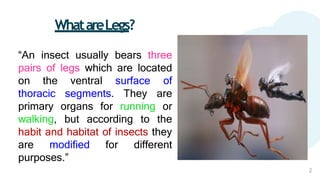
“An insect usually bears three
pairs of legs which are located
on the ventral surface of
thoracic segments. They are
primary organs for running or
walking, but according to the
habit and habitat of insects they
are modified for different
purposes.”
3
Structure of Insect Leg
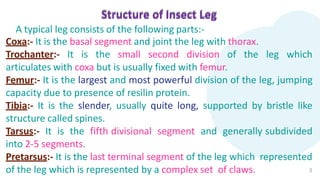
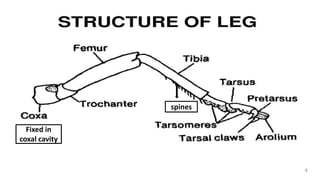
A typical leg consists of the following parts:-
Coxa:- It is the basal segment and joint the leg with thorax.
Trochanter:- It is the small second division of the leg which
articulates with coxa but is usually fixed with femur.
Femur:- It is the largest and most powerful division of the leg, jumping
capacity due to presence of resilin protein.
Tibia:- It is the slender, usually quite long, supported by bristle like
structure called spines.
Tarsus:- It is the fifth divisional segment and generally subdivided
into 2-5 segments.
Pretarsus:- It is the last terminal segment of the leg which represented
of the leg which is represented by a complex set of claws.
4
Fixed in
coxal cavity
spines
ModificationsofLeg
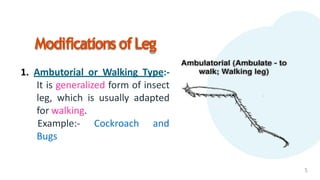
1. Ambutorial or Walking Type:-
It is generalized form of insect
leg, which is usually adapted
for walking.
Example:- Cockroach and
Bugs
5
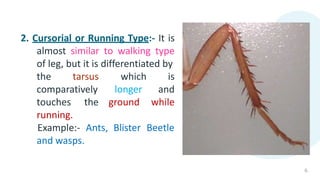
2. Cursorial or Running Type:- It is
almost similar to walking type
of leg, but it is differentiated by
6
the tarsus which is
longer and
ground while
comparatively
touches the
running.
Example:- Ants, Blister Beetle
and wasps.
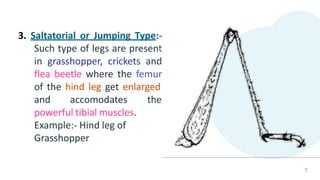
3. Saltatorial or Jumping Type:-
Such type of legs are present
in grasshopper, crickets and
flea beetle where the femur
of the hind leg get enlarged
the
and accomodates
powerful tibial muscles.
Example:- Hind leg of
Grasshopper
7
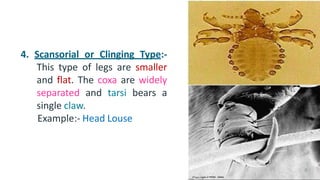
4. Scansorial or Clinging Type:-
This type of legs are smaller
and flat. The coxa are widely
separated and tarsi bears a
single claw.
Example:- Head Louse
8
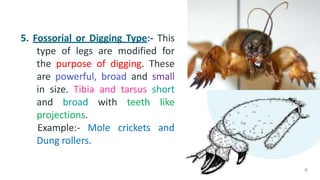
5. Fossorial or Digging Type:- This
type of legs are modified for
the purpose of digging. These
are powerful, broad and small
in size. Tibia and tarsus short
and broad with teeth like
projections.
Example:- Mole crickets and
Dung rollers.
9
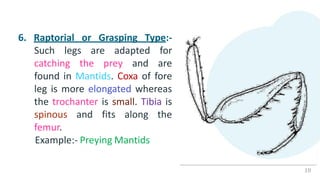
6. Raptorial or Grasping Type:-
Such legs are adapted for
catching the prey and are
found in Mantids. Coxa of fore
leg is more elongated whereas
the trochanter is small. Tibia is
spinous and fits along the
femur.
Example:- Preying Mantids
10
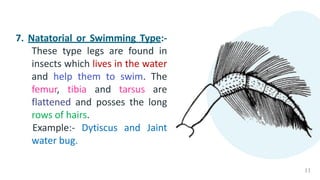
7. Natatorial or Swimming Type:-
These type legs are found in
insects which lives in the water
and help them to swim. The
femur, tibia and tarsus are
flattened and posses the long
rows of hairs.
Example:- Dytiscus and Jaint
water bug.
11
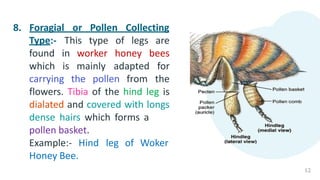
8. Foragial or Pollen Collecting
12
This type of legs are
bees
Type:-
found in
which is
worker honey
mainly
carrying the pollen from
adapted for
the
flowers. Tibia of the hind leg is
dialated and covered with longs
dense hairs which forms a
pollen basket.
Example:- Hind
Honey Bee.
leg of Woker
13
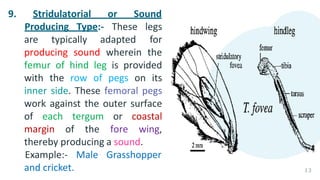
9. Stridulatorial or Sound
are typically adapted
Producing Type:- These legs
for
producing sound wherein the
femur of hind leg is provided
with the row of pegs on its
inner side. These femoral pegs
work against the outer surface
of each tergum or coastal
margin of the fore wing,
thereby producing a sound.
Example:- Male Grasshopper
and cricket.
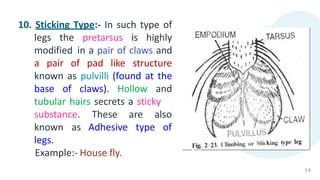
10. Sticking Type:- In such type of
legs the pretarsus is highly
modified in a pair of claws and
a pair of pad like structure
known as pulvilli (found at the
base of claws). Hollow and
tubular hairs secrets a sticky
14
These are also
Adhesive type of
substance.
known as
legs.
Example:- House fly.
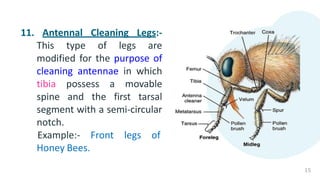
11. Antennal Cleaning Legs:-
This type of legs are
modified for the purpose of
cleaning antennae in which
tibia possess a movable
spine and the first tarsal
segment with a semi-circular
notch.
Example:- Front legs of
Honey Bees.
15
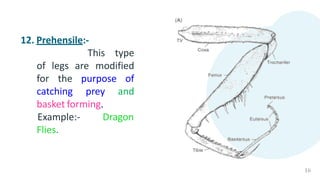
12. Prehensile:-
This
16
type
of legs are modified
for the
catching
purpose of
prey and
basket forming.
Dragon
Example:-
Flies.

insects leg structure and modification.pptx

  • 1.
  • 2.
    2 WhatareLegs? “An insect usuallybears three pairs of legs which are located on the ventral surface of thoracic segments. They are primary organs for running or walking, but according to the habit and habitat of insects they are modified for different purposes.”
  • 3.
    3 Structure of InsectLeg A typical leg consists of the following parts:- Coxa:- It is the basal segment and joint the leg with thorax. Trochanter:- It is the small second division of the leg which articulates with coxa but is usually fixed with femur. Femur:- It is the largest and most powerful division of the leg, jumping capacity due to presence of resilin protein. Tibia:- It is the slender, usually quite long, supported by bristle like structure called spines. Tarsus:- It is the fifth divisional segment and generally subdivided into 2-5 segments. Pretarsus:- It is the last terminal segment of the leg which represented of the leg which is represented by a complex set of claws.
  • 4.
  • 5.
    ModificationsofLeg 1. Ambutorial orWalking Type:- It is generalized form of insect leg, which is usually adapted for walking. Example:- Cockroach and Bugs 5
  • 6.
    2. Cursorial orRunning Type:- It is almost similar to walking type of leg, but it is differentiated by 6 the tarsus which is longer and ground while comparatively touches the running. Example:- Ants, Blister Beetle and wasps.
  • 7.
    3. Saltatorial orJumping Type:- Such type of legs are present in grasshopper, crickets and flea beetle where the femur of the hind leg get enlarged the and accomodates powerful tibial muscles. Example:- Hind leg of Grasshopper 7
  • 8.
    4. Scansorial orClinging Type:- This type of legs are smaller and flat. The coxa are widely separated and tarsi bears a single claw. Example:- Head Louse 8
  • 9.
    5. Fossorial orDigging Type:- This type of legs are modified for the purpose of digging. These are powerful, broad and small in size. Tibia and tarsus short and broad with teeth like projections. Example:- Mole crickets and Dung rollers. 9
  • 10.
    6. Raptorial orGrasping Type:- Such legs are adapted for catching the prey and are found in Mantids. Coxa of fore leg is more elongated whereas the trochanter is small. Tibia is spinous and fits along the femur. Example:- Preying Mantids 10
  • 11.
    7. Natatorial orSwimming Type:- These type legs are found in insects which lives in the water and help them to swim. The femur, tibia and tarsus are flattened and posses the long rows of hairs. Example:- Dytiscus and Jaint water bug. 11
  • 12.
    8. Foragial orPollen Collecting 12 This type of legs are bees Type:- found in which is worker honey mainly carrying the pollen from adapted for the flowers. Tibia of the hind leg is dialated and covered with longs dense hairs which forms a pollen basket. Example:- Hind Honey Bee. leg of Woker
  • 13.
    13 9. Stridulatorial orSound are typically adapted Producing Type:- These legs for producing sound wherein the femur of hind leg is provided with the row of pegs on its inner side. These femoral pegs work against the outer surface of each tergum or coastal margin of the fore wing, thereby producing a sound. Example:- Male Grasshopper and cricket.
  • 14.
    10. Sticking Type:-In such type of legs the pretarsus is highly modified in a pair of claws and a pair of pad like structure known as pulvilli (found at the base of claws). Hollow and tubular hairs secrets a sticky 14 These are also Adhesive type of substance. known as legs. Example:- House fly.
  • 15.
    11. Antennal CleaningLegs:- This type of legs are modified for the purpose of cleaning antennae in which tibia possess a movable spine and the first tarsal segment with a semi-circular notch. Example:- Front legs of Honey Bees. 15
  • 16.
    12. Prehensile:- This 16 type of legsare modified for the catching purpose of prey and basket forming. Dragon Example:- Flies.