Experiment No: 07
STUDY ON EXTERNAL STRUCTURE OF
INSECT LEG AND IT’S MODIFICATION
Leg
• True paired appendages of the thoracic
segments
• Locomotory appendages attached to the
pleural line
• Segmented, cylindrical and more or less
hollow
Fig: A typical insect leg
Objectives
• To identify and study the basic parts of
insect leg
• To study the different modification of insect
leg
Materials
• Cockroach, Grasshopper, Mole cricket,
Housefly, Honey bee, Praying mantid,
Scavenger beetle
• Compound microscope
• Needle
• Scissors
• Camel hair brush
• Dissecting tray
• Ethyl acetate
• Forceps
Procedure
• Anesthetized with ethyl acetate
• Legs detached from body
• Observed under microscope.
Functions of Leg
• Locomotion
• Searching of food
• Pollen carrying
• Predation
Observation
Parts of Leg
• Coxa
• Trochanter
• Femur
• Tibia
• Tarsus
• Pretarsus
Fig: A typical insect leg
Modifications of Leg
• Simple walking/running/crusorial type
• Jumping/saltatorial type
• Digging/fossorial type
• Pollen carrying/foragial type
• Grasping/raptorial type
• Swimming/natatorial type
• Clinging/scansorial type
• Legs modified for upside down walking on the
smooth surface
Simple Walking Type
• Simple type of leg
• It consists of coxa, trochanter, femur, tibia
and tarsus.
• Femur is greater than tibia.
• Example- Cockroach
Fig: Walking type leg
Fig: Cockroach
Jumping Type
• Femur is greatly elongated, muscular and adapted for
jumping.
• Coxa and trochanter are relatively smaller in size.
• Tibia spinus.
• Example- Hind leg of grasshopper.
Fig: Walking type leg
Fig: Cockroach
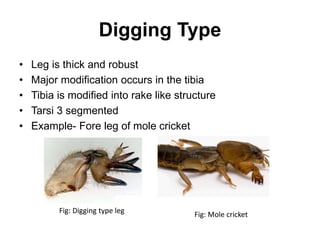
Digging Type
• Leg is thick and robust
• Major modification occurs in the tibia
• Tibia is modified into rake like structure
• Tarsi 3 segmented
• Example- Fore leg of mole cricket
Fig: Digging type leg Fig: Mole cricket
Pollen Carrying Type
• First segment of the tarsus modified into a pollen
carrying basket
• All the segments bear hairs for carrying pollen
• Example- Honey bee
Fig: Foragial type leg
Grasping Type
• Coxa elongated and strong
• Trochanter is very small in size
• Femur and tibia provided with spines for grasping
• Example- Foreleg of prayning mantid.
Fig: Grasping type leg Fig: Praying mantid
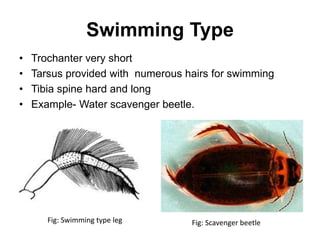
Swimming Type
• Trochanter very short
• Tarsus provided with numerous hairs for swimming
• Tibia spine hard and long
• Example- Water scavenger beetle.
Fig: Swimming type leg Fig: Scavenger beetle
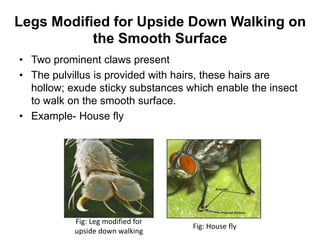
Legs Modified for Upside Down Walking on
the Smooth Surface
• Two prominent claws present
• The pulvillus is provided with hairs, these hairs are
hollow; exude sticky substances which enable the insect
to walk on the smooth surface.
• Example- House fly
Fig: Leg modified for
upside down walking
Fig: House fly

7.pptx

  • 1.
    Experiment No: 07 STUDYON EXTERNAL STRUCTURE OF INSECT LEG AND IT’S MODIFICATION
  • 2.
    Leg • True pairedappendages of the thoracic segments • Locomotory appendages attached to the pleural line • Segmented, cylindrical and more or less hollow Fig: A typical insect leg
  • 3.
    Objectives • To identifyand study the basic parts of insect leg • To study the different modification of insect leg
  • 4.
    Materials • Cockroach, Grasshopper,Mole cricket, Housefly, Honey bee, Praying mantid, Scavenger beetle • Compound microscope • Needle • Scissors • Camel hair brush • Dissecting tray • Ethyl acetate • Forceps
  • 5.
    Procedure • Anesthetized withethyl acetate • Legs detached from body • Observed under microscope.
  • 6.
    Functions of Leg •Locomotion • Searching of food • Pollen carrying • Predation
  • 7.
  • 8.
    Parts of Leg •Coxa • Trochanter • Femur • Tibia • Tarsus • Pretarsus Fig: A typical insect leg
  • 9.
    Modifications of Leg •Simple walking/running/crusorial type • Jumping/saltatorial type • Digging/fossorial type • Pollen carrying/foragial type • Grasping/raptorial type • Swimming/natatorial type • Clinging/scansorial type • Legs modified for upside down walking on the smooth surface
  • 10.
    Simple Walking Type •Simple type of leg • It consists of coxa, trochanter, femur, tibia and tarsus. • Femur is greater than tibia. • Example- Cockroach
  • 11.
    Fig: Walking typeleg Fig: Cockroach
  • 12.
    Jumping Type • Femuris greatly elongated, muscular and adapted for jumping. • Coxa and trochanter are relatively smaller in size. • Tibia spinus. • Example- Hind leg of grasshopper. Fig: Walking type leg Fig: Cockroach
  • 13.
    Digging Type • Legis thick and robust • Major modification occurs in the tibia • Tibia is modified into rake like structure • Tarsi 3 segmented • Example- Fore leg of mole cricket Fig: Digging type leg Fig: Mole cricket
  • 14.
    Pollen Carrying Type •First segment of the tarsus modified into a pollen carrying basket • All the segments bear hairs for carrying pollen • Example- Honey bee Fig: Foragial type leg
  • 15.
    Grasping Type • Coxaelongated and strong • Trochanter is very small in size • Femur and tibia provided with spines for grasping • Example- Foreleg of prayning mantid. Fig: Grasping type leg Fig: Praying mantid
  • 16.
    Swimming Type • Trochantervery short • Tarsus provided with numerous hairs for swimming • Tibia spine hard and long • Example- Water scavenger beetle. Fig: Swimming type leg Fig: Scavenger beetle
  • 17.
    Legs Modified forUpside Down Walking on the Smooth Surface • Two prominent claws present • The pulvillus is provided with hairs, these hairs are hollow; exude sticky substances which enable the insect to walk on the smooth surface. • Example- House fly Fig: Leg modified for upside down walking Fig: House fly