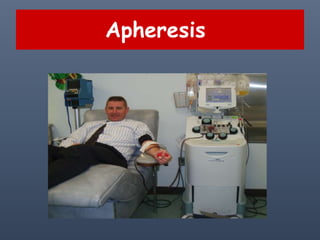
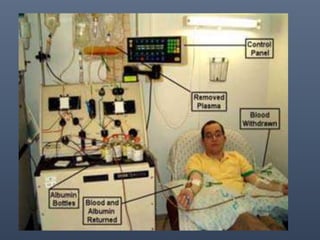

Apheresis
Overview
• Derives from Greek, “to carry away”
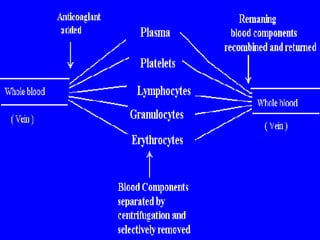
• A technique in which whole blood is
taken and separated extracorporealy,
separating the portion desired from the
remaining blood.
• This allows the desired portion (e.g.,
plasma) to be removed and the reminder
returned.
Definition
• Apheresis “a taking away” is a medical
technology in which the blood of a donor or
patient is passed through an apparatus that
separates out one particular constituent and
returns the remainder to the circulation.
Principle of Operation
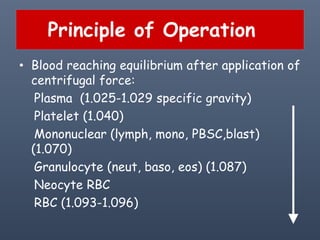
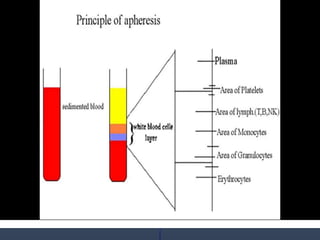
• Blood reaching equilibrium after application of
centrifugal force:
Plasma (1.025-1.029 specific gravity)
Platelet (1.040)
Mononuclear (lymph, mono, PBSC,blast)
(1.070)
Granulocyte (neut, baso, eos) (1.087)
Neocyte RBC
RBC (1.093-1.096)
Principle of Operation
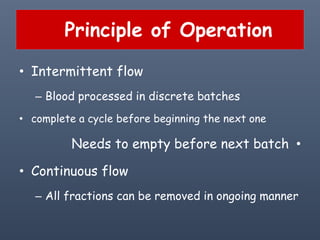
• Intermittent flow
– Blood processed in discrete batches
• complete a cycle before beginning the next one
•Needs to empty before next batch
• Continuous flow
– All fractions can be removed in ongoing manner
Anticoagulant
• Citrate
• Chelates calcium and block calcium
dependent clotting factor reactions
– Ensures extracorporeal blood remains in
fluid state
– Minimize activation of platelets and
clotting factors
1. Centrifugation (specific gravity)
a) Intermittent flow IFC
b) Contineous flow CFc
2. Immunoadsorption
Apheresis by membrane filteration
3. Photopheresis
the separation of lymphocytes by apheresis, and
treatment of the cells with ultraviolet radiation.
Methods
Applications
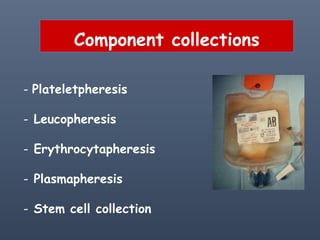
Component collections
- Plateletpheresis
- Leucopheresis
- Erythrocytapheresis
- Plasmapheresis
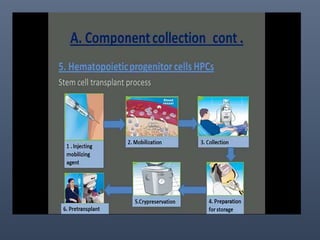
- Stem cell collection
Therapeutic Procedure
-Therapeutic cytapheresis
-Therapeutic plasma exchange
1) Paraproteins (Waldenstorm’s Macroglobulinem
2) Autoantibodies
3) Lipids (LDL in familial hypercholesterolemia;
4) Toxins or drugs (that are bound to albumin)
5) Circulating immune complexes (CIC)
Therapeutic Cytapheresis
1. Plateletpheresis the platelet count can be decreased
by 60% of the initial value.
2. Leucopheresis : e.g leukemia
3. Lymphocytespheresis .
4. Erythrocytapheresis : e.g SCA, severe parasitemia
5. Stem cells harvesting, Donor or patient.
Therapeutic Plasmapheresis
It is the removal and retention of the plasma
with return of all cellular components to the
patient.
Recommended 1-1.5 plasma volumes be
exchanged
Drug Removal
• Can remove:
– tobramycin,vancomycin, propranolol
• May reduce plasma levels of enzymes that
metabolize drugs
• May reduce plasma levels of proteins that bind
and transport drugs
Donation Criteria
 Donors for apheresis procedure must meet the
criteria applicable as the donors for normal donation.
 CBC, ABO and Rh typing, andtibody screening and
testing for transfusion transmitted diseases SHOULD
BE DONE.
 A drug history should be obtained; donors who have
taken aspirin or aspirin containing medications within 3
days of donation should be temporarily deferred.
Donation Interval
 The interval between platelet donations should be
at least 48 hours, with no more than two donations
in a week and 24 donations in a year.
 plasmapheresis donors may donate as often as
every 48 hours but not more than twice in a 7-day
period.
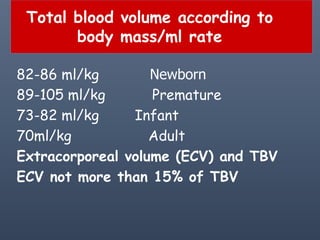
Total blood volume according to
body mass/ml rate
Newborn82-86 ml/kg
Premature89-105 ml/kg
Infant73-82 ml/kg
70ml/kg Adult
Extracorporeal volume (ECV) and TBV
ECV not more than 15% of TBV
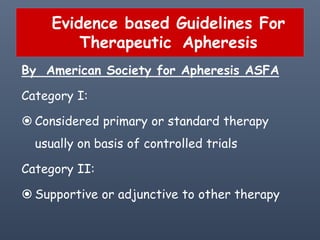
Evidence based Guidelines For
Therapeutic Apheresis
By American Society for Apheresis ASFA
Category I:
 Considered primary or standard therapy
usually on basis of controlled trials
Category II:
 Supportive or adjunctive to other therapy
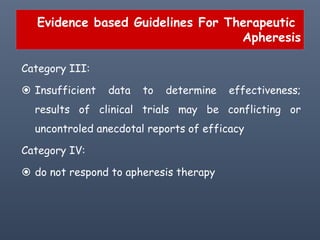
Evidence based Guidelines For Therapeutic
Apheresis
Category III:
 Insufficient data to determine effectiveness;
results of clinical trials may be conflicting or
uncontroled anecdotal reports of efficacy
Category IV:
 do not respond to apheresis therapy
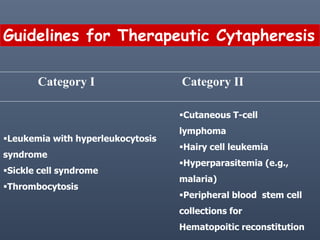
Guidelines for Therapeutic Cytapheresis
Leukemia with hyperleukocytosis
syndrome
Sickle cell syndrome
Thrombocytosis
Cutaneous T-cell
lymphoma
Hairy cell leukemia
Hyperparasitemia (e.g.,
malaria)
Peripheral blood stem cell
collections for
Hematopoitic reconstitution
Category I Category II
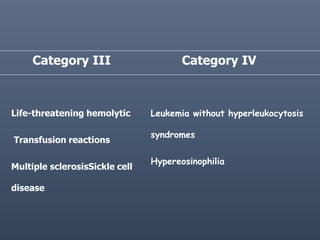
Life-threatening hemolytic
Transfusion reactions
Multiple sclerosisSickle cell
disease
Leukemia without hyperleukocytosis
syndromes
Hypereosinophilia
Category IVCategory III
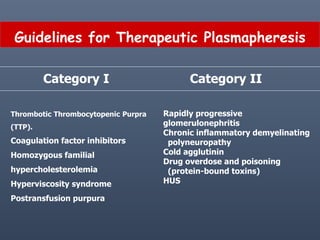
Guidelines for Therapeutic Plasmapheresis
Category I Category II
Thrombotic Thrombocytopenic Purpra
(TTP).
Coagulation factor inhibitors
Homozygous familial
hypercholesterolemia
Hyperviscosity syndrome
Postransfusion purpura
Rapidly progressive
glomerulonephritis
Chronic inflammatory demyelinating
polyneuropathy
Cold agglutinin
Drug overdose and poisoning
(protein-bound toxins)
HUS
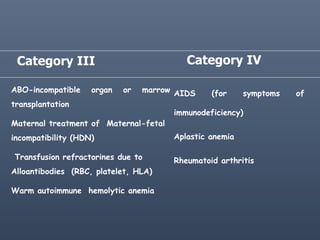
AIDS (for symptoms of
immunodeficiency)
Aplastic anemia
Rheumatoid arthritis
ABO-incompatible organ or marrow
transplantation
Maternal treatment of Maternal-fetal
incompatibility (HDN)
Transfusion refractorines due to
Alloantibodies (RBC, platelet, HLA)
Warm autoimmune hemolytic anemia
Category III Category IV
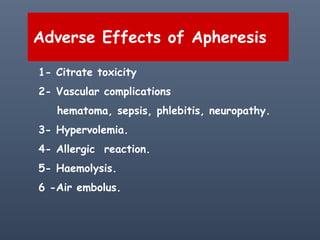
Adverse Effects of Apheresis
1- Citrate toxicity
2- Vascular complications
hematoma, sepsis, phlebitis, neuropathy.
3- Hypervolemia.
4- Allergic reaction.
5- Haemolysis.
6 -Air embolus.
7- Depletion of clotting factors.
8- Circulatory and respiratory distress.
9- transfusion transmitted diseases.
10- loss of lymphocytes.
11- depletion of proteins and immunoglobulin
Fluid replacement during apheresis
• When an apheresis system is used for
therapy, the system is removing
relatively small amounts of fluid (not
more than 10.5 mL/kg body weight).
• That fluid must be replaced to keep
correct intravascular volume
Conclusion
 Donation & Therapeutic Apheresis is safe and
easy effective methods to be used when needed.
 A well-trained and experienced team can
overcome the technical difficulties in order to
complete the procedures without complications.
 Policy and procedure of Donors Apheresis
 And Therapeutic Apheresis should be in place.
Thanks

Apherisis

  • 1.
  • 2.
    Overview • Derives fromGreek, “to carry away” • A technique in which whole blood is taken and separated extracorporealy, separating the portion desired from the remaining blood. • This allows the desired portion (e.g., plasma) to be removed and the reminder returned.
  • 3.
    Definition • Apheresis “ataking away” is a medical technology in which the blood of a donor or patient is passed through an apparatus that separates out one particular constituent and returns the remainder to the circulation.
  • 5.
    Principle of Operation •Blood reaching equilibrium after application of centrifugal force: Plasma (1.025-1.029 specific gravity) Platelet (1.040) Mononuclear (lymph, mono, PBSC,blast) (1.070) Granulocyte (neut, baso, eos) (1.087) Neocyte RBC RBC (1.093-1.096)
  • 6.
    Principle of Operation •Intermittent flow – Blood processed in discrete batches • complete a cycle before beginning the next one •Needs to empty before next batch • Continuous flow – All fractions can be removed in ongoing manner
  • 9.
    Anticoagulant • Citrate • Chelatescalcium and block calcium dependent clotting factor reactions – Ensures extracorporeal blood remains in fluid state – Minimize activation of platelets and clotting factors
  • 10.
    1. Centrifugation (specificgravity) a) Intermittent flow IFC b) Contineous flow CFc 2. Immunoadsorption Apheresis by membrane filteration 3. Photopheresis the separation of lymphocytes by apheresis, and treatment of the cells with ultraviolet radiation. Methods
  • 12.
  • 13.
    Component collections - Plateletpheresis -Leucopheresis - Erythrocytapheresis - Plasmapheresis - Stem cell collection
  • 15.
    Therapeutic Procedure -Therapeutic cytapheresis -Therapeuticplasma exchange 1) Paraproteins (Waldenstorm’s Macroglobulinem 2) Autoantibodies 3) Lipids (LDL in familial hypercholesterolemia; 4) Toxins or drugs (that are bound to albumin) 5) Circulating immune complexes (CIC)
  • 16.
    Therapeutic Cytapheresis 1. Plateletpheresisthe platelet count can be decreased by 60% of the initial value. 2. Leucopheresis : e.g leukemia 3. Lymphocytespheresis . 4. Erythrocytapheresis : e.g SCA, severe parasitemia 5. Stem cells harvesting, Donor or patient.
  • 17.
    Therapeutic Plasmapheresis It isthe removal and retention of the plasma with return of all cellular components to the patient. Recommended 1-1.5 plasma volumes be exchanged
  • 18.
    Drug Removal • Canremove: – tobramycin,vancomycin, propranolol • May reduce plasma levels of enzymes that metabolize drugs • May reduce plasma levels of proteins that bind and transport drugs
  • 19.
    Donation Criteria  Donorsfor apheresis procedure must meet the criteria applicable as the donors for normal donation.  CBC, ABO and Rh typing, andtibody screening and testing for transfusion transmitted diseases SHOULD BE DONE.  A drug history should be obtained; donors who have taken aspirin or aspirin containing medications within 3 days of donation should be temporarily deferred.
  • 20.
    Donation Interval  Theinterval between platelet donations should be at least 48 hours, with no more than two donations in a week and 24 donations in a year.  plasmapheresis donors may donate as often as every 48 hours but not more than twice in a 7-day period.
  • 21.
    Total blood volumeaccording to body mass/ml rate Newborn82-86 ml/kg Premature89-105 ml/kg Infant73-82 ml/kg 70ml/kg Adult Extracorporeal volume (ECV) and TBV ECV not more than 15% of TBV
  • 22.
    Evidence based GuidelinesFor Therapeutic Apheresis By American Society for Apheresis ASFA Category I:  Considered primary or standard therapy usually on basis of controlled trials Category II:  Supportive or adjunctive to other therapy
  • 23.
    Evidence based GuidelinesFor Therapeutic Apheresis Category III:  Insufficient data to determine effectiveness; results of clinical trials may be conflicting or uncontroled anecdotal reports of efficacy Category IV:  do not respond to apheresis therapy
  • 24.
    Guidelines for TherapeuticCytapheresis Leukemia with hyperleukocytosis syndrome Sickle cell syndrome Thrombocytosis Cutaneous T-cell lymphoma Hairy cell leukemia Hyperparasitemia (e.g., malaria) Peripheral blood stem cell collections for Hematopoitic reconstitution Category I Category II
  • 25.
    Life-threatening hemolytic Transfusion reactions MultiplesclerosisSickle cell disease Leukemia without hyperleukocytosis syndromes Hypereosinophilia Category IVCategory III
  • 26.
    Guidelines for TherapeuticPlasmapheresis Category I Category II Thrombotic Thrombocytopenic Purpra (TTP). Coagulation factor inhibitors Homozygous familial hypercholesterolemia Hyperviscosity syndrome Postransfusion purpura Rapidly progressive glomerulonephritis Chronic inflammatory demyelinating polyneuropathy Cold agglutinin Drug overdose and poisoning (protein-bound toxins) HUS
  • 27.
    AIDS (for symptomsof immunodeficiency) Aplastic anemia Rheumatoid arthritis ABO-incompatible organ or marrow transplantation Maternal treatment of Maternal-fetal incompatibility (HDN) Transfusion refractorines due to Alloantibodies (RBC, platelet, HLA) Warm autoimmune hemolytic anemia Category III Category IV
  • 28.
    Adverse Effects ofApheresis 1- Citrate toxicity 2- Vascular complications hematoma, sepsis, phlebitis, neuropathy. 3- Hypervolemia. 4- Allergic reaction. 5- Haemolysis. 6 -Air embolus.
  • 29.
    7- Depletion ofclotting factors. 8- Circulatory and respiratory distress. 9- transfusion transmitted diseases. 10- loss of lymphocytes. 11- depletion of proteins and immunoglobulin
  • 30.
    Fluid replacement duringapheresis • When an apheresis system is used for therapy, the system is removing relatively small amounts of fluid (not more than 10.5 mL/kg body weight). • That fluid must be replaced to keep correct intravascular volume
  • 31.
    Conclusion  Donation &Therapeutic Apheresis is safe and easy effective methods to be used when needed.  A well-trained and experienced team can overcome the technical difficulties in order to complete the procedures without complications.  Policy and procedure of Donors Apheresis  And Therapeutic Apheresis should be in place.
  • 32.