APHERESIS
I.ABDUL AZEES
MSC MLT Pathology
• Apheresis (or hemapheresis) is a Greek word that means to separate or remove.
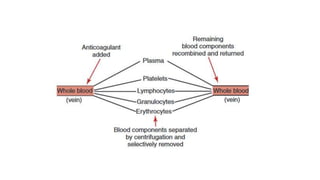
In apheresis blood is withdrawn from a donor or patient in anticoagulant solution
and separated into components. One (or more) component is retained and the
remaining constituents are returned to the individual. Any one of the components
of blood can be removed and the procedures are specified for the component
selected.
• Apheresis is a procedure carried out to harvest a particular component and
returning the rest of the blood to the donor by an automated machine. This
procedure shall be carried out only in a Blood Centre licensed for this purpose
• At least 48 hours must elapse between successive apheresis and not more than
twice in a week. For hematopoietic stem cells, the procedure can be done daily.
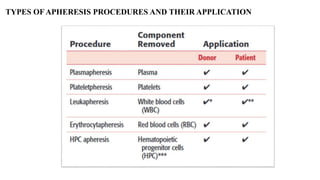
oProcess of removing Plasma- Plateletpheresis
oProcess of removing platelets- Leukapheresis
oProcess of removing Red cells- Erythrocytapheresis
AUTOMATED CELL-SEPARATOR MACHINES - used for both component
preparation and therapeutic applications.
MANUAL APHERESIS-whole blood is collected in multiple bags system and
centrifuged off-line. It involves great care that the bags are labeled correctly and
their contents are returned to the correct donor. With the current available
automatic technology now the manual process is seldom used.
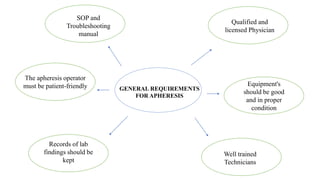
GENERAL REQUIREMENTS
FOR APHERESIS
Equipment's
should be good
and in proper
condition
Qualified and
licensed Physician
Well trained
Technicians
SOP and
Troubleshooting
manual
The apheresis operator
must be patient-friendly
Records of lab
findings should be
kept
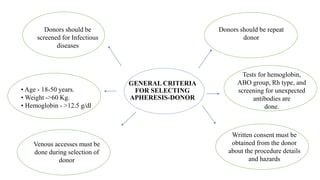
GENERAL CRITERIA
FOR SELECTING
APHERESIS-DONOR
Donors should be repeat
donor
Written consent must be
obtained from the donor
about the procedure details
and hazards
Venous accesses must be
done during selection of
donor
Donors should be
screened for Infectious
diseases
• Age - 18-50 years.
• Weight ->60 Kg.
• Hemoglobin - >12.5 g/dl
Tests for hemoglobin,
ABO group, Rh type, and
screening for unexpected
antibodies are
done.
TYPES OF APHERESIS PROCEDURES AND THEIR APPLICATION
PRINCIPLE OF OPERATION:
• The separation of blood components is based on the specific gravity
or weight of each individual blood constituent.
• Apheresis technology utilizes this same principle for separating
blood components.
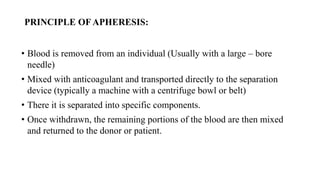
PRINCIPLE OF APHERESIS:
• Blood is removed from an individual (Usually with a large – bore
needle)
• Mixed with anticoagulant and transported directly to the separation
device (typically a machine with a centrifuge bowl or belt)
• There it is separated into specific components.
• Once withdrawn, the remaining portions of the blood are then mixed
and returned to the donor or patient.
PHYSIOLOGY OF APHERESIS
• Apheresis collection of a blood component, whether for therapeutic or
nontherapeutic purposes, is obviously different from the routine
collection of a unit of whole blood.
• Anticoagulant
• Fluid shift
• Cell loss
ANTICOAGULANT
• Citrate is used as the primary anticoagulant in apheresis procedures
• The binding of calcium ions by citrate inhibits the calcium-dependent
coagulation cascade
• If calcium ions are not available, coagulation cannot proceed to its
normal end-point.
CELL LOSS
• For both donor and patient apheresis procedures the goal is to intentionally
remove a specific cellular component. This would be expected to decrease
circulating levels of the specific cells however, other cellular components
may be affected as well.
FLUID SHIFTS
• During an apheresis procedure, changes in intravascular volume occur
secondary to removal of blood into the extracorporeal circuit. During donor
apheresis procedures, the total volume of components collected may be more
than the simple whole blood donation. If additional fluid is not infused during
the apheresis procedure, the donor may experience hypotension due to the
depletion of intravascular volume.
METHODS OF CENTRIFUGATION:
1. Intermittent flow centrifugation (IFC)
2. Continuous flow centrifugation (CFC).
INTERMITTENT FLOW CENTRIFUGATION
In an IFC procedure, blood is processed in batches or cycles, hence the term
intermittent.
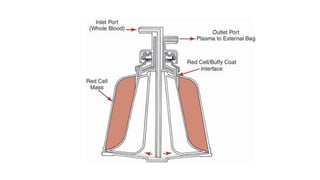
Require the use of a disposable unit consist of sterile tubings and a bowl.
Blood is drawn from an individual mixed with the anticoagulant with the help of a
pump and pumped into a centrifuge bowl through the inlet port.
The blood gets separated in the bowl into various components by differential
centrifugation.
The separated components flow from the bowl through the outlet port, with the
desired components being harvested into a separate collection bag.
The centrifuge stops and the pump gets reversed.
It completes one cycle
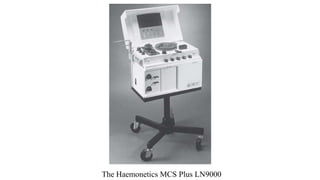
The Haemonetics MCS Plus LN9000
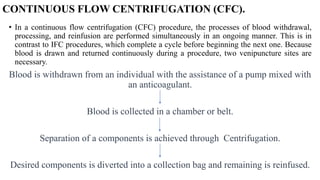
CONTINUOUS FLOW CENTRIFUGATION (CFC).
• In a continuous flow centrifugation (CFC) procedure, the processes of blood withdrawal,
processing, and reinfusion are performed simultaneously in an ongoing manner. This is in
contrast to IFC procedures, which complete a cycle before beginning the next one. Because
blood is drawn and returned continuously during a procedure, two venipuncture sites are
necessary.
Blood is withdrawn from an individual with the assistance of a pump mixed with
an anticoagulant.
Blood is collected in a chamber or belt.
Separation of a components is achieved through Centrifugation.
Desired components is diverted into a collection bag and remaining is reinfused.
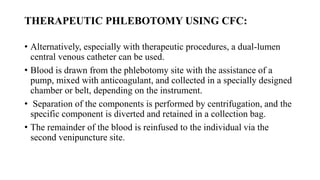
THERAPEUTIC PHLEBOTOMY USING CFC:
• Alternatively, especially with therapeutic procedures, a dual-lumen
central venous catheter can be used.
• Blood is drawn from the phlebotomy site with the assistance of a
pump, mixed with anticoagulant, and collected in a specially designed
chamber or belt, depending on the instrument.
• Separation of the components is performed by centrifugation, and the
specific component is diverted and retained in a collection bag.
• The remainder of the blood is reinfused to the individual via the
second venipuncture site.
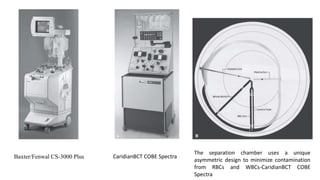
Baxter/Fenwal CS-3000 Plus CaridianBCT COBE Spectra
The separation chamber uses a unique
asymmetric design to minimize contamination
from RBCs and WBCs-CaridianBCT COBE
Spectra
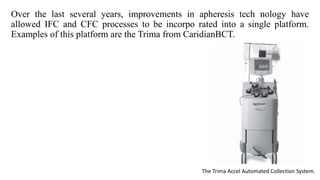
Over the last several years, improvements in apheresis tech nology have
allowed IFC and CFC processes to be incorpo rated into a single platform.
Examples of this platform are the Trima from CaridianBCT.
The Trima Accel Automated Collection System.
MEMBRANE FILTRATION:
• Membrane filtration technology can also be used to separate blood components.
• Membrane separators are typically composed of bundles of hollow fibers or flat
plate membranes with specific pore sizes.
• As whole blood flows over the fibers or membrane, plasma passes through the
pores and is collected, while the remainder of the cellular components is
returned to the donor.
• This technology lends itself well to the collection of plasma since pores can be
sized to prevent the passage of even small cellular elements.
• Filtration has several advantages over centrifugation, including the collection of
a cell-free product and the ability to selectively remove specific plasma proteins
by varying the pore size.
• The Fenwal Autopheresis-C instrument combines centrifugation and membrane
filtration technology through the use of a small rotating cylindrical filter. Like
other filtration technology, it is used only for plasma collection.
TYPES OF APHERESIS:
1) Plasmapheresis
2) Cytapheresis
PLASMAPHERESIS:
It is a procedure to harvest plasma from whole blood and returning the cellular
components to the donor. Plasma is harvested by an automated machine.
• Selection of donors
For selection of plasmapheresis donor, the donor shall fulfill all the crieteria as
per regulatory guidelines.
The total serum protein shall be more than 6 gm/dl before the first
plasmapheresis procedure. It should be tested before the third procedure if
done within four weeks, and it shall be ≥ 6 gm/dl.
In repeated plasmapheresis in which plasma is donated more frequently than
once every 12 weeks, the donor should be tested before every pheresis
procedure. Haemoglobin should be ≥ 12.5 g/dl and/or Hct ≥ 38%
In repeated plasmapheresis programme with the return of the cellular
components a minimum interval shall be of 48 hours between two procedures
(not more than 2 times a week, limited to 24 in one year).
Volume of plasma:
Volume of plasma obtained excluding anticoagulants from a donor
weighing at least 55 kg shall not exceed 500 ml with serum protein within
normal limit during one procedure or not more than 1000 ml per month with a
maximum of 12 L / year. Extra corporeal blood volume should not exceed 15%
of the donor’s estimated blood volume.
Records:
Records of donor’s periodic examination, laboratory tests, consent of
donor/patient, date of last apheresis procedure, certificate of the attending
physician, procedure details, volume of product separated, drugs used, adverse
reaction if any and their treatment shall be maintained
CYTAPHERESIS
Cytapheresis is the procedure for the separation of individual cellular components
of blood. It can be achieved by the cell separator machine, using a continuous or
intermittent cell separator. It includes
1) Plateletpheresis
2) Leucapheresis for harvesting
a. Granulocyte concentrate
b. Lymphocytes
c. Mononuclear cells
3) Erythrocytapheresis
4) Haematopoietic stem cells (peripheral blood stem cells): Attempt should be
made for harvesting a minimum of 2x10 6 CsD34 cells and/or minimum of 2x10⁸
MNCS/Kg of the recipient.
• Selection of donors: Donors who do not meet allogeneic donor requirements shall
undergo apheresis only when the components are expected to be of particular
value to an intended recipient and only when approved by the medical director.
• The interval between procedures for platelet, erythrocyte, and leucocyte donors
shall be as per regulatory requirements.A donor (except for erythrocytes) shall
undergo the procedure a maximum of two times in 7 days period or not more than
24 times in a year.
• In case of blood donors who undergo cytapheresis no more than once every 4
weeks should be treated as ordinary blood donors and routine donor screening
with laboratory tests should be done.
PLATELETPHERESIS
• The term plateletpheresis includes platelets collected by apheresis using a cell
separator, and the product is called single donor platelets and includes washed
single donor platelets, modified single donor platelets (with replacement of
compatible plasma), leuko-reduced single donor platelets and double (single
donor) platelets collected from single donor
Donor selection:
• Platelet-pheresis shall not be carried out on donors who have taken medication
containing aspirin or similar medicines within 3 days prior to donation.
• Donors with a personal and family history of bleeding tendency are not suitable
forplateletpheresis.
• Platelet count should be determined before plateletpheresis and should not be
below 150,000 / ul. Plateletpheresis donors with a platelet count of less than
1,50,000/ul shall be deferred from platelet donation until a subsequent platelet
count is at least 1,50,000/ul.
Storage
• Shall be kept up to 5 days between 20o C to 24o C with continuous agitation.
Quality Control
i) Apheresis platelet concentrate should contain a minimum of 3 X 10 11
platelets/unit in 75% of the units tested amongst 1% of monthly production or 4
platelet concentrates per month, whichever is higher.
ii) pH must be 6 or higher at the end of the permissible storage period.
iii) To be considered leucocyte reduced, platelets must contain less than 5x10⁶
leucocytes per unit.
iv) Minimum SDP volume shall be 200 ml in order to maintain optimum pH of
platelets.
v) If a blood centre uses PAS as additive solution volumes may change, however,
the shelf-life shall still be limited to 5 days or in accordance with regulatory
requirements.
LEUCAPHERESIS
• This procedure includes a collection of granulocytes
(granulocytapheresis),lymphocytes or peripheral blood stem cells or
haematopoietic stem cells for the treatment of traditional conditions followed by
their preservation.
• Before leucapheresis total white blood cells counts should be ≥ 4000 /ul with the
normal differential count.
• Donors may receive drugs to facilitate leucapheresis. Such drugs should not be
used for donors whose medical history is suggestive of some disease.
• Leucocyte concentrate should contain at least 1 x 10¹⁰ leucocytes.
• Granulocyte concentrates shall be stored at 200 to 240 C for 24 hours
without agitation.
• The red cells in the concentrates should be ABO compatible with the
recipient’s plasma. The component should be cross-matched if >2ml of
red cells are present.
• These should be transfused as soon as possible, preferably within 6 hrs.
• Transfusion should not be given through micro aggregate filters because
it will remove the collected granulocytes.
• Irradiation is required to prevent GvHD.
ERYTHROPHERESIS
This is the collection of two units of red cells from a single donor meeting specified requirements
The donor should have haemoglobin ≥ 13.5g /dl and weigh more than 65 Kgs