APHERESIS
DR. O. E. IHEANACHO
OUTLINE
Introduction
Instrumentation
Donor apheresis
Therapeutic apheresis
Conclusion
Learning objectives
Overview of Apheresis. Donor and Therapeutic
apheresis.
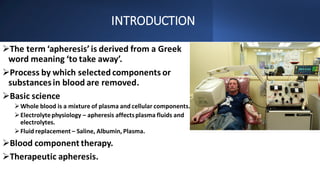
INTRODUCTION
➢The term ‘apheresis’ is derived from a Greek
word meaning ‘to take away’.
➢Process by which selected components or
substancesin blood are removed.
➢Basic science
➢Whole blood is a mixture of plasma and cellular components.
➢Electrolytephysiology – apheresis affectsplasma fluids and
electrolytes.
➢Fluid replacement – Saline, Albumin, Plasma.
➢Blood component therapy.
➢Therapeutic apheresis.
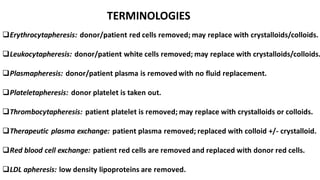
❑Erythrocytapheresis: donor/patient red cells removed; may replace with crystalloids/colloids.
❑Leukocytapheresis: donor/patient white cells removed; may replace with crystalloids/colloids.
❑Plasmapheresis: donor/patient plasma is removed with no fluid replacement.
❑Plateletapheresis: donor platelet is taken out.
❑Thrombocytapheresis: patient platelet is removed; may replace with crystalloids or colloids.
❑Therapeutic plasma exchange: patient plasma removed; replaced with colloid +/- crystalloid.
❑Red blood cell exchange: patient red cells are removed and replaced with donor red cells.
❑LDL apheresis: low density lipoproteins are removed.
TERMINOLOGIES
INSTRUMENTATION
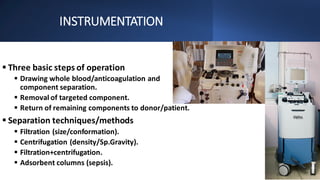
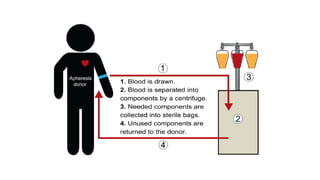
▪ Three basic steps of operation
▪ Drawing whole blood/anticoagulation and
component separation.
▪ Removal of targeted component.
▪ Return of remaining components to donor/patient.
▪ Separation techniques/methods
▪ Filtration (size/conformation).
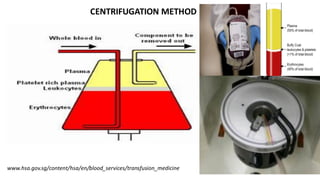
▪ Centrifugation (density/Sp.Gravity).
▪ Filtration+centrifugation.
▪ Adsorbent columns (sepsis).
CENTRIFUGATION METHOD
www.hsa.gov.sg/content/hsa/en/blood_services/transfusion_medicine
DONORAPHERESIS
o Makes blood component therapy more efficient.
o Reduces waste.
o Collects more components, variable donationfrequency.
o Saves cost.
o Adherence to guidelines and standards
o Quality systems, donor selection, documentation,component preparationand storage, TTI screening,
hemovigilance.
o Right product, right donor, right type.
o Erythrocytapheresis,leucocytapheresis,platelet apheresis, plasmapheresis.
o WBC, Blood group, etc.
DONORAPHERESIS cont’d
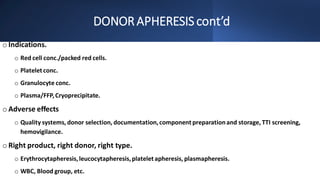
o Indications.
o Red cell conc./packed red cells.
o Platelet conc.
o Granulocyte conc.
o Plasma/FFP,Cryoprecipitate.
o Adverse effects
o Quality systems, donor selection, documentation,component preparationand storage, TTI screening,
hemovigilance.
o Right product, right donor, right type.
o Erythrocytapheresis,leucocytapheresis,platelet apheresis, plasmapheresis.
o WBC, Blood group, etc.
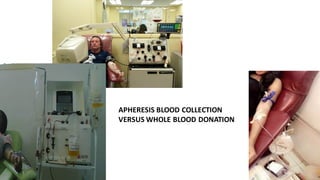
APHERESIS BLOOD COLLECTION
VERSUS WHOLE BLOOD DONATION
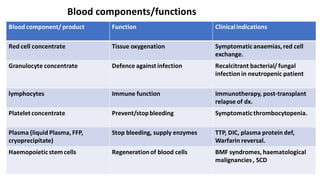
Blood component/ product Function Clinicalindications
Red cell concentrate Tissue oxygenation Symptomatic anaemias,red cell
exchange.
Granulocyte concentrate Defence against infection Recalcitrant bacterial/fungal
infectionin neutropenic patient
lymphocytes Immune function Immunotherapy, post-transplant
relapse of dx.
Platelet concentrate Prevent/stopbleeding Symptomatic thrombocytopenia.
Plasma (liquid Plasma, FFP,
cryoprecipitate)
Stop bleeding, supply enzymes TTP, DIC, plasma protein def,
Warfarin reversal.
Haemopoieticstem cells Regenerationof blood cells BMF syndromes, haematological
malignancies, SCD
Blood components/functions
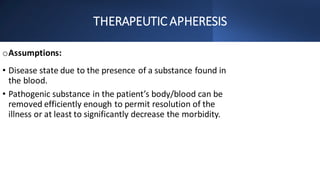
THERAPEUTIC APHERESIS
oAssumptions:
• Disease state due to the presence of a substance found in
the blood.
• Pathogenic substance in the patient’s body/blood can be
removed efficiently enough to permit resolution of the
illness or at least to significantly decrease the morbidity.
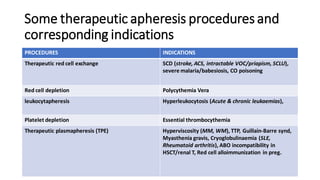
Some therapeutic apheresis procedures and
corresponding indications
PROCEDURES INDICATIONS
Therapeutic red cell exchange SCD (stroke, ACS, intractable VOC/priapism, SCLU),
severe malaria/babesiosis, CO poisoning
Red cell depletion Polycythemia Vera
leukocytapheresis Hyperleukocytosis (Acute & chronic leukaemias),
Platelet depletion Essential thrombocythemia
Therapeutic plasmapheresis (TPE) Hyperviscosity (MM, WM), TTP, Guillain-Barre synd,
Myasthenia gravis, Cryoglobulinaemia (SLE,
Rheumatoid arthritis), ABO incompatibility in
HSCT/renal T, Red cell alloimmunization in preg.
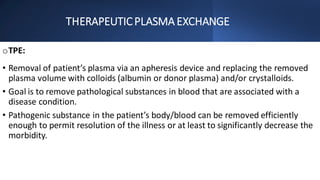
THERAPEUTICPLASMA EXCHANGE
oTPE:
• Removal of patient’s plasma via an apheresis device and replacing the removed
plasma volume with colloids (albumin or donor plasma) and/or crystalloids.
• Goal is to remove pathological substances in blood that are associated with a
disease condition.
• Pathogenic substance in the patient’s body/blood can be removed efficiently
enough to permit resolution of the illness or at least to significantly decrease the
morbidity.
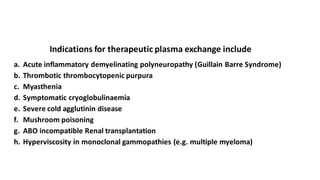
Indications for therapeutic plasma exchange include
a. Acute inflammatory demyelinating polyneuropathy (Guillain Barre Syndrome)
b. Thrombotic thrombocytopenic purpura
c. Myasthenia
d. Symptomatic cryoglobulinaemia
e. Severe cold agglutinin disease
f. Mushroom poisoning
g. ABO incompatible Renal transplantation
h. Hyperviscosity in monoclonal gammopathies (e.g. multiple myeloma)
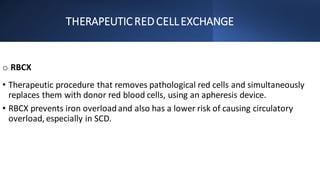
THERAPEUTICRED CELLEXCHANGE
o RBCX
• Therapeutic procedure that removes pathological red cells and simultaneously
replaces them with donor red blood cells, using an apheresis device.
• RBCX prevents iron overloadand also has a lower risk of causing circulatory
overload, especially in SCD.
Indications for red blood cell exchange include
1. Certain complications of sickle cell disease such as
a. Acute stroke or stroke prophylaxis.
b.Severe acute chest syndrome
c. RBCX could be done in some cases of priapism, splenic sequestration,
intrahepatic cholestasis, VOC, pre-op mgt, multi-organ failure and prevention
of iron overload (transfusional).
2. Severe Babesiosis
3. Severe malaria.
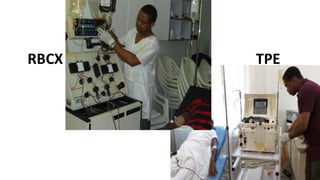
RBCX TPE
ADVERSE EVENTS DURING APHERESIS
❖Due to vascular access
Haematoma
Thrombosis
❖Allergic reactions (e.g. to ethylene oxide sterilization, donor blood)
Mild (hives, dyspnea, wheezing, hypotension etc.)
Anaphylaxis
❖Vasovagal reactions
Mild (pallor, diaphoresis, bradycardia, hypotension)
Severe (syncope, fecal/urinaryincontinence,seizure)
❖Citrate-induced hypocalcemia (due to anticoagulant)
Mild (perioral/peripheral paresthesis, dysgeusia, shivering, tremors etc.)
Severe (carpopedal spasms, laryngospasm)
SOME ADVERSE EVENTS DURING APHERESIS cont’d
❖Transfusion reactions
❖ Therapeutic exchange procedures where donor blood is used for replacement.
Allergic/anaphylactic reaction
Febrile non haemolytic reaction
Haemolytic reaction
Alloimmunization.
CONCLUSION
Apheresis.pdf
Apheresis.pdf

Apheresis.pdf

  • 1.
  • 2.
  • 3.
    Learning objectives Overview ofApheresis. Donor and Therapeutic apheresis.
  • 4.
    INTRODUCTION ➢The term ‘apheresis’is derived from a Greek word meaning ‘to take away’. ➢Process by which selected components or substancesin blood are removed. ➢Basic science ➢Whole blood is a mixture of plasma and cellular components. ➢Electrolytephysiology – apheresis affectsplasma fluids and electrolytes. ➢Fluid replacement – Saline, Albumin, Plasma. ➢Blood component therapy. ➢Therapeutic apheresis.
  • 5.
    ❑Erythrocytapheresis: donor/patient redcells removed; may replace with crystalloids/colloids. ❑Leukocytapheresis: donor/patient white cells removed; may replace with crystalloids/colloids. ❑Plasmapheresis: donor/patient plasma is removed with no fluid replacement. ❑Plateletapheresis: donor platelet is taken out. ❑Thrombocytapheresis: patient platelet is removed; may replace with crystalloids or colloids. ❑Therapeutic plasma exchange: patient plasma removed; replaced with colloid +/- crystalloid. ❑Red blood cell exchange: patient red cells are removed and replaced with donor red cells. ❑LDL apheresis: low density lipoproteins are removed. TERMINOLOGIES
  • 6.
    INSTRUMENTATION ▪ Three basicsteps of operation ▪ Drawing whole blood/anticoagulation and component separation. ▪ Removal of targeted component. ▪ Return of remaining components to donor/patient. ▪ Separation techniques/methods ▪ Filtration (size/conformation). ▪ Centrifugation (density/Sp.Gravity). ▪ Filtration+centrifugation. ▪ Adsorbent columns (sepsis).
  • 7.
  • 8.
    DONORAPHERESIS o Makes bloodcomponent therapy more efficient. o Reduces waste. o Collects more components, variable donationfrequency. o Saves cost. o Adherence to guidelines and standards o Quality systems, donor selection, documentation,component preparationand storage, TTI screening, hemovigilance. o Right product, right donor, right type. o Erythrocytapheresis,leucocytapheresis,platelet apheresis, plasmapheresis. o WBC, Blood group, etc.
  • 10.
    DONORAPHERESIS cont’d o Indications. oRed cell conc./packed red cells. o Platelet conc. o Granulocyte conc. o Plasma/FFP,Cryoprecipitate. o Adverse effects o Quality systems, donor selection, documentation,component preparationand storage, TTI screening, hemovigilance. o Right product, right donor, right type. o Erythrocytapheresis,leucocytapheresis,platelet apheresis, plasmapheresis. o WBC, Blood group, etc.
  • 11.
  • 12.
    Blood component/ productFunction Clinicalindications Red cell concentrate Tissue oxygenation Symptomatic anaemias,red cell exchange. Granulocyte concentrate Defence against infection Recalcitrant bacterial/fungal infectionin neutropenic patient lymphocytes Immune function Immunotherapy, post-transplant relapse of dx. Platelet concentrate Prevent/stopbleeding Symptomatic thrombocytopenia. Plasma (liquid Plasma, FFP, cryoprecipitate) Stop bleeding, supply enzymes TTP, DIC, plasma protein def, Warfarin reversal. Haemopoieticstem cells Regenerationof blood cells BMF syndromes, haematological malignancies, SCD Blood components/functions
  • 13.
    THERAPEUTIC APHERESIS oAssumptions: • Diseasestate due to the presence of a substance found in the blood. • Pathogenic substance in the patient’s body/blood can be removed efficiently enough to permit resolution of the illness or at least to significantly decrease the morbidity.
  • 14.
    Some therapeutic apheresisprocedures and corresponding indications PROCEDURES INDICATIONS Therapeutic red cell exchange SCD (stroke, ACS, intractable VOC/priapism, SCLU), severe malaria/babesiosis, CO poisoning Red cell depletion Polycythemia Vera leukocytapheresis Hyperleukocytosis (Acute & chronic leukaemias), Platelet depletion Essential thrombocythemia Therapeutic plasmapheresis (TPE) Hyperviscosity (MM, WM), TTP, Guillain-Barre synd, Myasthenia gravis, Cryoglobulinaemia (SLE, Rheumatoid arthritis), ABO incompatibility in HSCT/renal T, Red cell alloimmunization in preg.
  • 15.
    THERAPEUTICPLASMA EXCHANGE oTPE: • Removalof patient’s plasma via an apheresis device and replacing the removed plasma volume with colloids (albumin or donor plasma) and/or crystalloids. • Goal is to remove pathological substances in blood that are associated with a disease condition. • Pathogenic substance in the patient’s body/blood can be removed efficiently enough to permit resolution of the illness or at least to significantly decrease the morbidity.
  • 16.
    Indications for therapeuticplasma exchange include a. Acute inflammatory demyelinating polyneuropathy (Guillain Barre Syndrome) b. Thrombotic thrombocytopenic purpura c. Myasthenia d. Symptomatic cryoglobulinaemia e. Severe cold agglutinin disease f. Mushroom poisoning g. ABO incompatible Renal transplantation h. Hyperviscosity in monoclonal gammopathies (e.g. multiple myeloma)
  • 17.
    THERAPEUTICRED CELLEXCHANGE o RBCX •Therapeutic procedure that removes pathological red cells and simultaneously replaces them with donor red blood cells, using an apheresis device. • RBCX prevents iron overloadand also has a lower risk of causing circulatory overload, especially in SCD.
  • 18.
    Indications for redblood cell exchange include 1. Certain complications of sickle cell disease such as a. Acute stroke or stroke prophylaxis. b.Severe acute chest syndrome c. RBCX could be done in some cases of priapism, splenic sequestration, intrahepatic cholestasis, VOC, pre-op mgt, multi-organ failure and prevention of iron overload (transfusional). 2. Severe Babesiosis 3. Severe malaria.
  • 19.
  • 20.
    ADVERSE EVENTS DURINGAPHERESIS ❖Due to vascular access Haematoma Thrombosis ❖Allergic reactions (e.g. to ethylene oxide sterilization, donor blood) Mild (hives, dyspnea, wheezing, hypotension etc.) Anaphylaxis ❖Vasovagal reactions Mild (pallor, diaphoresis, bradycardia, hypotension) Severe (syncope, fecal/urinaryincontinence,seizure) ❖Citrate-induced hypocalcemia (due to anticoagulant) Mild (perioral/peripheral paresthesis, dysgeusia, shivering, tremors etc.) Severe (carpopedal spasms, laryngospasm)
  • 21.
    SOME ADVERSE EVENTSDURING APHERESIS cont’d ❖Transfusion reactions ❖ Therapeutic exchange procedures where donor blood is used for replacement. Allergic/anaphylactic reaction Febrile non haemolytic reaction Haemolytic reaction Alloimmunization.
  • 22.