
AnticoagulantsAnticoagulants
Dr. Ibrahim Khider Ibrahim
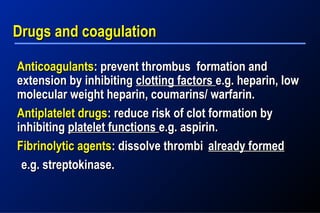
AnticoagulantsAnticoagulants: prevent thrombus formation and: prevent thrombus formation and
extension by inhibitingextension by inhibiting clotting factorsclotting factors e.g. heparin, lowe.g. heparin, low
molecular weight heparin, coumarins/ warfarin.molecular weight heparin, coumarins/ warfarin.
Antiplatelet drugsAntiplatelet drugs: reduce risk of clot formation by: reduce risk of clot formation by
inhibitinginhibiting platelet functionsplatelet functions e.g. aspirin.e.g. aspirin.
Fibrinolytic agentsFibrinolytic agents: dissolve thrombi: dissolve thrombi already formedalready formed
e.g. streptokinase.e.g. streptokinase.
Drugs and coagulationDrugs and coagulation
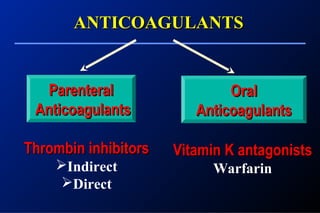
ParenteralParenteral
AnticoagulantsAnticoagulants
OralOral
AnticoagulantsAnticoagulants
ANTICOAGULANTSANTICOAGULANTS
Thrombin inhibitorsThrombin inhibitors
Indirect
Direct
Vitamin K antagonistsVitamin K antagonists
Warfarin
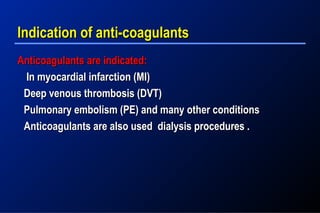
Indication of anti-coagulantsIndication of anti-coagulants
Anticoagulants are indicated:Anticoagulants are indicated:
In myocardial infarction (MI)In myocardial infarction (MI)
Deep venous thrombosis (DVT)Deep venous thrombosis (DVT)
Pulmonary embolism (PE) and many other conditionsPulmonary embolism (PE) and many other conditions
Anticoagulants are also used dialysis procedures .Anticoagulants are also used dialysis procedures .
Indirect Thrombin inhibitorsIndirect Thrombin inhibitors
Heparin and
heparin- related agents
Parenteral AnticoagulantsParenteral Anticoagulants
Heparin and related H- agentsHeparin and related H- agents
Heparin is anHeparin is an injectableinjectable rapidlyrapidly actingacting
anticoagulantanticoagulant
Active inActive in vitro and in vivovitro and in vivo
Low–molecular–weight forms (LMWHs), 1/3Low–molecular–weight forms (LMWHs), 1/3
the size of UFH are used as well and havethe size of UFH are used as well and have
many advantages over UFHmany advantages over UFH
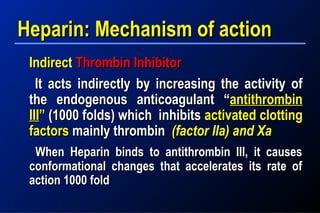
Heparin: Mechanism of actionHeparin: Mechanism of action
IndirectIndirect Thrombin InhibitorThrombin Inhibitor
It acts indirectly by increasing the activity ofIt acts indirectly by increasing the activity of
the endogenous anticoagulant “the endogenous anticoagulant “antithrombinantithrombin
IIIIII”” (1000 folds) which inhibits(1000 folds) which inhibits activatedactivated clottingclotting
factorsfactors mainly thrombinmainly thrombin (factor IIa) and Xa(factor IIa) and Xa
When Heparin binds to antithrombin III, it causesWhen Heparin binds to antithrombin III, it causes
conformational changes that accelerates its rate ofconformational changes that accelerates its rate of
action 1000 foldaction 1000 fold
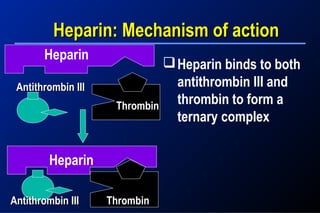
Heparin: Mechanism of actionHeparin: Mechanism of action
Heparin
Antithrombin IIIAntithrombin III
ThrombinThrombin
Heparin binds to both
antithrombin III and
thrombin to form a
ternary complex
Heparin
ThrombinThrombinAntithrombin IIIAntithrombin III
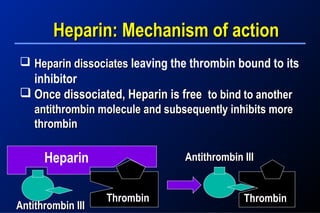
Heparin: Mechanism of actionHeparin: Mechanism of action
 Heparin dissociatesHeparin dissociates leaving the thrombin bound to its
inhibitor
 Once dissociated, Heparin is freeOnce dissociated, Heparin is free to bind to anotherto bind to another
antithrombin molecule and subsequently inhibits moreantithrombin molecule and subsequently inhibits more
thrombinthrombin
Heparin
ThrombinThrombin
Antithrombin IIIAntithrombin III
ThrombinThrombin
UFH : PharmacokineticsUFH : Pharmacokinetics
Heparin is not absorbed from the GITHeparin is not absorbed from the GIT
It should be administered by IV or SC injection.It should be administered by IV or SC injection. NotNot
injected IM as it causes haematomas at injection siteinjected IM as it causes haematomas at injection site
Once in the blood stream, UFH binds to plasma proteins,Once in the blood stream, UFH binds to plasma proteins,
endothelial cells and macrophagesendothelial cells and macrophages
Heparin does not cross the placenta;Heparin does not cross the placenta; thereforetherefore it is theit is the
drug of choice as anticoagulat during pregnancydrug of choice as anticoagulat during pregnancy
Close monitoring of theClose monitoring of the activated partial thromboplastinactivated partial thromboplastin
timetime (aPTT)(aPTT) is necessary in patients receiving UFH.is necessary in patients receiving UFH.
Disadvantages of UFHDisadvantages of UFH
The need for regular monitoring (aPTT)The need for regular monitoring (aPTT)
UFH carries a risk ofUFH carries a risk of heparin-inducedheparin-induced
thrombocytopenia (HIT)thrombocytopenia (HIT), a fall in the platelet, a fall in the platelet
count and increased risk of thrombosis duecount and increased risk of thrombosis due
to binding to plateletsto binding to platelets
UFH: Adverse effectsUFH: Adverse effects
The major adverse effect of heparin isThe major adverse effect of heparin is bleedingbleeding
Allergic reactions (chills, fever, urticaria)Allergic reactions (chills, fever, urticaria) asas
heparin is of animal origin and should be usedheparin is of animal origin and should be used
cautiously in patients with allergycautiously in patients with allergy
Long-term heparin therapy is associated withLong-term heparin therapy is associated with
osteoporosisosteoporosis
Heparin-induced thrombocytopenia (HIT )Heparin-induced thrombocytopenia (HIT )
Reversal of Heparin ActionReversal of Heparin Action
Discontinuation of the drugDiscontinuation of the drug
Heparin is strongly acidic and is neutralizedHeparin is strongly acidic and is neutralized
by i.v.by i.v. protamine sulfateprotamine sulfate (a strongly basic(a strongly basic
protein)protein)
It combines with heparin to form a stableIt combines with heparin to form a stable
complex devoid of anticoagulant activitycomplex devoid of anticoagulant activity
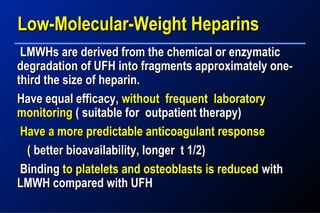
LMWHs are derived from the chemical or enzymaticLMWHs are derived from the chemical or enzymatic
degradation of UFH into fragments approximately one-degradation of UFH into fragments approximately one-
third the size of heparin.third the size of heparin.
Have equal efficacy,Have equal efficacy, without frequent laboratorywithout frequent laboratory
monitoringmonitoring ( suitable for outpatient therapy)( suitable for outpatient therapy)
Have a more predictable anticoagulant responseHave a more predictable anticoagulant response
( better bioavailability, longer t 1/2)( better bioavailability, longer t 1/2)
BindingBinding to platelets and osteoblasts is reducedto platelets and osteoblasts is reduced withwith
LMWH compared with UFHLMWH compared with UFH
Low-Molecular-Weight HeparinsLow-Molecular-Weight Heparins
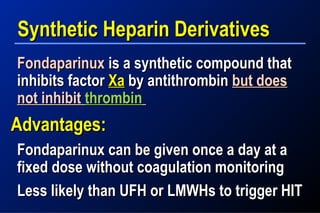
Synthetic Heparin DerivativesSynthetic Heparin Derivatives
FondaparinuxFondaparinux is a synthetic compound thatis a synthetic compound that
inhibits factorinhibits factor XaXa by antithrombinby antithrombin but doesbut does
not inhibitnot inhibit thrombinthrombin
Advantages:Advantages:
Fondaparinux can be given once a day at aFondaparinux can be given once a day at a
fixed dose without coagulation monitoringfixed dose without coagulation monitoring
Less likely than UFH or LMWHs to trigger HITLess likely than UFH or LMWHs to trigger HIT
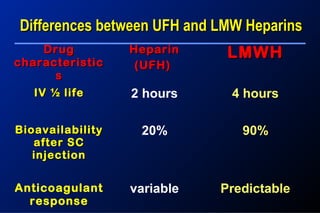
DrugDrug
characteristiccharacteristic
ss
HeparinHeparin
(UFH)(UFH)
LMWHLMWH
IV ½ lifeIV ½ life 2 hours 4 hours
BioavailabilityBioavailability
after SCafter SC
injectioninjection
20% 90%
Anticoagulant
response
variable Predictable
Differences between UFH and LMW HeparinsDifferences between UFH and LMW Heparins
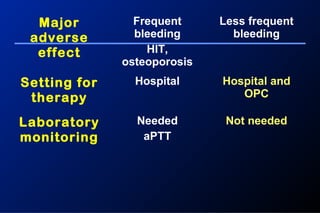
Major
adverse
effect
Frequent
bleeding
HIT,
osteoporosis
Less frequent
bleeding
Setting for
therapy
Hospital Hospital and
OPC
Laboratory
monitoring
Needed
aPTT
Not needed
Direct thrombin inhibitors (DTIs)Direct thrombin inhibitors (DTIs)
DTIs exert their anticoagulant effect byDTIs exert their anticoagulant effect by
directdirect binding to thrombinbinding to thrombin
This direct effect isThis direct effect is rapid and potentrapid and potent
DTIs are not associated with the
development of thrombocytopenia
Direct thrombin inhibitors (DTIs)Direct thrombin inhibitors (DTIs)
The first DTI to be developed wasThe first DTI to be developed was hirudin,hirudin,
LepirudinLepirudin is a polypeptide that bindsis a polypeptide that binds
directlydirectly to the active site of thrombinto the active site of thrombin
Recombinant hirudin “Lepirudin”Recombinant hirudin “Lepirudin” isis usedused
as IV anticoagulant in patients with HITas IV anticoagulant in patients with HIT
Oral AnticoagulantsOral Anticoagulants
““Vitamin K antagonists”Vitamin K antagonists”
WarfarinWarfarin
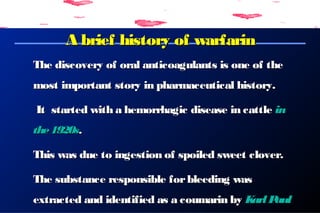
A brief history of warfarinA brief history of warfarin
The discovery of oral anticoagulants is one of theThe discovery of oral anticoagulants is one of the
mostmost importantimportant story in pharmaceutical history.story in pharmaceutical history.
It started with a hemorrhagic disease in cattleIt started with a hemorrhagic disease in cattle inin
the1920sthe1920s..
This was due to ingestion of spoiled sweet clover.This was due to ingestion of spoiled sweet clover.
The substance responsible forbleeding wasThe substance responsible forbleeding was
extracted and identified as a coumarin byextracted and identified as a coumarin by KarlPaulKarlPaul
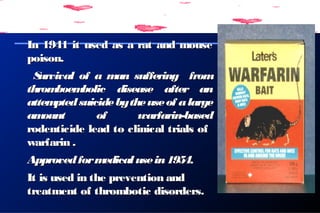
In 1941 it used as a rat and mouseIn 1941 it used as a rat and mouse
poison.poison.
Survival of a man suffering fromSurvival of a man suffering from
thromboembolic disease after anthromboembolic disease after an
attemptedsuicidebytheuseof alargeattemptedsuicidebytheuseof alarge
amount of warfarin-basedamount of warfarin-based
rodenticide lead to clinical trials ofrodenticide lead to clinical trials of
warfarin .warfarin .
Approvedformedicalusein1954Approvedformedicalusein1954..
It is used in the prevention andIt is used in the prevention and
treatment of thrombotic disorders.treatment of thrombotic disorders.
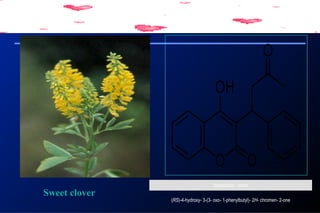
Sweet clover
Systematic name
(RS)-4-hydroxy- 3-(3- oxo- 1-phenylbutyl)- 2H- chromen- 2-one
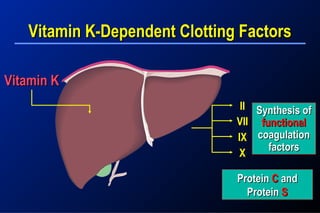
Vitamin KVitamin K
Synthesis ofSynthesis of
functionalfunctional
coagulationcoagulation
factorsfactors
IIII
VIIVII
IXIX
XX
Vitamin K-Dependent Clotting FactorsVitamin K-Dependent Clotting Factors
ProteinProtein CC andand
ProteinProtein SS
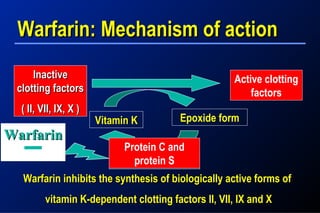
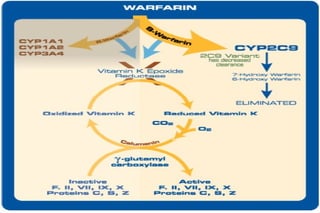
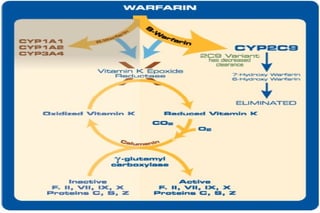
Warfarin: Mechanism of actionWarfarin: Mechanism of action
InactiveInactive
clotting factorsclotting factors
( II, VII, IX, X )( II, VII, IX, X )
Active clotting
factors
Vitamin KVitamin K Epoxide form
Epoxide reductase
Warfarin inhibits the synthesis of biologically active forms ofWarfarin inhibits the synthesis of biologically active forms of
vitamin K-dependent clotting factors II, VII, IX and Xvitamin K-dependent clotting factors II, VII, IX and X
WarfarinWarfarin
Protein C and
protein S
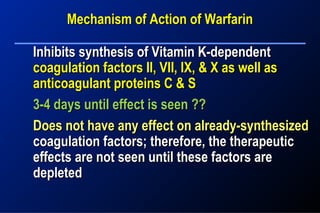
Mechanism of Action of WarfarinMechanism of Action of Warfarin
Inhibits synthesis of Vitamin K-dependentInhibits synthesis of Vitamin K-dependent
coagulation factors II, VII, IX, & X as well ascoagulation factors II, VII, IX, & X as well as
anticoagulant proteins C & Santicoagulant proteins C & S
3-4 days until effect is seen ??3-4 days until effect is seen ??
Does not have any effect on already-synthesizedDoes not have any effect on already-synthesized
coagulation factors; therefore, the therapeuticcoagulation factors; therefore, the therapeutic
effects are not seen until these factors areeffects are not seen until these factors are
depleteddepleted
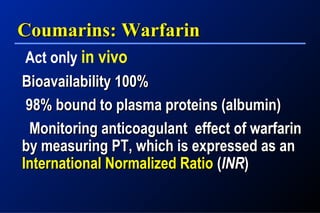
Coumarins: WarfarinCoumarins: Warfarin
Act only in vivo
Bioavailability 100%Bioavailability 100%
98% bound to plasma proteins (albumin)98% bound to plasma proteins (albumin)
Monitoring anticoagulant effect of warfarinMonitoring anticoagulant effect of warfarin
by measuring PT, which is expressed as anby measuring PT, which is expressed as an
International Normalized RatioInternational Normalized Ratio ((INRINR))
Coumarins: WarfarinCoumarins: Warfarin
Their effect takes several days (3-4 ) to developTheir effect takes several days (3-4 ) to develop
because of the time taken for degradation ofbecause of the time taken for degradation of
circulatingcirculating functional clotting factorsfunctional clotting factors
Therefore the onset of action starts when theseTherefore the onset of action starts when these
factors have been eliminatedfactors have been eliminated
Warfarin has a slow offset of action due to theWarfarin has a slow offset of action due to the
time required for synthesis of new,time required for synthesis of new, functionalfunctional
coagulation factorscoagulation factors
Disadvantages of Warfarin therapy
Variable, unpredictable effect necessitating regular
INR monitoring and dose adjustment
Narrow therapeutic window leading to increased risk
of severe bleeding
Slow onset and offset of action
Numerous interactions with foods containing vitamin
K and drugs
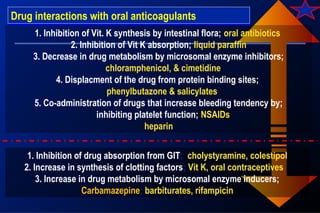
Drug interactions with oral anticoagulantsDrug interactions with oral anticoagulants
1. Inhibition of Vit. K synthesis by intestinal flora; oral antibiotics
2. Inhibition of Vit K absorption; liquid paraffin
3. Decrease in drug metabolism by microsomal enzyme inhibitors;
chloramphenicol, & cimetidine
4. Displacment of the drug from protein binding sites;
phenylbutazone & salicylates
5. Co-administration of drugs that increase bleeding tendency by;
inhibiting platelet function; NSAIDs
heparin
1. Inhibition of drug absorption from GIT; cholystyramine, colestipol
2. Increase in synthesis of clotting factors; Vit K, oral contraceptives
3. Increase in drug metabolism by microsomal enzyme inducers;
Carbamazepine; barbiturates, rifampicin
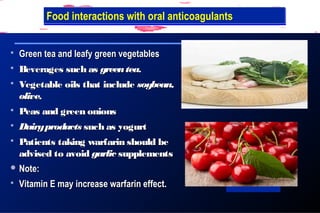
 Green tea and leafy green vegetablesGreen tea and leafy green vegetables
 Beverages such asBeverages such as greenteagreentea..
 Vegetable oils that includeVegetable oils that include soybean,soybean,
oliveolive..
 Peas and green onionsPeas and green onions
 DairyproductsDairyproducts such as yogurtsuch as yogurt
 Patients taking warfarin should bePatients taking warfarin should be
advised to avoidadvised to avoid garlicgarlic supplementssupplements
 Note:Note:
 Vitamin E may increase warfarin effect.Vitamin E may increase warfarin effect.
Vitamin K ,Foods to Avoid while on WarfarinFood interactions with oral anticoagulantsFood interactions with oral anticoagulants
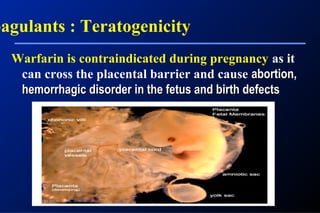
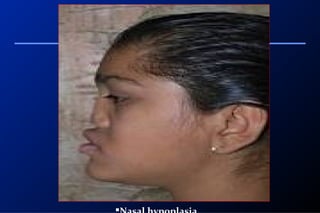
Warfarin is contraindicated during pregnancy as it
can cross the placental barrier and cause abortion,abortion,
hemorrhagic disorder in the fetus and birth defectshemorrhagic disorder in the fetus and birth defects
oagulants : Teratogenicity
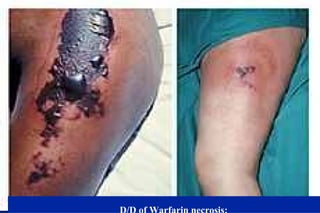
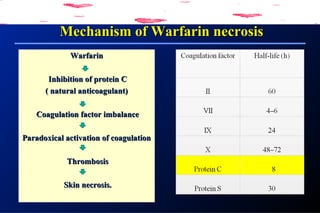
Mechanism of Warfarin necrosisMechanism of Warfarin necrosis
WarfarinWarfarin
Inhibition of protein CInhibition of protein C
( natural anticoagulant)( natural anticoagulant)
Coagulation factor imbalanceCoagulation factor imbalance
Paradoxical activation of coagulationParadoxical activation of coagulation
ThrombosisThrombosis
Skin necrosis.Skin necrosis.
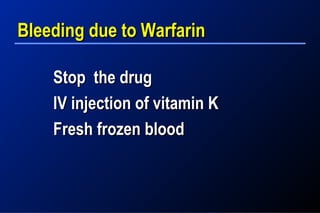
Bleeding due to WarfarinBleeding due to Warfarin
Stop the drugStop the drug
IV injection of vitamin KIV injection of vitamin K
Fresh frozen bloodFresh frozen blood
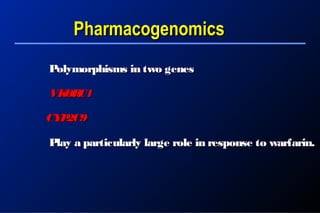
  Polymorphisms in two genesPolymorphisms in two genes
VKORC1VKORC1    
CYP2C9CYP2C9
Play a particularly large role in response to warfarin.Play a particularly large role in response to warfarin.
PharmacogenomicsPharmacogenomics
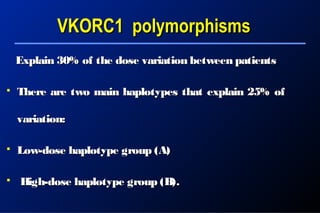
Explain 30% of the dose variation between patientsExplain 30% of the dose variation between patients
 There are two main haplotypes that explain 25% ofThere are two main haplotypes that explain 25% of
variation:variation:
 Low-dose haplotype group (A)Low-dose haplotype group (A)
 High-dose haplotype group (B).High-dose haplotype group (B).
VKORC1 polymorphismsVKORC1 polymorphisms
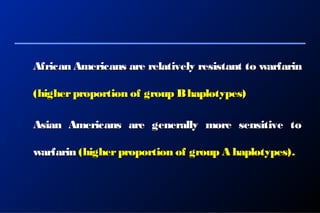
African Americans are relatively resistant to warfarinAfrican Americans are relatively resistant to warfarin
(higherproportion of group Bhaplotypes)(higherproportion of group Bhaplotypes)
Asian Americans are generally more sensitive toAsian Americans are generally more sensitive to
warfarinwarfarin (higherproportion of group A haplotypes).(higherproportion of group A haplotypes).
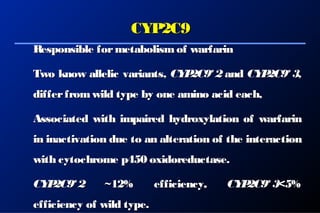
CYP2C9CYP2C9
Responsible formetabolismof warfarinResponsible formetabolismof warfarin
Two know allelic variants,Two know allelic variants, CYP2C9*2CYP2C9*2 andand CYP2C9*3CYP2C9*3,,
differfromwild type by one amino acid each,differfromwild type by one amino acid each,
Associated with impaired hydroxylation of warfarinAssociated with impaired hydroxylation of warfarin
in inactivation due to an alteration of the interactionin inactivation due to an alteration of the interaction
with cytochrome p450 oxidoreductase.with cytochrome p450 oxidoreductase.
CYP2C9*2CYP2C9*2 ~12% efficiency~12% efficiency, CYP2C9*3, CYP2C9*3<5%<5%
efficiency of wild type.efficiency of wild type.
Anticoagulant therapy

Anticoagulant therapy

  • 1.
  • 2.
    AnticoagulantsAnticoagulants: prevent thrombusformation and: prevent thrombus formation and extension by inhibitingextension by inhibiting clotting factorsclotting factors e.g. heparin, lowe.g. heparin, low molecular weight heparin, coumarins/ warfarin.molecular weight heparin, coumarins/ warfarin. Antiplatelet drugsAntiplatelet drugs: reduce risk of clot formation by: reduce risk of clot formation by inhibitinginhibiting platelet functionsplatelet functions e.g. aspirin.e.g. aspirin. Fibrinolytic agentsFibrinolytic agents: dissolve thrombi: dissolve thrombi already formedalready formed e.g. streptokinase.e.g. streptokinase. Drugs and coagulationDrugs and coagulation
  • 3.
  • 4.
    Indication of anti-coagulantsIndicationof anti-coagulants Anticoagulants are indicated:Anticoagulants are indicated: In myocardial infarction (MI)In myocardial infarction (MI) Deep venous thrombosis (DVT)Deep venous thrombosis (DVT) Pulmonary embolism (PE) and many other conditionsPulmonary embolism (PE) and many other conditions Anticoagulants are also used dialysis procedures .Anticoagulants are also used dialysis procedures .
  • 5.
    Indirect Thrombin inhibitorsIndirectThrombin inhibitors Heparin and heparin- related agents Parenteral AnticoagulantsParenteral Anticoagulants
  • 6.
    Heparin and relatedH- agentsHeparin and related H- agents Heparin is anHeparin is an injectableinjectable rapidlyrapidly actingacting anticoagulantanticoagulant Active inActive in vitro and in vivovitro and in vivo Low–molecular–weight forms (LMWHs), 1/3Low–molecular–weight forms (LMWHs), 1/3 the size of UFH are used as well and havethe size of UFH are used as well and have many advantages over UFHmany advantages over UFH
  • 7.
    Heparin: Mechanism ofactionHeparin: Mechanism of action IndirectIndirect Thrombin InhibitorThrombin Inhibitor It acts indirectly by increasing the activity ofIt acts indirectly by increasing the activity of the endogenous anticoagulant “the endogenous anticoagulant “antithrombinantithrombin IIIIII”” (1000 folds) which inhibits(1000 folds) which inhibits activatedactivated clottingclotting factorsfactors mainly thrombinmainly thrombin (factor IIa) and Xa(factor IIa) and Xa When Heparin binds to antithrombin III, it causesWhen Heparin binds to antithrombin III, it causes conformational changes that accelerates its rate ofconformational changes that accelerates its rate of action 1000 foldaction 1000 fold
  • 8.
    Heparin: Mechanism ofactionHeparin: Mechanism of action Heparin Antithrombin IIIAntithrombin III ThrombinThrombin Heparin binds to both antithrombin III and thrombin to form a ternary complex Heparin ThrombinThrombinAntithrombin IIIAntithrombin III
  • 9.
    Heparin: Mechanism ofactionHeparin: Mechanism of action  Heparin dissociatesHeparin dissociates leaving the thrombin bound to its inhibitor  Once dissociated, Heparin is freeOnce dissociated, Heparin is free to bind to anotherto bind to another antithrombin molecule and subsequently inhibits moreantithrombin molecule and subsequently inhibits more thrombinthrombin Heparin ThrombinThrombin Antithrombin IIIAntithrombin III Antithrombin IIIAntithrombin III ThrombinThrombin
  • 10.
    UFH : PharmacokineticsUFH: Pharmacokinetics Heparin is not absorbed from the GITHeparin is not absorbed from the GIT It should be administered by IV or SC injection.It should be administered by IV or SC injection. NotNot injected IM as it causes haematomas at injection siteinjected IM as it causes haematomas at injection site Once in the blood stream, UFH binds to plasma proteins,Once in the blood stream, UFH binds to plasma proteins, endothelial cells and macrophagesendothelial cells and macrophages Heparin does not cross the placenta;Heparin does not cross the placenta; thereforetherefore it is theit is the drug of choice as anticoagulat during pregnancydrug of choice as anticoagulat during pregnancy Close monitoring of theClose monitoring of the activated partial thromboplastinactivated partial thromboplastin timetime (aPTT)(aPTT) is necessary in patients receiving UFH.is necessary in patients receiving UFH.
  • 11.
    Disadvantages of UFHDisadvantagesof UFH The need for regular monitoring (aPTT)The need for regular monitoring (aPTT) UFH carries a risk ofUFH carries a risk of heparin-inducedheparin-induced thrombocytopenia (HIT)thrombocytopenia (HIT), a fall in the platelet, a fall in the platelet count and increased risk of thrombosis duecount and increased risk of thrombosis due to binding to plateletsto binding to platelets
  • 12.
    UFH: Adverse effectsUFH:Adverse effects The major adverse effect of heparin isThe major adverse effect of heparin is bleedingbleeding Allergic reactions (chills, fever, urticaria)Allergic reactions (chills, fever, urticaria) asas heparin is of animal origin and should be usedheparin is of animal origin and should be used cautiously in patients with allergycautiously in patients with allergy Long-term heparin therapy is associated withLong-term heparin therapy is associated with osteoporosisosteoporosis Heparin-induced thrombocytopenia (HIT )Heparin-induced thrombocytopenia (HIT )
  • 13.
    Reversal of HeparinActionReversal of Heparin Action Discontinuation of the drugDiscontinuation of the drug Heparin is strongly acidic and is neutralizedHeparin is strongly acidic and is neutralized by i.v.by i.v. protamine sulfateprotamine sulfate (a strongly basic(a strongly basic protein)protein) It combines with heparin to form a stableIt combines with heparin to form a stable complex devoid of anticoagulant activitycomplex devoid of anticoagulant activity
  • 14.
    LMWHs are derivedfrom the chemical or enzymaticLMWHs are derived from the chemical or enzymatic degradation of UFH into fragments approximately one-degradation of UFH into fragments approximately one- third the size of heparin.third the size of heparin. Have equal efficacy,Have equal efficacy, without frequent laboratorywithout frequent laboratory monitoringmonitoring ( suitable for outpatient therapy)( suitable for outpatient therapy) Have a more predictable anticoagulant responseHave a more predictable anticoagulant response ( better bioavailability, longer t 1/2)( better bioavailability, longer t 1/2) BindingBinding to platelets and osteoblasts is reducedto platelets and osteoblasts is reduced withwith LMWH compared with UFHLMWH compared with UFH Low-Molecular-Weight HeparinsLow-Molecular-Weight Heparins
  • 15.
    Synthetic Heparin DerivativesSyntheticHeparin Derivatives FondaparinuxFondaparinux is a synthetic compound thatis a synthetic compound that inhibits factorinhibits factor XaXa by antithrombinby antithrombin but doesbut does not inhibitnot inhibit thrombinthrombin Advantages:Advantages: Fondaparinux can be given once a day at aFondaparinux can be given once a day at a fixed dose without coagulation monitoringfixed dose without coagulation monitoring Less likely than UFH or LMWHs to trigger HITLess likely than UFH or LMWHs to trigger HIT
  • 16.
    DrugDrug characteristiccharacteristic ss HeparinHeparin (UFH)(UFH) LMWHLMWH IV ½ lifeIV½ life 2 hours 4 hours BioavailabilityBioavailability after SCafter SC injectioninjection 20% 90% Anticoagulant response variable Predictable Differences between UFH and LMW HeparinsDifferences between UFH and LMW Heparins
  • 17.
  • 18.
    Direct thrombin inhibitors(DTIs)Direct thrombin inhibitors (DTIs) DTIs exert their anticoagulant effect byDTIs exert their anticoagulant effect by directdirect binding to thrombinbinding to thrombin This direct effect isThis direct effect is rapid and potentrapid and potent DTIs are not associated with the development of thrombocytopenia
  • 19.
    Direct thrombin inhibitors(DTIs)Direct thrombin inhibitors (DTIs) The first DTI to be developed wasThe first DTI to be developed was hirudin,hirudin, LepirudinLepirudin is a polypeptide that bindsis a polypeptide that binds directlydirectly to the active site of thrombinto the active site of thrombin Recombinant hirudin “Lepirudin”Recombinant hirudin “Lepirudin” isis usedused as IV anticoagulant in patients with HITas IV anticoagulant in patients with HIT
  • 20.
    Oral AnticoagulantsOral Anticoagulants ““VitaminK antagonists”Vitamin K antagonists”
  • 21.
  • 22.
    A brief historyof warfarinA brief history of warfarin The discovery of oral anticoagulants is one of theThe discovery of oral anticoagulants is one of the mostmost importantimportant story in pharmaceutical history.story in pharmaceutical history. It started with a hemorrhagic disease in cattleIt started with a hemorrhagic disease in cattle inin the1920sthe1920s.. This was due to ingestion of spoiled sweet clover.This was due to ingestion of spoiled sweet clover. The substance responsible forbleeding wasThe substance responsible forbleeding was extracted and identified as a coumarin byextracted and identified as a coumarin by KarlPaulKarlPaul
  • 23.
    In 1941 itused as a rat and mouseIn 1941 it used as a rat and mouse poison.poison. Survival of a man suffering fromSurvival of a man suffering from thromboembolic disease after anthromboembolic disease after an attemptedsuicidebytheuseof alargeattemptedsuicidebytheuseof alarge amount of warfarin-basedamount of warfarin-based rodenticide lead to clinical trials ofrodenticide lead to clinical trials of warfarin .warfarin . Approvedformedicalusein1954Approvedformedicalusein1954.. It is used in the prevention andIt is used in the prevention and treatment of thrombotic disorders.treatment of thrombotic disorders.
  • 24.
    Sweet clover Systematic name (RS)-4-hydroxy-3-(3- oxo- 1-phenylbutyl)- 2H- chromen- 2-one
  • 25.
    Vitamin KVitamin K SynthesisofSynthesis of functionalfunctional coagulationcoagulation factorsfactors IIII VIIVII IXIX XX Vitamin K-Dependent Clotting FactorsVitamin K-Dependent Clotting Factors ProteinProtein CC andand ProteinProtein SS
  • 26.
    Warfarin: Mechanism ofactionWarfarin: Mechanism of action InactiveInactive clotting factorsclotting factors ( II, VII, IX, X )( II, VII, IX, X ) Active clotting factors Vitamin KVitamin K Epoxide form Epoxide reductase Warfarin inhibits the synthesis of biologically active forms ofWarfarin inhibits the synthesis of biologically active forms of vitamin K-dependent clotting factors II, VII, IX and Xvitamin K-dependent clotting factors II, VII, IX and X WarfarinWarfarin Protein C and protein S
  • 27.
    Mechanism of Actionof WarfarinMechanism of Action of Warfarin Inhibits synthesis of Vitamin K-dependentInhibits synthesis of Vitamin K-dependent coagulation factors II, VII, IX, & X as well ascoagulation factors II, VII, IX, & X as well as anticoagulant proteins C & Santicoagulant proteins C & S 3-4 days until effect is seen ??3-4 days until effect is seen ?? Does not have any effect on already-synthesizedDoes not have any effect on already-synthesized coagulation factors; therefore, the therapeuticcoagulation factors; therefore, the therapeutic effects are not seen until these factors areeffects are not seen until these factors are depleteddepleted
  • 29.
    Coumarins: WarfarinCoumarins: Warfarin Actonly in vivo Bioavailability 100%Bioavailability 100% 98% bound to plasma proteins (albumin)98% bound to plasma proteins (albumin) Monitoring anticoagulant effect of warfarinMonitoring anticoagulant effect of warfarin by measuring PT, which is expressed as anby measuring PT, which is expressed as an International Normalized RatioInternational Normalized Ratio ((INRINR))
  • 30.
    Coumarins: WarfarinCoumarins: Warfarin Theireffect takes several days (3-4 ) to developTheir effect takes several days (3-4 ) to develop because of the time taken for degradation ofbecause of the time taken for degradation of circulatingcirculating functional clotting factorsfunctional clotting factors Therefore the onset of action starts when theseTherefore the onset of action starts when these factors have been eliminatedfactors have been eliminated Warfarin has a slow offset of action due to theWarfarin has a slow offset of action due to the time required for synthesis of new,time required for synthesis of new, functionalfunctional coagulation factorscoagulation factors
  • 31.
    Disadvantages of Warfarintherapy Variable, unpredictable effect necessitating regular INR monitoring and dose adjustment Narrow therapeutic window leading to increased risk of severe bleeding Slow onset and offset of action Numerous interactions with foods containing vitamin K and drugs
  • 32.
    Drug interactions withoral anticoagulantsDrug interactions with oral anticoagulants 1. Inhibition of Vit. K synthesis by intestinal flora; oral antibiotics 2. Inhibition of Vit K absorption; liquid paraffin 3. Decrease in drug metabolism by microsomal enzyme inhibitors; chloramphenicol, & cimetidine 4. Displacment of the drug from protein binding sites; phenylbutazone & salicylates 5. Co-administration of drugs that increase bleeding tendency by; inhibiting platelet function; NSAIDs heparin 1. Inhibition of drug absorption from GIT; cholystyramine, colestipol 2. Increase in synthesis of clotting factors; Vit K, oral contraceptives 3. Increase in drug metabolism by microsomal enzyme inducers; Carbamazepine; barbiturates, rifampicin
  • 33.
     Green teaand leafy green vegetablesGreen tea and leafy green vegetables  Beverages such asBeverages such as greenteagreentea..  Vegetable oils that includeVegetable oils that include soybean,soybean, oliveolive..  Peas and green onionsPeas and green onions  DairyproductsDairyproducts such as yogurtsuch as yogurt  Patients taking warfarin should bePatients taking warfarin should be advised to avoidadvised to avoid garlicgarlic supplementssupplements  Note:Note:  Vitamin E may increase warfarin effect.Vitamin E may increase warfarin effect. Vitamin K ,Foods to Avoid while on WarfarinFood interactions with oral anticoagulantsFood interactions with oral anticoagulants
  • 34.
    Warfarin is contraindicatedduring pregnancy as it can cross the placental barrier and cause abortion,abortion, hemorrhagic disorder in the fetus and birth defectshemorrhagic disorder in the fetus and birth defects oagulants : Teratogenicity
  • 37.
    Mechanism of WarfarinnecrosisMechanism of Warfarin necrosis WarfarinWarfarin Inhibition of protein CInhibition of protein C ( natural anticoagulant)( natural anticoagulant) Coagulation factor imbalanceCoagulation factor imbalance Paradoxical activation of coagulationParadoxical activation of coagulation ThrombosisThrombosis Skin necrosis.Skin necrosis.
  • 38.
    Bleeding due toWarfarinBleeding due to Warfarin Stop the drugStop the drug IV injection of vitamin KIV injection of vitamin K Fresh frozen bloodFresh frozen blood
  • 39.
      Polymorphisms in two genesPolymorphisms intwo genes VKORC1VKORC1     CYP2C9CYP2C9 Play a particularly large role in response to warfarin.Play a particularly large role in response to warfarin. PharmacogenomicsPharmacogenomics
  • 40.
    Explain 30% ofthe dose variation between patientsExplain 30% of the dose variation between patients  There are two main haplotypes that explain 25% ofThere are two main haplotypes that explain 25% of variation:variation:  Low-dose haplotype group (A)Low-dose haplotype group (A)  High-dose haplotype group (B).High-dose haplotype group (B). VKORC1 polymorphismsVKORC1 polymorphisms
  • 41.
    African Americans arerelatively resistant to warfarinAfrican Americans are relatively resistant to warfarin (higherproportion of group Bhaplotypes)(higherproportion of group Bhaplotypes) Asian Americans are generally more sensitive toAsian Americans are generally more sensitive to warfarinwarfarin (higherproportion of group A haplotypes).(higherproportion of group A haplotypes).
  • 42.
    CYP2C9CYP2C9 Responsible formetabolismof warfarinResponsibleformetabolismof warfarin Two know allelic variants,Two know allelic variants, CYP2C9*2CYP2C9*2 andand CYP2C9*3CYP2C9*3,, differfromwild type by one amino acid each,differfromwild type by one amino acid each, Associated with impaired hydroxylation of warfarinAssociated with impaired hydroxylation of warfarin in inactivation due to an alteration of the interactionin inactivation due to an alteration of the interaction with cytochrome p450 oxidoreductase.with cytochrome p450 oxidoreductase. CYP2C9*2CYP2C9*2 ~12% efficiency~12% efficiency, CYP2C9*3, CYP2C9*3<5%<5% efficiency of wild type.efficiency of wild type.

Editor's Notes

  • #27 The anticoagulant effect of vitamin K antagonists, such as warfarin, is due to the synthesis of non-functional clotting factors. Prothrombin, factors VII, IX and X as well as anticoagulant protein C and protein S are all inactivated by vitamin K antagonists