Interlocks & Protection
AH, ID, FD, PA Fans & BD Valves
Rajneesh Vachaspati
Dy Director,NPTI
Flue gas Path
• Dampers Needed to be Opened before AH is
started
Dampers Open
AH Air
Motors
AH AC
Motors
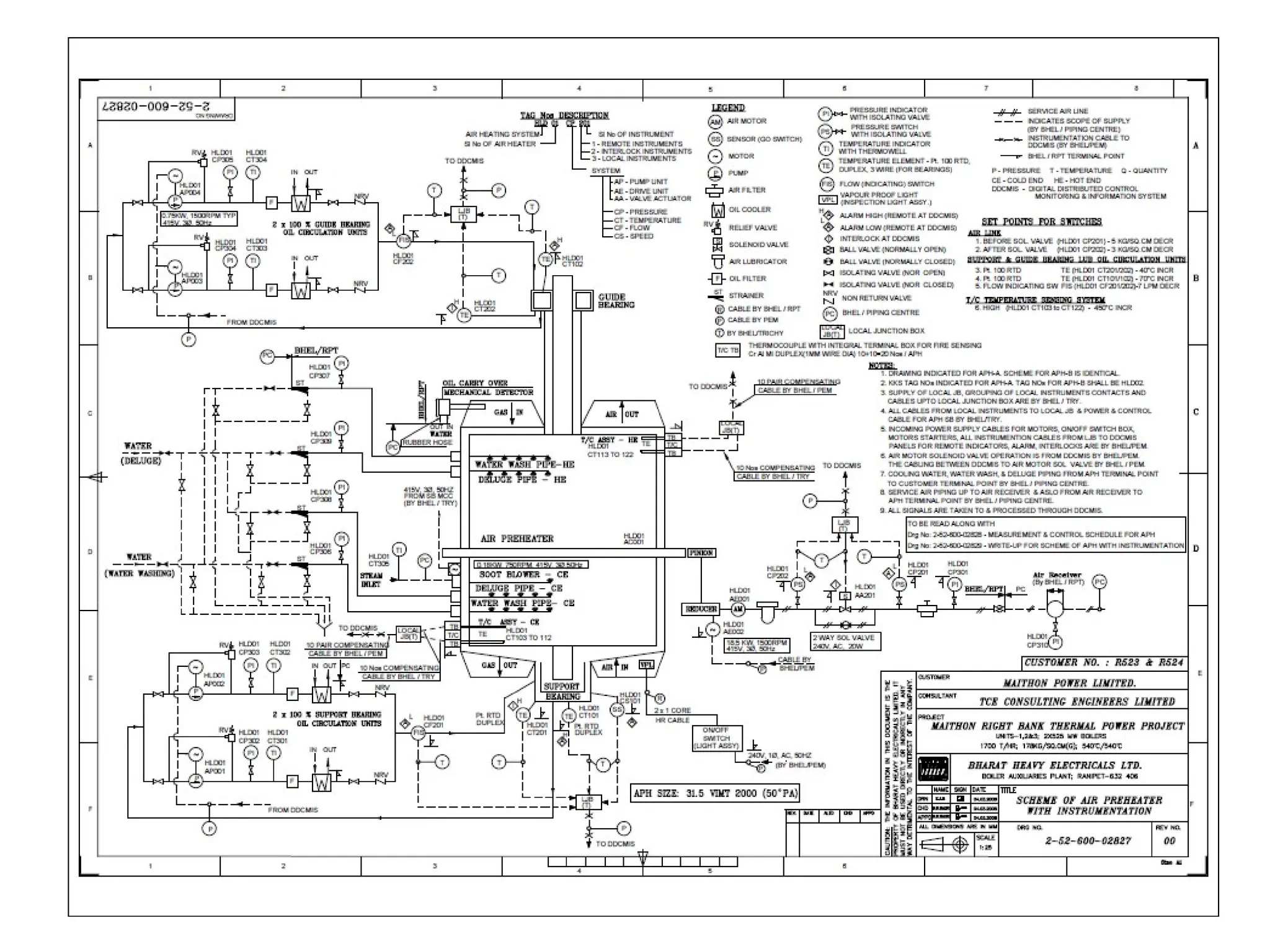
Starting of Rotary APH
• The lub. Oil pumps of support and guide bearings can be started
from the control room but preferably from Local for the first time.
• Start any one of the pumps locally and see no oil leakage.
• Check the lube oil pressure.
• Stop the pump and start the other pump and see that the flow
and pressure are normal and that there is no oil leakage.
• Now open the air valve for starting the air motor of APH A or B as
the case may be. As the main drives are not in service, the
solenoid will supply air to air motor.
• Check the operation of APH for any abnormal sound or abnormal
seal rubbing.
• If the performance is normal, the main drive can be started locally
or from remote.
Starting of Rotary APH
• Check the performance of APH on main drive-the load current and
abnormal sound and vibrations are to be watched.
• On starting the main drive, the Air motor shall stop. This can be
verified in control room by the indication given from the service air
pressure switch, provided in the line.
• Now stop the main drive from Control room and check that the Air
motor comes on Auto.
• The air preheater soot blowers are to operated at regular intervals,
after lighting up of the boiler.
• The DP across Air preheaters has to be watched closely to see that
the APHs are free from choking.
• The oxygen and carbon dioxide levels in flue gas, before and after
APH have to be measured once in a shift to see the performance of
the boiler as well as APH. Abnormal drop in carbon dioxide level
after APH shall indicate poor performance of the APH seals. Normal
Drop: 2%.
Rotary Air Heater Interlocks
Rotary AHs are the first auxiliary to start Boiler.
CONDITIONS BEFORE START UP OF AHS:
• Both AHS are off (both AC motors and Air motors are off)
• The inlet dampers and the outlet dampers in the gas path,
secondary air path, primary air path are in full open condition.
STARTING AH ‘A’ (AH ‘B’ IS OFF) OR AH ‘B’ (AH ‘A’ is OFF
• AH ‘A’/’B’ AC motor is started. If the temperature of the
bearings is less than 70 Deg.C
• Whenever AH AC motor trips impulse shall be given for
starting Air motor provided the temperature of support/guide
bearing of AH ‘A’ is less than 70 Deg. C.
• Impulse shall be given for closing of the inlet and outlet
dampers of AH which is off.
Tripping of Air heaters
TRIPPING OF AH ‘A’ (AH ‘B’ IS OFF)/TRIPPING OF AH ‘B’ (AH
‘A’ IS OFF)
• AH AC motor/Air motor shall trip manually when the
temperature of support/guide bearing of AH is very
high (i.e. greater than 70 Deg. C). Under this
condition AH Air motor shall be prohibited from
starting.
• Air motor shall trip automatically when AH AC motor
starts.
NOTE: Trip signal of AH is to be taken from both AC &
Air motors trip
Tripping Sequence Of Air Heaters
Condition A:- BOTH AHS ARE WORKING WHEN ONE TRIPS
AND OTHER AH CONTINUES TO RUN:
• The gas inlet damper the secondary air inlet
damper and primary air inlet damper of the tripped
AH shall automatically closed. The gas outlet
damper, the secondary air outlet damper and PA
outlet damper of the tripped AH need not be
closed.
• However, if the operator wants to manually close
these outlet dampers they can be closed
TRIPPING OF AIR HEATERS
Condition B:- ONE AH IS WORKING AND THE OTHER AH IS OFF:
• If the working Airheater trips, the operator shall try
for restarting the AH.
• If the restarting is not within 5 minutes, the boiler
shall be tripped.
Condition C:- BOTH AHS ARE WORKING AND TRIPPED.
• If both AHS ‘A’ and ‘B’ trip the operator may try for
restarting the AHs. If any one of the AH is not started
within 5 minutes the operator shall manually trip the
boiler within 5 minutes.
INTERLOCKS FOR LUBE OIL PUMPS OF
SUPPORT & GUIDE BEARINGS OF AH A & B
2x100% lube oil pump have been provided for the support
bearing. Any of the two lubricating oil pumps can be preselected
as main pump and the other as standby.
Following interlocks shall be provided for lub oil pumps.
• Whenever the temperature of support bearing of air heater A
is high (350
C), impulse shall be given to start the main oil pump.
• The standby oil pump shall start when the main oil pump fails
to start or trips.
• The main oil pump / stand by oil pump shall trip when the
temperature of the support bearing falls below a present value
(300
C)
Flue Gas Cycle.. Starting of ID Fans
Dampers Open
Dampers Closed
ID Fan Pre-checks
• Ensure the manholes are closed.
• Check the availability of instruments to measure flow, pressure,
temperature etc. of the ID fan and drive motor.
• Check the closing and the opening of the suction and discharge gates.
Keep them closed before starting the ID fan.
• Check healthiness of all the protections and interlocks for their
functioning.
• Ensure the local push button is in the released position.
• Check that the discharge dampers of blower motors are open and the
modules are kept ON for supply.
• Check that the flue gas path is made through
– APH inlet flue gas dampers are open .
– ESP inlet gates are open .
– ESP outlet gates are open .
• Check that the seal trough is filled with water and overflow is maintained.
• Start the ID fan after ensuring the healthiness of protections whenever the
fan is to be started after long shutdown.
Starting Permissive for ID Fan
Check that the final start permissive is available. The final start
permissive will get available if the following conditions are satisfied,
• ID fan stopped.
• Cooling water to the coolers adequate.
• Suction gate closed.
• Discharge gate closed.
• Ensure VFD for minimum speed.
• ID fan tripped indication should not exist.
• Ensure 220 V DC control supply for the breaker of other ID fans is
available.
• Now the first ID fan can be started
Post Start Checks of ID Fans
• Check the opening of gates on interlock, after 10
secs.
• Check the performance of the motor.
• Check adequate lub. oil pressure.
• Check the starting of both the discharge gate
blower motors on interlock. If not , start manually.
• Maintain the furnace vacuum at -12 mmWC by
suitable loading of the fan.
I.D. FAN INTERLOCKS
Conditions existing when the unit is shut
down and prior to starting of ID fans.
• Either or both AHs are running.
• I.D. Fan ‘A’ and ID Fan ‘B’ off.
• Regulating dampers of fans A&B open.
• Inlet gates of Fans A & B open.
• Outlet gates of fans A & B open.
• The regulating dampers will be on manual control during
shut down and impulse from furnace draft control to
regulating dampers of ID fans disconnected.
Starting ID Fan ‘A’ (ID Fan ‘B’ Off) Interlocks
ID Fan ‘A’ shall be prohibited from starting till the
following conditions are satisfied.
1. Regulating damper of Fan-A in minimum position.
2. Outlet gate of Fan-A closed.
3. Inlet gate of Fan-A closed.
4. Fan/fan motor bearing temperature not very
high.
5. One of the air preheaters running.
For starting ID Fan B ( ID Fan A is off)
Interlocks similar to those as above shall hold good of this conditions.
Starting ID Fan ‘A’
When ID fan ‘A’ is started (ID Fan B is off), impulses shall
be give for.
1. Opening the inlet gate and outlet gate of Fan A after
the motor reaches the rated speed.
2. Connecting the regulating damper of Fan A to the
auto control.
3. Closing the inlet gate and the outlet gate of ID Fan B
and bringin the regulating damper to minimum
position.
4. Permission to start either FD Fan A or FD Fan B.
Tripping of ID Fan A (ID fan B is off)
ID Fan ‘A’ shall trip automatically under following
conditions.
1. ID Fan A bearing temperature too high (prior to this,
ID Fan A bearing temperature high shall be
annunciated in UCB).
2. ID Fan A motor bearing temperature too high (prior
to this, ID Fan a motor bearing temperature high shall
be annunciated in UCB).
3. Post purge fan trip (contact from FSSS)
4. Vibration level of FAN/MOTOR very high.
Tripping of ID Fan B (ID Fan A is off):
Interlocks similar to those above shall hold good for this condition.
Tripping of ID Fan
When ID Fan A trips (ID Fan B is off) impulses shall be given for:
1. Opening the outlet gate of ID Fan B.
2. Opening the inlet gate of ID Fan B.
3. Opening the regulating damper of ID Fan B to wide open
position.
4. Disconnecting the regulators impulse from acting on
regulating damper of ID Fan A.
5. Opening the regulating damper of ID Fan A to wide open
position.
6. Tripping the working FD Fans.
7. Boiler tripping.
8. To keep the inlet gate and outlet gate of ID Fan A open.
Starting of ID Fan B (ID Fan A is on)
ID Fan B shall be prohibited from starting unless
the following conditions are satisfied.
1. Outlet gate of Fan B is closed.
2. Inlet gate of Fan B is closed.
3. Regulating damper of Fan Bareing minimum
position.
4. Fan/fan motor bearing temperature not very
high.
Starting of ID Fan A (ID fan B is on)
Interlocks similar to above shall hold good for this condition.
Both ID Fans Started
• When ID Fan B is started, impulses shall be
given for.
• Opening the inlet gate and outlet gate of Fan B
after the motor reaches rated speed.
• Connecting the regulating damper of Fan B to
auto control.
• Permission to start other FD Fan.
Tripping of ID Fan B (ID Fan A is on)
ID Fan B shall trip automatically under the
following conditions.
• Fan bearing temperature too high (prior to this
fan bearing temperature high shall be
annunciated in UCB)
• Fan motor bearing temperature too high (Prior to
this fan motor bearing temperature high shall be
annunciated in UCB)
• Vibration level of Fan/motor very high.
Tripping ID Fan A (ID fan B is on)
Interlocks similar to above shall hold good for this condition.
Post Purge Fan Trippings
When ID Fan B trips (ID Fan A is on) impulses shall be given
for:
1. Disconnecting the regulator from acting on the
regulating damper of Fan B.
2. Bringing the regulating damper of Fan B to the
minimum position.
3. Closing the inlet gate of Fan B.
4. Closing the outlet gate of Fan B.
5. Tripping the FD Fan B, provided FD Fan A is on.
6. Energisation of partial load relay.
FD Fans Starting
FD Fans Starting…. Prechecks
• Ensure No Permit is pending.
• Ensure the electric supply to the drives and equipment are available.
• Ensure the Air Heater flue gas inlet dampers the gas gates before and after ESP are
kept open.
• Ensure the secondary air dampers of Air Heaters A & B are kept open. At least one
pair should be kept open for starting the first FD fan.
• Ensure the Secondary air dampers in wind boxes are in open position as per FSSS
logic.
• Check healthiness of all the protections and interlocks for their functioning.
• The suction and discharge dampers of the FD fan should be checked for its operation
and kept closed before starting the fan.
• Ensure at least one ID fan is in service to start the first FD fan. Both ID fan should be
in service to start second FD fan.
• Ensure bottom ash hopper seal water trough is filled with water and maintain
overflow.
FD Fan Start Permissive
• Blade pitch control servomotor is in minimum
position.
• FD fans discharge dampers are in closed
position.
• ID Fan is running.
• Bearing temperature of motor are within
permissible limit.
FD Fan Start Sequence
START SEQUENCE OF THE FAN:
a) Tank oil level > 50%
b) Tank oil temp > 25 deg C
c) Control oil pressure > 20 bar
d) Lub oil pressure > 4 bar
e) Bearing temp < 95 deg C
f) Control blade adjustment : Manual
g) Impeller blades position : Close
h) Discharge damper/gate : Close
i) Fan Motor : ON
After Starting FD Fan
When any FD fan is started impulses shall be given for:
• Opening the outlet damper of the corresponding FD fan
after the motor reaches its rated speed. (After 10 secs.)
• Connecting the blade pitch control drive of the fan to
auto control, if Auto/Manual station is selected on Auto.
• Closing the atmospheric suction damper of scanner fan
if they are running with suction from the atmosphere
FD FAN INTERLOCKS
CONDITIONS PRIOR TO STARTING FD FANS.
1. FD Fan A and FD Fan B off.
2. Fan impellers tilted to maximum
opening.
3. Outlet dampers are fully open.
4. Fan impeller regulator disconnected.
5. Lube oil pumps of FD Fans off.
STARTING FD FAN A (FD FAN B IS OFF)
FD Fan A shall be prohibited from starting untill the
following conditions are satisfied.
1. ID Fan A or ID Fan B is on.
2. Control oil pressure adequate (8 kg/cm2
) (Control
oil pressure adequate lamp indication shall be
provided on the control desk.)
3. Fan A impeller in the minimum position.
4. Outlet damper of Fan A is closed position.
5. Fan/Motor bearing temperature not “very high”.
STARTING FD FAN B (FD FAN A IS OFF)
Interlocks similar to above shall hold good for this condition.
FD Fan Starting Sequence
When FD Fan A is started (FD Fan B off) impulse
shall be given for:
• Outlet damper of Fan A to open after the motor
reaches the rated speed.
• The outlet damper of FD Fan B to close &
impeller blades of Fan B to be driven to
minimum position.
• Connecting the impeller of Fan A control drive to
auto control.
TRIPPING OF FD FAN A (FD FAN B IS OFF)
FD Fan A shall trip under the following conditions:
1. FD Fan a bearing temperature too high (Prior to this, FD
Fan A bearing temperature high will be annuciated in
UCB)
• NOTE: Oil pressure low shall be annunciated in UCB
1. FD Fan A motor bearing temperature too high (prior to
this, FD Fan A motor bearing temperature high will be
annunciated in UCB)
2. Both ID Fans trip.
3. Post purge fan trip (Contact from FSSS)
TRIPPING FD FAN B (FD FAN A IS OFF)
Interlocks similar to above shall hold good for this condition
FD Fan Tripping Sequence
1. When FD Fan A trip (FD Fan B is off) impulses shall be given
for:
2. Disconnecting the impeller control drive from the regulator
of Fan A.
3. Bringing the impeller of Fan A to the maximum position.
4. Bringing the impeller of FD Fan B to the maximum position.
5. Opening the outlet damper of FD Fan B.
6. To open the emergency scanner air damper.
7. Boiler tripping.
8. The outlet damper of FD fan A shall remain open.
STARTING FD FAN B (FD FAN A IS ON)
FD Fan B (FD Fan A is on) shall be prohibited from
starting until the following conditions are satisfied.
1. Both ID Fans are on.
2. Control oil pressure adequate (8 kg/cm2
) (control
oil pressure adequate lamp indication shall be
provided on the control desk).
3. Impeller of Fan B in the minimum position.
4. Outlet damper of Fan B in the closed position.
5. Fan/Fan motor bearing temperature not very high
STARTING FD FAN A (FD FAN B IS ON)
Interlocks similar to those at 2.6 shall hold good for this condition.
Starting Sequence of FD Fan B
1. When FD Fan B is started (FD Fan A is on),
impulses shall be given for:
2. Opening the outlet damper of Fan B after the
fan reaches the rated speed.
3. Connecting the impeller control drive of Fan
B to auto control.
TRIPPING OF FD FAN B (FD FAN A IS ON)
FD Fan B shall trip when FD Fan A is on under the following
conditions.
1. ID Fan B trips.
2. FD Fan B motor bearing temperature too high (prior to this,
FD fan B motor bearing temperature high shall be
annunciated in UCB.
3. FD Fan B motor bearing temperature too high (Prior to this,
FD Fan B bearing temperature high shall be annunciated in
UCB).
4. Vibration level of Fan/Motor very high.
NOTE: Oil pressure low shall be annunciated at UCB.
TRIPPING OF FD FAN A (FD FAN B IS ON)
Interlocks similar to as above shall hold good for this condition
Tripping Sequence of FD Fan B
When FD Fan B trips (FD Fan A is on), impulses shall be
given for:
1. Disconnecting regulator impulse from acting on
impeller control drive of Fan B.
2. Bringing impeller of Fan B to the minimum position.
3. Closing the outlet damper of Fan B.
4. Energisation of partial load relay.
5. Tripping mills working more than three through
FSSS.
ALARM & TRIP VALUES FD Fan
DESCRIPTION ALARM TRIP
Fan Bearing Temperature >= 95 deg C >= 105 deg C
Fan Bearing Vibration (Vel -rms) For
Fans erected on Solid Concrete
foundation.
>= 4.5 mm/s >= 9.0 mm/s
Fan Bearing Vibration (Vel - rms)
For Fans erected on Spring Isolator
>= 7.0 mm/S >= 14 mm/s
Differential Pressure across oil filter >= 5 bar ****
Lub Oil Pressure low <= 4 bar ****
Control Oil Pressure low <=14 bar ****
Oil Level In The Tank low < 50 % ****
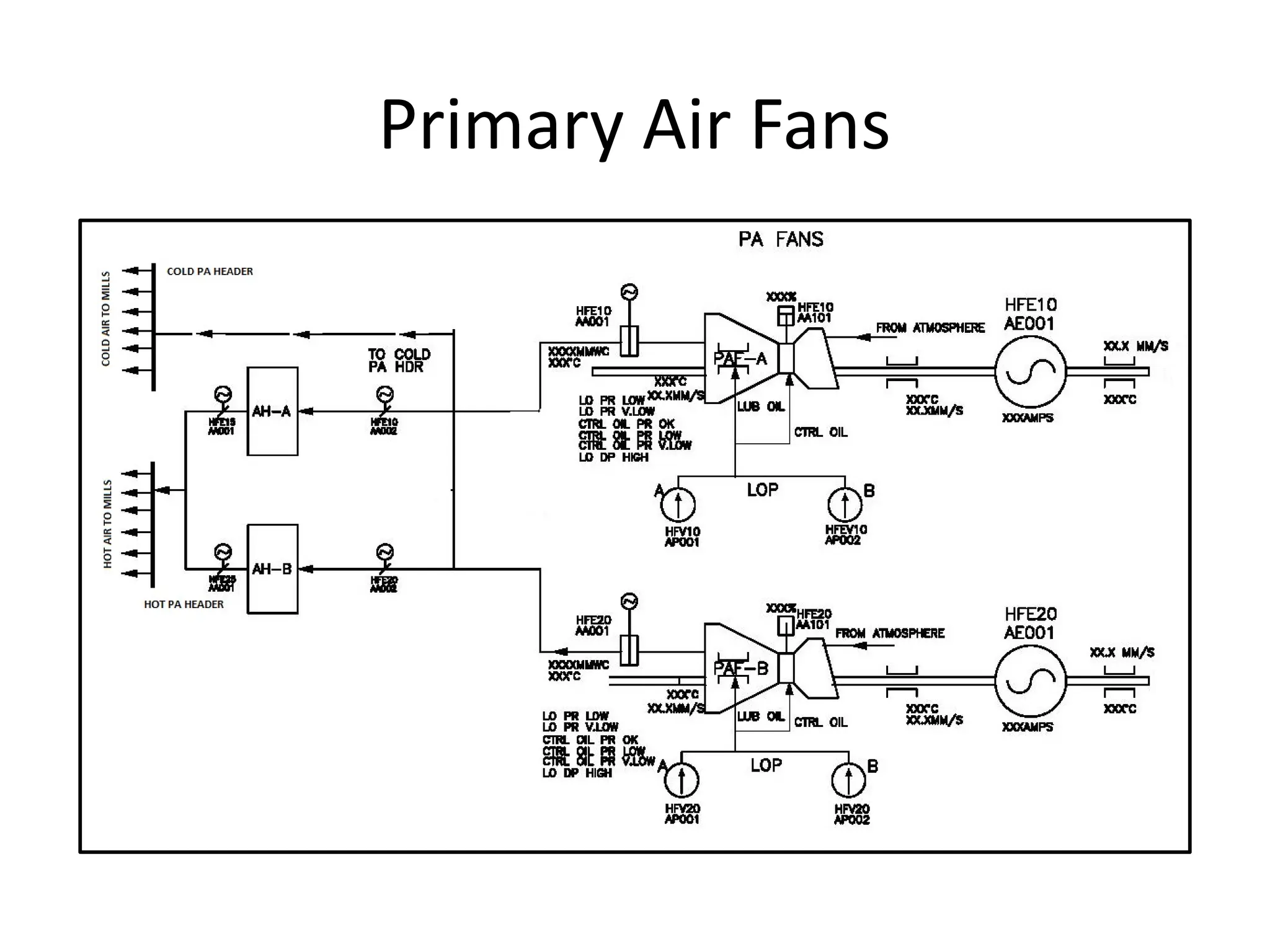
Primary Air Fans
P.A. FANS INTERLOCKS
CONDITIONS PRIOR TO START:
1. PA Fan A and PA Fan B off.
2. Outlet dampers of Fan A and Fan B close.
3. Regulating damper of Fan A and Fan B is
closed position.
4. Regulating damper regulator disconnected.
STARTING PA FAN A (PA FAN B OFF)
PA Fan A shall be prohibited from starting until the following
conditions are satisfied.
1. Regulating damper of Fan A in the minimum position.
2. Outlet damper of Fan A in closed position.
3. Any one FD Fan is on.
4. Purge complete. (From FSSS)
5. PA Fan/fan motor bearing temperature not very high.
6. PA Fan lubricating oil pressure adequate.
NOTE: Signal from PA Fan A start PB shall simultaneously go
to start PA Fan A and seal air fan.
STARTING PA FAN B (PA FAN A IS OFF)
Interlocks similar to as above shall hold good for this condition
Starting Sequence of PA Fan A
When PA Fan A is started (PA Fan B is off), impulses shall
be given for:
1. Opening the outlet damper of Fan A after the motor
vehicles the rated speed.
2. Connecting the regulating damper of PA Fan B to the
minimum position.
3. Bringing the regulating damper of PA Fan B to the
minimum position.
4. Closing the outlet damper of PA Fan B.
5. Permission to start any three mills through FSSS
TRIPPING OF PA FAN A (PA FAN B IS OFF)
PA Fan A shall trip (PA Fan B is off) under the following
condition:
1. PA Fan A bearing temperature too high (prior to this
bearing temperature high shall be annunciated in UCB)
2. PA Fan A motor bearing temperature too high. (Prior to
this motor bearing temperature high shall be
annunciated in UCB)
3. Boiler trips.
4. Vibrator level of Fan/Motor very high.
TRIPPING OF PA FAN B (PA FAN A IS OFF):
Interlocks similar to those as above shall hold good for this condition
Tripping Sequence of PA Fan A (Fan B Off)
When PA Fan A trips (PA Fan B is off), impulses shall be given for:
1. Disconnecting the regulating damper of Fan A from the auto
control.
2. Bringing the regulating damper of Fan A to minimum
position.
3. Closing the outlet damper of PA Fan A.
4. Bringing the regulating damper PA Fan B to minimum
position.
5. Closing the outlet damper of PA Fan B.
6. Tripping all the operating mills (done through FSSS)
STARTING PA FAN B (PA FAN A IS ON)
PA Fan B shall be prohibited from starting unless
the following conditions are satisfied.
1. Any one FD Fan is ON.
2. Regulating damper of Fan B in the minimum
position.
3. Outlet damper of Fan B in closed position.
4. PA Fan B /Fan motor bearing temperature
not very high
STARTING OF PA FAN A (PA FAN B IS ON)
Interlocks similar to those as above shall hold good for this condition
Starting Sequence of PA Fan
When PA Fan B is started (PA Fan A is ON)
impulses shall be given for:
1. Opening the outlet damper of PA Fan B after
the motor reaches the rated speed.
2. Connecting the regulating damper of Fan B to
the auto controls.
3. Permission to start three more mills through
FSSS.
Tripping Of PA Fans
P.A. Fan B shall trip (PA Fan A is on) under the following
conditions
1. PA Fan B bearing temperature too high (prior to this, fan
bearing temperature high shall be annunciated in UCB)
2. PA Fan B motor bearing temperature too high (Prior to
this, fan motor bearing temperature high shall be
annunciated in UCB)
3. Boiler trip.
4. Vibration level of Fan/Motor very high
• TRIPPING OF PA FAN A (PA FAN B IS ON)
Interlocks similar to those above shall hold good for this condition
• Both the PA Fans shall trip simultaneously when any boiler trip
condition is present (impulse from FSSS)
Tripping Sequence of PA Fan
• When PA Fan B trips (PA Fan A is ON) impulse shall be
given for:
• Disconnecting the regulating damper of Fan B from the
auto control.
• Bringing the regulation damper of Fan B to the
minimum position.
• Closing the outlet damper of fan B.
• Energisation of partial load relay.
• Bringing the regulating damper of PA Fan A to max. safe
position
Boiler Drum Drain
Blow
Down
Valves
BLOW DOWN VALVES BD8 & BD9
• When drum water level rises to 120 mm above
normal water level, an annunciation, Drum Level
High shall be given in UCB.
• When drum level rises to 25 mm above normal
water level, blow down valves B56 and B57 shall
open and this condition shall be annunciated.
• Blow down valves shall close automatically when the
water level falls down to NWL. One de-interlock
switch, shall be provided for both the valves for
manual operation.

APH Interlock Protection for thermal power plant.pptx

  • 1.
    Interlocks & Protection AH,ID, FD, PA Fans & BD Valves Rajneesh Vachaspati Dy Director,NPTI
  • 2.
    Flue gas Path •Dampers Needed to be Opened before AH is started Dampers Open AH Air Motors AH AC Motors
  • 4.
    Starting of RotaryAPH • The lub. Oil pumps of support and guide bearings can be started from the control room but preferably from Local for the first time. • Start any one of the pumps locally and see no oil leakage. • Check the lube oil pressure. • Stop the pump and start the other pump and see that the flow and pressure are normal and that there is no oil leakage. • Now open the air valve for starting the air motor of APH A or B as the case may be. As the main drives are not in service, the solenoid will supply air to air motor. • Check the operation of APH for any abnormal sound or abnormal seal rubbing. • If the performance is normal, the main drive can be started locally or from remote.
  • 5.
    Starting of RotaryAPH • Check the performance of APH on main drive-the load current and abnormal sound and vibrations are to be watched. • On starting the main drive, the Air motor shall stop. This can be verified in control room by the indication given from the service air pressure switch, provided in the line. • Now stop the main drive from Control room and check that the Air motor comes on Auto. • The air preheater soot blowers are to operated at regular intervals, after lighting up of the boiler. • The DP across Air preheaters has to be watched closely to see that the APHs are free from choking. • The oxygen and carbon dioxide levels in flue gas, before and after APH have to be measured once in a shift to see the performance of the boiler as well as APH. Abnormal drop in carbon dioxide level after APH shall indicate poor performance of the APH seals. Normal Drop: 2%.
  • 6.
    Rotary Air HeaterInterlocks Rotary AHs are the first auxiliary to start Boiler. CONDITIONS BEFORE START UP OF AHS: • Both AHS are off (both AC motors and Air motors are off) • The inlet dampers and the outlet dampers in the gas path, secondary air path, primary air path are in full open condition. STARTING AH ‘A’ (AH ‘B’ IS OFF) OR AH ‘B’ (AH ‘A’ is OFF • AH ‘A’/’B’ AC motor is started. If the temperature of the bearings is less than 70 Deg.C • Whenever AH AC motor trips impulse shall be given for starting Air motor provided the temperature of support/guide bearing of AH ‘A’ is less than 70 Deg. C. • Impulse shall be given for closing of the inlet and outlet dampers of AH which is off.
  • 7.
    Tripping of Airheaters TRIPPING OF AH ‘A’ (AH ‘B’ IS OFF)/TRIPPING OF AH ‘B’ (AH ‘A’ IS OFF) • AH AC motor/Air motor shall trip manually when the temperature of support/guide bearing of AH is very high (i.e. greater than 70 Deg. C). Under this condition AH Air motor shall be prohibited from starting. • Air motor shall trip automatically when AH AC motor starts. NOTE: Trip signal of AH is to be taken from both AC & Air motors trip
  • 8.
    Tripping Sequence OfAir Heaters Condition A:- BOTH AHS ARE WORKING WHEN ONE TRIPS AND OTHER AH CONTINUES TO RUN: • The gas inlet damper the secondary air inlet damper and primary air inlet damper of the tripped AH shall automatically closed. The gas outlet damper, the secondary air outlet damper and PA outlet damper of the tripped AH need not be closed. • However, if the operator wants to manually close these outlet dampers they can be closed
  • 9.
    TRIPPING OF AIRHEATERS Condition B:- ONE AH IS WORKING AND THE OTHER AH IS OFF: • If the working Airheater trips, the operator shall try for restarting the AH. • If the restarting is not within 5 minutes, the boiler shall be tripped. Condition C:- BOTH AHS ARE WORKING AND TRIPPED. • If both AHS ‘A’ and ‘B’ trip the operator may try for restarting the AHs. If any one of the AH is not started within 5 minutes the operator shall manually trip the boiler within 5 minutes.
  • 10.
    INTERLOCKS FOR LUBEOIL PUMPS OF SUPPORT & GUIDE BEARINGS OF AH A & B 2x100% lube oil pump have been provided for the support bearing. Any of the two lubricating oil pumps can be preselected as main pump and the other as standby. Following interlocks shall be provided for lub oil pumps. • Whenever the temperature of support bearing of air heater A is high (350 C), impulse shall be given to start the main oil pump. • The standby oil pump shall start when the main oil pump fails to start or trips. • The main oil pump / stand by oil pump shall trip when the temperature of the support bearing falls below a present value (300 C)
  • 11.
    Flue Gas Cycle..Starting of ID Fans Dampers Open Dampers Closed
  • 12.
    ID Fan Pre-checks •Ensure the manholes are closed. • Check the availability of instruments to measure flow, pressure, temperature etc. of the ID fan and drive motor. • Check the closing and the opening of the suction and discharge gates. Keep them closed before starting the ID fan. • Check healthiness of all the protections and interlocks for their functioning. • Ensure the local push button is in the released position. • Check that the discharge dampers of blower motors are open and the modules are kept ON for supply. • Check that the flue gas path is made through – APH inlet flue gas dampers are open . – ESP inlet gates are open . – ESP outlet gates are open . • Check that the seal trough is filled with water and overflow is maintained. • Start the ID fan after ensuring the healthiness of protections whenever the fan is to be started after long shutdown.
  • 13.
    Starting Permissive forID Fan Check that the final start permissive is available. The final start permissive will get available if the following conditions are satisfied, • ID fan stopped. • Cooling water to the coolers adequate. • Suction gate closed. • Discharge gate closed. • Ensure VFD for minimum speed. • ID fan tripped indication should not exist. • Ensure 220 V DC control supply for the breaker of other ID fans is available. • Now the first ID fan can be started
  • 14.
    Post Start Checksof ID Fans • Check the opening of gates on interlock, after 10 secs. • Check the performance of the motor. • Check adequate lub. oil pressure. • Check the starting of both the discharge gate blower motors on interlock. If not , start manually. • Maintain the furnace vacuum at -12 mmWC by suitable loading of the fan.
  • 15.
    I.D. FAN INTERLOCKS Conditionsexisting when the unit is shut down and prior to starting of ID fans. • Either or both AHs are running. • I.D. Fan ‘A’ and ID Fan ‘B’ off. • Regulating dampers of fans A&B open. • Inlet gates of Fans A & B open. • Outlet gates of fans A & B open. • The regulating dampers will be on manual control during shut down and impulse from furnace draft control to regulating dampers of ID fans disconnected.
  • 16.
    Starting ID Fan‘A’ (ID Fan ‘B’ Off) Interlocks ID Fan ‘A’ shall be prohibited from starting till the following conditions are satisfied. 1. Regulating damper of Fan-A in minimum position. 2. Outlet gate of Fan-A closed. 3. Inlet gate of Fan-A closed. 4. Fan/fan motor bearing temperature not very high. 5. One of the air preheaters running. For starting ID Fan B ( ID Fan A is off) Interlocks similar to those as above shall hold good of this conditions.
  • 17.
    Starting ID Fan‘A’ When ID fan ‘A’ is started (ID Fan B is off), impulses shall be give for. 1. Opening the inlet gate and outlet gate of Fan A after the motor reaches the rated speed. 2. Connecting the regulating damper of Fan A to the auto control. 3. Closing the inlet gate and the outlet gate of ID Fan B and bringin the regulating damper to minimum position. 4. Permission to start either FD Fan A or FD Fan B.
  • 18.
    Tripping of IDFan A (ID fan B is off) ID Fan ‘A’ shall trip automatically under following conditions. 1. ID Fan A bearing temperature too high (prior to this, ID Fan A bearing temperature high shall be annunciated in UCB). 2. ID Fan A motor bearing temperature too high (prior to this, ID Fan a motor bearing temperature high shall be annunciated in UCB). 3. Post purge fan trip (contact from FSSS) 4. Vibration level of FAN/MOTOR very high. Tripping of ID Fan B (ID Fan A is off): Interlocks similar to those above shall hold good for this condition.
  • 19.
    Tripping of IDFan When ID Fan A trips (ID Fan B is off) impulses shall be given for: 1. Opening the outlet gate of ID Fan B. 2. Opening the inlet gate of ID Fan B. 3. Opening the regulating damper of ID Fan B to wide open position. 4. Disconnecting the regulators impulse from acting on regulating damper of ID Fan A. 5. Opening the regulating damper of ID Fan A to wide open position. 6. Tripping the working FD Fans. 7. Boiler tripping. 8. To keep the inlet gate and outlet gate of ID Fan A open.
  • 20.
    Starting of IDFan B (ID Fan A is on) ID Fan B shall be prohibited from starting unless the following conditions are satisfied. 1. Outlet gate of Fan B is closed. 2. Inlet gate of Fan B is closed. 3. Regulating damper of Fan Bareing minimum position. 4. Fan/fan motor bearing temperature not very high. Starting of ID Fan A (ID fan B is on) Interlocks similar to above shall hold good for this condition.
  • 21.
    Both ID FansStarted • When ID Fan B is started, impulses shall be given for. • Opening the inlet gate and outlet gate of Fan B after the motor reaches rated speed. • Connecting the regulating damper of Fan B to auto control. • Permission to start other FD Fan.
  • 22.
    Tripping of IDFan B (ID Fan A is on) ID Fan B shall trip automatically under the following conditions. • Fan bearing temperature too high (prior to this fan bearing temperature high shall be annunciated in UCB) • Fan motor bearing temperature too high (Prior to this fan motor bearing temperature high shall be annunciated in UCB) • Vibration level of Fan/motor very high. Tripping ID Fan A (ID fan B is on) Interlocks similar to above shall hold good for this condition.
  • 23.
    Post Purge FanTrippings When ID Fan B trips (ID Fan A is on) impulses shall be given for: 1. Disconnecting the regulator from acting on the regulating damper of Fan B. 2. Bringing the regulating damper of Fan B to the minimum position. 3. Closing the inlet gate of Fan B. 4. Closing the outlet gate of Fan B. 5. Tripping the FD Fan B, provided FD Fan A is on. 6. Energisation of partial load relay.
  • 24.
  • 25.
    FD Fans Starting….Prechecks • Ensure No Permit is pending. • Ensure the electric supply to the drives and equipment are available. • Ensure the Air Heater flue gas inlet dampers the gas gates before and after ESP are kept open. • Ensure the secondary air dampers of Air Heaters A & B are kept open. At least one pair should be kept open for starting the first FD fan. • Ensure the Secondary air dampers in wind boxes are in open position as per FSSS logic. • Check healthiness of all the protections and interlocks for their functioning. • The suction and discharge dampers of the FD fan should be checked for its operation and kept closed before starting the fan. • Ensure at least one ID fan is in service to start the first FD fan. Both ID fan should be in service to start second FD fan. • Ensure bottom ash hopper seal water trough is filled with water and maintain overflow.
  • 26.
    FD Fan StartPermissive • Blade pitch control servomotor is in minimum position. • FD fans discharge dampers are in closed position. • ID Fan is running. • Bearing temperature of motor are within permissible limit.
  • 27.
    FD Fan StartSequence START SEQUENCE OF THE FAN: a) Tank oil level > 50% b) Tank oil temp > 25 deg C c) Control oil pressure > 20 bar d) Lub oil pressure > 4 bar e) Bearing temp < 95 deg C f) Control blade adjustment : Manual g) Impeller blades position : Close h) Discharge damper/gate : Close i) Fan Motor : ON
  • 28.
    After Starting FDFan When any FD fan is started impulses shall be given for: • Opening the outlet damper of the corresponding FD fan after the motor reaches its rated speed. (After 10 secs.) • Connecting the blade pitch control drive of the fan to auto control, if Auto/Manual station is selected on Auto. • Closing the atmospheric suction damper of scanner fan if they are running with suction from the atmosphere
  • 29.
    FD FAN INTERLOCKS CONDITIONSPRIOR TO STARTING FD FANS. 1. FD Fan A and FD Fan B off. 2. Fan impellers tilted to maximum opening. 3. Outlet dampers are fully open. 4. Fan impeller regulator disconnected. 5. Lube oil pumps of FD Fans off.
  • 30.
    STARTING FD FANA (FD FAN B IS OFF) FD Fan A shall be prohibited from starting untill the following conditions are satisfied. 1. ID Fan A or ID Fan B is on. 2. Control oil pressure adequate (8 kg/cm2 ) (Control oil pressure adequate lamp indication shall be provided on the control desk.) 3. Fan A impeller in the minimum position. 4. Outlet damper of Fan A is closed position. 5. Fan/Motor bearing temperature not “very high”. STARTING FD FAN B (FD FAN A IS OFF) Interlocks similar to above shall hold good for this condition.
  • 31.
    FD Fan StartingSequence When FD Fan A is started (FD Fan B off) impulse shall be given for: • Outlet damper of Fan A to open after the motor reaches the rated speed. • The outlet damper of FD Fan B to close & impeller blades of Fan B to be driven to minimum position. • Connecting the impeller of Fan A control drive to auto control.
  • 32.
    TRIPPING OF FDFAN A (FD FAN B IS OFF) FD Fan A shall trip under the following conditions: 1. FD Fan a bearing temperature too high (Prior to this, FD Fan A bearing temperature high will be annuciated in UCB) • NOTE: Oil pressure low shall be annunciated in UCB 1. FD Fan A motor bearing temperature too high (prior to this, FD Fan A motor bearing temperature high will be annunciated in UCB) 2. Both ID Fans trip. 3. Post purge fan trip (Contact from FSSS) TRIPPING FD FAN B (FD FAN A IS OFF) Interlocks similar to above shall hold good for this condition
  • 33.
    FD Fan TrippingSequence 1. When FD Fan A trip (FD Fan B is off) impulses shall be given for: 2. Disconnecting the impeller control drive from the regulator of Fan A. 3. Bringing the impeller of Fan A to the maximum position. 4. Bringing the impeller of FD Fan B to the maximum position. 5. Opening the outlet damper of FD Fan B. 6. To open the emergency scanner air damper. 7. Boiler tripping. 8. The outlet damper of FD fan A shall remain open.
  • 34.
    STARTING FD FANB (FD FAN A IS ON) FD Fan B (FD Fan A is on) shall be prohibited from starting until the following conditions are satisfied. 1. Both ID Fans are on. 2. Control oil pressure adequate (8 kg/cm2 ) (control oil pressure adequate lamp indication shall be provided on the control desk). 3. Impeller of Fan B in the minimum position. 4. Outlet damper of Fan B in the closed position. 5. Fan/Fan motor bearing temperature not very high STARTING FD FAN A (FD FAN B IS ON) Interlocks similar to those at 2.6 shall hold good for this condition.
  • 35.
    Starting Sequence ofFD Fan B 1. When FD Fan B is started (FD Fan A is on), impulses shall be given for: 2. Opening the outlet damper of Fan B after the fan reaches the rated speed. 3. Connecting the impeller control drive of Fan B to auto control.
  • 36.
    TRIPPING OF FDFAN B (FD FAN A IS ON) FD Fan B shall trip when FD Fan A is on under the following conditions. 1. ID Fan B trips. 2. FD Fan B motor bearing temperature too high (prior to this, FD fan B motor bearing temperature high shall be annunciated in UCB. 3. FD Fan B motor bearing temperature too high (Prior to this, FD Fan B bearing temperature high shall be annunciated in UCB). 4. Vibration level of Fan/Motor very high. NOTE: Oil pressure low shall be annunciated at UCB. TRIPPING OF FD FAN A (FD FAN B IS ON) Interlocks similar to as above shall hold good for this condition
  • 37.
    Tripping Sequence ofFD Fan B When FD Fan B trips (FD Fan A is on), impulses shall be given for: 1. Disconnecting regulator impulse from acting on impeller control drive of Fan B. 2. Bringing impeller of Fan B to the minimum position. 3. Closing the outlet damper of Fan B. 4. Energisation of partial load relay. 5. Tripping mills working more than three through FSSS.
  • 38.
    ALARM & TRIPVALUES FD Fan DESCRIPTION ALARM TRIP Fan Bearing Temperature >= 95 deg C >= 105 deg C Fan Bearing Vibration (Vel -rms) For Fans erected on Solid Concrete foundation. >= 4.5 mm/s >= 9.0 mm/s Fan Bearing Vibration (Vel - rms) For Fans erected on Spring Isolator >= 7.0 mm/S >= 14 mm/s Differential Pressure across oil filter >= 5 bar **** Lub Oil Pressure low <= 4 bar **** Control Oil Pressure low <=14 bar **** Oil Level In The Tank low < 50 % ****
  • 39.
  • 40.
    P.A. FANS INTERLOCKS CONDITIONSPRIOR TO START: 1. PA Fan A and PA Fan B off. 2. Outlet dampers of Fan A and Fan B close. 3. Regulating damper of Fan A and Fan B is closed position. 4. Regulating damper regulator disconnected.
  • 41.
    STARTING PA FANA (PA FAN B OFF) PA Fan A shall be prohibited from starting until the following conditions are satisfied. 1. Regulating damper of Fan A in the minimum position. 2. Outlet damper of Fan A in closed position. 3. Any one FD Fan is on. 4. Purge complete. (From FSSS) 5. PA Fan/fan motor bearing temperature not very high. 6. PA Fan lubricating oil pressure adequate. NOTE: Signal from PA Fan A start PB shall simultaneously go to start PA Fan A and seal air fan. STARTING PA FAN B (PA FAN A IS OFF) Interlocks similar to as above shall hold good for this condition
  • 42.
    Starting Sequence ofPA Fan A When PA Fan A is started (PA Fan B is off), impulses shall be given for: 1. Opening the outlet damper of Fan A after the motor vehicles the rated speed. 2. Connecting the regulating damper of PA Fan B to the minimum position. 3. Bringing the regulating damper of PA Fan B to the minimum position. 4. Closing the outlet damper of PA Fan B. 5. Permission to start any three mills through FSSS
  • 43.
    TRIPPING OF PAFAN A (PA FAN B IS OFF) PA Fan A shall trip (PA Fan B is off) under the following condition: 1. PA Fan A bearing temperature too high (prior to this bearing temperature high shall be annunciated in UCB) 2. PA Fan A motor bearing temperature too high. (Prior to this motor bearing temperature high shall be annunciated in UCB) 3. Boiler trips. 4. Vibrator level of Fan/Motor very high. TRIPPING OF PA FAN B (PA FAN A IS OFF): Interlocks similar to those as above shall hold good for this condition
  • 44.
    Tripping Sequence ofPA Fan A (Fan B Off) When PA Fan A trips (PA Fan B is off), impulses shall be given for: 1. Disconnecting the regulating damper of Fan A from the auto control. 2. Bringing the regulating damper of Fan A to minimum position. 3. Closing the outlet damper of PA Fan A. 4. Bringing the regulating damper PA Fan B to minimum position. 5. Closing the outlet damper of PA Fan B. 6. Tripping all the operating mills (done through FSSS)
  • 45.
    STARTING PA FANB (PA FAN A IS ON) PA Fan B shall be prohibited from starting unless the following conditions are satisfied. 1. Any one FD Fan is ON. 2. Regulating damper of Fan B in the minimum position. 3. Outlet damper of Fan B in closed position. 4. PA Fan B /Fan motor bearing temperature not very high STARTING OF PA FAN A (PA FAN B IS ON) Interlocks similar to those as above shall hold good for this condition
  • 46.
    Starting Sequence ofPA Fan When PA Fan B is started (PA Fan A is ON) impulses shall be given for: 1. Opening the outlet damper of PA Fan B after the motor reaches the rated speed. 2. Connecting the regulating damper of Fan B to the auto controls. 3. Permission to start three more mills through FSSS.
  • 47.
    Tripping Of PAFans P.A. Fan B shall trip (PA Fan A is on) under the following conditions 1. PA Fan B bearing temperature too high (prior to this, fan bearing temperature high shall be annunciated in UCB) 2. PA Fan B motor bearing temperature too high (Prior to this, fan motor bearing temperature high shall be annunciated in UCB) 3. Boiler trip. 4. Vibration level of Fan/Motor very high • TRIPPING OF PA FAN A (PA FAN B IS ON) Interlocks similar to those above shall hold good for this condition • Both the PA Fans shall trip simultaneously when any boiler trip condition is present (impulse from FSSS)
  • 48.
    Tripping Sequence ofPA Fan • When PA Fan B trips (PA Fan A is ON) impulse shall be given for: • Disconnecting the regulating damper of Fan B from the auto control. • Bringing the regulation damper of Fan B to the minimum position. • Closing the outlet damper of fan B. • Energisation of partial load relay. • Bringing the regulating damper of PA Fan A to max. safe position
  • 49.
  • 50.
    BLOW DOWN VALVESBD8 & BD9 • When drum water level rises to 120 mm above normal water level, an annunciation, Drum Level High shall be given in UCB. • When drum level rises to 25 mm above normal water level, blow down valves B56 and B57 shall open and this condition shall be annunciated. • Blow down valves shall close automatically when the water level falls down to NWL. One de-interlock switch, shall be provided for both the valves for manual operation.