APA Referencing
Guided By:
DR. ARCHANA DUBEY
Presented By:
DIWYA JOSHI
What is APA?
APA is one of many referencing styles used in
academic writing. APA stands for American
Psychological Association. The Association outlines
the style in the Publication manual of the American
Psychological Association [APA] (6th ed.).
CHARACTERISTICS OF APA
The American Psychological Association reference
style uses the Author-Date format.
When quoting directly or indirectly from a source, the
source must be acknowledged in the text by author
name and year of publication.
IN-TEXT To cite information directly or indirectly,
there are two ways to acknowledge citations:
1) Make it a part of a sentence or
2) Put it in parentheses at the end of the sentence.
CHARACTERISTICS OF APA
Direct quotation – use quotation marks around the
quote and include page numbers
Cohen and Lotan (2014) argue that "many different
kinds of abilities are essential for any profession"
(p.151). 2)
“Many different kinds of abilities are essential for
any profession" (Cohen & Lotan, 2014, p.151).
CHARACTERISTICS OF APA
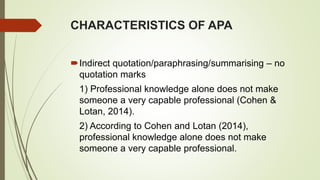
Indirect quotation/paraphrasing/summarising – no
quotation marks
1) Professional knowledge alone does not make
someone a very capable professional (Cohen &
Lotan, 2014).
2) According to Cohen and Lotan (2014),
professional knowledge alone does not make
someone a very capable professional.
CHARACTERISTICS OF APA
Page numbers are optional when paraphrasing,
although it is useful to include them (Publication
Manual, p. 171).
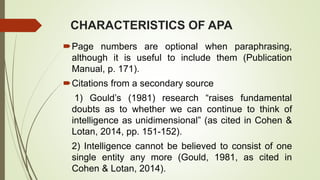
Citations from a secondary source
1) Gould’s (1981) research “raises fundamental
doubts as to whether we can continue to think of
intelligence as unidimensional” (as cited in Cohen &
Lotan, 2014, pp. 151-152).
2) Intelligence cannot be believed to consist of one
single entity any more (Gould, 1981, as cited in
Cohen & Lotan, 2014).
CHARACTERISTICS OF APA
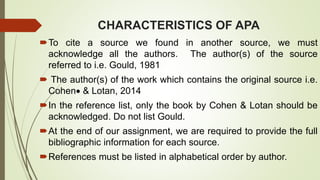
To cite a source we found in another source, we must
acknowledge all the authors. The author(s) of the source
referred to i.e. Gould, 1981
 The author(s) of the work which contains the original source i.e.
Cohen & Lotan, 2014
In the reference list, only the book by Cohen & Lotan should be
acknowledged. Do not list Gould.
At the end of our assignment, we are required to provide the full
bibliographic information for each source.
References must be listed in alphabetical order by author.
EXAMPLES OF REFERENCES BY TYPE
In a reference list In-text citation
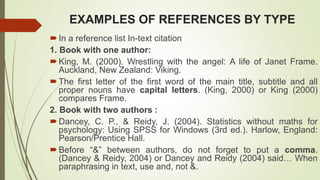
1. Book with one author:
King, M. (2000). Wrestling with the angel: A life of Janet Frame.
Auckland, New Zealand: Viking.
The first letter of the first word of the main title, subtitle and all
proper nouns have capital letters. (King, 2000) or King (2000)
compares Frame.
2. Book with two authors :
Dancey, C. P., & Reidy, J. (2004). Statistics without maths for
psychology: Using SPSS for Windows (3rd ed.). Harlow, England:
Pearson/Prentice Hall.
Before “&” between authors, do not forget to put a comma.
(Dancey & Reidy, 2004) or Dancey and Reidy (2004) said… When
paraphrasing in text, use and, not &.
REFERENCE LIST IN-TEXT
CITATION
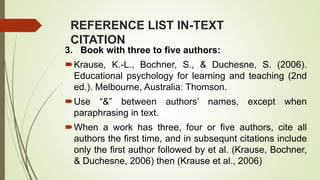
3. Book with three to five authors:
Krause, K.-L., Bochner, S., & Duchesne, S. (2006).
Educational psychology for learning and teaching (2nd
ed.). Melbourne, Australia: Thomson.
Use “&” between authors’ names, except when
paraphrasing in text.
When a work has three, four or five authors, cite all
authors the first time, and in subsequnt citations include
only the first author followed by et al. (Krause, Bochner,
& Duchesne, 2006) then (Krause et al., 2006)
REFERENCE LIST IN-TEXT CITATION
4. Book or report by a corporate author e.g.
organisation, association, government department,
International Labour Organization. (2007). Equality at work:
Tackling the challenges (International Labour Conference
report). Geneva, Switzerland: Author.
When the author and the publisher are the same, use
Author in the publisher field.
In text, some group authors may be abbreviated in
subsequent citations if they are readily recognisable
(International Labour Organization, 2007) or (International
Labour Organization [ILO], 2007), then (ILO, 2007)
REFERENCE LIST IN-TEXT CITATION
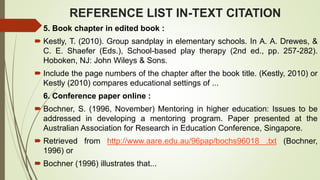
5. Book chapter in edited book :
 Kestly, T. (2010). Group sandplay in elementary schools. In A. A. Drewes, &
C. E. Shaefer (Eds.), School-based play therapy (2nd ed., pp. 257-282).
Hoboken, NJ: John Wileys & Sons.
 Include the page numbers of the chapter after the book title. (Kestly, 2010) or
Kestly (2010) compares educational settings of ...
6. Conference paper online :
 Bochner, S. (1996, November) Mentoring in higher education: Issues to be
addressed in developing a mentoring program. Paper presented at the
Australian Association for Research in Education Conference, Singapore.
 Retrieved from http://www.aare.edu.au/96pap/bochs96018 .txt (Bochner,
1996) or
 Bochner (1996) illustrates that...
REFERENCE LIST IN-TEXT CITATION
7. Course handout/Lecture notes (electronic version)
 Archard, S., Merry, R., & Nicholson, C. (2011). Karakia and waiata
[Powerpoint slides]. Retrieved from TEPS757-11B (NET):
Communities of Learners
 website:
http://elearn.waikato.ac.nz/mod/resource/view.php?id=174650
 Put format in square brackets –
 e.g. [Lecture notes] [Panopto video].
 This referencing format should be used only for assignments.
(Archard, Merry, & Nicholson, 2011) then subsequently, if 3-5 authors
(Archard et al., 2011)
REFERENCE LIST IN-TEXT CITATION
8. Film
 Preston, G. (Director/Producer) (2010). Home by
Christmas [Motion picture]. New Zealand: Gaylene Preston
Production.
 For films, DVDs or video recordings use [Motion picture] in
square brackets. Give the country of origin and the name of
the motion picture studio. (Preston, 2010)
REFERENCE LIST IN-TEXT CITATION
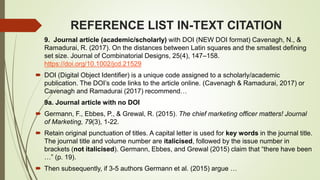
9. Journal article (academic/scholarly) with DOI (NEW DOI format) Cavenagh, N., &
Ramadurai, R. (2017). On the distances between Latin squares and the smallest defining
set size. Journal of Combinatorial Designs, 25(4), 147–158.
https://doi.org/10.1002/jcd.21529
 DOI (Digital Object Identifier) is a unique code assigned to a scholarly/academic
publication. The DOI’s code links to the article online. (Cavenagh & Ramadurai, 2017) or
Cavenagh and Ramadurai (2017) recommend…
9a. Journal article with no DOI
 Germann, F., Ebbes, P., & Grewal, R. (2015). The chief marketing officer matters! Journal
of Marketing, 79(3), 1-22.
 Retain original punctuation of titles. A capital letter is used for key words in the journal title.
The journal title and volume number are italicised, followed by the issue number in
brackets (not italicised). Germann, Ebbes, and Grewal (2015) claim that “there have been
…” (p. 19).
 Then subsequently, if 3-5 authors Germann et al. (2015) argue …
REFERENCE LIST IN-TEXT CITATION
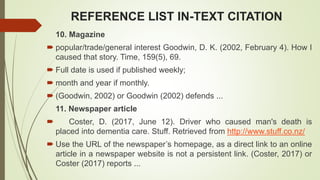
10. Magazine
 popular/trade/general interest Goodwin, D. K. (2002, February 4). How I
caused that story. Time, 159(5), 69.
 Full date is used if published weekly;
 month and year if monthly.
 (Goodwin, 2002) or Goodwin (2002) defends ...
11. Newspaper article
 Coster, D. (2017, June 12). Driver who caused man's death is
placed into dementia care. Stuff. Retrieved from http://www.stuff.co.nz/
 Use the URL of the newspaper’s homepage, as a direct link to an online
article in a newspaper website is not a persistent link. (Coster, 2017) or
Coster (2017) reports ...
REFERENCE LIST IN-TEXT CITATION
12. Personal Communication:
 Information such as Letters, telephone conversations, emails,
interviews, and private social networking is called “Personal
Communication”, and no reference list entry is required (W.
Bush, personal communication, March 19, 2017)
13. Reference book – dictionary or encyclopedia entry
 Hwang, E.-G. (2002). North Korea: Economic system. In
D. Levinson, & K. Christenson (Eds.), Encyclopedia of
modern Asia (Vol. 4, pp. 350-353). New York, NY: Charles
Scribner's Sons.
 If no author stated, the entry’s title takes the author position.
REFERENCE LIST IN-TEXT CITATION
14. For online dictionaries and encyclopedias,
 a retrieval statement takes the place of publisher location / name (Hwang,
2002) or Hwang (2002) identifies the hurdles North Korea ...
15. Webpage :
 New Zealand Trade and Enterprise. (n.d.). Agribusiness. Retrieved from
https://www.nzte.govt.nz/en/export/market-research/agribusiness/
 (n.d.) = no date.
 The basic format is:
 (1) Author (could be organisation).
 (2) Date (either date of publication or latest update).
 (3) Title.
 (4) URL. (New Zealand Trade and Enterprise, n.d., para.
REFERENCE LIST IN-TEXT CITATION
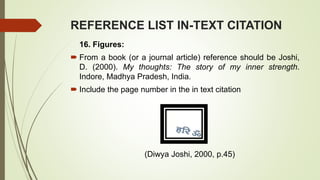
16. Figures:
 From a book (or a journal article) reference should be Joshi,
D. (2000). My thoughts: The story of my inner strength.
Indore, Madhya Pradesh, India.
 Include the page number in the in text citation
(Diwya Joshi, 2000, p.45)
BASIC RULE OF APA REFERENCING
When creating the reference list entry for an information
source we need to identify and record specific details. It might
be useful to remember these Ws!
 Who – wrote /edited it – author or editor
 When was it written – date
 What is it – title of book, title of the article & serial/journal, title
of the web document
 Where was it published (Books) – place of publication–
usually city & country and publisher’s name
 Where was the article located (Serial/journal) - volume
number, issue number and page numbers of the article
 Where we located it (Internet sources) - URL – web address.
American Psychological Association Referencing

American Psychological Association Referencing

  • 1.
    APA Referencing Guided By: DR.ARCHANA DUBEY Presented By: DIWYA JOSHI
  • 2.
    What is APA? APAis one of many referencing styles used in academic writing. APA stands for American Psychological Association. The Association outlines the style in the Publication manual of the American Psychological Association [APA] (6th ed.).
  • 3.
    CHARACTERISTICS OF APA TheAmerican Psychological Association reference style uses the Author-Date format. When quoting directly or indirectly from a source, the source must be acknowledged in the text by author name and year of publication. IN-TEXT To cite information directly or indirectly, there are two ways to acknowledge citations: 1) Make it a part of a sentence or 2) Put it in parentheses at the end of the sentence.
  • 4.
    CHARACTERISTICS OF APA Directquotation – use quotation marks around the quote and include page numbers Cohen and Lotan (2014) argue that "many different kinds of abilities are essential for any profession" (p.151). 2) “Many different kinds of abilities are essential for any profession" (Cohen & Lotan, 2014, p.151).
  • 5.
    CHARACTERISTICS OF APA Indirectquotation/paraphrasing/summarising – no quotation marks 1) Professional knowledge alone does not make someone a very capable professional (Cohen & Lotan, 2014). 2) According to Cohen and Lotan (2014), professional knowledge alone does not make someone a very capable professional.
  • 6.
    CHARACTERISTICS OF APA Pagenumbers are optional when paraphrasing, although it is useful to include them (Publication Manual, p. 171). Citations from a secondary source 1) Gould’s (1981) research “raises fundamental doubts as to whether we can continue to think of intelligence as unidimensional” (as cited in Cohen & Lotan, 2014, pp. 151-152). 2) Intelligence cannot be believed to consist of one single entity any more (Gould, 1981, as cited in Cohen & Lotan, 2014).
  • 7.
    CHARACTERISTICS OF APA Tocite a source we found in another source, we must acknowledge all the authors. The author(s) of the source referred to i.e. Gould, 1981  The author(s) of the work which contains the original source i.e. Cohen & Lotan, 2014 In the reference list, only the book by Cohen & Lotan should be acknowledged. Do not list Gould. At the end of our assignment, we are required to provide the full bibliographic information for each source. References must be listed in alphabetical order by author.
  • 8.
    EXAMPLES OF REFERENCESBY TYPE In a reference list In-text citation 1. Book with one author: King, M. (2000). Wrestling with the angel: A life of Janet Frame. Auckland, New Zealand: Viking. The first letter of the first word of the main title, subtitle and all proper nouns have capital letters. (King, 2000) or King (2000) compares Frame. 2. Book with two authors : Dancey, C. P., & Reidy, J. (2004). Statistics without maths for psychology: Using SPSS for Windows (3rd ed.). Harlow, England: Pearson/Prentice Hall. Before “&” between authors, do not forget to put a comma. (Dancey & Reidy, 2004) or Dancey and Reidy (2004) said… When paraphrasing in text, use and, not &.
  • 9.
    REFERENCE LIST IN-TEXT CITATION 3.Book with three to five authors: Krause, K.-L., Bochner, S., & Duchesne, S. (2006). Educational psychology for learning and teaching (2nd ed.). Melbourne, Australia: Thomson. Use “&” between authors’ names, except when paraphrasing in text. When a work has three, four or five authors, cite all authors the first time, and in subsequnt citations include only the first author followed by et al. (Krause, Bochner, & Duchesne, 2006) then (Krause et al., 2006)
  • 10.
    REFERENCE LIST IN-TEXTCITATION 4. Book or report by a corporate author e.g. organisation, association, government department, International Labour Organization. (2007). Equality at work: Tackling the challenges (International Labour Conference report). Geneva, Switzerland: Author. When the author and the publisher are the same, use Author in the publisher field. In text, some group authors may be abbreviated in subsequent citations if they are readily recognisable (International Labour Organization, 2007) or (International Labour Organization [ILO], 2007), then (ILO, 2007)
  • 11.
    REFERENCE LIST IN-TEXTCITATION 5. Book chapter in edited book :  Kestly, T. (2010). Group sandplay in elementary schools. In A. A. Drewes, & C. E. Shaefer (Eds.), School-based play therapy (2nd ed., pp. 257-282). Hoboken, NJ: John Wileys & Sons.  Include the page numbers of the chapter after the book title. (Kestly, 2010) or Kestly (2010) compares educational settings of ... 6. Conference paper online :  Bochner, S. (1996, November) Mentoring in higher education: Issues to be addressed in developing a mentoring program. Paper presented at the Australian Association for Research in Education Conference, Singapore.  Retrieved from http://www.aare.edu.au/96pap/bochs96018 .txt (Bochner, 1996) or  Bochner (1996) illustrates that...
  • 12.
    REFERENCE LIST IN-TEXTCITATION 7. Course handout/Lecture notes (electronic version)  Archard, S., Merry, R., & Nicholson, C. (2011). Karakia and waiata [Powerpoint slides]. Retrieved from TEPS757-11B (NET): Communities of Learners  website: http://elearn.waikato.ac.nz/mod/resource/view.php?id=174650  Put format in square brackets –  e.g. [Lecture notes] [Panopto video].  This referencing format should be used only for assignments. (Archard, Merry, & Nicholson, 2011) then subsequently, if 3-5 authors (Archard et al., 2011)
  • 13.
    REFERENCE LIST IN-TEXTCITATION 8. Film  Preston, G. (Director/Producer) (2010). Home by Christmas [Motion picture]. New Zealand: Gaylene Preston Production.  For films, DVDs or video recordings use [Motion picture] in square brackets. Give the country of origin and the name of the motion picture studio. (Preston, 2010)
  • 14.
    REFERENCE LIST IN-TEXTCITATION 9. Journal article (academic/scholarly) with DOI (NEW DOI format) Cavenagh, N., & Ramadurai, R. (2017). On the distances between Latin squares and the smallest defining set size. Journal of Combinatorial Designs, 25(4), 147–158. https://doi.org/10.1002/jcd.21529  DOI (Digital Object Identifier) is a unique code assigned to a scholarly/academic publication. The DOI’s code links to the article online. (Cavenagh & Ramadurai, 2017) or Cavenagh and Ramadurai (2017) recommend… 9a. Journal article with no DOI  Germann, F., Ebbes, P., & Grewal, R. (2015). The chief marketing officer matters! Journal of Marketing, 79(3), 1-22.  Retain original punctuation of titles. A capital letter is used for key words in the journal title. The journal title and volume number are italicised, followed by the issue number in brackets (not italicised). Germann, Ebbes, and Grewal (2015) claim that “there have been …” (p. 19).  Then subsequently, if 3-5 authors Germann et al. (2015) argue …
  • 15.
    REFERENCE LIST IN-TEXTCITATION 10. Magazine  popular/trade/general interest Goodwin, D. K. (2002, February 4). How I caused that story. Time, 159(5), 69.  Full date is used if published weekly;  month and year if monthly.  (Goodwin, 2002) or Goodwin (2002) defends ... 11. Newspaper article  Coster, D. (2017, June 12). Driver who caused man's death is placed into dementia care. Stuff. Retrieved from http://www.stuff.co.nz/  Use the URL of the newspaper’s homepage, as a direct link to an online article in a newspaper website is not a persistent link. (Coster, 2017) or Coster (2017) reports ...
  • 16.
    REFERENCE LIST IN-TEXTCITATION 12. Personal Communication:  Information such as Letters, telephone conversations, emails, interviews, and private social networking is called “Personal Communication”, and no reference list entry is required (W. Bush, personal communication, March 19, 2017) 13. Reference book – dictionary or encyclopedia entry  Hwang, E.-G. (2002). North Korea: Economic system. In D. Levinson, & K. Christenson (Eds.), Encyclopedia of modern Asia (Vol. 4, pp. 350-353). New York, NY: Charles Scribner's Sons.  If no author stated, the entry’s title takes the author position.
  • 17.
    REFERENCE LIST IN-TEXTCITATION 14. For online dictionaries and encyclopedias,  a retrieval statement takes the place of publisher location / name (Hwang, 2002) or Hwang (2002) identifies the hurdles North Korea ... 15. Webpage :  New Zealand Trade and Enterprise. (n.d.). Agribusiness. Retrieved from https://www.nzte.govt.nz/en/export/market-research/agribusiness/  (n.d.) = no date.  The basic format is:  (1) Author (could be organisation).  (2) Date (either date of publication or latest update).  (3) Title.  (4) URL. (New Zealand Trade and Enterprise, n.d., para.
  • 18.
    REFERENCE LIST IN-TEXTCITATION 16. Figures:  From a book (or a journal article) reference should be Joshi, D. (2000). My thoughts: The story of my inner strength. Indore, Madhya Pradesh, India.  Include the page number in the in text citation (Diwya Joshi, 2000, p.45)
  • 19.
    BASIC RULE OFAPA REFERENCING When creating the reference list entry for an information source we need to identify and record specific details. It might be useful to remember these Ws!  Who – wrote /edited it – author or editor  When was it written – date  What is it – title of book, title of the article & serial/journal, title of the web document  Where was it published (Books) – place of publication– usually city & country and publisher’s name  Where was the article located (Serial/journal) - volume number, issue number and page numbers of the article  Where we located it (Internet sources) - URL – web address.