APA Style
of
Referencing
Why do you have to do this?
• Because learning to write means mastering
an accepted and uniform writing style.
• Because APA style is the most common
writing style in Communication Studies
(and in the social sciences).
What’s Included in APA Style?
• Basically everything in your paper:
- How your pages are set up
- How you cite sources
- Your references
- Even your language
List of references
• Required if you cite any sources in your
paper
• Every source cited in your paper must
appear on the reference list, and every entry
in your reference list must be cited in your
paper
• Double spaced!
Single-authored book
Lastname, F. M. (Date published). Title of
book. Place of publication: Publisher name
Eg: Perloff, R. M. (1995). The dynamics of
persuasion. Hillsdale, NJ: Erlbaum.
Reissued book
Newcomb, H. (Ed.). (1995). Television: The
critical view (5th
ed.). New York: Oxford
University Press.
*Note: Capitals in the title of the book are restricted
to the first letter of the first word of the title, the
first letter of any proper names, and the first letter
of the first word after a semicolon, period, or
question mark.
Dual-authored book
Baran, S. J., & Davis, D. K. (1995). Mass
communication theory: Foundations,
ferment and future. Belmont, CA:
Wadsworth.
*Note: when listing authors, use an
ampersand (&) in the reference list, not
“and.”
Essay or chapter in an edited
book (Book Chapter)
Last name, F. M. (Date published). Chapter name. In
Author name, Title of book. Place of publication:
Publisher name
Eg: Bryant, J. (1989). Message features and entertainment
effects. In J. J. Bradac (Ed.), Message effects in
communication sceince (pp. 231-262). Newbury Park,
CA: Sage.
*Note: You must include the page numbers if you’re just
referencing one part of a book.
Single-authored article
Last name, F. M. (Date published). Title of article.
Journal name, Volume(issue), page nos.
Eg: Garramone, G. M. (1985). Effects of negative political
advertising: The roles of sponsor and rebuttal. Journal of
Broadcasting & Electronic Media, 29, 149-159.
*Note: The first letter of every important word in the title
of the journal is capitalized.
Two or more authors (article)
Suzuki, S., & Rancer, A. S. (1994).
Argumentativeness and verbal aggressiveness:
Testing for conceptual and measurement
equivalence across cultures. Communication
Monographs, 61(3), 256-279.
*Note: Can you find the volume number, issue
number and page numbers in this citation?
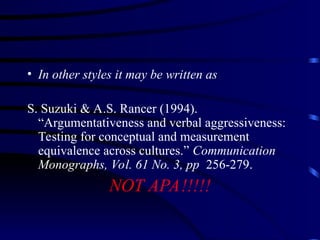
• In other styles it may be written as
S. Suzuki & A.S. Rancer (1994).
“Argumentativeness and verbal aggressiveness:
Testing for conceptual and measurement
equivalence across cultures.” Communication
Monographs, Vol. 61 No. 3, pp 256-279.
NOT APA!!!!!
Two or more authors (article)
Cheung, J. M. Y., Bartlett, D. J., Armour, C.
L., Laba, T. L., & Saini, B. (2018). To drug
or not to drug: A qualitative study of
patients’ decision-making processes for
managing insomnia. Behavioral Sleep
Medicine, 16(1), 1-26.
doi:10.1080/15402002.2016.116370
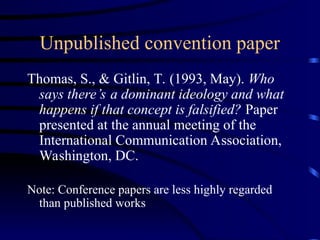
Unpublished convention paper
Thomas, S., & Gitlin, T. (1993, May). Who
says there’s a dominant ideology and what
happens if that concept is falsified? Paper
presented at the annual meeting of the
International Communication Association,
Washington, DC.
Note: Conference papers are less highly regarded
than published works
Internet articles based on a print
source
VandenBos, G., Knapp, S., & Doe, J. (2001).
Role of reference elements in the selection
of resources by psychology undergraduates.
[Electronic version]. Journal of
Bibliographic Research, 5, 117-123.
*Note: Sometimes electronic versions are
different from the print versions.
Article in an internet-only journal
Frederickson, B. L. (2000, March 7).
Cultivating positive emotions to optimize
health and well-being. Prevention &
Treatment, 3. Retrieved November 20,
2000, from
http://journals.apa.org/prevention/volume3/
pre0030001a.html
*Note: this would be the correct citation format for
the article you abstracted for class
Web Source
• Webpage with an author
Lastname, F. M. (Date published). Title of page. Retrieved from
URL
Eg: Lopez, S. J. (2000). The emergence of Positive Psychology:
The building of a field of dreams. Retrieved from
http://www.apa.org/apags/profdev/pospsyc.htm
• Webpage with no author
Title. (year).Retrieved from URL
$250m funding boost for malaria vaccine. (2003). Retrieved
from https://www.abc.net.au/news/2003-09-22/250m-funding-
boost-for-malaria-vaccine/1482220
Web Source
• Webpage with an author and no date
Last name, F. M. (n.d.). Title of page. Retrieved from URL
Smith, W. (n.d.). The future of aged care nursing in Australia.
Retrieved
from https://healthtimes.com.au/hub/aged-care/2/news/nc1/the-
future-of-aged-care-nursing-in-australia/495/
• Webpage with no author and no date
Title. (n.d.).Retrieved from URL
$250m funding boost for malaria vaccine. (n.d.). Retrieved
from https://www.abc.net.au/news/2003-09-22/250m-funding-
boost-for-malaria-vaccine/1482220
Hang on, you’re not done!!
Learning how to
do your
reference page
is only the
beginning to
APA style!!
When do you cite your sources in
your paper?
• When you’re referring to an idea or concept
you drew from something you read.
• When you quote from something you read
or heard.
• When you want to give the reader some
other places to look for additional
information.
Paraphrasing
Scott (1992) identified…
Several researchers
(Anthony, 1990; Gregory
& Jacobs, 1985; Polk et
al., 1980) reported…
Or at the end of a sentence
paraphrased from another
work (Scott, 1992).
Citing while paraphrasing
• List the last names of all authors the first
time you cite them, unless there are more
than 5.
• If there are more than five, or you are citing
the paper of 3 or more authors for a second
or more time, list last name of first author,
followed by “et al.,” and the date.
Examples
Scott, Williamson, and
Schaffer (1990)
reported that…
(FIRST TIME)
Scott et al. (1990)
reported that
(EVERY TIME AFTER)
Scott and Williamson
(1990) reported that…
(FIRST TIME and
EVERY TIME)
6 or more authors, use
“et al.,” first time and
every time.
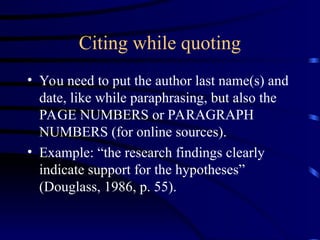
Citing while quoting
• You need to put the author last name(s) and
date, like while paraphrasing, but also the
PAGE NUMBERS or PARAGRAPH
NUMBERS (for online sources).
• Example: “the research findings clearly
indicate support for the hypotheses”
(Douglass, 1986, p. 55).
Warning
• Keep quotations to a minimum (less than 3
per paper)
• Don’t forget the quotation marks and page
numbers (or paragraph numbers), or you
will be guilty of plagiarism!
• Journal name/ book name in italics
Don’t get tied up in knots…
Ask your mentor/guide if you’re
unsure about anything..

APA_style (1).ppt CHAPTER 6: PRACTICAL E

  • 1.
  • 2.
    Why do youhave to do this? • Because learning to write means mastering an accepted and uniform writing style. • Because APA style is the most common writing style in Communication Studies (and in the social sciences).
  • 3.
    What’s Included inAPA Style? • Basically everything in your paper: - How your pages are set up - How you cite sources - Your references - Even your language
  • 4.
    List of references •Required if you cite any sources in your paper • Every source cited in your paper must appear on the reference list, and every entry in your reference list must be cited in your paper • Double spaced!
  • 5.
    Single-authored book Lastname, F.M. (Date published). Title of book. Place of publication: Publisher name Eg: Perloff, R. M. (1995). The dynamics of persuasion. Hillsdale, NJ: Erlbaum.
  • 6.
    Reissued book Newcomb, H.(Ed.). (1995). Television: The critical view (5th ed.). New York: Oxford University Press. *Note: Capitals in the title of the book are restricted to the first letter of the first word of the title, the first letter of any proper names, and the first letter of the first word after a semicolon, period, or question mark.
  • 7.
    Dual-authored book Baran, S.J., & Davis, D. K. (1995). Mass communication theory: Foundations, ferment and future. Belmont, CA: Wadsworth. *Note: when listing authors, use an ampersand (&) in the reference list, not “and.”
  • 8.
    Essay or chapterin an edited book (Book Chapter) Last name, F. M. (Date published). Chapter name. In Author name, Title of book. Place of publication: Publisher name Eg: Bryant, J. (1989). Message features and entertainment effects. In J. J. Bradac (Ed.), Message effects in communication sceince (pp. 231-262). Newbury Park, CA: Sage. *Note: You must include the page numbers if you’re just referencing one part of a book.
  • 9.
    Single-authored article Last name,F. M. (Date published). Title of article. Journal name, Volume(issue), page nos. Eg: Garramone, G. M. (1985). Effects of negative political advertising: The roles of sponsor and rebuttal. Journal of Broadcasting & Electronic Media, 29, 149-159. *Note: The first letter of every important word in the title of the journal is capitalized.
  • 10.
    Two or moreauthors (article) Suzuki, S., & Rancer, A. S. (1994). Argumentativeness and verbal aggressiveness: Testing for conceptual and measurement equivalence across cultures. Communication Monographs, 61(3), 256-279. *Note: Can you find the volume number, issue number and page numbers in this citation?
  • 11.
    • In otherstyles it may be written as S. Suzuki & A.S. Rancer (1994). “Argumentativeness and verbal aggressiveness: Testing for conceptual and measurement equivalence across cultures.” Communication Monographs, Vol. 61 No. 3, pp 256-279. NOT APA!!!!!
  • 12.
    Two or moreauthors (article) Cheung, J. M. Y., Bartlett, D. J., Armour, C. L., Laba, T. L., & Saini, B. (2018). To drug or not to drug: A qualitative study of patients’ decision-making processes for managing insomnia. Behavioral Sleep Medicine, 16(1), 1-26. doi:10.1080/15402002.2016.116370
  • 13.
    Unpublished convention paper Thomas,S., & Gitlin, T. (1993, May). Who says there’s a dominant ideology and what happens if that concept is falsified? Paper presented at the annual meeting of the International Communication Association, Washington, DC. Note: Conference papers are less highly regarded than published works
  • 14.
    Internet articles basedon a print source VandenBos, G., Knapp, S., & Doe, J. (2001). Role of reference elements in the selection of resources by psychology undergraduates. [Electronic version]. Journal of Bibliographic Research, 5, 117-123. *Note: Sometimes electronic versions are different from the print versions.
  • 15.
    Article in aninternet-only journal Frederickson, B. L. (2000, March 7). Cultivating positive emotions to optimize health and well-being. Prevention & Treatment, 3. Retrieved November 20, 2000, from http://journals.apa.org/prevention/volume3/ pre0030001a.html *Note: this would be the correct citation format for the article you abstracted for class
  • 16.
    Web Source • Webpagewith an author Lastname, F. M. (Date published). Title of page. Retrieved from URL Eg: Lopez, S. J. (2000). The emergence of Positive Psychology: The building of a field of dreams. Retrieved from http://www.apa.org/apags/profdev/pospsyc.htm • Webpage with no author Title. (year).Retrieved from URL $250m funding boost for malaria vaccine. (2003). Retrieved from https://www.abc.net.au/news/2003-09-22/250m-funding- boost-for-malaria-vaccine/1482220
  • 17.
    Web Source • Webpagewith an author and no date Last name, F. M. (n.d.). Title of page. Retrieved from URL Smith, W. (n.d.). The future of aged care nursing in Australia. Retrieved from https://healthtimes.com.au/hub/aged-care/2/news/nc1/the- future-of-aged-care-nursing-in-australia/495/ • Webpage with no author and no date Title. (n.d.).Retrieved from URL $250m funding boost for malaria vaccine. (n.d.). Retrieved from https://www.abc.net.au/news/2003-09-22/250m-funding- boost-for-malaria-vaccine/1482220
  • 18.
    Hang on, you’renot done!! Learning how to do your reference page is only the beginning to APA style!!
  • 19.
    When do youcite your sources in your paper? • When you’re referring to an idea or concept you drew from something you read. • When you quote from something you read or heard. • When you want to give the reader some other places to look for additional information.
  • 20.
    Paraphrasing Scott (1992) identified… Severalresearchers (Anthony, 1990; Gregory & Jacobs, 1985; Polk et al., 1980) reported… Or at the end of a sentence paraphrased from another work (Scott, 1992).
  • 21.
    Citing while paraphrasing •List the last names of all authors the first time you cite them, unless there are more than 5. • If there are more than five, or you are citing the paper of 3 or more authors for a second or more time, list last name of first author, followed by “et al.,” and the date.
  • 22.
    Examples Scott, Williamson, and Schaffer(1990) reported that… (FIRST TIME) Scott et al. (1990) reported that (EVERY TIME AFTER) Scott and Williamson (1990) reported that… (FIRST TIME and EVERY TIME) 6 or more authors, use “et al.,” first time and every time.
  • 23.
    Citing while quoting •You need to put the author last name(s) and date, like while paraphrasing, but also the PAGE NUMBERS or PARAGRAPH NUMBERS (for online sources). • Example: “the research findings clearly indicate support for the hypotheses” (Douglass, 1986, p. 55).
  • 24.
    Warning • Keep quotationsto a minimum (less than 3 per paper) • Don’t forget the quotation marks and page numbers (or paragraph numbers), or you will be guilty of plagiarism! • Journal name/ book name in italics
  • 25.
    Don’t get tiedup in knots… Ask your mentor/guide if you’re unsure about anything..