APA Referencing
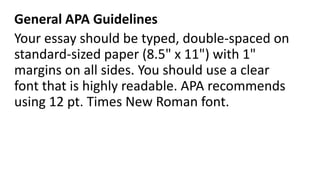
General APA Guidelines
Your essay should be typed, double-spaced on
standard-sized paper (8.5" x 11") with 1"
margins on all sides. You should use a clear
font that is highly readable. APA recommends
using 12 pt. Times New Roman font.
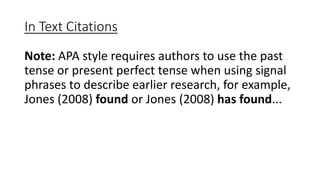
In Text Citations
Note: APA style requires authors to use the past
tense or present perfect tense when using signal
phrases to describe earlier research, for example,
Jones (2008) found or Jones (2008) has found...
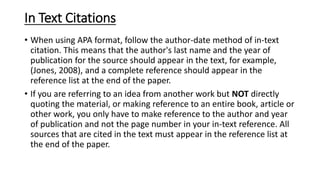
In Text Citations
• When using APA format, follow the author-date method of in-text
citation. This means that the author's last name and the year of
publication for the source should appear in the text, for example,
(Jones, 2008), and a complete reference should appear in the
reference list at the end of the paper.
• If you are referring to an idea from another work but NOT directly
quoting the material, or making reference to an entire book, article or
other work, you only have to make reference to the author and year
of publication and not the page number in your in-text reference. All
sources that are cited in the text must appear in the reference list at
the end of the paper.
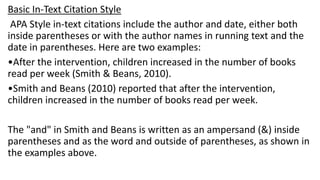
Basic In-Text Citation Style
APA Style in-text citations include the author and date, either both
inside parentheses or with the author names in running text and the
date in parentheses. Here are two examples:
•After the intervention, children increased in the number of books
read per week (Smith & Beans, 2010).
•Smith and Beans (2010) reported that after the intervention,
children increased in the number of books read per week.
The "and" in Smith and Beans is written as an ampersand (&) inside
parentheses and as the word and outside of parentheses, as shown in
the examples above.
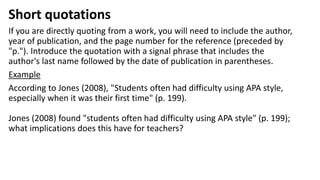
Short quotations
If you are directly quoting from a work, you will need to include the author,
year of publication, and the page number for the reference (preceded by
"p."). Introduce the quotation with a signal phrase that includes the
author's last name followed by the date of publication in parentheses.
Example
According to Jones (2008), "Students often had difficulty using APA style,
especially when it was their first time" (p. 199).
Jones (2008) found "students often had difficulty using APA style" (p. 199);
what implications does this have for teachers?
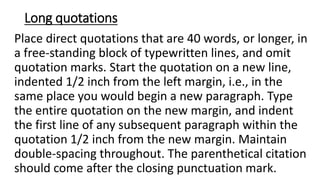
Long quotations
Place direct quotations that are 40 words, or longer, in
a free-standing block of typewritten lines, and omit
quotation marks. Start the quotation on a new line,
indented 1/2 inch from the left margin, i.e., in the
same place you would begin a new paragraph. Type
the entire quotation on the new margin, and indent
the first line of any subsequent paragraph within the
quotation 1/2 inch from the new margin. Maintain
double-spacing throughout. The parenthetical citation
should come after the closing punctuation mark.
Jones‘ (2008) study found the following:
Students often had difficulty using APA style,
especially when it was their first time citing sources. This difficulty could
be attributed to the fact that many students failed to purchase a style
manual or to ask their teacher for help. (p. 199)
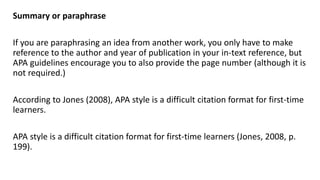
Summary or paraphrase
If you are paraphrasing an idea from another work, you only have to make
reference to the author and year of publication in your in-text reference, but
APA guidelines encourage you to also provide the page number (although it is
not required.)
According to Jones (2008), APA style is a difficult citation format for first-time
learners.
APA style is a difficult citation format for first-time learners (Jones, 2008, p.
199).
In-Text Citations
•If there is no author, use the title (or a short form of
the title, if it is lengthy) and the year. Titles that are
italicized in the reference list are italicized in text;
titles that are not italicized in the reference list
appear in quotation marks.
•If there is no date, use “n.d.” (without quotation
marks) instead.
Dealing with missing information
What information do you have? Solution Position A Position B
I have both author and date n/a Author surname(s) year
Author is missing
Substitute the title for the
author name
Title of Book or "Title
of Article"
year
Date is missing Use "n.d." for "no date" Author surname(s) n.d.
Author and date are both missing
Combine solutions for author
and date being missing
Title of Book or "Title
of Article"
n.d.
How do you format a bibliography in APA
Style®?
•APA Style® calls for a list of references instead of a
bibliography.
•The requirements of a reference list are that all
references cited in the text of a paper must be listed
alphabetically by first author's last name in the list of
references and that all references listed must be
cited within the text.
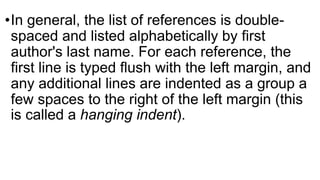
•In general, the list of references is double-
spaced and listed alphabetically by first
author's last name. For each reference, the
first line is typed flush with the left margin, and
any additional lines are indented as a group a
few spaces to the right of the left margin (this
is called a hanging indent).
Website
http://www.citationmachine.net/apa/cite-a-book
Can life get any easier? To do your Reference List check out the website
below:
Source
Http://www.apastyle.org/learn/quick-guide-on-references.aspx#In-Text
https://owl.english.purdue.edu/owl/resource/560/01/

Apa referencing

  • 1.
  • 2.
    General APA Guidelines Youressay should be typed, double-spaced on standard-sized paper (8.5" x 11") with 1" margins on all sides. You should use a clear font that is highly readable. APA recommends using 12 pt. Times New Roman font.
  • 3.
    In Text Citations Note:APA style requires authors to use the past tense or present perfect tense when using signal phrases to describe earlier research, for example, Jones (2008) found or Jones (2008) has found...
  • 4.
    In Text Citations •When using APA format, follow the author-date method of in-text citation. This means that the author's last name and the year of publication for the source should appear in the text, for example, (Jones, 2008), and a complete reference should appear in the reference list at the end of the paper. • If you are referring to an idea from another work but NOT directly quoting the material, or making reference to an entire book, article or other work, you only have to make reference to the author and year of publication and not the page number in your in-text reference. All sources that are cited in the text must appear in the reference list at the end of the paper.
  • 5.
    Basic In-Text CitationStyle APA Style in-text citations include the author and date, either both inside parentheses or with the author names in running text and the date in parentheses. Here are two examples: •After the intervention, children increased in the number of books read per week (Smith & Beans, 2010). •Smith and Beans (2010) reported that after the intervention, children increased in the number of books read per week. The "and" in Smith and Beans is written as an ampersand (&) inside parentheses and as the word and outside of parentheses, as shown in the examples above.
  • 6.
    Short quotations If youare directly quoting from a work, you will need to include the author, year of publication, and the page number for the reference (preceded by "p."). Introduce the quotation with a signal phrase that includes the author's last name followed by the date of publication in parentheses. Example According to Jones (2008), "Students often had difficulty using APA style, especially when it was their first time" (p. 199). Jones (2008) found "students often had difficulty using APA style" (p. 199); what implications does this have for teachers?
  • 7.
    Long quotations Place directquotations that are 40 words, or longer, in a free-standing block of typewritten lines, and omit quotation marks. Start the quotation on a new line, indented 1/2 inch from the left margin, i.e., in the same place you would begin a new paragraph. Type the entire quotation on the new margin, and indent the first line of any subsequent paragraph within the quotation 1/2 inch from the new margin. Maintain double-spacing throughout. The parenthetical citation should come after the closing punctuation mark.
  • 8.
    Jones‘ (2008) studyfound the following: Students often had difficulty using APA style, especially when it was their first time citing sources. This difficulty could be attributed to the fact that many students failed to purchase a style manual or to ask their teacher for help. (p. 199)
  • 9.
    Summary or paraphrase Ifyou are paraphrasing an idea from another work, you only have to make reference to the author and year of publication in your in-text reference, but APA guidelines encourage you to also provide the page number (although it is not required.) According to Jones (2008), APA style is a difficult citation format for first-time learners. APA style is a difficult citation format for first-time learners (Jones, 2008, p. 199).
  • 10.
    In-Text Citations •If thereis no author, use the title (or a short form of the title, if it is lengthy) and the year. Titles that are italicized in the reference list are italicized in text; titles that are not italicized in the reference list appear in quotation marks. •If there is no date, use “n.d.” (without quotation marks) instead.
  • 11.
    Dealing with missinginformation What information do you have? Solution Position A Position B I have both author and date n/a Author surname(s) year Author is missing Substitute the title for the author name Title of Book or "Title of Article" year Date is missing Use "n.d." for "no date" Author surname(s) n.d. Author and date are both missing Combine solutions for author and date being missing Title of Book or "Title of Article" n.d.
  • 12.
    How do youformat a bibliography in APA Style®? •APA Style® calls for a list of references instead of a bibliography. •The requirements of a reference list are that all references cited in the text of a paper must be listed alphabetically by first author's last name in the list of references and that all references listed must be cited within the text.
  • 13.
    •In general, thelist of references is double- spaced and listed alphabetically by first author's last name. For each reference, the first line is typed flush with the left margin, and any additional lines are indented as a group a few spaces to the right of the left margin (this is called a hanging indent).
  • 15.
  • 17.
    http://www.citationmachine.net/apa/cite-a-book Can life getany easier? To do your Reference List check out the website below:
  • 18.