Name
Ahsan
Sarwar
Roll #
2K15-
MET-21
Topic
Basics of
IC Engine
University Name :- NFC IET MULTAN
PAKISTAN
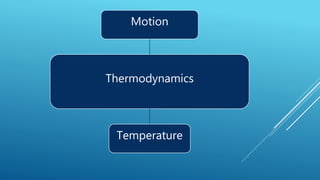
Thermodynamics
Motion
Temperature
Thermodynamics
Thermodynamics is a Greek word which means
flow of heat in physical and chemical reactions
Thermodynamics is a branch of science which
deals with study of different forms of energy
and their interconversions
It deals with energy changes in physical and
chemical processes
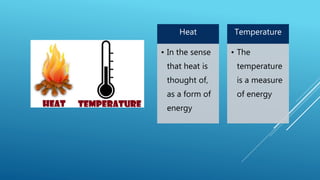
Difference Between Heat and Temperature
Heat
• The hotter an object is, the faster
the motion of the molecules inside
it. Thus, the heat of an object is the
total energy of all the molecular
motion inside that object.
• unit joule (J)
Temperature
• Temperature, on the other hand, is
a measure of the average heat or
thermal energy of the molecules in
a substance.
• Unit Centigrade (c
Heat
• In the sense
that heat is
thought of,
as a form of
energy
Temperature
• The
temperature
is a measure
of energy
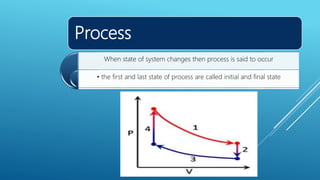
Process
When state of system changes then process is said to occur
• the first and last state of process are called initial and final state
Process
Process give us the path by which system changes
from one state to other
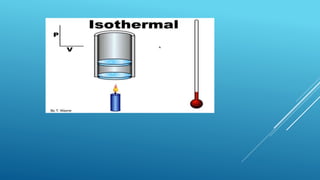
Isothermal process
An isothermal process is a change of a system, in
which the temperature remains constant:
ΔT = 0.
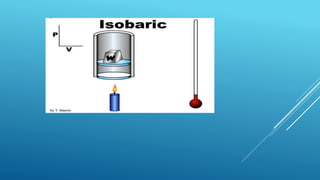
Isobaric process
An isobaric process is a thermodynamic
in which the pressure stays constant: ΔP = 0
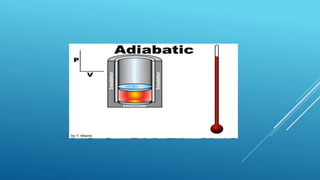
Adiabatic process
In thermodynamics, an adiabatic process is one that occurs
without transfer of heat or matter between a
system and its surroundings. In an adiabatic process, energy
is transferred to its surroundings only as work.
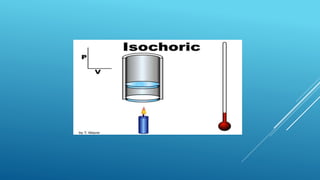
Isochoric process
An isochoric process, also called a constant-volume
process, an isovolumetric process,
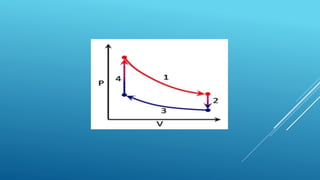
Cyclic Process
• Here the system undergoes
of changes
and finally returns to its initial state
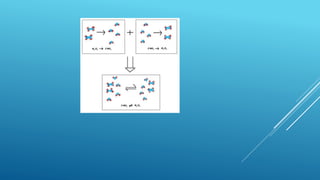
Reversible reaction
A reversible reaction is a reaction where the reactants form
products, which react together to give the reactants back. A
B can react to form C and D or, in the reverse reaction, C and D
can react to form A and B. This is distinct from reversible
in thermodynamics.
Irreversible process
Change is brought about rapidly and the system does not
equilibrium
The force which drives the reactants towards products is
than opposing force which is to carry reverse process
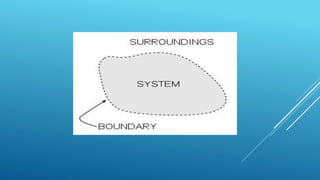
System
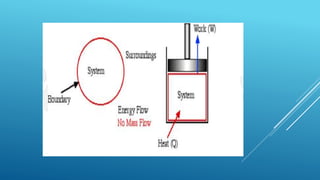
May be defined as the part of universe selected for
thermodynamic consideration i.e. to study the effect of
temperature, pressure etc.
It may also be defined as specified part of universe in
which energy changes are taking place
Surrounding
• The remaining portion of universe excluding
the system is called Surrounding
• Universe = System + Surrounding
The System And Surrounding can be separated
by real and imaginary Boundary
Types of System
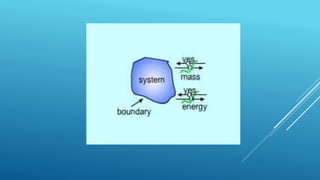
1. Open System:
Here mass and energy can be exchanged with surroundings eg. If some water is
kept in open vessel or hot tea in open cup
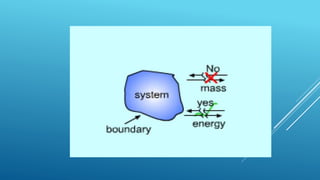
Closed System
In a closed system, there is only the exchange of energy
with surroundings, no exchange of mass takes place
For example, if water is placed in closed metallic vessel or
hot tea placed in closed tea pot
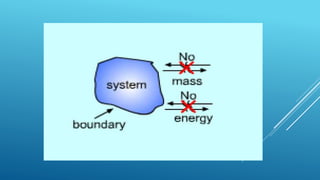
Isolated System
There is neither exchange of mass nor energy
with surrounding.
Eg. Water placed in a vessel which is closed as
well as insulated or tea placed in a thermos
Classification of system on the basis of
nature of constituents
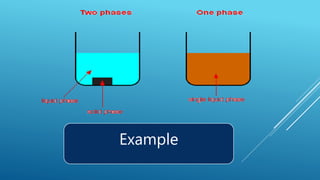
Homogenous System:
All the constituents are present in the same
phase and composition of system is uniform
throughout
Heterogenous System:
It contains two or more phases and the
composition is uniform throughout
Example
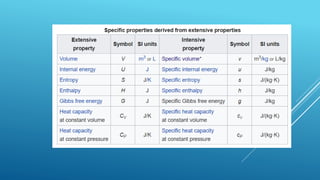
Intensive and Extensive Properties
Intensive Properties
They do not depend on the size of the system or
quantity of matter present in it.
They are dependent on the nature of substance
present in it.
Example: pressure, temperature, density, surface
tension
Extensive Properties
• Depend on the Quantity of matter present in the
• Examples: volume, energy, heat capacity, entropy
Spontaneous process
• It may also be defined as the process which can
take place by itself or initiation Which take place
itself
• Evaporation of water in open vessel
• Dissolution of salt in water
• Flow of water down a hill
example
Which take place by initiation
• Combination of oxygen and hydrogen to form
water
• Lighting of candle is initiated by ignition
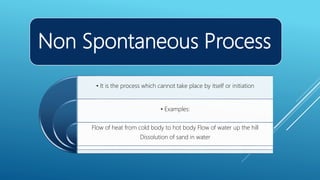
Non Spontaneous Process
• It is the process which cannot take place by itself or initiation
• Examples:
Flow of heat from cold body to hot body Flow of water up the hill
Dissolution of sand in water
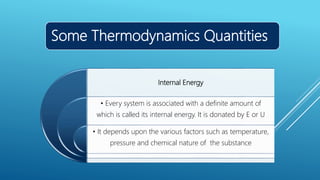
Some Thermodynamics Quantities
Internal Energy
• Every system is associated with a definite amount of
which is called its internal energy. It is donated by E or U
• It depends upon the various factors such as temperature,
pressure and chemical nature of the substance
Some Thermodynamics Quantities
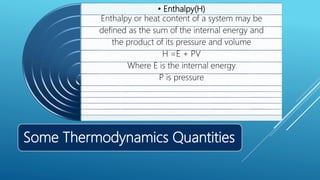
• Enthalpy(H)
Enthalpy or heat content of a system may be
defined as the sum of the internal energy and
the product of its pressure and volume
H =E + PV
Where E is the internal energy
P is pressure
Some Thermodynamics Quantities
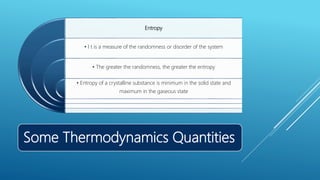
Entropy
• I t is a measure of the randomness or disorder of the system
• The greater the randomness, the greater the entropy
• Entropy of a crystalline substance is minimum in the solid state and
maximum in the gaseous state
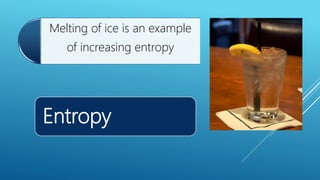
Entropy
Melting of ice is an example
of increasing entropy
LAWS OF THERMODYNAMICS
There are four Laws of thermodynamics:
• Zeroth law of thermodynamics
• 1st Law of thermodynamics
• 2nd Law of thermodynamics
• 3rd Law of thermodynamics
LAWS OF THERMODYNAMICS
Zeroth Law of thermodynamics
When two bodies A and B are separately in
thermal equilibrium with a third body, they in turn
are in equilibrium with each other
LAWS OF THERMODYNAMICS
1st Law of thermodynamics
• Energy can neither be created nor destroyed although it
may be converted from one form to other
• The total energy of the universe remains constant
although it may undergo transformation from one form
to other
• The energy of an isolated system remains constant
LAWS OF THERMODYNAMICS
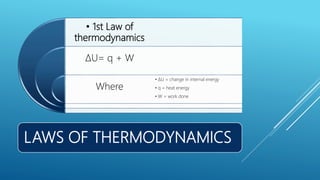
• 1st Law of
thermodynamics
ΔU= q + W
Where
• ΔU = change in internal energy
• q = heat energy
• W = work done
LAWS OF THERMODYNAMICS
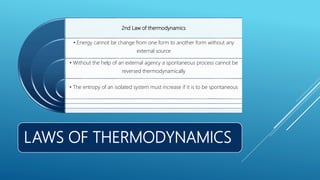
2nd Law of thermodynamics
• Energy cannot be change from one form to another form without any
external source
• Without the help of an external agency a spontaneous process cannot be
reversed thermodynamically
• The entropy of an isolated system must increase if it is to be spontaneous
LAWS OF THERMODYNAMICS
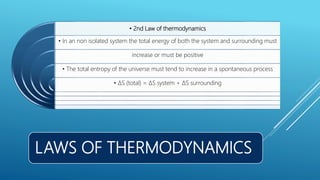
• 2nd Law of thermodynamics
• In an non isolated system the total energy of both the system and surrounding must
increase or must be positive
• The total entropy of the universe must tend to increase in a spontaneous process
• ΔS (total) = ΔS system + ΔS surrounding
LAWS OF THERMODYNAMICS
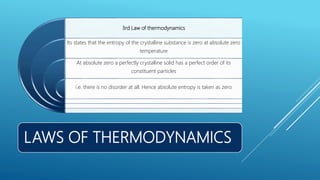
3rd Law of thermodynamics
Its states that the entropy of the crystalline substance is zero at absolute zero
temperature
At absolute zero a perfectly crystalline solid has a perfect order of its
constituent particles
i.e. there is no disorder at all. Hence absolute entropy is taken as zero
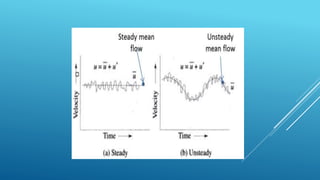
Steady Flow
Definition of steady flow. : a flow in
which the velocity of the fluid at a
particular fixed point does not
with time — called also stationary
flow; compare uniform flow.
Basic Definition of Thermodynamics and IC Engine

Basic Definition of Thermodynamics and IC Engine

  • 2.
  • 3.
    University Name :-NFC IET MULTAN PAKISTAN
  • 4.
  • 5.
    Thermodynamics Thermodynamics is aGreek word which means flow of heat in physical and chemical reactions Thermodynamics is a branch of science which deals with study of different forms of energy and their interconversions It deals with energy changes in physical and chemical processes
  • 6.
    Difference Between Heatand Temperature Heat • The hotter an object is, the faster the motion of the molecules inside it. Thus, the heat of an object is the total energy of all the molecular motion inside that object. • unit joule (J) Temperature • Temperature, on the other hand, is a measure of the average heat or thermal energy of the molecules in a substance. • Unit Centigrade (c
  • 7.
    Heat • In thesense that heat is thought of, as a form of energy Temperature • The temperature is a measure of energy
  • 8.
    Process When state ofsystem changes then process is said to occur • the first and last state of process are called initial and final state
  • 9.
    Process Process give usthe path by which system changes from one state to other
  • 10.
    Isothermal process An isothermalprocess is a change of a system, in which the temperature remains constant: ΔT = 0.
  • 12.
    Isobaric process An isobaricprocess is a thermodynamic in which the pressure stays constant: ΔP = 0
  • 14.
    Adiabatic process In thermodynamics,an adiabatic process is one that occurs without transfer of heat or matter between a system and its surroundings. In an adiabatic process, energy is transferred to its surroundings only as work.
  • 16.
    Isochoric process An isochoricprocess, also called a constant-volume process, an isovolumetric process,
  • 18.
    Cyclic Process • Herethe system undergoes of changes and finally returns to its initial state
  • 20.
    Reversible reaction A reversiblereaction is a reaction where the reactants form products, which react together to give the reactants back. A B can react to form C and D or, in the reverse reaction, C and D can react to form A and B. This is distinct from reversible in thermodynamics.
  • 22.
    Irreversible process Change isbrought about rapidly and the system does not equilibrium The force which drives the reactants towards products is than opposing force which is to carry reverse process
  • 24.
    System May be definedas the part of universe selected for thermodynamic consideration i.e. to study the effect of temperature, pressure etc. It may also be defined as specified part of universe in which energy changes are taking place
  • 26.
    Surrounding • The remainingportion of universe excluding the system is called Surrounding • Universe = System + Surrounding The System And Surrounding can be separated by real and imaginary Boundary
  • 28.
    Types of System 1.Open System: Here mass and energy can be exchanged with surroundings eg. If some water is kept in open vessel or hot tea in open cup
  • 30.
    Closed System In aclosed system, there is only the exchange of energy with surroundings, no exchange of mass takes place For example, if water is placed in closed metallic vessel or hot tea placed in closed tea pot
  • 32.
    Isolated System There isneither exchange of mass nor energy with surrounding. Eg. Water placed in a vessel which is closed as well as insulated or tea placed in a thermos
  • 34.
    Classification of systemon the basis of nature of constituents Homogenous System: All the constituents are present in the same phase and composition of system is uniform throughout Heterogenous System: It contains two or more phases and the composition is uniform throughout
  • 35.
  • 36.
    Intensive and ExtensiveProperties Intensive Properties They do not depend on the size of the system or quantity of matter present in it. They are dependent on the nature of substance present in it. Example: pressure, temperature, density, surface tension
  • 37.
    Extensive Properties • Dependon the Quantity of matter present in the • Examples: volume, energy, heat capacity, entropy
  • 39.
    Spontaneous process • Itmay also be defined as the process which can take place by itself or initiation Which take place itself • Evaporation of water in open vessel • Dissolution of salt in water • Flow of water down a hill
  • 40.
    example Which take placeby initiation • Combination of oxygen and hydrogen to form water • Lighting of candle is initiated by ignition
  • 41.
    Non Spontaneous Process •It is the process which cannot take place by itself or initiation • Examples: Flow of heat from cold body to hot body Flow of water up the hill Dissolution of sand in water
  • 42.
    Some Thermodynamics Quantities InternalEnergy • Every system is associated with a definite amount of which is called its internal energy. It is donated by E or U • It depends upon the various factors such as temperature, pressure and chemical nature of the substance
  • 43.
    Some Thermodynamics Quantities •Enthalpy(H) Enthalpy or heat content of a system may be defined as the sum of the internal energy and the product of its pressure and volume H =E + PV Where E is the internal energy P is pressure
  • 44.
    Some Thermodynamics Quantities Entropy •I t is a measure of the randomness or disorder of the system • The greater the randomness, the greater the entropy • Entropy of a crystalline substance is minimum in the solid state and maximum in the gaseous state
  • 45.
    Entropy Melting of iceis an example of increasing entropy
  • 46.
    LAWS OF THERMODYNAMICS Thereare four Laws of thermodynamics: • Zeroth law of thermodynamics • 1st Law of thermodynamics • 2nd Law of thermodynamics • 3rd Law of thermodynamics
  • 47.
    LAWS OF THERMODYNAMICS ZerothLaw of thermodynamics When two bodies A and B are separately in thermal equilibrium with a third body, they in turn are in equilibrium with each other
  • 48.
    LAWS OF THERMODYNAMICS 1stLaw of thermodynamics • Energy can neither be created nor destroyed although it may be converted from one form to other • The total energy of the universe remains constant although it may undergo transformation from one form to other • The energy of an isolated system remains constant
  • 49.
    LAWS OF THERMODYNAMICS •1st Law of thermodynamics ΔU= q + W Where • ΔU = change in internal energy • q = heat energy • W = work done
  • 50.
    LAWS OF THERMODYNAMICS 2ndLaw of thermodynamics • Energy cannot be change from one form to another form without any external source • Without the help of an external agency a spontaneous process cannot be reversed thermodynamically • The entropy of an isolated system must increase if it is to be spontaneous
  • 51.
    LAWS OF THERMODYNAMICS •2nd Law of thermodynamics • In an non isolated system the total energy of both the system and surrounding must increase or must be positive • The total entropy of the universe must tend to increase in a spontaneous process • ΔS (total) = ΔS system + ΔS surrounding
  • 52.
    LAWS OF THERMODYNAMICS 3rdLaw of thermodynamics Its states that the entropy of the crystalline substance is zero at absolute zero temperature At absolute zero a perfectly crystalline solid has a perfect order of its constituent particles i.e. there is no disorder at all. Hence absolute entropy is taken as zero
  • 53.
    Steady Flow Definition ofsteady flow. : a flow in which the velocity of the fluid at a particular fixed point does not with time — called also stationary flow; compare uniform flow.