Depression and Anxiety in People with Epilepsy  Scott E. Hirsch, MD NYU-Langone Medical Center 5/15/11
No financial support from pharmaceutical companies. Information obtained from best available evidence from: Medical Literature Clinical Experience Disclosures
Epilepsy  The management of patients with epilepsy is focused on: Controlling seizures Avoiding treatment side effects Maintaining quality of life.
Epilepsy and Quality of Life  If seizure free, people with epilepsy enjoy a quality of life similar to the general population. One third of people with epilepsy continue to have seizures despite treatment. Because people with recurring seizures may have lower quality of life, every effort must be made to restore quality of life.
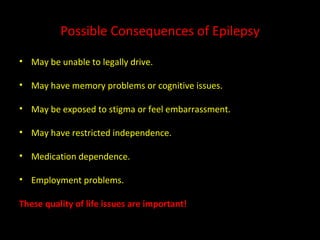
Possible Consequences of Epilepsy May be unable to legally drive. May have memory problems or cognitive issues. May be exposed to stigma or feel embarrassment. May have restricted independence. Medication dependence. Employment problems. These quality of life issues are important!
Adjustment Disorder When coping and problem-solving strategies fail, depressed mood and anxiety symptoms may result. This isn’t necessarily a “disorder,” but rather acknowledgement that the person is having trouble adjusting to a life change or a new stressor.  Bolstering social support, attending support groups, and learning new coping skills often helps adjustment and leads to resolution of symptoms.
Feeling sad sometimes is normal Feeling sad, “blue,” or “down” is part of our normal human experience. Appropriate when we experience tragedy, loss, or receive bad news. When these feelings persist for more than  2 weeks  and also interfere with daily functioning, then we think about “Major Depression.”
Epilepsy and Depression Depressed mood is NOT normal in people with epilepsy. Depression can be part of a complex partial seizure. Depression can also be pre-ictal or post-ictal. Untreated depression is associated with more difficulty achieving seizure freedom.
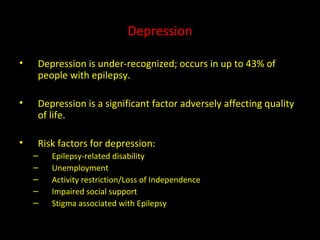
Depression Depression is under-recognized; occurs in up to 43% of people with epilepsy. Depression is a significant factor adversely affecting quality of life. Risk factors for depression: Epilepsy-related disability Unemployment Activity restriction/Loss of Independence Impaired social support Stigma associated with Epilepsy
What causes Depression in Epilepsy?  Psychological factors:  difficulty coping with stressors, such as recurrent seizures real or perceived losses  life experiences that set the stage for later depression Biological factors:  prior history of mental illness family history of mental illness some seizure types Social factors: social isolation financial issues limits on independence
Depression Important to treat in both children and adults.  Treating depression improves quality of life in people with epilepsy.
Criteria for Major Depression Over a  2 week  period, most of the day, nearly every day:   Depressed Mood OR Loss of pleasure AND… 4 or more of the following nearly every day: Significant change in appetite or weight Trouble falling asleep, staying asleep, waking early/late Observable slowness of thought and movement Fatigue or loss of energy Feelings of worthlessness or excessive guilt Difficulty thinking or concentrating Recurring thoughts of death or suicide
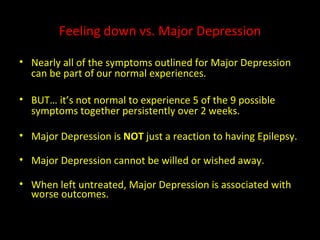
Feeling down vs. Major Depression Nearly all of the symptoms outlined for Major Depression can be part of our normal experiences. BUT… it’s not normal to experience 5 of the 9 possible symptoms together persistently over 2 weeks. Major Depression is  NOT  just a reaction to having Epilepsy. Major Depression cannot be willed or wished away. When left untreated, Major Depression is associated with worse outcomes.
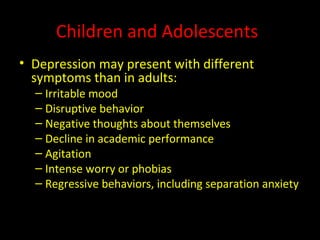
Children and Adolescents Depression may present with different symptoms than in adults: Irritable mood Disruptive behavior Negative thoughts about themselves Decline in academic performance Agitation Intense worry or phobias  Regressive behaviors, including separation anxiety
STAR*D: Efficacy of Treatment for Depression  Sequenced Treatment Alternatives to Relieve Depression. Nationwide public health clinical trial funded by the NIH. NOT  funded by pharmaceutical companies! Largest and longest study to evaluate depression treatment.  Randomized, Double blinded study. 2,876  participants, ages 18-75 in Level 1. Fewer participants in subsequent levels by design. Standardized rating system and treatment.
STAR D* Study Design Level 1:   Celexa (an SSRI) for 12-14 weeks a. Symptom free -> 12 month follow-up b. Symptoms persist or intolerable side effects -> Level 2 Level 2:   Participant  given   option of switching to Talk therapy, a different medication or adding talk therapy or a new medication a. Symptom free -> 12 month follow-up b. Symptoms persist or intolerable side effects -> Level 3 Level 3:  Participant  given   option of switching or adding different medication  a. Symptom free -> 12 month follow-up b. Symptoms persist or intolerable side effects -> Level 4 Level 4: All medications discontinued Randomly switched to 4 th  line medication
STAR D* Conclusions 50% of participants had remission after 2 treatments 75% of participants had remission after 4 treatments May need to try more than one treatment for remission
Anxiety Anxiety is a common, normal emotion Jitters Butterflies in the stomach Fear Nervousness Worry Tension Trepidation Panic Anxiety isn’t all bad Sharpens our senses Helps us know something is wrong
Anxiety and Epilepsy In people with epilepsy, Anxiety becomes a way of life. Worry about having a life-threatening seizure. Worry about having a seizure in public. Worry about being socially rejected Fear or worry might be an aura or seizure. When anxiety interferes with social, academic, occupational, or home functioning, treatment is recommended.
Anxiety When persistent, Anxiety becomes a problem. 1 in 4 people develop an Anxiety Disorder over their lifetime: Generalized Anxiety Disorder Panic Disorder Agoraphobia Social Anxiety Disorder Obsessive-Compulsive Disorder Post-Traumatic Stress Disorder
Barriers in treating Depression and Anxiety People do not recognize or believe they need treatment.  People think current mood or anxiety problems are related to a temporary situation. People do not want to consider taking another medicine. Concern about worsening seizures with medication. Concern about side effects. Stigma.
Treatments for Depression and Anxiety Talk therapy: the first line of treatment Individual therapy Group therapy Family therapy Support groups Caregiver support Goals of therapy include: Developing solutions to immediate problems in living. Implementing lifestyle modifications. Correcting maladapative thoughts or behaviors. Uncovering thoughts that lead to feelings of helplessness and hopelessness.  Overcoming fears of dependency or abandonment.  Learning new coping skills (relaxation techniques, imagery, focused breathing exercises, meditation, and progressive muscle relaxation).
Medication for Depression and Anxiety  Medications are a mainstay of management for people with Major Depression and Anxiety Disorders. Antidepressants are  safe and effective  in people with Major Depression and Anxiety Disorders when taken under a doctor’s care .  Medications: Alleviate depressed mood and anxiety symptoms. Reduce emotional lability, irritability, and worry. Reduce social withdrawal.  Improve a person’s ability to participate in epilepsy treatments. Improve overall functioning.
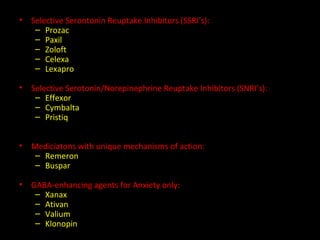
Selective Serontonin Reuptake Inhibitors (SSRI’s): Prozac Paxil Zoloft Celexa Lexapro Selective Serotonin/Norepinephrine Reuptake Inhibitors (SNRI’s): Effexor Cymbalta Pristiq Mediciatons with unique mechanisms of action: Remeron Buspar GABA-enhancing agents for Anxiety only: Xanax Ativan Valium Klonopin

Scott Hirsch, MD

  • 1.
    Depression and Anxietyin People with Epilepsy Scott E. Hirsch, MD NYU-Langone Medical Center 5/15/11
  • 2.
    No financial supportfrom pharmaceutical companies. Information obtained from best available evidence from: Medical Literature Clinical Experience Disclosures
  • 3.
    Epilepsy Themanagement of patients with epilepsy is focused on: Controlling seizures Avoiding treatment side effects Maintaining quality of life.
  • 4.
    Epilepsy and Qualityof Life If seizure free, people with epilepsy enjoy a quality of life similar to the general population. One third of people with epilepsy continue to have seizures despite treatment. Because people with recurring seizures may have lower quality of life, every effort must be made to restore quality of life.
  • 5.
    Possible Consequences ofEpilepsy May be unable to legally drive. May have memory problems or cognitive issues. May be exposed to stigma or feel embarrassment. May have restricted independence. Medication dependence. Employment problems. These quality of life issues are important!
  • 6.
    Adjustment Disorder Whencoping and problem-solving strategies fail, depressed mood and anxiety symptoms may result. This isn’t necessarily a “disorder,” but rather acknowledgement that the person is having trouble adjusting to a life change or a new stressor. Bolstering social support, attending support groups, and learning new coping skills often helps adjustment and leads to resolution of symptoms.
  • 7.
    Feeling sad sometimesis normal Feeling sad, “blue,” or “down” is part of our normal human experience. Appropriate when we experience tragedy, loss, or receive bad news. When these feelings persist for more than 2 weeks and also interfere with daily functioning, then we think about “Major Depression.”
  • 8.
    Epilepsy and DepressionDepressed mood is NOT normal in people with epilepsy. Depression can be part of a complex partial seizure. Depression can also be pre-ictal or post-ictal. Untreated depression is associated with more difficulty achieving seizure freedom.
  • 9.
    Depression Depression isunder-recognized; occurs in up to 43% of people with epilepsy. Depression is a significant factor adversely affecting quality of life. Risk factors for depression: Epilepsy-related disability Unemployment Activity restriction/Loss of Independence Impaired social support Stigma associated with Epilepsy
  • 10.
    What causes Depressionin Epilepsy? Psychological factors: difficulty coping with stressors, such as recurrent seizures real or perceived losses life experiences that set the stage for later depression Biological factors: prior history of mental illness family history of mental illness some seizure types Social factors: social isolation financial issues limits on independence
  • 11.
    Depression Important totreat in both children and adults. Treating depression improves quality of life in people with epilepsy.
  • 12.
    Criteria for MajorDepression Over a 2 week period, most of the day, nearly every day: Depressed Mood OR Loss of pleasure AND… 4 or more of the following nearly every day: Significant change in appetite or weight Trouble falling asleep, staying asleep, waking early/late Observable slowness of thought and movement Fatigue or loss of energy Feelings of worthlessness or excessive guilt Difficulty thinking or concentrating Recurring thoughts of death or suicide
  • 13.
    Feeling down vs.Major Depression Nearly all of the symptoms outlined for Major Depression can be part of our normal experiences. BUT… it’s not normal to experience 5 of the 9 possible symptoms together persistently over 2 weeks. Major Depression is NOT just a reaction to having Epilepsy. Major Depression cannot be willed or wished away. When left untreated, Major Depression is associated with worse outcomes.
  • 14.
    Children and AdolescentsDepression may present with different symptoms than in adults: Irritable mood Disruptive behavior Negative thoughts about themselves Decline in academic performance Agitation Intense worry or phobias Regressive behaviors, including separation anxiety
  • 15.
    STAR*D: Efficacy ofTreatment for Depression Sequenced Treatment Alternatives to Relieve Depression. Nationwide public health clinical trial funded by the NIH. NOT funded by pharmaceutical companies! Largest and longest study to evaluate depression treatment. Randomized, Double blinded study. 2,876 participants, ages 18-75 in Level 1. Fewer participants in subsequent levels by design. Standardized rating system and treatment.
  • 16.
    STAR D* StudyDesign Level 1: Celexa (an SSRI) for 12-14 weeks a. Symptom free -> 12 month follow-up b. Symptoms persist or intolerable side effects -> Level 2 Level 2: Participant given option of switching to Talk therapy, a different medication or adding talk therapy or a new medication a. Symptom free -> 12 month follow-up b. Symptoms persist or intolerable side effects -> Level 3 Level 3: Participant given option of switching or adding different medication a. Symptom free -> 12 month follow-up b. Symptoms persist or intolerable side effects -> Level 4 Level 4: All medications discontinued Randomly switched to 4 th line medication
  • 17.
    STAR D* Conclusions50% of participants had remission after 2 treatments 75% of participants had remission after 4 treatments May need to try more than one treatment for remission
  • 18.
    Anxiety Anxiety isa common, normal emotion Jitters Butterflies in the stomach Fear Nervousness Worry Tension Trepidation Panic Anxiety isn’t all bad Sharpens our senses Helps us know something is wrong
  • 19.
    Anxiety and EpilepsyIn people with epilepsy, Anxiety becomes a way of life. Worry about having a life-threatening seizure. Worry about having a seizure in public. Worry about being socially rejected Fear or worry might be an aura or seizure. When anxiety interferes with social, academic, occupational, or home functioning, treatment is recommended.
  • 20.
    Anxiety When persistent,Anxiety becomes a problem. 1 in 4 people develop an Anxiety Disorder over their lifetime: Generalized Anxiety Disorder Panic Disorder Agoraphobia Social Anxiety Disorder Obsessive-Compulsive Disorder Post-Traumatic Stress Disorder
  • 21.
    Barriers in treatingDepression and Anxiety People do not recognize or believe they need treatment. People think current mood or anxiety problems are related to a temporary situation. People do not want to consider taking another medicine. Concern about worsening seizures with medication. Concern about side effects. Stigma.
  • 22.
    Treatments for Depressionand Anxiety Talk therapy: the first line of treatment Individual therapy Group therapy Family therapy Support groups Caregiver support Goals of therapy include: Developing solutions to immediate problems in living. Implementing lifestyle modifications. Correcting maladapative thoughts or behaviors. Uncovering thoughts that lead to feelings of helplessness and hopelessness. Overcoming fears of dependency or abandonment. Learning new coping skills (relaxation techniques, imagery, focused breathing exercises, meditation, and progressive muscle relaxation).
  • 23.
    Medication for Depressionand Anxiety Medications are a mainstay of management for people with Major Depression and Anxiety Disorders. Antidepressants are safe and effective in people with Major Depression and Anxiety Disorders when taken under a doctor’s care . Medications: Alleviate depressed mood and anxiety symptoms. Reduce emotional lability, irritability, and worry. Reduce social withdrawal. Improve a person’s ability to participate in epilepsy treatments. Improve overall functioning.
  • 24.
    Selective Serontonin ReuptakeInhibitors (SSRI’s): Prozac Paxil Zoloft Celexa Lexapro Selective Serotonin/Norepinephrine Reuptake Inhibitors (SNRI’s): Effexor Cymbalta Pristiq Mediciatons with unique mechanisms of action: Remeron Buspar GABA-enhancing agents for Anxiety only: Xanax Ativan Valium Klonopin

Editor's Notes

  • #2 Scott Hirsch, MD Depression and Anxiety in People with Epilepsy