UNIPOLAR MOOD
DISORDER
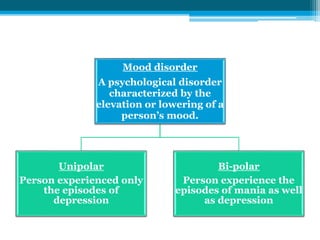
Mood disorder
A psychological disorder
characterized by the
elevation or lowering of a
person’s mood.
Unipolar
Person experienced only
the episodes of
depression
Bi-polar
Person experience the
episodes of mania as well
as depression
DEFINITION: UNIPOLAR
Unipolar Mood Disorder is a mental disorder
characterized by pervasive and persistent low
mood that is accompanied by low self esteem
and by a loss of interest of pleasure in enjoyable
activities.
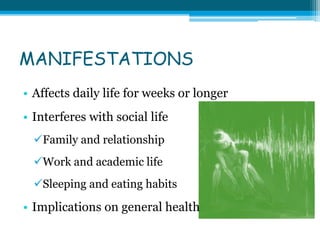
MANIFESTATIONS
• Affects daily life for weeks or longer
• Interferes with social life
Family and relationship
Work and academic life
Sleeping and eating habits
• Implications on general health
• Most common effective disorder
• Profound sadness and related problems, such as
sleep and appetite disturbances, loss of energy
and self-esteem issues.
• Also known as clinical depression, major
depression or as recurrent depression.
DEPRESSIVE DISORDERS
1. Disruptive mood dysregulation disorder
2. Major depressive disorder
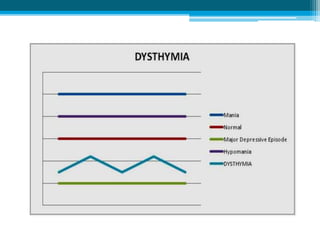
3. Persistent depressive disorder
4. Premenstrual dysphoric disorder
5. Substance / medication induced depressive disorder
6. Depressive disorder due to another medical conditions
7. Other specific depressive disorder
8. Unspecified depressive disorder
• Common feature of all of these disorders: -presence of
sad, empty, or irritable mood
• Accompanied by somatic and cognitive changes that
significantly affect the individual's capacity to function.
• Differences: - issues of duration, timing, or presumed
etiology.
1. DISRUPTIVE MOOD
DYSREGULATION DISORDER
DIAGNOSTIC CODE – 296.99
DIAGNOSTIC CRITERIAS
• A. Severe recurrent temper outbursts manifested verbally (e.g., verbal
rages) and/or behaviorally (e.g., physical aggression toward people or
property) that are grossly out of proportion in intensity or duration to
the situation or provocation.
• B. The temper outbursts are inconsistent with developmental level.
• C. The temper outbursts occur, on average, three or more times per
week.
• D. The mood between temper outbursts is persistently irritable or
angry most of the day, nearly every day, and is observable by others
(e.g., parents, teachers, peers).
• E. Criteria A-D has been present for 12 or more months. Throughout
that time, the individual has not had a period lasting 3 or more
consecutive months without all of these symptoms in Criteria A-D.
• F. Criteria A and D are present in at least two of three settings (i.e.,
at home, at school, with peers) and are severe in at least one of
these.
• G. The diagnosis should not be made for the first time before
age 6 years or after age 18years.
• H. By history or observation, the age at onset of Criteria A-E
is before 10 years.
• I. There has never been a distinct period lasting more than 1
day during which the full symptom criteria, except duration,
for a manic or hypomanic episode have been met.
• J. The behaviors do not occur exclusively during an
episode of major depressive disorder and are not
better explained by another mental disorder (e.g.,
autism spectrum disorder, posttraumatic stress
disorder, separation anxiety disorder, persistent
depressive disorder [dysthymia]).
• K. The symptoms are not attributable to the
physiological effects of a substance or to another
medical or neurological condition.
DIFFERENTIAL DIAGNOSIS
• Bipolar disorders.
• Oppositional defiant disorder.
• Attention-deficit/hyperactivity disorder, major
depressive disorder, anxiety disorders, and
autism spectrum disorder.
• Intermittent explosive disorder.
CLINICAL MANIFESTATIONS
This severe irritability has two prominent clinical
manifestations,
1. Frequent temper outbursts (Criterion B,C,E
and E)
2. chronic, persistently irritable or angry mood
that is present between the severe temper
outbursts. (Criterion C)
CONTN
• DMDD is distinguished from presentations of other, related
conditions, particularly pediatric bipolar disorder.
• DMDD was added to DSM-5 to address the considerable
concern about the appropriate classification and treatment of
children who present with chronic, persistent irritability
relative to children who present with classic (i.e., episodic)
bipolar disorder.
CAUSES
• Family problems such as divorces, moves, death in the family may
contribute to the disorder.
• Psychological trauma or emotional, sexual, or physical abuses in
early ages are also proposed causes.
• Alcohol and drug abuse during pregnancy may be factors.
• Neurological problems such as migraines may also contribute to
this disorder.
• Poor diet, such as vitamin deficiencies and malnutrition, is thought
to be a probable cause. E.g., Vitamin B12, folate, and iron
deficiencies may cause the symptoms of this disorder.
TOOLS FOR ASSESSMENT
• DMDD is a new diagnosis, there are no available
assessment tools to assist in diagnosing and
assessing the disorder per se.
• Professional counselors are currently dependent
upon a process of ruling out other medical
disorders.
PROGNOSTIC FACTORS
• Temperamental
• Genetic and physiological
PREVALENCE
• DMDD is Common among children
• Prevalence estimates of the disorder in the community
are unclear.
• The overall 6-month to 1-year period-prevalence of
DMDD among children and adolescents probably falls in
the 2%-5% range.
• Rates are higher in males and school age children.
TREATMENT
• Medication
• Psychological treatments
• Psychotherapy
• Parent training
• Computer based training
• Medication – Stimulants, Antidepressants and Antipsychotic
• Psychotherapy – CBT, Adlerian Play Therapy, BT, Behavior
modification therapy, Educating family and teachers about DMDD
and how to deal with the outbursts instead of punishment,
Observing the children for their individual triggers, Timeout
strategies
2. MAJOR DEPRESSIVE DISORDER
DIAGNOSTIC CRITERIA
• A. Five (or more) of the following symptoms have been
present during the same 2-weekperiod and represent a change
from previous functioning: at least one of the symptoms is
either (1) depressed mood or (2) loss of interest or pleasure.
• Note: Do not include symptoms that are clearly attributable to
another medical condition.
• 1. Depressed mood most of the day, nearly every day, as
indicated by either subjective report (e.g., feels sad, empty,
hopeless) or observation made by others (e.g., appears
tearful). (Note: In children and adolescents, can be irritable
mood.)
• 2. Markedly diminished interest or pleasure in all, or almost
all, activities most of the day, nearly every day (as indicated by
either subjective account or observation).
• 3. Significant weight loss when not dieting or weight gain
(e.g., a change of more than5% of body weight in a month), or
decrease or increase in appetite nearly every day.(Note: In
children, consider failure to make expected weight gain.)
• 4. Insomnia or hypersomnia nearly every day.
• 5. Psychomotor agitation or retardation nearly every day
(observable by others, not merely subjective feelings of
restlessness or being slowed down).
• 6. Fatigue or loss of energy nearly every day.
• 7. Feelings of worthlessness or excessive or
inappropriate guilt (which may be delusional)
nearly every day (not merely self-reproach or
guilt about being sick).
• 8. Diminished ability to think or concentrate, or
indecisiveness, nearly every day (either by subjective
account or as observed by others).
• 9. Recurrent thoughts of death (not just fear of
dying), recurrent suicidal ideation without a specific
plan, or a suicide attempt or a specific plan for
committing suicide.
• B. The symptoms cause clinically significant distress or
impairment in social, occupational, or other important areas
of functioning.
• C. The episode is not attributable to the physiological effects
of a substance or to another medical condition.
• Note: Criteria A-C represent a major depressive episode.
• D. The occurrence of the major depressive episode is not
better explained by schizoaffective disorder,
schizophrenia, schizophrenic form disorder, delusional
disorder, or other specified and unspecified
schizophrenia spectrum and other psychotic disorders.
• E. There has never been a manic episode or a hypomanic
episode.
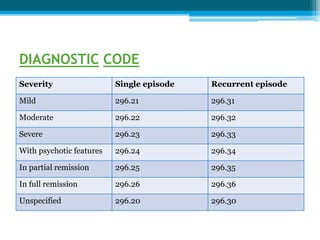
DIAGNOSTIC CODE
Severity Single episode Recurrent episode
Mild 296.21 296.31
Moderate 296.22 296.32
Severe 296.23 296.33
With psychotic features 296.24 296.34
In partial remission 296.25 296.35
In full remission 296.26 296.36
Unspecified 296.20 296.30
DIFFERENTIAL DIAGNOSIS
1. Manic episodes with irritable mood or mixed episodes.
2. Mood disorder due to another medical condition.
3. Substance/medication-induced depressive or bipolar
disorder.
4. Attention-deficit/hyperactivity disorder.
5. Adjustment disorder with depressed mood.
6. Sadness.
CLINICAL MANIFESTATIONS
• MDD occur in an individual who also has a general
medical condition (e.g., cancer, stroke, myocardial
infarction, diabetes, pregnancy).
• Signs and Symptoms: - weight loss with untreated
diabetes; fatigue with cancer; hypersomnia early in
pregnancy; insonmia later in pregnancy or the
postpartum
CONTN
• Appetite change may involve either a reduction or increase.
• Significant loss or gain in weight due to appetite change , or,
in children, a failure to make expected weight gains may be
noted (Criterion A3).
• Sleep disturbance may take the form of either difficulty
sleeping or sleeping excessively (Criterion A4).
CONTN
• Middle insomnia, Initial insomnia or Terminal
insomnia may occur.
• Individuals who present with oversleeping
(hypersomnia) may experience prolonged sleep
episodes at night or increased
daytime sleep.
CAUSES
• Biological differences
• Brain chemistry
• Hormones
• Inherited traits
TOOLS FOR ASSESSMENT
• MSE, Case History
• Differential Diagnosis
• The Structured Clinical Interview for DSM-IV Axis I
Disorders (SCID-I) and the Mini-International
Neuropsychiatric Interview (MINI) are clinician-rated
diagnostic instruments,
• 9-item Patient Health Questionnaire (PHQ-9) and the
PRIME-MD are commonly used patient-rated tools.
CONTN
• For monitoring of depressive symptoms on treatment,
the Hamilton Depression Rating Scale (HAM-D) and the
Montgomery-Åsberg Depression Rating Scale (MADRS
are gold-standard clinician-rated scales.
• Other measures include the Quick Inventory of
Depressive Symptomatology (QIDS) which is available in
both clinician-rated and patient-rated formats and the
patient-rated Beck Depression Inventory (BDI).
PROGNOSTIC FACTORS
• Temperamental
• Environmental
• Genetic and physiological
• Course modifiers
PREVALENCE
• Twelve-month prevalence of major depressive disorder
is approximately 7%
• With marked differences by age group such that the
prevalence in 18- to 29-year-old individuals is three fold
higher than the prevalence in individual’s age 60 years or
older.
• Females experience 1.5- to 3-fold higher rates than males
beginning in early adolescence.
TREATMENT
• Medication – Antidepressants (selective serotonin
reuptake inhibitors), Atypical antidepressants.
• Psychotherapy – CBT , Interpersonal therapy,
Group therapy, Psychodynamic approach, BT,
Marital therapy, Family therapy
3. PERSISTENT DEPRESSIVE
DISORDER (DYSTHYMIA)
DIAGNOSTIC CODE – 300.4
DIAGNOSTIC CRITERIA
• A. Depressed mood for most of the day, for more
days than not, as indicated by either
subjective account or observation by others, for at
least 2 years.
• Note: In children and adolescents, mood can be
irritable and duration must be at least 1 year.
• B. Presence, while depressed, of two (or more) of the
following:
• 1. Poor appetite or overeating.
• 2. Insomnia or hypersomnia.
• 3. Low energy or fatigue.
• 4. Low self-esteem.
• 5. Poor concentration or difficulty making decisions.
• 6. Feelings of hopelessness.
• C. During the 2-year period (1 year for children or
adolescents) of the disturbance, the individual has
never been without the symptoms in Criteria A and
B for more than 2 months at a time.
• D. Criteria for a major depressive disorder may be
continuously present for 2 years.
• E. There has never been a manic episode or a hypomanic
episode, and criteria have never been met for
cyclothymic disorder.
• F. The disturbance is not better explained by a persistent
schizoaffective disorder, schizophrenia, delusional
disorder, or other specified or unspecified schizophrenia
spectrum and other psychotic disorder.
• G. The symptoms are not attributable to the
physiological effects of a substance (e.g., a drug of
abuse, a medication) or another medical condition
(e.g. hypothyroidism).
• H. The symptoms cause clinically significant
distress or impairment in social, occupational, or
other important areas of functioning.
• Specify if:
• With mixed features
• With anxious distress
• With melancholic features
• With atypical features
• With mood-congruent psychotic features
• With mood-incongruent psychotic features
• With peripartum onset
• Specify if:
• In partial remission
• In full remission
• Specify if:
• Early onset: If onset is before age 21 years.
• Late onset: If onset is at age 21 years or older.
• Specify if (for most recent 2 years of persistent
depressive disorder):
• With pure dysthymic syndrome: Full criteria
for a major depressive episode have not been met in
at least the preceding 2 years.
• With persistent major depressive episode:
Full criteria for a major depressive episode have
been met throughout the preceding 2-year period.
• With intermittent major depressive episodes, with current
episode: Full criteria for a major depressive episode are currently
met, but there have been periods of at least 8 weeks in at least the
preceding 2 years with symptoms below the threshold for a full
major depressive episode.
• With intermittent major depressive episodes, without
current episode: Full criteria for a major depressive episode are
not currently met, but there have been one or more major
depressive episodes in at least the preceding 2 years.
• Specify current severity:
• Mild
• Moderate
• Severe
DIFFERENTIAL DIAGNOSIS
• Major depressive disorder.
• Depressive or bipolar and related disorder due
to another medical condition.
• Substance/medication-induced depressive or
bipolar disorder.
• Personality disorders
CLINICAL MANIFESTATIONS
• Depressed mood that occurs for most of the day, for
more days than not, for at least 2 years, or at least 1
year for children and adolescents (Criterion A).
• Individuals with persistent depressive disorder
describe their mood as sad or "down in the dumps."
• During periods of depressed mood, at least two of the six
symptoms from Criterion B are present.
• Because these symptoms have become a part of the individual's
day-today experience, particularly in the case of early onset (e.g.,
"I've always been this way"), they may not be reported unless the
individual is directly prompted.
• During the 2-year period (1 year for children or adolescents),
any symptom-free intervals last no longer than 2 months
(Criterion C).
CAUSES
• Biological differences
• Brain chemistry
• Inherited traits
• Life events
TOOLS FOR ASSESSMENT
• Feelings Checklist
• Cornell Dysthymic Rating Scale (CDRS) – 20
item scale developed specifically to assess
frequency and severity of dysthymic symptoms
over the previous week.
PROGNOSTIC FACTORS
• Environmental
• Genetic and physiological
PREVALENCE
• Persistent depressive disorder is effectively an
amalgam of DSM-IV dysthymic disorder and
chronic major depressive episode.
• The 12-month prevalence in the United States is
approximately 0.5% for persistent depressive
disorder and 1.5% for chronic major depressive
disorder.
TREATMENT
• Medication – Antidepressants, SSRI’s and
SNRI’s
• Psychotherapy – Psychological counselling, CBT,
Insight-oriented therapy, Support groups,
Cognitive Behavior analysis system of
psychotherapy (CBASP)
4. PREMENSTRUAL DYSPHORIC
DISORDER
DIAGNOSTIC CODE - 625.4
DIAGNOSTIC CRITERIA
• A. In the majority of menstrual cycles, at least five
symptoms must be present in the final week before
the onset of menses, start to improve within a few
days after the onset of menses, and become minimal
or absent in the week post menses.
• B. One (or more) of the following symptoms must be present:
• 1. Marked affective labiality (e.g., mood swings: feeling
suddenly sad or tearful, or increased sensitivity to rejection).
• 2. Marked irritability or anger or increased interpersonal
conflicts.
• 3. Marked depressed mood, feelings of hopelessness, or self-
deprecating thoughts.
• 4. Marked anxiety, tension, and/or feelings of being keyed up
or on edge.
• C. One (or more) of the following symptoms must additionally be
present, to reach a total of five symptoms when combined with
symptoms from Criterion B above.
• 1. Decreased interest in usual activities (e.g., work, school, friends,
hobbies).
• 2. Subjective difficulty in concentration.
• 3. Lethargy, easy fatigability, or marked lack of energy.
• 4. Marked change in appetite; overeating; or specific food cravings.
• 5. Hypersomnia or insomnia.
• 6. A sense of being overwhelmed or out of control.
• 7. Physical symptoms such as breast tenderness or swelling, joint or
muscle pain, a sensation of “bloating,” or weight gain.
• D. The symptoms are associated with clinically significant distress
or interference with work, school, usual social activities, or
relationships with others (e.g., avoidance of social activities;
decreased productivity and efficiency at work, school, or home).
• E. The disturbance is not merely an exacerbation of the symptoms
of another disorder, such as major depressive disorder, panic
disorder, persistent depressive disorder (dysthymia), or a
personality disorder (although it may co-occur with any of these
disorders).
• F. Criterion A should be confirmed by prospective daily
ratings during at least two symptomatic cycles. (Note: The
diagnosis may be made provisionally prior to this
confirmation.)
• G. The symptoms are not attributable to the physiological
effects of a substance (e.g., a drug of abuse, a medication,
other treatment) or another medical condition (e.g.,
hyperthyroidism).
DIFFERENTIAL DIAGNOSIS
1. Premenstrual syndrome
2. Dysmenorrhea
3. Bipolar disorder, major depressive disorder,
and persistent depressive disorder
(dysthymia).
4. Use of hormonal treatments.
CLINICAL MANIFESTATIONS
• Essential features: -expression of mood lability,
irritability, dysphoria, and anxiety symptoms that
occur repeatedly during the premenstrual phase of
the cycle and remit around the onset of menses or
shortly thereafter.
• Symptoms must have occurred in most of the
menstrual cycles during the past year and must have
an adverse effect on work or social functioning.
• Peak around the time of the onset of menses
• Symptoms to linger into the first few days of
menses, the individual must have a symptom-free
period in the follicular phase after the menstrual
period begins.
• Mood and anxiety symptoms, behavioral and
somatic symptoms commonly also occur.
• Delusions and hallucinations have been described in
the late luteal phase of the menstrual cycle but are
rare.
• The premenstrual phase has been considered by
some to be a risk period for suicide.
• In order to confirm a provisional diagnosis, daily
prospective symptom ratings are required for at
least two symptomatic cycles
CAUSES
• PMDD is caused by the brain's abnormal response
to a woman's fluctuation of normal hormones
during the menstrual cycle, leading in turn to a
deficiency in the neurotransmitter serotonin.
• Personal or family history of postpartum depression,
mood disorders or depression.
TOOLS FOR ASSESSMENT
• Sheehan disability scale – 10 point self rated scale in 3
spheres of function – work, home and social life.
• Daily record of severity of problems (DRSP) – used for
diagnosing and evaluating PMDD. (24 item, uses 6 point
rating scale to evaluate 11 symptoms of psychological
and physical symptoms, 3 items measures functional
impairment.
PROGNOSTIC FACTORS
• Environmental
• Genetic and physiological
• Course modifiers
PREVALENCE
• Twelve-month prevalence of premenstrual
dysphoric disorder is between 1.8% and 5.8%of
menstruating women.
• However, estimated prevalence based on a daily
record of symptoms for 1-2 months may be less
representative, as individuals with the most
severe symptoms may be unable to sustain the
rating process.
CONTN
• The most rigorous estimate of premenstrual
dysphoric disorder is 1.8% for women whose
symptoms meet the full criteria without
functional impairment and 1.3% for women
whose symptoms meet the current criteria with
functional impairment and without co-occurring
symptoms from another mental disorder.
TREATMENT
• Psychotherapy - Relaxation techniques, Light
therapy, CBT
• Medication – Anxiolytics, antidepresseants,
mood stabilizers
• Others- Herbal therapy, Hormonal treatment,
Proper diet.
5. SUBSTANCE/MEDICATION
INDUCED DEPRESSIVE DISORDER
DIAGNOSTIC CRITERIA
• A. A prominent and persistent disturbance in
mood that predominates in the clinical picture
and is characterized by depressed mood or
markedly diminished interest or pleasure in all,
or almost all, activities.
• B. There is evidence from the history, physical
examination, or laboratory findings of both(1) and
(2):
• 1. The symptoms in Criterion A developed during or
soon after substance intoxication or withdrawal or
after exposure to a medication.
• 2. The involved substance/medication is capable of
producing the symptoms in Criterion A.
• C. The disturbance is not better explained by a depressive disorder
that is not substance/medication-induced. Such evidence of an
independent depressive disorder could include the following:
The symptoms preceded the onset of the substance/medication use;
the symptoms persist for a substantial period of time (e.g., about 1
month) after the cessation of acute withdrawal or severe
intoxication; or there is other evidence suggesting the existence of
an independent non-substance/medication-induced depressive
disorder (e.g., a history of recurrent non substance/medication-
related episodes).
• D. The disturbance does not occur exclusively
during the course of a delirium.
• E. The disturbance causes clinically significant
distress or impairment in social, occupational,
or other important areas of functioning.
DIAGNOSTIC CODE
• Alcohol - 291.89
• Phencyclidine - 292.84
• Other hallucinogen - 292.84
• Inhalant - 292.84
• Opioid - 292.84
• Sedative, hypnotic, or anxiolytic - 292.84
• Amphetamine (or other stimulant)- 292.84
• Cocaine - 292.84
• Other (or unknown) substance - 292.84
DIFFERENTIAL DIAGNOSIS
• Substance intoxication and withdrawal
• Primary depressive disorder
• Depressive disorder due to another medical
condition
CLINICAL MANIFESTATIONS
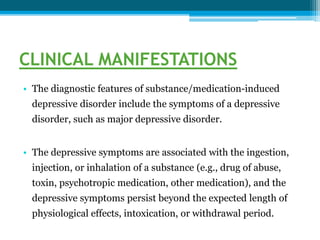
• The diagnostic features of substance/medication-induced
depressive disorder include the symptoms of a depressive
disorder, such as major depressive disorder.
• The depressive symptoms are associated with the ingestion,
injection, or inhalation of a substance (e.g., drug of abuse,
toxin, psychotropic medication, other medication), and the
depressive symptoms persist beyond the expected length of
physiological effects, intoxication, or withdrawal period.
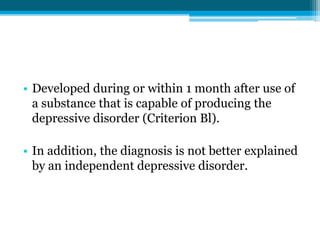
• Developed during or within 1 month after use of
a substance that is capable of producing the
depressive disorder (Criterion Bl).
• In addition, the diagnosis is not better explained
by an independent depressive disorder.
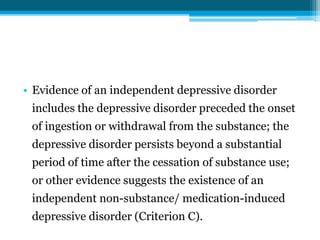
• Evidence of an independent depressive disorder
includes the depressive disorder preceded the onset
of ingestion or withdrawal from the substance; the
depressive disorder persists beyond a substantial
period of time after the cessation of substance use;
or other evidence suggests the existence of an
independent non-substance/ medication-induced
depressive disorder (Criterion C).
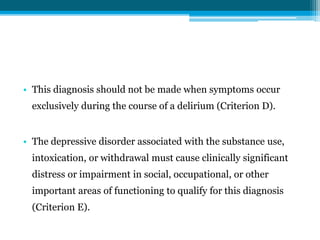
• This diagnosis should not be made when symptoms occur
exclusively during the course of a delirium (Criterion D).
• The depressive disorder associated with the substance use,
intoxication, or withdrawal must cause clinically significant
distress or impairment in social, occupational, or other
important areas of functioning to qualify for this diagnosis
(Criterion E).
• A substance/medication-induced depressive disorder is
distinguished from a primary depressive disorder by
considering the onset, course, and other factors
associated with the substance use.
• There must be evidence from the history, physical
examination, or laboratory findings of substance use,
abuse, intoxication, or withdrawal prior to the onset of
the depressive disorder.
CAUSES – psychoactive substances
• Alcohol-induced depressive disorder
• Phencyclidine-induced depressive disorder
• Other hallucinogen-induced depressive disorder
• Inhalant-induced depressive disorder
• Opioid-induced depressive disorder
• Sedative-induced depressive disorder
• Hypnotic-induced depressive disorder
• Anxiolytic-induced depressive disorder
• Amphetamine-induced depressive disorder
• Other stimulant-induced depressive disorder
• Cocaine-induced depressive disorder
• Other substance-induced depressive disorder
• Unknown substance-induced depressive disorder
Medications
• Steroid-induced depressive disorder
• L-dopa-induced depressive disorder
• Antibiotic-induced depressive disorder
• Central nervous system drug-induced depressive
disorder
• Dermatological agent-induced depressive disorder
• Chemotherapeutic drug-induced depressive disorder
• Immunological agent-induced depressive disorder
TOOLS FOR ASSESSMENT
• Practice Parameter for the Assessment and
Treatment of Children and Adolescents with
Substance use Disorder – AACAP
• Substance Abuse Treatment for Persons with co-
occurring Disorders a Treatment Improvement
Protocol – U.S. Department of Health and Human
Services
• Managing Depressive Symptoms in Substance
Abuse Clients During Early Recovery -SAMHSA
PROGNOSTIC FACTORS
• Temperamental
• Environmental
• Course modifiers
PREVALANCE
• In a nationally representative U.S. adult
population, the lifetime prevalence of substance/
medication-induced depressive disorder is
0.26%.
TREATMENT
• Psychotherapies - Cognitive Behavioral Therapy
(CBT), Community Reinforcement, Family
Therapy.
• Medication – eliminate instigating agent,
antidepressant
6. DEPRESSIVE DISORDERS DUE
TO ANOTHER MEDICAL
CONDITIONS
DIAGNOSTIC CODE: - 293.83
DIAGNOSTIC CRITERIAS
• A. A prominent and persistent period of depressed
mood or markedly diminished interestor pleasure in
all, or almost all, activities that predominates in the
clinical picture.
• B. There is evidence from the history, physical
examination, or laboratory findings that the disturbance
is the direct pathophysiological consequence of another
medical condition.
• C. The disturbance is not better explained by another
mental disorder (e.g., adjustment disorder, with
depressed mood, in which the stressor is a serious
medical condition).
• D. The disturbance does not occur exclusively
during the course of a delirium.
• E. The disturbance causes clinically significant
distress or impairment in social, occupational,
or other important areas of functioning.
DIFFERENTIAL DIAGNOSIS
• Depressive disorders not due to another medical
condition
• Medication-induced depressive disorder
• Adjustment disorders
CLINICAL MANIFESTATIONS
• The essential feature of depressive disorder due to
another medical condition is a prominent and
persistent period of depressed mood or markedly
diminished interest or pleasure in all, or almost all,
activities that predominates in the clinical picture
(Criterion A) and that is thought to be related to the
direct physiological effects of another medical
condition (Criterion B).
• There are no infallible guidelines for determining whether the
relationship between the mood disturbance and the general
medical condition is etiological, several considerations
provide some guidance in this area.
• One consideration is the presence of a temporal association
between the onset, exacerbation, or remission of the general
medical condition and that of the mood disturbance.
• A second consideration is the presence of features that
are atypical of primary Mood Disorders (e.g., atypical
age at onset or course or absence of family history).
• Evidence suggests that there can be a direct association
between the general medical condition in question and
the development of mood symptoms can provide a useful
context in the assessment of a particular situation.
CAUSES
• HIV/AIDS
• Diabetes
• Arthritis
• Strokes
• Brain disorders such as Parkinson's disease,
Huntington's disease, multiple sclerosis, and Alzheimer's
disease
• Metabolic conditions (e.g. vitamin B12 deficiency)
• Autoimmune conditions (e.g., lupus and rheumatoid
arthritis)
• Viral or other infections (hepatitis, mononucleosis,
herpes)
• Back pain
• Certain cancers (e.g., pancreatic)
TOOLS FOR ASSESSMENT
• Reynolds Adolescent depression scale
• BDI – II
• Hamilton rating scale for depression
• Geriatric depression scale
• Patient health questionnaire
• Structured clinical interview
• Modified scale for suicidal ideation
PROGNOSTIC FACTOR
• The risk of acute onset of a major depressive disorder
following a CVA (within 1 day to a week of the event) appears
to be strongly correlated with lesion location, with greatest
risk associated with left frontal strokes and least risk
apparently associated with right frontal lesions in those
individuals who present within days of the stroke. The
association with frontal regions and laterality is not observed
in depressive states that occur in the 2-6 months following
stroke.
TREATMENT
• Medication – antidepressants
• Psychotherapy – CBT, interpersonal therapy and
group therapy
7. OTHER SPECIFIED
DEPRESSIVE DISORDER
DIAGNOSTIC CODE – 311
• This category applies to presentations in which symptoms
characteristic of a depressive disorder that cause clinically
significant distress or impairment in social, occupational, or
other important areas of functioning predominate but do not
meet the full criteria for any of the disorders in the depressive
disorders diagnostic class.
• Used in situations in which the clinician chooses to
communicate the specific reason that the
presentation does not meet the criteria for any
specific depressive disorder.
• This is done by recording “other specified depressive
disorder” followed by the specific reason (e.g.,
“short-duration depressive episode”).
Examples of presentations that can be specified using the
“other specified” designation include the following:
• Recurrent brief depression: Concurrent presence of
depressed mood and at least four other symptoms of
depression for 2-13 days at least once per month (not
associated with the menstrual cycle) for at least 12
consecutive months in an individual whose presentation
has never met criteria for any other depressive or bipolar
disorder and does not currently meet active or residual
criteria for any psychotic disorder.
• Short-duration depressive episode (4-13 days): Depressed
affect and at least four of the other eight symptoms of a major
depressive episode associated with clinically significant
distress or impairment that persists for more than 4 days, but
less than 14 days, in an individual whose presentation has
never met criteria for any other depressive or bipolar
disorder, does not currently meet active or residual criteria for
any psychotic disorder, and does not meet criteria for
recurrent brief depression.
• Depressive episode with insufficient symptoms: Depressed
affect and at least one of the other eight symptoms of a major
depressive episode associated with clinically significant
distress or impairment that persist for at least 2 weeks in an
individual whose presentation has never met criteria for any
other depressive or bipolar disorder, does not currently meet
active or residual criteria for any psychotic disorder, and does
not meet criteria for mixed anxiety and depressive disorder
symptoms.
8. UNSPECIFIED DEPRESSIVE
DISORDER
DIAGNOSTIC CODE – 311
• This category applies to presentations in which
symptoms characteristic of a depressive disorder that
cause clinically significant distress or impairment in
social, occupational, or other important areas of
functioning predominate but do not meet the full criteria
for any of the disorders in the depressive disorders
diagnostic class.
• Used in situations in which the clinician chooses
not to specify the reason that the criteria are
not met for a specific depressive disorder, and
includes presentations for which there is
insufficient information to make a more specific
diagnosis (e.g., in emergency room settings).
SPECIFIERS FOR DEPRESSIVE
DISORDERS
Specify if:
• With anxious distress: Anxious distress is
defined as the presence of at least two of
the following symptoms during the majority
of days of a major depressive episode or
persistent depressive disorder (dysthymia):
CONTN
• 1. Feeling keyed up or tense.
• 2. Feeling unusually restless.
• 3. Difficulty concentrating because of worry.
• 4. Fear that something awful may happen.
• 5. Feeling that the individual might lose control of
himself or herself.
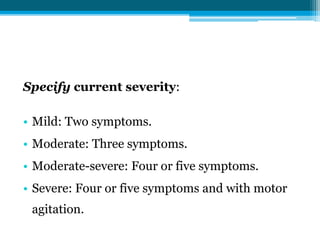
Specify current severity:
• Mild: Two symptoms.
• Moderate: Three symptoms.
• Moderate-severe: Four or five symptoms.
• Severe: Four or five symptoms and with motor
agitation.
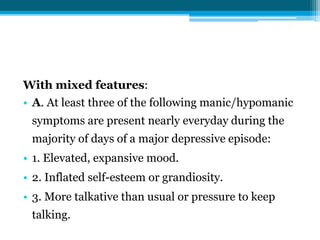
With mixed features:
• A. At least three of the following manic/hypomanic
symptoms are present nearly everyday during the
majority of days of a major depressive episode:
• 1. Elevated, expansive mood.
• 2. Inflated self-esteem or grandiosity.
• 3. More talkative than usual or pressure to keep
talking.
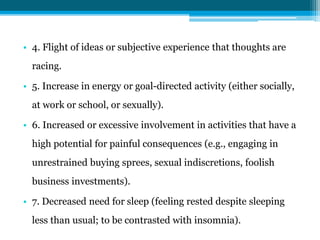
• 4. Flight of ideas or subjective experience that thoughts are
racing.
• 5. Increase in energy or goal-directed activity (either socially,
at work or school, or sexually).
• 6. Increased or excessive involvement in activities that have a
high potential for painful consequences (e.g., engaging in
unrestrained buying sprees, sexual indiscretions, foolish
business investments).
• 7. Decreased need for sleep (feeling rested despite sleeping
less than usual; to be contrasted with insomnia).
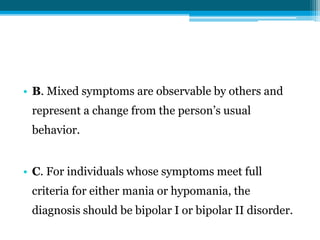
• B. Mixed symptoms are observable by others and
represent a change from the person’s usual
behavior.
• C. For individuals whose symptoms meet full
criteria for either mania or hypomania, the
diagnosis should be bipolar I or bipolar II disorder.
• D. The mixed symptoms are not attributable to the
physiological effects of a substance(e.g., a drug of abuse, a
medication or other treatment).Note: Mixed features
associated with a major depressive episode have been found
to be a significant risk factor for the development of bipolar I
or bipolar II disorder. As a result, it is clinically useful to note
the presence of this specifier for treatment planning and
monitoring of response to treatment.
With melancholic features:
• A. One of the following is present during the
most severe period of the current episode:
• 1. Loss of pleasure in all, or almost all, activities.
• 2. Lack of reactivity to usually pleasurable
stimuli (does not feel much better, even
temporarily, when something good happens).
• B. Three (or more) of the following;
• 1. A distinct quality of depressed mood characterized
by profound despondency, despair, and/or
moroseness or by so-called empty mood.
• 2. Depression that is regularly worse in the morning.
• 3. Early-morning awakening (i.e., at least 2
hours before usual awakening).
• 4. Marked psychomotor agitation or retardation.
• 5. Significant anorexia or weight loss.
• 6. Excessive or inappropriate guilt.
With atypical features:
• This specifier can be applied when these features
predominate during the majority of days of the
current or most recent major depressive episode
or persistent depressive disorder.
• A. Mood reactivity (i.e., mood brightens in
response to actual or potential positive events).
• B. Two (or more) of the following:
• 1. Significant weight gain or increase in appetite.
• 2. Hypersomnia.
• 3. Leaden paralysis (i.e., heavy, leaden feelings in arms or
legs).
• 4. A long-standing pattern of interpersonal rejection
sensitivity (not limited to episodes of mood disturbance) that
results in significant social or occupational impairment.
• C. Criteria are not met for “with melancholic features” or
“with catatonia” during the same episode.
With psychotic features:
• Delusions and/or hallucinations are present.
With mood-congruent psychotic features:
• The content of all delusions and hallucinations is
consistent with the typical depressive themes of personal
inadequacy, guilt, disease, death, nihilism, or deserved
punishment.
With mood-incongruent psychotic features:
• The content of the delusions or hallucinations does
not involve typical depressive themes of personal
inadequacy, guilt, disease, death, nihilism, or
deserved punishment, or the content is a mixture of
mood-incongruent and mood-congruent themes.
With catatonia:
• The catatonia specifier can apply to an episode of
depression if catatonic features are present during
most of the episode. See criteria for catatonia
associated with a mental disorder (for a description
of catatonia, see the chapter "Schizophrenia
Spectrum and Other Psychotic Disorders”).
With peripartum onset:
• This specifier can be applied to the current or, if
full criteria are not currently met for a major
depressive episode, most recent episode of major
depression if onset of mood symptoms occurs
during pregnancy or in the 4 weeks following
delivery.
With seasonal pattern:
• This specifier applies to recurrent major depressive
disorder.
• A. There has been a regular temporal relationship
between the onset of major depressive episodes in
major depressive disorder and a particular time of
the year (e.g. in the fall or winter).
• B. Full remissions (or a change from major depression to
mania or hypomania) also occur at a characteristic time of the
year (e.g., depression disappears in the spring).
• C. In the last 2 years, two major depressive episodes have
occurred that demonstrate the temporal seasonal
relationships defined above and no non-seasonal major
depressive episodes have occurred during that same period.
• D. Seasonal major depressive episodes (as
described above) substantially outnumber the
non-seasonal major depressive episodes that
may have occurred over the individual’s lifetime.
Specify if:
• In partial remission: Symptoms of the immediately
previous major depressive episode are present, but full
criteria are not met, or there is a period lasting less than 2
months without any significant symptoms of a major
depressive episode following the end of such an episode.
• In full remission: During the past 2 months, no significant
signs or symptoms of the disturbance were present.
Specify current severity:
• Severity is based on the number of criterion
symptoms, the severity of those symptoms, and the
degree of functional disability.
• Mild: Few, if any, symptoms in excess of those
required to make the diagnosis are present, the
intensity of the symptoms is distressing but
manageable, and the symptoms result in minor
impairment in social or occupational functioning
• Moderate: The numbers of symptoms, intensity of
symptoms, and/or functional impairment are between
those specified for “mild” and “severe.”
• Severe: The number of symptoms is substantially in
excess of that required to make the diagnosis, the
intensity of the symptoms is seriously distressing and
unmanageable, and the symptoms markedly interfere
with social and occupational functioning.
UNIPOLAR MOOD DISORDER

UNIPOLAR MOOD DISORDER

  • 1.
  • 2.
    Mood disorder A psychologicaldisorder characterized by the elevation or lowering of a person’s mood. Unipolar Person experienced only the episodes of depression Bi-polar Person experience the episodes of mania as well as depression
  • 3.
    DEFINITION: UNIPOLAR Unipolar MoodDisorder is a mental disorder characterized by pervasive and persistent low mood that is accompanied by low self esteem and by a loss of interest of pleasure in enjoyable activities.
  • 4.
    MANIFESTATIONS • Affects dailylife for weeks or longer • Interferes with social life Family and relationship Work and academic life Sleeping and eating habits • Implications on general health
  • 5.
    • Most commoneffective disorder • Profound sadness and related problems, such as sleep and appetite disturbances, loss of energy and self-esteem issues. • Also known as clinical depression, major depression or as recurrent depression.
  • 6.
    DEPRESSIVE DISORDERS 1. Disruptivemood dysregulation disorder 2. Major depressive disorder 3. Persistent depressive disorder 4. Premenstrual dysphoric disorder 5. Substance / medication induced depressive disorder 6. Depressive disorder due to another medical conditions 7. Other specific depressive disorder 8. Unspecified depressive disorder
  • 7.
    • Common featureof all of these disorders: -presence of sad, empty, or irritable mood • Accompanied by somatic and cognitive changes that significantly affect the individual's capacity to function. • Differences: - issues of duration, timing, or presumed etiology.
  • 8.
    1. DISRUPTIVE MOOD DYSREGULATIONDISORDER DIAGNOSTIC CODE – 296.99 DIAGNOSTIC CRITERIAS • A. Severe recurrent temper outbursts manifested verbally (e.g., verbal rages) and/or behaviorally (e.g., physical aggression toward people or property) that are grossly out of proportion in intensity or duration to the situation or provocation. • B. The temper outbursts are inconsistent with developmental level. • C. The temper outbursts occur, on average, three or more times per week.
  • 9.
    • D. Themood between temper outbursts is persistently irritable or angry most of the day, nearly every day, and is observable by others (e.g., parents, teachers, peers). • E. Criteria A-D has been present for 12 or more months. Throughout that time, the individual has not had a period lasting 3 or more consecutive months without all of these symptoms in Criteria A-D. • F. Criteria A and D are present in at least two of three settings (i.e., at home, at school, with peers) and are severe in at least one of these.
  • 10.
    • G. Thediagnosis should not be made for the first time before age 6 years or after age 18years. • H. By history or observation, the age at onset of Criteria A-E is before 10 years. • I. There has never been a distinct period lasting more than 1 day during which the full symptom criteria, except duration, for a manic or hypomanic episode have been met.
  • 11.
    • J. Thebehaviors do not occur exclusively during an episode of major depressive disorder and are not better explained by another mental disorder (e.g., autism spectrum disorder, posttraumatic stress disorder, separation anxiety disorder, persistent depressive disorder [dysthymia]). • K. The symptoms are not attributable to the physiological effects of a substance or to another medical or neurological condition.
  • 12.
    DIFFERENTIAL DIAGNOSIS • Bipolardisorders. • Oppositional defiant disorder. • Attention-deficit/hyperactivity disorder, major depressive disorder, anxiety disorders, and autism spectrum disorder. • Intermittent explosive disorder.
  • 13.
    CLINICAL MANIFESTATIONS This severeirritability has two prominent clinical manifestations, 1. Frequent temper outbursts (Criterion B,C,E and E) 2. chronic, persistently irritable or angry mood that is present between the severe temper outbursts. (Criterion C)
  • 14.
    CONTN • DMDD isdistinguished from presentations of other, related conditions, particularly pediatric bipolar disorder. • DMDD was added to DSM-5 to address the considerable concern about the appropriate classification and treatment of children who present with chronic, persistent irritability relative to children who present with classic (i.e., episodic) bipolar disorder.
  • 15.
    CAUSES • Family problemssuch as divorces, moves, death in the family may contribute to the disorder. • Psychological trauma or emotional, sexual, or physical abuses in early ages are also proposed causes. • Alcohol and drug abuse during pregnancy may be factors. • Neurological problems such as migraines may also contribute to this disorder. • Poor diet, such as vitamin deficiencies and malnutrition, is thought to be a probable cause. E.g., Vitamin B12, folate, and iron deficiencies may cause the symptoms of this disorder.
  • 16.
    TOOLS FOR ASSESSMENT •DMDD is a new diagnosis, there are no available assessment tools to assist in diagnosing and assessing the disorder per se. • Professional counselors are currently dependent upon a process of ruling out other medical disorders.
  • 17.
  • 18.
    PREVALENCE • DMDD isCommon among children • Prevalence estimates of the disorder in the community are unclear. • The overall 6-month to 1-year period-prevalence of DMDD among children and adolescents probably falls in the 2%-5% range. • Rates are higher in males and school age children.
  • 19.
    TREATMENT • Medication • Psychologicaltreatments • Psychotherapy • Parent training • Computer based training
  • 20.
    • Medication –Stimulants, Antidepressants and Antipsychotic • Psychotherapy – CBT, Adlerian Play Therapy, BT, Behavior modification therapy, Educating family and teachers about DMDD and how to deal with the outbursts instead of punishment, Observing the children for their individual triggers, Timeout strategies
  • 21.
    2. MAJOR DEPRESSIVEDISORDER DIAGNOSTIC CRITERIA • A. Five (or more) of the following symptoms have been present during the same 2-weekperiod and represent a change from previous functioning: at least one of the symptoms is either (1) depressed mood or (2) loss of interest or pleasure. • Note: Do not include symptoms that are clearly attributable to another medical condition.
  • 22.
    • 1. Depressedmood most of the day, nearly every day, as indicated by either subjective report (e.g., feels sad, empty, hopeless) or observation made by others (e.g., appears tearful). (Note: In children and adolescents, can be irritable mood.) • 2. Markedly diminished interest or pleasure in all, or almost all, activities most of the day, nearly every day (as indicated by either subjective account or observation).
  • 23.
    • 3. Significantweight loss when not dieting or weight gain (e.g., a change of more than5% of body weight in a month), or decrease or increase in appetite nearly every day.(Note: In children, consider failure to make expected weight gain.) • 4. Insomnia or hypersomnia nearly every day. • 5. Psychomotor agitation or retardation nearly every day (observable by others, not merely subjective feelings of restlessness or being slowed down).
  • 24.
    • 6. Fatigueor loss of energy nearly every day. • 7. Feelings of worthlessness or excessive or inappropriate guilt (which may be delusional) nearly every day (not merely self-reproach or guilt about being sick).
  • 25.
    • 8. Diminishedability to think or concentrate, or indecisiveness, nearly every day (either by subjective account or as observed by others). • 9. Recurrent thoughts of death (not just fear of dying), recurrent suicidal ideation without a specific plan, or a suicide attempt or a specific plan for committing suicide.
  • 26.
    • B. Thesymptoms cause clinically significant distress or impairment in social, occupational, or other important areas of functioning. • C. The episode is not attributable to the physiological effects of a substance or to another medical condition. • Note: Criteria A-C represent a major depressive episode.
  • 27.
    • D. Theoccurrence of the major depressive episode is not better explained by schizoaffective disorder, schizophrenia, schizophrenic form disorder, delusional disorder, or other specified and unspecified schizophrenia spectrum and other psychotic disorders. • E. There has never been a manic episode or a hypomanic episode.
  • 28.
    DIAGNOSTIC CODE Severity Singleepisode Recurrent episode Mild 296.21 296.31 Moderate 296.22 296.32 Severe 296.23 296.33 With psychotic features 296.24 296.34 In partial remission 296.25 296.35 In full remission 296.26 296.36 Unspecified 296.20 296.30
  • 29.
    DIFFERENTIAL DIAGNOSIS 1. Manicepisodes with irritable mood or mixed episodes. 2. Mood disorder due to another medical condition. 3. Substance/medication-induced depressive or bipolar disorder. 4. Attention-deficit/hyperactivity disorder. 5. Adjustment disorder with depressed mood. 6. Sadness.
  • 30.
    CLINICAL MANIFESTATIONS • MDDoccur in an individual who also has a general medical condition (e.g., cancer, stroke, myocardial infarction, diabetes, pregnancy). • Signs and Symptoms: - weight loss with untreated diabetes; fatigue with cancer; hypersomnia early in pregnancy; insonmia later in pregnancy or the postpartum
  • 31.
    CONTN • Appetite changemay involve either a reduction or increase. • Significant loss or gain in weight due to appetite change , or, in children, a failure to make expected weight gains may be noted (Criterion A3). • Sleep disturbance may take the form of either difficulty sleeping or sleeping excessively (Criterion A4).
  • 32.
    CONTN • Middle insomnia,Initial insomnia or Terminal insomnia may occur. • Individuals who present with oversleeping (hypersomnia) may experience prolonged sleep episodes at night or increased daytime sleep.
  • 33.
    CAUSES • Biological differences •Brain chemistry • Hormones • Inherited traits
  • 34.
    TOOLS FOR ASSESSMENT •MSE, Case History • Differential Diagnosis • The Structured Clinical Interview for DSM-IV Axis I Disorders (SCID-I) and the Mini-International Neuropsychiatric Interview (MINI) are clinician-rated diagnostic instruments, • 9-item Patient Health Questionnaire (PHQ-9) and the PRIME-MD are commonly used patient-rated tools.
  • 35.
    CONTN • For monitoringof depressive symptoms on treatment, the Hamilton Depression Rating Scale (HAM-D) and the Montgomery-Åsberg Depression Rating Scale (MADRS are gold-standard clinician-rated scales. • Other measures include the Quick Inventory of Depressive Symptomatology (QIDS) which is available in both clinician-rated and patient-rated formats and the patient-rated Beck Depression Inventory (BDI).
  • 36.
    PROGNOSTIC FACTORS • Temperamental •Environmental • Genetic and physiological • Course modifiers
  • 37.
    PREVALENCE • Twelve-month prevalenceof major depressive disorder is approximately 7% • With marked differences by age group such that the prevalence in 18- to 29-year-old individuals is three fold higher than the prevalence in individual’s age 60 years or older. • Females experience 1.5- to 3-fold higher rates than males beginning in early adolescence.
  • 38.
    TREATMENT • Medication –Antidepressants (selective serotonin reuptake inhibitors), Atypical antidepressants. • Psychotherapy – CBT , Interpersonal therapy, Group therapy, Psychodynamic approach, BT, Marital therapy, Family therapy
  • 39.
    3. PERSISTENT DEPRESSIVE DISORDER(DYSTHYMIA) DIAGNOSTIC CODE – 300.4 DIAGNOSTIC CRITERIA • A. Depressed mood for most of the day, for more days than not, as indicated by either subjective account or observation by others, for at least 2 years. • Note: In children and adolescents, mood can be irritable and duration must be at least 1 year.
  • 40.
    • B. Presence,while depressed, of two (or more) of the following: • 1. Poor appetite or overeating. • 2. Insomnia or hypersomnia. • 3. Low energy or fatigue. • 4. Low self-esteem. • 5. Poor concentration or difficulty making decisions. • 6. Feelings of hopelessness.
  • 41.
    • C. Duringthe 2-year period (1 year for children or adolescents) of the disturbance, the individual has never been without the symptoms in Criteria A and B for more than 2 months at a time. • D. Criteria for a major depressive disorder may be continuously present for 2 years.
  • 42.
    • E. Therehas never been a manic episode or a hypomanic episode, and criteria have never been met for cyclothymic disorder. • F. The disturbance is not better explained by a persistent schizoaffective disorder, schizophrenia, delusional disorder, or other specified or unspecified schizophrenia spectrum and other psychotic disorder.
  • 43.
    • G. Thesymptoms are not attributable to the physiological effects of a substance (e.g., a drug of abuse, a medication) or another medical condition (e.g. hypothyroidism). • H. The symptoms cause clinically significant distress or impairment in social, occupational, or other important areas of functioning.
  • 44.
    • Specify if: •With mixed features • With anxious distress • With melancholic features • With atypical features • With mood-congruent psychotic features • With mood-incongruent psychotic features • With peripartum onset
  • 45.
    • Specify if: •In partial remission • In full remission • Specify if: • Early onset: If onset is before age 21 years. • Late onset: If onset is at age 21 years or older.
  • 46.
    • Specify if(for most recent 2 years of persistent depressive disorder): • With pure dysthymic syndrome: Full criteria for a major depressive episode have not been met in at least the preceding 2 years. • With persistent major depressive episode: Full criteria for a major depressive episode have been met throughout the preceding 2-year period.
  • 47.
    • With intermittentmajor depressive episodes, with current episode: Full criteria for a major depressive episode are currently met, but there have been periods of at least 8 weeks in at least the preceding 2 years with symptoms below the threshold for a full major depressive episode. • With intermittent major depressive episodes, without current episode: Full criteria for a major depressive episode are not currently met, but there have been one or more major depressive episodes in at least the preceding 2 years.
  • 48.
    • Specify currentseverity: • Mild • Moderate • Severe
  • 50.
    DIFFERENTIAL DIAGNOSIS • Majordepressive disorder. • Depressive or bipolar and related disorder due to another medical condition. • Substance/medication-induced depressive or bipolar disorder. • Personality disorders
  • 51.
    CLINICAL MANIFESTATIONS • Depressedmood that occurs for most of the day, for more days than not, for at least 2 years, or at least 1 year for children and adolescents (Criterion A). • Individuals with persistent depressive disorder describe their mood as sad or "down in the dumps."
  • 52.
    • During periodsof depressed mood, at least two of the six symptoms from Criterion B are present. • Because these symptoms have become a part of the individual's day-today experience, particularly in the case of early onset (e.g., "I've always been this way"), they may not be reported unless the individual is directly prompted. • During the 2-year period (1 year for children or adolescents), any symptom-free intervals last no longer than 2 months (Criterion C).
  • 53.
    CAUSES • Biological differences •Brain chemistry • Inherited traits • Life events
  • 54.
    TOOLS FOR ASSESSMENT •Feelings Checklist • Cornell Dysthymic Rating Scale (CDRS) – 20 item scale developed specifically to assess frequency and severity of dysthymic symptoms over the previous week.
  • 55.
  • 56.
    PREVALENCE • Persistent depressivedisorder is effectively an amalgam of DSM-IV dysthymic disorder and chronic major depressive episode. • The 12-month prevalence in the United States is approximately 0.5% for persistent depressive disorder and 1.5% for chronic major depressive disorder.
  • 57.
    TREATMENT • Medication –Antidepressants, SSRI’s and SNRI’s • Psychotherapy – Psychological counselling, CBT, Insight-oriented therapy, Support groups, Cognitive Behavior analysis system of psychotherapy (CBASP)
  • 58.
    4. PREMENSTRUAL DYSPHORIC DISORDER DIAGNOSTICCODE - 625.4 DIAGNOSTIC CRITERIA • A. In the majority of menstrual cycles, at least five symptoms must be present in the final week before the onset of menses, start to improve within a few days after the onset of menses, and become minimal or absent in the week post menses.
  • 59.
    • B. One(or more) of the following symptoms must be present: • 1. Marked affective labiality (e.g., mood swings: feeling suddenly sad or tearful, or increased sensitivity to rejection). • 2. Marked irritability or anger or increased interpersonal conflicts. • 3. Marked depressed mood, feelings of hopelessness, or self- deprecating thoughts. • 4. Marked anxiety, tension, and/or feelings of being keyed up or on edge.
  • 60.
    • C. One(or more) of the following symptoms must additionally be present, to reach a total of five symptoms when combined with symptoms from Criterion B above. • 1. Decreased interest in usual activities (e.g., work, school, friends, hobbies). • 2. Subjective difficulty in concentration. • 3. Lethargy, easy fatigability, or marked lack of energy. • 4. Marked change in appetite; overeating; or specific food cravings. • 5. Hypersomnia or insomnia. • 6. A sense of being overwhelmed or out of control. • 7. Physical symptoms such as breast tenderness or swelling, joint or muscle pain, a sensation of “bloating,” or weight gain.
  • 61.
    • D. Thesymptoms are associated with clinically significant distress or interference with work, school, usual social activities, or relationships with others (e.g., avoidance of social activities; decreased productivity and efficiency at work, school, or home). • E. The disturbance is not merely an exacerbation of the symptoms of another disorder, such as major depressive disorder, panic disorder, persistent depressive disorder (dysthymia), or a personality disorder (although it may co-occur with any of these disorders).
  • 62.
    • F. CriterionA should be confirmed by prospective daily ratings during at least two symptomatic cycles. (Note: The diagnosis may be made provisionally prior to this confirmation.) • G. The symptoms are not attributable to the physiological effects of a substance (e.g., a drug of abuse, a medication, other treatment) or another medical condition (e.g., hyperthyroidism).
  • 63.
    DIFFERENTIAL DIAGNOSIS 1. Premenstrualsyndrome 2. Dysmenorrhea 3. Bipolar disorder, major depressive disorder, and persistent depressive disorder (dysthymia). 4. Use of hormonal treatments.
  • 64.
    CLINICAL MANIFESTATIONS • Essentialfeatures: -expression of mood lability, irritability, dysphoria, and anxiety symptoms that occur repeatedly during the premenstrual phase of the cycle and remit around the onset of menses or shortly thereafter. • Symptoms must have occurred in most of the menstrual cycles during the past year and must have an adverse effect on work or social functioning.
  • 65.
    • Peak aroundthe time of the onset of menses • Symptoms to linger into the first few days of menses, the individual must have a symptom-free period in the follicular phase after the menstrual period begins. • Mood and anxiety symptoms, behavioral and somatic symptoms commonly also occur.
  • 66.
    • Delusions andhallucinations have been described in the late luteal phase of the menstrual cycle but are rare. • The premenstrual phase has been considered by some to be a risk period for suicide. • In order to confirm a provisional diagnosis, daily prospective symptom ratings are required for at least two symptomatic cycles
  • 67.
    CAUSES • PMDD iscaused by the brain's abnormal response to a woman's fluctuation of normal hormones during the menstrual cycle, leading in turn to a deficiency in the neurotransmitter serotonin. • Personal or family history of postpartum depression, mood disorders or depression.
  • 68.
    TOOLS FOR ASSESSMENT •Sheehan disability scale – 10 point self rated scale in 3 spheres of function – work, home and social life. • Daily record of severity of problems (DRSP) – used for diagnosing and evaluating PMDD. (24 item, uses 6 point rating scale to evaluate 11 symptoms of psychological and physical symptoms, 3 items measures functional impairment.
  • 69.
    PROGNOSTIC FACTORS • Environmental •Genetic and physiological • Course modifiers
  • 70.
    PREVALENCE • Twelve-month prevalenceof premenstrual dysphoric disorder is between 1.8% and 5.8%of menstruating women. • However, estimated prevalence based on a daily record of symptoms for 1-2 months may be less representative, as individuals with the most severe symptoms may be unable to sustain the rating process.
  • 71.
    CONTN • The mostrigorous estimate of premenstrual dysphoric disorder is 1.8% for women whose symptoms meet the full criteria without functional impairment and 1.3% for women whose symptoms meet the current criteria with functional impairment and without co-occurring symptoms from another mental disorder.
  • 72.
    TREATMENT • Psychotherapy -Relaxation techniques, Light therapy, CBT • Medication – Anxiolytics, antidepresseants, mood stabilizers • Others- Herbal therapy, Hormonal treatment, Proper diet.
  • 73.
    5. SUBSTANCE/MEDICATION INDUCED DEPRESSIVEDISORDER DIAGNOSTIC CRITERIA • A. A prominent and persistent disturbance in mood that predominates in the clinical picture and is characterized by depressed mood or markedly diminished interest or pleasure in all, or almost all, activities.
  • 74.
    • B. Thereis evidence from the history, physical examination, or laboratory findings of both(1) and (2): • 1. The symptoms in Criterion A developed during or soon after substance intoxication or withdrawal or after exposure to a medication. • 2. The involved substance/medication is capable of producing the symptoms in Criterion A.
  • 75.
    • C. Thedisturbance is not better explained by a depressive disorder that is not substance/medication-induced. Such evidence of an independent depressive disorder could include the following: The symptoms preceded the onset of the substance/medication use; the symptoms persist for a substantial period of time (e.g., about 1 month) after the cessation of acute withdrawal or severe intoxication; or there is other evidence suggesting the existence of an independent non-substance/medication-induced depressive disorder (e.g., a history of recurrent non substance/medication- related episodes).
  • 76.
    • D. Thedisturbance does not occur exclusively during the course of a delirium. • E. The disturbance causes clinically significant distress or impairment in social, occupational, or other important areas of functioning.
  • 77.
    DIAGNOSTIC CODE • Alcohol- 291.89 • Phencyclidine - 292.84 • Other hallucinogen - 292.84 • Inhalant - 292.84 • Opioid - 292.84 • Sedative, hypnotic, or anxiolytic - 292.84 • Amphetamine (or other stimulant)- 292.84 • Cocaine - 292.84 • Other (or unknown) substance - 292.84
  • 78.
    DIFFERENTIAL DIAGNOSIS • Substanceintoxication and withdrawal • Primary depressive disorder • Depressive disorder due to another medical condition
  • 79.
    CLINICAL MANIFESTATIONS • Thediagnostic features of substance/medication-induced depressive disorder include the symptoms of a depressive disorder, such as major depressive disorder. • The depressive symptoms are associated with the ingestion, injection, or inhalation of a substance (e.g., drug of abuse, toxin, psychotropic medication, other medication), and the depressive symptoms persist beyond the expected length of physiological effects, intoxication, or withdrawal period.
  • 80.
    • Developed duringor within 1 month after use of a substance that is capable of producing the depressive disorder (Criterion Bl). • In addition, the diagnosis is not better explained by an independent depressive disorder.
  • 81.
    • Evidence ofan independent depressive disorder includes the depressive disorder preceded the onset of ingestion or withdrawal from the substance; the depressive disorder persists beyond a substantial period of time after the cessation of substance use; or other evidence suggests the existence of an independent non-substance/ medication-induced depressive disorder (Criterion C).
  • 82.
    • This diagnosisshould not be made when symptoms occur exclusively during the course of a delirium (Criterion D). • The depressive disorder associated with the substance use, intoxication, or withdrawal must cause clinically significant distress or impairment in social, occupational, or other important areas of functioning to qualify for this diagnosis (Criterion E).
  • 83.
    • A substance/medication-induceddepressive disorder is distinguished from a primary depressive disorder by considering the onset, course, and other factors associated with the substance use. • There must be evidence from the history, physical examination, or laboratory findings of substance use, abuse, intoxication, or withdrawal prior to the onset of the depressive disorder.
  • 84.
    CAUSES – psychoactivesubstances • Alcohol-induced depressive disorder • Phencyclidine-induced depressive disorder • Other hallucinogen-induced depressive disorder • Inhalant-induced depressive disorder • Opioid-induced depressive disorder • Sedative-induced depressive disorder
  • 85.
    • Hypnotic-induced depressivedisorder • Anxiolytic-induced depressive disorder • Amphetamine-induced depressive disorder • Other stimulant-induced depressive disorder • Cocaine-induced depressive disorder • Other substance-induced depressive disorder • Unknown substance-induced depressive disorder
  • 86.
    Medications • Steroid-induced depressivedisorder • L-dopa-induced depressive disorder • Antibiotic-induced depressive disorder • Central nervous system drug-induced depressive disorder • Dermatological agent-induced depressive disorder • Chemotherapeutic drug-induced depressive disorder • Immunological agent-induced depressive disorder
  • 87.
    TOOLS FOR ASSESSMENT •Practice Parameter for the Assessment and Treatment of Children and Adolescents with Substance use Disorder – AACAP • Substance Abuse Treatment for Persons with co- occurring Disorders a Treatment Improvement Protocol – U.S. Department of Health and Human Services • Managing Depressive Symptoms in Substance Abuse Clients During Early Recovery -SAMHSA
  • 88.
    PROGNOSTIC FACTORS • Temperamental •Environmental • Course modifiers
  • 89.
    PREVALANCE • In anationally representative U.S. adult population, the lifetime prevalence of substance/ medication-induced depressive disorder is 0.26%.
  • 90.
    TREATMENT • Psychotherapies -Cognitive Behavioral Therapy (CBT), Community Reinforcement, Family Therapy. • Medication – eliminate instigating agent, antidepressant
  • 91.
    6. DEPRESSIVE DISORDERSDUE TO ANOTHER MEDICAL CONDITIONS DIAGNOSTIC CODE: - 293.83 DIAGNOSTIC CRITERIAS • A. A prominent and persistent period of depressed mood or markedly diminished interestor pleasure in all, or almost all, activities that predominates in the clinical picture.
  • 92.
    • B. Thereis evidence from the history, physical examination, or laboratory findings that the disturbance is the direct pathophysiological consequence of another medical condition. • C. The disturbance is not better explained by another mental disorder (e.g., adjustment disorder, with depressed mood, in which the stressor is a serious medical condition).
  • 93.
    • D. Thedisturbance does not occur exclusively during the course of a delirium. • E. The disturbance causes clinically significant distress or impairment in social, occupational, or other important areas of functioning.
  • 94.
    DIFFERENTIAL DIAGNOSIS • Depressivedisorders not due to another medical condition • Medication-induced depressive disorder • Adjustment disorders
  • 95.
    CLINICAL MANIFESTATIONS • Theessential feature of depressive disorder due to another medical condition is a prominent and persistent period of depressed mood or markedly diminished interest or pleasure in all, or almost all, activities that predominates in the clinical picture (Criterion A) and that is thought to be related to the direct physiological effects of another medical condition (Criterion B).
  • 96.
    • There areno infallible guidelines for determining whether the relationship between the mood disturbance and the general medical condition is etiological, several considerations provide some guidance in this area. • One consideration is the presence of a temporal association between the onset, exacerbation, or remission of the general medical condition and that of the mood disturbance.
  • 97.
    • A secondconsideration is the presence of features that are atypical of primary Mood Disorders (e.g., atypical age at onset or course or absence of family history). • Evidence suggests that there can be a direct association between the general medical condition in question and the development of mood symptoms can provide a useful context in the assessment of a particular situation.
  • 98.
    CAUSES • HIV/AIDS • Diabetes •Arthritis • Strokes • Brain disorders such as Parkinson's disease, Huntington's disease, multiple sclerosis, and Alzheimer's disease
  • 99.
    • Metabolic conditions(e.g. vitamin B12 deficiency) • Autoimmune conditions (e.g., lupus and rheumatoid arthritis) • Viral or other infections (hepatitis, mononucleosis, herpes) • Back pain • Certain cancers (e.g., pancreatic)
  • 100.
    TOOLS FOR ASSESSMENT •Reynolds Adolescent depression scale • BDI – II • Hamilton rating scale for depression • Geriatric depression scale • Patient health questionnaire • Structured clinical interview • Modified scale for suicidal ideation
  • 101.
    PROGNOSTIC FACTOR • Therisk of acute onset of a major depressive disorder following a CVA (within 1 day to a week of the event) appears to be strongly correlated with lesion location, with greatest risk associated with left frontal strokes and least risk apparently associated with right frontal lesions in those individuals who present within days of the stroke. The association with frontal regions and laterality is not observed in depressive states that occur in the 2-6 months following stroke.
  • 102.
    TREATMENT • Medication –antidepressants • Psychotherapy – CBT, interpersonal therapy and group therapy
  • 103.
    7. OTHER SPECIFIED DEPRESSIVEDISORDER DIAGNOSTIC CODE – 311 • This category applies to presentations in which symptoms characteristic of a depressive disorder that cause clinically significant distress or impairment in social, occupational, or other important areas of functioning predominate but do not meet the full criteria for any of the disorders in the depressive disorders diagnostic class.
  • 104.
    • Used insituations in which the clinician chooses to communicate the specific reason that the presentation does not meet the criteria for any specific depressive disorder. • This is done by recording “other specified depressive disorder” followed by the specific reason (e.g., “short-duration depressive episode”).
  • 105.
    Examples of presentationsthat can be specified using the “other specified” designation include the following: • Recurrent brief depression: Concurrent presence of depressed mood and at least four other symptoms of depression for 2-13 days at least once per month (not associated with the menstrual cycle) for at least 12 consecutive months in an individual whose presentation has never met criteria for any other depressive or bipolar disorder and does not currently meet active or residual criteria for any psychotic disorder.
  • 106.
    • Short-duration depressiveepisode (4-13 days): Depressed affect and at least four of the other eight symptoms of a major depressive episode associated with clinically significant distress or impairment that persists for more than 4 days, but less than 14 days, in an individual whose presentation has never met criteria for any other depressive or bipolar disorder, does not currently meet active or residual criteria for any psychotic disorder, and does not meet criteria for recurrent brief depression.
  • 107.
    • Depressive episodewith insufficient symptoms: Depressed affect and at least one of the other eight symptoms of a major depressive episode associated with clinically significant distress or impairment that persist for at least 2 weeks in an individual whose presentation has never met criteria for any other depressive or bipolar disorder, does not currently meet active or residual criteria for any psychotic disorder, and does not meet criteria for mixed anxiety and depressive disorder symptoms.
  • 108.
    8. UNSPECIFIED DEPRESSIVE DISORDER DIAGNOSTICCODE – 311 • This category applies to presentations in which symptoms characteristic of a depressive disorder that cause clinically significant distress or impairment in social, occupational, or other important areas of functioning predominate but do not meet the full criteria for any of the disorders in the depressive disorders diagnostic class.
  • 109.
    • Used insituations in which the clinician chooses not to specify the reason that the criteria are not met for a specific depressive disorder, and includes presentations for which there is insufficient information to make a more specific diagnosis (e.g., in emergency room settings).
  • 110.
    SPECIFIERS FOR DEPRESSIVE DISORDERS Specifyif: • With anxious distress: Anxious distress is defined as the presence of at least two of the following symptoms during the majority of days of a major depressive episode or persistent depressive disorder (dysthymia):
  • 111.
    CONTN • 1. Feelingkeyed up or tense. • 2. Feeling unusually restless. • 3. Difficulty concentrating because of worry. • 4. Fear that something awful may happen. • 5. Feeling that the individual might lose control of himself or herself.
  • 112.
    Specify current severity: •Mild: Two symptoms. • Moderate: Three symptoms. • Moderate-severe: Four or five symptoms. • Severe: Four or five symptoms and with motor agitation.
  • 113.
    With mixed features: •A. At least three of the following manic/hypomanic symptoms are present nearly everyday during the majority of days of a major depressive episode: • 1. Elevated, expansive mood. • 2. Inflated self-esteem or grandiosity. • 3. More talkative than usual or pressure to keep talking.
  • 114.
    • 4. Flightof ideas or subjective experience that thoughts are racing. • 5. Increase in energy or goal-directed activity (either socially, at work or school, or sexually). • 6. Increased or excessive involvement in activities that have a high potential for painful consequences (e.g., engaging in unrestrained buying sprees, sexual indiscretions, foolish business investments). • 7. Decreased need for sleep (feeling rested despite sleeping less than usual; to be contrasted with insomnia).
  • 115.
    • B. Mixedsymptoms are observable by others and represent a change from the person’s usual behavior. • C. For individuals whose symptoms meet full criteria for either mania or hypomania, the diagnosis should be bipolar I or bipolar II disorder.
  • 116.
    • D. Themixed symptoms are not attributable to the physiological effects of a substance(e.g., a drug of abuse, a medication or other treatment).Note: Mixed features associated with a major depressive episode have been found to be a significant risk factor for the development of bipolar I or bipolar II disorder. As a result, it is clinically useful to note the presence of this specifier for treatment planning and monitoring of response to treatment.
  • 117.
    With melancholic features: •A. One of the following is present during the most severe period of the current episode: • 1. Loss of pleasure in all, or almost all, activities. • 2. Lack of reactivity to usually pleasurable stimuli (does not feel much better, even temporarily, when something good happens).
  • 118.
    • B. Three(or more) of the following; • 1. A distinct quality of depressed mood characterized by profound despondency, despair, and/or moroseness or by so-called empty mood. • 2. Depression that is regularly worse in the morning.
  • 119.
    • 3. Early-morningawakening (i.e., at least 2 hours before usual awakening). • 4. Marked psychomotor agitation or retardation. • 5. Significant anorexia or weight loss. • 6. Excessive or inappropriate guilt.
  • 120.
    With atypical features: •This specifier can be applied when these features predominate during the majority of days of the current or most recent major depressive episode or persistent depressive disorder. • A. Mood reactivity (i.e., mood brightens in response to actual or potential positive events).
  • 121.
    • B. Two(or more) of the following: • 1. Significant weight gain or increase in appetite. • 2. Hypersomnia. • 3. Leaden paralysis (i.e., heavy, leaden feelings in arms or legs). • 4. A long-standing pattern of interpersonal rejection sensitivity (not limited to episodes of mood disturbance) that results in significant social or occupational impairment. • C. Criteria are not met for “with melancholic features” or “with catatonia” during the same episode.
  • 122.
    With psychotic features: •Delusions and/or hallucinations are present. With mood-congruent psychotic features: • The content of all delusions and hallucinations is consistent with the typical depressive themes of personal inadequacy, guilt, disease, death, nihilism, or deserved punishment.
  • 123.
    With mood-incongruent psychoticfeatures: • The content of the delusions or hallucinations does not involve typical depressive themes of personal inadequacy, guilt, disease, death, nihilism, or deserved punishment, or the content is a mixture of mood-incongruent and mood-congruent themes.
  • 124.
    With catatonia: • Thecatatonia specifier can apply to an episode of depression if catatonic features are present during most of the episode. See criteria for catatonia associated with a mental disorder (for a description of catatonia, see the chapter "Schizophrenia Spectrum and Other Psychotic Disorders”).
  • 125.
    With peripartum onset: •This specifier can be applied to the current or, if full criteria are not currently met for a major depressive episode, most recent episode of major depression if onset of mood symptoms occurs during pregnancy or in the 4 weeks following delivery.
  • 126.
    With seasonal pattern: •This specifier applies to recurrent major depressive disorder. • A. There has been a regular temporal relationship between the onset of major depressive episodes in major depressive disorder and a particular time of the year (e.g. in the fall or winter).
  • 127.
    • B. Fullremissions (or a change from major depression to mania or hypomania) also occur at a characteristic time of the year (e.g., depression disappears in the spring). • C. In the last 2 years, two major depressive episodes have occurred that demonstrate the temporal seasonal relationships defined above and no non-seasonal major depressive episodes have occurred during that same period.
  • 128.
    • D. Seasonalmajor depressive episodes (as described above) substantially outnumber the non-seasonal major depressive episodes that may have occurred over the individual’s lifetime.
  • 129.
    Specify if: • Inpartial remission: Symptoms of the immediately previous major depressive episode are present, but full criteria are not met, or there is a period lasting less than 2 months without any significant symptoms of a major depressive episode following the end of such an episode. • In full remission: During the past 2 months, no significant signs or symptoms of the disturbance were present.
  • 130.
    Specify current severity: •Severity is based on the number of criterion symptoms, the severity of those symptoms, and the degree of functional disability. • Mild: Few, if any, symptoms in excess of those required to make the diagnosis are present, the intensity of the symptoms is distressing but manageable, and the symptoms result in minor impairment in social or occupational functioning
  • 131.
    • Moderate: Thenumbers of symptoms, intensity of symptoms, and/or functional impairment are between those specified for “mild” and “severe.” • Severe: The number of symptoms is substantially in excess of that required to make the diagnosis, the intensity of the symptoms is seriously distressing and unmanageable, and the symptoms markedly interfere with social and occupational functioning.