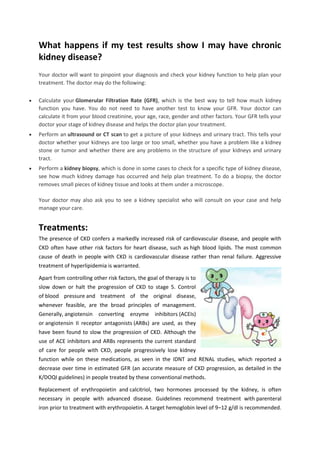
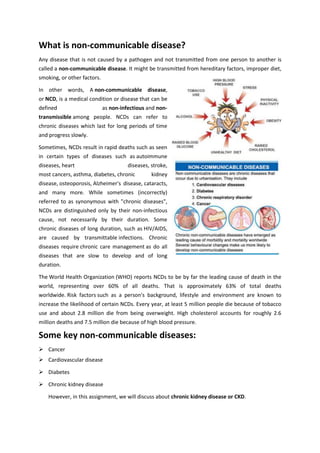
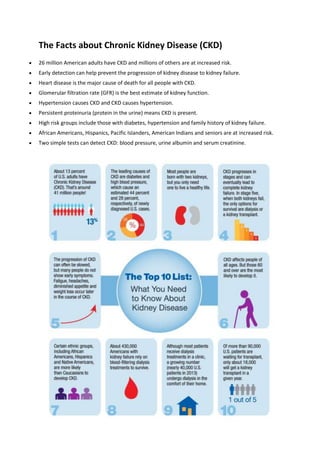
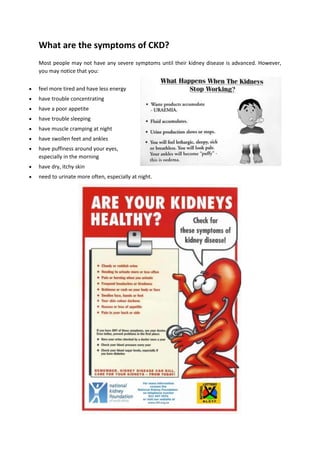
This document discusses chronic kidney disease (CKD). It defines CKD as a progressive loss of renal function over months or years that is identified by increased creatinine levels and protein or blood in the urine. The two main causes of CKD are diabetes and high blood pressure, which together account for two-thirds of cases. Symptoms of CKD may not appear until later stages and include fatigue, poor appetite, and swollen limbs. Anyone can develop CKD, but those with diabetes, high blood pressure, family history, older age, or certain ethnicities are at higher risk. CKD is diagnosed through tests of kidney function and imaging and staged based on glomerular filtration rate.





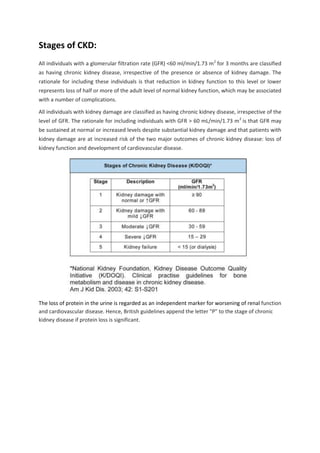
![ Stage 1:
Slightly diminished function; kidney damage with normal or relatively high GFR (≥90 ml/min/1.73
m2
): Kidney damage is defined as pathological abnormalities or markers of damage, including
abnormalities in blood or urine test or imaging studies.[1]
Stage 2:
Mild reduction in GFR (60–89 ml/min/1.73 m2
) with kidney damage: Kidney damage is defined as
pathological abnormalities or markers of damage, including abnormalities in blood or urine test or
imaging studies.
Stage 3:
Moderate
reduction in GFR
(30–59
ml/min/1.73
m2
):. British
guidelines
distinguish
between stage 3A
(GFR 45–59) and
stage 3B (GFR 30–
44) for purposes of
screening and
referral.
Stage 4:
Severe reduction in
GFR (15–29
ml/min/1.73
m2
) Preparation for
renal replacement
therapy
Stage 5:
Established kidney
failure (GFR <15 ml/min/1.73 m2
, permanent renal replacement therapy, or end-stage renal disease](https://image.slidesharecdn.com/1191d998-2752-42d8-a11d-0c4a9b180d65-150807100906-lva1-app6892/85/PBH101-Assignment-on-CKD-10-320.jpg)