ICD & DSM CLASSIFICATION
INTRODUCTION
• The ICD (The International Statistical
Classification of Diseases ) is the global health
information standard for mortality and morbidity
statistics.
• ICD is increasingly used in clinical care and research
to define diseases and study disease patterns, as well
as manage health care, monitor outcomes and allocate
resources.
Contd….
• More than 100 countries use the system to report mortality
data, a primary indicator of health status. This system helps to
monitor death and disease rates worldwide and measure
progress towards the Millennium Development Goals.
• About 70% of the world’s health expenditures (USD $ 3.5
billion) are allocated using ICD for reimbursement and
resource allocation
• ICD has been translated into 43 languages.
• The 11th revision process is underway and the final ICD-11
will be released in 2018
DEFINITION
• ICD-10 is the 10th revision of (The International Statistical
Classification of Diseases )and Related Health
Problems (ICD), a medical classification list by the World
Health Organization(WHO).
• It contains codes for diseases, signs and symptoms, abnormal
findings, complaints, social circumstances, and external causes
of injury or diseases.
• Work on ICD-10 began in 1983, became endorsed by the
Forty-third World Health Assembly in 1990, and was first used
by member states in 1994. It remains current until January 1,
2022, when it will be replaced by ICD-11
Contd…
• The Diagnostic and Statistical Manual of Mental
Disorders (DSM) (latest edition: the DSM-5, published in
2013) is a publication for the classification of mental
disorders using a common language and standard criteria.
It is published by the American Psychiatric
Association (APA) and is used by clinicians,
researchers, psychiatric drug regulation agencies, health
insurance companies, pharmaceutical companies, the
legal system, and policy makers.
Contd…
• The International Classification of Diseases(ICD) is
produced by the World Health Organization(WHO).
• It has broader scope than the DSM, covering overall
health; chapter V covers mental and behavioural
disorders.
• While the DSM is the most popular diagnostic system for
mental disorders in the U.S., the ICD is used more widely
in Europe and other parts of the world, giving it a far
larger reach than the DSM.
Contd….
• The DSM-IV-TR (4th. ed.) contains specific codes
allowing comparisons between the DSM and the ICD
manuals, which may not systematically match
because revisions are not simultaneously coordinated.
• Though recent editions of the DSM and ICD have
become more similar due to collaborative agreements,
each one contains information absent from the other.
Contd…
• In 1917, together with the National Commission
on Mental Hygiene (now Mental Health America), the
APA developed a new guide for mental hospitals called
the Statistical Manual for the Use of Institutions for the
Insane.
• This included twenty-two diagnoses and would be
revised several times by the APA over the years. Along
with the New York Academy of Medicine, the APA also
provided the psychiatric nomenclature subsection of the
U.S. general medical guide, the Standard Classified
Nomenclature of Disease, referred to as the Standard.
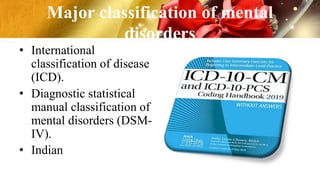
Major classification of mental
disorders
• International
classification of disease
(ICD).
• Diagnostic statistical
manual classification of
mental disorders (DSM-
IV).
• Indian
PURPOSE OF CLASSIFICATION
• Communication
• Control :-control is
most important purpose
of a classification of
mental disorders.
Contd….
• Comprehensive:- comprehensive implies
understanding the cause of mental disorders and the
processes involved in their development and
maintenance
HISTORY OF OFFICIAL
CLASSIFICATION
• 1840: The official system for tabulation mental disorder in U.S with
one category –idiotic and insane
• 1880: 7 categories { Mania , Malancholic , Monomania , paresis ,
Dementia , Dipsomania ,Epilepsy )
• 1889: System adopted by American psychiatric association called as
standard classified nomenclature of diseases
• 1935: Classification was only for chronic patients proved inadequate
for use with world war II psychiatric causative acute disturbance
psychosomatic personality disorders .
• 1948 :- WHO revised
Contd…
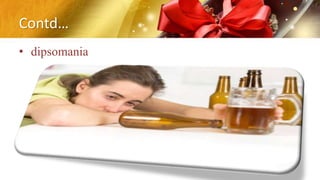
• dipsomania
Contd…
International list of cause of death (1900)
• It was revised every ½ year and its 6th revision renamed
as manual of the international classification of disease ,
injuries &causes of death which contained for the first
time a manual of mental disorder entitled as (mental
psychoneurotic and personality disorder ) with 10
categories of psychosis, 9 categories of psycho neurosis .
7 categories of disorder of character , behavior of
intelligence
Contd…
• ICD -10 -1992 –(International Statistical
Classifications of disease & related health
problem) earlier called as International Classification
of Disease injuries and cause of death -10 revision
International statistical classification of
disease and related health problem (ICD
• In 1960 the WHO drafted the 8th revision of ICD -8.
• In 1979 ICD -9 was revised and numerical code(001-
999)were used.
• The latest revision (ICD-10) was published in 1992 with
its expanded scope and availability of 1000 categories slot
of 3 digit level (00.0-99.9)
Contd…
• Chapter V of ICD constitutes the chapter on mental and
behavioral disorder . ICD -10 used and alphanumerical
code of an alphabet F followed by several digit .
• The first digit after the alphabet F denoted the main
category of the mental and behavior disorder . There 10
category denoted by the digit 0-9
• The second digit after the alphabet denote subcategory
Contd….
After the third character there is a decimal point to
indicate that the third character can be subdivided into
ten and each of this into another ten .
• WHO classification for all disease and related health
problems
• Chapter F- classified psychiatric disorders as mental
and behavioral disorders Codes them on an
alphanumeric system from F00 to F99.
What is difference between ICD and
DSM IV
• The ICD is produced by
a global health agency
with a constitutional
public health mission,
professional association.
• ICD's development is
global, multidisciplinary
and multilingual;.
• WHO's primary focus for the
mental and behavioral
disorders classification is to
help countries to reduce the
disease burden of mental
disorders.
• The primary constituency of
the DSM is U.S. psychiatrists
• The DSM is produced by a
single national
Contd…
• The ICD is approved by the World
Health Assembly, composed of the
health ministers of all 193 WHO
member countries;
• The ICD is distributed as broadly as
possible at a very low cost, with
substantial discounts to low-income
countries, and available free on the
Internet
• The DSM is approved by the assembly
of the American Psychiatric
Association, a group much like APA's
Council of Representatives.
• The DSM generates a very substantial
portion of the American Psychiatric
Association's revenue, not only from
sales of the book itself, but also from
related products and copyright
permissions for books and scientific
articles.
The main categories of ICD 10
F00-F09
• Organic, including symptomatic, mental disorders
• F00 Dementia in Alzheimer's disease
• F00.0Dementia in Alzheimer's disease with early onset
• F00.1Dementia in Alzheimer's disease with late onset
• F00.2Dementia in Alzheimer's disease, atypical or mixed
type
• F00.9Dementia in Alzheimer's disease, unspecified
F01Vascular dementia
• F01.0Vascular dementia of
acute onset
• F01.1Multi-infarct dementia
• F01.2Subcortical vascular
dementia
• F01.3Mixed cortical and
subcortical vascular dementia
• F01.8Other vascular dementia
• F01.9Vascular dementia,
unspecified
F02Dementia in other diseases
classified elsewhere
• F02.0Dementia in Pick's disease
• F02.1Dementia in Creutzfeldt-
Jakob disease
• F02.2Dementia in Huntington's
disease
• F02.3Dementia in Parkinson's
disease
• F02.4Dementia in human
immunodeficiency virus [HIV]
disease
• F02.8Dementia in other specified
diseases classified elsewhere
F03Unspecified dementia
• A fifth character may be added to specify dementia in
F00-F03, as follows:
• .x0 Without additional symptoms
• .x1 Other symptoms, predominantly delusional
• .x2 Other symptoms, predominantly hallucinatory
• .x3 Other symptoms, predominantly depressive
• .x4 Other mixed symptoms
Contd…
• F04- Organic amnesic syndrome, not induced by alcohol
and other substances
• F05- Delirium, not induced by alcohol and other
psychoactive substances
• F05.0-Delirium, not superimposed on dementia, so
described
• F05.1-Delirium, superimposed on dementia
• F05.8-Other delirium
• F05.9-Delirium, unspecified
ICD & DSM CLASSIFICATION
F06--Other mental disorders due to brain damage and
dysfunction and to physical disease
• F06.0Organic hallucinosis
• F06.1Organic catatonic disorder
• F06.2 Organic delusional [schizophrenia-like] disorder
• F06.3 Organic mood [affective] disorders
Contd…
• .30 Organic manic disorder
• .31 Organic bipolar affective disorder
• .32 Organic depressive disorder
• .33 Organic mixed affective disorder
• F06.4Organic anxiety disorder
• F06.5Organic dissociative disorder
• F06.6Organic emotionally labile [asthenic] disorder
• F06.7Mild cognitive disorder
Contd….
• F06.8Other specified mental disorders due to
brain damage and dysfunction and to physical disease
• F06.9Unspecified mental disorder due to brain
damage and dysfunction and to physical disease
Contd…..
F07-Personality and behavioral disorder due to brain
disease, damage and dysfunction
• F07.0Organic personality disorder
• F07.1Postencephalitic syndrome
• F07.2Postconcussional syndrome
• F07.8Other organic personality and behavioral
disorder due to brain disease, damage and dysfunction
Contd…
F09Unspecified organic or symptomatic mental disorder
F10--F19
• Mental and behavioral disorders due to psychoactive
substance use
• F10.-Mental and behavioral disorders due to use of
alcohol
• F11.-Mental and behavioral disorders due to use of
opioids
• F12.-Mental and behavioral disorders due to use of
cannabinoids
Contd…
• F13.-Mental and behavioral disorders due to use of
sedatives or hypnotics
• F14.-Mental and behavioral disorders due to use of
cocaine
• F15.-Mental and behavioral disorders due to use of
other stimulants, including caffeine
• F16.-Mental and behavioral disorders due to use of
hallucinogens
Contd….
• F17.-Mental and behavioral disorders due to use of
tobacco
• F18.-Mental and behavioral disorders due to use of
volatile solvents
• F19.-Mental and behavioral disorders due to multiple
drug use and use of other psychoactive substance
Contd….
F20-F29
• Schizophrenia, schizotypal and delusional disorders
F20 Schizophrenia
• F20.0 Paranoid schizophrenia
• F20.1 Hebephrenic schizophrenia
• F20.2 Catatonic schizophrenia
• F20.3 Undifferentiated schizophrenia
Contd..
• F20.4 Post-schizophrenic depression
• F20.5 Residual schizophrenia
• F20.6 Simple schizophrenia
• F20.8 Other schizophrenia
• F20.9 Schizophrenia, unspecified
Contd…
• F21 Schizotypal disorder
F22 Persistent delusional disorders
F22.0 Delusional disorder
F22.8 Other persistent delusional disorders
F22.9 Persistent delusional disorder, unspecified
Contd…..
F23 Acute and transient psychotic disorders
• F23.0 Acute polymorphic psychotic disorder without
symptoms of schizophrenia
• F23.1 Acute polymorphic psychotic disorder with symptoms of
schizophrenia
• F23.2 Acute schizophrenia-like psychotic disorder
• F23.3 Other acute predominantly delusional psychotic
disorders
• F23.8 Other acute and transient psychotic disorders
• F23.9 Acute and transient psychotic disorders unspecified
Contd..
• F24 Induced delusional disorder
• F25 Schizoaffective disorders
• F25.0 Schizoaffective disorder, manic type
• F25.1 Schizoaffective disorder, depressive type
• F25.2 Schizoaffective disorder, mixed type
• F25.8 Other schizoaffective disorders
• F25.9 Schizoaffective disorder, unspecified
Contd…
• F28 Other nonorganic psychotic disorders
• F29 Unspecified nonorganic psychosis
F30-F39
• Mood [affective] disorders
Contd…
• F30 Manic episode
• F30.0 Hypomania
• F30.1 Mania without psychotic symptoms
• F30.2 Mania with psychotic symptoms
• F30.8 Other manic episodes
• F30.9 Manic episode, unspecified
Contd..
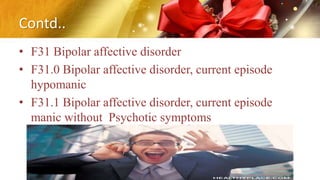
• F31 Bipolar affective disorder
• F31.0 Bipolar affective disorder, current episode
hypomanic
• F31.1 Bipolar affective disorder, current episode
manic without Psychotic symptoms
Contd…
• F31.2 Bipolar affective disorder, current episode
manic with psychotic symptoms
• F31.3Bipolar affective disorder, current episode mild
or moderate depression
• .30 Without somatic syndrome
• .31 With somatic syndrome
Contd..
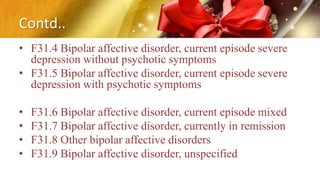
• F31.4 Bipolar affective disorder, current episode severe
depression without psychotic symptoms
• F31.5 Bipolar affective disorder, current episode severe
depression with psychotic symptoms
• F31.6 Bipolar affective disorder, current episode mixed
• F31.7 Bipolar affective disorder, currently in remission
• F31.8 Other bipolar affective disorders
• F31.9 Bipolar affective disorder, unspecified
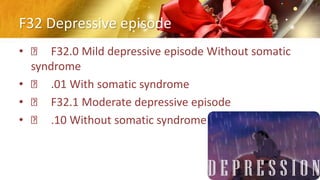
F32 Depressive episode
• F32.0 Mild depressive episode Without somatic
syndrome
• .01 With somatic syndrome
• F32.1 Moderate depressive episode
• .10 Without somatic syndrome
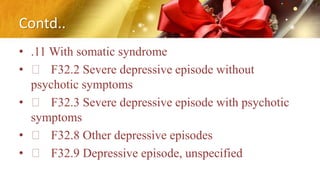
Contd..
• .11 With somatic syndrome
• F32.2 Severe depressive episode without
psychotic symptoms
• F32.3 Severe depressive episode with psychotic
symptoms
• F32.8 Other depressive episodes
• F32.9 Depressive episode, unspecified
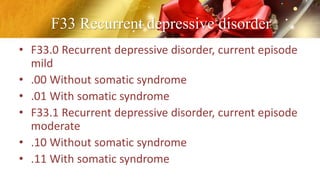
F33 Recurrent depressive disorder
• F33.0 Recurrent depressive disorder, current episode
mild
• .00 Without somatic syndrome
• .01 With somatic syndrome
• F33.1 Recurrent depressive disorder, current episode
moderate
• .10 Without somatic syndrome
• .11 With somatic syndrome
Contd…
• F33.2 Recurrent depressive disorder, current
episode severe without psychotic symptoms
• F33.3 Recurrent depressive disorder, current
episode severe with psychotic symptoms
Contd…
• F33.4 Recurrent depressive disorder, currently in
remission
• F33.8 Other recurrent depressive disorders
• F33.9 Recurrent depressive disorder, unspecified
Contd…
• F34 Persistent mood [affective] disorders
• F34.0 Cyclothymia
• F34.1 Dysthymia
• F34.8 Other persistent mood [affective] disorders
• F34.9 Persistent mood [affective] disorder,
unspecified
Contd…
• F38 Other mood [affective] disorders
• F38.0 Other single mood [affective] disorders
• .00 Mixed affective episode
• F38.1 Other recurrent mood [affective] disorders
• .10 Recurrent brief depressive disorder
• F38.8 Other specified mood [affective] disorders
Contd…
• F39 Unspecified mood [affective] disorder
F40-F48
• Neurotic, stress-related and somatoform disorders
• F40 Phobic anxiety disorders
• F40.0 Agoraphobia
• .00 Without panic disorder
Contd…
• .01 With panic disorder
• F40.1 Social phobias
• F40.2 Specific (isolated) phobias
• F40.8 Other phobic anxiety disorders
• F40.9 Phobic anxiety disorder, unspecified
Contd….
• F41 Other anxiety disorders
• F41.0 Panic disorder [episodic paroxysmal anxiety]
• F41.1 Generalized anxiety disorder
• F41.2 Mixed anxiety and depressive disorder
• F41.3 Other mixed anxiety disorders
• F41.8 Other specified anxiety disorders
• F41.9 Anxiety disorder, unspecified
F42 Obsessive - compulsive disorder
• F42.0 Predominantly obsessional thoughts or
ruminations
• F42.1 Predominantly compulsive acts [obsessional
rituals]
• F42.2 Mixed obsessional thoughts and acts
• F42.8 Other obsessive - compulsive disorders
• F42.9 Obsessive - compulsive disorder, unspecified
F43 Reaction to severe stress, and adjustment
disorders
• F43.0 Acute stress reaction
• F43.1 Post-traumatic stress disorder
• F43.2 Adjustment disorders
• .20 Brief depressive reaction
• .21 Prolonged depressive reaction
• .22 Mixed anxiety and depressive reaction
Contd…
• .23 With predominant disturbance of other emotions
• .24 With predominant disturbance of conduct
• .25 With mixed disturbance of emotions and conduct
• .28 With other specified predominant symptoms
• F43.8 Other reactions to severe stress
Contd….
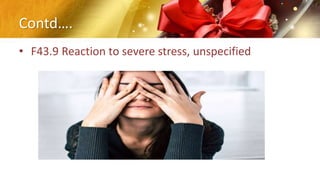
• F43.9 Reaction to severe stress, unspecified
F44 Dissociative [conversion] disorders
• F44.0 Dissociative amnesia
• F44.1 Dissociative fugue
• F44.2 Dissociative stupor
• F44.3 Trance and possession disorders
• F44.4 Dissociative motor disorders
• F44.5 Dissociative convulsions
• F44.6 Dissociative anesthesia and sensory loss
Trance &possesion
Contd…
• F44.7 Mixed dissociative [conversion] disorders
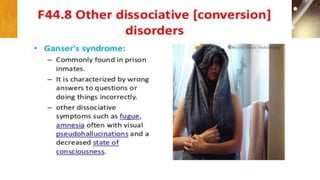
• F44.8 Other dissociative [conversion] disorders
• .80 Ganser's syndrome
• .81 Multiple personality disorder
Contd….
Contd…
• .82 Transient dissociative [conversion] disorders
occurring in
• Childhood and adolescence
• .88 Other specified dissociative [conversion]
disorders
• F44.9 Dissociative [conversion] disorder, unspecified
F45 Somatoform disorders
• F45.0 Somatization disorder
• F45.1 Undifferentiated somatoform disorder
• F45.2 Hypochondriacal disorder
• F45.3 Somatoform autonomic dysfunction
• .30 Heart and cardiovascular system
• .31 Upper gastrointestinal tract
• .32 Lower gastrointestinal tract
Contd….
• .33 Respiratory system
• .34 Genitourinary system
• .38 Other organ or system
• F45.4 Persistent somatoform pain disorder
• F45.8 Other somatoform disorders
• F45.9 Somatoform disorder, unspecified
F48 Other neurotic disorders
• F48.0 Neurasthenia
• F48.1 Depersonalization - derealization syndrome
• F48.8 Other specified neurotic disorders
• F48.9 Neurotic disorder, unspecified
Contd….
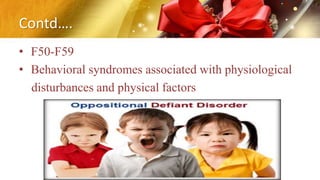
• F50-F59
• Behavioral syndromes associated with physiological
disturbances and physical factors
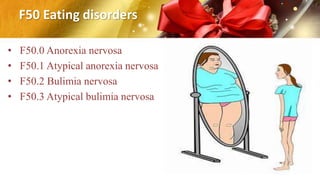
F50 Eating disorders
• F50.0 Anorexia nervosa
• F50.1 Atypical anorexia nervosa
• F50.2 Bulimia nervosa
• F50.3 Atypical bulimia nervosa
Contd….
• F50.4 Overeating associated with other psychological
disturbances
• F50.5 Vomiting associated with other psychological
disturbances
• F50.8 Other eating disorders
• F50.9 Eating disorder, unspecified
F51 Nonorganic sleep disorders
• F51.0 Nonorganic insomnia
• F51.1 Nonorganic hypersomnia
• F51.2 Nonorganic disorder of the sleep-wake
schedule
• F51.3 Sleepwalking [somnambulism]
Contd….
• F51.4 Sleep terrors [night terrors]
• F51.5 Nightmares
• F51.8 Other nonorganic sleep disorders
• F51.9 Nonorganic sleep disorder, unspecified
F52 Sexual dysfunction, not caused by organic
disorder or disease
• F52.0 Lack or loss of sexual desire
• F52.1 Sexual aversion and lack of sexual enjoyment
• .10 Sexual aversion
• .11 Lack of sexual enjoyment
• F52.2 Failure of genital response
• F52.3 Orgasmic dysfunction
Contd…
• F52.4 Premature ejaculation
• F52.5 Nonorganic vaginismus
• F52.6 Nonorganic dyspareunia
• F52.7 Excessive sexual drive
• F52.8 Other sexual dysfunction, not caused by
organic disorders or disease
• F52.9 Unspecified sexual dysfunction, not caused by
organic
• Disorder or disease
F53Mental and behavioral disorders associated
with the puerperium, not elsewhere classified
• F53.0 Mild mental and behavioral disorders associated
with the puerperium, not elsewhere classified
• F53.1 Severe mental and behavioral disorders associated
with the puerperium, not elsewhere classified
• F53.8 Other mental and behavioral disorders associated
with the puerperium, not elsewhere classified
• F53.9 Puerperal mental disorder, unspecified
Contd…
• F54Psychological and behavioral factors associated
with disorders or diseases classified elsewhere
• F55 Abuse of non-dependence-producing substances
• F55.0 Antidepressants
• F55.1 Laxatives
• F55.2 Analgesics
• F55.3 Antacids
• F55.4 Vitamins
• F55.5 Steroids or hormones
Contd…
• F55.6 Specific herbal or folk remedies
• F55.8 Other substances that do not produce
dependence
• F55.9 Unspecified
• F59 Unspecified behaviuoral syndromes associated
with physiological disturbances and physical factor
Contd..
• F60-F69
• Disorders of adult personality and behavior
• F60 Specific personality disorders
• F60.0 Paranoid personality disorder
• F60.1 Schizoid personality disorder
• F60.2 Dissocial personality disorder
Contd…
• F60.3 Emotionally unstable personality disorder
• .30 Impulsive type
• .31 Borderline type
• F60.4 Histrionic personality disorder
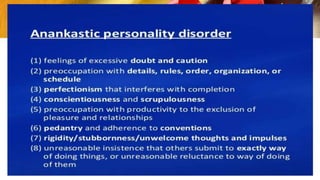
• F60.5 Anankastic personality disorder
• F60.6 Anxious [avoidant] personality disorder
• F60.7 Dependent personality disorder
• F60.8 Other specific personality disorders
• F60.9 Personality disorder, unspecified
Contd….
• F61 Mixed and other personality disorders
• F61.0 Mixed personality disorders
• F61.1 Troublesome personality changes
F62 Enduring personality changes, not
attributable to brain damage and disease
• F62.0 Enduring personality change after catastrophic
experience
• F62.1 Enduring personality change after psychiatric
illness
• F62.8 Other enduring personality changes
• F62.9 Enduring personality change, unspecified
F63 Habit and impulse disorders
• F63.0 Pathological gambling
• F63.1 Pathological fire-setting [pyromania]
• F63.2 Pathological stealing [kleptomania]
• F63.3 Trichotillomania
• F63.8 Other habit and impulse disorders
• F63.9 Habit and impulse disorder, unspecified
F64 Gender identity disorders
• F64.0 Trans-sexualism
• F64.1 Dual-role transvestism
• F64.2 Gender identity disorder of childhood
• F64.8 Other gender identity disorders
• F64.9 Gender identity disorder, unspecified
F65 Disorders of sexual preference
• F65.0 Fetishism
• F65.1 Fetishistic transvestism
• F65.2 Exhibitionism
• F65.3 Voyeurism
• F65.4 Paedophilia
• F65.5 Sadomasochism
• F65.6 Multiple disorders of sexual preference
Contd….
• F65.8 Other disorders of sexual preference
• F65.9 Disorder of sexual preference, unspecified
F66 Psychological and behavioural disorders
associated with sexual
• development and orientation
• F66.0 Sexual maturation disorder
• F66.1 Ego-dystonic sexual orientation
• F66.2 Sexual relationship disorder
• F66.8 Other psychosexual development disorders
• F66.9 Psychosexual development disorder,
unspecified
Contd….
• A fifth character may be used to indicate association
with:
• .x0 Heterosexuality
• .x1 Homosexuality
• .x2 Bisexuality
• .x8 Other, including prepubertal
F68 Other disorders of adult personality and
behaviour
• F68.0 Elaboration of physical symptoms for
psychological reasons
• F68.1 Intentional production or feigning of symptoms
or disabilities,
• either physical or psychological [factitious disorder]
• F68.8 Other specified disorders of adult personality
and behaviour
Contd….
• F69 Unspecified disorder of adult personality and
behavior
• F70-F79
Contd…
Mental retardation
• F70 Mild mental retardation
• F71 Moderate mental retardation
• F72 Severe mental retardation
• F73 Profound mental retardation
• F78 Other mental retardation
• F79 Unspecified mental retardation
Contd…
F80-F89 --Disorders of psychological development
• F80 Specific developmental disorders of speech and language
• F80.0 Specific speech articulation disorder
• F80.1 Expressive language disorder
• F80.2 Receptive language disorder
• F80.3 Acquired aphasia with epilepsy [Landau-Kleffner syndrome]
• F80.8 Other developmental disorders of speech and language
• F80.9 Developmental disorder of speech and language, unspecified
Contd…
• F81 Specific developmental disorders of scholastic
skills
• F81.0 Specific reading disorder
• F81.1 Specific spelling disorder
• F81.2 Specific disorder of arithmetical skills
• F81.3 Mixed disorder of scholastic skills
• F81.8 Other developmental disorders of scholastic skills
• F81.9 Developmental disorder of scholastic skills,
unspecified
Contd…
• F82 Specific developmental disorder of motor
function
• F83 Mixed specific developmental disorders
• F84 Pervasive developmental disorders
• F84.0 Childhood autism
• F84.1 Atypical autism
• F84.2 Rett's syndrome
Contd…
• F84.3 Other childhood disintegrative disorder
• F84.4Overactive disorder associated with mental
retardation and
• stereotyped movements
• F84.5 Asperger's syndrome
• F84.8 Other pervasive developmental disorders
• F84.9 Pervasive developmental disorder, unspecified
Contd..
• F88 Other disorders of psychological development
• F89 Unspecified disorder of psychological
development
F90-F98
• Behavioral and emotional disorders with onset
usually occurring in childhood and adolescence
Contd….
• F90 Hyperkinetic disorders
• F90.0 Disturbance of activity and attention
• F90.1 Hyperkinetic conduct disorder
• F90.8 Other hyperkinetic disorders
• F90.9 Hyperkinetic disorder, unspecified
F91 Conduct disorders
• F91.0 Conduct disorder confined to the family
context
• F91.1 Unsocialized conduct disorder
• F91.2 Socialized conduct disorder
• F91.3 Oppositional defiant disorder
• F91.8 Other conduct disorders
• F91.9 Conduct disorder, unspecified
F92 Mixed disorders of conduct and emotions
• F92.0 Depressive conduct disorder
• F92.8 Other mixed disorders of conduct and emotions
• F92.9 Mixed disorder of conduct and emotions,
unspecified
F93 Emotional disorders with onset specific to
childhood
• F93.0 Separation anxiety disorder of childhood
• F93.1 Phobic anxiety disorder of childhood
• F93.2 Social anxiety disorder of childhood
• F93.3 Sibling rivalry disorder
• F93.8 Other childhood emotional disorders
• F93.9 Childhood emotional disorder, unspecified
F94 Disorders of social functioning with onset
specific to childhood
• F94.0 Elective mutism
• F94.1 Reactive attachment disorder of childhood
• F94.2 Disinhibited attachment disorder of
childhood
• F94.8 Other childhood disorders of social
functioning
• F94.9 Childhood disorder of social functioning,
unspecified
F95 Tic disorders
• F95.0 Transient tic disorder
• F95.1 Chronic motor or vocal tic disorder
• F95.2 Combined vocal and multiple motor tic
disorder [Gills de la Tourette's
• syndrome]
• F95.8 Other tic disorders
• F95.9 Tic disorder, unspecified
F98 Other behavioral and emotional disorders with
onset usually occurring in childhood and adolescence
• F98.0 Nonorganic enuresis
• F98.1 Nonorganic encopresis
• F98.2 Feeding disorder of infancy and childhood
• F98.3 Pica of infancy and childhood
• F98.4 Stereotyped movement disorders
• F98.5 Stuttering [stammering]
Contd…
• F98.6 Cluttering
• F98.8Other specified behavioral and emotional
disorders with onset usually occurring in childhood
and adolescence
• F98.9Unspecified behavioral and emotional disorders
with onset usually occurring in childhood and
adolescence
Contd…
• F99
• Unspecified mental disorder
• F99 Mental disorder, not otherwise specified
DSM IV & statistical manual of mental disorders
• It has mainly 5 axis
• Axis I : clinical psychiatric Axis
• Axis II: personality disorders & mental retardation
• Axis III: General medical conditions
• Axis IV: psychological and environmental problems
• Axis V: Global assessment of functioning - past one
year
Contd…
• DSM IV & statistical manual of mental disorders
• It has mainly 5 axis
• Axis I : clinical psychiatric Axis
• Axis II: personality disorders & mental retardation
• Axis III: General medical conditions
• Axis IV: psychological and environmental problems
• Axis V: Global assessment of functioning - past one year
•
Contd…
• DSM I : 1951 U.S with representation of American
psychiatric association developed as alternative to mental
disorder section of ICD -6 which was published in 1952 .
It replace the outdated mental disorders section ANA and
first time provided a glossary of definition of categories
• DSM II: in the 1965 by American psychiatric
association . It encouraged multiple diagnosis by
clinician unlike DSM –I and the word “ reaction” was
eliminated
Contd…
• DSM III: in 1974 -1980was published using poly
diagnostic criteria and multi axial system i.e
• Axis I :- Mental disorders and additional codes
• Axis II :- Personality disorders and specific development
of disorders.
• Axis III: Physical disorders
• Axis IV: severity of psychosocial stressors
• Axis V: Highest level of adaptive functioning past year .
Contd…
• DSM IV: The fourth edition of DSM of mental
disorder published in 1994 , is the latest and most up
to date classification of mental disorders . It
correlation with 10th edition of WHO ICD.
Contd…
• AXIS I clinical disorders and other condition
• Disorders usually first diagnosed during infancy
childhood , adolescence.
• Delirium , dementia , amnesia and other cognitive
disorder
• Mental disorder due general medical
• substance related disorders
• Mood disorders
• Anxiety disorders
Contd..
• Somatoform
• Factitious disorders
• Dissociative disorders
• Sexual and gender identity disorders
• Eating disorders
• Sleep disorders
• impulsive control disorders
• Adjustment disorders
• Other condition that may not be focus of clinical attention
Axis II Personality disorders and mental
Retardation
• paranoid personality disorders
• Schizoid personality disorders
• schizotypical personality disorders
• Antisocial personality disorders
• Borderline personality disorders
• Histrionic personality disorders
Contd…
• Narcissistic personality disorders
• Avoidant personality disorders
• Dependent personality disorders
• Obsessive – compulsive personality disorders
• Personality – disorders
Axis- III General Medical condition
• Infection parasites disease
• Endocrine , nutrition , metabolic disease and immune disorders
• Disorders of blood and blood forming organ
• Disorders of nervous and sense organ
• Disorders of circulatory, respiratory, digestive , gastrointestinal
• Complication of childbirth , pregnancy , peuperium
• Disorders of skin and subcutaneous tissues
• Disorders of musculoskeletal and connective tissues
• Congenital abnormality
Axis –IV psychosocial and environment
problems
• Problem with primary support group
• Problem related to the social environment
• Educational problems
• Occupations
• Housing
• Economic
Contd…
• Problem with access to health care system / service
• Problem related to interaction and the legal
• Other psychological to environmental problem
Axis –V Global assessment of function
• 91-100- superior function /no symptoms
• 81 –90 – absent or minimal symptoms good function in
all area
• 71-80 – if system presents , they are transient and
expectable reactions to psychological stressors –no more
than sight impairment
• 61-70- some mild symptoms / difficulty but generally
function well has some meaningful interpersonal
relationship
Contd…
• 51-60 – moderate symptoms / difficulty
• 41-50 – serious symptoms / difficulty
• 31-40 – major impairment in several areas –work / school /
functions
• 21-30 - Behavior is conderably influenced by delusion or
hallucination or serious impairment in communication / adjustment.
• 11-20 – some of hurtiy self or other or occotinally fails to maintain
personal hygiene and gross impairment of communication
• 1-10 – persistent danger of hurting self or other
Indian classification
• In India , Neki (1963 ) wig and singer (1967) Vahia
(1961) and (1971) have attempted some modification of
ICD8 to suit India’s condition of mental health.
(A) Psychosis
• 1. Functional
• a. schizophrenia
• b. simple schizophrenia
• c. Hebephrenic schizophrenia
• d. Paranoid schizophrenia
Contd…
• 2. Affective
• a. mania
• b. Depression
• Organic
• a. Acute
• b. Chronic
• B. Neurosis
• 1. Anxiety
• 2. Depression neurosis
Contd…
• Hysterical Neurosis
4. obsessive compulsive neurosis
5. phobic neurosis
Special Disorders
• Childhood disorders
• Conduct disorders
• Emotional disorders
2. Personality disorders
• Sociopath
• Psychopath
3. Substance abuse
• Alcohol abuse
• Drug abuse
Contd…
• 4. Psycho physiological disorders
• Asthma
• Psoriasis
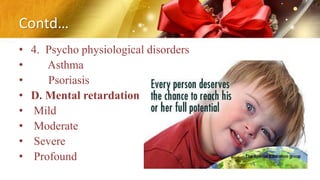
• D. Mental retardation
• Mild
• Moderate
• Severe
• Profound
Contd…
REFERENCES
• Townsend MC “Psychiatric mental health nursing”8th edition published by Jaypee brother medical
publisher” p p :175-176
• Theodore .dorothy d “Mental Health Nursing” volume -1 published reed Elsevier india private
limited Pp 305-12
• Gupta Ram kumar “Mental Health Nursing” edition 1st published by s vikas &company Pp:171-75
• Sreevani R “A guide to mental health &psychiatric nursing”3rd edition published by jaypee brothers
Pp114-20
• Ahuja N.A “Short text book psychiatric” 5th edition published by jaype brothers Pp155-58
• Bhaskara raj D.Elakkuvana “DEBR’S Mental health nursing”1st edition published by EMMESS
Medical PublishersPp22-25
www.slideshare.net-drjayeshpatidar/classification-of-mental-disorder viewed on 16/4/2020.

Icd dsm

  • 1.
    ICD & DSMCLASSIFICATION
  • 2.
    INTRODUCTION • The ICD(The International Statistical Classification of Diseases ) is the global health information standard for mortality and morbidity statistics. • ICD is increasingly used in clinical care and research to define diseases and study disease patterns, as well as manage health care, monitor outcomes and allocate resources.
  • 3.
    Contd…. • More than100 countries use the system to report mortality data, a primary indicator of health status. This system helps to monitor death and disease rates worldwide and measure progress towards the Millennium Development Goals. • About 70% of the world’s health expenditures (USD $ 3.5 billion) are allocated using ICD for reimbursement and resource allocation • ICD has been translated into 43 languages. • The 11th revision process is underway and the final ICD-11 will be released in 2018
  • 4.
    DEFINITION • ICD-10 isthe 10th revision of (The International Statistical Classification of Diseases )and Related Health Problems (ICD), a medical classification list by the World Health Organization(WHO). • It contains codes for diseases, signs and symptoms, abnormal findings, complaints, social circumstances, and external causes of injury or diseases. • Work on ICD-10 began in 1983, became endorsed by the Forty-third World Health Assembly in 1990, and was first used by member states in 1994. It remains current until January 1, 2022, when it will be replaced by ICD-11
  • 5.
    Contd… • The Diagnosticand Statistical Manual of Mental Disorders (DSM) (latest edition: the DSM-5, published in 2013) is a publication for the classification of mental disorders using a common language and standard criteria. It is published by the American Psychiatric Association (APA) and is used by clinicians, researchers, psychiatric drug regulation agencies, health insurance companies, pharmaceutical companies, the legal system, and policy makers.
  • 6.
    Contd… • The InternationalClassification of Diseases(ICD) is produced by the World Health Organization(WHO). • It has broader scope than the DSM, covering overall health; chapter V covers mental and behavioural disorders. • While the DSM is the most popular diagnostic system for mental disorders in the U.S., the ICD is used more widely in Europe and other parts of the world, giving it a far larger reach than the DSM.
  • 7.
    Contd…. • The DSM-IV-TR(4th. ed.) contains specific codes allowing comparisons between the DSM and the ICD manuals, which may not systematically match because revisions are not simultaneously coordinated. • Though recent editions of the DSM and ICD have become more similar due to collaborative agreements, each one contains information absent from the other.
  • 8.
    Contd… • In 1917,together with the National Commission on Mental Hygiene (now Mental Health America), the APA developed a new guide for mental hospitals called the Statistical Manual for the Use of Institutions for the Insane. • This included twenty-two diagnoses and would be revised several times by the APA over the years. Along with the New York Academy of Medicine, the APA also provided the psychiatric nomenclature subsection of the U.S. general medical guide, the Standard Classified Nomenclature of Disease, referred to as the Standard.
  • 9.
    Major classification ofmental disorders • International classification of disease (ICD). • Diagnostic statistical manual classification of mental disorders (DSM- IV). • Indian
  • 10.
    PURPOSE OF CLASSIFICATION •Communication • Control :-control is most important purpose of a classification of mental disorders.
  • 11.
    Contd…. • Comprehensive:- comprehensiveimplies understanding the cause of mental disorders and the processes involved in their development and maintenance
  • 12.
    HISTORY OF OFFICIAL CLASSIFICATION •1840: The official system for tabulation mental disorder in U.S with one category –idiotic and insane • 1880: 7 categories { Mania , Malancholic , Monomania , paresis , Dementia , Dipsomania ,Epilepsy ) • 1889: System adopted by American psychiatric association called as standard classified nomenclature of diseases • 1935: Classification was only for chronic patients proved inadequate for use with world war II psychiatric causative acute disturbance psychosomatic personality disorders . • 1948 :- WHO revised
  • 13.
  • 14.
    Contd… International list ofcause of death (1900) • It was revised every ½ year and its 6th revision renamed as manual of the international classification of disease , injuries &causes of death which contained for the first time a manual of mental disorder entitled as (mental psychoneurotic and personality disorder ) with 10 categories of psychosis, 9 categories of psycho neurosis . 7 categories of disorder of character , behavior of intelligence
  • 15.
    Contd… • ICD -10-1992 –(International Statistical Classifications of disease & related health problem) earlier called as International Classification of Disease injuries and cause of death -10 revision
  • 16.
    International statistical classificationof disease and related health problem (ICD • In 1960 the WHO drafted the 8th revision of ICD -8. • In 1979 ICD -9 was revised and numerical code(001- 999)were used. • The latest revision (ICD-10) was published in 1992 with its expanded scope and availability of 1000 categories slot of 3 digit level (00.0-99.9)
  • 17.
    Contd… • Chapter Vof ICD constitutes the chapter on mental and behavioral disorder . ICD -10 used and alphanumerical code of an alphabet F followed by several digit . • The first digit after the alphabet F denoted the main category of the mental and behavior disorder . There 10 category denoted by the digit 0-9 • The second digit after the alphabet denote subcategory
  • 18.
    Contd…. After the thirdcharacter there is a decimal point to indicate that the third character can be subdivided into ten and each of this into another ten . • WHO classification for all disease and related health problems • Chapter F- classified psychiatric disorders as mental and behavioral disorders Codes them on an alphanumeric system from F00 to F99.
  • 19.
    What is differencebetween ICD and DSM IV • The ICD is produced by a global health agency with a constitutional public health mission, professional association. • ICD's development is global, multidisciplinary and multilingual;. • WHO's primary focus for the mental and behavioral disorders classification is to help countries to reduce the disease burden of mental disorders. • The primary constituency of the DSM is U.S. psychiatrists • The DSM is produced by a single national
  • 20.
    Contd… • The ICDis approved by the World Health Assembly, composed of the health ministers of all 193 WHO member countries; • The ICD is distributed as broadly as possible at a very low cost, with substantial discounts to low-income countries, and available free on the Internet • The DSM is approved by the assembly of the American Psychiatric Association, a group much like APA's Council of Representatives. • The DSM generates a very substantial portion of the American Psychiatric Association's revenue, not only from sales of the book itself, but also from related products and copyright permissions for books and scientific articles.
  • 21.
    The main categoriesof ICD 10 F00-F09 • Organic, including symptomatic, mental disorders • F00 Dementia in Alzheimer's disease • F00.0Dementia in Alzheimer's disease with early onset • F00.1Dementia in Alzheimer's disease with late onset • F00.2Dementia in Alzheimer's disease, atypical or mixed type • F00.9Dementia in Alzheimer's disease, unspecified
  • 22.
    F01Vascular dementia • F01.0Vasculardementia of acute onset • F01.1Multi-infarct dementia • F01.2Subcortical vascular dementia • F01.3Mixed cortical and subcortical vascular dementia • F01.8Other vascular dementia • F01.9Vascular dementia, unspecified
  • 23.
    F02Dementia in otherdiseases classified elsewhere • F02.0Dementia in Pick's disease • F02.1Dementia in Creutzfeldt- Jakob disease • F02.2Dementia in Huntington's disease • F02.3Dementia in Parkinson's disease • F02.4Dementia in human immunodeficiency virus [HIV] disease • F02.8Dementia in other specified diseases classified elsewhere
  • 24.
    F03Unspecified dementia • Afifth character may be added to specify dementia in F00-F03, as follows: • .x0 Without additional symptoms • .x1 Other symptoms, predominantly delusional • .x2 Other symptoms, predominantly hallucinatory • .x3 Other symptoms, predominantly depressive • .x4 Other mixed symptoms
  • 25.
    Contd… • F04- Organicamnesic syndrome, not induced by alcohol and other substances • F05- Delirium, not induced by alcohol and other psychoactive substances • F05.0-Delirium, not superimposed on dementia, so described • F05.1-Delirium, superimposed on dementia • F05.8-Other delirium • F05.9-Delirium, unspecified
  • 26.
    ICD & DSMCLASSIFICATION F06--Other mental disorders due to brain damage and dysfunction and to physical disease • F06.0Organic hallucinosis • F06.1Organic catatonic disorder • F06.2 Organic delusional [schizophrenia-like] disorder • F06.3 Organic mood [affective] disorders
  • 27.
    Contd… • .30 Organicmanic disorder • .31 Organic bipolar affective disorder • .32 Organic depressive disorder • .33 Organic mixed affective disorder • F06.4Organic anxiety disorder • F06.5Organic dissociative disorder • F06.6Organic emotionally labile [asthenic] disorder • F06.7Mild cognitive disorder
  • 28.
    Contd…. • F06.8Other specifiedmental disorders due to brain damage and dysfunction and to physical disease • F06.9Unspecified mental disorder due to brain damage and dysfunction and to physical disease
  • 29.
    Contd….. F07-Personality and behavioraldisorder due to brain disease, damage and dysfunction • F07.0Organic personality disorder • F07.1Postencephalitic syndrome • F07.2Postconcussional syndrome • F07.8Other organic personality and behavioral disorder due to brain disease, damage and dysfunction
  • 30.
    Contd… F09Unspecified organic orsymptomatic mental disorder F10--F19 • Mental and behavioral disorders due to psychoactive substance use • F10.-Mental and behavioral disorders due to use of alcohol • F11.-Mental and behavioral disorders due to use of opioids • F12.-Mental and behavioral disorders due to use of cannabinoids
  • 31.
    Contd… • F13.-Mental andbehavioral disorders due to use of sedatives or hypnotics • F14.-Mental and behavioral disorders due to use of cocaine • F15.-Mental and behavioral disorders due to use of other stimulants, including caffeine • F16.-Mental and behavioral disorders due to use of hallucinogens
  • 32.
    Contd…. • F17.-Mental andbehavioral disorders due to use of tobacco • F18.-Mental and behavioral disorders due to use of volatile solvents • F19.-Mental and behavioral disorders due to multiple drug use and use of other psychoactive substance
  • 33.
    Contd…. F20-F29 • Schizophrenia, schizotypaland delusional disorders F20 Schizophrenia • F20.0 Paranoid schizophrenia • F20.1 Hebephrenic schizophrenia • F20.2 Catatonic schizophrenia • F20.3 Undifferentiated schizophrenia
  • 34.
    Contd.. • F20.4 Post-schizophrenicdepression • F20.5 Residual schizophrenia • F20.6 Simple schizophrenia • F20.8 Other schizophrenia • F20.9 Schizophrenia, unspecified
  • 35.
    Contd… • F21 Schizotypaldisorder F22 Persistent delusional disorders F22.0 Delusional disorder F22.8 Other persistent delusional disorders F22.9 Persistent delusional disorder, unspecified
  • 36.
    Contd….. F23 Acute andtransient psychotic disorders • F23.0 Acute polymorphic psychotic disorder without symptoms of schizophrenia • F23.1 Acute polymorphic psychotic disorder with symptoms of schizophrenia • F23.2 Acute schizophrenia-like psychotic disorder • F23.3 Other acute predominantly delusional psychotic disorders • F23.8 Other acute and transient psychotic disorders • F23.9 Acute and transient psychotic disorders unspecified
  • 37.
    Contd.. • F24 Induceddelusional disorder • F25 Schizoaffective disorders • F25.0 Schizoaffective disorder, manic type • F25.1 Schizoaffective disorder, depressive type • F25.2 Schizoaffective disorder, mixed type • F25.8 Other schizoaffective disorders • F25.9 Schizoaffective disorder, unspecified
  • 38.
    Contd… • F28 Othernonorganic psychotic disorders • F29 Unspecified nonorganic psychosis F30-F39 • Mood [affective] disorders
  • 39.
    Contd… • F30 Manicepisode • F30.0 Hypomania • F30.1 Mania without psychotic symptoms • F30.2 Mania with psychotic symptoms • F30.8 Other manic episodes • F30.9 Manic episode, unspecified
  • 40.
    Contd.. • F31 Bipolaraffective disorder • F31.0 Bipolar affective disorder, current episode hypomanic • F31.1 Bipolar affective disorder, current episode manic without Psychotic symptoms
  • 41.
    Contd… • F31.2 Bipolaraffective disorder, current episode manic with psychotic symptoms • F31.3Bipolar affective disorder, current episode mild or moderate depression • .30 Without somatic syndrome • .31 With somatic syndrome
  • 42.
    Contd.. • F31.4 Bipolaraffective disorder, current episode severe depression without psychotic symptoms • F31.5 Bipolar affective disorder, current episode severe depression with psychotic symptoms • F31.6 Bipolar affective disorder, current episode mixed • F31.7 Bipolar affective disorder, currently in remission • F31.8 Other bipolar affective disorders • F31.9 Bipolar affective disorder, unspecified
  • 43.
    F32 Depressive episode •F32.0 Mild depressive episode Without somatic syndrome • .01 With somatic syndrome • F32.1 Moderate depressive episode • .10 Without somatic syndrome
  • 44.
    Contd.. • .11 Withsomatic syndrome • F32.2 Severe depressive episode without psychotic symptoms • F32.3 Severe depressive episode with psychotic symptoms • F32.8 Other depressive episodes • F32.9 Depressive episode, unspecified
  • 45.
    F33 Recurrent depressivedisorder • F33.0 Recurrent depressive disorder, current episode mild • .00 Without somatic syndrome • .01 With somatic syndrome • F33.1 Recurrent depressive disorder, current episode moderate • .10 Without somatic syndrome • .11 With somatic syndrome
  • 46.
    Contd… • F33.2 Recurrentdepressive disorder, current episode severe without psychotic symptoms • F33.3 Recurrent depressive disorder, current episode severe with psychotic symptoms
  • 47.
    Contd… • F33.4 Recurrentdepressive disorder, currently in remission • F33.8 Other recurrent depressive disorders • F33.9 Recurrent depressive disorder, unspecified
  • 48.
    Contd… • F34 Persistentmood [affective] disorders • F34.0 Cyclothymia • F34.1 Dysthymia • F34.8 Other persistent mood [affective] disorders • F34.9 Persistent mood [affective] disorder, unspecified
  • 49.
    Contd… • F38 Othermood [affective] disorders • F38.0 Other single mood [affective] disorders • .00 Mixed affective episode • F38.1 Other recurrent mood [affective] disorders • .10 Recurrent brief depressive disorder • F38.8 Other specified mood [affective] disorders
  • 50.
    Contd… • F39 Unspecifiedmood [affective] disorder F40-F48 • Neurotic, stress-related and somatoform disorders • F40 Phobic anxiety disorders • F40.0 Agoraphobia • .00 Without panic disorder
  • 51.
    Contd… • .01 Withpanic disorder • F40.1 Social phobias • F40.2 Specific (isolated) phobias • F40.8 Other phobic anxiety disorders • F40.9 Phobic anxiety disorder, unspecified
  • 52.
    Contd…. • F41 Otheranxiety disorders • F41.0 Panic disorder [episodic paroxysmal anxiety] • F41.1 Generalized anxiety disorder • F41.2 Mixed anxiety and depressive disorder • F41.3 Other mixed anxiety disorders • F41.8 Other specified anxiety disorders • F41.9 Anxiety disorder, unspecified
  • 53.
    F42 Obsessive -compulsive disorder • F42.0 Predominantly obsessional thoughts or ruminations • F42.1 Predominantly compulsive acts [obsessional rituals] • F42.2 Mixed obsessional thoughts and acts • F42.8 Other obsessive - compulsive disorders • F42.9 Obsessive - compulsive disorder, unspecified
  • 54.
    F43 Reaction tosevere stress, and adjustment disorders • F43.0 Acute stress reaction • F43.1 Post-traumatic stress disorder • F43.2 Adjustment disorders • .20 Brief depressive reaction • .21 Prolonged depressive reaction • .22 Mixed anxiety and depressive reaction
  • 55.
    Contd… • .23 Withpredominant disturbance of other emotions • .24 With predominant disturbance of conduct • .25 With mixed disturbance of emotions and conduct • .28 With other specified predominant symptoms • F43.8 Other reactions to severe stress
  • 56.
    Contd…. • F43.9 Reactionto severe stress, unspecified
  • 57.
    F44 Dissociative [conversion]disorders • F44.0 Dissociative amnesia • F44.1 Dissociative fugue • F44.2 Dissociative stupor • F44.3 Trance and possession disorders • F44.4 Dissociative motor disorders • F44.5 Dissociative convulsions • F44.6 Dissociative anesthesia and sensory loss
  • 58.
  • 59.
    Contd… • F44.7 Mixeddissociative [conversion] disorders • F44.8 Other dissociative [conversion] disorders • .80 Ganser's syndrome • .81 Multiple personality disorder
  • 60.
  • 61.
    Contd… • .82 Transientdissociative [conversion] disorders occurring in • Childhood and adolescence • .88 Other specified dissociative [conversion] disorders • F44.9 Dissociative [conversion] disorder, unspecified
  • 62.
    F45 Somatoform disorders •F45.0 Somatization disorder • F45.1 Undifferentiated somatoform disorder • F45.2 Hypochondriacal disorder • F45.3 Somatoform autonomic dysfunction • .30 Heart and cardiovascular system • .31 Upper gastrointestinal tract • .32 Lower gastrointestinal tract
  • 63.
    Contd…. • .33 Respiratorysystem • .34 Genitourinary system • .38 Other organ or system • F45.4 Persistent somatoform pain disorder • F45.8 Other somatoform disorders • F45.9 Somatoform disorder, unspecified
  • 64.
    F48 Other neuroticdisorders • F48.0 Neurasthenia • F48.1 Depersonalization - derealization syndrome • F48.8 Other specified neurotic disorders • F48.9 Neurotic disorder, unspecified
  • 65.
    Contd…. • F50-F59 • Behavioralsyndromes associated with physiological disturbances and physical factors
  • 66.
    F50 Eating disorders •F50.0 Anorexia nervosa • F50.1 Atypical anorexia nervosa • F50.2 Bulimia nervosa • F50.3 Atypical bulimia nervosa
  • 67.
    Contd…. • F50.4 Overeatingassociated with other psychological disturbances • F50.5 Vomiting associated with other psychological disturbances • F50.8 Other eating disorders • F50.9 Eating disorder, unspecified
  • 68.
    F51 Nonorganic sleepdisorders • F51.0 Nonorganic insomnia • F51.1 Nonorganic hypersomnia • F51.2 Nonorganic disorder of the sleep-wake schedule • F51.3 Sleepwalking [somnambulism]
  • 69.
    Contd…. • F51.4 Sleepterrors [night terrors] • F51.5 Nightmares • F51.8 Other nonorganic sleep disorders • F51.9 Nonorganic sleep disorder, unspecified
  • 70.
    F52 Sexual dysfunction,not caused by organic disorder or disease • F52.0 Lack or loss of sexual desire • F52.1 Sexual aversion and lack of sexual enjoyment • .10 Sexual aversion • .11 Lack of sexual enjoyment • F52.2 Failure of genital response • F52.3 Orgasmic dysfunction
  • 71.
    Contd… • F52.4 Prematureejaculation • F52.5 Nonorganic vaginismus • F52.6 Nonorganic dyspareunia • F52.7 Excessive sexual drive • F52.8 Other sexual dysfunction, not caused by organic disorders or disease • F52.9 Unspecified sexual dysfunction, not caused by organic • Disorder or disease
  • 72.
    F53Mental and behavioraldisorders associated with the puerperium, not elsewhere classified • F53.0 Mild mental and behavioral disorders associated with the puerperium, not elsewhere classified • F53.1 Severe mental and behavioral disorders associated with the puerperium, not elsewhere classified • F53.8 Other mental and behavioral disorders associated with the puerperium, not elsewhere classified • F53.9 Puerperal mental disorder, unspecified
  • 73.
    Contd… • F54Psychological andbehavioral factors associated with disorders or diseases classified elsewhere • F55 Abuse of non-dependence-producing substances • F55.0 Antidepressants • F55.1 Laxatives • F55.2 Analgesics • F55.3 Antacids • F55.4 Vitamins • F55.5 Steroids or hormones
  • 74.
    Contd… • F55.6 Specificherbal or folk remedies • F55.8 Other substances that do not produce dependence • F55.9 Unspecified • F59 Unspecified behaviuoral syndromes associated with physiological disturbances and physical factor
  • 75.
    Contd.. • F60-F69 • Disordersof adult personality and behavior • F60 Specific personality disorders • F60.0 Paranoid personality disorder • F60.1 Schizoid personality disorder • F60.2 Dissocial personality disorder
  • 76.
    Contd… • F60.3 Emotionallyunstable personality disorder • .30 Impulsive type • .31 Borderline type • F60.4 Histrionic personality disorder • F60.5 Anankastic personality disorder • F60.6 Anxious [avoidant] personality disorder • F60.7 Dependent personality disorder • F60.8 Other specific personality disorders • F60.9 Personality disorder, unspecified
  • 78.
    Contd…. • F61 Mixedand other personality disorders • F61.0 Mixed personality disorders • F61.1 Troublesome personality changes
  • 79.
    F62 Enduring personalitychanges, not attributable to brain damage and disease • F62.0 Enduring personality change after catastrophic experience • F62.1 Enduring personality change after psychiatric illness • F62.8 Other enduring personality changes • F62.9 Enduring personality change, unspecified
  • 80.
    F63 Habit andimpulse disorders • F63.0 Pathological gambling • F63.1 Pathological fire-setting [pyromania] • F63.2 Pathological stealing [kleptomania] • F63.3 Trichotillomania • F63.8 Other habit and impulse disorders • F63.9 Habit and impulse disorder, unspecified
  • 81.
    F64 Gender identitydisorders • F64.0 Trans-sexualism • F64.1 Dual-role transvestism • F64.2 Gender identity disorder of childhood • F64.8 Other gender identity disorders • F64.9 Gender identity disorder, unspecified
  • 82.
    F65 Disorders ofsexual preference • F65.0 Fetishism • F65.1 Fetishistic transvestism • F65.2 Exhibitionism • F65.3 Voyeurism • F65.4 Paedophilia • F65.5 Sadomasochism • F65.6 Multiple disorders of sexual preference
  • 83.
    Contd…. • F65.8 Otherdisorders of sexual preference • F65.9 Disorder of sexual preference, unspecified
  • 84.
    F66 Psychological andbehavioural disorders associated with sexual • development and orientation • F66.0 Sexual maturation disorder • F66.1 Ego-dystonic sexual orientation • F66.2 Sexual relationship disorder • F66.8 Other psychosexual development disorders • F66.9 Psychosexual development disorder, unspecified
  • 85.
    Contd…. • A fifthcharacter may be used to indicate association with: • .x0 Heterosexuality • .x1 Homosexuality • .x2 Bisexuality • .x8 Other, including prepubertal
  • 86.
    F68 Other disordersof adult personality and behaviour • F68.0 Elaboration of physical symptoms for psychological reasons • F68.1 Intentional production or feigning of symptoms or disabilities, • either physical or psychological [factitious disorder] • F68.8 Other specified disorders of adult personality and behaviour
  • 87.
    Contd…. • F69 Unspecifieddisorder of adult personality and behavior • F70-F79
  • 88.
    Contd… Mental retardation • F70Mild mental retardation • F71 Moderate mental retardation • F72 Severe mental retardation • F73 Profound mental retardation • F78 Other mental retardation • F79 Unspecified mental retardation
  • 89.
    Contd… F80-F89 --Disorders ofpsychological development • F80 Specific developmental disorders of speech and language • F80.0 Specific speech articulation disorder • F80.1 Expressive language disorder • F80.2 Receptive language disorder • F80.3 Acquired aphasia with epilepsy [Landau-Kleffner syndrome] • F80.8 Other developmental disorders of speech and language • F80.9 Developmental disorder of speech and language, unspecified
  • 90.
    Contd… • F81 Specificdevelopmental disorders of scholastic skills • F81.0 Specific reading disorder • F81.1 Specific spelling disorder • F81.2 Specific disorder of arithmetical skills • F81.3 Mixed disorder of scholastic skills • F81.8 Other developmental disorders of scholastic skills • F81.9 Developmental disorder of scholastic skills, unspecified
  • 91.
    Contd… • F82 Specificdevelopmental disorder of motor function • F83 Mixed specific developmental disorders • F84 Pervasive developmental disorders • F84.0 Childhood autism • F84.1 Atypical autism • F84.2 Rett's syndrome
  • 92.
    Contd… • F84.3 Otherchildhood disintegrative disorder • F84.4Overactive disorder associated with mental retardation and • stereotyped movements • F84.5 Asperger's syndrome • F84.8 Other pervasive developmental disorders • F84.9 Pervasive developmental disorder, unspecified
  • 93.
    Contd.. • F88 Otherdisorders of psychological development • F89 Unspecified disorder of psychological development F90-F98 • Behavioral and emotional disorders with onset usually occurring in childhood and adolescence
  • 94.
    Contd…. • F90 Hyperkineticdisorders • F90.0 Disturbance of activity and attention • F90.1 Hyperkinetic conduct disorder • F90.8 Other hyperkinetic disorders • F90.9 Hyperkinetic disorder, unspecified
  • 95.
    F91 Conduct disorders •F91.0 Conduct disorder confined to the family context • F91.1 Unsocialized conduct disorder • F91.2 Socialized conduct disorder • F91.3 Oppositional defiant disorder • F91.8 Other conduct disorders • F91.9 Conduct disorder, unspecified
  • 96.
    F92 Mixed disordersof conduct and emotions • F92.0 Depressive conduct disorder • F92.8 Other mixed disorders of conduct and emotions • F92.9 Mixed disorder of conduct and emotions, unspecified
  • 97.
    F93 Emotional disorderswith onset specific to childhood • F93.0 Separation anxiety disorder of childhood • F93.1 Phobic anxiety disorder of childhood • F93.2 Social anxiety disorder of childhood • F93.3 Sibling rivalry disorder • F93.8 Other childhood emotional disorders • F93.9 Childhood emotional disorder, unspecified
  • 98.
    F94 Disorders ofsocial functioning with onset specific to childhood • F94.0 Elective mutism • F94.1 Reactive attachment disorder of childhood • F94.2 Disinhibited attachment disorder of childhood • F94.8 Other childhood disorders of social functioning • F94.9 Childhood disorder of social functioning, unspecified
  • 99.
    F95 Tic disorders •F95.0 Transient tic disorder • F95.1 Chronic motor or vocal tic disorder • F95.2 Combined vocal and multiple motor tic disorder [Gills de la Tourette's • syndrome] • F95.8 Other tic disorders • F95.9 Tic disorder, unspecified
  • 100.
    F98 Other behavioraland emotional disorders with onset usually occurring in childhood and adolescence • F98.0 Nonorganic enuresis • F98.1 Nonorganic encopresis • F98.2 Feeding disorder of infancy and childhood • F98.3 Pica of infancy and childhood • F98.4 Stereotyped movement disorders • F98.5 Stuttering [stammering]
  • 101.
    Contd… • F98.6 Cluttering •F98.8Other specified behavioral and emotional disorders with onset usually occurring in childhood and adolescence • F98.9Unspecified behavioral and emotional disorders with onset usually occurring in childhood and adolescence
  • 102.
    Contd… • F99 • Unspecifiedmental disorder • F99 Mental disorder, not otherwise specified
  • 103.
    DSM IV &statistical manual of mental disorders • It has mainly 5 axis • Axis I : clinical psychiatric Axis • Axis II: personality disorders & mental retardation • Axis III: General medical conditions • Axis IV: psychological and environmental problems • Axis V: Global assessment of functioning - past one year
  • 104.
    Contd… • DSM IV& statistical manual of mental disorders • It has mainly 5 axis • Axis I : clinical psychiatric Axis • Axis II: personality disorders & mental retardation • Axis III: General medical conditions • Axis IV: psychological and environmental problems • Axis V: Global assessment of functioning - past one year •
  • 105.
    Contd… • DSM I: 1951 U.S with representation of American psychiatric association developed as alternative to mental disorder section of ICD -6 which was published in 1952 . It replace the outdated mental disorders section ANA and first time provided a glossary of definition of categories • DSM II: in the 1965 by American psychiatric association . It encouraged multiple diagnosis by clinician unlike DSM –I and the word “ reaction” was eliminated
  • 106.
    Contd… • DSM III:in 1974 -1980was published using poly diagnostic criteria and multi axial system i.e • Axis I :- Mental disorders and additional codes • Axis II :- Personality disorders and specific development of disorders. • Axis III: Physical disorders • Axis IV: severity of psychosocial stressors • Axis V: Highest level of adaptive functioning past year .
  • 107.
    Contd… • DSM IV:The fourth edition of DSM of mental disorder published in 1994 , is the latest and most up to date classification of mental disorders . It correlation with 10th edition of WHO ICD.
  • 108.
    Contd… • AXIS Iclinical disorders and other condition • Disorders usually first diagnosed during infancy childhood , adolescence. • Delirium , dementia , amnesia and other cognitive disorder • Mental disorder due general medical • substance related disorders • Mood disorders • Anxiety disorders
  • 109.
    Contd.. • Somatoform • Factitiousdisorders • Dissociative disorders • Sexual and gender identity disorders • Eating disorders • Sleep disorders • impulsive control disorders • Adjustment disorders • Other condition that may not be focus of clinical attention
  • 110.
    Axis II Personalitydisorders and mental Retardation • paranoid personality disorders • Schizoid personality disorders • schizotypical personality disorders • Antisocial personality disorders • Borderline personality disorders • Histrionic personality disorders
  • 111.
    Contd… • Narcissistic personalitydisorders • Avoidant personality disorders • Dependent personality disorders • Obsessive – compulsive personality disorders • Personality – disorders
  • 112.
    Axis- III GeneralMedical condition • Infection parasites disease • Endocrine , nutrition , metabolic disease and immune disorders • Disorders of blood and blood forming organ • Disorders of nervous and sense organ • Disorders of circulatory, respiratory, digestive , gastrointestinal • Complication of childbirth , pregnancy , peuperium • Disorders of skin and subcutaneous tissues • Disorders of musculoskeletal and connective tissues • Congenital abnormality
  • 113.
    Axis –IV psychosocialand environment problems • Problem with primary support group • Problem related to the social environment • Educational problems • Occupations • Housing • Economic
  • 114.
    Contd… • Problem withaccess to health care system / service • Problem related to interaction and the legal • Other psychological to environmental problem
  • 115.
    Axis –V Globalassessment of function • 91-100- superior function /no symptoms • 81 –90 – absent or minimal symptoms good function in all area • 71-80 – if system presents , they are transient and expectable reactions to psychological stressors –no more than sight impairment • 61-70- some mild symptoms / difficulty but generally function well has some meaningful interpersonal relationship
  • 116.
    Contd… • 51-60 –moderate symptoms / difficulty • 41-50 – serious symptoms / difficulty • 31-40 – major impairment in several areas –work / school / functions • 21-30 - Behavior is conderably influenced by delusion or hallucination or serious impairment in communication / adjustment. • 11-20 – some of hurtiy self or other or occotinally fails to maintain personal hygiene and gross impairment of communication • 1-10 – persistent danger of hurting self or other
  • 117.
    Indian classification • InIndia , Neki (1963 ) wig and singer (1967) Vahia (1961) and (1971) have attempted some modification of ICD8 to suit India’s condition of mental health. (A) Psychosis • 1. Functional • a. schizophrenia • b. simple schizophrenia • c. Hebephrenic schizophrenia • d. Paranoid schizophrenia
  • 118.
    Contd… • 2. Affective •a. mania • b. Depression • Organic • a. Acute • b. Chronic • B. Neurosis • 1. Anxiety • 2. Depression neurosis
  • 119.
    Contd… • Hysterical Neurosis 4.obsessive compulsive neurosis 5. phobic neurosis
  • 120.
    Special Disorders • Childhooddisorders • Conduct disorders • Emotional disorders 2. Personality disorders • Sociopath • Psychopath 3. Substance abuse • Alcohol abuse • Drug abuse
  • 121.
    Contd… • 4. Psychophysiological disorders • Asthma • Psoriasis • D. Mental retardation • Mild • Moderate • Severe • Profound
  • 122.
    Contd… REFERENCES • Townsend MC“Psychiatric mental health nursing”8th edition published by Jaypee brother medical publisher” p p :175-176 • Theodore .dorothy d “Mental Health Nursing” volume -1 published reed Elsevier india private limited Pp 305-12 • Gupta Ram kumar “Mental Health Nursing” edition 1st published by s vikas &company Pp:171-75 • Sreevani R “A guide to mental health &psychiatric nursing”3rd edition published by jaypee brothers Pp114-20 • Ahuja N.A “Short text book psychiatric” 5th edition published by jaype brothers Pp155-58 • Bhaskara raj D.Elakkuvana “DEBR’S Mental health nursing”1st edition published by EMMESS Medical PublishersPp22-25 www.slideshare.net-drjayeshpatidar/classification-of-mental-disorder viewed on 16/4/2020.