Skills Development for MSMEs:
Mapping of Key Initiatives in
IndiaIndia
Anup Kumar Das
Jawaharlal Nehru University, India
ASIP2013
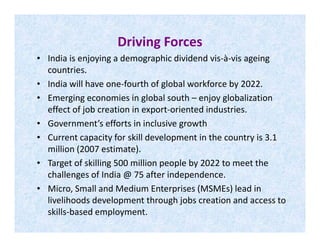
Driving Forces
• India is enjoying a demographic dividend vis-à-vis ageing
countries.
• India will have one-fourth of global workforce by 2022.
• Emerging economies in global south – enjoy globalization
effect of job creation in export-oriented industries.
• Government’s efforts in inclusive growth• Government’s efforts in inclusive growth
• Current capacity for skill development in the country is 3.1
million (2007 estimate).
• Target of skilling 500 million people by 2022 to meet the
challenges of India @ 75 after independence.
• Micro, Small and Medium Enterprises (MSMEs) lead in
livelihoods development through jobs creation and access to
skills-based employment.
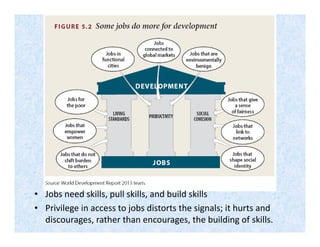
• Jobs need skills, pull skills, and build skills
• Privilege in access to jobs distorts the signals; it hurts and
discourages, rather than encourages, the building of skills.
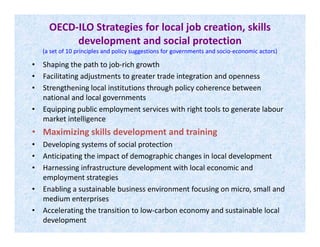
OECD-ILO Strategies for local job creation, skills
development and social protection
(a set of 10 principles and policy suggestions for governments and socio-economic actors)
• Shaping the path to job-rich growth
• Facilitating adjustments to greater trade integration and openness
• Strengthening local institutions through policy coherence between
national and local governments
• Equipping public employment services with right tools to generate labour
market intelligence
• Maximizing skills development and training
• Developing systems of social protection
• Anticipating the impact of demographic changes in local development
• Harnessing infrastructure development with local economic and
employment strategies
• Enabling a sustainable business environment focusing on micro, small and
medium enterprises
• Accelerating the transition to low-carbon economy and sustainable local
development
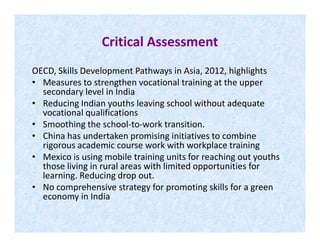
Critical Assessment
OECD, Skills Development Pathways in Asia, 2012, highlights
• Measures to strengthen vocational training at the upper
secondary level in India
• Reducing Indian youths leaving school without adequate
vocational qualifications
• Smoothing the school-to-work transition.• Smoothing the school-to-work transition.
• China has undertaken promising initiatives to combine
rigorous academic course work with workplace training
• Mexico is using mobile training units for reaching out youths
those living in rural areas with limited opportunities for
learning. Reducing drop out.
• No comprehensive strategy for promoting skills for a green
economy in India
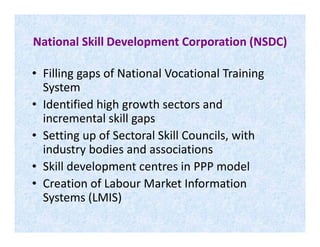
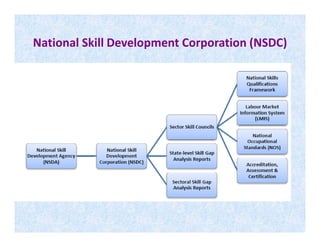
National Skill Development Corporation (NSDC)
• Filling gaps of National Vocational Training
System
• Identified high growth sectors and
incremental skill gapsincremental skill gaps
• Setting up of Sectoral Skill Councils, with
industry bodies and associations
• Skill development centres in PPP model
• Creation of Labour Market Information
Systems (LMIS)
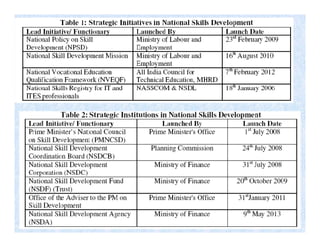
National Skill Development Corporation (NSDC)
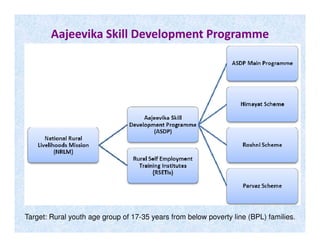
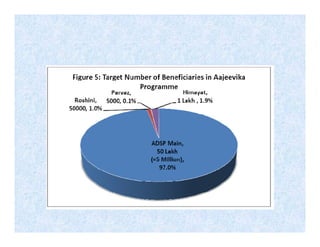
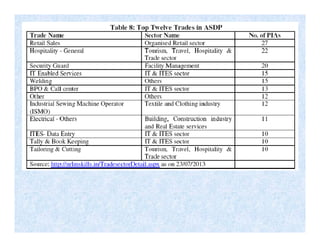
Aajeevika Skill Development Programme
(ASDP)
Target: Rural youth age group of 17-35 years from below poverty line (BPL) families.
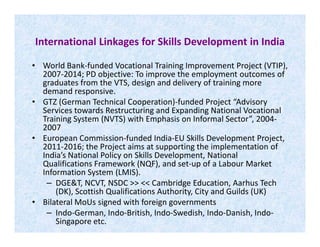
International Linkages for Skills Development in India
• World Bank-funded Vocational Training Improvement Project (VTIP),
2007-2014; PD objective: To improve the employment outcomes of
graduates from the VTS, design and delivery of training more
demand responsive.
• GTZ (German Technical Cooperation)-funded Project “Advisory
Services towards Restructuring and Expanding National Vocational
Training System (NVTS) with Emphasis on Informal Sector”, 2004-
20072007
• European Commission-funded India-EU Skills Development Project,
2011-2016; the Project aims at supporting the implementation of
India’s National Policy on Skills Development, National
Qualifications Framework (NQF), and set-up of a Labour Market
Information System (LMIS).
– DGE&T, NCVT, NSDC >> << Cambridge Education, Aarhus Tech
(DK), Scottish Qualifications Authority, City and Guilds (UK)
• Bilateral MoUs signed with foreign governments
– Indo-German, Indo-British, Indo-Swedish, Indo-Danish, Indo-
Singapore etc.
Concluding remarks
• Increasing capacity and quality of skills development and
vocational education will improve productivity in micro
enterprises, and SMEs
• Skills certification and benchmarking through NSQF and NOS
will help in participation of MSMEs in globalized jobs created
in India
• ASDP and its sub-schemes ensure skill building of rural youth,• ASDP and its sub-schemes ensure skill building of rural youth,
their job-diversification, and help them in coming out of
poverty through skills-based jobs
• NSDC’s Sector Skill Councils and ASDP both will improve
capability to reaching out skills required for informal and
unorganized sectors and/or people in informal sectors
• Who is more efficient in school-to-work smooth transition>>
ASDP or NSDC or vocational stream at high school level
• Thank You
anupdas2072@gmail.com

Skills Development for MSMEs: Mapping of Key Initiatives in India

  • 1.
    Skills Development forMSMEs: Mapping of Key Initiatives in IndiaIndia Anup Kumar Das Jawaharlal Nehru University, India ASIP2013
  • 2.
    Driving Forces • Indiais enjoying a demographic dividend vis-à-vis ageing countries. • India will have one-fourth of global workforce by 2022. • Emerging economies in global south – enjoy globalization effect of job creation in export-oriented industries. • Government’s efforts in inclusive growth• Government’s efforts in inclusive growth • Current capacity for skill development in the country is 3.1 million (2007 estimate). • Target of skilling 500 million people by 2022 to meet the challenges of India @ 75 after independence. • Micro, Small and Medium Enterprises (MSMEs) lead in livelihoods development through jobs creation and access to skills-based employment.
  • 3.
    • Jobs needskills, pull skills, and build skills • Privilege in access to jobs distorts the signals; it hurts and discourages, rather than encourages, the building of skills.
  • 4.
    OECD-ILO Strategies forlocal job creation, skills development and social protection (a set of 10 principles and policy suggestions for governments and socio-economic actors) • Shaping the path to job-rich growth • Facilitating adjustments to greater trade integration and openness • Strengthening local institutions through policy coherence between national and local governments • Equipping public employment services with right tools to generate labour market intelligence • Maximizing skills development and training • Developing systems of social protection • Anticipating the impact of demographic changes in local development • Harnessing infrastructure development with local economic and employment strategies • Enabling a sustainable business environment focusing on micro, small and medium enterprises • Accelerating the transition to low-carbon economy and sustainable local development
  • 5.
    Critical Assessment OECD, SkillsDevelopment Pathways in Asia, 2012, highlights • Measures to strengthen vocational training at the upper secondary level in India • Reducing Indian youths leaving school without adequate vocational qualifications • Smoothing the school-to-work transition.• Smoothing the school-to-work transition. • China has undertaken promising initiatives to combine rigorous academic course work with workplace training • Mexico is using mobile training units for reaching out youths those living in rural areas with limited opportunities for learning. Reducing drop out. • No comprehensive strategy for promoting skills for a green economy in India
  • 7.
    National Skill DevelopmentCorporation (NSDC) • Filling gaps of National Vocational Training System • Identified high growth sectors and incremental skill gapsincremental skill gaps • Setting up of Sectoral Skill Councils, with industry bodies and associations • Skill development centres in PPP model • Creation of Labour Market Information Systems (LMIS)
  • 8.
    National Skill DevelopmentCorporation (NSDC)
  • 11.
    Aajeevika Skill DevelopmentProgramme (ASDP) Target: Rural youth age group of 17-35 years from below poverty line (BPL) families.
  • 14.
    International Linkages forSkills Development in India • World Bank-funded Vocational Training Improvement Project (VTIP), 2007-2014; PD objective: To improve the employment outcomes of graduates from the VTS, design and delivery of training more demand responsive. • GTZ (German Technical Cooperation)-funded Project “Advisory Services towards Restructuring and Expanding National Vocational Training System (NVTS) with Emphasis on Informal Sector”, 2004- 20072007 • European Commission-funded India-EU Skills Development Project, 2011-2016; the Project aims at supporting the implementation of India’s National Policy on Skills Development, National Qualifications Framework (NQF), and set-up of a Labour Market Information System (LMIS). – DGE&T, NCVT, NSDC >> << Cambridge Education, Aarhus Tech (DK), Scottish Qualifications Authority, City and Guilds (UK) • Bilateral MoUs signed with foreign governments – Indo-German, Indo-British, Indo-Swedish, Indo-Danish, Indo- Singapore etc.
  • 15.
    Concluding remarks • Increasingcapacity and quality of skills development and vocational education will improve productivity in micro enterprises, and SMEs • Skills certification and benchmarking through NSQF and NOS will help in participation of MSMEs in globalized jobs created in India • ASDP and its sub-schemes ensure skill building of rural youth,• ASDP and its sub-schemes ensure skill building of rural youth, their job-diversification, and help them in coming out of poverty through skills-based jobs • NSDC’s Sector Skill Councils and ASDP both will improve capability to reaching out skills required for informal and unorganized sectors and/or people in informal sectors • Who is more efficient in school-to-work smooth transition>> ASDP or NSDC or vocational stream at high school level
  • 16.