EVALUATION, DATA AND METRICS: 
LESSONS FROM OECD COUNTRIES: 
THE UK 
U.S. Department of Labor-OECD LEED 
Workshop on Workforce Development and 
Local Job Creation – An International 
Perspective 
18-19 November, 2014 
Anne Green, Institute for Employment 
Research, University of Warwick, UK
Overview 
• Aspiration 
evidence-based policy which is continuously evaluated 
and accountable 
• Effective use of evidence 
is more evident nationally than locally – reflecting better 
evidence, greater resources and expertise 
• Change in institutional structures 
demise of regional tier of governance (in England) and 
transfer of powers to local level – but limited resources 
• Funding 
public spending cuts
Challenges for evaluation in the context 
of Localism 
• At local level foremost interest tends to be in formative 
evaluation rather than impact evaluation 
• Attempts to improve the evidence base face tensions 
between: 
- delivering what has been delivered before 
- desire for INNOVATION 
and: 
- competition versus collaboration 
- ‘black box’ versus ‘glass box’ 
• What doesn’t work?
Findings from Local Job Creation in 
England (1) 
• Appetite amongst local stakeholders for policies and 
programmes to be informed by ‘hard’ and ‘soft’ evidence: 
- official statistics 
- administrative data 
- national surveys (e.g. Employer Skills Survey) 
- locally-commissioned surveys 
- market intelligence 
- evaluation studies 
• Local Enterprise Partnerships have commissioned 
consultants to use evidence and data to inform strategies
Findings from Local Job Creation in 
England (2) 
Need strategic expertise, capability and capacity 
• Capacity to use available information and intelligence to 
‘tell a story’ 
- facilitated by co-location 
- hampered by austerity: cutbacks and fragmentation 
- some reductions in quantity and quality of data 
- challenges of ‘ownership’ and sharing of data 
• Possible solutions: 
- establishment of Observatories 
including government statisticians 
local benchmarking 
- more intelligent use of local data in national surveys
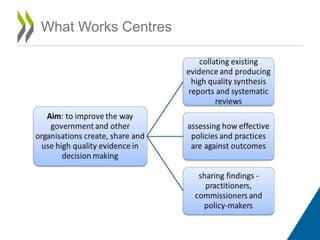
What Works Centres
An example: What Works Centre for 
Local Economic Growth
For further information 
Contact: 
Anne.Green@warwick.ac.uk 
Institute for Employment Research 
University of Warwick, UK

Evaluation, data and metrics: Lessons from OECD Countries: THE UK

  • 1.
    EVALUATION, DATA ANDMETRICS: LESSONS FROM OECD COUNTRIES: THE UK U.S. Department of Labor-OECD LEED Workshop on Workforce Development and Local Job Creation – An International Perspective 18-19 November, 2014 Anne Green, Institute for Employment Research, University of Warwick, UK
  • 2.
    Overview • Aspiration evidence-based policy which is continuously evaluated and accountable • Effective use of evidence is more evident nationally than locally – reflecting better evidence, greater resources and expertise • Change in institutional structures demise of regional tier of governance (in England) and transfer of powers to local level – but limited resources • Funding public spending cuts
  • 3.
    Challenges for evaluationin the context of Localism • At local level foremost interest tends to be in formative evaluation rather than impact evaluation • Attempts to improve the evidence base face tensions between: - delivering what has been delivered before - desire for INNOVATION and: - competition versus collaboration - ‘black box’ versus ‘glass box’ • What doesn’t work?
  • 4.
    Findings from LocalJob Creation in England (1) • Appetite amongst local stakeholders for policies and programmes to be informed by ‘hard’ and ‘soft’ evidence: - official statistics - administrative data - national surveys (e.g. Employer Skills Survey) - locally-commissioned surveys - market intelligence - evaluation studies • Local Enterprise Partnerships have commissioned consultants to use evidence and data to inform strategies
  • 5.
    Findings from LocalJob Creation in England (2) Need strategic expertise, capability and capacity • Capacity to use available information and intelligence to ‘tell a story’ - facilitated by co-location - hampered by austerity: cutbacks and fragmentation - some reductions in quantity and quality of data - challenges of ‘ownership’ and sharing of data • Possible solutions: - establishment of Observatories including government statisticians local benchmarking - more intelligent use of local data in national surveys
  • 6.
  • 7.
    An example: WhatWorks Centre for Local Economic Growth
  • 8.
    For further information Contact: Anne.Green@warwick.ac.uk Institute for Employment Research University of Warwick, UK