SKILL DEVELOPMENT

The Vision and Strategy of the 12th
               Plan
"Vision is the art of seeing the invisible."
                         — Jonathan Swift
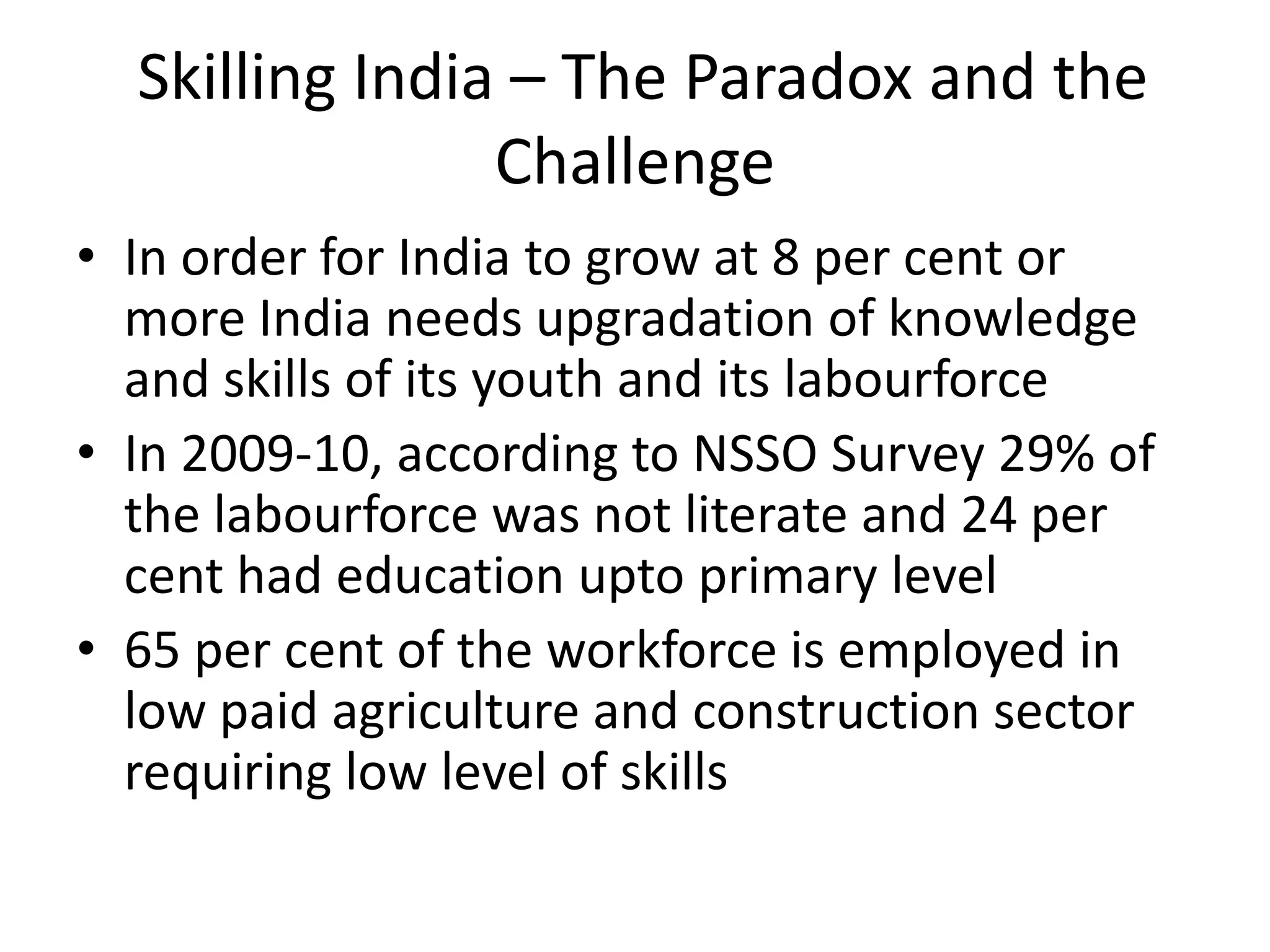
Skilling India – The Paradox and the
                Challenge
• In order for India to grow at 8 per cent or
  more India needs upgradation of knowledge
  and skills of its youth and its labourforce
• In 2009-10, according to NSSO Survey 29% of
  the labourforce was not literate and 24 per
  cent had education upto primary level
• 65 per cent of the workforce is employed in
  low paid agriculture and construction sector
  requiring low level of skills
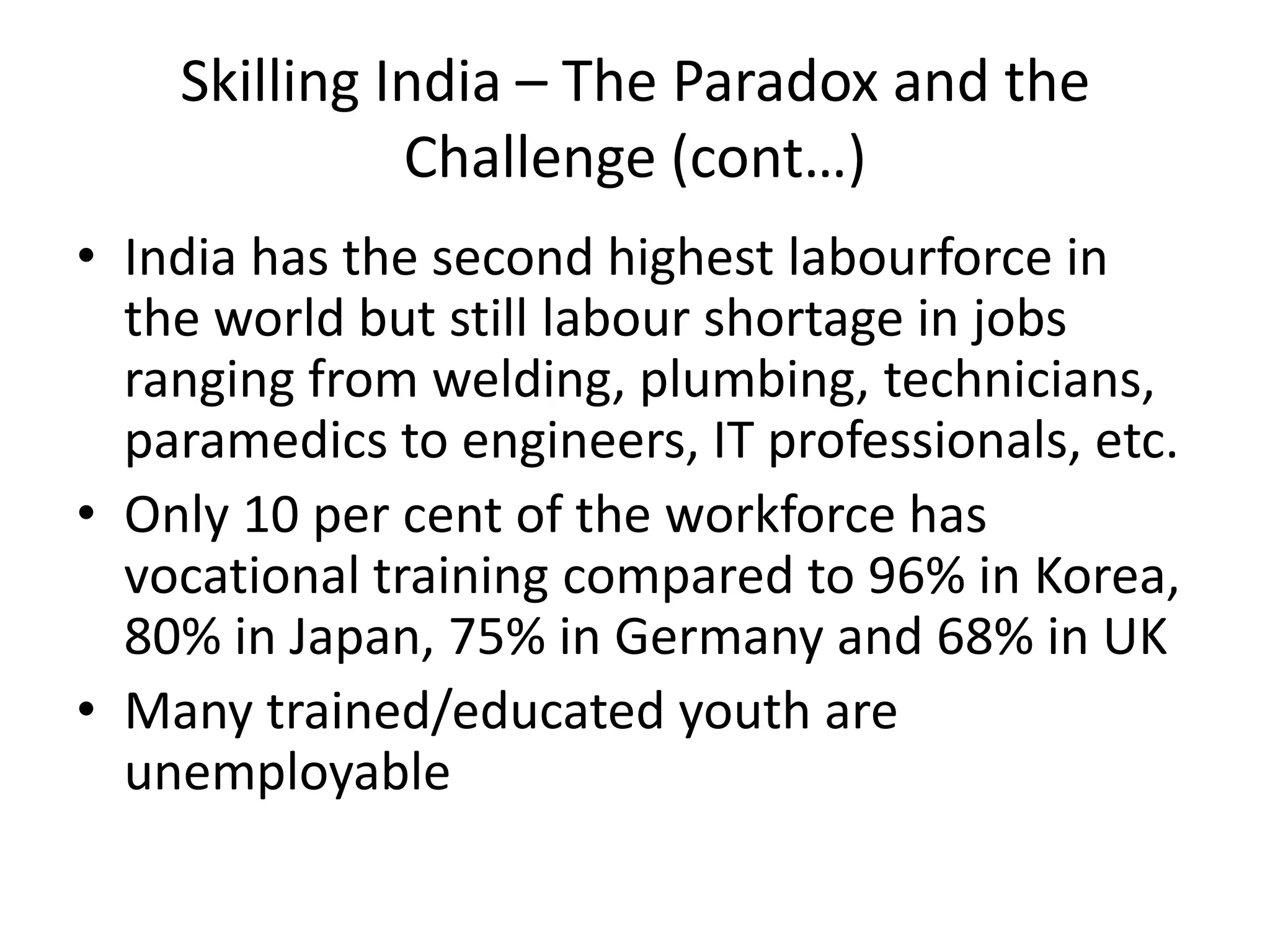
Skilling India – The Paradox and the
              Challenge (cont…)
• India has the second highest labourforce in
  the world but still labour shortage in jobs
  ranging from welding, plumbing, technicians,
  paramedics to engineers, IT professionals, etc.
• Only 10 per cent of the workforce has
  vocational training compared to 96% in Korea,
  80% in Japan, 75% in Germany and 68% in UK
• Many trained/educated youth are
  unemployable
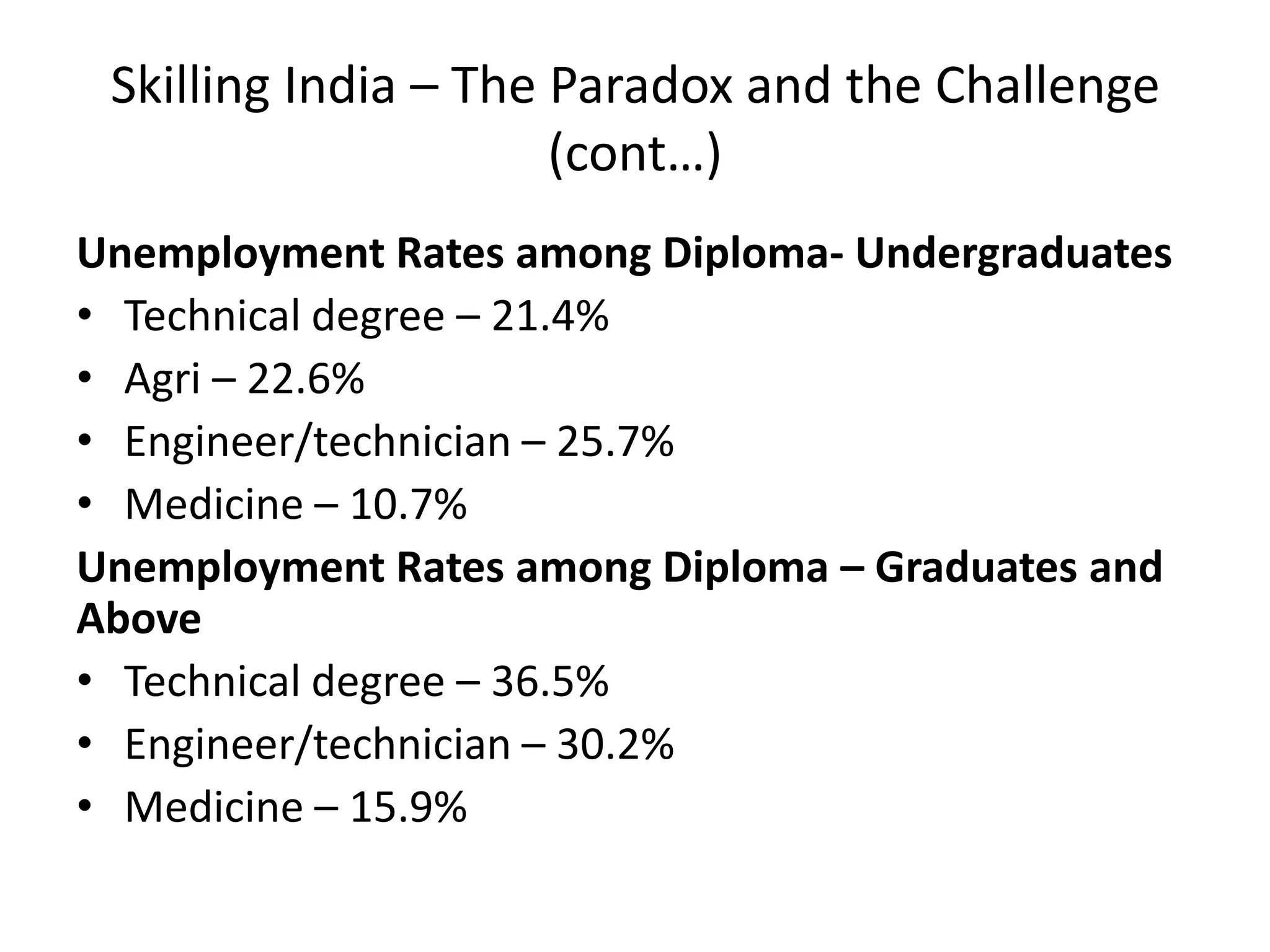
Skilling India – The Paradox and the Challenge
                      (cont…)
Unemployment Rates among Diploma- Undergraduates
• Technical degree – 21.4%
• Agri – 22.6%
• Engineer/technician – 25.7%
• Medicine – 10.7%
Unemployment Rates among Diploma – Graduates and
Above
• Technical degree – 36.5%
• Engineer/technician – 30.2%
• Medicine – 15.9%
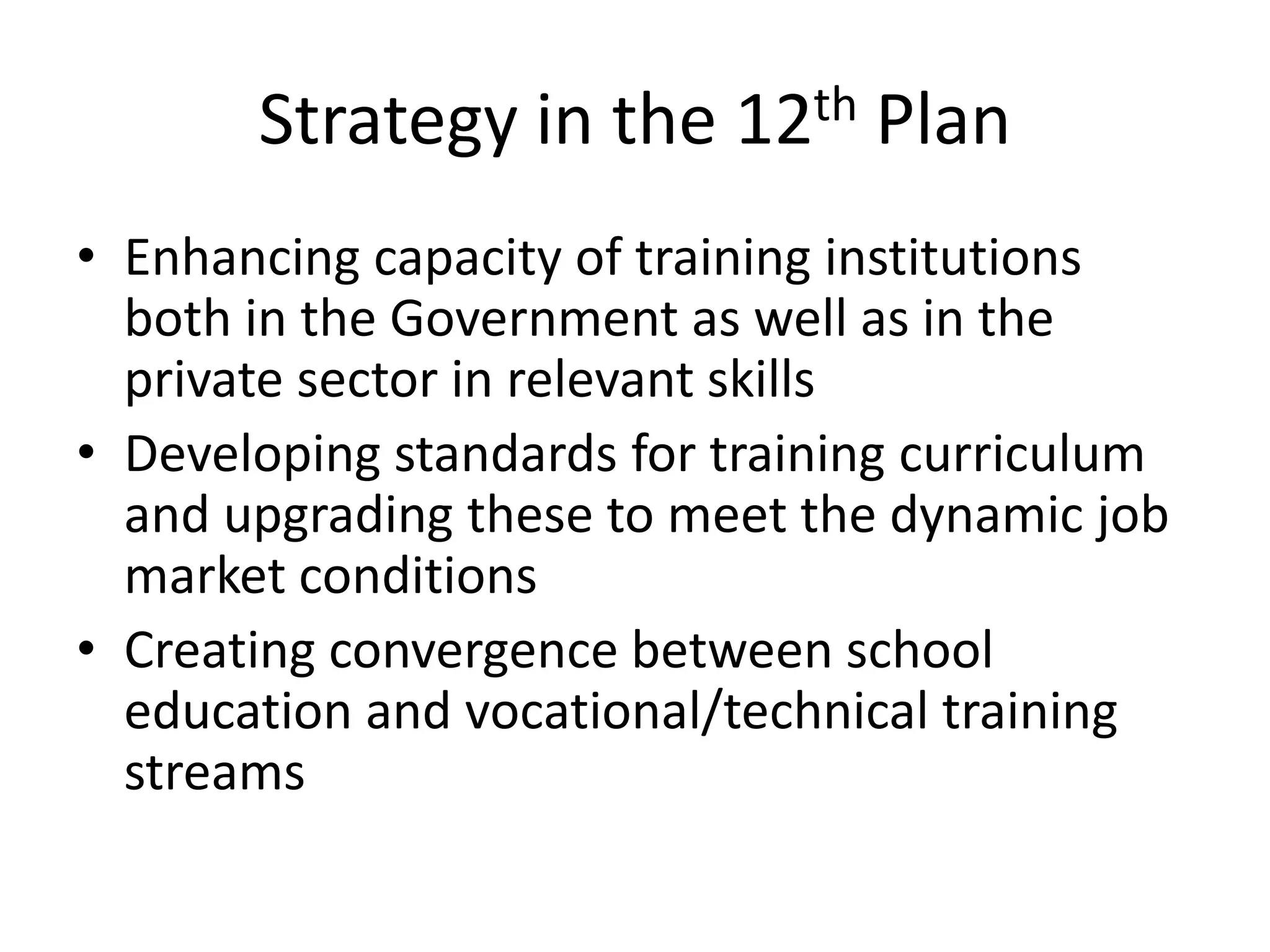
Strategy in the 12th Plan
• Enhancing capacity of training institutions
  both in the Government as well as in the
  private sector in relevant skills
• Developing standards for training curriculum
  and upgrading these to meet the dynamic job
  market conditions
• Creating convergence between school
  education and vocational/technical training
  streams
Strategy in the 12th Plan (cont…)
• Developing quality assurance framework
  through examinations and certification as well
  as affiliations and accreditation
• Bringing together and synergising the training
  efforts of Central Government, State
  Governments, Private Sector, NGOs, etc.
  through a National Agency
• Developing labour market information system
  for informed policy action
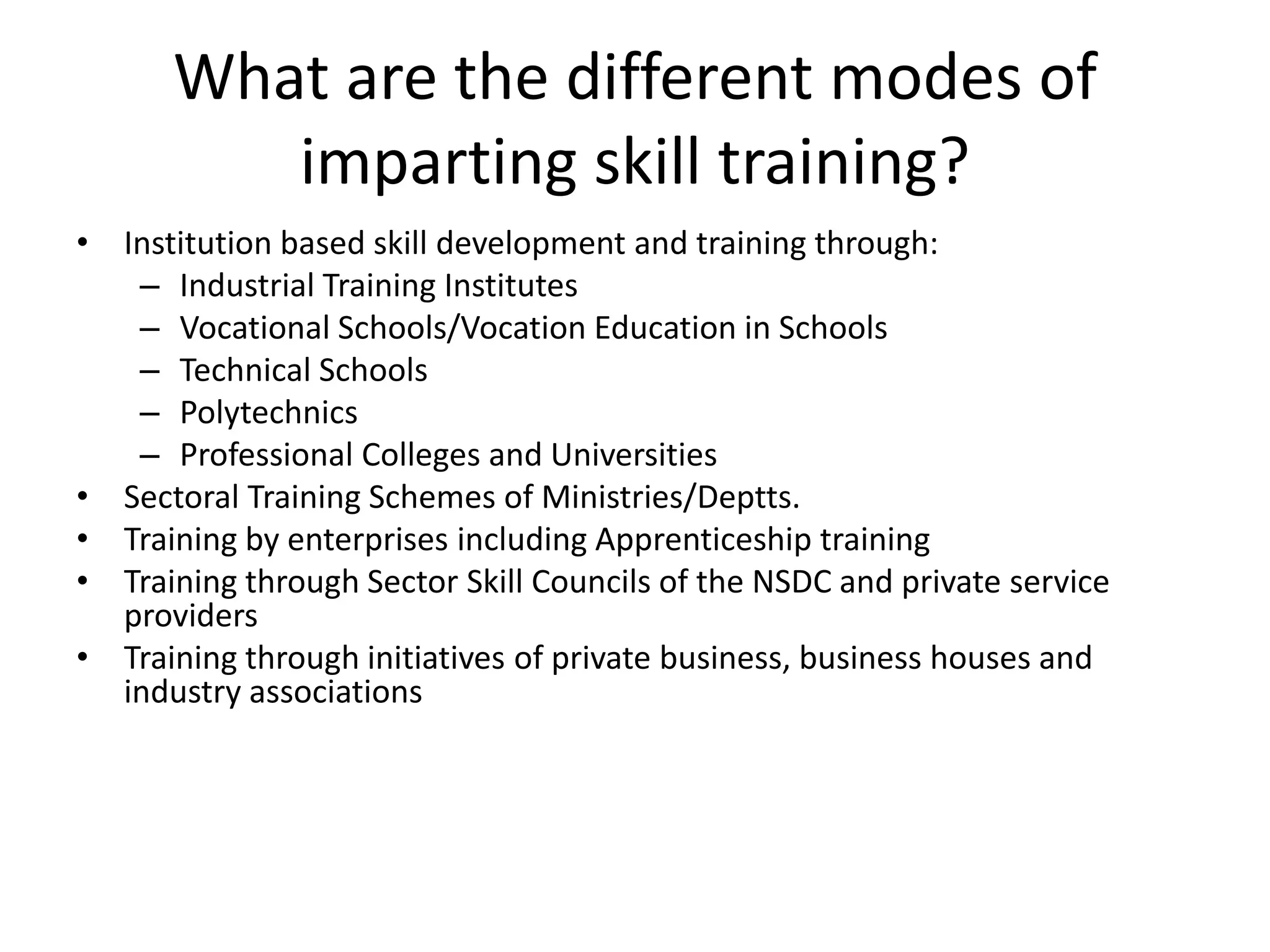
What are the different modes of
         imparting skill training?
• Institution based skill development and training through:
   – Industrial Training Institutes
   – Vocational Schools/Vocation Education in Schools
   – Technical Schools
   – Polytechnics
   – Professional Colleges and Universities
• Sectoral Training Schemes of Ministries/Deptts.
• Training by enterprises including Apprenticeship training
• Training through Sector Skill Councils of the NSDC and private service
  providers
• Training through initiatives of private business, business houses and
  industry associations
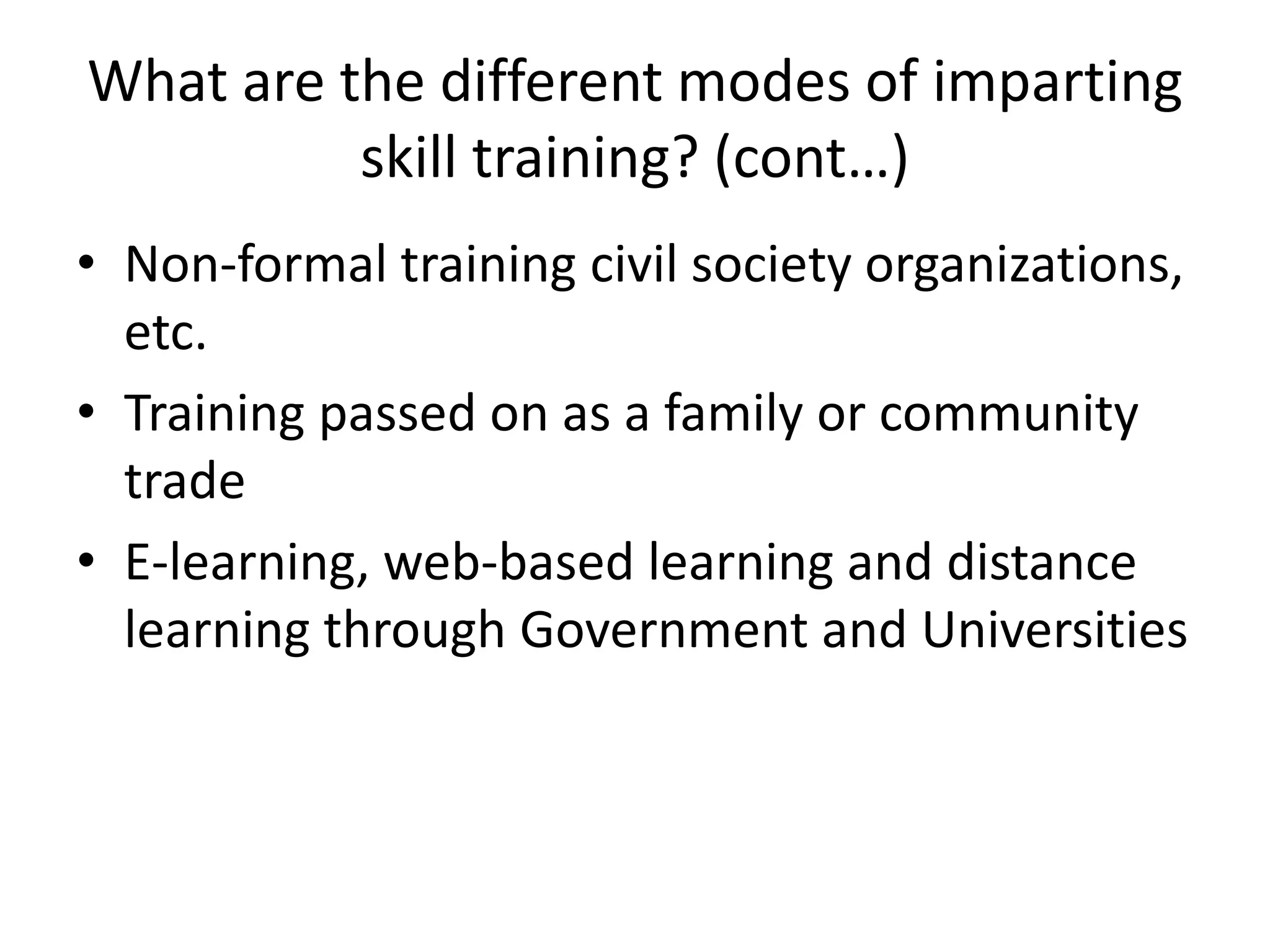
What are the different modes of imparting
          skill training? (cont…)
• Non-formal training civil society organizations,
  etc.
• Training passed on as a family or community
  trade
• E-learning, web-based learning and distance
  learning through Government and Universities
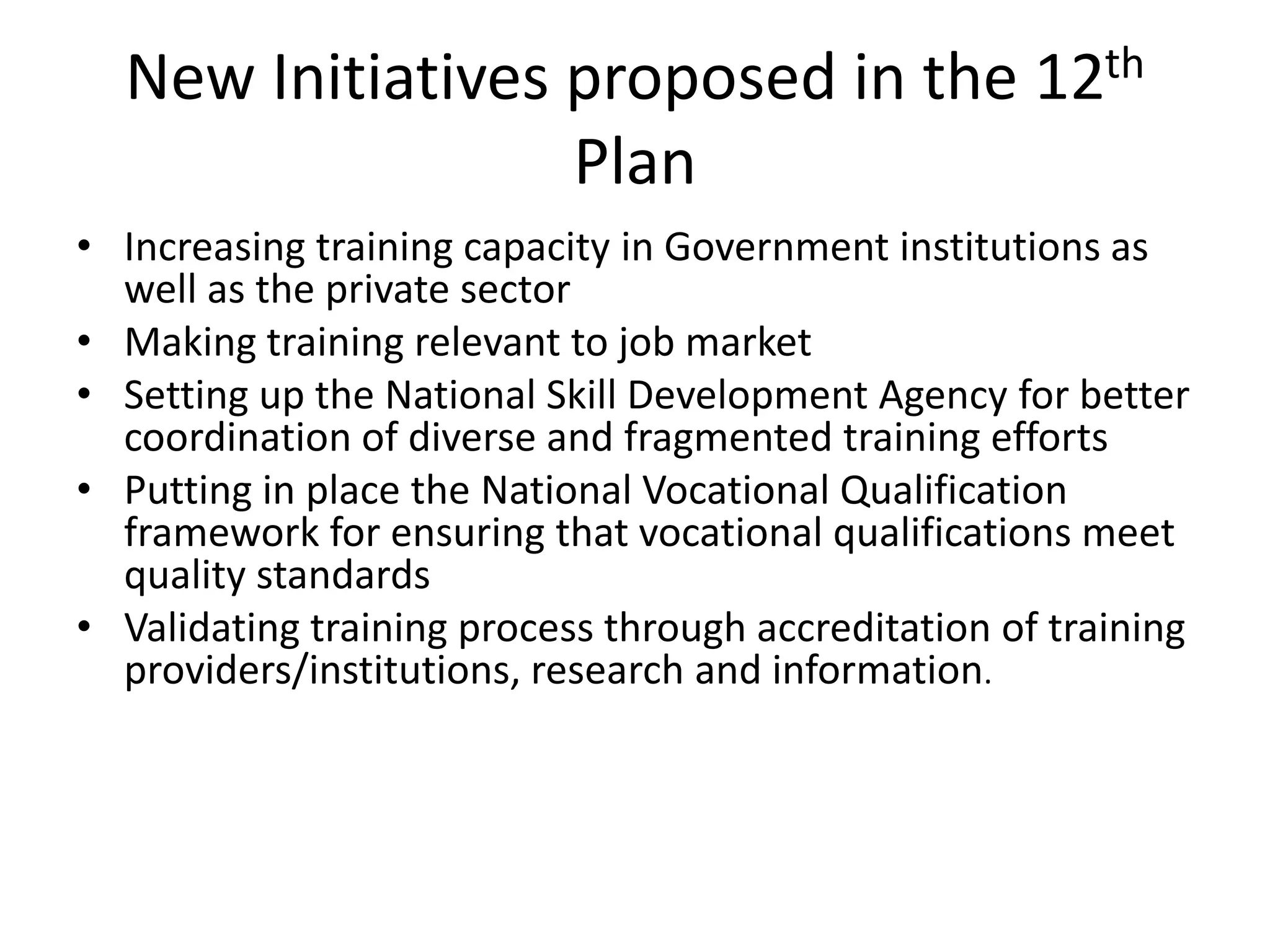
New Initiatives proposed in the 12th
                  Plan
• Increasing training capacity in Government institutions as
  well as the private sector
• Making training relevant to job market
• Setting up the National Skill Development Agency for better
  coordination of diverse and fragmented training efforts
• Putting in place the National Vocational Qualification
  framework for ensuring that vocational qualifications meet
  quality standards
• Validating training process through accreditation of training
  providers/institutions, research and information.
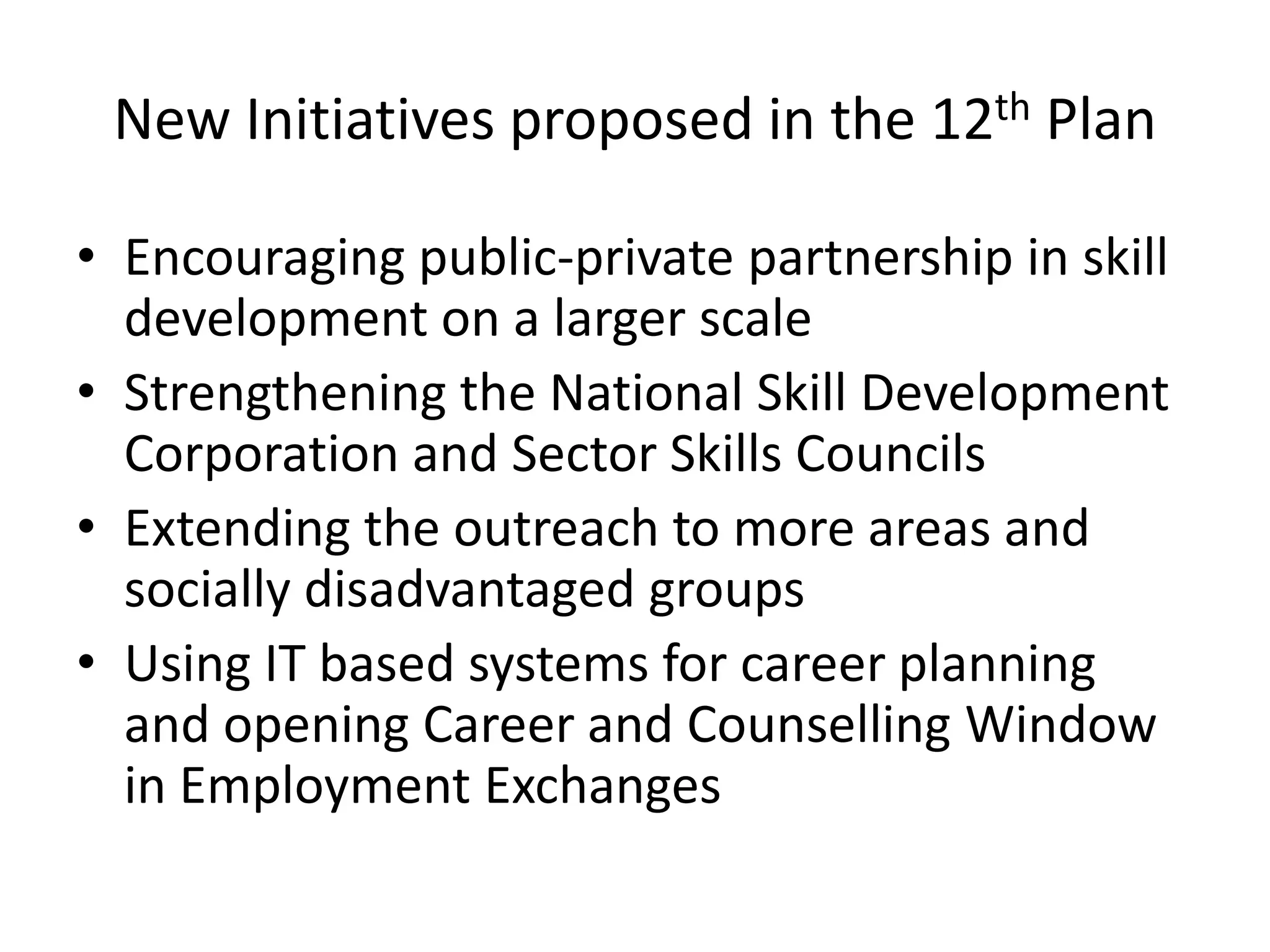
New Initiatives proposed in the 12th Plan

• Encouraging public-private partnership in skill
  development on a larger scale
• Strengthening the National Skill Development
  Corporation and Sector Skills Councils
• Extending the outreach to more areas and
  socially disadvantaged groups
• Using IT based systems for career planning
  and opening Career and Counselling Window
  in Employment Exchanges
Strengthening Private Initiative through NSDC

• NSDC is a public private initiative to develop
  relevant skills, particularly in the unorganised
  sector through Sector Skills Councils, training
  of trainer programmes, international
  outreach, connecting with organisations,
  Labour Market Information System, NVQF, etc.
Strengthening Private Initiative through NSDC
                   (cont…)
• Around 20 SSCs formed with the objective:
   • to reduce skills gaps and shortages
   • to improve productivity
   • to boost the skills of their sector workforces
• Major sectors needing skilling:
   •   Building and construction
   •   Organised Retail
   •   Auto
   •   IT and ITES
   •   Health Care
   •   Textiles and Clothing
   •   Banking, Financial Services and Insurance Industry
Major Universal Skilling Programmes
        of the Government
• Craftsman Training Scheme
  – run by MOLE through Govt. ITI s and ITCs with
    reservation of 25% for women and 3% for physically
    handicapped
• Apprenticeship Training Programme
  – Run by MOLE for trade apprentices and HRD
    Ministry for graduate apprentices
• Modular Employable Skill Scheme
  – Run by MOLE for skill upgradation including
    recognition of prior learning for school dropouts
Sectoral Skilling Programmes of the
               Government
• Hunar se Rozgar Scheme
   – Implemented by Ministry of Tourism through Institutes of Hotel
     Management, Food Craft Institutes and ITDC for skilling youth
     for the hospitality sector

• Integrated Skill Development Scheme
   – Implemented by Ministry of Textiles for handicrafts, handlooms,
      sericulture, jute, technical textiles, etc.

• Entrepreneurial Skill Development Programme
   – Implemented by Ministry of Medium, Small and Micro
     Enterprises for providing skill to technicians, techno-managerial
     skills and catering to disadvantaged groups in remote areas
Sectoral Skilling Programmes of the
           Government (cont…)
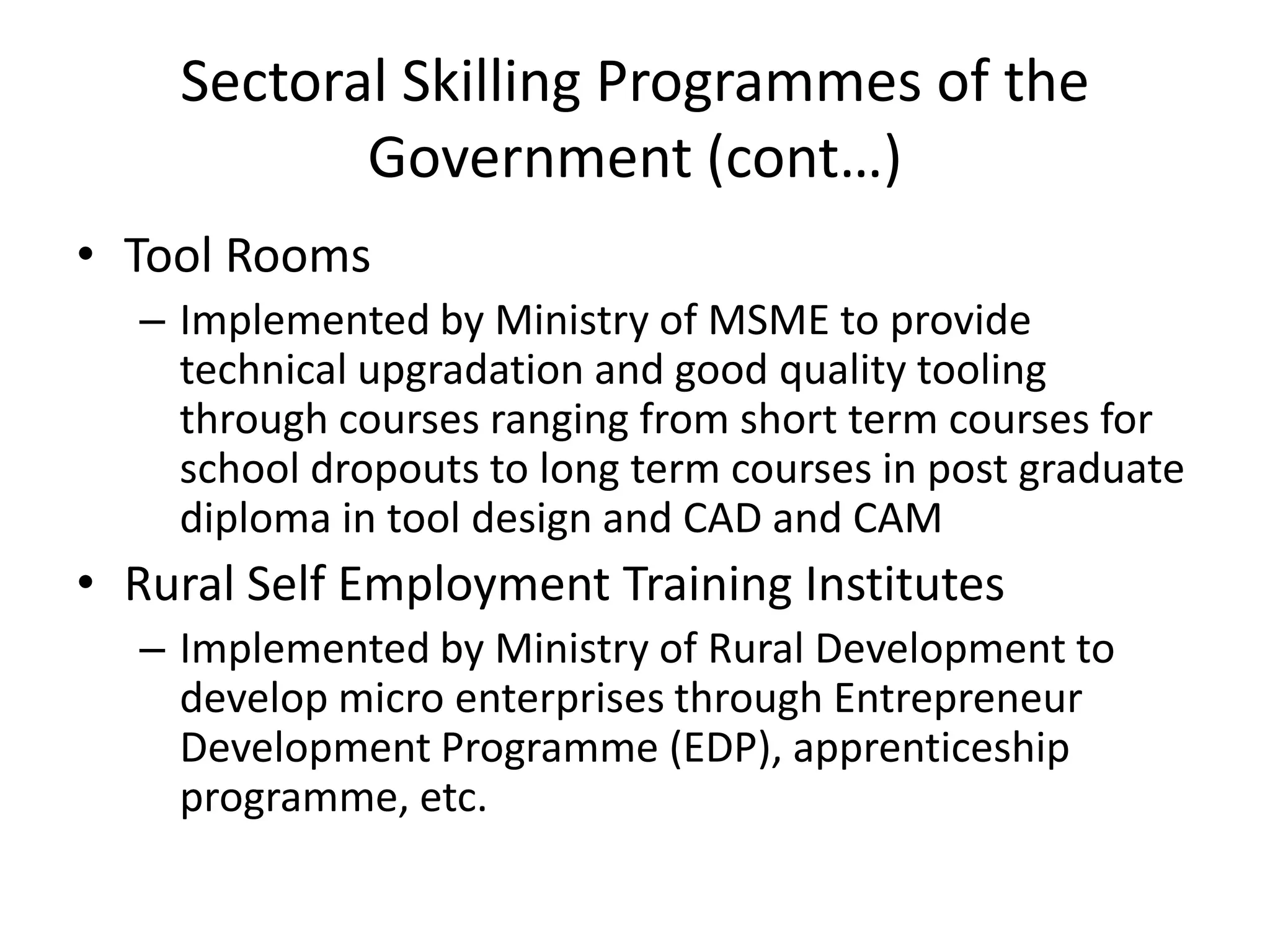
• Tool Rooms
  – Implemented by Ministry of MSME to provide
    technical upgradation and good quality tooling
    through courses ranging from short term courses for
    school dropouts to long term courses in post graduate
    diploma in tool design and CAD and CAM
• Rural Self Employment Training Institutes
  – Implemented by Ministry of Rural Development to
    develop micro enterprises through Entrepreneur
    Development Programme (EDP), apprenticeship
    programme, etc.
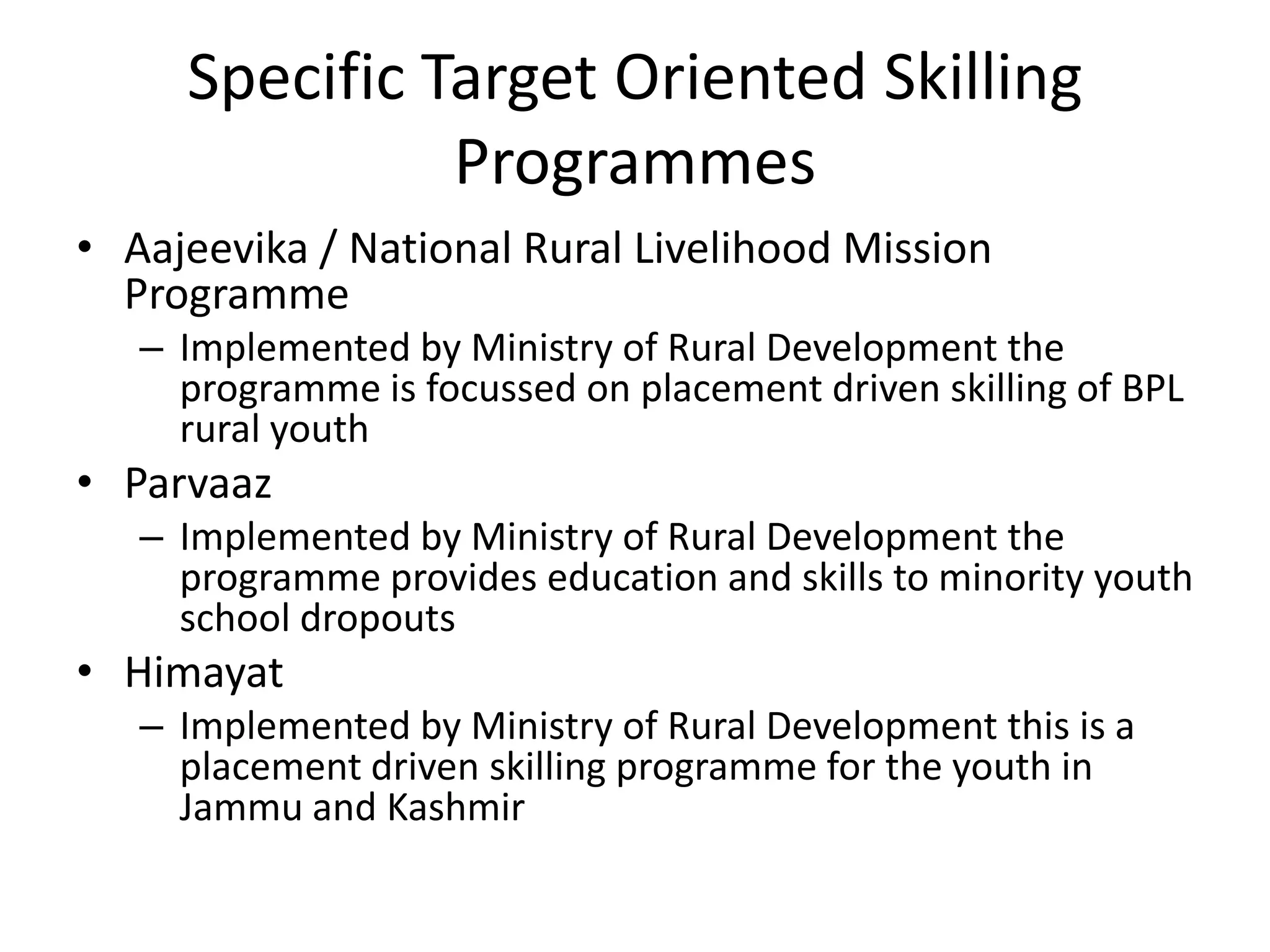
Specific Target Oriented Skilling
               Programmes
• Aajeevika / National Rural Livelihood Mission
  Programme
   – Implemented by Ministry of Rural Development the
     programme is focussed on placement driven skilling of BPL
     rural youth
• Parvaaz
   – Implemented by Ministry of Rural Development the
     programme provides education and skills to minority youth
     school dropouts
• Himayat
   – Implemented by Ministry of Rural Development this is a
     placement driven skilling programme for the youth in
     Jammu and Kashmir
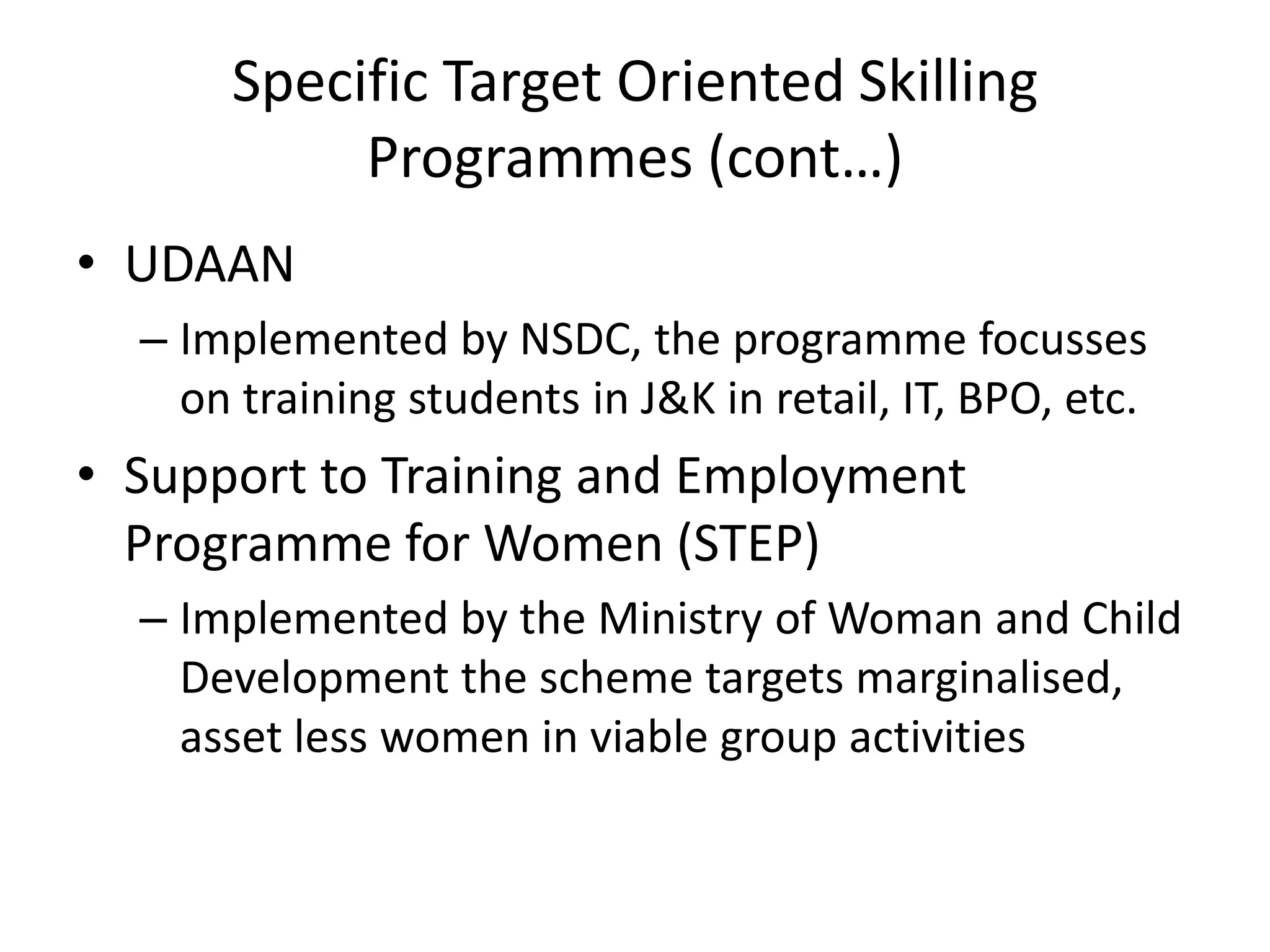
Specific Target Oriented Skilling
           Programmes (cont…)
• UDAAN
  – Implemented by NSDC, the programme focusses
    on training students in J&K in retail, IT, BPO, etc.
• Support to Training and Employment
  Programme for Women (STEP)
  – Implemented by the Ministry of Woman and Child
    Development the scheme targets marginalised,
    asset less women in viable group activities
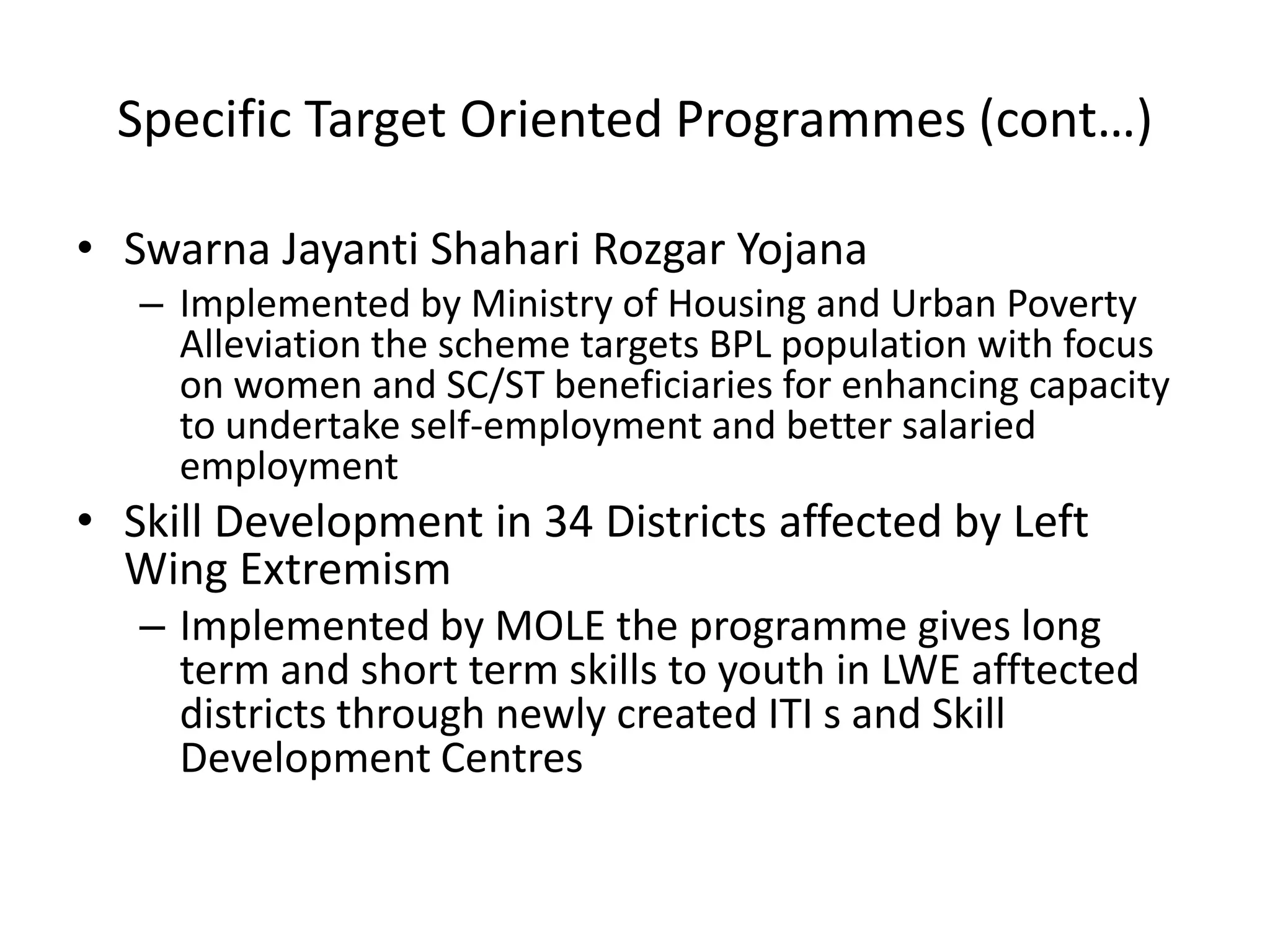
Specific Target Oriented Programmes (cont…)

• Swarna Jayanti Shahari Rozgar Yojana
   – Implemented by Ministry of Housing and Urban Poverty
     Alleviation the scheme targets BPL population with focus
     on women and SC/ST beneficiaries for enhancing capacity
     to undertake self-employment and better salaried
     employment
• Skill Development in 34 Districts affected by Left
  Wing Extremism
   – Implemented by MOLE the programme gives long
     term and short term skills to youth in LWE afftected
     districts through newly created ITI s and Skill
     Development Centres
Realizing the 12th Plan Vision
Medium term vision:
• Target of skilling 50 million persons during the
  12th Plan
Short term vision:
• Skilling 9 million persons during 2013-14
“…the miracle is in the unfolding of the wings.
You may not know where you're going, but you
know that so long as you spread your wings,
the winds will carry you.” ― C. JoyBell C.


May the winds of change carry the youth and
this country to greater heights….

Skill Development - 12th Plan Hackathon - 6th April 2013

  • 1.
    SKILL DEVELOPMENT The Visionand Strategy of the 12th Plan
  • 2.
    "Vision is theart of seeing the invisible." — Jonathan Swift
  • 3.
    Skilling India –The Paradox and the Challenge • In order for India to grow at 8 per cent or more India needs upgradation of knowledge and skills of its youth and its labourforce • In 2009-10, according to NSSO Survey 29% of the labourforce was not literate and 24 per cent had education upto primary level • 65 per cent of the workforce is employed in low paid agriculture and construction sector requiring low level of skills
  • 4.
    Skilling India –The Paradox and the Challenge (cont…) • India has the second highest labourforce in the world but still labour shortage in jobs ranging from welding, plumbing, technicians, paramedics to engineers, IT professionals, etc. • Only 10 per cent of the workforce has vocational training compared to 96% in Korea, 80% in Japan, 75% in Germany and 68% in UK • Many trained/educated youth are unemployable
  • 5.
    Skilling India –The Paradox and the Challenge (cont…) Unemployment Rates among Diploma- Undergraduates • Technical degree – 21.4% • Agri – 22.6% • Engineer/technician – 25.7% • Medicine – 10.7% Unemployment Rates among Diploma – Graduates and Above • Technical degree – 36.5% • Engineer/technician – 30.2% • Medicine – 15.9%
  • 6.
    Strategy in the12th Plan • Enhancing capacity of training institutions both in the Government as well as in the private sector in relevant skills • Developing standards for training curriculum and upgrading these to meet the dynamic job market conditions • Creating convergence between school education and vocational/technical training streams
  • 7.
    Strategy in the12th Plan (cont…) • Developing quality assurance framework through examinations and certification as well as affiliations and accreditation • Bringing together and synergising the training efforts of Central Government, State Governments, Private Sector, NGOs, etc. through a National Agency • Developing labour market information system for informed policy action
  • 8.
    What are thedifferent modes of imparting skill training? • Institution based skill development and training through: – Industrial Training Institutes – Vocational Schools/Vocation Education in Schools – Technical Schools – Polytechnics – Professional Colleges and Universities • Sectoral Training Schemes of Ministries/Deptts. • Training by enterprises including Apprenticeship training • Training through Sector Skill Councils of the NSDC and private service providers • Training through initiatives of private business, business houses and industry associations
  • 9.
    What are thedifferent modes of imparting skill training? (cont…) • Non-formal training civil society organizations, etc. • Training passed on as a family or community trade • E-learning, web-based learning and distance learning through Government and Universities
  • 10.
    New Initiatives proposedin the 12th Plan • Increasing training capacity in Government institutions as well as the private sector • Making training relevant to job market • Setting up the National Skill Development Agency for better coordination of diverse and fragmented training efforts • Putting in place the National Vocational Qualification framework for ensuring that vocational qualifications meet quality standards • Validating training process through accreditation of training providers/institutions, research and information.
  • 11.
    New Initiatives proposedin the 12th Plan • Encouraging public-private partnership in skill development on a larger scale • Strengthening the National Skill Development Corporation and Sector Skills Councils • Extending the outreach to more areas and socially disadvantaged groups • Using IT based systems for career planning and opening Career and Counselling Window in Employment Exchanges
  • 12.
    Strengthening Private Initiativethrough NSDC • NSDC is a public private initiative to develop relevant skills, particularly in the unorganised sector through Sector Skills Councils, training of trainer programmes, international outreach, connecting with organisations, Labour Market Information System, NVQF, etc.
  • 13.
    Strengthening Private Initiativethrough NSDC (cont…) • Around 20 SSCs formed with the objective: • to reduce skills gaps and shortages • to improve productivity • to boost the skills of their sector workforces • Major sectors needing skilling: • Building and construction • Organised Retail • Auto • IT and ITES • Health Care • Textiles and Clothing • Banking, Financial Services and Insurance Industry
  • 14.
    Major Universal SkillingProgrammes of the Government • Craftsman Training Scheme – run by MOLE through Govt. ITI s and ITCs with reservation of 25% for women and 3% for physically handicapped • Apprenticeship Training Programme – Run by MOLE for trade apprentices and HRD Ministry for graduate apprentices • Modular Employable Skill Scheme – Run by MOLE for skill upgradation including recognition of prior learning for school dropouts
  • 15.
    Sectoral Skilling Programmesof the Government • Hunar se Rozgar Scheme – Implemented by Ministry of Tourism through Institutes of Hotel Management, Food Craft Institutes and ITDC for skilling youth for the hospitality sector • Integrated Skill Development Scheme – Implemented by Ministry of Textiles for handicrafts, handlooms, sericulture, jute, technical textiles, etc. • Entrepreneurial Skill Development Programme – Implemented by Ministry of Medium, Small and Micro Enterprises for providing skill to technicians, techno-managerial skills and catering to disadvantaged groups in remote areas
  • 16.
    Sectoral Skilling Programmesof the Government (cont…) • Tool Rooms – Implemented by Ministry of MSME to provide technical upgradation and good quality tooling through courses ranging from short term courses for school dropouts to long term courses in post graduate diploma in tool design and CAD and CAM • Rural Self Employment Training Institutes – Implemented by Ministry of Rural Development to develop micro enterprises through Entrepreneur Development Programme (EDP), apprenticeship programme, etc.
  • 17.
    Specific Target OrientedSkilling Programmes • Aajeevika / National Rural Livelihood Mission Programme – Implemented by Ministry of Rural Development the programme is focussed on placement driven skilling of BPL rural youth • Parvaaz – Implemented by Ministry of Rural Development the programme provides education and skills to minority youth school dropouts • Himayat – Implemented by Ministry of Rural Development this is a placement driven skilling programme for the youth in Jammu and Kashmir
  • 18.
    Specific Target OrientedSkilling Programmes (cont…) • UDAAN – Implemented by NSDC, the programme focusses on training students in J&K in retail, IT, BPO, etc. • Support to Training and Employment Programme for Women (STEP) – Implemented by the Ministry of Woman and Child Development the scheme targets marginalised, asset less women in viable group activities
  • 19.
    Specific Target OrientedProgrammes (cont…) • Swarna Jayanti Shahari Rozgar Yojana – Implemented by Ministry of Housing and Urban Poverty Alleviation the scheme targets BPL population with focus on women and SC/ST beneficiaries for enhancing capacity to undertake self-employment and better salaried employment • Skill Development in 34 Districts affected by Left Wing Extremism – Implemented by MOLE the programme gives long term and short term skills to youth in LWE afftected districts through newly created ITI s and Skill Development Centres
  • 20.
    Realizing the 12thPlan Vision Medium term vision: • Target of skilling 50 million persons during the 12th Plan Short term vision: • Skilling 9 million persons during 2013-14
  • 21.
    “…the miracle isin the unfolding of the wings. You may not know where you're going, but you know that so long as you spread your wings, the winds will carry you.” ― C. JoyBell C. May the winds of change carry the youth and this country to greater heights….