Principles of
antibiotic therapy
Outline
• Introduction
• Pathogens
• Danger of overuse
• Selection and administration of antibiotics
• Methods of administration of antibiotics
Introduction
Chemical substances produced by microorganism that has the capacity to inhibit
growth or destroy bacteria
Chemical substances produced by microorganism that has the capacity to inhibit
growth or destroy bacteria
BactericidalBactericidal BacteriostaticBacteriostatic
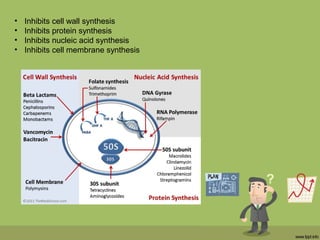
• Inhibits cell wall synthesis
• Inhibits protein synthesis
• Inhibits nucleic acid synthesis
• Inhibits cell membrane synthesis
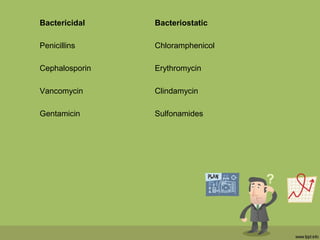
Bactericidal Bacteriostatic
Penicillins Chloramphenicol
Cephalosporin Erythromycin
Vancomycin Clindamycin
Gentamicin Sulfonamides
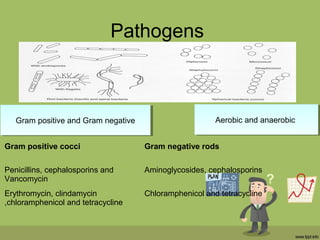
Pathogens
Gram positive and Gram negativeGram positive and Gram negative Aerobic and anaerobicAerobic and anaerobic
Gram positive cocci Gram negative rods
Penicillins, cephalosporins and
Vancomycin
Aminoglycosides, cephalosporins
Erythromycin, clindamycin
,chloramphenicol and tetracycline
Chloramphenicol and tetracycline
Chloramphenicol
• First line treatment of bacterial
conjunctivitis(broad spectrum)
• Bacteriostatic antibiotic which inhibits
protein synthesis
• Streptococci, Pneumococci and
Corynebacteria
• 0.5% drops and a one percent ointment
Fluoroquinolones
• Ciprofloxacin, ofloxacin(2nd
generation)
• Levofloxacin( 3rd
generation)
• Moxifloxacin, Gatifloxacin( fourth generation)
• Efficacious against Gram positive and Gram
negative bacteria, particularly staphylococci
• Low toxicity
• Enzymic inhibition of bacterial DNA
production( DNA gyrase)
• Deposit of whitish material in the base of corneal
ulcers which can make monitoring of the progress
of the disease more difficult.
Penicillins
• Benzylpenicillin,Procaine penicillin,
Benzathine penicillin ,Phenoxymethyl
penicillin, Cloxacillin,Ampicillin/amoxicillin
• Bactericidal and inhibit cell wall synthesis
• Low toxicity
Cephalosporins
• 1st
generation: cefazolin, cephalexin( gram
positive cocci)
• 2nd
generation: cefaclor, cefuroxime
sodium( gram positive and negative)
• 3rd
generation: cefotaxime sodium,
ceftizoxime(gram negative bacilli)
• Bactericidal and Inhibit cell wall synthesis
• Allergic reaction, neutropenia and
thrombocytopenia
Aminoglycosides
• Gentamicin(0.3%), Kanamycin,
Neomycin(0.3-0.5%), Streptomycin,
Tobramycin(1%), amikacin
• Bactericidal and inhibit protein synthesis
• Oto-toxicity and nephrotoxicity
Macrolides
• Erythromycin, Clarithromycin,
Azithromycin
• Inhibits protein synthesis
Danger of overuse
1.Hypersensitivity
• Skin eruptions
• Painful swollen joints, asthma and
fever
• Anaphylactic shock
2. Drug toxicity
• Aplastic anemia
3. Bacterial resistance 4. Alteration of normal bacterial flora
Selection and administration of
antibiotics
1. Nature of the offending organism and its
sensitivity to antibiotic
2. Nature of the disease, seriousness and
location
3. General health, sensitivities and allergies
of the patient
Methods of administration of
antibiotics
• Topical
• Subconjunctivally
• Intracamerally
• Systematically
Topical
• Conjunctivitis
• Superficial corneal ulcers
Systematic antibiotics
• Intraocular infections
• Infections of the orbit
• Severe conjunctivitis
• Severe corneal ulcers
Subconjunctival injections
• Severe intraocular infections
• Severe corneal ulcers
Intracamerally
• Bacterial endophthalmitis
Summary
• Introduction
• Pathogens
• Danger of overuse
• Selection and administration of antibiotics
• Methods of administration of antibiotics
Thank you
Antibiotics in ophthalmology

Antibiotics in ophthalmology