Ocular  Therapeutics Ocular  Therapeutics Dr Rajvin  Samuel  Ponraj
Pharmacodynamics Study of mechanisms of  drug effects  Receptor  -  special types based on transduction of signal Regulation of receptors – Down regulation Up regulation Therapeutic  index
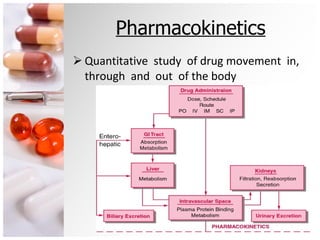
Pharmacokinetics Quantitative  study  of drug movement  in,  through  and  out  of the body
Transport across cell membrane Passive  transport  Specialized  transport First  Pass metabolism Bioavailabilty
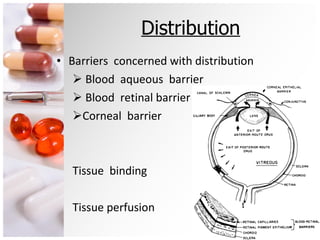
Distribution Barriers  concerned with distribution Blood  aqueous  barrier  Blood  retinal barrier Corneal  barrier Tissue  binding Tissue perfusion
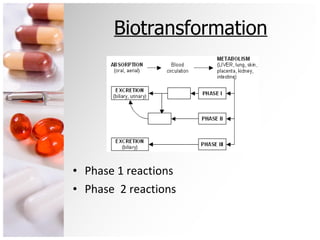
Biotransformation Phase 1 reactions Phase  2 reactions
Excretion of  drugs Elimination kinetics -  First order kinetics Zero order kinetics Clearance Half  life
ADVERSE  DRUG  EFFECTS SIDE  EFFECTS TOXIC  EFFECTS INTOLERANCE TERATOGENICITY
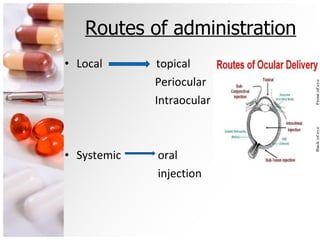
Routes of administration Local  topical Periocular Intraocular Systemic  oral injection
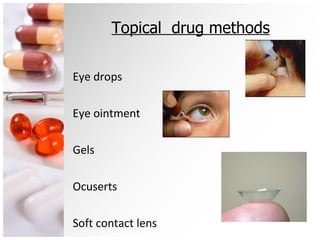
Topical  drug methods Eye drops Eye ointment Gels Ocuserts Soft contact lens
Drug  penetration Topically :  -Lipid and water solubility -Contact  time ,  viscosity , - isotonicity  Systemically : - Lipid solubility - eye inflammation - protein binding  -molecular  weight
Ocular anaesthetics MOA  :- Reduce nerve impulse conduction by reducing membrane to sodium ions. Common local anaestheitics  :-  Ester type =  Tetracaine 0.5 % , propacaine 0.75 %  Amide type  =  Lidocaine 2 % , Bupivacaine 0.75 %
Topical anaesthetic Aim :- To block nerves of superficial cornea Advantages :- No needle insertion No haemorrage Systemic anticoagulants can use Patient alert Disadvantages :-  No akinesia Not adequate anaesthesia Adv effects :- Corneal stinging ,epithelial & endothelial toxicity Allergy  & contact dermatitis Contraindications :- Nystagmus , uncooperative patients
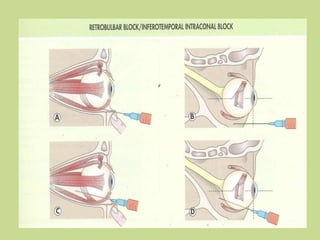
Retrobulbar block Aim :-  To block  3 rd cranial nerve in posterior intraconal space Site of injection :- Above inferior orbital rim  midway  of  lateral  canthus & temporal limbus Advantages :- Excellent akinesia quick onset of block Disadvantages:- High complication rate Complications :- Retrobulbar Haemorrhage Globe perforation Optic nerve contusion Oculocardiac reflex Respiratory  depression
 
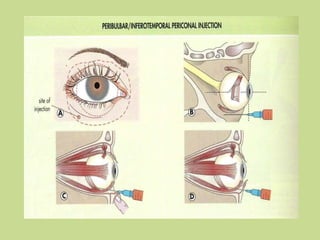
Peribulbar block Aim :- To block extraconally the nerves Site of injection :- midway  b/w temporal  limbus & lateral canthus -Inferomedial to superior orbital notch Advantages :- All that of retrobulbar block Less complications  Disadvantages :-  More than one injection needed Only good akinesia , anesthesia Longer time for anesthesia Chemosis
 
Sub tenon’s  block At  1 or 2  ‘0’  clock positions from corneal limbus  [7-8 mm away] Using a 30 mm radius flexible cannula  after perforating conjunctiva  Passed beyond equator b/w  tenon’s capsule & sclera Most frequent site is inferotemporal .
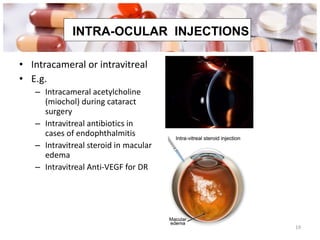
Intraocular injections Intracameral or intravitreal E.g. Intracameral acetylcholine (miochol) during cataract surgery Intravitreal antibiotics in cases of endophthalmitis Intravitreal steroid in macular edema Intravitreal Anti-VEGF for DR INTRA-OCULAR  INJECTIONS
Mydriatics & Cycloplegics  Anticholinergic drugs  :-  Atropine 1 %  - 1 week Homatropine 2 % -  24 hrs Cyclopentolate  1 %  -  24 hrs Tropicamide  0.5 % -  4 hrs Indications  :- corneal ulcer , uveitis , cycloplegic refraction Side effects  :-  blurry vision , photophobia ,precipitates  angle closure glaucoma Sympathomimetics :-  Phenylephrine  5 % I ndications  - Along  with  mydriatic  in  Preoperative cataract preparation  , fundus  examination Side effects -  Stinging , rise in Blood pressure
Anti glaucoma drugs -  B adrenergic blockers  : MOA -  Reduce aqueous production –  down regulation of Adenylcyclase Advan : NO  pupil change, induced myopia No headache, nor IOT fluctuation Side eff : Stinging,burning ,allergy,.. Bronchospasm,Heart block Timolol –  Non selective 0.5 % Betaxolol  -  B 1 selective
MIOTICS : Pilocarpine –cholinomimetic drug  MOA :  increases tone of ciliary muscles  -pull trabecular meshwork  - outflow of  aqueous Advant :  Rapid but short acting Disadv :  IOT fluctuation ,dim visual loss Side eff :  Spasm of accomadation  ,brow ache,  git disturbances 0.5 %  - drops , ocuserts, gel
Adrenergic  agonists Epinephrine MOA -  On alpha , beta  receptors – reduce aqueous formation increases aqueous outflow Side effects : Burning , stinging  , Conjunctival  blanching , CME , Endothelial toxicity follicular  conjunctivitis  [0.5 -2 %] tachycardia , hypertension Contradicted  in aphakic & Closed angle glaucoma  Apraclonidine MOA-  On  alpha 1,2  receptors –reduce aqueous  formation Side eff : Itching ,dryness in mouth, follicular  conjunctivitis, mydriasis Use : to reduce IOT after laser trabeculoplasty [0.25 – 1 %] Brimonidine  – alpha 2 selective Side eff :- dryness in mouth ,fall in Bp,
Carbonic anhydrase inhibitors ACETAZOLAMIDE   MOA -  inhibits  bicarbonate ion production , osmotic gradient  reduce aqueous formation Side effects – Paraesthesia, anorexia, malaise ,Gi irritation Oral  0.25 gms BD DORZOLAMIDE  – 2 %  DROPS PROSTOGLANDINS  LATANOPROST MOA – On prostanoid FB receptors  Increase uveoscleral flow & permeability of CBM Side effects – eye irritation , pain, blurry vision 0.005 %  drops
Hypertonic agents MOA  -  Raises the osmotic pressure  to reduce intra ocular pressure Glycerol  [ 10 % infusion  / 1 gm /kg oral ] Side effects : nauseating sweet taste ,diarrhoea,headache Mannitol  [ 20 % infusion ]  Side effects : Hypervolemia , pulmunory edema
Drugs during glaucoma surgery ANTIFIBROBLASTIC  AGENTS –  5 FU  &  MITOMYCIN C MOA  -Inhibit collagen and protein synthesis  by interfering  with  DNA transcription and replication Side effects :  5 FU –  keratopathy  Mitomycin -  scleral ulcer & iritis Administration :  5 FU - 50 mg/ml Sponge / sub conjunctival mitomycin – 0.5 mg/ml topically
Antibacterials PENICILLINS MOA :- Bactericidal  Destroys  cell wall [gram + , gram – cocci,spirochetes] - penicillin G  [1 lakh  U/ml topical] [0.5 M U/ ml sub conj inj ] [5 M U / 4 hrs  IV]  - Cloxacillin [penicillinase resistant] [50-100 mg/kg] 6 hrly oral [staphylococci] - Amoxycillin  [25-50 mg/kg] 6 hrly oral [ gram +,- bacteria] Adverse eff :- Hypersensitivity  reactions , rash ,..
QUINOLONES MOA  :-  [ Bacterial ] Anti DNA gyrase – inhibits division & supercoiling [gram  --  bacteria , gram + bacteria ,chlamydia, mycoplasma] -  Ciprofloxacin  :-  0.3 % topical , 500 mg BD oral , 5-10 mg/kg IV 200 mg /ml intravitreal Uses :- Keratoconjunctivitis, ulcers,blepharitis, dacryocystitis , infectious endoophthalmitis S/E :-  Arthropathy in children ,GIT irritation, Photosensitivity ,rash, liver damage -  Gatifloxacin  :-
CEPHALOSPORINS MOA :- Bactericidal – destroys cell wall  1 st  generation  :- gram + cocci  &  gram – bacilli Cephazolin – 0.5 – 1 g/ml  8 hrly IM /IV 2000 ug Intravitreal , 100 mg S/C Cefadroxil – 0.5 -1 g BD oral S/E :- GIT disturbances ,hypoprothrombinemia 2 nd generation :- gram – bacteria ,some anaerobes Cefuroxime axetil – 250-500 mg BD oral  Cefoxitin –  1-2  gm  8 hrly  IM/IV S/E :-  GIT disturbances , migraines, headache  3 rd generation :-  gram – bacteria Cefixim – 200-400 mg bd oral ceftazidim -1-2 gm  8 hrly  IM/IV S/E:  diarrhoea , neutropenia, thrombocytopenia
4 th generation :- against many bacteria ,highly resistant to  B –lactamases Cefepime  & cefpirome :-  1-2 gm 8 hrly  IM/IV S/E : allergic reactions , breathing difficulty,  swelling of face ,.. Uses :-  along with aminoglycosides  In endoophthalmitis  and  bacterial  corneal  ulcers,..
Chloramphenicol MOA  :-  Bacteriostatic  , Inhibits Protein synthesis  by binding  to 50 S ribosomal subunit [gram +,- aerobes , chlamydia,ricketssia,mycoplasma] 0.5 % ointment,  50 mg /kg  4 times oral 2 mg/ml intravitreal Uses  :-  Intraocular infections Conjunctivitis Side eff  :-  Bone marrow depression Aplastic anemia , agranulocytosis
Tetracycline MOA :-  Bacteriostatic  - inhibits protein synthesis by binding to  30  S  Ribosome  -  250-500 mg  4 hrly oral -  1 % topical Uses :-  Chlamydial  diseases  phlyctenular conjunctivitis Toxoplasmosis ocular rosacea Side eff :-  GIT disturbances discolouration of teeth photosensitivity , rashes nephrotoxicity
AMINOGLYCOSIDES MOA :-  Bacteriocidal -  inhibits protein synthesis ,binding 30 S  ribosome sub unit [gram  negative bacteria  &  staph aureus ADR : Ototoxicity , nephrotoxicity ,corneal , retinotoxicity,.. Gentamycin :- 0.3 % drops, 20 mg  sub conjunctival inj  200 ug/ml  intravitreal inj Uses :- Endoophthalmitis , ocular injuries ,retained FB conjunctival necrosis Amikacin :-  0.3 % drops , 15 mg / kg  8 hrly IV , 0.4 mg intravitreal Uses :- along  vancomycin  in post op endophthalmitis Tobramycin :- including proteus,pseudomonas 0.3 %  drops , 3 - 5  mg /kg /day IV , 150-200 ug /ml
SULPHONAMIDES MOA  :- Bacteriostatic  - Inhibits folate synthesis [PABA  folic acid ] [gram - ,+ bacteria]  Sulfacetamide , Sulfamethoxazole , sulfadiazine Topically 10% ,20 % ,30 % drops Oral 2-4 gm/day  TDS COTRIMOXAZOLE  MOA  :-  Inhibits Dihydro folate reductase  in conversion of DHF  THF  Sulfamethoxazole [400 mg ] + trimethoprim [80 mg]
USES  :- In trachoma  along with pyrimethamine  in toxoplasmosis  S/E  :-  GIT disturbances , Hypersensitivity reactions , urticaria ,  renal toxicity-crystalluria.
Antifungals Polyene antibiotics :- MOA -  Selective action on ergosterol of fungal cell membrane forming micropores – increase permeability Amphotericin B – Against yeast ,filamental fungi [0.25 % topical ] [ 0.25 mg/kg  oral] Nystatin -  against  candida [ 1 lakh u/gm oint] Natamycin – against candida , aspergillus ,fusarium [  5 % suspension] Uses in keratomycosis and  endophthalmitis[5-10 ug intravitreal] Common side effects : allergic hypersensitivity reactions
Imidazoles :- MOA -  Block fungal cytochrome P-450 enzyme in ergosterol [increase permeability tru membrane] Clotrimazole :-  [1 % topical] Miconazole :- [ 1 % drops,2 % oint, 5-10 mg  sub conj ] Ketoconazole :- [200-800 mg oral daily , 0.5 mg intravitreal] Uses :- candida,fungal ,  endoophthalmitis Side effect:- liver toxicity Triazoles :-  Fluconazole -  [100-200 mg oral] [0.2% topical] [0.1 mg intravitreal] Uses :- Candida,cryptococcus
Anti virals PYRIMIDINE  DERIVATIVES Idoxuridine  :-  0.1 %  drops hrly /  0.5 % ointment TRIFLUOROTHYMIDINE  :-   1 %  drops  MOA :  By incorporation - inhibition of viral DNA synthesis Uses :- Dendritic ulcer , herpes simplex  keratoconjunctivitis  Side effects :-  with corticosteroids – SPK, follicular  conjunctivitis,..
PURINE DERIVATIVES ADENINE ARABINOSIDE MOA :-  Blocking  DNA synthesis of virus Acyclovir  -  3 %  ointment , 400-800 mg  5 times/day a week Uses :-  EB virus, CMV ,Herpes zoster virus,.. S/E :-  Allergic reactions,.. Valacyclovir -  1000 mg TDS Famciclovir  -  500 mg  TDS S/E :- GIT  disturbances  Ganciclovir  -  5-6 mg  intravitreal  inj  , 5 mg IV S/E :- bone marrow depression , rashes
Ocular antiallergics MOA – Competitive antagonist of  H1  receptors Uses  - vernal keratoconjunctivitis , Giant papillary conjunctivitis Allergic conjunctivitis CPM – 4 times /day topical Azelastine  - 2 times/day Loratadine/ cetrizine – at bed time Mast cell stabilizers MOA – Stabilizes mast cells and prevent release of histmaine Cromolyn sodium [2-4 % ] 6 hrly Olapatadine [0.1 % ] 12 hrly
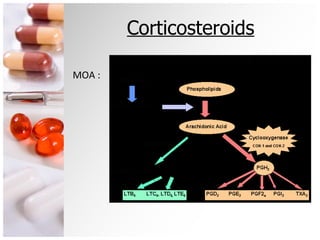
Corticosteroids MOA :
In general :  Anti inflammatory  action -  fibroblast formation reduce capillary permeable Topical  steroids : 1 %  prednisolone 0.1 %  FML 0.1 %  dexamethasone  in conjunction to  antibiotic Uses : Allergic conjunctivitis , iritis, keratitis ,episcleritis Injection steroids : 40 mg Triamcinolone  acetate -  periocular 1 mg  dexamethasone  -  intravitreal Uses  : Endoophthalmitis, Cysotid macular edema ,…
Oral steroids :  1 - 2  mg /kg /wt  -  orbital inflammation post operative inflammation panuveitis Adverse drug reaction : Prolonged use  -  posterior  sub capsular cataract glaucoma
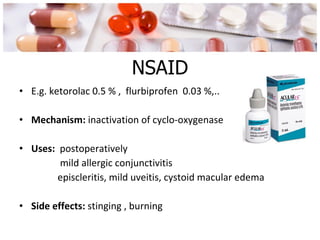
NSAID E.g. ketorolac 0.5 % ,  flurbiprofen  0.03 %,.. Mechanism:  inactivation of cyclo-oxygenase  Uses:  postoperatively mild allergic conjunctivitis episcleritis, mild uveitis, cystoid macular edema Side effects:  stinging , burning
Anti VEGF  MOA :  Inhibits  vascular EGF  in retinal  ischaemia  Uses :  Diabetic retinopathy , macular edema , ROP  ARMD -  Intravitreal  inj  -  Pegaptanib [macugen ]  Ranibizumab [ lucentis ]
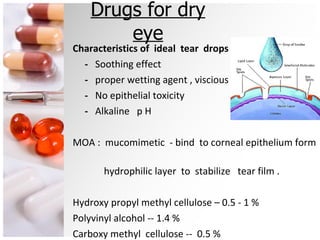
Drugs for dry eye Characteristics of  ideal  tear  drops :  -  Soothing effect -  proper wetting agent , viscious -  No epithelial toxicity -  Alkaline  p H MOA :  mucomimetic  - bind  to corneal epithelium form  hydrophilic layer  to  stabilize  tear film . Hydroxy propyl methyl cellulose – 0.5 - 1 %  Polyvinyl alcohol -- 1.4 % Carboxy methyl  cellulose --  0.5 %
Viscoelastics Properties  -  optical -  cohesive  [ space maintaining  tissue manipulation in surgery] - dispersive [ Coating ocular surface  protecting corneal endothelium lower surface tension] -  Elasticity  Sodium hyaluronate  1 % Sodium hyaluronate 3  %  &  chondroitin  sulphate 4 %  Hydroxy propyl methyl cellulose  3 % Uses :-  - In gonioscopy - in intra ocular surgeries
IRRIGATING  SOLUTIONS Characteristics of an  ideal solution : --  Maintain  moisture  of  &  cleanse  ocular tissues --  Isotonicity  electrolyte and p   H  same as  aqueous --  Maintain  pressure of  globe  --  Protect delicate ocular structures  --  Endothelial  nourishment Available preparations :-  Balanced salt solution[BSS] BSS plus  Dextran containing  soln Glucose fortified BSS plus USES :-  Intraocular – in cataract surgery Extraocular – FB removal,tonometry,gonioscopy
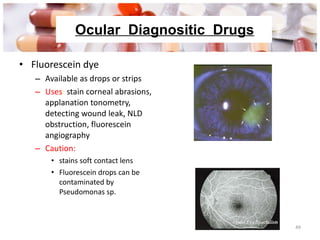
Ocular diagnostic drugs Fluorescein dye Available as drops or strips  Uses :  stain corneal abrasions, applanation tonometry, detecting wound leak, NLD obstruction, fluorescein angiography Caution: stains soft contact lens Fluorescein drops can be contaminated by Pseudomonas sp. Ocular  Diagnositic  Drugs
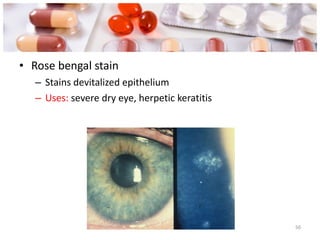
Rose bengal stain Stains devitalized epithelium Uses:  severe dry eye, herpetic keratitis
Ocular toxicology : Amiodarone :-  Vortex keratopathy Digitalis :-  Chromatopsia  [seeing  yellow colour ] Chloroquine :-  Bull’s eye maculopathy Ethambutol :-  Optic neuropathy , colour vision disturbed Corticosteroids :-  Posterior sub capsular cataracts Thioridazine :-  Pigmentary retinopathy Copper, Gold :-  Lenticular opacities Rifabutin :-  Anterior uveitis
THANK  YOU

Ocular therapeutics

  • 1.
    Ocular TherapeuticsOcular Therapeutics Dr Rajvin Samuel Ponraj
  • 2.
    Pharmacodynamics Study ofmechanisms of drug effects Receptor - special types based on transduction of signal Regulation of receptors – Down regulation Up regulation Therapeutic index
  • 3.
    Pharmacokinetics Quantitative study of drug movement in, through and out of the body
  • 4.
    Transport across cellmembrane Passive transport Specialized transport First Pass metabolism Bioavailabilty
  • 5.
    Distribution Barriers concerned with distribution Blood aqueous barrier Blood retinal barrier Corneal barrier Tissue binding Tissue perfusion
  • 6.
    Biotransformation Phase 1reactions Phase 2 reactions
  • 7.
    Excretion of drugs Elimination kinetics - First order kinetics Zero order kinetics Clearance Half life
  • 8.
    ADVERSE DRUG EFFECTS SIDE EFFECTS TOXIC EFFECTS INTOLERANCE TERATOGENICITY
  • 9.
    Routes of administrationLocal topical Periocular Intraocular Systemic oral injection
  • 10.
    Topical drugmethods Eye drops Eye ointment Gels Ocuserts Soft contact lens
  • 11.
    Drug penetrationTopically : -Lipid and water solubility -Contact time , viscosity , - isotonicity Systemically : - Lipid solubility - eye inflammation - protein binding -molecular weight
  • 12.
    Ocular anaesthetics MOA :- Reduce nerve impulse conduction by reducing membrane to sodium ions. Common local anaestheitics :- Ester type = Tetracaine 0.5 % , propacaine 0.75 % Amide type = Lidocaine 2 % , Bupivacaine 0.75 %
  • 13.
    Topical anaesthetic Aim:- To block nerves of superficial cornea Advantages :- No needle insertion No haemorrage Systemic anticoagulants can use Patient alert Disadvantages :- No akinesia Not adequate anaesthesia Adv effects :- Corneal stinging ,epithelial & endothelial toxicity Allergy & contact dermatitis Contraindications :- Nystagmus , uncooperative patients
  • 14.
    Retrobulbar block Aim:- To block 3 rd cranial nerve in posterior intraconal space Site of injection :- Above inferior orbital rim midway of lateral canthus & temporal limbus Advantages :- Excellent akinesia quick onset of block Disadvantages:- High complication rate Complications :- Retrobulbar Haemorrhage Globe perforation Optic nerve contusion Oculocardiac reflex Respiratory depression
  • 15.
  • 16.
    Peribulbar block Aim:- To block extraconally the nerves Site of injection :- midway b/w temporal limbus & lateral canthus -Inferomedial to superior orbital notch Advantages :- All that of retrobulbar block Less complications Disadvantages :- More than one injection needed Only good akinesia , anesthesia Longer time for anesthesia Chemosis
  • 17.
  • 18.
    Sub tenon’s block At 1 or 2 ‘0’ clock positions from corneal limbus [7-8 mm away] Using a 30 mm radius flexible cannula after perforating conjunctiva Passed beyond equator b/w tenon’s capsule & sclera Most frequent site is inferotemporal .
  • 19.
    Intraocular injections Intracameralor intravitreal E.g. Intracameral acetylcholine (miochol) during cataract surgery Intravitreal antibiotics in cases of endophthalmitis Intravitreal steroid in macular edema Intravitreal Anti-VEGF for DR INTRA-OCULAR INJECTIONS
  • 20.
    Mydriatics & Cycloplegics Anticholinergic drugs :- Atropine 1 % - 1 week Homatropine 2 % - 24 hrs Cyclopentolate 1 % - 24 hrs Tropicamide 0.5 % - 4 hrs Indications :- corneal ulcer , uveitis , cycloplegic refraction Side effects :- blurry vision , photophobia ,precipitates angle closure glaucoma Sympathomimetics :- Phenylephrine 5 % I ndications - Along with mydriatic in Preoperative cataract preparation , fundus examination Side effects - Stinging , rise in Blood pressure
  • 21.
    Anti glaucoma drugs- B adrenergic blockers : MOA - Reduce aqueous production – down regulation of Adenylcyclase Advan : NO pupil change, induced myopia No headache, nor IOT fluctuation Side eff : Stinging,burning ,allergy,.. Bronchospasm,Heart block Timolol – Non selective 0.5 % Betaxolol - B 1 selective
  • 22.
    MIOTICS : Pilocarpine–cholinomimetic drug MOA : increases tone of ciliary muscles -pull trabecular meshwork - outflow of aqueous Advant : Rapid but short acting Disadv : IOT fluctuation ,dim visual loss Side eff : Spasm of accomadation ,brow ache, git disturbances 0.5 % - drops , ocuserts, gel
  • 23.
    Adrenergic agonistsEpinephrine MOA - On alpha , beta receptors – reduce aqueous formation increases aqueous outflow Side effects : Burning , stinging , Conjunctival blanching , CME , Endothelial toxicity follicular conjunctivitis [0.5 -2 %] tachycardia , hypertension Contradicted in aphakic & Closed angle glaucoma Apraclonidine MOA- On alpha 1,2 receptors –reduce aqueous formation Side eff : Itching ,dryness in mouth, follicular conjunctivitis, mydriasis Use : to reduce IOT after laser trabeculoplasty [0.25 – 1 %] Brimonidine – alpha 2 selective Side eff :- dryness in mouth ,fall in Bp,
  • 24.
    Carbonic anhydrase inhibitorsACETAZOLAMIDE MOA - inhibits bicarbonate ion production , osmotic gradient reduce aqueous formation Side effects – Paraesthesia, anorexia, malaise ,Gi irritation Oral 0.25 gms BD DORZOLAMIDE – 2 % DROPS PROSTOGLANDINS LATANOPROST MOA – On prostanoid FB receptors Increase uveoscleral flow & permeability of CBM Side effects – eye irritation , pain, blurry vision 0.005 % drops
  • 25.
    Hypertonic agents MOA - Raises the osmotic pressure to reduce intra ocular pressure Glycerol [ 10 % infusion / 1 gm /kg oral ] Side effects : nauseating sweet taste ,diarrhoea,headache Mannitol [ 20 % infusion ] Side effects : Hypervolemia , pulmunory edema
  • 26.
    Drugs during glaucomasurgery ANTIFIBROBLASTIC AGENTS – 5 FU & MITOMYCIN C MOA -Inhibit collagen and protein synthesis by interfering with DNA transcription and replication Side effects : 5 FU – keratopathy Mitomycin - scleral ulcer & iritis Administration : 5 FU - 50 mg/ml Sponge / sub conjunctival mitomycin – 0.5 mg/ml topically
  • 27.
    Antibacterials PENICILLINS MOA:- Bactericidal Destroys cell wall [gram + , gram – cocci,spirochetes] - penicillin G [1 lakh U/ml topical] [0.5 M U/ ml sub conj inj ] [5 M U / 4 hrs IV] - Cloxacillin [penicillinase resistant] [50-100 mg/kg] 6 hrly oral [staphylococci] - Amoxycillin [25-50 mg/kg] 6 hrly oral [ gram +,- bacteria] Adverse eff :- Hypersensitivity reactions , rash ,..
  • 28.
    QUINOLONES MOA :- [ Bacterial ] Anti DNA gyrase – inhibits division & supercoiling [gram -- bacteria , gram + bacteria ,chlamydia, mycoplasma] - Ciprofloxacin :- 0.3 % topical , 500 mg BD oral , 5-10 mg/kg IV 200 mg /ml intravitreal Uses :- Keratoconjunctivitis, ulcers,blepharitis, dacryocystitis , infectious endoophthalmitis S/E :- Arthropathy in children ,GIT irritation, Photosensitivity ,rash, liver damage - Gatifloxacin :-
  • 29.
    CEPHALOSPORINS MOA :-Bactericidal – destroys cell wall 1 st generation :- gram + cocci & gram – bacilli Cephazolin – 0.5 – 1 g/ml 8 hrly IM /IV 2000 ug Intravitreal , 100 mg S/C Cefadroxil – 0.5 -1 g BD oral S/E :- GIT disturbances ,hypoprothrombinemia 2 nd generation :- gram – bacteria ,some anaerobes Cefuroxime axetil – 250-500 mg BD oral Cefoxitin – 1-2 gm 8 hrly IM/IV S/E :- GIT disturbances , migraines, headache 3 rd generation :- gram – bacteria Cefixim – 200-400 mg bd oral ceftazidim -1-2 gm 8 hrly IM/IV S/E: diarrhoea , neutropenia, thrombocytopenia
  • 30.
    4 th generation:- against many bacteria ,highly resistant to B –lactamases Cefepime & cefpirome :- 1-2 gm 8 hrly IM/IV S/E : allergic reactions , breathing difficulty, swelling of face ,.. Uses :- along with aminoglycosides In endoophthalmitis and bacterial corneal ulcers,..
  • 31.
    Chloramphenicol MOA :- Bacteriostatic , Inhibits Protein synthesis by binding to 50 S ribosomal subunit [gram +,- aerobes , chlamydia,ricketssia,mycoplasma] 0.5 % ointment, 50 mg /kg 4 times oral 2 mg/ml intravitreal Uses :- Intraocular infections Conjunctivitis Side eff :- Bone marrow depression Aplastic anemia , agranulocytosis
  • 32.
    Tetracycline MOA :- Bacteriostatic - inhibits protein synthesis by binding to 30 S Ribosome - 250-500 mg 4 hrly oral - 1 % topical Uses :- Chlamydial diseases phlyctenular conjunctivitis Toxoplasmosis ocular rosacea Side eff :- GIT disturbances discolouration of teeth photosensitivity , rashes nephrotoxicity
  • 33.
    AMINOGLYCOSIDES MOA :- Bacteriocidal - inhibits protein synthesis ,binding 30 S ribosome sub unit [gram negative bacteria & staph aureus ADR : Ototoxicity , nephrotoxicity ,corneal , retinotoxicity,.. Gentamycin :- 0.3 % drops, 20 mg sub conjunctival inj 200 ug/ml intravitreal inj Uses :- Endoophthalmitis , ocular injuries ,retained FB conjunctival necrosis Amikacin :- 0.3 % drops , 15 mg / kg 8 hrly IV , 0.4 mg intravitreal Uses :- along vancomycin in post op endophthalmitis Tobramycin :- including proteus,pseudomonas 0.3 % drops , 3 - 5 mg /kg /day IV , 150-200 ug /ml
  • 34.
    SULPHONAMIDES MOA :- Bacteriostatic - Inhibits folate synthesis [PABA folic acid ] [gram - ,+ bacteria] Sulfacetamide , Sulfamethoxazole , sulfadiazine Topically 10% ,20 % ,30 % drops Oral 2-4 gm/day TDS COTRIMOXAZOLE MOA :- Inhibits Dihydro folate reductase in conversion of DHF THF Sulfamethoxazole [400 mg ] + trimethoprim [80 mg]
  • 35.
    USES :-In trachoma along with pyrimethamine in toxoplasmosis S/E :- GIT disturbances , Hypersensitivity reactions , urticaria , renal toxicity-crystalluria.
  • 36.
    Antifungals Polyene antibiotics:- MOA - Selective action on ergosterol of fungal cell membrane forming micropores – increase permeability Amphotericin B – Against yeast ,filamental fungi [0.25 % topical ] [ 0.25 mg/kg oral] Nystatin - against candida [ 1 lakh u/gm oint] Natamycin – against candida , aspergillus ,fusarium [ 5 % suspension] Uses in keratomycosis and endophthalmitis[5-10 ug intravitreal] Common side effects : allergic hypersensitivity reactions
  • 37.
    Imidazoles :- MOA- Block fungal cytochrome P-450 enzyme in ergosterol [increase permeability tru membrane] Clotrimazole :- [1 % topical] Miconazole :- [ 1 % drops,2 % oint, 5-10 mg sub conj ] Ketoconazole :- [200-800 mg oral daily , 0.5 mg intravitreal] Uses :- candida,fungal , endoophthalmitis Side effect:- liver toxicity Triazoles :- Fluconazole - [100-200 mg oral] [0.2% topical] [0.1 mg intravitreal] Uses :- Candida,cryptococcus
  • 38.
    Anti virals PYRIMIDINE DERIVATIVES Idoxuridine :- 0.1 % drops hrly / 0.5 % ointment TRIFLUOROTHYMIDINE :- 1 % drops MOA : By incorporation - inhibition of viral DNA synthesis Uses :- Dendritic ulcer , herpes simplex keratoconjunctivitis Side effects :- with corticosteroids – SPK, follicular conjunctivitis,..
  • 39.
    PURINE DERIVATIVES ADENINEARABINOSIDE MOA :- Blocking DNA synthesis of virus Acyclovir - 3 % ointment , 400-800 mg 5 times/day a week Uses :- EB virus, CMV ,Herpes zoster virus,.. S/E :- Allergic reactions,.. Valacyclovir - 1000 mg TDS Famciclovir - 500 mg TDS S/E :- GIT disturbances Ganciclovir - 5-6 mg intravitreal inj , 5 mg IV S/E :- bone marrow depression , rashes
  • 40.
    Ocular antiallergics MOA– Competitive antagonist of H1 receptors Uses - vernal keratoconjunctivitis , Giant papillary conjunctivitis Allergic conjunctivitis CPM – 4 times /day topical Azelastine - 2 times/day Loratadine/ cetrizine – at bed time Mast cell stabilizers MOA – Stabilizes mast cells and prevent release of histmaine Cromolyn sodium [2-4 % ] 6 hrly Olapatadine [0.1 % ] 12 hrly
  • 41.
  • 42.
    In general : Anti inflammatory action - fibroblast formation reduce capillary permeable Topical steroids : 1 % prednisolone 0.1 % FML 0.1 % dexamethasone in conjunction to antibiotic Uses : Allergic conjunctivitis , iritis, keratitis ,episcleritis Injection steroids : 40 mg Triamcinolone acetate - periocular 1 mg dexamethasone - intravitreal Uses : Endoophthalmitis, Cysotid macular edema ,…
  • 43.
    Oral steroids : 1 - 2 mg /kg /wt - orbital inflammation post operative inflammation panuveitis Adverse drug reaction : Prolonged use - posterior sub capsular cataract glaucoma
  • 44.
    NSAID E.g. ketorolac0.5 % , flurbiprofen 0.03 %,.. Mechanism: inactivation of cyclo-oxygenase Uses: postoperatively mild allergic conjunctivitis episcleritis, mild uveitis, cystoid macular edema Side effects: stinging , burning
  • 45.
    Anti VEGF MOA : Inhibits vascular EGF in retinal ischaemia Uses : Diabetic retinopathy , macular edema , ROP ARMD - Intravitreal inj - Pegaptanib [macugen ] Ranibizumab [ lucentis ]
  • 46.
    Drugs for dryeye Characteristics of ideal tear drops : - Soothing effect - proper wetting agent , viscious - No epithelial toxicity - Alkaline p H MOA : mucomimetic - bind to corneal epithelium form hydrophilic layer to stabilize tear film . Hydroxy propyl methyl cellulose – 0.5 - 1 % Polyvinyl alcohol -- 1.4 % Carboxy methyl cellulose -- 0.5 %
  • 47.
    Viscoelastics Properties - optical - cohesive [ space maintaining tissue manipulation in surgery] - dispersive [ Coating ocular surface protecting corneal endothelium lower surface tension] - Elasticity Sodium hyaluronate 1 % Sodium hyaluronate 3 % & chondroitin sulphate 4 % Hydroxy propyl methyl cellulose 3 % Uses :- - In gonioscopy - in intra ocular surgeries
  • 48.
    IRRIGATING SOLUTIONSCharacteristics of an ideal solution : -- Maintain moisture of & cleanse ocular tissues -- Isotonicity electrolyte and p H same as aqueous -- Maintain pressure of globe -- Protect delicate ocular structures -- Endothelial nourishment Available preparations :- Balanced salt solution[BSS] BSS plus Dextran containing soln Glucose fortified BSS plus USES :- Intraocular – in cataract surgery Extraocular – FB removal,tonometry,gonioscopy
  • 49.
    Ocular diagnostic drugsFluorescein dye Available as drops or strips Uses : stain corneal abrasions, applanation tonometry, detecting wound leak, NLD obstruction, fluorescein angiography Caution: stains soft contact lens Fluorescein drops can be contaminated by Pseudomonas sp. Ocular Diagnositic Drugs
  • 50.
    Rose bengal stainStains devitalized epithelium Uses: severe dry eye, herpetic keratitis
  • 51.
    Ocular toxicology :Amiodarone :- Vortex keratopathy Digitalis :- Chromatopsia [seeing yellow colour ] Chloroquine :- Bull’s eye maculopathy Ethambutol :- Optic neuropathy , colour vision disturbed Corticosteroids :- Posterior sub capsular cataracts Thioridazine :- Pigmentary retinopathy Copper, Gold :- Lenticular opacities Rifabutin :- Anterior uveitis
  • 52.