URBANIZATION:
CAUSES &
IMPACTS
Created by:
Mounika Nagireddy
Assistant Professor
Anil Neerukonda Institute of Technology &
Sciences
CONTENTS
• Introduction
• Urbanization
• Causes of urbanization
• Economic causes
• Migration and Immigration of people
• Industrial revolution
• Job opportunities
• Education
• Environmental degradation
• Social causes
• Population increase
• Positive impacts of urbanisation
• Negative impacts of urbanisation
• Summary
• References
1
INTRODUCTION
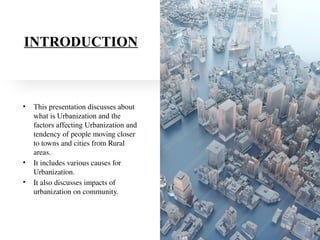
• This presentation discusses about
what is Urbanization and the
factors affecting Urbanization and
tendency of people moving closer
to towns and cities from Rural
areas.
• It includes various causes for
Urbanization.
• It also discusses impacts of
urbanization on community.
2
URBANIZATION
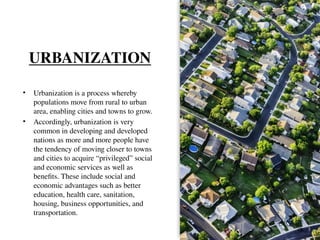
• Urbanization is a process whereby
populations move from rural to urban
area, enabling cities and towns to grow.
• Accordingly, urbanization is very
common in developing and developed
nations as more and more people have
the tendency of moving closer to towns
and cities to acquire “privileged” social
and economic services as well as
benefits. These include social and
economic advantages such as better
education, health care, sanitation,
housing, business opportunities, and
transportation.
3
TYPES OF CAUSES FOR
URBANIZATION
• Main causes of urbanization are:
1. Economic causes
2. Migration and Immigration of people
3. Industrial revolution
4. Job opportunities
5. Education
6. Environmental degradation
7. Social causes
8. Population increase
4
ECONOMIC CAUSES
• Poverty in rural area forces people to
move in urban areas for better
employment opportunities.
• The rise of industries in developing
countries has provided more job
opportunities in urban areas, and
cities have increased in size due to
this.
5
MIGRATION AND
IMMIGRATION OF PEOPLE
•People are migrating from rural area to
urban areas for better living standards,
more job opportunities, educational
facilities and better health condition etc.
•People are also immigrating to the other
countries due to industrialisation and
economic transformation of the country.
6
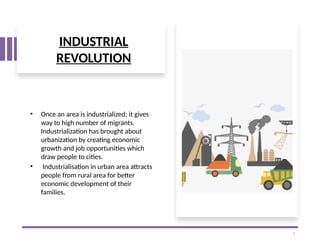
INDUSTRIAL
REVOLUTION
• Once an area is industrialized; it gives
way to high number of migrants.
Industrialization has brought about
urbanization by creating economic
growth and job opportunities which
draw people to cities.
• Industrialisation in urban area attracts
people from rural area for better
economic development of their
families.
7
JOB
OPPORTUNITY
• Job opportunity is an important factor
that draws people from the rural areas to
seek better livelihood in the city.
• However, there are certain number of
people who frequently migrate into
urban areas to access well-paying jobs.
• Services and industries generate and
increase higher value-added jobs, and
this leads to more employment
opportunities in urban areas.
8
EDUCATION
• Opportunity for better education
facilities draw young people to urban
centres, where they hope to provide
better prospects for the future of
themselves and their families.
• Urban centres in developing countries
become hubs of education training, as
they are also in developed country.
9
ENVIRONMENTAL
DEGRADATION
• When the natural habitat of farming
families is destroyed due to
deforestation, industrialisation or
mining, they are forced to find
somewhere else to live.
• Often small amount of compensation
fund provided to the families to move in
urban area, but there is no guarantee of
work in the cities, and they have to face
unemployment issues.
10
SOCIAL CAUSES
• Many people migrate to urban centres
in search of better lifestyle changes, and
with the desire to become associated
with the society.
• In urban area amenities like water
supply, sanitation, road network,
recreational parks, attracts rural
population.
• Other facilities like, gas supply,
electricity and telecommunication are
easily available at door step in urban
area, which attracts people to migrate.
11
POPULATION
INCREASE
• There has been significant increase of
population in many developing
countries due to improved medical care,
immunization programs, better
sanitation and more widespread
education.
• Death rates have decreased, and there
are fewer infant deaths, resulting in
population growth.
12
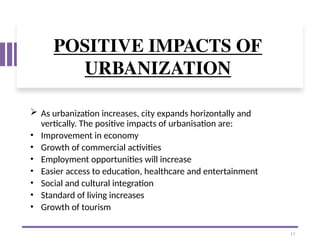
POSITIVE IMPACTS OF
URBANIZATION
 As urbanization increases, city expands horizontally and
vertically. The positive impacts of urbanisation are:
• Improvement in economy
• Growth of commercial activities
• Employment opportunities will increase
• Easier access to education, healthcare and entertainment
• Social and cultural integration
• Standard of living increases
• Growth of tourism
13
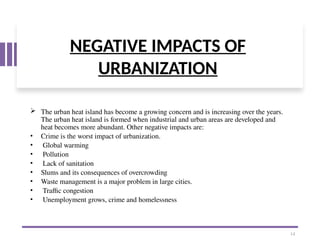
NEGATIVE IMPACTS OF
URBANIZATION
 The urban heat island has become a growing concern and is increasing over the years.
The urban heat island is formed when industrial and urban areas are developed and
heat becomes more abundant. Other negative impacts are:
• Crime is the worst impact of urbanization.
• Global warming
• Pollution
• Lack of sanitation
• Slums and its consequences of overcrowding
• Waste management is a major problem in large cities.
• Traffic congestion
• Unemployment grows, crime and homelessness
14
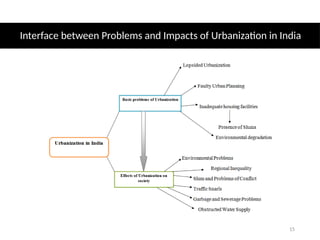
Interface between Problems and Impacts of Urbanization in India
15
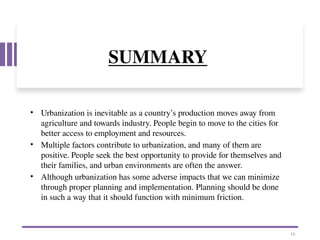
SUMMARY
• Urbanization is inevitable as a country’s production moves away from
agriculture and towards industry. People begin to move to the cities for
better access to employment and resources.
• Multiple factors contribute to urbanization, and many of them are
positive. People seek the best opportunity to provide for themselves and
their families, and urban environments are often the answer.
• Although urbanization has some adverse impacts that we can minimize
through proper planning and implementation. Planning should be done
in such a way that it should function with minimum friction.
16
REFERENCES
• P. Luhaniwal, ‘Urbanization and Its Causes and Effects’, International Journal of
Research and Scientific Innovation (IJRSI), Volume 3, September 2016, pp: 110-112.
• N. Jaysawal and S. Saha, ‘Urbanization in India: Impact Assessment’, International
journal of Applied Sociology, Volume 4(2), January 2014, pp: 60-65.
• M. H. Arouri, A. B. Youssef, C. Nguyen-Viet, and A. Soucat, ‘Effects of urbanization on
economic growth and human capital formation’, Journal on the Global demography
of aging at Harvard University, Volume 1, September 2014, pp: 2-18.
• P. Datta, ‘Urbanisation in India’, Journal of Indian Statistical Institute-Kolkata, June
2006, Volume 2, pp: 3-16.
• Dr. V. Venkatesham, ‘The problems and issues in urbanization in India’, Research
paper , Dept. of Public Administration, Osmania University, Hyderabad, Telangana
State, Volume 4, August 2015, pp: 277-278.
17
THANK
YOU

Urbanisation, it's Causes and Impacts.pptx

  • 1.
    URBANIZATION: CAUSES & IMPACTS Created by: MounikaNagireddy Assistant Professor Anil Neerukonda Institute of Technology & Sciences
  • 2.
    CONTENTS • Introduction • Urbanization •Causes of urbanization • Economic causes • Migration and Immigration of people • Industrial revolution • Job opportunities • Education • Environmental degradation • Social causes • Population increase • Positive impacts of urbanisation • Negative impacts of urbanisation • Summary • References 1
  • 3.
    INTRODUCTION • This presentationdiscusses about what is Urbanization and the factors affecting Urbanization and tendency of people moving closer to towns and cities from Rural areas. • It includes various causes for Urbanization. • It also discusses impacts of urbanization on community. 2
  • 4.
    URBANIZATION • Urbanization isa process whereby populations move from rural to urban area, enabling cities and towns to grow. • Accordingly, urbanization is very common in developing and developed nations as more and more people have the tendency of moving closer to towns and cities to acquire “privileged” social and economic services as well as benefits. These include social and economic advantages such as better education, health care, sanitation, housing, business opportunities, and transportation. 3
  • 5.
    TYPES OF CAUSESFOR URBANIZATION • Main causes of urbanization are: 1. Economic causes 2. Migration and Immigration of people 3. Industrial revolution 4. Job opportunities 5. Education 6. Environmental degradation 7. Social causes 8. Population increase 4
  • 6.
    ECONOMIC CAUSES • Povertyin rural area forces people to move in urban areas for better employment opportunities. • The rise of industries in developing countries has provided more job opportunities in urban areas, and cities have increased in size due to this. 5
  • 7.
    MIGRATION AND IMMIGRATION OFPEOPLE •People are migrating from rural area to urban areas for better living standards, more job opportunities, educational facilities and better health condition etc. •People are also immigrating to the other countries due to industrialisation and economic transformation of the country. 6
  • 8.
    INDUSTRIAL REVOLUTION • Once anarea is industrialized; it gives way to high number of migrants. Industrialization has brought about urbanization by creating economic growth and job opportunities which draw people to cities. • Industrialisation in urban area attracts people from rural area for better economic development of their families. 7
  • 9.
    JOB OPPORTUNITY • Job opportunityis an important factor that draws people from the rural areas to seek better livelihood in the city. • However, there are certain number of people who frequently migrate into urban areas to access well-paying jobs. • Services and industries generate and increase higher value-added jobs, and this leads to more employment opportunities in urban areas. 8
  • 10.
    EDUCATION • Opportunity forbetter education facilities draw young people to urban centres, where they hope to provide better prospects for the future of themselves and their families. • Urban centres in developing countries become hubs of education training, as they are also in developed country. 9
  • 11.
    ENVIRONMENTAL DEGRADATION • When thenatural habitat of farming families is destroyed due to deforestation, industrialisation or mining, they are forced to find somewhere else to live. • Often small amount of compensation fund provided to the families to move in urban area, but there is no guarantee of work in the cities, and they have to face unemployment issues. 10
  • 12.
    SOCIAL CAUSES • Manypeople migrate to urban centres in search of better lifestyle changes, and with the desire to become associated with the society. • In urban area amenities like water supply, sanitation, road network, recreational parks, attracts rural population. • Other facilities like, gas supply, electricity and telecommunication are easily available at door step in urban area, which attracts people to migrate. 11
  • 13.
    POPULATION INCREASE • There hasbeen significant increase of population in many developing countries due to improved medical care, immunization programs, better sanitation and more widespread education. • Death rates have decreased, and there are fewer infant deaths, resulting in population growth. 12
  • 14.
    POSITIVE IMPACTS OF URBANIZATION As urbanization increases, city expands horizontally and vertically. The positive impacts of urbanisation are: • Improvement in economy • Growth of commercial activities • Employment opportunities will increase • Easier access to education, healthcare and entertainment • Social and cultural integration • Standard of living increases • Growth of tourism 13
  • 15.
    NEGATIVE IMPACTS OF URBANIZATION The urban heat island has become a growing concern and is increasing over the years. The urban heat island is formed when industrial and urban areas are developed and heat becomes more abundant. Other negative impacts are: • Crime is the worst impact of urbanization. • Global warming • Pollution • Lack of sanitation • Slums and its consequences of overcrowding • Waste management is a major problem in large cities. • Traffic congestion • Unemployment grows, crime and homelessness 14
  • 16.
    Interface between Problemsand Impacts of Urbanization in India 15
  • 17.
    SUMMARY • Urbanization isinevitable as a country’s production moves away from agriculture and towards industry. People begin to move to the cities for better access to employment and resources. • Multiple factors contribute to urbanization, and many of them are positive. People seek the best opportunity to provide for themselves and their families, and urban environments are often the answer. • Although urbanization has some adverse impacts that we can minimize through proper planning and implementation. Planning should be done in such a way that it should function with minimum friction. 16
  • 18.
    REFERENCES • P. Luhaniwal,‘Urbanization and Its Causes and Effects’, International Journal of Research and Scientific Innovation (IJRSI), Volume 3, September 2016, pp: 110-112. • N. Jaysawal and S. Saha, ‘Urbanization in India: Impact Assessment’, International journal of Applied Sociology, Volume 4(2), January 2014, pp: 60-65. • M. H. Arouri, A. B. Youssef, C. Nguyen-Viet, and A. Soucat, ‘Effects of urbanization on economic growth and human capital formation’, Journal on the Global demography of aging at Harvard University, Volume 1, September 2014, pp: 2-18. • P. Datta, ‘Urbanisation in India’, Journal of Indian Statistical Institute-Kolkata, June 2006, Volume 2, pp: 3-16. • Dr. V. Venkatesham, ‘The problems and issues in urbanization in India’, Research paper , Dept. of Public Administration, Osmania University, Hyderabad, Telangana State, Volume 4, August 2015, pp: 277-278. 17
  • 19.