PREFABRICATION -
CASESTUDY
Presented by
ABIRAMI G
PREFABTICATION
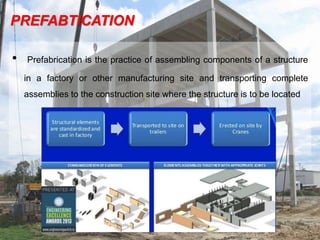
• Prefabrication is the practice of assembling components of a structure
in a factory or other manufacturing site and transporting complete
assemblies to the construction site where the structure is to be located
2
PRECAST SYSTEM
 Bearing wall system
 Moment resisting frame system
 Dual system
3
CASESTUDY – PRAGATI TOWERS
 Location: Bhoiwada, Mumbai
 Architectural Type: Residential Building
 Developer: Larsen and Toubro Ltd., (L&T)
 Construction Start: Jan 2013
 Construction End: 2016
 Floor Count: G+23
 Plan Dimension: 45.8m x 19.69m
 Height: 70m
 Foundation : Pile Foundation
 System Type:
 Ground And Terrace Floor: Conventional Type
 1 To 23 Floor : Precast Large Panel Wall Type
4
PLAN VIEW
5
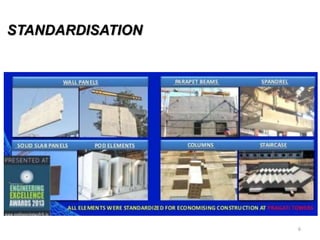
STANDARDISATION
6
QUALITY CONTROL
7
CONNECTION
8
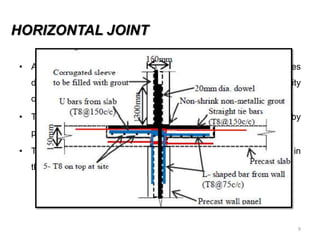
HORIZONTAL JOINT
• A horizontal connection between panels transfers vertical stresses
due to gravity loads and any out-of-plane bending due to eccentricity
of the loads.
• The horizontal joint between panels at a floor level is made by
projecting dowel bars.
• Tie reinforcement overlapped with U-bars and L-bars are provided in
the slabs for slab-to-wall connection.
9
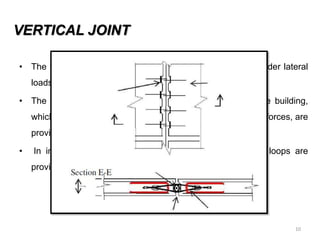
VERTICAL JOINT
• The vertical joints are designed to transfer shear forces under lateral
loads
• The exterior wall panels along the shorter direction of the building,
which constitute the primary shear walls to resist the lateral forces, are
provided with six shear keys per storey height
• In interior wall joints, reduced number of reinforcement loops are
provided per storey height since the shear demand is less.
10
COMPARITIVE STUDY OF VERTICAL
JOINT
• The vertical joints between the panels were modelled as two
extreme conditions as:
 Integrated model – shear transfer was assumed
 Discrete gap model – no shear transfer
11
INTEGRATED MODEL DISCRETE GAP MODEL
12
ANALYSIS RESULTS
13
ANALYSIS RESULTS
14
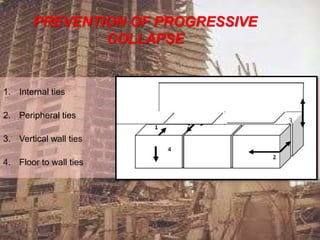
PREVENTION OF PROGRESSIVE
COLLAPSE
1. Internal ties
2. Peripheral ties
3. Vertical wall ties
4. Floor to wall ties
15
INTERIORS
16
ENVIRONMENTAL BENEFITS
17
Thank You..!

Prefabrication

  • 1.
  • 2.
    PREFABTICATION • Prefabrication isthe practice of assembling components of a structure in a factory or other manufacturing site and transporting complete assemblies to the construction site where the structure is to be located 2
  • 3.
    PRECAST SYSTEM  Bearingwall system  Moment resisting frame system  Dual system 3
  • 4.
    CASESTUDY – PRAGATITOWERS  Location: Bhoiwada, Mumbai  Architectural Type: Residential Building  Developer: Larsen and Toubro Ltd., (L&T)  Construction Start: Jan 2013  Construction End: 2016  Floor Count: G+23  Plan Dimension: 45.8m x 19.69m  Height: 70m  Foundation : Pile Foundation  System Type:  Ground And Terrace Floor: Conventional Type  1 To 23 Floor : Precast Large Panel Wall Type 4
  • 5.
  • 6.
  • 7.
  • 8.
  • 9.
    HORIZONTAL JOINT • Ahorizontal connection between panels transfers vertical stresses due to gravity loads and any out-of-plane bending due to eccentricity of the loads. • The horizontal joint between panels at a floor level is made by projecting dowel bars. • Tie reinforcement overlapped with U-bars and L-bars are provided in the slabs for slab-to-wall connection. 9
  • 10.
    VERTICAL JOINT • Thevertical joints are designed to transfer shear forces under lateral loads • The exterior wall panels along the shorter direction of the building, which constitute the primary shear walls to resist the lateral forces, are provided with six shear keys per storey height • In interior wall joints, reduced number of reinforcement loops are provided per storey height since the shear demand is less. 10
  • 11.
    COMPARITIVE STUDY OFVERTICAL JOINT • The vertical joints between the panels were modelled as two extreme conditions as:  Integrated model – shear transfer was assumed  Discrete gap model – no shear transfer 11
  • 12.
  • 13.
  • 14.
  • 15.
    PREVENTION OF PROGRESSIVE COLLAPSE 1.Internal ties 2. Peripheral ties 3. Vertical wall ties 4. Floor to wall ties 15
  • 16.
  • 17.
  • 18.