CONTENTS
 Introduction
 Drugs
 Treatment
 Dots therapy
 Reference
INTRODUCTION
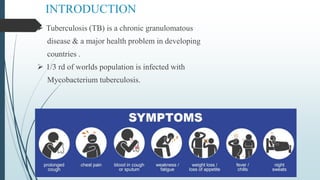
 Tuberculosis (TB) is a chronic granulomatous
disease & a major health problem in developing
countries .
 1/3 rd of worlds population is infected with
Mycobacterium tuberculosis.
BIOLOGY OF TB
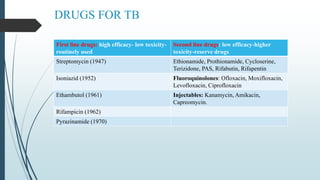
DRUGS FOR TB
First line drugs: high efficacy- low toxicity-
routinely used
Second line drugs: low efficacy-higher
toxicity-reserve drugs
Streptomycin (1947) Ethionamide, Prothionamide, Cycloserine,
Terizidone, PAS, Rifabutin, Rifapentin
Isoniazid (1952) Fluoroquinolones: Ofloxacin, Moxifloxacin,
Levofloxacin, Ciprofloxacin
Ethambutol (1961) Injectables: Kanamycin, Amikacin,
Capreomycin.
Rifampicin (1962)
Pyrazinamide (1970)
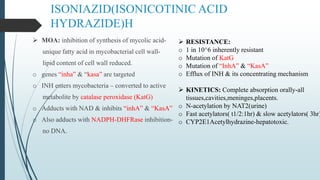
ISONIAZID(ISONICOTINIC ACID
HYDRAZIDE)H
 MOA: inhibition of synthesis of mycolic acid-
unique fatty acid in mycobacterial cell wall-
lipid content of cell wall reduced.
o genes “inha” & “kasa” are targeted
o INH enters mycobacteria – converted to active
metabolite by catalase peroxidase (KatG)
o Adducts with NAD & inhibits “inhA” & “KasA”
o Also adducts with NADPH-DHFRase inhibition-
no DNA.
 RESISTANCE:
o 1 in 10^6 inherently resistant
o Mutation of KatG
o Mutation of “InhA” & “KasA”
o Efflux of INH & its concentrating mechanism
 KINETICS: Complete absorption orally-all
tissues,cavities,meninges,placents.
o N-acetylation by NAT2(urine)
o Fast acetylators( t1/2:1hr) & slow acetylators( 3hr)
o CYP2E1Acetylhydrazine-hepatotoxic.
 Drug interactions: Aluminium hydroxide (AIOH)
o Retards metabolism - Phenytoin, carbamazepine diazepam, theophylline CYP2C19 and CYP3A4
 ADRs:
o Peripheral neuropathy- numbness, parasthesia, mental disturbance & convulsion dose dependent
• Why? pyridoxal INH (hydrazone) pyridoxal PO4 not formed from pyridoxine
• Prophylactic- pyridoxine (100 mg/day) special group
o Hepatitis elderly and alcoholics (CYP2E1 induced)
o Lethargy, rash, fever, acne and athralgia
RIFAMPICIN(R)
 MOA: Interrupts RNA synthesis
o Binds to B subunit of DNA- dependent RNA
polymerase (rboB) -blocks polymerizing
function
 Resistance:
o Primary resistance 1 in 1071Developes
rapidly and due to mutation of rboB gene-
reduces affinity for drugs,mutation in efflux
pumps.
o Primary resistance- rare 2%
o No cross resistance
 Kinetics: well absorbed - 70%
bioavailability-food Interferes
o Well distributed penetrates
intracellularly, cavities, caseous
masees and placenta
o Crosses meninges but pumped out
p-gp
o Deacetylated in liver and excreted in
bile and urine
o Enterohepatic circulation
o Half life 2-5 hours
 Interactions: Hepatic microsomal
enzymeInducer CYP3A4, CYP2D6, CYP1A2
and CYP2C
o Induces own metabolism
o Warfarin, OCP corticosteroids sulfonylureas,
proteaseinhibitors, NNRTIs,theophylline,
metoprolol, fluconazole, clarithromycin,
phenytoin, NNRTIS
o Remember OCP-failure
 Uses: Leprosy, Meningococcal and H.
influenzae meningitis, Brucellosis
ADRS: Hepatitis-pre-existing
disease + > 600 mg-jaundice
discontinue
o Cutaneous syndrome:
flushing, pruritus, rash,
redness and watering of eyes
o Flu syndrome: chill, fever,
headache, malaise and bone
pain
o Abdominal syndrome; nausea,
vomiting, abdominal cramps
diarrhoea
o Orange-red urine
o Purpura, haemolysis, shock
and renal failure
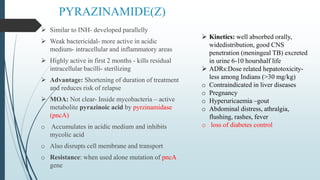
PYRAZINAMIDE(Z)
 Similar to INH- developed parallelly
 Weak bactericidal- more active in acidic
medium- intracellular and inflammatory areas
 Highly active in first 2 months - kills residual
intracellular bacilli- sterilizing
 Advantage: Shortening of duration of treatment
and reduces risk of relapse
 MOA: Not clear- Inside mycobacteria – active
metabolite pyrazinoic acid by pyrzinamidase
(pncA)
o Accumulates in acidic medium and inhibits
mycolic acid
o Also disrupts cell membrane and transport
o Resistance: when used alone mutation of pncA
gene
 Kinetics: well absorbed orally,
widedistribution, good CNS
penetration (meningeal TB) excreted
in urine 6-10 hourshalf life
 ADRs:Dose related hepatotoxicity-
less among Indians (>30 mg/kg)
o Contraindicated in liver diseases
o Pregnancy
o Hyperuricaemia –gout
o Abdominal distress, athralgia,
flushing, rashes, fever
o loss of diabetes control
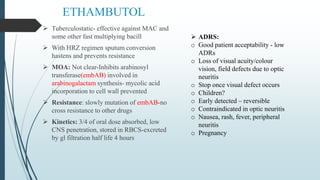
ETHAMBUTOL
 Tuberculostatic- effective against MAC and
some other fast multiplying bacill
 With HRZ regimen sputum conversion
hastens and prevents resistance
 MOA: Not clear-Inhibits arabinosyl
transferase(embAB) involved in
arabinogalactam synthesis- mycolic acid
incorporation to cell wall prevented
 Resistance: slowly mutation of embAB-no
cross resistance to other drugs
 Kinetics: 3/4 of oral dose absorbed, low
CNS penetration, stored in RBCS-excreted
by gl filtration half life 4 hours
 ADRS:
o Good patient acceptability - low
ADRs
o Loss of visual acuity/colour
vision, field defects due to optic
neuritis
o Stop once visual defect occurs
o Children?
o Early detected – reversible
o Contraindicated in optic neuritis
o Nausea, rash, fever, peripheral
neuritis
o Pregnancy
STREPTOMYCIN
 First clinically useful anti-TB drug -
aminoglycoside
 Tuberculocidal - less effective than INH or
Rifampicin
 Only on extracellular bacilli - poor penetration
 Other drugs and host defence mechanism
 MOA: Inhibition of protein synthesis - binds to
305and 505 subunits - freeze initiation and interferes
polysome formation and misreading of mRNA code
 Resistance: rapidly and relapse-stop in resistance
o Acquiring of membrane bound inactivating enzyme-
phosphorylate/adenylate/acetylate the drug-
conjugated drugs do not bind to target ribosomes -- -
conjugation and plasmid mediated acquiring-
nosocomial microbes
o Mutation decreasing the affinity of ribosomal
proteins to drugs
 ADRS: Ototoxicity: Most common
vestibular and cochlear damage
deposition in labyrinthine fluid slowly
removed greater toxicity when persistent
high plasma concentration
o Cochlear damage- base to apex and high
to low frequency sounds no regeneration
of sensory cells permanent deafness
o Vestibular damage- Headache nausea,
vomiting. dizziness, nystagmus, vertigo,
ataxia
o Nephrotoxicity: Tubular damage urinary
conc. mechanism lost, low GFR,
nitrogen retention, albuminuria and casts
due to deposition incortex
o Neuromuscular blockade: reduce Ach
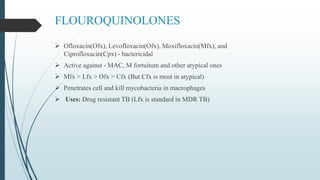
FLOUROQUINOLONES
 Ofloxacin(Ofx), Levofloxacin(Ofx), Moxifloxacin(Mfx), and
Ciprofloxacin(Cpx) - bactericidal
 Active against - MAC, M fortuitum and other atypical ones
 Mfx > Lfx > Ofx > Cfx (But Cfx is most in atypical)
 Penetrates cell and kill mycobacteria in macrophages
 Uses: Drug resistant TB (Lfx is standard in MDR TB)
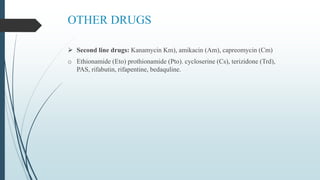
OTHER DRUGS
 Second line drugs: Kanamycin Km), amikacin (Am), capreomycin (Cm)
o Ethionamide (Eto) prothionamide (Pto). cycloserine (Cs), terizidone (Trd),
PAS, rifabutin, rifapentine, bedaquline.
MANAGEMENT OF TB
GOALS OF ANTI-TUBERCULAR CHEMOTHERAPY
 Kill dividing bacilli: Drugs with early bactericidal action rapidly reduce bacillary
load in the patient and achieve quick sputum negativity so that transmission of TB
is interrupted. This also affords quick symptom relief.
 Kill persisting bacilli: To effect cure and prevent relapse. This depends on
sterilizing capacity of the drug.
 Prevent emergence of resistance: The relative activity of the first line drugs in
achieving these goals.
PRINCIPLES OF ANTITUBERCULOSIS CHEMOTHERAPY
 Mycobacterium tuberculosis is not a single species, but a complex of species with
99.9% similarity at the nucleotide level. The complex includes M. tuberculosis
(typus humanus), M. canettii, M. africanum, M. bovis, and M. microti.
 ANTITUBERCULOSIS THERAPY:
 Traditionally, first-line anti-TB agents are used for the treatment
 Treating TB in less than 6 months
 Traditionally, first-line agents were more efficacious and better tolerated-
 Relative to second-line agents. Second-line agents were used in case of poor
tolerance or resistance to first-line agents.
TYPES OF ANTITUBERCULOSIS THERAPY
Prophylaxis
Definitive therapy of drug
–susceptible TB
Definitive therapy of drug susceptible TB
TYPES OF ANTITUBERCULOSIS THERAPY
 Prophylaxis:
o After infection with M. tuberculosis, about 10% of people will develop active disease
over a lifetime.
o The highest risk of reactivation TB is in patients with Mantoux tuberculin skin test
reaction 5 mm or greater who also fall into one of the following categories
# recently exposed to TB
# have HIV coinfection
# have fibrotic changes on chest radiograms
# post-transplantation
# taking immunosuppressive medications
o Any person with a skin test greater than 15 mm is also at high risk of disease.
TYPES OF ANTITUBERCULOSIS THERAPY
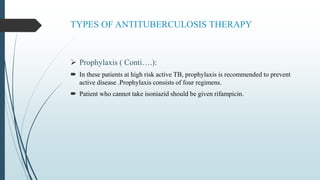
 Prophylaxis ( Conti….):
 In these patients at high risk active TB, prophylaxis is recommended to prevent
active disease .Prophylaxis consists of four regimens.
 Patient who cannot take isoniazid should be given rifampicin.
TYPES OF ANTITUBERCULOSIS THERAPY
 Definitive therapy of drug- susceptible TB:
 All active TB cases should be confirmed by culture or rapid diagnostic methods such as
nucleic acid amplification tests
 The duration of therapy of drug- susceptible pulmonary TB is 6 months.
#) Initial phase of therapy ( first 2 months of four drug regimen)
#) Continuation phase ( last 4 months)
 A 9- month duration should be used for patients with cavitary disease who are still sputum
culture positive at 2 months.
 The treatment of TB pericarditis is a special case in which the use of steroids has been
advocated.
TYPES OF ANTITUBERCULOSIS THERAPY
 Definitive Therapy of Drug-Resistant TB:
 The XDR-TB is MDR-TB that is also resistant to fluoroquinolones and at least one of three
injectable second-line drugs (ie., amikacin, kanamycin, or capreomycin).
 These diseases, virtually untreatable (bedaquiline and delaminid in combination with
optimized background regimens can be used)
 Therapy should be based on evidence of susceptibility and should include:
o at least three drugs with at least one of the injectable anti-TB agents
o MDR-TB, a prolonged course of 5 to 7 agents,
o except a shorter 9-12 month regimen if there is no resistance to fluoroquinolones and
second-line injectable agents.
TREATMENT OF TUBERCULOSIS IN
ADULTS
Fixed-Dose Combinations Directly Observed Therapy
(FDCs) (DOT)
Treatment of TB in adults
 Fixed-Dose Combination (FDCs):
o Forecox-Trac Film Coated Tab: Isoniazid, Rifampicin, Ethambutoland
Pyrazinamide
o Rimactazid 300 Sugar Coated Tab: Isoniazid and Rifampicin
o Rimcure 3-FDC Film Coated Tab: Isoniazid, Rifampicin & Pyrazinamide
o Akurit - Z Tab: Isoniacid, Rifambin (Rifampicin), & Pyrazinamide.
o Akurit Tab : Isoniazid, Rifampin ( Rifmpicin)
o Akurit -Z kid Tab: Isoniazid, Rifampin & Pyrazinamide.
o Akurit -4 : Ethambutol , Isoniazid, Rifampin, & Pyrazinamide.
 Directly Observed Therapy (DOT)
 WHO introduced 6-8 month multidrug 'short course' regimens in 1995 under the Direct
Observed Therapy, Short Course (DOTS)programme.
 Directly observed therapy (DOT) to ensure adherence and good management practice.
 In this patients are divided into 4 categories.
#) Category I : New case of sputum smear positive or severe pulmonary TB.
#) Category II: Defaulted, irregularly treated and relapse cases.
#) Category III: New sputum smear negative pulmonary TB.
#) Category IV: Chronic cases who remained or again became sputum smear positive after
receiving fully supervised category II treatment.
SHORT COURSE CHEMOTHERAPY ( DOTS)
TB IN CHILDREN
There is an increasing trend of TB cases among children in Malaysia. AntiTB drug and
management of children with TB Suld be in line with the WHO Stop TB Strategy, taking
into consideration the epidemiology and clinical presentation of TB in children.
TB IN PREGNANT WOMEN
The WHO and British Thoracic Society consider H, R, E and Z to be safe to the foetus and
recommend the standard 6 month (2HRZE + 4HR) regimen for pregnant women with TB.
S is contraindicated because it is ototoxic to the foetus.
[Isoniazid (H), Rifampin (R), Pyrazinamide (2), Ethambutol (E)]
Tuberculosis in lactation
 Breast feeding mothers with TB should receive a full course of anti-TB drugs.
First-line anti-TB drugs are safe in breast feeding.
 Mother and baby should stay together for continuation of breastfeeding. Once
active TB in the baby is ruled out, the baby should be given six months isoniazid
prophylaxis, followed by BCG vaccination.
Tuberculosis in AIDS patients
 The association of HIV and TB infection is a serious problem. HIV positive
cases have a higher incidence of extrapulmonary, more severe, more lethal and
more infectious TB.
 Initial intensive phase therapy with daily HRZE for 2 months is started
immediately on the diagnosis of TB, and is followed by a continuation phase of
HR for 4-7 months (total 6-9 months).
[Isoniazid (H), Rifampin (R), Pyrazinamide (Z), Ethambutol (E)]
TB CLASSIFICATION FOR DRUG REGIMEN
 Drug-sensitive TB: Sensitive to all 5 drugs all new cases who have never taken any drug
or taken for less than 1 (one) month
 Multidrug resistant TB (MDR-TB): Resistant to both R and H with or without resistant
to any other drug
 Rifampicin resistant TB (RR-TB): Resistant to R but not to H with or without resistant to
other drugs-treated like MDR TB
 Mono-resistant TB: Resistant to 1 (one) first line drug but not to R
 Poly drug resistant TB: Resistant to more than one first line drug but not to R and H
 Extensive drug resistant TB (XDR-TB): MDR-TB with resistance to 1 fluoroquinolone
and 2 Line Injectable drug.
DRUG SENSITIVE TB
 New cases:
o Initial 2 months: Treated with RHZ and E reduces the risk of resistance H
o Next 4 months After 2 months Z discontinued and continued with RHE (Old guideline E
was not included and thrice weekly regime)
o Given daily basis
 Previously treated:
o Initial 2 months Treated with S R H Z and E
o 3 month: No 5 but H R Z E
o Next 5 months: continued with R H E
 In severe extrapulmonary TB: P is extended by 3-6 months in both above cases
 Fixed dose combinations are recommended - patient takes all the drug risk of bacilli being
exposed to only 1 or 2 drugs
MULTI DRUG RESISTANT (MDR) TB
 MDR-TB is defined as resistance to both H and R, and may be any number of other (first line)
drug(s). Its treatment requires complex
 The general principles of treatment of MDR-TB are:
#) The regimen should have at least 4 drugs certain to be effective
#) Efficacy may be placed on survey of similar patients who have been
treated
#) Avoid combining cross resistance drug. e.g. two FQs,
#) Include drugs from group I to group IV (alternative classification) in a
hierarchial order.Gr. I drug included (Z and E), 1 Gr.ll drug, 1 Gr.Ill drug & 2 Gr.Ivdrugs.
OTHER CASES
 RR-TB: treated like MDR-TB H is added
o IP & months with 7 drugs Km, Lx, Eto, 5, 7, E, and H
o 18 months continuation phase Lfx, Eto, 1, E and H
 Monodrug resistant: Resistant to 1 first line drug (DST or LPA (line probe assay): R2 of
the first line drugs-1 injectable 2 line 1 FQ daily in IP of 3-6 months (Total9-12 months)
 Poly drug resistance: Resistance to more than 1 first line drug except R: R1 injectable 2
line 1 FQ 1 first line drug 1 oral 2nd Line (Eto/Cs/PAS) IP of 3-6 months-injectable
stopped in CP (9-12 months)
 Isoniazide resistant: Low level due to mutation of InhA dose Increased up to 900 mg daily
but in KatG mutation- does not work.
XDR -TB
 Resistant to at least 4 effective drugs H, R, FQ and one of Km/Am/Cm
 Difficult to treat
 Standard MDR-TB drugs must be stopped
 Cm 1000mg, Mfx 400 mg, H 900 mg, PAS 12 gm, Linezolid 200 mg,
Amoxycillin/clavulanate 875+125 (2 tablets)
 IP 6-12 months and P 18 months.
REFERENCE
 The pharmacological basis of therapeutics, Goodman & Gilman’s, 12th edition, Pg no:
1550-1578
 A Review on Clinical Pharmacist Care Services on Prevention and Management of
Tuberculosis associated Burden in Health Care Practice by MS Umashankar, A Bharath
Kumar.
 K D Tripathi, 8th edition, page number: 654-673
 Internet source.

TB.pptx

  • 2.
    CONTENTS  Introduction  Drugs Treatment  Dots therapy  Reference
  • 3.
    INTRODUCTION  Tuberculosis (TB)is a chronic granulomatous disease & a major health problem in developing countries .  1/3 rd of worlds population is infected with Mycobacterium tuberculosis.
  • 5.
  • 6.
    DRUGS FOR TB Firstline drugs: high efficacy- low toxicity- routinely used Second line drugs: low efficacy-higher toxicity-reserve drugs Streptomycin (1947) Ethionamide, Prothionamide, Cycloserine, Terizidone, PAS, Rifabutin, Rifapentin Isoniazid (1952) Fluoroquinolones: Ofloxacin, Moxifloxacin, Levofloxacin, Ciprofloxacin Ethambutol (1961) Injectables: Kanamycin, Amikacin, Capreomycin. Rifampicin (1962) Pyrazinamide (1970)
  • 7.
    ISONIAZID(ISONICOTINIC ACID HYDRAZIDE)H  MOA:inhibition of synthesis of mycolic acid- unique fatty acid in mycobacterial cell wall- lipid content of cell wall reduced. o genes “inha” & “kasa” are targeted o INH enters mycobacteria – converted to active metabolite by catalase peroxidase (KatG) o Adducts with NAD & inhibits “inhA” & “KasA” o Also adducts with NADPH-DHFRase inhibition- no DNA.  RESISTANCE: o 1 in 10^6 inherently resistant o Mutation of KatG o Mutation of “InhA” & “KasA” o Efflux of INH & its concentrating mechanism  KINETICS: Complete absorption orally-all tissues,cavities,meninges,placents. o N-acetylation by NAT2(urine) o Fast acetylators( t1/2:1hr) & slow acetylators( 3hr) o CYP2E1Acetylhydrazine-hepatotoxic.
  • 8.
     Drug interactions:Aluminium hydroxide (AIOH) o Retards metabolism - Phenytoin, carbamazepine diazepam, theophylline CYP2C19 and CYP3A4  ADRs: o Peripheral neuropathy- numbness, parasthesia, mental disturbance & convulsion dose dependent • Why? pyridoxal INH (hydrazone) pyridoxal PO4 not formed from pyridoxine • Prophylactic- pyridoxine (100 mg/day) special group o Hepatitis elderly and alcoholics (CYP2E1 induced) o Lethargy, rash, fever, acne and athralgia
  • 9.
    RIFAMPICIN(R)  MOA: InterruptsRNA synthesis o Binds to B subunit of DNA- dependent RNA polymerase (rboB) -blocks polymerizing function  Resistance: o Primary resistance 1 in 1071Developes rapidly and due to mutation of rboB gene- reduces affinity for drugs,mutation in efflux pumps. o Primary resistance- rare 2% o No cross resistance  Kinetics: well absorbed - 70% bioavailability-food Interferes o Well distributed penetrates intracellularly, cavities, caseous masees and placenta o Crosses meninges but pumped out p-gp o Deacetylated in liver and excreted in bile and urine o Enterohepatic circulation o Half life 2-5 hours
  • 10.
     Interactions: Hepaticmicrosomal enzymeInducer CYP3A4, CYP2D6, CYP1A2 and CYP2C o Induces own metabolism o Warfarin, OCP corticosteroids sulfonylureas, proteaseinhibitors, NNRTIs,theophylline, metoprolol, fluconazole, clarithromycin, phenytoin, NNRTIS o Remember OCP-failure  Uses: Leprosy, Meningococcal and H. influenzae meningitis, Brucellosis ADRS: Hepatitis-pre-existing disease + > 600 mg-jaundice discontinue o Cutaneous syndrome: flushing, pruritus, rash, redness and watering of eyes o Flu syndrome: chill, fever, headache, malaise and bone pain o Abdominal syndrome; nausea, vomiting, abdominal cramps diarrhoea o Orange-red urine o Purpura, haemolysis, shock and renal failure
  • 11.
    PYRAZINAMIDE(Z)  Similar toINH- developed parallelly  Weak bactericidal- more active in acidic medium- intracellular and inflammatory areas  Highly active in first 2 months - kills residual intracellular bacilli- sterilizing  Advantage: Shortening of duration of treatment and reduces risk of relapse  MOA: Not clear- Inside mycobacteria – active metabolite pyrazinoic acid by pyrzinamidase (pncA) o Accumulates in acidic medium and inhibits mycolic acid o Also disrupts cell membrane and transport o Resistance: when used alone mutation of pncA gene  Kinetics: well absorbed orally, widedistribution, good CNS penetration (meningeal TB) excreted in urine 6-10 hourshalf life  ADRs:Dose related hepatotoxicity- less among Indians (>30 mg/kg) o Contraindicated in liver diseases o Pregnancy o Hyperuricaemia –gout o Abdominal distress, athralgia, flushing, rashes, fever o loss of diabetes control
  • 12.
    ETHAMBUTOL  Tuberculostatic- effectiveagainst MAC and some other fast multiplying bacill  With HRZ regimen sputum conversion hastens and prevents resistance  MOA: Not clear-Inhibits arabinosyl transferase(embAB) involved in arabinogalactam synthesis- mycolic acid incorporation to cell wall prevented  Resistance: slowly mutation of embAB-no cross resistance to other drugs  Kinetics: 3/4 of oral dose absorbed, low CNS penetration, stored in RBCS-excreted by gl filtration half life 4 hours  ADRS: o Good patient acceptability - low ADRs o Loss of visual acuity/colour vision, field defects due to optic neuritis o Stop once visual defect occurs o Children? o Early detected – reversible o Contraindicated in optic neuritis o Nausea, rash, fever, peripheral neuritis o Pregnancy
  • 13.
    STREPTOMYCIN  First clinicallyuseful anti-TB drug - aminoglycoside  Tuberculocidal - less effective than INH or Rifampicin  Only on extracellular bacilli - poor penetration  Other drugs and host defence mechanism  MOA: Inhibition of protein synthesis - binds to 305and 505 subunits - freeze initiation and interferes polysome formation and misreading of mRNA code  Resistance: rapidly and relapse-stop in resistance o Acquiring of membrane bound inactivating enzyme- phosphorylate/adenylate/acetylate the drug- conjugated drugs do not bind to target ribosomes -- - conjugation and plasmid mediated acquiring- nosocomial microbes o Mutation decreasing the affinity of ribosomal proteins to drugs  ADRS: Ototoxicity: Most common vestibular and cochlear damage deposition in labyrinthine fluid slowly removed greater toxicity when persistent high plasma concentration o Cochlear damage- base to apex and high to low frequency sounds no regeneration of sensory cells permanent deafness o Vestibular damage- Headache nausea, vomiting. dizziness, nystagmus, vertigo, ataxia o Nephrotoxicity: Tubular damage urinary conc. mechanism lost, low GFR, nitrogen retention, albuminuria and casts due to deposition incortex o Neuromuscular blockade: reduce Ach
  • 14.
    FLOUROQUINOLONES  Ofloxacin(Ofx), Levofloxacin(Ofx),Moxifloxacin(Mfx), and Ciprofloxacin(Cpx) - bactericidal  Active against - MAC, M fortuitum and other atypical ones  Mfx > Lfx > Ofx > Cfx (But Cfx is most in atypical)  Penetrates cell and kill mycobacteria in macrophages  Uses: Drug resistant TB (Lfx is standard in MDR TB)
  • 15.
    OTHER DRUGS  Secondline drugs: Kanamycin Km), amikacin (Am), capreomycin (Cm) o Ethionamide (Eto) prothionamide (Pto). cycloserine (Cs), terizidone (Trd), PAS, rifabutin, rifapentine, bedaquline.
  • 16.
  • 18.
    GOALS OF ANTI-TUBERCULARCHEMOTHERAPY  Kill dividing bacilli: Drugs with early bactericidal action rapidly reduce bacillary load in the patient and achieve quick sputum negativity so that transmission of TB is interrupted. This also affords quick symptom relief.  Kill persisting bacilli: To effect cure and prevent relapse. This depends on sterilizing capacity of the drug.  Prevent emergence of resistance: The relative activity of the first line drugs in achieving these goals.
  • 19.
    PRINCIPLES OF ANTITUBERCULOSISCHEMOTHERAPY  Mycobacterium tuberculosis is not a single species, but a complex of species with 99.9% similarity at the nucleotide level. The complex includes M. tuberculosis (typus humanus), M. canettii, M. africanum, M. bovis, and M. microti.  ANTITUBERCULOSIS THERAPY:  Traditionally, first-line anti-TB agents are used for the treatment  Treating TB in less than 6 months  Traditionally, first-line agents were more efficacious and better tolerated-  Relative to second-line agents. Second-line agents were used in case of poor tolerance or resistance to first-line agents.
  • 20.
    TYPES OF ANTITUBERCULOSISTHERAPY Prophylaxis Definitive therapy of drug –susceptible TB Definitive therapy of drug susceptible TB
  • 21.
    TYPES OF ANTITUBERCULOSISTHERAPY  Prophylaxis: o After infection with M. tuberculosis, about 10% of people will develop active disease over a lifetime. o The highest risk of reactivation TB is in patients with Mantoux tuberculin skin test reaction 5 mm or greater who also fall into one of the following categories # recently exposed to TB # have HIV coinfection # have fibrotic changes on chest radiograms # post-transplantation # taking immunosuppressive medications o Any person with a skin test greater than 15 mm is also at high risk of disease.
  • 22.
    TYPES OF ANTITUBERCULOSISTHERAPY  Prophylaxis ( Conti….):  In these patients at high risk active TB, prophylaxis is recommended to prevent active disease .Prophylaxis consists of four regimens.  Patient who cannot take isoniazid should be given rifampicin.
  • 23.
    TYPES OF ANTITUBERCULOSISTHERAPY  Definitive therapy of drug- susceptible TB:  All active TB cases should be confirmed by culture or rapid diagnostic methods such as nucleic acid amplification tests  The duration of therapy of drug- susceptible pulmonary TB is 6 months. #) Initial phase of therapy ( first 2 months of four drug regimen) #) Continuation phase ( last 4 months)  A 9- month duration should be used for patients with cavitary disease who are still sputum culture positive at 2 months.  The treatment of TB pericarditis is a special case in which the use of steroids has been advocated.
  • 24.
    TYPES OF ANTITUBERCULOSISTHERAPY  Definitive Therapy of Drug-Resistant TB:  The XDR-TB is MDR-TB that is also resistant to fluoroquinolones and at least one of three injectable second-line drugs (ie., amikacin, kanamycin, or capreomycin).  These diseases, virtually untreatable (bedaquiline and delaminid in combination with optimized background regimens can be used)  Therapy should be based on evidence of susceptibility and should include: o at least three drugs with at least one of the injectable anti-TB agents o MDR-TB, a prolonged course of 5 to 7 agents, o except a shorter 9-12 month regimen if there is no resistance to fluoroquinolones and second-line injectable agents.
  • 25.
    TREATMENT OF TUBERCULOSISIN ADULTS Fixed-Dose Combinations Directly Observed Therapy (FDCs) (DOT)
  • 26.
    Treatment of TBin adults  Fixed-Dose Combination (FDCs): o Forecox-Trac Film Coated Tab: Isoniazid, Rifampicin, Ethambutoland Pyrazinamide o Rimactazid 300 Sugar Coated Tab: Isoniazid and Rifampicin o Rimcure 3-FDC Film Coated Tab: Isoniazid, Rifampicin & Pyrazinamide o Akurit - Z Tab: Isoniacid, Rifambin (Rifampicin), & Pyrazinamide. o Akurit Tab : Isoniazid, Rifampin ( Rifmpicin) o Akurit -Z kid Tab: Isoniazid, Rifampin & Pyrazinamide. o Akurit -4 : Ethambutol , Isoniazid, Rifampin, & Pyrazinamide.
  • 27.
     Directly ObservedTherapy (DOT)  WHO introduced 6-8 month multidrug 'short course' regimens in 1995 under the Direct Observed Therapy, Short Course (DOTS)programme.  Directly observed therapy (DOT) to ensure adherence and good management practice.  In this patients are divided into 4 categories. #) Category I : New case of sputum smear positive or severe pulmonary TB. #) Category II: Defaulted, irregularly treated and relapse cases. #) Category III: New sputum smear negative pulmonary TB. #) Category IV: Chronic cases who remained or again became sputum smear positive after receiving fully supervised category II treatment.
  • 28.
  • 29.
    TB IN CHILDREN Thereis an increasing trend of TB cases among children in Malaysia. AntiTB drug and management of children with TB Suld be in line with the WHO Stop TB Strategy, taking into consideration the epidemiology and clinical presentation of TB in children. TB IN PREGNANT WOMEN The WHO and British Thoracic Society consider H, R, E and Z to be safe to the foetus and recommend the standard 6 month (2HRZE + 4HR) regimen for pregnant women with TB. S is contraindicated because it is ototoxic to the foetus. [Isoniazid (H), Rifampin (R), Pyrazinamide (2), Ethambutol (E)]
  • 30.
    Tuberculosis in lactation Breast feeding mothers with TB should receive a full course of anti-TB drugs. First-line anti-TB drugs are safe in breast feeding.  Mother and baby should stay together for continuation of breastfeeding. Once active TB in the baby is ruled out, the baby should be given six months isoniazid prophylaxis, followed by BCG vaccination. Tuberculosis in AIDS patients  The association of HIV and TB infection is a serious problem. HIV positive cases have a higher incidence of extrapulmonary, more severe, more lethal and more infectious TB.  Initial intensive phase therapy with daily HRZE for 2 months is started immediately on the diagnosis of TB, and is followed by a continuation phase of HR for 4-7 months (total 6-9 months). [Isoniazid (H), Rifampin (R), Pyrazinamide (Z), Ethambutol (E)]
  • 31.
    TB CLASSIFICATION FORDRUG REGIMEN  Drug-sensitive TB: Sensitive to all 5 drugs all new cases who have never taken any drug or taken for less than 1 (one) month  Multidrug resistant TB (MDR-TB): Resistant to both R and H with or without resistant to any other drug  Rifampicin resistant TB (RR-TB): Resistant to R but not to H with or without resistant to other drugs-treated like MDR TB  Mono-resistant TB: Resistant to 1 (one) first line drug but not to R  Poly drug resistant TB: Resistant to more than one first line drug but not to R and H  Extensive drug resistant TB (XDR-TB): MDR-TB with resistance to 1 fluoroquinolone and 2 Line Injectable drug.
  • 32.
    DRUG SENSITIVE TB New cases: o Initial 2 months: Treated with RHZ and E reduces the risk of resistance H o Next 4 months After 2 months Z discontinued and continued with RHE (Old guideline E was not included and thrice weekly regime) o Given daily basis  Previously treated: o Initial 2 months Treated with S R H Z and E o 3 month: No 5 but H R Z E o Next 5 months: continued with R H E  In severe extrapulmonary TB: P is extended by 3-6 months in both above cases  Fixed dose combinations are recommended - patient takes all the drug risk of bacilli being exposed to only 1 or 2 drugs
  • 33.
    MULTI DRUG RESISTANT(MDR) TB  MDR-TB is defined as resistance to both H and R, and may be any number of other (first line) drug(s). Its treatment requires complex  The general principles of treatment of MDR-TB are: #) The regimen should have at least 4 drugs certain to be effective #) Efficacy may be placed on survey of similar patients who have been treated #) Avoid combining cross resistance drug. e.g. two FQs, #) Include drugs from group I to group IV (alternative classification) in a hierarchial order.Gr. I drug included (Z and E), 1 Gr.ll drug, 1 Gr.Ill drug & 2 Gr.Ivdrugs.
  • 34.
    OTHER CASES  RR-TB:treated like MDR-TB H is added o IP & months with 7 drugs Km, Lx, Eto, 5, 7, E, and H o 18 months continuation phase Lfx, Eto, 1, E and H  Monodrug resistant: Resistant to 1 first line drug (DST or LPA (line probe assay): R2 of the first line drugs-1 injectable 2 line 1 FQ daily in IP of 3-6 months (Total9-12 months)  Poly drug resistance: Resistance to more than 1 first line drug except R: R1 injectable 2 line 1 FQ 1 first line drug 1 oral 2nd Line (Eto/Cs/PAS) IP of 3-6 months-injectable stopped in CP (9-12 months)  Isoniazide resistant: Low level due to mutation of InhA dose Increased up to 900 mg daily but in KatG mutation- does not work.
  • 35.
    XDR -TB  Resistantto at least 4 effective drugs H, R, FQ and one of Km/Am/Cm  Difficult to treat  Standard MDR-TB drugs must be stopped  Cm 1000mg, Mfx 400 mg, H 900 mg, PAS 12 gm, Linezolid 200 mg, Amoxycillin/clavulanate 875+125 (2 tablets)  IP 6-12 months and P 18 months.
  • 36.
    REFERENCE  The pharmacologicalbasis of therapeutics, Goodman & Gilman’s, 12th edition, Pg no: 1550-1578  A Review on Clinical Pharmacist Care Services on Prevention and Management of Tuberculosis associated Burden in Health Care Practice by MS Umashankar, A Bharath Kumar.  K D Tripathi, 8th edition, page number: 654-673  Internet source.