QUERCETIN & KAEMPFEROL
ANTHOCYANIDIN:
 IT WAS DERIVED FROM GREEK WORD
ANTOS : FLOWER , KYANOS : BLUE
 THEY ARE THE CLASS OF PIGMENTS
BELONGING TO A LARGER GROUP KNOWN AS
FLAVANOIDS.
 IT HAS BEEN USED SINCE ANTIQUITY AS
DYES , CONTRIBUTING COLOURATION OF
PETALS, FRUITS, BRACTS, AND LEAVES.
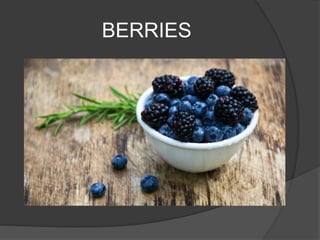
 THEY ARE FOUND IN FLOWERS AND
BERRIES.
BERRIES
STRUCTURE OF
ANTHOCYANIDIN
QUERCETIN
 Quercetin is a plant flavonol from
the flavonoid group of polyphenols.
 It is found in many fruits, vegetables,
leaves, seeds, and grains; red onions
and kale are common foods containing
appreciable amounts of quercetin.
 Quercetin has a bitter flavor and is used
as an ingredient in dietary supplements,
beverages, and foods.
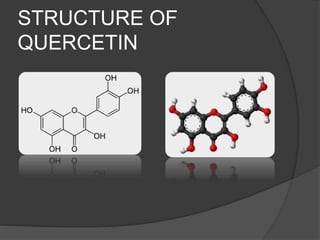
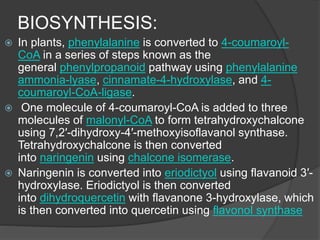
STRUCTURE OF
QUERCETIN
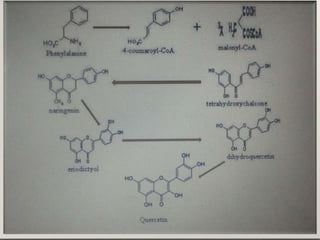
BIOSYNTHESIS:
 In plants, phenylalanine is converted to 4-coumaroyl-
CoA in a series of steps known as the
general phenylpropanoid pathway using phenylalanine
ammonia-lyase, cinnamate-4-hydroxylase, and 4-
coumaroyl-CoA-ligase.
 One molecule of 4-coumaroyl-CoA is added to three
molecules of malonyl-CoA to form tetrahydroxychalcone
using 7,2′-dihydroxy-4′-methoxyisoflavanol synthase.
Tetrahydroxychalcone is then converted
into naringenin using chalcone isomerase.
 Naringenin is converted into eriodictyol using flavanoid 3′-
hydroxylase. Eriodictyol is then converted
into dihydroquercetin with flavanone 3-hydroxylase, which
is then converted into quercetin using flavonol synthase
ELUCIDATION OF
QUERCETIN:
 WIDELY DISTRIBUTED PIGMENTS
OCCURS AS RHAMNOSIDES
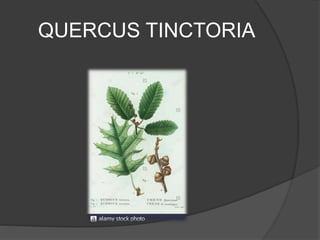
(QUERCITINE) IN THE BARK OF
QUERCUS TINCTORIA.
QUERCITINE RHAMNOSE+QUERCETIN
 MOLECULAR FORMULA : C15H10O7
 IT WAS FOUND TO CONTAIN FOUR HYDROXYL
GROUPS AS IT FORMS PENTA – ACETYL AND
PENTAMETHYL GROUP.
QUERCUS TINCTORIA
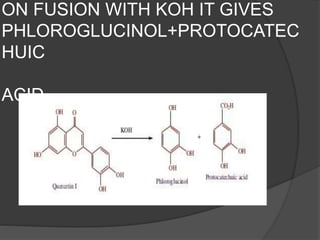
ON FUSION WITH KOH IT GIVES
PHLOROGLUCINOL+PROTOCATEC
HUIC
ACID.
USES:
 Asthma. Early research shows that taking
quercetin might improve asthma symptoms and
reduce the use of rescue inhalers in people with
asthma.
 A blood disorder that reduces levels of protein in
the blood called hemoglobin (beta-thalassemia).
Some people with beta-thalassemia need blood
transfusions. These transfusions can cause too
much iron to build up in the body. Early research
shows that taking quercetin might reduce iron
levels in people with beta-thalassemia who need
blood transfusions.
CONT…
 Heart disease. Some research suggests that
eating foods rich in quercetin, such as tea, onions
and apples, may reduce the risk of death due to
heart disease in elderly men. However, taking a
daily quercetin supplement does not seem to
improve heart disease risk factors in people who
are healthy.
 Kidney damage caused by contrast dyes (contrast
induced nephropathy). Early research shows that
taking quercetin before and after receiving
contrast dye doesn't prevent kidney damage
caused by the dye.
CONT…
 Muscle damage caused by exercise. Taking quercetin
doesn't seem to help to prevent muscle soreness due to
cycling or running. But it might prevent muscle damage
and improve muscle strength recovery with certain types
of weight training.
 Airway infections caused by exercise. Early research
shows that taking quercetin may reduce the chance for
upper respiratory infections after heavy exercise.
 High cholesterol. Short-term use of quercetin does not
appear to lower "bad cholesterol" (low-density lipoprotein
(LDL) cholesterol) or total cholesterol, or to raise "good
cholesterol" (high-density lipoprotein (HDL) cholesterol).
But most of the studies conducted have been small and
included people without high cholesterol. It's unclear if
quercetin would show benefit in only people with high
cholesterol.
KAEMPFEROL:
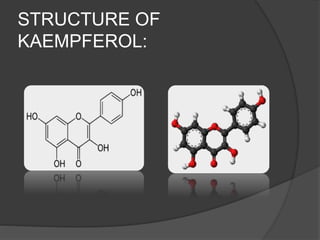
 Kaempferol (3,4′,5,7-tetrahydroxyflavone) is
a natural flavonol, a type of flavonoid, found
in a variety of plants and plant-derived foods
including kale, beans, tea, spinach and broc
coli.
 Kaempferol is a yellow crystalline solid with
a melting point of 276–278 °C (529–532 °F).
It is slightly soluble in water and highly
soluble in hot ethanol, ethers, and DMSO.
Kaempferol is named for 17th-century
German naturalist Engelbert Kaempfer.
CONT….
 Kaempferol has also been identified in
both Dicotyledons and Monocotyledons
of Angiosperms. The total average
intake of flavonols and flavones in a
normal diet is estimated as 23 mg/day,
to which kaempferol contributes
approximately 17%.
STRUCTURE OF
KAEMPFEROL:
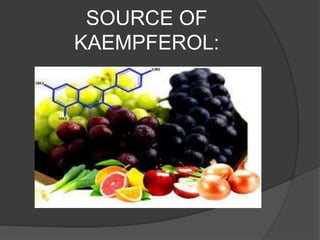
 Common foods that contain kaempferol include:
apples, grapes, tomatoes, green
tea, potatoes, onions, broccoli, Brussels
sprouts, squash, cucumbers, lettuce, green
beans, peaches, blackberries, raspberries, and spinach.
 Plants that are known to contain kaempferol
include:
Aloe vera, Coccinia grandis, Cuscuta
chinensis, Euphorbia pekinensis, Glycine
max, Hypericum perforatum, Pinus sylvestris, Moringa
oleifera, Rosmarinus officinalis, Sambucus
nigra, and Toona sinensis, and Ilex. It also is present
in endive.
SOURCE OF
KAEMPFEROL:
BIOSYNTHESIS:
 The biosynthesis of kaempferol occurs in four
major steps:
 Phenylalanine is converted into 4-coumaroyl-
CoA
 4-coumaroyl-CoA combines with three
molecules of malonyl-coA to form naringenin
chalcone (tetrahydroxychalcone) through the
action of the enzyme chalcone synthase
 Naringenin chalcone is converted
to naringenin and then a hydroxyl group is
added to form dihydrokaempferol
CONT….
 Dihydrokaempferol has a double bond
introduced into it to form kaempferol
 The amino acid phenylalanine is formed
from the Shikimate pathway, which is the
pathway that plants use in order to make
aromatic amino acids. This pathway is
located in the plant plastid, and is the entry
to the biosynthesis of phenylpropanoids.
 The phenylpropanoid pathway is the
pathway that converts phenylalanine into
tetrahydroxychalcone. Flavonols, including
kaempferol, are products of this pathway.
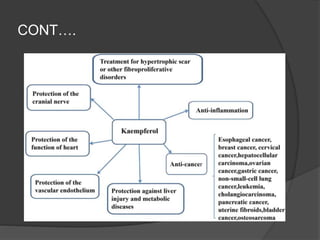
USES OF KAEMPFEROL:
 Kaempferol reduces the risk of chronic
diseases, especially cancer. Kaempferol
augments human
body's antioxidant defense against free
radicals.
 Kaempferol modulates apoptosis,
angiogenesis, inflammation, and
metastasis. Nanotechnology can improve
the bioavailability of kaempferol.
CONT….

Anthocyanidins

  • 1.
  • 2.
    ANTHOCYANIDIN:  IT WASDERIVED FROM GREEK WORD ANTOS : FLOWER , KYANOS : BLUE  THEY ARE THE CLASS OF PIGMENTS BELONGING TO A LARGER GROUP KNOWN AS FLAVANOIDS.  IT HAS BEEN USED SINCE ANTIQUITY AS DYES , CONTRIBUTING COLOURATION OF PETALS, FRUITS, BRACTS, AND LEAVES.  THEY ARE FOUND IN FLOWERS AND BERRIES.
  • 3.
  • 4.
  • 5.
    QUERCETIN  Quercetin isa plant flavonol from the flavonoid group of polyphenols.  It is found in many fruits, vegetables, leaves, seeds, and grains; red onions and kale are common foods containing appreciable amounts of quercetin.  Quercetin has a bitter flavor and is used as an ingredient in dietary supplements, beverages, and foods.
  • 6.
  • 7.
    BIOSYNTHESIS:  In plants,phenylalanine is converted to 4-coumaroyl- CoA in a series of steps known as the general phenylpropanoid pathway using phenylalanine ammonia-lyase, cinnamate-4-hydroxylase, and 4- coumaroyl-CoA-ligase.  One molecule of 4-coumaroyl-CoA is added to three molecules of malonyl-CoA to form tetrahydroxychalcone using 7,2′-dihydroxy-4′-methoxyisoflavanol synthase. Tetrahydroxychalcone is then converted into naringenin using chalcone isomerase.  Naringenin is converted into eriodictyol using flavanoid 3′- hydroxylase. Eriodictyol is then converted into dihydroquercetin with flavanone 3-hydroxylase, which is then converted into quercetin using flavonol synthase
  • 9.
    ELUCIDATION OF QUERCETIN:  WIDELYDISTRIBUTED PIGMENTS OCCURS AS RHAMNOSIDES (QUERCITINE) IN THE BARK OF QUERCUS TINCTORIA. QUERCITINE RHAMNOSE+QUERCETIN  MOLECULAR FORMULA : C15H10O7  IT WAS FOUND TO CONTAIN FOUR HYDROXYL GROUPS AS IT FORMS PENTA – ACETYL AND PENTAMETHYL GROUP.
  • 10.
  • 11.
    ON FUSION WITHKOH IT GIVES PHLOROGLUCINOL+PROTOCATEC HUIC ACID.
  • 12.
    USES:  Asthma. Earlyresearch shows that taking quercetin might improve asthma symptoms and reduce the use of rescue inhalers in people with asthma.  A blood disorder that reduces levels of protein in the blood called hemoglobin (beta-thalassemia). Some people with beta-thalassemia need blood transfusions. These transfusions can cause too much iron to build up in the body. Early research shows that taking quercetin might reduce iron levels in people with beta-thalassemia who need blood transfusions.
  • 13.
    CONT…  Heart disease.Some research suggests that eating foods rich in quercetin, such as tea, onions and apples, may reduce the risk of death due to heart disease in elderly men. However, taking a daily quercetin supplement does not seem to improve heart disease risk factors in people who are healthy.  Kidney damage caused by contrast dyes (contrast induced nephropathy). Early research shows that taking quercetin before and after receiving contrast dye doesn't prevent kidney damage caused by the dye.
  • 14.
    CONT…  Muscle damagecaused by exercise. Taking quercetin doesn't seem to help to prevent muscle soreness due to cycling or running. But it might prevent muscle damage and improve muscle strength recovery with certain types of weight training.  Airway infections caused by exercise. Early research shows that taking quercetin may reduce the chance for upper respiratory infections after heavy exercise.  High cholesterol. Short-term use of quercetin does not appear to lower "bad cholesterol" (low-density lipoprotein (LDL) cholesterol) or total cholesterol, or to raise "good cholesterol" (high-density lipoprotein (HDL) cholesterol). But most of the studies conducted have been small and included people without high cholesterol. It's unclear if quercetin would show benefit in only people with high cholesterol.
  • 15.
    KAEMPFEROL:  Kaempferol (3,4′,5,7-tetrahydroxyflavone)is a natural flavonol, a type of flavonoid, found in a variety of plants and plant-derived foods including kale, beans, tea, spinach and broc coli.  Kaempferol is a yellow crystalline solid with a melting point of 276–278 °C (529–532 °F). It is slightly soluble in water and highly soluble in hot ethanol, ethers, and DMSO. Kaempferol is named for 17th-century German naturalist Engelbert Kaempfer.
  • 16.
    CONT….  Kaempferol hasalso been identified in both Dicotyledons and Monocotyledons of Angiosperms. The total average intake of flavonols and flavones in a normal diet is estimated as 23 mg/day, to which kaempferol contributes approximately 17%.
  • 17.
  • 18.
     Common foodsthat contain kaempferol include: apples, grapes, tomatoes, green tea, potatoes, onions, broccoli, Brussels sprouts, squash, cucumbers, lettuce, green beans, peaches, blackberries, raspberries, and spinach.  Plants that are known to contain kaempferol include: Aloe vera, Coccinia grandis, Cuscuta chinensis, Euphorbia pekinensis, Glycine max, Hypericum perforatum, Pinus sylvestris, Moringa oleifera, Rosmarinus officinalis, Sambucus nigra, and Toona sinensis, and Ilex. It also is present in endive.
  • 19.
  • 20.
    BIOSYNTHESIS:  The biosynthesisof kaempferol occurs in four major steps:  Phenylalanine is converted into 4-coumaroyl- CoA  4-coumaroyl-CoA combines with three molecules of malonyl-coA to form naringenin chalcone (tetrahydroxychalcone) through the action of the enzyme chalcone synthase  Naringenin chalcone is converted to naringenin and then a hydroxyl group is added to form dihydrokaempferol
  • 21.
    CONT….  Dihydrokaempferol hasa double bond introduced into it to form kaempferol  The amino acid phenylalanine is formed from the Shikimate pathway, which is the pathway that plants use in order to make aromatic amino acids. This pathway is located in the plant plastid, and is the entry to the biosynthesis of phenylpropanoids.  The phenylpropanoid pathway is the pathway that converts phenylalanine into tetrahydroxychalcone. Flavonols, including kaempferol, are products of this pathway.
  • 22.
    USES OF KAEMPFEROL: Kaempferol reduces the risk of chronic diseases, especially cancer. Kaempferol augments human body's antioxidant defense against free radicals.  Kaempferol modulates apoptosis, angiogenesis, inflammation, and metastasis. Nanotechnology can improve the bioavailability of kaempferol.
  • 23.