Blueberries
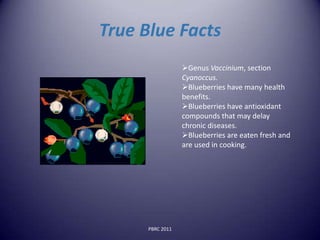
True Blue Facts
                  Genus Vaccinium, section
                  Cyanoccus.
                  Blueberries have many health
                  benefits.
                  Blueberries have antioxidant
                  compounds that may delay
                  chronic diseases.
                  Blueberries are eaten fresh and
                  are used in cooking.


      PBRC 2011
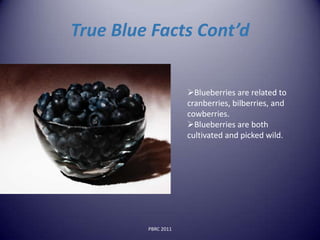
True Blue Facts Cont’d


                     Blueberries are related to
                     cranberries, bilberries, and
                     cowberries.
                     Blueberries are both
                     cultivated and picked wild.


         PBRC 2011
Research

• Blueberries have the highest
  concentration of antioxidants.
• Reduce the markers of
  oxidative stress in chronic
  smokers.
• Are beneficial in inhibiting oral,
  breast, colon and prostate
  cancers.


                                PBRC 2011
What’s Healthy
  about Blueberries?


The health benefits of blueberries
     are believed to be due to the      Blueberries are low in calories
    many phytochemicals that act              and fat, they are a good
                   as:                       source of fiber, Vitamin K
        •     Antioxidants                    and Manganese and an
                                                 excellent source of
     •    Anti-cancer agents                          vitamin C.
  •     Anti-neurodegenerative
                  agents
 •     Anti-inflammatory agents


                                 PBRC 2011
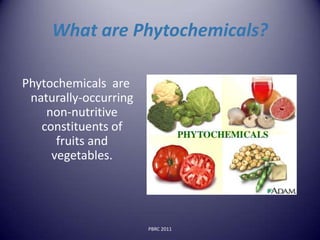
What are Phytochemicals?

Phytochemicals are
 naturally-occurring
    non-nutritive
   constituents of
      fruits and
     vegetables.


                       PBRC 2011
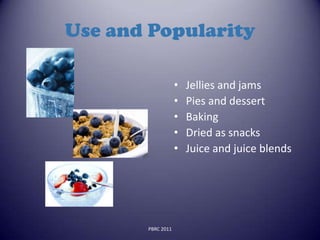
Use and Popularity

                   •   Jellies and jams
                   •   Pies and dessert
                   •   Baking
                   •   Dried as snacks
                   •   Juice and juice blends


       PBRC 2011
Cancer Risk
Cancers related to blueberry intake include oral, breast, colon and
prostate cancers.

Studies show that blueberry extract inhibits the growth of human
oral, breast, colon and prostate tumor cell lines that is
concentration dependent. Greater concentration is more effective.

Out of 10 different extracts of fruits and berries, blueberry extract
had the greatest effects on colon cancer cells.


                                PBRC 2011
Heart Disease Risk

                   Consuming one cup of
                      blueberries a day for
                      three weeks can result
                      in reduction of heart
                      disease risk factors.
                   A single dose of berries is
                      not effective.


       PBRC 2011
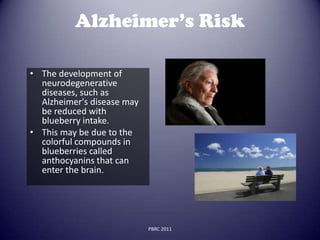
Alzheimer’s Risk

• The development of
  neurodegenerative
  diseases, such as
  Alzheimer's disease may
  be reduced with
  blueberry intake.
• This may be due to the
  colorful compounds in
  blueberries called
  anthocyanins that can
  enter the brain.


                            PBRC 2011
GI Health
        Many compounds in berries
        have been found to inhibit
        the growth of several
        intestinal pathogens, such as
        Salmonella, Staphylococcus
        and Helicobacter pylori.
        Blueberry extracts also
        increased the susceptibility of
        H. pylori to clarithromycin, a
        medication used for the
        treatment of ulcers.


            PBRC 2011
VISION
                        Our vision is to lead the world in eliminating chronic diseases.
                        MISSION
                        Our mission is to discover the triggers of chronic diseases through innovative research that
                        improves human health across the lifespan. We are helping people live Well Beyond the
                        Expected.
Authors:
Beth Kalicki            The Pennington Center has several research areas, including:
                          Clinical Obesity Research
Heli Roy, PhD, RD         Experimental Obesity
                          Functional Foods
                          Health and Performance Enhancement
Division of Education     Nutrition and Chronic Diseases
                          Nutrition and the Brain
Pennington Biomedical     Dementia, Alzheimer’s and healthy aging
Research Center           Diet, exercise, weight loss and weight loss maintenance
                        The research fostered in these areas can have a profound impact on healthy living and on the
                        prevention of common chronic diseases, such as heart disease, cancer, diabetes,
                        hypertension and osteoporosis.
                         The Division of Education provides education and information to the scientific community
                        and the public about research findings, training programs and research areas, and
                        coordinates educational events for the public on various health issues.
                         We invite people of all ages and backgrounds to participate in the exciting research studies
                        being conducted at the Pennington Center in Baton Rouge, Louisiana. If you would like to
                        take part, visit the clinical trials web page at www.pbrc.edu or call (225) 763-3000.


                                        PBRC 2011

Blueberries

  • 1.
  • 2.
    True Blue Facts Genus Vaccinium, section Cyanoccus. Blueberries have many health benefits. Blueberries have antioxidant compounds that may delay chronic diseases. Blueberries are eaten fresh and are used in cooking. PBRC 2011
  • 3.
    True Blue FactsCont’d Blueberries are related to cranberries, bilberries, and cowberries. Blueberries are both cultivated and picked wild. PBRC 2011
  • 4.
    Research • Blueberries havethe highest concentration of antioxidants. • Reduce the markers of oxidative stress in chronic smokers. • Are beneficial in inhibiting oral, breast, colon and prostate cancers. PBRC 2011
  • 5.
    What’s Healthy about Blueberries? The health benefits of blueberries are believed to be due to the Blueberries are low in calories many phytochemicals that act and fat, they are a good as: source of fiber, Vitamin K • Antioxidants and Manganese and an excellent source of • Anti-cancer agents vitamin C. • Anti-neurodegenerative agents • Anti-inflammatory agents PBRC 2011
  • 6.
    What are Phytochemicals? Phytochemicalsare naturally-occurring non-nutritive constituents of fruits and vegetables. PBRC 2011
  • 7.
    Use and Popularity • Jellies and jams • Pies and dessert • Baking • Dried as snacks • Juice and juice blends PBRC 2011
  • 8.
    Cancer Risk Cancers relatedto blueberry intake include oral, breast, colon and prostate cancers. Studies show that blueberry extract inhibits the growth of human oral, breast, colon and prostate tumor cell lines that is concentration dependent. Greater concentration is more effective. Out of 10 different extracts of fruits and berries, blueberry extract had the greatest effects on colon cancer cells. PBRC 2011
  • 9.
    Heart Disease Risk Consuming one cup of blueberries a day for three weeks can result in reduction of heart disease risk factors. A single dose of berries is not effective. PBRC 2011
  • 10.
    Alzheimer’s Risk • Thedevelopment of neurodegenerative diseases, such as Alzheimer's disease may be reduced with blueberry intake. • This may be due to the colorful compounds in blueberries called anthocyanins that can enter the brain. PBRC 2011
  • 11.
    GI Health Many compounds in berries have been found to inhibit the growth of several intestinal pathogens, such as Salmonella, Staphylococcus and Helicobacter pylori. Blueberry extracts also increased the susceptibility of H. pylori to clarithromycin, a medication used for the treatment of ulcers. PBRC 2011
  • 12.
    VISION Our vision is to lead the world in eliminating chronic diseases. MISSION Our mission is to discover the triggers of chronic diseases through innovative research that improves human health across the lifespan. We are helping people live Well Beyond the Expected. Authors: Beth Kalicki The Pennington Center has several research areas, including: Clinical Obesity Research Heli Roy, PhD, RD Experimental Obesity Functional Foods Health and Performance Enhancement Division of Education Nutrition and Chronic Diseases Nutrition and the Brain Pennington Biomedical Dementia, Alzheimer’s and healthy aging Research Center Diet, exercise, weight loss and weight loss maintenance The research fostered in these areas can have a profound impact on healthy living and on the prevention of common chronic diseases, such as heart disease, cancer, diabetes, hypertension and osteoporosis. The Division of Education provides education and information to the scientific community and the public about research findings, training programs and research areas, and coordinates educational events for the public on various health issues. We invite people of all ages and backgrounds to participate in the exciting research studies being conducted at the Pennington Center in Baton Rouge, Louisiana. If you would like to take part, visit the clinical trials web page at www.pbrc.edu or call (225) 763-3000. PBRC 2011

Editor's Notes

  • #3 Blueberries are the common name for the group of flowering plants in the genus Vaccinium, section Cyanoccus.The USDA reports that between the years of 1994 and 2003 that the annual US consumption of fresh blueberries rose about 1.6 times!This increased consumption is likely due to health benefits associated with regular blueberry consumption. Blueberries have antioxidant compounds that may delay chronic diseases.Blueberries are used in jellies, jams, and pies. They are baked into muffins and are an ingredient in many other snacks.
  • #4 Other sections in the genus, native to other parts of the world, like Europe, include other wild shrubs which produce edible berries, such as cranberries, bilberries, and cowberries. These berries are also known for having important health benefits.Blueberries are both cultivated and picked wild. In North America, VacciniumCorymbosum (aka Northern Highbush Blueberry) is the most common cultivated species.
  • #5 Regular consumption of fruit and vegetables lowers the risk for developing heart disease due to their antioxidant properties. Blueberries have the highest concentration of antioxidants.A daily intake of 250 grams of blueberries (about 1.5 cups) for 3 weeks reduced the markers of oxidative stress in chronic smokers. Blueberries were effective if they were consumed as a regular past of the diet, not if taken occasionally.Several animal studies show that it may be beneficial in inhibiting oral, breast, colon and prostate cancers.
  • #7 Phytochemicals, commonly referred to as phytonutrients, are naturally-occurring non-nutritive (not required in the diet like nutrients) constituents of fruits and vegetables. They are said to be bioactive and are considered to have a beneficial effect on human health.
  • #8 Blueberries are used in jellies, jams and pies. They are baked into muffins and are an ingredient in many other snacks and delicacies.A more recent use of blueberries includes blueberry juice, which has now entered the market and is considered a whole new category of juice on the beverage aisle.Blueberries have increasingly gained attention; USDA reports indicate that between the years of 1994 and 2003, annual US consumption of fresh blueberries rose approximately 1.6 times.This gain in attention is likely due to the increased recognition of the potential human health benefits of regular blueberry consumption.
  • #9 Overview: Berry fruits, particularly blueberries, have been under recent investigation in regards to their role in cancer prevention. Several different cancers have been investigated, including oral, breast, colon and prostate cancers. Reporting the Studies One study evaluating the ability of 6 different berry extracts (including blueberry extract) to inhibit the growth of human oral, breast, colon and prostate tumor cell lines at differing concentrations (25 to 200 μg/ml) found all extracts to be concentration dependent. The greater the concentration of berry extract, the greater the inhibition of cell proliferation in all cell lines observed, translating to lower risks for cancer. Another in vitro study looked at the effects of 10 different extracts of fruits and berries on cell proliferation of colon cancer cells HT29 and breast cancer cells MCF-7. This study also found the effects of these extracts to be concentration dependent and noted that of the 10 extracts tested (at the highest concentration used), blueberry extract exhibited the greatest effects on colon cancer cells. In order to determine which component of blueberry extract is most responsible for these anticancer properties observed among several in vitro studies, one study separated blueberry extract based on phenolic compounds known to be present. This separation resulted in 4 different fractions: the flavanol, tannin, phenolic acid, and Anthocyanin fractions. Although all four fractions did show inhibition of cell proliferation, the Anthocyanin fractions were shown to be the strongest, inhibiting cancer cell proliferation at much lower concentrations than the other fractions. **In vitro studies take place in an artificial environment outside of the living organism.
  • #10 It is known that regular consumption of fruits and vegetables lowers the risk for developing heart disease. A study examined the effects of blueberry consumption in relation to heart disease risk. Participants (chronic cigarette smokers) consumed either 250 grams of blueberries a day for three weeks or one dose of 250 grams of fruit. Several markers of oxidative stress were examined along with a marker of antioxidant potential. A significant decrease in one marker of oxidative stress was found among those who consumed fruit on a daily basis but not in those with one dose. This suggests that in order to obtain the greatest level of benefits comes from regular consumption.
  • #11 The consumption of blueberries is also believed to possibly play a role in delaying the development of neurodegenerative diseases, such as Alzheimer's disease. There have been several studies in laboratory animals that show promising results. One study fed blueberry extracts to laboratory animals for 8 weeks. After the 8-week feeding, the researchers noted a reversal of age-related deficits in both neuronal signaling and behavioral parameters. Although the researchers believed that the improvements seen were due to the polyphenols in the blueberry (BB) extract, it was not evident whether or not these phytonutrients entered the brain. A further study for 8-10 weeks on spatial learning and memory measures was repeated. Results showed that several anthocyanin were found in the brain and there was a positive relationship between spatial learning/memory and anthocyanin content of the cortex. Researchers concluded that the polyphenols can enter the brain.
  • #12 The consumption of phenolic compounds in berries has also been suggested to play a role in gastrointestinal (GI) health. One study found that these compounds inhibited the growth of several intestinal pathogens, such as Salmonella and Staphylococcus. Another study examined the effect of six different berries (raspberries, straw-berries, cranberries, elderberries, blueberries, and bilberries) on inhibiting the growth of Helicobacter pylori. H pylori is a bacterial infection that can become serious if left untreated. It has the potential to progress to gastritis (irritation and inflammation of the lining of the stomach), peptic ulcer disease [PUD] (characterized by sores in the stomach or the duodenum) and possibly even stomach cancer later in life. This particular study was done in order to determine the effects of the berries alone and also in combination with a drug, clarithromycin, which H. pylori. H pylori can become resistant to clarithromycin. The study found that, when compared with the controls, all berries significantly inhibited growth of H. pylori, and that the berry extracts also increased the susceptibility of H. pylori to clarithromycin.