Pennington Nutrition Series
Healthier lives through education in nutrition and preventive medicine                    2005 No. 14


                    Genetic Considerations

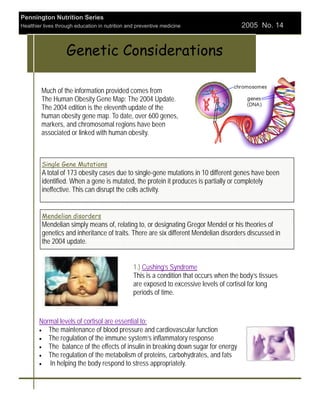
         Much of the information provided comes from
         The Human Obesity Gene Map: The 2004 Update.
         The 2004 edition is the eleventh update of the
         human obesity gene map. To date, over 600 genes,
         markers, and chromosomal regions have been
         associated or linked with human obesity.


         Single Gene Mutations
         A total of 173 obesity cases due to single-gene mutations in 10 different genes have been
         identified. When a gene is mutated, the protein it produces is partially or completely
         ineffective. This can disrupt the cells activity.


         Mendelian disorders
         Mendelian simply means of, relating to, or designating Gregor Mendel or his theories of
         genetics and inheritance of traits. There are six different Mendelian disorders discussed in
         the 2004 update.


                                                 1.) Cushing’s Syndrome
                                                 This is a condition that occurs when the body’s tissues
                                                 are exposed to excessive levels of cortisol for long
                                                 periods of time.


        Normal levels of cortisol are essential to:
        • The maintenance of blood pressure and cardiovascular function
        • The regulation of the immune system’s inflammatory response
        • The balance of the effects of insulin in breaking down sugar for energy
        • The regulation of the metabolism of proteins, carbohydrates, and fats
        •  In helping the body respond to stress appropriately.
2.) Cortisone Reductase Deficiency
In this condition, the synthesis of cortisol from cortisone
is reduced. This leads to an androgen excess and a
polycystic ovary syndrome-like disorder with obesity
and insulin resistance.


                                     3.) Isolated Growth Hormone Deficiency
                                     This is a condition caused by mutations in the growth
                                     hormone gene. Adult patients with this condition are
                                     described as having central obesity.


     Human Growth Hormone


4.) X-Linked Syndromic Mental Retardation 16
Obesity in these affected individuals is very common. With this
condition, there is a protein that controls protein production in other
cells making them partially or completely ineffective once produced.


                         5.) Bardet-Biedl Syndrome
                         Of the previously reported disorders, the greatest advance has been
                         in the understanding of this syndrome. There have been recent new
                         gene discoveries related to this condition. Most genes involved
                         appear to play a role in proteins that help move body fluids. It is clear
                         that these genes are related to the syndrome, however how these
                         genes relate to obesity and insulin resistance is uncertain.


6.) Albright Hereditary Osteodystrophy-Like Syndrome and others
Information on new mutations in casual genes have been added for
many conditions this year.
Murine Gene-deficient and Transgenic Models of Obesity
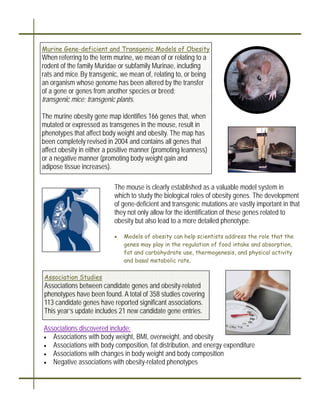
When referring to the term murine, we mean of or relating to a
rodent of the family Muridae or subfamily Murinae, including
rats and mice. By transgenic, we mean of, relating to, or being
an organism whose genome has been altered by the transfer
of a gene or genes from another species or breed:
transgenic mice; transgenic plants.

The murine obesity gene map identifies 166 genes that, when
mutated or expressed as transgenes in the mouse, result in
phenotypes that affect body weight and obesity. The map has
been completely revised in 2004 and contains all genes that
affect obesity in either a positive manner (promoting leanness)
or a negative manner (promoting body weight gain and
adipose tissue increases).

                           The mouse is clearly established as a valuable model system in
                           which to study the biological roles of obesity genes. The development
                           of gene-deficient and transgenic mutations are vastly important in that
                           they not only allow for the identification of these genes related to
                           obesity but also lead to a more detailed phenotype.

                           •   Models of obesity can help scientists address the role that the
                               genes may play in the regulation of food intake and absorption,
                               fat and carbohydrate use, thermogenesis, and physical activity
                               and basal metabolic rate.

Association Studies
Associations between candidate genes and obesity-related
phenotypes have been found. A total of 358 studies covering
113 candidate genes have reported significant associations.
This year’s update includes 21 new candidate gene entries.

Associations discovered include:
• Associations with body weight, BMI, overweight, and obesity
• Associations with body composition, fat distribution, and energy expenditure
• Associations with changes in body weight and body composition
• Negative associations with obesity-related phenotypes
Linkage Studies
 There is evidence for genetic linkages with obesity-related phenotypes.
 More than 20 positive linkages have been recently published. Most of
 the genome-wide studies were based primarily on BMI measurements.
 Studies of BMI measures were performed on participants from the
 Framingham Heart Study linking BMI and obesity to particular
 chromosomes in these subjects. Similar studies were conducted on
 individuals with type 2 diabetes, sleep apnea, and childhood obesity
 linking their BMI with markers on certain chromosomes.

In conclusion, the large                        The Pennington Biomedical Research Center is a world-
number of genes and                             renowned nutrition research center.
their location indexed in
                                                Mission:
the obesity gene map is                         To promote healthier lives through research and education in
a good indication of the                        nutrition and preventative medicine.
complexity and
challenge in the task of                        The Pennington Center has six priorities in research:
identifying genes associated with               1. Clinical Obesity Research
susceptibility to obesity. The goal still       2. Experimental Obesity
remains to identify the right combination of    3. Functional Foods
genes and mutations that are associated         4. Health and Performance Enhancement
with this increased risk of common              5. Nutrition and Chronic Diseases
diseases and to determine how                   6. Nutrition and the Brain
environmental factors interact with these
                                                The research fostered by these divisions can have a profound
genes and mutations to determine the risk.
                                                impact on healthy living and on the prevention of common
                                                chronic diseases, such as heart disease, cancer, diabetes,
Pennington Nutrition Series, Number 14, 2005    hypertension and osteoporosis.

Authors:                                        The Division of Education provides education and information
Heli Roy, PhD, RD                               to the scientific community and the public about research
Shanna Lundy                                    findings, training programs and research areas, and
                                                coordinates educational events for the public on various
Division of Education                           health issues.
Phillip Brantley, PhD, Chief
Pennington Biomedical Research Center           We invite people of all ages and backgrounds to participate in
Claude Bouchard, PhD, Executive Director        the exciting research studies being conducted at the
6/05                                            Pennington Center in Baton Rouge, Louisiana. If you would like
                                                to take part, visit the clinical trials web page at www.pbrc.edu
Perusse et al. The human obesity gene map:The   or call (225) 763-2597.
2004 update. Obesity Research. 13: 381-490,
2005.                                                      Visit our Web Site: www.pbrc.edu

Genetic considerations in obesity development

  • 1.
    Pennington Nutrition Series Healthierlives through education in nutrition and preventive medicine 2005 No. 14 Genetic Considerations Much of the information provided comes from The Human Obesity Gene Map: The 2004 Update. The 2004 edition is the eleventh update of the human obesity gene map. To date, over 600 genes, markers, and chromosomal regions have been associated or linked with human obesity. Single Gene Mutations A total of 173 obesity cases due to single-gene mutations in 10 different genes have been identified. When a gene is mutated, the protein it produces is partially or completely ineffective. This can disrupt the cells activity. Mendelian disorders Mendelian simply means of, relating to, or designating Gregor Mendel or his theories of genetics and inheritance of traits. There are six different Mendelian disorders discussed in the 2004 update. 1.) Cushing’s Syndrome This is a condition that occurs when the body’s tissues are exposed to excessive levels of cortisol for long periods of time. Normal levels of cortisol are essential to: • The maintenance of blood pressure and cardiovascular function • The regulation of the immune system’s inflammatory response • The balance of the effects of insulin in breaking down sugar for energy • The regulation of the metabolism of proteins, carbohydrates, and fats • In helping the body respond to stress appropriately.
  • 2.
    2.) Cortisone ReductaseDeficiency In this condition, the synthesis of cortisol from cortisone is reduced. This leads to an androgen excess and a polycystic ovary syndrome-like disorder with obesity and insulin resistance. 3.) Isolated Growth Hormone Deficiency This is a condition caused by mutations in the growth hormone gene. Adult patients with this condition are described as having central obesity. Human Growth Hormone 4.) X-Linked Syndromic Mental Retardation 16 Obesity in these affected individuals is very common. With this condition, there is a protein that controls protein production in other cells making them partially or completely ineffective once produced. 5.) Bardet-Biedl Syndrome Of the previously reported disorders, the greatest advance has been in the understanding of this syndrome. There have been recent new gene discoveries related to this condition. Most genes involved appear to play a role in proteins that help move body fluids. It is clear that these genes are related to the syndrome, however how these genes relate to obesity and insulin resistance is uncertain. 6.) Albright Hereditary Osteodystrophy-Like Syndrome and others Information on new mutations in casual genes have been added for many conditions this year.
  • 3.
    Murine Gene-deficient andTransgenic Models of Obesity When referring to the term murine, we mean of or relating to a rodent of the family Muridae or subfamily Murinae, including rats and mice. By transgenic, we mean of, relating to, or being an organism whose genome has been altered by the transfer of a gene or genes from another species or breed: transgenic mice; transgenic plants. The murine obesity gene map identifies 166 genes that, when mutated or expressed as transgenes in the mouse, result in phenotypes that affect body weight and obesity. The map has been completely revised in 2004 and contains all genes that affect obesity in either a positive manner (promoting leanness) or a negative manner (promoting body weight gain and adipose tissue increases). The mouse is clearly established as a valuable model system in which to study the biological roles of obesity genes. The development of gene-deficient and transgenic mutations are vastly important in that they not only allow for the identification of these genes related to obesity but also lead to a more detailed phenotype. • Models of obesity can help scientists address the role that the genes may play in the regulation of food intake and absorption, fat and carbohydrate use, thermogenesis, and physical activity and basal metabolic rate. Association Studies Associations between candidate genes and obesity-related phenotypes have been found. A total of 358 studies covering 113 candidate genes have reported significant associations. This year’s update includes 21 new candidate gene entries. Associations discovered include: • Associations with body weight, BMI, overweight, and obesity • Associations with body composition, fat distribution, and energy expenditure • Associations with changes in body weight and body composition • Negative associations with obesity-related phenotypes
  • 4.
    Linkage Studies Thereis evidence for genetic linkages with obesity-related phenotypes. More than 20 positive linkages have been recently published. Most of the genome-wide studies were based primarily on BMI measurements. Studies of BMI measures were performed on participants from the Framingham Heart Study linking BMI and obesity to particular chromosomes in these subjects. Similar studies were conducted on individuals with type 2 diabetes, sleep apnea, and childhood obesity linking their BMI with markers on certain chromosomes. In conclusion, the large The Pennington Biomedical Research Center is a world- number of genes and renowned nutrition research center. their location indexed in Mission: the obesity gene map is To promote healthier lives through research and education in a good indication of the nutrition and preventative medicine. complexity and challenge in the task of The Pennington Center has six priorities in research: identifying genes associated with 1. Clinical Obesity Research susceptibility to obesity. The goal still 2. Experimental Obesity remains to identify the right combination of 3. Functional Foods genes and mutations that are associated 4. Health and Performance Enhancement with this increased risk of common 5. Nutrition and Chronic Diseases diseases and to determine how 6. Nutrition and the Brain environmental factors interact with these The research fostered by these divisions can have a profound genes and mutations to determine the risk. impact on healthy living and on the prevention of common chronic diseases, such as heart disease, cancer, diabetes, Pennington Nutrition Series, Number 14, 2005 hypertension and osteoporosis. Authors: The Division of Education provides education and information Heli Roy, PhD, RD to the scientific community and the public about research Shanna Lundy findings, training programs and research areas, and coordinates educational events for the public on various Division of Education health issues. Phillip Brantley, PhD, Chief Pennington Biomedical Research Center We invite people of all ages and backgrounds to participate in Claude Bouchard, PhD, Executive Director the exciting research studies being conducted at the 6/05 Pennington Center in Baton Rouge, Louisiana. If you would like to take part, visit the clinical trials web page at www.pbrc.edu Perusse et al. The human obesity gene map:The or call (225) 763-2597. 2004 update. Obesity Research. 13: 381-490, 2005. Visit our Web Site: www.pbrc.edu