ANTENNAS
ISOTROPIC RADIATOR
An isotropic radiator is a fictious radiator which radiates uniformly in all directions. It
is also called as omnidirectional radiator or unipole.
It is a hypothetically lossless radiator with which practical radiators are compared.
It is used as reference antenna.
Ideal antenna not physically realizable.
Radiated power from isotropic antenna is given by
𝑃𝑟 =
𝑤𝑡
4𝜋𝑟2
Radiation pattern of isotropic radiator
Radiation pattern
It is a mathematical function or graphical representation of the antenna radiation
properties as a function of spherical coordinates.
Radiation Pattern is a graph which shows the variation in actual field strength of
electromagnetic field at all points which are at equal distance from the antenna
The graph of radiation pattern will be three dimensional and can't be represented on
a plain paper.
Radiation Properties include radiation intensity, field strength, directivity and
polarization.
Field Strength Pattern: If the radiation from an antenna is expressed in terms of field
strength E (Volt/Meter) the R.P is called "Field Strength Pattern".
Power Pattern: If the radiation from an antenna is expressed in terms of Power per
unit solid angle the R.P is called "Power Pattern".
Isotropic Pattern - an antenna pattern defined by uniform radiation in all directions,
produced by an isotropic radiator (point source, a non-physical antenna which is the
only non directional antenna).
Directional Pattern - a pattern characterized by more efficient radiation in one
direction than another (all physically realizable antennas are directional antennas).
Omnidirectional Pattern - a pattern which is uniform in a given plane
PRINCIPAL PATTERNS
Principal Plane Patterns - the E-plane and H-plane patterns of a linearly polarized
antenna.
E-PLANE PATTERN: The plane containing the electric field vector and the direction of
maximum radiation.
H-PLANE PATTERN :The plane containing the magnetic field vector and the direction of
maximum radiation.
RADIATION PATTERN LOBES
Different parts of radiation pattern are called as LOBES.
A RADIATION LOBE is a portion of the radiation pattern bounded by regions of
relatively weak radiation intensity.
CLASSIFICATION OF LOBES
Major Lobe (main lobe, main beam): It is defined as "The radiation lobe containing the
direction of maximum radiation".
Minor Lobe :Any Lobe except a major lobe is a minor lobe. It is classified into two
types.
(i).Side Lobe :It is adjacent to the main lobe and occupies the hemisphere in the
direction of the main beam.
(ii).Back Lobe Radiation Lobe in a direction opposite to the major lobe.
Radiation lobes
Antenna beam width
Half power beam width(HPBW) or 3-dB beam width:
It is defined as "In a plane containing the direction of the maximum radiation, the
angle between the two directions in which the radiation intensity is one half the
maximum value of the beam.
It is measured on the radiation pattern (major lobe) between points where the
radiated power has fallen to half its maximum value. This is called as "beam: width"
between half power points or half power beam width (HPBW) because power at half
power points is just half.
Half Power Beam width is also known as 3 db beam width because at half power
points the power is 3 db down of the maximum power value of major lobe.
Further at half power points the field intensity(voltage) equals 1/√2 or 0.707 times
its maximum value
First Null Beam width (FNBW) or Beam width between First Nulls(BWFN):-The angular
width between the first nulls or first side lobes on either side of the main beam.
𝐻𝑃𝐵𝑊 =
𝐹𝑁𝐵𝑊
2
FRONT TO BACK RATIO
It is defined as the ratio of power radiated in desired direction to the power radiated
in opposite direction.
Higher the front to back ratio better it is.
ANTENNA BANDWIDTH
Antenna Bandwidth is the range of frequency over which the antenna maintains
certain required characteristics like gain, front to back ratio or SWR pattern (shape or
direction). polarization and impedance.
It is the bandwidth within which the antenna maintains a certain set of given
specifications.
ANTENNA FIELD TYPES
Reactive field the portion of the antenna field characterized by standing (stationary)
waves which represent stored energy.
Radiation field the portion of the antenna field characterized by radiating
(propagating) waves which represent transmitted energy.
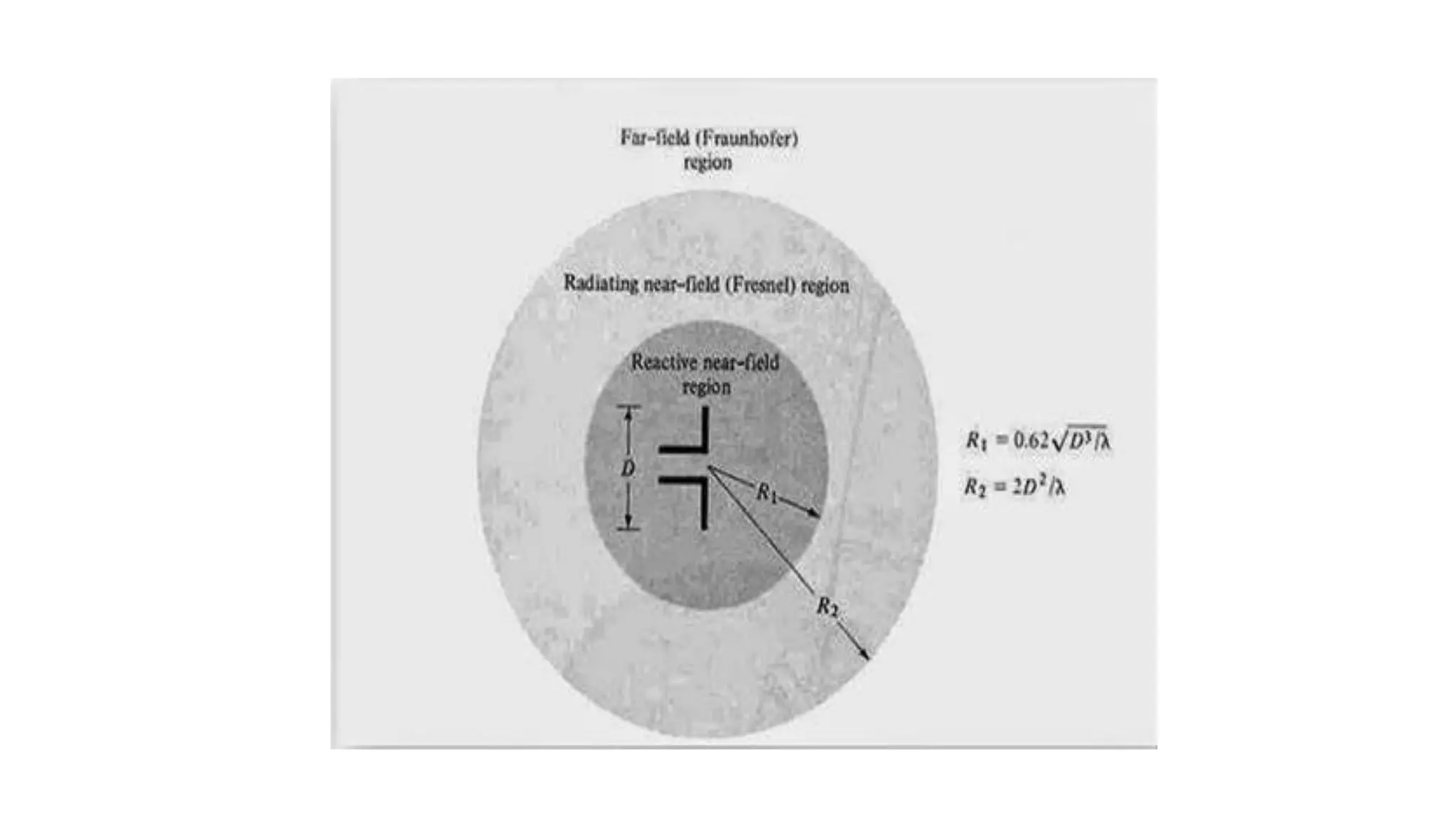
Reactive Near Field Region- the region immediately surrounding the antenna
where the reactive field. (stored energy-standing waves) is dominant. For most
antennas, the boundary of this region is taken to exist at a distance from the antenna
surface.
𝑅1 = 0.62√
𝐷3
𝞴
Where,
A =wavelength
D=Largest dimension of the antenna
Radiating Near-Field (Fresnel) Region the region between the reactive near field
and the far field where the radiation fields are dominant and the field distribution is
dependent on the distance from the antenna.
Inner boundary distance is,
𝑅1 ≥ 0.62√
𝐷3
𝞴
Outer boundary distance is,
𝑅2 <
2𝐷2
𝞴
Far-Field (Fraunhofer) Region:The region farthest away from the antenna where
the field distribution is essentially independent of the distance from the antenna
(propagating waves).
Far-field region is commonly taken to exist at distances greater than
2𝐷2
𝞴
from the
antenna.
Inner boundary distance =
2𝐷2
𝞴
and the outer one at infinity
antenna 1.pptx

antenna 1.pptx

  • 1.
  • 2.
    ISOTROPIC RADIATOR An isotropicradiator is a fictious radiator which radiates uniformly in all directions. It is also called as omnidirectional radiator or unipole. It is a hypothetically lossless radiator with which practical radiators are compared. It is used as reference antenna. Ideal antenna not physically realizable. Radiated power from isotropic antenna is given by 𝑃𝑟 = 𝑤𝑡 4𝜋𝑟2
  • 3.
    Radiation pattern ofisotropic radiator
  • 4.
    Radiation pattern It isa mathematical function or graphical representation of the antenna radiation properties as a function of spherical coordinates. Radiation Pattern is a graph which shows the variation in actual field strength of electromagnetic field at all points which are at equal distance from the antenna The graph of radiation pattern will be three dimensional and can't be represented on a plain paper. Radiation Properties include radiation intensity, field strength, directivity and polarization.
  • 5.
    Field Strength Pattern:If the radiation from an antenna is expressed in terms of field strength E (Volt/Meter) the R.P is called "Field Strength Pattern". Power Pattern: If the radiation from an antenna is expressed in terms of Power per unit solid angle the R.P is called "Power Pattern".
  • 6.
    Isotropic Pattern -an antenna pattern defined by uniform radiation in all directions, produced by an isotropic radiator (point source, a non-physical antenna which is the only non directional antenna). Directional Pattern - a pattern characterized by more efficient radiation in one direction than another (all physically realizable antennas are directional antennas). Omnidirectional Pattern - a pattern which is uniform in a given plane
  • 7.
    PRINCIPAL PATTERNS Principal PlanePatterns - the E-plane and H-plane patterns of a linearly polarized antenna. E-PLANE PATTERN: The plane containing the electric field vector and the direction of maximum radiation. H-PLANE PATTERN :The plane containing the magnetic field vector and the direction of maximum radiation.
  • 8.
    RADIATION PATTERN LOBES Differentparts of radiation pattern are called as LOBES. A RADIATION LOBE is a portion of the radiation pattern bounded by regions of relatively weak radiation intensity.
  • 9.
    CLASSIFICATION OF LOBES MajorLobe (main lobe, main beam): It is defined as "The radiation lobe containing the direction of maximum radiation". Minor Lobe :Any Lobe except a major lobe is a minor lobe. It is classified into two types. (i).Side Lobe :It is adjacent to the main lobe and occupies the hemisphere in the direction of the main beam. (ii).Back Lobe Radiation Lobe in a direction opposite to the major lobe.
  • 10.
  • 11.
    Antenna beam width Halfpower beam width(HPBW) or 3-dB beam width: It is defined as "In a plane containing the direction of the maximum radiation, the angle between the two directions in which the radiation intensity is one half the maximum value of the beam. It is measured on the radiation pattern (major lobe) between points where the radiated power has fallen to half its maximum value. This is called as "beam: width" between half power points or half power beam width (HPBW) because power at half power points is just half.
  • 12.
    Half Power Beamwidth is also known as 3 db beam width because at half power points the power is 3 db down of the maximum power value of major lobe. Further at half power points the field intensity(voltage) equals 1/√2 or 0.707 times its maximum value First Null Beam width (FNBW) or Beam width between First Nulls(BWFN):-The angular width between the first nulls or first side lobes on either side of the main beam. 𝐻𝑃𝐵𝑊 = 𝐹𝑁𝐵𝑊 2
  • 13.
    FRONT TO BACKRATIO It is defined as the ratio of power radiated in desired direction to the power radiated in opposite direction. Higher the front to back ratio better it is.
  • 14.
    ANTENNA BANDWIDTH Antenna Bandwidthis the range of frequency over which the antenna maintains certain required characteristics like gain, front to back ratio or SWR pattern (shape or direction). polarization and impedance. It is the bandwidth within which the antenna maintains a certain set of given specifications.
  • 15.
    ANTENNA FIELD TYPES Reactivefield the portion of the antenna field characterized by standing (stationary) waves which represent stored energy. Radiation field the portion of the antenna field characterized by radiating (propagating) waves which represent transmitted energy.
  • 16.
    Reactive Near FieldRegion- the region immediately surrounding the antenna where the reactive field. (stored energy-standing waves) is dominant. For most antennas, the boundary of this region is taken to exist at a distance from the antenna surface. 𝑅1 = 0.62√ 𝐷3 𝞴 Where, A =wavelength D=Largest dimension of the antenna
  • 17.
    Radiating Near-Field (Fresnel)Region the region between the reactive near field and the far field where the radiation fields are dominant and the field distribution is dependent on the distance from the antenna. Inner boundary distance is, 𝑅1 ≥ 0.62√ 𝐷3 𝞴 Outer boundary distance is, 𝑅2 < 2𝐷2 𝞴
  • 18.
    Far-Field (Fraunhofer) Region:Theregion farthest away from the antenna where the field distribution is essentially independent of the distance from the antenna (propagating waves). Far-field region is commonly taken to exist at distances greater than 2𝐷2 𝞴 from the antenna. Inner boundary distance = 2𝐷2 𝞴 and the outer one at infinity